a thesis
submitted to the department of computer engineering
and the institute of engineering and science
of bilkent university
in partial fulfillment of the requirements
for the degree of
master of science
By
Yasemin Satıro˘glu
August, 2004
Prof. Dr. H. Altay G¨uvenir (Advisor)
I certify that I have read this thesis and that in my opinion it is fully adequate, in scope and in quality, as a thesis for the degree of Master of Science.
Asst. Prof. Dr. Bedir Tekinerdo˘gan
I certify that I have read this thesis and that in my opinion it is fully adequate, in scope and in quality, as a thesis for the degree of Master of Science.
Asst. Prof. Dr. Ali Aydın Sel¸cuk
Approved for the Institute of Engineering and Science:
Prof. Dr. Mehmet B. Baray Director of the Institute
INFORMATION SYSTEMS
Yasemin Satıro˘glu M.S. in Computer Engineering Supervisor: Prof. Dr. H. Altay G¨uvenir
August, 2004
A legacy information system is an old system that typically has been developed several years ago, and remains in operation within an organization. Since the soft-ware requirements change, legacy systems must be evolved accordingly. Various approaches such as wrapping, migration and redevelopment have been proposed to maintain legacy information systems. Unfortunately, these approaches have not explicitly considered the concerns that are difficult to capture in single com-ponents, and tend to crosscut many components. Examples of such crosscutting concerns include distribution, synchronization, persistence, security, logging and real-time behavior. The crosscutting property of concerns seriously complicates the maintenance of legacy systems because the code of the system needs to be changed at multiple places, and conventional maintenance techniques fall short to do this effectively.
Aspect-Oriented Software Development (AOSD) provides explicit mechanisms for coping with these crosscutting concerns. However, current AOSD approaches have primarily focused on coping with crosscutting concerns in software systems that are developed from scratch. Hereby, the crosscutting concerns are imple-mented as aspects at the beginning, hence localized in single modules. In this way the implementation and maintenance of crosscutting concerns can be pre-pared to a large extent so that the maintenance of these systems will be easier later on. Unfortunately, legacy systems impose harsher requirements, because crosscutting concerns in legacy systems are neither explicitly identified nor have been prepared before.
We provide a systematic process for analyzing the impact of crosscutting con-cerns on legacy systems. The process, which is called Aspectual Legacy Analysis Process (ALAP), consists of three sub-processes, Feasibility Analysis, Aspectual
Analysis and Maintenance Analysis. All the three sub-processes consist of a set of heuristic rules and the corresponding control. Feasibility Analysis, which consists of two phases, describes rules for categorizing legacy systems, in the first phase; and describes the rules for evaluating legacy systems with respect to the ability to implement static crosscutting and ability to implement dynamic crosscutting, in the second phase. The rules of the first phase are based on the categories of legacy systems that we have defined after a thorough study to legacy information systems, and the rules of the second phase are based on our discussion of these categories with respect to crosscutting implementation. Once the legacy system has been categorized and evaluated with respect to crosscutting implementation, the Aspectual Analysis sub-process describes rules for identifying and specifying aspects in legacy systems. Based on the results of the Feasibility Analysis and Aspectual Analysis sub-processes, the Maintenance Analysis describes the rules for the selection of the appropriate legacy maintenance approach.
ALAP has been implemented in the Aspectual Legacy Analysis Tool (ALAT), which implements the rules of the three sub-processes and as such helps to sup-port the legacy maintainer in analyzing the legacy system and identifying the appropriate maintenance approach.
Keywords: Legacy Information Systems, Aspect-Oriented Software Development, Heuristic Rule Modelling.
M˙IRAS B˙ILG˙I S˙ISTEMLER˙IN˙IN ˙ILG˙IYE-Y ¨
ONEL˙IK
GEL˙IS¸T˙IR˙IM˙I
Yasemin Satıro˘glu
Bilgisayar M¨uhendisli˘gi, Y¨uksek Lisans Tez Y¨oneticisi: Prof. Dr. H.Altay G¨uvenir
A˘gustos, 2004
Miras sistem, bir¸cok yıl ¨once geli¸stirilen ve bir kurulu¸sta kullanılmaya de-vam edilen sistemdir. Yazılım gereksinimleri de˘gi¸stik¸ce miras sistemler de uy-gun olarak geli¸stirilmelidir. Miras sistemlerin bakımı icin sarma, ta¸sıma ve yeniden geli¸stirme gibi bir¸cok y¨ontem ¨onerilmi¸stir. Maalesef, bu y¨ontemler tek bir bile¸sende yakalanması g¨u¸c, ve bir¸cok bile¸seni enine kesme e˘giliminde olan ¨ozellikleri a¸cık¸ca g¨oz ¨on¨unde bulundurmamı¸slardır. Da˘gıtım, e¸s zamanlama, de-vamlılık, g¨uvenlik, kayıt tutma ve ger¸cek zaman davranı¸sı, enine kesen ¨ozellik ¨ornekleri arasındadır. Bu ¨ozelliklerin enine kesme niteligi miras sistemlerin bakımını ciddi anlamda karma¸sıkla¸stırır, ¸c¨unk¨u, sistemin kodunun birden fazla yerde de˘gi¸stirilmesini gerektirir ve geleneksel bakım teknikleri bu i¸slemi etkili olarak ger¸cekle¸stirmede yetersiz kalmaktadır.
˙Ilgiye-Y¨onelik Yazılım Geli¸stirme enine kesen ¨ozellikler ile ba¸sa ¸cıkmak i¸cin kesin mekanizmalar saglar. Fakat ge¸cerli ˙Ilgiye-Y¨onelik Yazılım Geli¸stirme teknikleri, esas olarak, sıfırdan geli¸stirilen yazılım sistemleri i¸cerisindeki enine kesen ¨ozellikler ile ba¸s etmek ¨uzerine odaklanmı¸s durumdadır. Bu sistemlerde enine kesen ¨ozellikler ba¸slangı¸cta birer ilgi olarak ger¸cekle¸stirilerek tek bir bile¸sen i¸cerisine yerle¸stirilebilir. Bu ¸sekilde, enine kesen ¨ozelliklerin ger¸cekle¸stirim ve bakımı b¨uy¨uk ¸capta d¨uzenlenebilir, ki bu da sistemin ilerideki bakımını ko-layla¸stıracaktır. Ne yazık ki, miras sistemler daha sert gereksinimler y¨uklerler, ¸c¨unk¨u miras sistemlerde enine kesen ¨ozellikler ¨onceden a¸cık olarak tanımlanamaz ve d¨uzenlenemez. Bununla beraber, enine kesen ¨ozellikler ile ba¸s etmek i¸cin uygun tekniklerin eksikli˘gi miras sistemlerin bakımını ¸carpıcı bir bi¸cimde engeller.
Bu tezde, miras sistemlerin analizi i¸cin sistematik bir s¨ure¸c tanımlanmaktadır. ˙Ilgiye-Y¨onelik Miras Analiz S¨ureci isimli bu s¨ure¸c, Olurluk Analizi, ˙Ilgiye-Y¨onelik Analiz ve Bakım Analizi olmak ¨uzere ¨u¸c alt s¨ure¸cten olusur. Herbir alt s¨ure¸c, bir
bulu¸ssal kurallar k¨umesi ve bunlara ili¸skin kontrol mekanizmasından olu¸sur. ˙Iki a¸samadan olu¸san Olurluk Analizi, birinci a¸samada miras sistemlerin kategoriza-syonu ile ilgili kuralları, ikinci a¸samada da miras sistemlerin, statik ve dinamik enine kesme ger¸cekle¸stirim yetene˘gine g¨ore de˘gerlendirilmesi ile ilgili kuralları tanımlar. ˙Ilk a¸samada tanımlanan kurallar, miras sistemler hakkında derinleme-sine bir ¸calı¸sma sonrasında tanımladı˘gımız miras sistem kategorilerine dayan-maktadır. ˙Ikinci a¸samada tanımlanan kurallar da bu kategorilerin enine kesme ger¸cekle¸stirimi ¨uzerine yaptı˘gımız tartı¸smaya dayanmaktadır. Miras sistem kate-gorize edilip enine kesme ger¸cekle¸stirimine g¨ore de˘gerlendirildikten sonra, ˙Ilgiye-Y¨onelik Analiz, miras sistemdeki ilgilerin te¸shis edilmesi ve belirtilmesi ile ilgili kuralları tanımlar. Bakım Analizi, Olurluk Analizi ve ˙Ilgiye-Y¨onelik Analiz alt s¨ure¸clerinin sonu¸clarına dayanarak miras sistem i¸cin uygun bakım yakla¸sımının se¸cimi ile ilgili kuralları tanımlar.
Bu alt s¨ure¸cler, herbir alt s¨ure¸cle ilgili kuralları ger¸cekle¸stiren, ve bu ¸sekilde, miras sistemin bakımını yapan ki¸siye, miras sistemin analizi ve uygun bakım yakla¸sımının belirlenmesinde yardım sa˘glayan ˙Ilgiye-Y¨onelik Miras Anal-izi Aracı’nda ger¸cekle¸stirilmi¸stir.
Anahtar s¨ozc¨ukler : Miras Bilgi Sistemleri, ˙Ilgiye-Y¨onelik Yazılım Geli¸stirme, Bulu¸ssal Kural Modellemesi.
I am deeply grateful to my de facto supervisor Asst. Prof. Dr. Bedir Tekin-erdo˘gan, who has guided me with his invaluable suggestions and criticisms, and provided me a great support. He encouraged and helped me a lot, in all the time of research for and writing of this thesis. It was a great pleasure for me to have a chance of working with such a valuable and kind person.
I would also like to express my special thanks to Prof. Dr. H. Altay G¨uvenir and Asst. Prof. Dr. Ali Aydın Sel¸cuk, for their valuable comments.
Above all, I would like to express my deep sense of gratitude to my precious family; my mother Emine, my father Adnan, and my elder sister Esra; for their endless love. Without their great support and encouragement, I could never complete this thesis. I love them and I thank God every day for being a member of such a lovely family.
1 Introduction 1
1.1 Problem Statement . . . 1
1.2 Contribution . . . 3
1.3 Outline of Thesis . . . 5
2 Categorization of Legacy Systems 6 2.1 Background . . . 6
2.2 Legacy System Categories . . . 9
2.2.1 Categorization Based on Criticality . . . 10
2.2.2 Categorization Based on Health State . . . 10
2.2.3 Categorization Based on Accessibility . . . 11
2.3 Legacy System Maintenance Approaches . . . 12
2.3.1 Wrapping . . . 12
2.3.2 Migration . . . 14
2.3.3 Redevelopment . . . 14
2.4 Analysis of Legacy System Maintenance Approaches . . . 15
2.4.1 Wrapping . . . 15
2.4.2 Migration . . . 16
2.4.3 Redevelopment . . . 21
2.5 Legacy System Design Space . . . 22
2.6 Summary . . . 23
3 Crosscutting Concerns in Legacy Systems 24 3.1 Case Study: Drugstore Information System . . . 24
3.2 Enhancing the Legacy System . . . 26
3.3 Problem Statement . . . 28
4 Aspect-Oriented Software Development 30 4.1 Introduction . . . 30 4.2 Basics of AOP . . . 32 4.3 AOSD Approaches . . . 33 4.3.1 AspectJ . . . 34 4.3.2 Composition Filters . . . 39 4.3.3 Hyper/J . . . 49 4.3.4 DJ . . . 59
5.1 Top-Level Process . . . 64
5.2 Feasibility Analysis . . . 65
5.2.1 Categorization phase . . . 67
5.2.2 Crosscutting evaluation phase . . . 70
5.3 Aspectual Analysis . . . 73
5.3.1 Rules . . . 74
5.3.2 Evaluation . . . 75
5.3.3 Control of the Rules . . . 75
5.4 Maintenance Analysis . . . 76
5.4.1 Rules . . . 76
5.5 Summary . . . 78
6 ALAT: Aspectual Legacy Analysis Tool 79 6.1 General Structure . . . 79
6.2 Interface Part . . . 80
6.2.1 Analysis Data Tool . . . 80
6.2.2 Add/Update/Remove Rule Tool . . . 85
6.2.3 Analysis Processes Tool . . . 87
6.2.4 Reports Tool . . . 90
6.3 Application Logic Part . . . 93
6.5 Summary . . . 96
7 Aspectual Refactoring 97 7.1 Definition . . . 97
7.2 Aspectual Refactoring Techniques . . . 99
7.2.1 Extract method calls . . . 100
7.2.2 Extract introduction . . . 101
7.2.3 Extract interface implementation . . . 102
7.2.4 Extract exception handling . . . 103
7.2.5 Replace override with advice . . . 103
2.1 Classic decision matrix . . . 9
2.2 Wrapping technique . . . 13
2.3 Chicken Little strategy . . . 20
3.1 Class diagram of Drugstore Information System . . . 26
4.1 Components of the CF model [7] . . . 39
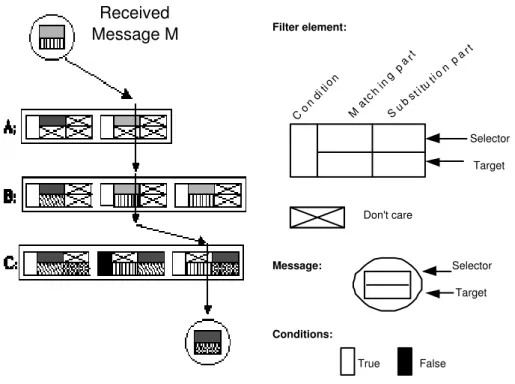
4.2 Structure of a filter specification . . . 40
4.3 Message evaluation by filters . . . 43
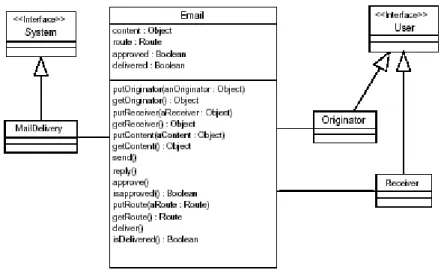
4.4 Class diagram of the Mail System . . . 45
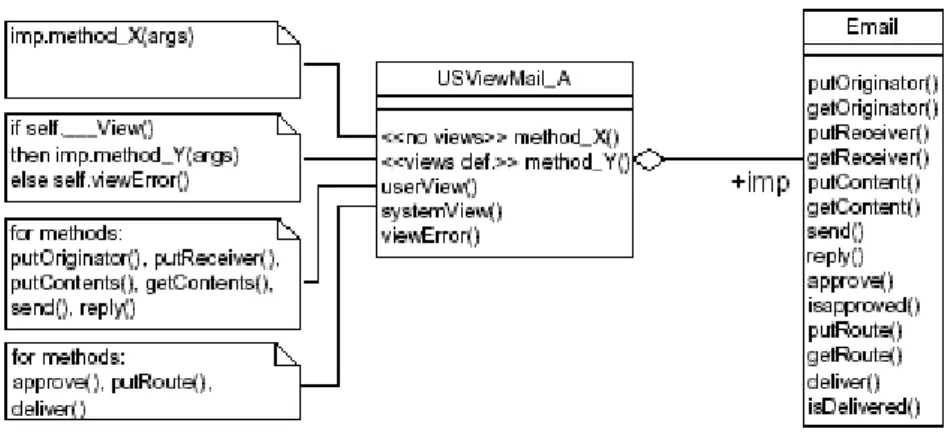
4.5 Aggregation-based composition of multiple views . . . 46
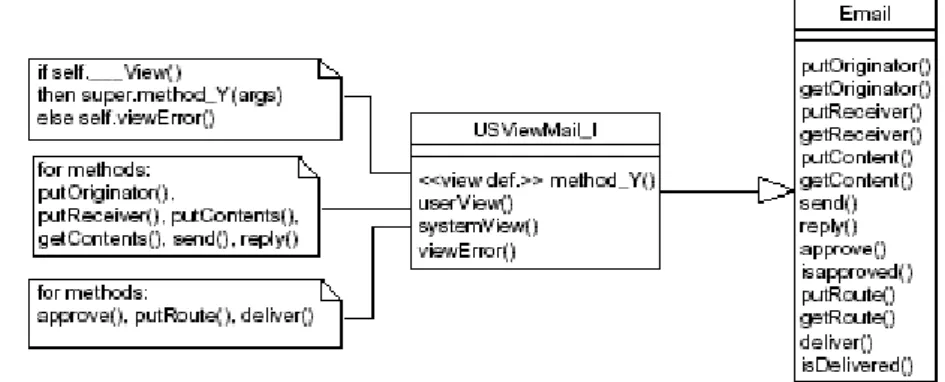
4.6 Inheritance-based composition of multiple views . . . 47
4.7 Filter definition for class USViewMail . . . 48
4.8 Personnel Software class diagram . . . 54
4.9 Addition of export functionality . . . 56
4.10 Hyperspace solution - Step 1 . . . 56 xii
4.11 Hyperspace solution - Step 2 . . . 57
4.12 Hyperspace solution - Step 3 . . . 57
4.13 Hyperspace solution - Step 4 and Step 5 . . . 58
4.14 Hyperspace solution - Step 6 . . . 58
4.15 An example traversal strategy . . . 61
4.16 An example adaptive method . . . 63
5.1 Aspectual Legacy Analysis Process (ALAP) . . . 66
5.2 Feasibility Analysis rules (Categorization phase) . . . 68
5.3 Evaluation approach for the Categorization phase of Feasibility Analysis . . . 69
5.4 Feasibility Analysis rules (Crosscutting evaluation phase) . . . 73
5.5 Aspectual Analysis rules . . . 74
5.6 Evaluation approach for the rules of Aspectual Analysis . . . 75
5.7 Maintenance Analysis rules . . . 78
6.1 Structure of the Interface part of the ALAT . . . 80
6.2 Launcher of ALAT . . . 81
6.3 Analysis Data Tool . . . 81
6.4 Criteria Definition Tool . . . 82
6.5 Criteria Evaluation Tool . . . 83
6.7 Maintenance Activity Tool . . . 85
6.8 Add/Update/Remove Rule Tool . . . 86
6.9 Add Rule Tool . . . 86
6.10 Update Rule Tool . . . 87
6.11 Remove Rule Tool . . . 88
6.12 Analysis Processes Tool . . . 88
6.13 Analysis Tool (Feasibility Analysis performed) . . . 89
6.14 Analysis Tool (Aspectual Analysis performed) . . . 90
6.15 Reports Tool . . . 90
6.16 View Report Tool (Feasibility Report) . . . 91
6.17 View Report Tool (Concern Report) . . . 91
6.18 View Report Tool (Maintenance Report) . . . 92
6.19 Class diagram of the ALAT . . . 93
7.1 Doctor, Drugstore and Patient classes before any refactoring . . . 98
7.2 Doctor, Drugstore and Patient classes after conventional refactoring 99 7.3 Extract method calls refactoring [23] . . . 100
7.4 Doctor, Drugstore and Patient classes after aspectual refactoring . 101 7.5 LoggerAspect.java . . . 102
7.7 FrmDoc, FrmDS and FrmPres classes before applying any aspec-tual refactoring . . . 105 7.8 FrmDoc, FrmDS and FrmPres classes after applying extract
ex-ception handling aspectual refactoring . . . 106 7.9 Class MainSystem after applying extract exception handling
as-pectual refactoring . . . 107 7.10 ExceptionHandlerAspect.java . . . 107
2.1 Legacy system categories vs. evolution approaches . . . 23
5.1 Evaluation of legacy system categories with respect to static and dynamic crosscutting . . . 72
6.1 Rules table . . . 94
6.2 Criteria table . . . 95
6.3 Approach table . . . 95
Introduction
A legacy software system may be defined informally as an old system that re-mains in operation within an organization [41]. Legacy systems typically have been developed several years ago, sometimes without anticipating that they would be still running much later. Inevitably the software requirements for legacy sys-tems might change and legacy syssys-tems must be evolved accordingly. Maintaining legacy systems, however, is, in general, difficult because legacy systems very often run on obsolete, slow hardware that is hard to maintain, the documentation of the legacy system is lacking or incomplete, the interfaces of the legacy system components are limited for integration and/or adaptation, etc. Organizations dealing with legacy systems can either decide to replace the system or maintain the system. A simple replacement, if possible at all, might be desirable but too expensive to consider because of the huge volumes of necessary changes, or too risky because of the continuous demand for on-line operation.
1.1
Problem Statement
Several viable solutions such as reengineering [39] and system reengineering pat-terns [34] have been proposed for maintaining legacy systems. In principle, legacy systems are enhanced using one of the three techniques: wrapping, migration, and
redevelopment [9]. The possible maintenance approaches differ according to the type of the legacy system. Given a concrete legacy system problem, it is not, however, always possible to categorize the solution according to one problem [9] and often combinations of these techniques are used.
Conventional maintenance approaches have generally focused on, or are basi-cally good at, coping with non-crosscutting concerns. Hereby, the maintenance and evolution requirements impact single components and can be more easily localized. However, it appears that several concerns cannot be easily localized in single components and tend to be scattered over multiple components. These so-called crosscutting concerns severely hinder the maintenance and the adaptability of software systems.
In contrast, crosscutting evolution requirements have to deal with evolution of concerns that tend to crosscut several components. Required changes to these concerns are difficult because these changes need to be performed at multiple places impeding even further the maintainability. One basic reason why legacy systems are usually associated with high maintenance costs is because of the inflexibility of the adopted techniques [6]. In case crosscutting concerns are not appropriately addressed, the continuous maintenance of legacy systems might thus easily lead to a degradation of its structure and as such its maintainability. This might manifest itself in the following ways:
• Updating existing concerns
If existing concerns such as for example, synchronization, recovery, logging, are not modularized in the legacy system, then they will be scattered over different components. The maintenance of these concerns will therefore need to take place at several places. For this all the affected components in the legacy system must be identified first, which is definitely not a trivial task. Furthermore, the affected components need to be changed appropri-ately. This whole process does not only seriously impede updating these concerns, but also is a tedious and error-prone activity.
• Inserting new crosscutting concerns
Inserting concerns that crosscut over multiple components results in a sim-ilar effect as updating existing concerns. In this case, inserting crosscutting concerns requires finding the components in the legacy system which are affected, but do not include the concern yet. This lack of additional in-formation might even further complicate the identification of the affected components. Once the components have been identified, similar to updating concerns the legacy code must be enhanced.
The Aspect-Oriented Software Development (AOSD) community has provided several general purpose solutions for coping with aspects in software systems. Unfortunately, existing AOSD approaches seem to have primarily focused on identifying, specifying and implementing aspects for systems that are developed from scratch. Identifying, updating and specifying aspects in legacy information systems impose common but also different requirements and constraints on the maintenance. As such, the application of aspect-oriented techniques to maintain-ing legacy systems seems to be a worthwhile attempt.
1.2
Contribution
The contribution of this thesis is as follows: • Categorization of legacy systems
To reason about legacy systems we provide a categorization on the various legacy systems as described in the literature. Based on our literature survey and the existing categorizations, we categorize legacy systems according to the criteria of criticality to business needs, health state and accessibility. • Selecting the maintenance approaches for legacy system categories
In parallel with the categorization of legacy systems, we provide an analysis of existing legacy maintenance approaches. For each legacy system category, the required (conventional) legacy maintenance techniques are described.
• Identification of crosscutting concerns problem in legacy systems
We identify the crosscutting concerns problem in legacy information sys-tems, utilizing a general case study, Drugstore Information System. Since existing maintenance approaches do not explicitly consider crosscutting con-cerns they fall short to maintain the legacy system appropriately.
• Defining a process for analyzing legacy systems in case of crosscutting con-cerns
Existing legacy maintenance approaches do not explicitly consider the pro-cess for maintaining the legacy system (also) based on crosscutting con-cerns. We provide a process called ALAP, for analyzing legacy systems both for crosscutting concerns and non-crosscutting concerns. ALAP con-sists of Feasibility Analysis, Aspectual Analysis and Maintenance Analysis sub-processes. Feasibility Analysis, which consists of two phases, defines a categorization of the legacy system in the first phase, and evaluates the legacy system with respect to the ability to implement static and dynamic crosscutting in the second phase. Aspectual Analysis provides a systematic analysis on the impact of the concern on the corresponding legacy system, and determines whether the concern is crosscutting or not. Finally, Mainte-nance Analysis provides the required mainteMainte-nance techniques which might include conventional techniques or aspectual techniques, according to the results of the first two sub-processes.
• Explicit reasoning on modularizing aspects of legacy systems
In the second phase of Feasibility Analysis sub-process of ALAP, we explain how different legacy systems behave differently with respect to crosscutting implementation. For each category of the legacy system we provide an anal-ysis of the implementation of crosscutting concerns. We describe explicit rules for identifying and specifying aspects in legacy systems, in the Aspec-tual Analysis sub-process of ALAP. Also, aspecAspec-tual refactoring of legacy systems, which apply aspectual techniques to integrate or update new con-cerns is explained by some examples.
1.3
Outline of Thesis
The thesis is organized as follows: Chapter 2 provides an overview and the catego-rization of legacy systems, and the conventional legacy maintenance approaches. Chapter 3 explains the crosscutting concern problem, and introduces an example case, Drugstore Information System. Chapter 4 provides an overview of AOSD, and explains how AOSD deals with crosscutting concerns. Chapter 5 explains the ALAP, the systematic process we have defined. Chapter 6 presents ALAT, the tool we have developed in order to automate the ALAP. Chapter 7 explains several aspectual refactoring techniques. Finally, Chapter 8 presents the conclu-sions.
Categorization of Legacy Systems
In this chapter we provide the background on legacy systems and analyze the various legacy maintenance approaches. Section 2.1 provides a general overview of legacy systems. Section 2.2 describes the criteria for categorization that we apply. Section 2.3 presents the conventional maintenance approaches. Section 2.4 provides the analysis of conventional legacy maintenance approaches. Finally, Section 2.5 explains the design space of legacy systems.
2.1
Background
Legacy systems are the software systems that typically have been developed sev-eral years ago (sometimes 20-30 years ago), sometimes without anticipating that they would be still running decades later. They have been constructed without having the ability to change as a first-class design goal. Many of these systems were developed using technologies that are now obsolete. These systems are still business critical, that is, they are essential for the normal functioning of the busi-ness. They are typically the backbone of an organization’s information flow and their failure can have serious impact on business [9].
It is possible to collect a large number of definitions of legacy systems: 6
• A legacy software system may be defined informally as an old system that remains in operation within an organization [41].
• Legacy systems are large software systems that we do not know how to cope with but that are vital to our organization [6].
• A legacy software system is a computer system or an application program, which continues to be used because of the prohibitive cost of replacing or redesigning it and despite its poor competitiveness and compatibility with modern equivalents. The implication is that the system is large, monolithic, and difficult to modify [2].
• A legacy system is any information system that significantly resists mod-ification and evolution to meet new and constantly changing business re-quirements [12].
Inevitably the software requirements for legacy systems might change and legacy systems must be evolved accordingly. This is however easier said than done because legacy systems significantly resist change, in general. The reasons for this might be because legacy systems run on obsolete, slow hardware that is hard to maintain; the documentation of the legacy system is lacking, incom-plete or out of date; the interfaces of the legacy system components are limited for integration and/or adaptation; different parts are implemented by different teams without any consistent programming style; the system structure may be corrupted by many years of maintenance; techniques to save space or increase speed at the expense of understandability may have been used, etc. Maintenance and understanding of legacy software can pose problems, particularly when the original programmers have left, and replacement staff do the modifications. Due to individual programming styles, developed programs could be difficult to under-stand and maintain. Over time, source code maintenance has changed the original software specification and design. However, as is often the case, the specifications and design have not been updated. Thus, program design and understanding is lost, and the only documentation of the system is the source code itself.
situations, the legacy leftover can be very important and valuable. In particular, legacy systems have typically evolved over many years to reflect subtle and tacit business process knowledge, unlikely to be recaptured in a replacement system without years of debugging effort. This hard-won robustness makes a legacy system a troublesome burden. Here lies the legacy system dilemma: a legacy system is both a business asset and a business liability; businesses cannot afford to keep them, and cannot afford to do without them.
The overriding problem for the industry is deciding what to do with its legacy software. Organizations dealing with legacy systems can either decide to replace the system or maintain the system. A simple replacement, if possible at all, might be desirable but too expensive to consider because of the huge volumes of necessary changes, or too risky because of the continuous demand for on-line operation. There is a significant business risk in simply scrapping a legacy system and replacing it with a system that has been developed using modern technology since business processes are reliant on the legacy system. Also, the processes involved in a legacy system have generally been there for some time and have widespread usage and acceptance within the organization. It is very unlikely that the benefits of legacy systems, like widespread usage and acceptance can be transferred instantly. Because of these reasons, legacy systems are continu-ously adapted to cope with the evolution requirements. A successful sustainment and modernization program can keep systems current with changing business and technology requirements while saving time, money, and IT staff resources. Preventing systems from slowly becoming legacy systems requires active sustain-ment. Sustainment means taking time to repair defects correctly and not simply patching the code. By this way, maintainability and evolvability of the code may be retained even as modification requests are satisfied. Sustainment may require technology refresh and architectural evolution. To avoid obsolescence, the sus-tainment budget must exceed that used for simple maintenance and let the IT team keep pace with changing technology and evolving business needs.
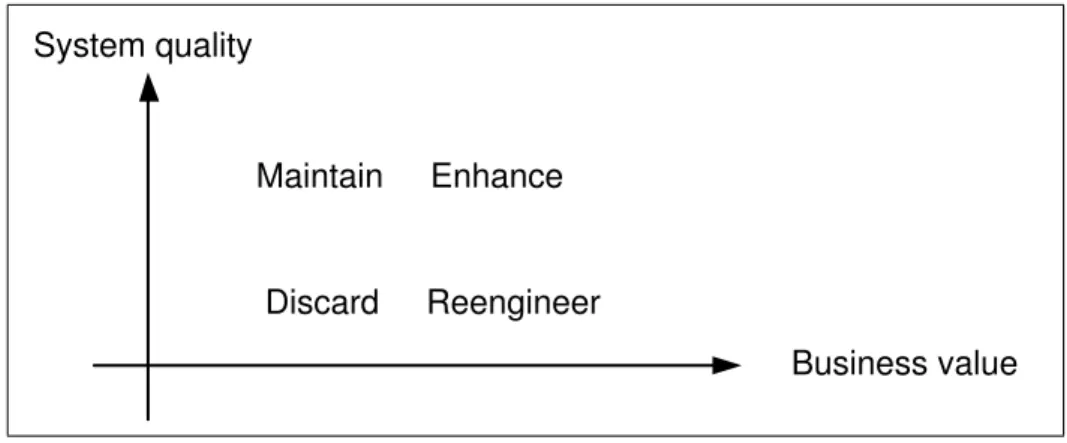
The classic decision matrix, which is shown in Figure 2.1, shows the options that can be considered when deciding what to do with a legacy system [34]:
System quality
Maintain Enhance
Discard Reengineer
Business value
Figure 2.1: Classic decision matrix
• Systems that are very valuable for the business but are too hard to change to be enhanced without restructuring are good candidates for reengineer-ing. These make an important business contribution but are expensive to maintain. They should be reengineered.
• Systems with low business value and low quality are candidates for replace-ment with commercial packages. They can be discarded.
• Systems with high quality and low business value can be maintained with continued low level maintenance activities.
• Systems with high quality and high business value should be actively sus-tained to avoid degradation. They should be enhanced.
2.2
Legacy System Categories
Legacy Systems can be categorized in different ways based on various adapted criteria. In the following, we will categorize legacy systems based on the criteria of criticality, health state and accessibility. These criteria have been derived from the literature on legacy systems.
2.2.1
Categorization Based on Criticality
This categorization is done according to the business criticality criterion. The legacy system types in this categorization are mission critical and replaceable legacy system types.
Mission critical systems are the systems that are essential to the continued operation of the business, and, that provide service on which the organization is highly dependent. A failure in this type of systems may have a serious impact on the business [13]. If a mission critical system stops working, the business may grind to a halt. Also, these systems hold mission critical business knowledge which cannot be easily replaced [44].
Replaceable systems are the systems that no longer meet business needs or that are technically inefficient. These systems are ineffective in support of the business, and they are constantly falling over or becoming expensive to maintain.
2.2.2
Categorization Based on Health State
This categorization is done according to the health state criterion. In this cate-gorization, legacy systems are compared to living organisms. Their environment can affect their state of health; they can be more or less healthy depending on the changes in their environment and the treatment they receive from the organi-zation they reside in. The legacy system types that are in this categoriorgani-zation are healthy, ill, and terminally ill legacy system types [42]. Healthy legacy systems are the systems that satisfy the current enterprise needs and are kept healthy by routine maintenance. Routine maintenance is the incremental and iterative process in which small changes are made to the system. These small changes are usually bug corrections or small functional enhancements. Healthy systems do not need major structural changes in order to support business needs [14]. For these systems, either the legacy system is satisfactorily handling current enter-prise needs or the needs are changing in relatively minor ways that the legacy system can be updated or maintained in a timely and economical fashion [42].
Ill legacy systems are the systems whose health has deteriorated to the point that some kind of non routine intervention is required [42]. For these systems, routine maintenance falls behind the business needs and a modernization effort is required. An ill legacy system requires more extensive changes than those possi-ble during maintenance. These changes include system restructuring, important functional enhancements, or new software attributes [14].
Terminally ill legacy systems are the systems that cannot keep pace with the business needs. The life of these systems can be prolonged by extraordinary life support, but heroic measures are required and are often not economically justified. That is, for these systems, modernization is either not possible or not cost effective, and these systems must be replaced. Also, if there is nobody left that knows anything about the system and there is no source code available for the system, the system is terminally ill [42].
2.2.3
Categorization Based on Accessibility
This categorization is done according to the accessibility criterion. The legacy system types in this categorization are black box, white box decomposable and white box non-decomposable legacy system types.
Black box legacy systems are the systems that are like a black box; we have no detail on the internal structure of these systems. For these systems, only the externally visible behavior is considered, not the implementation. Source code of the system is either not available or inscrutable. Also, a software component may be defined as a black box, if all the interactions occur through a published interface [13].
White box decomposable legacy systems are the systems, for which the system internals, such as module interfaces, system components and their relationships, domain models are visible. The source code is available for these systems, and it is possible to extract information from the code in order to create abstractions that help in the understanding of the underlying system structure. In addition,
the applications, interfaces, and database services can be considered as distinct components; and there are well defined interfaces for all these three components. The interface component is separated from the business logic and data model components. In this type of systems, application modules are independent of each other (e.g. have no hierarchical structure), and interact only with the database service. It is possible to make changes to one module without a need to change others.
White box non-decomposable legacy systems are the systems, in which the system internals are visible but not separable. In essence, it is hard to derive the structure of these systems.
2.3
Legacy System Maintenance Approaches
Several viable solutions, such as reengineering [39] have been proposed for main-taining legacy systems. In principle, legacy systems are enhanced using one of the three techniques: wrapping, migration, and redevelopment [9].
2.3.1
Wrapping
Wrapping provides a new interface to a legacy component so that it can be more easily accessed by other components, and legacy applications can be used by new applications in modern architectures. This gives old components new operations or a new and improved look. The wrapped component acts as a server, performing some function required by an external client that does not need to know how the service is implemented [9].
Wrapping requires the identification of business logic at a level of granularity that is sufficient for providing benefit to new applications without reinventing the wheel. Wrappers are generally used to access legacy core functionalities from a new environment. In wrapping, you encapsulate a legacy system, so it can be used as a whole under a new execution environment or within a new system. It isolates
calling processes from all changes to the called legacy systems. The system is surrounded with a software layer that hides the complexity of the system. By this way, the mismatches between the interface exported by the legacy system and the interface required by the new applications are removed.
Wrapping has some attractive features. One of them is safety. Since there is no software change, original functionalities are preserved. Wrapping permits reusing well-tested components trusted by the organization; and by this way, benefiting from the massive investment done in the legacy system for several years [10]. Since we do not alter anything in the legacy code, we do not introduce any bugs to the core functionality of the system. There may be bugs in the wrapper parts, but since the only new code is in the wrapper part we know where to look for these errors. Another good feature is low cost. Since the system still runs on its original platform, no new hardware or equipment is necessary. Also, there is no need for deep analysis and understanding of system structures and code. As well as these good features, wrapping has certain limitations. No performance gain is one of them. Since the system still runs on its original, possibly slow, and outdated platform, it cannot take full advantage of the new computing environment. Also, flexibility is low, since in this technique, a legacy system can only be reused as a whole, and it is impossible to reuse its individual parts [28].
Figure 2.2 shows the mechanism of the wrapping technique. An interface is defined which contains all the requests that the system is able to handle; and all the interaction between components outside the system and the system go through this interface. The requests are forwarded from the interface to the responsible parts of the system; but the internal operations are not touched.
Client User Interface
Wrapper Interface Legacy System Core
2.3.2
Migration
Migration moves the legacy system to a more flexible environment that allows the system to be easily maintained and adapted to new business requirements. In migration, the system’s original functionality is retained, and the disruption caused to the existing operational and business environment is as little as possible. The methodology for migrating legacy code lies between a wrap and a full rewrite. Migration is much more complex then wrapping, but if successful, it offers greater long-term benefits. On the other hand, it aims to avoid a com-plete redevelopment of the legacy system. If most of the legacy system must be discarded, the developer will be facing a redevelopment project, not a migra-tion project. Migramigra-tion aims to reuse as much of the legacy system as possible, including implementation, design, specification, and requirements [9].
The target system, which is the result of the migration process, runs in a different computing environment. This may be a different programming language or a completely new architecture and technology [9]. For example, a system may be migrated from mainframe environment to a UNIX server; or procedural COBOL code may be migrated to object-oriented technology.
2.3.3
Redevelopment
Redevelopment is the legacy system maintenance approach that leads to most im-portant changes. It requires rewriting the existing code, and involves developing a system from scratch.
Redevelopment requires a thorough understanding of the existing system and thus involves many reengineering activities [9]. Reengineering is the examination and modification of a system to reconstitute it in a new form and the subsequent implementation of the new form. Reengineering consists of two stages: (1) reverse engineering, and (2) forward engineering. Reverse engineering is the process of
discovering software design and specification from source code. In reengineer-ing, initially, the current program is reverse engineered to recover the high-level abstraction or design of the software. The recovered design is then forward engi-neered with a low level implementation of the high level abstraction. The result is a new program with either the same functionality, or enhanced functionality to meet new requirements.
The redevelopment of legacy systems is widely recognized as one of the most significant challenges facing software engineers. Legacy systems are well-tested and encapsulate considerable business expertise; but there is no guarantee that the new system, which is the result of the redevelopment process, will be as robust and functional as the old one. Redevelopment needs extensive testing of the new system. Also, since the technology and the business requirements are constantly changing, the developers may come across a situation where the new system no longer meets the business needs when they have finished redeveloping the system.
2.4
Analysis of Legacy System Maintenance
Approaches
In this section, we define the possible legacy maintenance activities for each legacy system type, as it is presented in the literature.
2.4.1
Wrapping
Wrapping only requires the knowledge of the external interfaces of the legacy system. In wrapping, only the legacy interface is analyzed, inputs and outputs of the system are examined; and legacy system internals are ignored. The system is treated as a black box. For a successful wrapping, a good black-box model of the existing source code must be available. The input and output routines of the legacy code must be well defined. Since this technique doesn’t require insight on the legacy system internals, it is suitable for both black box and white box legacy
systems.
Wrapping may be applicable to mission critical systems, because they allow an organization to benefit from the new technologies without having to interrupt the operation of their mission critical legacy system [32].
If a legacy system does not function properly, wrapping the system cannot be recommended. Wrappers are useful for gaining access to legacy code, not for repairing it. So, wrapping is not applicable to terminally ill systems.
2.4.2
Migration
Legacy system migration process is divided into five phases [10]:
1. The first phase is the justification phase. Since the legacy system migration process is an expensive procedure and carries a risk of failure, an intensive study should be undertaken in order to be able to weigh the risks and benefits of migrating the system, before taking any decision.
2. The second phase is called legacy system understanding phase. This phase consists of the analysis and assessment of the legacy system to understand its operations and interactions. Since a legacy system already meets some of the business and user requirements demanded of the target system, poor legacy system understanding can lead to incorrect target system require-ment specifications and to failed migration projects [9]. For the success of migration, it is essential that the functionalities of the legacy system, and how it interacts with its domain must be understood. The issues of understanding the source code of legacy applications, and understanding the structure of legacy data are central to all migration projects. Typically, at the beginning of the migration process, stock of all application artifacts such as source code must be taken; a complete database analysis includ-ing tables, views, indexes, procedures, and triggers, and data profilinclud-ing is required; and also, it is necessary to identify and map out the core business
logic, to show the interrelationships of the code performing the application’s business function.
3. The third phase is the target system development phase. This phase consists of developing a target system according to the requirements specification prepared in the legacy system understanding phase. The target system must be fully operative, and functionally equivalent to the legacy system. 4. The fourth phase is the testing phase. Since in most cases the legacy system
is mission critical, target system outputs must be completely consistent with those of the legacy system. So, testing activity takes the most time during migration. Migration projects are often expected to add functionality to justify the project’s expense and risk. If this is the case, the legacy system should be migrated first, and, new functionality should be introduced to the target system after the initial migration. Because, when functionality is the same, engineers can directly compare outputs to determine the target system’s validity, in the testing phase.
5. The last step is the migration phase, and it is concerned with the cutover from the legacy system to the target system. Three different strategies [33] have been proposed for this step:
• The first one is the cut-and-run strategy, which consists of cutting over to the target system in a single step. This is unrealistic and risky because the target system is untried and thus untrustworthy.
• The second strategy, which is called phased interoperability, is highly complex. In this strategy, the cut over is performed in small, incremen-tal steps, and each step replaces a few components of the legacy system with corresponding target components. To be successful, legacy sys-tem applications must be split into functionally separate modules, or the data must be separated into portions that can be independently migrated. But such a step-wise approach is difficult because of the monolithic and unstructured nature of most legacy systems.
this strategy, the legacy system and the target system operate simul-taneously, with both systems performing all operations. During this period, the target system is continually tested; once it is fully tested, the legacy system is retired.
As can be understood from the explanations of the phases of migration pro-cess, in order to be able to apply migration to a system, information on the internal structure of the system must be available; in other words, the legacy system must be a white box system. Migration is not applicable to black box legacy systems.
Different migration techniques, that are explained in [10], [11], [32], [44], and [43], are examined below, according to their applicabilities to different categories of legacy systems. Note that, the first three of the techniques must be considered for the legacy systems which contain a database. We admit that not all of the legacy systems have a database; there may be a legacy system which consists only of Java code, for example. Hence, in Table 2.1, we do not focus on specific techniques but the migration approach in general.
• Forward Migration (Database First) : Forward Migration involves the initial migration of legacy data to a modern, probably relational Database Man-agement System and then incrementally migrating the legacy applications and interfaces. In this method, while legacy applications and interfaces are being redeveloped, the legacy system remains operable. The interoperabil-ity between the legacy and target systems is allowed, and provided by a module known as Gateway. Forward Gateway enables the legacy applica-tions to access the database environment in the target side of the migration process. Here, the legacy system can remain operational while legacy ap-plications and interfaces are rebuilt and migrated to the target system one by one. When migration is complete, the gateway is no longer required [32] [44]. The migration of legacy data may take a significant amount of time during which the legacy system will be inaccessible; so, this method is not applicable to mission critical systems [44]. This approach is applicable
to legacy systems which are white box decomposable, and where a clean interface to the legacy database service exists [32].
• Reverse Migration (Database Last Approach) : In this approach, legacy applications are gradually migrated to the target platform while the legacy database remains on the original platform. Legacy database migration is the final process. As in Forward Migration, a gateway allows the interop-erability between old and new systems. A reverse gateway enables target applications to access the legacy data management environment [32] [44]. This method is not applicable to mission critical legacy systems because of the unacceptability of the period of time during which the legacy system will be shut down during the migration process. This approach is suitable for white box decomposable legacy systems as is the case with Forward Migration [32].
• Composite Database Approach : Here, the legacy and target information systems are operated in parallel throughout the migration project. The old legacy system and the target system form a composite information system during the migration process. A combination of forward and reverse gate-ways is used. A transaction coordinator is employed to provide consistency between the legacy and target databases [32]. This approach eliminates the need for a single large migration of legacy data during which the legacy system is inaccessible, so it is not inapplicable to mission critical systems, as Forward and Reverse Migration methods were [32].
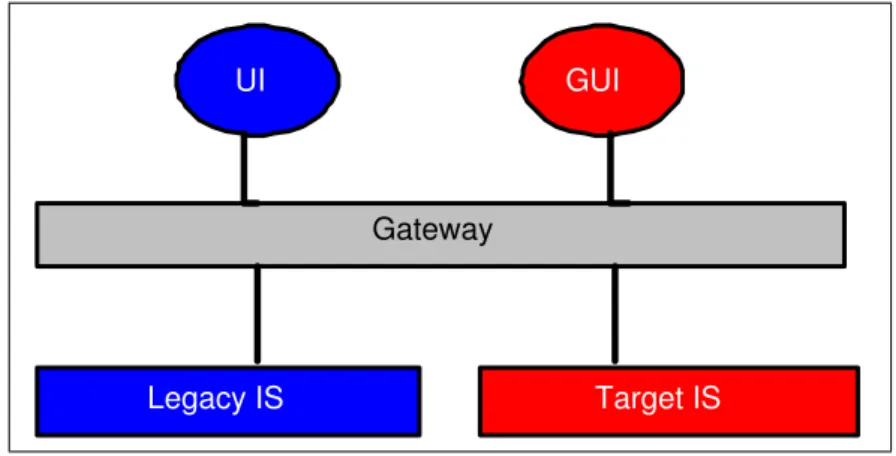
• Chicken Little Strategy : In this method [11], the legacy system is migrated in small incremental steps until the desired objective is reached. The re-source allocation is small for each incremental step. If one of the steps fails, only that step needs to be repeated, not the entire migration process. The incremental steps are designed to be inexpensive so do not cause any prob-lems with the management to be funded. The legacy and the target systems operate in parallel during the migration process, and they are connected by a gateway. This method is applicable to both white box decomposable, and white box non-decomposable systems [32]. Also, it is applicable to mission critical systems, because it takes into account that mission critical legacy
systems cannot be out of operation for any significant amount of time, and thus provides a mechanism for the legacy system to remain operable throughout the migration process [10].
Figure 2.3 shows the mechanism of Chicken Little strategy. The gateway maintains the interface that the legacy user interface (UI) expects of the legacy system even though the system is being changed behind the scenes. This transparency permits the developer to alter one part of the legacy IS at a time. This capability is critical to the Chicken Little strategy. As the target graphical user interface (GUI) is iteratively introduced, the gateway makes transparent to the GUI and UI whether the legacy information sys-tem or the target information syssys-tem or both are supporting a particular function. Hence, the gateway can insulate a component that is not being changed (e.g., the UI) from changes that are being made (e.g., migrating the legacy database to the target database). Legacy applications are grad-ually rebuilt on the target platform. When the target system can perform all the functionality of the legacy system, the legacy system can be retired.
UI GUI
Gateway
Legacy IS Target IS
Figure 2.3: Chicken Little strategy
• Butterfly Methodology : This method assumes that the target and legacy systems need not interoperate during the migration process, eliminating the need for gateways [10] [32] [44] [43]. It separates the target system development and data migration phases. Using this methodology, the mi-gration process is reversible prior to the cut-over phase; and mimi-gration can be safely stopped. This method is applicable to mission critical systems
as the Chicken Little Strategy, since the legacy system will remain in full production during the migration process [44].
2.4.3
Redevelopment
The most widely researched and best-understood approach to redeveloping legacy systems is the cold turkey approach [12]. In this approach, the legacy system is replaced by a new system with the same or improved functionality, that is, the system is completely rewritten. This is done in two phases: in the first phase, a new set of requirements is constructed and some aspects of the existing design such as overall architecture are identified and retained, using reverse engineering and domain analysis techniques. Then in the second phase, the new system is built using an appropriate software development methodology. It requires the system to be shut down either during development or during replacement.
Unfortunately, for a high proportion of large legacy systems, this approach is infeasible. Making such a huge change in a single step is rather risky, and also, the downtime required for the cutover from the legacy system to the target system is unacceptable for mission critical legacy systems [34]. So, this method is applicable to legacy systems which are not mission critical, which are relatively small in size, and which have a well defined stable functionality [32].
Development of such massive systems takes years, so business requirements may change during the redevelopment project itself. Then unintended business processes will have to be added to come up with the changing business require-ments and this will increase the risk of failure. Some other factors working against cold turkey approach are listed in [11] as follows: In most of the organizations, management rarely approves a major expenditure if the only result is lower main-tenance costs, instead of additional business functionality. So, in order to get the required sources for the redevelopment process, a better system and additional features must be promised. Also, the redevelopment process generally takes longer than planned and ends up costing much more than anticipated. While the legacy redevelopment proceeds, some changes occur in the business processes that the
target system will support; and this leads to significant changes in the require-ments of the target system during the redevelopment process, increasing the risk of failure.
2.5
Legacy System Design Space
Given the different types of legacy systems, it is not trivial to identify the ap-propriate maintenance approach for a legacy system type. To provide a more systematic interpretation on legacy systems, we utilize design space modelling [38] to define the design space of legacy systems. We can model a legacy system as follows: Legacy System = (Criticality, Health, Accessibility)
Hereby a legacy system is modelled as a Cartesian product of the vectors (dimensions) criticality, health, and accessibility. Each dimension includes its own set of values (coordinates). Criticality dimension includes the coordinates mission critical and replaceable; health state dimension includes the coordinates healthy, ill and terminally ill ; and finally accessibility dimension includes the coordinates black box, white box non-decomposable and white box decomposable. In this way all the set of alternative legacy systems can be represented. Given the three categorization dimensions, we could have 2(for criticality) x 3(for health state) x 3(for accessibility) = 18 possible kind of legacy systems. In general legacy systems which are not business critical are usually not considered for maintenance activities. For this, we will consider only mission critical legacy systems which will lead to 3x3=9 possible kinds of legacy systems.
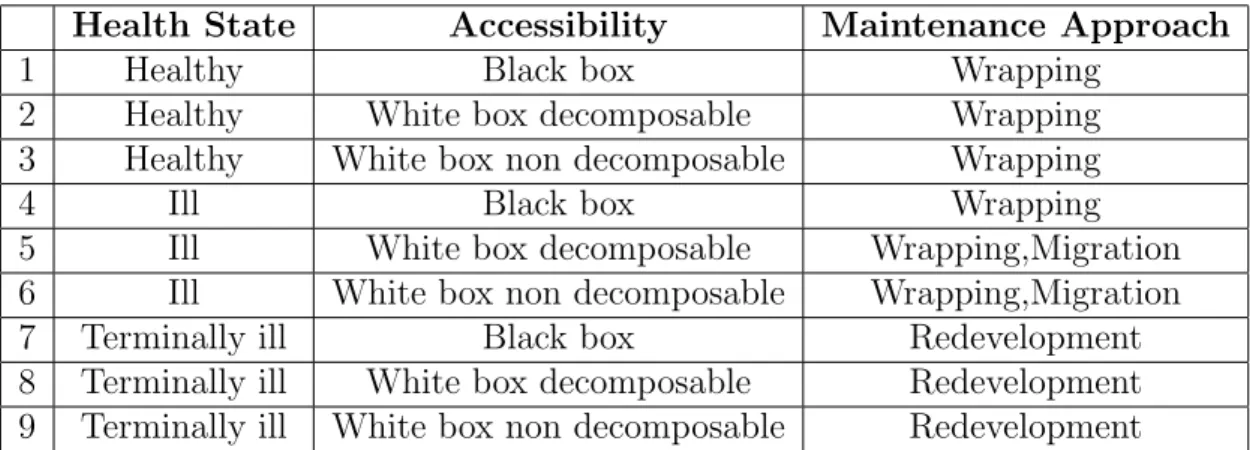
In finding the right evolution approach for a legacy system, we should first characterize the corresponding legacy system, and then identify the necessary legacy evolution technique. The kind of evolution approach usually depends on all of the three legacy categorization criteria. For example, a legacy system could be mission critical because it is important from a business perspective, ill since it has deteriorated and white box decomposable because of a clear accessible structure. In this case, by looking at Table 2.1, we can say that both wrapping
and migration may be applicable for maintaining the legacy system.
Health State Accessibility Maintenance Approach
1 Healthy Black box Wrapping
2 Healthy White box decomposable Wrapping
3 Healthy White box non decomposable Wrapping
4 Ill Black box Wrapping
5 Ill White box decomposable Wrapping,Migration
6 Ill White box non decomposable Wrapping,Migration
7 Terminally ill Black box Redevelopment
8 Terminally ill White box decomposable Redevelopment
9 Terminally ill White box non decomposable Redevelopment
Table 2.1: Legacy system categories vs. evolution approaches
2.6
Summary
In this chapter we have defined the legacy system categories according to the criticality, health state and accessibility criteria. Then we have explained the three legacy maintenance approaches wrapping, migration and redevelopment, and evaluated these approaches for the legacy system categories we have defined. As a result, we have defined appropriate legacy maintenance techniques for each legacy system category. These information is presented in Table 2.1.
Crosscutting Concerns in Legacy
Systems
In this chapter we explain the so-called crosscutting concerns that cut across the natural units of modularity. These concerns cannot be specified in a single module and they tend to be scattered over the whole code. In Section 3.1, we describe an example case, Drugstore Information System, which is implemented in Java and that we consider as legacy code for illustration purposes. The example case is analyzed using evolution scenarios, which are described in Section 3.2. Finally, in Section 3.3 we describe the problem statement.
3.1
Case Study: Drugstore Information System
The Drugstore Information System (DIS) is an information system for supporting the retail of medicine. It is implemented in Java.
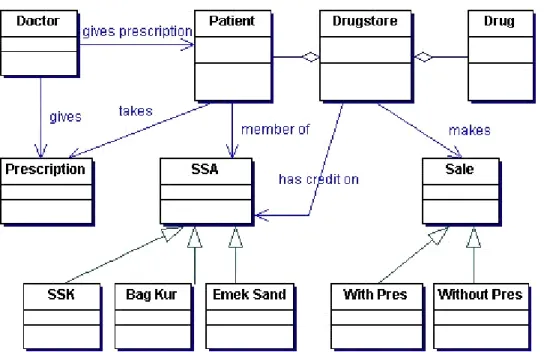
DIS consists mainly of the classes Drugstore, Drug, Doctor, Patient, Sale and Prescription. In this system, a drugstore sells drugs to patients. Some of the drugs are only sold to a patient having a prescription, while others can be sold to every patient. Also drugs have some other characteristics, such as expiration date,
contained active elements, and critical level, which represents the least amount that must be in the stock of a drugstore.
A doctor in our system has patients. When a patient visits a doctor, the doctor examines the patient and gives a prescription.
Patients may be a member of a Turkish social security association (SSA) such as SSK, Bag Kur, or Emekli Sandigi. This allows the patients to pay only a certain amount of the payment when buying drugs from a drugstore. In this situation, the drugstore gets the rest of the payment from the associated social security association.
Figure 3.1 shows the class diagram of DIS. Most important classes are briefly explained below.
Doctor is a person qualified to give a prescription to a patient.
Drug contains the properties of drugs, like active elements in it, price, expi-ration date, sold with/without prescription, critical level, stock level, etc.
Drugstore is a store that sells drugs to patients with or without prescription, if the drugs they want to buy are available.
Patient is a person that buys drugs from a drugstore with or without pre-scription, and that goes to doctor for taking prescription.
Prescription is a document given to a patient by a doctor and it specifies properties such as prescription id, date, names and amount of drugs prescribed, name of patient, name of doctor, social security association.
Sale contains the information of the sales of a drugstore, such as the patient name, drug names, and if with prescription, doctor name.
Figure 3.1: Class diagram of Drugstore Information System
3.2
Enhancing the Legacy System
Scenarios have been used in various ways like, for requirements elicitation [15], for analysis of software architecture [19], etc. In this section, we use scenarios for analyzing the enhancement of DIS with new concerns. The scenarios for enhancing the DIS are explained below.
Scenario 1. Adding logging concern
The system has a new requirement that, doctors, drugstores and patients must keep track of their operations; i.e. the operations of the classes Doctor, Drugstore and Patient must be logged. For example, a doctor keeps information of the patients, drugstore keeps the information on the drugs and the sales, and also a patient keeps the information of prescriptions given to him. The logs must be written to a file.
Scenario 2. Updating exception handling concern
In DIS, whenever a public method call returns throwing an exception, an error message is given. Suppose that there is a new requirement that the way of excep-tion handling must be updated in a way that the program must be terminated if a public method call returns throwing an exception. In order to implement this update it is required to change the code in multiple places in the system. Because the exception handling concern is scattered over the whole system.
Scenario 3. Updating allergy checking concern
Patients may have allergies to some active elements contained in drugs. In DIS, the allergies of the patient are taken into account by the doctors and drug-stores when giving a prescription and selling a drug to a patient. That is, if the patient has allergy to any of the active elements contained in the drug he/she wants to buy, the drugstore does not sell that drug to him/her. Or a doctor checks if the patient has allergy to any of the active elements of the drug before giving prescription to the patient for that drug. If he/she has, the doctor does not give prescription. Suppose that an update is required for this allergy checking concern, such that, if the patient is allergic to the drug he/she wants to buy, the drugstore will find a drug with equal effect and sell it to the patient. Also, the doctor will prescribe a drug which has equal effect to a patient, if the patient is allergic to the drug he/she has initially prescribed.
Scenario 4. Removing tracing code
In order to increase the visibility of the internal workings of the program for simplifying debugging, trace statements were added at specified method calls. Suppose that the debugging is complete, and these trace statements need to be removed from the DIS code.
Scenario 5. Removing security concern
valid ID-password information in order to use the system. Suppose that the log in operation is no longer needed, and needs to be removed.
3.3
Problem Statement
In this section we analyze the above scenarios, and explain the problem with these scenarios.
• Adding new concerns
In Scenario 1, the expectation is the addition of a new concern to the system. The logging concern is related to Doctor, Patient and Drugstore classes. Hence, in order to add this concern, we must change the code of some methods of multiple classes, which is a time consuming task. Also, when we add this concern to the related methods of the related classes, it will not be related to the main concern of the methods it is added to; but it will be tangled with their main logic. As a result, it will get harder to understand these methods.
• Updating existing concerns
In Scenarios 2 and 3, it is required to update an existing concern. Im-plementing the requirements are difficult, because the concerns of both of the scenarios are scattered over the whole system. Therefore the update needs to be done in several places. First the points to be updated must be identified. Then the code must be changed in these points in order to implement the update. In order to realize Scenario 2, the points where an exception is handled must be identified first, and then the code must be changed to terminate the program at these points. On the other hand, for realizing Scenario 3, the related methods of both the Doctor and the Drugstore classes must be changed. This is not only a tedious work, but also error-prone, since not managing to define all the points where the code must be changed results in the wrong way of working of the program.
• Removing existing concerns
In Scenario 4 and 5 , the expectation is the removal of an existing concern. In Scenario 4, the involved concern is the tracing concern, which crosscuts a large part of the system. As in the update of this type of concerns, the removal is tiring. Removing the tracing code completely results in the waste of the considerable effort spent for figuring out the trace points, and adding print statements to these points. On the other hand, commenting out the tracing code may result in bad looking code, and confusion of the statements of one kind of debugging with the statements of another kind [3]. On the other hand, the removal of the security concern in Scenario 5 is also difficult, since the removal of the code must be performed in two different places.
Above scenarios are in general crosscutting. Dealing with these types of sce-narios is difficult, because the system must be changed at many places in order to realize these scenarios. The concerns they are related to are spread throughout the program in an undisciplined way, and cut across the natural units of mod-ularity. If not appropriately coped with, the addition, update and removal of crosscutting concerns result in code tangling, which means multiple concerns are interleaved in a single module; and code scattering, which means a single concern affects multiple modules.
To the best of our knowledge, existing legacy maintenance approaches do not provide mechanisms to cope with crosscutting concerns. This increases the complexity and reduces the maintainability of the system even further. The system must be extended to cope with the crosscutting concerns.
Aspect-Oriented Software
Development
In this chapter, we give a background on Aspect-Oriented Software Development (AOSD). We first explain the basics of Aspect-Oriented Programming (AOP) in Section 4.1, and then the basic AOP approaches, AspectJ in Section 4.3.1, Composition Filters in Section 4.3.2, HyperJ in Section 4.3.3 and DJ in Section 4.3.4.
4.1
Introduction
One of the most important principles in software engineering for coping with complexity and achieving quality software is the separation of concerns principle. This principle states that a given design problem involves different kinds of con-cerns, which should be identified and separated in different modules; and tries to separate the basic algorithm from special purpose concerns. It minimizes and clarifies the dependencies between concerns at the conceptual and implementation level.
The history of software development has experienced an evolution of different 30
programming languages and design paradigms that have provided useful modular-ity mechanisms. Object-Oriented Programming (OOP) has been the mainstream over the last decade, and has almost completely replaced the procedural approach. Object orientation has the central idea that each concern of a software system should be implemented as a separate module, and a software system can be seen as being built of a collection of discrete classes each implementing a different concern. In OOP, each class has a well defined task and clearly defined respon-sibilities. They altogether achieve the application’s overall goal by collaboration [40].
Software development techniques used, including procedural programming and OOP, have made significant improvements in modularity [20]. However, as it is experienced in practice and generally acknowledged by researchers, it ap-pears that these approaches are inherently unable to modularize all concerns of complex software systems. There are some concerns, such as synchronization, recovery and logging that tend to be more systemic, and crosscut a broader set of modules. They cannot be easily specified in a single module, they need to be addressed in many modules. For the OOP case, there are parts of a system that cannot be viewed as a responsibility of only one class, because they affect many classes and crosscut the complete system. The code to handle these parts must be added to each class separately, resulting in the violation of separation of concerns principle. Hence, even OOP techniques are not sufficient to clearly capture the concerns that inherently crosscut the modularity of the rest of the implementation [20]. If these crosscutting concerns are not appropriately coped with, their implementation is scattered throughout the whole system, and the code to handle these concerns is mixed in with the core logic of a huge number of modules, resulting in tangled code. These increase complexity and reduce several quality factors of software, such as adaptability, maintainability and reusability.
AOP has been proposed to deal with the problem of improving separation of concerns in software. It is a technique that builds on previous technologies including procedural programming and OOP, and provides better separation of concerns by explicitly considering crosscutting concerns as well. AOP makes it possible to implement crosscutting concerns in a modular way, and achieve the
usual benefits of improved modularity: simpler code that is easier to develop and maintain, and has greater potential for reuse [20]. Using AOP, one can implement individual concerns in a loosely-coupled fashion, and combine these implementations to form the final system. AOP provides explicit abstractions for representing crosscutting concerns, such as aspects; and for composing these into programs, such as aspect weaving.
4.2
Basics of AOP
The AOP based implementation of an application consists of: (1) a component language with which to program components (components are properties which can be cleanly encapsulated in a generalized procedure); (2) one or more as-pect languages with which to program the asas-pects; (3) an asas-pect weaver for the combined languages; (4) a component program that implements the components using the component language; (5) one or more aspect programs that implement the aspects using the aspect languages. The aspect weaver corresponds to the compiler (or interpreter) in the object oriented implementation. It accepts the component and aspect programs as input, and emits a program as output [21].
Development steps of AOP are explained in [22] as follows:
1. Aspectual decomposition: In this step, requirements are decomposed in or-der to identify crosscutting system level concerns and module level common concerns.
2. Concern implementation: In this step, each concern is implemented sepa-rately.
3. Aspectual recomposition: In this step, an aspect integrator specifies recom-position rules by creating modularization units which are called aspects. Recomposition process which is also known as weaving, or integrating, uses recomposition rules to compose the final system.
AOP helps to overcome code tangling and code scattering problems. It also brings some other advantages [22]:
• Even in the presence of crosscutting concerns, AOP implements a system in a modularized way, by addressing each concern separately with minimal coupling.
• It is easy to evolve systems by AOP. Newer functionalities can be added to a system easily, by creating new aspects.
• With AOP, an architect can delay making design decisions for future re-quirements, since he/she can implement those as separate aspects.
AOP has also some disadvantages. For example, there are few experiments about the AOP, hence the technique is not mature yet. Also, AOP approaches like AspectJ are language dependent. Furthermore, less focus has been put on the design of aspect-oriented systems.
4.3
AOSD Approaches
AOP is a concept and it is not bound to a certain programming language, or a pro-gramming paradigm. Several aspect-oriented approaches have been introduced providing different solutions to the problems caused by crosscutting concerns. In particular, we will consider the following approaches:
• AspectJ, developed by XEROX PARC
• Composition Filters, developed by University of Twente • HyperJ, developed by IBM