Full Terms & Conditions of access and use can be found at
https://www.tandfonline.com/action/journalInformation?journalCode=rcrc20
Critical Arts
South-North Cultural and Media Studies
ISSN: 0256-0046 (Print) 1992-6049 (Online) Journal homepage: https://www.tandfonline.com/loi/rcrc20
Accented Essays: Documentary as Artistic Practice
in Contemporary Audiovisual Works from Turkey
Elif Akçalı
To cite this article: Elif Akçalı (2019) Accented Essays: Documentary as Artistic
Practice in Contemporary Audiovisual Works from Turkey, Critical Arts, 33:2, 42-55, DOI: 10.1080/02560046.2019.1671888
To link to this article: https://doi.org/10.1080/02560046.2019.1671888
Published online: 07 Nov 2019.
Submit your article to this journal
Article views: 86
View related articles
Accented Essays: Documentary as Artistic Practice in
Contemporary Audiovisual Works from Turkey
Elif Akçalı
Department of Radio, TV and Cinema, Kadir Has Universitesi, Istanbul, Turkey
ABSTRACT
This article looks at the use of documentary filmmaking in contemporary artistic practices in Turkey, specifically focusing on three works that adopt a first-person, subjective viewpoint: Didem Pekün’s Of Dice and Men (2016), Şener Özmen’s How to Tell of Peace to a Living Dove? (2015), and Aykan Safoğlu’s Off-White Tulips (2013). Made by artists in transition, these films tackle themes of belonging and identity through stylistic choices proper to essayistic filmmaking, which allow these works to be regarded as accented essays. The personal questions raised through the aesthetics they employ become relevant to collective issues of culture, history, and memory, offering an alternative understanding of the social context, which was largely affected by the political events during the period in which they were made.
KEYWORDS
Essayfilm; documentary; contemporary art; Turkey; accented cinema
Introduction
Nichols starts his article “Documentary Film and the Modernist Avant-Garde” with the following question: “How is it that the most formal and, often, the most abstract of films and the most political, and sometimes, didactic of films arise, fruitfully intermingle, and then separate in a common historical moment?” (2001, 580). He then claims that “our understanding of the relationship between documentary film and the modernist avant-garde requires revision” (580). This revision that Nichols pleads for is perhaps par-tially fulfilled by the recent interest in conceptualising and historicising the essay film.1 Scholars writing about essay film trace an alternative lineage within the history of cinema and bring together films that were previously studied separately, which can be read as an attempt to expose the“false division between the avant-garde and docu-mentary” (581) that Nichols writes about. Nichols suggests a “necessary proximity” (581) between these two categories, which I think highlights those films that offer an inves-tigation into and a celebration of the volatile boundaries between fact andfiction. This proximity, as Nichols also explains, is seemingly contradictory to “terms of individual citizenship and state responsibility” (582) that writers like Grierson value because of
© 2019 Critical Arts
CONTACT Elif Akçalı [email protected] Kadir Has Universitesi, Istanbul 34083, Turkey
1See, for instance, Corrigan (2011), Rascaroli (2009; 2017), Papazian and Eades (2016), Alter (2017), and Alter and Corrigan
(2017).
2019, VOL. 33, NO. 2, 42–55
the indifference of avant-garde practices to claiming truth.2Lebow (2007) also touches upon the historical division between documentary and avant-garde and experimental filmmaking in terms of their reception, and she outlines how documentary and art started to integrate.3 “Until very recently,” Lebow (2007, 71) claims,“there has been a tacit assumption that documentary film and video has no place in the art world.”4 This is not to say that documentary did not exist as a practice, but its recognition as a form of art was questionable. Similar to Grierson’s understanding of content and form as an ethical responsibility attached to documentary, the art world seemingly rejected documentary style for the same reason, as being remote from creativity and imagination. “At the risk of being overly reductive,” Lebow writes, “avant-garde and experimental film tends to be read aesthetically, while documentary is read socially and politically” (2007, 72). I find that this division between the political and the aesthetic is mistakenly mirrored in the division between fact and fiction and, similarly, between realism and formalism. Audiovisual works that transcend representational conventions allow these false opposites to merge, and highlight the multiplicity of possible mean-ings that arise out of such intersections.
Evident in the works of Chris Marker, Jonas Mekas, and, more recently, Hito Steyerl, one thread of the use of documentary style in artistic audiovisual practices is the form of essay. In this article I take as case studies a group of contemporary audiovisual works of art from Turkey which adopt afirst-person, subjective viewpoint presented through a voice-over narration, namely Şener Özmen’s How to Tell of Peace to a Living Dove? (2015), Aykan Safoğlu’s Off-White Tulips (2013), and Didem Pekün’s Of Dice and Men (2016).5 My purpose in this article is to explore the formal qualities that shape these works’ essayism, and to lay out the ways in which this essayism offers an alternative understanding of the current social, cultural, and political context in Turkey. Made by “artists-in-transition” between countries, these works emphasise an in-betweenness both in content (predominantly under the shared thematic concerns of identity, migration, and belonging) and in form (through stylistic contrasts, creative non-fiction, and the distinctiveness of audio and video tracks), thus approximating an “accented” style, in the sense that Naficy (2001) uses the term. The following section lays out my definition of audiovisual essayism, mainly drawing upon the writings of Corrigan, Alter, and Rascaroli. I also discuss how essayism can be understood through Naficy’s (2001) and Marks’s (2000) accounts of accented and intercultural cinema, respectively, in the context of the three case studies.
2
See the sections“Introduction, with a Brief History of Nonfiction Film” in Warren (1996),“Founders” in Aufderheide (2007), and“Transition: Into the 1930s and Documentary” in Rees (2008) for connections and overlaps between avant-garde and documentary. Chanan defines essay as “one of documentary’s earliest proclivities” (2012, 24) and outlines the influences of art, ethnography, sociology, and television on its development when discussing his own filmmaking practice. See Nichols (2017) for periods and movements in which fiction and non-fiction modes of filmmaking overlap.
3
Lebow’s article is an examination of the essential quality of documentary filmmaking in Kutluğ Ataman’s works. Almost in line with the historical separation of art and documentary in criticism and history studies, Ataman’s interviews are sug-gestive of a rejection and disdain of the term“documentary” as being a restrictive and conventional category. Quoting Hal Foster, Lebow explains the“ethnographic turn” (2007, 68) in contemporary art, and then goes on to argue that “Ataman’s work is more in line with Mary Louise Pratt’s notion of ‘autoethnography’” (2007, 69).
4“Since 2002,” Lebow explains, “there have been several major art shows [that] virtually declare the ‘discovery’ of
docu-mentary by the art world” (2007, 70).
An accented essayism
“Luck and play are essential to [the essay],” Adorno claims, as is “discontinuity” (2017, 61, 74). When discussing the essay, Adorno refers to a form that provides neither afixed truth nor a single viewpoint of a truth; he introduces a form of thinking that allows different relations with concepts through experience:
Thought does not progress in a single direction: instead, the moments are interwoven as in a carpet. The fruitfulness of the thoughts depends on the destiny of the texture. The thinker does not actually think but rather makes himself into an arena for intellectual experience, without unraveling it. While even traditional thought is fed by impulses from such experience, it eliminates the memory of the process by virtue of its form. The essay, however, takes this experience as its model without, as reflected form, simply imitating it. The experience is mediated through the essay’s own conceptual organisation; the essay proceeds, so to speak, methodically unmethodically. (2017, 70)
Similar to the form of essay in literature as described by Adorno, Ifind that audiovisual essayism6emphasises the thinking process;7exists within an ephemeral form, unrestricted by rigid definitions; and is “uncertain, incomplete and heterogeneous in its mode of address” (Mulvey2017, 314). The expressive quality of voice and its personal ownership are essential in essayfilms.8This voice can be delivered either in the form of an actual voice-over, or through other audiovisual tools that are expressive of a subjective view-point, such as camera, editing, or sound techniques. An expression of subjectivity, then, is a defining element of essayism; what augments this element is its relation with experi-ence and a constant questioning of experiexperi-ence in terms of its validity and truthfulness. In many essayfilms, there is a positioning of the self in the past and present against another, and a testing of experience through remembering, thinking, and questioning.
Most essayfilms fluctuate between fact and fiction with ease, through the transparent use offilmmaking techniques. Perhaps this transparency is definitive of non-fiction film, uniting documentaries and artists’ films and differentiating them from narrative cinema as an outer, alternative category infilm history. Alter (2017) discusses artists’ use of docu-mentary, and identifies the distinction between documentary and avant-garde practices as stemming not from their formal qualities, but from the way history and criticism have been written. According to Alter, the history of experimentalfilmmaking excluded those works that made use of documentary strategies. Even though artists may not have been entirely against narrative, to describe avant-garde practice, emphasis was put on anti-narrative works. Likewise, the use of words such as “artistic”, “subjective”, and“fictive” in defining documentary filmmaking was highly unlikely. The production of essayistic practices can perhaps be found at the intersections of these areas, namely avant-garde/experimental art and documentaryfilmmaking.
Alter argues that in Europe essayfilm “was accepted as a discrete practice by the 1960s”, but that it was“acknowledged by U.S. filmmakers, critics and historians” only in the 1990s (2017, 196). In Turkey,“essay film” was not a term in use, and documentary practice in art 6
See Corrigan (2011), Alter (2007), Rascaroli (2009), and Lopate (1992), who all discuss the qualities of subjectivity and reflectivity, especially with regard to the presence of a personal voice that allows a dialogue with the viewer most of the time.
7Rascaroli (2017) borrows from Deleuze’s idea of “cinema as thought” and defines essay film as a thinking image, similar to
previous writers such as Bellour (2017).
was almost non-existent until a few decades ago. The arts and culture scene in Turkey saw a period of vitalisation starting in the 1990s, mainly in the hub of Istanbul, as local and global curators and artists started to showcase works in newly opened galleries, museums, and art spaces. The Istanbul Biennial expanded in size, and young artists started attending global residency programmes, affecting the international circulation and visibility of their works. This period also marked a proliferation in political works of art, especially about issues silenced under the states of emergency and coups of the previous decades.9
Following this fairly productive period, Turkey has recently undergone different kinds of crises. The years leading up to the failed coup d’état in 2016 saw many violent incidents, after which a state of emergency was declared. It was renewed for the sixth time in 2018 and only recently legally terminated. These events were received differently by different people in Turkey and seemingly underlined distinctions in viewpoints; the anxiety that such tension has engendered among the population is evident in many works of art produced during the unrest of these years. Audiovisual essayism in both narrative and artisticfilmmaking prac-tices in Turkey emerged as part of this contemporary phenomenon, but nonetheless, examples are rare.10 This synchronicity is significant, and can perhaps be explained through the following observation by Alter:“Theorists of the essay have argued […] that the genre manifests itself in moments of crisis—political and representational” (2007, 51). The works examined here convey personal responses to the cultural, social, and political milieu, and are about identities, choices, or obligations related to belonging to Turkey.
In addition to these common themes, the use of some shared stylistic choices in language, voice, and address in these works allows them to appropriate an“accented” style. They can be read as“letter-films [which are] in the form of epistles” (Naficy2001, 101) or, more precisely, accented essays.11 There are many overlaps between Naficy’s and Marks’s writings that are centred around exilic and intercultural experiences and the conceptions of essay as discussed by Corrigan, Alter, and Rascaroli; reading these works in conversation with each other provides a new viewpoint from which to formulate essayisticfilm practices.12
In the following sections, I investigate the outcomes that can be attained by the inter-sections of these scholarly works through the analysis of the case studies, which have various qualities in common. The voice-over narrations are spoken in a manner that is similar to keeping a diary as a document or a memoir of that which is untold; hence, these works are evocative of Corrigan’s (2011) “essayistic diaries” as well as Naficy’s (2001)“epistolary narratives” and Marks’s (2000) discussion of“recollection-images”. The audio and video tracks blend personal memory with public (or official) history, 9
See Yardımcı (2004), Smith (2005), Akay (2008), Özmen (2008), Madra (2008), Karaca (2011), Somhegyi (2012), Hansen (2012), and Kahraman (2014) for a variety of critical and historical reviews of the post-1990s art world.
10
Studies about essayisticfilmmaking in Turkey are also rare—see Pekün (2016) and Akçalı (2019). One globally acclaimed artist from Turkey practising documentary is Kutluğ Ataman. See Lebow (2007) and Çakırlar (2011;2013). Belit Sağ’s works also lie between documentary and art.
11Not yet published during the time of Naficy’s writing, contemporary scholarly work on essay filmmaking impels me to call
this body of work“accented essays”.
12Marks writes that“experimental documentary, or what Nichols (1991) calls ‘reflexive documentary’ […] provides a
gen-erous legacy to intercultural cinema” (2000, 10), which includes works by filmmakers that Corrigan, Alter, and Rascaroli use to define essay film. Meanwhile, Naficy’s (2001) conception of“epistolary narratives” resonates in the “diary” and “editorial” modes of essay that Corrigan outlines in his book. “Audio-visual essays problematise binary categories of rep-resentation,” Alter (2007, 45) writes; perhaps these binary categories are produced by“the already sayable [or the dis-cursive order], against which intercultural cinema struggles”, and this “is not only official history but more often also identity politics, with their tendency toward categorization” (Marks2000, 29).
“confront[ing] what cannot be represented and attempt[ing] to bring it into dialogue with memory” (Marks 2000, 51). The videos’ experimentation with aesthetics is a resistance against mainstream representations of the“other”, offering glimpses of cultural memory by way of personal expressions. Corrigan (2011) briefly talks about resistance as the tension between the verbal and the visual registers; this formal characteristic found in most essayistic works, when viewed in light of Marks’s understanding of intercultural cinema, can be read as a political statement. Moreover, all three works contain personal confessions thatfill out the gaps between the objective truth and a subjective interpret-ation of it, challenging“the orders of the discursive and the visible” (Marks2000, 30).
How to tell of peace to a living dove? by Şener Özmen
This four-minute video depicts a silent confrontation with a white dove that takes place in a minimal interior setting reminiscent of an interrogation scene from a crimefilm. Dressed in black, Özmen sits at a black table against a black background; his body’s silhouette is hardly visible. His body blends with the surrounding darkness, and only his hands and head are distinct. This is a highly controversial setting; it seems as if the white dove, whose symbolism is evident and mundane to the point of banality, is being taken in to be questioned by this man (or with him). The bird is supposed to bring peace, to be free andflying out in the open, yet it is brought inside, in a setting that calls for a conversation in a human-invented language that requires spoken words, which the dove is incapable of pursuing. The video’s date, 2015, is significant, as it marks the year in which violence in Turkey reached its peak, including the attacks in Suruç and Ankara.13 Born and raised inİdil, Şırnak, and mainly residing in Diyarbakır, Özmen’s identity as a Kurdish citizen in Turkey shapes the form and the content of the video.14Even though the artist’s confrontation with the dove is silent, as he never opens his mouth, the video is not; it is loaded with a voice-over that expresses thoughts, questions, and comments (Figure 1).
Around one minute into the video, a child starts speaking in Turkish,15in a voicefitting to his age, but using words reminiscent of an adult—supposedly Özmen himself. The child starts off by saying, in broken Turkish, “Frankly, dear little dove,” and goes on, presumably, to read the following words, intermittently pausing to pronounce them correctly:“You and I should have met well before our unrecognised lives turned into hell, not now! Not restrained by the evil frame of this video, […] without the war evoking the peace and the peace evoking the war.”
The essayistic qualities of this video mainly stem from this personal voice-over. The artist separates his visual presence from the audio, and it is precisely this separation that conveys the many conflicts that the video attempts to point at: past and present (childhood and adulthood), inside and outside (incarceration and freedom), fact and fiction (truth and its recording). The obvious visual contrast between black and white (man and dove) adds other layers to these oppositions, especially emphasising war and peace. However, what atfirst seem to be distinct oppositions blend into one another as the video progresses. This is a personal interpretation of violence in Turkey. The voice-13
In July 2015, a bomb exploded in Suruç, a district ofŞanlıurfa in southeastern Turkey, resulting in at least 30 dead and 100 injured. Another attack followed soon in Ankara, killing about 100 and leaving another 500 injured.
14
These towns are located in the region with the highest Kurdish population in the southeast.
over assigns it an ongoing quality by merging past and present, questioning the difference between the violence inside and outside, and commenting on the delivering of the truth about this violence through self-reflexive references.
The use of“I” is exemplary of subjectivity in the essayistic mode, even though the voice-over does not directly address the viewer but the bird. In fact, there is no conversation between the man and the bird; the voice-over is an aural representation of the artist’s thoughts as a man who once was a child.“Good things could happen even here, dear white dove,” the child says, “and they do occasionally happen, disperse very soon though, just like art, ether, and childhood. Like my own childhood that won’t reintegrate. … How can I tell you about something I don’t know, haven’t seen or experienced?” A child talking about an ephemeral childhood evokes questions: Is it peace that he has not experi-enced, good things in general, or his own childhood? The child talks to the bird, who is dumb; through the use of the child’s voice, the artist in the video addresses the viewer who, akin to the bird, cannot talk back. The title, How to Tell of Peace to a Living Dove?, deserves attention in that it reflects the oxymoron that this confrontation conveys.
The video takes place in the same setting throughout, with no visual indications of time passing, and the words in the voice-over reinforce the artist’s subjectivity, indicating a par-allelism between past and present—a convoluted understanding of time similar to the “sheets of past” that Deleuze (2000, 99) refers to in his reading of Bergson.16 Even though there is no conception of“a non-chronological time” (Deleuze 2000, 99) in this
Figure 1.Still from How to Tell of Peace to a Living Dove? (2015) byŞener Özmen.
16
Deleuze describes memory as something in constant transformation; childhood, adolescence, and adult life“appear to succeed each other. But they succeed each other only from the point of view of the actual present […] These are the paradoxical characteristics of a non-chronological time: the pre-existence of a past in general; the coexistence of all sheets of past; and the existence of a most contracted degree” (2000, 99).
video, which is represented in a manner that clearly marks and separates time periods, the unchanging setting—an apparently arrested man whose presumed internal voice (of his childhood) speaks throughout an undefined and arrested time—triggers the viewer to think about the past and present as one. Moreover, this subjective address hints at the memory of both the artist and the viewer, as well as the possible differences in how the past is remembered, due to, perhaps, different reasons such as censorship, ignorance, or trauma.
Corrigan proposes that reflexivity opens up an “abstracted zone for thinking through and aboutfilm as a critical experience in itself, thinking through the very terms of cine-matic thinking” (2011, 195). The voice-over’s subjective labelling of the camera as “evil” points at the restriction of the filmic medium, its capability to leave out the “truth”, perhaps referring to the many mainstream media and journalism practices in the past that have involved manipulation and exclusion.17 The camera, on the other hand, creates a hierarchy: it puts the viewer in the position of an observer, or perhaps an inter-rogator, looking through a one-way mirror. This position is emphasised by the fact that the artist avoids looking at the camera, as if unaware of or in denial of authority. The incarcer-ated, recorded, and interrogated man is Kurdish; he is under the viewer’s gaze, controlled and silent, while he is trying to complete the impossible task of communicating with a dove.
The abstract setting of a typical interrogation room from a crimefilm and the absurd meeting of a silent man and a dove are designed to support this position that the camera offers the viewer to employ. The video is surreal in this sense, and its tone is black humour: such a setting is obviouslyfictional, but the off-screen voice of the child, his reluctance in speaking, and the heavy words he uses seem to be factual. Through such obvious abstraction and humour, the video blurs fact andfiction, and simultaneously poses questions related to the unspoken and unwritten past, much of which is now a mix of reality and memory. This is similar to the“disjunction between […] official history and private memory”, which Marks writes about, “by juxtaposing different orders of image, or image and sound tracks that do not correspond to each other” (2000, 31). The video can be read as an artistic documentary that adopts an interior realism, one that documents thoughts, feelings, and conscience. Ripped out of time and space, the video is able to refer to many times, spaces, and experiences within the political history of Turkey.
Off-White Tulips (2013) by Aykan Safoğlu
In this 24-minute essayfilm,18the personal voice-over belongs to Safoğlu himself and, akin to Özmen’s use of voice-over, it addresses not the viewer, but James Baldwin, the African-American writer/poet. Using Baldwin’s writings and snap-shots, and his own family pic-tures, Safoğlu creates an essay about the brief time Baldwin spent in Istanbul in the 1960s with a close circle of friends, and compares what Baldwin might have experienced, felt, and thought about life and culture in Istanbul to his own experiences and perceptions as a child growing up in this city in the 1980s and the 1990s. Thefilm’s style is minimalistic: 17
As Marks writes,“the dominant regime […] sets the terms of what counts as knowledge. Other knowledges cannot be expressed in its terms. They may evade expression because of censorship; because memory is inaccessible; or because to give expression to those memories is to invite madness” (2000, 24).
photographs, clippings, drawings, and other visual materials are framed against a beige background.19 Safoğlu’s voice provides a description of and contextual relevance for these items, but seldom in a clear and straightforward manner. Thefilm’s audio and the visual tracks are complementary, but never exactly definitive of one another, leaving things ambiguous or producing more questions.
Using the pronoun“you”, Safoğlu’s voice recounts moments from Baldwin’s visit with the confidence and accuracy of a biographer, as if he personally witnessed those times caught in the photographs on the screen.20Moreover, he addresses Baldwin as a friend; the words he chooses suggest a certain intimacy: “You were jaded,” he claims, as if he knew him;“You had fears and reservations” about going to Africa; in Istanbul “immediately you felt warmth” for these people, “because you love people.” The voice-over’s content and form produce a sense of trust, and curiosity as well, because it feels like a secret con-versation that we are becoming a part of. The personal aspect of this voice-over is a defining element, especially in terms of using fiction to expose facts. By including photo-graphic and written evidence of Baldwin’s visit to Istanbul, and orally interpreting this visit, Safoğlu arrives at his own reading of certain cultural and social milestones and icons in Turkey, which leads to his self-chosen exile in Germany. In this sense, the work approaches what Corrigan terms “editorial”, as it “reclaims an active subjectivity as a kind of editor seeking a face, where to edit means to investigate or to open events with‘an opinion,’ thought, or idea about history” (2011, 170–71).
Similar to the other two works discussed here, Safoğlu’s film comprises self-reflexive instances. “I think the white balance of my camera is off?” he says in the first minute. “Anyway,” he continues, “there won’t be a certain white balance setting for this film.” Hereby he points to the associations that the words “white” and “balance” hold with regard to racial and sexual identity politics, which the artist subtly criticises throughout. Colour is a motif that Safoğlu chooses to use to describe the changes that Turkey went through during the 1980s. Visually, the colour palette hardly changes throughout the film, but Safoğlu interprets and compares the cultural shifts in Turkey and the racial issues that Baldwin had to confront in the United States through references to colour. “Irk (race), mürekkep (ink), means something forming when two things merge. Its meaning is forgotten during the project of purifying Turkish, for me this is the best word to describe your writing: Mürekkep”, he comments.
Themes of race, hybridity, and purity are touched upon through examples from both Baldwin’s encounters in Turkey and Safoğlu’s memories. Describing a trend in hair colour amongst upper-middle-class urban women in Turkey in the 1970s, Safoğlu explains that his “mom was turning into a blond woman”; this is accompanied by pictures that show her dark hair slowly becoming paler. In contrast, his sister’s skin colour became darker when “being tan was hip”, a phenomenon that confused him as a child when the posters that hung on their bedroom walls showed that La Toya Jackson’s skin was getting lighter. A paper clipping with a picture of Baldwin displays an article whose head-line announces that Baldwin hasfinished his last novel and is “defending the negro (zenci) case”. Safoğlu’s preoccupation as a child with observing changes in the hair and skin
19Safoğlu uses some photographs taken by Sedat Pakay, who made a short film about Baldwin during this visit, called
James Baldwin: From Another Place (1973).
colour of his mom, his sister, and La Toya—and seemingly his desire to understand the connection between identities and visual appearances—is also evident in the film’s voice-over.“With their language revealing and feeding other discriminations, they prob-ably didn’t know how to define you,” he says, as he underlines the word “zenci” with a thick felt-tip pen.“Zenci stands in Arabic for dark-skinned African”, he continues, but, point-ing to the word’s deeply rooted discriminatory nature, and accompanied by the image of a rusty coin in-between two shiny ones, he goes on to explain:“No one remembers that ety-mologically it comes from the Farsi word ‘zangi’, meaning ‘rusty’.” Safoğlu appears to be asking why colour is an issue and protesting against this: Why did the three women feel the need to change? Is it because they felt safer, more confident or complete? Meanwhile, as a gay black man in a foreign land, what did Baldwin feel? Safoğlu provides some hints to this question:“You knew what it was to be a black child in the US, what the fear meant. You remembered your adolescent years, the tension they created,” he says, commenting on Baldwin’s unease in his homeland. He claims that “obviously departing the US worked well. Your novel was born in a foreign land.” However, one picture displays Baldwin eating a fish sandwich under posters of Mustafa Kemal and Kennedy: “Although you were alone, how far could you run away from the US, while these two blondes radiantly shone above your head?” he asks. It appears that Baldwin could produce works of art in this land, which allowed him some kind of freedom, something that Safoğlu rightly ques-tions and is unlikely to believe because of his own experiences.
Trying to understand Baldwin, Safoğlu voices his own desire: “Maybe you were dream-ing of an order that can hold everyone together regardless of race.” Race is replaced with gender in Safoğlu’s story, as he explains how he received a report that stated his exemp-tion from obligatory military service in Turkey.21 “If tulips were lilies, they would be expelled from the army,” he says, over images of the addressed envelope and a photo of Safoğlu himself. The colour of the envelope matches the film’s unchanging beige back-ground; the photo shows Safoğlu cross-dressed in a pink halter top and a colourful head-scarf (seeFigure 2). The next shot shows only the photo, while Safoğlu says, “Some things are better understood from a distance. The country you have left behind and how you recall it.” The voice-over is now addressing not only Baldwin, but Safoğlu himself, as if these two identities have merged (Figure 2).
Towards the end of the work, colour is further emphasised with regard to its potential to blur differences. “Rakı has no colour […] If you add water to rakı, it gets blurred. Its colour picks a greyish white tone,” Safoğlu comments. Two colourless liquids mixing to produce colour seems illogical and absurd, just like the dream that Safoğlu had one night after getting drunk from drinking rakı. The dream echoes a previous comment: “Maybe you were dreaming of an order that can hold everyone together regardless of race.” This is a climatic moment, in which all the characters who have been introduced become mixed up in terms of space, time, causality, and their physical, emotional, and social attri-butes. The dream is a celebration of hybridity and a deconstruction of identities. The essayistic voice-over, personal experiences, artefacts, and memories allow Safoğlu to produce a subjective viewpoint from which to contrast identity politics with regard to race and gender in the past and present, and within Turkey and outside it.
21
A report written after an examination by the military’s medical staff to prove a man’s homosexuality, and thus his inelig-ibility for military service.
Of Dice and Men (2016) by Didem Pekün
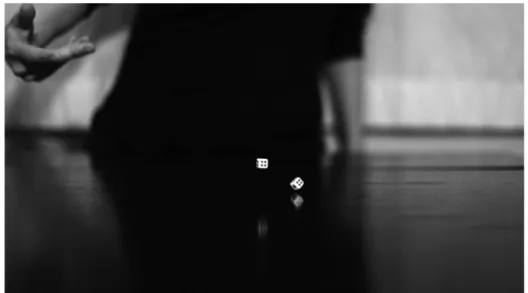
The overarching theme in the previous work discussed, namely Baldwin’s/Safoğlu’s exile, finds a match in Pekün’s expression of her non-belonging self in Of Dice and Men, as a tra-veller between two cities: Istanbul and London. This 40-minute work is designed as a bi-lingual22essayistic diary chronicling both major and minor events, encounters, and inci-dents that took place in these cities between 2011 and 2014. In thefilm Pekün narrates her own understanding and interpretation of this time-frame as an artist on the move, tra-velling back and forth, and seemingly observing what is around her, by herself and as an outsider (Figure 3).
Similar to the other two works discussed, the personal voice-over of the artist is de fini-tive in Of Dice and Men, functioning as a confessional track to provide the viewer with a guide to read the images. The voice-over is intimate, seemingly sharing a secret with the viewer. It offers a visualisation of that which is not on the screen, and reveals thoughts and comments that are invisible, or impossible to capture. The use of split screen and choices in framing and camera distance support this sense of intimacy because they allow the viewer to observe from a distance, yet seemingly beside the narrator. In this sense, the voice-over situates the viewer as the one addressed, as a silent companion, which differentiates this video’s style from the other examples, as they address the white dove and James Baldwin respectively, and the viewer only indirectly.
Of Dice and Men’s opening describes a moment in London’s underground, in which Pekün becomes interested in a girl who is with her brother and father, playing saz while singing. “I immediately thought, should I film them, or should I chat with them? My biggest dilemma,” she confesses “Should I film or not? If I film, I know for a fact that there is a great chance of me ruining that moment.” This confession not only exposes
Figure 2.Still from Off-White Tulips (2013) by Aykan Safoğlu.
22
Pekün switches from English to Turkish in the voice-over, according to where the memory took place or where the images were shot. The subtitles are always in the language that she is not using.
her obsession withfilming, and having her camera at her disposal all the time, but also lays out the self-reflexive form of the video.
The use of two screens is dominant throughout, reminding the viewer of the artist moving between two places during this time period. The sounds of the rolling dice and keyboard buttons enhance the sense of her distance from the subjects and the conse-quent anxiety—not as someone disinterested, but as someone who is split, who cannot be in both places at the same time. The rolling of the dice feels random, yet the keyboard buttons appear to control the moving images. These sounds return the viewer to the form of the video: these are sequences brought together by the artist as an interpretive rep-resentation of some of the most significant political and social events that took place in Turkey in recent years by way of actively experiencing and witnessing, as much as remem-bering, talking, reading, and hearing about them.
Pekün talks about the Roboski case that“ended with no prosecution. 34 people were murdered in the bombing—19 of them teenagers.” Soon after, she refers to car explosions in Reyhanlı, which led to “at least 46 dead and over a 100 injured.” Over the out-of-focus, black-and-white images of her throwing dice in the split screen, she speaks:“There was an immediate media blackout on all the reporting on Reyhanlı. The reason behind it, they say, we have to protect the public from distressing images, but we had already seen the whole truth on social media. We are kept in the dark.” The video then runs on in black, and is silent for a few seconds. This moment not only marks a climax in the violent events that happened up until 2013, but also acts as a signal for change and hope in the video’s tone.
“The most incredible things always happen when you are away,” Pekün’s voice continues thereafter. She hears about the Gezi protests through social media while in London.“I’m glued to the computer and people are determined to take Gezi Park back,” she says, perhaps regretful of not being there at the right time, pointing yet again to being in-between. The video’s self-reflexive form provides an alternative to actual experience. Putting hundreds of still images from the Gezi Park demonstrations into a sequence of
one frame at a time, Pekün asks,“When nothing is settled yet, and considering that some things are simply unrepresentable, how am I to edit these in a meaningful sequence?” While these pictures document a multiplicity of experiences from the Gezi protests, their editing points at the impossibility of capturing an actual event on film. Drawing from Deleuze, Marks writes,“a recollection-image embodies the traces of an event whose rep-resentation has been buried, but it cannot represent the event itself” (2000, 50). Marks emphasises the significance of recollection-images in creating collective memories; aroused by means of expressive and experimental uses, and partial in their representation, they tend to emphasise the many gaps between Information and Experience.23
Perhaps Pekün’s question about “unrepresentability” finds an answer in another anec-dote that is included in the video. She witnesses thefirst gay wedding in the UK, outside a church, as a random encounter. Over the images of the two husbands smiling at the gath-ered crowd, she says:“I was one of the dozens of cameras.” She goes on to quote one of the husbands:“Our event wasn’t compromised by the fact that it was a public event. They work well together, a moment in history and a personal moment.” A historical moment is also a personal moment by experience, which is what Pekün allows us to see through her essayistic choices in the video. These moments may not be representable as absolute, but each subjective viewpoint is significant with regard to understanding the significance of that moment. The split between London and Istanbul forms the backbone of Of Dice and Men; Pekün’s experiences shift according to where she is. The artist gives the viewer clues about the mishaps of her shifting subjective viewpoint; in thefinal words of her video she describes herself as someone “who ceaselessly changes language, changes SIM cards, changes humour, changes cities.”
Conclusion
The works analysed here engage with a multiplicity of meanings through the ambiguity of blending fact andfiction, and they are personal and critical readings of repressive environ-ments. They all utilise the unconstrained language of nonfiction film that does not require a systematic representation or recounting of things and events. The essayistic expressions in these works become markers of an artistic form that takes its source directly from real life events. These are all confessional works centring on the artist as subject. They raise questions related to identity, history, and memory, and although they stem from intimate experiences, they echo political causes and collective issues.
“We must remember in our seeing that we transcend and subtend the images we produce and allow ourselves to be produced by,” Sobchack writes (2004, 161). In the overlap of documentary and audiovisual art are found resistant modes of filmmaking, works that resist ideologies, modes of production, film styles, viewers, and authorities. Reading these works as accented essays not only uncovers their shared formal qualities, but also illuminates how these qualities evoke the gap between Experience and Infor-mation, unfolding aspects of Experience to turn them into public images, as Marks suggests (2008, 85). Only an embodied spectatorship24allows this process to take place, 23The use of capital letters is intentional, as this is how Marks (2008) uses these terms.
24
See Rascaroli (2008) and Marks (2000) on embodied spectatorship within the contexts of essay and interculturalfilm, respectively.
and images multiply and transform in this intellectual and emotional interaction between the viewer and the text.
Disclosure statement
No potential conflict of interest was reported by the author.
ORCID
Elif Akçalı http://orcid.org/0000-0002-7372-7468
References
Adorno, T. W. 2017.“The Essay as Form.” In Essays on the Essay Film, edited by N. M. Alter and T. Corrigan, 60–82. New York: Columbia University Press.
Akay, A.2008.“Threads of Progress Adhering to Modern Art in Turkey.” Third Text 22 (1): 99–104. Akçalı, E.2019.“Essayistic Tendencies in Contemporary Kurdish Filmmaking in Turkey.” Journal of
Film and Video 71 (1): 20–34.
Alter, N. M.2007.“Translating the Essay into Film and Installation.” Journal of Visual Culture 6 (1): 44–57.
Alter, N. M.2017. The Essay Film after Fact and Fiction. New York: Columbia University Press. Alter, N.M., and Corrigan, T., eds.2017. Essays on the Essay Film. New York: Columbia University Press. Aufderheide, P.2007. Documentary Film: A Very Short Introduction. Oxford: Oxford University Press. Bellour, R.2017.“The Cinema and the Essay as a Way of Thinking.” In Essays on the Essay Film, edited
by N. M. Alter and T. Corrigan, 227–39. New York: Columbia University Press.
Çakırlar, C.2011.“Queer Art of Parallaxed Document: The Visual Discourse of Docudrag in Kutluğ Ataman’s Never My Soul!” Screen 52 (3): 358–75.
Çakırlar, C.2013.“Aesthetics of Self-Scaling: Parallaxed Transregionalism and Kutluğ Ataman’s Art Practice.” Critical Arts: South-North Cultural and Media Studies 27 (6): 684–706.
Chanan, M. 2012.“The Role of History in the Individual.” In The Cinema of Me: The Self and Subjectivity in First-Person Documentary, edited by A. Lebow, 15–32. London: Wallflower Press.
Corrigan, T.2011. The Essay Film: From Montaigne, after Marker. London: Oxford University Press. Deleuze, G.2000. Cinema 2: The Time-Image. London: The Athlone Press.
Hansen, S.2012.“The Istanbul Art-Boom Bubble.” The New York Times Magazine, February, 40. Kahraman, H. B.2014. Contemporary Art in Turkey. Akbank Culture and Art Series: 81. Akbank. Karaca, B.2011.“Images Delegitimized and Discouraged: Explicitly Political Art and the Arbitrariness
of the Unspeakable.” New Perspectives on Turkey 45: 155–83.
Lebow, A.2007.“Worldwide Wigs: Kutluğ Ataman and Global Art Documentary.” The Arab Studies Journal 15/16 (2/1): 57–82.
Lopate, P.1992.“In Search of the Centaur: The Essay-Film.” The Threepenny Review 48: 19–22. Madra, B.2008.“The Hot Spot of Global Art: Istanbul’s Contemporary Art Scene and Its Sociopolitical
and Cultural Conditions and Practices.” Third Text 22 (1): 105–112.
Marks, L. U.2000. The Skin of the Film: Intercultural Cinema, Embodiment and the Senses. Durham: Duke University Press.
Marks, L. U.2008.“Experience – Information – Image: A Historiography of Unfolding. Arab Cinema as Example.” Cultural Studies Review 14 (1): 85–98.
Mulvey, L.2017.“Riddles as Essay Film.” In Essays on the Essay Film, edited by N. M. Alter and T. Corrigan, 314–21. New York: Columbia University Press.
Naficy, H.2001. An Accented Cinema: Exilic and Diasporic Filmmaking. Princeton: Princeton University Press.
Nichols, B.2001.“Documentary Film and the Modernist Avant-Garde.” Critical Inquiry 27 (4): 580–610. Nichols, B.2017. Introduction to Documentary. 3rd ed. Bloomington: Indiana University Press.
Özmen,Ş.2008.“Art on the Line … ” Third Text 22 (1): 113–21.
Papazian, E. A., and C. Eades, eds. 2016. The Essay Film: Dialogue, Politics and Utopia. New York: Wallflower Press.
Pekün, D.2016.“First-Person Molecular Subjectivities: Turkey and Turkishness.” PhD diss., Goldsmiths, University of London.
Rascaroli, L.2008.“The Essay Film: Problems, Definitions, Textual Commitments.” Framework 49 (2): 24–47.
Rascaroli, L.2009. The Personal Camera: Subjective Cinema and the Essay Film. London: Wallflower Press.
Rascaroli, L.2017. How the Essay Film Thinks. New York: Oxford University Press. Rees, A. L.2008. A History of Experimental Film and Video. London: BFI.
Smith, L.2005.“In Istanbul, Contemporary Art Blooms amid a Thousand Minarets.” The New York Times, August 28, TR12.
Sobchack, V.2004. Carnal Thoughts: Embodiment and Moving Image Culture. Berkeley: University of California Press.
Somhegyi, Z.2012.“On the Boom and Value of Contemporary Art Scene in Turkey.” Contemporary Practices: Visual Arts from the Middle East 12: 66–72.
Warren, C., ed.1996. Beyond Document: Essays on Nonfiction Film. Middletown: Wesleyan University Press.
Yardımcı, S.2004.“Meeting in Istanbul: Cultural Globalisation and Art Festivals”. PhD diss., Lancaster University.