ISSN 1015 • 3918
ANKARA ÜNİVERSİTESİ
ECZACILIK FAKÜLTESİ
DERGİSİ
JOURNAL OF FACULTY OF PHARMACY
OF
ANKARA UNIVERSITY
Cilt/Vol : 3 1
Sayı /No : 4
Yıl/Year: 2002
ANKARA ÜNİVERSİTESİ
ECZACILIK FAKÜLTESİ
DERGİSİ
JOURNAL OF FACULTY OF PHARMACY
OF
ANKARA UNIVERSITY
Cilt/Vol : 31
Sayı/No : 4
Yıl/Year : 2002
Ankara - 2002
ANKARA ÜNİVERSİTESİ ECZACILIK FAKÜLTESİ DERGİSİ
(Ankara Ecz, Fak. Derg.) Sahibi: Prof. Dr. Seçkin ÖZDEN Editör : Prof. Dr. Feyyaz ONUR Danışma Kurulu:
Asuman KARAKAYA Peter J. HOUGHTON John S. DAVIES Diana ANDERSON Peter Christian SCHMIDT Henry R, BESCH
Muzaffer TUNCEL Yusuf ÖZTÜRK
Ayşegül DEMİRHAN ERDEMİR İhsan ÇALIŞ
Toru OKUYAMA
Muhammad Iqbal CHOUDARY Thomas J.SCHMJDT Jack WOOLLEY Henk TIMMERMANN Sevil AŞICI Meral TORUN Esin ŞENER Maksut COŞKUN Nurşin GÖNÜL Nurten ALTANLAR
(Ankara Üniversitesi, Ankara, Türkiye) (Kings College, Londra, İngiltere) (University of Wales, Swansea, İngiltere) (University of Bradford, Bradford, İngiltere) (Eberhard-Karls Universitaet, Tubingen, Almanya) (Indiana University, Indianapolis, USA)
(Anadolu Üniversitesi, Eskişehir, Türkiye) (Anadolu Üniversitesi, Eskişehir, Türkiye) (Uludağ Üniversitesi, Bursa, Türkiye) (Hacettepe Üniversitesi, Ankara, Türkiye)
(Meiji Pharmaceutical University, Tokyo, Japonya) (University of Karachi, Karachi, Pakistan)
(Universitaet Dusseldorf, Dusseldorf, Almanya) (Leiceister University, Leiceister, İngiltere) (Vrije Universiteit, Amsterdam, Hollanda) (Ege Üniversitesi, İzmir, Türkiye)
(Gazi Üniversitesi, Ankara, Türkiye) (Ankara Üniversitesi, Ankara, Türkiye) (Ankara Üniversitesi, Ankara, Türkiye) (Ankara Üniversitesi, Ankara, Türkiye) (Ankara Üniversitesi, Ankara, Türkiye)
Ankara Üniversitesi Eczacılık Fakültesi Dergisi farmasötik bilimler alanındaki önemli gelişmeleri içeren orijinal araştırmalar, derlemeler ve kısa bildiriler için uluslararası bir yayın ortamıdır. Bu dergi yılda 4 sayı yayınlanır. Yayımlanan yazıların sorumluluğu yazar(lar)ına aittir. Dergiye gönderilen makalelerin daha önce tamamen veya kısmen başka bir yerde yayınlanmamış veya yayını için başka bir yere başvuruda bulunulmamış olması gereklidir. Makaleler derginin arka sayfalarında yer alan yazım kurallarına uymalıdır.
Bu dergi, Chemical Abstracts (CA), Excerpta Medica Database (EMBASE),Medicinal Aromatic Plants Abstracts (MAPA) ve Türk Tıp Dizini 'nde indekslenmektedir.
Web adresi: www.pharmacy.ankara.edu.tr/journal Yazışma adresi:
Prof. Dr. Feyyaz ONUR
Ankara Üniversitesi, Eczacılık Fakültesi, Analitik Kimya Anabilim Dalı, 06100 Tandoğan - Ankara, e-mail: [email protected] Tel: (0312) 212 68 05, fax: (0312) 213 10 81
Editör Yardımcıları:
- Doç. Dr. Gülbin ÖZÇELİKAY
- Doç. Dr. İlkay YILDIZ ÖREN e-mail: [email protected] e-mail: [email protected] Ankara Üniversitesi Basımevi
JOURNAL OF FACULTY OF PHARMACY OF ANKARA UNIVERSITY
(J. Fac.Pharm. Ankara) Published by : Prof. Dr. Seçkin ÖZDEN
Editor : Prof. Dr. Feyyaz ONUR Editorial Board:
Asuman KARAKAYA Peter J. HOUGHTON John S.DAVIES Diana ANDERSON Peter Christian SCHMIDT Henry R. BESCH
Muzaffer TUNCEL Yusuf ÖZTÜRK
Ayşegül DEMİRHAN ERDEMİR İhsan ÇALIŞ
Toru OKUYAMA
Muhammad Iqbal CHOUDARY Thomas J.SCHMIDT Jack WOOLLEY Henk TIMMERMANN Sevil AŞICI Meral TORUN Esin ŞENER Maksut COŞKUN Nurşin GÖNÜL Nurten ALTANLAR
(Ankara University, Ankara, Turkey) (Kings College, Londra, U.K.) (University of Wales, Swansea, U.K.) (University of Bradford, Bradford, U.K.)
(Eberhard-Karls Universitaet, Tubingen, Germany) (Indiana University, Indianapolis, USA)
(Anadolu University, Eskişehir, Turkey) (Anadolu University, Eskişehir, Turkey) (Uludağ University, Bursa, Turkey) (Hacettepe University, Ankara, Turkey)
(Meiji Pharmaceutical University, Tokyo, Japan) (University of Karachi, Karachi, Pakistan) (Universitaet Dusseldorf, Dusseldorf, Germany) (Leiceister University, Leiceister, U.K.)
(Vrije Universiteit, Amsterdam, The Netherlands) (Ege University, İzmir, Turkey)
(Gazi University, Ankara, Turkey) (Ankara University, Ankara, Turkey) (Ankara University, Ankara, Turkey) (Ankara University, Ankara, Turkey) (Ankara University, Ankara, Turkey)
Journal of Faculty of Pharmacy of Ankara University is an international medium for the publication of original research reports, reviews and short communications on relevant developments in pharmaceutical sciences. This journal is published quarterly. All the articles appeared in this journal are published on the responsibility of the author(s). The manuscript submitted to the journal should not be published previously as a whole or in part and not be submitted elsewhere. The manuscripts should be prepared in accordance with the requirements specified at the end of the issue.
This journal is indexed in Chemical Abstracts (CA), Excerpta Medica Database (EMBASE), Medicinal Aromatic Plants Abstracts (MAPA) and Turkish Medical Index
Web address : www.pharmacy.ankara.edu.tr/journal Editorial correspondence:
Prof. Dr. Feyyaz ONUR
Ankara University, Faculty of Pharmacy, Department of Analytical Chemistry, 06100 Tandoğan - Ankara, TURKEY, e-mail: [email protected] Tel: +90 312 212 68 05, F a x : + 9 0 312 213 10 81
Editorial assistants:
- Assoc. Prof. Dr. Gülbin ÖZÇELİKAY - Assoc. Prof. Dr. İlkay YILDIZ ÖREN
e-mail: [email protected] e-mail: [email protected] Ankara Üniversitesi Basımevi
İÇİNDEKİLER/CONTENTS
Sayfa
Orjinal Makaleler/ Original Articles
Süreyya ÖLGEN, Doğu NEBİOĞLU • Evaluation of indole • 2 • carboxylic acid esters as anti •
HIV agents -Indol -2- karboksilik asit esterlerinin anti-HIV ajanlar olarak değerlendirilmesi, 215
Uthman M. DAWOUD, Ali DİŞLİ, Yılmaz YILDIRIR, B. Zühtü UYSAL • Structural elucidation
of jojoba plant (Simwondsk Chinmis) oil from Saudia Arabia • Suudi Arabistan'da
yetişen Jojoba bitkisi (Simmondsia Chinensis) den elde edilen yağın yapısının aydınlatılması. 223
Filiz KUZ, Gülbin ÖZÇELİKAY • Eczacılık eğitiminde toplam kalite yönetimi uygulanabilirliği
II-Ankara'daki Eczacılık Fakültesi öğrencilerinin Fakülte ortamı, Fakülte Şartları ve
Üniversite bilinci hakkında değerlendirmeleri • Applicability of total quality management
in pharmacy education -II- The evaluation about faculty environment, condition of the
faculty and university conciousness by the pharmacy students in Ankara. 231
Valentina PETKOVA, Zlarka DIMITROVA - The assessment of the pharmacy patients compliance
in Bulgaria • Bulgaristan'da eczaneye başvuran hastaların uyunç değerlendirmesi. 251
Şebnem Ş. ÇEÇEN, Gülhan CENGİZ, Tülin SÖYLEMEZOĞLU • The protective effects of
N-acetylcysteine in paraquat-induced toxicity • Paraquat toksisitesinde N-asetilsisteinin
koruyucu etkisi. 259
Derlemeler/Reviews
Ö. Nazan ERDOĞAN • Sağlık hizmetlerinin bir konusu: Plasebo ve plasebo etkiler
Ankara Ecz. Fak. Derg. 31 (4)215-221,2002
J. Fac. Pharm, Ankara 31 (4)215-221,2002
E V A L U A T I O N O F INDOLE-2-CARBOXYLIC A C I D E S T E R S A S ANTI-HIV A G E N T S
Süreyya ÖLGEN Doğu NEBİOĞLU
University of Ankara, Faculty of Pharmacy, Department of Pharmaceutical Chemistry, 06100 Tandoğan, ANKARA-TURKEY
ABSTRACT
The indole esters, which were previously synthesized for inhibition of cyclooxygenase-2 (COX-2), were evaluated for their anti-HIV activities. Among these compounds 4 and 27 were found slightly active against HIV without any cytotoxicity.
Key Words: Indole esters; Anti-HIV activity; Cytotoxicity ÖZET
Daha önce siklooksigenaz-2 (COX-2) enziminin inhibisyonu için sentezlenen indol esterleri, anti-HIV aktiviteleri için değerlendirilmiştir. Bileşik 4 ve 27, sitotoksisiteleri olmaksızın az da olsa HlV'ye karşı aktif bulunmuşlardır.
Anahtar Kelimeler: İndol esterleri; Anti-HIV aktivitesi; Sitotoksisite
INTRODUCTION
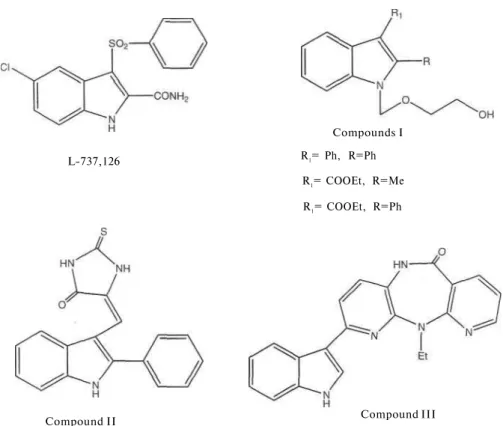
A number of diverse indole derivatives such as; 5-chloro-3-(phenylsulfonyl)indole-2-carboxamide (L-737,126) (1), l-(2-hydroxyethoxy)methylindoles (compounds I) (2) and 5-(2-phenyl-3'-indolal)-2-thiohydantoin (compound II) have been shown to have potent anti-HIV activity (human immunodeficiency virus) (3). The structural formula of these compounds are shown in Figure 1. In clinical settings, non-nucleoside class inhibitors of reverse transcriptase (RT) such as nevirapine, have been shown resistant and thus require that this class of inhibitors should be used in combination with other drugs (4). Recent studies were focused on the elimination of the resistance problem against RT mutant. The changing of 2-pyrrolyl substituent to larger rings such as indole on the nevirapine derivatives (compound III) (Figure 1) demonstrated the activity against several clinically relevant forms of HIV-1 reverse transcriptase (5).
216 Süreyya ÖLGEN, Doğu NEBİOĞLU
L-737,126
Compounds I
R1= COOEt, R=Me
R1= COOEt, R=Ph
Compound II Compound III
Figure 1: Indole-based molecules with anti-HIV activity.
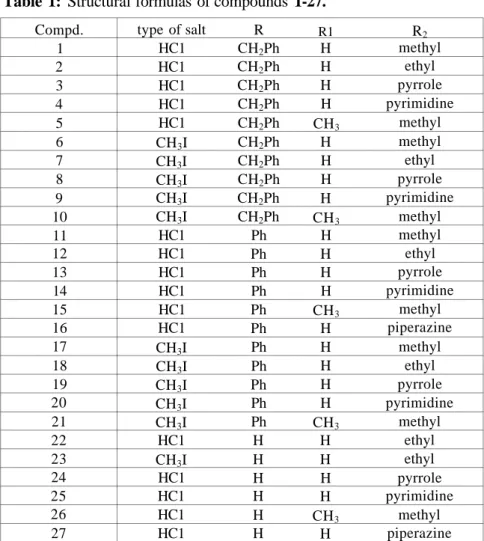
In connection with our research project on indole derivatives, it was noteworthy for evaluating anti-HIV activities of previously synthesized indole esters (6). The formula of tested compounds are shown in Table 1.
Ankara Ecz. Fak. Derg., 31 (4) 215-221, 2002 217
Table 1: Structural formulas of compounds 1-27.
Compd. 1 2 3 4 5 6 7 8 9 10 11 12 13 14 15 16 17 18 19 20 21 22 23 24 25 26 27 type of salt HC1 HC1 HC1 HC1 HC1 CH3I CH3I CH3I CH3I CH3I HC1 HC1 HC1 HC1 HC1 HC1 CH3I CH3I CH3I CH3I CH3I HC1 CH3I HC1 HC1 HC1 HC1 R CH2Ph CH2Ph CH2Ph CH2Ph CH2Ph CH2Ph CH2Ph CH2Ph CH2Ph CH2Ph Ph Ph Ph Ph Ph Ph Ph Ph Ph Ph Ph H H H H H H R1 H H H H CH3 H H H H CH3 H H H H CH3 H H H H H CH3 H H H H CH3 H R2 methyl ethyl pyrrole pyrimidine methyl methyl ethyl pyrrole pyrimidine methyl methyl ethyl pyrrole pyrimidine methyl piperazine methyl ethyl pyrrole pyrimidine methyl ethyl ethyl pyrrole pyrimidine methyl piperazine
MATERIALS AND METHODS
Candidate compounds were dissolved in dimethylsulfoxide and diluted 1:100 in cell
culture medium before preparing serial half-log
10dilutions. T4 lymphocytes (CEM cell line)
were added and after a brief interval HIV-1 was added, resulting in a 1:200 final dilution of the
compound. Uninfected cells with the compounds served as the toxicity control, and infected and
uninfected cells without the compounds served as basic controls. Cultures were incubated at
37°C in a 5% carbon dioxide atmosphere for 6 days. The tetrazolium salt, (XTT) was added to
all wells, and cultures were incubated to allow formazon colour development by viable cells.
Individual wells were analyzed spectrophotometrically to quantitate formazon production and
were viewed by microscopy for detection of viable cells and confirmation of protective activity.
Drug-treated virus-infected cells were compared with drug-treated noninfected cells and with
other appropriate controls on the same plate. Data were reviewed in comparison with other tests
carried on at the same time and the activity was determined.
218 Süreyya ÖLGEN, Doğu NEBİOĞLU
RESULTS AND DISCUSSION
The procedure used in the National Cancer Institute's test for the agents active against human immunodeficiency virus (HIV) is designed to detect agents acting at any stage of the virus reproductive cycle (7). The assay basically involves the killing of T4 lymphocytes by HIV. Small amounts of HIV are added to cells, and two cycles of virus reproduction are necessary to obtain the required cell killing. Agents that interact with virions, cells or virus gene-products to interfere with viral activities will protect cells from cytolysis. The system is automated in several features to accommodate large numbers of candidate agents and is generally design to detect anti-HIV activity. However, compounds that degenerate or are rapidly metabolized in the culture conditions may not show activity in the screen. All tests are compared with at least one positive AZT-treated control, which was done at the same time under the identical conditions.
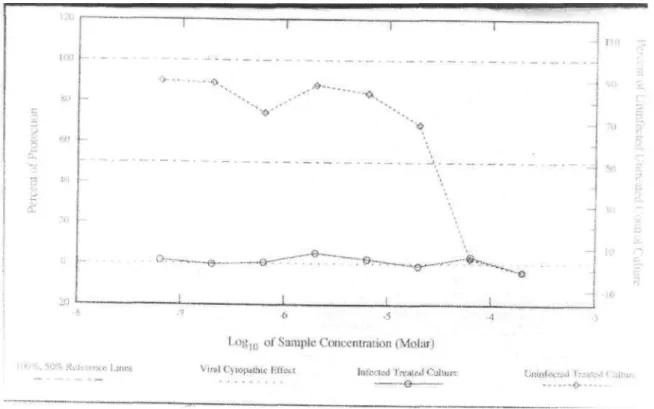
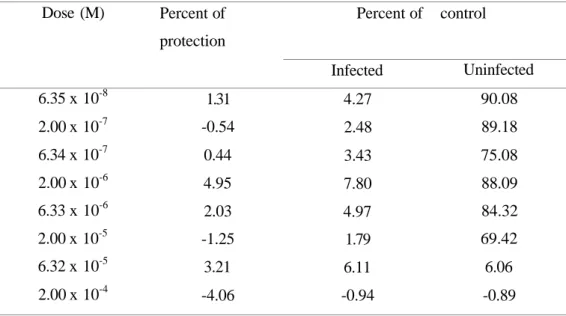
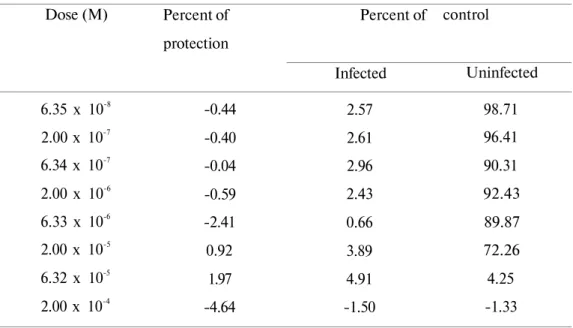
The anti-HIV assay of indole esters showed that compounds 4 and 27 were slightly active anti-HIV agents without any cytotoxicity. In vitro anti-HIV screening results of compounds 4 and 27 are shown in Figures 2 and 3 and activity against HIV-1 and growth inhibitory properties were placed in Tables 2 and 3 respectively.
Ankara Ecz. Fak. Derg., 31 (4) 215-221, 2002 219
Figure 3: In vitro anti-HIV screening of compound 27.
Table 2: Activity against HIV-1 and growth inhibitory properties of compound 4.
Dose (M)
6.35 x 10
-82.00 x 10
-76.34 x 10
-72.00 x 10
-66.33 x 10
-62.00 x 10
-56.32 x 10
-52.00 x 10
-4Percent of
protection
1.31
-0.54
0.44
4.95
2.03
-1.25
3.21
-4.06
Percent of
Infected
4.27
2.48
3.43
7.80
4.97
1.79
6.11
-0.94
control
Uninfected
90.08
89.18
75.08
88.09
84.32
69.42
6.06
-0.89
220 Süreyya ÖLGEN, Doğu NEBİOĞLU
Table 3: Activity against HIV-1 and growth inhibitory properties of compound 27.
Dose (M) 6.35 x 10⁻⁸ 2.00 x 10⁻⁷ 6.34 x 10⁻⁷ 2.00 x 10⁻⁶ 6.33 x 10⁻⁶ 2.00 x 10⁻⁵ 6.32 x 10⁻⁵ 2.00 x 10⁻⁴ Percent of protection -0.44 -0.40 -0.04 -0.59 -2.41 0.92 1.97 -4.64 Percent of Infected 2.57 2.61 2.96 2.43 0.66 3.89 4.91 -1.50 control Uninfected 98.71 96.41 90.31 92.43 89.87 72.26 4.25 -1.33
None of the other derivatives was active and did not exhibit a rather strong cytotoxicity. According to the biological activity result, it can be concluded that N-substitution of indole ring is not important for anti-HIV activity since compound 27 does not have substitution on one position of indole structure. Furthermore, the cyclic groups such as pyrrolidine and piperazine, which constitute the side chain of indole-2-carboxylic acid esters, might have increased the anti-HIV activity of the compounds. Despite these results, the series of compounds presented in this work demonstrated the possibility of modifying indole derivatives that show activity against HIV virus.
ACKNOWLEDGMENTS
This work was supported in part by a grant from the Turkish Scientific and Technical Research Institute (SBAG-AYD-108).
We thank to Dr. V.L. Narayanan (Drug synthesis & Chemistry Branch of National Cancer Institute-U.S.A.) for performing anti-HIV activity tests.
Ankara Ecz. Fak. Derg., 31 (4)215-221,2002 221
REFERENCES
1. Williams, T.M., Ciccarone, T.M., MacTough, S.C., Rooney, C.S., Balani, S.K., Condra, J.H., Emini, E.A., Goldman, M.E., Greenlee, W.J., Kauffman, L.R., O'Brien, J.A., Sardana, V.V., Schleif, W.A., Theoharides, A.D., Anderson, P.S. "5-Chloro 3
(phenylsulfonyl)indole-2-carboxamide: A Novel, Non-Nucleoside Inhibitor of HIV-1 Reverse Transcriptase", J. Med. Chem. 36, 1291-1294 (1993)
2. Almerico, A.M., Barraja, P., Diana, P., Cirrincione, G., Mingoia, F., Musiu, C, Perra, G., Putzolu, M., Marongiu, M.E. "Glycosidopyrroles Part 3. Effect of the
benzocondensation on acyclic derivatives: l-(2-hydroxyethoxy)methylindoles as potential antiviral agents", IL Farmaco, 53, 409-414 (1998)
3. Suzen, S., Buyukbingol, E. "Evaluation of anti-HIV activity of 5-(2-phenyl-3'-indolyl)-2-thiohydantoin", IL Farmaco, 53, 525-527 (1998)
4. Murphy, R., Montaner, J. "Nevirapine: a review of its development, pharmacological
profile and potential for clinical use", Exp. Opin. Invest. Drugs, 5, 1183-1199 (1996)
5. Kelly, T.A., McNeil, D.W., Rose, J.M., David, E., Shih, C.-C, Grob, P.M. Novel
non-nucleoside inhibitors of human immunodeficiency virus type 1 reverse transcriptase. 6. 2-indol-3-yl- and 2-aza2-indol-3-yl-dipyridodiazepinones", J. Med. Chem. 40, 2430-2433 (1997)
6. Olgen, S., Akaho, E., Nebioğlu, D. "Synthesis and receptor docking studies of /V-substituted
indole-2-carboxylic acid esters as a search for COX-2 selective enzyme inhibitors", Eur. J. Med. Chem. 36, 747-770 (2001)
7. Weislow, O.W., Kiser, R., Fine, D., Bader, J., Shoemaker, R.H., Boyd, M.R.
"New soluble-formazon assay for HIV-1 cytopathic effects: application to high-flux screening of synthetic and natural products for AIDS-antiviral activity", J. Natl. Cancer Inst. 81, 577-586(1988)
Başvuru Tarihi: 12.07.2002 Kabul Tarihi: 05.08.2002