J
ournal of
F
isheries
S
ciences.com
ISSN 1307-234X© 2009
www.fisheriessciences.com
RESEARCH ARTICLE ARAŞTIRMA MAKALESİ
AGE AND GROWTH, REPRODUCTION AND DIET OF
THE BLACK GOBY, (GOBIUS NIGER) FROM
AEGEAN SEA, TURKEY
Halit Filiz
1∗, Melahat Toğulga
21 Mugla University, Faculty of Fisheries, Department of Hydrobiology, Kotekli, Mugla, Turkey 2 Ege University, Faculty of Fisheries, Department of Hydrobiology, Bornova, Izmir, Turkey
Abstract:
Black gobies, Gobius niger L., 1758, were sampled monthly between March 2003 and Febru-ary 2004 in Izmir Bay involving 1149 specimens. Length distribution varied between 5.1 and 15.2 cm total length. Age determined from direct reading on otoliths was comprised from zero to five years. There were significant differences in mean lengths at age group for the two sexes, which did not allow the use of combined data. The parameters of the fitted Von Bertalanffy growth equation (with seasonal component, birth date on the 1st of January) were L∞= 16.69 cm, k= 0.301 yr-1, t
0= -2.205 for males, and L∞= 14.84 cm, k= 0.321 yr-1, t0= -1.459 for fe-males. Macroscopic examination of the gonads, and analysis of the monthly values of the go-nadosomatic index, indicated that reproduction starts in March and lasts during October, with a maximum in March, followed by August and October. Individuals become sexually mature around 7.80 cm TL (a size that can be reached in less than 1 year) for females. In this popula-tion, the sex ratio (male:female) was 3.6:1. Stomach contents were mainly Mollusca (%IRI= 47.53), Crustacea (%IRI= 42.94), Polychaeta (%IRI= 8.26), Foreminifera (%IRI= 1.14) and Teleostei (%IRI= 0.13).
Keywords: Age and growth; reproduction; feeding; black goby; Gobius niger; Aegean Sea
*Correspondence to: Halit FİLİZ, Mugla University, Faculty of Fisheries, Department of Hydrobiology, 48000 Kotekli-Mugla-–TURKEY
Introduction
The black goby is widely distributed in Eastern Atlantic and Mediterranean Sea (include Black Sea), throughout North Africa from Cape Blanc, Mauritania north and eastwards to the Suez Canal; also along the eastern Atlantic coast northwards to Trondheim (Norway) and Baltic Sea (Miller, 1986). It can be found on sandy and muddy bot-toms, in depth between 2 and 70 m (Hureau & Monod, 1973, Vesey & Langford, 1985). Also, it is able to live in brackish water down to %o 6 S (Vaas et al., 1975). This species is distributed on all coasts of Turkey (Bilecenoglu et al., 2002).
There are numerous studies about its abun-dance, distribution and habitat selection (Claridge et al., 1986; Wiederholm, 1987; Costello, 1992; Koutrakis et al., 2000; Gordo & Cabral, 2001; Letourneur et al., 2001; Malavasi et al., 2005), biology (Vaas et al., 1975; Fabi & Froglia, 1984; Vesey & Langford, 1985; Doornbos & Twisk, 1987; Arruda et al., 1993; Silva & Gordo, 1997; Bouchereau & Guelorget, 1998), growth (Fabi & Giannetti, 1985), feeding ecology and behavior (Casabianca & Kiener, 1969; McGrath, 1974; Fabi & Froglia, 1983; Magnhagen, 1988; Fernan-dez et al., 1995; Labropoulou & Markakis, 1998; Labropoulou & Papadopoulou-Smith, 1999), reproductive biology (Bonnin, 1971a, 1971b, 1975, 1977, 1981, 1984, 1989; Bonnin & Croizet, 1972, 1973; Holt & Byrne, 1988; Magnhagen, 1990, 1991; Joyeux et al., 1991b, 1992; Mar-conato et al., 1996; Pampoulie et al., 1999; Loca-tello et al., 2002; Mazzoldi & Rasotto, 2002; Pi-lastro et al., 2002; Rasotto & Mazzoldi, 2002; Immler et al., 2004; Mazzoldi et al., 2005; Scag-giante et al., 2005), genetic (Colombera & Ra-sotto, 1982; Vitturi & Catalano, 1989; Hoeglund & Thomas, 1992; Zander & Kesting, 1998; Sorice & Caputo, 1999; Mandrioli et al., 2001), parasites (Leiro et al., 1984; Loubes et al., 1984; Dezfuli et al., 1992; Zander, 2003; Kvach, 2005), and envi-ronmental effects and pollution (Bouchereau, 1997; Cunha & Antunes, 1999; Pampoulie et al., 2001; Antunes & Cunha, 2002; Arcos et al., 2002; Katalay & Parlak, 2002, 2004a, 2004b; Carnevali & Maradonna, 2003; Maradonna et al., 2004; Katalay et al., 2005; Migliarini et al., 2005). Also,
no commercial value in Turkey, probably, fisher-ies biologists did not give enough attention of its biology. However, this species has important ecologic values. Black goby is one of the species that used in monitoring pollution (as an indicator species) (Katalay & Parlak, 2002). Also, this spe-cies has an important role in the food chain in Izmir Bay (Bilecenoglu, 2003).
This paper provides the first information on the black goby, an important species of the Izmir Bay, in Aegean Sea, specifically on its age, growth, reproduction and feeding.
Material and Methods
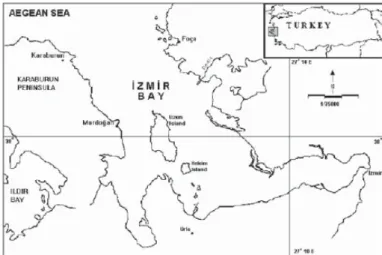
Izmir Bay is situated at the western coast of the Anatolian peninsula, and is connected to the Ae-gean Sea. The bay is roughly ‘‘L’’ shaped. The leg of the ‘‘L’’ is about 20 km wide and 40 km long and the base of the ‘‘L’’ is about 5–7 km wide and 24 km long (Figure 1). The Izmir Bay has been divided into three areas according to their physical characteristics. These are Outer, Middle and Inner Bay (Sayin, 2003).
Figure 1. Map showing the location of the Izmir
Bay.
All kind of fisheries activity is prohibited in inner part of Izmir Bay because it has highly pol-luted by both domestic and industrial wastes. Also, southeast part of the line combined Ardıç Cape (38° 31' 58" N - 26° 37' 22" E) and Deve-boynu (38° 39' 24" N - 26° 43' 42" E) is
prohib-(Metin et al., 2000). Main fisheries activity in the Bay rely on pelagic fish stocks (sardine, anchovy, mackerel, etc.) (Cihangir et al., 1999). There is no statistical data about caught fish amount in Izmir Bay (Bilecenoglu, 2003). Therefore, Kara & Gur-bet (1999) reported that there is totally 2256 boat in the Bay and nearly 20000 tones fish caught yearly.
Izmir Bay was sampled monthly between March 2003 and February 2004. Specimens ob-tained via trawl (n= 78), and fishing line (n= 1071). Trawl specimens were sampled by R/V EGESUF (27 m length and 463 HP). A conven-tional bottom trawl net of 22 mm cod-end mesh size was used and three hauls in same day were carried out and haul durations stabilized 30 min-utes. The vessel speed was maintained at 2.5 knots. Depth of the fishing ground was 30 m. fishing line sampling carried out in first, middle and last weeks of every month. A fishing line named “sinek oltasi” was used (no. 18 needle, 0.20 mm main body and 25 g lead weight). Fish were caught in the Izmir Bay (where they abun-dant) in three locations between 09:00 and 12:00 a.m. (Table 1). All the specimens were injected to abdomen region with 4% alcohol and frozen.
In the laboratory, the total length of all indi-viduals was measured to the nearest millimeter below (later grouped in 1.0 cm length classes) and weighed to the nearest 0.01 g total weight. Sex was recorded and the gonads were weighed to the nearest 0.001 g (in the males, sperm-duct gland was not included in the gonadal weight). Sagittal otoliths were removed, cleaned, dried and stored in labeled plastic tubes.
For age determination, the otoliths of speci-mens were examined under a stereoscope micro-scope with a reflected light (x14 magnification). The otoliths were read by three readers and when there was no agreement among the three readings, the otolith was excluded. Age was expressed in years, the birthday of the fish being considered to be 1 January.
The mean lengths at age were analyzed sepa-rately per sex and were compared statistically using Student’s t test (p>0.05).
To examine fish growth, a von Bertalanffy growth equation (VBGE) was calculated using the iterated least square method (Sparre et al., 1989).
W = ln a + b ln L. Parameters a and b were cal-culated by least-squares regression, as was the
coefficient of determination (r2). Significant
dif-ference of b values from 3, which represent iso-metric growth, was tested with the t-test (Pauly, 1993).
To quantify the changes that occurred in the gonads during the annual sexual cycle and to de-termine the spawning season, the gonadosomatic index (GSI) (expressing gonadal weight as a per-centage of total weight minus gonadal weight) (King, 1995) was calculated, between March 2003 and January 2004, monthly and per sex, their mean values being calculated from the individual ones. In order to determine first sexual maturation length and age, a logistic curve equation was used (King, 1995):
P = 1 / (1 + exp[ -r (L - Lm)])
here, P, proportion of mature individuals; r, slope of curve; L, total length, and Lm, mean length at maturity length or mean length of individuals where 50% of population is reproduced.
Sex ratio (males/females) was calculated by age.
Prey items in each stomach were identified to group level, measured, counted and weighed on an electronic balance (precision 0.0001 g). Diet composition was evaluated using three measures described by Hyslop (1980): the numerical index (%N); the gravimetric index (%W), and frequency of occurrence (%O). Based on Cortes' (1997) sug-gestion, the index of relative importance (IRI) was calculated and expressed as a percentage (%IRI). Subsequently, food items were grouped into cate-gories of preference using the method proposed by Morato et al. (1998) and described by Sever et al. (2008). The categories were defined as fol-lows:
IRI≥ 30*(0.15*∑%O) main important prey (MIP) 30*(0.15*∑%O)>IRI>10*(0.05*∑%O) -
secondary prey (SP)
Table 1. Coordinates, depth and floor structure of stations where samples
taken (M: muddy; S: sandy; St: Stony; G: grassy)
Method Coordinates Depth (m) Floor
Trawl 38º 26’ N 25º 40’ E / 38º 27’ N 26º 40’ E 30-30 M-S Line
38º21’946N 26º46’307E 2 M-S
38º21’960N 26º46’277E 1 S
38º21’964N 26º46’258E 1.5-2 St-G
Results and Discussion
Age and growth
The mean values of temperature recorded for the bay during the sampling period are shown in Figure 2. The lowest value of tem-perature (11.3°C) was found in February 2004 and the highest (27.8 °C) in August 2003.
Table 2 shows the descriptive statistics re-garding length and weight data of all and sexed individuals.
Among the 1149 black goby which were otolith’s taken, 49 individuals could not be aged since both there were undetermined specimens (n= 26) and there was no agreement between readers (n= 23). Thus, 865 (78.6%) males and 235 (21.4%) females were used for direct reading on otoliths (Table 3 and 4).
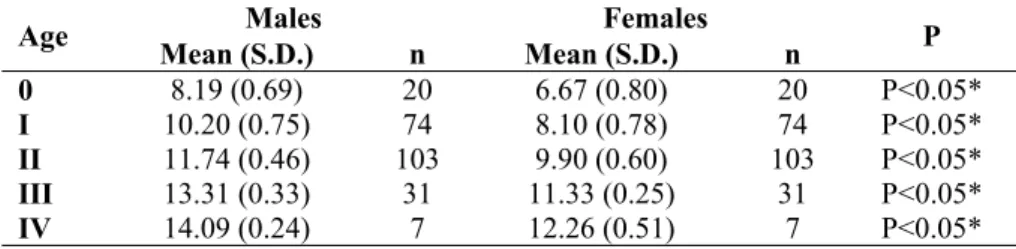
The length range by age group for both males and females was different. Application of the Student’s t-test to the mean lengths and standard deviations per age groups showed that there was significant difference between sexes (Table 5). The test was not applied to both males and females of age V because there was no female in this age. So, results from direct reading on the otoliths were not pooled, and calculations were made by sex separately.
To describe the growth of the black goby population found in Izmir Bay, a VBGE, based on the males and females data, was established (Table 6).
The length-weight relationships were cal-culated for each sex (Table 7).
13.7 15.3 20.7 24.5 27.7 27.8 25 21.6 17.5 13.2 12.6 11.3 0 5 10 15 20 25 30 Mar .03 Apr. 03 May0 3 Jun. 03 Jul.0 3 Aug. 03 Spt.0 3 Oct.0 3 Nov. 03 Dec. 03 Jan. 04 Feb. 04 T e m p er at u re ( °C )
Table 2. Descriptive statistics of length and weight data of
specimens obtained from Izmir Bay (Values given are the mean ± SD and range in parenthesis).
Sex n Total Length (cm) Total Weight (g) ♂+♀ 1149 [5.1 – 15.2] 11.27±1.62 [1.42 – 39.02] 16.57±6.73
♂ 865 [5.1 – 15.2] 11.65±1.50 [1.42 – 39.02] 18.16±6.49 ♀ 258 [5.3 – 14.0] 9.97±1.24 [1.46 – 28.07] 11.19±4.19 Undetermined 26 10.08 ± 1.88 [6.2 – 13.2] [2.16 – 28.12] 12.54±6.02
Table 3. Results from direct reading on the otoliths of males G. niger from
Izmir Bay. Age expressed in years.
TL (cm) 0 I II III IV V Ages Total
5.0-5.9 1 1 6.0-6.9 7.0-7.9 17 17 8.0-8.9 28 1 29 9.0-9.9 6 51 57 10.0-10.9 121 9 130 11.0-11.9 39 197 236 12.0-12.9 203 16 219 13.0-13.9 137 5 142 14.0-14.9 28 4 32 15.0-15.9 2 2 n 52 212 409 153 33 6 865 Mean 8.18 10.34 11.93 13.29 14.14 14.78 S.D. 0.76 0.63 0.53 0.33 0.23 0.43 % 6.0 24.5 47.3 17.7 3.8 0.7 100.0
Table 4. Results from direct reading on the otoliths of females G. niger
from Izmir Bay.
TL (cm) 0 I II III IV Ages Total
5.0-5.9 3 3 6.0-6.9 8 8 7.0-7.9 9 26 35 8.0-8.9 34 34 9.0-9.9 14 53 67 10.0-10.9 47 47 11.0-11.9 3 27 30 12.0-12.9 4 6 10 13.0-13.9 1 1 n 20 74 103 31 7 235 Mean 6.67 8.10 9.90 11.33 12.26 - S.D. 0.80 0.78 0.60 0.25 0.51 - % 8.5 31.5 43.8 13.2 3.0 100.0
Table 5. Results of the application of the Student’s t test to the mean
lengths per age group for males and females G. niger from Iz-mir Bay.
Age Mean (S.D.) Males Females n Mean (S.D.) n P 0 8.19 (0.69) 20 6.67 (0.80) 20 P<0.05* I 10.20 (0.75) 74 8.10 (0.78) 74 P<0.05* II 11.74 (0.46) 103 9.90 (0.60) 103 P<0.05* III 13.31 (0.33) 31 11.33 (0.25) 31 P<0.05* IV 14.09 (0.24) 7 12.26 (0.51) 7 P<0.05* * indicates significant importance
Table 6. Growth parameters of G. niger in Izmir Bay.
Sex n L∞ (cm) k to Φ ́
♂ 865 16.69 0.301 – 2.205 1.92
♀ 235 14.84 0.321 – 1.459 1.85
Table 7. Descriptive statistics and estimated parameters of the length–weight
relationship for G. niger collected from Izmir Bay of the eastern Aegean Sea, Turkey. Lmin – Lmax = minimum and maximum lengths (cm); Wmin – Wmax = minimum and maximum weights (g); C.I = confidence intervals; a = intercept of the relationship; b =
slope of the relationship; r2= coefficient of determination; n =
sample size.
Sex n Lmin – Lmax Wmin – Wmax a b ± 95%C.I. W = aLb r2 Growth Type
♂ 865 5.1 – 15.2 1.42 – 39.02 0.0169 2.82 ± 0.06 0.91 A(-) ♀ 258 5.3 – 14.0 1.46 – 28.07 0.0197 2.74 ± 0.13 0.88 A(-) ♂ + ♀ 1149 5.1 – 15.2 1.42 – 39.02 0.0151 2.86 ± 0.05 0.92 A(-)
Reproduction
Monthly changes in gonadosomatic index (GSI) for females are shown in Figure 3. GSI values remain similar between November and February, and then show a marked increase in March. Therefore, this month seems to be the beginning of the spawning season which lasts until November.
Comparing the GSI values attained by fe-males it can be noticed that, during the
repro-duction period, females reach GSI values of about 18.2%.
The sex ratio was found as 3.3:1 males were dominant in all ages (Table 8), as in all months and seasons.
Females reached sexual maturity at 7.80 cm TL and before I year old (0.86 year) (Figure 4 and 5). The smallest female had well devel-oped gonad was 7.50 cm TL.
0 1 2 3 4 5 Ma r.03 Apr.0 3 Ma y03 Jun. 03 Jul.03Aug. 03 Sep. 03 Oct .03 Nov. 03 Dec. 03 Jan. 04 Feb. 04 Months G S I v a lu e s ( % )
Figure 3. Variation in gonadosomatic index, GSI for female G. niger in the Izmir Bay. Table 8. Age and sex composition of G. niger from Izmir Bay.
♂ ♀ ♂ + ♀ Age n %n n %n n %n ♂ : ♀ 0 52 4.7 20 1.8 72 6.5 2.6 : 1 I 212 19.3 74 6.7 286 26.0 2.9 : 1 II 409 37.2 103 9.4 512 46.6 3.9 : 1 III 153 13.9 31 2.8 184 16.7 4.9 : 1 IV 33 3.0 7 0.7 40 3.6 4.7 : 1 V 6 0.5 - - 6 0.7 -- Total 865 78.6 235 21.4 1100 100.0 3.6 : 1
Food
Of the 508 black goby stomachs examined, 489 had food (96.3%) and 19 were empty (3.7%). Mollusca, Crustacea and Polychaeta were found to be most important prey group (MIP; IRI≥561) in the diet. Foraminifera con-stituted the secondary prey group (SP; 561>IRI>63), whereas Teleost fishes were an occasional prey group (OP; IRI≤63). Mollusca, Crustacea and Polychaeta constituted of 98.73% of the diet. Foraminifera and Teleostei comprised 1.14 and 0.13% of the diet, respec-tively (Table 9).
In order to determine whether any differ-ence between seasons, stomach contents were examined for each season (Table 10-13). Gen-erally, Crustacea and Mollusca were found as
important prey items in all seasons. Teleosts never consumed in spring, while they eaten occasionally in other seasons (Table 14).
In order to determine whether any differ-ence between ages, stomach contents are ex-amined for each age group (Table 15-20). Generally, Crustacea and Mollusca were found as important prey items in all ages. While Teleosts were consumed as occasianlly by 1 year old specimens, they became secondary in 3 and important in 4 years old (Table 21).
In order to determine whether any differ-ence between sexes, stomach contents were examined for each sex. Mollusca and Crusta-cea were found as important prey items in both sexes. Teleosts consumed occasionally (Table 22 and 23).
Figure 5. Age of first maturity of females in Izmir Bay Table 9. General food items found for G. niger in Izmir Bay
Food Items %N %W %O IRI %IRI
Foraminifera 13.62 1.18 5.84 88.18 1.14 Polychaeta 22.27 1.81 26.62 641.01 8.26 Crustacea 29.76 43.56 45.45 3332.39 42.94 Mollusca 33.19 50.33 44.16 3688.40 47.53 Teleost 0.86 3.12 2.60 10.35 0.13 Total 100.00 100.00 124.67 7760.33 100.00
Table 10. Food items found for G. niger in Izmir Bay in spring.
Food Items %N %W %O IRI %IRI
Polychaeta 40.44 2.06 40.00 1700.00 17.99 Crustacea 43.38 50.93 58.00 5469.98 57.92 Mollusca 16.18 47.01 36.00 2274.84 24.09 Total 100.00 100.00 134.00 9444.82 100.00
Table 11. Food items found for G. niger in Izmir Bay in summer.
Food Items %N %W %O IRI %IRI
Foraminifera 16.16 0.05 13.64 221.10 2.47 Polychaeta 4.04 0.17 9.09 38.27 0.43 Crustacea 17.17 48.14 50.00 3265.50 36.49 Mollusca 61.62 46.29 50.00 5395.50 60.29 Teleost 1.01 5.35 4.55 28.94 0.32 Total 100.00 100.00 127.28 8949.31 100.00
Table 12. Food items found for G. niger in Izmir Bay in autumn.
Food Items %N %W %O IRI %IRI
Foraminifera 18.92 0.50 2.33 45.25 0.59 Polychaeta 19.82 0.52 20.93 425.72 5.51 Crustacea 19.82 44.99 34.88 2260.57 29.26 Mollusca 40.54 48.70 55.81 4980.48 64.45 Teleost 0.90 5.29 2.33 14.42 0.19 Total 100.00 100.00 116.28 7726.44 100.00
Table 13. Food items found for G. niger in Izmir Bay in winter.
Food Items %N %W %O IRI %IRI
Foraminifera 25.15 6.01 17.14 534.08 6.04 Polychaeta 15.34 7.74 31.43 725.40 8.20 Crustacea 36.81 6.81 54.29 2368.13 26.77 Mollusca 22.09 79.34 51.43 5216.54 58.97 Teleost 0.61 0.10 2.86 2.03 0.02 Total 100.00 100.00 157.15 8846.18 100.00
Table 14. Comparison of food preferences of G. niger in Izmir
Bay according to seasons.
Food Items Spring Summer Autumn Winter
Foraminifera --- SP OP SP
Polychaeta MIP OP SP MIP
Crustacea MIP MIP MIP MIP
Mollusca MIP MIP MIP MIP
Teleost --- OP OP OP
Table 15. Food of “0” year old individuals in Izmir Bay.
Food Items %N %W %O IRI %IRI
Foraminifera 15.38 0.02 3.33 51.28 0.72 Polychaeta 23.08 4.68 40.00 1110.40 15.56 Crustacea 30.77 13.93 33.33 1489.85 20.87 Mollusca 30.77 81.37 40.00 4485.60 62.85 Total 100.00 100.00 116.66 7137.13 100.00
Table 16. Food of “1” year old individuals in Izmir Bay.
Food Items %N %W %O IRI %IRI
Foraminifera 17.97 1.05 8.57 163.00 1.82 Polychaeta 28.76 5.13 40.00 1355.60 15.17 Crustacea 32.02 23.82 54.29 3031.55 33.94 Mollusca 20.92 69.30 48.57 4381.99 49.05 Teleost 0.33 0.70 1.43 1.47 0.02 Total 100.00 100.00 152.86 8933.61 100.00
Table 17. Food of “II” years old individuals in Izmir Bay.
Food Items %N %W %O IRI %IRI
Foraminifera 17.02 0.54 5.56 97.63 1.06 Polychaeta 6.38 1.16 16.67 125.69 1.37 Crustacea 21.28 33.44 41.67 2280.18 24.84 Mollusca 55.32 64.86 55.56 6667.20 72.73 Total 100.00 100.00 119.46 9180.70 100.00
Table 18. Food of “III” years old individuals in Izmir Bay.
Food Items %N %W %O IRI %IRI
Polychaeta 7.69 0.01 6.67 51.36 0.47 Crustacea 50.00 66.47 66.67 7765.05 71.18 Mollusca 34.62 27.81 46.67 2913.61 26.71
Teleost 7.69 5.71 13.33 178.62 1.64
Total 100.00 100.00 133.34 10908.64 100.00
Table 19. Food of “IV” years old individuals in Izmir Bay.
Food Items %N %W %O IRI %IRI
Crustacea 37.50 45.45 33.33 2764.72 46.39 Mollusca 50.00 35.25 33.33 2841.38 47.68 Teleost 12.50 19.30 11.11 353.30 5.93 Total 100.00 100.00 77.77 5959.40 100.00
Table 20. Food of “V” years old individuals in Izmir Bay.
Food Items %N %W %O IRI %IRI
Polychaeta 12.50 0.02 25.00 313.00 2.50 Crustacea 75.00 75.45 75.00 11283.75 90.11 Mollusca 12.50 24.53 25.00 925.75 7.39 Total 100.00 100.00 125.00 12522.50 100.00
Table 21. Comparison of food preferences of G. niger in Izmir Bay
according to ages.
Food Items 0 I II Ages III IV V
Foraminifera OP SP SP OP --- ---
Polychaeta MIP MIP SP --- --- SP
Crustacea MIP MIP MIP MIP MIP MIP
Mollusca MIP MIP MIP MIP MIP MIP
Teleost --- OP --- SP MIP ---
Table 22. Food of males in Izmir Bay.
Food Items %N %W %O IRI %IRI
Foraminifera 12.18 0.96 6.93 91.06 1.16 Polychaeta 21.79 1.67 22.77 534.18 6.82 Crustacea 29.49 44.78 45.54 3382.26 43.16 Mollusca 35.58 48.16 45.54 3813.52 48.66
Table 23. Food of females in Izmir Bay.
Food Items %N %W %O IRI %IRI
Foraminifera 17.42 1.70 3.77 72.08 0.94 Polychaeta 23.23 2.10 33.96 860.21 11.28 Crustacea 30.32 40.67 45.28 3214.43 42.13 Mollusca 28.38 55.48 41.51 3481.03 45.63 Teleost 0.65 0.05 1.89 1.32 0.02 Total 100.00 100.00 126.41 7629.07 100.00
Age and growth
There are various studies providing infor-mation about maximum lengths of the species both in Mediterranean and Atlantic. These studies give us a chance to make a compara-sion (Table 24). As it is seen, maximum length in Izmir Bay is a little higher than those ob-tained in other parts of Mediterranean (except central Adriatic) and quite higher than those obtained from Atlantic. It seems that Mediter-ranean populations can be attained much big-ger lengths from Atlantic ones. Whereas, ex-pected outcome is that individuals living in Atlantic must be bigger. Sampling methods used may affect to this situation. It can be dif-ficult to obtain bigger individuals in Atlantic by trawls since black gobies possess nest in the sand or under some substratum like stone, rocks or shells. Therefore, we obtained a big part of samples via fishing line in the shallow zone. This allowed us be able to see individu-als when fishing and bigger male individuindividu-als attacker bait. Additionally, if we consider that most of the Mediterranean studies are made in lagoon areas, temperature and food availability can affect in this outcome.
Age determination from direct observations on the otoliths resulted in the establishment of six age groups (0, I, II, III, IV and V) for the population. Among the 1100 specimen aged, 865 (78.6%) were males and 235 (21.4%) were females. Age group II and I included 46.6% and 26.0% of the population, respectively. Age group V was consisted of only males (Table 25).
The maximum age reached by specimens of black goby (5 years) from the Izmir Bay is
life span seems to be shorter (2-3 years) in the Atlantic lagoons and estuaries. From these re-sults, it can be concluded that the populations living in the Aegean and Adriatic Sea are the ones that reach the maximum age (5) and close to the maximum length ever recorded (16.5cm).
In terms of mean length per age group sig-nificant differences were found between the two sexes (Table 5). Males attain a bigger length than females. These differences between male and female growth rates and life span have already been noticed by Vaas et al. (1975), Fabi & Froglia (1984), Fabi & Giannetti (1985), Joyeoux et al. (1991a), Arruda et al. (1993), Silva & Gordo (1997) and
Bouchereau & Guelorget (1998) (Table 26).
Just about any factor that might possibly influence growth has been shown to have an effect, including temperature, food availability, nutrient availability, light regime, oxygen, salinity, pollutants, current speed, predator density, intraspecific social interactions and genetics (Helfman et al., 1997). These factors, often working in combination, create large variations in size of fishes of the same and different ages (Helfman et al., 1997).
In this study, growth rate of the population has been found relatively low. Since the earlier spawning fish has slower somatic (body) growth (Helfman et al., 1997), this finding was expected. However, the growth coefficient is highly variable among different studies (k= 0.19-0.91) (Table 27). The asymptotic length
(L∞) estimated in this study was within the
observed total length of males and females. When compared with the the previous studies
Langford (1985) and Silva & Gordo (1997). Although there were observed differences, no significant differences were found among our Φ value and ones obtained for Mediterranean and Atlantic from previous studies (p> 0.05).
Bouchereau & Guelorget (1998) interpreted the differences in the growth rates: “G. niger growth is different in the Atlantic and the Mediterranean. Growth rate in the Mediterranean populations is, during the first year, clearly higher than of Atlantic populations. Afterwards, it decrases strongly in the Mediterranean but regulate itself in Atlantic. After the third year, differences in size are less evident, but final performances are better in the Mediterranean (136 mm) than in the Atlantic (130 mm).
A comparison of published length–weight relationships for the species is given in Table
28. The values of the slope (b) ranged from 2.86 to 3.39 and our results remained within the ranges given. Our b value (2.86) has constituted of lowest limit. Concerning growth type, the length-weight relationships revealed negative allometry. The length-weight relationship in fishes can be affected by a number of factors, including season, habitat, gonad maturity, sex, diet and stomach fullness, health and preservation techniques, and differences in the length ranges of the specimen caught (Tesch, 1971; Wootton, 1998), which were not accounted for in the present study. Thus, differences in length-weight relationships between this and other studies could potentially be attributed to the combination of one or more of the factors given above.
Table 24. Comparison of the maximum lengths.
Area Study Locality Length Lmax.
M
ed
iterran
ean
Fabi & Froglia (1983) Adriatic Sea TL 16.5 Fabi & Froglia (1984) Adriatic Sea TL 16.0 Fabi & Giannetti (1985) Adriatic Sea TL 16.5 Joyeux et al. (1991a) Mauguio Lagoon TL 13.6 Pompoulie et al. (1999) Vaccares Lagoon TL 13.9 Abdallah (2002) Off Alexandria TL 13.3 Locatello et al. (2002) Venetian Lagoon TL 14.9 Mazzoldi & Rasotto
(2002) Venetian Lagoon TL 13.5
Rasotto & Mazzoldi
(2002) Venetian Lagoon TL 13.9
Çiçek et al. (2006) Babadillimanı Bay TL 12.2 Verdiell-Cubedo et al.
(2006) Mar Menor Lagoon TL 9.2
This study Izmir Bay TL 15.2
Atlan
tic Vaas et al. (1975) Vesey & Langford (1985) England Verse Meer Lake TL TL 13.0 12.6 Arruda et al. (1993) Rio de Aveiro Lag. TL 14.4 Silva & Gordo (1997) Obidos Lagoon TL 15.0
Table 25. Age and sex composition of the G. niger in Izmir Bay.
♂ ♀ ♂ + ♀ Age n %n n %n n %n ♂ : ♀ 0 52 4.7 20 1.8 72 6.5 2.6 : 1 I 212 19.3 74 6.7 286 26.0 2.9 : 1 II 409 37.2 103 9.4 512 46.6 3.9 : 1 III 153 13.9 31 2.8 184 16.7 4.9 : 1 IV 33 3.0 7 0.7 40 3.6 4.7 : 1
Table 26. Comparison of maximum age and age at lengths records.
Area Study Locality Sex 0+ I II III IV V
M
ed
iterran
ean
Fabi & Giannetti (1985) Adriatic Sea ♂ 7.7 9.4 ♀ 6.2 7.8 11.9 9.5 13.5 14.5 15.5 10.4 11.8
Joyeux et al. (1991a) Mauguio Lagoon ♂ - 8.8-9.6 9.6-12.0 12.0-13.2 13.6 - ♀ - 8.4-9.2 9.2-11.6 11.6-12.4 - -
Rasotto & Mazzoldi (2002) Venetian Lagoon ♂ - 7.4 10.1 12.2 12.8 -
This study Izmir Bay.
♂ 8.18 10.34 11.93 13.29 14.14 14.78
♀ 6.67 8.10 9.90 11.33 12.26
♂+♀ 7.76 9.76 11.52 12.96 13.81 14.78
Atlan
tic
Vaas et al. (1975) Verse Meer Lake ♂ 5.5 8.2 ♀ 5.5 8.1 9.5 9.6 12.0 10.5 11.1
Nash (1984) Norwegian coasts ♂+♀ - 4.4 7.1 8.6 9.6 9.3
Vesey & Langford (1985) Stanswood Bay ♂+♀ ~3 5.6 9.0 10.9 - -
Doornbos & Twisk (1987) Grevelingen Lake ♂+♀ 4.7 8.0-8.5 12.2-12.5 - - -
Arruda et al. (1993) Ria de Aveiro Lagoon ♂ 7.6 10.8 11.8 ♀ 7.2 10.5 11.5 - - - - - -
Table 27. Comparisons of growth parameters.
Area Study Sex L∞ (cm) k (year-1) t0 (year) tmaxA. Φ ́ B Locality
M
ed
iterran
ean
Fabi & Giannetti (1985)
♂ 18.52 0.30 -1.689 10.1 2.01 Adriatic Sea
♀ 16.58 0.19 -2.571 15.7 1.72
Froese & Pauly (2006) ♂ 18.5 0.30 10.0 2.01 Adriatic Sea ♀ 16.9 0.19 15.8 1.73 This study ♂ 16.69 0.30 -2.205 10.0 1.92 Izmir Bay ♀ 14.84 0.32 -1.459 9.3 1.85 ♂+♀ 17.59 0.26 -2.174 11.7 1.90 Atlan
tic Vesey & Langford (1985) ♂ 11.7 0.91 0.32 3.3 ♀ 15.1 0.91 0.32 3.3 2.10 2.32 Stanswood Bay Silva & Gordo
(1997) ♂+♀ 16.66 0.34 -1.910 8.9 1.97 Obidos Lagoon
A tmax(life-span)= based on 3/k assumption (acoording to Froese & Binohlan 2000) BΦ ́ = logk+2 log L
∞
Reproduction
The male:female ratios obtained both in Mediterranean and Atlantic have shown in Table 29. In all seasons, including reproduction period, males were found as dominant. In previous studies, a decrease in the availability of the males has been reported, especially in spring and summer months (reproduction period). According to Miller
(1984), this fact is very common among
gobioid fishes since during the breeding season, there is a marked reduction in the proportion of males due to the egg protection behaviour, because they guard eggs under shells or stones and so less easily cauhgt. This egg protection behaviour of males also has been observed in free divings, especially made in reproduction period. So, the dominancy of the males in Aegean Sea does not mean that they have no egg protection. The most important factor in this differency is probably sampling method. Altought, studies claimed a decrease in the availability of the males especially in the reproduction period used beach siene nets (Arruda et al., 1993; Silva & Gordo, 1997; Bouchereau & Guelorget 1998; Pampoulie et al., 1999) and trawl (Vaas et al., 1975; Fabi & Froglia, 1984; Fabi & Giannetti, 1985; Vesey & Langford, 1985), in this study most of specimens was caught by hand line.
Monthly changes in gonadosomatic index for females are shown in Figure 3. A comparison between the spawning season of
spawning period, although the Northern populations have a shorter breeding season than the Southern ones. The longer spawning period of the latter can not be dissociated from the climatic conditions. In fact, the warmer temperature and longer day length have a large influence on gonadal development, favouring a longer spawning period (Joyeux et al., 1992; Silva & Gordo, 1997).
Most individuals of the Izmir Bay populations probably reproduce in their first year. Females reached sexual maturity at 7.80 cm TL and before I year old (0.86 year) (Figure 4 and 5). The smallest female had well developed gonad was 7.50 cm TL. Obtained first maturity ages and lengths from previous studies were compared in Table 31.
Vaas et al. (1975) reported that reproduction of the black goby starts when the water temperature exceeds 12 °C (in May in Veerse Meer). Measured water temperatures in Izmir Bay in March appeared to be support the relationship between reproduction and water temperature.
Food
In the Izmir Bay, the diet of black goby is based on small benthic invertebrates, generally similar to that of other populations (Table 32). Therefore, Foraminifera comprised 8.26% of the diet. We believed that those foraminiferans are ingested accidentally, together with the animal constituents of the diet.
Table 28. Comparision of the LW relationships.
Area Study Locality n a b W= aLb r2
Mediterranean
Fabi & Froglia
(1984) Adriatic Sea 2873 0.0082 3.12 0.97 Fabi & Giannetti
(1985) Adriatic Sea 662 0.0081 3.14 0.98 Abdallah (2002) off Alexandria 141 0.016 2.89 0.94 Çiçek et al. (2006) Babadillimanı Bay 272 0.0047 3.39 0.95 Verdiell-Cubedo et
al. (2006) Mar Menor Lagoon 225 0.0124 2.97 0.97 This study Izmir Bay 1149 0.0151 2.86 0.92 Atlantic
Vaas et al. (1975) Verse Meer Lake 3234 0.007 3.29 0.93 Vesey & Langford
(1985) Stanswood Bay 553 0.0001 3.19 0.94 Silva & Gordo (1997) Obidos Lagoon 1426 0.072 3.26 0.99
Table 29. Comparison of male:female ratios.
Study Male:Female Vaas et al. (1975) 1.04:1.0
Fabi & Froglia (1984) 1.0:1.0
Nash (1984) 0.97:1.0
Fabi & Giannetti (1985) 2.0:1.0 Vesey & Langford (1985) 0.5:1.0 Joyeux et al. (1991a) 1.5:1.0 Joyeux et al. (1992) 1.5:1.0 Silva & Gordo (1997) 1.1:1.0 Pompoulie et al. (1999) 2.0:1.0
This study 3.6:1.0
Table 30. Comparison of the spawning season of G. niger obtained from different areas and according
to several authors.+ = occurence of spawning season; ?= possible occurence of spaning season.
Area Study March April May June July August September
M
ed
iterran
ean Fabi & Froglia (1984) Joyeux et al. (1991b) + + + + + + + + + + + +
Mazzoldi & Rasotto (2002) + + + + +
Rasotto & Mazzoldi (2002) + + + + +
Immler et al. (2004) + + + + + +
This study + + + + + + +
Atlan
tic
Duncker & Ladiges (1960) + + + +
Muus (1966) + + + +
Casabianca & Kiener (1969) + + + +
Vaas et al. (1975) + + + +
Le Menn (1979) + + + +
Nash (1984) + + +
Vesey & Langford (1985) + + ? ? ? ?
Table 31. Comparison of the maturity age (tm) and length (Lm) of G. niger obtained from different areas and according to several
authors.
Area Study tm (year) Lm (cm)
M
ed
itt.
Fabi & Froglia (1984) 1+ 6.0
Joyeux et al. (1991b)
Joyeux et al. (1992) 7-13 months 5.4
Mazzoldi & Rasotto (2002) -- 6.0-8.0
Rasotto & Mazzoldi (2002) 1 7.4
This study 0.86 7.8
Atl.
Vesey & Langford (1985) 1+ 5.0
Arruda et al. (1993) 0+ 6.0
Table 32. Food items of different populations of G. niger. (M): Mediterranean; (A): Atlantic
Study Locality Method used Food Items
Casabianca & Kiener (1969) Corsica coasts (M) %N Mollusca, Crustacea
McGrath (1974) Baltic Sea %N Crustacea
Vaas et al. (1975) Verse Meer Lake, Holland %N Polychaeta, Crustacea, Mollusca, Teleost
Fabi & Froglia (1983) Adriatic (M) %O Crustacea, Polychaeta
Fjosne & Gjosaeter (1996) Norwegian coasts (A) %IRI Crustacea (80.8%), Teleost eggs/larvae (13.0%), Polychaeta (6.2%)
Labropoulou & Markakis (1998) Heraklion Bay (M) %IRI Crustacea (65.1%), Polychaeta (39.9%), Cumacea
Labropoulou & Papadopoulou-Smith (1999) Heraklion Bay (M) %IRI Polychaeta
Stergiou & Karpouzi (2002) Mediterranean %IRI Polychaeta (46.0%), Crustacea (49.0%), others
Froese & Pauly (2006) ---- %IRI Crustacea, Mollusca, Teleost
References
Abdallah M. (2002), Length-Weight Relationship of Fishes Caught by Trawl off Alexandria, Egypt. Naga The ICLARM Quarterly, 25: 19-20.
Anonymous, (2007), Republic of Turkey Ministry of Agriculture and Rural Affairs General Di-rectorate of Protection And Control, “Notifi-cation 1/1 Regulating Commercial Fishing”, Ankara, Published in the Official Gazette date: 19.10.2007- 26675 Notification Num-ber: 2007-43
Antunes, M., Lopes Da Cunha, P., (2002), Skeletal anomalies in Gobius niger (Gobiidae) from Sado estuary, Portugal. Cybium, 26: 179-184.
Arcos, J. M., Ruiz, X., Bearhop, S., Furness, R.W., (2002), Mercury levels in seabirds and their fish prey at the Ebro Delta (NW Mediterranean): the role of trawler discards as a source of contamination. Marine Ecology Progress Series, 232: 281-290. Arruda, L. Azevedo, M., J. N., Neto, A. I., (1993),
Abundance, age-structure and growth and reproduction of gobies (Pisces; Gobiidae) in the Ria de Averio Lagoon (Portugal). Estuarine, Coastal and Shelf Science, 37: 509-523.
Bilecenoglu, M., Taskavak, E., Mater, S., Kaya, M., (2002), Checklist of the marine fishes of Turkey. Zootaxa 113. Magnolia Pres, Auckland, 194 p.
Bilecenoglu, M., (2003), Modelling Trophic Relationships Among Fishes Inhabiting Izmir Bay (in Turkish). PhD Thesis, Supervisor Kaya, M., Ege University Graduate School of Natural and Applied Sciences. Izmir, 156 pages.
Bonnin, J. P., (1971a), Organotypic cultures of thyroids of a marine teleostean fish: Gobius niger L. Effects of TSH and prolactin. Comptes Rendus des Séances de la Société de Biologie et de ses Filiales, 165: 1284-1291.
----(1975), Association in organ culture of the hypophysis and glandular tissue of the testis of Gobius niger L. Comptes Rendus des Séances de la Société de Biologie et de ses Filiales, 169: 920-923.
----(1977), Radioimmunoassay of hormonal activity of Gobius niger L. testicular interstitial tissue in organ culture: spontaneous activity and stimulation by pituitary gland. Comptes Rendus Hebdomadaires des Séances de l'Académie des Sciences. Série D: Sciences naturelles,
284: 1827-1830.
----(1981), Effect of ovine prolactin on plasma testosterone and the male genital tract of Gobius niger L. Comptes Rendus des Séances de l'Académie des Sciences. Série III: Sciences de la vie, 292: 319-322.
----(1984), Response of the seminal vesicles of Gobius niger L. to castration, followed or without treatment with free or conjugated testosterone. Comptes Rendus des Séances de l'Académie des Sciences. Série III: Sciences de la vie, 298: 119-122.
----(1989), Prolactin and specific binding of testosterone in cultured cells of the seminal vesicle of Gobius niger L. Comptes Rendus des Séances de l'Académie des Sciences. Série III: Sciences de la vie, 309: 435-440. Bonnin, J. P., Croizet, M., (1972), Evaluation of
hormonal activity in culture of thyroid explants of Gobius niger L. Comptes Rendus des Séances de la Société de Biologie et de ses Filiales, 166: 347-350.
----(1973), In vitro action of dibutyryl-3'-5'-AMPc on thyroid explants of Gobius niger L. Comptes Rendus des Séances de la Société de Biologie et de ses Filiales, 167: 1106-1109. Bouchereau, J. L., (1997), Biodiversity of tactics
used by three Gobiidae (Pisces; Teleostei): Pomatoschisthus minutus (Pallas, 1770), P. microps (Kroyer, 1838), Gobius niger Linnaeus, 1758, to survive in a Mediterranean lagoon environment. Oceanological Studies, 2/3: 153-170.
Carnevali, O., Maradonna, F., (2003), Exposure to xenobiotic compounds: looking for new biomarkers. General and Comparative Endocrinology, 131: 203–209.
Casabianca, M. L., Kiener, A., (1969), Gobides des etangs corses: systematique,.ecologie, regime alimentaire et position dans les chaines trophiques. Vie et Milieu, 20: 611-634.
Cihangir, B., Önen, M., Kocataş, A., Ergen, Z., Mater, S., Koray, T., Katağan, T., Özel, İ., Demirkurt, E., Tıraşın, E.M., Ünlüoğlu, A., Çınar, M.E., Çolak, F., Çoker, T., Öztürk, B., Doğan, A., (1999), Some biological properties of Izmir Bay. Ecosystem '99: Workshop On The Role Of The Physical, Chemical And Biological Processes In Marine Ecosystems, 19-48, Izmir.
Claridge, P.N., Hardisty, M.W., Potter, I.C., Williams, C.V., (1986), Abundance, Life History and ligulolsis in the gobies (Teleostei) of the inner seven estuary. Journal of the Marine Biological Association of the United Kingdom, 65: 951-968.
Colombera, D., Rasotto, M., (1982), Chromosome studies in males of Gobius niger jozo (Padoa) and Gobius paganellus (Linneo) (Gobiidae, Osteichthyes). Caryologia, 35: 257-260. Cortes, E., (1997), A critical review of methods of
studying fish feeding based on analysis of stomach contents: application to elasmobranch fishes. Canadian Journal of Fisheries and Aquatic Sciences, 54: 726-738. Costello, M. J., (1992), Abundance and spatial
overlap of gobies (Gobiidae) in Lough Hyne, Ireland. Environmental Biology of Fishes, 33: 239-248.
Cunha, P., Antunes, M.M., (1999). Occurrence of vertebral deformities in Gobiidae (Pisces) from the Tagus Estuary. Aquatic Ecology, 33: 281–285.
Cicek, E., Avsar, D., Yeldan, H., Ozutok, M., (2006), Length-weight relationships for 31 teleost fishes caught by bottom trawl net in the Babadillimani Bight (northeastern
Mediterranean). Journal of Applied
Ichthyology, 22: 290-292.
propinguus (Acanthocephala) parasite of Gobius niger from the Northern Adriatic Sea. Parassitologia, 34: 203-204.
Doornbos, G., Twisk, F., (1987), Density, growth, and annual food consumption of gobiid fish in the saline lake Grevelingen, Netherlands. Netherlands Journal of Sea Research, 21:
45-74.
Duncker, G.W., Ladiges, W., (1960), Die Fische der Nordmark. Hamburg.
Fabi, G., Froglia, C., (1983), Food and feeding of Gobius niger L. in the central Adriatic Sea (Osteichthyes: Gobiidae). Rapports Commission Internationale pour l’Exploration Scientifique de la Mer Méditerree, 28: 99-102.
Fabi, G., Froglia, C., (1984). A note on the biology and fishery of the black goby (Gobius niger) in the Adriatic Sea. Fish. Rep./FAO Rapp., 290: 167-170.
Fabi, G., Giannetti, G., (1985), Groth parameters of the balck goby (Gobius niger L.) in the Adriatic Sea, based on otolith readings. Rapports Commission Internationale pour l’Exploration Scientifique de la Mer Méditerree, 29: 87-90.
Fernandez, L., Freire, J., Gonzalez, G.E., (1995), Diel feeding activity of demersal fishes in the Ria de Arousa (Galicia, NW Spain): an area of intense mussel raft culture. Cahiers de Biologie Marine, 36: 141-151.
Fjosne, K., Gjosaeter, J., (1996), Dietary composition and the potential of food competition between )-group cod (Gadus morhua L.) and some toher fish species in the littoral zone. ICES Journal of Marine Science, 53: 757-770.
Froese, R., Binohlan, C., (2000), Empirical relationships to estimate asymptotic length, length at first maturity, and length at maximum yield per recruit in fishes, with a simple method to evaluate length frequency data. Journal of Fish Biology, 56: 758-773. Froese, R., Pauly, D., (2006), Fishbase World
Wide Web electronic publications. www.fishbase.org, 20 Sept. 2006.
altered coastal lagoon: the Obidos lagoon (Portugal). Hydrobiologia, 459: 125-133. Helfman, G. S., Collette, B.B., Facey, D.E.,
(1997), The diversity of fishes. Blackwell Science, United States of America.
Hoeglund J., Thomas, K., (1992), The black goby Gobius niger as a potential paratenic host for the parasitic nematode Anguillicola crassus in a thermal effluent of the Baltic. Diseases of Aquatic Organisms, 13:175-80.
Holt, E.W.L., Byrne, L.W., (1988), Notes on the reproduction of Teleostean fishes in the South-western district. Mittheil. Zool. Neap.,
8: 333-340.
Hureau, J-C., Monod, T., (1973), Check-list of the Fishes of the North-Eastern Atlantic and Mediterranean (CLOFNAM I), Unesco, Paris.
Hyslop, E. J., (1980), Stomach content analysis – a review of methods and their application. Journal of Fish Biology, 17: 411-429.
Immler, S., Mazzoldi, C., Rasotto, M.B., (2004). From sneaker to parental male: change of reproductive traits in the black goby, Gobius niger (Teleostei, Gobiidae). Journal of Experimental Zoology, 301: 177-185.
Joyeux, J.C., Bouchereau, J.L., Tomasini, J.A., (1991a), Croissance et structure demographie de la population de Gobius niger Linne, 1758. (poission teleosteen) dans uno lagune nord mediterraneene. Cahiers de Biologie Marine, 32: 415-437.
Joyeux, J.C., Bouchereau, J.L., Tomasini, J.A., (1991b), La reproduction de Gobius niger (Pisces, Gobiidae) dans lagune de Mauguio-France: rapports gonosomatiques, fecondites, ponte, oeufs et larves. Vie et Millieu, 41: 97-106.
Joyeux, J.C., Tomasini, J.A., Bouchereau, J.L., (1992), Modalites de la reproduction de Gobius niger (Teleostei, Gobiidae) dans une lagune mediterraneenne. Vie et Milieu, 42: 1-13.
gobby (Gobius niger Linn, 1758) (in Turkish). E.U. Journal of Fisheries & Aquatic Sciences, 19: 115-121.
Katalay, S., Parlak, H., (2004a), The effects of cadmium on erythrocyte structure of black goby (Gobius niger L., 1758) (in Turkish). E.U. Journal of Fisheries & Aquatic Sciences, 21: 99-102.
Katalay, S., Parlak, H., (2004b), The Effects of Pollution on Haematological Parameters of Black Goby (Gobius niger L., 1758) in Foça and Aliağa Bays. E.U. Journal of Fisheries & Aquatic Sciences, 21: 113-117.
Katalay, S., Parlak, H., Çakal Arslan, Ö., (2005), The accumulation of some heavy metals in the liver tissues of black gobby (Gobius niger L., 1758) living in the Aegean Sea (in Turkish). E.U. Journal of Fisheries & Aquatic Sciences, 22: 385-388.
King, M.., (1995), Fisheries Biology Assesment and Management. Fishing News Books, Oxford.
Koutrakis, E.T., Kokkinakis, A.K., Eleftheriadis, E.A., Argyropoulou, M.D., (2000), Seasonal changes in distribution and abundance of the fish fauna in the two estuarine systems of Strymonikos gulf (Macedonia, Greece). Belgian Journal of Zooogy, 130: 41-48. Kvach, Y., (2005), A comparative analysis of
helminth faunas and infection parameters of ten species of gobiid fishes (Actinopterygii: Gobiidae) from the North-western Black Sea. Acta Ichthyologica et Piscatoria, 35: 103-110.
Labropoulou, M., Markakis, G., (1998), Morphological-dietary relationships within two assemblages of marine demersal fishes. Environmental Biology of Fishes, 51: 309-319.
Labropoulou, M., Papadopoulou-Smith, K.N., (1999). Foraging behaviour patterns of four sympatric demersal fishes. Estuarine Coastal and Shelf Science, 49: 99-108.
Infection of black goby (Gobius niger) from NW coast of Spain by Loma dimorpha (Protozoa: Microspora). Research and Reviews in Parasitology, 54: 217-223.
Letourneur, Y., Darnaude, A., Salen-Picard, C., Harmelin-Vivien, M., (2001), Spatial and temporal variations of fish assemblages in a shallow Mediterranean soft-bottom area (Gulf of Fos, France). Oceanologica Acta,
24: 273-285.
Locatello, L., Mazzoldi, C., Rasotto, M.B., (2002), Ejaculate of sneaker males is pheromonally insconspicuous in the black goby, Gobius niger (Teleostei, Gobiidae. Journal of Experimental Zoology, 293: 601-605.
Loubes, C., Maurand, J., Gosc, C., De Burun, I., Borral, J., (1984), Etude ultrastructurale de Loma dimorpha n. Sp., microsporidie parasite de poissons Gobiidae languedociens. Protistologica 4: 579-589.
Magnhagen, C., (1988), Changes in foraging as a response to predation risk in two gobiid fish species, Pomatoschistus minutus and Gobius niger. Marine Ecology Progress Series, 49: 21-26.
Magnhagen, C., (1990), Reproduction under predation risk in the sand goby, Pomatoschistus minutus, and the black goby, Gobius niger: the effect of age and longevity. Behavioral Ecology and Sociobiology, 26: 331–335.
Magnhagen C., (1991), Predation risk as cost of reproduction. Trends in Ecology and Evolution, 6:183–186.
Malavasi, S., Franco, A., Fiorin, R., Franzoi, P., Torricelli, P., Mainardi, D., (2005), The shallow water gobiid assemblage of the Venice Lagoon: abundance, seasonal variation and habitat partitioning. Journal of Fish Biology, 67: 146-165.
Mandrioli, M., Manicardi, G.C., Machella, N., Caputo, V., (2001), Molecular and cytogenetic analysis of the goby Gobius niger (Teleostei, Gobiidae). Genetica, 110: 73–78.
Maradonna, F., Polzonetti, V., Bandiera, S.W.,
the marine fish Gobius niger, exposed to xenobiotic compounds. Environmental Science and Technology, 38: 6277-6282. Marconato, A., Rasotto, M.B., Mazzoldi, C.,
(1996), On the mechanism of sperm release in three gobiid fishes (Teleostei: Gobiidae). Environmental Biology of Fishes, 46: 321-327.
Mazzoldi, C., Rasotto, M.B., (2002), Alternative male mating tactics in Gobius niger. Journal of Fish Biology, 61: 157–172.
Mazzoldi, C., Petersen, C.W., Rasotto, M.B., (2005), The influence of mating system on seminal vesicle variability among gobies (Teleostei, Gobiidae). Journal of Zoological Systematics, 43: 307-314.
McGrath, D., (1974), Preliminary studies on the feeding of Gobius niger L. and Gobius flavescens (Fabricius) (Pisces, Gobiidae) in the Northern Baltic proper. Contr. Asko Lab.,
4: 25 pp.
Metin, C., Tosunoğlu, Z., Tokaç, A., Lök, A., Aydın, C., Kaykaç, H., (2000), Seasonal variations of demersal fish composition in Gülbahçe Bay (İzmir Bay). Turkish Journal of Zoology, 24: 437-446.
Migliarini, B., Campisi, A.M., Maradonna, F., Truzzi, C., Annibaldi, A., Scarponi, G., Carnevali, O., (2005), Effects of cadmium exposure on testis apoptosis in the marine
teleost Gobius niger. General and
Comparative Endocrinology, 142:241-247. Miller, P.J., (1984), The tokology of gobioid
fishes. in Potts, G.W., Wootton, R.J (eds), Fish reproduction: strategies and tactics, 119-153, London.
Miller, P. J., (1986), Gobiidae, in Whitehead et al., eds, Fishes of the Northern-Eastern Atlantic and the Mediterranean, UNESCO, 1019-1085, Paris.
Morato, T. M., Sola, E., Gros, M.P., Menezes, G., Pinho, M.R., (1998), Trophic relationships and feeding habits of demersal fishes from the Azores: importance to multispecies assessment. In. International Council for the Exploration of the Sea ICES CM 1998/O: 7, 34 pp.
Nash, R.D.M., (1984), Aspects of biology of the black goby, Gobius niger L., in: Oslofjorden, Norway. Sarsia, 69: 55-61.
Pampoulie, C., Priour, F., Bouchereau, J.L., Rosecchi, E., Crivelli, A.J., (1999), Reproductive traits of Gobius niger (Teleostei: Pisces) following a salinity stress: is it really a sedentary lagoon species. Journal of the Marine Biological Association of the United Kingdom, 79: 961-962.
Pampoulie, C., Chauvelon, P., Rosecchi, E., Bouchereau, J.L., Crivelli, A.J., (2001), Environmental factors influencing the gobiid assemblage of a Mediterranean Lagoon: Empirical evidence from a long-term study. Hydrobiologia, 445: 175–181.
Pauly D., (1993), Use of Fish Base in the context of the BDRM. Annexe IX5. Page 141 in Atelier sur la Mise en Ouvre de la Base de Donnée Régionale Maritime (BDRM), Dakar, Sénégal, 15-19 février 1993. Conference Ministerielle sur la Coopération entre les Etats africains riverains de l'Océan atlantique, Dakar/Brussels.
Pilastro, A., Scaggiante, G., Rasotto, M.B., (2002), Individual adjustment of sperm expenditure accords with sperm competition theory. Proceedings of the National-Academy of Sciences of the United States of America,
99: 9913-9915.
Rasotto, M.B., Mazzoldi, C., (2002), Male traits associated with alternative reproductive tactics in Gobius niger. Journal of Fish Biology, 61: 173–184.
Sayın, E., (2003), Physical features of the Izmir Bay. Continental Shelf Research, 23: 957-970.
Scaggiante, M., Rasotto, M.B., Romualdi, C., Pilastro, A., (2005), Territorial male gobies respond aggressively to sneakers but do not adjust their sperm expenditure. Behavioral Ecology, 16: 1001-1007.
Sever, T.M., Filiz, H., Bayhan, B., Taskavak, E., Bilge, G., (2008), Food habits of the
Silva, M. N., Gordo, L.S., (1997), Age, growth and reproduction of the black goby, Gobius niger, from Obidos Lagoon, Portugal. Cahiers De Biologie Marine, 38: 175-180. Sorice, M., Caputo, V., (1999), Genetic variation
in seven goby species (Perciformes: Gobiidae) assessed by electrophoresis and taxonomic inference. Marine Biology, 134: 327-333.
Sparre, P., Ursin, E., Venema, S.C., (1989), Introduction to tropical fish stock assesment. Part 1-Manual. FAO Fish. Tech. Pap. No: 306/1: 1-163.
Stergiou, K. I., Karpouzi, V.S., (2002), Feeding habits and trophic levels of Mediterranean fish. Reviews in Fish Biology and Fisheries,
11: 217-254.
Tesch, F.W., (1977), The eel. Biology and management of anguillid eels (Translated by P.H. Greenwood). Chapman and Hall, London.
Vaas, K.F., Vlasbom, A.G., Koeijer, P.de., (1975), Studies on the black goby (Gobies niger, Gobiidae, Pisces) in the Verse Meer, SW Netherlands. Netherlands Journal of Sea Research, 9: 56-68.
Verdiell-Cubedo, D., Oliva-Paterna, P.J., Torralva, M., (2006), Length-weight relationships for 22 fish species of the mar menor lagoon (western Mediterranean Sea). Journal of Applied Ichthyology, 22: 293-294. Vesey, G., Langford, T.E., (1985). The biology of the black goby, Gobius niger L. in an English south-coast bay. Journal of Fish Biology, 27: 417-429.
Vitturi, R., Catalano, E., (1989), Multiple chromosome polymorphism in the gobiid fish Gobius niger jozo L. 1758 (Pisces, Gobiidae). Cytologia, 54: 231-235.
Wiederholm, A.M., (1987), Habitat selection and interactions between three marine fish species (Gobiidae). Oikos, 48: 28-32.