Ankara Üniv Vet Fak Derg, 55, 79-82, 2008
Effects of inulin on rumen metabolism in vitro
Hakan ÖZTÜRK
Department of Physiology, Faculty of Veterinary Medicine, University of Ankara, Ankara-Turkey.
Summary: The objective of this study was to investigate the effects of inulin [as topinambur (Helianthus tuberosus L.) powder] on in vitro rumen fermentation of diets containing hay and pelleted concentrate for sheep (approximately 60:40%) in artificial rumen (the RUSITEC system). The RUSITEC system consisted of six fermentation vessels. Topinambur powder was added at levels of 0.2, 0.4, 0.6, 0.8 and 1.0 g/day into the five fermentation vessels while the last one served as a control (without having any topinambur powder). The results showed that the addition of topinambur powder up to 1.0 g/day reduced NH3-N concentration
significantly (p<0.05). However, the other basal parameters of rumen fermentation (pH, short-chain fatty acid production and organic matter digestibility) examined in this study were not significantly affected by the addition of topinambur powder. These results indicated that inulin has the potential to improve ruminal nitrogen utilization.
Key words: Helianthus tuberosus L., inulin, prebiotic, rumen, topinambur powder.
Inulinin rumen metabolizması üzerine in vitro etkileri
Özet: Bu araştırmada, kuru ot ve koyun konsantre pelet yeminden oluşan (60:40) bir rasyonun in vitro fermentasyonunu, inulinin [yer elması (Helianthus tuberosus L.) unu formunda] ne şekilde etkilediğinin ortaya konması amaçlanmıştır. Bu amaçla altı fermenterden oluşan bir RUSITEC sistem kullanılmıştır. Fermenterlerden beşine yer elması unu 0.2, 0.4, 0.6, 0.8 ve 1.0 g/gün dozlarında ilave edilirken, sonuncusuna herhangi bir ekleme yapılmayıp kontrol fermenteri olarak kullanılmıştır. Yer elması ununun 1,0 g/gün dozuna kadar yapılan ilavesi amonyak konsantrasyonunu azaltırken (p<0.05), rumen metabolizmasının diğer temel parametreleri olan pH, günlük uçucu yağ asitleri üretimi ve organik madde sindirilebilirliğinde istatistiksel bir değişikliğe yol açmamıştır. Bu araştırmanın sonuçları inulinin ruminal azot değerlendirilebilirliği üzerine olumlu etkilere sahip olabileceğini göstermektedir.
Anahtar sözcükler: Helianthus tuberosus L., inulin, prebiyotik, rumen, yer elması unu.
Introduction
For many years, ruminant nutritionists and microbiologists have been interested in manipulating the microbial ecosystem of the rumen to improve production efficiency by domestic ruminants. Much of the research in the past 20 to 25 years has focused on the effects of antimicrobial compounds on ruminal fermentation. Ionophore antibiotics, such as monensin and lasalocid, have been used extensively to improve rumen fermentation (1). Due to the emergence of microbes resistant to antibiotics that are used to treat human and animal infections, the European Commission decided to phase out, and ultimately ban since 1 January 2006, the marketing and use of antibiotics as growth promoters in animal feed. For this reason, attention has recently shifted to natural feed additives as a safe means for modifying ruminal fermentation. Because prebiotics are used for a long time in human medicine for improving intestinal microbial balance, it would be of interest to examine the suitability of inulin as a feed additive in ruminant nutrition.
Inulin is a polydisperse non-starch polysaccharide naturally occurring as a storage carbohydrate in some 36,000 plant species. The main sources of inulin are chicory and topinambur (Helianthus tuberosus L.). Inulin consists of chains of fructose units coupled by β (2,1)-bonds most often (though not always) terminated by a single glucose moiety. The degree of polymerization (dp) of inulin ranges from 2 to 60 and above and depends mainly on the type of plant from which it is isolated (3, 8). Due to their β (2,1)-bonds, inulin is resistant to enzymatic hydrolysis in the upper gastrointestinal tract of humans and monogastric animals. When undigested inulin reaches the colon it is fermented by colonic microflora, which causes selectively stimulating the growth of certain groups of bacteria. Therefore, inulin is considered the archetypal prebiotic (6, 15, 19, 21). A prebiotic is defined as “a nondigestible food ingredient that beneficially affects the host by selectively stimulating the growth and/or activity of one or a limited number of bacteria in the colon and thus improves host health” (7). Inulin is used successfully in monogastric
Hakan Öztürk 80
animals, but not in ruminants. The process of fermentation that occurs in the colon of monogastric animals is essentially identical to that occurs in the forestomachs of ruminants. At present, few studies have investigated the direct effects of inulin on rumen metabolism.
The aim of the present experiment is to evaluate the effects of inulin on rumen metabolism in vitro.
Materials and Methods Incubation technique
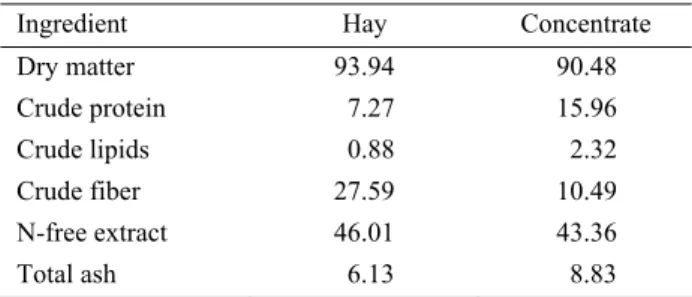
The study was carried out using the rumen simulation technique (RUSITEC) described by Czerkawski and Breckenridge (5). The experiment consisted of 6 plexiglass 1-L vessels (fermentors) maintained at constant temperature (39°C). The nominal volume in each vessel was 750 mL. The vessels were inoculated on d 1 with liquid (gauze-filtered) and solid rumen contents taken from 2 rumen cannulated adult donor sheep that were maintained on a diet of hay and concentrates. Animals had free access to hay, water, and a vitamin-enriched salt lick. The same dietary components were used for in vitro fermentation trials. The chemical composition of the experimental diet is presented in Table 1.
Table 1. Chemical composition of the diets (%). Tablo 1. Rasyonun kimyasal içeriği (%).
Ingredient Hay Concentrate
Dry matter 93.94 90.48 Crude protein 7.27 15.96 Crude lipids 0.88 2.32 Crude fiber 27.59 10.49 N-free extract 46.01 43.36 Total ash 6.13 8.83
Each vessel was loaded with 2 nylon bags (pore size, 150 µm). At the start of the trial, one bag was filled with 80 g of solid rumen contents (fresh weight) and the other with the daily diet, a mixture of 5 g of hay and 4 g of pelleted concentrate. The nylon bag with solid rumen contents was replaced after 24 h of incubation with a bag containing the diet. The feed bag was changed after 48 h so that 2 bags were always present. This gave a retention time of 48 h for feed. When the bag was being changed, the vessels were flushed with nitrogen to maintain anaerobic conditions. The liquid flow through the vessels was maintained by continuous infusion of a buffer solution of pH 8.12 with 307 mosm/L at a rate of 750 mL/d. The buffer composition is presented in Table 2.
Table 2. Chemical composition of the buffer solution (mmol/l). Tablo 2. Tampon solüsyonun kimyasal içeriği (mmol/l).
Ingredient NaCl 8.04 KCl 7.65 CaCl2.2H2O 0.22 MgCl2.6H2O 0.63 NH4Cl 5.00 Na2HPO4.12H2O 26.20 NaHCO3 117.90 Experimental procedure
In vitro incubation trial lasted for 18 days and was
divided into three periods: an equilibration, a control and an experimental period. The first 8 days period represented an equilibration period (to achieve steady state conditions) and the following 5 days were used to determine basic parameters of ruminal fermentation under control conditions without addition of topinambur powder. The last 5 days served as the experimental period. In this last period topinambur powder was added at levels of 0.2, 0.4, 0.6, 0.8 and 1.0 g/day into the five fermentation vessels, while last one served as a control without having any topinambur powder.
For the investigation of inulin on rumen fermentation in vitro, topinambur powder (Lohmann Animal Health, Cuxhaven, Germany) was used as an inulin source. Topinambur (Helianthus tuberosus L.) is storing inulin in its tubers as energy providing compound. So the main carbohydrate in topinambur tubers is inulin, composing 80–90% of the solid content (18).
Analytical procedures and samplings
The pH values were measured daily in each vessel at the time of feeding using a pH electrode (Typ 408 and Pt 4805-S7/120, Mettler Toledo, Steinbach, Germany) connected to a Knick pH meter (digital pH meter 646, Knick, Berlin, Germany). Liquid effluent was collected daily and samples were taken for analyses of short-chain fatty acids (SCFA) and NH3-N. The overflow flasks were
placed into ice to stop microbial activity and preserve fermentation products. An aliquot of effluent was centrifuged at 40,000 × g for 20 min at 4°C. The resulting supernatant was acidified with 0.1 mL of 98% formic acid and then centrifuged at 4000 × g for 10 min at 4°C, then it was analyzed for SCFA by gas chromatography (model 5890 II, Hewlett Packard, Böblingen, Germany) equipped with a 1.8 m × 2 mm glass column packed with Chromosorb WAW (mesh 80/100) with 20% neopentyl glycol succinate and 2% ortho phosphoric acid. Helium was used as a carrier gas with a flow rate of 25 mL/min. Injection port, detector,
Ankara Üniv Vet Fak Derg, 55, 2008 81 Table 3. Effects of topinambur powders on in vitro ruminal fermentation parameters.
Tablo 3. Yer elması ununun in vitro ruminal fermentasyon parametreleri üzerine etkileri.
Experimental period (n=1) Control period (n=6) 0.0 g/d 0.0 g/d 0.2 g/d 0.4 g/d 0.6 g/d 0.8 g/d 1.0 g/d pH 7.06±0.04 7.09±0.03 7.06±0.03 7.03±0.06 7.06±0.02 7.03±0.05 7.05±0.05 Total SCFA (mmol/d) 23.95±2.97 23.46±1.92 26.02±0.97 24.48±2.21 23.11±1.57 25.55±2.21 22.17±1.93 Acetate (mmol/d) 13.49±1.71 13.38±0.63 14.50±0.48 13.32±1.26 12.63±0.77 13.84±1.14 12.62±1.09 Propionate (mmol/d) 4.63±0.60 4.67±0.38 5.05±0.20 4.77±0.55 4.47±0.37 5.14±0.57 4.40±0.44 Butyrate (mmol/d) 4.00±0.54 3.78±0.39 4.27±0.25 3.95±0.39 4.03±0.27 4.36±0.42 3.64±0.32 NH3-N (mmol/l) 6.03±0.29 6.36±0.07a 6.06±0.20 5.89±0.28b 5.97±0.18b 6.29±0.24 6.06±0.13
OMD (%) 41.17±4.10 40.40±2.07 40.40±3.51 39.20±6.87 38.00±2.92 40.60±2.51 38.00±3.96
a,bMeans within the same row with different superscript differ (p<0.05).
and oven temperatures were 220, 250, and 130°C, respectively. Daily production rates of SCFA were estimated by multiplying the respective concentration by the volume of effluent collected. Ammonia N was measured using the steam distillation method of Kjeldahl (20). The ruminal digestibility of organic matter (OMD) was analyzed using the technique described by Orskov et al (16).
Statistical analyses
The means of values from treatments were compared by one-way analysis of variance (Sigmastat 3.1; Systat Software, Erkrath, Germany). The tables show the group means and the standard division (± SD). When the differences in treatment means were significant at the probability level of p<0.05, they were compared by using Duncan's multiple range test.
Results
In this study, the addition of topinambur powders up to 1.0 g/day to a hay : concentrate (60% : 40%) diet did not have any effects on the basal parameters of rumen fermentation in vitro except for NH3-N concentration
(Table 3).
The ruminal pH values were in the normal range (7.06 ± 0.04 and 7.09 ± 0.03) in both control period and control fermenter. Addition of different doses of topinambur powders caused no statistically significant effects (p= 0.37) on ruminal pH. Productions of individual (acetate, propionate and butyrate) and total SCFA were not significantly effected by addition of topinambur powders (p>0.05). A trend toward lower NH3-N concentrations was noticed after all doses of
topinambur powder; however, this decrease was only significant (p<0.05) after dose 0.4 and 0.6 g/day. Addition of 0.4 and 0.6 g/day topinambur powder reduced NH3-N concentration by 6 and 7%, respectively,
compared to the control fermenter. The digestibility of organic matter was not statistical (p = 0.67) influenced by topinambur powders.
Discussion and Conclusion
Topinambur, where the tubers contain high proportions of the fructan ‘inulin’, is known as a precursor of a prebiotic in dairy products for human nutrition and as a feed for piglets while studies in ruminants are very limited so far (9, 12). However, current opinion contends that inulin can be digested and metabolized in the rumen ecosystem (4). In the present experiment, no clear effect of inulin on ruminal pH was noticed, in spite of relatively high doses of topinambur powders. This result can be explained by two mechanisms. Firstly, the microbial breakdown of polymeric fructans to fructose is a relatively slow process (2). A relatively slow release of fructose is desirable in order to avoid a rapid drop in pH. Secondly, the Rusitec system used in this study was buffered with the high buffer capacity solution and may not have been appropriate to study the effect of inulin on ruminal pH. The reason of unaffected production rates of SCFA could also be explained by slow ruminal breakdown of inulin.
When compared with the control fermenter, topinambur powders resulted in a deacresed ruminal NH3-N concentration. The finding from this study agreed
with Biggs and Hancock (2), Lee et al. (13) and Öztürk and Breves (17). The fermentation of carbohydrates affects nitrogen metabolism in the rumen. It has been reported that ammonia concentration in the gut lumen can be reduced by active carbohydrate fermentation, which stimulates the bacterial requirement for nitrogen due to an enhanced growth (11). The decreased NH3-N
concentration in the rumen can be attributed to a decreased proteolysis, an increased absorption of NH3-N
from the rumen, an increased turnover rate of rumen fluid and a decreased NH3-N utilization by the rumen
microorganisms (10). In the Rusitec system NH3-N
concentration is determined only by the protein breakdown and by the NH3-N utilization of rumen
microorganisms. The decrease in NH3-N concentration
might have been the result of increased incorporation of ammonia into microbial protein.
Hakan Öztürk 82
The digestibility of organic matter was not statistically influenced by the addition of inulin powders. Two main different pathways of metabolic activity can be maintained by organic matter degradation in rumen microbes (14). Firstly, the growth rate of the microorganisms determined by microbial protein synthesis, and secondly, fermentation rate determined by SCFA production. Since the digestibility of organic matter was unchanged in the presence of topinambur powders, the lower ammonia concentrations were indicators that the added inulin was preferably digested by the rumen microflora as additional substrates for metabolic purposes.
In vitro NH3-N reducing effect of inulin could be of
great value in increasing microbial growth and avoiding accumulation of ammonia in the rumen in vivo. Moreover, additional research is necessary to clarify the potentially beneficial effects of inulin on rumen metabolism.
Acknowledgments
I am grateful to G. Becker and M. Burmester for their skilled technical assistance.
References
1. Bergen, WG, Bates DB (1984): Ionophores: their effect
on production efficiency and mode of action. J Anim Sci,
58, 1465–1483.
2. Biggs DR, Hancock KR (1998): In vitro digestion of
bacterial and plant fructans and effects on ammonia accumulation in cow and sheep rumen fluids. J Gen Appl
Microbiol, 44, 167-171.
3. Böhm A, Kaiser I, Trebstein A, Henle T (2005):
Heat-induced degradation of inulin. Eur Food Res Technol, 220,
466–471.
4. Chesson A, Forsberg CW (1988): Polysaccharide
degradation by rumen micro-organisms. 251-284. In: PN
Hobson (Ed), The Rumen Microbial Ecosystem, Elsevier Applied Science, London and New York.
5. Czerkawski JW, Breckenridge G (1977): Design and
development of long-term rumen simulation technique (RUSITEC). Br J Nutr, 38, 271–384.
6. Fischbein L, Kaplan M, Gough M (1988):
Fructo-oligosaccharides: a review. Vet Hum Toxicol, 30, 104–
107.
7. Gibson GR, Roberfroid MB (1995): Dietary modulation
of the colonic microbiota: introducing the concept of prebiotics. J Nutr, 125, 1401–1412.
8. Havenaar R, Marol-Bonin S, Van Dokkum W, Petitet S, Shaafsma G (1999): Inulin: Fermentation and
microbial ecology in the intestinal tract. Food Rev Int, 15,
109–120.
9. Hindrichsen IK, Wettstein HR, Machmüller A, Bach Knudsen KE, Madsen J, Kreuzer M (2006): Digestive
and metabolic utilisation of dairy cows supplemented with concentrates characterised by different carbohydrates.
Anim Feed Sci Technol, 126, 43-61.
10. Höller H, Breves G, Martens H (1983):
Non-protein-nitrogen and reduced phosphorus supply to sheep, I.
Phosphorus, volatile fatty acids, NH3 and pH of rumen
liquid and daily fluid and phosphorus outlow from the rumen. 81-87. In: Nuclear Technique for Assessing and
Improving Ruminant Feeds, IAEA, Vienne.
11. Jorgensen H, Zhao XQ, Theil PK, Gabert VM, Bach Knudsen KE (2003): Energy metabolism and protein
balance in growing rats fed different levels of dietary fibre and protein. Arch Anim Nutr, 57, 83–98.
12. Kasperowicz A, Michalowski T (2002): Assessment of
the fructanolytic activities in the rumen bacterium Treponema saccharophilum strain S. J Appl Microbiol, 92,
140–146.
13. Lee MRF, Merry RJ, Davies DR, Moorby JM, Humphreys MO, Theodorou MK, MacRae JC, Scollan ND (2003): Effect of increasing availability of
water-soluble carbohydrates on in vitro rumen fermentation.
Anim Feed Sci Technol, 104, 59-70.
14. Leng RA (1982): Modification of rumen fermentation. 427–453. In: JB Hacker (Ed), Nutritional Limits to Animal Production from Pastures. Farnham Royal, Commonwealth Agricultural Bureaux.
15. Niness KR (1999): Inulin and oligofructose: What are
they? J Nutr, 129, 1402-1406.
16. Orskov ER, Hovell FDDeB, Mould F (1980): The use of
nylon bag technique for the evaluation of feedstuffs. Trop
Anim Prod, 5, 195-213.
17. Öztürk H, Breves G (2005): Effects of the prebiotic inulin
on in vitro ruminal microbial metabolism. Proceedings of
the Society of Nutrition Physiology, Hohenheim-Stuttgart, Germany, 14, 157.
18. Patkia G, Barta J (2000): Carbohydrate composition of
different Jerusalem artichoke varieties. Abstracts of 4th
International Fructan Symposium "Fructan 2000". August 16-20, 2000. Arolla. Switzerland. P.2.10.
19. Roberfroid MB, Van Loo JAE, Gibson GR (1998): The
bifidogenic nature of chicory inulin and its hydrolysis products. J Nutr, 128, 11–19.
20. Stuck K, Faul K, Hylla S, Stein J, Breves G (1995): The
application of a semi-continuous colon simulation technique (COSITEC) for studying the effects of clindamycin on microbial hindgut metabolism. Z.
Gastroenterol. 33, 241–246.
21. Wang X, Gibson GR (1993): Effects of the in vitro
fermentation of oligofructose and inulin by bacteria growing in the human large intestine. J Appl Bacteriol, 75,
373–380.
Geliş tarihi: 20.09.2007 / Kabul tarihi: 09.11.2007
Address for correspondence
Dr. Hakan Öztürk
Ankara University, Faculty of Veterinary Medicine Department of Physiology
Diskapi 06110 Ankara - Turkey