N .A RG Ü N M. S . T h e si s 2012
EXPLORATION OF TURKISH CONSUMERS’ TRUST IN
E-COMMERCE
NİLAY ARGÜN
KADIR HAS UNIVERSITY 2012
EXPLORATION OF TURKISH CONSUMERS’ TRUST IN
E-COMMERCE
NİLAY ARGÜN
B.S., Statistics and Computer Science, Kadir Has University, 2009 B.S., Computer Engineering, Kadir Has University, 2009
Submitted to the Graduate School of Science and Engineering in partial fulfillment of the requirements for the degree of
Master of Science in
Management Information Systems
KADIR HAS UNIVERSITY 2012
KADIR HAS UNIVERSITY
GRADUATE SCHOOL OF SCIENCE AND ENGINEERING
EXPLORATION OF TURKISH CONSUMERS’ TRUST IN E-COMMERCE
NİLAY ARGÜN
APPROVED BY:
Dr. Christophe Bisson Kadir Has University (Thesis Supervisor)
Prof. Dr. Hasan Dağ Kadir Has University Asst. Prof. Mehmet Nazif Aydın Işık University
i
Exploration of Turkish Consumers’ Trust in E-Commerce
Abstract
With the rapid penetration of the Internet into people’s daily lives, technology forced some companies in many sectors to change their way of doing business, in the meantime, presented some companies the opportunity to utilize it as an alternative and effective way to reach their target market while inviting the consumers to this charming revolutionary process.
Electronic commerce undoubtedly reshaped shopping habits from scratch, bridging consumers who are willing to pay for the needed product or service with the merchants in the cyberspace ready to satisfy the demand in a cost effective and time saving manner. Still, there are some considerations related with the issues such as security, privacy, trust which hinder a part of the population from being a member of this process. Among them, being a multi-dimensional concept, trust could be seemed as the latent cumulus behind the various shopping decisions.
In this study, top websites in Turkey are examined and evaluated in terms of different trust elements suggested by previous research. In the light of the literature review, the most crucial factors are obtained in order to constitute useful guidelines for companies which are in a desire of coming up with the trust blocks and try to achieve great enhancements in building trust with their customers which lead them to increase in sales and to be competitive in the market.
ii
Türkiye’deki Tüketicilerin E-ticarete Karşı Güveninin İncelenmesi
Özet
İnternetin bireylerin günlük hayatına hızlı bir şekilde nüfus etmesi ile birlikte, teknoloji çoğu sektördeki işletmeleri iş yapış şekillerini değiştirmeye zorlarken, aynı zamanda işletmelere hedef kitlelerine ulaşmak için alternatif ve etkin bir seçenek sunmuş ve tüketicileri bu merak uyandırıcı yenilik hareketine davet etmiştir.
Elektronik ticaret, siber dünyada tüketicileri ihtiyaç duydukları ürün ya da hizmeti zaman ve maliyet bakımından avantajlı bir şekilde sağlayan işletmelerle buluşturarak şüphesiz ki alışveriş alışkanlıklarını kökten değiştirmiştir. Bununla birlikte, toplumun bir bölümünü bu süreçten uzak tutan güvenlik, gizlilik ve güven gibi bir takım nedenler mevcuttur. Bu etkenlerin içerisinde çok boyutlu bir kavram olan güven, bir çok alışveriş kararının arkasındaki gizli bir bulut kümesi olarak düşünülebilir.
Bu çalışmada, Türkiye’deki en iyi web siteleri, konuyla ilgili yapılmış geçmiş akademik çalışmalar ışığında farklı güven öğeleri bakımından incelenmiştir. Yapılan literatür çalışması doğrultusunda, tüketicilerin e-ticaret işlemlerinde yaşadıkları güven engelini aşarak, satışlarında artış sağlamak ve piyasada rekabet gücü kazanmak isteyen işletmeler için faydalı pratikler sağlayan en kritik güven öğeleri belirlenmiştir.
Anahtar Kelimeler: E-ticaret, güven, online alışveriş, tüketici davranışları, güvenlik.
APP END
iii
Acknowledgements
I would like to thank all those people who made this thesis an unforgettable experience for me.
First of all, I would like to thank my supervisor Dr. Christophe Bisson, who provided continuous advice and encouragement throughout the thesis period. I thank him for his systematic guidance and significant effort he provided training me in the scientific field.
I also wish to thank Ms. Esra Vatansever and Ms. Elif Taştan for helping me to get through the difficult times.
Finally, I take this opportunity to present my profound gratitude to my family, my colleagues, and my friends for their love and continuous support.
APP END
iv
v
Table of Contents
Abstract i Özet ii Acknowledgements iii Table of Contents v List of Tables xList of Figures xii
List of Abbreviations xiv
1. Introduction 16 1.1. Introduction ... 16 1.2. Problem Background... 17 1.3. Problem Statement ... 18 1.4. Thesis Objectives ... 18 1.5. Thesis Scope ... 18
1.6. Importance of the Thesis ... 19
1.7. Thesis Structure ... 19
1.8. Summary of the Chapter ... 20
2. Trust and Related Concepts 21
2.1. Objective of the Chapter ... 21
2.2. Definition of Trust in Different Contexts ... 21
2.3. Definition of Trust Related Concepts and Their Relation with Trust ... 24
2.3.1. Trust and Trustworthiness ... 24
2.3.2. Trust and E-Loyalty ... 25
2.3.3. Trust and Online Stickiness ... 26
2.3.4. Trust and Online Satisfaction ... 26
2.3.5. Trust, Psychological Contracts and Psychological Contract Violation ... 27
2.3.6. Trust and Privacy ... 27
2.3.7. Trust and Risk ... 28
2.3.8. Trust and Security ... 28 APP
vi
2.3.9. Trust and Premium Pricing ... 30
2.4. Characteristics of Trust ... 30
2.5. Importance of Trust from Individuals’ Perspective and Companies’ Perspective ... 31
2.6. Different Trust Classifications ... 32
2.6.1. Interpersonal Trust, Institutional Trust and Disposition to Trust... 32
2.6.2. Macro Level and Micro Level Trust... 34
2.6.3. Initial Trust and Repeat Trust ... 36
2.7. Summary of the Chapter ... 40
3. E-Commerce and Related Concepts 41
3.1. Objective of the Chapter ... 41
3.2. Definition of E-commerce ... 41
3.3. Definition of E-commerce Related Concepts and Their Relation with E-commerce ... 43
3.4. Different Types of E-commerce ... 46
3.5. Why E-commerce is Important for Companies and Individuals? ... 50
3.6. E-commerce Limitations ... 52
3.7. E-commerce Quality and Success Metrics ... 54
3.8. Overview of E-commerce in Turkey ... 62
3.9. Overview of E-commerce in the World ... 70
3.10. Summary of the Chapter ... 72
4. Trust in E-Commerce 73
4.1. Objective of the Chapter ... 73
4.2. Characteristics of Online Trust... 73
4.3. Models and Theories related with Consumer Behavior and Trust ... 74
4.3.1. Theory of Reasoned Action ... 74
4.3.2. Theory of Planned Behavior ... 75
4.3.3. Social Exchange Theory ... 76
vii
4.3.5. Online Consumer Behavior Modeland Decision Making ... 79
4.3.6. Theory of Perceived Risk ... 82
4.3.7. Technology Acceptance Model ... 86
4.3.8. Technology Acceptance Model 2 ... 87
4.3.9. Extended Technology Acceptance Model... 88
4.3.10. Unified Theory of Acceptance and Use of Technology (UTAUT) ... 89
4.3.11. A Process-oriented Multidimensional Trust Formation Model ... 89
4.4. E-commerce Trust Indicators ... 94
4.5. Privacy Issues in E-commerce ... 97
4.6. Security Issues in E-commerce ...100
4.7. Legal Issues in E-commerce ...102
4.8. Technologies and Techniques for Building Trust ...103
4.8.1. Encryption Techniques ...104
4.8.2. Secure Socket Layer (SSL) Technology...104
4.8.3. Secure Hypertext Transfer Protocol (S-HTTP) ...105
4.8.4. Trust Seals ...105
4.8.5. Reputation Systems ...106
4.8.6. Secure Electronic Transaction (SET)...107
4.8.7. Privacy Policy...107
4.8.8. Digital Certificate ...108
4.8.9. 3D Secure Technology...108
4.8.10. Watchdogs ...109
4.8.11. Word of Mouth ...109
4.9. Trust and Web Design ...110
4.10. Summary of the Chapter ...113
5. Evaluation and Comparison of E-commerce Websites 115
viii
5.2. Data Collection ...115
5.2.1. Selection of Ranking Provider and Determination of Sample Size ...115
5.2.2. Selection of Evaluation Criteria ...118
5.2.2.1. Findings from Literature Review ...118
5.2.2.1.1. Findings on Trust and Trustworthiness ...118
5.2.2.1.2. Findings on Macro Level and Micro Level Trust ...119
5.2.2.1.3. Findings on Initial Trust and Repeat Trust ...119
5.2.2.1.4. Findings on E-commerce Quality and Success Metrics ...120
5.2.2.1.5. Findings on OECD Guidelines...121
5.2.2.1.6. Findings on Models and Theories related with Consumer Behaviorand Trust ...121
5.2.2.1.7. Findings on E-commerce Trust Indicators ...122
5.2.2.1.8. Findings on Privacy Issues in E-commerce ...124
5.2.2.1.9. Findings on Security Issues in E-commerce ...125
5.2.2.1.10. Findings on Legal Issues in E-commerce ...125
5.2.2.1.11. Findings on Technologies and Techniques for Building Trust ...126
ix
5.2.2.2. List of Selected Criteria ...128
5.3. Evaluation and Comparison of Top Websites in Turkey...131
5.3.1. Selection of Top 30 E-commerce Websites in Turkey ...132
5.3.2. Comments on the Selected Criteria ...133
5.3.3. Summary of the Findings on the Criteria Set ...147
5.3.4. Trustworthiness Assessment of the Websites...150
5.3.4.1. Assessment According to the Findings of This Study ...151
5.3.4.2. Assessment According to the Study of Che-Hussin et al ...156
5.3.4.3. Comparison of the Two Methods ...161
5.4. Summary of the Chapter ...162
6. Conclusion 163
6.1. Objective of the Chapter ...163
6.2. Research Perspective and Implication ...163
6.3. Thesis Limitations ...166
6.4. Suggestions for Future Practices and Future Researches ...167
References 169
Appendix A: Website Comparison Table 197
x
List of Tables
Table 2.1: Dimensions of trustworthiness in e-commerce literature... 34
Table 3.1: Types of e-commerce ... 47
Table 3.2: Highlighted limitations of e-commerce... 53
Table 3.3: Limitations on the growth of B2C e-commerce ... 54
Table 3.4: ETailQ items: measuring customer satisfaction with websites ... 61
Table 3.5: Total number of virtual credit card transactions and their ratio in total number of e-commerce transactions ... 69
Table 4.1: Five types of perceived risk ... 85
Table 4.2: Definitions of trust dimensions, subdimensions and literature sources ... 93
Table 4.3: Trust attributes and their group... 94
Table 4.4: Top ten trust attributes for merchant trust ... 95
Table 4.5: Summary of privacy seals ... 106
Table 4.6: Trust inducing features for web design ... 111
Table 4.7: Guidelines for integrating trust in online stores ... 112
Table 4.8: Classification of trust triggers ... 113
Table 5.1: Some ranking providers ... 115
Table 5.2: Web design elements for consumer trust ... 129
Table 5.3: Customer supportive elements for consumer trust ... 129
Table 5.4: Privacy control elements for consumer trust ... 130
Table 5.5: Security control elements for consumer trust ... 130
Table 5.6: Legacy control elements for consumer trust ... 130
Table 5.7: Consumer informative elements related with company for consumer trust ... 131
Table 5.8: Consumer informative elements related with shopping for consumer trust ... 131
xi
List of Tables (Continued)
Table 5.9: Top 30 e-commerce websites in Turkey according to Alexa
web statistics ... 133
Table 5.10: Summary of the criteria meeting for website examinations ... 147
Table 5.11: Ranking of the websites according to the criteria set of this study ... 152
Table 5.12: Ranks of private shopping websites ... 154
Table 5.13: Ranks of multi category retailers' websites ... 154
Table 5.14: Ranks of buying group websites ... 154
Table 5.15: Ranks of retailing firms with physical shops ... 154
Table 5.16: Ranks of C2C websites ... 156
Table 5.17: Selected elements from the study of Che-Hussin et al. ... 157
Table 5.18: Selected attributes for ROC method from the study of Che- Hussin et al. ... 158
Table 5.19: Ranking of the websites according to the 7 trust attributes of Che-Hussin et al. ... 159
Table 5.20: Ranks of private shopping websites ... 160
Table 5.21: Ranks of multi category retailers' websites ... 160
Table 5.22: Ranks of buying group websites ... 160
Table 5.23: Ranks of retailing firms with physical shops ... 161
xii
List of Figures
Figure 2.1: CIA Triad ... 28
Figure 2.2: Pakerian Hexad... 29
Figure 2.3: A Proposed Model for Chinese Consumers’ Macro-level Trust on B2C E-commerce ... 35
Figure 2.4: Model of initial trust development ... 38
Figure 3.1: E-business forms and their impact on the supply chain... 45
Figure 3.2: Scopes of e-commerce, e-business, e-marketing, Internet marketing ... 46
Figure 3.3: OECD broadband subscribers in million between 1997 and 2008 ... 49
Figure 3.4: D&M IS Success Model ... 56
Figure 3.5: Updated D&M IS Success Model ... 57
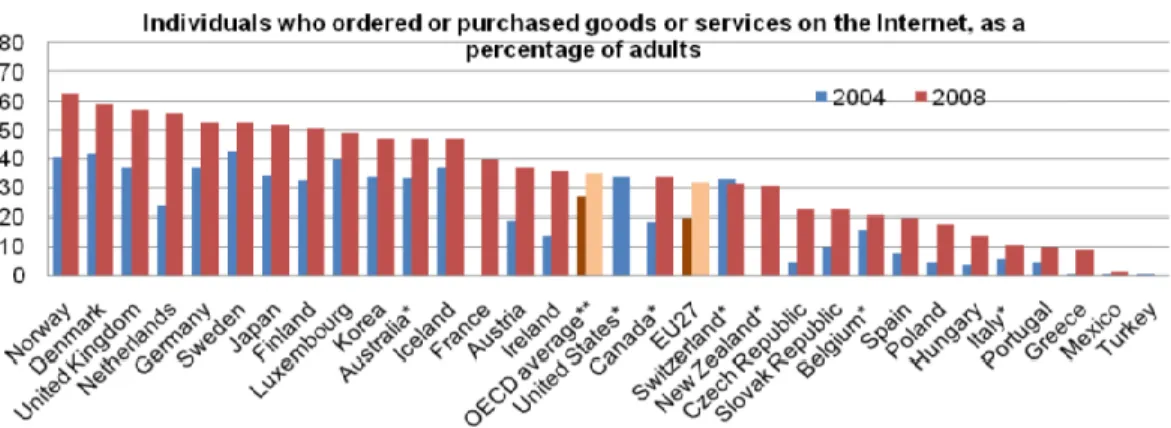
Figure 3.6: Individuals who ordered or purchased goods or services on the Internet ... 63
Figure 3.7: The total number of credit cards in Turkey ... 64
Figure 3.8: The total number of e-commerce transactions in Turkey ... 64
Figure 3.9: The total number e-commerce transactions in Turkey ... 65
Figure 3.10: The total number of virtual credit card transactions in Turkey ... 68
Figure 3.11: The total amount of virtual credit card transactions in Turkey ... 68
Figure 3.12: Internet users per 100 inhabitants between 1997 and 2007 ... 70
Figure 3.13: Individuals who ordered or purchased goods or services on the Internet as a percentage of adults ... 72
Figure 4.1: Theory of Planned Behavior ... 76
Figure 4.2: Stages in Consumer Decision Making ... 79
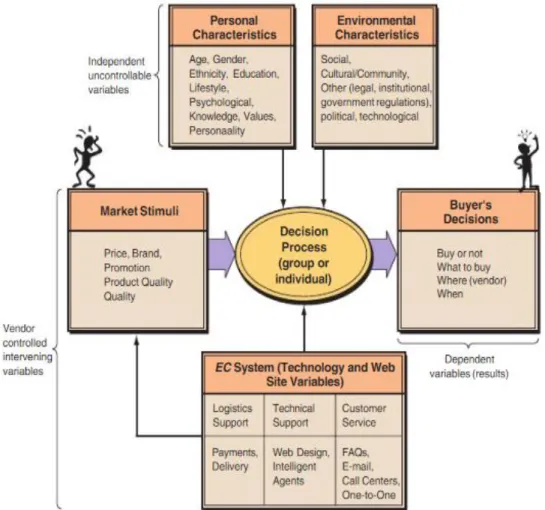
Figure 4.3: EC Consumer Behavior Model ... 80
Figure 4.4: Framework of Online Consumer Behavior ... 81
Figure 4.5: Theoretical framework for consumer attitudes and behavior on the web ... 82
xiii
List of Figures (Continued)
Figure 4.7: Technology Acceptance Model 2 ... 88
Figure 4.8: Extending TAM to include determinants for perceived ease of use ... 88
Figure 4.9: Four entities of e-commerce markets ... 90
Figure 4.10: A process-oriented multidimensional trust formation model ... 91
Figure 4.11: Effects of website trust ... 96
Figure 5.1: Homepage of the website Gittigidiyor.com ... 136
Figure 5.2: An example for performance history on Sahibinden.com ... 137
Figure 5.3: An example of online chat visual element on Sanalpazar.com ... 138
Figure 5.4: Examples of reputation rating visual elements ... 139
Figure 5.5: Examples of virtual community visual elements ... 140
Figure 5.6: Examples of third party visual elements ... 140
Figure 5.7: Examples of security visual elements ... 141
Figure 5.8: Example of secure technology visual element ... 142
Figure 5.9: Examples of 3d-secure technology visual element ... 142
Figure 5.10: Some examples of visual elements related with protection of intellectual property ... 147
xiv
List of Abbreviations
ATM Automatic Teller Machine BBB Better Business Bureau BBS Bulletin Board System BKM Bankalar Arası Kart Merkezi BTS Business Technology Strategy B2B Business to Business
B2B2C Business to Business to Consumer B2C Business to Consumer
B2G Business to Government CA Certification Authority
CDT Center of Democracy and Technology CIA Central Intelligence Agency
CIA Confidentiality Integrity Availability CPQ Consumer Perceived Quality
CSI Computer Security Institute CVV Card Verification Value C2B Consumer to Business C2C Consumer to Consumer D&M Delone and Mclean
EC Electronic Commerce
EFT Electronic Fund Transfer
EPIC Electronic Privacy Information Center ETID Elektronik Ticaret İşletmeleri Derneği
EU European Union
E2E Exchange to Exchange FAQs Frequently Asked Questions FBI Federal Bureau of Investigation FTC Federal Trade Commission G2C Government to Citizens
HP Hewlett Packard
xv
List of Abbreviations (Continued)
IBM International Business Machines
ID Identification
IS Information System
ISA Internet Seals of Approval ISP Internet Service Provider IT Information Technologies
ITU International Telecommunication Union
NSW New South Wales
OECD Organization for Economic Co-operation and Development
PC Personal Computer
PEOU Perceived Ease of Use
POS Point of Sale
PU Perceived Usefulness
P2P Peer to Peer
ROC Rank Order Centroid SERVQUAL Service Quality
SET Secure Electronic Transaction SSL Secure Socket Layer
S-HTTP Secure Hypertext Transfer Protocol TAM Technology Acceptance Model TRA Theory of Reasoned Action TTPs Trusted Third Parties USD United States Dollar
UTAUT Unified Theory of Acceptance and Use of Technology WTO World Trade Organization
XIWT Cross-Industry Working Team XML Extensible Markup Language
16
Chapter 1
Introduction
1.1. Introduction
Rapid growth in online and mobile technologies has provided a significant contribution to the enlargement of e-commerce in recent years. According to Visa Europe statistics, in 2011, 25% of its transactions in the European Union (EU) were made on line (The Organization for Economic Co-operation and Development [OECD], 2012) which is an important indicator for the enhancement of the e-commerce and the transition rate to e-e-commerce from the traditional e-commerce. Although there is a picture which demonstrates a growing trend in number of sales, e-commerce still has reached a little part of its potential in many countries. The reasons behind this fact is various and changes with many variable. However, there are definite factors that affect the purchase decision of people in an online environment.
Turkey is currently attracting more attention since its economy is flourishing with the second highest growth after China (CIA, 2012). According to Cengiz, Ayyıldız and Er (2007), banking sector plays a significant role in the world and Turkish economy has a big share in the total financial sector. Throughout the past years, there have been important changes including many technological developments in the sector. Internet banking, online payment services have been developed as an alternative to classical banking system and payment methods. Many websites have entered to the area and most of them have adapted the online payment by credit cards, while a few of them also added other online payment options such as paying by PayPal. Besides, Turkey still suffers from the low online transaction rates, so that it is also among the countries in which e-commerce composes a little part of the whole economy.
Trust factor is one of the most considerable factors, worth to be examined in order to detect the reasons of customer resistance in online transactions and to suggest
17
solutions and recommendations for the development of e-commerce sector. Many researchers in e-commerce field have commented that the lack of e-commerce trust is the key factor which caused a decline in the number of consumers participating to e-commerce transactions (Tan & Thoen, 2000; Patton & Josang, 2004; Pennanen, 2005; Nefti, Meziane & Kasiran, 2005; Zhang, 2009). Since consumers are not able to experience the item physically, trust factor gains more importance in cyberspace transactions in comparison to traditional transactions.
There are several studies in the literature which investigated dimensions of trust in the online environment. These studies include different kinds of issues such as trust models, consumer behavior models, customer satisfaction, security and privacy issues, and web design elements.
Yet, no research has been done as a wide research about these issues, extracting the most considerable trust elements as a combination of all concluded factors. In this study, the top e-commerce websites in Turkey are examined in terms of trust elements concluded from the literature review and key elements are detected in order to guide e-commerce companies in Turkey to enhance trust of Turkish consumers and hence to help the development of e-commerce in this country.
1.2. Problem Background
Many businesses have started to run their business online either by leaving their physical shops, or by doing their online and physical business at the same time. In the recent years, it turned to be a growing trend to sell their product and services online for many companies in different sectors. On the other hand, the intangibility of the e-commerce environment made many consumers to investigate trustworthiness of this environment and caused them to be concerned about these issues. Although there have been many studies including different types of models developed, several interviews and questionnaires done in order to detect the trustworthiness elements of e-commerce websites in the literature, trust issues related with e-commerce transactions still exist today. Moreover, low online transaction rates despite the advanced payment systems and e-commerce technologies make Turkey an important sample to investigate consumer trust elements.
18
In this study, it is suggested that previous consumer behavior and trust models, privacy and security related studies, key technologies and web design practices related with trust can contribute to the detection of elements affecting Turkish consumers’ trust in e-commerce when the top websites are examined in terms of concluded factors from the literature. Furthermore, the resulting factors may guide to Turkish e-commerce websites in order to build trust with their customers.
1.3. Problem Statement
The main problem which is investigated and tried to be solved in this study is “What are the necessary observable and non-subjective elements for e-commerce websites needed to build trust with consumers in Turkey?”
1.4. Thesis Objectives
The objectives of this thesis are as follow:
1) Study trust and trust related concepts and models. 2) Study e-commerce and e-commerce related concepts.
3) Study trust in e-commerce and models related with trust in e-commerce. 4) Determine the trust elements necessary for an e-commerce website.
5) Out of the concluded trust elements from the literature, to investigate the existence of observable and non-subjective trust elements on the top 30 websites in Turkey.
6) Extraction of the common trust elements on the examined top 30 websites in Turkey.
7) Ranking and evaluation of the 30 websites in terms of trust elements.
1.5. Thesis Scope
The study only concentrates on trust issues out of many related topics related with e-commerce.
Out of the findings about trust factors in e-commerce from the literature review, the ones which are clearly observable and then non-subjective will be investigated on the chosen websites.
The findings about trust factors in e-commerce from the literature review will be only investigated on the chosen websites according to www.alexa.com.
19
The resulting findings about the consumer trust factors in e-commerce website may not be enough to build trust with consumers. But they can provide valuable practices and suggestions about trust issues.
Although in the study, different types of e-commerce were examined and mentioned, the focus is on business to consumer (B2C) e-commerce.
1.6. Importance of the Thesis
Trust concerns of consumers considerably affect e-commerce transactions and hinder most of people from shopping online. Detecting the important factors which lay behind these concerns and concluding suggestions for the trust elements in e-commerce websites will contribute to tackle with these issues by providing some guidelines for implementing trust elements and also will encourage researchers in this area while supporting future studies. Moreover, to supply an evaluation for the top websites in Turkey is valuable since it gives a clearer and more concrete understanding about the trustworthiness of the examined websites.
1.7. Thesis Structure
This thesis consists of mainly 2 parts which are theoretical study and empirical study. Part 1, which is theoretical study, includes the chapters 2, 3 and 4.
In Chapter 2, trust and trust related concepts are defined and the relation between trust and trust related concepts is clarified.
In Chapter 3, the concept of e-commerce, its different types and e-commerce related concepts are defined. Additionally, the advantages which e-commerce bring for companies as well as its limitations for them are discussed. This chapter also answers the questions: What is the current status of e-commerce in Turkey and in the world? What are the necessary things to be done for e-commerce success? Which models can be implemented to succeed in e-commerce?
Chapter 4 gives information about characteristics of online trust and identifies different theories and models related with trust and consumer behavior in the literature. The chapter also answers the following questions: What are the issues
20
related with privacy and security in e-commerce? Which regulations exist currently related with e-commerce? What are the necessary technologies and the techniques to build trust in e-commerce? What are the necessary web design elements and conditions to enhance trust in e-commerce?
Part 2, which is empirical study, covers the Chapter 5. In this chapter, 30 chosen e-commerce websites are compared and evaluated according to the trust criteria retrieved from the literature review which is done in the previous sections. Trustworthiness ranking of the websites as well as the most important trust attributes for e-commerce websites are also presented in this chapter.
Chapter 6 concludes the study with a summary of the results of the study. It also makes suggestions for enhancing e-commerce trust in Turkey and gives the reader some recommendations for further study.
1.8. Summary of the Chapter
In this chapter, an overview of the study was discussed stressing the importance of the trust factors in e-commerce. The problem was defined and also its background was stated. Moreover, project objectives and scope were identified in order to give a clear understanding about the study. Additionally, thesis structure is given in order to see the content of the study as a whole. It is expected that this project will contribute some knowledge in the field of trust in e-commerce.
21
Chapter 2
Trust and Related Concepts
2.1. Objective of the Chapter
The objective of the chapter is to define and examine trust and trust related concepts in detail. Additionally, it is aimed to discuss the relation between trust and trust related concepts and to state different trust classifications.
2.2. Definition of Trust in Different Contexts
Trust is a very broad term in the literature and also used in a variety of meaning in daily life. Therefore, its perception by individuals is relative depending on the situation. The definition of the term appears frequently in sociology, psychology and also in the e-commerce context.
In their daily lives, people try to control their social environment. In this process, they gain some insights about the future effects of their behaviors on other people and also the effects of these behaviors on themselves. When rules and customs get insufficient since the social complexity, trust arises. Trust, conventionally evokes the reliance on others by taking the risk of the reverse action into account, depending on the background of the relation between the related participants. The risk level is higher when there is no former interaction was occurred between the participants and declines with the frequency and number of positive experiences in the past. It is a strong feeling and is the corner stone of friendship, family ties, and business connections.
As Mcknight and Chervany (2002) mentioned, trust is a very comprehensive concept, and has been defined in many different ways in a variety of discipline. In accordance with this fact, there is no agreed definition of trust although its significance has been accepted by many researchers so far. For instance, Hosmer (1995) states that “there
22
appears to be widespread agreement on the importance of trust in human conduct, but unfortunately there also appears to be equally widespread lack of agreement on a suitable definition of the construct” (p.380).
Trust is defined in the Oxford English Dictionary (1971) as, “confidence in or reliance on some quality or attribute of a person or thing, or the truth of a statement” (p.3423).
According to Möllering, Bachmann and Lee (2004), trust concept goes back to the 13th century and its origin of designating faithfulness and loyalty, despite the notion is likely as ancient as the primal genre of humankind. For instance, Confucius (551-479 BC) viewed trust as a prerequisite for the whole useful social relations (Hann, 1968).
Being a multi-disciplinary concept made trust to be a subject of different fields such as psychology, management, marketing, organizational behavior and public relations.
Personality psychologists (e.g. Rotter, 1967) considered trust as a belief, expectancy, or feeling that takes its source from the personality and from the individual's early psychological growth (Rotter, 1967). On the other hand, social psychologists described trust as a prospect about how other people behave in transactions. (Lewicki & Bunker, 1995). Economists also stressed the important role of trust in economic exchanges (Gambetta, 1988; Macauley, 1963) and suggested the detractive effect of it in transaction costs since it prohibits negotiations and contracts which cost high (Dyer, 1996, 1997; Gulati,1995; Sako,1992).
In order to understand the meaning and role of trust in different fields and in different contexts, some different organizational, psychological and sociologic explanations of trust in the literature are given in this study.
In the organizational literature, Mayer, Davis and Schoorman (1995) commented that “trust is the willingness of one party to be vulnerable to the actions of another party
23
based on the expectation that the other will perform a particular action important to the trustor, irrespective of the ability to monitor or control that other party” (p.712).
Moreover, trust has been defined many times in the psychological and sociologic context. Gefen (2000) defined trust as;
Trust, in a broad sense, is the confidence a person has in his or her favorable expectations of what other people will do, based, in many cases, on previous interactions. Although another party’s (person or persons) previous behavior cannot guaranty that that party will behave as one expects, previous interactions in which that party behaved as expected increase trust that is the belief that the other will behave as one anticipates (p.726).
As a result of an extensive literature review, Giffin (1967) too defined trust as “reliance upon the characteristics of an object, or the occurrence of an event, or the behavior of a person in order to achieve a desired but uncertain objective in a risky situation” (p.105).
Boon and Holmes (1991), social psychologists, say that “trust is a state involving confident positive expectations about another’s motives with respect to oneself in situations entailing risk” (p.194).
Zucker (1986) viewed trust as a set of prospects that is subjected to an exchange including social rules and lawfully enabled processes.
McAllister (1995) defines trust as “the extent to which a person is confident in and willing to act on the basis of, the words, actions, and decisions of another” (p.25). According to Moorman, Deshpande and Zaltman (1993) trust is “a willingness to rely on an exchange partner in whom one has confidence” (p.82).
Putnam (1995) and Misztal (1996) viewed trust as a social capital which coordinates and cooperates people.
In the e-commerce context, trust is defined by researchers as below.
According to Jarvenpaa, Tractinsky, and Vitale (2000), trust is “a governance mechanism in exchange relationships” (p.46).
24
Lee and Turban (2001) argued trust as
The willingness of a consumer to be vulnerable to the actions of an internet merchant in an internet shopping transaction, based on the expectation that the internet merchant will behave in certain agreeable ways, irrespective of the ability of the consumer to monitor or control the internet merchant (p.79).
Corritore, Kracher and Wiedenbeck (2003) defined online trust as “an attitude of confident expectation in an online situation of risk that one’s vulnerabilities will not be exploited” (p.740).
Kaplan and Nieschwietz (2003) referred to trust as “a consumer’s willingness (the trustor) to give Web sites (the trustee) personal and financial information in exchange for goods or services and promises to follow stated policies and procedures” (p.97). Pavlou and Gefen (2002) stated that trust is -willingness to depend- in online auctions. From the above definitions, it should be concluded that each description from different discipline and perspective does not substitute each other; rather they are complementary for the whole meaning and functions of trust.
2.3. Definition of Trust Related Concepts and Their Relation with Trust 2.3.1. Trust and Trustworthiness
The concept of trustworthiness is often confused with the consumer trust concept (Serva, Benamati & Fuller, 2005). In contrast to trust, trustworthiness is a feature of a trustee, and is related with the evaluation of the trustee’s trustworthiness, that is the trustor can judge if the trustee will be more or less trusted (Mayer et al., 1995; Gefen, Rao & Tractinsky, 2003). It can be inferred that trust is a feature of the trustor, while trustworthiness is a feature of the trustee. Trustworthiness of a site is about the level of the trust of the users to the website according to the elements such as brand name, recognition, prompt production delivery, fraud protection and more (Fogg et al., 2001a; Grabner-Krauter & Kaluscha, 2003). Mostly, a site can get trustworthiness according to its performance in the long term and through word-of-mouth via its users (Yenisey, Ozok & Salvendy, 2005).
25
Moreover the study of Nielsen, Molich, Snyder, and Farrell (2000) advices some issues to online companies in order to communicate trustworthiness including:
Easily findable company information
Pricing with the inclusion of taxes and shipping costs
Fast in interaction
Stable information about products
Professional Web Design furnished by human error messages
Clear and friendly privacy
Security and return policies
Proper request for personal information and clear clarification for the reason of information sought
Alternative ways of ordering
Reach to supporting people through email or live chat. 2.3.2. Trust and E-Loyalty
Most e-commerce websites look for attracting new customers rather than retaining them by introducing new strategies and campaigns. This is a big mistake since the success of a company is strongly related to gaining the loyalty of its most profitable existing customers as well as acquiring new customers. Srinivasan, Anderson and Ponnavolu (2002) defined loyalty as “a customer’s favorable attitude toward the e-retailer that results in repeat buying behavior” (p.42). In order to make customers loyal it is obligatory to gain their trust (Reichheld & Schefter, 2000). That is true for real world commerce. Moreover, the significance of this issue gets higher importance on the Web, where there is no physical interaction between the participants of the shopping process including buyer, seller and item being sold and correspondingly, the risk and uncertainty perception of the shoppers are higher. As Pavlou (2003) mentioned, trust is a very crucial element for e-loyalty. However, the fact that costs for searching and switching to another website do not exist (Bakos, 1997; Chen & Hitt,
26
2002), the customers in an online environment are less loyal and they are more inclinable to buy from another seller for a better price (Torres & Martin, 2007).
2.3.3. Trust and Online Stickiness
E-loyalty and online stickiness have been similarly used in the literature, but there exists significant differences between them. Davenport (2000) commented that stickiness is the websites’ capability to attract new customers and sustain the existing ones. From the above definition of e-loyalty, a significant feature of e-loyalty is customer’s repeat purchase. Moreover, Li (2006) defined stickiness basically as “repetitive visits and use of preferred website” (p.106) while Lin (2007) emphasizes stickiness as the customer’s desire of revisit the website and lengthening the duration of staying on the website. As stated in this definition, it can be seen that stickiness is related with customer’s repetitive visits and the duration of these visits, while repetitive purchase is necessary for customers’ loyalty. Previous studies have indicated that trust is so crucial in e-commerce, that it can boost the user’s desire to revisit the web site (Suh & Han, 2003) which increases the online stickiness of the customer. 2.3.4. Trust and Online Satisfaction
Another closely related term with trust and e-loyalty is “online satisfaction” which is the positive affect of customer’s experience while using online services (Liu & Xu, 2010).
Previous studies suggested that satisfaction affects loyalty. Ranaweera and Prabhu (2003) concluded that customer satisfaction has effect on customer loyalty owing to customer trust.
27
2.3.5. Trust, Psychological Contracts and Psychological Contract Violation
“Psychological contract violation” term, which has been subjected to many organizational behavior studies, has been also extensively examined in the marketing field. According to Haicheng (2005), psychological contract means “customers’ perception and belief of responsibility or liability made by enterprises” (p.37). In the light of this definition, the psychological contract violation is the breach of these implicit promises. When a customer perceives the psychological contract violation, it affects the customer’s psychology in terms of customer’s trust to vendor. Pavlou and Gefen (2005) concluded that psychological contract violation negatively affects trust and purchase intention in online auctions while it feeds risk perception. They also suggested that psychological contract violation not only affects the transactions with the related seller but also will extend this emotion to other online sellers. There are sources for psychological contract violation according to their study such as not delivering the product purchased, product misrepresentation, not sending the product, delay in product delivery.
2.3.6.Trust and Privacy
When the subject is trust then privacy comes to mind at the first glance for most cases. With the rapid development of technology in recent years, online firms have the opportunity to get and analyze huge size of customers’ data from online transactions. The capabilities, which today’s technological tools present, provided companies the chance to misuse the sensitive customer information for additional gain (Mai, Menon, Raghunathan, & Sarkar, 2005). In the literature, there are several definitions of privacy. Warren and Brandeis (1890) defined privacy as the justice to be let alone. Privacy can also mean “the claim of individuals, groups, or institutions to determine for themselves when, how, and to what extent information about them is communicated to others” (Westin, 1967, p.83). From a privacy viewpoint, trust is the customer’s expectation about the fairness of an online business in treating the customer information justly (Shankar, Urban & Sultan, 2002). In this regard, privacy is a vital factor for online companies to gain customer trust.
28
2.3.7. Trust and Risk
Another term that is closely related and frequently used with trust is “risk”. Risk is defined differently in Information System [IS] and non-IS literature. Risk exists in a condition that the possibility of being harmed may be higher than the advantage provided (Luhmann, 1988). On the other hand, Rousseau, Sitkin, Burt, and Camerer (1998) describe risk as “the perceived probability of loss” (p.395). In the context of consumer trust, Dowling and Staelin (1994) viewed risk as a subjective experience of an indefinite result of the action consumer took. In the literature, there is a common view that trust is solely significant in situations where risk exists. This view is originated from the work by Deutsch (1958) who provided a basis for trust. Yet, different approaches still exists in the literature for their relationship, that is it is ambiguous whether risk is a premise to trust, or risk is a result of trust (Mayer et al., 1995). Still, it can be concluded from the e-commerce literature researches that the risk perception is significant in terms of trust.
2.3.8. Trust and Security
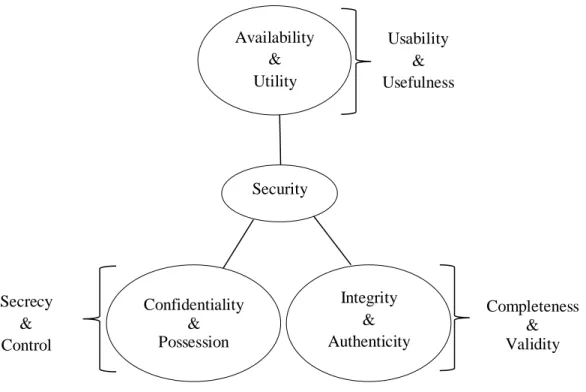
Security, another concept related with trust, is vital for the success of any e-commerce transaction. Exploitation of financial and personal information, attacks to transaction data cause security threats (Cheung & Lee, 2006) and security is the protection against such threats (Belanger, Hiller, & Smith, 2002). ISO 17799 enforces the three basic elements of information security – CIA – which stands for confidentiality, integrity and availability (Kenning, 2001) (see Figure 2.1).
Figure 2.1: CIA Triad
Confidentiality
Availability
Integrity
29
Donn B. Parker also proposed “Parkerian hexad” which is a set of six elements of information security (Parker, 2002).
As its name implies, it has six elements including confidentiality, possession, integrity, authenticity, availability,and utility as seen in Figure 2.2.
Figure 2.2: Pakerian Hexad (Wu, 2009, p.92)
Availability: It is related with assuring that there is legitimate access is present to reach information and service that is provided.
Utility: It refers to usefulness of the data for a purpose.
Possession: It is related with holding, control and ability to use data. Bosworth, Kabay, and Whyne (2009) define this component as: “A state of having in or taking into one’s control or holding at one’s disposal; actual physical control of property by one who holds for himself, as distinguished from custody; something owned or controlled” (p.10).
Confidentiality: This concept is similar to privacy, but they are not the same. It is about sharing the data with people who are authorized to view it and the protection of data from those who are not authorized to view it.
Security Secrecy & Control Completeness & Validity Usability & Usefulness Availability & Utility Integrity & Authenticity Confidentiality & Possession
30
Integrity: It is one of original components of CIA model. It is described as the ability to protect data against any unauthorized and undesirable change (Andress, 2011).
Authenticity is a component which Parker added to the CIA model. It is about ensuring that “a message, transaction, or other exchange of information is from the source it claims to be from” (Clemmer, 2010, p.1).
2.3.9. Trust and Premium Pricing
Brynjolfsson and Smith (2000) suggest that consumers are ready to pay a premium price for a product that they trust the retailer of it and they stress that variation in trust to retailer may cause price dispersion in the online market. According to Varian (2002), several loyalty programs can be applied to the online markets in order to increase costs of switching and hence provide retailer to apply premium prices.
2.4. Characteristics of Trust
In the literature there are generally four characteristics defined by researchers including trustor and trustee, vulnerability, produced actions and subjective matter (Wang & Emurian, 2005).
Trustor and trustee. Two particular parties are necessary for all trusting relationships including a party who is trusting (trustor) and a party which is trusted (trustee). The capability of the trustee to behave according to the best expedience of the trustor and the trust level that the trustor constitutes on the trustee provides the development of trust.
Vulnerability. Trust entails vulnerability and is just required in an environment in which ambiguity and risk exist. Trustors have to be eager to be vulnerable for trust to be operational while taking the risk of loss into consideration and confiding trustees not to misuse this vulnerability.
Produced actions. Trust induces actions which generally require behaviors to undertake risk. The way to perform the action changes with the situation and this action may be related with physical things as well as abstract things.
31
Subjective matter. Trust is subjective and connected with personal distinctions and stateful factors. Depending on the situation, each individual views the role of trust differently and presents distinct levels of trust towards different trustees.
2.5. Importance of Trust from Individuals’ Perspective and Companies’
Perspective
At large, trust is a significant element in most of communal and economical interactions in which ambiguity and dependency exist (Hosmer, 1995; Kumar, 1996; Rousseau et al., 1998). It gains higher value when it is necessary to take considerable decisions (Luhmann, 1997). Gefen (1997) also showed trust is an important factor for web users to decide to download software from a website.
Trust with its past dating back to many years ago has been one of the basic elements of social interactions and relationships. It is an important part of affairs, friendships, family ties and a part of many others. As Nissenbaum (2011) commented, “Trust is an extraordinarily rich concept, covering a variety of relationships, conjoining a variety of objects. One can trust (or distrust) persons, institutions, governments, information, deities, physical things, systems, and more” (p.104). Moreover Erikson (1963) stressed the importance of trust in terms of personality trait as being “a central ingredient for the formation of a healthy personality” (p.7).
In the virtual environment, since the uncertainty is higher and there exists less control in comparison with traditional environment, trust is a very important factor for the success in e-commerce platform (Zhong & Shao, 2006) and for keeping longtime relationships with consumers (Reichheld & Schefter, 2000; Gefen, Karahanna, & Straub, 2003). Furthermore, online customers are unable to get the trust cues and signs when they get in face to face interaction with the sellers. Additionally, parties involved into the transaction may be in distinct regions in which an online transaction cannot be depended to the laws of specific country or state (Clarke, 1997). With these considerations, many consumers dither about shopping online and this situation is mostly pointed out as the main reason for the fact that e-commerce has not reached its full potential. It is estimated that more than $15 billion was lost in possible
e-32
commerce revenues in 2001 because of a deficiency of consumer trust (Meinert, Peterson, Criswell & Crossland, 2006). If online trust can be comprehended and achieved by online merchants, it will raise the number of online users who buy online and will make people more relax about sharing their personal and financial information. It will result in healthier and intensive transactions in which both sides mutually benefit from the deal.
From the companies’ perspective, trust is also has a substantial role in business relationships (Dasgupta, 1988; Fukuyama, 1995; Gambetta, 1988; Gulati, 1995; Kumar, Scheer, & Steenkamp, 1995; Moorman, Zaltman, & Deshpande, 1992). Deutsch pointed out the significance of trust factor for the foundation of cooperation and stated that “the initiation of cooperation requires trust whenever the individual, by his choice to cooperate, places his fate partly in the hands of others” (Deutsch, 1962, p.302). Besides, it is so critical in organizational deals where the conventional social layouts depended on authority, give precedence to self-direction and self-control that is it is primary means of social controls and coordination (Miles & Snow, 1992). Additionally, the deficiency of trust lessens all types of cooperative efforts (Cummings & Bromiley, 1996). On the other hand, when the trust level is high, organizations can undertake many types of cooperative efforts while putting transaction costs down. According to Uzzi (1997), trust reduces the cost of intra-organizational and inter-organizational transactions.
2.6. Different Trust Classifications
Trust has been differently categorized in previous researches. These classifications change with the trust object and environment subjected to the research.
2.6.1. Interpersonal Trust, Institutional Trust and Disposition to Trust
McKnight and Chervany (2002) have considered trust comprising interpersonal trust, institutional trust and disposition to trust. According to this typology;
Interpersonal trust has two components including trusting beliefs and trusting intentions. Trusting beliefs means that one party believes another having one or more characteristics useful for oneself. Other component, trusting intention implies even one party cannot control the other party, this party is eager to
33
depend on. For instance, in an online shopping website, when a customer involved in a transaction by providing his personal information by accepting general terms and conditions, this could be named as a trusting intention.
For institutional trust or institution-based trust, it is shown that the trustor trusts the situation or system and it is related with particular person and the organization or system. That is, it is the sociological dimension of the trust. In e-commerce transactions, this system is internet and the trustor is the internet user. The safety and security level of the Internet have an impact on this type of trust and also can affect trusting beliefs and intentions to an online vendor (Keen, Balance, Chan, & Schrump, 2000).
There are various types of trusting beliefs are present in the literature. The most prevalent types are competence, benevolence, and integrity (Bhattacherjee, 2002; Gefen, 1997; Mayer et al., 1995). These elements also exist in recent literature concerning the trustworthiness of e- commerce as the most relevant dimensions (Table 2.1). Competence means that trustee believes that truster has the ability to do what is agreed (Tan & Sutherland, 2004; Garbarino & Lee, 2003). In the e-commerce context, it can be viewed as the e-vendor has all the products available that exist on their website. Benevolence is about the fact that someone believes that the other party will notice his/her interest (Tan & Sutherland, 2004). For instance, the consumer can suppose that the e-vendor will deliver the products that the customer ordered in the way that customer expects and will be satisfied. Integrity means that someone can believe the other party acts according to ethical considerations. For example, the consumer can believe that the e-vendor doesn’t share his/her personal information and credit card information with third parties without his/her consent.
Disposition to trust related with being tentative to depend on other people in many situations. In contrast to institutional trust, it is generally not situation specific. As Lewicki and Bunker (1995) mentioned, since this type of trust is related with the individual itself, it is more associated with cultural background, personality and experience.
34
Table 2.1: Dimensions of trustworthiness in e-commerce literature
(Pennanen & Paakki, 2007, p.2)
Author(s) Competence Benevolence Integrity Some
Other
Bhattacherjee (2002) x x x
Garbarino & Lee
(2003) x x
Gummerus, Liljander, Pura & van Riel (2004)
x x x
Lee & Turban (2001) x x x
McKnight, Choudhury & Kacmar (2002) x x x Nöteberg, Christiaanse & Wallage (2003) x
Roy, Dewit & Aubert
(2001) x x x
Serva, Benamati &
Fuller (2005) x x x
Tan & Sutherland
(2004) x x x x
2.6.2. Macro Level and Micro Level Trust
Trust is also categorized as macro-level and micro-level (Kim & Tadisina, 2007). In the macro-level trust in e-commerce, target is the environment such as legal, technical, social environment. Since this kind of trust enables the threshold for consumers to be included to electronic markets, it is crucial. For the micro-level, the target is each individual e-commerce rather than the environment. Micro-level trust is also considerable as trust of consumers’ in an e-commerce entity can conserve the relationship of the customer with the company.
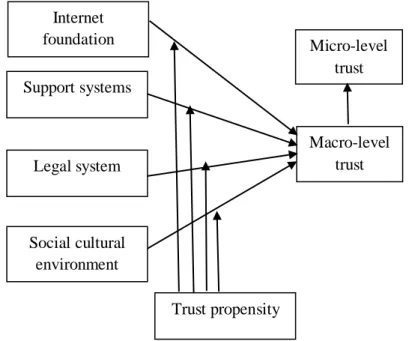
Wang (2008) modeled macro-level trust composed of internet foundation, support systems, legal system, and social cultural environment (Figure 2.3). By Internet
35
foundation, the hardware and software foundation of the Internet is meant. With the good quality of the foundation there are less information delay and obstruct and also Internet will be safer against information theft or the other security gaps.
Figure 2.3: A Proposed Model for Chinese Consumers’ Macro-level Trust on B2C
E-commerce (Wang, 2008, p.377)
Other component, support systems are related with payment systems, logistics, credit evaluation and third part certification system. The presence of the online credit cards and their compatibility to other platforms of banks are important for customer trust. Secondly, logistics is important since the cost and the speed of the delivery of the products is an important consideration for consumer expectations. Moreover, compatibility of credit evolution system to the long-distance transaction of e-commerce is another macro-level trust element. Lastly, third party certification is essential for the persuasion of a consumer about the fact that the vendor will behave ethically.
The other leg of Wang’s model, legal systems provide people to believe there is a formal foundation exists for the possible problems that they will live in their commerce experience. This factor will improve the trust of consumers toward e-commerce.
The other element of macro-level trust is social cultural environment. This factor is
Internet foundation Support systems Legal system Social cultural environment Trust propensity Micro-level trust Macro-level trust
36
about the lifestyles of the people. That is; their living, working, consumption, shopping habits are strongly related with their attitude towards e-commerce. In a society which mostly consists of people like face-to-face interaction, used to cash on delivery and do not like buying online, the rate of the online shopping will low and the trust of these people for e-commerce will be very low.
Wang (2008) in his model also added trust propensity influencing the composition of macro-level trust environment. Since this factor is related with each individual’s background, personality and developmental experience, it has effect on the entire macro-level environment elements. As Lee and Turban (2001) suggested, the level of the trust propensity will affect the influence of trust attributes on the trust generation process and it will behave like a moderating factor. The customer with a high level of trust propensity will have more possibility to shop online.
Micro-level trust includes personality and process based trust. Their difference lies under the characteristics of trustee and trustor. While process-based trust is related with the features of a trustee or an e-business, the personality-based trust is depended on a trustor’s features. Personality-based trust is also known as trust propensity which already mentioned in Wang’s model and is a moderating factor. McKnight, Choudhury and Kacmar (2000) suggested process-based trust composing of trusting beliefs and trusting intentions.
Process-based trust depends on the transactions occurred in past, repeated purchases or expected future exchanges, meaning that it is related with gift giving, reputation and brand names. The key element for this type of trust is the good experience in the past shopping experiences (Ganesan, 1994; Gefen, 1997).
2.6.3. Initial Trust and Repeat Trust
In the literature there is also another classification of trust as initial trust and repeat trust. Initial trust of a customer in an online transaction is related with the trust the customer has toward an e-vendor which he/she has no prior interaction experience with before (McKnight et al., 2002). According to Pavlou, it is the degree of trust which starts when the customer first browses the products on online stores and ends when the
37
customer first buys from that particular store (Pavlou, 2002). In contrast, repeat online trust is related with the trust that consumer experienced in the previous online transactions (Kim, Xu & Koh, 2004).
In online stores, customers make assessments about the e-vendor in the initial part of their contact with the e-vendor. In this stage, the uncertainty and risk perception about the e-vendor is at high levels and customers decide whether they will use this website or buy from there in the future according to these early assessments. Therefore, e-vendors struggle for convincing customers to deal with them by diminishing the risk perception. Taking these issues into consideration, it can be clearly seen that initial trust is crucial for an e-vendor’s success for gaining new customers for its virtual store. Moreover, website quality (Kim, Xu & Koh, 2004; McKnight, Choudhury & Kacmar, 2002), information quality of e-vendor’s website (McKnight et al., 2002), situational normality of the Web, the structural assurance of the Web (McKnight, Cummings, & Chervany, 1998), and e-vendor reputation (McKnight et al., 2002) are the main factors affecting initial trust of a consumer towards an e-vendor. For repeat trust, website quality which has more effect on initial trust (Kim, Xu & Koh, 2004; McKnight, Choudhury, & Kacmar, 2002), perceived trustworthiness (competence, benevolence, and integrity) of the e-vendor (McKnight et al., 2002) are important factors.
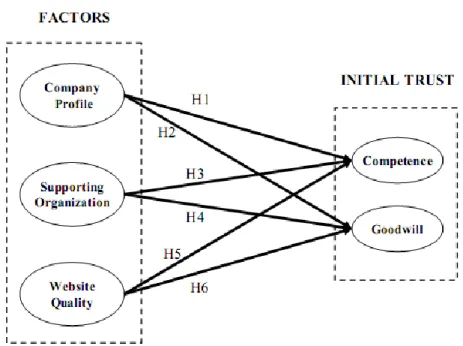
Kim and Tadisina (2005) summarized the factors affecting the initial trust in the light of previous researches in three headings including company profile, supporting organization, and website quality. According to this model, company profile is an important factor impacting initial trust and it is composed of company’s size, reputation and history. Additionally, the trustworthiness of supporting organizations according to customers is also shown as a significant element for the initial trust of customers. Examples of these organizations are assurance service organizations or the parent company of a company or any company which has a close connection with the company. The last factor component of the model is website quality which is about the degree of website’s efficiency in providing necessary information about the products, making the completion of transactions easy and rapid while also achieving personalization and enjoyment. Figure 2.4 depicts the suggested model.
38
Figure 2.4: Model of initial trust development (Kim & Tadisina, 2005)
In a virtual environment, the development of initial trust is difficult for new customers since the anonymity and information asymmetry exist (Bigley & Pearce, 1998). In order to overcome this asymmetry in online transactions, e-vendors should transmit the necessary signals including information associated with product to the potential customers while improving their initial trust level, decreasing the uncertainty and risk perception and contributing them for the identification and selection of e-vendors (Mayer et al., 1995). Some researchers classified these signals as “intrinsic signals” such as security, website design, and full description of goods, brand choice variety, friendly user interface, good navigation (Montoya-Weiss, Voss, & Grewal, 2003) and “extrinsic signals” such as perceived reputation, brand and country of origin (Yoon, Guffey, & Kijewski, 1993). One of these extrinsic signals, perceived reputation is a critical factor for initial trust and it has a great influence on customers’ initial trust if they have not too much experience in their products or service and do not know too much about the their counterparties (Rodgers, Negash, & Suk, 2005). Perceived reputation in online environment has two components including reputation ratings and online customer feedbacks (Casalo, Flavia, & Miguel, 2007). When the reputation ratings of the e-vendors are high, the initial trust of the customer will also be higher. Online customer feedbacks are the commentaries which are done by customers according to their buying and usage experiences of products and also includes the suggestions with the related product (Resnick, Zeckhauser, Friedman, & Kuwabara,
39
2000). These comments and recommendations contribute less experienced customers in online shopping to find the products which fit best with their needs and so increase their initial trust level.
One of the intrinsic signals, product descriptions exposit the products based on their technical specifications and the performance in terms of technical standards (Lee, Park, & Han, 2008). In online environment, sellers identify the products by texts and pictures (Park, Lee, & Han, 2007). These elements help customers to better perceive the quality and get idea about the specifications of the product and hence can diminish the information asymmetry between customers and e-vendors (Liao, Palvia, & Lin, 2006; Gefen, Karahanna, & Straub, 2003). On the other hand, customers who are inexperienced in online shopping may have difficulty while evaluating the quality of product according to the product descriptions. At this point, intrinsic signals are not sufficient for these customers and they utilize extrinsic signals for the quality assessment. According to Nysveena and Pedersen, the trust of customers who have little experience in online shopping mostly depends on the reputation ratings and the recommendation of other customers (Nysveena & Pedersen, 2004). In contrast to inexperienced customers, experienced customers are able to make comparison and selection of products which have good performance and the selection of online stores which are trustworthy according to product descriptions presented by the sellers (Jøsang, Ismail, & Boyd, 2007).
40
2.7. Summary of the Chapter
In this chapter, several trust definitions in different fields such as psychology, management, marketing, organizational behavior and public relations have been stated in order to provide different viewpoints to the reader. Additionally, some concepts closely related with trust including trustworthiness, e-loyalty, online stickiness, online satisfaction, psychological contracts, privacy, risk, security, premium pricing have been discussed. The importance of trust for companies and individuals has been underlined, since it is the key factor for many business relationships and personal affairs. Moreover, various classifications of trust including interpersonal trust, institutional trust and disposition to trust; macro and micro level trust; initial trust and repeat trust have been identified by different models and examples suggested from previous research. This chapter contributes the study in the understanding of trust and related concepts and their relationship with each other. In the next chapter, e-commerce and related concepts will be explained.
41
Chapter 3
E-commerce and Related
Concepts
3.1. Objective of the Chapter
The objective of the chapter is to supply definitions about e-commerce, different types of commerce and commerce related concepts. Also, the advantages of e-commerce for companies and individuals as well as its limitations are aimed to be clarified. To give a general insight about the current status of e-commerce in Turkey and in the world and to investigate the success models related with e-commerce are the further issues which are among the objectives of this chapter.
3.2.Definition of E-commerce
By the 21st century, businesses changed their way of businesses and switched from the primitive type of trading, bartering to virtual trading. Electronic commerce (e-commerce) has a high popularity in the mass media as well as IS research. There have been many definitions made by different scholars. Innovations in e-commerce processes and activities have been launched and implemented rapidly in a short period of time and in parallel to these innovations, definitions changed and evolved based on the existing technology and environment.
The most comprehensive and robust definition was made by Kalakota and Whinston (1997) who viewed e-commerce from four perspectives:
“From a communications perspective, e-commerce is the delivery of goods, services, information, or payment over computer networks or by any other electronic means.” (p.3)
“From a business process perspective, e-commerce is the application of technology toward the automation of business transactions and workflow.” (p.3)