T.C
ISTANBUL AYDIN UNIVERSITY INSTITUTE OF SOCIAL SCIENCES
THE EFFECTS OF MONETARY POLICY SHOCKS ON
MACROECONOMIC VARIABLES: A CASE FOR TURKISH ECONOMY
THESIS ABDUR REHMAN
Department of Business Business Administration Program
Thesis Advisor: Assoc. Prof. Dr. ZELHA ALTINKAYA
T.C
ISTANBUL AYDIN UNIVERSITY INSTITUTE OF SOCIAL SCIENCES
THE EFFECTS OF MONETARY POLICY SHOCKS ON
MACROECONOMIC VARIABLES: A CASE FOR TURKISH ECONOMY
THESIS ABDUR REHMAN
Department of Business Business Administration Program
Thesis Advisor: Assoc. Prof. Dr. ZELHA ALTINKAYA
“knowledge may give weight, but accomplishments give luster, and many more people see than weigh.”
To my parents, Abdul Ghafar & Nasreen Ghafar
v FOREWORD
This study analyzes the response of macroeconomic variables to both monetary policy and external shocks in Turkey. The study solves the price and exchange rate puzzles. The study also reveals that external shocks are not important for Turkish domestic fluctuations and Monetary Transmission Works better through exchange rate.
Many individuals and friends have helped me in making this thesis a success. Pivotal in this role, was my advisor Assoc. Prof. Dr. Zelha ALTINKAYA who taught me literally being a skeptic and helped me to develop the critical thinking. His delicate balance of guiding the students without transforming them into order-taking robots always impressed me. I feel very lucky to have met her and the opportunity to work with her.
I would like to thank Aatif Ijaz, without him, I could never have finished my thesis. He always supported and motivated me to accomplish my goals.
Finally, I would like to thank my family members especially my elder brother Hafiz Muhammad Asif and friends Naveed Ahmed Abbasi, Rizwan Sadiq, and Sonia Rizwan for their support during stressful and difficult moments.
vi TABLE OF CONTENTS Page FOREWORD………... v TABLE OF CONTENTS………... vi ABBREVIATIONS ... viii LIST OF FIGURES……….ix ÖZET ... x ABSTRACT ... xii 1 INTRODUCTION ... 1 1.1 Methodology ... 3
1.2 Reliability and Validity ... 4
2 MONETARY THEORIES AND POLICIES ... 5
2.1 Monetary Theories ... 5
2.1.1 Classical approach ... 5
2.1.2 Neo-Classical approach ... 8
2.1.3 Keynesian approach ... 9
2.1.4 Monetarist approach ... 11
2.1.5 New Keynesian Economics... 12
2.2 Monetary Policies ... 13
2.2.1 Types of Monetary Policies ... 13
2.3 Monetary Policy Instruments in Advanced Economies ... 14
2.3.1 Conventional Monetary Policy instruments ... 14
2.3.2 Unconventional Monetary Policy Instruments ... 16
2.4 Monetary Policies and Instruments followed by Central Bank of the Republic of Turkey ... 18
2.4.1 Monetary Policies... 18
2.4.2 New Policy Instruments ... 19
2.5 Monetary Transmission Mechanism ... 20
2.5.1 Interest rate ... 21
2.5.2 Asset Price ... 21
2.5.3 Credit Channel ... 23
2.6 The J- Curve Effect ... 25
2.7 The Exchange Rate Overshooting ... 28
3 LITERATURE REVIEW ... 29
4 THE EFFECTS OF MONETARY POLICY SHOCKS ON MACROECONOMIC VARIABLES: A CASE FOR TURKISH ECONOMY ... 35
4.1 The Model and its Specification ... 35
4.2 Reliability & Validity ... 37
4.3 Data ... 38
vii 6 CONCLUSION ... 43 7 REFERENCES ... 44 8 APPENDICES ... 51 8.1 Appendix A: Data ... 51 8.1.1 Domestic data ... 51 8.1.2 External Data ... 51
8.2 Appendix B: Data Statistics from Rats Output ... 52
viii ABBREVIATIONS
CBRT : Central Bank of the Republic of Turkey ECB : European Central Bank
ER : Exchange Rate
FED : Federal Reserve System FFR : Federal Funds Rate
IMF : International Monetary Funds IR : Interest Rate
MTM : Monetary Transmission Mechanism QE : Quantitative Easing
SVAR : Structural Vector Autoregressive
TL : Turkish Lira
ix LIST OF FIGURES
Page
Figure 2.1 The link between Monetary Policy and Aggregate Demand: MTM ... 25
Figure 2.2: J-Curve ... 27
Figure 2.3: Exchange Rate Overshooting ... 28
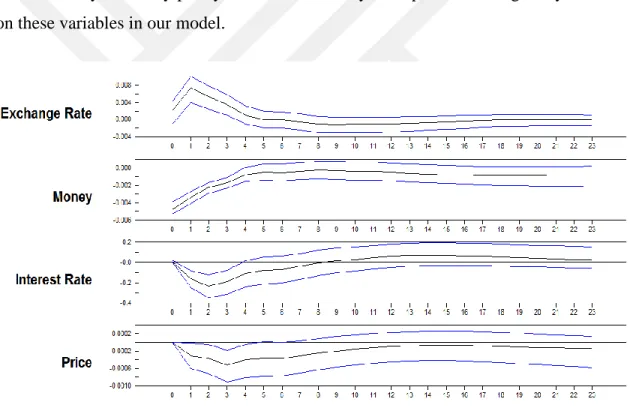
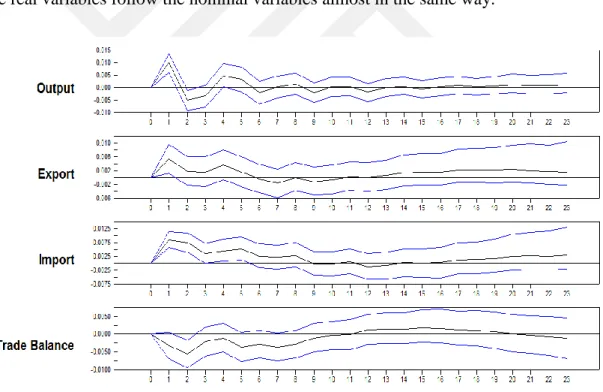
Figure 5.1: (a) Domestic Monetary Policy Shock ... 39
Figure 5.2: (b) Domestic Monetary Policy Shock ... 40
Figure 5.3: (c) Domestic Monetary Policy Shock... 41
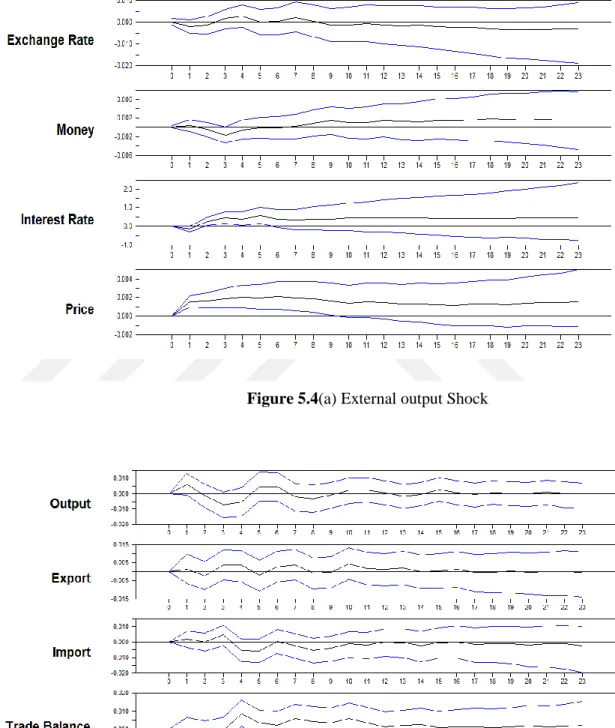
Figure 5.4: (a) External output Shock ... 42
x
PARA POLİTİKASI ŞOKLARININ MAKROEKONOMİK DEĞİŞKENLER ÜZERİNDEKİ ETKİLERİ: TÜRKİYE EKONOMİSİ ÖRNEĞİ
ÖZET
Çalışma, para politikasının ve dışsal şokların, küçük açık bir ekonominin makroekonomik değişkenleri üzerindeki etkisini incelemektedir. Bu şokları Türkiye özelinde belirleyebilmek için Yapısal Vektör Otoregresif Regresyon (SVAR) modelini blok dışsallık (block exogeneity) yöntemiyle birlikte kullanmaktadır. Halihazırda Vektör Otoregresif Regresyon (VAR) yaklaşımını kullanarak para politikası şoklarının küçük açık ekonomiler üzerindeki etkilerini inceleyen çalışmalar mevcuttur, fakat bu çalışmalar sonuç olarak fiyat ve döviz kuru çıkmazları (puzzle) üretmişlerdir. Literatürden farklı olarak, bu çalışmada SVAR yönteminin kullanılması ile yukarıda bahsedilen çıkmazlar ortaya çıkmamıştır. Çalışma böylelikle SVAR yönteminin bu çerçevede önemini ortaya koymakla birlikte bu yöntemin, küçük açık ekonomilerdeki parasal değişkenleri açıklamada, standart VAR yönteminden daha iyi sonuçlar ürettiği sonucuna ulaşmaktadır. Çalışmanın temel sonuçlarından bir tanesi sıkı para politikasına karşı Türkiye'de TL'nin değer kazandığı ve fiyatlar düzeyinin düştüğü yönündedir. Bu sonuç literatür ile uyumludur. Ayrıca çalışma fiyatların kısa dönemde yapışkan olduğunu ortaya koymaktadır. Sıkılaştırıcı para politikası üretimi artırmıştır fakat bu artış ciddi bir düzeyde değildir. Belirtilmelidir ki bu artış halihazırdaki teorilerle de uyumlu değildir. Faiz oranları beklendiği gibi sıkılaştırıcı para politikasına karşı yükselmiştir fakat bu değişim istatistiksel olarak anlamlı değildir. Para stoğunda ise tutarlı bir düşüş gözlenmiştir. Sıkılaştırıcı para politikası ihracat ve ithalatın sadece kısa dönem için artmasına sebep olmuştur. Analizde ayrıca dış ticaret dengesinin başlangıçta kötüleştiği ardından toparlanma yaşadığı gözlenmiştir. Dış ticaret dengesinde ters J-eğrisi trendi bulunmaktadır. Kapsanmamış faiz haddinden kısa dönemli bazı sapmalar gözlenmiştir. Ayrıca bulgular dışsal üretim şoklarının Türkiye’deki ekonomik dalgalanmalar üzerinde önemli ölçüde etkili olmadığını ortaya koymaktadır. Bu araştırma içsel ve dışsal şokların Türkiye gibi küçük açık bir ekonominin genel ekonomik durumu üzerinde ne kadar etkili olduğunu açıklamaya çalışmaktadır. Çalışma ayrıca aktarım mekanizmasının döviz kurları üzerinden daha iyi işlediğini göstermektedir.
Anahtar Kelimeler: Türkiye ekonomisi, para politikası, açık ekonomi, SVAR, parasal aktarım mekanizması, klasik para politikası araçları, klasik olmayan para politikası araçları
xi
THE EFFECTS OF MONETARY POLICY SHOCKS ON MACROECONOMIC VARIABLES: A CASE FOR TURKISH ECONOMY
ABSTRACT
The study analyzes the response of macroeconomic variables to monetary policy and foreign shocks in a small open economy. This study follows Structural Vector Autoregressive model (SVAR) with block exogeneity approach to identify these shocks in Turkey. Some previous studies followed VAR approach (recursive order) to analyze the monetary policy shocks in small open economies but produced price and exchange rate puzzles while using SVAR approach this research does not produce such puzzles. The study uncovers the significance of SVAR approach and reveals that it is a better approach than VAR approach to determine the monetary behaviors in small open economies. This dissertation finds that currency appreciates, and prices diminish in response to tight monetary policy. All results are in accordance with well-known theories. The study discloses that prices are sticky in the short-run. The output increases, but it is not critical. It is not in accordance with theoretical expectations. The interest rate rises as expected in reaction to monetary shock but not significant. The analysis also shows a consistent decrease in the money stock. The contractionary policy helps to increase export and import but only for short term. The research also finds that trade balance initially worsens, and then improves in response to tight monetary policy shock. There is an Inverse J-curve trend in the trade balance. There are some deviations from Uncovered Interest party (UIP) but only for short period. Further, the study displays that foreign output shocks are not critical for domestic economic fluctuations in Turkey except some fluctuations in prices. So, this study tries to find that how much domestic and foreign shocks influence the overall economic conditions in the open economy like Turkey. The study reveals that transmission mechanism works better through the exchange rate.
Keywords: Turkish economy, monetary policy, Monetary transmission mechanism, conventional monetary policy instruments, non- conventional monetary policy instruments, SVAR, open economy.
1
1 INTRODUCTION
Last two decades have been very important for emerging economies as these economies showed a consistent growth in economic activities. Central banks around the world use monetary policy to maintain high economic growth rates and to stabilize inflation rates. To identify the reactions of economic activities and prices to monetary policy shocks, one needs to estimate these reactions to monetary policy shocks accurately along with policy execution timings, especially in emerging economies. Researchers have been trying to answer the questions (by using VAR model) about the connection between monetary policy and macroeconomic variables but there is no consensus among them about the reaction of macroeconomic variables to monetary policy shocks.
Proper identification approach is required to identify the behavior of monetary policy shocks on macroeconomic variables in small open economies. Researchers extensively used, “The Choleski approach” (A VAR analysis) to identify the monetary policy behaviors. Being a lower triangular matrix, this approach is a subject of contemporaneous limitations, for example, exchange rate (ER) being last in the model can respond contemporaneously to all other variables but not vice versa. This condition makes it suitable for relatively large and closed economy like U.S as its monetary decisions are independent of any external movement. It is not suitable for a small open economy like Turkey as it is vulnerable to both monetary and external shocks. Such limitations produce price and ER puzzles in a small open economy like Turkey.
This study tries to analyze the effects of monetary policy shocks on macroeconomic variables in small open economy by using Structural VAR approach of Cushman and Zha (1997). The study uses Turkey as a case study. Turkey being an open economy is vulnerable to foreign variables; from this point of view, we consider some foreign variables, such as CPI*, Y*, FFR*, and OP* to separate any exogenous monetary policy
2
movement. Fung (2002), Buckle et al. (2002) and Franken et al. (2006) also adopted Structural VAR approach to identify the monetary policy shocks.
We find that contractionary policy appreciates the currency significantly, diminishes the prices and increases the interest rates but not significantly. So, the does not produce any ER or price puzzle in our analysis but it can have puzzles if we use Choleski decomposition. The contractionary policy increases the exports, but this is not significant. There is a significant increase in imports in response to contractionary monetary policy shock. The study also finds some deviations from the uncovered interest party (UIP) for only three months. Our study shows that foreign output shocks do not play a crucial role in domestic fluctuations in Turkey except some fluctuations in prices.
There are some Turkish studies which also used VAR approach to analyze the monetary policy shocks (Berument 2007) and (Özdemir 2015). These studies also do not produce any price or ER puzzle.
The study also contributes into the existing by testing two hypotheses. The J-Curve Hypothesis and ER overshooting. The overshooting hypothesis highlights a sudden appreciation in exchange rates (ERs) for only short-period and then depreciation in response to a contractionary monetary policy. It is believed that prices respond slowly (prices are sticky in the short-run) while exchange rates respond quickly to monetary policy shock. A compensation for sticky prices in the economy. Thus, the monetary policy shock will have more effect on ER in the short run rather than on the prices in the long run and this condition will produce overshooting in exchange rates for short-period. The study finds that ER overshoots in response to tight monetary policy.
The J-curve hypothesis underlines that expansionary monetary policy depreciates the currency which helps to decrease the import volume and to increase the import prices and the export volume. There will be trade deficit if the effect of import prices is stronger than the import volume effect and if it is not strong, then there will be trade surplus. The J-Curve highlights that import prices effect is strong than import volume effect in the short-run (a trade deficit) and weak in the long-short-run (trade surplus) in response to expansionary
3
monetary policy (at least theoretically). The study finds J-Curve inverses because in our analysis, we consider contractionary rather than expansionary monetary policy stance.
1.1 Methodology
The purpose of the study is to analyze the effects of monetary policy shocks on macroeconomic variables in Turkey and to deal with ER and price puzzles which has been normally founded in earlier studies regarding the identification of monetary policy shocks. The study also tries to find, which is better monetary transmission mechanism?
This study follows Structural Vector Autoregressive model (SVAR) with block exogeneity approach of Cushman and Zha (1997) to identify the monetary policy shocks in Turkey. Some previous studies followed VAR approach (recursive or choleski) to analyze the monetary policy shocks in small open economies but produced price and exchange rate puzzles while using SVAR approach this research does not produce such puzzles. Recursive or choleski approach is lower triangular matrix where succeeding variable is affected by proceeding variable and not vice versa. So, this contemporaneous limit makes it invalid for small open economy like Turkey where monetary policy respond immediately to any foreign shock. Structural VAR approach is very flexible in compared to Choleski or Recursive approach. Under this approach, each variable can react immediately to other variables contemporaneously whose data are available for policy makers within month.
The SVAR model’s specification is divided into three equations; money supply and demand, information, and production equations. The money demand contains typical text book equation and money supply contains all variables whose data is available within one month. The information equation contains all variables contemporaneously and production equation contains Impt, Expt, Y and CPI. The study uses RATS software.
The study uses monthly data series from 2006:1 to 2015:12 and it is in log form. The dataset starts from pure inflation targeting regime as this period has stable and low inflation trend. The data sets are of two types; foreign and domestic. Foreign data consists of federal funds rate (FFR*), Advance economies industrial production index (Y*),
4
Advance economies consumer price index (CPI*), and Oil prices (OP*) and domestic dataset consists of monetary aggregate (M2), monthly overnight rate (R), Real exchange rate (RER), consumer price index (CPI), industrial production index (Y), exports (Expt) and imports (Impt).
1.2 Reliability and Validity
The research’s data sets sources are reliable because it choses data from well-known reliable sources. This study sources include International Financial Statistics (IFS), Federal Reserve System, Istanbul Stock Exchange, Turk-Stat and Central Bank of Turkey. Almost among all researchers, these data sources are reliable. So, if some other research or study try to produce the results of this research or study again, it will produce same results as this research produced. The study is assured about its reliability.
The results got by using SVAR approach are valid and genuine for small open economy. This approach is valid for small open economy because it also includes a block of exogenous variables which is very important while analyzing the monetary policy shocks. So, by using this model, almost same results can be produced for any small open economy and this believability of this models shows that how much valid this model is.
The rest of the study is arranged as follows. Section 2 introduces the monetary theories and policies Section 3 specifies the literature review. Section 4 presents the effects of monetary policy shocks on Turkish macroeconomic variables. Section 5 displays the results and, section 6 describes the conclusion. In section 7 References and finally, section 8 discusses Appendices.
5
2 MONETARY THEORIES AND POLICIES
2.1 Monetary Theories
The focus is on monetary theories in detail along with some background of other economic theories. Our subject of discussion is mainly macroeconomics. We can divide macroeconomics into five major approaches. (1) Classical approach, (2) Neo-Classical approach (3) Keynesian approach, (4) Monetarist approach, (5) New Keynesian approach.
2.1.1 Classical Approach
Most economists believe that classical economics started with the work of Scottish author Adam Smith’s book “The Wealth of Nations” in 1776. According to Allgoewer (2009), other major contributions in classical economics are of Jean Baptiste Say (1803), David Ricardo (1821), Thomas Malthus (1823) and John Stuart Mill (1884). Some economists consider Marx (1867) and Henry George (1884) as contemporary of classical economics.
They were believer of the free market or laissez-faire market. Classical economists believe that markets can work well itself, without any incorporation of government. They consider that the involvement of government can create more problems for the economy to work well rather than to solve it. The details of some classical economists and their theories are as follows;
Today, many economists believe that Adam Smith is a father of modern economics. Adam Smith was a believer in laissez-faire market or free trade market and capitalism. According to Smith (1776), markets can work well without the intervention of government. He was the proponent of mercantilism because in his view that economy grows quickly in the free trade market.
6
Smith (1776) used a phrase, “invisible hand” in his book the “An Inquiry into the Nature and Causes of the Wealth of Nations” means that an individual who works for personal
benefits also benefits the whole economy. Individuals use scarce resources efficiently to fulfill their needs which ultimately increase the wealth of nations indirectly without the intention of individuals.
Smith also described the theory of labor value. He was a follower of his idea that labor produces a wealth of nations and believe that production is only because of consumption. According to Smith (1776), whatever labor produce, it belongs to laborer, but it is not always the case, sometimes it should share its part of the production with the landlord when land is held privately.
Smith (1776) valued gold, silver, and corn in terms of measures but later he concludes that it can fluctuate with the passage of time. He argues that labor is the only thing which does not fluctuate with the passage of time and concludes that it is actual price of the commodity and refers that rent on land is not an expense but a surplus (Dooley, 2002).
Smith was also concerned about labor division. According to Smith (1776), it guides “the greatest improvement in the productive powers of labor”. He believed that labor division can increase economic output, labor skills and as well as production with same numbers of labors (Schumacher, 2012).
David Ricardo, a well-known British economist did a lot of work in political economy, a field of economics which deals with production and trade and its relationship with governing authorities. Ricardo gave the ideas of comparative advantage, the law of diminishing return, value theory of labor, the theory of rent and Ricardian equivalence.
Ricardo (1821) in his book, “The principles of Political Economy, and Taxation” explained that labor theory of value is a summary of labor quantity. It means that a price of the commodity was a result of the quantity of labor (how much labor used to produce a commodity). Stigler (1958) elaborated Ricardo’s idea that a change in relative commodity prices was mainly due to a change in the quantity of labor.
7
Ricardo (1821) believes that when you keep on increasing one input unit (agriculture) by keeping other variables constant, it will increase total production to some fix-point but after that point, it will start decreasing because of available fixed land.
The main contribution of Ricardo in economics was the idea of competitive advantage (Dooley, 2005). Ruffin (2002) in his article “history of political economy” explains the idea of Ricardo that international free trade can benefit both countries in the long run and short run by sharing goods among them, in which they are specialized or have a cost advantage.
Ricardo (1821) believed that if you can purchase cheaper goods from abroad then no need to produce it at home. Another idea, Ricardian equivalence which demonstrates that it will not affect the economy either government manages expenditures through debt or taxes.
His theory of rent was also a major work in economics. Ricardo (1821) clarified that rent is a distinction between marginal of production and fertile volume of land. He also mentioned about the theory of profit, in his view, real wages and profit have an inverse relation (Formaini, 2004).
Jean Baptiste Say (1803), a French economist was also in favor of free trade (laissez-faire) and market competition like other classical economists. He was also a proponent of government intervention. Jean Baptiste Say (1803) in his work, “A Treatise on Political Economy” introduced “Say’s Law” or” Law of Market”. Say’s law relies on this assumption that “A product is no sooner created, than it, from that instant, affords a market for other products to the full extent of its own value ... the mere circumstance of the creation of one product immediately opens a vent for other products” and “As each of us can only purchase the productions of others with his own productions – as the value we can buy is equal to the value we can produce, the more men can produce, the more they will purchase”. What does this statement mean? It means that supply itself produces other products in the form of demand (Meng 2006).
8 2.1.2 Neo-Classical approach
Alfred Marshall, a founder of neoclassical economist, who gave the idea of supply and demand through the graph, cost of production and marginal utility in his famous book “principles of economics”. Alfred Marshall (1890) express the quantity theory of money through Cambridge cash approach (M.1/K= P.Y). He was a believer of money demand effect like John Maynard Keynes (1937) rather than money supply effect.
Another neoclassical economist, A.C. Pigou did a lot of work in economics such as Pigou effect (wealth effect), Pigovian tax and Pigou club. A.C Pigou was the man, who actually introduced the “Cambridge equation” (demand for real cash balances). Unlike the Fisher’s nominal price level (pn),
Piguo (1943) took the real price of money as the quantity of wheat that a unit of tender can purchase (pw). He mentioned that pw just depends only on the demand for real balances and can be measured as a product of resources enjoyed by a community in terms of good wheat Rw and real resources held by the community (k). Pigou’s actual price of legal tender: Pw = KRw /M (McLure, 2013).
Irving Fisher, an American neoclassical economist is famous for his work in economic and monetary theories. He gave many economic and monetary theories such as utility theory, IR and investment theories, debt deflation theory (in response to stock market crises in 1929) and the quantity theory of money. From the perspective of demand for money, Fisher (1911) believes that it is a function of income as Md = k (PY) and demand for money is not affected by the IR. He also believes that velocity V (number of times in a year, the dollar used for buying goods and services in the economy) will remain constant in the short run.
According to Fisher (1911), Quantity of money will determine the total nominal spending in the economy as 𝑃 × 𝑌 = 𝑀 × 𝑉 whereas (PY is total spending in economy) P is price level and Y is aggregate output and M is quantity of money and v is velocity of money. When money supply M doubles, then income also doubles. Classical economists (including Fisher) believed that prices and wages were not fixed so Y would be at full
9
employment and constant in the short run. So, price level P doubles when money supply M doubles.
2.1.3 Keynesian approach
Keynesian economics start with the book “The General Theory of Employment, Interest, and Money” of well-known British Economist John Maynard Keynes. It was written in response to “The Great Depression” of 1930’s. Unlike classical economists, Keynesian economists favor the state intervention during recessions. Keynesian economists believe that aggregate demand influences the economic output during recessions, especially in short run. It is demand side economics rather than supply side of classical economics.
John Maynard Keynes (1937), in his book “the general theory of employment, interest, and money” rejected the idea of quantity theory that velocity is constant and introduced the theory of money demand that explained the significance of IR. He gave the theory of money demand, named as liquidity preference theory. According to Keynes (1937), people want to hold money because of three motives.
2.1.3.1 Transaction motives
The amount of money people wants to hold for everyday transactions. Firstly, he considered that it is proportional to income but later, he realized that technology can also change demand for money. Payment technology can reduce the demand for money because you can purchase almost everything without holding money in cash. So, he recognized that advancement in technology can reduce the demand for money relative to income.
2.1.3.2 Precautionary Motives
People also keep the money for sudden unseen future events and opportunities, and also to hold an asset, whose value is fixed in terms of money to meet a subsequent liability are further motives for keeping the cash. He recognized that it is also proportional to income.
10 2.1.3.3 Speculative Motives
People keep the money as a store of wealth. This is the important motive as it transmits the effects of a change in the quantity of money. Keynes (1937) recognized two types of assets, money, and bonds. He believed that money earns no interest whereas bonds earn. So, when interest goes up, the demand for holding bonds increase while the demand for money falls.
Keynes (1937) explained in his general theory of interest rate that when the IR is low, the demand for money will exceed the available supply and will decrease when the IR is high. He formulated liquidity preference function as M = L(r) where M is the quantity of money, L is liquidity preference function and r is IR. By combing these motives, Keynes (1937) concluded liquidity function as, Md/P= L (i-, Y+). It indicates that money demand is negative to IR and positive to real income.
Later, there were four developments in liquidity preference theory as mentioned by Johnson (1962) in his article. First, according to Johnson, Alvin Hansen started to consider transaction demand as interest-elastic also. Later, James Tobin also explained that transaction demand for money is interest-elastic as it can also earn a profit. So, many economists started to consider that both income and IR are important for money demand as a whole.
Second, Johnson explained that John’s speculative motive was based on interest-elasticity which was later explained by Keynesian writers that this interest-elasticity based on future uncertainty rather on explicit expectation about its level. Third, the initiation of the value of wealth, which also relies on the rate of interest, as a clear element money demand was a portion of more general activity of freeing Keynesian theory from its short-period equilibrium expectations. It suggests for liquidity preference theory that variation in money quantity by open market operations and fiscal policy would create different liquidity preference curve.
Fourth, the assets division other than money as Keynes aggregated all assets into bonds and suggested the use of a single rate of interest. It changed Keynesian theory of liquidity
11
into the theory of relative prices of other assets. Other factors that can change demand for money are; a risk of other assets, wealth, and liquidity of other assets (Mishkin, 2015).
2.1.4 Monetarist approach
Normally, economists referred monetarist economics to the work of Milton Friedman. Monetarists believe that economic health can be maintained well by controlling the money supply in the economy. They were concerned about that inflation plays an important role in economic health and it can be controlled through money supply.
They also believe that total output in the short run and price level over a long-period can be influenced by changing the money supply. Monetarists also believe that economic policy (interest rate or money supply) should be based on predetermined rules (for example Taylor rule or Friedman’s k-percent rule) rather than on discretionary rules (ad hoc judgment).
Milton Friedman laid down the foundation of monetarist economics. In his book “A history of the united states 1867-1960” with co-author Anna Schwartz argued that “inflation is always and everywhere a monetary phenomenon” (Friedman & Schwartz, 2008). He argued that an increase in money supply always brought an inflationary pressure, so price stability (equilibrium between money supply and demand) should be the main objective of monetary authorities.
He also argued that deflationary pressure occurs during liquidity crunch due to the lack of proper money supply. Friedman gave the idea of Friedman k-percent rule, which can be described as a permanent (fixed percentage) increase in money supply every year. Milton Friedman in his article 1956 “The Quantity Theory of Money: A Restatement” gave the theory of demand for money. Friedman took the money as an asset and used the theory of asset demand for money (Johnson 1962). According to Mishkin (2004), Friedman considered that demand for money is a function of total resources and futures earnings on other forms of assets relative to money.
12
After careful analysis, Friedman also believed that people hold a certain amount of real balances (money in real terms). He recognized that function of demand for money relies on return on bonds and equity and expected inflation.
In his wealth definition, Friedman uses the concept of permanent income (long-run income). He viewed that permanent income doesn’t fluctuate much because most deviations in income are temporary. So, Friedman claimed that money demand has a positive connection with wealth (permanent income).
Friedman also believes that increase in expected returns in other forms of assets like bonds, equity, and goods decrease the demand for money. Unlike Keynes, Friedman recognized that interest has an insignificant effect on demand for money because he didn’t take a return on money as a constant (Brunner, 1970).
2.1.5 New Keynesian Economics
New Keynesian economics developed in the 1980s in response to classical economists that Keynesian economics is totally a failure. Classical economists believe that New Keynesian Economics is based on fancy ideas that have no valid structure, have no belief on expectations, and have no clear explanation with regarding to price stickiness.
New Keynesian argue to these criticisms and accept that “adaptive expectations are fancy, fake, and unreal”. Many efforts have been made to construct Keynesian arguments that consist of microeconomic structure and rational expectations.
For example, a model about wage accuracy and transactions cost-based model for sticky prices. They believe that “prices are sticky in the short-run” means that the prices change in the long-run, not in the short run (change but at very slow pace) to any unanticipated shock. They believe on government interventions for the correctness of the market like the classical Keynesian economists.
13 2.2 Monetary Policies
According to Fed’s definition, “Monetary policy is a term used to refer to the actions of central banks to achieve macroeconomic policy objectives such as price stability, full employment, and stable economic growth”. In other words, monetary policy is all about the management of money supply. How central bank or monetary authority of a country controls the money supply to accomplish its target of inflation or IR in order to stabilize the prices and unemployment rates.
Money supply usually affects IR and other economic activities. According to new Keynesian models, price stability is still a mandatory goal of monetary policy. Some economists think that financial instability in emerging markets was a result of monetary policy decisions, but advanced economies think it as a prudential policy (Gali, 2015).
2.2.1 Types of Monetary Policies
There are two types of monetary policies, expansionary policy during bust to enhance economic activity and contractionary policy during the boom to target inflation rate (Borio, 2014). Expansionary policy is an increase in the amount of money in the market and it causes to decrease interest rates, reserve requirements as well as depreciation in ER while contractionary policy causes decrease in money supply, increase in interest rates and appreciation in ER. Expansionary and contractionary policies have different results in the short run and the long turn.
Central banks also use unconventional policies, when interest rates are zero or near to zero and sometimes even negative. Central banks use another policy called as “quantitative easing” (unconventional policy) to boost the economy. Quantitative easing is unconventional in a sense that central banks purchase more securities than usual (Labonte & Makinsen, 2008).
14
2.3 Monetary Policy Instruments in Advanced Economies 2.3.1 Conventional Monetary Policy instruments
Before 2008 Financial Crisis, developed economies especially the Fed were normally using three monetary policy tools, open market operations, discount lending and reserve requirements to influence interest rate and money supply while ECB (European Central Bank) was also using these three tools along with deposit facility (interest on reserves) before 2008. Later, the Fed also started to use interest on reserves as another monetary policy tool. Normally, economists call these three tools as conventional monetary policy tools.
2.3.1.1 Open Market Operations
Handa (2009) describes that open market operations are normally used by developed economies where financial markets and public debt transactions are huge. So, many countries in the world cannot use open market operations as these require particular-conditions to use them effectively.
Open market operations are major sources of change in the monetary base and IR. Open market purchases increase the money supply and decrease the short IR while sales decrease the money supply as well as increase the short-term IR. Through repurchase agreement (repo) and matched sale-purchase agreement (reverse repo), Fed can also change monetary base for a very short-period.
Mishkin (2015), in his book “the money, banking, and financial markets” mentioned two types of open market operations, dynamic open market operations cause to change in monetary base and reserves level while defensive open market operations are additional factors to offset the effect of Fed or float. In U.S trading desk at the Federal Reserve Bank of New York conducts these open market operations.
Fed can control open market operations directly and implement them very easily and quickly. ECB uses two types of open market operations; main refinancing operations
15
(mostly used) and long-term refinancing operations (least used) as its primary tools to conduct monetary policy.
2.3.1.2 Discount lending
The central bank is the major monetary authority in any country who can influence the economy by changing interest rates (IRs). Market IRs are usually influenced by discount rates or marginal landing facility in the European Union (loans by a central bank to commercial banks) and overnight rates (loan rates among banks). IRs play a significant role in the economy in changing the investment decisions and aggregate demand. Central banks around the world now have started to use IRs as their major monetary targets because of unstable money demand function. Change in discount rates and overnight rates usually an indicator of the future stance of monetary policy.
Each central bank around the world has its own criteria to set discount rate or bank loan. The Fed provides loans to commercial banks through the discount window while ECB provides loans through marginal landing facility.
Loans are of three types, primary loans for strong financially banks. Secondary loans for financially troubled banks and seasonal loans to small banks for agricultural needs. “Discount loans are also referred as the lender of last resort”. The basic purpose of discount loans is to save banks from financial panics and liquidity shortage in periods of recession. Fed cannot control discount loans directly because it’s the choice of commercial banks, when to take loans and how to use them. So, that’s why discount loans cannot be used as the main tool for conducting monetary policy (Mishkin, 2004).
2.3.1.3 Reserve Requirements
Reserve requirement is another monetary policy tool. Mostly used by weak economies where open market operations are not possible to operate (Handa, 2009). The rise in reserve requirements helps to increase federal funds rate (FFR) or target financing rate in the European Union and to contract the money supply. The decrease in reserve requirements helps to decrease IR and to expand money supply during this process.
16
Central banks around the world have their own minimum reserve requirement ratio. It is very powerful tool for money supply because a slight change in money supply can produce severe results, and liquidity problem. So, Central banks mostly avoid using it as a monetary tool (Mishkin, 2004).
2.3.1.4 Interest on Reserves
Since the Financial Crisis of 2008, Central banks in developed economies especially the Fed has started to pay interest on reserves while ECB has been using deposit facility since 1999. Before 2008, excess reserves ratio was not much high in US banking system. After the Financial Crisis of 2007-08, huge monetary policy stimulus or quantitative easing (QE) caused the excess reserve ratio to increase trillions of dollars, which ultimately put downward pressure on FFR (the rate at which banks can borrow from other banks).
The Fed’s rate fell near to zero and then, to prevent from falling further, the fed started to pay an interest rate on reserves. So, by paying banks the deposit funds, the fed set a “floor” on the rate at which banks will lend funds to each other – the Fed Funds rate (Copolla, 2015). It will facilitate the Federal Reserve to exit from zero policy rates and to increase FFR.
2.3.2 Unconventional Monetary Policy Instruments
Conventional monetary policy instruments fail during severe economic conditions because it is not possible for the central bank to decrease interest rate as it already hit the zero bound (Smaghi, 2014). It is not possible in actual terms for the IR to be negative because bonds can always earn more than cash. During these conditions, central banks use nonconventional monetary policy tools. These tools include liquidity provision, large-scale asset purchases and commitment to future monetary policy actions.
2.3.2.1 Liquidity Provision
Mishkin (2015) explains that when conventional tools fail during Financial Crisis, the Federal Reserve not only increases its lending facilities but also introduced new lending
17
programs. The Federal Reserve made expansion in its discount window operation by lowering discount rate to only 25 basis points above the federal funds rate target, but this expansion was not enough during 2008 Financial Crisis.
Normally, Fed keeps the discount rate 100 basis points above the FFR. During 2008 Financial Crisis, the fed and ECB started Term Auction Facility (TAF) to provide liquidity to the financial sector and its rate was lower than the discount window. The rate was set by competitive auction rather than by predetermined rate.
During 2008 worldwide Financial Crisis, the Fed introduced new lending programs which include TALF (Term Asset-Backed Securities) AMLF (Asset-Backed Commercial Paper Money Market Mutual Fund Liquidity Facility) PDCF (Primary Dealer Credit Facility) and CPFF (Commercial Paper Funding Facility) to provide liquidity to financial markets.
2.3.2.2 Large Asset Purchases
Normally, central banks purchase treasury or government securities through open market operations but during 2008 Financial Crisis, the Fed and ECB also started to purchase mortgage-backed securities to offset the prolonged period of low inflation. They purchased short term as well long-term securities during that time to lower the long-term IRs and they also introduced per month packages of quantitative easing.
The Fed introduced Government Sponsored Entities Purchase Program in November 2008. The Fed purchased $1.25 trillion of mortgage-backed securities under this program. In November 2010, the Fed announced that it would purchase $600 billion of long-term Treasury securities at a rate of about $75 billion per month. The Fed purchased $40 billion of mortgage- backed securities and $45 billion of long-term Treasuries in September 2012.
2.3.2.3 Forward Guidance
Expectations are very important in economic theories. When IR hits zero bound, the central bank signals the stance of monetary policy by keeping the nominal short-term interest rate low for a long period because it cannot go down further. This commitment
18
reflects that fed will keep the short-term interest rate at zero, which ultimately will help long-term IR to fall. Such commitment called forward guidance.
2.4 Monetary Policies and Instruments followed by Central Bank of the Republic of Turkey
2.4.1 Monetary Policies
The major focus here will about unconventional monetary policy framework because it is more related to the period between 2009 and 2015 (the time when CBRT adopted unconventional policies). The Central Bank of the Republic of Turkey (CBRT) has been adopting different monetary policy frameworks since 2001. Why is it adopting different monetary policies since 2001?
According to Eşkinat (2013), Turkey was following fixed exchange rate regime before 2001, but after Financial Crisis of 2001, CBRT changed its fixed exchange rate regime to floating ER regime with the instructions of International Monetary Fund (IMF). CBRT started to follow inflation targeting regime and ultimately adopted full fledge targeting regime in 2006. CBRT started to target price stability as its main goal under these regimes and IR as a major instrument for its monetary operations.
In 2010, The CBRT adopted the unconventional monetary policy. Why now CBRT adopted an unconventional monetary policy under inflation targeting regime. Financial stability relation with monetary policy and financial threats posed by global crisis to Turkish economy (as an emerging economy) were the main reasons to adopt this unconventional policy (Küçük et al., 2015) and (Başçı, 2012).
The deep expansionary policies in advanced economies (after 2008 Financial Crisis) posted financial instability in emerging economies because these expansionary policies led to flow excess liquidity to emerging economies.
Emerging economies including Turkey were aware that these excess inflows will put pressure on ER, asset prices, and credit channel. As a result, they adopted unconventional
19
monetary policies to handle short-term excess inflows. In this manner, CBRT made some changes in inflation targeting framework and adopted financial stability as a secondary goal (supplementary to price stability).
2.4.2 New Policy Instruments
Kara (2012) mentioned following instruments, which were adopted by CBRT after 2010 along with policy rate to affect price stability and financial stability through credit and exchange rate mechanisms.
Interest rate corridor Liquidity policies Weekly repo rate
Reserve requirements and recently adopted reserve option mechanism
To communicate the newly adopted policy and its effects on price and financial stability, Central Bank used explicit credit and exchange rate mechanisms because data on these channels are easily available. They can also be monitored and observed easily.
When CBRT focuses on price stability along with financial stability, then it should use credit and exchange rate channel together unlike the traditional single price stability goal. For example, when the economy gets overheated, the CBRT can cool down the economy by increasing IR, which ultimately appreciates the currency and decreases the credit growth.
The CBRT has many tools to change the IR and quantity of liquidity in the market. One-week Repo auctions are the main tools through which CBRT can affect liquidity. CBRT normally can provide liquidity on the daily, weekly and monthly basis.
Küçük et al., (2015) describe that CBRT can also provide liquidity through CBRT overnight lending facility, overnight repo/reverse repo market, and late window liquidity as a lender of last resort. One-week rate serves as policy rate which remains within lending
20
and borrowing rate limits. The area between two interest rates, the lending, and the borrowing respectively is referred as IR corridor (Kara 2012).
Unlike traditional inflation targeting regime in which the CBRT focuses only on single short-term interest rate stability, the unconventional regime has no such commitment. Money market rates can fluctuate on daily basis under interest rate corridor instrument, unlike traditional short-term rates. Interest rate corridor’s lending represents upper limit and borrowing represents lower limits for overnight rates. The spread between lending and borrowing rates signals about the stance of liquidity management.
Reserve requirements also played a significant role under the new policy framework. A high ratio of reserve requirements helps to control the unanticipated short-term inflows which ultimately stabilize the financial conditions in the economy. It can also help when conditions got worse in the credit market through lower ratio channel.
According to Eşkinat (2013), Reserve option mechanism (banks have the facility to keep required reserve ratio in foreign exchange) helps to decrease the effects of unanticipated inflows in the economy because banks can keep excessive foreign inflows as required reserves ratio against TL lira.
2.5 Monetary Transmission Mechanism
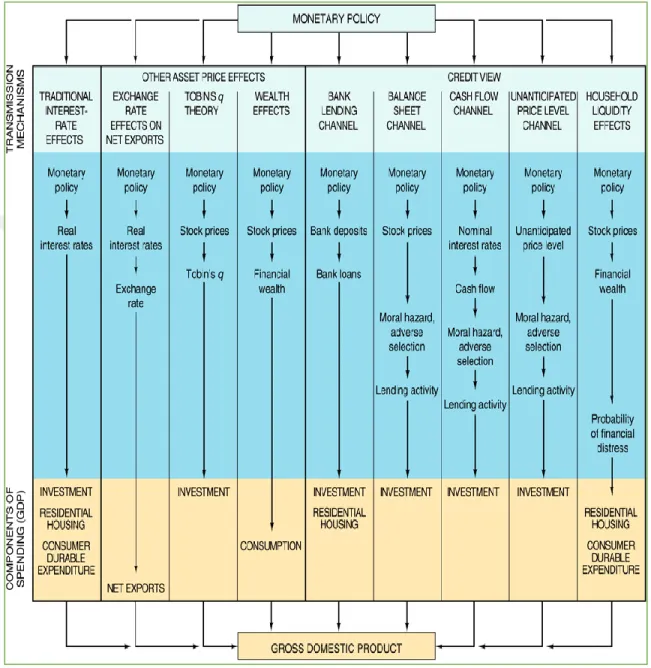
Monetary policy decisions affect overall economy and aggregate demand through monetary transmission mechanism channel (Mishkin, 2015). Central banks around the world keep in view that how their decisions can affect the overall economy while taking monetary policy decisions. So, it is necessary to understand MTM (monetary transmission mechanism) that how it can affect overall economic conditions.
These mechanisms can be divided into three major categories; traditional interest rate (IR) channels or so-called money channel (based on traditional IS-LM model), other asset prices channels and credit channel.
21 2.5.1 Interest rate
The expansionary monetary policy helps the central banks to decrease the IR and as a result, real borrowing cost falls, which helps to increase investment spending and ultimately aggregate demand. Keynes (1937) considered investment decisions only on business bases but later, economists considered housing and durable items also as an investment decision (Mishkin, 1996).
It’s the real IR rather than the nominal IR which affects the investment decisions. The concept of sticky prices states that prices adjust slowly over time and this helps to decrease the nominal IR which ultimately helps to decrease the real IR.
Through real IR channel, central banks can stimulate the economy even if nominal IRs are zero. Expectations about future commitment to easy policy can raise inflation and it also can decrease the real IR even at zero bound and then, which ultimately increases the aggregate demand.
The relationship between IR transmission mechanism and aggregate demand was weak for Turkish economy as IR were very high and inflation was very volatile before 2001 Financial Crisis (Sarıkaya, 2007).
After 2001 Financial Crisis, the restructuring of the banking system and other sectors helped to decrease inflation volatility and interest rates in Turkey. These changes helped to strengthen the relationship between IR and spending decisions.
John Taylor (1993) thinks that it is IR which affects investment spending, but other economists consider it is not an IR mechanism that affects investment spending. They consider other monetary transmission mechanisms which are of two types; other asset price channels and credit channel (Mishkin, 2015).
2.5.2 Asset Price
Typical aggregate demand analysis just relies on one asset price, the IR. Economic research has brought other assets which are important for monetary transmission
22
mechanism (MTM) of monetary policy. The assets other than the IR are exchange rates (ERs) and equity prices.
2.5.2.1 Net Exports reaction to Exchange Rate
The advent of flexible exchange rate regime and integration of financial markets have put special focus on ERs that how monetary decisions can affect net exports and aggregate demand through the ER. Since exchange rates (ERs) are very close to IR decisions because an increase or decrease in IRs also affect ERs (an appreciation or depreciation of local currency make it valuable or less valuable with respect to foreign currency) which in turn affect net exports and ultimately affect the overall aggregate demand (Aslan & Korap, 2007).
According to Sarıkaya (2007), the ER channel was not good transmission mechanism of monetary policy in Turkey before 2001 because it was considered as the main indicator of inflation expectations under fixed exchange regime. Any change in exchange rate either temporary or permanent was transmitted to prices but thanks to flexible exchange rate regime and structural changes in the banking sector, which made it a strong indicator of MTM in Turkey.
2.5.2.2 Tobin’s q Theory
Equity prices also play a significant role as an MTM. The major contribution in this field was by Tobin (1969) through the development of q theory. Q can be defined as the physical value of an asset relative to its replacement cost. High q boost investment because it is easy for firms to purchase new equipment when replacement cost is low than its physical value of an asset. This channel also works through IR phenomenon; lower IRs on bonds means expected return on (other alternative assets) stocks will attractive, which in turn will increase the demand for them, and which ultimately will increase their prices. Here, higher prices mean higher q, which means higher investment spending and as a result, an increase in aggregate demand.
23 2.5.2.3 Wealth Effects
The life cycle theory of Ando & Modigliani (1963) refers to consumption on the non-durable goods and services; consumption means lifetime resources of consumers. The financial wealth referred as lifetime resources of consumers (common stock). Aggregate demand increases because of increase in consumption, wealth and lifetime resources of consumers. According to Cambazoğlu & Güneş (2011), risk premium and expectations can also affect change in asset prices.
2.5.3 Credit Channel
In developing countries like Turkey, credit channel plays a significant role because small businesses which do not have direct access to finance by means of issuing securities, generally finance themselves through the banking sector. Credit channel is actually; “A financial friction in financial market”. It can be explained by two monetary transmission mechanism (MTM); bank lending channel (narrow) and balance sheet channel (broad).
2.5.3.1 Balance Sheet
The net worth of a firm plays a key role to get loans. In case of low net worth, adverse selection and moral hazard got severe and as a result, it causes to decrease investment spending. The expansionary or contractionary monetary policies can affect the balance sheet.
Mishkin (2015) describes that during expansionary policy, the IR goes down, which helps to increase stock prices (return on bonds is low). It means that firm net worth is high now, and adverse selection and moral hazard are low, and as a result, investment spending and overall economic activity will increase.
2.5.3.2 Bank Lending
Small businesses mostly depend on bank loans as they have no access to funds through other sources. In that manner, Bank lending plays an important role in the monetary transmission channel. According to Mishkin (2015), Banks increase their reserves during
24
periods of easy policy, which ultimately motivate them to lend more and as a result, more lending helps to increase investment spending. In this way, overall output and economic activity increase in the country. Economic research shows that this channel is more attractive and valid in developing economies rather than in developed economies.
2.5.3.3 Unanticipated Price Level
Monetary policy can also affect economic activity through unanticipated price channel. An expansionary policy normally increases an unanticipated price level which increases the net worth of a firm (because of fixed debt contracts, debt burden decreases in real terms when price level increases) and in the end, it helps to increase spending and output within the economy.
2.5.3.4 Cash Flow Channel
Monetary policy also affects aggregate demand through cash flow channel. Nominal low- IRs help to increase cash flow (balance sheet). The cash flow increases the firm’s liquidity, which means that firm can pay its debts very quickly in the view of investors. Such kind of positivity of firm helps to increase the investment spending and aggregate demand in the economy.
2.5.3.5 Household Liquidity Effects
Credit channel not only affects business spending but also consumer spending. Liquidity plays a key role in this channel (how quickly assets can… be converted into cash during economic shocks). Consumers are more concerned about financial distress. If they think that there will be no expected financial distress, then they will prefer to have more durable assets and houses.
An easy policy decreases IRs which help to improve the value of durable assets and houses through a rise in stock prices. Improved assets value decreases the expected financial distress and as a result, it will help to increase the overall economic conditions in the economy. The monetary transmission mechanism (MTM) is summarized in figure 1.
25
Sources: The economics of money, banking, and finance 11th edition by Mishkin
2.6 The J- Curve Effect
The difference between exports and imports are called trade balance. Generally, when there are more imports than exports, it is said trade deficit and it is said trade surplus, when exports are more than imports. How trade deficit can be improved with the help of
26
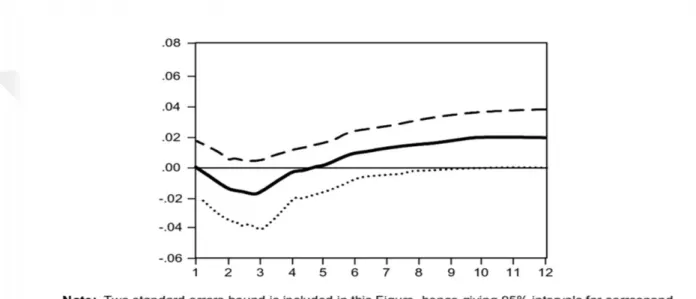
exports? The widely used way to improve trade deficit is by depreciating the domestic currency against other international currencies. The lower value of domestic currency will make imports more expensive and exports cheaper. This situation will decrease the imports volume and increase the exports volume, which ultimately will improve trade deficit. However, due to some reasons, the trade balance initially worsens, and then improve in response to the devaluation of currency. In economics terminology, it shows a J-Curve shape.
There can be several reasons behind so-called J-Curve effects (Macmillan, 2008). First, prices are measured at old exchange rate, when currency started to depreciate. This condition will worsen the trade balance more, if it was already started to worsen before the currency devaluation. Anyhow, trade balance will start to improve, when the prices will be measured at new ER. Second, it could be possible that a country’s economic activity started to grow quickly at the time of currency deterioration. So, it may offset the currency deterioration effects by increasing significant imports because it is normally considered that when a country’s economic activity grows, it increases the consumption of domestic and as well as of the import goods. Last, it is believed that import decreases, and export increases in response to devaluation of the currency. However, the change in exchange rate may delay the adjustment between imports and exports.
In other words, the J-curve effect underlines that expansionary monetary policy depreciates the currency which helps to decrease the import volume and to increase the import prices and the export volume. There will be trade deficit if the effect of import prices is stronger than the import volume effect and if it is not strong, then there will be trade surplus. The J-Curve highlights that import prices effect is stronger than import volume effect in the short-run (a trade deficit) and weak in the long-run (trade surplus) in response to expansionary monetary policy (Hacker and Hatemi, 2003).
In 1973, Stephen Magee was the first, who analyzes the J-Curve phenomenon for U.S trade balance. Magee (1973) analyzed that depreciation of dollar has further deteriorated the trade balance. Then economist started to think that how much time will it take to improve trade balance after the currency depreciation? Mohsen Bahmani-Oskooee (1985)
27
was the researcher, who gave the idea to test J-Curve directly with ER along with other determinants rather than to test it with aggregate trade data (the import, export data between single and rest of the world). This idea changed the roots of analysis for trade balance among researchers.
The J-Curve phenomenon can be seen in figure 2;
Figure 2.2: J-Curve
There is another case for J-Curve. A case when Inverse J-Curve occurs in response to appreciation of a country’s currency (a case for tight monetary policy shock). The appreciation of currency will make export expensive for importing countries. So, due to the competition in the market, importing countries will import goods from countries where the prices are less compared to this country (a county which experienced a currency appreciation). The appreciation in currency may also increase imports if these are available at cheaper prices. The whole procedure will then produce J-Curve but this time inversely.
28 2.7 The Exchange Rate Overshooting
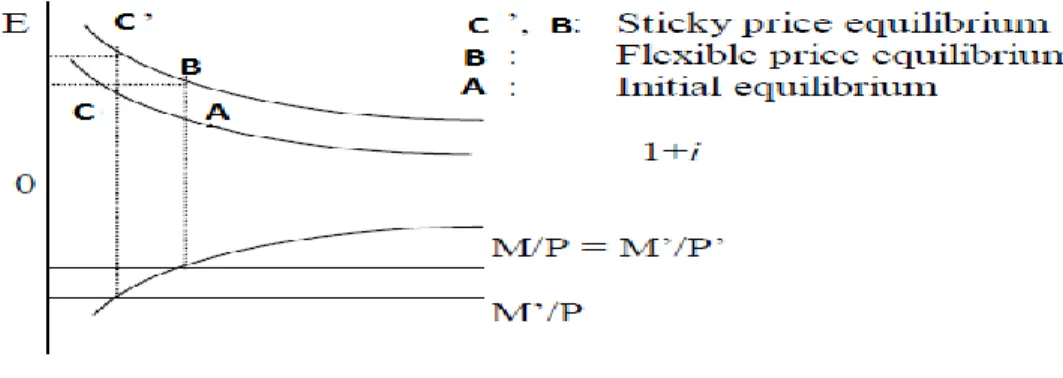
Krugman (2015) in his book “International Economics: Theory and policy” explained that “the exchange rate (ER) is said to be overshoot when its immediate response to a disturbance is greater than its long-run response”. The overshooting helps to explain that why ERs are so volatile? Dornbusch (1976) explained that this phenomenon is due to “differential adjustment speeds in asset and goods markets”. It is believed that prices respond slowly (prices are sticky in the short-run) while exchange rates respond quickly to monetary policy shock. A compensation for sticky prices in the economy. Thus, the monetary shock will have more effect on ER in the short run rather than on the prices in the long run and this condition will produce overshooting in exchange rates for short-period.
But the prices adjust immediately in monetary markets and foreign exchange markets. However, brokers know that ER depreciates, and price rises in the long run. Naknoi (2003) explained that “Due to this rationality, Curve in the foreign exchange market diagram moves upward”. It is explained in Figure 3. “B represents long-run equilibrium. The economy moves from A to B immediately under flexible price. It moves from A to C’ immediately under sticky price. It then moves from C’ to B but slowly. P and i also rises but slowly. Due to the change in expectation, C is not considered as an equilibrium. The difference between levels of E at C’ and at B measures the degree of overshooting”.
Figure 2.3: Exchange Rate Overshooting
29
3 LITERATURE REVIEW
No consensus among researchers which is best monetary policy indicator. Bernanke and Blinder (1992) suggest that federal funds rate (FFR*) is the best indicator of monetary policy because they believe that interest rate (IR) can inform us about forthcoming movements of macroeconomic variables. Gordon and Leeper (1994) questioned the validity of FFR* as well as of the monetary aggregates as they found some dynamic behaviors of macroeconomic variables (that are different from conventional monetary analysis) to monetary policy shocks.
McCallum (1983), Bagliano & Favero (1998) and Bernanke & Mihov (1998) also recommend IR as a better measure of monetary policy. Eichenbaum (1992) and Strongin (1995) propose nonborrowed reserves as better measure of monetary policy while Cushman and Zha (1997) recommend that an ER works better as a monetary transmission mechanism (MTM). Christiano and Eichenbaum (1992) also suggest that MTM normally works through IR, not the EX rate in the relative large economy.
Researchers have been using “Choleski or Recursive approach” to analyze the reactions of macroeconomic variables to monetary policy shocks. Recursive approach is a lower order triangular matrix where the succeeding variable is affected by proceeding variable and not vice versa. Some researchers in their empirical works (e.g., Sims (1992) and Eichenbaum & Evans (1995)) used exchange rate after the monetary policy variable in their models.
Cushman and Zha (1997) suggest that this monetary restriction is better for a relatively large economy like U.S where monetary policy will be less affected by foreign shocks.
30
Kim and Roubini (2000) explain that small open economies are vulnerable to both domestic and foreign monetary shocks.
In his analysis, Mackowiak (2007) explains that foreign shocks play a significant role to fluctuate the economic activities in emerging economies. Moreover, he suggests that foreign shocks are more important than monetary policy shocks of U.S.
The lower triangular approach has produced “puzzles” the exchange rate (ER) puzzle and the price puzzle, particularly for a small open economy. ER puzzle occurs when positive innovations in interest rate (IR) causes the domestic currency to depreciate rather than to appreciate while price puzzle occurs when positive IR innovations cause the price level to increase rather than to decrease.
Sims (1992) investigates five advanced economies and represents IR as monetary policy shock. He found both ER and price puzzles in most countries. Grilli and Roubini (1995) also find prize puzzle in his analysis of the G-7 countries except U.S. To deal with the price puzzle for a closed economy like U.S, Christiano et al., (1996) and Sims & Zha (1998) incorporate inflationary expectation in their models.
Peersman and Smets (2001) in his analysis for euro area find that ER appreciates, output falls and prices stay sticky in the short run in response to innovations in IR. He does not find any price and ER puzzle.
To determine these puzzles, particularly for the small open economy, Cushman and Zha (1997) suggest an empirical SVAR approach with block exogeneity for Canada to keep pure exogenous monetary policy shocks separate from domestic monetary policy shocks and they also recommend that these external shocks have influential effects on the Canadian economy.
Franken et al. (2006) adopt same SVAR block exogeneity approach for Chilean economy and they find external shocks are important for domestic monetary policy movements. Moreover, they find that domestic monetary shocks play a critical role in business fluctuations.
31
Cashin and Sosa (2009) share the view that foreign shocks are major sources to fluctuate the macroeconomic variables in the Eastern Caribbean. Pagan et al. (2008) study the monetary transmission mechanism of Brazil. They find that IR performs swiftly in Brazil than in advanced economies and that ER plays an important in this matter.
Vinayagathasan (2013) also use block exogeneity SVAR approach to solve these puzzles for Sri Lankan economy. He finds that IR explains better macroeconomic movements rather than ER or monetary aggregates for Sri Lanka. He also suggests that it is better to target reserve money than broad money. Moreover, he proposes that external shocks are not vital for Sri Lankan economy. This study also follows the SVAR approach with block exogeneity to overcome these empirical puzzles.
Many researchers also studied the Turkish monetary mechanism and tried to analyze the effects of Turkish monetary policy shocks on macroeconomic variables. Aslan and Korap (2007) analyze the Turkish economic MTM for the period 1992-2004. Their results show that weakly foreign inflow increase the ER value and as a result decrease the IR and local inflation.
After the 2001 crisis, Başçı et al. (2008) witness the development of MTM in Turkey. Their results confirm that IR and credit channels have a significant impact on Turkish macroeconomic activities.
Monetary policy helped to stabilize the economic activities of Turkey in relatively stable inflation period after 2002 (Akyurek et al. 2011).
Aktaş et al. (2008) analyze the behaviors of financial variables to sudden monetary policy changes by using the period after 2001 crisis. They find the importance of bonds and bills market as a mechanism to monetary policy shocks. Their paper also confirms that MTM works through credit view in Turkey and it also suggests that reserve requirement can be used as a monetary policy instrument for monetary control. Anyhow, these studies do not focus on the effects of monetary policy shocks on different economic activities.