This is the accepted manuscript made available via CHORUS. The article has been
published as:
Determination of the Spin and Parity of the Z_{c}(3900)
M. Ablikim et al. (BESIII Collaboration)
Phys. Rev. Lett. 119, 072001 — Published 16 August 2017
DOI:
10.1103/PhysRevLett.119.072001
M. Ablikim1, M. N. Achasov9,f, X. C. Ai1, O. Albayrak5, M. Albrecht4, D. J. Ambrose44, A. Amoroso49A,49C,
2
F. F. An1, Q. An46,a, J. Z. Bai1, R. Baldini Ferroli20A, Y. Ban31, D. W. Bennett19, J. V. Bennett5, M. Bertani20A,
3
D. Bettoni21A, J. M. Bian43, F. Bianchi49A,49C, E. Boger23,d, I. Boyko23, R. A. Briere5, H. Cai51, X. Cai1,a, O.
4
Cakir40A,b, A. Calcaterra20A, G. F. Cao1, S. A. Cetin40B, J. F. Chang1,a, G. Chelkov23,d,e, G. Chen1, H. S. Chen1,
5
H. Y. Chen2, J. C. Chen1, M. L. Chen1,a, S. Chen41, S. J. Chen29, X. Chen1,a, X. R. Chen26, Y. B. Chen1,a,
6
H. P. Cheng17, X. K. Chu31, G. Cibinetto21A, H. L. Dai1,a, J. P. Dai34, A. Dbeyssi14, D. Dedovich23, Z. Y. Deng1,
7
A. Denig22, I. Denysenko23, M. Destefanis49A,49C, F. De Mori49A,49C, Y. Ding27, C. Dong30, J. Dong1,a,
8
L. Y. Dong1, M. Y. Dong1,a, Z. L. Dou29, S. X. Du53, P. F. Duan1, J. Z. Fan39, J. Fang1,a, S. S. Fang1, X. Fang46,a,
9
Y. Fang1, R. Farinelli21A,21B, L. Fava49B,49C, O. Fedorov23, F. Feldbauer22, G. Felici20A, C. Q. Feng46,a,
10
E. Fioravanti21A, M. Fritsch14,22, C. D. Fu1, Q. Gao1, X. L. Gao46,a, X. Y. Gao2, Y. Gao39, Z. Gao46,a,
11
I. Garzia21A, K. Goetzen10, L. Gong30, W. X. Gong1,a, W. Gradl22, M. Greco49A,49C, M. H. Gu1,a, Y. T. Gu12,
12
Y. H. Guan1, A. Q. Guo1, L. B. Guo28, R. P. Guo1, Y. Guo1, Y. P. Guo22, Z. Haddadi25, A. Hafner22, S. Han51,
13
X. Q. Hao15, F. A. Harris42, K. L. He1, T. Held4, Y. K. Heng1,a, Z. L. Hou1, C. Hu28, H. M. Hu1, J. F. Hu49A,49C,
14
T. Hu1,a, Y. Hu1, G. S. Huang46,a, J. S. Huang15, X. T. Huang33, X. Z. Huang29, Y. Huang29, Z. L. Huang27,
15
T. Hussain48, Q. Ji1, Q. P. Ji30, X. B. Ji1, X. L. Ji1,a, L. W. Jiang51, X. S. Jiang1,a, X. Y. Jiang30, J. B. Jiao33,
16
Z. Jiao17, D. P. Jin1,a, S. Jin1, T. Johansson50, A. Julin43, N. Kalantar-Nayestanaki25, X. L. Kang1, X. S. Kang30,
17
M. Kavatsyuk25, B. C. Ke5, P. Kiese22, R. Kliemt14, B. Kloss22, O. B. Kolcu40B,i, B. Kopf4, M. Kornicer42,
18
W. Kuehn24, A. Kupsc50, J. S. Lange24,a, M. Lara19, P. Larin14, C. Leng49C, C. Li50, Cheng Li46,a, D. M. Li53,
19
F. Li1,a, F. Y. Li31, G. Li1, H. B. Li1, H. J. Li1, J. C. Li1, Jin Li32, K. Li13, K. Li33, Lei Li3, P. R. Li41,
20
Q. Y. Li33, T. Li33, W. D. Li1, W. G. Li1, X. L. Li33, X. M. Li12, X. N. Li1,a, X. Q. Li30, Y. B. Li2, Z. B. Li38,
21
H. Liang46,a, J. J. Liang12, Y. F. Liang36, Y. T. Liang24, G. R. Liao11, D. X. Lin14, B. Liu34, B. J. Liu1,
22
C. X. Liu1, D. Liu46,a, F. H. Liu35, Fang Liu1, Feng Liu6, H. B. Liu12, H. H. Liu16, H. H. Liu1, H. M. Liu1,
23
J. Liu1, J. B. Liu46,a, J. P. Liu51, J. Y. Liu1, K. Liu39, K. Y. Liu27, L. D. Liu31, P. L. Liu1,a, Q. Liu41,
24
S. B. Liu46,a, X. Liu26, Y. B. Liu30, Z. A. Liu1,a, Zhiqing Liu22, H. Loehner25, X. C. Lou1,a,h, H. J. Lu17,
25
J. G. Lu1,a, Y. Lu1, Y. P. Lu1,a, C. L. Luo28, M. X. Luo52, T. Luo42, X. L. Luo1,a, X. R. Lyu41, F. C. Ma27,
26
H. L. Ma1, L. L. Ma33, M. M. Ma1, Q. M. Ma1, T. Ma1, X. N. Ma30, X. Y. Ma1,a, Y. M. Ma33, F. E. Maas14,
27
M. Maggiora49A,49C, Y. J. Mao31, Z. P. Mao1, S. Marcello49A,49C, J. G. Messchendorp25, J. Min1,a, R. E. Mitchell19,
28
X. H. Mo1,a, Y. J. Mo6, C. Morales Morales14, N. Yu. Muchnoi9,f, H. Muramatsu43, Y. Nefedov23, F. Nerling14,
29
I. B. Nikolaev9,f, Z. Ning1,a, S. Nisar8, S. L. Niu1,a, X. Y. Niu1, S. L. Olsen32, Q. Ouyang1,a, S. Pacetti20B,
30
Y. Pan46,a, P. Patteri20A, M. Pelizaeus4, H. P. Peng46,a, K. Peters10, J. Pettersson50, J. L. Ping28, R. G. Ping1,
31
R. Poling43, V. Prasad1, H. R. Qi2, M. Qi29, S. Qian1,a, C. F. Qiao41, L. Q. Qin33, N. Qin51, X. S. Qin1,
32
Z. H. Qin1,a, J. F. Qiu1, K. H. Rashid48, C. F. Redmer22, M. Ripka22, G. Rong1, Ch. Rosner14, X. D. Ruan12,
33
A. Sarantsev23,g, M. Savri´e21B, K. Schoenning50, S. Schumann22, W. Shan31, M. Shao46,a, C. P. Shen2,
34
P. X. Shen30, X. Y. Shen1, H. Y. Sheng1, M. Shi1, W. M. Song1, X. Y. Song1, S. Sosio49A,49C, S. Spataro49A,49C,
35
G. X. Sun1, J. F. Sun15, S. S. Sun1, X. H. Sun1, Y. J. Sun46,a, Y. Z. Sun1, Z. J. Sun1,a, Z. T. Sun19, C. J. Tang36,
36
X. Tang1, I. Tapan40C, E. H. Thorndike44, M. Tiemens25, M. Ullrich24, I. Uman40D, G. S. Varner42, B. Wang30,
37
B. L. Wang41, D. Wang31, D. Y. Wang31, K. Wang1,a, L. L. Wang1, L. S. Wang1, M. Wang33, P. Wang1,
38
P. L. Wang1, S. G. Wang31, W. Wang1,a, W. P. Wang46,a, X. F. Wang39, Y. Wang37, Y. D. Wang14, Y. F. Wang1,a,
39
Y. Q. Wang22, Z. Wang1,a, Z. G. Wang1,a, Z. H. Wang46,a, Z. Y. Wang1, Z. Y. Wang1, T. Weber22, D. H. Wei11,
40
J. B. Wei31, P. Weidenkaff22, S. P. Wen1, U. Wiedner4, M. Wolke50, L. H. Wu1, L. J. Wu1, Z. Wu1,a, L. Xia46,a,
41
L. G. Xia39, Y. Xia18, D. Xiao1, H. Xiao47, Z. J. Xiao28, Y. G. Xie1,a, Q. L. Xiu1,a, G. F. Xu1, J. J. Xu1, L. Xu1,
42
Q. J. Xu13, Q. N. Xu41, X. P. Xu37, L. Yan49A,49C, W. B. Yan46,a, W. C. Yan46,a, Y. H. Yan18, H. J. Yang34,
43
H. X. Yang1, L. Yang51, Y. X. Yang11, M. Ye1,a, M. H. Ye7, J. H. Yin1, B. X. Yu1,a, C. X. Yu30, J. S. Yu26,
44
C. Z. Yuan1, W. L. Yuan29, Y. Yuan1, A. Yuncu40B,c, A. A. Zafar48, A. Zallo20A, Y. Zeng18, Z. Zeng46,a,
45
B. X. Zhang1, B. Y. Zhang1,a, C. Zhang29, C. C. Zhang1, D. H. Zhang1, H. H. Zhang38, H. Y. Zhang1,a, J. Zhang1,
46
J. J. Zhang1, J. L. Zhang1, J. Q. Zhang1, J. W. Zhang1,a, J. Y. Zhang1, J. Z. Zhang1, K. Zhang1, L. Zhang1,
47
S. Q. Zhang30, X. Y. Zhang33, Y. Zhang1, Y. H. Zhang1,a, Y. N. Zhang41, Y. T. Zhang46,a, Yu Zhang41,
48
Z. H. Zhang6, Z. P. Zhang46, Z. Y. Zhang51, G. Zhao1, J. W. Zhao1,a, J. Y. Zhao1, J. Z. Zhao1,a,
49
Lei Zhao46,a, Ling Zhao1, M. G. Zhao30, Q. Zhao1, Q. W. Zhao1, S. J. Zhao53, T. C. Zhao1, Y. B. Zhao1,a,
50
Z. G. Zhao46,a, A. Zhemchugov23,d, B. Zheng47, J. P. Zheng1,a, W. J. Zheng33, Y. H. Zheng41, B. Zhong28,
2
L. Zhou1,a, X. Zhou51, X. K. Zhou46,a, X. R. Zhou46,a, X. Y. Zhou1, K. Zhu1, K. J. Zhu1,a, S. Zhu1, S. H. Zhu45,
52
X. L. Zhu39, Y. C. Zhu46,a, Y. S. Zhu1, Z. A. Zhu1, J. Zhuang1,a, L. Zotti49A,49C, B. S. Zou1, J. H. Zou1
53
(BESIII Collaboration)
54
1 Institute of High Energy Physics, Beijing 100049, People’s Republic of China
55
2 Beihang University, Beijing 100191, People’s Republic of China
56
3 Beijing Institute of Petrochemical Technology, Beijing 102617, People’s Republic of China
57
4 Bochum Ruhr-University, D-44780 Bochum, Germany
58
5 Carnegie Mellon University, Pittsburgh, Pennsylvania 15213, USA
59
6 Central China Normal University, Wuhan 430079, People’s Republic of China
60
7 China Center of Advanced Science and Technology, Beijing 100190, People’s Republic of China
61
8 COMSATS Institute of Information Technology, Lahore, Defence Road, Off Raiwind Road, 54000 Lahore, Pakistan
62
9 G.I. Budker Institute of Nuclear Physics SB RAS (BINP), Novosibirsk 630090, Russia
63
10 GSI Helmholtzcentre for Heavy Ion Research GmbH, D-64291 Darmstadt, Germany
64
11 Guangxi Normal University, Guilin 541004, People’s Republic of China
65
12 GuangXi University, Nanning 530004, People’s Republic of China
66
13 Hangzhou Normal University, Hangzhou 310036, People’s Republic of China
67
14 Helmholtz Institute Mainz, Johann-Joachim-Becher-Weg 45, D-55099 Mainz, Germany
68
15 Henan Normal University, Xinxiang 453007, People’s Republic of China
69
16 Henan University of Science and Technology, Luoyang 471003, People’s Republic of China
70
17 Huangshan College, Huangshan 245000, People’s Republic of China
71
18 Hunan University, Changsha 410082, People’s Republic of China
72
19 Indiana University, Bloomington, Indiana 47405, USA
73
20 (A)INFN Laboratori Nazionali di Frascati, I-00044, Frascati,
74
Italy; (B)INFN and University of Perugia, I-06100, Perugia, Italy
75
21 (A)INFN Sezione di Ferrara, I-44122, Ferrara, Italy; (B)University of Ferrara, I-44122, Ferrara, Italy
76
22 Johannes Gutenberg University of Mainz, Johann-Joachim-Becher-Weg 45, D-55099 Mainz, Germany
77
23 Joint Institute for Nuclear Research, 141980 Dubna, Moscow region, Russia
78
24 Justus Liebig University Giessen, II. Physikalisches Institut, Heinrich-Buff-Ring 16, D-35392 Giessen, Germany
79
25 KVI-CART, University of Groningen, NL-9747 AA Groningen, The Netherlands
80
26 Lanzhou University, Lanzhou 730000, People’s Republic of China
81
27 Liaoning University, Shenyang 110036, People’s Republic of China
82
28 Nanjing Normal University, Nanjing 210023, People’s Republic of China
83
29 Nanjing University, Nanjing 210093, People’s Republic of China
84
30 Nankai University, Tianjin 300071, People’s Republic of China
85
31 Peking University, Beijing 100871, People’s Republic of China
86
32 Seoul National University, Seoul, 151-747 Korea
87
33 Shandong University, Jinan 250100, People’s Republic of China
88
34 Shanghai Jiao Tong University, Shanghai 200240, People’s Republic of China
89
35 Shanxi University, Taiyuan 030006, People’s Republic of China
90
36 Sichuan University, Chengdu 610064, People’s Republic of China
91
37 Soochow University, Suzhou 215006, People’s Republic of China
92
38 Sun Yat-Sen University, Guangzhou 510275, People’s Republic of China
93
39 Tsinghua University, Beijing 100084, People’s Republic of China
94
40 (A)Istanbul Aydin University, 34295 Sefakoy, Istanbul, Turkey; (B)Istanbul Bilgi
95
University, 34060 Eyup, Istanbul, Turkey; (C)Uludag University, 16059 Bursa,
96
Turkey; (D)Near East University, Nicosia, North Cyprus, 10, Mersin, Turkey
97
41 University of Chinese Academy of Sciences, Beijing 100049, People’s Republic of China
98
42 University of Hawaii, Honolulu, Hawaii 96822, USA
99
43 University of Minnesota, Minneapolis, Minnesota 55455, USA
100
44 University of Rochester, Rochester, New York 14627, USA
101
45 University of Science and Technology Liaoning, Anshan 114051, People’s Republic of China
46 University of Science and Technology of China, Hefei 230026, People’s Republic of China
103
47 University of South China, Hengyang 421001, People’s Republic of China
104
48 University of the Punjab, Lahore-54590, Pakistan
105
49 (A)University of Turin, I-10125, Turin, Italy; (B)University of Eastern
106
Piedmont, I-15121, Alessandria, Italy; (C)INFN, I-10125, Turin, Italy
107
50 Uppsala University, Box 516, SE-75120 Uppsala, Sweden
108
51 Wuhan University, Wuhan 430072, People’s Republic of China
109
52 Zhejiang University, Hangzhou 310027, People’s Republic of China
110
53 Zhengzhou University, Zhengzhou 450001, People’s Republic of China
111
a Also at State Key Laboratory of Particle Detection and
112
Electronics, Beijing 100049, Hefei 230026, People’s Republic of China
113
b Also at Ankara University,06100 Tandogan, Ankara, Turkey
114
c Also at Bogazici University, 34342 Istanbul, Turkey
115
d Also at the Moscow Institute of Physics and Technology, Moscow 141700, Russia
116
e Also at the Functional Electronics Laboratory, Tomsk State University, Tomsk, 634050, Russia
117
f Also at the Novosibirsk State University, Novosibirsk, 630090, Russia
118
g Also at the NRC ”Kurchatov Institute”, PNPI, 188300, Gatchina, Russia
119
h Also at University of Texas at Dallas, Richardson, Texas 75083, USA
120
i Also at Istanbul Arel University, 34295 Istanbul, Turkey
121
The spin and parity of the Zc(3900)± state are determined to be JP = 1+ with a statistical
significance larger than 7σ over other quantum numbers in a partial wave analysis of the process e+e−
→ π+π−J/ψ. We use a data sample of 1.92 fb−1 accumulated at √s = 4.23 and 4.26 GeV
with the BESIII experiment. When parameterizing the Zc(3900)± with a Flatt´e-like formula, we
determine its pole mass Mpole= (3881.2 ± 4.2stat± 52.7syst) MeV/c2 and pole width Γpole= (51.8 ±
4.6stat± 36.0syst) MeV. We also measure cross sections for the process e+e− → Zc(3900)+π−+
c.c. → J/ψπ+π−and determine an upper limit at the 90% confidence level for the process e+e−
→ Zc(4020)+π−+ c.c. → J/ψπ+π−.
PACS numbers: 14.40.Rt, 13.66.Bc, 14.40.Pq 122
A charged charmoniumlike state, Z±
c (Zc denotes
123
Zc(3900) throughout this Letter except when its mass is
124
explicitly mentioned), was observed by the BESIII [1] and
125
Belle [2] collaborations in the process e+e−→ π+π−J/ψ
126
and confirmed using CLEO-c’s data [3]. As there are at
127
least four quarks in the structure, many theoretical
inter-128
pretations of the nature and the decay dynamics of the
129
Zc have been put forward [4–9].
130
A similar charged structure, the Zc(3885)±, was
ob-131
served in the process e+e−→ (D ¯D∗)±π∓ [10], with spin
132
parity (JP) assignment of 1+ favored over the 1− and
133
0− hypotheses. However, its mass and width are 2σ
134
and 1σ, respectively, below those of the Z±
c observed in
135
e+e− → π+π−J/ψ. Are the Z
c(3885)± and the Zc± the
136
same state and do they have the same spin and parity?
137
This is one of the most important pieces of information
138
desired in many theoretical analyses [6, 11]. Finally, the
139
Zc(4020) was observed for the first time in the processes
140
e+e−→ π+π−h
c [12] and e+e−→ (D∗D¯∗)±π∓ [13], but
141
it has not been searched for in the π+π−J/ψ final state
142
yet.
143
In this Letter, we report on the determination of spin
144
and parity of the Zc and a search for the Zc(4020)±
145
in the process e+e− → π+π−J/ψ. The results are
146
based on a partial wave analysis (PWA) of the e+e− →
147
π+π−J/ψ events accumulated with the BESIII
detec-148
tor [14]. The BESIII detector consists of a
helium-gas-149
based drift chamber (MDC), a plastic scintillator
time-150
of-flight system, and a CsI(Tl) electromagnetic
calorime-151
ter (EMC), all enclosed in a superconducting solenoidal
152
magnet providing a 1.0-T magnetic field. The solenoid is
153
supported by an octagonal flux-return yoke with resistive
154
plate counter muon identifier modules interleaved with
155
steel. The data sample includes 1092 pb−1e+e−collision
156
data at a center-of-mass (c.m.) energy√s = 4.23 GeV,
157
and 827 pb−1 data at√s = 4.26 GeV [15]. The precise
158
c.m. energies are measured with the di-muon process [16].
159
The e+e− → π+π−J/ψ candidate events are
se-160
lected with the same selection criteria as described in
161
Refs. [1, 17] with J/ψ reconstructed from lepton pairs
162
(ℓ+ℓ− = µ+µ−, e+e−). The numbers of selected
can-163
didate events are 4154 at √s = 4.23 GeV and 2447 at
164
√s = 4.26 GeV; the event samples are estimated to
165
contain 365 and 272 background events, respectively, at
166
these two points, using the J/ψ mass sidebands as has
167
been done in Ref. [1].
4 Amplitudes of the PWA are constructed with the
helicity-covariant method [18]; the process e+e− →
π+π−J/ψ is assumed to proceed via the Z
c resonance,
i.e., e+e− → Z±
c π∓, Zc± → J/ψπ±, and via the
non-Zc decay e+e− → RJ/ψ, R → π+π−. All processes
are added coherently to obtain the total amplitude [19]. For a particle decaying to the two-body final state, i.e., A(J, m) → B(s, λ)C(σ, ν), where spin and helicity are
indicated in the parentheses, its helicity amplitude Fλ,ν
is related to the covariant amplitude via [18, 20]
Fλ,ν= X lS glS r 2l + 1 2J + 1hl0Sδ|Jδihsλσ − ν|Sδir l Bl(r) Bl(r0) , (1)
where δ = λ−ν, and glSis the coupling constant in the
l-169
S coupling scheme, the angular brackets denote
Clebsch-170
Gordan coefficients, r is the magnitude of the
momen-171
tum difference between the two final state particles, r0
172
corresponds to the momentum difference at the nominal
173
mass of the resonance, and Bl is a barrier factor [21].
174
The nonresonant process, e+e−→ π+π−J/ψ, is
param-175
eterized with an amplitude based on the QCD multipole
176
expansion [22].
177
The relative magnitudes and phases of the complex
178
coupling constants glS are determined by an unbinned
179
maximum likelihood fit to data. The minimization is
180
performed using the package minuit [23], and the
back-181
grounds are subtracted from the likelihood as in Ref. [24].
182
In the nominal fit, we assume the Zcto have JP = 1+,
and its lineshape is described with a Flatt´e-like formula
taking into account the fact that the Z±
c decays are
dom-inated by the final states (D ¯D∗)± [10] and J/ψπ± [1],
i.e., BW (s, M, g′ 1, g′2) = 1 s − M2+ i[g′ 1ρ1(s) + g2′ρ2(s)] , (2)
where the subscripts in g′
i (i = 1, 2) represent the Zc± →
183
π±J/ψ and (D ¯D∗)±decays, respectively; ρ
i(s) = 2ki/√s
184
is a kinematic factor with ki being the magnitude of the
185
three-vector momentum of the final state particle (J/ψ
186
or D) in the Zc rest frame; and g′1 and g2′ are the
cou-187
pling strengths of Z±
c → π±J/ψ and Zc± → (D ¯D∗)±,
188
respectively, which will be determined by the fit to data.
189
To describe the π+π− mass spectrum, four
reso-190
nances, σ, f0(980), f2(1270) and f0(1370), are
intro-191
duced. f0(980) is described with a Flatt´e formula [25],
192
and the others are described with relativistic
Breit-193
Wigner (BW) functions. The width of the wide resonance
194 σ is parameterized with Γσ(s) = q 1 − 4m2π s Γ [26, 27], 195
and the masses and widths for the f2(1270) and f0(1370)
196
are taken from the Particle Data Group (PDG) [28]. The
197
statistical significance for each resonance is determined
198
by examining the probability of the change in log
likeli-199
hood (log L) values between including and excluding this
200
resonance in the fits, and the probability is calculated
201
under the χ2 distribution hypothesis taking the change
202
of the number of degrees of freedom ∆(ndf) into account.
203
With this procedure, the statistical significance of each
204
of these states and the nonresonant process is estimated
205
to be larger than 5σ. All of them are therefore
includ-206
ed in the nominal fit, which includes the e+e−→ σJ/ψ,
207
f0J/ψ, f0(1370)J/ψ, f2(1270)J/ψ, Zc±π∓ and
nonreso-208
nant processes.
209
A simultaneous fit is performed to the two data sets.
210
The coupling constants are set as free parameters and are
211
allowed to be different at the two energy points except
212
for the common ones describing Zc decays. The
oppo-213
sitely charged Zcstates are regarded as isospin partners;
214
they share a common mass and coupling parameters g′
1
215
and g′
2. Figure 1 shows projections of the fit results at
216
√
s = 4.23 and 4.26 GeV, with fit goodness of the Dalitz
217
plot χ2/ndf =1.3 and 1.2, respectively. The mass of Z±
c
218
is measured to be MZc= (3901.5 ± 2.7stat) MeV/c
2 and
219
the coupling parameters g′
1 = (0.075 ± 0.006stat) GeV2
220
and g′
2/g′1 = 27.1 ± 2.0stat. This measurement is
con-221
sistent with the previous result g′
2/g1′ = 27.1 ± 13.1
esti-222
mated based on the measured decay width ratio Γ(Z±
c →
223
(D ¯D∗)±)/Γ(Z±
c → J/ψπ±) = 6.2 ± 2.9 [10]. If the Zc± is
224
parameterized as a constant width BW function, the
si-225
multaneous fit gives a mass of (3897.6 ± 1.2stat) MeV/c2
226
and a width of (43.5 ± 1.5stat) MeV, but the value of
227
− ln L increases by 22 with ∆(ndf) = 1. The BW
228
parametrization is thus disfavored with a significance of
229
6.6σ.
230
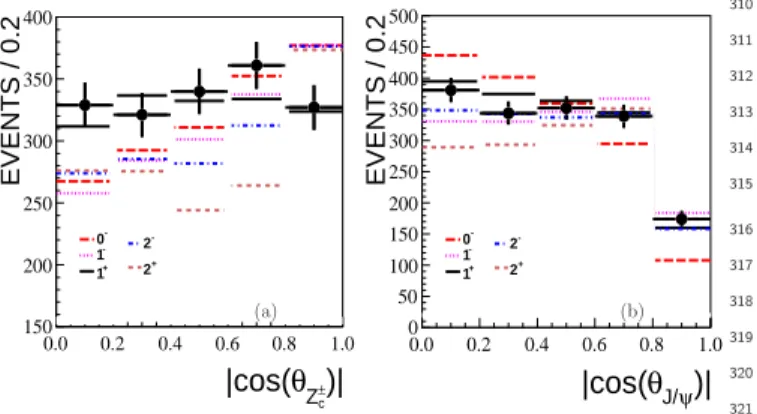
Figure 2 shows the polar angle (θZ±
c) distribution of
231
Z±
c in the process e+e−→ Zc+π−+ c.c. and the helicity
232
angle (θJ/ψ) distribution in the decay Zc± → π±J/ψ for
233
the combined data within the Zc mass region mJ/ψπ±∈
234
(3.86, 3.92) GeV/c2, where θ
J/ψ is the angle between the
235
momentum of J/ψ in the Zc rest frame and the Zc
mo-236
mentum in the e+e−rest frame. The fit results, using
dif-237
ferent assumptions for the Zcspin and parity, are drawn
238
with a global normalization factor. The distribution
indi-239
cates that data favors a spin and parity assignment of 1+
240
for the Z±
c . The significance of the Zc±(1+) hypothesis is
241
further examined using the hypothesis test [29], in which
242
the alternative hypothesis is our nominal fit with an
ad-243
ditional Z±
c (JP 6= 1+) state. Possible JP assignments,
244
other than 1+, are 0−, 1−, 2−, and 2+. The changes
245
−2∆ ln L when the Zc(1+)π∓amplitude is removed from
246
the alternative hypothesis are listed in Table I. Using the
247
associated change in the ndf when the Z±
c (1+) is
exclud-248
ed, we determine the significance of the 1+ hypothesis
249
over the alternative JP possibilities to be larger than 7σ.
250
The fit results shown in Fig. 1 indicate that process
251
is dominated by the ππ S−wave resonances, i.e. the σ,
252
f0(980) and f0(1370). The fraction of all π+π− S-wave
253
components including the interference between them is
254
measured to be (61.7 ± 2.1stat)% of the total π+π−J/ψ
)
2(GeV/c
-π + πm
0.2 0.4 0.6 0.8 1.0 1.2 2EVENTS / 0.02 GeV/c
0 20 40 60 80 100 120 140 160 180 ψ S-Wave J/ π π ψ (1270) J/ 2 f +c.c. -π + c Z total)
2(GeV/c
± π ψ J/m
3.2 3.4 3.6 3.8 4.0 4.2 2EVENTS / 0.015 GeV/c
0 20 40 60 80 100 120 140 160 180 200 ψ S-Wave J/ π π ψ (1270) J/ 2 f +c.c. -π + c Z total(c)
(d)
)
2(GeV/c
-π + πm
0.2 0.4 0.6 0.8 1.0 1.2 2EVENTS / 0.02 GeV/c
0 50 100 150 200 250 300 ππ S-Wave J/ψ ψ (1270) J/ 2 f +c.c. -π + c Z total)
2(GeV/c
± π ψ J/m
3.2 3.4 3.6 3.8 4.0 4.2 2EVENTS / 0.015 GeV/c
0 50 100 150 200 250 300 350 400 ψ S-Wave J/ π π ψ (1270) J/ 2 f +c.c. -π + c Z total(a)
(b)
FIG. 1: (color online) Projections to mπ+π−(a, c) and mJ/ψπ±(b, d) of the fit results with JP = 1+for the Zc, at√s = 4.23 GeV (a, b) and√s = 4.26 GeV (c, d). The points with error bars are data, and the black histograms are the total fit results including backgrounds. The shaded histogram denotes backgrounds. The contributions from the π+π−S-wave J/ψ, f
2(1270)J/ψ, and
Zc±π∓, are shown in the plots. The π+π−S-wave resonances include the σ, f0(980) and f0(1370). Plots (b) and (d) are filled
with two entries (mJ/ψπ+ and mJ/ψπ−) per event.
TABLE I: Significance of the spin parity 1+over other
quan-tum numbers for Z±
c . The significance is obtained for given
change in ndf, ∆(ndf). In each case, ∆(ndf) = 2×4+5, where 2 ×4 ndf account for the coupling strength for e+e−
→ Zc±π∓
at the two data sets, and the additional five ndf are the contri-bution of the common degrees of freedom for the Zcresonant
parameters and the coupling strength for Z±
c → J/ψπ±. Hypothesis ∆(−2 ln L) ∆(ndf) Significance 1+ over 0− 94.0 13 7.6σ 1+ over 1− 158.3 13 10.8σ 1+ over 2− 151.9 13 10.5σ 1+ over 2+ 96.0 13 7.7σ
events at√s = 4.23 GeV and (71.4 ± 4.1stat)% at√s =
256
4.26 GeV. The signal yields NZ±
c of Z
±
c are calculated by
257
scaling its partial signal ratio with the total number of
258
signal events. They are measured to be NZ±
c = 952.3 ±
259
39.3stat at √s = 4.23 GeV and 343.3 ± 23.3stat at√s =
260
4.26 GeV. Here, the errors are statistical only, and they
261
are estimated using the covariance matrix from the fits.
262
To measure amplitudes associated with the
polariza-263
tion of Z±
c in e+e− → Zc±π∓ and that of J/ψ in
264
Z±
c → J/ψπ± decays in the nominal fit, the ratios of
265
helicity amplitudes with different polarizations as
de-266
fined in Eq. (1) are calculated to be |FZc
1,0|2/|F Zc
0,0|2 =
267
0.22±0.05statat 4.23 GeV, and 0.21±0.11statat 4.26 GeV
268 for e+e− → Z± c π∓, and |F ψ 1,0|2/|F ψ 0,0|2 = 0.45 ± 0.15stat 269 for Z±
c → J/ψπ±, at both energy points. Here F
Zc/ψ
1,0
270
and FZc/ψ
0,0 correspond to transverse and longitudinal
po-271
larization amplitudes in the decay, respectively. The
re-272
sults show that the Zc polarization is dominated by the
273
longitudinal component.
6 )| ± c Z θ |cos( 0.0 0.2 0.4 0.6 0.8 1.0 EVENTS / 0.2 150 200 250 300 350 400 -0 -1 + 1 -2 + 2 )| ψ J/ θ |cos( 0.0 0.2 0.4 0.6 0.8 1.0 EVENTS / 0.2 0 50 100 150 200 250 300 350 400 450 500 -0 -1 + 1 -2 + 2 (a) (b)
FIG. 2: (color online) (a) Polar angle distribution of Z± c in the
process e+e−
→ Zc+π−+ c.c., (b) helicity angle distribution
of J/ψ in the Z±
c → π±J/ψ. The dots with error bars show
the combined data with requirement mJ/ψπ± ∈ (3.86, 3.92) GeV/c2, and compared to the total fit results with different
JP hypotheses.
The Born cross section for Zc production is measured
275
with the relation σ = NZ±
c/(L(1 + δ)ǫB), where NZ
± c is 276
the signal yield for the process e+e− → Z+
c π−+ c.c. →
277
π+π−J/ψ, L is the integrated luminosity, and ǫ is the
278
detection efficiency obtained from a MC simulation which
279
is generated using the amplitude parameters determined
280
in the PWA. The radiative correction factor (1 + δ) is
281
determined to be 0.818 [1]. The Born cross section is
282
measured to be (22.0 ± 1.0stat) pb at√s = 4.23 GeV and
283
(11.0 ± 1.2stat) pb at√s = 4.26 GeV.
284
Using these two data sets, we also search for the
pro-285
cess e+e− → Z
c(4020)+π−+ c.c. → π+π−J/ψ, with the
286
Zc(4020)± assumed to be a 1+ state. In the PWA, its
287
mass is taken from Ref. [12], and its width is taken as the
288
observed value, which includes the detector resolution.
289
The statistical significance for Zc(4020)± → J/ψπ± is
290
found to be 3σ in the combined data. The Born cross
291
sections are measured to be (0.2 ± 0.1stat) pb at 4.23
292
GeV and (0.8 ± 0.4stat) pb at s = 4.26 GeV, and the
cor-293
responding upper limits at the 90% confidence level are
294
estimated to be 0.9 pb and 1.4 pb, respectively.
295
Systematic errors associated with the event selection,
296
including the luminosity measurement, tracking
efficien-297
cy of charged tracks, kinematic fit, initial state
radia-298
tion (ISR) correction factor and the branching fraction
299
of Br(J/ψ → ℓ+ℓ−), have been estimated to be 4.8% for
300
the cross section measurement and 1.8 MeV for the Zc
301
mass in the previous analysis [1].
302
Uncertainties associated with the amplitude
analy-303
sis come from the σ and Zc parametrizations, the
304
background estimation, the parameters in the f0(980)
305
Flatt´e formula, the barrier radius in the barrier factor,
306
the mass resolution and the component of non-resonant
307
amplitude.
308
The systematic uncertainty due to the σ lineshape is
309
estimated by comparing the nominal fit with two
oth-310
er parameterizations, the PKU ansatz [30] and the
Zou-311
Bugg approach [31]. The differences in the Zc signal
312
yields and mass measurement are taken as the errors,
313
which are 2.5% (31.0%) for the signal yields at 4.23
314
(4.26) GeV and 19.5 MeV for the Zc mass.
315
The uncertainty due to the f0(980) lineshape is
esti-316
mated by varying the couplings by 1σ as determined in
317
the decays J/ψ → φπ+π− and φK+K− [25].
Uncer-318
tainties associated with the f0(1370) are estimated by
319
varying the mass and width by one standard deviation
320
around the world average values [28].
321
The uncertainty due to the Zc parametrization is
es-322
timated by using a constant-width relativistic BW
func-323
tion. The simultaneous fit gives the Zcmass of (3897.6 ±
324
1.2stat) MeV/c2 and the width of (43.5 ± 1.5stat) MeV.
325
The difference in the Zc signal yields is 15.5% (7.9%) for
326
the data taken at 4.23 (4.26) GeV.
327
The uncertainty due to the background level is
esti-328
mated by changing the number of background events by
329
1σ around the nominal value, that is, ±25 around 637
330
events.
331
The barrier radius is usually taken in the range r0 ∈
332
(0.25, 0.76) fm, with 0.6 fm being used in the nominal fit.
333
Uncertainties at both ends are checked. For a
conserva-334
tive estimation, the radius r0= 0.76 fm, which results in
335
the larger difference, is used to estimate the uncertainty.
336
The uncertainty due to the mass resolution in the J/ψπ
337
invariant mass is estimated with an unfolded Zc width.
338
A truth width is unfolded from the observed Zc width
339
using a relation determined by the MC simulation, and
340
its difference from the unfolded width, δΓ/Γ = δg′
1/g′1, is
341
taken as the systematic uncertainty for the coupling
con-342
stant g′
1. The uncertainties in the signal yields and the Zc
343
mass are determined with the truth coupling constant.
344
The nonresonant process is described with a formula
345
derived from the QCD multipole expansion [22]. It
in-346
cludes the S- and D-wave components. The uncertainty
347
associated with this amplitude is estimated by
remov-348
ing the insignificant D-wave component and using the
349
S-wave component only.
350
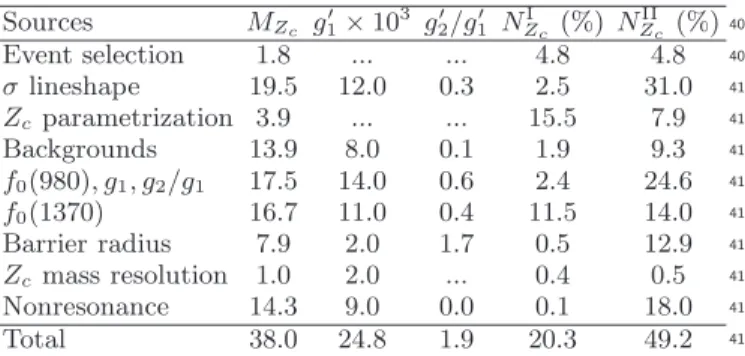
Table II summarizes the systematic uncertainties.
As-351
suming all of these sources are independent, the total
sys-352
tematic uncertainties are 38.0 MeV for the measurement
353
of the Zc mass, and 20.3% (49.2%) for the measurement
354
of Zc cross sections at√s = 4.23 (4.26) GeV.
355
In summary, with 1.92 fb−1 data taken at √s = 4.23
356
and 4.26 GeV, the Z±
c state is studied with an
am-357
plitude fit to the e+e− → π+π−J/ψ samples, and
358
its spin and parity have been determined to be 1+
359
with a statistical significance larger than 7σ over
oth-360
er quantum numbers. The mass is measured to be
361
MZc = (3901.5 ± 2.7stat ± 38.0syst) MeV/c
2 in the
362
parametrization of a Flatt´e-like formula with parameters
TABLE II: Summary of systematic uncertainties on the Zc (JP = 1+) mass MZc (MeV/c
2), parameters g′
1 (GeV2)
and g′2/g1′, and the signal yields at 4.23 GeV (NZIc) and 4.26
GeV (NII
Zc). The uncertainties shown for the Zc mass, pa-rameter g′
1 and the ratio g2′/g′1 are absolute values, while the
uncertainties for NI
Zc and N
II
Zc are relative ones.
Sources MZc g ′ 1× 10³ g′2/g1′ NZIc (%) N II Zc (%) Event selection 1.8 ... ... 4.8 4.8 σ lineshape 19.5 12.0 0.3 2.5 31.0 Zcparametrization 3.9 ... ... 15.5 7.9 Backgrounds 13.9 8.0 0.1 1.9 9.3 f0(980), g1, g2/g1 17.5 14.0 0.6 2.4 24.6 f0(1370) 16.7 11.0 0.4 11.5 14.0 Barrier radius 7.9 2.0 1.7 0.5 12.9 Zcmass resolution 1.0 2.0 ... 0.4 0.5 Nonresonance 14.3 9.0 0.0 0.1 18.0 Total 38.0 24.8 1.9 20.3 49.2 g′
1 = 0.075 ± 0.006stat± 0.025syst GeV2, and g2′/g′1 =
364
27.1 ± 2.0stat± 1.9syst, which corresponds to the Zc pole
365
mass Mpole = (3881.2 ± 4.2stat± 52.7syst) MeV/c2 and
366
pole width Γpole= (51.8 ± 4.6stat± 36.0syst) MeV, where
367
Mpole−iΓpole/2 is the solution for which the denominator
368
of Flatt´e-like formula is zero. The pole mass is consistent
369
with the previous measurement [10]. The Born cross
sec-370
tions for the process e+e−→ π+Z−
c + c.c. are measured
371
to be (21.8 ± 1.0stat± 4.4syst) pb at√s = 4.23 GeV and
372
(11.0 ± 1.2stat± 5.4syst) pb at√s = 4.26 GeV. The
con-373
tributions from Zc(4020)± are also searched for, but no
374
significant signals are observed, and an upper limit for
375 the e+e−→ π+Z c(4020)−+ c.c. process is determined to 376 be 0.9 (1.4) pb at√s = 4.23 (4.26) GeV. 377
The BESIII collaboration thanks the staff of BEPCII
378
and the computing center for their strong support. This
379
work is supported in part by the Ministry of Science and
380
Technology of China under Contract No. 2009CB825200;
381
Joint Funds of the National Natural Science Foundation
382
of China under Contracts Nos. U1332201; National
Nat-383
ural Science Foundation of China (NSFC) under
Con-384
tracts Nos. 11175188, 11375205, 11235011, 11375221,
385
11565006, 10825524; German Research Foundation DFG
386
under Contract No. Collaborative Research Center
CRC-387
1044, 627240; Istituto Nazionale di Fisica Nucleare, Italy;
388
Ministry of Development of Turkey under Contract No.
389
DPT2006K-120470; U.S. Department of Energy under
390
Contracts Nos. SC-0012069, SC-0010504,
DE-391
SC-0010118, DE-FG02-05ER41374; U.S. National
Sci-392
ence Foundation; University of Groningen (RuG)
un-393
der Contracts No. 530-4CDP03, and the
Helmholtzzen-394
trum fuer Schwerionenforschung GmbH (GSI),
Darm-395
stadt; WCU Program of National Research Foundation
396
of Korea under Contract No. R32-2008-000-10155-0.
397
[1] M. Ablikim et al. (BESIII Collaboration), Phys. Rev. 398
Lett. 110, 252001 (2013). 399
[2] Z. Q. Liu et al. (Belle Collaboration), Phys. Rev. Lett. 400
110, 252002 (2013). 401
[3] T. Xiao, S. Dobbs, A. Tomaradze and K. K. Seth, Phys. 402
Lett. B 727, 366 (2013). 403
[4] N. Brambilla et al., Eur. Phys. J. C 74, 2981 (2014). 404
[5] G. T. Bodwin et al., arXiv:1307.7425. 405
[6] M. B. Voloshin, Phys. Rev. D 87, 091501(R) (2013). 406
[7] A. Esposito et al., Int. J. Mod. Phys. A 30, 1530002 407
(2014). 408
[8] X. Liu, Chin. Sci. Bull. 59, 3815 (2014). 409
[9] F.-K. Guo, C. Hidalgo-Duque, J. Nieves and M. Pavon 410
Valderrama, Phys. Rev. D 88, 054007 (2013). 411
[10] M. Ablikim et al. (BESIII Collaboration), Phys. Rev. 412
Lett. 112, 022001 (2014). 413
[11] E. Braaten, Phys. Rev. Lett. 111, 162003 (2013). 414
[12] M. Ablikim et al. (BESIII Collaboration), Phys. Rev. 415
Lett. 111, 242001 (2013). 416
[13] M. Ablikim et al. (BESIII Collaboration), Phys. Rev. 417
Lett. 112, 132001 (2014). 418
[14] M. Ablikim et al. (BESIII Collaboration), Nucl. Instrum. 419
Meth. A 614, 345 (2010). 420
[15] M. Ablikim et al. (BESIII Collaboration), Chin. Phys. C 421
39, 093001 (2015). 422
[16] M. Ablikim et al. (BESIII Collaboration), Chin. Phys. C 423
40, 063001 (2016). 424
[17] M. Ablikim et al. (BESIII Collaboration), Phys. Rev. 425
Lett. 118, 092001 (2017). 426
[18] S. U. Chung, Phys. Rev. D 57, 431 (1998); S. U. 427
Chung, Phys. Rev. D 48, 1225 (1993); S. U. Chung and 428
J. M. Friedrich, Phys. Rev. D 78, 074027 (2008). 429
[19] H. Chen and R. G. Ping, Phys. Rev. D 95, 076010 (2017). 430
[20] V. Filippini, A. Fontana and A. Rotondi, Phys. Rev. D 431
51, 2247 (1995). 432
[21] B. S. Zou and D. V. Bugg, Eur. Phys. J. A 16, 537 (2003). 433
[22] V. A. Novikov and M. A. Shifman, Z. Phys. C 8, 43 434
(1981); M. B. Volshin, Prog. Part. Nucl. Phys. 61, 455 435
(2008); D.-Y. Chen, X. Liu and X.-Q. Li, Eur. Phys. J. 436
C 71, 1808 (2011). 437
[23] F. James, CERN Program Library Long Writeup D 506 438
(1998). 439
[24] M. Ablikim et al. (BESIII Collaboration), Phys. Rev. D 440
86, 072011 (2012). 441
[25] M. Ablikim et al. (BES Collaboration), Phys. Lett. B 442
598, 149 (2004). 443
[26] S. M. Berman and M. Jacob, Phys. Rev. B 139, 1608 444
(1965). 445
[27] M. Ablikim et al. (BES Collaboration), Phys. Lett. B 446
645, 19 (2007). 447
[28] K. A. Olive et al. (Particle Data Group), Chin. Phys. C 448
38, 090001 (2014). 449
[29] I. Narsky, Nucl. Instrum. Meth. A 450, 444 (2000); Y. S. 450
Zhu, High Energy Physics and Nuclear Physics 30, 331 451
(2006). 452
[30] H. Q. Zheng et al., Nucl. Phys. A 733, 235 (2004). 453
[31] B. S. Zou and D. V. Bugg, Phys. Rev. D 48, 3948 (1993). 454
M. Ablikim et al. (BES Collaboration), Phys. Lett. B, 455
598149 (2004). 456