1. Introduction
Nuts are known as a fundamental component of a healthy human diet, because of being rich in unsaturated fatty acids, proteins, phytochemicals, essential micronutrients, B vitamins, carotenoids, tocopherols and other bioactive components (Asghari et al., 2017; Stuetz et al., 2017). Nuts are often consumed roasted in confectionary industry (Eliseeva et al., 2017; Stuetz et al., 2017). Due to their lipid components, they are associated with a series of health benefit against some diseases such as high blood pressure, coronary heart disease, the risk of stroke, metabolic syndrome and some cancers (Amaral et al., 2003; Song et al., 2018). On the other hand, because nuts contain approximately 40-80% fat, there are some concerns about gaining weight with the consumption of nuts (Amaral et al., 2003; Song et al., 2018), but the previous studies showed that, the certain amount of nut consumption does not cause to gain weight (Asghari et al., 2017; Stuetz et
al., 2017). The high polyunsaturated fatty acids (PUFA) content of the nuts reduces the heart disease risks by increasing HDL-cholesterol and decreasing the total and LDL-cholesterol (Davis et al., 2007). It is known that eating nuts has beneficial effects on glycemic and lipid parameters and it can also modify the insulin resistance (Asghari et al., 2017; Gulati et al., 2014).
Pistachio nut is one of the most common known tree nuts in the world because of its high nutritional value, deep green kernel colour, unique flavour and texture (Gamlı and Hayoğlu, 2007; Kendirci and Onogur, 2014). The shape of the pistachio nut is generally oval and it has a hard shell around which protects the kernel in every aspect (Aliakbarkhani et al., 2015). The pistachio tree is known as ‘a green gold tree’ due to its all beneficial health effects (Aliakbarkhani et al., 2015). The nutritional properties of the pistachio nuts are mainly attributed to their richness of fatty acids (myristic, palmitic, margaric, stearic, elaidic, oleic and linoleic acids),
Physical and chemical properties of some pistachio varieties (Pistacia vera L.) and
oils grown under irrigated and non-irrigated conditions in Turkey
O. Kola1*, İ. Hayoğlu2, H. Türkoğlu3, E. Parıldı1, B. Erol Ak4 and M. Reis Akkaya1
1Department of Food Engineering, Faculty of Engineering, Adana Science and Technology University, Adana 01180, Turkey; 2Department of Food Engineering, Faculty of Agriculture, Harran University, Şanlıurfa 63100, Turkey; 3Ula Ali Koçman Vocational School, Muğla Sıtkı Koçman University, Muğla 48000, Turkey; 4Department of Horticulture, Faculty of Agriculture, Harran University, Şanlıurfa 63040, Turkey; [email protected]
Received: 26 October 2017 / Accepted: 17 July 2018 © 2018 Wageningen Academic Publishers
RESEARCH ARTICLE
Abstract
The purpose of this study was to compare physicochemical characteristics and fatty acid profiles of two varieties (Kırmızı and Siirt) of pistachio nut (Pistacia vera L.) and to determine the effects of irrigation on some chemical characteristics and fatty acid composition. It was observed that while the irrigation caused an increase in Pistachio nut yield, crude fibre, ash and oil content of the nuts and decrease in protein content, it had no effect on kernel and nut sizes and dry matter contents. Variety affected primary fatty acids markedly, but irrigation did not. Total lipid levels in two varieties of pistachio were between 53.09 and 56.11%. The results showed that the most abundant fatty acid in pistachio oils was oleic acid, composing between 70.47 and 75.82% of the total fatty acids. The oil of Kırmızı pistachio variety had the highest linoleic acid content (17.72%) under irrigated conditions. Total saturated fatty acids of pistachio nuts were less than 12.02%, monounsaturated and polyunsaturated fatty acids totalled up to 77.07 and 17.99%, respectively.
carotenoids (alpha-carotene, beta-carotene, trans-carotene, lutein and zeaxanthin), chlorophylls (chlorophyll a and b) and tocopherols (alpha-tocopherol, gamma tocopherol and delta-tocopherols) (Chaharbaghi et al., 2017). Compared with other edible nuts, pistachios are the richest source of unsaturated fatty acids (linoleic, linolenic and oleic acids), phytosterols, phenolic and other compounds (Bartzas and Komnitsas, 2017; Mokhtarian et al., 2017). They also contain mineral salts, vitamins, polysaccharides (pectin), protein and fibre (Chaharbaghi et al., 2017; Gulati et al., 2014). They have a high antioxidant and anti-inflammatory potential because of their phytosterols, polyphenols and tocopherols (Mokhtarian et al., 2017; Ojeda-Amador et al., 2018). The most common pistachio variety is ‘Uzun’ in Turkey (Sonmezdag et al., 2018).
Essential fatty acids can only be taken from foods because of not being synthesised in the human body (Galedar et al., 2009). These fatty acids are very important for the biological systems such as providing energy sources (Galedar et al., 2009). Nuts, especially pistachio nuts, have a healthy and essential fatty acid profile with low saturated and high unsaturated fatty acids (Galedar et al., 2009; Kendirci and Onogur, 2014). Some fatty acids such as oleic, linoleic and linolenic acids are present in pistachio kernels at the rate of 50-60% (Galedar et al., 2009). Because of its green colour, it is mainly preferred for the production of the baklava, ice cream and nut paste (Galedar et al., 2009; Kendirci and Onogur, 2014). The green hull of pistachio has antimutagenic, antimicrobial activities and high antioxidant capacity due to phenolic compounds such as catechin, naringin, 4-hydroxibenzoic acid (Galedar et al., 2009). Gallic acid, which is able to scavenge free radicals, is the most predominant phenolic compound in the pistachio green hull (Galedar et al., 2009). Pistachio kernel is very popular in confectionery and snack foods (Galedar et al., 2009). Pistachio nuts are mainly used as dried or roasted with salt (Ling et al., 2016).
With the inauguration of the South East Anatolian Project in Turkey, an increase is expected in pistachio production due to irrigation. To the best of our knowledge, there is no much study on the effects of irrigation during the growth period on the fatty acid composition of pistachio. The purpose of this research was to investigate the effects of irrigation on some chemical characteristics and the fatty acid composition of pistachio Siirt and Kırmızı varieties.
2. Materials and methods
Materials
Kırmızı (long shape) and Siirt (round shape) varieties of pistachio nuts were grown in Research Field (36°50'46''N 40°02'56''E) of Harran University, Turkey. A calcareous,
reddish brown and medium textured soil with low organic matter content was used (Anonymous, 2012). In the growing region, the lowest temperatures recorded in February were ranging from -2.6 °C to 16.4 °C. The maximum temperatures recorded in July were ranging from 26.8 °C to 46.0 °C and the average temperature was 31.8 °C. In the same year, average relative humidity was 73% in February and 32.4% in July. The highest recorded rainfall was 88.2 mm in February, but during July, August and September no rainfall was recorded (Ak and Fidan, 2012). The available moisture levels of irrigation sites are 28.42, 34.85 and 19.26 mm at 0-30, 30-60 and 30-60-90 cm, respectively. This value is 12 mm or less in non-irrigation sites. Some pistachio nuts in both varieties were irrigated with a drip irrigation system under controlled conditions, and some of them were grown under non-irrigation (dry) conditions. Irrigation, 250 tons in total, was carried out to pistachio nuts grown on irrigated conditions once a week between June and September. Pistachio nuts grown on dry and irrigated conditions were harvested at the last week of August and the first week of September. The pistachio samples were harvested and dried to about 4% moisture, as achieved traditionally. They were stored at room temperature until the analysis. The hard shells of pistachio samples were crushed and the inner skins of them were removed before the analysis.
All chemicals used in this study were obtained from Sigma (St. Louis, MO, USA) or Aldrich Chemical Company (Milwaukee, WI, USA) and they were of ACS-grade or better quality.
Oil extraction
To define the amount of oil in the pistachio, exhaustive extractions were performed in a Soxhlet extractor (Gerhardt Soxtherm SX-40, Königswinter, Germany). Approximately 20 g of pistachio samples were extracted in the Soxhlet for 6 h in accordance with the procedure defined in AOAC (1990), at the boiling point of the hexane (AOAC, 1990). Then, the organic phase was removed with the help of a rotary evaporator under decreased pressure; the oil was flushed with a stream of nitrogen and stored at -20 °C in sealed tubes until the analyses.
Physicochemical characteristics
The 100-kernel weight and the 100-dehulled nut weight was determined with three replications, weighed randomly and counted out according to (AOAC, 1990). To determine the kernel to nut ratio, 10 g of the whole pistachio nuts were manually and carefully broken in triplicate. They were weighed with their shells removed. After this, the kernel weight to the total pistachio nut weight was determined. To determine the dry matter, oven drying was performed at 105 °C to constant weight (AOAC, 1990). The ash content was ascertained according to the (AOAC, 1990). Nitrogen
was determined by the Kjeldahl procedure and the crude protein was calculated as N×6.25 (AOAC, 1990). Pistachio samples were analysed for crude fibre using AACC Method 32-10.01 described in (AACC, 2000). The refractive index in pistachio oil was determined by an Abbe refractometer (WYA-2WAJ, Ningbo Yuda Import & Export Co. Ltd, Beijing, China) at 20 °C (AOAC, 1990).
The degree of unsaturation (DU) was determined according to Porzucek (1990) and the equation was stated below: 1×(wtMUFA%) + 2×(wtDUFA%) + 3×(wtPUFA%) DU = 100
MUFA, DUFA and PUFA represent monounsaturated, diunsaturated and polyunsaturated fatty acids, respectively. Fatty acid composition of the oil samples
Fatty acid methyl esters (FAMEs) analysis were performed by the following procedure. (Lutterodt et al., 2011; Parry et al., 2005). In brief, 1 mg oil and 0.1 M NaOH-MeOH reacted with each other for 5 min and this mixture reacted with 4% HCl-MeOH for 5 min, at environmental temperature. To stop this reaction, it was added some water and then fatty acid methyl esters were extracted by using iso-octane. Gas chromatography (GC) analysis was carried out with a Shimadzu GC-2010 equipped with a flame ionization detector and a Shimadzu AOC-20Si auto sampler (Shimadzu, Columbia, MD, USA). A fused silica capillary column SP™ -2380 (30 mm 0.25 mm with a 0.25 µm film thickness) from Supelco (Bellefonte, PA, USA) was used in GC analyses. Helium was used as the carrier gas at a flow rate of 0.8 ml/min whereas 1 µl was as
selected as an injection volume. The split ratio was 10/1. Initial temperature of 142 °C was increased at 6 °C/min to 184 °C, held for 3 min, and then increased at 6 °C/min to 244 °C. Identification of individual fatty acid methyl esters were performed by comparing their retention times with those of FAME standards. Ratio of the area under each fatty acid peak to the total area of all fatty acid peaks was used to quantify the fatty acids identified. All samples were analysed in duplicate.
Statistical analysis
The experiment was designed according to 2 (irrigation)×2 (variety) factorial design with triplicate. The results obtained were subjected to analyse statistically (SAS System for Windows v6.12, SAS Institute, Inc., Cary, NC, USA) and evaluated. Analysis of variance by the general linear model (PROC GLM) procedure and comparison of means by Duncan’s test were performed using Statistical Analysis System (SAS, 2001).
3. Results and discussion
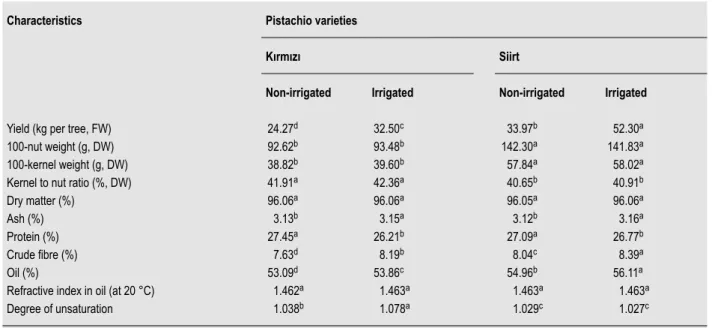
Some properties of Kırmızı and Siirt pistachio varieties grown under non-irrigated and irrigated conditions were determined and the mean values were shown in the Table 1. Irrigation increased the yield by 33.91% in Kırmızı, and 53.96% in Siirt pistachio variety. The kernel and nut weights of Siirt variety were higher than that of Kırmızı. The kernels and nuts of Siirt variety are larger, plump and oval, while the kernels and nuts of Kırmızı are thin and long. The effect of irrigation on 100-kernel weight, 100-nut weight, and
Table 1. Physicochemical characteristics of Turkish pistachio nut varieties (Kırmızı and Siirt).1
Characteristics Pistachio varieties
Kırmızı Siirt
Non-irrigated Irrigated Non-irrigated Irrigated
Yield (kg per tree, FW) 24.27d 32.50c 33.97b 52.30a
100-nut weight (g, DW) 92.62b 93.48b 142.30a 141.83a
100-kernel weight (g, DW) 38.82b 39.60b 57.84a 58.02a
Kernel to nut ratio (%, DW) 41.91a 42.36a 40.65b 40.91b
Dry matter (%) 96.06a 96.06a 96.05a 96.06a
Ash (%) 3.13b 3.15a 3.12b 3.16a
Protein (%) 27.45a 26.21b 27.09a 26.77b
Crude fibre (%) 7.63d 8.19b 8.04c 8.39a
Oil (%) 53.09d 53.86c 54.96b 56.11a
Refractive index in oil (at 20 °C) 1.462a 1.463a 1.463a 1.463a
Degree of unsaturation 1.038b 1.078a 1.029c 1.027c
the kernel to nut ratio was not significant (P<0.05) in both varieties. Monastra et al. (1995) reported that, although yield increased in parallel with irrigation, the average weight of fruit in shell and dry did not change significantly. Although irrigation increased the ash content slightly, values are very close to each other. The significance between these results may be attributed to the fact that the differences between replications were very small.
In the same way, the crude fibre content increased with irrigation significantly (P<0.05). The protein contents of both pistachio varieties were significantly (P<0.05) higher under non-irrigated conditions than in irrigated conditions. But irrigation increased the oil content of both varieties. The oil content of Siirt variety was higher in both non-irrigated and non-irrigated conditions. Satil reported that, Siirt pistachio contained the higher level of oil than other varieties investigated (Satil et al., 2003).
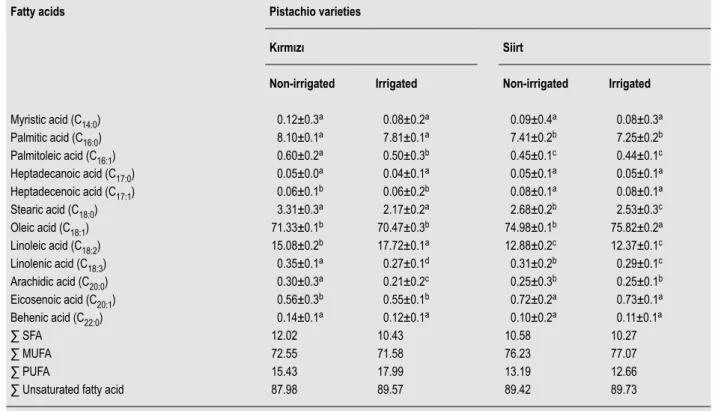
Total lipid levels were between 53.09 and 56.11% in two varieties (Kırmızı and Siirt) of pistachio. The fatty acid compositions (%) were characterised in Kırmızı and Siirt pistachio varieties (Table 2) under non-irrigated (dry) and irrigated conditions.
The major fatty acids characterised of both pistachio varieties were, oleic acid (70.47-75.82%), linoleic acid (12.37-17.72%), palmitic acid (7.25-8.10%), stearic acids (2.17-3.31%). Similar results were reported by earlier research (Agar et al., 1994; Aslan et al., 2002; Satil et al., 2003). The oleic acid content of Siirt was higher than Kırmızı variety. The effect of irrigation on the oleic acid content was insignificant (P<0.05) in Siirt pistachio variety. Agar reported a clear inverse correlation between oleic and linoleic acids, and considered them as complementary (Agar et al., 1994).
Linoleic acid was the most abundant polyunsaturated fatty acid in pistachio. Contrary to oleic acid, the linoleic acid content of Kırmızı was higher than Siirt. The effect of irrigation was insignificant on Siirt, but it increased the linoleic acid content of Kırmızı pistachio. Oleic acid is known more stable against oxidative alterations than linoleic and linolenic acids, the higher level of oleic acid than them make pistachio more stable for oxidation.
The Kırmızı variety had higher amount of stearic acid under both dry and irrigated conditions. The palmitic acid content of pistachio followed the same pattern as linoleic acid. It
Table 2. Fatty acid composition (%) of the oils of Turkish pistachio nut varieties.1
Fatty acids Pistachio varieties
Kırmızı Siirt
Non-irrigated Irrigated Non-irrigated Irrigated
Myristic acid (C14:0) 0.12±0.3a 0.08±0.2a 0.09±0.4a 0.08±0.3a Palmitic acid (C16:0) 8.10±0.1a 7.81±0.1a 7.41±0.2b 7.25±0.2b Palmitoleic acid (C16:1) 0.60±0.2a 0.50±0.3b 0.45±0.1c 0.44±0.1c Heptadecanoic acid (C17:0) 0.05±0.0a 0.04±0.1a 0.05±0.1a 0.05±0.1a Heptadecenoic acid (C17:1) 0.06±0.1b 0.06±0.2b 0.08±0.1a 0.08±0.1a Stearic acid (C18:0) 3.31±0.3a 2.17±0.2a 2.68±0.2b 2.53±0.3c Oleic acid (C18:1) 71.33±0.1b 70.47±0.3b 74.98±0.1b 75.82±0.2a Linoleic acid (C18:2) 15.08±0.2b 17.72±0.1a 12.88±0.2c 12.37±0.1c Linolenic acid (C18:3) 0.35±0.1a 0.27±0.1d 0.31±0.2b 0.29±0.1c Arachidic acid (C20:0) 0.30±0.3a 0.21±0.2c 0.25±0.3b 0.25±0.1b Eicosenoic acid (C20:1) 0.56±0.3b 0.55±0.1b 0.72±0.2a 0.73±0.1a Behenic acid (C22:0) 0.14±0.1a 0.12±0.1a 0.10±0.2a 0.11±0.1a ∑ SFA 12.02 10.43 10.58 10.27 ∑ MUFA 72.55 71.58 76.23 77.07 ∑ PUFA 15.43 17.99 13.19 12.66
∑ Unsaturated fatty acid 87.98 89.57 89.42 89.73
1 Means in a same column with different letters are significantly different (P<0.05); data are expressed as means (n=3). SFA, MUFA and PUFA stand for
was higher in Kırmızı than in Siirt variety. Although it was higher under non-irrigated grown varieties than irrigated ones, the difference was statistically insignificant (P<0.05). The fatty acid levels determined in the present study were generally lower than those reported by (Küçüköner and Yurt, 2003). Higher temperature is reported to decrease the palmitic acid level in pistachio (Satil et al., 2003). Neither irrigation nor variety affected myristic and behenic acids, which were below 1%, significantly.
Of the characterised fatty acids, the amounts of saturated fatty acids were determined as 12.02 and 10.43% in Kırmızı and 10.58% and 10.27% in Siirt in dry and irrigated conditions, respectively. In general, the amount of saturated fatty acids increased in dry conditions. Polyunsaturated fatty acids (PUFA) content of Kırmızı pistachio was much higher than that in the Siirt variety.
The results indicated that oleic acid was the most abundant fatty acid in pistachio oils, contributing between 70.47 and 75.82% of total fatty acids. Oil of Kırmızı pistachio variety had the highest linoleic acid content (17.72%) under irrigated conditions. Other fatty acids present consist of palmitic acid (7.25-8.10%) and stearic acid (2.17-3.31%). Total saturated fatty acids were less than 12.02%, monounsaturated and polyunsaturated fatty acids totalled up to 77.07 and 17.99%, respectively.
4. Conclusions
The fatty acid composition affected the oil quality of oilseed crops. The nutritional, pharmaceutical and industrial suitability of a vegetable oil is evaluated by the determination of its fatty acid composition. This fatty acid composition varies according to plant species and variety. It can be concluded that irrigation increased Pistachio nut yield, ash, oil, crude fibre, but decreased protein content while it did not affect kernel and nut sizes, and dry matter contents. In general, variety effected the major fatty acid composition, but irrigation did not, markedly.
Acknowledgements
This project was supported by Harran University Scientific Research Community (HUBAK). Project Number; 489, Researches are supplied by the Directorate of Harran University.
References
Agar, I., Kaska, N. and Kafkas, S., 1994. Effect of different ecologies on the fat content and fatty acid composition of different Pistacia vera varieties grown in different parts of Turkey. International Symposium on Pistachio 419: 411-416.
Ak, B. and Fidan, M., 2012. Determination of macro and micro elements of different pistachio cultivars in ‘on’ and ‘off’ year trees (A25). VII International Symposium on Mineral Nutrition of Fruit Crops, Chanthaburi, Thailand.
Aliakbarkhani, S.T., Akbari, M., Hassankhah, A., Talaie, A. and Moghadam, M.F., 2015. Phenotypic and genotypic variation in Iranian pistachios. Journal of Genetic Engineering and Biotechnology 13: 235-241.
Amaral, J.S., Casal, S., Pereira, J.A., Seabra, R.M. and Oliveira, B.P.P., 2003. Determination of sterol and fatty acid compositions, oxidative stability, and nutritional value of six walnut (Juglans regia L.) cultivars grown in Portugal. Journal of Agricultural and Food Chemistry 51: 7698-7702.
American Association of Cereal Chemists (AACC), 2000. Approved methods of AACC. Approved methods committee AACC Inc., Wiley, St. Paul, MN, USA.
Anonymous, 2012. Soil taxonomy: a basic system of soil classification for making and interpreting soil surveys. USDA, Washington, DC, USA.
Asghari, G., Ghorbani, Z., Mirmiran, P. and Azizi, F., 2017. Nut consumption is associated with lower incidence of type 2 diabetes: The Tehran lipid and glucose study. Diabetes and Metabolism 43: 18-24.
Aslan, M., Orhan, I. and Sener, B., 2002. Short communication. Comparison of the seed oils of Pistacia vera L. of different origins with respect to fatty acids. International Journal of Food Science and Technology 37: 333-336.
Association of Official Analytical Chemists (AOAC), 1990. Official methods of analysis. AOAC, Rockville, MD, USA.
Bartzas, G. and Komnitsas, K., 2017. Life cycle analysis of pistachio production in Greece. Science of the Total Environment 595: 13-24. Chaharbaghi, E., Khodaiyan, F. and Hosseini, S.S., 2017. Optimization of pectin extraction from pistachio green hull as a new source. Carbohydrate Polymers 173: 107-113.
Davis, L., Stonehouse, W., Loots, D.T., Mukuddem-Petersen, J., Van der Westhuizen, F.H., Hanekom, S.M. and Jerling, J.C., 2007. The effects of high walnut and cashew nut diets on the antioxidant status of subjects with metabolic syndrome. European Journal of Nutrition 46: 155-164.
Eliseeva, L., Yurina, O. and Hovhannisyan, N., 2017. Nuts as raw material for confectionary industry. Annals of Agrarian Science 15: 71-74.
Galedar, M.N., Mohtasebi, S.S., Tabatabaeefar, A., Jafari, A. and Fadaei, H., 2009. Mechanical behavior of pistachio nut and its kernel under compression loading. Journal of Food Engineering 95: 499-504. Gamlı, Ö.F. and Hayoğlu, İ., 2007. The effect of the different packaging
and storage conditions on the quality of pistachio nut paste. Journal of Food Engineering 78: 443-448.
Gulati, S., Misra, A., Pandey, R.M., Bhatt, S.P. and Saluja, S., 2014. Effects of pistachio nuts on body composition, metabolic, inflammatory and oxidative stress parameters in Asian Indians with metabolic syndrome: A 24-wk, randomized control trial. Nutrition 30: 192-197.
Kendirci, P. and Onogur, T.A., 2014. Comparison of three different techniques for extraction of volatiles from pistachio nuts. Foodbalt 2014: 289-293.
Küçüköner, E. and Yurt, B., 2003. Some chemical characteristics of
Pistacia vera varieties produced in Turkey. European Food Research
and Technology 217: 308-310.
Ling, B., Hou, L., Li, R. and Wang, S., 2016. Storage stability of pistachios as influenced by radio frequency treatments for postharvest disinfestations. Innovative Food Science and Emerging Technologies 33: 357-364.
Lutterodt, H., Slavin, M., Whent, M., Turner, E. and Yu, L.L., 2011. Fatty acid composition, oxidative stability, antioxidant and antiproliferative properties of selected cold-pressed grape seed oils and flours. Food Chemistry 128: 391-399.
Mokhtarian, M., Tavakolipour, H. and Ashtari, A.K., 2017. Effects of solar drying along with air recycling system on physicochemical and sensory properties of dehydrated pistachio nuts. LWT – Food Science and Technology 75: 202-209.
Monastra, F., Avanzato, D., Martelli, Z. and Dascanio, R., 1995. Pistachio trial under different volumes of irrigation in Italy. Acta Horticulturae 419: 249-252.
Ojeda-Amador, R.M., Fregapane, G. and Salvador, M.D., 2018. Composition and properties of virgin pistachio oils and their by-products from different cultivars. Food Chemistry 240: 123-130. Parry, J., Su, L., Luther, M., Zhou, K., Yurawecz, M.P., Whittaker, P.
and Yu, L., 2005. Fatty acid composition and antioxidant properties of cold-pressed marionberry, boysenberry, red raspberry, and blueberry seed oils. Journal of Agricultural and Food Chemistry 53: 566-573.
Porzucek, H. and Raznikiewicz, L., 1990. Fatty acid composition and lipoxygenase activity of flours and protein isolates from leguminous plants. Swedish Journal of Agricultural Research 20: 31-34. SAS, 2001. SAS user’s guide. SAS Institute Inc., Cary, NC, USA. Satil, F., Azcan, N. and Baser, K., 2003. Fatty acid composition of
pistachio nuts in Turkey. Chemistry of Natural Compounds 39: 322-324.
Song, S., Cheong, L.-Z., Wang, H., Man, Q.-Q., Pang, S., Li, Y., Ren, B., Wang, Z. and Zhang, J., 2018. Characterization of phospholipid profiles in six kinds of nut using HILIC-ESI-IT-TOF-MS system. Food Chemistry 240: 1171-1178.
Sonmezdag, A.S., Kelebek, H. and Selli, S., 2018. Pistachio oil (Pistacia
vera L. cv. Uzun): characterization of key odorants in a representative
aromatic extract by GC-MS-olfactometry and phenolic profile by LC-ESI-MS/MS. Food Chemistry 240: 24-31.
Stuetz, W., Schlörmann, W. and Glei, M., 2017. B-vitamins, carotenoids and α-/ γ-tocopherol in raw and roasted nuts. Food Chemistry 221: 222-227.