POLITICS OF INSTITUTONAL CHANGE IN STATE-BUSINESS RELATION: A CASE STUDY IN TURKEY’S ELECTRICITY SECTOR
A Master’s Thesis
by MESUT KILIÇ
Department of International Relations İhsan Doğramacı Bilkent University
Ankara August 2018 M ESUT KILI Ç P OLI TICS OF INS TIT UTON AL C H AN GE IN ST AT E -B USI N ESS RELAT IO N B ilk en t Un iversi ty 2 0 18
POLITICS OF INSTITUTONAL CHANGE IN STATE-BUSINESS RELATION: A CASE STUDY IN TURKISH ELECTRICITY SECTOR
The Graduate School of Economics and Social Sciences of
İhsan Doğramacı Bilkent University
by
MESUT KILIÇ
In Partial Fulfillment of the Requirements for the Degree of MASTER OF ARTS
THE DEPARTMENT OF INTERNATIONAL RELATIONS İHSAN DOĞRAMACI BİLKENT UNIVERSITY
ANKARA August 2018
i
ABSTRACT
POLITICS OF INSTITUTIONAL CHANGE IN STATE-BUSINESS RELATION: A CASE STUDY IN TURKISH ELECTRICITY SECTOR
Kılıç, Mesut
M.A., Department of International Relations Supervisor: Asst. Prof. Dr. Pınar İpek
August 2018
Since the early 2000s, the electricity sector in Turkey has witnessed an institutional change, with the enactment of Electricity Market Law (EML), 2001, and the declaration of the 2004 Energy Strategy Paper (ESP) published by the Higher Planning Council. Within this new institutional framework, the state has been giving up its monopoly in electricity production and distribution sectors and transferring its considerable amount of operations to private companies. Although one of the main reasons of this institutional change in the sector indicated in ESP is “security of supply,” Turkey’s interdependence between natural gas and electricity market has substantially increased. Therefore, this development in Turkish electricity sector requires further investigation of state-business relation in the context of politics of institutional change in electricity market. In order to understand and explain the politics of institutional change in Turkish electricity sector, the thesis employs three main theories namely rational choice, historical institutionalism, and constructivism. Having examined the institutional change process, the thesis concludes that despite the extent of exogenous factors, there is an endogenous process of path dependent institutional change within the historical trajectory of state-business relation in Turkey. The perceived understanding of stakeholders in the electricity market about their self-interested market activities seem to be inseparable from how they frame their actions through uncertainty and ideational forces.
Keywords: Energy Sector in Turkey, Path-dependence, Politics of Institutional Change, Role of Ideas, State-business Relation
ii
ÖZET
DEVLET-ŞİRKET İLİŞKİSİNDE KURUMSAL DEĞİŞİM POLİTİKLARI: TÜRK ELEKTRİK SEKTÖRÜ VAKA İNCELEMESİ
Kılıç, Mesut
Yüksek Lisans, Uluslararası İlişkiler Bölümü Tez Danışmanı: Dr. Öğr. Üyesi Pınar İpek
Ağustos 2018
Türkiye’deki elektrik sektörü, 2000’li yılların başlarından itibaren, Elektrik Piyasa Kanunu’nun 2001 yılında yasalaşması ve 2004 Enerji Strateji Belgesi’nin (ESB) Yüksek Planlama Kurulu tarafından yayınlanmasıyla birlikte, kurumsal bir değişime tanık oldu. Devlet, bu yeni kurumsal çerçeve içerisinde, elektrik üretim ve dağıtım sektörlerinde tekel olmaktan vazgeçiyor ve operasyonlarının önemli bir kısmını özel şirketlere devretti. ESB’de sektördeki bu kurumsal değişimin ana nedenlerinden biri “arz güvenliği” olarak gösterilse de, süreç içerisinde Türkiye’deki doğal gaz ve elektrik piyasası arasındaki karşılıklı bağımlılık önemli derecede arttı. Dolayısıyla, Türk elektrik sektöründeki bu gelişme kurumsal değişim politikaları bağlamında devlet-şirket ilişkisi hakkında daha fazla araştırma yapmayı gerektiriyordu. Bu tez, Türk elektrik sektöründeki kurumsal değişim politikalarını anlamak ve açıklamak için bu politikaları üç ana teori çerçevesinde ele almıştır: Rasyonel Seçim, Tarihsel Kurumsalcılık ve Yapısalcılık. Tez, Türk elektrik sektöründeki kurumsal değişim sürecini inceledikten sonra şu sonuca varmıştır: Dış kaynaklı bazı faktörlerin yanı sıra, Türkiye’de, devlet-şirket ilişkisinin tarihsel gidişatı içerisinde patika bağımlı kurumsal değişimin iç kaynaklı süreci görülmektedir. Elektrik piyasasındaki paydaşların çıkarcı piyasa eylemleri, bu paydaşların piyasa eylemlerini belirsizlik ve fikirsel güçlerin etkisiyle çerçevelendirmelerinden bağımsız değildir.
Anahtar Kelimeler: Devlet-şirket İlişkisi, Fikirlerin Rolü, Kurumsal Değişim Politikaları, Patika Bağımlılığı, Türkiye’de Enerji Sektörü
iii
ACKNOWLEDGMENTS
First of all, I would like to express my gratitude to my supervisor Asst. Prof. Dr. Pınar İpek who has been greatly accommodating, and supportive in tough times. I am obliged to her because of her perfect guidance. I would like to thank Assoc. Prof. Dr. Mehmet Fatih Tayfur and Asst. Prof. Dr. Seçkin Köstem for being the members of my thesis committee and for sparing their valuable time to read my thesis.
I am grateful to my elder sister, Dilek Aydoğan, for her invaluable spiritual support. And, I am indebted to Adil Karadağ for being extremely helpful in arranging all interviews in the thesis.
I would like to thank Selin Şahin, Nilay Albay, and Ahmet Karakülle for their valuable friendship and support during the thesis preparation process.
Last but not least I appreciate my family members, Kemal Kılıç, Nejla Kılıç, Murat Kılıç, Muhammet Emin Aydoğan, Özlem Kılıç, Serhan Aydoğan, Onur Aydoğan, and Abdullah Kılıç, for the love and support they give me.
iv
TABLE OF CONTENTS
ABSTRACT...i ÖZET...ii ACKNOWLEDGMENTS...iii TABLE OF CONTENTS…...iv LIST OF TABLES.………..vii LIST OF FIGURES.……….…….viii CHAPTER 1 INTRODUCTION...1CHAPTER 2 THEORETICAL FRAMEWORK (STATE-BUSINESS RELATION AND POLITICS OF INSTITUTIONAL CHANGE)………...6
2.1. State’s Role in Economic Development...6
2.1.1. Neopatrimonial States...7
2.1.2. Cohesive-Capitalist States...……….………..9
2.1.3. Fragmented-Multiclass States….………11
2.2. Politics of Institutional Change………..………..16
2.2.1. Rational Choice Arguments for Institutional Change.………..…….16
2.2.2. Historical Institutionalism and Gradual Change…..……….…….19
v
2.2.3.1. Ideational Forces and Material Interests in
Double Movement: The Case of Energy Sector in Turkey……….32
2.3. Methodology……….………36
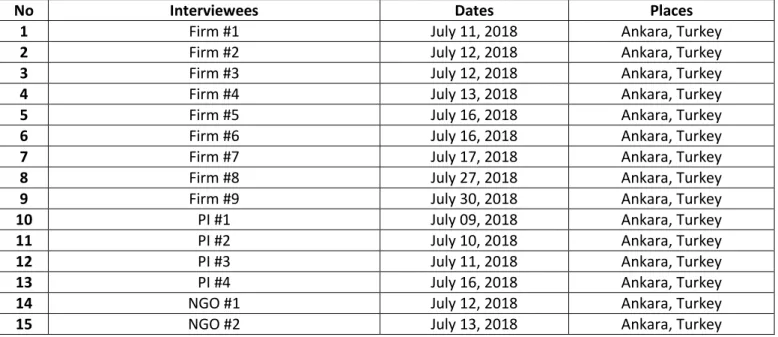
2.3.1. Data collection and Sample………….………..……….38
CHAPTER 3 HISTORICAL BACKGROUND IN STATE-BUSINESS RELATION AND INSTITUTIONAL CHANGE IN TURKEY’S ENERGY SECTOR……….….41
3.1. 1st Period (1923-1930).……….…….……….…….…42
3.2. 2nd Period (1930-1950).……….…..….….……44
3.3. 3rd Period (1950-1960).…...46
3.4. 4th Period (1960-1980)………..………..…48
3.5. 5th Period (1980-2001)…..………..………51
3.6. The puzzle for my research question……….…….………56
CHAPTER 4 THE ROLE OF UNCERTAINTY, IDEAS, AND PARADIGM SHIFT IN POLITICS OF INSTITUIONAL CHANGE IN ELECTRICITY PRODUCTION (2001-2017)……...61
4.1. Major Institutional Changes and Structural Constraints in Domestic Electricity Market...61
4.1.1. The 2001 Law on Electricity Market (The Law No. 4628) and The 2004 Strategy Paper (Reform in Electricity Sector and Privatization Strategy Paper)…………...61
4.1.2. Restructuring of Turkey’s Economy: The Conditionality of IMF Loans and Turkey’s Accession Process to the EU……….………65
vi
4.1.3. Turkey’s Increasing Energy Demand and Energy Imports…...66
4.2. Politics of Institutional Change in Electricity Market in the Context of State-Business Relation…….………..………..………66
4.2.1. Self Interests of Actors and Gradual Change in Politics of Institutional Change………..………..………66
4.2.2. Constructivism and Politics of Institutional Change………72
4.2.2.1. Uncertainty, Ideas, and Paradigm Shift in Electricity Sector in Turkey.…….……….72
4.2.2.2. The Paradox of Liberalism as an Endogenous Process of Path Dependent Institutional Change within the Historical Trajectory of State-Business Relation in Turkey………..79 CHAPTER 5 CONCLUSION ……….……….96 REFERENCES………….…...103 APPENDICES...108 A. POPULATION OF FIRMS…...109 B. INTERVIEW DATES...116 C. INTERVIEW QUESTIONS………...117
vii
LIST OF TABLES
1. Main Characteristics and Policy tool comparison of Cohesive-capitalist &
Fragmented-multiclass states………...15
2. Sample List of Interviews………...40
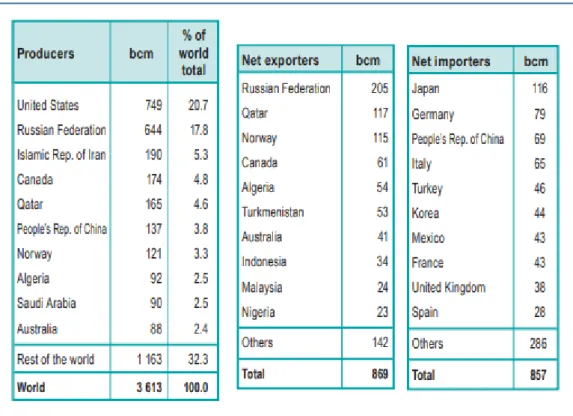
3. Producers, net exporters, and net importers of natural gas, 2016………60
viii
LIST OF FIGURES
1. Electricity Generation and Shares by Energy Resources (2018), Turkey ………...55
2. Global Electricity Generation and Shares by Energy Resources (2015) & Turkey’s Electricity Generation and Shares by Energy Resources……….………..……59
1
CHAPTER 1
INTRODUCTION
During the 1990s, Turkish privatization process was relatively unsuccessful in the
electricity production sector. However, since the early 2000s, the sector has
witnessed an institutional change, with the enactment of Electricity Market Law
(EML), 2001, and the declaration of the Strategy Paper published by the Higher
Planning Council published in 2004. Within this new institutional framework, the
state has been giving up its monopoly in electricity production and distribution
sectors and transferring some of these operations to private companies. There were
several motivations for the observed institutional change. First, the state was
technically incapable of meeting projected electricity demand of Turkey. Second,
during the 1990s, Turkey experienced serious economic crises. The state was
economically incapable of meeting the highly needed investment amount into
energy sector so that it could keep its role in the sector. Third, the International
Monetary Fund (IMF) and the European Union (EU) asked for privatization and
liberalization process in the electricity sector through the conditionalities in stand
by agreements and Turkey’s accession process to the EU, respectively.
Accordingly, this thesis examines the following research question:
Which factors are more plausible in understanding and explaining the politics of
institutional change in state-business relation in the energy sector, specifically in
2
I specifically focus on the electricity generation from natural gas because of the
puzzle as follows:
Although one of the main reasons of privatization in electricity sector, indicated in
the 2004 Energy Strategy Paper (ESP) is security of supply, Turkey’s interdependence
between natural gas and electricity markets has substantially increased.
In 2004, the share of natural gas in generating electricity was 41.3 per cent.
However, it peaked with 49.7 per cent in 2008 and slightly decreased to 47.9 per
cent in 2014. Even today, the share of natural gas in generating electricity is more
than 35 per cent, while it can exceed 45 per cent during high demand times in
winter months.
Thus, despite the new institutions introduced into the energy market after the 2001
economic crisis, persistently high share of natural gas in electricity generation is
puzzling and requires further investigation of state-business relation in the context
of politics of institutional change in electricity market.
My methodology is case study of Turkish electricity sector and particularly
electricity generation from natural gas. This sector is important for understanding
and explaining the politics of institutional change in state-business relation, because
electricity generation from natural gas has the biggest share in energy mix in
Turkey. I collected data from the official documents and conducted several
interviews with private firm, business association representatives in the electricity
sector, and officials in the Ministry of Energy and Natural Resources.
In this study, I firstly consider Kohli’s typology for states’ role in economic
development. And, it can be argued that both cohesive-capitalist and multi-class
3
development. This means that Turkey should have been experiencing a number of
institutional changes, associated with different political coalitions between state
and business in economic development.
I also consider three different theoretical perspectives, namely rational choice,
historical institutionalism, and constructivism in understanding and explaining the
politics of institutional change in state-business relationship in Turkey. Rational
choice scholars think that the main drive of institutional change is self-interest.
Human beings as individuals created organizations and institutions to purse their
own self-interests. Thus, institutions are merely seen as instrumental creations of
individuals. They make use of these institutions to enlarge their own personal
utilities. Therefore, according to rational choice theories, institutional change only
takes place when it bears more benefits for the actors.
Historical institutionalists argue that a historically constructed set of institutional
restrictions and opportunities affects the behavior of political actors and interest
groups that engage in the policy process. They underscore path dependence and
unintended consequences in institutional construction. Moreover, current studies
in historical institutionalism argue that institutional change is accountable as an
ideationally path-dependent process in which agents construct their institutional
future from a limited set of ideas. According to these studies, institutional change
arises from endogenous sources of instability, and that endogenous mechanisms of
change are more influential than exogenous ones, referring to “gradual change.”
Gradual change more specifically has four different categories, namely
4
Constructivist scholars argue that it is necessary to develop a better understanding
than that of Karl Polanyi’s double movement concept in order to understand and
explain politics of institutional change. Even though double movement is still
significant today, it separates the market from society and supplants the institutions
of social protection with more market-conforming institutions. Nevertheless, the
political uses of economic ideas and politics of organized business can be employed
to develop a better theoretical understanding. Ideas allow agents to decrease
uncertainty, suggest a specific solution to a moment of crisis, and empower agents
to resolve the crisis. Thus, new ideas are important components in constructing
politics of institutional change. They briefly argue that social scientists need to
reconsider the link between ideas and interests.
Having conducted 15 interviews, and examined the official papers, and secondary
resources, I argue that
Despite the extent of exogenous factors, there is an endogenous process of
path dependent institutional change within the historical trajectory of state-business
relation in Turkey.
The perceived understanding of stakeholders in the electricity market about
their self-interested market activities seem to be inseparable from how they frame
their actions through uncertainty and ideational forces.
The thesis contains five chapters. Following the introduction chapter, the second
chapter presents the theoretical framework to examine politics of institutional
change in state-business relation and the hypotheses that I consider for my
research question. The third chapter looks into the historical background in
5
sector. In light of the role of state in Turkish political economy and institutional
changes in energy sector, the historical background is divided into five periods: 1st
Period (1923-1930), 2nd Period (1930-1950), 3rd Period (1950-1960), 4th Period
(1960-1980), and 5th Period (1980-2001), respectively. The fourth chapter
demonstrates the main findings of the thesis. It concludes that there is an
endogenous process of path dependent institutional change within the historical
trajectory of state-business relation in Turkey. The perceived understanding of
stakeholders in the electricity market about their self-interested market activities
seem to be inseparable from how they frame their actions through uncertainty and
6
CHAPTER 2
THEORETICAL FRAMEWORK: STATE-BUSINESS RELATION AND
POLITICS OF INSTITUTIONAL CHANGE
2.1. State’s Role in Economic Development
The state has always been at the heart of economic development, especially in
developing states. This observation leads scholars to consider the state as the most
significant economic actor in peripheral countries. Energy sector is no exception of
this general rule, since the infra and superstructure of the sector has a high-risk in
and high-cost of investment; and the role of private sector is expected to be limited
in the initial stages of economic development. In fact, the state in late-industrialized
developing countries has been particularly influential in energy sector given the lack
of large capital accumulation in private sector or bourgeoisie, if any, in the early
phases of their industrialization.
Nevertheless, we can see changing role of state in energy sector through different
periods of industrialization process and economic development in developing
countries. In this regard, historical context of state-business relation in Turkey
matters to understand and explain the contingent conditions for politics of
institutional change in energy sector, and especially the case of electricity
generation from natural gas. In this section, I look at the role of state to describe
characteristics and various policy tools of different state types, which influence
economic development, and specifically industrialization at different levels. There
7
(2004) work since he has an inductive approach to examine different degree of
industrialization among developing countries. He has in-depth case studies of
Nigeria, Brazil, India, and South Korea. In light of Kohli’s state typology, I question
the state’s role in Turkey’s economic development and consider some of the
described characteristics to identify how Turkish state has intervened into politics of
institutional change in the case of electricity sector.
Kohli asserts that in order to compare and analyze state types in development, one
need to consider a number of specific characteristics, which are “leadership goals,
degree of centralization of public authority, downward penetration of public
authority, political organization of the mobilized political society, scope of state
intervention in economy, and quality of the economic bureaucracy” (Kohli 2004, p.
12). According to Kohli, there are three historical patterns of how state authority is
organized and used in the developing world: neopatrimonial states,
cohesive-capitalist states, and fragmented-multiclass states (Kohli 2004, p. 9).
2.1.1. Neopatrimonial States
All modern states have centralized authority and coercive control over a specific
territory. They also have a well-established public arena that can be distinguished
from private interests and their pursuits. This distinction between the public and
private sphere of activities is quite weak in several developing country states. Thus,
a number of states emerged with weakly centralized and legitimate authority
structures, self-interested leaders not limited by institutions, and bureaucracies of
8
modern state, public officeholders tend to treat public resources as their personal
patrimony” (Kohli 2004, p. 9). As a result, these states are quasi-modern states -
neither completely modern nor accurately rational-legal states.
Under neopatrimonial state support, state-led development has frequently resulted
in disaster to the extent that personal and/or narrow group interests have usually
undermined state capacity and public goals. Kohli states that neopatrimonial states
have come to exist in societies with weak private sectors. They, like
cohesive-capitalist and fragmented-multiclass states, have also intervened overwhelmingly in
their economies but with destructive results. Instead of strengthening the private
sector, however, these states have seized scarce economic resources, hindering
efficient allocation of available resources towards productive investment (Kohli
2004, p. 15). Therefore, inconsistent economic policies, failure to bolster domestic
capitalists, poorly educated work force, and political instability have contributed to
the substantial weakness of the national private sector.
Neopatrimonial states have dealt with economic activities directly or invited foreign
producers to overcome the deficiencies and to meet the public needs. However,
importing goods or attracting foreign investments can be taken as supportive
means only if the state has alternative sources (Kohli 2004, p. 15). These states
depend on foreign resource and expertise as they lack of organizational skills,
sufficient domestic capital, and political capacity (Kohli 2004, p. 11). The least
succeeded countries in industrialization have been the states that have had no clear
public goals and whose leaders reduced the state to a personal interest tool. These
neopatrimonial states have composed of a remarkable part of the periphery. The
9
political support through patronage and/or by personal greed. As a result, Kohli
indicates that “the relationship of the state and the private sector in such contexts
has just as often been mutually corrupt: political instability, inconsistent policies,
and pilfering of public resources for personal and sectional gains have all hurt
state-led efforts to promote industry and growth” (Kohli 2004, p. 15).
According to Kohli, in the contemporary developing world, cohesive-capitalist and
fragmented-multiclass states are two of the other ideal-typical states (Kohli 2004, p.
13). In the developing world, modern rational-legal states have become inclined to
two main dimensions: “cohesion of state authority and the state’s class
commitments” (Kohli 2004, p. 13). The former is committed to working with
capitalists, while the latter rests its power and goals on a more multi-class base.
2.1.2. Cohesive-Capitalist States
The cohesive-capitalist states can be called developmental states. In terms of the
political effectiveness and durability, they are opposite to neopatrimonial states
(Kohli 2004, p. 14). Kohli argues that in some way or other cohesive-capitalist states
have demonstrated to be the most successful state-led industrialized states in
developing countries (Kohli 2004, p. 11).
The main characteristics of these states are cohesive politics – centralized and
purposive authority structures that often penetrate deep into the society. These
states are inclined to put rapid economic growth and national security in the same
equation. They forge a close link with society’s major economic groups, producer or
10
In order to get acceptance from society, ruling authority often use ideological
mobilization, such as nationalism and/or anti-communism. Cohesive-capitalist
states in developing countries, according to Kohli, follow repressive and
authoritarian policies, sharing some organizational and class features with fascist
states of interwar Europe (Kohli 2004, p. 15).
Cohesive-capitalist states have by and large turned their countries into state-guided
corporations, being the fastest in terms of their economic growth rate among
peripheral countries. They have been growth-oriented and devoted themselves to
high growth by developing trade and industry with well-designed, stable, properly
implemented interventionist policies. Kohli states in his book, titled State-directed
Development that “specific policy measures varied but were generally aimed at
easing supply-and-demand constraints faced by private entrepreneurs” (Kohli 2004,
p. 13). According to Kohli’s findings, for example, on the supply side
cohesive-capitalist states help to facilitate the availability of capital, labor, technology, and
even entrepreneurship. On the demand side, the examples for cohesive state’s
interventions include expansionist monetary and fiscal policies, and tariffs and
exchange-rate policies. If these measures are not sufficient, then the state adopts
newer policies to shift the focus on export promotion or, more likely, production for
both domestic and foreign consumption.
Cohesive-capitalist states make considerable efforts and use an extensive set of
policy tools to reach economic growth targets, such as well-functioning tax
collection and public investment; allocation of publicly controlled banks credit
directly to selected private firms and sectors; shifting resources from agriculture
11
flexible, and disciplined labor; public investment in education and research and
development; state’s bargaining power and incentives to enable technology
transfer by multinational firms’ direct investment; devaluated exchange rates,
subsidized exports, and suppressed wages to contribute to private sector’s capital
accumulation following productivity gains (Kohli 2004, p. 13).
In summary, the key features of cohesive-capitalist states are emphasized as: “the
top leadership equating rapid economic growth with national security, a highly
centralized and penetrating public authority, state-controlled political society
(though in close alliance with capitalist groups), and a highly interventionist state,
with a good quality economic bureaucracy” (Kohli 2004, p. 12). Thus, in
cohesive-capitalist states we observe state-business relation institutionalized pragmatically
for capitalist development rather than those relations that are institutionalized
ideologically promarket (Kohli 2004, pp. 13-14).
2.1.3. Fragmented-Multiclass States
Fragmented-multiclass state represent the middle position in between the two
extreme end of state typology, namely neopatrimonial and cohesive-capitalist
states in terms of their political effectiveness. Kohli conceptualizes
fragmented-multiclass states as real modern states unlike the conceptualization of
neopatrimonial states. The main difference of fragmented-multiclass state from
cohesive capitalist state is that public authority is prone to be more fragmented and
based on a broader class alliance. Hence, fragmented-multiclass state’s policy goals
12
(Kohli 2004, p. 11). The political leader should be more worried about political
support than do leaders in other state types in developing countries. Accordingly,
not only industrialization and economic growth but also agricultural development,
economic redistribution, welfare provision, and maintaining national sovereignty
are significant policy goals.
Mixed political goals of fragmented-multiclass states have had several
consequences for development policy design and implementation. First, ruling elites
have been less focused on using state intervention strictly in terms of growth
consequences. Instead, they spread goals that enable various groups and individuals
to access state resources for consumption-oriented short-term benefits. Second,
the relationship between state and business has been remarkably more complex
than those in cohesive-capitalist states. The fragmented-multiclass states have been
both cooperative and conflictual towards the private sector. Last, both policy
making and implementation processes have been more politicized, weakening their
unilateral effectiveness (Kohli 2004, p. 14).
The main characteristics of fragmented multi-class states are the following: limited
tax-collecting capacities, various public-spending priorities with numerous purposes
other than growth promotion, efforts to direct credit turning into nepotism,
inflation as a liability for political leaders concerned about their legitimacy, and
monetary and fiscal policies for legitimacy (Kohli 2004, p. 14). Further,
fragmented-multiclass states have been neither more nor less interventionist than
cohesive-capitalist ones. These states’ development policy goals aimed not only at promoting
13
have been, however, mostly less effective at easing the supply-and-demand
limitations.
The state elites’ periodic hostile behavior towards private investors has made both
domestic and foreign investors reluctant to invest. Moreover, because of tariff and
exchange rate policies, which were adopted to protect national economy, the
demand for domestic goods has increased. Thus, powerful domestic interest groups
have often been created (Kohli 2004, pp. 14-15). In short, fragmented-multiclass
and cohesive-capitalist states both promote industrialization; however,
fragmented-multiclass states do so less effectively because their goals were more plural and
their political capacities less developed (Kohli 2004, p. 15).
Within the framework of Kohli’s typology for states’ role in economic development,
it can be argued that both cohesive-capitalist and multi-class fragmented state
types are observed during different periods of Turkey’s economic development.
This means that Turkey should have been experiencing a number of institutional
changes, associated with different formal and informal rules, norms and political
coalitions for the role of state in economic development. Furthermore, according
to Woo-Cumming (1999), state-led development involves a combination of political,
bureaucratic, and monetary influences that form economic growth, development,
and industrialization. The state employs different tools to intervene into selected
sectors for economic development.
In this study, I consider major sources of state intervention particularly into energy
sector. Among different sources of state intervention, I focus on bureaucracy and
state capacity that can be observed in the institutionalized relations between state
14
never been in the category of “Neopatrimonial” state. Because states in this type
are in constant need of foreign source and expertise as they lack of organizational
skills, sufficient domestic capital, and political capacity. They do not have any clear
public goals and intervene in private sector solely for politicians’ personal interests.
When I consider state-business relation as a process in the historical context of
Turkey’s economic development, therefore, I exclude intervention tools of
neopatrimonial states from this study.
However, I argue that Turkey showed main characteristics of cohesive-capitalist and
fragmented-multiclass states in different periods. In order to understand whether
and how Turkey employs cohesive-capitalist or fragmented-multiclass policy tools in
the context of institutional change in the energy sector, I concentrate on these two
state types’ intervention policy tools and bureaucracy and state capacity as major
sources of state intervention.
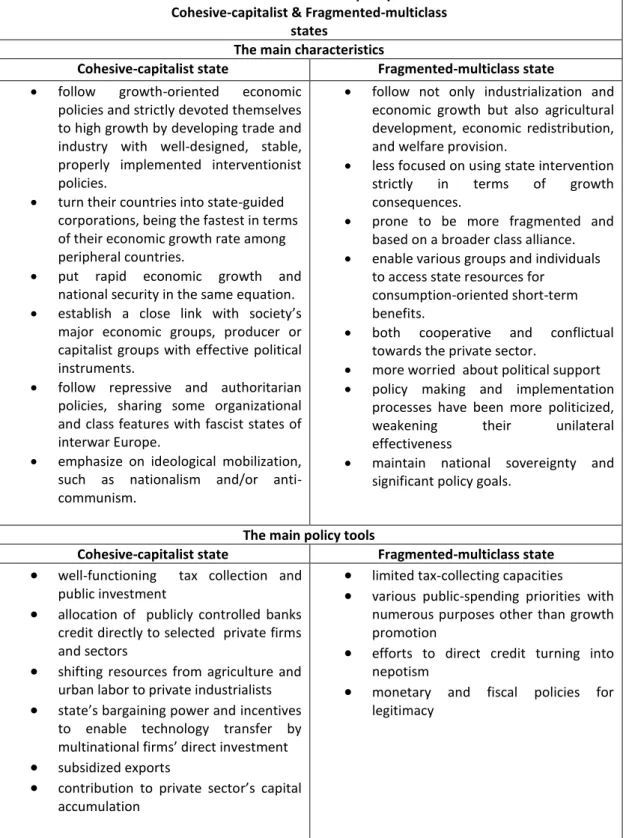
The main characteristics and policy tools of these state types can be seen in Table 1.
I focus on tax collection and exemption capabilities, state incentives, regulations,
privatization rates and techniques, public and private investment rates, and pricing
mechanism tools. These selected policy tools would help to examine my
hypotheses. In the light of available data from interviews, legislations, and official
reports, I try to understand and explain how state type of Turkey has shaped
state-business relation by employing these policy tools in the context of institutional
change in the energy sector.
In the next section, I consider major theoretical approaches to understand and
15
of state and business relations in energy sector, specifically in electricity generation
from natural gas. The politics of institutional change is the theoretical background
for my second and third hypotheses.
Table 1: Main Characteristics and Policy tool comparison of Cohesive-capitalist &
Fragmented-multiclass states (Kohli 2004)
The main characteristics and policy tools of Cohesive-capitalist & Fragmented-multiclass
states
The main characteristics
Cohesive-capitalist state Fragmented-multiclass state
follow growth-oriented economic policies and strictly devoted themselves to high growth by developing trade and industry with well-designed, stable, properly implemented interventionist policies.
turn their countries into state-guided corporations, being the fastest in terms of their economic growth rate among peripheral countries.
put rapid economic growth and national security in the same equation.
establish a close link with society’s major economic groups, producer or capitalist groups with effective political instruments.
follow repressive and authoritarian policies, sharing some organizational and class features with fascist states of interwar Europe.
emphasize on ideological mobilization, such as nationalism and/or anti-communism.
follow not only industrialization and economic growth but also agricultural development, economic redistribution, and welfare provision.
less focused on using state intervention strictly in terms of growth consequences.
prone to be more fragmented and based on a broader class alliance.
enable various groups and individuals to access state resources for
consumption-oriented short-term benefits.
both cooperative and conflictual towards the private sector.
more worried about political support
policy making and implementation processes have been more politicized, weakening their unilateral effectiveness
maintain national sovereignty and significant policy goals.
The main policy tools
Cohesive-capitalist state Fragmented-multiclass state well-functioning tax collection and
public investment
allocation of publicly controlled banks credit directly to selected private firms and sectors
shifting resources from agriculture and urban labor to private industrialists
state’s bargaining power and incentives to enable technology transfer by multinational firms’ direct investment
subsidized exports
contribution to private sector’s capital accumulation
limited tax-collecting capacities
various public-spending priorities with numerous purposes other than growth promotion
efforts to direct credit turning into nepotism
monetary and fiscal policies for legitimacy
16 2.2. Politics of Institutional Change
I have divided this section into three main parts, articulating the theoretical
background for competing explanations in the intuitional change literature. There
are three main theories to understand and explain the politics of institutional
change, namely rational choice, historical institutionalist, and constructivist
theories.
2.2.1. Rational Choice Arguments for Institutional Change
Rationalist theories explaining institutional change are grounded in the basic
assumptions of microeconomics. So, they consider agents’ preferences as the
primitives. If agents’ preferences are taken as the reference point, then all social
structures and institutions are degradable to individual utility units. Keynes states
that the economy is separated from the wider social, political, and cultural context.
The maximization of material self-interest is directly linked with individual behavior.
In the capitalist economic system, the private property appears as the key factor. In
this regard, Douglas North reduces the foundation of organizations and institutions,
and therefore, the politics of institutional change to the individual level.
According to North, first, organizations are comprised of political, economic, social,
and educational bodies. And, they are groups of individuals having some common
purpose to achieve objectives. Institutions are the rules of the game in a society,
and are constraints that form human interaction. Both organizations and
institutions are, thus, a creation of human beings. That is, they evolve and are altered by human beings; thus, the theory must begin with the individual (North
17
1990, pp. 3, 5). Hence, all social phenomena and outcomes must be intentional at
the very basic level, and institutions can thereby merely be seen as instrumental
products. Individuals use these products in order to maximize their personal
utilities. Therefore, from rationalist theories’ perspective, institutions change only in
accordance with rapidly shifting contract curves, cost/benefit trade-offs, and the
like (Blyth 2002, p. 19).
The seminal works that include ideas in explaining are those of Douglass North
(1987, 1990), and of Judith Goldstein and Robert O. Keohane (1993). North was
dissatisfied with the incapability of classic economic theories explaining institutional
change. He developed a theory of institutional supply based on the concepts of
transactions, costs, uncertainty, and ideology. From North’s point of view,
rationalist theories mistreated three problems. The first one was explaining
institutional supply from rationalist microfoundations. Essentially, making a rational
choice for institutions from a number of possible alternatives was impossible.
Hence, institutional design concepts of rationalist theories became questionable.
Second one was the following. Even though institutions are a rational response to
transacting problems, their generation is a collective action problem, which has no
exogenous solution. The last one was the problem of commitment. In other words,
it is not logical that rational egoists abide by institutions, considering that
institutions are only self-enforced constraints (Blyth 2002, pp. 23-24). By
incorporating ideas into a transaction cost theory of institutions, North tried to
produce answers to the questions above. According to North, ideas enable us to
explain how agents defeat collective action problems and produce institutions while
18
Building upon the work of North, Goldstein and Keohane develop the distinction
between different types of ideas – namely, “principled beliefs, causal beliefs, and
worldviews.” They argue that even type of idea is important in explaining
institutional change (Blyth 2002, p. 24). Principled beliefs are considered as the
normative bases and justifications for particular decisions. Causal beliefs include
strategies for the achievement of goals, because of shared principles. Worldviews
are the whole cognitive framework of an agent and/or cultural combination of
entire groups and classes (Goldstein and Keohane 1993, pp. 63-65). Thus, ideational
analysis of Goldstein and Keohane is more diversified than of North.
Raymond Geuss argues that true interests can be assessed, and therefore acted
upon, merely under optimal condition with perfect information (Geuss 1981, pp.
45-55). The full range of alternatives and their relative costs become apparent to
the agent only under such conditions. Moreover, the processing skills of agents are
equivalent with perfect information. Hence, with perfect information, any of two
different agents from the same class, sector, or position would make the same
objective evolution and the same choice. On the other hand, North argues that
uncertainty is the outcome of the complexity of the problems deriving from
incomplete information between agents (North 1987, p. 25). Therefore, the lack of
information among agents is the fundamental reason to devise institutions. By
doing so, uncertainty can be overcome.
According to rational choice arguments, the impetus of institutional change is
self-interest. Organizations and institutions are a creation of human beings. Therefore,
institutions can only be seen as instrumental creations of individuals. They use
19
view of rational choice theories, institutional change only occurs when it bears more
benefits for the actors.
Accordingly, the first hypothesis of the thesis is as follows:
The self-interests of companies and politicians have a dominant role in shaping the
politics of institutional change in electricity generation from natural gas in Turkey.
2.2.2. Historical Institutionalism
Historical institutionalism is based on the presumption that a historically
constructed set of institutional limitations and opportunities influences the
behavior of political actors and interest groups that engage in the policy process
(Steinmo, Thelen, and Longstreth 1992; Pierson 1994). Contrary to sociological and
rational choice institutionalisms, historical institutionalists concentrate on
asymmetrical power relations and the effect of long-term institutional legacies on
policymaking (Hall and Taylor 1996).
Historical Institutionalism’s core argument is that institutions structure individuals’
preferences (Pierson 1994; Thelen 2002). Contrary to the rational choice argument
that the preferences of individuals structure institutions, historical institutionalists
concentrate on path dependence and the unintended consequences of institutional
construction. Thus, they have a core concern with the way institutional processes
unfold overtime (Pierson 2011, p. 33).
Historical institutionalists have been critical in bringing ideas “back in” and opening
up the possibility that ideas are themselves transformative of institutions. The
assumptions behind this body of theory, however, indicate that ideas tend to be
20
were considered to explain the anomaly of change within otherwise a static
approach in the orthodox theories of historical institutionalism, which concentrate
on path dependence and the unintended consequences of institutional construction
(Steinmo, Thelen & Longstreth 1992; Hall and Taylor 1996, p. 943). According to this
school, institutional change is explicable as an ideationally path-dependent process
where agents build their institutional future from a limited set of ideas. Therefore,
path dependence refers to the restrictions of newly established institutions, which
stems from already established ones. Moreover, as institutions have multiple
effects, actors have limited time horizons and information. Therefore, institutions
may lead to unanticipated and unintended consequences (Clemens & Cook 1999;
Pierson 2011, pp. 115-118).
Historical institutionalists have generally no interest in institutional change
(Clemens & Cook 1999). Their main focus has been on the concept of path
dependence. However, historical institutionalism has recently begun to offer
comprehensive theoretical accounts of ideas and institutional change, trying to
explain and understand how institutions change over time (Thelen 2003, 2004;
Streeck & Thelen 2005). Streeck and Thelen states that after analyzing several
institutional changes, they decided to concentrate on “gradual change,” which
stems from endogenous sources of instability. Mainly they argue that endogenous
mechanisms of change are more influential than exogenous ones. According to
Streeck and Thelen, there are four different categories of gradual change:
“displacement,” “layering,” “drift,” and “conversion.” Displacement means the
removal of old institutional rules and the replacement of the new ones. Layering
21
happens where there is no change in formal regulations but where the effect of
existing regulations changes because of changes in the wider environment.
Conversion appeals to situations where regulations stay the same but are
interpreted and enacted in new ways (Streeck &Thelen 2005, pp. 22-26).
Mahoney and Thelen developed this framework further in order to provide an
explanation for why specific types of changes are prone to occurring in particular
political contexts and in institutions with specific features (Mahoney & Thelen pp.
16-21). They think that while both displacement and layering include the
introduction of new formal regulations, it is the presence or absence of veto
possibilities that determines which one happens. If there are actors in existing
institutions having strong veto power, they are more likely to withstand
displacement, leading to layering. The existence of strong veto probabilities via
delegation to external agencies or via privatization proposes that layering could be a
specifically common form of gradual change in the energy sector (Mahoney &
Thelen 2010, pp. 23-25).
For example, Kern and Howlett’s study examines the cases of institutional change in
the energy sector of the Netherlands. Their findings demonstrate that the
Netherlands has experienced to manage the energy sector in the existence of
strong veto probabilities that shaped gradual change (Kern & Howlett 2009). The
UK, on the other hand, has changed its institutions in energy sector through layering
over the years starting from 2000s. The British experience implies displacement of
one regime by another, and having layering characteristics for the support of
decarbonization and energy security on top of a basic market approach (Helm
22
Drift and conversion, on the contrary, include the neglect or reinterpretation of
existing regulations rather than the introduction of new ones. In the energy sector,
since there is high sensitivity level about national security, and many institutional
regulations, which include commercial relationships, actors are prone to having a
low level of discretion in the interpretation or enforcement of rules. So, drift and
conversion as forms of change are less common (Lockwood et al. 2017).
These studies, however, focus on highly industrialized countries that have early
capitalist development. Thus, the case of state-business relation in electricity
generation in Turkey is important given the contingent conditions of economic
development in its historical context as a late industrializing developing country.
According to historical institutionalism, a historically constructed set of institutional
limitations and opportunities influences the behavior of political actors and interest
groups that engage in the policy process. In contrast to the rational choice
argument, actors are limited in exerting fully their self-interests because especially
path-dependent institutional constrains influence their preferences. Historical
institutionalists emphasize path dependence and the unintended consequences in
institutional construction. Further, new studies in historical institutionalism argue
that institutional change is explicable as an ideationally path-dependent process in
which agents build their institutional future from a limited set of ideas. These
studies argue that institutional change stems from endogenous sources of
instability, and that endogenous mechanisms of change are more influential than
exogenous ones, referring to “gradual change.” Gradual change more specifically
has four different categories, namely “displacement,” “layering,” “drift,” and
23
According to arguments of historical institutionalism for politics of institutional
change, the second hypothesis of the thesis is as follows:
Gradual change, which stems from endogenous sources of instability, shapes the
politics of institutional change in electricity generation from natural gas, in Turkey.
2.2.3. Constructivism and Institutional Change
Blyth (2002) argues that Polanyi’s concept of the “double movement” still has a
great value in understanding and explaining institutional change (Blyth 2002, p. 3).
In the face of rising power of capitalism and the commodification of labor, labor
mobilized and demanded protection from the state against the market, which led to
a large-scale institutional change (Blyth 2002, pp. 3-4). According to Blyth, Polanyi
fell into a fallacy in his thought, because Polanyi is of the opinion that the
countermovement demanding protection through an institutional change against
the capitalists was the end of double movement. Instead, Blyth underlines that it
would be reasonable to expect capitalists to organize another movement against
those institutions.
Nevertheless, Polanyi’s double movement is still important today and the neoliberal
economic institutions can be seen as the latest repetition of it. These institutions
are attempting to separate the market from society and replace the institutions of
social protection with more market-conforming institutions. Despite the fact that
double movement as a theory of institutional change has some problems, it is still
important and seems to have had another repetition or a reversal (Blyth 2002, p. 4).
Blyth argues that having experienced the Great Depression, the state and labor
24
increasing the state intervention over economy. During the 1970s and 1980s
business reacted against this increased intervention in economy. Blyth states that
“in this effort, business and its political allies were quite successful, and by the
1990s a new neoliberal institutional order had been established in many advanced
capitalist states with remarkable similarities to the regime discredited in the 1930s”
(Blyth 2002, p. 6). That is to say, high capital mobility, large private capital flows,
market-conforming tools of macroeconomic management, a willingness to live
through balance of payments, view of the rate of employment as dependent on the
market-clearing price of labor have been the main features of both classical
liberalism and neoliberalism. According to Blyth, in order to explain both sets of
transformations, it is necessary to develop a better understanding than that of
double movement.
The political uses of economic ideas and politics of organized business can be
employed to develop a better theoretical understanding. Thus, focusing on ideas,
specifically economic ones are vitally important components of institutional
construction and change. Therefore, for Blyth, ideas and interests together are key
elements of institutional change (Blyth 2002, pp. 6-7).
As economic structures are not presented with an instruction sheet, economic ideas
make an institutional explanation by providing a diagnosis as to what a crisis
actually is and when a given situation actually constitutes a crisis. Economic ideas
analyze what went wrong and what is to be done. Thus, Blyth states that “the
nature of a crisis is not simply given by its effects, dislocations or casualties, nor are
the actions of agents simply given by their given interests” (Blyth 2002, p. 10).
25
also taken as a construction that makes the uncertainty that agents perceive
explicable, manageable, and actionable. Hence, key economic agents must use the
economic ideas during economic crisis times (Blyth 2002, p. 10). Although Polanyi
considered the double movement as a function of agents with structurally given
interests, which react to self-apparent crises, Polanyi’s argument other static
versions of institutional change misses the importance of uncertainty and ideas in
determining the form and content of institutional change (Blyth 2002, p. 10).
Economic ideas account for the working of the economy by defining what economy
constitutes and are “proper/improper” interrelations in economy. Therefore,
economic ideas let agents decrease uncertainty, propose a specific solution to a
moment of crisis, and empower agents to resolve the crisis in question, by
constructing new institutions in accordance with these new ideas (Blyth 2002, p.
11). What Polanyi’s double movement and other static versions also miss is a way of
making institutional change dynamic, contingent, and political.
According to Blyth, exogenous material changes may help explain why a particular
institutional order becomes unstable; however, they do not explain how the new or
modified order becomes existent. Theoretically, there is no exogenous factor
capable of explaining the specific forms that institutional change takes. “While the
destabilization of existing institutions can be exogenously driven, moving from such
a position to a new stable institutional order must be seen as an endogenous
process” (Blyth 2002, p. 8). Blyth raises important questions that need to be
especially analyzed, such as how agents redesign and rebuild institutional orders,
26
Moreover, Blyth argues that the works of rational scholars show how ideas are
frequently employed to define disconfirming outcomes within existing frameworks
rather than investigating what ideas do by themselves. For example, Blyth presents
the paradox in North’s study. On the one hand, North argues that ideas make
collective action, and therefore institutional supply, possible. However, on the other
hand, he asserts that “institutions, by reducing the price we pay for our convictions,
make ideas, dogmas, and fads important sources of institutional change” (North
1987, pp. 85-86). As a result, then, ideas produce institutions by enabling agents to
overcome collective action problems. Meanwhile, existing institutions make ideas
powerful by reducing the costs of action. Therefore, a “chicken and egg” or “agency
and structure” paradox appears. If institutions enable ideas to be actionable, then
no one can appeal to ideas to create institutions. Notwithstanding that if ideas
create institutions, then no one can appeal to institutions to define ideational and
thus institutional change (Blyth 2002, pp. 25-26).
Blyth also claims that the work of Goldstein and Keohane is not capable of resolving
problems of explaining supply and stability. Common ideas can be seen as
substantial in promoting cooperation. However, traditional instruments like side
payments can function to boost cooperation more effectively. Additionally, ideas
can serve as focal points, but it does not mean that ideas are constitutive of focal
points. It is not obvious why a particular idea is chosen as the focal point. Instead of
relying upon institutions to cope with collective action problems, the theorist
depends on ideas. Nevertheless, as institutions are themselves collective action
problems, they offer no real solution to the problems. Therefore, calling upon ideas
27
they constitute auxiliary hypotheses designed to explain disconfirming outcomes. In
addition, social scientists have to reconsider the nexus between ideas and interests.
Just in doing so, one can develop a theory of institutional change that takes ideas as
genuinely transformative (Blyth 2002, pp. 26-27).
Regarding the rational choice argument about uncertainty, lack of information and
therefore the need to design institutions, Blyth reminds us that informational
asymmetries among agents may lead to situations of moral hazard and other
agency problems. While Geuss (1981) and North’s (1987) arguments assume that
agents are aware of what their interests are, Blyth takes our attention that they are
not just so sure how to pursue them given the behavior of others. Accordingly,
under conditions of uncertainty, information is not the problem. The main problem
is that agents are not sure as to what their interests actually are at the very
beginning (Blyth 2002, pp. 28-29). If interests are the representations of beliefs and
desires, and if agents are muddled about their desires, then agents’ interests have
to be unstable, too – especially in situations of high uncertainty. In situations of
institutional instability, the conceptualization of interests change strictly (Blyth
2002, p. 30).
According to Blyth, the role of economic ideas is the substantial piece of the puzzle.
Ideas may or may not mirror the real world; however, they are constructions that
provide “agents with both a ‘scientific’ and a ‘normative’ account of the existing
economy and polity, and a vision that specifies how these elements should be
28
often creates “Knightian uncertainty1” (Knight 1921). When even an economic crisis
occurs with uncertain origins, economic ideas become even more remarkable,
because they serve as simplifying blueprints that dictate agents what to do and
what future to anticipate. Some scholars like Jens Beckert think that uncertainty is
the main feature of situations where agents cannot predict the result of a decision
and cannot assign probabilities to the result (Beckert 1996, p. 804). Further, Frank
H. Knight notes that uncertainty is much more a probability distribution problem
(Knight 2012, p. 53). Uncertain situation is different from a situation of risk. In
situations of risk, the distribution of outcome is known with monitoring previous
instances. However, in situations of uncertainty, every single situation is
unprecedented. That is, it is worthless to monitor previous instances – even the
word of “instance” is irrelevant for situations of uncertainty, because it is impossible
to form a group of instances. Agents cannot predict what possible outcomes are
likely, and therefore what their actual interests are (Blyth 2002, pp. 31-32).
Building upon these basic assumptions, Blyth establishes five particular sequences
about how institutional change occurs. First, ideas decrease uncertainty in periods
of economic crisis. Second, following the uncertainty reduction, ideas gather the
actors around them and make collective action and coalition building possible.
Third, after coalition building and collective action process, ideas are used as
weapons to struggle over existing institutions. Fourth, following the delegitimation
of existing institutions, new ideas act as institutional blueprints. Fifth, having built a
1
“Knightian uncertainty” is a concept to distinguish true unknowns from more quantifiable risks. The concept recognizes a fundamental degree of ignorance, a limit to knowledge, and an essential unpredictability of future events.
29
new institutional construction, ideas make institutional stability possible (Blyth
2002, pp. 34-36).
Contrary to rational choice argument, “individuals do not intervene in the world on
the basis of ad hoc generalizations distilled from randomly gathered information”
(Blyth 2002, p. 32). Rather, complex set of ideas enable agents to order and
interfere in the world by aligning agents’ beliefs, desires, and purposes. By
developing ideas, therefore, agents decrease uncertainty to a significant level, by
shrinking possible interpretations of the crisis, and hence courses of action.
Therefore, after accepting ideas as having different casual effects in different
periods as part of a sequence of change, one can explain both stability and change
(Blyth 2002, p. 35).
Further, Blyth argues that historical institutionalists treat the institutions as
“ontologically prior to the individuals who constitute them” (Blyth 2002, p. 19). If
individuals’ interests were institutionally originated, Blyth underlines that it makes
little sense to appeal to individuals as sources of institutional change (Blyth 2002,
pp. 19-20). Although historical institutionalism does not neglect ideas, they pay
insufficient attention to analyzing the independent effect of ideas on outcomes and
institutions (Blyth 1997; Campbell 1998; Schmidt 2010).
Correspondingly, Alexander Wendt argues that one needs to consider what is
desired as a sociological construction rather than a material given, because our
concentration to the schemas and representations via agents determines their
interests and the roles that such schemas denote (Wendt 1999, p. 124). According
to Wendt, “we want what we want because of how we think about it, and not
30
Therefore, although ideas are much more relevant components to gain insight into
institutions, one needs to understand how people construct their ideas. Social
context should be considered as one of the most significant elements to form ideas
(Blyth 2002, p. 29).
According to Hall, state-centric and state-structural theories are different from each
other. The former refers to “the autonomy of the state from societal pressure,” that
is state officials are independent from the influence of interest groups and political
parties (Hall 1993, p. 276). The latter refers to the important role of “interest
groups, political parties, and other actors outside the state.” These theories
emphasize that the structure of past state activities generally influences the nature
of the demands of these actors (Hall 1993, p. 276). Following the differentiation of
the theories, he tries to understand the relationship between ideas and
policymaking and to what extent ideas are important in policy changes. According
to Hall, ideas are central to policymaking. Policy makers follow procedures within a
framework of ideas and standards (Hall 1993, p. 279). Therefore, Hall states that
policy makers act in accordance with policy paradigms. In this regard, he employs
British financial system as an example, emphasizing how Keynesian ideas
constructed the procedures of the British Treasury. Hall takes Thomas Kuhn’s model
to locate the different sorts of policy change relative to one another.
Hall (1993) conceptualizes three types of change, namely First, Second, and Third
Order. First and Second order change are seen in cases of “normal policymaking,” a
process which adjusts policy without challenging the overall terms of a given policy
paradigm. Third order change, however, is keen on mirroring a very different
31
which is associated with a “paradigm shift” (Hall 1993, p. 279). Hall states that first
and second order changes do not necessarily lead to the third order change. It can
occur quite differently (Hall 1993, p. 280).
First order change is likely to happen in a gradual process. Second order change and
the development of new policy tools may move faster in the direction of strategic
action. The third order change, however, refers to a comprehensive alteration in
the system, called paradigm shift. Hall states that if the existing paradigm is
genuinely not be able to deal with unusual developments, it will end up with policy
failures that step by step undermine the authority of the existing paradigm and its
protagonists. Hence, the movement from one paradigm to another in third order
change is “likely to involve the accumulation of anomalies, experimentation with
new forms of policy, and policy failures that precipitate a shift in the locus of
authority over policy and initiate a wider contest between competing paradigms”
(Hall 1993, p. 280) . The third order change will end only when the protagonists of a
new paradigm secure their positions over existing policymaking and are capable of
readjust the organization and standard operating procedures of the policy process
so as to institutionalize the new paradigm (Hall 1993, p. 281).
According to constructivist scholars’ argument, in order to understand and explain
politics of institutional change, it is necessary to develop a better understanding
than that of double movement concept of Karl Polanyi. Although double movement
is still important today, it separates the market from society and replaces the
institutions of social protection with more market-conforming institutions.
However, the political uses of economic ideas and politics of organized business can