THE EMERGENCE OF INTER-STATE PARTY CARTELIZATION?:
COMPARATIVE STUDY OF FOREIGN POLICY BEHAVIOR
ABOUT THE CASES OF KEYSTONE XL PIPELINE PROJECT
BETWEEN CANADA AND THE U.S. AND KÜRECİK RADAR
BASE BETWEEN THE U.S. AND TURKEY
A Master’s Thesis
by
FATİH EROL
Department of
International Relations
İhsan Doğramacı Bilkent University
Ankara
THE EMERGENCE OF INTER-STATE PARTY CARTELIZATION?:
COMPARATIVE STUDY OF FOREIGN POLICY BEHAVIOR
ABOUT THE CASES OF KEYSTONE XL PIPELINE PROJECT
BETWEEN CANADA AND THE U.S. AND KÜRECİK RADAR
BASE BETWEEN THE U.S. AND TURKEY
Graduate School of Economics and Social Sciences of
İhsan Doğramacı Bilkent University
by
FATİH EROL
In Partial Fulfillment of the Requirements for the Degree of
MASTER OF ARTS
in
THE DEPARTMENT OF
INTERNATIONAL RELATIONS
İHSAN DOĞRAMACI BILKENT UNIVERSITY
ANKARA
I certify that I have read this thesis and have found that it is fully adequate, in scope and in quality, as a thesis for the degree of Master of Arts in International Relations.
--- Assist. Prof. Dr. Özgür Özdamar Supervisor
I certify that I have read this thesis and have found that it is fully adequate, in scope and in quality, as a thesis for the degree of Master of Arts in International Relations.
--- Assist. Prof. Dr. Pınar İpek Examining Committee Member
I certify that I have read this thesis and have found that it is fully adequate, in scope and in quality, as a thesis for the degree of Master of Arts in International Relations.
--- Assoc. Prof. Dr. Müge Kınacıoğlu Examining Committee Member
Approval of the Graduate School of Economics and Social Sciences
--- Prof. Dr. Erdal Erel
ABSTRACT
THE EMERGENCE OF INTER-STATE PARTY CARTELIZATION?:
COMPARATIVE STUDY OF FOREIGN POLICY BEHAVIOR
ABOUT THE CASES OF KEYSTONE XL PIPELINE PROJECT
BETWEEN CANADA AND THE U.S. AND KÜRECİK RADAR
BASE BETWEEN THE U.S. AND TURKEY
Erol, Fatih
MA, Department of International Relations Supervisor: Assist. Prof. Özgür Özdamar
July 2015
Political parties’ evolutionary trajectory starts from elite party to mass party, to catch-all party, and to cartel party (Katz and Mair, 1995: 18). Cartel party modeling envisions oligopoly of political parties that sustain market-economy oriented policies irrespective of the divisions among the left-right spectrum of the electorate. This thesis investigates presence/absence of inter-state party cartelization in the international relations of countries with cartel party system. The research inquires whether there will be increased cooperation among cartel parties of two states, if the policy question is market-based [and blended with (non-) traditional form of national security]. The analysis focuses on two case studies: Keystone XL
pipeline project debate in the U.S. and Canada at the federal government level since 2008 and Turkish-American memorandum of understanding to host “the Army Navy Transportable Radar Surveillance System (AN/TPY-2)” (Kaya, 2011) on Turkey’s Malatya province’s Kürecik district in September 2011. The research integrates James N. Rosenau’s (1966) “pre-theories” framework with electoral and party systems literature from comparative politics and refers to the stream of democratic peace theory studies. This study employs the most different systems design along with chi-square statistics and Pearson’s r. Robert D. Putnam’s (1988) two-level game analysis is utilized as the foreign policy decision-making modeling. In the case of high politics (security issues) [Kürecik radar base], cartel party hypothesis’ projection into foreign policy decision-making process is statistically supported. As for low politics (welfare issues) [Keystone XL pipeline], cartel party hypothesis’ application into foreign policy decision-making process is not statistically validated.
Key Words: Comparative Study of Foreign Policy, Pre-Theories, Cartel Party
System, Two-Level Game Analysis, Keystone XL Pipeline Project, Kürecik Radar Base
ÖZET
DEVLETLER ARASI PARTİ KARTELLEŞMESİNİN ORTAYA
ÇIKIŞI?:
KANADA-ABD ARASINDAKİ KEYSTONE XL BORU HATTI
PROJESİ VE ABD-TÜRKİYE ARASINDAKİ MALATYA KÜRECİK
RADAR ÜSSÜ OLAYLARI ÖZELİNDE KARŞILAŞTIRMALI DIŞ
POLİTİKA DAVRANIŞI İNCELEMESİ
Erol, Fatih
Yüksek Lisans, Uluslararası İlişkiler Bölümü Tez Yöneticisi: Yrd. Doç. Dr. Özgür Özdamar
Temmuz 2015
Siyasi partilerin evrimsel dönüşümü kadro partisinden kitle partisine, ardından herkesi yakala partisine, ve sonunda kartel partiye doğru evrilmektedir (Katz and Mair, 1995: 18). Kartel parti modeli, siyasi oligopol oluşumunu öngörmektedir. Bu yapılanmada siyasi yelpazenin solunda ve sağında bulunan seçmen ayrılıklarına bakılmaksızın, partiler arasında piyasa ekonomisini devam ettirme temelli işbirliği gerçekleşmektedir. Bu tezin temelinde incelenmek istenen olgu, kartel parti sistemine sahip ülkelerin birbirleriyle olan dış ilişkilerinde devletler arası parti kartelleşmesinin var olup/olmadığını ölçmektir. Araştırma, mevcut siyasi
sorunun piyasa ekonomisiyle [ve geleneksel olan/olmayan ulusal güvenlikle] alakadar olduğu bir zamanda, ilgili anlaşmanın/problemin çözümünde iki ülkenin kartel partileri arasında artan iş birliği olup olmadığını çözümlemeyi amaçlamaktadır. Bu amaçta, bu tez iki vaka çalışması üzerine durmaktadır: (a) federal hükümet düzeyinde 2008 yılından beri tartışılmaya devam edilen Keystone XL boru hattı projesi, ve (b) 2011 Eylül’ünde Malatya’nın Kürecik nahiyesine “Kara-Deniz Kuvvetleri İçin Ortak, Taşınabilen İzleme Radarı’nın (AN/TPY-2)” (Kaya, 2011) yerleştirilmesini öngören Türk-Amerikan ortak niyet bildirgesi. Teoride, James N. Rosenau’nun (1966) “ön-teoriler” çerçevesi, karşılaştırmalı siyaset alanındaki seçim ve parti sistemleri yazınlarıyla bütünleştirilmiş ve ardından demokratik barış teorisi çalışmalarına atıflarda bulunulmuştur. Metodolojide, en farklı sistemler tasarımının yanında Ki-kare testi ve Pearson çarpım-moment korelasyon katsayısı’ndan faydalanılmaktadır. Vaka çalışmalarındaki dış politika karar alma süreçlerinin modelini oluşturmak için Robert D. Putnam’ın (1988) iki seviyeli oyun metaforundan yararlanılmaktadır. Birincil politika durumunda (güvenlik sorunları) [Kürecik radar üssü], kartel parti tezinin dış politika karar alma sürecine yansıması istatistiki olarak desteklenmektedir. İkincil politika durumunda (refah sorunları) [Keystone boru hattı], kartel parti tezinin dış politika karar alma sürecine uygunluğu istatistiki olarak doğrulanmamaktadır.
Anahtar Kelimeler: Karşılaştırmalı Dış Politika Çalışması, Ön Teoriler, Kartel Parti
ACKNOWLEDGEMENTS
This thesis would not have been possible without the support of the people and the institutions I have mentioned below.
I would like to express gratitude to my thesis supervisor Asst. Prof. Dr. Özgür Özdamar. Without his invaluable assistance, support and guidance, this research on nearly forgotten comparative study of foreign policy literature would not have been completed. I also would like to express my appreciation to thesis committee members, Asst. Prof. Dr. Pınar İpek and Assoc. Prof. Dr. Müge Kınacıoğlu, without whose constructive comments and criticisms, this thesis would not have been successful and I would not have been cognizant of the intellectual spirit in the academia.
Likewise, I am deeply indebted to Asst. Prof. Dr. Can E. Mutlu. With his academically stimulating guidance, I have conducted an authentic case study and have integrated this project into a broader philosophy of science debate.
I am grateful to my postgraduate friends and colleagues Alperen Özkan, Egehan Altınbay, Başar Baysal, Burak Toygar Halistoprak, İsmail Erkam Sula and Sercan Canbolat for their friendship.
I would like to convey my thanks to the department secretaries Fatma Toga Yılmaz and Ebru Şeniz Akgül and dormitory director Nimet Kaya for their kindness and support.
Further, I am thankful to the Department of International Relations and Bilkent University Library to provide the essential infrastructure for excellence of scholarship.
Most importantly, I would like to express my deepest gratitude to my family. Without their constant encouragement, I would have lost my incentive to think outside the box.
TABLE OF CONTENTS
ABSTRACT ……….. iii
ÖZET ……….. v
ACKNOWLEDGEMENTS ……….. vii
TABLE OF CONTENTS ……….. ix
LIST OF TABLES ……… xii
LIST OF FIGURES ………. xvi
CHAPTER 1: INTRODUCTION ………... 1
1.1. Problem Significance ……… 1
1.2. Research Questions and Theoretical and Methodological Outline …………... 5
CHAPTER 2: LITERATURE REVIEW ……… 8
2.1. Organization of the Selected Literature ……… 8
2.2. Comparative Study of Foreign Policy ……….. 9
2.3. Electoral and Party Systems ………... 20
2.4. Democratic Peace Theory Studies on Foreign Policy Decision-Making …... 32
2.5. Case Studies and Conclusion ……….. 34
CHAPTER 3: RESEARCH AND METHODOLOGY ……… 39
3.1. Determining the Methodology for Pre-Theories Framework ………. 39
3.2. The Comparative Method ………... 40
3.2.1. The Most Different Systems Design and Case Selection ………. 42
3.3. Identifying the Variables and Data Sources ………... 48
3.3.1. Operationalization of the Dependent Variable ………. 48
3.3.2. Operationalization of the Independent Variables ………. 50
3.3.2.1. System-Orientation of the Political Party Positioning ……… 50
3.3.2.2. Responsiveness to the Electorate ……… 52
3.3.2.3. Exposure to the Systemic Threats ………... 53
CHAPTER 4: DATA ANALYSIS OF LEGISLATIVE VOTING BEHAVIOR AND CHI-SQUARE TESTS ………... 56
4.1. Malatya Kürecik Radar Base Case ………. 56
4.1.1. Turkish Context ……… 57
4.1.2. American Context ………. 70
4.2. Keystone XL Pipeline Project Case – American Context ……….. 79
4.2.1. American Context ………. 79
4.2.2. Canadian Context ……….. 91
4.3. Research Limitation, Overview of the Findings, and Added Value of the Data Analysis ……….. 100
CHAPTER 5: FOREIGN POLICY MODELING ……….. 108
5.1. Two-Level Game Analysis: Review and Critique of the Framework …... 108
5.2. Malatya Kürecik Radar Base Case ………... 114
5.3. Keystone XL Pipeline Project Case ……….. 120
CHAPTER 6: CONCLUSION ………... 127
6.1. Overview of the Research Design ……… 127
6.2. Reconsideration of the Chi-square Test Results and Decision-Making Modeling ………. 133
6.3. Added Value of the Thesis and Consideration for Future Studies ………... 142
APPENDIX ………. 160
LIST OF TABLES
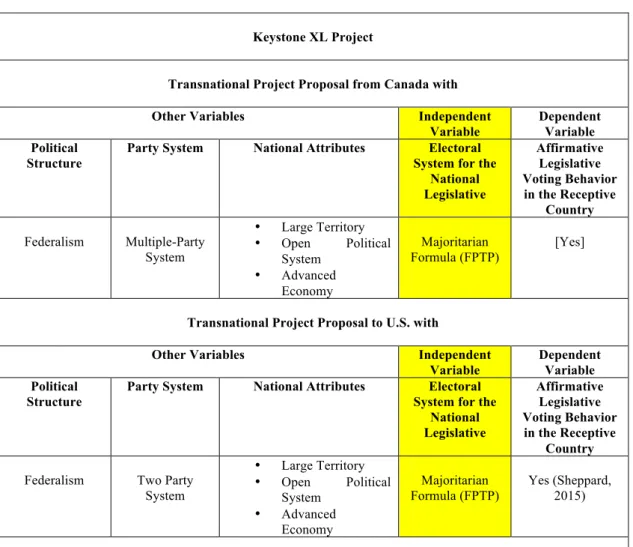
Table 1. Framework for the Most Different Systems Design by Referring to
Transnational Project Proposal Flow………... 43
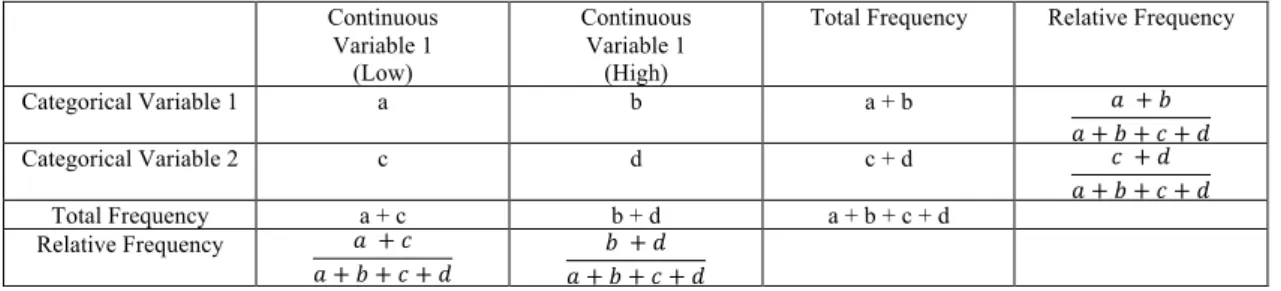
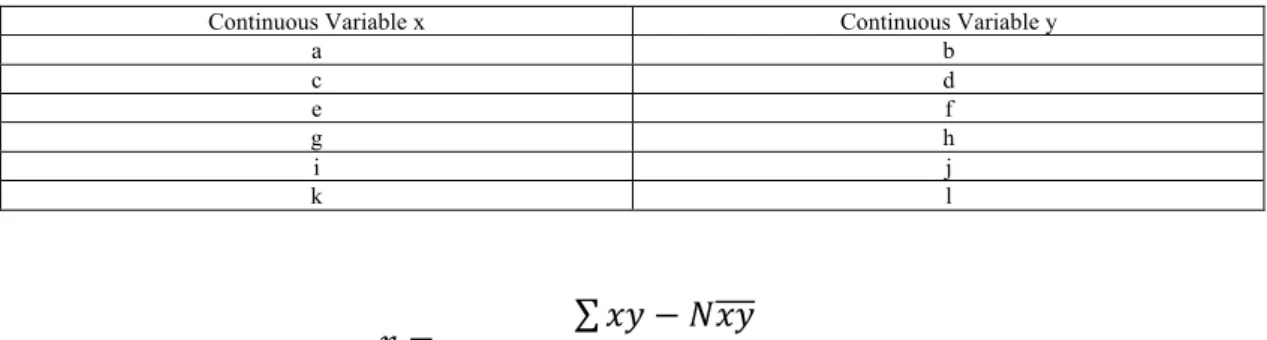
Table 2. Exemplary Information Table for Chi-Square Statistics………. 46 Table 3. Exemplary Information Table for Pearson’s r Calculation………. 47 Table 4. A Measure of Modified Group Likeness Scores and Absentee MP Numbers
Per Party for the Grand National Assembly of Turkey in-between 2003 and 2011 under Kürecik Radar Base Case………...……...……. 58
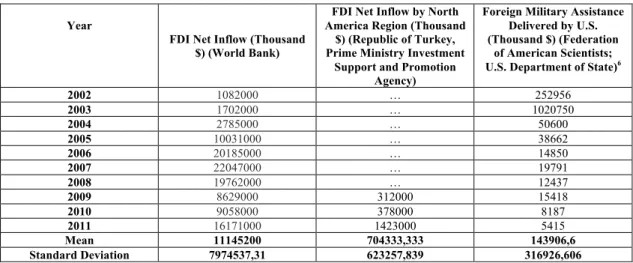
Table 5. A Comparative Measurement of FDI Net Inflow into Turkey by Year and
by Region, and of Foreign Military Assistance Delivered by U.S. to Turkey by Year………... 63
Table 6. Chi-Square Statistics Calculation for the First Null Hypothesis in the
Turkish Context under Kürecik Radar Base Case………. 64
Table 7. Chi-Square Statistics Calculation for the Second Null Hypothesis in the
Turkish Context under Kürecik Radar Base Case………. 66
Table 8. A Measurement of Turkish Electorate’s Preference for Foreign Policy as
the Country’s Most Important Problem ……… 67
Table 9. Chi-Square Statistics Calculation for the Second Null Hypothesis in the
Turkish Context under Kürecik Radar Base Case………. 68
Table 10. A Measure of Modified Group Likeness Scores for U.S. House of
Representatives in-between 2002 and 2011 under Kürecik Radar Base Case……….………... 70
Table 11. Chi-Square Statistics Calculation for the First Null Hypothesis in the
American Context under Kürecik Radar Base Case………….………. 72
Table 12. Chi-Square Statistics Calculation for the Second Null Hypothesis in the
American Context under Kürecik Radar Base Case………….………. 74
Table 13. A Measurement of American Electorate’s Preference for Foreign Policy as
Table 14. Chi-Square Statistics Calculation for the Third Null Hypothesis in the
American Context under Kürecik Radar Base Case………….………. 76
Table 15. A Measure of Modified Group Likeness Scores for the Legislative
Proceedings for U.S. Senate in-between 2002 and 2011 under Kürecik Radar Base Case...77
Table 16. A Measure of Modified Group Likeness Scores for U.S. House of
Representatives in-between 2005 and 2015 under Keystone XL Pipeline Project Case………... 79
Table 17. A Comparative Measurement of FDI Net Inflow into U.S. by Year, and of
Financial Losses in Weather Related Events Incurred by U.S. per Year in-between 2004 and 2013………. 81
Table 18. Chi-Square Statistics Calculation for the First Null Hypothesis in the
American Context under Keystone XL Pipeline Project Case………….…. 83
Table 19. Chi-Square Statistics Calculation for the Second Null Hypothesis in the
American Context under Keystone XL Pipeline Project Case………….…. 85
Table 20. Chi-Square Statistics Calculation for the Second Null Hypothesis in the
American Context under Keystone XL Pipeline Project Case………….…. 87
Table 21. A Measure of Modified Group Likeness Scores for U.S. Senate
in-between 2005 and 2015 under Keystone XL Pipeline Project Case……... 89
Table 22. A Measure of Group Likeness Scores for the Canadian House of
Commons in-between 2005 and 2015 under Keystone XL Pipeline Project Case………...………. 91
Table 23. Chi-Square Statistics Calculation for the First Null Hypothesis in the
Canadian Context under Keystone XL Pipeline Project Case………….….. 94
Table 24. Chi-Square Statistics Calculation for the Second Null Hypothesis in the
Canadian Context under Keystone XL Pipeline Project Case………….….. 97
Table 25. Chi-Square Statistics Calculation for the Third Null Hypothesis in the
Canadian Context under Keystone XL Pipeline Project Case………….….. 99
Table 26. Summary Table for Chi-Square Statistics Results for the Turkish context
under Kürecik Radar Base Case……….. 101
Table 27. Summary Table for Chi-Square Statistics Results for the American context
under Kürecik Radar Base Case……….. 102
Table 28. Summary Table for Chi-Square Statistics Results for the American
Table 29. Summary Table for Chi-Square Statistics Results for the American
Context under Keystone XL Pipeline Project
Case……….………….. 105
Table 30. Macro Level Analysis for Two-Level Game Framework for the Kürecik
Case……….. 114
Table 31. Macro Level Analysis for Two-Level Game Framework for the Keystone
XL Case………... 120
Appendix Table 1. List of Legislative Proceedings for the Grand National Assembly
of Turkey in-between 2003 and 2011 under Kürecik Radar Base Case..… 160
Appendix Table 2. Turkish Political Parties’ Positioning on Foreign Policy, and
Macro-Economic Policy Conduct under Kürecik Radar Base Case…….... 163
Appendix Table 3. Chi-Square Statistics Calculation Phases for the First Null
Hypothesis in the Turkish Context under Kürecik Radar Base Case…..… 164
Appendix Table 4. Chi-Square Statistics Calculation Phases for the Second Null
Hypothesis in the Turkish Context under Kürecik Radar Base Case…..… 165
Appendix Table 5. Chi-Square Statistics Calculation Phases for the Third Null
Hypothesis in the Turkish Context under Kürecik Radar Base Case…..… 165
Appendix Table 6. List of Legislative Proceedings for the House of Representatives
of U.S. in-between 2002 and 2011 under Kürecik Radar Base Case…….. 166
Appendix Table 7. American Political Parties’ Positioning on Foreign Policy, and
Macro-Economic Policy Conduct under Kürecik Kadar Radar Base Case. 170
Appendix Table 8. Chi-Square Statistics Calculation Phases for the First Null
Hypothesis in the American Context under Kürecik Radar Base Case…... 171
Appendix Table 9. Chi-Square Statistics Calculation Phases for the Second Null
Hypothesis in the American Context under Kürecik Radar Base Case…... 171
Appendix Table 10. Chi-Square Statistics Calculation Phases for the Third Null
Hypothesis in the American Context under Kürecik Radar Base Case…... 172
Appendix Table 11. List of Legislative Proceedings for the Senate of U.S.
in-between 2002 and 2011 under Kürecik Radar Base Case………... 174
Appendix Table 12. List of Legislative Proceedings for the House of
Representatives of U.S. in-between 2005 and 2015 under Keystone XL Pipeline Project Case ...………... 176
Appendix Table 13. American Political Parties’ Positioning on Foreign Policy,
Macro-Economic, and Environmental Policy Conduct under Keystone XL Pipeline Project………...………. 178
Appendix Table 14. Chi-Square Statistics Calculation Phases for the First Null
Hypothesis in the American Context under Keystone XL Pipeline Project……….. 179
Appendix Table 15. Chi-Square Statistics Calculation Phases for the Second Null
Hypothesis in the American Context under Keystone XL Pipeline Project……….. 179
Appendix Table 16. Chi-Square Statistics Calculation Phases for the Third Null
Hypothesis in the American Context under Keystone XL Pipeline Project……….. 181
Appendix Table 17. List of Legislative Proceedings for the Senate of U.S.
in-between 2005 and 2015 under Keystone XL Pipeline Project……..…….. 182
Appendix Table 18. List of Legislative Proceedings for the House of Commons of
Canada in-between 2005 and 2015 under Keystone XL Pipeline Project... 187
Appendix Table 19. Canadian Political Parties’ Positioning on Foreign Policy,
Macro-Economic, and Environmental Policy Conduct under Keystone XL Pipeline Project……… 191
Appendix Table 20. Chi-Square Statistics Calculation Phases for the First Null
Hypothesis in the Canadian Context under Keystone XL Pipeline Project Case……….. 192
Appendix Table 21. Chi-Square Statistics Calculation Phases for the Second Null
Hypothesis in the Canadian Context under Keystone XL Pipeline Project Case……….. 193
Appendix Table 22. Chi-Square Statistics Calculation Phases for the Third Null
Hypothesis in the Canadian Context under Keystone XL Pipeline Project Case……….. 193
LIST OF FIGURES
Figure 1. Box Plot for the Modified Likeness Scores for U.S. House of
Representatives in-between 2002 and 2011 under Kürecik Radar Base Case……….... 71
Figure 2. Box Plot for the Modified Likeness Scores for U.S. Senate in-between
2002 and 2011 under Kürecik Radar Base Case……… 78
Figure 3. Box Plot for the Modified Likeness Scores for U.S. House of
Representatives in-between 2005 and (January) 2015 under Keystone XL Pipeline Project Case………. 80
Figure 4. Box Plot for the Modified Likeness Scores for U.S. Senate in-between
2005 and (March) 2015 under Keystone XL Pipeline Project Case……….. 90
Figure 5. Box Plot for the Modified Likeness Scores for the Canadian House of
Commons in-between 2005 and (March) 2015 under Keystone XL Pipeline Project Case………... 92
Figures 6. Graphical Representation of Level I and Level II Strategies during
International Negotiations……… 113
Figure 7. Graphical Representation of Level I and Level II Strategies during Kürecik
Radar Base Station Negotiation………... 115
Figure 8. Graphical Representation of Level I and Level II Strategies During
CHAPTER 1:
INTRODUCTION
1.1. Problem Significance
Political party modeling studies’ main body of research design concentrates on the straightforward relationship between the parties and civil society in terms of inputs (votes) and outputs (policies). Compared to that ontological preference, Richard Katz’s and Peter Mair’s (1995) “cartel party thesis” scrutinizes the transformations that political parties have gone through in Western Europe (Katz and Mair, 1995: 9; Katz and Mair, 2009: 756; MacIvor, 1996: 317). The objective of their thesis is to reveal an emergent tendency of party dependence on the state for public funding and avenues of propaganda given the trends of declining party revenues and increasing party expenditures at the expense of connection with the societal base since the mid-1970s under four separate but evolutionary stages of “the elite party, the mass party, the catch-all party, and the cartel party” (van Biezen, 2004: 706; Katz and Mair, 1995: 9; Katz and Mair, 2009: 756; MacIvor, 1996: 318).
Within the last phase, the cartelized variant, political party-to-political party dimension prevails over political party-to-electorate dimension (Katz and Mair, 1995: 9). Parties explicitly or implicitly start to collaborate with each other to
maintain their organizational tenacity by narrowing down the “policy-space” and delegating the responsibility of the certain issue areas to the public entities that are not accountable to the electorate in the era of the globalized world in which the market requires states to diminish their authority and autonomy (Blyth and Katz, 2005: 41-45). Final result of that trajectory is policy convergence between competing parties in domestic politics.
The gap in this literature is its apparent lack of analysis about that current party system’s influence on politically oligopolized countries’ foreign policy behavior with each other. With respect to that argument, Keystone XL pipeline project debate in U.S. and Canada at the federal government level since 2008 and Turkish-American memorandum of understanding to host “the Army Navy Transportable Radar Surveillance System (AN/TPY-2)” on Turkish eastern Anatolian city Malatya’s Kürecik district in September 2011 present “hypothesis-generating case studies” (Lijphart, 1971: 692).
A 1.179-mile long pipeline, Keystone XL project is designed to transport oil made from tar sands from Alberta in Canada to Nebraska in U.S. and later the crude will be moved to the Gulf Coast that has the necessary infrastructure of refineries (Eilperin, 2014; Pew Research Center, 2013: 2). Within U.S., throughout the debates, prospective job creation, lessening energy dependence on the Middle East, and declining energy costs for transportation and industrialization outweigh the expected increase in the greenhouse gas emissions and highly probable environmental degradation due to possible leakages along the pipeline route (Smith, 2013: 74). For Canada, holding the same possible environmental costs constant, being an energy
export hub and reaping the benefits of that development for other sectors in the economy are the focal points (Chastko, 2012: 166).
Accordingly, this study’s postulation is that when the agenda is about market-related issue areas that pit economic growth against environmental protection like pipeline construction, the cartel parties of two post-industrial Western liberal democracies (Republican Party and Democratic Party in U.S. and Conservative and Liberal Parties in Canada) may collaborate with each other to attain the realization of that project at the expense of a certain proportion of the electorate inside and/or outside of their constituents (i.e., environmentalists in U.S., and First Nation communities in Canada) and of political parties (New Democratic Party, Green Party, and Bloc Québécois in Canada) that are excluded from the domestic political oligopoly due to legal and fiscal impediments created by their cartel rivals.
Further, a component of U.S. Department of Defense’s first phase of the European Phased Adaptive Approach (EPAA) to protect Europe from any oncoming ballistic missile threat (Whitmore and Deni, 2013: 29) [from Iran at the time-being], Kürecik radar station, which is 435 miles away from the Turkish-Iranian border’s Western flank, is designed to spot any ballistic missile departure within its maximum 1.000 km range, and to deliver information about the departure’s origin to intercept the missile on flight beforehand (Küntay, 2013: 31; Kaya, 2011: 85-86). Within Turkey, the debate about the radar station was twofold.
The first stage of the discussions started inside the parliament nearly a year after the signature to locate the station in 2011 and they were mainly about the identity of the rank-and-file in the base, presence of backdoors to share intelligence with Israel, and the direction of the radar range (Mercan and Akbal, 2014: 513). The
second stage of the discussions, on the other hand, gained momentum inside the civil society a month after the signature. The Initiative against the Missile Shield in Kürecik (Kürecik’te Füze Kalkanına Hayır İnisiyatifi) under the aegis of local Kürecik Platform (Kürecik Platformu) started to release reports about the impact of the radiation waves from radar base on human and natural life [like cancer formation, dysfunctions in the nervous system, genetic disorder along with destruction of the benign microorganisms for soil fertility and hence negative externalities for livestock “the city’s main source of income”] (Göynü, 2015: 3).
Therefore, there was objection to that radar base’s construction and the socio-political members of that resistance are: the opposition of minority members of parliament (MP) inside the main opposition Republican People’s Party (CHP), independent MP’s under Labour, Democracy and Freedom Bloc (Emek, Demokrasi ve Özgürlük Bloku), Socialist Party of the Oppressed (Ezilenlerin Sosyalist Partisi), Community Centres (Halkevleri), Initiative of the Seventy-Eighters (78’liler Girişimi), Workers’ Movement Party (Emekçi Hareket Partisi) and Communist Party of Turkey (Türkiye Komünist Partisi) (Vardar, 2011). These socio-political actors are also the ones who have been mostly hampered by the electoral and party system [list proportional representation with Dhond’t and 10% electoral threshold]. Despite the aforementioned opposition, the decision to agree with U.S. to deploy the radar system by Turkish higher echelons happened at ease through by-passing the legislative approval of the base.
Then, the second postulation of the study is that when the agenda is at the intersection of the market-economy – military assistance and foreign direct investment – and traditional sense of national security – national and alliance defense
–, the cartel parties of a post-industrial Western liberal democracy (Republican Party and Democratic Party in U.S.) and partially free developing economy (Justice and Development Party and Republican People’s Party in Turkey) may collaborate with each other to attain the realization of that project at the expense of a certain proportion of the electorate inside and/or outside of their constituents and of political parties that are excluded from the domestic political oligopoly due to legal and fiscal impediments created by their cartel rivals.
1.2. Research Questions and Theoretical and Methodological Outline
By referring to the two case-specific statements of electoral and party system’s likely impact on inter-state relations, this thesis aims to investigate a pattern of inter-state party cartelization (cooperative foreign policy behavior) in the international relations of countries with cartel party system with fourfold argumentation. First, if the international negotiation topic is about pro-market polices [and is related to (non-) conventional definition of national security], cooperation between cartelized parties of negotiating states will increase. Second, if there emerges collusion between cartel parties of these relevant states, that process of inter-state party cartelization will occur through the exclusion of third parties, which are hampered fiscally and legally by their country-specific political system. Third, if the political oligopoly supersedes the third parties during foreign policy decision-making stage successfully, policy space of foreign policy conduct will be circumscribed to limited alternatives. Fourth, if the international negotiation topic is about pro-market polices [and is related to (non-) conventional definition of national security] and there emerges no collusion
defector party of the political oligopoly will jeopardize its share of the public funding and hence its organizational survival in the oncoming elections.
Thus, it is plausible to pose the following research question: What are the implications of the cartel party system for foreign policy decision-making process of the countries whose electoral and party systems are susceptible to cartelization of domestic politics?
In addition to the main inquiry, the study aims to answer four sub questions: What is the political economy of policy
convergence in foreign policy domain for the politicians?
Based on this politico-economic legislator behavior, is there a need of updating the conceptualization on foreign policy decision-making actors in terms of members of the political cartelization and outliers of the political oligopoly?
To what extent can this emergent or already existing cooperative foreign policy behavior be trend among other democracies with cartel party system?
Does this phenomenon, inter-state party cartelization, exhibit the tension between democracy and market economy?
The theoretical background of that scrutiny will integrate James N. Rosenau’s (1966) “pre-theories” framework with electoral and party systems literature from comparative politics and will refer to the stream of foreign policy studies on democratic peace theory that incorporate the basic conclusions of the first and the latter. Methodologically, the study employs the most different systems design along with bivariate statistical analyses [the Chi-square Statistics, and Pearson’s r] to analyze any statistically important dependence between the dependent variable - affirmative convergent legislative voting behavior espousing system-related
transnational projects – and the independent variables – system-orientation of the political party positioning, responsiveness to the electorate, and exposure to the systemic threats. For each case, there are three null hypotheses and their rejection or acceptance would determine the presence or absence of any statistical relationship between the dependent and each independent variable. These are:
H1: A relationship exists between relatively higher (/lower) cooperative
legislative voting behavior towards transnational project in consideration and system orientation (/anti-system orientation) of the legislative political parties’ election programs.
H2: A relationship exists between relatively higher (/lower) cooperative
legislative voting behavior towards transnational project in consideration and preference gap (/congruity) between the electorate and the elected politicians.
H3: A relationship exists between relatively higher (/lower) cooperative
legislative voting behavior towards transnational project in consideration and the relevant country’s level of fragility to the system-related threats.
Lastly, after detailing the outcome of the decision-making process statistically, Putnam’s (1988) two-level game analysis will be employed as the foreign policy decision-making modeling in order to investigate the decision-making process of these two case studies. Overall, theoretical and empirical added value of this project will be enhancement of the explanatory power of comparative study of foreign policy through narrowing the scope of comparison and by the addition of the cartel party system into the canon along with bivariate statistics.
CHAPTER 2:
LITERATURE REVIEW
2.1. Organization of the Selected Literature
Putting the inter-state party cartelization (cooperative foreign policy behavior among countries with cartel party systems) postulation forward as the basis for a “hypothesis-generating case study” (Lijphart, 1971: 692) necessitates reviewing the literature about the electoral and party systems from comparative politics, James N. Rosenau’s (1966) “pre-theories” framework within comparative study of foreign policy that can integrate the basic assumptions of the specific party modeling detailed, and the stream of foreign policy studies that incorporate the basic conclusions of the first and the latter.
Therefore, throughout the review, first, comparative study of foreign policy canon is inquired as being the potential framework of the analysis because there is an intellectual avenue to pursue multivariate explanation and also to attain predictive capability for foreign policy behavior (FP behavior) through expounding the independent variables. Second, electoral and party systems are posited to be vital in order to be able to account for the research question along with the pre-theory
canon’s learned lessons. Third, studies under the legacy of the combination of the above-mentioned framework and systems are referred. Finally, the case studies of this thesis are theoretically detailed by indicating the similarities and differences between the expected results of the electoral and party systems and emergent legislative and voting behavior on the relevant inter-state projects.
2.2. Comparative Study of Foreign Policy
Having been at the conjuncture of political science and international relations (IR), comparative study of foreign policy (FP thereafter) has provided insight to examine the interactive engagement between domestic politics and international affairs. By giving reference to Gregor Mendel’s achievement of drawing a distinction between “genotype and phenotype” in the area of genetics, comparative study of FP pioneered by Rosenau (1966) aims at generating “a cross-national and multi-level theory of foreign policy” (Hudson, 2005: 6, 9). The aspiration to generate a fully-fledged theorization about FP behavior through utilizing “if-then hypotheses” has two root causes, namely “intellectual and historical factors” (Rosenau, 1966: 27, 32; Rosenau, 1968: 300). Intellectually, the trend in political science in the 1950s was towards structural-functional analysis throughout which the scrutiny was about looking for similarities and differences between diverse government/state/society structures and their resultant functions like integration/disintegration of the society or upward/downward mobilization in the global value chain and in the standards of living (Rosenau, 1968: 301-303).
Historically, rapid increase in the number of nation-states in-between 1955 and 1965 the period of decolonization, the development of thermonuclear weaponry, and ascendancy of China as alternative power within the Communist bloc were the epicenter of examination (Rosenau, 1968: 301-303). It is because that higher number of states brought forth greater ratio of inter-state interaction at the systemic level. Post-colonial states that once shared similar levels of development, the same political regime and socio-ethnic-religious configuration showed different FP behavior towards each other, the previous colonial nations, and the third-party states. Further, the problems of credibility and stability in an environment of nuclear arms race had different connotations in different regimes with different decision-making structures and bureaucratic/organizational complexity. Finally, countries that ardently espoused the same belief sets displayed divergent interpretations of the Communist credo, different interaction/interconnection patterns with the world economy, and diverse FP conducts within their bloc and with the Western bloc.
Hence, methodological and contextual imperatives of the time being urged the scholars of foreign policy analysis (FPA) to look for general and testable theories. In a similar fashion with their colleagues in political science, proliferation of the structures and alteration in their quality and divergence in the consequent functions necessitate closer inspection at comparative politics. Under the influence of behavioralism in political science, scholars of this tradition have attempted to make an “analogy” between the “vote” casted at the ballot box and FP behavior or “events” to detect “law-like generalizations” in international relations for the greater purpose of delivering “general and verifiable theories about foreign policy” (Hermann and Peacock, 1987: 16; Hudson, 2005: 9).
Therefore, in order to ameliorate the vague positioning as combination of the elements from domestic politics and international affairs and to create its characteristic field, comparative foreign policy (CFP) had to hold “its own point of view, its own theory, its own subject, its own discipline” (Roseanu, 1968: 310). With regard to the frame of reference, there was agreement around the advancement of the current explanatory and predictive power of FPA by accounting for the interrelationship among the variations in the domestic-international milieu, the spatio-temporal context, and cooperative/conflictive/neutral/indifferent FP conducts (Roseanu, 1968: 311). With respect to the theorization, the inability to go beyond the limitations of country specific descriptions, absence of standardized research questions dealing with FP behavior, ambiguity of the criteria to categorize FP behavior, and most importantly, unavailability of “comprehensive system of testable generalizations” drained theoretical potentiality of CFP (Roseanu, 1966: 32). Failure to attain that purpose, eventually, stimulated two debates within the literature about the canon’s unit of analysis FP behavior’s place in the causal mechanism and about the discipline in thought in the selected methodology of comparison (Hermann and Peacock, 1987: 16, 19).
Throughout the initial discussion of CFP’s subject matter, the question was about whether the FP phenomenon is independent, dependent, or intervening variable or should it be located in a dialectical process whereby FP behavior interchanges these three roles (Hermann and Peacock, 1987: 17). Hence, conceptualization and operationalization of the causal mechanisms in comparative studies of FP have been done through delineating three steps of “the initiatory, implementative, and responsive stages” that also represent the independent, intervening, and dependent variables, respectively (Roseanu, 1968: 311-313). Moreover, in the literature, there
has been an endeavor to avoid the common fallacy of omitting the interactive linkage between domestic and international affairs by dividing the independent and dependent variables into two forms – internal and external (Roseanu, 1968: 312-313). The first point here is that the internal elements are about the variables particular to the nation-state in consideration like oncoming/recent elections, the level of integration/fragmentation inside the ruling elite/society, geo-economic/geo-political assets/deficiencies and military capability/weakness (Roseanu, 1968: 312-314). On the other hand, the second point is about developments occurring as external stimuli to the state such as cooperative/conflictive second- and/or third-parties, financial crisis, natural disasters, regime changes within neighbour countries, and proliferation/de-escalation in the armaments race (Roseanu, 1968: 312-314).
In the latter debate, the rationale behind the scientific growth of knowledge in comparative methods was questioned such that under the aegis of behavioralism in political science, there emerged two possible “scientific inquiries” in CFP, which were “neopositivist inductionism and Kuhnian normal science” (Hermann and Peacock, 1987: 18). Throughout the first strand, there has been some degree of generalizations about group decision-making, bilateral/multi-lateral FP behavior, and third party involvement into interstate conflicts by aggregating certain empirical results but neopositivist inductionism’s motivation of reaching for “a growing body of verifiable knowledge” did not happen due to the canon’s inability to amalgamate those findings into a broader theoretical framework (Hermann and Peacock, 1987: 18-21).
As for the Kuhnian approach in CFP, there was not much success because the succession of obsolete paradigms by the up to date ones is void unless the relevant
core premises have “the theoretical component” (Hermann and Peacock, 1987: 20-21). In consideration of that dilemma between two logics of conducting research and lack of a common theoretical framework, a third way was proposed based on Lakatosian methodology of “juxtaposing competing theories within the larger structure of a research program” (Hermann and Peacock, 1987: 21-22) about FP behavior in a way that advancement of scientific knowledge occurs as long as these theories’ empirical findings keep growing. In that respect, there assumed to be six “theorizing efforts” that are Richard C. Snyder and his colleagues’ “decision-making framework,” Rosenau’s CFP, Michael Brecher’s distinction between the “operational and psychological environments,” Rudolph J. Rummel’s “Dimensionality of Nations,” William Coplin and Michael O’Leary’s “the Programmated International Computer Environment (PRINCE), Wilkenfeld and et al.’s “Interstate Behavior Analysis,” and “the Comparative Research on the Events of Nations (CREON)” (Hudson, 2005: 5; Hermann and Peacock, 1987: 22-29).
Within CFP, especially, CREON is in need of particular attention. By collecting FP events data from a variety of sources such as newspapers and official press releases under the aegis of “whom-did-what-to-whom-when-where” questionnaire structure, events data analysis aims at detecting patterns of cooperation and conflict in foreign affairs and creating ground for predicting their future trajectory (Schrodt and Yonamine, 2013: 15-16). Hence, this branch of CFP improved itself in three requirements of being a field – point of view, subject, and discipline. As for the first, the data set’s codification procedure that inquires the actors, their behavior, the recipient of that behavior, and the spatio-temporal context of the event is in line with the aforementioned frame of reference. As for the second necessity of being a field – CFP’s subject matter, the independent variables are the
three national attributes of the state’s territorial size, level of economic development, and political system; and the dependent variables are “verbal/nonverbal cooperative behavior and verbal/nonverbal conflictive behavior” (Richardson, 1987: 168-169).
The variables that lay behind CREON’s “logic of inquiry” are threefold and their reasoning is that:
(1) largeness/smallness of the territorial size determines the number of actors that the state has to engage with on its borders, the extent of the domestic population and their variety of concerns/problems/interests in the international arena, the ratio of natural resources inside the borders, the complexity and hugeness of the bureaucratization, the level of self-sustenance, and the intensity of the conventional army;
(2) level of economic development conditions the position in the global value chain and status in the global distribution of labor, complexity and specialization of the bureaucratization, pressure of the interest groups to maintain status quo in the international political-economic system and to engage more/less with foreign actors in domains of trade and finance, and advancement of the military-industrial complexity; and
(3) open/closed regime affects the limitations on certain FP conducts due to the mechanisms of political accountability and separation of powers among
judiciary, legislative, and executive, the public’s variety of
concerns/problems/interests in the international arena and the level of engagement with foreign actors, complexity, hugeness, and specialization of the bureaucratization, the extent of the involvement into international trade and finance,
and the strength of the conventional/nonconventional army (East and Hermann, 1974: 273-283).
As for the third necessity, the discipline in thought, scholars of events data analysis successfully made/make use of advanced methodologies like “linear regression models, time series, hidden Markov models, sequence analysis, and vector auto regression” (Schrodt and Yonamine, 2013: 17). Nonetheless, pure large-N statistics without theorization only produced great amounts of correlations, statistically significant relationships, and hypotheses that blackbox the state as unified and rational actor as opposed to FPA academia’s choice for actor-specific theories. These studies that account for the variance among national attributes and international environment leave the variance of the variables inside the states and the ones embedded in the larger system.
In that respect, given CFP canon’s lack of theoretical basis that can offer an intellectual avenue of modus operandi to draw inferences from the data generated by certain research tradition to accumulate knowledge, scholars like James N. Rosenau (1966), Stephen J. Andriole and et al. (1975) have/had proclivity for abstract frameworks and pre-theories (Caporaso and et al., 1988: 37). With the purpose of attaining a basis for comparing and contrasting FP behavior of the sample countries, “a pre-theory of foreign policy” puts forward five-fold explanantia whose names may be different but their essence remains the same throughout the canon (Andriole and et al., 1975: 165-166). These are the following: “(1) the idiosyncratic, (2) role, (3) governmental, (4) societal, and (5) systemic variables” (Andriole and et al., 1975: 165-166).
For these five variables, (a) peculiarities of the individual ranging from belief systems to learned lessons of the past in the first set, (b) requirements of the bureaucratic standing occupied by the relevant person(s) in the second set, (c) prohibitive/permissive nature of the political system over foreign policy decision making (FPDM) in the third set, (d) “non-governmental aspects of a society” such as level of convergence/divergence around particular identities/values in the fourth set, and (e) dynamics and developments unfolding externally to the society in consideration in the final set are part and parcel of the aforementioned “pre-theory” (Rosenau, 1966: 43).
Notwithstanding the fact that those five parts are the determinants of FP conduct, “pre-theory” formation requires reckoning with measurement of those independent variables’ “relative potencies” (Andriole and et al., 1975:171) vis-à-vis the observed external FP behavior. With regard to that prerequisite, four assessment tools are brought forth: country typology, degree of penetration in the political system, issue classification, and determination of the means-ends viability (Rosenau, 1966: 47-48, 53, 65, 68, 71, 82-83, 85-86). Consequently, ordering of the independent variables is based on the state’s territorial size of being large or small, level of economic (under)development, openness/closeness of its political system, scope of the issue areas in its national agenda (regarding “status, territory, and (non)human resources”), and specification of that issue areas based on the degree of means-ends “tangibility” (Rosenau, 1966: 90-91).
Nevertheless, pre-theories framework is problematic into two facets that are unclear conceptualization of the variables in the causal mechanism and limitations of the methodology and theory. Firstly, the boundary between the variables
idiosyncrasy and role is amorphous because it does not reckon with the fact that the role in the bureaucracy could demand certain set of personal characteristics like discreetness and experience as such the two overlap (Andriole and et al., 1975:170-171). Secondly, given the ambition of CFP to carry out inferential statistics, there appears to be no clear procedure to quantify peculiarities of the individuals and their role in the bureaucracy (Hudson, 2005: 28-30). Thirdly, the systemic variable is unclear regarding its context whether as “inter-state, multi-state, or global” (Andriole and et al., 1975:170-171).
Further, pre-theory was methodologically and theoretically “time-bounded” by anchoring the inquiry into Cold War paradigm for which the prime unit of analysis is the state, the paramount dependent variable is about extension/contraction of the spheres of influence through cooperative/conflictive behavior, and the fundamental principle that re-orders the independent variables is prevention of the rival’s expansionist objectives (Rosenau, 1973: 428; Rosenau, 1984: 251). Temporally, the concepts of the pre-theory cannot travel into the post Cold War era because proliferation of cross-border trade, trans-nationalization of consumption and production, and global interdependency in finance at the macro-level, and promulgation and protection of individual interests and rights via civic associations and growing importance of identity in politics at the micro-level pave the way to “pervasive breakdown of [state] authority” (Rosenau, 1984: 251).
The emergent “sub-groupism” that is the presence of separate relationships of “loyalty, authority, demand articulation, and identity formation” (Rosenau, 1984: 253-254) from the existent ones at the state level necessitates also looking into the sub-state systems like electoral and party systems. Therefore, the analysis of FP
behavior takes sub-state, state, and systemic levels’ three-way interaction into account. The individual actors may have a say in domains of politics and economy at the sub-state level through mass parties and later catch-all parties along with anti-austerity, anti-war, and/or anti-market positions (Rosenau, 1984: 259). However, the costs that those individuals would incur in domains of economy, finance, and security by the impositions of the system in the era of globalization enforce the turn towards center or center-right market-friendly positioning in the political spectrum.
Hence, the revision of the pre-theory framework alludes to the relative autonomy of the state from the dominant political-economic classes in the society as such it calls for “political economy framework of comparative foreign policy” (Moon, 1987: 35, 37-38). Given the significance of foreign direct investment (FDI) in the case of “capital accumulation” and the act of legitimizing that interconnection and interaction between the market economy and steady functioning of the state mechanism and the politicians’ survival endeavor in office as an “issue of national security,” the range of policy choices both at the domestic politics and FPDM become restricted to diminishing array of pro-market/system choices (Moon, 1987: 37-38, 44). Hence, the key to narrate the revisions of the pre-theory in addition to its original premise is to choose the right sub-state system, which in this analysis is cartel party system (Katz and Mair, 1995) and it will be detailed in the next sub-section of this chapter.
Lastly, moving downward in the “levels of abstraction” from “high level” to “medium level categories” with less emphasis on “cross-area comparisons among heterogeneous contexts” and more on “intra-area comparisons among relatively homogenous contexts” (Sartori, 1970: 1044) can be beneficial for the canon to
deliver more valid conclusions. The rationale for that proposition is that each independent variable has different developmental trajectory in each setting that would reflect diverse end products. Consequently, “pre-theory of foreign policy” should direct the focus just on “large and small” countries with “developed economy and open polity” (Rosenau, 1966: 90-91) or post-industrial Western liberal democracies so to speak. Hence, ordering of the “relative potencies” of the “pre-theory” variables of CFP regarding the “large and small” countries with “open polity and developed economy” is in need of adjustment.
When the issue was territorial and blended with market economy and national security both in traditional and nontraditional sense in those Western liberal democracies with advanced economies, the order from highest to lowest impact was the following: “(1) role, (2) systemic, (3) societal, (4) governmental, and (5) idiosyncratic” (Rosenau, 1966: 90). It was no surprise that during the time when the dominant party model was a mass party where parties were the “links between the state and civil society,” (Katz and Mair, 1995: 11) societal variables were above the governmental features. However, today, in these same states with cartel party systems where the global economic system necessitates its rules to be followed by international and national actors, the new ordering seems to be the following: (1) systemic, (2) governmental, (3) role, (4) idiosyncratic, and (5) societal. Therefore, in order to explain the dependent variable that is FP behavior in “pre-theory of foreign policy,” there is a need for updating the relationship between “societal” and “governmental” variables with the help of integrating electoral and party systems literature into the research.
2.3. Electoral and Party Systems
In the ensuing instances of Italy and the Federal Republic of Germany following the end of World War II and successive cases of party organizations’ inclusion within constitution, political parties haven been discerned as the essential condition of democracy in Western Europe (van Biezen, 2004: 702, 705, 708). Nonetheless, surveying the developmental trajectories of parties as monolithic entities pursuing singular evolutionary stages would blackbox the variability of the mechanisms behind representative democracy. Hence, it is essential to review comparative politics literature on electoral and party systems.
Similar to the pressure of the international political-economic system on individual decision-makers at the state level to narrow down the policy alternatives to the central positions, at the sub-state systemic level, electoral systems determine the extension and contraction of the scope for policy choices for the politicians in three ways. First, majoritarian or proportional nature of the electoral formula determines the spatial scope of the electorate whose interests, concerns, and problems are prime importance to the politicians who want to be (re-)elected.
When the criteria to be elected requires just more than half of the valid votes casted at the ballot box in districts with single seats to the parliament, the parties and politicians that have limited resources in terms of money and human power and limited information about each voters’ attitude would want to locate their election promises and their deliveries to the half of the electorate inhabitant of the politically crucial districts (Rodden, 2009: 336-337). On the other hand, when the formula is proportional for which seats in the parliament are distributed based on the
which each voter’s choice is relevant without any district and majority status discrimination, politicians have to stand for the whole electorate (Rodden, 2009: 336-337).
Second, majoritarian – proportional distinction in the electoral formula shapes the voting behavior of the voters and hence it limits the policy alternatives of the parties. Given the inability of expressing divergent policy programs and lack of coalitional nature in the executive unlike the proportional systems, the electorate of the districts where majority is the middle-class and the rule is majoritarian would want to cast their votes to the parties on the right to prevent the ascendancy of the left and its redistributive policies because the prospective government formed by the leftist party and the legislative dominated by the left-oriented MPs will leave little capability to the rightist politicians to voice their bases’ interests and concerns (Carey and Hix, 2013: 3-4).
Thirdly, the majoritarian – proportional electoral formula distinction affects the level of voter dealignment from the elections and consequently alters the attributes of the median voter and their respective political party preference and those parties’ left-right platform. Since each voter in proportional systems hold the belief that their acts of voting are taken into account without any district and majority status distinction, the voter turnout in each legislative election is high compared to majoritarian systems (Rodden, 2009: 337-338). Therefore, the numbers of the electorate with poor standards of living will increase and the government party and competing parties in the elections will tilt towards redistributive taxation and social expenditures (Rodden, 2009: 337-338). Ergo, it becomes imperative to review the debates inside the electoral systems literature thoroughly.
Having been the framework whereby “citizens’ votes [are translated] into representatives’ seats,” the electoral systems composed of three elements – “the electoral formula, the district magnitude, and the electoral threshold” (Lijphart, 1994: 1, 7, 10) – determine two aspects of the broader political systems that are (dis)proportionality of the elections and type of political party systems. It is because that the scale of voter exclusion depends on the electoral rules and those regularities determine the number of parties capable of representation inside the legislative.
Based on the definition of democracy by Daniel Webster in 1830 as “people’s government, made for the people, made by the people, and answerable to the people,” the perennial question in political science and in politics is in need of further elaboration: who will govern and who will be represented when there are divergent interests between majority/plurality of the voters and minority of the public? (Lijphart, 1999: 1-2). The classical answer revolved around the disparity between majoritarian and consensus democracy where the proponents of the first stand for the advantages of stability in the cabinet and effectiveness of the policy implementation and advocates of the latter postulate that bargaining and compromise inside the coalitional governments would bring forth plurality of the voices as such it would cement socio-political integration in the regime further based on five dimensions: (1) centralization/decentralization of the governmental power inside “single-party majority cabinets/multi-party coalitions,” (2) balance of power between the executive and legislative and the relative autonomy/dependency of the latter from/on the former, (3) the numbers of parties in the legislative – “two-party vs. multi-party systems,” (4) disproportionality of the electoral formulas, and (5)
relationship of the interest groups with the state mechanism – pluralism vs. corporatism (Lijphart, 1999: 1-3).
Nonetheless, that sort of continuum misses the points of variation among the Western liberal democracies in terms of “electoral formula, district magnitude, electoral threshold, total membership of the body to be elected, the influence of the presidential elections on legislative elections, malapportionment, and inter-party links” (Lijphart, 1999: 144-146). Hence, the first debate in the literature reckons with the level of discrepancy between the votes received in the elections and the seats gained after the elections and is structured around two approaches standing for empirical and normative concerns. Empirically, there are three major formulas – majoritarian one (with its subdivisions plurality, majority-plurality, and the alternative vote); proportional representation (PR) method (with its subdivisions list PR, mixed member proportional formula, and single transferable vote); and intermediate systems (limited vote, single nontransferable vote, parallel plurality-PR) (Lijphart, 1994: 18, 21-23, 40).
In the first group, (a) the plurality rule or First-Past-the Post (FPTP) is about selection of the candidate who attains the most votes irrespective of “whether a majority or plurality of them;” (b) the majority-plurality rule is about selection of the candidates in two rounds throughout which the ones who could not pass the minimum cut-off points are eliminated in the first round and the winner is determined based on his/her absolute majority in the first ballot, if not, based on his/her success of receiving plurality of the votes in the second round; and (c) alternative vote is about giving voters more than one preference at the ballot box and the selection of the candidate is based on winning the absolute majority in the first
preferences, if not, the votes of the candidates who receive the fewest are eliminated and then transfer of their vote shares to the remaining candidates in the upward order of preference is expected to create a winner with the majority of the votes (Lijphart, 1999: 146-147).
In the second group, (a) the list PR is about the provision of party lists of candidates at the ballots and the citizens’ choice for one party list or joint list and is about reflecting distribution of the seats in the legislative in proportion to the percentage of the votes received with the exception of d’Hondt, which displays relatively “slight bias in favor of large parties;” (b) mixed-member proportional (MMP) formula is about giving each voter two votes to select candidates in the district and to select party lists in order to alleviate any disproportionality between vote shares and seat allocations in the district results; and (c) the single-transferable vote (STV) is about selection of the candidate by asking voters at the ballot box to rank their choices in order as such the votes of the ones who could not pass the cut-off points will go to the ones in the next order upward and the surplus of the votes of the ones who passed the threshold to be elected will go to the ones in the next order downward (Lijphart, 1999: 147-149).
In the last group, (a) the limited vote is about selecting the candidates who win majority of the votes but citizens have limited amount of votes grounded on the numbers of seats in their districts as such any increase in the district magnitude (seats) means movement towards PR from plurality; (b) single non-transferable vote (SNTV) is similar to the limited vote but in SNTV voters have just one vote and the candidates with the greatest ratio of the vote shares win their respective seats in multi-member districts; (c) and parallel plurality-PR rule is about selecting some
parts of the legislators by plurality in districts with single seats and some parts of the candidates by PR but unlike MMP, these two votes of the electorate are not aimed at compensating the disproportionality in the district elections because the two are held separately (Lijphart, 1999: 149).
Normatively, the question is about the interrelationship between (dis)proportionality of the election results under the aegis of one of the three categorical electoral formulas and stability of governance through concern for representation’s scale of inclusion/exclusion (Blais, 1991: 240, 243). The complementary measures to gauge the level of that representative inclusion/exclusion are the following: the increase/decrease in the number of seats (district magnitude) and the electoral formula’s bias against or in favor of small parties, higher/lower electoral thresholds, the extent of the total seats available in the legislature and the electoral formula’s bias against or in favor of large parties, projection of the success of larger parties in the presidential elections into the legislative elections at the expense of small parties due to the electoral formula of the presidential election (plurality vs. majority run-off), the assignment of disproportionate seat shares to the electorate with smaller number of voters compared to the districts with the same seat shares but with greater registered voters (malapportionment), and inclusion of small parties that could not pass electoral threshold by themselves via creation of joint lists (Lijphart, 1999: 150, 153-154, 156-157). Overall, in terms of proportionality from highest to lowest value based on the parameters of representation threshold, district magnitude (the number of seats allocated per district), the district size, and the voting type could be the following: PR, intermediate systems, and majoritarian formula (Lijphart, 1994: 20, 25, 40; Blais, 1991: 248-249, 254-255).
For the second part that addresses the causal relationship between electoral formula’s (dis)proportionality outcome and the number of parties and those parties’ likely minority/majority status in the legislatives, the debate is about two levels of measurement, which are categorical and interval (McDonald and Ruhl, 1989: 9; Lijphart, 1994: 57, 72). The criticism directed towards number-based party system categorization in terms of unipartism, twopartism, and multipartism is that integers disregard the dimensions of political power concentration and scales of political fragmentation and polarization (Sartori, 2005: 105; Maor, 1997: 31-32).
In consequence, within unipartism, one party system depends on the condition that there is only one party that is legal and the rest are excluded due to monopolization of the political power as opposed to the contexts where either small parties are allowed to keep presence by the ruling party under the rubric of hegemonic party or small parties along with the ruling party are equally present in the system but the latter wins in each successive electoral process through predominant party system (McDonald and Ruhl, 1989: 9-10). Within twopartism, two parties contend for the majority of the votes on an equal footing (Lijphart, 1994: 67). Within multipartism, “low fragmentation” or the number of parties less than five defines moderate pluralism whereas “high fragmentation with low polarization” or the number of parties greater than five and smaller distance in the ideological spectrum of the parties in toto portray polarized pluralism (Sartori, 2005: 105; Maor, 1997: 31-32). For the atomization to emerge, greater ideological distance with number of parties greater than five is necessary (Sartori, 2005: 112-113).
On the other hand, parameters of the “effective number of elective and parliamentary parties” (Lijphart, 1994: 57) are the most relevant factors for the