DESIGN OF
A MODULAR PLAYGROUND EQUIPMENT SYSTEM FOR PHYSICALLY (MOTOR) DISABLED CHILDREN
A THESIS SUBMITTED TO
THE DEPARTMENT OF INTERIOR ARCHITECTURE AND ENVIRONMENTAL DESIGN
AND INSTITUTE OF FINE ARTS OF BILKENT UNIVERSITY IN PARTIAL FULFILLMENT OF THE REQUIREMENTS
FOR THE DEGREE OF MASTER OF FINE ARTS
By
Yaprak Savut Sağdıç February, 1993
M-:f
■larafiniîîM (■,'■-'l·., " ■* ...
Q\/
LfXb'S
I certify that I have read this thesis and in my opinion it is fully adequate, in scope and in quality, as a thesis for the degree of Master of Fine Arts.
__________'I'TiVy
________
Assist. Prof. Dr. Halime Demirkan (Principal Advisor)I certify that I have read this thesis and in my opinion it is fully adequate, in scope and in quality, as a thesis for the degree of Master of Fine Arts.
Assoc. Prof. Dr. Can Kumbaracıbaşı
I certify that I have read this thesis and in my opinion it is fully adequate, in scope and in quality, as a thesis for the degree of Master of Fine Arts.
Assist. Prof Mehmet Asatekin
Approved by the Institute of Fine Arts.
ö r ~
ABSTRACT
DESIGN OF A MODULAR PLAYGROUND EQUIPMENT SYSTEM FOR PHYSICALLY (MOTOR) DISABLED CHILDREN
Yaprak Savut Sağdıç M.F.A. in
Interior Architecture and Environmental Design Supervisor: Assist. Prof. Dr. Halime Demirkan
February, 1993
The elements of a medium for gathering the able and disable bodied children are examined within the scope of this study. Starting from the importance of play for children, the characteristics and the properties of the middle childhood are chosen as the domain. The play spaces and the playgrounds including the equipment are examined. The types of disabilities with special emphasize on the physically disabled ones are investigated. The motor type of disabled ones are specified as the potential user group. Besides, the assistive devices and rehabilitative apparatus used by the physically (motor) disabled children are pointed out. Finally, a modular playground equipment system is designed for the physically disabled children, which can serve both as a rehabilitation apparatus and a center for gathering all children in a playground to enjoy themselves.
K eyw ord s: Playground Equipment, Disabled/Handicapped People, Play, Child.
ÖZET
FİZİKSEL (MOTOR) ÖZÜRLÜ ÇOCUKLAR İÇİN
MODÜLER BİR OYUN BAHÇESİ DONATI SİSTEMİ TASARIMI
Yaprak Savut Sağdıç
İç Mimarlık ve Çevre Tasnmı Bölümü Yüksek Lisans
Tez Yöneticisi: Yrd. Doç. Dr. Halime Demirkan Şubat, 1993
Bu çalışm ada, normal çocuklarla özürlü çocukların bir araya gelebilecekleri bir ortamın elemanları incelenmiştir. Oyunun çocuklar için öneminden başlayarak, orta çocukluk dönemi özel ilgi alanı olarak seçilmiştir. Oyun alanları ve elemanlarıyla beraber oyun bahçeleri incelenmiştir. Özürlülük çeşitleri ve fiziksel özürlülük çeşitleri belirtilmiş ve motor özürlüler kullanıcı gurubu olarak özelleştirilmiştir. Bunlara ilave olarak, fiziksel (motor) özürlü çocukların kullandıkları yardımcı aletler ve tedavide kullanılan ekipmanlara işaret edilmiştir. Sonuç olarak, fiziksel (motor) özürlü çocuklar için hem tedavi ekipmanı olarak, hem de bütün çocukların biraraya gelip eğlenebilecekleri, her oyun bahçesine konulabilecek modüler bir oyun bahçesi donatısı sistemi tasarlanmıştır.
Anahtar sözcükler; Oyun Bahçesi Donatıları, Özürlü İnsanlar, Oyun, Çocuk.
ACKNOWLEDGEMENTS
Doing a master thesis is a very troublesome study and takes fairly long time; whereas, it is one of the few enjoyful studies I have ever done. Foremost, I would like to thank Assist. Prof. Dr. Halime Demirkan for her endless diligence, help and sensitiveness which show me the way I should be on. And I appreciate Ms. Demirkan for her support without which this thesis wouldn't have been completed.
Secondly, I would like to appreciate Oğuz Sağdıç, my husband, for his endless patience and help everytime I have been in trouble; we shared both the goods and bads.
Thirdly, I would like to thank both Sağdıç's and Savut's for their confidence and providing every kind of supports, which cheer me up.
Fourthly, I would like to thank all the people, who have helped me at 'Ankara Rehabilitation Center' and 'Orthoses and Prosthesis Polyclinic of Prof Dr. Hidayet Erdem'.
Finally, I would like to thank all the ones, who have given me critics about this project and let this project worthy.
TABLE OF CONTENTS Signature P a g e ___________________________________________________ ii Abstract _________________________________________________________ iii Ö z e t _____________________________________________________________ iv Acknowledgements_________________________________________________ v Table of Contents_____________________________ vi List of T a b le s_____________________________________________________ ix List of F ig u res_____________________________________________________ x LEmiODUCTION 1 1.1 .Problem___________________________________________________ 1 1.2. Object and Methodology.__ ;________________________________2 1.3. Structure of Thesis_________________________________________ 5
2. PLAY 7
2.1. Definition of'Play'__________________________________________ 8 2.1.1. Varieties of Play____________________________________ 9 2.1.2. Role of Play in Development________________________ 10 2.1.3. Quality of Play__________________________________ __12 2.2. Characteristics and Properties of the Potential Age Group
________________________ 13
2.2.1. Physical Development in Middle Childhood--- 17 2.2.2. Cognitive Development in Middle Childhood---18 2.2.3. Social and Emotional Development in Middle Childhood 18
3. PLAYGROUND 21
3.1. Play spaces---22 3.1.1. Effects of Play Spaces from Developmental Approaches
__________________________________________________ 22
3.1.2. Quality of Play Spaces_____________________________ 26 3.1.3. Types of Play Spaces______________________________ 27 3.2. Playgrounds (As the Most Popular Play Spaces) 29 3.2.1. Types of Playgrounds______________________________ 29 3.2.2. Activities on Playgroxmds--- 31 3.3. Equipment (As Basic Cells of any Playground)_____________ 33 3.3.1. General Properties of Mostly Used Playground Equipment
... 34
3.3.2. Selecting a Playground Equipm ent_________________ 43 3.3.3. Role of Colour--- 46 3.3.4. Safety F actor______________________________________47
4. DISABLED CHILDREN 51
4.1. Definition of Term s---52 4.2. Types of Disabilities ____________________________________ 54 4.2.1. Types of Physical Disabilities--- 55 4.2.2. Assistive Devices Used by the Physically Disabled
C h ildren _______________________________________________ 59 4.2.3. Equipment Used for the Rehabilitation of the
Physically Disabled Children_____________________________65 4.3. Role of Playgrounds in Rehabilitation of Physically Disabled
Children _______________________________________________69 5. DESIGN OF A MODULAR PLAYGROUND EQUIPMENT SYSTEM
FOR PHYSICALLY DISABLED CHILDREN 72
5.1. Necessary Dimensions____________________________________ 73 5.1.1. Necessary Anthropometric Dimensions--- 73 5.1.2. Related Dimensions of Elements in System--- 84
5.2. Material____________ 93
5.2.1. Surfacing of Groimd F lo o r__________________________ 93 5.2.2. Materials Used in System--- 97 5.3. Assembling the System__________________________________ 100
6. CONCLUSION 109
GLOSSARY 117
LIST OF TABLES
Table 2.1. Stage Theories of Play: Piaget and P a r t e n ________________ 9 Table 2.2. Milestones of Motor Development During Early Childhood and Middle Childhood__________________________________________________ 16 Table 2.3 Piaget's Stages of Cognitive D evelopm ent_________________ 16 Table 3.1. The Matrix Chart of Activities Carried out by Children on Playgrounds_______________________________________________________ 32
Page
LIST OF FIGURES
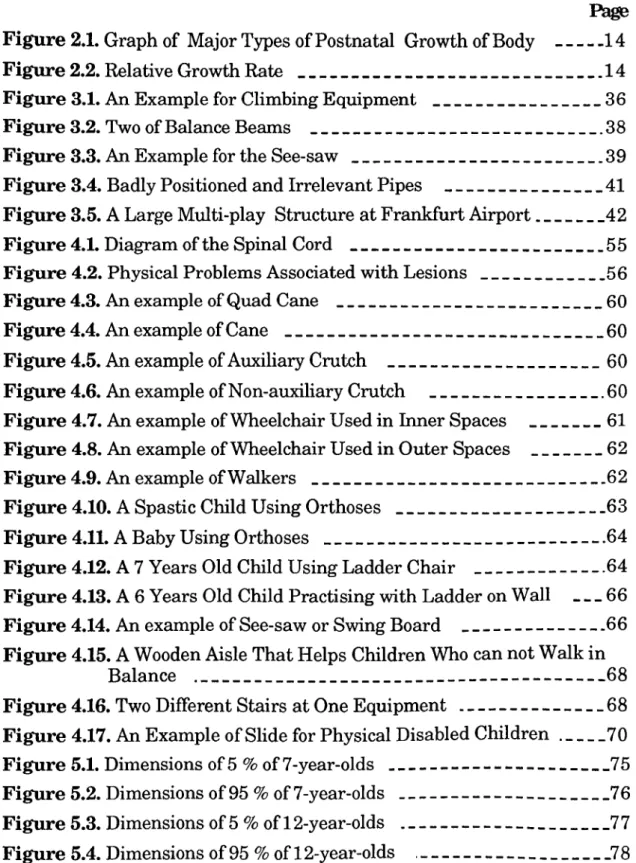
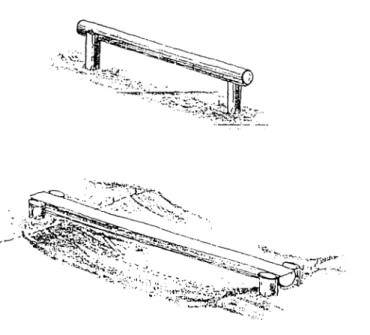
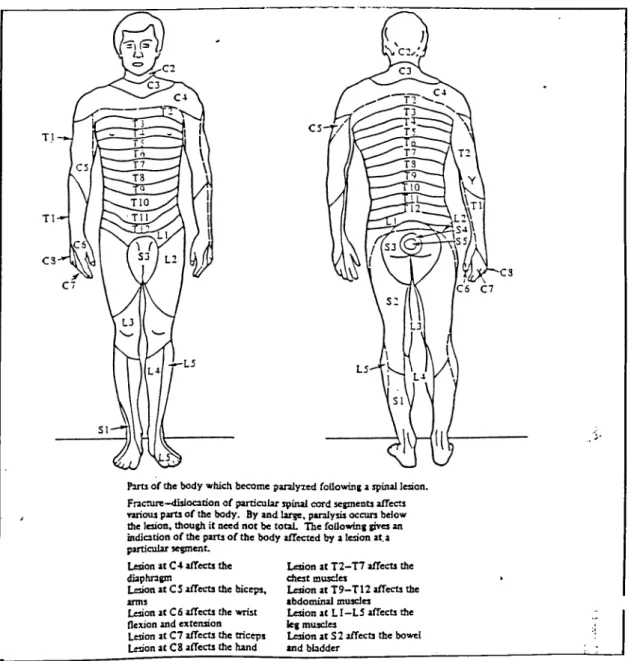
Figure 2.1. Graph of Major Types of Postnatal Growth of Body ---14 Figure 2.2. Relative Growth Rate _________________________________ 14 Figure 3.1. An Example for Climbing Equipment __________________ 36 Figure 3.2. Two of Balance Beams ________________________________ 38 Figure 3.3. An Example for the S ee-sa w ___________________________ 39 F igure 3.4. Badly Positioned and Irrelevant Pipes _________________ 41 F igure 3.5. A Large Multi-play Structure at Frankfurt Airport_______ 42 F igure 4.1. Diagram of the Spinal Cord ____________________________55 F igure 4.2. Physical Problems Associated with L e s io n s _____________ 56 Figure 4.3. An example of Quad Cane _____________________________ 60 Figure 4.4. An example of Cane ___________________________________ 60 Figure 4.5. An example of Auxiliary Crutch ________________________ 60 Figure 4.6. An example of Non-auxiliary Crutch ___________________ 60 F igure 4.7. An example of Wheelchair Used in Inner Spaces ________ 61 F igure 4.8. An example of Wheelchair Used in Outer Spaces ________ 62 Figure 4.9. An example of Walkers ________________________________ 62 F igure 4.10. A Spastic Child Using Orthoses _______________________ 63 F igure 4.11. A Baby Using Orthoses _______________________________ 64 F igure 4.12. A 7 Years Old Child Using Ladder Chair ______________ 64 F igure 4.13. A 6 Years Old Child Practising with Ladder on Wall --- 66 F igure 4.14. An example of See-saw or Swing Board _______________ 66 F igure 4.15. A Wooden Aisle That Helps Children Who can not Walk in
Balance _____________________________________________ 68 F igure 4.16. Two Different Stairs at One E quipm ent---68 Figure 4.17. An Example of Slide for Physical Disabled C h ildren --- 70 Figure 5.1. Dimensions of 5 % of 7-year-olds ________________________ 75 Figure 5.2. Dimensions of 95 % of 7-year-olds _______________________ 76 Figure 5.3. Dimensions of 5 % of 12-year-olds --- 77 Figure 5.4. Dimensions of 95 % of 12-year-olds --- ^78 F igure 5.5. The Grip Diameters of 7-year-olds --- ^79
F igure 5.6. The Grip Diameters of 12-year-olds _____________________79 F igure 5.7. The Corrections of Physically Disabled Children (6-9 years old)
_______________________ ______________________________ 81 Figure 5.8. The Corrections of Physically Disabled Children (9-12 years
old) ... 82 F igure 5.9. Dimensions of Stairs for Disabled People ________________ 83 F igure 5.10. Dimensions of Openings and Closed Zones on Platforms
... 83 F igure 5.11. The Necessary Angle of Ramps for Disabled People _____ 83 F igure 5.12. Types of Platform A and Assemling Combinations ______ 85 F igure 5.13. Platform B and 3 Possibilities of Turning Angles ________86 F igure 5.14. Different Usages of Platform A ________________________ 88 F igure 5.15. Different Angles That can be Created by Platform B ____ 89 F igure 5.16. Section of Handrail for Smaller Children and Older Children
_________________ 90
F igure 5.17. Orthographic Views of Vertical Elements (Pipes) _______ 91 F igure 5-18. Handrails Used as Vertical Ladder_____________________ 92 F igure 5.19. The Layers under Tufted Carpet in Order to Improve Impact
Absorbency---96 F igure 5.20. Sections of Fiberglass Barriers and Iron Sheet Platforms
_____ ________ 99
F igure 5.21. Section of a Rubber Based Painted Pipes Used as Handrail's Material_______________________________________________99 Figure 5.22. The Sectional Drawing of Vertical Elements, Pipes ____100 F igure 5.23. 3 Dimensional View of Button _______________________ 101 Figure 5.24. The Working System of Type A Connectors ____________101 Figure 5.25. The Sectional Detail of Assembling the Handrails with Pipes
...102 Figure 5.26. A 3D Drawing of One of the Equipment _______________103 Figure 5.27. Top View of Figure 5.26 ______________________________ 104 F igure 5.28. One of the Sample Plans of Possible Configurations --- 105 Figure 5.29. A Possible 3D Drawing of Figure 5.28 106 F igure 5.30. An Other Possible Plan of Configurations --- 107 F igure 5.31. An Other Example of Plans __________________________ 108
1. ESTTRODUCTION
1.1. Problem
Huchingson (1989) mentioned that all of us are handicapped in one way or another. Some of us are too big for an environment designed for an average person. Some are left-handed and given scissors with many other variety of equipment designed for the right-handed people. Some lack the sensory-motor skills to adapt to activities in which they wish to participate.
Many years ago, this important factor was not taken into consideration, but after the World War II., the ergonomic studies being developed and most of the solution are found for these handicaps. Both the equipment and the places (either interior or exterior) are begun to be designed according to the anthropometric dimensions of the people who are going to use them. Moreover; the users also become more conscious of using the right equipment and living in the right places as possible as they can. All the effort to match the right equipment to the right person is a part of designers' world and most of them are dealing with the normal people, who are healthy and have no absence of some body parts.
On the other hand, there is an other group of people whom we called as 'disabled'. In many societies, the disabled people are still discriminated and accepted as problematic 'creatures', because being a handicapped. In fact, these people are in handicap because the environment they have to live is not suitable for their 'di-. - __ .cities. The special part of this group is the disabled children who can not be able to control some members of their bodies in a way or another. The disabled children are in need of more care than the any other group of people, because there are 3,161,000 disabled people living in Turkey at the age of 0 - 18 years old
and all these people are the potential of our future. From this point of view, the healthier development (physical, emotional and intellectual) of the disabled children becomes more and more important. When the point is that, there must be something to be done for these people by the designers.
L2. Object and Methodology of the Study
Each of us can become handicapped in the situations when we are foimd in an environment which is not suitable to our physical and psychological properties. From this perspective, the disabled people should not be accepted as handicaps and passed on, but their problems should be solved. They should not be separated from the society but should be given opportunities to engage and become a part of the society.
Most of the disabilities are results of diseases or accidents. For example; strokes may produce paralysis and loss of speech. Certain nerve diseases may result in blindness, deafness and lack of coordination. Cerebral palsy is a disorder that damages the brain before, during or after birth. Depending on what part of the brain is damaged, cerebral palsy can cause speech problems, muscular weakness, or involuntary movements of the arms and legs. It also can produce mental retardation. Accidents cause a wide range of impairment, including spinal damage, and loss of limbs. In most of the societies, the disabled people are seen as aliens and the healthier people do not want to be in contact with them. The worst point is that the separation begins in the childhood period, because many of disabilities happens during this period. Although many people think that the disabled people are burdens of the society, with proper motivation and special training, even severely handicapped people can lead productive and fulfilling lives.
he wrote his epic master piece, Paradise Lost. The great German composer Ludwig van Beethoven wrote much of his finest music after he became deaf. Franklin D. Roosevelt, paralysed in both legs by polio, became President of United States. Helen Keller became blind, deaf and mute before she was two years old, but she learned to read, write and speak. She devoted her life to helping the deaf and the blind. In other words, in order to overcome handicap, people must learn to live with their disability and desire to be independent.
This projects point is that if the disabled children can be provided to live in the same conditions of normal children, two goals will be achieved as a result. One of them is that the disabled children feel themselves as a part of society and are going to be grown up as differently abled but productive people. The second goal is that the normal children are going to grown up as normal adults who are aware of the problems of handicapped people and accept them as a part of society. Both sides will learn how to behave towards each other. In order to achieve these two goals, the children should be gathered in a medium that they would like to be in and would never be shame of their being different from each other.
At first step, the characteristics and properties of children should be examined and a litreture research has been done about child development. The children have been studied from the physical, cognitive, social and emotional developments’ point o f views. The periods of childhood are compared to each other in order to find a clue for an activity and a place to gather all the children, willingly.
The importance of play is the second step to be examined in child's development, since everyone is the aware of the fact that play is the best medium for the healthier development of all children. The authorities have catagorized many types of play and these groups are co <
each other in order to point out which t3T>es of plays should be aimed as the activity to interact the children with each other. Besides the type of play, the quality of play is also very important, since children learn
a very important factor for children and they learn to be socialized while playing, play can be used as a reason for gathering the normal and disabled children.
The third point is researching the answer of where children can play, because play and play spaces can not be distinguished from each other. Play space is a general term that is used for every place where children play on and each play space effect child development from different points of view. The quality of play space is as important as the quality of play if the children are wanted to possess better play opportunities. It should not be forgotten that providing the quality o f play space has a close relationship with the type of play space, because the play spaces are classified according to the conditions they are found in.
Playgrounds have a special property among the other play spaces, since they have different types with respect to the aims for which they are build up. The activities carried out by children on playgrounds are remarkable since they determine the type and the quality of each equipment which is going to be placed. The problem is that disabled children can not make use of the equipment found in many playgrounds. However, in order to socialize the disabled children and gather them with the abled ones, one should not limit them and close in an unpleasant environment. Being careful with the selection of the right equipment in right place can easily solve this problem, with the addition of using suitable colours to motivate all children.
From this perspective, the equipment of the playground is very important, because most of the equipment produced in the market have different properties and the suitability of each equipment to the disabled children should be researched. Eventhough, the normal children can manage to do - j s and make use of the equipinent easier than the disabled ones, the dimensional information and other properties of disabled children becomes more important.
After determining the subject and place in order to create the medium according to the aim of this project, it is obvious that all of the disabled
children can not be put together, because of different disabilities causing different characteristics. The types o f disabilities is researched as the fourth point, with respect to the reasons and rehabilitation periods in order to live like the able bodied people. There are also some assistive devices, which are used by most of disabled people, are examined at the Othosis and Prosthesis Polyclinic of Prof. Dr. Hidayet Erdem. At this Polyclinic, also the training methodology is researched and the rehabilitations periods are established. The specifically designed equipment are determined in order to design the right playground equipment system with a rehabilitation value, after the observations made at Ankara Rehabilitation Center and the Polyclinic stated before. All these examinations and researches are done in order to find a good way to gather the able bodied and disabled children and be sensitive to the problems of each other for better living conditions. Children will learn many things about each other and accept to live in reconciliation, Avithout any kind of discrimination.
1.3. Structure o f the Thesis
There are four main chapters which give the information about the researches and the inferences about the related subjects excluding the introduction and conclusion chapters. First chapter is the introduction part of the thesis and the sixth chapter is the conclusion part.
In the second chapter, the meaning of play is discussed besides being a term in dictionary, and the varieties of play are examined from two authorities' point of view. Besides the role of play and the criteria, that must be taken into consideration for a high quality of play in child development are uuua m short terms, they are analysed from the perspectives of psychoanalytic, learning and cognitive theories. The characteristics and the properties of the age groups are examined in order to decide on the potential age group, and finally, physical, cognitive, social
In the third chapter, the important role of play spaces with respect to the environmental, physiological, creative and educational developments, and social education of the children are explained. The types of play spaces according to the environmental position of the lands and the quality of play spaces are examined. The types of playgrounds, as the most popular play spaces from various points of view are stated and the activities that take place with in each playground are specified. The equipment foimd on the playgrounds, and the required specifications of the equipment are examined. And finally, the role of colour and ways of keeping safety in playgrounds and equipment are mentioned.
In the fourth chapter, definition of terms, (impairment, disability, and handicap) which are related to differently abled people are stated. The type of disabilities are examined later and the emphasis is given to the physical disabilities. The six types of physical disabilities are the subjects; namely, paraplegia, hemiplegia, quadriplegia, amputation, visual-impairment and finally, hearing-impairment. The assistive devices used by the disabled people are examined in detail, since they determine the related measurements of the playground equipment. The role of playgrounds in rehabilitation are discussed as the last issue of the chapter.
In the fifth chapter, the necessary anthropometric dimensions and the measurements of generally used assistive devices are stated which determine the dimensions of the designed modules. The material of the elements used in the system are examined under the second subtitle, and the colour combinations are stated. The assembling process and recommended combinations are the last subtitle of this chapter.
2. PLAY
Although the importance of play has been recognized for many years, its functions have not been understood fully in the wide range of society. As a general belief, education has a superiority and education through play has a lower rank. There is a familiar saying that "It should be better studying instead of playing!". On the other hand, it is a fact that play is a process by which children learn and come to terms with social and physical environments (Heseltine & Holborn 1987).
In the United Nations Declaration of the Child's Right to Play, which was broadcasted in 1959, Principle 7 states:
The child shall have full opportunity for play and recreation which shall be directed to the same purpose as education; society and public authorities shall endeavour to promote the enjoyment o f that right.
After 20 years, in 1979, the Malta Declaration of Child's Right to Play which was formulated by the International Association for the Child's Right to Play (IPA), as part of the International Year of the Child declared that;
Play, along witn the basic needs o f nutrition, health, shelter and edu cation, is vital for development o f the potential o f all the children.
In this chapter, it is going to be discussed what play means besides being a term in dictionary. Piaget's and Parten's, who are accepted as authorities in child development, point of views on the varieties of play will be examined. Practice, fantasy and sociodr^'r being at one side, and solitary, parallel, associative and cooperative types on the other. Besides, the role of play, and the criteria, that should be taken into consideration for a high quality of play in child development will be told in short terms from the perspectives o f psychoanalytic, learning and
cognitive theories. The characteristics and the properties of the age groups will be examined in order to decide on the potential age group. Finally, physical, cognitive, social and emotional development of the potential age group will be stated.
2.1. Definition o f 'Play'
'Play' is one of the words, which have more than one meaning, those are found in English, but in this work it will be accepted as not only a word with one of the meanings of;
play 1 something done to amuse oneself; fun; sport; recreation. 2 a turn move or act in a game. 3 act o f carrying on or playing a game. 4 manner or style o f carrying on or playing a game. 5 story written for or presented as a dramatic or theatrical performance; drama. 6 a
dramatic or theatrical performance, as on the stage. 7 action or
dealing o f a specified kind. 8 activity; operation; working. 9 light, quick movement or change. 10 freedom or opportunity for action; scope o f activity. 11 free or unimpeded movement. 12 the proper motion o f a piece o f mechanism or o f a part o f the living body. 13 gambling. Etc. (Barnhart, 1974)
but will also be a very important part of any child's physical and psychological development.
The research done on the children for many years let human be aware of the reality that children are in need of playing as much as all the other important necessities as a part of growing up. Some of the researchers accepted 'play' as a spontaneous, pleasurable activity (Bruner, 1972; Garvey, 1977; Rubin, Fein & Vandenberg, 1983).
In fact, the definition of play depends on the varieties which change according to children's developmental stages, and the quality which deals with time, change, challenge, suitability and cooperation. Tnese suujects will be examined during the next three subtitles with the addition of the role of play in child's development.
2.1.L Varieties of Play
During the preschool period, a developmental progression can be described in the kinds of play most likely to occur (Piaget, 1963). From Piaget's point of view, the child first engages mainly in the practice play, later on develops symbolic play/fantasy play which can be classified as the individual plays. When children coordinate activities with others, it is called social pretended play/sociodramatic play. Finally, the last stage of development of play is the games with rules.
There is another theory which was advanced by Mildred Parten in 1932. Parten observed preschoolers as progressing from unoccupied behaviour through the stages of solitary, parallel, associative and cooperative play. The stage theories of Parten and of Piaget are stated in Table 2.1.
Stage of Play Description
PIAGET Practice play Repeated movements to consolidate, perfect, or elaborate a skill. Example: Going down a slide. (First, down the right way, feet first. Later, down backwards or head first.)
Symbolic play Play in which one thing stands for another. Example: Playing house. (Child uses play materials to represent some imaginary thing.)
Games with rules Play involving rules and competition between individuals or groups. Example: Hide-and-seek.
PARTEN Solitary play Child plays alone. Example: Child sits alone in the sandbox and fills pail with sand. Parallel play Play in close proximity to other children
but without interaction. Example: Two children sit next to each other in a sandbox, each filling a pail.
Associative play Children respond to each other during play but maintain separate goals. Example: Two children talked to each other while playing with sand in a sandbox.
Cooperative play Play is organized around joint activities. Example: Two children work together to build a sand castle
T able 2.1. Stage Theories of Play: Piaget and Parten
Both of the theories emphasize that complex forms of play emerge from the simple forms. It can not be denied that social play appears later than both parallel and practice play, and with age, play that involves interaction among children increases while non-interactive play declines (Johnson and Ershler, 1981). During the preschool years, social play that involves role coordination, pretend activities, development of common theme, and turn taking frequently increases (Parten, 1932; Smith & Connolly, 1972; Rubin & Maioni, 1975; Rubin & Pepler, 1980).
The type of play which is going to be examined in this work will be the practice play (according to Piaget's theory), since the child have to acquire many practices in order to manage a special kind of movement. On the other hand from Parten's point of view, it is consistent with the associative play because of the child's being in need of respond to each other during play while trying to achieve separate goals.
2.L2. Role of Play in Development
Heseltine and Holbom (1987) mention that when we compare the children who have the opportunities for good quality play to the children who are deprived of play opportunities, the first group appear to develop a greater creativity, a greater flexibility of approach to problem solving, to have better social skills and to be physically healthier than the second group. Fogel and Melson (1988) emphasize three theories, related to the role of play in development of children, which can be named as psychoanalytic theory, learning theory, and cognitive theory. If these headlines should be detailed, it can begin from psychoanalytic point of view.
From this young children have the opportunity to act out conflicts and fears in a safe environment, while they are playing. In this way, a boy can express aggressive impulses without fear o f punishment, when he experiences an Oedipal rivalry with his father. In the game of hide-and-seek fear of abandonment can be experienced and be overcome in
small manageable doses. The works done within this view of social play give the key of developing the techniques o f play therapy. In these therapies, young children who have experienced a trauma, like child abuse, are encouraged to express their feelings with playthings.
As an other point, emphasized by psychoanalytic theory, is that the pretended themes of fantasy play let the young child satisfy unrealized desires and overcome frustrations (Fogel & Melson, 1988). The parental roles taken place in a playing house is a good example to the stated situation, since the children become aware of the fact that they are not ready to assume. Finally, since children make-up play themselves and are not imposed, it provides opportunities to build self-esteem. The children can make-up play episodes those are within their capacities and those show off their strengths.
The second theory is learning theory, which should be taken into consideration, because it stresses that play can lead children to reinforce each other’s behaviour. Preschoolers' playing with the same-sex peers is a good example of this theory (La Feriere, Strayer & Gauthier, 1984). Generally more positive exchanges and less conflict occur in same-sex play than in mixed-sex peer play (Langlois, Gottfried & Seay, 1973; Jacklin & Maccoby, 1978; Lamb & Roopnarine, 1979).
Social learning theorists mention that social play allow children to observe their peers as models and to imitate them. Imitation of peers is thought to be a good source of learning, since less advanced children can learn more from watching moderately more advanced models than from watching models whose behaviour is much more advanced, like the adults. This is because of children's inability to imitate the behaviours those are completely different from their own skills.
The third and the final theory is the cognitive one which has a perspective to see the social play as a natural training ground for decreasing egocentrism, prompting awareness of the feelings of others, and providing
opportunities for creativity, empathy and pro-social behaviour (Zahn-Waxler, lanotti & Chapman, 1982).
Although children with already developed perspective-taking and empathic skills may gravitate to social play where they can use these abilities (Hartup, 1983), it is evident that social play, particularly social fantasy play, promotes interpersonal understanding (Selman, 1976) enhanced problem solving (Sylva, Bruner & Genova, 1976; Vandenberg, 1980) and creative thinking in young children (Dansky & Silverman, 1973, 1975).
In other words, because of the developmental significance of social play from variety of perspectives, there is a concern about young children between three and five years of age in participating regularly in some kind of peer group. Some children are sought out by the others and are frequently involved in social play while others are ignored or actively rejected by their peers.
2.L3. Quality of Play
Quality of play is important as much as quality of education that is looked for ever5rwhere by the parents, but most of them are not aware of the fact that children learn through playing more than through any systematic school education. This is the basic reason for stating some criteria those should be taken into consideration while directing the children's play.
The quality of play depends on five criteria (Heseltine & Holborn, 1987), which can be named as time, change, challenges, suitability and cooperation. In other words;
Time - the longer time a non-repetitive play activity takes and attracts the child's attention, the better the play quality is.
Change - the greater the capacity of play space and the equipment to be changed, and the more possibilities are offered to the child, the greater the
play value is.
Challenge - the more opportunities the play space has to offer an increasing level of challenges to children, the better the play value is.
Suitability - the more the play space can match different ages and needs at the right time, the better that play value is.
Cooperation - the more the play space can stimulate cooperation and group play, the greater the play value is .
Until here, the varieties of play and the role o f play during the development of child has tried to be explained and the points, which should be taken into consideration while providing the opportunity of playing to children, has been stated. However, the characteristics and properties of different age groups must also be paid attention for healthier solutions. The characteristics and properties o f potential age group will be determined under the next title.
22u Characteristics and Properties o f the Potential Age Group
Since the child grows up as the time passes, his needs and longing change according to physical and psychological development. It cannot be expected all the children to have the same pleasure, performance and properties. Therefore, it is important to determine a specific age group which is going to be worked on.
The researchers studying development of children, generally divide the childhood period into four groups (Clarke-Stewart & Friedman, 1987; Fogel & Melson, 1988); infancy, early childhood/young child (preschool period), middle childhood, adolescence. During each oi tnese periods, different parts of the body reaches maturity and this is called as asynchronous growth and is shown on the Figure 2.1.
Lymphoid Type
Thymus. Lymph-Nodes. Intestinal Lymphoid Masses. Neural Type
Brain and its Parts. Dura. Spinal Cord. Optic Apparatus Many Head Dimensions General Type
Body as a Whole. External Dimensions (With Exception of Head and Neck), Respiratory and Digestive Organs Kidneys. Aorta and Pulmonary Trunks, Spleen, Musculature as a Whole Skeleton as a Whole, Blood Volume. Genital Type
Testis, Ovary. Epididymis.
Uterine Tube. Prostate, Prostatic urethra. Seminal Vesicles.
Age in Years
Figure 2.L Graph of Major Types of Postnatal Growth of Body.
(From FOGEL, A. & MELSON, G. F. Child Development: Individual, Family, and Society. New York; West Publishing Company, 1988. p. 343)
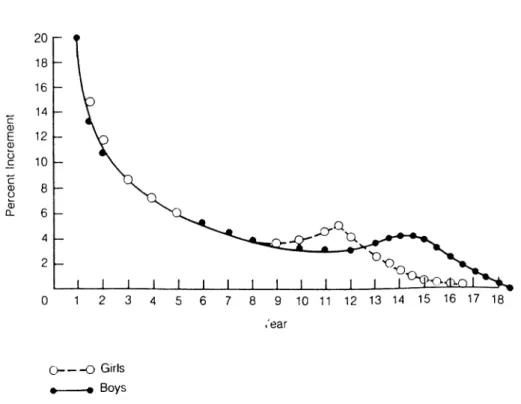
O--- o Girls # . Boys
Figure 2J2. Relative Growth Rate.
(From FOGEL, A. & MELSON, G. F. Child Development: Individual, Family, and Society. New York; West Publishing Company, 1988. p. 343)
The brain, skull, eyes and ears grow slowly and most of the growth in the head occurs pre-natally and in infancy. The sex organs are formed pre-natally and grow little before the onset of puberty (Tanner, 1970). On the other hand, the lymph system, a network of vessels carrying lymph or tissue fluid from tissues into veins, grows more rapidly during middle childhood than at any other time.
As it can be followed on the Figure 2.2, growth rates for boys and girls are not the same, from the end of the age of 8 through the beginning of adolescence period (nearly 13 years old). During this time girls' growth rate is higher than the boys' and by the age o f 13 boys' growth rate becomes higher until the age of 18.
Although changes in height and weight are mostly seen, the best indicator of physical growth is skeletal maturity or bone age, which is measured by the extend of hardening of the bones (called ossification). The growth of the special regions (called epiphyses) cause the lengthening of arms and legs. Height is correlated closely with rate of ossification of the epiphyses.
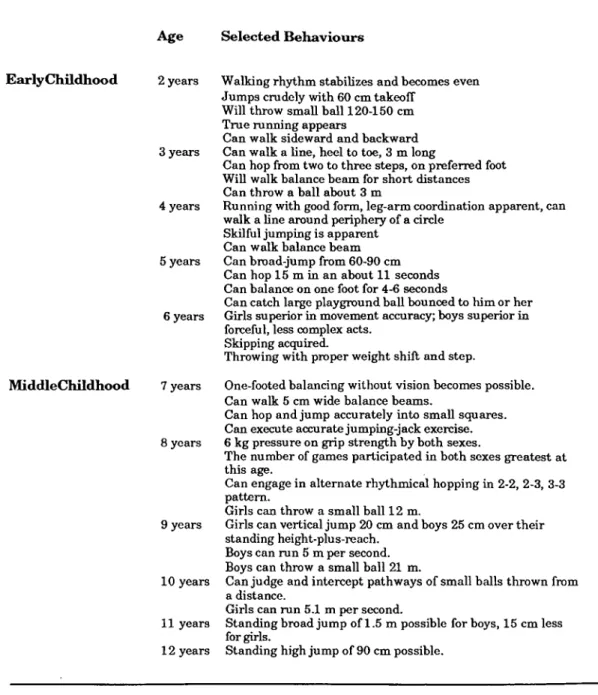
Besides these changes in height and body weight, children are developing new abilities to use their extra capacities. Boys and girls becoming more skilled in many aspects of motor behaviour during childhood as shown in Table 2.2.
The stages those are shown on Table 2.3 are Piaget's stages of cognitive development. According to Piaget's theory, children are ready to adapt and to learn from the world by birth. They do not have to be taught deliberately to walk or that objects have to obey certain physical laws and people have to obey moral rules. In his opinion, children built-up knowledge as they mentally organize infoi · n the environment.
Infants and children actively participate in their own development. They manipulate and explore their world, guided by their mental structures or mental representations of how things work ( Clarke-Stewart & Friedman, 1987).
Age Selected Behaviours
EarlyChildhood
MiddleChUdhood
2 years Walking rhythm stabilizes and becomes even Jumps crudely with 60 cm takeoff
Will throw small ball 120-150 cm True running appears
Can walk sideward and backward 3 years Can walk a line, heel to toe, 3 m long
Can hop from two to three steps, on preferred foot Will walk balance beam for short distances Can throw a ball about 3 m
4 years Running with good form, leg-arm coordination apparent, can walk a line around periphery of a circle
Skilful jumping is apparent Can walk balance beam 5 years Can broad-jump from 60-90 cm
Can hop 15 m in an about 11 seconds Can balance on one foot for 4-6 seconds
Can catch large playground ball bounced to him or her 6 years Girls superior in movement accuracy; boys superior in
forceful, less complex acts. Skipping acquired.
Throwing with proper weight shill and step.
7 years One-footed balancing without vision becomes possible. Can walk 5 cm wide balamce beams.
Can hop and jump accurately into small squares. Can execute accurate jumping-jack exercise. 8 years 6 kg pressure on grip strength by both sexes.
The number of games participated in both sexes greatest at this age.
Can engage in alternate rhythmical hopping in 2-2, 2-3, 3-3 pattern.
Girls can throw a small ball 12 m.
9 years Girls can vertical jump 20 cm and boys 25 cm over their standing height-plus-reach.
Boys can run 5 m per second. Boys can throw a small ball 21 m.
10 years Can judge and intercept pathways of small balls thrown from a distance.
Girls can run 5.1 m per second.
11 years Standing broad jump of 1.5 m possible for boys, 15 cm less for girls.
12 years Standing high jump o f 90 cm possible.
T able 2.2. Milestones of Motor Development During Early Childhood and Middle Childhood. (From Cratty, Bryant J., Perceptual and Motor Development in Infants and Children, 1979, p. 222)
Sensarimotor Birth to two years Preopemtional 2 to 7 years Concreteoperational 7 to 11 years Formaloperational Over 11 years
Activities and achievements
Infants discover aspects of the world through their sensory impression, motor activities, and coordination of the two.
Child can not yet think by operations, by manipulating and transforming
information in basic and logical ways. They can think in images symbols and form mental representations of objects and events.
Children can understand logical principles that apply to concrete, external objects.
Adolescents and adults can think abstractly. Their thinking i ' ^
constrained by the given of the immediate situation but can work in probabilities and possibilities.
Table 2.3 Piaget's Stages of Cognitive Development.
(From CIARKE-STEWART, A. & FRIEDMAN, S. Child Development: Infancy Through Adolescence. New 19)
Qualitative changes, which take place in these mental structures occur for all children as they make shifts in their organization of knowledge in a particular order of stages.
When all of these informations are being got into consideration, the specific age group which will be examined in this project is the children of the middle childhood. This group has been chosen not only because of the skeletal growth takes place mostly at these ages, but the type of play they practice involves rehabilitation. During the middle childhood, children can be convinced more reasonably than the infants and preschoolers and children from 7 to 12 years can understand logical principles in achieving some certain movements.
In order to give more detailed information about the properties of the middle childhood, the characteristics of physical, cognitive, social and emotional development of this period will be examined in details under the next three subtitles.
2^L Physical Development in Middle Childhood
As they enter middle childhood, boys and girls begin to grow more slowly than they did as younger children. They do not differ much in their physical shape and abilities during this period, although boys' forearms are stronger and girls' bodies are more flexible (Tanner, 1970) and both of them are more physically coordinated than they were in early childhood period. They can throw a ball twice as far as a preschooler, manage a screw-driver, hammer and saw, knit, draw, write, button buttons, ride a bicycle, climb ladders and trees, swim and dive, roller-skate, ice-skate, and skateboard, jump rope, play football, cards and jacks.
All these physical activities help children to develop master skills, raise their self-esteem and increase their competence in the eyes of others. Physically active children do their bodies a favour by developing muscle, keeping in fitness and preventing chronic diseases. Moreover, they also do
something for their minds as an old saying "Healthy mind in healthy body."
2.2.2. Cognitive development in IVtiddle Childhood
Middle childhood is a period, both when children grow physically coordinated and become skilful, and when children mature cognitively. Thinking typical of early childhood is a blend of impressions, intuition and partial logic. As children enter school and middle childhood, the way of their thinking change and they begin to grasp the logical relations of things, the rules and constant properties. Piaget calls reasoning logically about objects as concrete operational thought (concrete comes from children's reasoning only about tangible things like milk and cookies and operational comes from children's performing mental manipulations on the things in an organized and systematic way.)
By the middle childhood, some important differences in physical size, strength and vulnerability, in play styles and preferences, in nurturance and aggression, and in cognitive abilities takes place. At the end of many researches, girls are found to have greater verbal abilities than boys. They learn to read sooner and by the end of middle childhood they understand and use language fluently than boys. In contrast, boys have more spatial abilities than girls.
2.2.3. Social and Emotional Development in Middle Childhood
The world o f school-age children is full of family members, teachers and classmates, and the other children. Although children are involved in family life, they are independent enough to ride the school bus and play in their nei ’ f ’ 1. All the activities let children to develop social skills. At this period most children have at least one friend. Friendship is important to children's development. Friends offer opportunities to learn social skills like communication, cooperation, and self-control, emotional and cognitive resources. They provide a context for developing intimacy;
and they serve as precursors of later relationships.
In school, the children work together with their friends. They collaborate in projects, tutor, teach one another, and compete as well. Out of school, they also work together, play games and sports, form clubs, go exploring, sit and talk, and share toys, arguments and fantasies.
With their improved motor skills and their burst of interest in other children, the middle childhood children find in games lots of fun. Some games are spontaneous and informal, some elaborate and formal; some require teams, some a partner. Games help children make the transition into the larger social world and they offer practice in following rules, in cooperating and competing; challenges to rise to and succeed at. As they get older, children get better in understanding others feelings, moods, intentions, and motives. As their social understanding increases, their social competence increases, too.
The way that children perceive themselves change in the middle childhood as they begin to recognize that they have unique qualifications. Children's self-esteem derives in part from others' opinions of them and in part from their mastery of developmental tasks, their performance in school, and their ability to deal with social situations. Some temperamental traits - activity level, intensity, adaptability, and rhythmicity - seem somewhat stable from infancy to early childhood. Across childhood and beyond, the most stable qualities are aggressiveness and sociability.
In the second chapter, the concept of play with respect to the children's development, and the characteristics of the potential age group has been determined. After examining the varieties of play, the most suitable type is decided as the practice j ’ rding to Piaget) and the associative play (according to Parten). The role o f play in development has been examined from the points o f view of the psychoanalytic theory, the learning theory and the cognitive theory. It has been mentioned that the quality of play depends on time, change, challenge, suitability and
cooperation.
A comparison has been made between the early childhood/yoimg child and middle childhood, under the title of characteristics and properties of the potential age group and as a result, the group of middle childhood has been chosen as the specified age group. While designing the equipment, the properties and characteristics of this age group will be taken into consideration.
3. PLAYGROUND
Piaget (1963) presented assimilation and accommodation, as two basic functions of human development. Assimilation occurs when a person sees a new situation in terms o f something familiar (Dattner, 1969); when one acts in a new situation, as he/she has acted in the past situations. In other words, assimilation is the mastery of familiar or new skills by repetition and practice. It is the inner organization of experience.
Accommodation, on the other side, is complementary to assimilation. It occurs when variations in the environment demand a modification in one’s pattern of behaviour. Accommodation occurs when a previously learned response fails to work in a new situation, and the organism modifies its response. When a balance occurs between these two functions, the development of intellect takes place. Piaget named this process as play. On the other hand, 'play space' is as important as play and in most cases it can not be distinguished from play. Play space can be defined as;
an outdoor learning environment designed to support and suggest activities those are the essential part of the child's learning and development (social, emotional, cognitive and physical)' ( Ericksen, 1980).
In this part, the important role of play spaces with respect to the environmental, physiological, creative and educational developments, and social education of the children will be explained. The types of play spaces according to the environmental position of the lands and nullity of play spaces will be discussed. The types of playgrounds, as the most popular play spaces from various points of view will be stated. The activities that take place with in each playground will be specified. The equipment found on the playgrounds, and the required specifications of
the equipment will be examined. And finally, the role of colour and ways of keeping safety in playgrormds and equipment will be mentioned.
3 JL. P la y Spaces
The children, generally, create their own play spaces according to the opportunities given to them. From this point of view, it can not be talked about the equality in playing conditions. In other words, a child playing inside of a house, can have completely different activities than a child playing outside. Especially the need to adventure leads the children to make use of every kind of play spaces, even a shelter that is created by themselves.
In this part, the effects of play spaces on child development will be examined, with the addition of quality of play spaces and the types of play spaces under the following subtitles.
3XL Effects of Play Spaces on Child Development
In relation to play areas, five particular themes - environmental, physiological, creative and educational development, and social education - are developed for interpreting play (Heseltine & Holborn, 1987):
Environmental Development: Children receive information from the surrounding environment, in order to use it in their intellectual development. This information has the properties of life enhancement, providing a range of choices and experiences, and stimulating and challenging. By the implications of this information, children learn many
s about texture, colour, sound, aesthetics, etc. These are the beneficial implications and must have to be developed. If a child is brought up in an environment of broken windows, he can not be expected to realise the reality of breaking windows is not permitted.
Von Hertzen (1971) mentions that where good planting took place and the
natural environment has retained, vandalism was less. On the other hand, a tree placed into an area of concrete can become an alien object and a child's natural exploration of the function and material can become the cause of its destruction.
In designing an environment, which is stimulating the provider faces severe problems, like the requirements of the child may not fit to the requirements o f the adult community. Therefore, while designing a playground, even if it is a unit, the children's needs must be taken into consideration, instead of the adult's assumptions. Moreover; it must be accepted that a playground equipment may give many messages to the children as a part of the environmentsd education.
Physioli^cal Development: Play is a part of a process by which children learn to develop some o f the motor skills necessary for intellectual development. If movements are badly co-ordinated, there can be problems. Studies of movement patterns demonstrate how co-ordination increases with constant practice and recurrent use of play spaces equipment (Heseltine & Holborn, 1987). Sand play, toys and the natural environment all help with the process of fine timing, which is especially necessary at the preschool age. Maher (1982) suggested that gross motor learning may be largely complete by 4 years of age, and it is important since a child yoimger than 5 years old should not be over-stressed.
Through the use of equipment which is, unpredictable, the child is helped to develop spatial and visual perception. The importance of learning through play is that the child assimilates the concepts, accommodating them at his/her own pace and in his/her own way. The need to experience and experiment are all important and the lessons should be more fully learnt.
Climbing is one of the good examples of this process. Since the steps can be seen and the motion is visual and predictable, going up a climbing structure is relatively simple. However; coming down is more of a problem
and therefore, they can develop these facilities to a limited extent. However, all play spaces have the potential for education. A play space can provide information to identify concepts of shape, size, number, the relationship between parts, and so far so forth. By learning to relate knowledge to experience children begin to build up a body of information on which to base input from other types of learning and from other sources.
Social Education: The function of play is essential during the process of understanding the development of the 'self idea in relation to the environment and others. The concepts of self-confidence, self-reliance and independence all come about through play experiences and through fantasy play.
Play spaces provide the opportunity to children to meet and interact with each other. The proximity of other children is important for the young children, but the interaction between them is not great. There is a preference for playing in the company of others rather than with them. As children get older, their capacity and need to interact face-to-face increases. All these preferences for grouping have implications for the amount and type of play space provided.
The play spaces create a natural meeting place for older children and at the same time a natural space for developing socialization skills. A child can make use of an item of any equipment on the play space while he/she builds up confidence to rejoin a group.
After examining the contributions of play through the learning process in the previous chapter, the additions of play spaces to the learning facilities are examined under the perspectives of environmental, physiological, creative and educational developments and social education. It is being realized that the characteristics and properties of play spaces are as much important as the characteristics and properties of play itself, through the development of children. The quality of play spaces and the
criteria for deciding on a play space's quality will be examined in the following section.
3.L2. Quality of Play Spaces
The 'quality of play' was mentioned in the previous chapter. The 'quality of the play space' is also very important, since the children are wanted to possess better play opportunities. Poly Hill (1983) has suggested some properties for playgrounds which can not be fully suggested on every play space; however, it will be very good to gather at least a few of these criteria, while designing a play space. These can be named as;
Physical fitness - by providing equipment which develops muscular growth and coordination .
Intelligence - using equipment and materials which can be adapted and developed.
Creativity and imagination - by providing a variety of equipment, textures and loose materials.
Emotional stability and initiative - through the involvement of adults. Social assurance and cooperation - by providing suitable materials, spaces and equipment.
Self-confidence and competence - by providing choices and challenges in equipment.
Individuality - through the provision of non-directive leadership.
Sense o f responsibility - through the involvement in the design and management of the play areas.
Non-sexist/ non-racist outlook - by ensuring that play space meets the needs of both sexes and all ethnic groups.
Sense o f humour - by the use of colourful and innovative equipment and materials.
Children from 6 to 12 require an area which is suitable for the informal play activities and low organized games which require a level space where as some of them are needed to be played on a slope or among the trees.
However it is designed, children under ten require relatively little space for most of their activities when compared to the field or team games. Whatever the play space kind is, the important point to be mentioned is whether the children could find the opportunity to satisfy their need of playing. As Nicholson (1971) says:
In any environment, both the degree of inventiveness and creativity, and the possibility of discovery, are directly proportional to the number and kind of variables in it.
Although it can not be expected a play space to carry all of the stated properties, it will be better to pay attention to the involvement, at least some of them, in pla3ung areas. The fussiness that can be showed at this point will affect the children's development heavily.
It should not be ignored that the types of play spaces determine the effects o f any play space on educational, physiological and other developments. The different kinds of play spaces will be stated under the next title.
3.L3. Types of Play Spaces
The types of play spaces show different characteristics just like the types of plays. The environmental factors and the opportunities which are given to the children by the play spaces determine these characteristics. Many researcher may have done classifications according to their surveys, but in this part, the types of the play spaces will be classified in eight different groups, as Heseltine and Holborn (1987) did:
N a tu ra l: The children at the age o f 4 to 9 range require many opportunities to utilize the environment for exploration and socializing. In the play activities of this age, the importance of natur«^ is reflected by the children’s desire to affect, to change, to explore, to experiment with loose materials, to meet and interact with other children. Under-used land: These are the lands, for example, between a main road and an estate road which access is restricted, either by barriers or by
parental prohibition. The under-used lands are a part of the most attractive play spaces in order to satisfy the spirit of adventure that is found in the nature of children.
Idle or dormant land: These are the ones, which are essentially undamaged and which could easily be made usable, possibly on a temporary basis.
Despoiled land: They require major reclamation treatment.
Operational land: Sometimes local authorities, or nationalized or private industry, held a land which is surplus to their requirements. These can also be interesting for the children with the same reasons as under-used land.
Found space: In development or new housing areas, allowance has to be made for found space for children; small areas of private land - the rear garages, hedges (retained and created), bushes and well-planted areas, screened and semi-private land. These spaces can be used for social activities and as a gathering place by the children.
Amenity areas: These are the spaces on which it is not possible to build and which the designer not allocate any other function.
Woonerven - the living streets: These are the streets which are in use and also very dangerous for the children up to age of 12, since they have not developed their perceptual and intellectual skills to manage safely. While the children are playing, they can easily run through the vehicles and cause various kinds of accidents ended by death.
Playgrounds: These places are the ones created by the human beings artificially in order to provide a safer and more controlled play area for the The equipment of playgrounds are specialized according to the aims and the needs of the potential user group.
After having a short look at the t5q)es of play spaces, it becomes obvious that playgrounds have to be chosen among the other types of the playing spaces for the children. The most basic reason of this choice is that, as
mentioned before, the equipment, which are going to be used by the children on a playground, are produced artificially, in most cases. The most suitable form of the necessary equipment can be designed according to the specifications o f the user, and the most useful and safest apparatuses let parents have confidence in playgrounds.
In next section, in addition to the types of playgrounds which will be stated according to the usability, the materials of the equipment and the potential group as the user, the equipment those are found on the playgrounds will be examined in details.
3 ^ . Playgrounds (as the Most Popular Play Spaces)
As it was mentioned in the previous part, besides having many opportunities, there is a better chance of satisfying children's need of playing in spaces where are called as 'playgrounds'. The playgrounds are created artificially by human in order to give the occasion to develop children’s muscles and intelligence together while they are playing. The playgrounds are accepted as the a small-scale imitation of the world in most cases, but they also supply the basic motives to make the imagination work as much as possible.
In this section, in addition to the types of playgrounds which will be stated according to the usability, the activities those are carried out in the playgrounds will be pointed out.
3^.L Types of Playgrounds
From Da^^r: ’ ‘^'’ 9) point of view a playground has to give a chance to children proving themselves in a series of challenges which ranges from simple to experienced level. The other important point is that, there must be a continuity among the elements and the levels, so that each child has a dual experience of having mastered some aspects of his environment
while he is aware of the other aspects that he may still want to master.
According to Flynn (1985) the playgrounds (as the general meaning) can be classified into different groups with respect to the aims for which they are build up. Here are the types of playgrounds;
One-time user: Usually a commercial play area designed to sustain interests for a short time span.
Returning client: Usually a school or public recreation area which is designed to stimulate multiple responses and some elements of unexpected situations.
A d ult: Commercial and educational planners are dealing with the equipment designed for adults so the designs are characterized according to the adults (in size and in challenge).
Adventure: The adventure play areas are developed especially in Europe. Children are involved in planning, creating and building an area by the leadership of an adult to facilitate play and construction. Some elements of the adventure playgrounds are build to be fixed, when the others are mobile. Moreover; some parts can be changed daily or periodically.
Creative: This kind of areas motivate the children to examine and learn various answers rather than a single one. There are both loose and fixed objects in the setting.
Junk: These play areas are usually constructed by the adults from the discarded materials, which ensures a wide variety of the available choices and stimulates multiple sensory responses (i.e. tires, telephone cable spools, railroad ties, sand, wood, rope.)
Thematic: The thematic playgrounds usually built around a central idea, like the 'pioneer', 'treao^xv. 'Indian', 'safari', etc. Variety is important as much as the appropriateness with the local environment
and safety of the objects.
swings, slides, see-saws, merry-go-rounds, etc. The traditional playgrounds has a single purpose in design and they tend to move children rather than to stimulate children to move,
Vestpocket: They are created by Paul Friedberg (1976) for high school students in New York, and build among the high buildings for the adult scale to be compact and indestructible.
Construction : The construction playgrounds are the ones built, especially for the children, to meet the need of controlling the body movement and developing the muscles as a part of the psychological grow up by learning to feel responsible for themselves. The equipment are, generally, constructed frames.
Therapeutic: They are created in order to be used by the differently abled children as a part of their rehabilitation. All the equipment designed for this special purpose playground has the sizes related to the differently abled children's anthropometry.
The developmental requirements of the 6 to 12 years old age group are met best by the construction playground, in natural play spaces, or by secondary properties of the environment. On the other hand, the type of the playground that is going to be examined in this project will be the therapeutic one, since the potential children will be specified for their being differently abled in the fourth chapter.
3^^ . Activities on Playgrounds
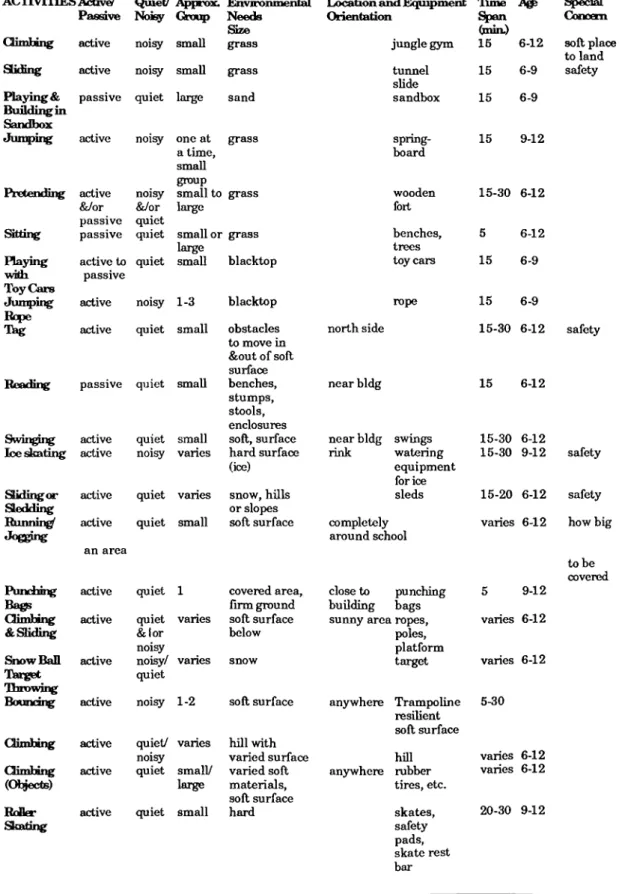
The activities carried out by the children on playgrounds are also very remarkable since they determine the type and quality of the equipment which are going to be placed. The matrix chart of Table 3.1 is prepared after a survey among children in Michigan oy ii.ncksen (1985).
The similarities of the activities of children on the playgrounds between Michigan and Turkey can easily be recognized. Both of them are climbing, sliding, playing in sand-box, jumping, sitting, playing with