ANADOLU UNIVERSITY EFL TEACHERS’ READING TEXTBOOK EVALUATION CRITERIA BEFORE AND AFTER TRAINING
The Institute of Economics and Social Sciences Of
Bilkent University
by
DUYGU USLU
In Particular Fulfilment of the Requirements for the Degree of
MASTER OF ARTS IN TEACHING ENGLISH AS A FOREIGN LANGUAGE
in
THE DEPARTMENT OF
TEACHING ENGLISH AS A FOREIGN LANGUGAE BILKENT UNIVERSITY
ANKARA
To my parents, Osman & Mahinur USLU, and my brother, Ozgur USLU, for their endless support and love…
BİLKENT UNIVERSITY
INSTITUTE OF ECONOMICS AND SOCIAL SCIENCES MA THESIS EXAMINATION RESULT FORM
JULY 7, 2003
The examining committee appointed by for the Institute of Economics and Social Sciences for the thesis examination of the MA TEFL student
Duygu Uslu
has read the thesis of the student.
The committee has decided that the thesis of the student is satisfactory.
Title: Anadolu University EFL Teachers’ Textbook Evaluation Criteria Before and After Training
Thesis Supervisor: Dr. Fredricka L. Stoller
Bilkent University, MA TEFL Program Director Committee Members: Dr. Martin Endley
Bilkent University, MA TEFL Program Dr. William Grabe
I certify that I have read this thesis and have found that it is fully adequate, in scope and in quality, as a thesis for the degree of Master of Teaching English as a Foreign Language.
--- (Fredricka L. Stoller) Supervisor
I certify that I have read this thesis and have found that it is fully adequate, in scope and in quality, as a thesis for the degree of Master of Teaching English as a Foreign Language.
--- (Dr. Martin Endley)
Examining Committee Member
I certify that I have read this thesis and have found that it is fully adequate, in scope and in quality, as a thesis for the degree of Master of Teaching English as a Foreign Language.
--- (Dr.William Grabe)
Examining Committee Member
Approval of the Institute of Economics and Social Sciences
--- (Prof. Dr. Kürşat Aydoğan) Director
ABSTRACT
ANADOLU UNIVERSITY EFL TEACHERS’ READING TEXTBOOK EVALUATION CRITERIA BEFORE AND AFTER TRAINING
Uslu, Duygu
M.A., Department of Teaching English as a Foreign Language Supervisor: Dr. Fredricka L. Stoller
Co-Supervisor: Dr. Martin Endley
June 2003
A lack of training in evaluating textbooks is one of the drawbacks of teacher education. Many descriptive articles in the literature discuss how to evaluate textbooks, but few empirical studies have been conducted on teachers’ abilities to evaluate textbooks and the criteria that they use. Simply using a textbook is not enough since textbooks do not always meet the needs of learners or the teacher. Nor do they always complement the goals and objectives of the course and institution (Brown, 1995; Byrd, 2001; Pakkan, 1997). As a result, teachers need to know how to evaluate the textbooks that they are using and those that they may use. The aim of the study reported here is to determine teachers’ abilities to judge the appropriateness of language teaching textbooks for English language classes at a Turkish university. The data were collected
through a Reading Material Evaluation Questionnaire, pre-training guided think-aloud protocols, and post-training guided think-aloud protocols. The results of the questionnaire revealed that the teachers evaluated their course materials inconsistently. Results of pre- and post-training guided think-alouds showed that textbook-evaluation training changed teachers’ textbook
evaluation criteria by raising their consciousness and knowledge base about textbook evaluation. This research indicates a need for pre- and in-service teacher training on the evaluation of textbooks that are/may be/will be used in the classroom.
ÖZET
ANADOLU ÜNİVERSİTESİ YABANCI DİLLER YÜKSEK OKULUNDAKİ İNGİLİZCE ÖGRETMENLERİNİN EGİTİMDEN ONCE VE SONRA OKUMA KİTABI
DEGENLENDİRME KRİTERLERİ
Uslu, Duygu
Yüksek Lisans, Yabancı Dil Olarak İngilizce Öğretimi Tez Yöneticisi: Fredricka L. Stoller
Ortak Tez Yöneticisi: Dr. Martin Endley Haziran 2003
Ders kitaplarının değerlendirilmesiyle ilgili eğitimin yetersizliği, öğretmen yetiştirme eğitiminin eksikliklerinden birinin oluşturmaktadır. Ders kitaplarının hangi yöntemler kullanılarak değerlendirilmesi gerektiğiyle ilgili bir çok açıklayıcı yayın bulunmasına karşın, öğretmenlerin ders kitapları
değerlendirebilme becerileri ve bu süreçte kullandıkları kriterler üzerine yapılmış çok az araştırma bulunmaktadır. Ders kitaplarının öğrencilerin ve öğretmenlerin ihtiyaçlarını hiçbir zaman tam anlamıyla
karşılayamayacaklarından dolayı, herhangi bir ders kitabını seçmiş olmak tek başına yeterli değildir. Ders kitapları dersin ve eğitim kurumunun amaç ve hedeflerine her zaman tam bir uyum göstermeyebilir. Dolayısıyla,
öğretmenlerin kullandıkları veya ilerde (muhtemel) kullanabilecekleri ders kitaplarını nasıl değerlendirmeleri gerektiğini bilmeleri gerekir. Bu çalışmanın amacı bir Türk üniversitesindeki öğretmenlerin, İngilizce derslerine yönelik dil
öğretim materyallerinin uygunluğunu değerlendirebilme becerilerini
ölçmektedir. Bu çalışma için veri, bir okuma materyali değerlendirme anketi, eğitim-öncesi yönlendirilmiş sesli düşünme yöntemi, ve eğitim-sonrası
yönlendirilmiş sesli düşünme yöntemi aracılığıyla elde edilmiştir. Bu çalışmada anketlerin ortaya çıkardığı sonuç, öğretmenlerin ders materyallerini
değerlendirme kriterlerinin tutarlı olmadığıdır. Eğitim-öncesi ve eğitim-sonrası yönlendirilmiş sesli-düşünme yöntemlerinin sonuçlarına göre öğretmenlerin ders kitabı değerlendirmeye yönelik ilgi ve bilgilerini artırmış olmasından dolayı, ders kitabı değerlendirme kriterleri değişmiştir. Bu çalışma derslerde kullanılan veya kullanılabilecek ders kitaplarının değerlendirilmesi için
öğretmenlere yönelik bir hizmet öncesi veya hizmet-içi eğitiminin gerekliliğini ortaya koymuştur.
ACKNOWLEDGEMENTS
First of all, I would like to express my special thanks to my thesis advisor, Dr. Fredricka L. Stoller for her invaluable guidance, constant encouragement at every stage of this thesis. I would also thank my instructors, Dr. Julie Mathews-Aydınlı, Dr. William E. Snyder, and Dr. Martin Endley, for their continuous help and support throughout the year. Thanks to Martin Endley and William Grabe for serving as thesis committee members and offering me valuable feedback.
I am deeply grateful to the previous director of the Preparatory School of Anadolu University, Prof. Dr. Gül Durmuşoglu, and present director, Dr. Handan Yavuz, who provided me the opportunity to study at MA TEFL Program at Bilkent University.
Thanks are extended to Dr. Bahar Cantürk, Dr. Aynur Yürekli, and Şeyda Ülsever who enabled me to benefit from their expertise.
I owe the greatest gratitude to Elif Sema Nur Mutlu, Murat Polat, Selin Müftüoglu, and Tuba Yürür, who participated in this study. Without them, this thesis would never have been possible.
I am sincerely grateful to all my MA TEFL friends for their cooperation, support, patience, and friendship throughout the program.
Finally, I must express my deep appreciation to my family, who have always been with me and supported me throughout.
TABLE OF CONTENTS ABSTRACT ...v ÖZET ...…vii ACKNOWLEDGMENTS ...ix TABLE OF CONTENTS ...x LIST OF TABLES………...………..xiv LIST OF FIGURES………...xv CHAPTER I: INTRODUCTION ...1 Introduction ...…..…1
Background of the Study ...…...…1
Statement of the Problem ...……...5
Research Questions ...……...7
Significance of the Problem ...……...7
Key Terminology ...………8
CHAPTER II: LITERATURE REVIEW...10
Introduction ...……10
Reasons for Using and Evaluating Textbooks...……..10
Textbook Evaluation Process...…….13
Textbook Evaluation Criteria ...……...15
Reading in English for Academic Purposes...……...23
Students’ Academic Reading Needs and Implications for Academic Reading
Textbooks ………...…...30
Conclusion………...…….43
CHAPTER III: METHODOLOGY ……….45
Introduction ………...………..………...45
Participants ………...………..45
Instruments ………...………..46
Data Collection..…………...……….……...52
Data Analysis ………...……….54
CHAPTER IV: DATA ANALYSIS ...56
Introduction…………..……….……….56 Data Analysis ………..………..56 Questionnaire Results ………. ………..57 Pre-training think-alouds…..…….……….65 Post-training think-alouds……...………..66
Similarities and Differences in Each Participant's Pre- and Post- training Think-alouds……...…..……….…….69 Participant A ………...69 Participant B………71 Participant C………74 Participant D………..…………..76 Conclusion ………...79
CHAPTER V: CONCLUSION ...81
Overview of the Study …………...………..………...81
Summary of Findings.………...……...82
Limitations of the Study ………..…...90
Pedagogical Implications ………...……92
Implications for Further Research ………...94
Conclusion.………..……….…96
BIBLIOGRAPHY………..97
APPENDICES………..100
Appendix A: The Reading Textbook Evaluation Questionnaire…..…...100
Appendix B: Sample Test ...………107
Appendix C: Think-aloud Training Lesson Plan.……….109
Appendix D: Textbook Evaluation Workshop: Lesson Plan and Handouts……….114
Appendix E: Pre- and Post-training Guided Think-aloud of Participant A ………..……....125
Appendix F: Pre- and Post-training Guided Think-aloud of Participant B……….………..128
Appendix G: Pre- and Post-training Guided Think-aloud of Participant C………..………..131
Appendix H: Pre- and Post-training Guided Think-aloud of Participant D……….……...134
Appendix J: Questionnaire Items in Parts B, C, D, E for Which 70%+ Participants Agree and Strongly Agree………139 Appendix K: Questionnaire Items in Parts B, C, D, E for Which 70%+
Participants Disagree and Strongly Disagree ………..140 Appendix L: Questionnaire Items in Parts B, C, D, E for Which Less
Than 70% Participants Agree and Disagree..………..141 Appendix M: Inventory of Pre-Training Think-Aloud Comments by
Participants in Line with Questionnaire Items ………142 Appendix N: Inventory of Post-Training Think-Aloud Comments by
Participants in Line with Questionnaire Items……….145 Appendix O: Inventory of Pre-Training Think-Aloud Comments by
Participants, Addressed in Workshop, but Not Covered in Reading Material Evaluation Questionnaire……….148 Appendix P: Inventory of Post-Training Think-Aloud Comments by
Participants, Addressed in Workshop, but Not Covered in Reading Material Evaluation Questionnaire……….149
LIST OF TABLES
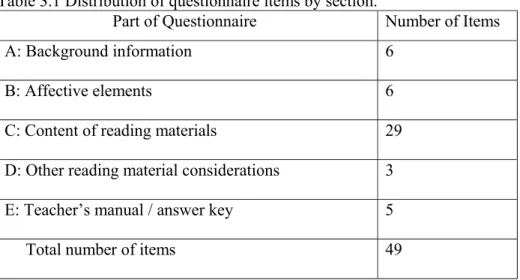
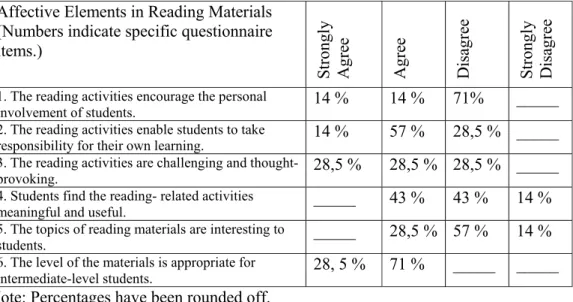
2.1. Summary of General Textbook Evaluation Criteria………....22 3.1. Distribution of Questionnaire Items by Sections……….48 3.2. Inventory of Questionnaire Items by Topics in the Literature Review...49 4.1. Summary of Participants’ Responses for Questionnaire Items Related to
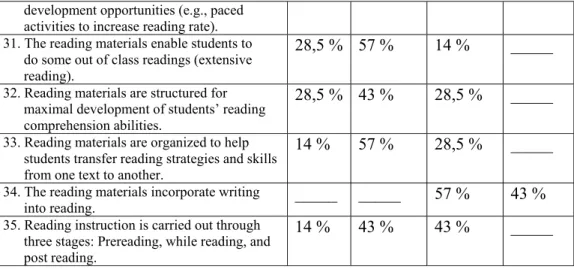
Affective Elements of Currently- Used Reading Materials………..58 4.2. Summary of Participants’ Responses for Questionnaire Items Related to Content of Currently- Used Reading Materials ………..61 4.3. Summary of Participants’ Responses for Questionnaire Items Related to
Other Reading Material Considerations of Currently- Used Reading
Materials ……….63
4.4. Summary of Participants’ Responses for Questionnaire Items Related to Teacher’s Manual/ Answer Key ………64
LIST OF FIGURES
CHAPTER 1: INTRODUCTION Introduction
Successful language teaching and learning depends on giving appropriate consideration to factors that affect language learning and teaching. These factors include the role of teacher and the learner, the syllabus, institutional constraints, and instructional materials, including textbooks. In most instructional settings, textbooks play an essential role in providing effective language instruction since language teachers usually base their teaching on language textbooks. In some settings, textbooks actually define the curriculum, indicating the importance often placed on textbooks. Taking these ideas as starting points, the purpose of this study is to find out the extent to which teachers of English know how to evaluate reading textbooks, teachers’ reasons for evaluating textbooks, and what criteria they use for evaluation.
The study was conducted in the Preparatory School of Anadolu University, Eskisehir, Turkey in the spring term of 2003. The results of this study should indicate whether teachers at this institution would benefit from any in-service training for evaluating textbooks, in particular reading textbooks.
Background of the Study
Textbooks, as one type of instructional material, are one of numerous factors that may affect the effectiveness of language teaching and learning. Although using appropriate textbooks, and other instructional materials, is a primary concern of language teachers, as they are the ones who use the textbooks and materials in their classrooms, most teachers often lack the required training in textbook and material evaluation. Pakkan (1997) states that English language teachers are usually equipped with methodology knowledge, such as approaches,
methods, and techniques used in language teaching. However, almost no training is provided in evaluating textbooks, even if textbooks play a crucial role in their classrooms.
A published English language teaching (ELT) textbook can be defined as a commercially available book that provides content, teaching, and learning activities including explanations, examples, exercises, tasks, activities, and graphical elements to help learners of English improve their language skills and abilities (Byrd, 2001; Sheldon, 1987). Language teachers have many reasons for preferring to use commercial textbooks in their classrooms. First of all, language teaching textbooks are written by experienced professionals and the materials are most likely piloted in real classroom environments before being published. Secondly, maintaining consistency across courses remains one of the primary concerns of language program administrators, and using textbooks helps language teachers to maintain a degree of consistency in courses at institutions where different teachers, with a range of professional skills and personality traits, teach the same course. Thirdly, textbooks can bring the real world into artificial classroom settings making it possible for learners to relate language components to actual usage. Lastly, a good textbook helps learners realize how much progress they have made, provides practice in what has been learned so far, and gives them opportunities to review materials on their own.
Since textbooks and other instructional materials used in classrooms are usually regarded as the core of teaching (Pakkan, 1997), teachers of English need to be able to evaluate textbooks and other materials that they may use, will use, or are using. Simply using a textbook, and other instructional materials, is not enough since textbooks and materials do not always meet the needs of learners or
the teacher. Nor do they always complement the goals and objectives of the course and the institution (Brown, 1995; Byrd, 2001; Pakkan, 1997). Because of these possible mismatches, teachers need to know how to evaluate the textbooks that they are using in order to determine their appropriateness in terms of
students’ needs, teachers’ needs, institutional constraints, physical characteristics of the institution, logistical characteristics of the textbook, supplementary materials, and editorial qualities of the textbook under review.
There are seven commonly cited considerations to be addressed in textbook evaluation. First, textbooks used for a particular course should fit the curriculum. Secondly, textbooks should meet the needs of the students they are addressing. Thirdly, textbooks should meet teachers’ needs. Fourthly, the author’s and/or publisher’s backgrounds should be considered. As the fifth and sixth
considerations, teachers should evaluate textbooks in terms of their physical characteristics and logistics. Lastly, physical conditions of the setting in which the textbook will be used should be kept in mind during evaluation.
Textbook evaluation is a complex process, which is often carried out in two stages: External evaluation and internal evaluation. External evaluation, the first stage, occurs when teachers evaluate the textbook by analyzing its contents, organization, explanations, and exercises. External evaluation can be carried out in two ways: initial evaluation and detailed evaluation. In initial evaluation, teachers look at the preface, contents, and the abstract of the textbook often on the back cover, in order to determine whether the textbook is suitable for learners’ needs and the purposes of the course. Detailed evaluation, on the other hand, is a process in which teachers use checklists and evaluation forms to complete a more objective evaluation of the textbook.
In the second stage of evaluation, internal evaluation, teachers try to evaluate the effectiveness of textbooks while actually using them in their classes. ‘Macro evaluation’ and ‘micro evaluation’ are two ways of internal evaluation. Macro evaluation can be defined as an overall assessment of whether the textbooks actually work in classroom settings. In micro evaluation, teachers choose one particular unit or a task and evaluate its usefulness and suitability in detail (Ellis, 1997; McDonough & Shaw, 1993; Pakkan, 1997). Teachers can make use of any of these evaluation methods to make sure that the textbook that they may use or that they are using is best suited to their students’ needs, their needs as teachers, and institutional requirements.
Reading-skill textbooks require evaluation, just like other textbooks. Reading, as one of the four major skills, is required in many facets of life. In educational settings, good reading skills guarantee success (Crandall, 1995; Grabe & Stoller, 2001). Carrell and Grabe (2002) also state that “reading abilities are critical for academic learning” (p. 233). In addition, Carrell and Grabe (2002) add that teaching reading skills is a challenging task and it requires much time and many resources; so, reading teachers face many challenges in the classroom. In order to ease the challenges that teachers face in reading classes, appropriate instructional materials, including textbooks, should be used. Thus, thorough and effective evaluation of reading textbooks is important.
Teachers should be aware of reading textbook evaluation criteria, which includes knowledge of the academic reading needs of learners. In academic reading, first of all, students need large vocabulary storage and various
opportunities for recycling this vocabulary. Secondly, students need to recognize words rapidly and automatically. Recognizing the purpose for reading or
becoming aware of one’s reading purpose can be counted as the third need. Acquiring strategic reading skills and becoming aware of reading strategies are further student needs. As the fifth need, academic reading requires that learners integrate text information with their knowledge and/or activate their background knowledge. Reading critically and acquiring evaluation skills can be regarded as two additional needs of students in academic settings. Lastly, students should be encouraged to read and take responsibility for their own learning (Carrell & Grabe, 2002; Grabe & Stoller, 2001). When teachers are familiar with the needs of academically-oriented students in reading classes, they are better able to choose a well-suited reading textbook.
In conclusion, textbook evaluation is a complex phenomenon. It requires careful attention to general textbook evaluation criteria, such as a textbook’s fit with students, teachers and institutional goals; physical conditions of the teaching setting and logistical characteristics; editorial qualities of the book; and
considerations of the physical conditions of the setting in which the textbook is going to be used. Reading textbook evaluation adds other dimensions to the evaluation process; it requires an understanding of students’ academic reading needs, such as having large vocabulary storage, becoming aware of purposes of reading, acquiring strategic reading skills, activating background knowledge, making use of critical reading skills, and using evaluation skills. Only when these factors are analyzed by teachers in detail is it possible for teachers to choose the best-suited textbook for academic reading classes.
Statement of the Problem
Better textbooks and materials can lead to improved teaching and learning (Pakkan, 1997) since teachers usually use language textbooks, and other
materials, to guide their teaching or to set the parameters of their courses. To find out the extent to which textbooks meet the needs of learners and complement course and institutional objectives, teachers need to evaluate the materials and textbooks that they use or that they may use (Brown, 1995; Byrd, 2001; Pakkan, 1997). Although most professionals would argue that textbooks and materials play a crucial role in effective language teaching and learning, few, if any, empirical studies have been conducted on teachers’ abilities to evaluate textbooks and materials or on the criteria that they use for evaluation. There are, however, many descriptive articles on how the evaluation of a textbook can be carried out and what criteria teachers should use. Because of this mismatch, there is a need for an empirical study on textbook evaluation.
The aim of this study is to determine teachers’ abilities to judge the appropriateness of textbooks for language teaching instruction in English
language teaching classrooms at Anadolu University. The study will be beneficial to those working at the Preparatory School of Foreign Languages at Anadolu University in the sense that results of this study may reveal whether teachers need in-service training on textbook evaluation or not. Although the study will be carried out at Anadolu University, the results may be valuable to all teachers of English who may be required to evaluate textbooks, in particular academic reading textbooks.
Currently, no textbook is used for reading courses at Anadolu University. Rather, materials collected from different sources are used. These collections represent little more than an exercise book that addresses only some reading skills. In other words, those materials, which make up the course pack, cannot meet either teachers or students’ needs in terms of academic reading instruction.
In addition, in the coming years, there may be a change in the curriculum and a new reading textbook may be required. In this case, teachers need to be able to evaluate textbooks to determine the extent to which the textbooks address learners’ and teachers’ needs and institutional goals and objectives.
Research Questions
This study will address the following research questions:
1- How do teachers at Anadolu University, School of Foreign Languages, evaluate the reading materials that they are currently using?
2- What criteria do teachers at Anadolu University, School of Foreign Languages, use in evaluating reading textbooks?
3- To what extent do textbook evaluation criteria change when teachers are trained in textbook evaluation?
Significance of the Problem
Lack of training in evaluating materials and textbooks is one of the
drawbacks of education provided to teachers of English. Many descriptive articles in the literature discuss how to evaluate textbooks, but few empirical studies have been conducted on teachers’ abilities to evaluate textbooks and the criteria that they use. Acquiring the ability to evaluate textbooks and materials is crucial for English teachers as they are the ones who will experience whether a textbook or materials are good enough for their students, or whether the textbook and materials need to be adapted and supplemented. Keeping the importance of textbooks and materials for effective language teaching and learning in mind, in this study I will try to find out whether teachers know how to evaluate reading textbooks, what criteria they consider in the evaluation process, and whether teachers need any training in textbook evaluation.
The results of this study may help current teachers and prospective teachers of English understand the criteria that they should keep in mind while evaluating textbooks; this understanding will help them become more knowledgeable and successful textbook evaluators. Primarily, the Preparatory School of Anadolu University will benefit from the results of this study. The study provided teachers at Anadolu University with the opportunity to assess their textbook evaluation criteria and, as a result, teachers became aware of their abilities. Furthermore, the study added new dimensions to their English language teaching knowledge by introducing them to new criteria for evaluating textbooks in a training session. In the future, these teachers may be able to use insights gained in the training session in the evaluation of textbooks that they may use in their classrooms. Moreover, this research may reveal a need for pre-service and in-service training of teachers on the evaluation of textbooks and materials that are used in their classrooms.
Key Terminology
The following items are used frequently throughout the thesis. They are listed here with their definitions.
External evaluation: Evaluation of a textbook by analyzing its contents, organization, explanations, and exercises. There are two types of external
evaluation: initial evaluation and detailed evaluation. External evaluation is often referred to as predictive evaluation.
Internal evaluation: Evaluation of a textbook while using it in the classroom or after using it in the classroom. There are two types of internal evaluation: macro evaluation and micro evaluation. Internal evaluation is often referred to as in-use evaluation, or retrospective evaluation.
CHAPTER 2: LITERATURE REVIEW Introduction
There are many factors that affect language learning and teaching including the role of the teacher and the learner, the syllabus, institutional constraints, such as physical conditions, resources, monetary matters, class size, and instructional materials including textbooks used in the classroom. To achieve the most effective language teaching and learning, each of these factors should be considered with care. Yet, in this chapter, I will focus on just one of these factors, specifically textbooks. To do so, I will present reasons for using and evaluating textbooks, a description of the textbook evaluation process, and textbook evaluation criteria. I will also explain the complex nature of reading processes since this study focuses on reading textbooks. This is followed by a description of the academic reading needs of students, and the ideal content of an academic reading textbook.
Reasons for Using and Evaluating Textbooks
Instructional materials, including textbooks, are regarded as sources of learning that play a crucial role in the effectiveness of teaching and learning languages. Crawford (2001) claims that instructional materials receive primary attention because they are usually used as a means for language input and language practice in classrooms. Textbooks usually help the teacher and students exploit classroom opportunities more effectively (Crawford, 2002; Nunan & Lamb, 1998; Pakkan, 1997). Sheldon (1987) defines a language textbook as a published book with the dual aim of (a) helping learners to improve their language knowledge, skills, and abilities, and (b) supporting teachers to enhance teaching and learning. Textbooks, designed for presenting teaching and learning activities, usually contain content, explanations, examples, exercises, activities, graphical elements, and
illustrations in order to make teaching and learning easier for teachers and learners (Byrd, 2001). As Crawford (2002), Grant (1987), Richards (2001), and Sheldon (1987) all claim, no textbook can be a perfect match for students, teachers, and institutional goals. The reason for this predictable mismatch is that purposes for learning differ among learners, and objectives change from one institution and teacher to another. As Crawford (2002) admits, a textbook can be ideal for one particular group of students, and the same textbook may fail to respond to the requirements of students, teachers, and institutions in different situations, possibly in the same institution. However, some textbooks can be more appropriate than others; so, choosing the best-suited textbook — one that addresses the targeted goals and objectives of students, teachers, and institutions — represents an important responsibility for a language program. Textbook evaluations and selections are best accomplished with the participation of teachers, level
coordinators, and/or administrators (Chambers, 1997; Grant, 1987; Graves, 2000; Nunan & Lamb, 1998; Sheldon, 1987).
There are various advantages of using a textbook in language teaching (Graves, 2000; Richards, 2001; Tomlinson, 1998). First of all, textbooks are prepared by experienced and well-qualified professionals. Secondly, textbooks are usually piloted in real teaching environments before they are published. As a third reason, Crawford (2002), Graves (2000), and Tomlinson (1998) suggest that textbooks provide invaluable help to inexperienced teachers and a bank of useful ideas, activities, and tasks for more experienced teachers. Textbooks often provide the framework for course syllabi since what will be learned and taught, and the order in which it will be taught, has already been defined by the author(s) of the textbook. Moreover, a language textbook can help teachers to save time as
textbooks often provide a set of visuals, activities, readings, exercises, tasks, and so on that can be used to structure class sessions. Another advantage of using a well-chosen textbook is that it often provides supporting materials like cassettes, worksheets, audio-visuals, and/or manuals. Maintaining a degree of consistency among teachers who teach the same course is another source of usefulness for using a textbook as individual teachers bring different professional backgrounds and personality traits into the classroom (Crawford, 2002; Graves, 2000; Pakkan, 1997).
An effective textbook is useful for learners too. Learners can connect
language items to actual usage because an effective textbook usually brings the real world into the somewhat artificial classroom environment. Likewise, a good textbook can help learners measure their rate of progress and provide opportunities for practice outside of classroom instruction (Pakkan, 1997). In addition, Graves (2000) believes that students feel secure with textbooks as they know what to expect and they become aware of what is expected of them.
It is possible to find thousands of language textbooks on the market today. Since textbooks vary in quantity and quality, it is not an easy job to decide on one and use it without hesitation (Grant, 1987). In addition, the possible negative outcome of using an inappropriate textbook cannot be disregarded. Past experiences with improperly selected textbooks or textbooks that poorly match students’ needs provide an impetus for the careful evaluation of textbooks. Teachers actually evaluate textbooks for various reasons. Brown (1995) suggests that teachers need to evaluate textbooks in order to measure their suitability for their programs that already have agreed upon goals and objectives. The contents of textbooks, including examples and explanations, and their relevance to the students and institution where it will be used are issues to be considered. The language-skill focus of textbooks
needs to be evaluated to find the best match to the curriculum since one or more skills, or aspects of language, may be given more emphasis than others. Because better textbooks lead to better teaching and learning of the target language, teachers need to question the effectiveness of textbooks that they may use in their classes.
Textbook Evaluation Process
Textbook evaluation is a complex issue because it can be carried out in different ways and at different levels with different textbook-evaluation methods. Thus, teachers should be familiar with the ways, levels, and methods of textbook evaluation to be able to choose the best-suited textbook for their institutions. Professionals in the field identify two principal methods for evaluating textbooks that can help teachers to choose the most appropriate textbook for their classes. In situations where teachers are required to evaluate textbooks, they can either rely on evaluations by others, such as expert reviewers, which often remain inexact, or they may prefer to evaluate textbooks on their own by using checklists and guidelines (Ellis, 1997).
Textbook evaluation occurs at two levels: the local level and state level. Local-level textbook evaluation occurs when teachers who teach in the classroom make decisions about textbooks either individually or as a group of teachers. Sometimes local-level decisions are made by administrators who select the
textbooks that are used in the classroom. State-level textbook evaluation is different. In some countries, like Turkey, the Board of Education is in charge of choosing textbooks to be used in state schools throughout the country. This is an example of state-level textbook evaluation. Although teachers are not always part of the textbook decision-making process, they need to be aware of how the evaluation system works since they are the ones who use the selected textbooks. Moreover,
they will inevitably determine whether the textbook is worth using, which parts work, and which parts need modification (Byrd, 2001; Ellis, 1997).
When teachers are required to evaluate a textbook, McDonough and Shaw (1993) suggest two types of textbook evaluation: external evaluation and internal evaluation. In external evaluation, sometimes called predictive evaluation, teachers evaluate the textbook by analyzing its contents, organization, explanations, and exercises. External evaluation can be carried out in two ways: initial evaluation and detailed evaluation (Pakkan, 1997). Looking at the preface, contents, and abstract of the textbook, and analyzing the textbook to see the extent to which the textbook is suitable for learners' needs, the purposes of the course, and the institution represent the essential steps of initial evaluation. Detailed evaluation, on the other hand, as defined by Pakkan (1997), usually requires evaluation check lists and evaluation forms to make more detailed evaluations of textbooks. Ellis (1997), Grant (1987), McDonough & Shaw (1993), and Pakkan (1997) all agree that looking through a textbook, as part of an initial evaluation, can be a quite subjective form of evaluation; so, detailed evaluation is needed for more reliable and objective evaluation since it usually provides information about how the materials are organized. In addition, detailed evaluation reveals information about vocabulary, study skills, and functions that are to be covered.
In the second type of evaluation, internal evaluation, teachers evaluate the effectiveness of textbooks while actually using them in their classrooms (Grant, 1987; McDonough & Shaw, 1993). Ellis (1997) and Pakkan (1997) label this type of evaluation as in-use evaluation, or retrospective evaluation. Internal evaluation can be carried out in two ways: macro evaluation and micro evaluation (Ellis, 1997). Macro evaluation is defined as an overall assessment of whether the
textbook worked well or not during teaching. In micro evaluation, the teacher chooses one particular unit or a teaching task and evaluates it in more detail in terms of its usefulness and suitability (Ellis, 1997).
Textbook Evaluation Criteria
In the evaluation of textbooks, a basic step is to find out the extent to which the textbook responds to the goals and objectives of students, teachers, and particular institutions. To achieve an effective evaluation, initially students’ needs and the purposes for teaching and learning a language should be clearly understood. Learners’ needs and purposes, and the goals and objectives of the institution and the course, should be defined so that the criteria for textbook evaluation can be framed properly. Preparing a reasonable, yet comprehensive, checklist of evaluation criteria can be a challenging job because of the need to incorporate so many important elements, including (a) the textbook’s fit with the curriculum, students, and
teachers; (b) the author(s) / publisher(s) background; (c) physical characteristics of the textbook; (d) logistical characteristics of the textbook; and (e) physical
conditions of the classroom where the textbook is to be used.
A textbook’s fit with the curriculum is the first criterion to be taken into consideration while evaluating a textbook. Textbooks that are selected should be appropriate for the curricular goals and objectives of the institution (Brown, 1995; Byrd, 2001; Nunan & Lamb, 1998; Pakkan, 1997; Richards, 2001). In the case of a mismatch, the result may be failure (Byrd, 2001). When evaluating a textbook to determine its appropriacy at the curriculum level, teachers should verify the educational principles and approach that the textbook is based on. The extent to which the textbook syllabus agrees with the institution’s syllabus and whether the textbook is well-organized are to be questioned in the evaluation process. The
general language needs of target student populations, and their levels of language proficiency, are issues to be considered as well. The nature and form of any required internal or external language examinations are other questions to be posed in measuring a textbook’s relevancy to the curriculum of a particular institution. In addition, teachers need to question whether the language program is required or optional for students, or whether learning English is professionally and/or socially advantageous for the learners so that an objective evaluation can be carried out. The suitability of a textbook can change depending on whether the language program is required or optional. In the case of a required language program, more intensively designed textbooks may be preferable. However, in language programs where language learning is optional, a textbook that presents a general overview of the target language can be viewed as more suitable (Brown, 1995; Pakkan, 1997; Richards, 2001; Tomlinson, 1998). In addition, the consistency of lessons, techniques, and exercises in the textbook are other important points that teachers need to take into consideration while evaluating a textbook in light of a home institution’s curriculum (Brown, 1995; Byrd, 2001; McDonough & Shaw, 1993; Pakman, 1997). In short, textbooks should be responsive to curricula and course objectives.
The second criterion is the textbook’s fit with students. Primarily, textbooks should be appropriate for the age level and language proficiency of learners (Brown, 1995; Byrd, 2001; McDonough & Shaw, 1993; Pakman, 1997). For instance, adopting a children’s textbook for adult learners will most probably not work. Similarly, selecting an intermediate textbook for beginner learners would be quite unreasonable and illogical. Secondly, learners' educational backgrounds and needs are two important considerations to be kept in mind when evaluating a
textbook’s fit with students. Brown (1995) states that students with no language education background would have difficulty with textbooks that do not provide necessary background knowledge for what is being taught and learned.
Teachers should also consider students’ purposes for learning a language. Students may need the target language to advance in their academic studies or survive when they go abroad. In the first case, textbooks addressing skills and strategies needed to support academic study could be viewed as effective textbooks, whereas, in the second case, textbooks that provide learners with exposure to the target language culture and general daily usage of the language would be a good match with the needs of the students (Brown, 1995; Byrd, 2001; Graves, 2000; Pakkan, 1997).
Students’ interests should also be taken into consideration while evaluating a textbook’s fit with students (Brown, 1995; Byrd, 2001; Graves, 2000; McDonough & Shaw, 1993; Nunan & Lamb, 1998; Pakkan, 1997; Richards, 2001). Ideally, teachers should know a lot about their students (Byrd, 2001; Pakkan, 1997) in order to compare objectively what the textbook offers and the extent to which there is match between the textbook and students` interests. The textbook should include tasks, activities, and content that interest students so that students become more motivated to learn.
Because each student has his own personality traits, preferences, likes, and dislikes, students differ from one another. These differences result in different learning styles being represented in every class. Some students prefer to learn by visuals whereas others prefer to listen to the teacher. Some may learn by doing and practicing on their own rather than watching or listening. In short, teachers should find an appropriate balance between students’ learning styles and evaluate the
textbook considering this balance. How a textbook responds to these differences is an important consideration in the evaluation of a textbook’s fit with students (Ehrman, 1996; Grant, 1987; Lightbown & Spada, 1999).
Students’ cognitive and affective needs should also be taken into
consideration when evaluating the suitability of a textbook. A good textbook should meet students’ future academic needs, including the ability to transfer what is learned in the language classroom to tasks done outside the class. In some settings, textbook activities, tasks, and techniques should allow students to solve problems, discover, analyze, and synthesize. In all settings, whatever is done in class based on the textbook should be motivating and challenging at the same time (Anderson, 1999; Brown, 1995; Crawford, 2002). In sum, a well-suited textbook should respond to learners’ affective needs, motivating them to learn, building their self-confidence, and guiding them in taking responsibility for their own learning.
A textbook’s fit with teachers’ needs is the third criterion to be examined (Brown,1995; Byrd, 2001; Graves, 2000; McDonough & Shaw, 1993; Nunan & Lamb, 1998; Pakkan, 1997). Teachers should question whether they can handle the textbook, and whether the textbook meets their needs (Byrd, 2001). The textbook should be teacher friendly. In other words, teachers should be able to handle the textbook and the textbook should provide content that teachers find appropriate for carrying out the goals of the course and program. There should be a fit between the content of the textbook and the knowledge base of the teachers so that teachers can explain the contents of the textbook to their students. Supplementary materials, if available, should also be evaluated from the teachers’ perspective (Brown, 1995; Byrd, 2001; McDonough & Shaw, 1993; Pakkan, 1997). Textbooks that provide a teacher’s manual, audiotapes, workbooks, and answer keys are favorable since
supplementary materials, such as these, help teachers to teach effectively and realize the stated goals and objectives of their institutions (Brown, 1995). In short, textbooks should make a teacher’s job easier.
The background of author(s) and publisher(s) is the fourth criterion to be taken into consideration in the evaluation of a textbook. Teachers need to ask if the author(s) has any relevant experiences (e.g., formal training in materials
development or teaching) to write a textbook. Teachers might also try to determine if there are any other textbooks available written by the same author. Authors’ and publishers’ reputations represent other issues worthy of consideration. Another issue is if there is any published textbook by the same company (Brown, 1995; Pakkan, 1997; Tomlinson, 1998). A thorough textbook evaluation takes issues such as these into consideration.
The physical characteristics of textbooks are the fifth criterion that teachers need to question as part of the textbook evaluation process. Basically, there are four points related to physical characteristics that are worthy of consideration: layout, organization, editorial qualities, and material quality (Brown, 1995; Pakkan, 1997; Tomlinson, 1998). When evaluating a textbook’s layout, spacing, pictures, texts, and highlighting are important. The textbook should provide enough free space on each page. In addition, legibility, authenticity, and clarity of pictures and texts should be considered to determine the quality. Similarly, the number of pictures and number of texts should be adequate. The extent to which language components are focused on and whether the targeted skills are dealt with appropriately are worth considering as well (Brown, 1995; Byrd, 2001; Pakkan, 1997; Tomlinson, 1998).
Organization is the next issue related to the physical characteristics of a textbook. A good textbook should have a table of contents that clearly sets out
which and in which order language skills, strategies, and structures are presented (Brown, 1995; Grant, 1987). A good textbook will also have indexes to help teachers and students find explanations, special lists, special tables and visual displays (e.g., verb conjugations) that might enable learners to comprehend better. Answer keys help both teachers and students before and after class. A glossary saves teachers time and makes vocabulary learning easier for students (Brown, 1995; McDonough & Shaw, 1993; Nunan & Lamb, 1998; Pakkan, 1997).
Editorial qualities and material quality are two other elements that teachers should keep in mind while evaluating a textbook’s physical characteristics. Accuracy of content and a clear and consistent editorial style are necessary. Directions and examples that are clear and easy to follow for both teachers and students are important to look for while evaluating a textbook (Pakkan, 1997). Brown (1995) suggests that teachers should also evaluate the quality of paper and binding, and the possibility of pages falling apart if there are any tear-out pages provided in the textbook. Crawford (2002) reinforces the importance of the quality of the material when she states “the quality of the material is… important because of its impact on learners and their motivation” (p. 85).
Logistical characteristics of a textbook are the sixth criterion in evaluating a textbook. Logistical characteristics include the price, auxiliary parts (supplementary materials), and availability of the textbook. As Nunan and Lamb (1998) suggest, the price of the textbook should be usually one of a teacher’s primary concerns while evaluating a textbook. The price of the book should be affordable for both teachers and students (Nunan & Lamb, 1998; Pakkan, 1997).
Supplementary materials that are available represent another logistical
workbooks, software, and unit tests. Brown (1995), Byrd (2001), Crawford (2002), McDonough and Shaw (1993), and Pakkan (1997) all agree that the audio-visual materials should be well-developed for teaching purposes, and that they should be well-integrated with textbook lessons. In addition, the sequence of the units and subjects in a textbook should be coherently linked. There should be consistency between the workbook and the textbook that is used in class. Software, when provided or available, must be evaluated in terms of an institution’s ability to provide necessary technical support. Moreover, unit tests that textbooks provide can be useful for teachers and students. Teachers can use those unit tests as sources for measuring students’ progress. Textbook availability remains as the final issue related with the logistical characteristics of a textbook. Teachers and students should not have any difficulty in obtaining the textbook (Brown, 1995; Pakkan, 1997). Logically, the textbook should be easily accessible.
The physical condition of the classrooms where the textbook is used is the seventh criterion that teachers should consider in the evaluation process (Brown, 1995; McDonough & Shaw, 1993; Pakkan, 1997; Tomlinson, 1998). The number of students, classroom size, flexibility of seating arrangements, board space, available audio-visual equipment, time constraints (e.g., number of teaching hours allocated per week to language teaching), duration of class sessions, and the time of
instruction are some factors that may affect language teaching efficiency. The activities and tasks that the textbook advocates should be appropriate for the classroom size. In addition, the activities and tasks should be compatible with available class time. These are all elements to be questioned by teachers while evaluating the textbooks' suitability for the course and the program (Brown, 1995; Pakkan, 1997; Tomlinson, 1998). For instance, it would be unreasonable to choose
a textbook that favors large group work for small classes or where students cannot form groups due to space or furniture limitations.
The seven considerations just presented (and which are summarized in Table 2.1.) can be regarded as general textbook evaluation criteria. These seven
considerations are derived from the professional literature. Although they are highlighted in the literature, there is no empirical research on the effectiveness of these seven considerations.
Table 2.1. Summary of general textbook evaluation criteria 1. Textbook’ fit with the curriculum
2.Textbook’s fit with students’ needs 3.Textbook’s fit with teachers’ needs 4.Background of author(s) and publisher(s) 5.Physical characteristics of the textbook 6.Logistical characteristics of the textbook
7.Physical conditions of the classroom where the textbook is used
Despite the importance of these seven general criteria, when textbooks are actually evaluated, more specific criteria take on greater importance. For instance, textbooks targeting particular skills should include elements necessary for the development of that particular skill. Academic reading textbooks, as an example of textbooks designed for skill instruction, should be evaluated in terms of whether they cover academic reading skills adequately and whether they are in line with current thinking about the skill. To develop this notion further, the next two sections will deal with reading in academic settings, students’ academic reading needs, and the elements of comprehensive academic reading textbooks. The issues covered
represent topics that should be considered when determining the appropriateness of a reading textbook.
Reading in English for Academic Purposes
Because reading is one of the most powerful sources of language input (Anderson, 1999; Crandall, 1995), many language programs adopt reading
textbooks to guide their instruction and define their objectives. Reading is required in many aspects of life, including educational and many work place settings. In such settings, good reading skills ensure success and development. In other words, students need to read not only in class but also out of class for a variety of purposes (Crandall, 1995; Grabe & Stoller, 2001). The importance of reading abilities is explained well by Carrell and Grabe (2002) who say that “reading abilities are critical for academic learning” (p. 233). In addition, Anderson (1999) states that developed reading skills enable students to make progress and attain greater development in all academic areas. Moreover, teaching students how to read efficiently should be a major curricular goal. Grabe (1991) also explains the goal of reading instruction as follows:
For teachers, the goal of reading instruction [is] to provide students with a range of effective approaches to texts —including helping students define goals and strategies for reading, to use prereading activities to enhance conceptual readiness, and to provide students strategies to deal with difficult syntax, vocabulary and organizational structure (p. 377).
In addition, Carrell and Grabe (2002) suggest that reading is complex and the development of reading abilities is a challenging task, partially because it requires much time, many resources, and sustained effort. Because of these conditions, reading teachers face many challenges in the classroom. Teaching students how to utilize skills and knowledge that have been acquired before, develop vocabulary learning strategies and increase vocabulary storage, and develop reading
comprehension and reading rate are some responsibilities of a reading teacher. In addition, Grabe (1991) adds that reading teachers should help students use strategies successfully and monitor their own improvement. Some other
responsibilities of reading teachers include teaching students to take responsibility for their own learning, enabling them to be involved in reading tasks, and helping them to have increased motivation to read more (Carlisle, 2000; Carrell & Grabe, 2002; Crawford, 2002; Grabe & Stoller, 2001).
Because reading is a complex phenomenon (Carrell & Grabe, 2002; Grabe & Stoller, 2001), it cannot be defined easily. Nonetheless, Grabe and Stoller (2001) define reading as drawing information from a text and combining it with already acquired information. In addition, facts about reading can help to define reading. As stated by Grabe (1991), research on reading has revealed some facts about the development of reading skills, and these facts can help teachers enable their students to develop reading skills. The first fact is that reading is an active process because there is always interaction between what a reader knows and what s/he is learning from the text. In addition, a variety of subskills and strategies are required for the reader to construct meaning from the text and this makes reading an active process of getting information (Anderson, 1999; Doreen, 1999). Another fact about reading is that reading is a recursive process. Recursiveness in reading can be directly explained by means of what Zamel (1992) points out when she says that “reading is open to revision, reading is work in progress” (p. 472).
In order to teach reading as active and recursive processes, teachers should pay attention to schemata activation, or activation of background knowledge (Carrell & Grabe, 2002; Grabe & Stoller, 2001; Leki, 1993). As Li and Munby (1996), and Janzen and Stoller (1998) claim, background knowledge is important and it plays
an inevitable role in reading comprehension. Reading texts usually contain new information, new concepts, and/or new ideas, and they can have greater meaning when the readers relate this content to something that the individual reader already knows. This is why activation of background knowledge is necessary in reading. For Janzen and Stoller (1998), students who are familiar with the content of the texts that they are asked to read can deal with more difficult texts. Similarly, Li and Munby (1996) claim that “successful L2 readers [are] capable of using personal and general knowledge to associate with the text being read” (p. 205).
There are a number of ways teachers can activate students’ background
knowledge. First, students need to understand that, in reading, they need to activate their schemata and background knowledge because it will improve their
comprehension abilities. Second, students should be provided with a variety of opportunities to activate their schemata or background knowledge. Activating student’s background knowledge can be achieved by a variety of techniques. Prereading activities, such as webbing, mapping, and brainstorming, are effective ways of activating schemata. Third, having students reread texts gives them practice in making connections with information already acquired. Lastly, reading relevant texts on a similar topic can help students activate their schemata. Some of the advantages of providing related texts are explained by Shih (1992) who states that “new concepts and vocabulary are recycled and reinforced when students are asked to read related texts” (p. 295).
Anderson (1999), Crandall (1995), Doreen (1999), Grabe and Stoller (2002), and Leki (1993) all agree that reading involves an interactive process. Thus, in comprehending a text, good readers use not only background knowledge but also the information in the text. Readers construct meaning through this interaction with
the text. Morino (1998) reinforces the importance of this interaction when stating that “in reading, readers read and react to what another person wrote” (p. 7).
Another fact about reading is that efficient reading is rapid. This means that readers must read at a sufficient rate to comprehend and make connections and inferences (Carrell & Grabe, 2002; Grabe & Stoller, 2001). Defining a purpose for reading is another feature of the reading skill that teachers should know because having a purpose increases motivation and results in better readers (Doreen, 1999; Grabe & Stoller, 2001). Another important feature of reading, often seen as the essence of reading, is that it is a ‘comprehending’ process which can be defined as understanding what is being read. For Grabe (1991), ‘flexible reading’ can be regarded as an additional feature of reading. Reading skill naturally requires a range of strategies and various subskills such as skimming, scanning, and adjusting reading rate. In this sense, it is possible to define reading as flexible since when one strategy fails, the other strategies can be appropriate.
Next, it is a fact that reading develops over time. Obviously, a reader cannot become a fluent reader, or develop effective reading skills, after reading one book; so, the more students read, the better readers they become. In short, to become fluent readers requires a long-term effort and commitment. The last fact that Carrell and Grabe (2002) point out is that reading is a complex issue and it cannot be taught in a short time. The development of reading skills requires considerable time and resources.
Reading abilities are required for a variety of reading purposes (Anderson, 1999; Carrell & Grabe, 2002; Doreen, 1999; Grabe & Stoller, 2001). These purposes are defined by Grabe and Stoller ( 2002) as follows: (a) Students read to search for simple information, (b) students read to skim quickly, (c) students read to
learn from text, (d) students read to integrate information that has been acquired before, (e) students read to search for information needed for writing, (f) students read to critique texts, and lastly, (g) students read for general comprehension. Reading for academic purposes is usually confined to reading to search for
information, reading for general comprehension, reading to learn new information, and lastly reading to synthesize and evaluate information (Carrell & Grabe, 2002; Grabe & Stoller, 2001).
Reading to search for information is one of the purposes for academic reading. Grabe & Stoller (2002) indicate that reading to search for information requires students to develop cognitive processes. Scanning a text for particular information (e.g., a date, name, word) and skimming a text in order to get the main idea are some skills needed for this purpose. In addition, guessing where important
information is through a combination of reading strategies can address the needs of reading to search for information (Carrell & Grabe, 2002; Grabe & Stoller, 2001). Reading for general comprehension, as explained by Grabe and Stoller (2002), requires skills such as rapid and automatic word recognition, and the coordination of reading processes. Lower-level processes involve (a) lexical access, (b) syntactic knowledge, (c) semantic proposition information, and (d) working memory
activation. Higher level processes involve (a) text comprehension, (b) the situation model of reader interpretation, and (c) prior knowledge use and inferencing. Both lower- and higher-level processing must occur rapidly for efficient reading. In addition, reading for general comprehension involves strongly developed skills in shaping a general meaning from a text.
The third purpose for reading in academic settings is to learn information from a text. Reading to learn information requires formulating and recalling main
ideas/details, elaborating supporting ideas/details, and building knowledge of rhetorical frames (compare and contrast, narrative, argumentative, process, etc.). In addition, linking the text to the reader’s knowledge base, or inferencing, are two other abilities required to achieve this purpose (Anderson, 1999; Carrell & Grabe, 2002; Grabe & Stoller, 2001).
The last purpose for reading in academic settings is that students read to integrate information, write, and critique texts. Academic reading requires critical evaluation of what is being read and the integration of new information with already acquired knowledge (Anderson, 1999; Carrell & Grabe, 2002; Grabe & Stoller, 2001; Janzen & Stoller, 1998). In addition, as Grabe & Stoller (2002) indicate, composing, selecting, and critiquing information from a text are other abilities that can be developed during reading. In this sense, whatever is done in planning and implementing reading classes (in terms of activities, tasks, assignments, choice of materials, design of curriculum, etc.) should fit with one of these purposes.
There are some issues that may influence the development of reading skills in academic settings. Carrell and Grabe (2002) divide these issues into three parts: (a) linguistic and processing differences, (b) individual and experiential differences, and (c) socio-cultural and institutional factors. Linguistic and processing differences may have an effect on reading development abilities. Students’ native language and the target language may have different linguistic and processing structures and this may hinder the development of reading skill. Similarly, as Carrell and Grabe (2002) suggest, learners’ interaction with their native language and target language differs. Learners use different interaction processes. In addition, the two languages may differ in terms of socio-linguistic domains; all these factors can have an effect on learners’ reading development. Lastly, learners’ language proficiencies differ, and
learners carry out tasks differently for a variety of purposes (Carrell & Grabe, 2002). These differences may influence the development of reading skill in academic settings.
Individual and experiential differences among learners can affect the development of reading abilities as well. First of all, learners have different levels of reading abilities and they differ in the amount of exposure to target-language print. Secondly, students are motivated for different purposes. Lastly, students may be exposed to different kinds of texts in target language and different language learning sources (Carrell & Grabe, 2002). Because these three factors can have an important effect on students’ reading ability development, teachers should pay attention to them
As for the last factor that may effect the development of academic reading ability, Carrell and Grabe (2002) suggest socio-cultural and institutional factors. Obviously, students may bring dissimilar socio-cultural backgrounds to the
classroom. These differences may be more noticeable in some instructional settings; dissimilarities in socio-cultural background may cause differences in the
development of reading skills. Moreover, expectations of educational institutions in native and target language cultures may differ; so, teachers should be aware of such differences because they may have an effect on reading skill development.
Basically, the issues introduced above as linguistic and processing differences, individual and experiential differences and socio-cultural and institutional factors may have an effect on the development of reading skills. Teachers should take these factors into consideration during reading instruction and also in the evaluation of textbooks that they may use in academic reading classes.
Students’ Academic Reading Needs and Implications for Academic Reading Textbooks
In academic reading settings, students’ reading needs should be addressed to help learners become more competent readers. Parallel to the depiction of reading in the previous section, students’ needs are many and varied. In general terms, as indicated in the literature, students need large vocabulary storage and various opportunities for recycling this vocabulary. Secondly, students need to recognize words rapidly and automatically. Recognizing purpose or becoming aware of reading purpose can be counted as the third need. Acquiring strategic reading skills and becoming aware of reading strategies represent other student needs. As the fifth need, integrating text information with students’ knowledge and/or activating their background knowledge are important in academic reading. Reading critically and acquiring evaluation skills can be regarded as two additional student needs in academic settings. In addition, students should be encouraged to read and take responsibility for their own learning. They should also be motivated to become personally involved in tasks, provided with opportunities to work collaboratively or on their own, and given opportunities to monitor their own learning (Carrell & Grabe, 2002; Grabe & Stoller, 2001). Moreover, because students’ learning styles vary, they can benefit from being introduced to different learning styles. In addition, they need to be engaged with the target culture. Furthermore, exposing learners to texts without social biases (e.g., sexist and racist elements) is also important in academic reading settings. Another important element is engaging learners with authentic and created materials with real-life language use. Lastly, task variations, and the ability to incorporate the tasks flexibly, are elements that help teachers to respond to learners’ academic reading needs. Each one of these needs is worthy of a
more detailed explanation, though it should be noted that every instructional setting should conduct an on-site needs analysis to determine the real academic reading needs of its students (W. Grabe, personal communication, 07 July 2003).
Vocabulary knowledge and automaticity in word recognition have a significant effect on learners’ comprehension of reading texts and acquisition of reading skills (Grabe & Stoller, 2002). First of all, academically-oriented students need large vocabulary storage and various opportunities for recycling this
vocabulary. Vocabulary learning requires a long-term effort since one cannot learn vocabulary after one simple exposure. Limited vocabulary is one of the most serious obstacles to the development of reading skill. In addition, Anderson (1999) states that readability research has proven that vocabulary plays a crucial role in reading skill development as well as academic achievement of students; this research reveals that vocabulary storage is an essential component for improving reading skills. In this sense, in order to develop academic reading abilities, students need to have certain amount of vocabulary storage.
Teaching vocabulary is an important part of reading instruction; it should be kept in mind while evaluating the effectiveness of a good reading textbook. Anderson (1999) and Grabe and Stoller (2001) propose some ways to enlarge students’ vocabulary in order to achieve advanced reading skill development. These suggestions include providing a print-rich environment, providing extensive reading opportunities, asking students to make word lists and keep diaries, incorporating prereading activities (e.g., brainstorming, semantic mapping, grouping, and
categorizing) into instruction, guiding students in making predictions, and building students’ vocabulary recognition and fluency.
Recycling new vocabulary in subsequent reading passages and exercises in a textbook is another factor that teachers should consider when reviewing a reading book. Shih (1992) also points out the importance of recycling vocabulary in reading and she explains that in reading, “new concepts and vocabulary are recycled and reinforced” (p. 295). Based on what has been pointed out above, a good reading textbook should help learners build up a large vocabulary with provisions for different learning settings, extensive reading opportunities, and various vocabulary development activities.
Secondly, students need to recognize words rapidly and automatically. Automaticity plays a vital role in reading skill development. Increasing automatic reading rate and automatic word recognition provide opportunities for developing cognitive skills (Anderson, 1999). Instead of reading one word at a time, readers who have developed automaticity can devote time to analyzing and synthesizing what is being read. Grabe and Stoller (2001) also highlight the importance of automatic recognition skills in reading comprehension and skill development. Similarly, Carrell and Grabe (2002) explain the importance of word recognition by stating that “word recognition exercises are probably useful for both older and younger L2 readers, enhancing fluency and raising students’ awareness of the processing demands of extended independent reading” (p. 238). Also, they add that vocabulary recognition is not automatic and it needs to be developed and practiced in order to be used effectively in conjunction with reading. Automaticity in reading has the additional benefit of increasing students’ motivation. A sense of
achievement increases students’ willingness to read and use reading sub-skills (Anderson, 1999; Grabe & Stoller, 2001). At a practical level, a good reading textbook should include rapid word recognition exercises which improve learners’