T Ü B İ T A K
Turkish Journal of Electrical Engineering & Computer Sciences Turk J Elec Eng & C om p Sci (2013) 21: 1411 - 1425 © T Ü B İT A K
Research Article d oi:10.3906/elk-1201-15
h t t p : / / j o u r n a l s . t u b i t a k . g o v . t r / e l e k t r i k /
Efficient feature integration with W ikipedia-based semantic feature extraction for
Turkish text summarization
A y s u n G Ü R A N , 1 * N ilg ü n G Ü L E R B A Y A Z I T ,2 M u s ta fa Zahid G Ü R B Ü Z 1 1 C om puter Engineering D epartm ent, D oğuş University, Istanbul, Turkey 2M athem atical Engineering D epartm ent, Y ıldız Technical University, Istanbul, Turkey
R e c e iv e d : 06.01.2012 • A c c e p t e d : 15.05.2012 • P u b lis h e d O n lin e : 12.08.2013 • P r in t e d : 06.09.2013
A b s tr a c t: T h is study presents a novel hybrid Turkish text sum m arization system that com bines structural and semantic features. T h e system uses 5 structural features, 1 o f w hich is newly p roposed and 3 are sem antic features w hose values are extracted from Turkish W ik ipedia links. T h e features are com bined using the weights calculated by 2 novel approaches. T h e first approach makes use o f an analytical hierarchical process, w hich depends on a series o f expert judgm ents based on pairwise com parisons o f the features. T h e second approach makes use o f the artificial bee colony algorithm for autom atically determ ining the weights o f the features. T o confirm the significance o f the proposed hybrid system, its perform ance is evaluated on a new Turkish corpus that contains 110 docum ents and 3 hum an-generated extractive sum m ary corpora. T h e experim ental results show that exploiting all o f the features by com bining them results in a better perform ance than exploiting each feature individually.
K e y w ords: Turkish text sum m arization, latent sem antic analysis, analytical hierarchical process, artificial bee colony algorithm , Turkish W ik ipedia
1. Introduction
Autom atic document summarization (AD S) is a process where a com puter summarizes a document. In this process, a document is entered into the com puter and a summarized document is returned. The summarized document is extremely useful in allowing users to quickly understand the main theme o f the whole document and it effectively saves their searching time.
ADS can perform extractive and abstractive summarization tasks. Extractive summarization techniques involve selecting the most important existing sentences, whereas abstractive summarization techniques involve generating novel sentences from given documents. The abstractive summarization approaches require a deeper understanding o f the documents. The existing abstractive summarization works have been quite limited and can be categorized into 2 types: methods using prior knowledge [1,2] and methods using natural language generation systems [3,4]. In contrast to the abstractive summarization approaches, extractive summarization approaches are more practical. Most o f them represent documents with some structural and semantic sentence features that indicate sentence importance using a sentence score function. Studies [5-7] represent documents with structural features such as the term frequency, sentence position, and title words, and combine them to get an effective sentence score function. Studies [8-10] represent documents with semantic sentence features based on latent semantic analysis (LSA), probabilistic latent semantic analysis [11], and nonnegative matrix
GURAN et al./Turk J Elec Eng & Comp Sci
factorization (NM F) [12], which analyze the relationships between a set o f sentences and terms by producing a set o f topics related to the sentences and the terms.
Algorithms for text summarization based on machine learning algorithms [13,14] consist o f 2 phases: the training phase and the test phase. The training phase extracts important features from the training corpus and then generates rules using a learning algorithm. The test phase applies these rules on the test corpus and produces the corresponding summaries.
In recent years, optimization-based methods have also been proposed. The authors in [15] defined text summarization as a maximum coverage problem, whereas the authors in [16] formalized it as a knapsack problem. In [17], document summarization was m odeled as a nonlinear 0-1 programming problem that covers the main content o f the given documents through sentence assignment.
In contrast to other languages, automatic text summarization has not been extensively studied for the Turkish language. This is partly due to the nonexistence o f standard text summarization test collections in Turkish. The previous research about Turkish summarization has been carried out in [18-24], where in [18 21], structural features were used, and [22-24] have used semantic features. In this study, we propose a new hybrid Turkish text summarization system that combines the structural and semantic sentence features. The system employs 5 structural features, 1 o f which is newly proposed and 3 are semantic features whose values are extracted from Turkish W ikipedia links. The features are com bined using the weights calculated by 2 novel approaches. The first approach makes use o f an analytical hierarchical process (AH P) [25], which is a manual process that depends on a series o f expert judgments based on pairwise comparisons o f the features. The second approach makes use o f the artificial bee colony (A B C ) algorithm for automatically determining the weights o f the features. The A B C algorithm, described in [26], imitates the foraging behavior o f honey bees for numerical optimization and classification. In order to see the performance o f the proposed hybrid system, we put together a Turkish corpus that contains 110 documents and derived 3 human-generated extractive summary corpora. The performance analysis o f the algorithms is conducted on the human-generated extractive summary corpora. As a performance measure, we use the F-measure score that determines the coverage between the manually and automatically generated summaries. We supplement the above metric with the ROU GE evaluation toolkit [27], which is based on the n-gram cooccurrence between the manually generated and automatically generated summaries.
The main contribution o f this work is the proposed hybrid text summarization system, which integrates the structural and semantic features’ scores into an overall sentence score function using the methods based on the AHP and A B C algorithm. Additional contributions include the proposal o f a new structural feature based on the text categorization and a modification o f the semantic document features based on the LSA, which uses Turkish W ikipedia as a basis for detecting syntactically related words. The final contribution is the com position o f a Turkish corpus that contains 110 news documents and human-generated summary data sets generated by 3 analysts rather than the 1 analyst used in the previous Turkish data sets. To confirm the significance o f our contributions, algorithmic results are presented in detail and discussed.
The remaining parts o f the paper are organized as follows: Section 2 explains the sentence features used in the extractive summarization. Section 3 outlines how the sentence features are com bined via the proposed hybrid system. Section 4 presents the data corpus and the evaluation data set. Section 5 presents the experimental results, and finally, Section 6 gives the concluding remarks.
GURAN et al./Turk J Elec Eng & Comp Sci
2. T he framework for the proposed hybrid system
The proposed hybrid system combines the structural and semantic features based on the weights calculated by either the AHP or the A B C algorithm. Using the combined sentence score function, it then ranks the sentences in the document and extracts the highest scored sentences to generate a summary.
A detailed description o f the 2 types o f sentence features is presented below.
2 .1. f i -Structural features
The structural features included in our model principally depend on the structural analysis o f the sentences in the document. These features are the ‘ f n : Length’, ‘ f i2 : Position’ , ‘ f i3 : Title’ , ‘ f i4 : Frequency’, and ‘ f i5 : Class relevance’ features. A detailed explanation o f these features is given below.
f i i - Length: The use o f this feature is motivated by the idea that sentences are important if the number o f words in them is within a certain range. After the stop words are eliminated and the stemming is applied using Zemberek [28], each sentence is given a length score, which is the number o f words contained in the sentence.
f 12 - P osition : Sentences at the beginning o f the documents always introduce the main topics that the documents describe. To capture the significances o f different sentence positions, each sentence in a document is given a rank according to the formula shown in Eq. (1):
S c o re (f 12) P , (1)
Pi where Pi is the position o f the i th sentence.
f i3-T itle: This feature is based on the assumption that the sentences are important if they contain the title words o f a document. After the stop words are eliminated and the stemming is applied, each sentence is given a title score by summing the number o f overlapping words between the title and the sentence.
f i4 -Frequency: This feature depends on the intuition that words occurring frequently within a document usually have salient information and that sentences with a higher number o f such words are important [20]. After the stop words are eliminated and the stemming is applied, each sentence is given a frequency score by summing the frequencies o f the constituent words.
f i5 -Class relevance: This sentence feature is a novel sentence feature that applies the text classification task for summary generation. In order to obtain this feature, first o f all, each document to be summarized is classified using the multinomial naive Bayes algorithm. The classifier is trained with the 1150 documents obtained from the study [29]. This data set contains 5 different classes (economy, magazine, health, political, and sports) o f documents and there are 230 documents in each class. Additionally, from this data set, the most frequent unigram, bigram, and trigram word combinations in each class are stored in 5 separate dictionaries. For the document to be summarized, we count the matching unigram, bigram, and trigram words in each sentence using the N-gram word dictionary o f its class. If a sentence in the document to be summarized contains these frequent N-gram words in the dictionary for the class o f the document, we assume that this sentence is important for the summary generation. Therefore, we assign a sentence score to each sentence according to the number of matches between its N-gram words and the related frequent N-gram word dictionary. The above procedure is applied after the stop words are eliminated and the stemming is performed on both the text categorization and the summarization data sets.
GURAN et al./Turk J Elec Eng & Comp Sci
2.2. f 2-Sem antic features
The semantic features included in our model consist o f 3 LSA-based text summarization features: ‘ f 21: Relevance to each to p ic’ , ‘ f 22: Relevance to overall to p ic’ . and ‘ f 23: Relevance to other sentences’ . These features use 3 main steps: creation o f the input matrix, singular value decomposition, and sentence selection.
2 .2 .1 . C reation o f input m atrix
In order to extract the above features for text summarization, a document is represented as an m x n term- sentence matrix A = [a1j , a 2j ,...a nj ], where each entry aij is obtained by multiplying a local and a global weighting factor as follows: aij = L (tij ) G ( t ij ). Here, L (tij ) is defined as L (tij ) = log(1 + t f (tij ))) and G (tij ) is defined as G (tij ) = log(N -) + 1, where t f (tij ) is the number o f times that term t j occurs in the sentence, N is the total number o f sentences in the document, and ni is the number o f sentences that contain term t ij .
In this study, when the matrix A is created, instead o f considering the words individually, we detect syntactically related words in the documents and treat them as a single word. For example, Mustafa Kemal Ataturk (the founder o f the Turkish Republic), is considered as a single term. In order to find these syntactically related words, we use Turkish W ikipedia (Vikipedi). The main purpose o f mining Vikipedi is to extract information by analyzing web links. There are several successful studies that use W ikipedia as an external knowledge resource to enrich text mining applications. In [30,31], a novel m ethod called explicit semantic analysis (ESA) was presented to get better performance for text classification systems with W ikipedia. In their approach, they use a semantic interpreter to represent each text document as a weighted vector o f W ikipedia concepts. They then add these W ikipedia concepts to a traditional bag o f words approach as new features. Their results show that the ESA with W ikipedia improves the correlation o f the com puted semantic relatedness score with humans. The study in [32] presented a single-document summarization m ethod that maps document sentences to semantic concepts in W ikipedia and selects sentences based on the frequency o f the m apped-to concepts. Their results indicate that the W ikipedia-based summarization m ethod is com petitive with the state- of-the-art single document summarization. The study in [33] worked on categorization through syntactically related word associations and the study in [34] used syntactically related words for topic segmentation and link detection. The underlying motivation o f these approaches comes from the observation that syntactically related word associations may be used to represent the gist o f the semantic content o f a document.
Although there are numerous studies using the English W ikipedia in semantic analysis, there are a limited number o f studies using Vikipedi [35-37]. The study in [35] employed Vikipedi to discover missing links in a Vikipedi article. The study in [36] integrated semantic information into the suffix tree clustering algorithm using Vikipedi. In [37], knowledge-based word sense disambiguation methods were com pared for Turkish texts, using Turkish W ordNet as a primary knowledge base and Vikipedi as an enrichment resource. In another study [24], an automatic Turkish document summarization system was built. In that study, the NMF-based summarization algorithm was used with syntactically related word associations.
W ikipedia contains many different types o f semantic relationships, such as synonymy, polysemy, categor ical information, and hyperlinks, between articles. In our study, we only use the semantic relationship o f words that cooccu r literally.
W ikipedia has 2 important characteristics: the dense web link structure and the concept identification by the web links, called uniform resource locaters (URLs). Articles are strongly connected to each other by this dense structure o f web links. Almost every concept (article/page) has its own URL as an identifier (i.e.
GURAN et al./Turk J Elec Eng & Comp Sci
consecutive words that occur in a single URL represent a single concept or entity). In order to find these concepts or entities, all URLs are searched in Vikipedi and the syntactically related words in the links, such as Recep Akdag (name o f a person), Anayasa Mahkemesi (Constitutional Court), Saglik Bakanligi (Ministry o f Health), and Domuz Gribi (swine flu), are selected. This modification provides semantic integration between consecutive words. In this work, all o f the semantic features are extracted after the syntactically related word detection phase and we show that the performance o f this modification shows promising results.
2 .2 .2 . Singular value decom position
Given the m xn dimensional term-sentence matrix A with rank r < m in(m, n ) , the singular value decom position (SVD ) o f A is defined as A = U S V T , where U is an m x r column-orthonormal matrix whose columns are called left singular vectors, S = diag(a1, a 2, ...ar ) is an r x r diagonal matrix o f the singular values whose diagonal elements are nonnegative singular values sorted in descending order, and V T is an r x n orthonormal matrix whose rows are called right singular vectors.
From a semantic perspective, the SVD indicates a breakdown o f the original matrix A into r topics that contain salient patterns o f word combinations in the document. In this definition, each columni o f matrix A corresponding to the sentence i in the document is mapped to column i o f V T . Matrix U emphasizes the mapping between the space o f r topics and the space o f the m terms. The singular values o f S specify the importance o f the selected topics [38].
2 .2 .3 . Sentence selection
The features f 21, f 22, and f 23, extracted by the SVD, are the scores assigned to each sentence o f a given document. The details o f these features are described below.
f 21 - Relevance to each topic: W hen the SVD is applied to a document, the sentences o f the document are represented by the columns o f V T and the extracted topics that are considered in the order from 1 through r are represented by the row o f V T . Here, the row order emphasizes the importance o f the topics (i.e. the first row o f V T represents the most important topic and the last row o f V T represents the less important topic). For a top ick , row V ^ = [vk,1, v k 2, ...,v k n] o f matrix V T is considered [8]. The elements o f this row specify the weights o f topick in n s e n te n c e s . In our hybrid system, the sen ten cei with the maximum v k}i element is selected. This means that the sen ten cei matches the topick better than others. After detecting the sentence with the maximum value, we assign a sentence score to the detected sentence using the below formula:
S co ret 2 1 = — , (2)
r i
where ri is the row order o f V T that emphasizes the importance o f the sentence extracted from topic ri . The aim o f this feature is to detect the sentences that are related to the most important topics.
f 22 -Relevance to overall topics: This feature assigns a numerical value to each sentence in a document based on the study in [9]. According to this study, after performing the SVD on A , the right singular vector matrix V T and the diagonal matrix S is obtained. Next, a modified latent vector spaceB is constructed:
GURAN et al./Turk J Elec Eng & Comp Sci
Using the modified latent vector space B , each sentence is given a sentence score using Eq. (4):
Sk =
J2
blk (4)The study in [9] points out that a higher S k value indicates that the sentence is more related to all o f the important topics extracted from the document. Hence, it can be said that the aim o f this feature is to detect the sentences that are related to all o f the important topics.
f 23 -Relevance to other sentences: Based on the study in [10], the feature f 23 applies a process o f dimension reduction to A , by considering only the first k largest original singular values in S . The result o f the dimension reduction is a matrix A k = UkSk , where k < m in(m , n ) .
After the dimension reduction process is applied, for each document, a sentence relationship map is established with links between the sentence vectors o f the corresponding columns o f A k . The links are invalid if the sentences have a high similarity, which is com puted as the inner product between the sentence vectors o f the corresponding columns o f A k (in this study, to decide whether a link should be considered as a valid link, we set the similarity threshold value as 0.02). The similarity between a pair o f sentences S\ and Sj is defined in Eq. (5):
Sim (Si, S j) SiSj Si
(5)
For the final phase, f 23 gives a sentence score to each sentence by counting the number o f valid links that it has.
3. Com bining sentence features via the hybrid system
In our proposed hybrid system, to generate a summary o f a given document, first, all o f the structural and semantic feature scores are normalized using z-score normalization [39], which converts the scores to a com m on scale with an average o f 0 and a standard deviation o f 1. After the normalization, the features o f the sentence S are combined by the following linear model:
5 3
S core(S ) =
E
w 1j f 1j + J 2 W2j f 2j, (6)j=1 j=1
where wij denotes the weight o f feature fij .
In the above, the weights are determined by 2 different approaches. The first approach employs an AHP, which is a manual process, whereas, in the second approach, the weights are automatically learned by the ABC optimization algorithm. A detailed explanation o f these approaches is given below.
3.1. Finding the optim al weight o f the features with the A H P
The AH P was developed by Saaty [25] and compares criteria, or alternatives with respect to a criterion, in a pairwise fashion. It has been adopted for solving mathematical psychology and multicriteria decision making problems. It has also been used for combining classifiers in [40], where an AHP-based combined classifier produced a more robust classification performance.
GÜRAN et al./Turk J Elec Eng & Comp Sci
In this section, we describe how the optimal weights o f the features can be determined using the AHP. As a first step, we analyze each normalized sentence feature in a hierarchal structure, as shown in Figure 1. Next, we ask 3 linguistics experts to construct pairwise comparison matrices that indicate how many times more important one feature is with respect to another. A pairwise comparison matrix, P = [pij ]kxk, with k being the number o f features that will be compared, has the characteristic that p ij = 1 /pji , p ii = 1. The experts specify the matrices using the graphical comparison module embedded in the Expert Choice software [41]. This program module enables the assignment o f noninteger comparison values to the document features. To find the average pairwise comparison values for 3 separated comparison matrices, geometric mean is used.
f1: Structural features f11: Length f12: Position f13: Title fu : Frequency f15: Class Relevance Goal: Deciding weighting factors for f 21: Relevance to each topic f22: Relevance to overall topic f23: Relevance to other sentences f 2: Semantic features
F igure 1. Hierarchal structure.
According to Figure 1, there will be 3 pairwise comparison matrices in all: the 1st is the main feature matrix with respect to the goal (between f i and f 2), which is shown in Table 1; the 2nd is the subcriteria matrix under f i ( f n , f i2 , f i 3 , f i4 and f i5) that is given in Table 2; and the 3rd is the subcriteria matrix under f 2 ( f 2 i , f 22 and f 23) that is given in Table 3.
T able 1. A verage pairwise com parison m atrix o f the m ain features w ith respect to the goal.
Main features f i f2
f i 1 2
f2 1/2 1
T able 2. Average pairwise com parison m atrix for the features under / 1 .
f i f i i f i2 f i3 fi4 f i5 f i i 1 1.6 2.4 1/1.2 1.3 f 12 1/1.6 1 1.6 1/1.4 1/1.3 f 13 1/2.4 1/1.6 1 1/2 1/1.7 fi4 1.2 1.4 2 1 1.3 f 15 1/1.3 1.3 1.7 3 1
G U R A N et a l./T u rk J Elec Eng & C om p Sci
T able 3. Average pairwise com parison m atrix for the features under
f
2 .f2 f 21 f 22 f 23 f 21 1 1/1.8 1.5
f 22 1.8 1 2
f 23 1/1.5 1 /2 1
Using these comparison matrices, the AH P propagates the importance values o f each node from the topm ost features towards the subfeatures. Hence, each weighting score for the normalized sentence features is calculated. The results are represented in Figure 2.
w 21: 0.297 -w 22: 0.484 _ w 23: 0.219 | w 15: 0.202
F igu re 2. A H P based weighting factors o f each feature.
All o f the weighting factors in Figure 3 satisfy the condition shown in Eq. (7):
5 3
W 1w 1j + 1 3 W2 W2j = 1. (7)
j=1 j=1
3 .2. Finding the optim al weight o f the features with the A B C algorithm
Swarm intelligence is a research branch that models the population o f the interacting agents or swarms that are able to self-organize. An ant colony, a flock o f birds, or an immune system is a typical example o f a swarm system. The A B C algorithm is another example o f swarm intelligence. It was proposed in [26] and has been applied in the area o f numerical optimization problems [42,43]. More recently, this approach has found its way into the domain o f classification [45] and clustering [45,46] studies, where the experimental results show that the use o f the A B C algorithm can successfully be applied in these areas. In this section, we consider the automatic determination o f the optimal weights o f the sentence features using the A B C algorithm.
In A B C algorithm, there are 3 kinds o f bees, namely employed bees, onlooker bees, and scout bees. The employed bees go to their food source and com e back to their dance area. The onlooker bees watch the dances o f the employed bees and choose food depending on the dances. The scout bees search the solution space randomly and find new food sources. The position o f a food source represents a possible solution corresponding to the weights o f the sentence features W j . Each solution is a vector o f the feature weights. The vector has length o f 32 bits, since there are 8 features and each feature vale (between 0 and 15) can be represented by 4 bits. The
- w 11: 0.255 - w 12: 0.170 - w 13: 0.115
GÜRAN et al./Turk J Elec Eng & Comp Sci
nectar amount o f the food source corresponds to the quality o f the fitness function calculated by:
S n T fi = average
S (8)
where T is the manual summary and S is the machine generated summary.
Figure 3 shows the pseudo-code o f the A B C algorithm. As can be seen, the A B C algorithm starts the process by generating a randomly distributed initial population o f SN solutions, where SN denotes the size o f the population (food source position).
1 : Load training documents 2: Generate SN initial population
3 : Evaluate the fitness (fi) o f the population 4: set cycle to 1
5: repeat
6: F O R each em ployed b e e { Produce new solution Calculate the value f }
7 : Calculate the probability values p i for the solutions By Eq. (9)
8: F O R each onlooker bee {
Select a solution depending on p^ Produce new solution
Calculate the value fi }
9: I f there is an abandoned solution for the scout then replace it with a new solution
which w ill be randomly produced . 10: M em orize the best solution so far 11: cycle = cycle+1
12: until cycle = M C N
F igure 3. P seu d o-cod e o f the A B C algorithm.
After the initialization, an employed bee changes the food source by testing the nectar amount (fitness value) o f the new source. If the nectar amount o f the new source is more than that o f the old one, the bee learns the new position and forgets the old one. After all o f the employed bees finish the search process, they share the nectar information and their position with the onlooker bees. The onlooker bees choose food sources with probabilities related to their nectar amount. They produce a modification on the position o f the food sources and check the nectar amount o f the new sources. If the nectar amounts o f the new sources are more than those o f the old ones, the onlooker bees memorize the new positions and forget the old ones. The onlooker bees choose new food sources depending on the probability value associated with the food source:
p i = (9)
E fn n=1
The food source that does not progress for a certain number o f cycles is abandoned. This cycle number is called the “limit” . In this case, the food source o f which the nectar is abandoned by the bees is replaced with a new food source by the scout bees.
The control parameters o f the A B C algorithm are the number o f the SN, the value o f the limit, and the maximum cycle number (M CN ). In this work, we select a SN o f 20, MCN o f 1000, and a limit value o f 100.
GÜRAN et al./Turk J Elec Eng & Comp Sci
In order to find the optimal weights, we separate the corpus into a training set consisting o f 88 documents and a test set consisting o f 22 documents. We perform a 5-fold cross validation. Table 4 shows the optimal weights o f each feature that allows us to reach the highest average o f the precisions (Eq. (8)) calculated during the training.
T able 4. O ptim al weights o f each feature obtained by the A B C algorithm.
Features Weights W11 2 W12 2 W13 14 W14 1 W15 1 W21 12 W2 2 10 W23 11
4. D ata corpus and the evaluation data set
We construct a data corpus that contains 110 documents collected from online Turkish newspapers. Table 5 shows the attributes o f the data corpus.
T able 5. A ttribu tes o f the data corpus.
Attributes o f the data corpus Values Number o f docs 110 Total number o f sentences 2487
Min sentences/doc 9 Max sentences/doc 63
To evaluate the performance o f our system, 3 independent assessors are employed to conduct a manual summarization o f the 110 documents. For each document, each assessor is requested to select sentences without a compression ratio for the size o f the final summary. Hence, we are able to get a summary size that the assessors think is adequate. Table 6 shows the attributes o f the manual summarization results and the compression ratios for each assessor.
T a ble 6. A ttribu tes o f the manual sum m arization data set and the com pression rates o f the assessors.
Attributes o f the manual summarization data set Values Compression rates Number o f sentences selected by Assessorl: 775 33% Number o f sentences selected by Assessor2: 848 36% Number o f sentences selected by Assessor3: 729 31%
The average compression ratio o f the 3 assessors is 33%. We also analyze the degree o f disagreement among the 3 assessors. Table 7 shows the number o f sentences that are selected by 1, 2, and 3 assessors.
T able 7. N um ber o f com m on sentences that are selected by the assessors.
Summarization attributes Values Sentences selected by 1 person: 786 Sentences selected by 2 people: 451 Sentences selected by 3 people: 169
GURAN et al./Turk J Elec Eng & Comp Sci
As evidenced by these results, only 169 sentences are selected by all 3 assessors. The disagreement among the 3 assessors is more than we expected.
5. Experim ental results
Performance analysis is conducted on each individual sentence feature and the proposed hybrid system using the prepared Turkish data set. W hile analyzing the performance, the manually generated summaries are compared with the automatically generated summaries. The precision (P ), recall (R ), and F-measure (F) metrics that enable the evaluation o f the sentence coverage among the manually and automatically generated summaries are chosen for the evaluation results. Assuming that T is the manual summary and S is the automatically generated summary, the measurements P, R, and F are defined as follows:
P = I S n T I p = Is n T IF = 2 P R F (10)
p = n s r p = ^ t t f = p + p . (10)
We supplemented the above metrics with the ROU GE evaluation toolkit that is based on the N-gram co o c currence between the manually generated and automatically generated summaries. Suppose that a number o f assessors, created manually, generated a summary set (MSS). The ROUGE-N score o f a summary is calculated as follows:
Ar
J 2 s e M S sJ 2 gramN e S C ountmatch(gram N)p o U G E - N ^ ^ ;— , (11)
Z-^Se MSSZ-^gramN e S C ou n t(gra m N )
where C ou n tmatch(gra m N) is the maximum number o f N-grams occurring both in the automatic summary and in the human-generated summary, and C ou n t(g ra m N) is the number o f N-grams in the human-generated summary [27].
Tables 8 and 9 depict the effects o f the use o f the Turkish W ikipedia on the 3 semantic features ( f 21, f 22, f 23), where the performance results with the use o f the Turkish W ikipedia are encouraging. For the most part, for all 3 assessors, the use o f the Turkish W ikipedia leads to an increase in the performance over the performance without its use.
T able 8. F-m easure values that em phasize the effects o f the use o f the Turkish W ik ipedia for
f
21,f 22
, f 23.Assessor1 Assessor2 Assessor3
W ithout W ikipedia Use o f W ikipedia W ithout W ikipedia Use o f W ikipedia W ithout W ikipedia Use o f W ikipedia f 21 0.487 0.502 0.440 0.440 0.461 0.460 f 22 0.511 0.518 0.458 0.459 0.53 0.532 f 23 0.399 0.415 0.382 0.39 0.362 0.371
T able 9. R O U G E -1 F-m easure values that em phasize the effects o f the use o f the Turkish W ik ipedia for
f
21,f22
,f 23
.Assessor1 Assessor2 Assessor3
W ithout W ikipedia Use o f W ikipedia W ithout W ikipedia Use o f W ikipedia W ithout W ikipedia Use o f W ikipedia f 21 0.674 0.680 0.636 0.632 0.658 0.660 f 22 0.688 0.691 0.643 0.645 0.700 0.702 f 23 0.596 0.602 0.569 0.575 0.560 0.564
GURAN et al./Turk J Elec Eng & Comp Sci
Although the performance improvements are not very significant, which is usually the case in most o f the research in this area, the obtained improvements encourage us to perform further research on the use o f external resources like the Turkish W ikipedia we used to improve the text mining methods.
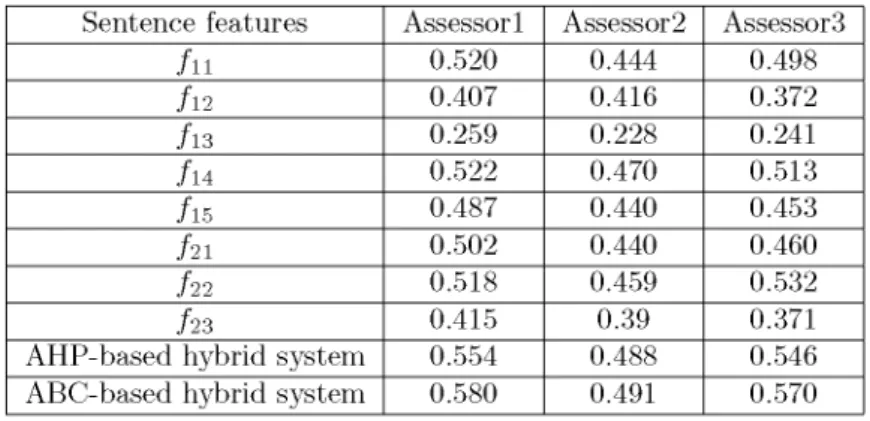
Tables 10 and 11 measure the effects o f each feature and the proposed hybrid system on the basis o f each assessor.
T able 1 0. F-m easure values o f each feature and the proposed hybrid system on the basis o f each assessor.
Sentence features Assessor1 Assessor2 Assessor3
f11 0.520 0.444 0.498 f 12 0.407 0.416 0.372 f 13 0.259 0.228 0.241 f14 0.522 0.470 0.513 f 15 0.487 0.440 0.453 f 21 0.502 0.440 0.460 f 22 0.518 0.459 0.532 f 23 0.415 0.39 0.371
AHP-based hybrid system 0.554 0.488 0.546 ABC-based hybrid system 0.580 0.491 0.570
Table 11. R O U G E -1 F-m easure values o f each feature and the p roposed hybrid system on the basis o f each assessor.
Sentence features Assessor1 Assessor2 Assessor3
f11 0.690 0.644 0.670 f 12 0.584 0.586 0.556 f 13 0.462 0.421 0.448 f14 0.695 0.641 0.688 f 15 0.666 0.631 0.644 f 21 0.680 0.632 0.660 f 22 0.691 0.645 0.702 f 23 0.602 0.575 0.564
AHP-based hybrid system 0.710 0.666 0.707 ABC-based hybrid system 0.726 0.670 0.715
Considering the ordering o f the features with respect to their performances, one can say that the assessors m ostly extract: 1) sentences that contain words that frequently occur in the document ( f 14) , 2) sentences that include all o f the topics o f the document ( f 22), and 3) sentences that are relatively long ( f 11). It can also be seen that the proposed structural feature ( f 15), which uses text categorization, outperforms the structural features like the position ( f 12), title ( f 13), and sentence similarity count ( f 23) for the 3 assessors and it may be considered an acceptable feature for the text summarization task.
The last 2 rows o f Tables 10 and 11 show the results that exploit the effects o f all o f the features by combining them with the hybrid system. The results show that exploiting all o f the features by combining them resulted in a better performance than exploiting each feature individually.
The AHP- and ABC-based hybrid systems assign a weight to each o f the features. The AH P generates the general feature weights depending on the expert judgment. This is a manual process and must be repeated for each different set o f the features by the experts. The weights are com puted automatically by the ABC method. In addition, as can be seen from Tables 10 and 11, the A B C produces the best performance results.
GÜRAN et al./Turk J Elec Eng & Comp Sci
6. Conclusion
This paper proposed a novel hybrid Turkish text summarization system that combines the structural and semantic sentence features to yield better summarization results. A new structural feature facilitated by the document class identification and a slight enhancement o f the LSA-based semantic document features by employing the Turkish W ikipedia as tool for extracting semantically related consecutive words are further contributions o f the current work. For combining the features’ scores into an overall score function, 2 approaches based on the AHP and the A B C algorithm have been explored. To carry out the experiments for comparing the proposed system against systems employing only structural or only semantic features, a new Turkish corpus has been constructed. The algorithmic results, which have been presented and discussed in detail, confirm the significance o f our contributions.
Acknowledgm ents
This work is supported by the Yıldız Technical University Scientific Research Project Commission: “2012-07- 03-DOP01” .
References
[1] D .R . R adev, K. M cK eow n, “G enerating natural language summ aries from m ultiple on-line sources” , C om putational Linguistics, Vol. 24, pp. 46 9-500, 1998.
[2] S.H. Sanda, F. Lacatusu, “G enerating single and m u lti-docum ent summ aries w ith gistexter” , D ocu m en t Under standing Conference, pp. 30-38, 2002.
[3] H. Saggion, G. Lapalm e, “G enerating in dicative-inform ative summaries w ith Su-m uM ” , C om putational Linguistics, Vol. 28, pp. 497-526, 2002.
[4] H. Jing, K .R . M cK eow n, “C u t and paste based text sum m arization” , Proceedings o f the 1st N orth A m erican Chapter o f the A ssociation for C om putational Linguistics Conference, pp. 178-185, 2000.
[5] H.P. Luhn, “T h e autom atic creation o f literature abstracts” , IB M Journal o f Research D evelopm ent, Vol. 2 , pp. 159-165, 1958.
[6] H.P. E dm undson, “New m ethods in autom atic extractin g” , Journal o f the A ssociation for C om putin g M achinery, Vol. 16 , pp. 264-285, 1969.
[7] K . W ong, M. W u, W . Li, “E xtractive sum m arization using supervised and sem i-supervised learning” , Proceedings o f the 22nd International Conference on C om putational Linguistics, M anchester, pp. 985-992, 2008.
[8] Y . G ong, X . Liu, “ G eneric text sum m arization using relevance measure and latent sem antic analysis” , Proceedings o f the 24th International A C M SIG IR Conference on Research and D evelopm ent in Inform ation Retrieval, pp. 19-25, 2001.
[9] J. Steinberger, “T ext sum m arization w ithin the L S A fram ew ork” , P h D Thesis, U niversity o f W est B ohem ia, Czech R epu blic, 2007.
[10] J.Y . Yeh, H .R. K e, W .P . Yang, I.H. M eng, “T ext sum m arization using a trainable summ arizer and latent semantic analysis” , Journal o f Inform ation P rocessing and M anagem ent, Vol. 41, pp. 75 -95 , 2005.
[11] L. Hennig, “T opic-based m u lti-docum ent sum m arization w ith probabilistic latent sem antic analysis” , International Conference on R ecent A dvances in N atural Language Processing, pp. 144-149, 2009.
[12] J. Lee, S. Park, C. A hn, D. K im , “A u tom atic generic docum ent sum m arization based on non-negative m atrix factorization ” , Inform ation Processing and M anagem ent, Vol. 45, pp. 20 -34 , 2009.
[13] J. K upiec, O .P. Jan, C. Francine, “A trainable docum ent sum m arizer” , Proceedings o f the 18th Annual International A C M SIG IR C onference on R esearch and D evelopm ent in Inform ation Retrieval, pp. 68 -73 , 1995.
GÜRAN et al./Turk J Elec Eng & Comp Sci
[14] S.H. Teufel, M . M oens, “Sentence extraction as a classification task” , A C L /E A C L W orkshop on Intelligent Scalable T ext Sum m arization, pp. 58 -65 , 1997.
[15] E. Filatova, V. H atzivassiloglou, “A form al m odel for inform ation selection in m ulti-sentence text extraction ” , P roceedings o f the 20th International C onference on C om putational Linguistics, pp. 397-403, 2004.
[16] R. M cD on a ld, “A study o f global inference algorithm s in m ulti-docum ent sum m arization” , 29th E uropean C onfer ence on IR Research, pp. 557-564, 2007.
[17] R .M . A lguliev, R .M . A liguliyev, M .S. H ajirahim ove, C .A . M ehdiyev, “M C M R : M axim um coverage and m inim um redundant text sum m arization m od el” , E xpert Systems w ith A pplications, Vol. 38, pp. 14514-14522, 2011. [18] Z. A ltan, “A Turkish autom atic text sum m arization system , IA S T E D International Conference on A rtificial Intel
ligence and A pp lications, 2004.
[19] E. Uzundere, E. D edja, B. Diri, M .F . Am asyalı, “A u tom atic text sum m arization for Turkish texts” , N ational Conference o f the A S Y Ü , 2008.
[20] C. Pem be, “A u tom ated query-biased and structure-preserving docum ent sum m arization for web search tasks” , P h D Thesis, B oğaziçi University, Turkey, 2011.
[21] C. Cıgır, M. K utlu, I. Cicekli, “ G eneric text sum m arization for Turkish” , T h e C om puter Journal, Vol. 53, pp. 1315-1323, 2010.
[22] A. G uran, E. Bekar, S. Akyokus, “A com parison o f feature and sem antic-based sum m arization algorithm s for Turkish” , International Sym posium on Innovations in Intelligent Systems and A pplications, 2010.
[23] M . Ozsoy, I. Cicekli, F.N . Alpaslan, “T ext sum m arization o f Turkish texts using latent sem antic analysis” , P ro ceedings o f the 23rd International C onference on C om putational Linguistics, pp. 869-876, 2010.
[24] A. G uran, N. G uler Bayazıt, E. Bekar, “A u tom atic sum m arization o f Turkish docum ents using non-negative m atrix factorization ” , International Sym posium on Innovations in Intelligent System s and A pp lications, pp. 480-484, 2011. [25] T .L . Saaty, T h e A n alytic Hierarchy Process, New York, M cG raw -H ill, 1980.
[26] D. K araboga, B. Basturk, “A pow erful and efficient algorithm for num erical fu nction optim ization: artificial bee colony (A B C ) algorithm ” , Journal o f G loba l O ptim ization, Vol. 39, pp. 459-171, 2007.
[27] C .Y . Lin, E. Hovy, “A u tom atic evaluation o f summ aries using N -gram co-occu rren ce statistics” , Language Tech nology Conference, Vol. 1, pp. 71 -78 , 2003.
[28] Zem berek- Zem berek 2 is an op en source N L P library for Turkic languages 2011-2012, available at: h ttp ://c o d e .g o o g le .c o m /p /z e m b e r e k /d o w n lo a d s /lis t.
[29] M .F . Am asyalı, A . Beken, “Tu rkce kelimelerin anlamsal benzerliklerinin ök u lm esi ve m etin sınıflandırm ada kul lanılması” , N ational Conference o f SIÜ, 2009.
[30] E. G abrilovich, S. M arkovich, “C om putin g sem antic relatedness using W ikipedia-based explicit sem antic analysis” , 20th International Joint Conference on A rtificial Intelligence, pp. 1606-1611, 2007.
[31] E. G abrilovich, S. M arkovitch, “O vercom ing the brittleness bottlen eck using W ikipedia: enhancing text catego rization w ith en cyclopedic know ledge” , 21st N ational Conference on A rtificial Intelligence, Vol. 2, pp. 1301-1306, 2006.
[32] K . Ram anathan, Y . Sankarasubramaniam, N. M athur, A . G upta, “D ocu m en t sum m arization using W ik ipedia” , 1st International Conference on H um an-C om puter Interaction, pp. 254-260, 2009.
[33] G. W illiam s, “In search o f representativity in specialised corpora: C ategorisation through colloca tion ” , International Journal o f Corpus Linguistics, Vol. 7, pp. 4 3 -64 , 2002.
[34] O. Ferret, “Using collocation s for top ic segm entation and link d etection ” , 19th International Conference on C om putational Linguistics, Vol. 1, pp. 260-266, 2002.
[35] O. Sunercan, A . Birturk, “W ik ipedia missing link discovery: a com parative study” , A A A I Spring Sym posium on Linked D ata M eets A rti?cial Intelligence, 2010.
GÜRAN et al./Turk J Elec Eng & Comp Sci
[36] C. Calli, “Im proving search result clustering by integrating sem antic inform ation from W ik ipedia” , M S Thesis, M iddle East Technical University, D epartm ent o f C om puter Engineering, 2010.
[37] A. Boynuegri, “ Cross-lingual inform ation retrieval on Turkish and English texts” , M S Thesis, M iddle East Technical Üniversity, D epartm ent o f C om puter Engineering, 2010.
[38] I.V . M ashechkin, M .I. Petrovskiy, D.S. P op o v , D .V . Tsarev, “A u tom atic text sum m arization using latent semantic analysis” , Program m ing and C om puter Software, Vol. 37, pp. 299-305, 2011.
[39] Standard Score from W ikipedia, the free en cyclopedia 2001-2012, available at: h ttp ://e n .w ik ip e d ia .o rg /w ik i/S ta n d a rd _ s co re .
[40] L. Felfoldi, A . K ocsor, “A H P -b ased classifier com bin ation ” , Proceedings o f the 4th International W orkshop on P attern R ecogn ition in Inform ation Systems, pp. 4 5 -58 , 2004.
[41] C ollab ora tion and D ecision, Support Software for G roups and O rganizations 2011-2012, available at: h ttp ://w w w .e x p e r tc h o ic e .c o m /
[42] R. Srinivasa R ao, S.V.L. Narasim ham, M . R am alingaraju, “O p tim ization o f distribution netw ork configuration for loss reduction using artificial bee colony algorithm ” , International Journal o f E lectrical Pow er and Energy Systems Engineering, Vol. 1 , pp. 116-122, 2008.
[43] F. K ang, J. Li, Q. X u , “Structural inverse analysis by hybrid sim plex artificial bee colony algorithm s” , C om puters and Structures, Vol. 87, pp. 861-870, 2009.
[44] S.N. Omkar, J. Senthilnath, “A rtificial bee colon y for classification o f acoustic em ission signal” , International Journal o f A erospace Innovations, Vol. 1, pp. 129-143, 2009.
[45] D. K araboga, C. O zturk, “A novel clustering approach: artificial bee colony (A B C ) algorithm ” , A pp lied Soft C om puting, Vol. 11, pp. 652-657, 2011.
[46] D. K araboga, C. O zturk, “Fuzzy clustering w ith artificial bee colon y algorithm , Scientific Research and Essays” , Vol. 5, pp. 1899-1902, 2010.