Supply Chain Optimization Studies: A Literature Review and
Classification
(*)Tedarik Zinciri Optimizasyon Çalışmaları: Literatür Araştırması ve Sınıflama
Yasemin KOCAOĞLU
(1), Alev TAŞKIN GÜMÜŞ
(2),
Batuhan KOCAOĞLU
(3)ABSTRACT: Supply chain planning is an integrated process in which a group of several organizations, such as suppliers, producers, distributors and retailers, work together. It comprises procurement, production, distribution and demand planning topics. These topics require taking strategical, tactical and operational decisions. This research aims to reveal which supply chain topics, which decision levels, and which optimization methods are mostly studied in supply chain planning. This paper presents a total of 77 reviewed works published between 1993 and 2016 about supply chain planning. The reviewed works are categorized according to following elements: decision levels, supply chain optimization topics, objectives, optimization models.
Keywords: Decision level, literature review, optimization model, supply chain, supply chain optimization topic.
Öz: Tedarik Zinciri, tedarikçiler, üreticiler, dağıtıcılar ve toptancılar gibi bir grup
organizasyonu birleştiren entegre bir süreçtir. Tedarik, üretim, dağıtım ve talep planlama konularını içerir. Bu konular stratejik, taktik ve operasyonel kararlar almayı gerektirir. Bu araştırma tedarik zinciri planlamasında hangi tedarik zinciri konularının, hangi karar/planlama seviyelerinin ve hangi optimizasyon metotlarının literatürde en çok çalışıldığını göstermektedir. Çalışma 1993 ve 2016 yılları arasındaki tedarik zinciri planlama konusundaki 77 adet çalışmanın incelenmesine ait sonuçları sunmaktadır. İncelenen çalışmalar şu kriterlere gore kategorize edilmiştir: karar seviyesi, tedarik zinciri optimizasyon konuları, amaçlar, optimizasyon modelleri.
Anahtar Kelimeler: Karar seviyesi, literatür incelemesi, optimizasyon modeli, tedarik
zinciri, tedarik zinciri optimizasyon konuları.
JEL Kodları: M11, R41, C61, O32
(1) Doğuş Teknoloji, E-Dönüşüm Projeleri Departmanı; [email protected] (2) Yıldız Teknik Üniversitesi, Endüstri Mühendisliği Bölümü; [email protected] (3) Piri Reis Üniversitesi, Yönetim Bilişim Sistemleri Bölümü; [email protected]
(*) This paper was presented at the “The 15th International Logistics and Supply Chain Congress
(LMSCM)” on October 19-20, 2017.
1. Introduction
A supply chain (SC) can be defined as an integrated system synchronizing a series of interrelated business processes in order to: (1) acquire raw materials and parts, (2) transform these raw materials and parts into finished products, and (3) distribute these products to either retailers or customers (Fahimnia et al.,2013).
Supply chain is the integration and coordination of procurement, production, distribution and demand planning. These planning activities require taking strategical, tactical and operational decisions. And optimization models are being developed to operate these activities in the supply chain.
The objectives of this paper are to (i) review the literature, (ii) analyze and categorize the works based on the decision levels, supply chain topics, optimization models, (iii) identify future research directions.
The remainder of the paper consists of three other sections. The next section introduces the review methodology. Then Section 3 presents the taxonomy of the reviewed papers. Finally, the last section provides the conclusions and directions for future research.
2. Review Methodology
The literature search is carried out with scientific-technical bibliographic databases which include publishing portals like Science Direct, Springer & Kluwer, Elsevier, Taylor & Francis, Wiley. Additionally, internet sources are used. The following search criteria are applied: Production and distribution planning in supply chains, production and transport planning in supply chains, production, distribution, and inventory planning in supply chains, supply chain optimization methods, multi-objective programming of production and distribution planning, integrated supply chains.
77 papers were collected for the study with the years between 1993 and 2016. Papers are categorized into 3 groups: According to decision levels, according to their topics, according to optimization models used.
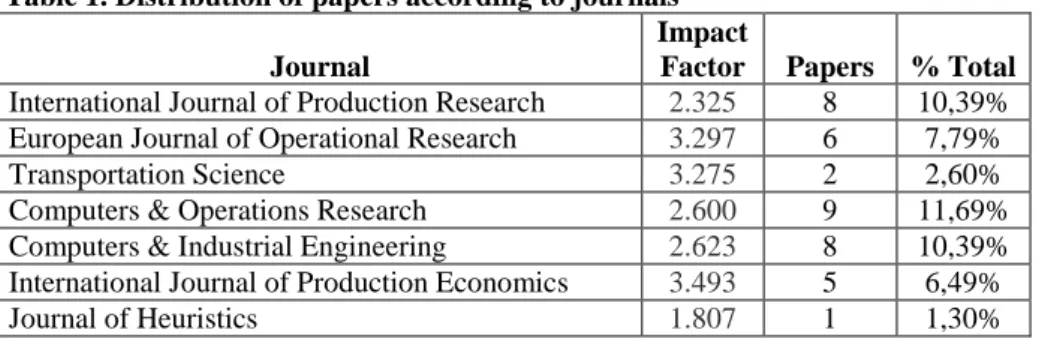
These papers were obtained from journals (98.7%) and congress papers (1.30%). Table 1 shows distribution of papers according to journals and impact factor of journals.
Table 1. Distribution of papers according to journals Journal
Impact
Factor Papers % Total
International Journal of Production Research 2.325 8 10,39%
European Journal of Operational Research 3.297 6 7,79%
Transportation Science 3.275 2 2,60%
Computers & Operations Research 2.600 9 11,69%
Computers & Industrial Engineering 2.623 8 10,39%
International Journal of Production Economics 3.493 5 6,49%
Production Planning & Control 2.369 2 2,60%
Journal of the Operational Research Society 1.077 2 2,60%
International Journal of Operations & Production Management
3.339
1 1,30%
IIE Transactions 1.451 2 2,60%
Interfaces 0.579 2 2,60%
Annals of Operations Research 1.709 1 1,30%
Computers & Chemical Engineering 3.024 3 3,90%
Applied Mathematical Modelling 2.35 2 2,60%
Industrial and Engineering Chemistry Research 2.843 1 1,30%
International Journal of Advanced Manufacturing Technology
2.209
2 2,60%
Omega 4.029 4 5,19%
International Journal of Computer Integrated Manufacturing
1.949
1 1,30%
Applied Mathematics and Computation 1.738 1 1,30%
Transportation Research Part E: Logistics and Transportation Review
2.974
1 1,30%
Chinese Journal of Chemical Engineering 1.174 2 2,60%
Advances in Engineering Software 3 1 1,30%
International Transactions In Operational Research 1.745 1 1,30%
International Journal of Physical Distribution & Logistics Management
2.577
1 1,30%
Fuzzy Sets and Systems 2.718 1 1,30%
AICHE Journal 2.836 1 1,30%
International Journal of Systems Science 2.285 1 1,30%
Journal of Scheduling 1.281 1 1,30%
Journal of Purchasing and Supply Management 3.24 1 1,30%
International Journal of Management Science and Engineering Management
1.78
1 1,30%
Expert Systems with Applications 3.928 1 1,30%
Journal of Cleaner Production 5.715 1 1,30%
Total 77 100,00%
3. Taxonomy
In this section 77 reviewed works are categorized according to decision levels, supply chain optimization topics and optimization models.
Huang et al. (2003) proposed four classification criteria as: supply chain structure, decision level, modeling approach and shared information. In this paper, Huang’s taxonomy is used as a reference. Decision level and modeling approach are used between of them. And in addition to them, supply chain optimization topic and objective are used. So four classification criteria are proposed: Decision level, supply chain optimization topic and supply chain optimization model and objective. Supply chain structure and shared information criteria will use in future study.
Decision level: Decisions in a supply chain can be divided into three hierarchical levels. These levels are strategical, tactical and operational.
Supply chain optimization topic: These topics are related with supply chain operations, and required in making strategical, tactical and operational decisions. Some of them are: Supply chain network design, facility/depot location, supply planning, production planning/scheduling, inventory planning, capacity planning, lot sizing, and supplier/carrier selection.
Optimization model: Optimization models are used to operate supply chain operations and cost, effectively. They can solve supply chain complex problems. Some of them are: Linear programming, mix integer programming, multi objective linear programming, multi objective mix integer programming, fuzzy mathematical programming, stochastic programming, heuristics and hybrid models.
Objective: Objectives are specific. They serve as the basis for evaluating performance. Some examples of objectives include minimizing costs, maximizing benefits, maximizing customer satisfaction. They are defined in the optimization model.
4. Review of The Works According to “Decisions Levels”
Decision levels are mainly classified by the extent or effect of the decision to be made in terms of time (Mula et al.,2010).
Strategical decisions consist of long term plans about 5 years or longer. These decisions are about determination of supply chain design and strategies. Selecting production, storage and distribution locations can be given as examples.
Tactical decisions consist of medium term plans about annually or monthly. These decisions are about supply chain planning. Purchasing decisions, inventory planning, procurement planning, demand forecasting, production and distribution planning, assigning production and transport capacities can be given as examples.
Tactical planning in a supply chain incorporates the synchronized planning of procurement, production, distribution and sale activities, in order to ensure that the customer demand is satisfied by the right product at the right time (Swaminathan & Tayur, 2003).
Operational decisions consist of short term plans about daily or hours. Scheduling of production, determination of distribution routing, scheduling of vehicle loading, scheduling of deliveries can be given as examples.
The reviewed works according to decision levels are categorized into 3 levels: Strategical, tactical and operational. Table 2, classifies the works reviewed in terms of the decision level. The numbers of reviewed works according to decisions levels are shown in table 3. Table 3 indicates that Tactical Planning is the most studied planning/decision level.
Table 2. “Planning/Decision Level” of reviewed works
Article Strategical Tactical Operational
(Chandra, 1993), (Martin et al.,1993), (Fisher & Chandra, 1994), (Chen & Wang, 1997), (Mcdonald & Karimi, 1997), (Lucas et al., 2001), (Sakawa et al., 2001), (Gupta & Maranas, 2003), (Ryu et al.,2004), (Bertazzi et al.,2005), (Lei et al.,2006), (Oh & Karimi, 2006), (Roghanian et al.,2007), (Park(a), 2007), (Dhaenens-Flipo & Finke, 2001), (Liang, 2007), (Boudia(a) et al.,2007), (Selim et al., 2008), (Jung et al.,2008), (Torabi & Hassini, 2008), (Boudia (a) et al.,2008) , (Bard(a) & Nananukul (a), 2009), (Bard(b) & Nananukul(b), 2009), (Park (b) & Hong, 2009), (Boudia (c) & Prins (c), 2009), (Chen et al.,2009), (Çetinkaya et al.,2009), (Leung & Chan, 2009), (Safaei et al.,2010) ,(Bard(c) & Nananukul(c), 2010) ,(Shiguemoto & Armentano, 2010), (Ozdamar & Yazgac, 2010), (Lee(b) et al.,2010), (Fahimnia et al.,2015), (Archetti et al.,2011), (Armentanoa et
al.,2011),(Mirzapour et al., 2011), (Jolaia et al.,2011), (Amorim et al.,2013), (Khakdaman et al.,2014), (Khakdaman et al.,2014),(Zhang et al.,2014) ,(Adulyasak et al.,2014), (Liu et al.,2015), (Keskin et al., 2015), (Senoussi et al.,2015), (Brahimia & Aouamb, 2015), (Darvish et al.,2016), (Zanjani et al.,2016), (Bajgiran et al.,2016), (Carvalho & Nascimento,
2016) x
(Fumero & Vercellis, 1999) , (Zare-Reisabadi & Mirmohammadi, 2015), (Stacey et al.,2007), (Bilgen & Çelebi,
2013), (Shi et al., 2015) x
(Timpe & Kallrath, 2000), (Sabri &
Beamon, 2000) x x
(Jayaraman & Pirkul, 2001), (Jang (a) et al., 2002), (Liu & Lee, 2003), (Kuhna & Liskea, 2011), (Choudhary & Shankar,
2014), (Garg et al.,2015) x x
(Chern & Hsieh, 2007), (Adil &
(Songsong & Papageorgiou, 2013), (Nasiri et al.,2014), (Mu˜noz et al.,2015)
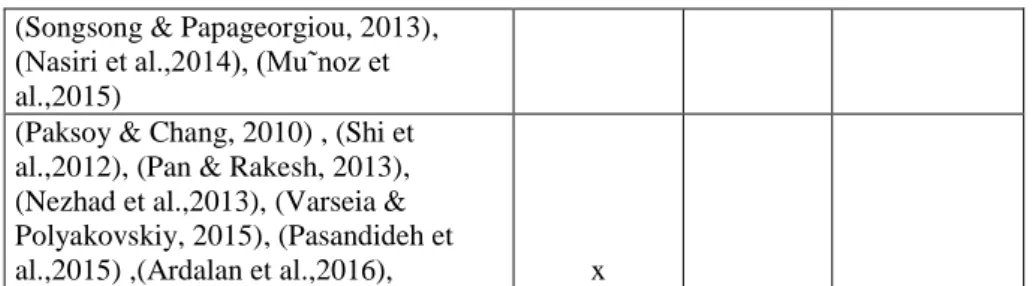
(Paksoy & Chang, 2010) , (Shi et al.,2012), (Pan & Rakesh, 2013), (Nezhad et al.,2013), (Varseia & Polyakovskiy, 2015), (Pasandideh et
al.,2015) ,(Ardalan et al.,2016), x
Table 3. Number of reviewed works according to “Planning/Decision Level” Planning/Decision Level Number of Reviewed Works
Strategical 7 Tactical 52 Operational 4 Strategical-Tactical 6 Strategical-Operational 2 Tactical-Operational 6 Total 77
5. Review of the Works According to “Supply Chain Optimization
Topics”
In this section, the categorization of reviewed works is presented according to supply chain optimization topics. Reviewed works show that integrated topics are trend for studying, so most of the work does not only study one topic like production planning, they are working about more than one topic like integration of production and distribution planning. And it is also dedicated from reviewed works that Production Planning/Scheduling and Distribution/Routing Planning are the most studied integrated topic. Table 4, classifies the works reviewed according to supply chain optimization topics.
Table 4. “Supply Chain Optimization Topics” of reviewed works
Article Su pp ly Cha in Ne two rk F a cilit y / D epo t L o ca tio n Su pp ly P la nn ing P ro du ct io n P la nn ing / S chedu lin g Dis tributio n/ Ro uti ng P la nn ing Inv ent o ry P la nn ing Ca pa cit y P la nn ing L o t Sizin g Su pp lier/ Ca rr ier Select io n (Chandra, 1993), (Stacey et al.,2007) x x
(Martin et al.,1993), (Fumero &
Kallrath, 2000), (Lei et al.,2006), (Bard(a) & Nananukul (a), 2009), (Bard(c) & Nananukul(c), 2010), (Shiguemoto & Armentano, 2010), (Fahimnia et al.,2015)
(Fisher & Chandra, 1994), (Chen & Wang, 1997), (Sakawa et al.,2001), (Ryu et al.,2004), (Bertazzi et al.,2005), (Oh & Karimi, 2006), (Roghanian et al.,2007), (Park(a), 2007), (Dhaenens-Flipo & Finke, 2001), (Liang, 2007), (Boudia(a) et al., 2007), (Selim et al.,2008), (Boudia (a) et al.,2008), (Bard(b) & Nananukul(b), 2009), (Park (b) & Hong, 2009), (Boudia (c) & Prins (c), 2009), (Chen et al.,2009), (Çetinkaya et al.,2009), (Safaei et al.,2010), (Ozdamar & Yazgac, 2010), (Lee(b) et al.,2010),
(Archetti et al., 2011), (Armentanoa et al.,2011), (Chen et al.,2009), (Amorim et al.,2013), (Bilgen & Çelebi, 2013), (Nasiri et al.,2014),
(Adulyasak et al.,2014) x x
(Mcdonald & Karimi, 1997), (Gupta & Maranas, 2003), (Torabi & Hassini, 2008), (Khakdaman et al.,2014), (Leung & Chan, 2009), (Mirzapour et al.,2011), (Brahimia
& Aouamb, 2015), (Shi et al.,2015) x
(Zare-Reisabadi & Mirmohammadi, 2015) , (Khalili-Damghani & Tajik-Khaveh, 2015), (Darvish et
al.,2016) x
(Sabri & Beamon, 2000) x x
(Jayaraman & Pirkul, 2001), (Jang(a) et al.,2002), (Mu˜noz et
al.,2015) x x x
(Lucas et al.,2001) x
(Liu & Lee, 2003) x x x
(Chern & Hsieh, 2007) x x x x
(Adil & Kanyalkar, 2007), (Senoussi et al.,2015) , (Zanjani et
al.,2016), (Bajgiran et al.,2016) x x x
(Jung et al.,2008), (Jolaia et al.,
(Paksoy & Chang, 2010), (Shi et al.,2012), (Pan & Rakesh, 2013), (Varseia & Polyakovskiy, 2015), (Garg et al.,2015), (Ardalan et
al.,2016) x
(Kuhna & Liskea, 2011) x x
(Nezhad et al.,2013) x
(Songsong & Papageorgiou, 2013) ,
(Zhang et al.,2014) x x x
(Choudhary & Shankar, 2014) x x
(Pasandideh et al.,2015) x x x x
(Liu et al.,2015), (Keskin et
al.,2015) x x
(Carvalho & Nascimento, 2016) x x
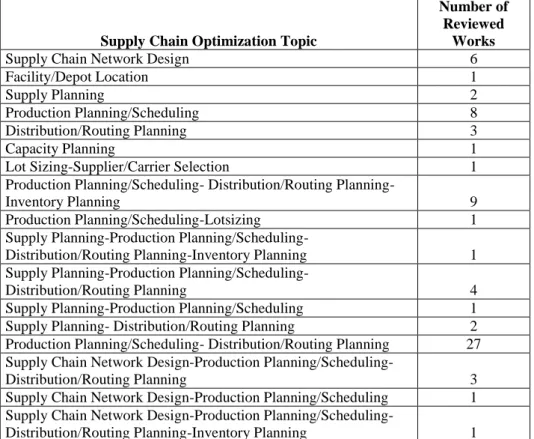
Table 5 shows that Production Planning/Scheduling- Distribution/Routing Planning is the most studied integrated topic. And following this, the other integrated topic is Production Planning /Scheduling- Distribution/Routing Planning-Inventory Planning.
Table 5. Number of reviewed works according to “Supply Chain Optimization Topic”
Supply Chain Optimization Topic
Number of Reviewed
Works
Supply Chain Network Design 6
Facility/Depot Location 1
Supply Planning 2
Production Planning/Scheduling 8
Distribution/Routing Planning 3
Capacity Planning 1
Lot Sizing-Supplier/Carrier Selection 1
Production Planning/Scheduling- Distribution/Routing
Planning-Inventory Planning 9
Production Planning/Scheduling-Lotsizing 1
Supply Planning-Production Planning/Scheduling-
Distribution/Routing Planning-Inventory Planning 1
Supply Planning-Production Planning/Scheduling-
Distribution/Routing Planning 4
Supply Planning-Production Planning/Scheduling 1
Supply Planning- Distribution/Routing Planning 2
Production Planning/Scheduling- Distribution/Routing Planning 27
Supply Chain Network Design-Production Planning/Scheduling-
Distribution/Routing Planning 3
Supply Chain Network Design-Production Planning/Scheduling 1
Supply Chain Network Design-Production Planning/Scheduling-
Production Planning/Scheduling- Distribution/Routing
Planning-Capacity Planning 2
Distribution/Routing Planning-Inventory Planning 2
Facility/Depot Location-Distribution/Routing Planning-Inventory
Planning 1
Total 77
6. Review of The Works According to “Optimization Models”
Optimization models are used to operate supply chain processes effectively. These models can handle complexity of supply chain. There are many optimization models used in supply chain processes. In this review, the optimization models are limited considering optimization models used in reviewed works. These are linear programming (LP), mixed integer programming (MIP), multi objective linear programming (MOLP), multi objective mixed integer programming (MOMIP), fuzzy mathematical programming (FMP), stochastic programming (SP), and heuristics (HEU). Heuristics abbreviation are given in table 6. These are: Decomposition Heuristic (DCOMPH), Lagrangian Heuristic (LRH), Ant colony system -Tabu search (ANT-TABU), Multi Objective Mixed-Integer based Heuristic (MOMIPH), Lagrangian and genetic algorithm (LR-GA), Iterative heuristic approach (ITRH), Mixed integer Programming based Decomposition approach (MIP-DCOMPH), Multi-objective linear programming based Heuristic algorithm (MOLPH),Mixed integer programming based local improvement procedure (MIP-LIMPH), A greedy randomized adaptive search procedure (GRASP), Tabu Search and Lagrangian Relaxation (TABU-LR), Branch-and-price (BRPCH), Mixed integer linear prog. and genetic algorithm (MILP-GA), Memetic algorithm (MEMETIC), Mixed-integer programming based heuristic algorithm (MIPH), Hybrid mathematical-simulation model (HYBRID SIM.) Mixed-integer linear prog. (MIP) based branch and price heuristic algorithm: MILP-BRPCH), Tabu search heuristic algorithm (TABU), Mixed-integer linear prog. based iterative heuristic algorithm iterative heuristic algorithm (MIP-ITRH), Genetic Algorithm (GA), Simulated Annealing (SA), The Savings Algorithm Clarke in combination with a 2-opt improvement heuristic (SAVING-2OPT), Adaptive large neighborhood search algorithm: (ADAP. NSA), Lagrangian decomposition (LR-DCOMP), Cluster decomposition algorithm (CLUS-DCOMP), Lagrangian relaxation and Surrogate sub-gradient algorithm (LR-SSG). Table 6, classifies the works reviewed according to optimization models.Table 6. “Optimization Models” of Reviewed Works
Article LP MIP M O L P M O M IP F M P SP H E U Heuristic name (Chandra, 1993), (Martin et al.,1993),
(Bertazzi et al.,2005), (Boudia (a) et
al.,2008), (Lei et al.,2006) x DCOMPH
(Fisher & Chandra, 1994), (Fumero & Vercellis, 1999), (Jayaraman & Pirkul, 2001), (Lucas et al.,2001), (Stacey et
2013) ,(Darvish et al.,2016), (Bajgiran et al.,2016), (Carvalho & Nascimento, 2016) (Chen & Wang, 1997) , (Ryu et al.,2004), (Oh & Karimi, 2006), (Dhaenens-Flipo &
Finke, 2001), (Jung et al.,2008) x
(Mcdonald & Karimi, 1997), (Timpe & Kallrath, 2000), (Paksoy & Chang, 2010) , (Archetti et al.,2011), (Mirzapour et
al.,2011) x
(Zare-Reisabadi & Mirmohammadi, 2015) x ANT-TABU
(Sabri & Beamon, 2000) x MOMIPH
(Sakawa, et al.,2001), (Liang, 2007),
(Selim et al.,2008) x
(Jang(a) et al.,2002), (Nasiri et al.,2014) x LR-GA
(Gupta & Maranas, 2003) x
(Liu & Lee, 2003) x ITRH
(Chern & Hsieh, 2007), (Songsong &
Papageorgiou, 2013) x MOLPH
(Roghanian et al.,2007), (Adil &
Kanyalkar, 2007), (Leung & Chan, 2009), (Pasandideh et al.,2015), (Varseia &
Polyakovskiy, 2015) x
(Park(a), 2007) x MIP-LIMP
(Boudia(a) et al.,2007) x GRASP
(Torabi & Hassini, 2008) x x
(Bard(a) & Nananukul (a), 2009) x TABU-LR
(Bard(b) & Nananukul(b), 2009) x BRPCH
(Park (b) & Hong, 2009) x MILP-GA
(Boudia (c) & Prins (c), 2009) x MEMETIC
(Chen et al.,2009), (Çetinkaya et al.,2009) , (Chen et al.,2009), (Bard(c) &
Nananukul(c), 2010), (Ozdamar & Yazgac, 2010) , (Bilgen & Çelebi, 2013), (Nezhad et al.,2013) (Khakdaman et al.,2014), (Zhang et al.,2014), (Liu et al.,2015), (Keskin et al.,2015), (Senoussi et al.,2015),
(Brahimia & Aouamb, 2015) x MIPH
(Safaei et al.,2010) x HYBRID SIM
(Shiguemoto & Armentano, 2010),
(Armentanoa et al.,2011) x TABU
(Lee(b) et al.,2010) x HYBRID SA
(Fahimnia et al.,2015) x GA-SA
(Kuhna & Liskea, 2011) x
SAVING-2OPT (Jolaia et al.,2011), (Choudhary & Shankar,
2014), (Khalili-Damghani & Tajik-Khaveh,
(Adulyasak et al.,2014) x ADAP. NSA
(Mu˜noz et al.,2015), (Shi et al.,2015) x LR-DCOMP
(Zanjani et al.,2016) x CLUS-DCOMP
(Ardalan et al.,2016) x LR-SSG
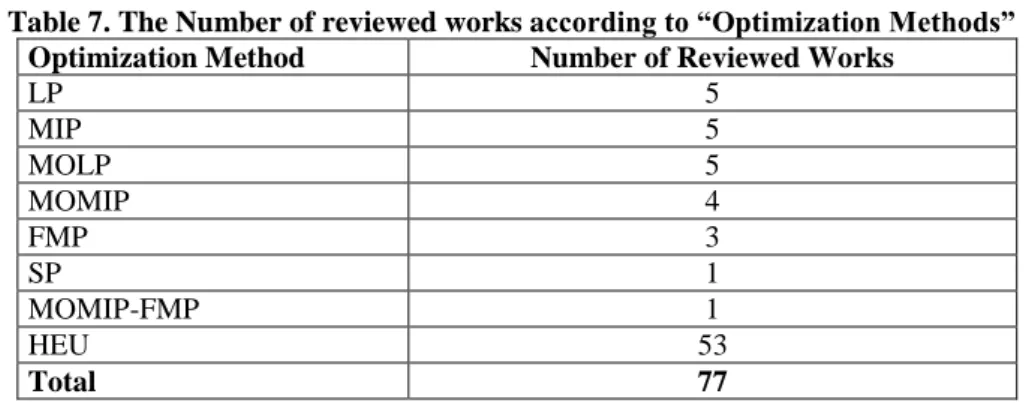
Table 7 shows number of reviewed works according to optimization methods. It can be inferred from that heuristics is the most studied optimization method.
Table 7. The Number of reviewed works according to “Optimization Methods”
Optimization Method Number of Reviewed Works
LP 5 MIP 5 MOLP 5 MOMIP 4 FMP 3 SP 1 MOMIP-FMP 1 HEU 53 Total 77
7. Review of The Works According to “Objective/s”
Objective/s are decided before solving optimization models. All the developed models consider minimization or maximization of objective or a combination of both. In this review, objective/s are limited considering objective/s used in reviewed works. These
are maximizing product rate (MPR), maximizing revenues (MR),
maximizing benefits (MB), minimizing costs (MC), maximizing service level (MSL),
maximizing customer satisfaction (MCS), and minimizing environmental impact
(MEI). Table 8, classifies the works reviewed according to objective/s.
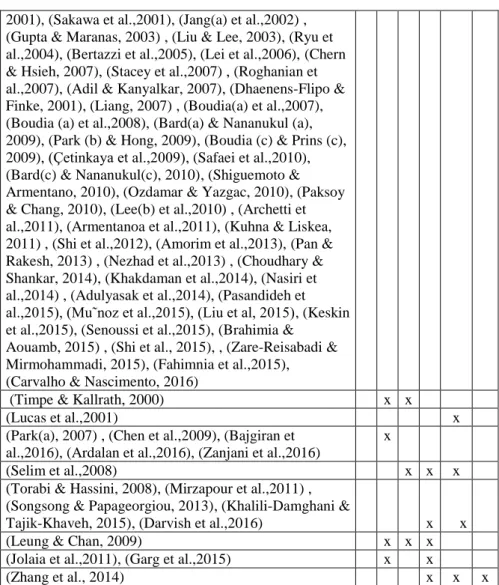
Table 8. “Objective/s” of reviewed works
Article M a x P ro du ct io n Ra te (M P R) M a x Rev enues ( M R) M ax B enefit (M B ) M in Co st (M C) M a x Serv ice L ev el (M SL )/ M a x Cus to mer Sa tis fa ct io n M in E nv iro menta l Imp a ct (Chandra, 1993) x
(Martin et al.,1993), (Mcdonald & Karimi, 1997), (Chen & Wang, 1997), (Oh & Karimi, 2006), (Jung et al.,2008), (Bard(b) & Nananukul(b), 2009), (Bilgen & Çelebi,
2013) x
(Fisher & Chandra, 1994), (Fumero & Vercellis,
2001), (Sakawa et al.,2001), (Jang(a) et al.,2002) , (Gupta & Maranas, 2003) , (Liu & Lee, 2003), (Ryu et al.,2004), (Bertazzi et al.,2005), (Lei et al.,2006), (Chern & Hsieh, 2007), (Stacey et al.,2007) , (Roghanian et al.,2007), (Adil & Kanyalkar, 2007), (Dhaenens-Flipo & Finke, 2001), (Liang, 2007) , (Boudia(a) et al.,2007), (Boudia (a) et al.,2008), (Bard(a) & Nananukul (a), 2009), (Park (b) & Hong, 2009), (Boudia (c) & Prins (c), 2009), (Çetinkaya et al.,2009), (Safaei et al.,2010), (Bard(c) & Nananukul(c), 2010), (Shiguemoto & Armentano, 2010), (Ozdamar & Yazgac, 2010), (Paksoy & Chang, 2010), (Lee(b) et al.,2010) , (Archetti et al.,2011), (Armentanoa et al.,2011), (Kuhna & Liskea, 2011) , (Shi et al.,2012), (Amorim et al.,2013), (Pan & Rakesh, 2013) , (Nezhad et al.,2013) , (Choudhary & Shankar, 2014), (Khakdaman et al.,2014), (Nasiri et al.,2014) , (Adulyasak et al.,2014), (Pasandideh et al.,2015), (Mu˜noz et al.,2015), (Liu et al, 2015), (Keskin et al.,2015), (Senoussi et al.,2015), (Brahimia &
Aouamb, 2015) , (Shi et al., 2015), , (Zare-Reisabadi & Mirmohammadi, 2015), (Fahimnia et al.,2015), (Carvalho & Nascimento, 2016)
(Timpe & Kallrath, 2000) x x
(Lucas et al.,2001) x
(Park(a), 2007) , (Chen et al.,2009), (Bajgiran et al.,2016), (Ardalan et al.,2016), (Zanjani et al.,2016)
x
(Selim et al.,2008) x x x
(Torabi & Hassini, 2008), (Mirzapour et al.,2011) , (Songsong & Papageorgiou, 2013), (Khalili-Damghani &
Tajik-Khaveh, 2015), (Darvish et al.,2016) x x
(Leung & Chan, 2009) x x x
(Jolaia et al.,2011), (Garg et al.,2015) x x
(Zhang et al., 2014) x x x
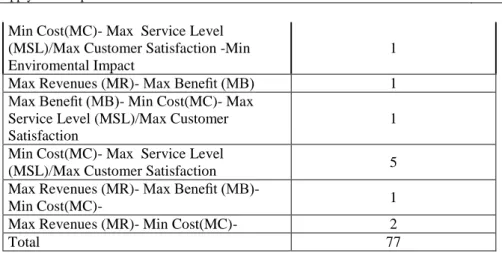
Table 9 shows number of reviewed works according to objective/s. It can be inferred from that minimizing costs is the most studied objective function in optimization models.
Table 9. The number of reviewed works according to “Objective/s”
Objective/s Number of Reviewed Works
Max Production Rate (MPR) 1
Max Revenues (MR) 5
Max Benefit (MB) 7
Min Cost(MC) 52
Max Service Level (MSL)/Max Customer
Min Cost(MC)- Max Service Level (MSL)/Max Customer Satisfaction -Min Enviromental Impact
1
Max Revenues (MR)- Max Benefit (MB) 1
Max Benefit (MB)- Min Cost(MC)- Max Service Level (MSL)/Max Customer Satisfaction
1
Min Cost(MC)- Max Service Level
(MSL)/Max Customer Satisfaction 5
Max Revenues (MR)- Max Benefit (MB)-
Min Cost(MC)- 1
Max Revenues (MR)- Min Cost(MC)- 2
Total 77
Table 10 shows number of reviewed works according to multiple/single objective/s. It can be inferred from single objective is the most studied.
Table 10. The number of reviewed works according to “Multiple/Single Objective/s”
Multiple/Single Number of Reviewed Works
Multiple 11
Single 66
8. Conclusions and Further Research
This paper presents a review of optimization studies about supply chain planning. A total of 77 reviewed works published between 1993 and 2016 are used as references. Huang et al. (2003) proposed four classification criteria: supply chain structure, decision level, modeling approach and shared information. Huang’s taxonomy is used as a reference here, and two classification criteria are selected from classification criteria proposed by Huang et al. (2003). And new classification criteria are added to them. And finally we proposed four classification criteria: decision level, supply chain optimization topic, supply chain optimization model and objective/s.
This paper’s purpose is to provide general overview of supply chain optimization works and directions for future research. It can be starting point for researchers. They can see which supply chain topics are popular for working, and which decision/planning level are mostly studied and which optimization method is the most preferred, and which objective/s is/are mostly studied. It would be useful for them to see supply chain topics that weren’t studied more.
The conclusions drawn from this work show that:
1. 7 of 77 works reviewed are about strategical decisions, 53 of them are about tactical decisions, 3 of them are about operational decisions, 6 of them are about both strategical and tactical decisions, 2 of them are both strategical and operational decisions, and six of them are about both tactical and operational. We can infer from that most of the works reviewed are interested in tactical decisions.
2. Majority of reviewed works are about integrated planning. The most popular topic is integrated production planning and distribution planning or production scheduling and routing planning. 28 of 77 reviewed works are about this topic. Today most of the studies are focused on real supply chain cases. So it can be the reason for why production planning and distribution planning or production scheduling and routing planning is the most popular topic.
3. The most preferred optimization method is heuristics; 53 of 77 works reviewed use heuristics. In real supply chains, the product types are changing, the number of customers and the number of members like suppliers, distribution centers, and depots are increasing. Developing a supply chain model that considers production, distribution and inventory planning becomes complicated, and this complexity can’t be solved by classical optimization methods in a short time. So, heuristics are widely used to overcome this complexity and provide solutions within a reasonable time.
4. The most studied objective is minimizing costs; 49 of 77 works reviewed use minimizing costs in objective function. And 66 of 77 works reviewed use single objective in optimization model. In real business world single objective is not sufficient to firm success, there are conflicting objectives so multiple objectives are considered together.
After this review, following future directions can be proposed:
In further studies, supply chain structure, supply chain cost (holding cost, purchase cost, production cost, etc.), and aspects relating to modeling and solving the problem: production (number of products, production capacity, set up times etc.) , inventory (safety stock available, inventory capacity etc.), routing (fleet and number of vehicles, number of visits, transport parameters like distance, time period etc.), can be added as classification criteria.
Real supply chain case studies can be analyzed and these studies can be categorized according to business branch, and other criteria.
Which heuristic methods are used mostly can be studied according to supply chain topics (production planning/scheduling, distribution/routing planning, inventory planning, procurement planning, etc.). And these heuristic methods can be compared according to their performances.
The most studied single/multiple Objective/s can be categorized according to supply chain topics (production planning/scheduling, distribution/routing planning, inventory planning, procurement planning, etc.).
Future research can focus on supply chain problems by considering multiple real-life limitations like resource constraints, capacity constraints, loading constraints etc.
9. References
Adil, G. K., & Kanyalkar, A. P. (2007). Aggregate and detailed production planning integrating procurement and distribution plans in a multi-site environment. International Journal of Production Research, 45:5329-5353.
Adulyasak, Y., Cordeau, J.-F., & Jans, R. (2014). Optimization-based adaptive large neighborhood search for the production routing problem. Transportation Science, 48 (1): 20-45.
Amorim, P., Belo-Filho, M. A., Toledo, F. M., Almeder, C., & Almada-Lobo, B. (2013). Lot sizing versus batching in the production and distribution planning of perishable goods. International Journal of Production Economics, 146(1):208– 218.
Archetti, C., Bertazzi, L., Paletta, G., & Speranza, M. (2011). Analysis of the maximum level policy in a production-distribution system. Computers & Operations Research, 38:1731-1746.
Ardalan, Z., Karimi, S., Naderi, B., & Khamseh, A. A. (2016). Supply chain networks design with multi-mode demand satisfaction policy. Computers & Industrial Engineering, 96:108-117.
Armentanoa, V., Shiguemotob, A., & Løkketangenc, A. (2011). Tabu search with path relinking for an integrated production–distribution problem. computers & Operations Research, 38(8): 1199–1209.
Bajgiran, O. S., Zanjani, M. K., & Nourelfath, M. (2016). The value of integrated tactical planning optimization in the lumber supply chain. International Journal of Production Economics, 171(1): 22-33.
Bard(a), J. F., & Nananukul (a), N. (2009). The integrated production–inventory– distribution–routing problem. Journal of Scheduling, 12: 257–280.
Bard(b), J. F., & Nananukul(b), N. (2009). Heuristics for a multiperiod inventory routing problem with production decisions. Computers & Industrial Engineering, 57: 713–723.
Bard(c), J. F., & Nananukul(c), N. (2010). A branch-and-price algorithm for an integrated production and inventory routing problem. Computers and Operations Research, 37(12): 2202-2217.
Bertazzi, L., Paletta, G., & Speranza, M. G. (2005). Minimizing the total cost in an integrated vendor—Managed inventory system. Journal of Heuristics, 11: 393-419.
Bilgen, B., & Çelebi, Y. (2013). Integrated production scheduling and distribution planning in dairy supply chain by hybrid modelling . Annals of Operations Research, 211(1): 55-82.
Boudia (a), M., Louly(a), M. A., & Prins(a), C. (2008). Fast heuristics for a combined production planning and vehicle routing problem. Production Planning and Control. Production Planning & Control: The Management of Operations, 19:85:96.
Boudia (c), M., & Prins (c), C. (2009). A memetic algorithm with dynamic population management for an integrated production–distribution problem. European Journal of Operational Research, 195:703-715.
Boudia(a), M., Louly(a), M. A., & Prins(a), C. (2007). A reactive GRASP and path relinking for a combined production–distribution problem. Computers & Operations Research, 34 : 3402–3419.
Brahimia, N., & Aouamb, T. (2015). Multi-item production routing problem with backordering: a MILP approach. International Journal of Production Research, 54(4): 1076-1093.
Carvalho, D. M., & Nascimento, M. C. (2016). Lagrangian heuristics for the capacitated multi-plant lot sizing problem with multiple periods and items. Computers & Operations Research, 71: 137-148.
Chandra, P. (1993). A Dynamic Distribution Model with Warehouse and Customer Replenishment Requirements. The Journal of the Operational Research Society, 44:681-692.
Chen, H., Hsueh, C., & Chang, M. (2009). Production scheduling and vehicle routing with time windows for perishable food products. Computers & Operations Research, 36(7): 2311–2319.
Chen, M., & Wang, W. (1997). A linear programming model for integrated steel production and distribution planning. International Journal of Operations & Production Management, 17 (6): 592-610.
Chern, C., & Hsieh, J. (2007). A heuristic algorithm for master planning that satisfies multiple objectives. Computers & Operations Research, 34:3491-3513. Choudhary, D., & Shankar, R. (2014). A goal programming model for joint decision
making of inventory lot-size, supplier selection and carrier selection. Computers & Industrial Engineering, 71: 1–9.
Çetinkaya, S., Üster, H., Easwaran, G., & Keskin, B. B. (2009). An integrated outbound logistics model for Frito-Lay: Coordinating aggregate-level production and distribution decisions. Interfaces, 39(5): 460-475.
Darvish, M., Larrain, H., & Coelho, L. C. (2016). A dynamic multi-plant lot-sizing and distribution problem. International Journal of Production Research, 1-12. Dhaenens-Flipo, C., & Finke, G. (2001). An integrated model for an industrial
production- distribution problem. IIE Transactions, 33 (9): 705-715.
Fahimnia, B., Farahani, R. Z., Marian, R., & Luong, L. (2013). A Review and Critique on Integrated Production-Distribution Planning Models and Techniques. Journal of Manufacturing Systems, 32:1-19.
FahimniaB., Davarzani, H., & Eshragh, A. (2015). Planning of complex supply chains: A performance comparison of three meta-heuristic algorithms.
Computers & Operations Research, in Press.,
https://doi.org/10.1016/j.cor.2015.10.008.
Fisher, M., & Chandra, P. (1994). Coordination of production and distribution planning. European Journal of Operational Research, 72: 503-517.
Fumero, F., & Vercellis, C. (1999). Synchronized Development of Production, Inventory, and Distribution Schedules. Transportation Science, 33:330-340. Garg, K., Kannan, D., Diabat, A., & Jhaa, P. (2015). A multi-criteria optimization
approach to manage environmental issues in closed loop supply chain network design. Journal of Cleaner Production, 100(1): 297–314.
Gupta, A., & Maranas, C. (2003). Managing demand uncertainty in supply chain planning. Computers & Chemical Engineering, 27: 1219–1227.
Jang(a), Y., Jang(b), S., Chang, B., & Park, J. (2002). A Combined Model of Network Design and Production/Distribution Plannig for a Supply Network. Computers and Industrial Engineering, 43: 263-281.
Jayaraman, V., & Pirkul, H. (2001). Planning and coordination of production and distribution facilities for multiple commodities. European Journal of Operational Research, 133: 394-408.
Jolaia, F., Yazdian, S. A., Shahanaghib, K., & Khojastehc, M. A. (2011). Integrating fuzzy TOPSIS and multi-period goal programming for purchasing multiple products from multiple suppliers. Journal of Purchasing and Supply Management, 17(1): 42–53.
Jung, H., Jeong, B., & Lee, C. (2008). An order quantity negotiation model for distributor-driven supply chains. International Journal of Production Economics, 111 (1): 147–158.
Keskin Aydın, G., Omurca, S. İ., N., A., & Ekinci, E. (2015). A comparative study of production–inventory model for determining effective production quantity and safety stock level. Applied Mathematical Modelling, 39(20): 6359–6374. Khakdaman, M., Wong, K. Y., Zohoori, B., Tiwari, M. K., & Merkert, R. (2014).
Tactical production planning in a hybrid Make-to- Stock–Make-to-Order environment under supply, process and demand uncertainties: a robust optimisation model. International Journal of Production Research, 53(5): 1358-1386.
Khalili-Damghani, K., & Tajik-Khaveh, M. (2015). Solving a objective multi-echelon supply chain logistic design and planning problem by a goal programming approach. International Journal of Management Science and Engineering Management, 10(4): 242-252.
Kuhna, H., & Liskea, T. (2011). Simultaneous supply and production planning. International Journal of Production Research, 49(13): 3795-3813.
Lee(b), Y., Kim(b), S. H., & Moon, C. (2010). Production-distribution planning in supply chain using a hybrid approach. Production Planning & Control: The Management of Operations, 13:35-46.
Lei, L., Liu, S., Ruszczynski, A., & Park, S. (2006). On the integrated production,inventory, and distribution routing problem. IIE Transactions, 38: 955-970.
Leung, S., & Chan, S. S. (2009). A goal programming model for aggregate production planning with resource utilization constraint. Computers & Industrial Engineering, 56 (3): 1053–1064.
Liang, T. F. (2007). Applying fuzzy goal programming to production/transportation planning decisions in a supply chain. International Journal of Systems Science, 38(4): 293 - 304.
Liu, S. C., & Lee, S. B. (2003). A two-phase heuristic method for the multi-depot location routing problem taking inventory control decisions into consideration. The International Journal of Advanced Manufacturing Technology, 22: 941-950.
Liu, X., Wang, W., & Peng, R. (2015). A novel two-stage Lagrangian decomposition approach for refinery production scheduling with operational transitions in mode switching. Chinese Journal of Chemical Engineering, 23:1793–1800.
Lucas, C., MirHassani, S., Mitra, G., & Poojari, C. (2001). An application of Lagrange relaxation to a capacity planning problem under uncertainty. Journal of the Operational Research Society, 52 (11): 1256-1266.
Martin, H., Denver, D. C., & James, C. E. (1993). Integrated production, distribution, and inventory planning at Libbey–Owens–Ford. Interfaces, 23:68-78.
Mcdonald, C., & Karimi, I. (1997). Planning and scheduling of parallel semicontinuous processes. Production planning. Industrial and Engineering Chemistry Research, 36, 2691–2700.
Mirzapour Al-e-hashema, S., . Malekly, H., & Aryanezhada, M. (2011). A multi-objective robust optimization model for multi-product multi-site aggregate production planning in a supply chain under uncertainty. International Journal of Production Economics, 34(1): 28-42.
Mu˜noz, E., Capón-García, E., Laínez-Aguirre, J. M., Espu˜na, A., & Puigjaner, L. (2015). Supply chain planning and scheduling integration using Lagrangian decomposition in a knowledge management environment. Computers and Chemical Engineering, 72:52-67.
Mula, J., Peidro, D., Díaz-Madroñero, M., & Vicens, E. (2010). Mathematical programming models for supply chain production and transport planning. European Journal of Operational Research, 204 :377–390.
Nasiri, G. R., Zolfaghari, R., & Davoudpour, H. (2014). An integrated supply chain production–distribution planning with stochastic demands. Computers & Industrial Engineering, 77:35–45.
Nezhad, A. M., Manzour, H., & Salhi, S. (2013). Lagrangian relaxation heuristics for the uncapacitated single-source multi-product facility location problem. Int. J. Production Economics, 145:713–723.
OH, H.--., & Karimi, I. (2006). Global multiproduct production–distribution planning with duty drawbacks. AIChE Journal, 52: 595–610.
Ozdamar, L., & Yazgac, T. (2010). A hierarchical planning approach for a production- distribution system. International Journal of Production Research, 37: 3759-3772.
Paksoy, T., & Chang, C. (2010). Revised choice goal programming for multi-period, multi-stage inventory controlled supply chain model with popup stores in Guerrilla marketing. Applied Mathematical Modelling, 34(11): 3586–3598. Pan, F., & Rakesh, N. (2013). Multi-echelon supply chain network design in agile
manufacturing. Omega, 41: 969–983.
Park (b), Y. B., & Hong, S. C. (2009). Integrated production and distribution planning for single-period inventory products. International Journal of Computer Integrated Manufacturing, 22: 443-457.
Park(a), Y. B. (2007). An integrated approach for production and distribution planning in supply chain management. International Journal of Production Research, 43: 1205-1224.
Pasandideh, S. H., Niakib, S. T., & Asadia, K. (2015). Optimizing a bi-objective multi-product multi-period three echelon supply chain network with warehouse reliability. Expert Systems with Applications, 42(5):2615–2623.
Roghanian, E., Sadjadi, S., & Aryanezhad, M. (2007). A probabilistic bi-level linear multi-objective programming problem to supply chain planning. Applied Mathematics and Computation, 188 (1): 786–800.
Ryu, J., Dua, V., & Pistikopoulos, E. (2004). A bilevel programming framework for enterprise-wide process networks under uncertainty. Computers & Chemical Engineering, 28 (6–7):1121–1129.
Sabri, E. H., & Beamon, B. M. (2000). A multi-objective approach to simultaneous strategic and operational planning in supply chain design. Omega, 28 (5): 581-598.
Safaei, A. S., S.M., M. H., Z., F. R., F., J., & Ghodsypoura, S. (2010). Integrated multi-site production-distribution planning in supply chain by hybrid modelling. International Journal of Production Research, 48(14): 4043-4069.
Sakawa, M., Nishizaki, I., & Uemura, Y. (2001). Fuzzy programming and profit and cost allocation for a production and transportation problem. European Journal of Operational Research, 131 (1): 1–15.
Selim, H., Am, C., & Ozkarahan, I. (2008). Collaborative production–distribution planning in supply chain: a fuzzy goal programming approach. Transportation Research Part E: Logistics and Transportation Review, 44(3): 396–419. Senoussi, A., K., M. N., Penz, B., Brahimi, N., & Dauz`ere-P´er`es, S. (2015).
Modeling and solving a one-supplier multi-vehicle production-inventory-distribution problem with clustered retailers. The International Journal of Advanced Manufacturing Technology, 1-19.
Shi, J., Zhang, G., & Sha, J. (2012). A Lagrangian based solution algorithm for a build-to-order supply chain network design problem . Advances in Engineering Software, 49:21–28.
Shi, L., Jiang, Y., Wang, L., & Huang, D. (2015). A novel two-stage Lagrangian decomposition approach for refinery production scheduling with operational transitions in mode switching. Chinese Journal of Chemical Engineering, 23:1793–1800.
Shiguemoto, A. L., & Armentano, V. A. (2010). A tabu search procedure for coordinating production, inventory and distribution routing problems. International Transactions In Operational Research, 17:179-195.
Songsong, L., & Papageorgiou, L. G. (2013). Multiobjective optimisation of production, distribution and capacity planning of global supply chains in the process industry. Omega, 41(2): 369–382.
Stacey, J., Natarajarathinam, M., & Sox, C. (2007). The storage constrained, inbound inventory routing problem. International Journal of Physical Distribution & Logistics Management, 37: 484 – 500.
Swaminathan, J., & Tayur, S. (2003). Tactical planning models for supply chain management. Handbooks in Operations Research and Management Science 11,, 423–454.
Timpe, C., & Kallrath, J. (2000). Optimal planning in large multi-site production networks. European Journal of Operational Research, 126 (2): 422–435. Torabi, S., & Hassini, E. (2008). An interactive possibilistic programming approach
for multiple objective supply chain master planning. Fuzzy Sets and Systems, 159(2): 193–214.
Varseia, M., & Polyakovskiy, S. (2015). Sustainable supply chain network design: A case of the wine industry in Australia. Omega , 1-12.
Zanjani, M. K., Bajgiran, O. S., & Nourelfath, M. (2016). A hybrid scenario cluster decomposition algorithm for supply chain tactical planning under uncertainty. European Journal of Operational Research, 252 :466–476.
Zare-Reisabadi, E., & Mirmohammadi, S. H. (2015). Site dependent vehicle routing problem with soft time window:Modeling and solution approach. Computers & Industrial Engineering, 177-185.
Zhang, Q., Shah, N., Wassick, J., Helling, R., & Egerschot, P. V. (2014). Sustainable supply chain optimisation: An industrial case study. Computers & Industrial Engineering, 74 :68–83.