Dergi web sayfası:
www.agri.ankara.edu.tr/dergi www.agri.ankara.edu.tr/journalJournal homepage:
TARIM BİLİMLERİ DERGİSİ
—
JOURNAL OF AGRICUL
TURAL SCIENCES
22 (2016) 455-461
A Variable Extractant Providing Method for On-The-Go Soil Nitrate
Analysis Systems
Saadettin YILDIRIMa
aAdnan Menderes University, Faculty of Agriculture, Department of Biosystem Engineering, Aydın, TURKEY
ARTICLE INFO
Research Article
Corresponding Author: Saadettin YILDIRIM, E-mail: [email protected], Tel: +90 (256) 772 70 22 Received: 08 April 2015, Received in Revised Form: 14 June 2015, Accepted: 16 June 2015
ABSTRACT
The objective of this study was to develop and test an automated extractant providing method utilizing pressurized air in a laboratory setting. Pressurized air was applied to extractant holder filled with extractant. An electro-pneumatic regulator valve was used to regulate the air pressure at 344.75, 551.6, and 758.45 kPa using an analog electrical signal. A two-position solenoid valve that was controlled via Labview software according to pre-specified time interval was used to provide a high pressure pulse at known durations to the extractant column inside the holder. The mass of extractant transported to the mixing unit during a single air pulse was measured and recorded for all treatments in the experimental design. Analysis of variance was performed to determine significance of each variable, namely pulse duration and air pressure. Step wise linear regression analysis was used to develop calibration models for the prediction of extractant mass. The only significant factor was pulse duration while pressure was insignificant (α= 0.05) on extractant mass for all treatments. Pulse duration was used to find a model to predict extractant mass, and provided a very good prediction (R2= 0.99) at fixed pressure setting. Laboratory test results proved that pressurized air was effective in obtaining known
quantity of extractant. The electro-pneumatic method was capable of obtaining and transporting a precise amount of extractant needed for on-the-go soil nitrate analysis within a short time (less than 100 ms) with a coefficient of variation of less than 3%. It was concluded that the electro-pneumatic method was a viable candidate to be a precise variable extractant supply method for on-the-go soil analysis system.
Keywords: Real-time soil analysis; Extractant provider; Electro-pneumatic method; Agricultural automation
Gerçek Zamanlı Nitrat Analiz Sistemleri İçin Değişken Düzeyli
Ekstraktant Sağlama Yöntemi
ESER BİLGİSİ
Araştırma Makalesi
Sorumlu Yazar: Saadettin YILDIRIM, E-posta: [email protected], Tel: +90 (256) 772 70 22 Geliş Tarihi: 08 Nisan 2015, Düzeltmelerin Gelişi: 14 Haziran 2015, Kabul: 16 Haziran 2015
ÖZET
Bu çalışmanın amacı, basınçlı hava ile çalışan bir otomatik ektstraktan sağlama yöntemi geliştirmek ve laboratuvar koşullarında test etmektir. Hazne içindeki ekstraktant yüzeyine basınçlı hava uygulanarak hazne basınçlandırılmıştır.
1. Introduction
The goal of precision agriculture is to optimize agricultural production by applying production input such as fertilizers and pesticides on a point-by-point basis within a field. Therefore, spatial variation across the field has to be accurately measured by collecting data on a finer resolution for success of precision agriculture. Soil nitrate measurement is an important concept to optimize agricultural production and to decrease environmental impact due to excessive fertilization. For this task several different methods have been studied by scientists during the last decades. Dalal & Henry (1986) measured total nitrogen (N) in soils with some success (R2>0.92) by using Near Infrared
Reflectance (NIR) reflectance method in the range of 1100 to 2500 nm; however, the prediction was very poor for lower nitrate concentrations and total N prediction was not possible for a wide range of soil colors. Upadhyaya et al (1994) investigated the feasibility of determining soil mineral-N using NIR absorbance data in the 1000 to 2400 nm range. They used both partial least squares regression (PLS) and Fast Fourier (FFT) techniques to analysis data. They reported that NIR absorbance data could be used to predict the amount of soil mineral-N in the soil samples if the correlation was blocked by moisture content (air dry, 10%, 15%). The standard prediction error was also reported high. McGrath &
Skotnikov (1996) developed an integrated system for determining optimum site-specific fertilizer application. Their system consisted of a soil sampler, a sample preparation unit, a laboratory workstation for soil analysis, and an expert software system to convert the soil analysis and supporting data into a fertilizer application program. The sampler collected samples automatically across the field and packaged them in plastic bags that were connected to form a long band. The automated laboratory workstation set up near the field analyzed the banded samples. The initial preparation of automated workstation required 90 minutes and then samples could be analyzed at a rate of 1 sample per minute. The analysis results were then input into an expert system to determine fertilizer recommendations. However, this system seems complicated and time consuming since soil sampling and analysis are done independently.
Adsett & Zoerb (1991) developed a real time nitrate sensing system. Their system consists of soil sampler, a device to collect soil samples, a mixing system to mix and extract a soil solution, and a data and control system to evaluate the nitrates in solution. Ion selective electrode was used for nitrate measurement. In the field test, the sampling component, which used a slot cutter to collect soil from the ground was capable of delivering a soil sample within three seconds; however, the system Hava basıncını, bir elektriksel analog sinyal aracılığı ile 344.75, 555.1 ve 758.45 kPa basınçlarında düzenleme amacıyla elektro-pnömatik bir valf kullanılmıştır. Puls süresini kontrol etmek için Labview yazılım programı aracılığı ile denetlenebilen iki-pozisyonlu bir selenoid valf kullanılmıştır. Deneme desenindeki her bir uygulama için puls süresinde elde edilen ekstraktant kütlesi ölçülerek kaydedilmiştir. Her bir değişkenin (puls süresi ve hava basıncı) önemlilik derecesini belirlemek amacıyla varyans analizi ve ekstraktant miktarının tahmini için ise model geliştirmede doğrusal regresyon yapılmıştır. İstatistiksel analizler sonucunda, bütün uygulamalarda extraktan miktarı üzerine sistem hava basıncının etkili olmadığı, sadece puls süresinin etkili olduğu belirlenmiştir (α= 0.05). Ekstraktant miktarı tahmini için modelde sadece puls süresi kullanılmış ve tahmin sonuçları sabit sistem basınç ayarlarında oldukça iyi çıkmıştır (R2=
0.99). Laboratuvar deneme sonuçları, istenilen miktarda ekstraktan sağlamada, basınçlı havanın oldukça etkili olduğunu ortaya koymuştur. Elektro-pnömatik ekstraktant sağlama yönteminin gerçek zamanlı nitrat analiz sistemleri için gerekli kısa sürelerde (100 ms’den daha az) ve gerekli hassasiyette (% 3’ten daha düşük değişkenliklerde) ekstraktan sağlama ve iletme kabiliyetine sahip olduğu belirlenmiştir. Elektro-pnömatik metodun, değişken-düzeyli hassas ekstraktan sağlama yöntemi olarak uygulamada kullanılmaya aday bir yöntem olduğu sonucuna varılmıştır.
Anahtar Kelimeler: Gerçek-zamanlı toprak algılama; Ekstraktant sağlama; Elektro-pnömatik metot; Tarımsal otomasyon © Ankara Üniversitesi Ziraat Fakültesi
did not produce repeatable results, only 40% of the nitrate readings were correct, and mixing and filtration system required improvement. Extraction system performance was affected by the soil consistency, which varied with soil type, relative speed, compaction, and soil moisture content. They concluded that ion-selective electrode technology is adaptable to automated field monitoring of soil nitrate levels. Adsett et al (1999) built and tested an automated, on-the-go; soil nitrate monitoring system (NMS) consisted of a soil sampler, a soil metering and conveying unit, a nitrate extraction and measurement, and a control unit. The soil sampler employs a woodsaw blade powered by a hydraulic motor. Nitrate ion selective electrode (ISE) was used to sense nitrate concentration. A field calibration process predicted soil nitrate levels within 10 s after soil sampling. Based on laboratory tests, nitrate level could be predicted with 95% accuracy after 6 s of measurement for a silty clay loam soil. They concluded that overall laboratory performance of NMS was very satisfactory; however, more work need to be done before using the system in the field.
Ion-selective field-effect transistors (ISFET) technology is a newer development that consists of a membrane, which responds to nitrate ions. It is based on the same chemical principles as ISE. Birrell & Hummel (2001) investigated the use of ion-selective field-effect transistors (ISFET) in conjunction with flow injection analysis (FIA) for use as a system for real-time soil nitrate sensing. They reported that the multi-ISFET/FIA system was successful to measure soil nitrate within 1.25 s in manually extracted soil extracts (R2>0.9) using
washout time of 0.5 s an injection time of 0.75 s. Nitrate ion selective field effect transistors (ISFETs) technology promises a convenient and fast method for on-the-go soil nitrate measurement. The nitrate measurement system requires a very small sample volume to minimize extractant use. They concluded that the rapid response and low sample volume requirement by the multi-sensor ISFET/FIA system makes it a strong candidate for use in real time soil nitrate sensing. However, automated soil extractant system requires considerable improvement.
Continuous soil sampling must become faster with increasing precision and accuracy in order to automate overall nitrate measurement process in the field. The collection of a known mass of soil, to maintain a constant repeatable soil/extractant ratio, is critical to the success of the complete nitrate analysis system. Yıldırım et al (2006) developed an automated electro-pneumatic soil sampling method for providing fast, reliable and accurate soil samples for real-time soil analysis. Laboratory results indicated that it was possible to obtain consistent soil samples within a short time period (less than 36 milliseconds) across a range of soil texture and moisture levels.
After collecting a soil sample the next step is to mix a known mass of soil sample with known amount of extracting solution, filter the slurry and then present the soil filtrate to the sensor to determine the nitrate concentration of the filtrate. It is important that the soil/extractant ratio is fixed and repeatable, or that this ratio can be accurately determined, to calculate the in-situ soil nitrate concentration. Therefore accurate extractant amount has to be supplied according to known soil mass collected by an automated soil sampler.
The objective of this study was to develop and test an extractant providing method based on pressurized air for soil analysis systems. Overall objective was to develop a real time soil macro nutrient measurement system based on soil sampling using ISE/ISFET sensor technology. This paper reports a variable extractant providing method which can be integrated into a nitrate analysis system. The effects of applied air pressure and pulse duration on extractant mass were also investigated.
2. Material and Methods
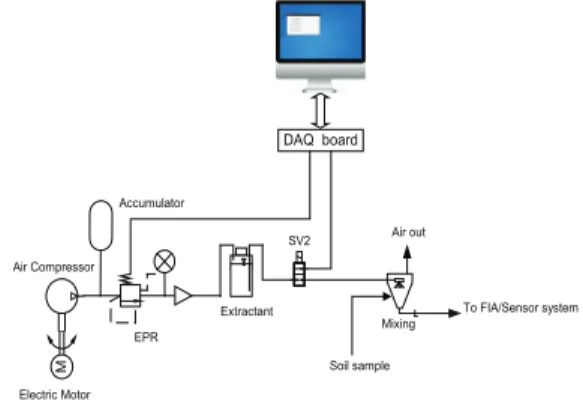
2.1. EquipmentA desktop computer was used to coordinate the operation of laboratory test set up of the electro-pneumatic extractant providing method (Figure 1). A labview program for control was developed and used to run the system automatically. The
Electro-Pneumatic Regulator (EPR) valve (ITV3000 series, SMC, Inc.,) was used to regulate the air pressure. The valve was capable of regulating the pressure from 5 to 900 kPa in proportion to an analog electrical signal. A two-position, direct operated, normally closed solenoid valve (SMC, VX22 series) controlled by Labview programming software according to pre-specified time interval provided a known high-pressure pulse duration to the extractant column inside a holder. When the valve initiated, a quantity of extractant was conveyed into the mixing unit along a delivery pipe. The mass of extractant transported to the mixing unit during a single air pulse was measured and recorded for all treatments in the experimental design.
M Electric Motor Air Compressor Accumulator EPR SV2 To FIA/Sensor system Mixing Air out Soil sample Extractant DAQ board
Figure 1- Schematic diagram of the electro-pneumatic extractant supply method for real-time nitrate sensing systems
Şekil 1- Gerçek-zamanlı nitrat ölçme sistemleri için otomatik ekstraktant sağlama yöntem şematiği
2.2. Experimental design and analysis
The randomized, complete block experimental design included three levels of pulse duration (30, 50, and 70 ms) and three levels of air pressure (low: 344.75; medium: 551.60; and high: 758.45 kPa), resulting in 9 different treatments, with five replicates of each treatment. Three levels of pulse were used to determine the effect of pulse duration on the mass of extractant obtained while the levels of air pressure were used to determine the effect of air pressure on the mass of extractant obtained.
To determine the significance of each variable (pulse and air pressure) on the measured extractant mass, analysis of variance was performed using Matlab Statistics Toolbox for each extractant mass individually. Air pressure and pulse duration were the independent variables, with extractant mass as the response (dependent) variable. Stepwise Linear Regression was performed at each pressure level and pooled data using Matlab Statistics Toolbox to model the relationship between the extractant mass and the independent variables (air pressure and pulse duration). The statistically significant (α= 0.05) main variables and their interactions were included in the final regression model. Water was used as an extractant during the tests.
3. Results and Discussion
The laboratory tests were conducted to investigate the effect and significance of air pressure and pulse duration on the quantity of extractant mass obtained. The mass of extractant transported to the container during a single air pulse was measured and recorded for all treatments in the experimental design. The mean extractant mass and standard deviations for all treatments studied in this experiment are given in Table 1. Mean extractant mass varied from 0.52 to 5.73 g depending on levels of pulse duration and applied air pressure. The standard deviation varied from 0.01 to 0.06 g, and the coefficient of variation (CV) varied from 0.54% to 2.89% depending on the pulse duration and applied air pressure levels.
Table 1- Mean extractant mass (g) and standard deviation for all laboratory test treatments
Çizelge 1- Deneme desenindeki tüm uygulamalar için ortalama ekstraktant ağırlığı (g) ve standart sapma değerleri
Pressure
Pulse 344.75 kPa 551.6 kPa 758.45 kPa
30 ms 50 ms 70 ms 1.05 (0.03) 2.77 (0.06) 4.72 (0.06) 1.02 (0.01) 3.24 (0.02) 5.69 (0.03) 0.52 (0.01) 2.97 (0.06) 5.73 (0.06)
3.1. Effect of pulse duration on extractant mass
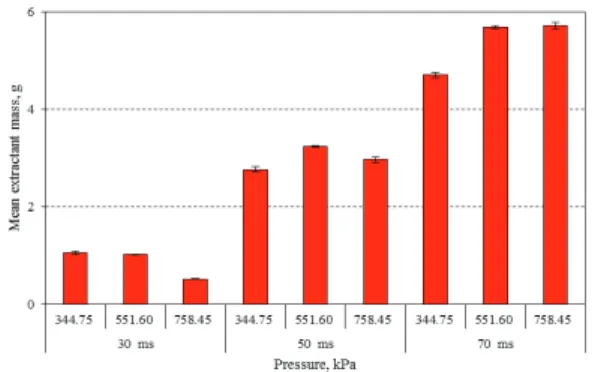
The results of statistics analysis showed that pulse duration had a significant effect (α= 0.05) on the extractant mass for all pressure levels. The mean mass values at different pulse durations for each air pressure level are shown in Figure 2. Mean extractant mass varied from 0.52 to 5.73 g, depending on pulse duration and air pressure levels. An increase in pulse duration level yielded a corresponding increase in the extractant mass for all pressure levels. The standard deviations (shown by the error bars) represent the overall standard deviation. This included the variance due to the difference in treatment means (pulse duration and air pressure) and random error. The standard deviations were less than 0.06 for all pressure levels.
Figure 2- Pulse duration effect on extractant mass for different pressure levels (n= 45), error bars represent standard deviations
Şekil 2- Farklı sistem basınçlarında puls süresinin ekstraktant kütlesi üzerine etkisi
3.2. Effect of air pressure on extractant mass
The statistics analysis suggested that air pressure had no significant effect (α= 0.05) on the extractant mass for all pulse duration levels. The mean mass values at different pulse duration for each air pressure level are shown in Figure 3. An increase in pressure level did not resulted in a corresponding increase in the extractant mass for all pulse durations. The standard deviations (shown by the error bars) represent the overall standard deviation.
Mean extractant mass varied from 0.52 to 5.73 g, depending on pulse duration and air pressure levels. The standard deviations were less than 0.06 g for all pulse duration levels.
Figure 3- Pressure effect on extractant mass for different pulse durations (n= 45) error bars represent standard deviations
Şekil 3- Farklı puls sürelerinde sistem basıncının ekstraktant kütlesi üzerine etkisi
3.3. Linear models for extractant prediction
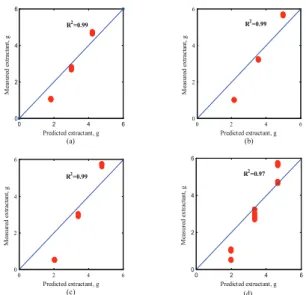
Stepwise linear regression analysis was used to develop the calibration models for prediction of extractant mass for each pulse duration level and pooled data. In regression analysis, all parameters were tested including their interactions. The final models only included parameters that were significant at the 5% level. In all cases, pulse duration was the only prediction variable of extractant mass and modeled to predict amount of extractant. The prediction model results for low, medium, high pressure levels, and pooled data are shown in Table 2. Pulse duration provided a very good prediction of extractant mass for all pressure levels, and pooled data. In the prediction model for the low level of pressure, the root mean square error (RMSE) was 0.076 g (mean extractant mass= 2.84 g), and the correlation of determination (R2) was 0.99. High
predictive capability of regression was obtained for medium level of pressure (RMSE= 0.062, R2= 0.99). Similarly, the good predictive capability
of regression was obtained for high level of pressure (the mean extractant mass= 3.07 g, RMSE= 0.093,
and R2= 0.99). In the case of pooled data, the RMSE
was 0.342 g (R2= 0.97 and the mean extractant mass=
3.08 g). Figure 4 shows the correlation between the estimated extractant mass and the actual measured sample mass at low, medium, high pressure levels, and for pooled data. Pulse duration provided a very good prediction of mass of extractant for all applied pressure levels, and pooled data.
Table 2- The regression model results for prediction of extractant mass for different pressure levels, and pooled data
Çizelge 2- Farklı sistem basınçlarında ekstraktant ağırlığı tahmini için regresyon model sonuçları
Pressure
(kPa) R
2 RMSE
(g) Mean mass (g) parameters (a)Model
344.75 551.6 758.45 Pooled data 0.99 0.99 0.99 0.97 0.076 0.062 0.093 0.342 2.84 3.32 3.07 3.08 Pulse Pulse Pulse Pulse
a, the final models only included parameters significant at the 5% level
The linear model for the pooled data is shown as Equation 1. L 0.11287P + 2.566 − = mass E (1)
Where; Emass, extractant mass (g) and PL, pulse
duration (ms)
The model indicated that the amount of extractant was only depended on pulse duration. This information withdrawn from the model offered several advantages; such as simplicity, fast response, digital controllability, accuracy and precision to allow automated extractant supply for complete real-time soil analysis system.
4. Conclusions
An electro-pneumatics method that utilizes pressurized air to provide precise amounts of extractant for on-the-go soil analysis was developed and tested under laboratory conditions. The results showed that electro-pneumatics method was capable of obtaining precise extractant mass within
30 to 70 ms with a CV ≤ 3% for all treatments in the experimental design regardless of pressure level. The mass of extractant was only affected by one variable, namely pulse duration. This dependency on one variable provided the flexibility to maintain a consistent soil/extractant ratio by changing pulse duration as soil sample mass varies and allowed easy automation of overall soil sensing system. The electro-pneumatics extractant providing method has the potential to be used in a real-time soil nutrient analysis system based on soil sampling.
References
Adsett J F & Zoerb G C (1991). Automated field monitoring of soil nitrate levels. In: Automated Agriculture for the
21st century, Paper No. 1191, ASAE, St. Joseph, MI
pp. 326-335 0 2 4 6 0 2 4 6 Predicted extractant, g M eas ur ed ex tract an t, g 0 2 4 6 0 2 4 6 Predicted extractant, g M eas ur ed ex tract an t, g 0 2 4 6 0 2 4 6 Predicted extractant, g M eas ur ed ex tract an t, g 0 2 4 6 0 2 4 6 Predicted extractant, g M eas ur ed ex tract an t, g (b) (a) (c) R2=0.99 (d) R2=0.97 R2=0.99 R2=0.99
Figure 4- The correlation between measured and predicted extractant mass: a, at low pressure (344.75 kPa); b, at medium pressure (551.60 kPa); c, at high pressure (758.45 kPa); and d, for pooled data (344.75, 551.60, 758.45 kPa; n= 45)
Şekil 4- Tahmin edilen ve ölçülen ekstraktant ağırlığı arasındaki korelasyon: a, düşük basınçta (344.75 kPa); b, orta basınçta (551.60 kPa); c, yüksek basınçta (758.45 kPa); d, tüm basınç değerlerinde (344.75, 551.60, 758.45 kPa; n= 45)
Adsett J F, Thottan J A & Sibley K J (1999). Development of an automatic on-the-go soil nitrate monitoring system. Applied Engineering in Agriculture 15(4):
351-356
Birrell S J & Hummel J W (2001). Real-time multi ISFET/ FIA soil analysis system with automatic sample extraction. Computers and Electronics in Agriculture
32(1): 45-67
Dalal R C & Henry R J (1986). Simultaneous determination of moisture, organic carbon, and total nitrogen by near infrared reflectance spectrophotometry. Soil Science
Society of America Journal 50: 120-123
McGrath D & Skotnikov A (1996). Automated work-station for soil analysis. Communications in Soil
Science and Plant Analysis 27(5-8): 1795-1812
Upadhyaya S K, Shafii S & Slaughter D (1994). Sensing soil nitrogen for site specific crop management (SSCM). Paper No. 1055, ASAE, St. Joseph, MI Yildirim S, Birrell S J & Hummel J W (2006). Laboratory
evaluation of an electro-pneumatic sampling method for real-time soil sensing. Transactions of the ASABE