INSTITUTE OF SOCIAL SCIENCES
GRADUATE SCHOOL OF BUSINESS ADMINISTRATION
MANAGEMENT AND ORGANIZATION
EFFECT OF PERCEIVED ORGANIZATIONAL CLIMATE
ON WHISTLEBLOWING INTENTION: RESEARCH IN
INTERNATIONAL TRADE ORIENTED ORGANIZATIONS
Codjori Edwige IKO AFE
MASTER THESIS
Advisor:
Assoc. Prof. Dr. Ali Şükrü ÇETINKAYA
T. C.
SELÇUK ÜNİVERSİTESİ
Sosyal Bilimler Enstitüsü Müdürlüğü
Bilimsel Etik Sayfası
Ö ğr en ci n in
Adı Soyadı Codjori Edwige IKO AFE Numarası 124227011010
Ana Bilim /
Bilim Dalı İŞLETME / YÖNETİM ORGANİZASYON Programı Tezli Yüksek Lisans
Tezin Adı
ALGILANAN ÖRGÜTSEL IKLIMIN WHISTLEBLOWING EĞILIMINE ETKISI: ULUSLARARASI TICARET YAPAN IŞLETMELERDE BIR ARAŞTIRMA
Bu tezin proje safhasından sonuçlanmasına kadarki bütün süreçlerde bilimsel etiğe ve akademik kurallara özenle riayet edildiğini, tez içindeki bütün bilgilerin etik davranış ve akademik kurallar çerçevesinde elde edilerek sunulduğunu, ayrıca tez yazım kurallarına uygun olarak hazırlanan bu çalışmada başkalarının eserlerinden yararlanılması durumunda bilimsel kurallara uygun olarak atıf yapıldığını bildiririm.
Öğrencinin imzası (İmza)
DEDICATION
This work is dedicated to my princesses E’Lonm and E’Yram Mebounou, my husband Guy Crescent Mebounou, my parents Raphael and Solange, my brothers Sylvestre, and Herbert, and my sister Isabelle.
ACKNOWLEDGMENTS
I am truly thankful to “Yurtdışı Türkler ve Akraba Topluluklar Başkanlığı” for the scholarship I was granted.
I would like to express my sincere gratitude and profound respect to my advisor Assoc. Prof. Dr. Ali Şükrü ÇETİNKAYA. His guidance, patience and support have given me motivation to always strive to do better. Thanks to him I have got the taste for research.
I am also pleased to acknowledge the constructive contributions of Assist. Prof. Dr. Melis Attar and Assist. Prof. Dr. Selçuk Karayel as jury members for my defense.
I am grateful to express my appreciation to all of the Social Sciences Institute members of Selçuk University.
My thanks also go to the lecturers of the Department of Business Administration of Selçuk University.
I am grateful to Dr. Alexis Abodohoui for his keen contributions. I would like to thank Mme Marcelline Babatounde and his husband Berthaire for their supports.
T. C.
SELÇUK ÜNİVERSİTESİ
Sosyal Bilimler Enstitüsü Müdürlüğü
Ö ğr en ci n in
Adı Soyadı Codjori Edwige IKO AFE Numarası 124227011010
Ana Bilim /
Bilim Dalı İŞLETME / YÖNETİM ORGANİZASYON Programı Tezli Yüksek Lisans
Tezin Adı
ALGILANAN ÖRGÜTSEL IKLIMIN WHISTLEBLOWING EĞILIMINE ETKISI: ULUSLARARASI TICARET YAPAN IŞLETMELERDE BIR ARAŞTIRMA
ÖZET
Bu araştırmada örgütsel iklim ile haberdar etme (whistleblowing) arasındaki ilişkinin tespit edilmesi amaçlanmıştır. Araştırmada çalışanlara iş yerindeki olumsuz veya hatalı davranışların haberdar edilmesini örgüt iklimini teşvik edip etmediği incelemiştir. Anket uygulamak için rastgele örnekleme yöntemiyle, Konya ve Ankara ilindeki organize sanayi bölgesindeki firmalar seçilmiştir. Kesitsel anket yoluyla veriler toplanmıştır. Çalışmada 274 geçerli anket geri dönüşü elde edilmiştir. Veriler; tanımlayıcı istatistikler, açıklayıcı faktör analizi, korelasyon analizi ve doğrusal regresyon yöntemleri kullanılarak analiz edilmiştir. Beklendiği gibi bireysel özerklik ve güven, haberdar etmeye olumlu katkıda bulunurken mobbing olumsuz etkiye yol açar. Aksine, örgütsel adalet, lider güvenilirliği, moral ve haberdar etme üzerinde tutarlı bir etkisi bulunmamaktadır.
Anahtar Kelimeler: Haberdar etme, örgütsel iklim, iş ortamı, ihracat yapan firmalar, olumsuz veya hatalı davranış.
T. C.
SELÇUK ÜNİVERSİTESİ
Sosyal Bilimler Enstitüsü Müdürlüğü
Ö ğr en ci n in
Adı Soyadı Codjori Edwige IKO AFE Numarası 124227011010
Ana Bilim /
Bilim Dalı İŞLETME / YÖNETİM ORGANİZASYON Programı Tezli Yüksek Lisans
Tezin Adı
EFFECT OF PERCEIVED ORGANIZATIONAL CLIMATE ON WHISTLEBLOWING INTENTION: RESEARCH IN
INTERNATIONAL TRADE ORIENTED ORGANIZATIONS
SUMMARY
This research investigated the relationship between organizational climate and whistleblowing intention in international trade oriented organizations. By using a random sampling method through a cross-sectional investigation in international trade oriented firms operating in Ankara and Konya, this research examined whether organizational climate motivates and encourages employees to unveil or report wrongdoings and malpractices witnessed in their working environment. The survey had led to 274 valid answered questionnaires used for the empirical analysis. Following the Exploratory Factors Analysis to check the validity of the measuring instrument and find out the relevant principal components, correlation and linear regression analyses were carried out to test the relationship between organizational climate drivers and whistleblowing intention. As expected, individually autonomy and trust are positively contributing to whistleblowing intention while mobbing has a negative effect on it. In contrary, organizational justice, morale and leader credibility display no consistent relationship with whistleblowing intention though they were expected to be positive drivers of organizational climate.
Key Words: Whistleblowing, organizational climate, working environment, international trade oriented organization, wrongdoings.
CONTENTS
BILIMSELETIKSAYFASI ... I DEDICATION ... II ACKNOWLEDGMENTS ... III ÖZET ... IV SUMMARY ... V CONTENTS ... VI TABLES ... VIII FIGURES ... IX INTRODUCTION ... 1
CHAPTER 1: WHISTLEBLOWING AND ORGANIZATIONAL CLIMATE: A THEORETICAL REVIEW ... 4
1.1.WHISTLEBLOWINGCONCEPT ... 4
1.1.1. Short History and Theoretical Background of Whistleblowing ... 4
1.1.1.1. Short History of Whistleblowing ... 4
1.1.1.1.1. Earliest Whistleblowing: Denunciation in Socio-Political Context ... 4
1.1.1.1.2. The Emergence of Whistleblowing in Private Organizations ... 7
1.1.1.2. The Main Theories Underpinning Whistleblowing... 10
1.1.1.2.1. Whistleblowing: Quandary or Tradeoff between Loyalty and Ethics ... 10
1.1.1.2.2. Whistleblowing: A governance Mechanism of Reducing Information Asymmetry and Agency Costs ... 12
1.1.2. Delineating Whistleblowing Concept ... 15
1.1.2.1. Definitions of Whistleblowing and Related Expressions ... 15
1.1.2.1.1. Definitions of Whistleblowing ... 15
1.1.2.1.2. Whistleblowing and Related Expressions ... 17
1.1.2.2. Whistleblowing and Whistleblowers: Typologies ... 19
1.1.2.2.1. Types of Whistleblowing ... 19
1.1.2.2.2. Types of Whistleblowers ... 22
1.1.3. Whistleblowing Development and Whistleblower Protection Worldwide... 24
1.1.3.1. Whistleblowing Development and protection in Anglo-Saxon Countries ... 25
1.1.3.2. Whistleblowing Development in other Parts of the World ... 26
1.2.ORGANIZATIONALCLIMATECONCEPT ... 30
1.2.1. Organizational Climate: Definition and Features ... 30
1.2.1.1. Meaning and Definition of Organizational Climate ... 30
1.2.1.2. Key Components of Organizational Climate ... 31
1.2.2. Key Theories Underpinning Organizational Climate... 33
1.2.2.1. The Hawthorne Studies ... 33
1.2.2.2. The Gestalt School of Psychology ... 34
1.2.2.3. The School of Functionalism ... 34
1.2.3. Organizational Climate and its Related Muddled Concepts ... 35
1.2.3.1. Organizational Climate and Psychological Climate ... 35
1.2.3.2. Organizational Culture and Organizational Climate ... 37
1.3.ORGANIZATIONALCLIMATEANDWHISTLEBLOWING... 40
1.3.1. Organizational Climate Drivers Stimulating Whistleblowing Intention ... 40
1.3.2. Organizational Climate Drivers Disheartening Whistleblowing Intention ... 41
CHAPTER 2: CONCEPTUAL FRAMEWORK AND RESEARCH METHOD... 44
2.1.CONCEPTUALFRAMEWORK ... 44
2.1.1. Research Objectives and Interests ... 44
2.1.1.1. Research Objectives ... 44
2.1.1.2. Research Theoretical and Methodological Interests ... 45
2.1.1.3. Practical Advantages for Management ... 46
2.1.2. Variables Selection ... 47
2.1.2.1. Dependent Variable: Whistleblowing Intention ... 47
2.1.2.2. Independent Variables: Organizational Climate Drivers ... 48
2.1.3. Theoretical Model and Research Hypotheses ... 52
2.1.3.1. Theoretical Model ... 52
2.1.3.2. Research Hypotheses... 53
2.2.ANALYSISDESIGN ... 54
2.2.1. Review of Prior Analysis Approaches ... 54
2.2.2. Methods of Analysis ... 57
2.2.2.1. Exploratory Factor Analysis ... 57
2.2.2.2. The Linear Regression Analysis ... 57
2.3.DATACOLLECTIONMETHOD ... 57
2.3.1. Population ... 57
2.3.2. Sampling ... 58
2.3.3. Data Gathering ... 60
2.3.3.1. Data Instruments and Scales ... 60
2.3.3.1.1 Whistleblowing Measurements ... 60
2.3.3.1.2. Organizational Climate Measures ... 60
2.3.3.1.3. Demographic Characteristics ... 63
2.3.3.2. Validity and Reliability of the Questionnaire ... 64
CHAPTER 3: ANALYSIS AND FINDINGS ... 66
3.1.PRELIMINARYANALYSESOFTHESURVEYDATA ... 66
3.1.1. Demographic Profile of the Sample ... 66
3.1.2. Reliability Test ... 69
3.1.3. Exploratory Factor Analysis ... 70
3.2.STATISTICALTESTSOFRELATIONSHIPSBETWEENVARIABLES ... 74
3.2.1. Correlation and Multicollinearity Analysis ... 74
3.2.2. Regression Analysis and Hypotheses Testing... 75
3.3.DISCUSSIONSANDLIMITATIONS ... 78
3.3.1. Discussions ... 78
3.3.2. Limitations of the Findings ... 79
CONCLUSION ... 81
REFERENCES ... 83
APPENDIX 1: QUESTIONNAIRE (ENGLISH) ... 93
APPENDIX 2: QUESTIONNAIRE (TURKISH) ... 96
TABLES
Table 2.1.1.3 : Summary of Research Interests ……… 46
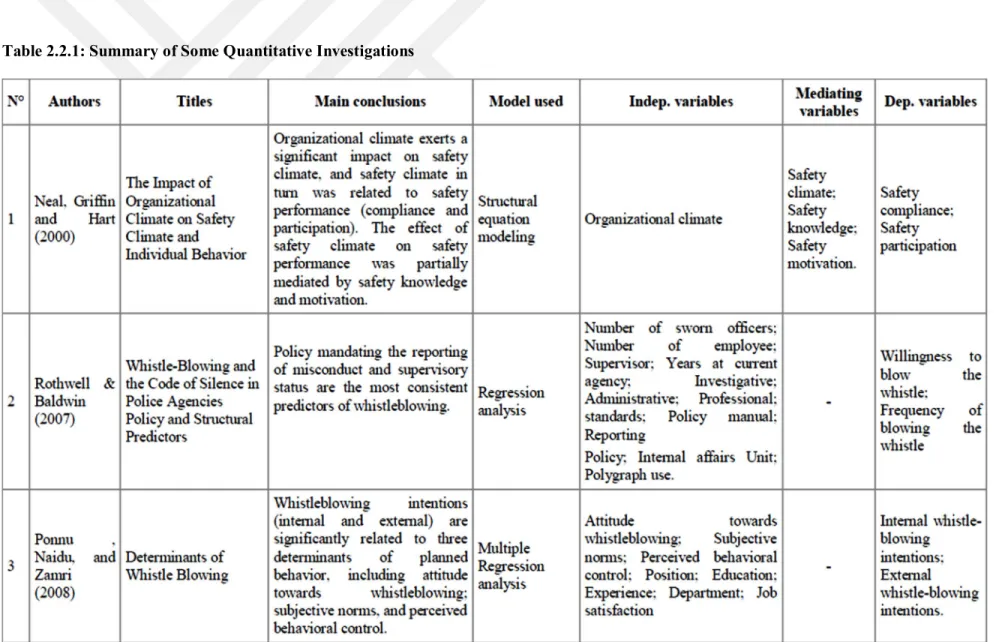
Table 2.2.1 : Summary of Some Quantitative Investigations………. 55
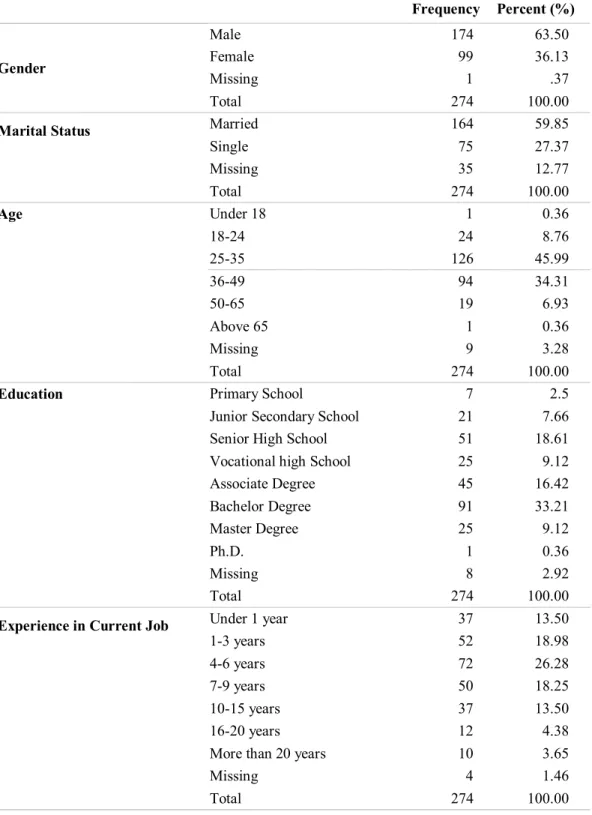
Table 3.1.1.A : Respondents’ Demographics ……….... 67
Table 3.1.1.B : Surveyed Companies’ Basic Characteristics………. 68
Table 3.1.2 :Cronbach’s Alpha for the Variables ………. 70
Table 3.1.3.A : Summary of key indicators underpinning principal component analysis ………. 71
Table 3.1.3.B : Exploratory factor analysis outputs ………. 72
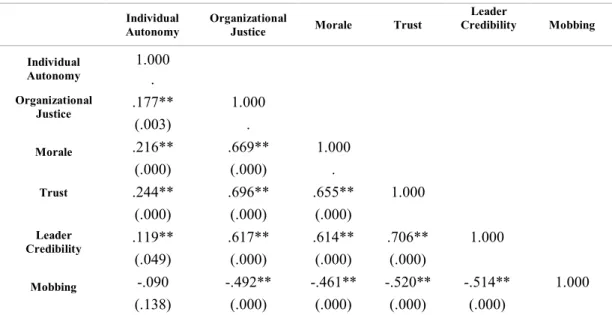
Table 3.2.1.A : Summary of Pearson's rho Correlations……… 74
Table 3.2.1.B : Variance Inflation Factors……… 75
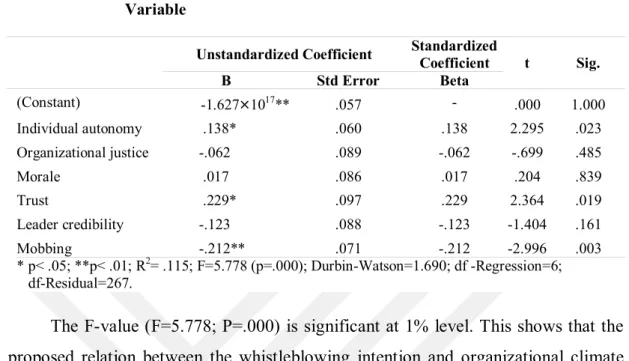
Table 3.2.2.A : Regression outputs using Whistleblowing Intention as dependent variable……… 76
FIGURES
Figure 1.1.2.1.2 : Denunciation and its hyponyms……… 18 Figure 1.1.2.2.1 : Whistleblowing typology……….. 21 Figure 2.1.3.1 : Research Model……… 53
INTRODUCTION
Following the failure of market regulation, Jensen and Meckling (1976: 4-7) developed agency theory to raise the major issues related to the principal/agent relationship, including the informational asymmetry, the moral hazard, the adverse selection, and the conflicting interest behaviors. This paved the way to corporate governance with an array of coordinating, regulating and monitoring mechanisms. Despite the implementation of complex arrangements such as audit committees, boards, and other legal and regulatory provisions, numbers of scandals have occurred in both public and private sphere. Perhaps, Enron in 2001 and Madoff in 2008 in United Sates should be considered the biggest frauds and embezzlement never experienced before in the mankind. These financial scandals have raised questions about the relevance of traditional governance devices. It is in this context that whistleblowing has got increasing prominence and greater visibility as a powerful denunciation tool for the public (Seifert, Stammerjohan, & Martin, 2014: 157) though the concept was coined more than three decades ago.
The last ten years, whistleblowing has become a buzzword in the encyclopedia of corporate governance jargons and myriad regulatory enforcement programs (Banerjee & Roy, 2014: 7) since it helps exposing improper conduct, including mismanagement, corruption, illegal kickbacks, bribes to government officials, financial scandals, use of prohibited inputs in the production, trading of outdated items in underdeveloped countries, failure with quality standards, delays and missed delivery deadlines, wage discriminations, sexual harassments, prejudice or harm to the public environment, etc. This ultimately aims to early rectify wrongdoings and avoid public scandals that could jeopardize shareholders and other stakeholders' values, either within the workplace or external. Therefore, whistleblowing appears as a credible alternative to unveil malpractices and wrongdoings in working environment in order to stop early the pillaging of resources and prevent unnecessary bankruptcies.
In the whistleblowing process, employees hold the prominent role since they are the very first people to realize or suspect a potential malpractice or wrongdoing in their workplace. They are even usually in touch with more information compared to the other stakeholders. Notwithstanding their privileged position in blowing the
whistle on wrongdoings, employees often face retaliations (mobbing, intimidation, harassment, dismissal, hostile treatment or violence) from employers, management, supervisors or even their fellow colleagues, without an opportunity for vindication. In many countries, whistleblowing is even associated with treachery or spy.
The perception an employee builds about the working environment might seriously affect his or her decision-making process to engage in whistleblowing. It is often very difficult, if not impossible, for an employee to get involved in whistleblowing actions in a fearful environment. Indeed, the perception of mobbing in a working environment may frighten and silent employees and therefore forced them not to report observed wrongdoings (Gül & Özcan, 2011: 130). Employee could be encouraged to speak out only if they are assured against adverse repercussions or retaliations, confident that they will be listened to, and confident that appropriate action will be taken. In essence, employees can feel more supported and regard whistleblowing process as more fair when managers demonstrate organizational justice and correct reported wrongdoings (Miceli et al., 2012: 928; Seifert et al., 2014: 158). It then seems that the nature of organizational climate plays a key role in building employee's confidence in whistleblowing process. In this respect, Huang, Lo, and Wu (2013: 694) argued that the establishment or improvement of the ethical climate can enhance whistleblowing intention for organizational members. In the same vein, Near, Baucus, and Miceli (1993: 204) posited that “positive organizational climates may discourage serious wrongdoing and encourage whistle-blowing under some conditions, but the relationship is not as straightforward as might be expectedˮ.
Since the literature lacks clear empirical evidence addressing the relation between organizational climate and whistleblowing, it will be worthwhile to examine the issue in international trade oriented organizations. The investigation begins with this basic question. Does the organizational climate influence whistleblowing in international companies? In fact, this quantitative research aims to systematically analyze the relationship between organizational climate and whistleblowing in international companies. To this end, a survey was carried out with a structured questionnaire to gather data on employees working in international trade oriented corporations operating in Turkey. The collected data were then analyzed using
various statistical procedures including Exploratory Factor Analysis and linear regression.
The remaining of the thesis is structured in three chapters as follows. The first chapter reviews the literature related to whistleblowing and organizational climate, examines the theoretical backgrounds underpinning these concepts as well as investigating the probable relationship between them. The second chapter outlines the conceptual framework and the research method. The third chapter presents the statistical estimated results and discusses the findings. Finally, main findings were summarized and directions for future research were suggested.
CHAPTER 1: WHISTLEBLOWING AND ORGANIZATIONAL CLIMATE: A THEORETICAL REVIEW
This chapter delves into the literature to examine whistleblowing and organizational climate as well as discussing the relationship between these two concepts.
1.1. WHISTLEBLOWING CONCEPT
In this section, a short history as well as theoretical backgrounds of whistleblowing was first presented. Following these, the scope of whistleblowing concept was clearly delineated in order to dispel out possible ambiguities with related constructs, including denunciation, denouncement, and alert. The section ends by displaying legal perspectives and whistleblowing protections around the globe.
1.1.1. Short History and Theoretical Background of Whistleblowing 1.1.1.1. Short History of Whistleblowing
1.1.1.1.1. Earliest Whistleblowing: Denunciation in Socio-Political Context
The history of whistleblowing seems to be hazy because no systematic description of its origin exists in the available literature and archive. Yet, whistleblowing might originate from the denunciation of the many nasty and demeaning socio-political events that had affected the history of humanity. As it could be expected, several attempts of denunciations to reveal those wrongdoings to the broader audience had been observed. In this work, some main examples have been exposed, including the denunciation of vicious practices of the clergy leading to the Reformation of the church; some harsh criticisms against the slave trade leading to its abolition; the denunciation of the wrongdoings perpetrated by senior officials during the French revolution; and the denunciation of the Holocaust during World War II.
Perhaps, one of the earliest whistleblowing practices can be traced back to Reformation epoch, when Martin Luther (1483-1546) challenged the Roman Church in the early 1500s A.D. In that period, the pope was considered as the interface between God and Man but at the same time, the higher clergy of the Roman Catholic
Church were deeply involved in corruption, luxury, abuses of position and power (Sydow, 1999: 3). Luther disputed these practices and gave a new impetus to Christianity. He believed religious beliefs should be based on the Bible alone and that the pope and his priests had no real authority. Then, each person was equal before God (Sydow, 1999: 7) and no one need a priest to explain the Bible to her or him. He argued that there is no need to interpret the mysterious writings of God and then eliminated the main function of priests as the performers of necessary religious rituals (Howard, 2005: 96). Furthermore, the invention of the printing presses at the same period had favored and hastened the spread of Luther’s ideas to the mass audience (Howard, 2005: 91) which led to major changes in mankind history and also profoundly affected the modern view of politics and law.
Another outstanding phenomenon in the mankind history is slavery that has been developed across all ages and continues to be performed in its modern-day forms. Nevertheless, the triangular trade is undoubtedly one of the worst experiences rooted in the collective memory and considered as a major crime orchestrated by the Westerns between the 15th and 19th century (Felsen & Kalaitzidis, 2005: 7-9). At that time, European smugglers have deported tens of millions of slaves from Africa to America in very humiliating conditions in order to sell them as labor force in various plantations. These slaves were exposed to cruel treatments causing them all kind of moral and physical pains. These abuses resulted in slave revolts and especially denunciations from the first Human Rights defenders such as Victor Schoelcher who was later considered as the initiator of the abolition of this slave trade in 1848 (Dorigny, 2003).
Furthermore, French Revolution that occurred around the period ranging from 1789 to 1799 had also brought some array of early practice of whistleblowing. At that time, whistleblowing, known as denunciation, was already included in the France Constitution of 1791 and was considered to be a virtue and civic duty. It was aiming to assure transparency of government actions and prevent the ongoing revolution from conspirators and the republic's traitors and enemies (Münch, 2011: 2-3).
In a political theory perspective, Bremond-Poulle (2006: 43-84) reviewed the whistleblowing practices in which Jean Paul Marat (1743-1793) was involved during
the French Revolution to dishearten the wrongdoings of aristocracy. Indeed, Marat was engaged in a systematic process to expose politicians with high position who were found guilty of corruption, embezzlement, authority abusing, self-interest behavior, and other malpractices detrimental to the common interest. He then urged his fellow citizens to blow the whistle every time they witness wrongdoings and malpractices perpetrated by public authorities. In this vein, a special research committee was established in 1789 in Paris to receive denunciations from ordinary citizens who might witness wrongdoings or possess any information related to actions or behaviors of public representatives which could be harmful to the public interests (Lucas, 1996: 770). However, he warned against slanders and asked whistleblowers to provide accurate proofs of the allegations and reveal their identity when doing so. He also considered press freedom as a powerful tool that can help the brave citizens to make public their complaints. A citizen does not need to be a member of the assembly before monitoring his elected representatives, and therefore exposing the transgressors of the economy and the traitors of the nation. It is then clear to notice that Marat had already projected whistleblowing as a powerful mechanism of governance in which the citizen control would play a key role.
Some whistleblowing traits can also be seen during the period of World War II and the period of the Cold War (1947-1991). At that time, the anti-Semitic issue was dominating the debate. Indeed, Jews were subject to excessive denunciation during the period when France was invaded by Germany. In fact, Jews were present in every strategic area and were even taking over some high position in the republic. This situation had exacerbated some French citizens who considered themselves as true patriots and thus systematically denounced this indignation. Thus, thousands of anonymous letters reporting the involvement of Jews in mafia networks were sending to the police who proceeded to hundreds of apprehensions in which some could be regarded as arbitrary. For example, in July 1942 a Russian Jew employed as a Franco-German interpreter by the city of Mothe-Saint-Heray was denounced and jailed (Joly, 2007: 137-138).
After World War II, there would certainly have been several attempts to denounce wrongdoings in socio-political environment. Although whistleblowers are often seen as traitors or enemies, they prefer to blow the whistle to unveil abuses and
wrongdoings at the expense of their freedom or even their lives. They become the “number one enemyˮ of government's top secrets. Furthermore, whistleblowing has been extended to private organizations where it is now playing a key role in corporate governance (Bowen, Call, & Rajgopal, 2010: 1239).
1.1.1.1.2. The Emergence of Whistleblowing in Private Organizations
Although early denunciations emerged centuries ago in the public and socio-political areas, it took until the late 1960s that a true debate began being initiated on the relevance of whistleblowing in private organizations. Over a long period, organization has been regarded as a black box where an employee should be absolutely loyal towards his employer. This duty of loyalty had been strengthened by the theories of scientific management mainly developed by Frederick Taylor, Lillian Gilbreth and Frank, Henry Gantt, Henry Fayol and Max Weber. These proponents of the classical school referred to the organization as a machine which must be operated based on centralized authority, clear lines of authority, marked division of labor, rules and regulations, specialization and expertise, and clear separation of staff and line (Celik & Dogan, 2011: 65). In this situation, an employee is required to be strictly loyal to his or her employer. This labor discipline had then prevented employees to reveal to the public any wrongdoing they could have witnessed in their working environment even if they were aware of the related risks for the organization or the public interest.
However, the organizational theories advancement combined with changes in the socio-economic environment had allowed challenging the labor discipline standards and its related loyalty. From scientific management perspectives to human resources school of thought, workers’ conditions have been improved in terms of delegation of authority, employee autonomy, trust and openness, concerns with the whole person, and interpersonal dynamics (Perrow, 1973: 3) leading to employee development. In this respect, employees should enhance their commitment to organization and even challenge the existing administrative authority when management teams become involved in self-interest behaviors or in harmful actions to the public interest.
Hence, the debate related to labor discipline raised in the early 1970s enabled employees to be disloyal to their employers in order to protect public interest. Ristau (2012: 923-928) termed it as the public policy exception enabling the employee to pass over or violate the duty of loyalty when employers undermine a clearly expressed public policy or get involved in illegal or prohibited actions that could jeopardize public health, safety, or welfare. Therefore, employees could no longer remain silent when they witness wrongdoings in their working environment. This led to the conflict between the public interest and the interest of the organization. Thus, it has become quite impossible to hide shortcomings, mistakes, problems, or other wrongdoings that may undermine public interests even though the whistleblowing is viewed to be harmful to the organization’s image (Vandekerckhove, 2012: 1-3). In this vein, Vandekerckhove (2012: 8) recalled that whistleblowing in an organizational context can be traced back to 1972 when consumer advocate Ralph Nader emphasized that an employee should blow the whistle any time the organization is involved in corruption, illegal, fraudulent or harmful activities.
The introduction of whistleblowing in organization was legitimized by the pre-eminence of public interest over the private interest despite the hostility developped towards daring employees who took the risk to sound the alarm on wrongdoings witnessed in their workplace. Nevertheless, whistleblowing continued to grow in importance in the organizational context and even became a powerful tool and a buzzword in corporate governance (Banerjee & Roy, 2014: 7). In the same way, several instances of whistleblowing have been stepped up in recent years. The most important cases of whistleblowing in the early years of this century occurred in anglo-saxon countries. Perhaps, some of the famous and well-publicized examples of whistleblowing in organizational context could be brought to Edward Snowden (2013) in Central Intelligence Agency; Olivier Dubuquoy (2011) in oil and gas sector; Sherron Watkins (2001) with Enron; Jeffrey Wigand (1996) in tobacco industry; and Erin Brockovich (1996) in water sector. Short comments related to these whistleblowing practices have been provided as follows:
Edward Snowden is a former employee of CIA, Dell, and NSA. Edward Snowden had revealed to the public several confidential documents on mass surveillance programs. He revealed in June 2013, the National Security
Agency's PRISM system launched in 2007 by the US government to monitor data from social networks users under the pretext of fighting terrorism. Prosecuted by justice for high treason, he fled his country to join Hong Kong in June 2013, and then has been granted temporary asylum in Moscow.
Olivier Dubuquoy revealed information on science washing practices that occurred in the oil and gas industry of France. In 2011, he released confidential investigation results related to the toxicity of red mud containing heavy metals. Sherron Watkins had been an executive for the Enron Corporation and helped
in exposing the enormous financial lies and frauds perpetrated in the company. She had drawn the CEO attention on the accounting irregularities. Although her warnings did not help to automatically end the illegal activities going on in the company, Sherron Watkins had significantly contributed to the following investigations carried out by U.S. House of Representatives and Senate Investigative Committee and leading to the downfall of Enron.
Jeffrey Wigand is a former tobacco company executive who revealed in the early 1990s to the general public that the industry knew long ago and were hiding the addictive and carcinogenic feature of cigarettes. He made several enemies by claiming in 1996 that cigarette companies were fully aware that they were packing their products with addictive levels of nicotine.
Erin Brockovich had unveiled the disaster related to the presence of hexavalent chromium in drinking water of Hinkley in California. By conducting an exhaustive investigation on a series of mysterious illnesses in the town of Hinckley, she discovered that Pacific Gas and Electric was leaking a toxic chromium into the groundwater which had been poisoning the small town's drinking water for over 30 years. Erin exposed this public health problem and then initiated a legal proceedings. Following a trial in 1993, the giant Pacific Gas and Electric Company was forced to pay out a compensation amounting hundreds of millions of dollars to the victims.
The above short description encompasses non-exhaustive examples of the most well-known whistleblowers who had mainly contributed to the revolution of whistleblowing in organizational context. Some call these individuals heroes while
many others view them as traitors and spies. They became famous by exposing to the general public the wrongdoings committed by their fellow colleagues or management teams or disclose supposedly confidential information of the organization they work/worked for even at the expense of their freedom and life. Their actions have triggered whistleblowing legislation or strengthened it and mainly contributed to the establishment of procedures of whistleblowing and whistleblowers' protection in organizational context.
1.1.1.2. The Main Theories Underpinning Whistleblowing
The advancement of denunciation and especially the emergence of the whistleblowing concept in organizations have led to significant theoretical changes. The whistleblowing development has improved some theories while it puts others into serious question. Indeed, denunciation and its derivative concepts have deeply challenged many theories developed on employee loyalty towards their employers and the organization in which they work for. Inversely, they have mainly contributed to the debates pertaining to ethical theories and at the same time helped in addressing the issue related to information asymmetry in the agency theory.
1.1.1.2.1. Whistleblowing: Quandary or Tradeoff between Loyalty and Ethics
Whistleblowing has raised serious debates related to the controversial issue between the loyalty duty of an employee and ethical requirements. The loyalty refers to the commitment and trust of an individual or an employee to a specific person, organization or group (Swiatek-Barylska, 2013: 51). The loyal employee sacrifices his or her own goals and interests and then gets involved with and identifies his or herself with the organization (Çetinkaya & Kaplan, 2013; Lurie & Frenkel, 2002: 296). It requires the obligation of discretion and confidentiality, the complete devotion to the corporate priorities, and after all the abstention from any acts that could harm the company. The employees are very often forced to a duty of loyalty that prevents them from reporting their employers’ wrongdoings (Riedy & Sperduto, 2014: 268-274). In other words, they cannot bite the hand that feeds them or show ingratitude to their employers by involving in whistleblowing actions. At first glance, whistleblowing seems to be a violation of loyalty and confidentiality duties of an
employee towards his or her employer and fellow colleagues. Thus whistleblowing should be regarded as a violation of the employer-employee trust relationship (Tavani & Grodzinsky, 2014: 10) and be considered as a betrayal and a fraying of social fabric (Waytz, Dungan, & Young, 2013: 1027).
Furthermore, Masaka (2007: 39) argued that whistleblowing is incompatible with loyalty and then morally irrelevant in working environment unless in case of protecting a higher public interest. This objection raised to justify the disloyal behavior of an employee is discussed through the standard theory and complicity theory developed by (Davis, 1996: 6-7). According to the standard theory, whistleblowing is morally permitted when the employee has already exhausted the internal procedures and possibilities without reaction and the wrongdoing will likely do serious and considerable harm to the public. Also, the employees should be sure that the external reporting will correct or stop the wrongdoing.
In complicity theory, the employee is morally required to report the wrongdoing that he or she has witnessed in the working environment in order to avoid colluding with the wrongdoers. In this case the employee refers to whistleblowing to disclaim moral responsibility. Since complicity theory refers to employee moral responsibility, it raises the ethical issue which is defined as moral principles that govern a person's or group's behavior. The ethics of whistleblowing is deeply related to its moral purpose, whether for changing a situation for the better or fulfilling a deontological duty (Wilmot, 2000: 1051).
As Waytz et al. (2013: 1027) put it, whistleblowing decision causes a conflicting relationship between fairness and loyalty norms. Similarly, Lukacs, Cristache, Nicolai, and Stoica (2012: 55) also emphasized that whistleblowing involves a conflict between employee loyalty and protection of public interest. Indeed, whistleblowing creates a disloyal behavior of the employee while promoting basic moral values including justice and fairness. However, Uys and Senekal (2008: 43-44) reconciled these conflicting issue by developing the framework in which morality of principle versus the morality of loyalty work together. They argued that whistleblowing should be interpreted as loyalty to the society as a whole since the organization in which the whistleblower works for is a microstructure of the society that is the macro-organization. Therefore, employees who witness wrongdoing in
their working environment should no longer feel confusing between their loyalty duties and ethical requirements. Overall, they should prioritize higher public interest and then could even involve in whistleblowing in order to correct or stop the wrongdoing. Furthermore, business ethics should be set up so that organizations will be operated by being conforming to the general ethics of the society which Uys and Senekal (2008: 39) referred as morality of principle. By doing so, whistleblowing becomes an important tool to reduce information asymmetry among stakeholders.
1.1.1.2.2. Whistleblowing: A governance Mechanism of Reducing Information Asymmetry and Agency Costs
Whistleblowing is increasingly becoming a critical tool in corporate governance and its related theories. Corporate governance is mainly rooted in the theories of the firm namely the transaction costs (Coase, 1937: 390-391), especially the agency theory (Jensen & Meckling, 1976: 308-313). Agency theory refers to a contractual relationship whereby one or more persons (the principal(s)) engage another person (the agent) to perform some service or task on their behalf which involves delegating some decision making authority to the agent (Jensen & Meckling, 1976: 308). The agency theory raises two main issues including the self-interested behavior and the agency costs.
The self-interested behavior happens when agents have the ability to operate in their own self-interest rather than in the best interests of the principal (s) because of the separation of ownership and control combined with the asymmetric information issue related to imperfect labor and capital markets. The asymmetric information arises from information failure whenever one party has more or better information than the other leading to an imbalance of power in economic transactions. The self-interested behavior may vary from the consumption of some corporate resources in the form of perquisites and the avoidance of optimal risk positions to more nasty behaviors including misappropriation, embezzlement, shirking, stealing, self-dealing, corruption, or mismanagement which Edwin Sutherland termed in 1940 as the white collar crimes (Shapiro, 2005: 279). The impossibility of the principal to monitor all of the agent’s actions may increase moral hazard problem or adverse selection whereby agents take unobserved actions in their own self-interest. Shapiro (2005:
267), Waterman and Meier (1998: 178-183) emphasized that the existence of multiple principals and multiple agents sometimes increases the informational asymmetries and undermines the monitoring. They also reported that information asymmetry is one of the reasons that organizational crimes can flourish undiscovered for long periods of time and buried in complex structures of actions. These agency issues should be addressed by increasing the amount and quality of information available in order to align the conflicting goals of principals and agents (Lin & Huang, 2011: 11442).
Principal should incur extra expenses known as agency costs to monitor and or encourage the agent to avoid self-interest behavior in order to maximize wealth for the principal. The agency costs may greatly vary and arise from many sources (Ali Fadhl Alfadhl & Alabdullah, 2013: 240) which may be classified into three major groups including:
Monitoring and policing costs (audit costs, incentives, bonding and insurance expenditures);
Organizational structuring expenditures to limit undesirable managerial behavior, such as appointing outside members to the board of directors or restructuring the company's business units and management hierarchy; and Opportunity costs which are incurred when shareholder imposed restrictions,
such as requirements for shareholder votes on specific issues, reducing the ability of managers to take actions that advance shareholder wealth.
The agency costs may increase when agents focus their efforts on the wrong things and when principals strengthen the organizational structures to minimize opportunism. However, the principal may be unable to cope with agency costs or decide not to squander resources when agency costs become too high. It would therefore be efficient to resort to mechanisms which could significantly reduce asymmetric information and its related agency costs as well as reconcile diverging interests among stakeholders in order to limit self-interest behaviors. That is precisely what governance theories try to address. So, Williamson (1979: 239) reported that the main function of governance is to harmonize interests that would otherwise give way to antagonistic sub-goal pursuits. Stoker (1998: 17) put it as
creating the conditions for ordered rules and collective actions. The adoption of suitable governance mechanisms lower the level of agency costs and reduce the asymmetry of information between stakeholders (Gul, Sajid, Razzaq, & Afzal, 2012: 275). Thus, governance can be seen as set of devices to carry out the coordination, regulation and monitoring of actors, social groups, institutions in order to achieve at lowest agency cost various and conflicting goals discussed and defined collectively in fragmented and uncertain environment.
The classical governance mechanisms which have hitherto been experienced revealed their limitations over the last few years. So, it becomes a duty to coin new devices for more efficient governance. It is in this context that whistleblowing has become an increasingly evident tool to enhance standards and controls for better and more effective corporate governance (Shaik Md Noor Alam, 2009: 3). Whistleblowing can then be perceived as effective arrangements to eradicate unlawful, unethical practices in order to move towards better corporate governance (Nagpal, 2013: 855) and develop a soundness social and economic system. In the same vein, Dorasamy (2013: 113) revealed that the effective management as well as the institutionalization of whistleblowing practices and procedures within any organization reflects good governance. In this respect, whistleblowing has become a buzzword in the encyclopedia of corporate governance jargons and myriad regulatory enforcement programs (Banerjee & Roy, 2014: 7), because it helps exposing improper conduct, including malpractice, wrongdoing, mismanagement, corruption, risk of injury, prejudice or harm to the public environment, shareholders and other stakeholders, either within the workplace or external. It promotes and enhances integrity, transparency and accountability in corporate governance. Since whistleblowing occurs with a free speech of an employee, it can be analyzed as the most efficient mechanism of governance to limit the asymmetry of information among stakeholders and significantly reduce agency costs. Despite all aforementioned knowledge about whistleblowing, it seems to be worthwhile to ascribe a precise meaning to whistleblowing concept in order to design a precise tool for assessing it.
1.1.2. Delineating Whistleblowing Concept
1.1.2.1. Definitions of Whistleblowing and Related Expressions 1.1.2.1.1. Definitions of Whistleblowing
Etymologically, whistleblowing derives from the association of the word “whistle” and the verb “to blow”. The word “whistle” refers to a small tool often use to make a clear high-pitched sound by forcing breath through it while “to blow” means forcing air out of your mouth and through an instrument. The original meaning of the expression “blow the whistle” or “Whistleblowing” is associated to an action from a policeman or a referee (Sampaio & Sobral, 2013: 372). They use a whistle to either signalize an illegal action or a foul within a game or draw attention on an infraction in the social setting. In this vein, Miceli and Near (1992: 15) made an analogy to an official such as a football referee on a playing field who blows the whistle to stop an action although they acknowledged not to be exactly sure about the true provenance of the expression. In the United Kingdom, the term can be attributed to the actions of the “English bobbies” (police constables) who blew the whistle when they noticed the commission of an infraction (Dasgupta & Kesharwani, 2010: 57). In essence, the police officer blows the whistle to summon public to help apprehending a lawbreaker. In both cases (policeman and referee), the whistleblower has the authority to either immediately stop the wrongdoer or to alert officially the law enforcement authorities in order to maintain fair-play as well as save the public from any harm or injustice.
Whistleblowing in the context mentioned above is not fully compatible with the perception associated to it nowadays in the organizational environment. Although the goals are similar, i.e. safeguarding the public interest, the whistleblower in workplace lacks the power and authority to immediately stop wrongdoing, unlike a referee or a policeman. Therefore, whistleblowing in working environment must appeal to someone of greater power or authority (Miceli and Near, 1992: 15). This could be one of the reasons why Vandekerckhove (2012: 7) argued that whistleblowing in organizational context entails an extra meaning. Thus, it is possible to encounter various definitions of whistleblowing since every scholar has often find his or her own way to describe it.
Whistleblowing in orgnizational context does not lead to the use of a true whistle. Rather it refers to speak out, to tell, to utter secretly, to whisper, to squeal, to signal, to summon, or to give secret information in order to unveil a wrongdoing, an irregularity or an injustice witnessed in a workplace. It is described as an act of a man or woman who, believing that the public interest overrides the interest of the organization he or she serves, blows the whistle when witnessing corrupt, illegal, fraudulent or harmful activities in the organization (Nader, Petkas, & Blackwell, 1972). Whistleblowing refers to a decision to report another person's unethical behavior to a third party Waytz et al. (2013: 1027) or to alert a third party that someone has done or is doing something wrong (Lamba, 2013: 229). The wording of these definitions could lead to confusion between whistleblowing and other related concepts such as alert, denouncement as well as denunciation. While waiting to bring light on the differences among these concepts, whistleblowing concept has been delineated by referring to its original context on the basis of the characteristics highlighted in the literature as well as the definitions meeting these criteria. By scanning the available literature (Chiu, 2003: 65; Dasgupta & Kesharwani, 2010: 57-58; Jubb, 1999: 77; Rocha & Kleiner, 2005: 80), the main criteria that should be included in whistleblowing definition can be summarized in five features as follows:
the person who is blowing the whistle must be a member of the organization concerned whether a current or a former;
the complaint, i.e. a wrongdoing, a misconduct or an unethical behavior being reported may be a violation of a law, rule, regulation and/or direct threat to public interest, such as fraud, abuse, theft, bribery, dishonesty, blackmail, nepotism collusion, health/safety violations, corruption, and so one. It must be clearly noticed within the organization or within an independent structure associated with it;
the wrongdoing reporting must be supported with irrefutable evidence or unequivocal proof;
the complaint may be reported to a person or an entity within the organization or outside, generally the management, the governmental authorities, or media;
the wrongdoing reporting must be undertaken as a voluntary moral protest in order to prevent unnecessary harm to others or to protect public interest.
Based on these features, the most recurring definition encountered in the literature is the one suggested by Near and Miceli (1985: 525), in which whistleblowing is considered as “the disclosure by organization members (former or current) of illegal, immoral, or illegitimate practices under the control of their employers, to persons or organizations that may be able to effect action”. James (1983) defined whistleblowing as an attempt by an employee or former employee of an organization to bring illegal or socially harmful activities of the organization to the attention of the public. In the same vein, Uys (2000: 259) referred to whistleblowing as the disclosure of illegal, unethical or harmful practices in the workplace to parties who might take action. Furthermore, Perks and Smith (2008: 15) emphasized that whistleblowing aims to eradicate unethical behavior in the work place.
1.1.2.1.2. Whistleblowing and Related Expressions
Although whistleblowing is a new word in the literature, it is rooted in an older concept called denunciation which is derived from the verb to denounce. The latter refers to an action to condemn or censure openly or publicly a wrongdoing. It means to make formal accusation against malpractices or to report an unethical behavior. The denunciation may be performed by a member of the organization or an outside individual or group in order to safeguard either the public interest or preserve self-interest. Denunciation is therefore a polysemic concept that encompasses more specific components such as alert, denouncement, and whistleblowing. It is then important to highlight the dissimilarities among these sub-components of denunciation in order to ascribe specific meaning to whistleblowing construct as a measured variable to be operationalized later in the empirical investigation.
Davis (1996: 7) argued on the difference between whistleblowing and alert by focusing on the internal or external nature of the person who speaks out to uncover the wrongdoing. Indeed, he emphasized that a person involved in whistleblowing, i.e. the whistleblower, must be a member of the organization, whether a current or former member. A whistleblower can only blow the whistle on wrongdoing
occurring in his or her working environment. In contrary, when a mere individual who does not belong to the organization sounds the alarm, this kind of denunciation is termed as an alert, not a whistleblowing. Moreover, whistleblowers must provide evidence and justify their actions (Jubb, 1999: 87; Lucas, 1996: 769). The motivation of whistleblowing is completly different from the substantiation underpinning the action of secret agents, spies, and other infiltrators.
Although both whistleblowing and denouncement are forms of denunciation, there is an absolute discrepancy between these two concepts. The difference is mainly based on the purpose pursued by the author involved in the denunciation. Indeed, a whistleblower generally seeks to prevent others from harm or protect the general interest. In contrary, the author of a denouncement is rather concerned with satisfying self-interests. He or she can be concerned about obtaining economic or financial gains as a result of his or her action. They can also seek moral satisfaction including revenge or increasing notoriety. While the whistleblowing seeks to protect the general interest, the denouncement is performed to meet self-interest.
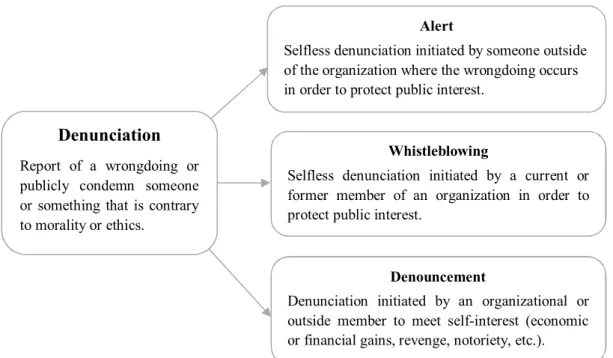
After all, denunciation, denouncement, alert, and whistleblowing are concepts closely related with some dis-similarities. Denunciation is a broader context that encompasses the whistleblowing, the denouncement and alert. The graphic below provides a synthetic view of the distinctions among them.
Figure 1.1.2.1.2: Denunciation and its hyponyms
Created by the author
Alert
Selfless denunciation initiated by someone outside of the organization where the wrongdoing occurs in order to protect public interest.
Whistleblowing
Selfless denunciation initiated by a current or former member of an organization in order to protect public interest.
Denouncement
Denunciation initiated by an organizational or outside member to meet self-interest (economic or financial gains, revenge, notoriety, etc.).
Denunciation
Report of a wrongdoing or publicly condemn someone or something that is contrary to morality or ethics.
1.1.2.2. Whistleblowing and Whistleblowers: Typologies
The whistleblowing is an action or an act while the whistleblower is the person who is responsible for that action. Although these two concepts are closely related they do not follow the same typology. This section exposes in one hand the different types of whistleblowing and in the other hand the typology of whistleblowers.
1.1.2.2.1. Types of Whistleblowing
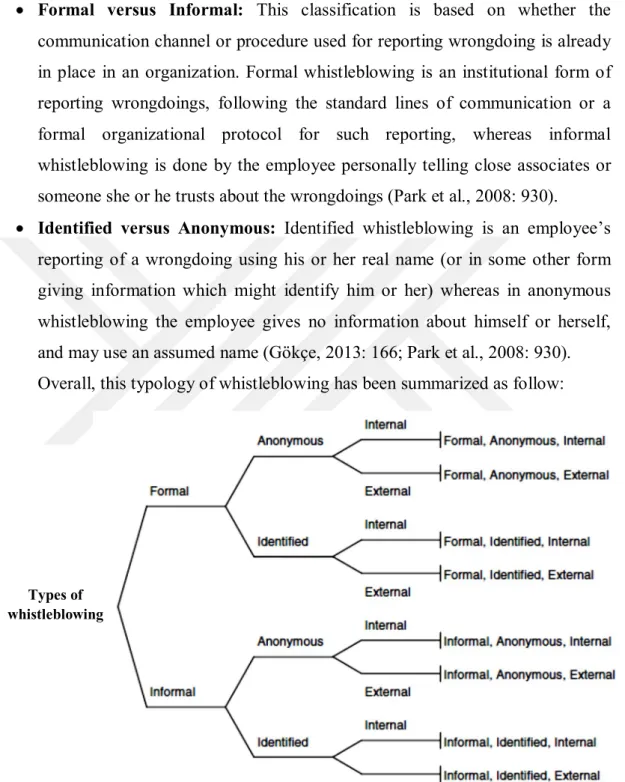
A number of investigations only focus on the differences between internal and external whistleblowing (Banerjee & Roy, 2014: 7; Park & Blenkinsopp, 2009: 545; Zhang, Chiu, & Wei, 2009: 25). However, the literature provides a broader categorization of whistleblowing based on three dimensions, each dimension representing a choice for the employee. In fact, they emphasize six types of whistleblowing grouped in three options, including internal versus external, formal versus informal and identified versus anonymous (Gökçe, 2013: 166; Oktem & Shahbazi, 2012: 946; Park et al., 2008: 930).
Internal versus External Whistleblowing: This classification is based on whether an employee provides information to someone inside or outside of the organization. This categorization is supported by Bouville (2008: 579) who considered whistleblowing as an act whereby an employee (or former employee) discloses what he/she believes to be unethical or illegal behavior to higher management (internal whistle-blowing) or to an external authority or the public (external whistle-blowing). The whistleblowing is termed internal when the wrongdoing is reported to persons within the organization, such as the top management or fellow colleagues. More broadly, the internal whistleblowing refers to the form in which whistleblowers may make their allegations internally, i.e. to other people within the same organization. Internal whistleblowers are employees who discover misconduct in the workplace and communicate this to their fellow colleagues or supervisors, who then follows established procedures to address the misconduct within the organization. So, an effective internal channel of complaints is the keystone of motivating
employee to be involved in internal whistleblowing rather to disclose wrongdoings outside the organization (Gökçe, 2013; Vinten, 1996: 108). In contrary, it becomes external when the disclosure is made to an external entity, such as governments, regulators, media, law enforcement agencies or groups concerned with the issues (Near & Miceli 1996: 509). External whistleblowing refers to disclosing a wrongdoing to outside agencies or entities which have the necessary power to correct it. Although both internal and external whistleblowing may coexist in the same organization, several investigations have revealed that the former usually precedes the latter (Mesmer-Magnus & Viswesvara, 2005: 278).
As a rule of thumb, Sampaio and Sobral (2013: 372) emphasized that an employee will only refer to external whistleblowing when a previous internal disclosure was not successful. In the same vein, Dasgupta and Kesharwani (2010: 60) argued that an employee who does not feel satisfied by the actions carried out by the organization after blowing the whistle internally can step forward to disclose the wrongdoing to external agencies. Moreover, Rothschild and Miethe (1999: 112) show that the vast majority of whistleblowers reported the misconduct to someone within the company rather than to external authorities.
Internal whistleblowing is more beneficial because organizations may be able to privately rectify the wrongdoings and without public scandals and a loss of reputation (Rothschild & Miethe, 1999: 120). Indeed, external whistleblowing can cause serious damage to the organizations as compared to internal whistleblowing whereby managers can fix the wrongdoings as well as ensuring organizational confidentiality which foster organizational accountability and learning (Zhang et al., 2009: 26). Thus, the Sarbanes-Oxley Act of 2002 encourages internal whistleblowing by requiring corporations to provide employees with a standardized channel through which they can report organizational misconducts internally (Moberly, 2006: 1107). Nevertheless, Sampaio and Sobral (2013: 372) argued that true whistleblowing relates only to reporting to parties outside of the organization. This external whistleblowing is processed more readily in a more highly regulated industry because of the
existence of regulatory agencies to which observers of wrongdoings might logically and easily report (Ponnu, Naidu, & Zamri, 2008: 288).
Formal versus Informal: This classification is based on whether the communication channel or procedure used for reporting wrongdoing is already in place in an organization. Formal whistleblowing is an institutional form of reporting wrongdoings, following the standard lines of communication or a formal organizational protocol for such reporting, whereas informal whistleblowing is done by the employee personally telling close associates or someone she or he trusts about the wrongdoings (Park et al., 2008: 930).
Identified versus Anonymous: Identified whistleblowing is an employee’s reporting of a wrongdoing using his or her real name (or in some other form giving information which might identify him or her) whereas in anonymous whistleblowing the employee gives no information about himself or herself, and may use an assumed name (Gökçe, 2013: 166; Park et al., 2008: 930). Overall, this typology of whistleblowing has been summarized as follow:
Figure 1.1.2.2.1: Whistleblowing typology
Source: Adapted from Park, Blenkinsopp, Oktem, and Omurgonulsen (2008: 930) Types of
1.1.2.2.2. Types of Whistleblowers
A whistleblower is an organization member (employee whether current or former) who witnesses a wrongdoing in his or her working environment and speaks out to uncover it. Very little research has been performed on categorization of whistleblowers. By delving into the available literature, so far two investigations have been involved in building whistleblowers typology. The first categorizes whistleblowers into three main groups, while the second builds five clusters of whistleblowers.
By investigating the conditions under which employees move towards public disclosure through ten proiminent case studies, Glazer (1983: 33) came out with the conclusion that whistleblowers can be categorized into three main groups including unbending resistors, implicated protestors and reluctant collaborators.
The unbending resistors blow the whistle on the unethical or illegal behavior they witness with a strict commitment to their moral principles despite any flattery or coercion. They usually begin their disclosing actions within the organization, and ultimately extend it outside when the first attempt failed or when they become subject of retaliations.
The implicated protestors exposed wrongdoings within the organization but fear legal liabilities. They are flexible in their process and ready to give up the initiative when they are forced to do so.
The reluctant collaborators only speak out to unveil malpractices to public after leaving the organization. As long as they work with the organization, they remain silent on the wrongdoings witnessed and can even become deeply involved in acts they privately condemn.
This earliest typology lacks rigor because it fails to consider the main dimensions useful to map out relevant clusters of whistleblowers. It is an unidimentional typology which only capture the perception of potential whistleblowers towards retailation. It has rather omitted important aspects such as the motivation of the whistleblower, the organizational features, and other important criteria. Glazer (1983: 33-41) failed to apply his theoretical approach to the ten cases he reviewedand no further empirical evidence has been used to test this theoretical whistleblowers' typology. Contrary to this three-tail categorization, Heumann,
Friedes, Cassak, Wright, and Joshi (2013: 40) recently constructed a broader multidimentional typology underpinned by whistleblower personalities, goals, motivations, claims and success rates as perceived by management, peers, families, the general public, and whistleblowers themselves. They provided a typology by differentiating five types of whistleblowers, including the altruist, the avenger, the organization man, the alarmist, and the bounty hunter.
The altruist sees an evil, objects fearlessly, and fights valiantly within, and even beyond the organization for the sake of justice and remedy. The altruist acts as the conscience of the organization and hopes for nothing other than rectifying the wrongdoings or malpractices witnessed in the working environment. Though the altruist achieves an honored status, and even enjoys elevation within the organization, he or she could face retaliatory actions. The organization man encompasses employees deeply stuck to organizational
culture and mission and who report what they perceive as illegal or improper conduct out of a primary concern for the company. They trust their own judgment about what the company or organization should be doing above that of others, even those higher up in the chain of command. Whistleblowers with this perspective see their own motivations as generally pure, and protective of the organization. Perceived as a “Mr. or Ms. Know-It-All”, they warn on the consequences of not acting as they say and its related harm and catastrophe. Management may perceive the Organization Man as a goad or a roadblock against achieving their goals or adhering to their policies, or an unwelcome voice at odds with managerial goals or procedures.
The alarmist is an employee who complains constantly but without much reliability and is almost always wrong. The alarmist may eventually lose credibility because of the irrelevance often detected in the complaints about conducts that could not be illegal, improper, or harmful to the public interest. The avenger is motivated by revenge purpose or retribution for a perceived
slight or injustice inflicted by the organization or one of its members. The avenger usually reports frauds, mismanagement, or illegal activities for self-vindication in order to get back at someone who offends or humiliates him or
her. The avenger is the organization member who blows the whistle because of the predominance of individual anger or selfishness instead of genuine concern for the harm caused by the wrongdoings to others.
The bounty hunter is primarily motivated to make money. A monetary compensation for whistleblowers should be a good incentive for employees who risk their jobs and expose themselves to all kinds of retaliations in order to serve general interest (Boumil, Nariani, Boumil, & Berman, 2010: 17).
This typology of whistleblowers seems to be concise and comprehensive. It presents mutually exclusive clusters although the difference between the altruist and the organization man is not easily perceivable. Nevertheless, it can be noticeable that the altruist detects wrongdoing by referring to common moral and ethical rules while the organization man considers his personal values based on his knowledge of the organizational culture and mission piled up from his experience in the company. More over the avenger and the bounty hunter can be classified as actors of denouncement rather than whistleblowers because of their self-interest motivation. It is also clear to notice that the typology of whistleblowers is poorly documented compared to the literature related to whistleblowing.
1.1.3. Whistleblowing Development and Whistleblower Protection Worldwide
Legislate to protect those who risk their lives in defending general interest is the backbone of whistleblowing protection development worldwide. Indeed, whistleblowers are often exposed to a variety of retaliations ranging from simple warning to murder in extreme circumstances. However, few countries in the world have implemented legislation and regulations to ensure a reliable and effective protection of whistleblower. To get more understanding on legal environment of whistleblowing, the development of its legislation worldwide have been reviewed in Anglo-Saxon countries where whistleblowing is rooted in common habits and either parts of the word where it is an emerging phenomenon, sometimes unknown by the large public.
1.1.3.1. Whistleblowing Development and protection in Anglo-Saxon Countries
Anglo-Saxon countries mainly refer to English-speaking countries with a common socio-political heritage, including United States of America, United Kingdom, Canada, Australia, Ireland, and New Zealand. Most of these countries have a long whistleblowing tradition as well as legislation to protect and encourage organization members who expose wrongdoings.
In the United States, legal protections vary according to the issue reported, and sometimes the state in which the whistleblowing arises. The first US law adopted to specifically protect whistleblowers was the 1863 United States False Claims Act (revised in 1986), which aimed to tackle suppliers’ fraud against the United States government. This Act encourages whistleblowers by providing them with a certain percentage (between 15 and 30 per cent) of the money recovered or damages won by the government (Sehgal, 2014: 7). It also protects whistleblowers from wrongful dismissal or other retaliations. Another US law that protects whistleblowers is the Lloyd–La Follette Act of 1912 which guaranteed the right of federal employees to provide information to the United States Congress. Similar protections for employees were put in subsequent laws, including the Clean Water Act of 1972, the Safe Drinking Water Act (1974), the Energy Reorganization Act of 1974 (through 1978 amendment to protect nuclear whistleblowers), the Toxic Substances Control Act of 1976, the Resource Conservation and Recovery Act (1976), the Comprehensive Environmental Response, Compensation, and Liability Act (CERCLA, the Superfund Law) (1980), the Surface Transportation Assistance Act (1982), the Clean Air Act (1990), the Pipeline Safety Improvement Act (PSIA) of 2002, the Sarbanes– Oxley Act of 2002 (for corporate fraud whistleblowers), the Dodd–Frank Wall Street Reform and Consumer Protection Act (2010), etc. It is also important to emphasize that the Civil Service Reform Act of 1978 adopted for federal employees has deeply revived the legal protections for employees who report illegal misconduct of their employers (Shimabukuro & Whitaker, 2012: 1). In short, USA set up a very comprehensive legal armory to reward and assure the protection of employees involved in blowing the whistle on wrongdoings in various fields.