Full Terms & Conditions of access and use can be found at
https://www.tandfonline.com/action/journalInformation?journalCode=wjdr20
Journal of Divorce & Remarriage
ISSN: (Print) (Online) Journal homepage: https://www.tandfonline.com/loi/wjdr20
The Role of Post-divorce Parental Conflict in
Predicting Aggression, Anger, and Symptoms
of Anxiety and Depression among University
Students
Rasit Avci , Arca Adiguzel , Saide Umut Zeybek & Oguzhan Çolakkadıoğlu
To cite this article: Rasit Avci , Arca Adiguzel , Saide Umut Zeybek & Oguzhan Çolakkadıoğlu (2021): The Role of Post-divorce Parental Conflict in Predicting Aggression, Anger, and Symptoms of Anxiety and Depression among University Students, Journal of Divorce & Remarriage, DOI: 10.1080/10502556.2021.1871830
To link to this article: https://doi.org/10.1080/10502556.2021.1871830
Published online: 31 Jan 2021.
Submit your article to this journal
Article views: 25
View related articles
View Crossmark data
~~ 8"
1
ılıl
tb
8"®
8"The Role of Post-divorce Parental Conflict in Predicting
Aggression, Anger, and Symptoms of Anxiety and
Depression among University Students
Rasit Avci a, Arca Adiguzel b, Saide Umut Zeybek b,
and Oguzhan Çolakkadıoğlu c
aPsychological Counseling and Guidance, Mugla Sitki Kocman Universitesi, Muğla, Turkey; bPsychological
Counseling and Guidance, Mugla Sitki Kocman Universitesi, Mugla, Turkey; cPsychological Counseling
and Guidance, Mustafa Kemal Universitesi, Hatay, Turkey
ABSTRACT
The aim of this study was to investigate whether post-divorce parental conflict predicted physical aggression, anger and symptoms of anxiety and depression among university stu-dents. One hundred and sixty students (96 females and 64 males) who were enrolled at Muğla Sıtkı Koçman University, whose parents were divorced and whose ages were between 18 and 24 were included in the study. Post-Divorce Parental Conflict Scale, physical aggression and anger dimensions of Buss-Perry Aggression Scale, and anxiety and depression dimen-sions of Brief Symptom Inventory were used as data collection tools. In this study, path analysis was used with statistically observed variables. The findings of the current study revealed that post-divorce parental conflict predicted physical aggres-sion, anger, and symptoms of anxiety and depression in the university students. Post-divorce parental conflict explained 7% of the variance in physical aggression, 5% of the variance in anger, 15% of the variance in anxiety symptoms, and 13% of the variance in depression symptoms. The obtained results were discussed in reference to the related literature.
KEYWORDS
Anger; anxiety; depression; divorce; parental conflict; physical aggression
Introduction
Divorce is a phenomenon gaining greater importance with each day. Divorces continue to increase in Organization for Economic Co-operation and Development (OECD) countries. Rough divorce rates vary significantly among OECD countries. For example, while in Chile, the rate of divorces is 0.1 per 1000 people, in Latvia the number of divorces per 1000 people is 3.1. When compared to 1970s, the number of divorces doubled in 2017 in coun-tries such as Belgium, Greece, Israel, Korea, Norway, and the Netherlands, which had high divorce rates even in the 1970s. In all the OECD member
CONTACT Rasit Avci [email protected] Mugla Sitki Kocman University, Faculty of Education, Kotekli Mah. Mentese, Mugla, 48000
Present affiliation of OguzhanÇolakkadıoğlu is Osmaniye Korkut Ata University/ Department of Social Services, Osmaniye, Turkey
https://doi.org/10.1080/10502556.2021.1871830
© 2021 Taylor & Francis Group, LLC
countries, the number of divorces per 1000 people is 1.9 (Organisation for Economic Co-operation and Development, 2019). When the divorce and marriage statistics of the European Union countries are examined, it is seen that the rough marriage rates have decreased by almost half between 1965 and 2016. On the other hand, divorce rates doubled in 2016 when compared to 1965 (Eurostat, 2019). There are some numerical data showing that divorce rates are on the increase in Turkey. When the numbers of divorces in the last 20 years are examined on the basis of the data issued by the Turkish Statistical Institute (TUİK) for the period ranging from 2010 to 2017, it is seen that the number of divorces was 42,621 in 1990; 55,136 in 1995; 76,230 in 2000; 95,895 in 2005; 115,818 in 2010 and 126,164 in 2016 and this number increased to 128,411 in 2017 by 1.8% increase. When the data issued on the figures of divorce are examined, it is seen that while the rate of divorce was 0.7 per thousand people, it became 1.59 in 2009 and 1.61 in 2017 (Turkish Statistical Institute, 2010, 2016, 2017).
The effects of divorce are too serious to be expressed in numbers because divorce has a widespread effect that will affect not only the partners but also their children (if there is any), their families, and the society. Thus, if a rough calculation is made on the basis of 2017 Turkish Statistical Institute (2017) data, it can be said that the number of the parties to divorce is 256,822 and that all these people have experienced the effects of divorce. If the root families of divorced couples are taken into consideration, then it can be said that 513,644 people were affected by the phenomenon of divorce. If we consider the assumption that each couple has one child; then, it can be concluded that only in 2017, the number of children who may have been affected from divorce is nearly 128,411. Thus, on the basis of this calculation conducted according to the 2017 data, it can be argued that a total of 898,877 people were affected by divorce in 2017.
It is possible to examine several potential consequences of divorce on each of these individuals, whose number is considerable, in psychological, eco-nomic, social, and legal dimensions (Şentürk, 2008). For instance, the two divorced spouses are affected by the divorce, and couples who have to establish a new life after separation may experience economic and social problems. Spouses may also experience various psychological disorders after divorce (Esmaeili & Yacoob, 2011). Moreover, divorce is not only a process that affects couples, but it can also affect children in many ways. Many scientific studies focus on the problems that both couples and children experience during and after separation (Amato, 2010; Öngider, 2013; Özabacı. et al., 2015; Symoens. et al., 2014).
Divorce brings about many problems for both parents and children. In fact, divorce, rather than putting an end to previous conflicts within a family, gives rise to some new problems. One of the recent perspectives on this issue is the Divorce-Stress-Adaptation approach, which offers a comprehensive
explanation of the issue (Doğan & Şahin, 2018). According to this approach, divorce is a very stressful process for both parents and children. The sources of stress for the child after divorce include less time spent with the parent not having the custody of the child, continuation of the conflict between parents, a decrease in the living standards of the child and moving (Amato, 2000). Moreover, according to the chronic strain model, which is one of the sub- dimensions of this model, divorce has a long-term effect on families and children. After the divorce has taken place, parents and children may experi-ence difficulties arising from divorce, such as economic problems, loneliness, and single-parent responsibilities for many years. As these difficulties do not disappear, they can continue to affect the well-being of the family and children more or less (Amato, 2000)
When the studies on the effects of divorce are examined, it is seen that the number of studies conducted on children is relatively higher. In the existing research, it has been emphasized that the effects of a divorce process can continue even in the adulthood if they have not been overcome successfully by the child during and after the divorce. For example, in one study, it was found that 25% of children had emotional problems after divorce, and this percentage decreased to 20% in the emerging adulthood period (Hetherington, 2005, 2006). Although there is some decrease in this rate, it can be said that the emotional problems experienced among the emerging adults are still significant. In a meta-analysis study conducted by Amato and Keith (1991) on the long-term effects of divorce, it was found that the well- being of the adults whose parents had been divorced was worse than that of the adults whose parents had not been divorced. Moreover, it was found that the largest effect of divorce was on the psychological adjustment, attitudes, behaviors, and academic achievement of the adults. Kuru (2018) reported that divorce of the parents of the children aged at 10–14 increased their level of depression. Esmaeili and Yacoob (2012) stated that the adolescents experiencing a high level of parental conflict, mother-induced problems, economic problems and lack of quality in parent–child relationships tend to exhibit a low self-esteem.
The divorce process may have some short-term or long-term effects, espe-cially on children who have experienced this process. In this context, examin-ing the long-term effects of divorce on the relationships of adolescents with their parents and peers, Frank (2007) found that while divorce worsens the relationships with fathers, it strengthens the relationships with mothers. In this regard, it can be contended that the conflicts experienced in the divorce process continue for a long time and even after the divorce process has been completed, they continue to affect children. In the same study, it was found that divorce does not affect the relationships between siblings. Similarly, it was found that while female adolescents whose parents had been divorced when they were children developed more positive attitudes toward their mothers,
they developed more negative attitudes toward their fathers (Keller, 2017). The study investigated, how the conflicts experienced between parents in the first year following the divorce are correlated with the psychological adjust-ment of the young adults in the following years.
Based on the long-term consequences of divorce, the effects of divorce continue even after many years. It is observed that what has been learned by the children raised in the environment where divorce has occurred about marriage and interpersonal relationships has a strengthening effect on the intergenerational transfer of divorce (Dronkers & Härkönen, 2008). In their study investigating the long-term effects of divorce, Huurre et al. (2006) found that the women having divorced families experienced more psychological problems and more problems in their interpersonal relationships than the women not having divorced families. In both genders having divorced families, problems such as shorter education life, unemployment, negative experiences, risky health behaviors are seen more frequently. In the study, it was concluded that divorce of the parents can serve as a source of stress for the female child even in their adulthood period and that the negative effects of these stress sources should be prevented or minimized. As a result, divorce can have both short-term and long-term effects on children.
It should be noted that divorce is not a bad phenomenon to be prevented as much as a marriage full of conflicts because if it is continued, it may have worse effects on both the couple and children than divorce. For this reason, the key point determining whether these phenomena will yield positive or nega-tive results is the quality of the relationship between spouses, either in mar-riage or after divorce. In her study, in which she discussed whether the divorce was postponed for the child in order to ensure the adaptability of the child, Gregory-Öngider (2016) concluded that divorce on its own did not have a negative effect on the child’s psychological adjustment.
This study aims to investigate the relations between the psychological adjustment of the university students who have divorced parents and the conflict experienced by the parents after divorce. Divorce is a global issue and has short- and long-time effect influencing children in different ways including economically, socially, psychologically, etc., the previous studies on the long-term effect of divorce mostly focused on the relations between then the phenomenon of divorce and psychological adjustment in the college students (Christopoulos, 2001; Connel et al., 2015). In a recent study, Bannon et al. (2018) examined the relations between involvement in conflict, academic and psychological functioning among the US college students whose parents were divorced or married, and found that regardless of marital status (divorced or married) involvement in conflict predicted both academic and psychological functioning. In another study, Lin et al. (2020) found that the association between perceived parenteral conflict and somatic symptom amongst the US college students whose parents were separated. These studies
have demonstrated that parental conflict before or after their parents are divorced can influence college students’ adjustment process. However, to fully understand the effect of post-divorced parental conflict on college stu-dents’ psychological adjustment, a need emerges more studies, especially in non-western countries including Turkey. Moreover, it is important to reveal the long-term consequences of divorce and university students with studies conducted in different cultures, and to understand the phenomenon of divorce and its consequences in a global context in terms of shedding light on studies to be carried out on this subject (Christopoulos, 2001). We believe it is worth examining the relationship between the divorce of parents and the adjustment of university students are found to be contradictory and more in-depth studies are needed on this subject. It becomes important to understand whether it is happening or not. With this study, it will be tried to understand whether the ongoing conflict between parents, especially after divorce, contributes to the problems that may arise in university students. Furthermore, the investigation of the relationships between the conflicts experienced between the parents after the divorce and physical aggression, anger, and symptoms of anxiety and depression of Turkish university students is believed to make a contribution to the relevant literature. Thus, the main problem of the current study was set to be “Does post-divorce parental conflict predict physical aggression, anger, and symptoms of anxiety and depression among university students?”
Method
Research design
In this study, correlational research design was used to examine the relation-ships between the conflict between parents after divorce and the physical aggression, anger, anxiety, and depression of university students. A correlational research design enables the researchers to examine the rela-tionship of two or more variables (Büyüköztürk. et al., 2008). In the study, post-divorce parental conflict variable is the independent variable while the physical aggression, anger, symptoms of anxiety, and depression variables are the dependent variables.
Participants
In the study, the criterion sampling method, one of the nonrandom sampling methods, was used. In the criterion sampling method, individuals, events, objects, or cases meeting some certain criteria are included in the study (Büyüköztürk. et al., 2008). The criteria set for the selection of the students to be included in the current study are the ones proposed by Sonnenblick and Schwarz (1992); (i) being single and having not been married before, (ii) being
in the age group 18–24 years old; (iii) their biologic parents’ having been divorced only once; (iv) being at least 6-years old when their parents got divorced and (v) at least 2 years having passed after the divorce of their parents. In this context, a total of 160 undergraduate students meeting these criteria from Muğla Sıtkı Koçman University were reached. Of these students, 96 are females (60%), 64 are males (40%); their mean age is 21.41 (Sd = 1.63). The students’ ages when their parents got divorced ranged from 6 to 21 and their mean age at the time of divorce was 13.03 (Sd = 4.20). In addition, 113 of the students (70.6%) were found to be living with their mothers after divorce, 35 students (21.9%) with their fathers, and 12 students (7.5%) with their grandparents.
Data collection
Institutional review board (IRB) permission was granted by Muğla Sıtkı Koçman University Ethical Review Board. All potential participants were invited through the study flyer that explained the purposes of the study. Volunteered participants were administered the questionnaire booklet with the consent form included on the front page. No information identifying the participants were collected, except demographic information including gen-der, etc. Volunteered participants stopped by the Psychological Counseling office and administered the questionnaire in the office of the guidance under the supervision of an independent expert in the field. All data were stored in a computer that only the researcher can assess.
Research team comprised two associated professors and two doctoral stu-dents in the psychological counseling and guidance field. The team has had publications related to family therapy and divorce. Two researchers in the team received Weinheim Systemic Therapy Institute Systemic Therapist and Systemic Supervisor certification. Also, they teach Marriage and Family Therapy, Divorce and Divorce Mediation courses in undergraduate and grad-uate levels.
Data collection tools
In order to collect demographic information regarding the variables of the current study, a Personal Information Form was used; to collect data about the post-divorce parental conflict variable, the Post-Divorce Parental Conflict Scale (PDPCS) was used; to collect data about the anger and physical aggres-sion variable, the Aggresaggres-sion Scale was used and to collect data about the symptoms of anxiety and depression, the Short Symptom Inventory (SSI) was used. Information about the measurement tools is given below.
Personal information form
This form developed by the researchers includes items to elicit information about the age, gender of the students and how old they were when their parents got divorced.
Post-divorce parental conflict scale (PDPCS)
This measurement tool was developed by Sonnenblick and Schwarz (1992) to evaluate the state of conflict perceived by the children whose parents got divorced between their parents within the first 1 year immediately following the divorce and in the last 1 year. The scale can be responded by the father and mother separately and for each, there are a total of 82 items to be responded; 42 items to evaluate the first 1 year immediately following the divorce and 42 items to evaluate the last 1 year. Participants respond to each item on the 5-point Likert scale ranging from 1 (This incidence has never occurred before- Never) to 5 (This incidence has occurred everyday-Always). Thirty-nine items of the scale are included in three sub-dimensions. The first sub-dimension is called Indirect Enmity (My mother used to communicate what she wanted to say to my father through me; my father would not pick up the phone when mom called); the second sub-dimension is called Verbal Enmity (My mother used to raise her voice when arguing with my father; my father used to say some things just to annoy my mother) and the third sub-dimension is called Physical Enmity (My mother used to hit my father; my father used to threaten my mother with a knife or a gun). Four items in the scale are intended to evaluate the conflict related to the parent with whom the child is living and are responded only for one parent. Within the context of the current study, the reliability and validity of the three-factor and 39-item version of PDPCS aiming to determine the state of conflict in the last 1 year were examined. The internal consistency coefficients of the sub-scales were found to be ran-ging from .80 to .90.
The adaptation of this scale to Turkish was made by the researchers in the current study. First, permission was taken from the developers of the scale to adapt the scale to Turkish. The scale was translated to Turkish by two field experts with a good competence of English and two experts in the field of ELT. The translations were checked by the researchers and the most suitable expressions were determined. The scale translated to Turkish was back- translated to English by two experts in the field of ELT. The translated scale was compared with the original scale by the researchers and thus the final form of the scale was given. This Turkish version of the scale was submitted to review of two experts in the field of Turkish teaching for them to check the suitability of the Turkish sentences. After the completion of the translation works of the scale, the instruments were applied.
First, in the Confirmatory Factor Analysis (CFA) conducted to determine the construct validity of the first one-year Parental Conflict Scale-Mother
form, in accordance with the original construct of the scale, three-factor model was tested. In this connection, the error variances of the items 31 and 32 were correlated. As a result, it was concluded that the three-factor construct of PDPCS could yield acceptable fit values (χ2/sd 1482.90/661 = 2,24; RMSEA = .088; TLI = .89; CFI = .89; IFI = .89). The standardized path coefficients found for the sub-dimensions of the scale are as follows: between .35 and .59 for Indirect Enmity; between .21 and .76 for Verbal Enmity; between .47 and .88 for Physical Enmity. When the correlation values between the factors are examined, it is seen that there is a positive and significant correlation between indirect enmity and verbal enmity .79 (p < .01); a positive and significant correlation between indirect enmity and physical enmity .30 (p < .01); a posi-tive and significant correlation between verbal enmity and physical enmity .19 (p < .01).
A Confirmatory Factor Analysis was also conducted for the first one-year Parental Conflict Scale-Father form and on the basis of the first results, errors variances were correlated between the items 38 and 39, 4 and 5 and 6 and 7. After these correction operations, it was determined that the model could yield acceptable fit values (χ2/sd 1653.44/659 = 2.50; RMSEA = .09; TLI = .92; CFI = .93; IFI = .93). The standardized path coefficients found for the sub- dimensions of the scale are as follows: between .41 and .63 for indirect enmity; between .30 and .73 for the verbal enmity; between .68 and .87 for physical enmity. When the correlation values between the factors are examined, it is seen that there is a positive and significant correlation between indirect enmity and verbal enmity .90 (p < .01); a positive and significant correlation between indirect enmity and physical enmity .67 (p < .01); a positive and significant correlation between verbal enmity and physical enmity .65 (p < .01).
In order to check the criterion-related validity, the correlations between the Mother and Father Forms of PDPCS and The Scale of Marriage Conflict Perceived by Children (SMCPC) adapted to Turkish by Ulu and Fışıloğlu (2004) were explored. In this regard, a positive and low correlation was found with the mother form (r = .22, p < .01) and the father form (r = .31, p < .01).
Within the context of the reliability studies, the internal consistency coeffi-cients (Cronbach Alpha) of the mother and father forms of the scale for the first 1 year following the divorce were separately calculated and it was found to be .89 for the mother form and .94 for the father form.
Aggression scale
The scale was developed by Buss and Perry (1992). The last revision of the scale was done by Buss and Warren in 2000. The adaptation study of the scale into Turkish was carried out by Can (2002). The scale is a 5-point Likert scale consisting of 34 items and five sub-dimensions. Within the context of the current study, only the physical aggression and anger sub-dimensions were used. A high total score indicates a high level of aggression (Buss & Warren,
2000; Can, 2002). The Cronbach Alpha coefficient was calculated to be .82 for the physical aggression sub-dimension of the scale and .63 for the anger sub- dimension.
Brief symptom inventory
The scale was developed by Derogatis (1992). This is a 53-item 5-point Likert type self-evaluation scale. The adaptation of the scale into Turkish was made by Şahin and Durak (1994). The scale is a 5-point Likert scale having 52 items and five sub-dimensions. Within the context of the current study, the 12-item depression sub-dimension and 13-item anxiety sub-dimension were used. A high score taken from the scale is an indication that the psychological symptoms of the individual are increasing. The Cronbach’s Alpha internal consistency coefficients of the scale were found to be .88 for the depression sub-dimension and .88 for the anxiety sub-dimension.
Findings
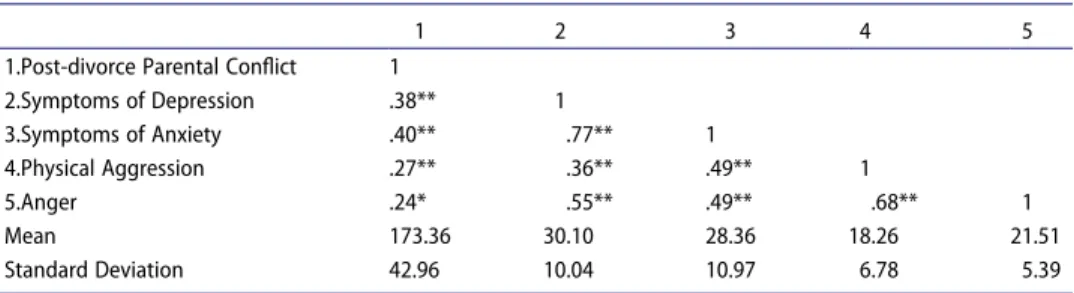
Before initiating the application of path analysis, means, standard deviations, and correlation values related to the variables are given in Table 1.
As can be seen in Table 1, there are positive and medium and low correla-tions between the post-divorce parental conflict experienced by the university students and their physical aggression (r = .27. p < .01), anger (r = .24, p < .01), symptoms of anxiety (r = .40, p < .01) and symptoms of depression (r = .38, p < .01).
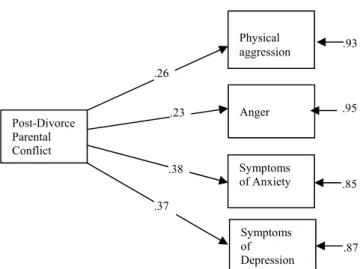
The linear correlations between the post-divorce parental conflict experi-enced by the university students and their physical aggression, anger, and symptoms of anxiety and depression were examined with path analysis. Paths were defined from the post-divorce parental conflict to physical aggression, anger, anxiety, and symptoms of depression and the model was tested. According to the results of the path analysis, when the standardized path coefficients were examined, it was found that the paths going from the post- divorce parental conflict to physical aggression (β = .26, p < .01), anger (β =
Table 1. Descriptive statistics correlation values for the variables of symptoms of depression and
anxiety, aggression and anger in the post-divorce parental conflict mother-father form.
1 2 3 4 5
1.Post-divorce Parental Conflict 1
2.Symptoms of Depression .38** 1 3.Symptoms of Anxiety .40** .77** 1 4.Physical Aggression .27** .36** .49** 1 5.Anger .24* .55** .49** .68** 1 Mean 173.36 30.10 28.36 18.26 21.51 Standard Deviation 42.96 10.04 10.97 6.78 5.39 **p<.01
.23, p < .01), symptoms of anxiety (β = .38. p < .01) and symptoms of depression (β = .37. p < .01) are significant. The post-divorce parental conflict explains 7% of the variance in physical aggression, 5% of the variance in anger, 15% of the variance in symptoms of anxiety, and 13% of the variance in symptoms of depression (See Figure 1).
In light of these findings, it can be argued that the conflict seen between the parents in the first 1 year following the divorce is a significant predictor of physical aggression, anger, symptoms of anxiety, and depression in the uni-versity students.
Discussion
As a result of the current study, it was revealed that there are significant correlations between the post-divorce parental conflict perceived by the uni-versity students and their physical aggression, anger, and symptoms of anxiety and depression. It is seen that with increasing amount of conflict between the parents, the students’ physical aggression, anger, and symptoms of anxiety and depression also increase. The results of the current study can be evaluated in two dimensions. The post-divorce parental conflict significantly predicts symptoms of anxiety and depression, which can be considered as internalizing disorders, and physical aggression and anger, which can be considered as externalizing disorders. In this regard, the findings of the current study concur with the findings reported in the literature (Auersperg et al., 2019; Hetherington, 2006; Kasuto, 2017; Richardson & McCabe, 2001; Stallman & Ohan, 2016). .93 Physical aggression .85 .87 .26 .95 Post-Divorce Parental Conflict Anger Symptoms of Anxiety Symptoms of Depression .37 .38 .23
Figure 1. Path coefficients between post-divorce parental conflict and physical aggression, anger,
According to Clarke-Steward and Brentano (2006), divorce does not only have short-term effects but also some long-term effects, some of which can be permanent. Particularly physical aggression and anger problems can be con-sidered in this respect. Hetherington (2006) reported that a significant rela-tionship was found between adolescents’ anti-social behaviors and divorce in longitudinal studies. Stallman and Ohan (2016) found that the post-divorce continuing parental conflicts and problems predict behavioral and emotional problems experienced by children in the age period 4–17 and that ambiguity in parenting roles predicts the externalizing problems experienced by children. In another study in which adolescents whose parents got divorced were compared with adolescents whose parents were not divorced, the aggression mean score of the adolescents having divorced parents was found to be higher. In another study, it was found that a high level of conflict between the parents of the young adults whose parents got divorced when they were adolescents negatively affected their level of adaptation. It was also found that children of divorced parents experience more anxiety, have less life-satisfaction, and experience more problems in their interpersonal relationships with people of the same gender compared to children not having divorced parents. All these findings reported in the literature seem to support the findings of the current study.
According to the Social Learning Theory (Bandura, 1977), children can learn some behaviors from their parents through modeling and display these behaviors in their own lives. It can be said that children see the first relation-ships they establish with others in their families. Thus, if there are problems in communication in the relationship modeled by the child and the child is able to learn these behaviors through modeling, then he/she may reflect this on his/ her future relationships. If the conflict experienced by the parents after the divorce is reflected on their children, the child may learn the behaviors exhibited in the conflict (Christie-Mizell, 2003). In fact, in the process of learning through modeling defined by Bandura, children learn verbal and physical aggression from their parents as a method of conflict resolution and may not develop the social skills necessary for friendship relationships (Amato & Booth, 2001). In addition, children exposed to conflict-based behavior patterns exhibited by their parents may have difficulty in establishing stable, satisfying, intimate relationships as young adults in the future. From this point of view, even if some negative developments can be seen in the child within a few years after the end of marriage, the delayed effects of divorce can only emerge when the child reaches his/her young adulthood period (Amato, 2000). Therefore, even if they are young adults, the individuals who experience the behaviors displayed by their parents in their conflicting relationships after divorce can more likely experience the sense of anger in their interpersonal relationships and can exhibit physically aggressive behaviors and can also
experience anxiety in their interpersonal relationships due to their lack of properly developed skills and as a result can exhibit symptoms of depression.
When the results obtained in the current study in relation to the other variables (symptoms of anxiety and depression) were examined, findings parallel to the ones reported in the literature were obtained (Auersperg et al., 2019). In their meta-analysis study focusing on the long-term effects of divorce, Auersperg et al. (2019) found that there are some correlations between divorce and anxiety and depression in children. Tezcan (2017) reported that 20–27 year old individuals whose parents got divorced when they were 18 years old experience depression and some other psychological problems more than their counterparts not having divorced parents. Low levels of parental conflict after divorce can be a protective factor for children with divorced parents against their becoming depressed during their young adulthood period (Kelly & Emery, 2003). In one study, depression levels of young adults whose parents got divorced when they were children and whose parents continued to have conflict after divorce were compared with those of young adults who had non-conflicting divorced parents and the depression level of the young adults between whose parents conflict was continuing was found to be higher than that of the young adults between whose parents there was no conflict (Zill et al., 1993). Post-divorce parental conflict can be a source of stress for individuals and can result in traumatic consequences in the lives of children and adolescents (Arnett, 2007). According to the findings of the study, post-divorce parental conflict can cause serious effects on the emer-gence of depressive symptoms in young adults even after many years have passed after divorce.
On the other hand, although Richardson and McCabe (2001) reported that young adults from divorced families experience more anxiety than those from non-divorced families, there is no significant difference between these two groups in terms of depression levels. However, in the same study, when the levels of conflict between parents in the family were evaluated rather than whether or not the divorce occurred, it was found that more depression, anxiety, and stress were experienced in the families where the amount of conflict was higher. In the current study, it was also found that post-divorce parental conflict predicts symptoms of anxiety and depression. Thus, although the divorce of parents may have short-term and long-term effects on the lives of children, one of the important points to be taken into consideration is how good parenting is provided for children after divorce by the parents. Despite the divorce, if the parents can work together and act jointly, it can be stated that the adaptation problems in the children can decrease slightly. Lamela et al. (2015) state that parents who can provide parenting to their children in a cooperative manner after divorce report fewer internalization and externa-lization problems in their children than parents who cannot. Seen from this
perspective, it can be said that it is important to help parents adopt collabora-tive parenting approaches.
Given that divorce is the end point of conflict between parents, Amato and Cheadle (2008) suggest that children’s observing the conflict between parents can be a direct source of stress for them. In this context, it may be difficult for the child to cope with the emotions resulting from remaining between two parents and witnessing their conflicts. In addition, conflict between parents after divorce can be dangerous when parents try to com-municate their anger at each other through their children (Buchanan et al., 1991). Parents who ask their children to convey their angry messages to the other parent, insult the other parent in front of their children and forbid the child to speak about the other parent may cause anxiety that the child cannot overcome and may cause long-term attachment problems in the life of the child and this may turn out to be a permanent situation (Kelly & Emery, 2003). The results of the study show that post-divorce parental conflict can cause anxiety in the part of the child even a long time has passed after divorce.
In addition, children may react to post-divorce parental conflicts and the anger felt by the parents against each other. Some of these reactions can be in the form of fear, aggression, and anger. When evaluated within the frame-work of family systems theories, coalitions can occur between the mother and the child or father and the child. If the mother sends some messages indicating a conflict with the father, then emerging adults may become distanced from their fathers; in turn, fathers become distanced from their children (Fauber et al., 1990). As a result, communication may be inter-rupted or the parent can reject the child. In addition, the child can develop reactions against the conflicts between the parents and can be involved in the solution to the conflict (Adamson & Thompson, 1998). In light of the research findings, it can be argued that young adults may have involved directly or indirectly in the conflict. The individuals exposed to the effects of parental conflict in this way may have felt anger and anxiety and may have exhibited symptoms of depressive and aggressive behaviors. This might be going on in the young adulthood period of their lives. Research findings revealing the long-term effects of divorce indicate that these effects can continue in the adulthood.
It may be useful to train parents about how to protect their children from the negative effects of the conflicts between them. Such training programs have been tried in America and Canada. When the effectiveness of such programs is tested, it is seen that the training given to parents reduces conflicts, and thus the negative effects on their children (Sarrazin & Cyr, 2007). And the prolif-eration of such programs in Turkey can reduce the negative effects of the problems arising from parental conflict on young adults. On the other hand, another possible situation that may be considered in this regard may be the
increase in parents’ emotional control of their children after divorce. With the increase in emotional control, some adaptation problems may occur in adults, including anxiety and depression (Fauber et al., 1990). Within this framework, it can be concluded that it is important to provide psychological counseling services for university students having divorced parents and to carry out some training activities for their families.
The current study focused on the effects of post-divorce parental conflict on the emotional and behavioral problems of the university students. Given that divorce may have some positive effects as such crises can contribute to the development and growth of students, future research can investigate the positive effects of the conflicts experienced after divorce on young people. Another suggestion for future research can be to focus on parental conflicts in families where there is no incidence of divorce and then compare the findings with the findings of the current study. Another suggestion can be to conduct preventive and therapeutic individual or group counseling and guidance activities with the university students experiencing adaptation problems such as physical aggression, anger, symptoms of depression, and anxiety after divorce. In this regard, psycho-education group programs can be devel-oped to be applied in universities.
One of the limitations of this study can be the unexplained variance in dependent variables of the study. Therefore, further studies with new variables are needed. In this study, parents’ conflict after divorce involves the conflict that occurred within a year after the divorce. For this reason, it is unclear whether the conflict continues after 1 year after the divorce and how long they stayed in the conflict environment, but still the research provides information about the conflict experienced in the past. Another limitation of this study is the number of participants (N = 160), so results of the study should be generalized with caution. Further studies could be carried out by reaching more participants from different countries and universities.
Acknowledgement
Some part of this study was orally presented at XIII. National PDR Congress, 2015, Mersin, Turkey.
Disclosure statement
No potential conflict of interest was reported by the authors.
ORCID
Rasit Avci http://orcid.org/0000-0003-4947-3397
Saide Umut Zeybek http://orcid.org/0000-0003-0947-7326
Oguzhan Çolakkadıoğlu http://orcid.org/0000-0002-3302-4928
References
Adamson, J. L., & Thompson, R. A. (1998). Coping with interparental verbal conflict by children exposed to spouse abuse and children from nonviolent homes. Journal of Family
Violence, 13(3), 213–232. https://doi.org/10.1023/a:1022896804777
Amato, P. R. (2000). The consequences of divorce for adults and children. Journal of Marriage
and Family, 62(4), 1269–1287. https://doi.org/10.1111/j.1741-3737.2000.01269.x
Amato, P. R. (2010). Research on divorce: Continuing trends and new developments. Journal of
Marriage and Family, 72(3), 650–666. https://doi.org/10.1111/j.1741-3737.2010.00723.x
Amato, P. R., & Booth, A. (2001). The legacy of parents’ marital discord: Consequences for children’s marital quality. Journal of Personality and Social Psychology, 81(4), 627–638.
https://doi.org/10.1037/0022-3514.81.4.627
Amato, P. R., & Cheadle, J. E. (2008). Parental divorce, marital conflict and children’s behavior problems: A comparison of adopted and biological children. Social Forces, 86(3), 139–161.
https://doi.org/10.1353/sof.0.0025
Amato, P. R., & Keith, B. (1991). Parental divorce and adult well-being: A meta-analysis.
Journal of Marriage and the Family, 53(1), 43–58. https://doi.org/10.2307/353132
Arnett, J. J. (2007). Emerging adulthood: What is it, and what is it good for? Child Development
Perspectives, 1(2), 68–73. https://doi.org/10.1111/j.1750-8606.2007.00016.x
Auersperg, F., Vlasak, T., Ponocny, I., & Barth, A. (2019). Long-term effects of parental divorce on mental health–A meta-analysis. Journal of Psychiatric Research, 119, 107–115. https://doi. org/10.1016/j.jpsychires.2019.09.011
Bandura, A. (1977). Social learning theory. Prentice-Hall.
Bannon, S. M., Barle, N., Mennella, M. S., & O’Leary, K. D. (2018). Parental conflict and college student functioning: Impact of child involvement in conflict. Journal of Divorce &
Remarriage, 59(3), 157–174. https://doi.org/10.1080/10502556.2017.1402654
Buchanan, C. M., Maccoby, E. E., & Dornbusch, S. M. (1991). Caught between parents: Adolescents’ experience in divorced homes. Child Development, 62(5), 1008–1029. https:// doi.org/10.1111/j.1467-8624.1991.tb01586.x
Buss, A. H., & Perry, M. (1992). The aggression questionnaire. Journal of Personality and Social
Psychology, 63(3), 452–459. http://citeseerx.ist.psu.edu/viewdoc/download?doi=10.1.1.455. 5915&rep=rep1&type=pdf
Buss, A. H., & Warren, W. L. (2000). Manual: Aggression questionnaire. Western Psychological Services.
Büyüköztürk., Ş., Çakmak., E., Akgün, Ö. E., Karadeniz., Ş., & Demirel, F. (2008). Scientific
research methods. Pegem A Publishing.
Can, S. (2002). Validity and reliability of the scale called “aggression questionnaire” in Turkish
population [Unpublished master’s thesis]. Gülhane Military Medical Academy, Ruh Sağlığı
ve Hastalıkları Servisi Şefliği.
Christie-Mizell, C. A. (2003). Bullying: The consequences of interparental discord and child’s self-concept. Family Process, 42(2), 237–251. https://doi.org/10.1111/j.1545-5300.2003. 42204.x
Christopoulos, A. L. (2001). Relationships between parents’ marital status and university students’ mental health, views of mothers and views of fathers: A study in Bulgaria.
Clarke-Steward, A., & Brentano, C. (2006). Divorce: Causes and consequences. Yale University Press.
Connel, B., Hayes, D., & Carlson, M. (2015). Relation between parental divorce and adjustment in college students. Journal of Divorce & Remarriage, 56(4), 336–345. https://doi.org/10. 1080/10502556.2015.1025756
Derogatis, L. R. (1992). The brief symptom inventory (BSI): Administration, scoring and
procedures manual. National Computer Systems.
Doğan, T., & Şahin, R. (2018). Divorce in the family: The adaptation of children and adoles-cents to life after divorce. In Ö. Erdur-Baker & T. Doğan (Eds.), Crisis counseling (pp. 266–304). Pegem Academy.
Dronkers, J., & Härkönen, J. (2008). The intergenerational transmission of divorce in cross-national perspective: Results from the fertility and family surveys. Population
Studies, 62(3), 273–288. https://doi.org/10.1080/00324720802320475
Esmaeili, N. S., & Yacoob, S. N. (2011). Post-divorce parental conflict and adolescents’ delinquency in divorced families. Asian Culture and History, 3(2), 34–40. https://doi.org/ 10.5539/ach.v3n2p34
Esmaeili, N. S., & Yacoob, S. N. (2012). Correlates of self-esteem among adolescents of divorced families. Archives Des Sciences, 65(8), 52–59. https://www.researchgate.net/publication/ 235428526_Correlates_of_Self-esteem_among_Adolescents_of_Divorced_Families
Eurostat. (2019, June 30). Mariage and divorce statistic. https://ec.europa.eu/eurostat/statistics- plained/index.php/Marriage_and_divorce_statistics
Fauber, R., Forehand, R., Thomas, A. M., & Wierson, M. (1990). A mediational model of the impact of marital conflict on adolescent adjustment in intact and divorced families: The role of disrupted parenting. Child Development, 61(4), 1112–1123. https://doi.org/10.1111/j. 1467-8624.1990.tb02845.x
Frank, H. (2007). Young adults’ relationship with parents and siblings: The role of marital status, conflict and post-divorce predictors. Journal of Divorce & Remarriage, 46(3–4), 105–124. https://doi.org/10.1300/J087v46n03_07
Gregory-Öngider, N. (2016). Divorce or continue marriage for child? An important question about psychological adjustment of child. Current Approaches in Psychiatry, 8(3), 275–289.
https://doi.org/10.18863/pgy.238189
Hetherington, E. M. (2005). Divorce and the adjustment of children. Pediatrics in Review, 26 (5), 163–169. https://doi.org/10.1542/pir.26-5-163
Hetherington, E. M. (2006). The influence of conflict, marital problem solving and parenting on children’s adjustment in nondivorced, divorced and remarried families. In A. Clarke- Stewart & J. Dunn (Eds.), The Jacobs Foundation series on adolescence. Families count: Effects
on child and adolescent development (pp. 203–237). Cambridge University Press.
Huurre, T., Junkkari, H., & Aro, H. (2006). Long–term psychosocial effects of parental divorce: A follow-up study from adolescence to adulthood. European Archives of Psychiatry and
Clinical Neuroscience, 256(4), 256–263. https://doi.org/10.1007/s00406-006-0641-y
Kasuto, M. (2017). The assessment of self-esteem and mental health variables of the parental
divorce children in comparison to the non- parental divorce children [Unpublished master’s
thesis]. Işık University, Social Sciences Institute.
Keller, H. (2017). Impact of inter-parental character assassination on children post-divorce [Master’s Thesis]. Eastern Washington University, Cheney.
Kelly, J. B., & Emery, R. E. (2003). Children’s adjustment following divorce: Risk and resilience perspectives. Family Relations, 52(4), 352–362. https://doi.org/10.1111/j.1741-3729.2003.00352.x
Kuru, D. (2018). Analysing the parents attitude to the children’s depression symptoms whos
parents get divorced or not get divorced [Unpublished master’s thesis]. İstanbul Arel
Lamela, D., Figueiredo, B., Bastos, A., & Feinberg, M. (2015). Typologies of post-divorce coparenting and parental well-being, parenting quality and children’s psychological adjust-ment. Child Psychiatry and Human Development, 47(5), 716–728. https://doi.org/10.1007/ s10578-015-0604-5
Lin, H. C., Yang, Y., Elliott, L., & Green, E. (2020). The associations between parental conflict, attachment anxiety, and somatic symptoms in adult children affected by parental separation.
Journal of Divorce & Remarriage, 61(3), 168–185. https://doi.org/10.1080/10502556.2019. 1679594
Öngider, N. (2013). Effects of divorce on children. Current Approaches in Psychiatry, 5(2), 140–161. https://doi.org/10.5455/cap.20130510
Özabacı., N., Gamsız., Ö., Biçen., B. Ş., Altınok., A., Dursun., A., Sandıkçı., Ç., & Ağcagil., Y. (2015). Divorced womens’ hopelessness and social support. International Journal of Human
Sciences, 12(1), 456–479. https://doi.org/10.14687/ijhs.v12i1.3015
Organisation for Economic Co-operation and Development. (2019, June 30). OECD family
database. https://www.oecd.org/els/family/SF_3_1_Marriage_and_divorce_rates.pdf
Richardson, S., & McCabe, M. (2001). Parental divorce during adolescence and adjustment in early adulthood. Adolescence, 36(143), 467–489. http://dro.deakin.edu.au/eserv/ DU:30001425/mccabe-parentaldivorce-2001.pdf
Şahin, N. H., & Durak, A. (1994). Brief symptom inventory (Kısa semptom envanteri- bsi): Adaptation for Turkish youth. Turkish Journal of Psychology, 9(31), 44–56. https://toad. halileksi.net/sites/default/files/pdf/kisa-semptom-envanteri-kse-toad.pdf
Sarrazin, J., & Cyr, F. (2007). Parental conflicts and their damaging effects on children. Journal
of Divorce & Remarriage, 47(1–2), 77–93. https://doi.org/10.1300/j087v47n01_05
Şentürk, Ü. (2008). Current risks to the family institution. Journal of Social Policy Studies, 14 (14), 7–32. http://dergipark.ulakbim.gov.tr/spcd/article/view/5000107988
Sonnenblick, R., & Schwarz, J. C. (1992, August 14–18). The development of the post-divorce
parental conflict scale. Paper presented at the 100th Annual Meeting of the American
Psychological Association Washington.
Stallman, H. M., & Ohan, J. L. (2016). Parenting style, parental adjustment, and co-parental conflict: Differential predictors of child psychosocial adjustment following divorce.
Behaviour Change, 33(2), 112–126. https://doi.org/10.1017/bec.2016.7
Symoens., S., Colman., E., & Bracke., P. (2014). Divorce. conflict. and mental health: How the quality of intimate relationships is linked to post-divorce well-being. Journal of Applied
Social Psychology, 44(3), 220–233. https://doi.org/10.1111/jasp.12215
Tezcan, G. (2017). Comparing and investigating the personality patterns of the individuals
according to marital status of their parents and demographic variables [Unpublished master’s
thesis]. Haliç University, Social Sciences Institute.
Turkish Statistical Institute. (2010). Marriage and divorce statistics 2009. General Directorate of Population and Citizenship Affairs. TÜİK Matbaası.
Turkish Statistical Institute. (2016, January 18). Newsletter: Family structure research. 2016.
https://www.tuik.gov.tr/tr/PreHaberBultenleri.do/?id=21869
Turkish Statistical Institute. (2017, March 2). Newsletter: Marriage and divorce statistics. 2017.
https://www.tuik.gov.tr/tr/PreHaberBultenleri.do/?id=27593
Ulu, İ. P., & Fışıloğlu, H. (2004). A validity and reliability study of the children’s perceptions of interparental conflict scale. Turkish Psychology Articles, 7(14), 61–75. https://toad.halileksi. net/sites/default/files/pdf/cocuklarin-evlilik-catismasini-algilamasi-olcegi-toad.pdf
Zill, N., Morrison, D. R., & Coiro, M. J. (1993). Long-term effects of parental divorce on parent-child relationships, adjustment, and achievement in young adulthood. Journal of