THE IMPACT OF TRAINING ON IMPROVING
THE PERFORMANCE OF EMPLOYEES: THE
CASE OF BANKING SECTOR IN LIBYA
2020
DOCTOR OF PHILOSOPHY
BUSINESS ADMINISTRATION
Ibrahim Suliman Said ELNAGAR
THE IMPACT OF TRAINING ON IMPROVING THE PERFORMANCE OF EMPLOYEES: THE CASE OF BANKING SECTOR IN LIBYA
Ibrahim Suliman Said ELNAGAR
T.C
Karabuk University Institute of Graduate Programs Department Of Business Administration
Prepared as
Doctor Of Philosophy Thesis
Prof. Dr. Fatma Zehra TAN
KARABUK July 2020
1
TABLE OF CONTENTS
TABLE OF CONTENTS ... 1
THESIS APPROVAL PAGE ... 4
DECLARATION ... 5
FOREWORD ... 6
ABSTRACT ... 7
ÖZ ... 8
ARCHIVE RECORD INFORMATION ... 9
ARŞİV KAYIT BİLGİLERİ (IN TURKISH) ... 10
ABBREVIATIONS ... 11
GENERAL FRAME WORK OF THE RESEARCH ... 12
SUBJECT OF THE RESEARCH ... 12
PURPOSE AND IMPORTANCE OF THE RESEARCH ... 12
METHOD OF THE RESEARCH ... 12
HYPOTHESIS OF THE RESEARCH / RESEARCH PROBLEM ... 13
SCOPE AND LIMITATIONS / DIFFICULTIES ... 13
CHAPTER ONE: EMPLOYEE PERFORMANCE ... 14
INTRODUCTION ... 14
1.1. Concept and Definition of Performance ... 15
1.2 Performance Evaluation ... 17
1.3 Performance Evaluation Objectives ... 18
1.4 Performance Evaluation Methods ... 19
1.4.1 Conventional Assessment Methods ... 19
1.4.2 Non-Traditional Assessment Methods ... 20
1.5 Failures in Performance Evaluation ... 22
1.5.1 Errors Caused by Performance Criteria ... 22
1.5.2 Technical Defects ... 23
1.5.3 Contrast Errors ... 23
1.5.4 Near Time Effect Error ... 23
1.5.5 Central Tendency (Standard Measurement) Errors ... 23
1.5.6 No Objectivity and Prejudices ... 24
2
1.6 Factors Affecting Employee Performance ... 24
CHAPTER TWO: MOTIVATION ... 26
2.1. The Nature of Motivation ... 26
2.2. Definition and Importance of Motivation ... 26
2.3. Motivation Types ... 30 2.3.1. Physiological motivation ... 31 2.3.2. Social motivation ... 31 2.3.3. Psychological motivation ... 32 2.4. Motivation Theory ... 33 2.4.1. Scope Theories ... 33
2.4.1.1. Maslow Hierarchy of Needs ... 34
2.4.1.2. Herzberg Double-Agent Theory ... 36
2.4.1.3. Equality Theory ... 37
2.4.1.4. Mc Chelland The Need to Achieve ... 38
2.4.1.5. Alderfer's Erg Theory ... 40
2.4.2. Process Theories ... 41
2.4.2.1. V. Room Expectation Theory ... 41
2.4.2.2. Lawler and Porter's Improved Expectation Theory ... 42
2.4.2.3. Locke's Theory of Purpose ... 42
CHAPTER THREE: CONCEPT OF JOB SATISFACTION ... 44
3.1.1. Definition and Significance ... 44
3.1.2. Factors Affecting Job Satisfaction ... 47
3.1.2.1. Individual Factors ... 47
3.1.2.1.1. Age ... 48
3.1.2.1.2. Gender and Marital Status ... 48
3.1.2.1.3. Seniority ... 48
3.1.2.1.4. Education ... 49
3.1.2.1.5. Personality ... 49
3.1.2.2. Organizational Factors ... 50
3.1.2.2.1. Wage ... 50
3.1.2.2.2. Workplace Physical Conditions ... 51
3.1.2.2.3. Colleagues ... 51
3
3.1.2.2.5. Performance Evaluation ... 52
3.1.2.2.6. Communication... 53
3.1.2.2.7. Promotion ... 53
3.1.3. The Results of Job Satisfaction and Dissatisfaction ... 54
3.1.3.1. Individual Results ... 54
3.1.3.2. Organizational Results ... 56
CHAPTER FOUR: RESULTS AND DISCUSSIONS ... 59
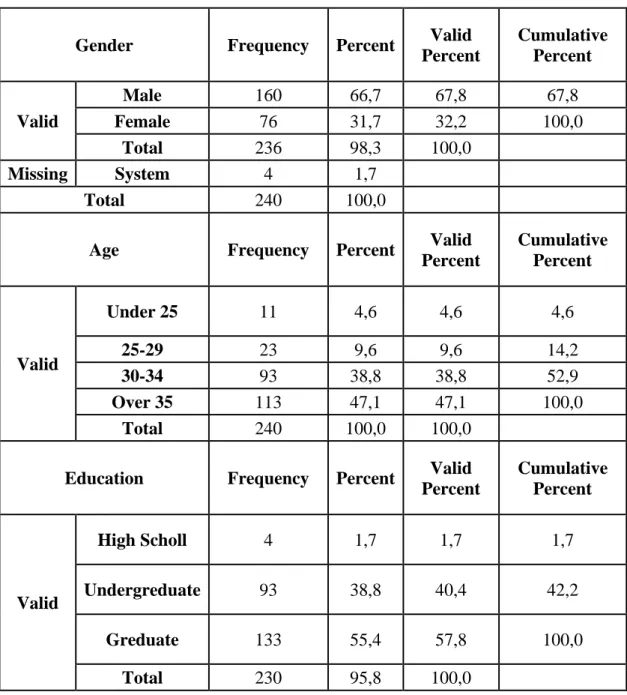
4.1. Demographic Features ... 59
4.2. Validity and Reliability of The Study ... 61
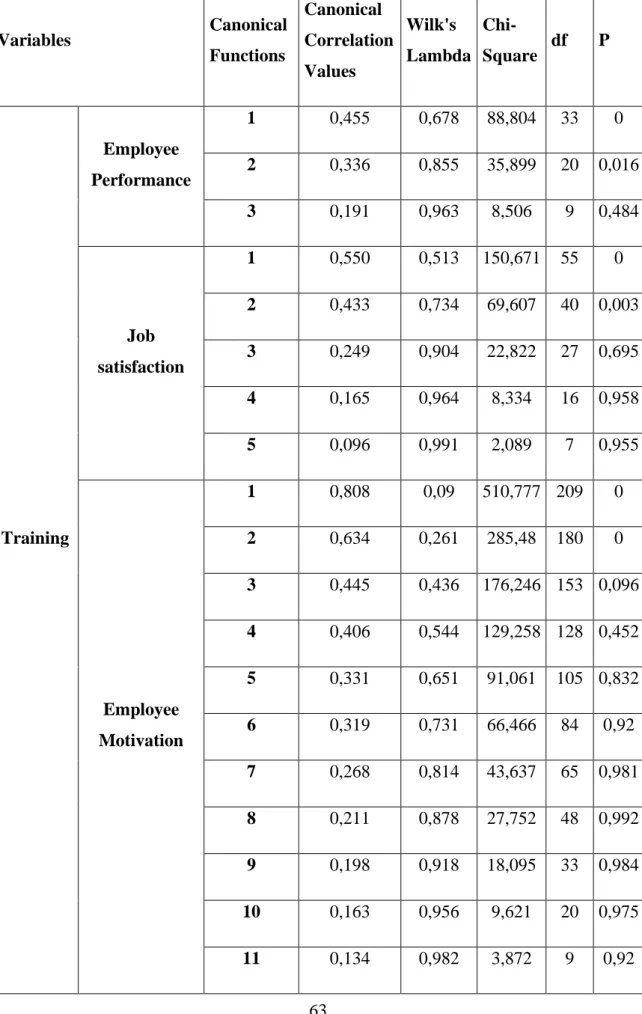
4.3. Findings ... 62 CONCLUSION ... 68 REFERENCES ... 70 LIST OF TABLES ... 77 LIST OF FIGURES ... 78 LIST OF ATTACHMENTS ... 79 QUESTIONAIRE ... 79 QUESTIONAIRE IN ARABIC (نايبتسإ) ... 83 CURRICULUM VITAE... 86
4
THESIS APPROVAL PAGE
I certify that in my opinion the thesis submitted by Ibrahim Suliman Said ELNAGAR titled “THE IMPACT OF TRAINING ON IMPROVING THE PERFORMANCE OF EMPLOYEES: THE CASE OF BANKING SECTOR IN LIBYA” is fully adequate in scope and in quality as a thesis for the degree of Doctor Of Philosophy In Business Administration.
Prof. Dr. Fatma Zehra TAN ... Thesis Advisor, Department of Business Administration
This thesis is accepted by the examining committee with a unanimous vote in the Department of Business Administration as a Doctor of Philosophy thesis. 27.07.2020
Examining Committee Members (Institutions) Signature
Chairman : Prof. Dr. Fatma Zehra TAN (KBU) ...
Member : Assoc. Prof. Dr. Ozan BÜYÜKYILMAZ (KBU) ...
Member : Assist. Prof. Dr. Hülya AKDEMİR CENGİZ (KBU) ...
Member : Assist. Prof. Dr. Sabahattin ÇETİN (BU) ...
Member : Prof. Dr. Tolga ULUSOY (KU) ...
The degree of Doctor of Philosophy in Business Administration by the thesis submitted is approved by the Administrative Board of the Institute of Graduate Programs, Karabuk University.
Prof. Dr. Hasan SOLMAZ ... Director of the Institute of Graduate Programs
5
DECLARATION
I hereby declare that this thesis is the result of my own work and all information included has been obtained and expounded in accordance with the academic rules and ethical policy specified by the institute. Besides, I declare that all the statements, results, materials, not original to this thesis have been cited and referenced literally.
Without being bound by a particular time, I accept all moral and legal consequences of any detection contrary to the aforementioned statement.
Name Surname: Ibrahim Suliman Said ELNAGAR Signature :
6
FOREWORD
I express sincere gratitude to all those, who gave me valuable support for completing this thesis. First, I acknowledge that this work was impossible without the kind attention and guidelines by Prof. Dr. Fatma Zehra TAN, who not just supervised this research work but also encouraged me during my academic program. She helped me learn a lot from her experience and valuable knowledge. It was her patience, supervision and insightfulness, which helped me improve my work many a times before finalizing it.
In addition, I want to thank my teachers for his support and assistance that I badly needed during the challenging times of my studies in Karabük.
7
ABSTRACT
It should never be forgotten that employees are the most important power in institutions and that the biggest resources of institutions are 'human resources'. For this fundamental reason, people in the top positions, in other words, managers, use many methods to make this resource better and develop as much as possible. Before the concept of "human resources" appeared in the enterprises, it was said that employees were not given much importance. However, it is a reality accepted by scientists that educated employees become more prominent after understanding the importance of human. With this study, the concepts of employee performance, motivation and job satisfaction are tried to be explained by making the necessary researches in the literature. Then, the relations of employee education with these concepts were tried to be analyzed with scales whose validity and reliability were tested. Random sampling technique was used in the study. A questionnaire was applied to 240 employees using face-to-face interview technique. The survey has 98.4% response rate. The hypotheses determined before the study can be listed as follows; There is a significant relationship between employee training and employee performance, there is a significant relationship between employee training and motivation, there is a significant relationship between employee training and job satisfaction. The data obtained by SPSS program were analyzed and it was tried to test whether there was a positive and significant relationship between these variables. The results show that employee training has a high value of relationship with job motivation, medium value of job satisfaction and relationship, and low value of relationship with employee performance. In the last part of the study, there are ideas and suggestions about what measures can be taken to increase the impact of the education dimension on other dimensions in order to strengthen relations with employee performance, job satisfaction and employee motivation.
8
ÖZ
Çalışanların kurumlardaki en önemli güç olduğu ve kurumların en büyük kaynaklarının ‘insan kaynağı’ olduğu asla unutulmamalıdır. Bu temel nedenden dolayı üst mevkilerdeki kişiler diğer bir deyişle yöneticiler bu kaynağın daha iyi kullanılabilmesi ve mümkün olduğunca geliştirilebilmesi için birçok yöntem uygulamaktadır. İşletmelerde ‘insan kaynağı ‘kavramı ortaya çıkmadan önce çalışanlara çok fazla önem verilmemekteydi, denilebilir. Fakat insanın önemi anlaşıldıktan sonra eğitimli çalışanların daha da öne çıktığı bilim insanları tarafından kabul edilmiş bir gerçekliktir. Bu çalışma ile öncelikle çalışan performansı, motivasyon ve iş tatmini kavramları, literatürde gerekli araştırmalar yapılarak açıklanmaya çalışılmıştır. Ardından çalışan eğitiminin bu kavramlar ile arasındaki ilişkiler geçerliliği ve güvenilirliği test edilmiş ölçekler ile analiz edilmeye çalışılmıştır. Çalışmada, rastgele örnekleme tekniği kullanılmıştır. 240 çalışana yüz yüze mülakat tekniği kullanılarak anket uygulanmıştır. Anket %98,4 cevaplanma oranına sahiptir. Çalışmadan önce belirlenen hipotezler şu şekilde sıralanabilir; Çalışan eğitimi ile çalışan performansı arasında anlamlı bir ilişki vardır, Çalışan eğitimi ile motivasyon arasında anlamlı bir ilişki vardır, çalışan eğitimi ile iş tatmini arasında anlamlı bir ilişki vardır. SPSS programı ile elde edilen veriler analiz edilmiş ve bu değişkenler arasında pozitif anlamlı bir ilişki olup olmadığı test edilmeye çalışılmıştır. Sonuçlar, çalışan eğitiminin, iş motivasyonu ile ilişki değerinin yüksek, iş memnuniyeti ile ilişki değerinin orta ve çalışan performansı ile ilişki değerinin düşük olduğunu göstermektedir. Çalışmanın son bölümünde ise çalışan performansı, iş doyumu ve çalışan motivasyonu ile ilişkileri güçlendirmek amacıyla eğitim boyutunun diğer boyutlar üzerindeki etkisini artırmak için hangi önlemlerin alınabileceğine dair fikir ve öneriler yer almaktadır.
Anahtar Kelimeler (Keywords in Turkish): Çalışan Eğitimi, Motivasyon, Çalışan
9
ARCHIVE RECORD INFORMATION
Title of the Thesis The impact of training on improving the performance of
employees: the case of banking sector in Libya
Author of the Thesis Ibrahim Suliman Said ELNAGAR
Supervisor of the Thesis
Prof. Dr. Fatma Zehra TAN
Status of the Thesis Ph.D
Date of the Thesis July - 202
Field of the Thesis Business Management
Place of the Thesis KBU/LEE Total Page Number 88
Keywords Employee Training, Motivation, Employee Performance, Job Satisfaction
10
ARŞİV KAYIT BİLGİLERİ (in Turkish)
Tezin Adı Eğitimin çalışanların performansını artırma üzerindeki etkisi: Libya'da bankacılık sektörü örneği
Tezin Yazarı Ibrahim Suliman Said ELNAGAR
Tezin Danışmanı Prof. Dr. Fatma Zehra TAN
Tezin Derecesi Doktora
Tezin Tarihi Temmuz - 2020
Tezin Alanı İşletme
Tezin Yeri KBÜ/LEE
Tezin Sayfa Sayısı 88
Anahtar Kelimeler Çalışan Eğitimi, Motivasyon, Çalışan Performansı, İş
11
ABBREVIATIONS
SPSS: Statistical Package for the Social Sciences KMO: Kesier-Meyer-Olkin
12
GENERAL FRAME WORK OF THE RESEARCH
SUBJECT OF THE RESEARCH
It is one of the issues that are discussed as one of the most important factors for employee performance, motivation and job satisfaction. n this study, research has been conducted on the extent to which the education factor affects these three factors and how it will affect more positively. For this, 240 subjects were selected among randomly employed people in the banking sector in Libya. Among the main reasons for choosing this sector is the high number of trained personnel. What is desired to be achieved in the research is to obtain the levels of the performance, motivation and job satisfaction of trained employees and contribute to the literature on how to increase these levels. At the same time, it can be said that with the increase in the education levels of the employees, the business development of the employees has increased.
PURPOSE AND IMPORTANCE OF THE RESEARCH
Similar studies are found in different countries and different sectors when the necessary literature review is made before starting the study. But, a similar study has not been encountered in the banking sector in Libya. At the same time, although the employee performance, employee motivation and job satisfaction are examined in the employee education, the relationship between the four elements in this study is also important In addition, the levels of the relationships between these variables were determined in this study, and suggestions were made on how to increase these levels. These suggestions are intended to assist future studies. I think that this study makes sense in terms of eliminating a deficiency in the literature.
METHOD OF THE RESEARCH
First of all, literature survey and face-to-face interview method were preferred. For this, the banking sector in Libya was preferred primarily with the idea that employee training is more effective and productive. 240 subjects were determined from the universe by random sampling method. A model has been established in which employee training has a significant relationship with employee performance, employee motivation and job satisfaction. Relationships between these variables were tried to be measured with the scale included in the appendix, which was tested for validity and reliability. The data obtained were analyzed by the SPSS program. Then, necessary comments were
13
made for the results and suggestions were made on how to increase the relations between them.
HYPOTHESIS OF THE RESEARCH / RESEARCH PROBLEM
The basic hypotheses of the study can be listed as follows;
H10: There is a significant relationship between employee training and employee performance.
H1:There is no significant relationship between employee training and employee performance.
H20: There is a significant relationship between employee training and motivation. H2:There is no significant relationship between employee training and motivation. H30: There is a significant relationship between employee training and job satisfaction. H3:There is no significant relationship between employee training and job satisfaction. While the main hypotheses included in the research are in this way, it is also tried to determine whether there is a positive and negative relationship between employee training, employee performance, employee motivation and job satisfaction.
SCOPE AND LIMITATIONS / DIFFICULTIES
This study was carried out on the banking sector in Libya. Researchers can do the same research in any sector, such as the education or hospital sector. This research can also be done in any other city, province or other country. Other sampling methods can be used. The biggest factor in the results of this research is the answers given by the participants. Therefore, when a larger sample is selected, it can make a larger contribution to the literature. In addition, when a larger time is allocated due to reasons such as time limitation, its relationship with employee training in other factors can be examined.
14
CHAPTER ONE: Employee Performance
INTRODUCTION
With the new approaches that emerge, both the world and the institutions are becoming more and more institutionalized day by day. With this institutionalization, the development of management skills and theories becomes inevitable. Education, performance, motivation and job satisfaction are among the concepts that have an important place in these theories and in this study. Scientists create new studies every day in order to understand the relationships between these concepts and to solve the relationships between them. It should not be forgotten that these concepts are in continuous relationship with each other and are a process.
In order to manage this process well and to gain the necessary knowledge and skills, human resources should be developed especially. It is advocated by various scientists that the most effective way of this is education. While education contributes to the individual's personal development, it can also help increase the self-esteem, contribute to the performance and motivation of the individual, and increase the feeling of satisfaction with the job. It can be seen that most institutions and organizations have long-term and educational plans. The reason for this is to prevent future problems with conscious and confident personnel. Thus, the performance of the employees will be increased with the responsibilities and obligations given to the employees.
Thanks to rapid, global and technological developments, institutions face new change needs in addition to problems. Technological advances have structured the need for talents and required efficiencies to perform certain tasks. Therefore, more efficient training programs are needed by all companies to face these challenges. Efficient training programs have enabled the creation of an additional suitable training environment for employees and training them to confront new challenges easily and at the appropriate time (Tai, 2006).
Education is an investment made in its own employees and institutions, just like other investments made by institutions. It is another way to get more productivity from the employees and increase the productivity. In order for the positive effects of the training to take place, personnel should be taken into account as necessary. In addition, although the positive aspects of education are many, the necessary time should be spent on the necessary research and funding (Colarelli, S. M., & Montei, M. S. 1996).
15
Although the concept of education is closely related to performance, motivation and job satisfaction, the benefit may decrease if the relations with each other are not transferred to the staff. Therefore, it is beneficial to consider the opinions and suggestions at the end of the study.
1.1. Concept and Definition of Performance
When we look at the historical development of the concept of performance, the evaluations of the employees' work were done in public service institutions in the USA in the 1900s. As a result of Taylor's studies on this issue, performance concept has gained scientific importance in organizations (Tural 2009, 30). Especially after the Industrial Revolution, it has been observed that the organizational performance has become an important issue and focuses on productivity (Kılınç 2012, 44).
The first performance evaluation was systematically performed after the First World War. In Western Europe and North America, performance evaluation system was used for administrative personnel decisions.
Performance is the measurement of efficiency in the most general sense in various generally accepted sources. The concept of performance, which is the qualitative or quantitative expression of the degree to which the employee has achieved the specified targets related to the work he has done, can be defined as the ability to reach the goals and objectives as a result of the comparison of the studies with the outputs. It is about the comparison and measurement of the work of the employees. Performance is the relationship between what needs to be done in the job description of the employee and what they actually do (Özkasap 2013, 32).
Some researchers describe work performance as the effort that employees pay for the wages they receive. Kohli (1985), who also makes a similar definition, describes the work, position and efficiency of the employees in the same position and position. ) Borman and Motowidlo have defined the business performance as the activities of the employees for their work performance (Akkoç et al. 2012, 108). Sonnentag and Frese
16
have defined the employee performance as measurable behaviors exhibited by employees on organizational goals (Türkmen 2009, 33). Performance is not only the result of the activity, but also the activity itself, ın says Campell, who provided a comprehensive description of the issue. While the amount of goods and services produced in a certain period of time defines the organizational dimension of the performance concept, the degree of employee achievement, the level of efficiency and effectiveness define the concept of performance in terms of individual (Özkasap 2013, 35). When we examine the performance concept in this way, it can be said that the individual performance is more important. Because organizations can only be as good as employees' performance (Şeker 2011, 28). In addition, the individual objectives of the employees and the organization's objectives overlap with each other will ensure that the individual performance is high. For this reason, employees' goals should be capable of supporting organizational goals.
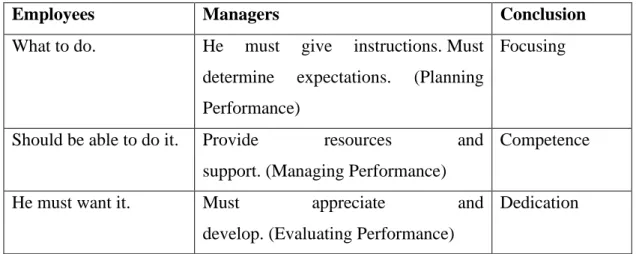
Individual performance consists of three basic elements. These elements; that the employee has the necessary skills to fulfill the requirements of the job (competence), and the employee's willingness to contribute to the organization to start work (devotion) (Kılınç 2012, 44). Individual performance elements in Table 1.1. are also described.
Table 1.1 Factors That Create Individual Performance
Employees Managers Conclusion
What to do. He must give instructions. Must determine expectations. (Planning Performance)
Focusing
Should be able to do it. Provide resources and support. (Managing Performance)
Competence
He must want it. Must appreciate and develop. (Evaluating Performance)
Dedication
Source: Baytar Ö. (2010), The Effects of Work Life Stress on Employee Performance, M.Sc. Thesis, Marmara University, Institute of Social Sciences, Istanbul.
The availability of targets, the optimal treatment of the recruitment of employees, the adoption of the objectives by the employees, the organizational climate, as well as the
17
individual performance of a number of variables, in other words, affects the performance of employees are located in various sources.
1.2 Performance Evaluation
As a result of the increasing competition due to globalization, it has become an important issue in the organizations to carry out intensive studies in order to evaluate employees' physical and intellectual potential in the best way. Performance evaluation is influenced by many economic and social areas. Performance evaluation, which is one of the most important areas that make up the organizational decisions, has a significant impact on the organization of organizational effectiveness. The purpose of performance evaluation is not the personal evaluation and punishment of the employees, but the measurement of the work success of the employees and the elimination of the deficiencies. Performance evaluation determines the behaviors necessary for the implementation of human resources strategies. Therefore, the results of the performance evaluation provide the optimum utilization of human resources in a way that is beneficial to the organization (Cengiz 2008, 75).
In general terms, performance evaluation is to measure the physical and intellectual contributions of the employees, to measure the work they do, to evaluate the strengths and weaknesses of the employees in relation to the job, to determine the extent to which the employee's skills and abilities overlap with the requirements of the job and to evaluate the success of the employees with objective analyzes. (Gedik 2010, 6) According to Timur (1983), performance evaluation is the scientific and systematic monitoring of the employees' personal characteristics, job success, development potential and the concrete and objective determination of the results (Cengiz 2008, 74). At present, performance evaluation evaluates the current situation and performance, and also evaluates the expected performance in the future. Therefore, performance evaluation is an important communication and management tool in organizations (Özen 2011, 13). From an organizational point of view, it also measures the extent to which the targets are carried out and ensures corrective actions. On the part of employees, performance evaluation allows a comparison between employees, rewarding and developing successful employees. In this context, it can be said that performance evaluation is effective not only individually but also in the organizational field and even
18
in the social field because of its effects. Because of these effects, it is extremely important to perform performance evaluation objectively.
1.3 Performance Evaluation Objectives
Performance evaluation is extremely important in order to determine the extent to which the objectives have been achieved, determine the achievability of the objectives, direct the future of the enterprises and provide efficiency and effectiveness by taking corrective actions. The performance appraisal system is a system that includes a variety of applications such as hiring, determining wage levels, identifying training needs, career planning and rewarding (Çotul 2014, 31). Criteria of the system are indicators such as cost effectiveness, productivity, profit rate, job satisfaction and quality (Güneş 2012, 82). Each organization has a performance evaluation system according to its strategic goals and objectives.
In the performance appraisal system, the process starts with the determination of the criteria to be based on the assessment, the determination of the extent to which the objectives are set by the criteria and the implementation of the corrective developer. As performance evaluation has many aims, it is one of the important objectives of the organizations which is important for the organizations to determine the individual performance differences and based on this, it constitutes the basis for making decisions such as promotion, wage policy (Çotul 2014, 32). The objectives of performance evaluation in the literature are listed below;
➢ Primary objective of performance appraisal is to inform individuals about their work so as to ensure the development of both employees and the organization (Şehitoğlu 2010, 101).
➢ Improvement of communication between the subordinate and the creation of a structure for solving the performance problems of employees is also an important goal (Madan 2011, 49).
➢ Funding and funding for implementation of human resources policies such as rewarding, promotion and dismissal.
19
➢ According to the assessment, identifying inadequate or unsuccessful staff to ensure corrective actions. In this way, to adapt to changing market conditions in the sector (Borş 2010, 83)
➢ Determination of training needs. The success of the employees, which constitute the source of the success of the organization, is evaluated and to ensure that the contribution of the individual is reached to the maximum level.
➢ It recognizes the future performance potential by recognizing the employees with all aspects such as knowledge, skills and ability (Pınar 2012, 26).
➢ Work done by enabling the analysis form the basis for determining the criteria in subsequent recruitment.
➢ Determining how talented individuals can better benefit from them (Ayan 2009, 52).
➢ It provides a transparent management approach and provides employees with trust in the organization (Baytar 2010, 67).
➢ Performance evaluations are carried out for various purposes such as determining whether organizational goals have been achieved and taking necessary actions.
1.4 Performance Evaluation Methods
Organizations choose performance evaluation methods according to their performance evaluation objectives, organizational structures and employee qualifications. When selecting organizations assessment methods, it is necessary to analyze what the techniques measure in terms of structure. In this context, it is extremely important to determine the methods that will contribute to the equal, fair and accurate measurement of this assessment while performing the performance evaluation of its employees. In the literature, performance evaluation methods in various sources are classified as classic and modern methods under two main headings.
1.4.1 Conventional Assessment Methods
The evaluation method is based on the assessment of the personal characteristics of the employees based on their skills and abilities, that the evaluation is confidential, that the employees do not participate in the assessment made about themselves, and that the evaluation is the instrument of punishment and pressure (Eymür 2009,
20
52). Conventional evaluation methods, which are classified by traditional and historical backgrounds, measure the performance of static methods used up to now. In this context, can be classified as traditional based on the past because it covers the present and the past. Employees are evaluated as successful or unsuccessful on the basis of past performances and as a result of this evaluation, employees are given feedback as reward and punishment (Eymür 2009, 54). Classical evaluation techniques are classified as follows (Gedik 2010, 10);
➢ Graphic Method of Measurement ➢ Critical Incident Method
➢ Compulsory Selection Method ➢ Descriptive Text Type Ratings ➢ Benchmarking Method
o Sort Method
o Alternative Placement Method o Man, to man Benchmarking Method ➢ Rating Method
➢ Trial Method
Because financial measures are used to provide information about the history of traditional assessment methods in today's changing dynamic environmental conditions, performance is insufficient to evaluate. Because traditional valuation methods focus on the costs of direct employees to the organization based on the financial system, this situation neglects the results that can be taken in the long term and may adversely affect the continuous development (Altındağ 2005, 37).
1.4.2 Non-Traditional Assessment Methods
In non-traditional modern performance valuation systems, employees are included in the design of the system. Some researchers related to the subject have found that in the studies conducted by Bretz et al. (1992), Mohrman, Resnick-West and Lawler (1990), the employees will adopt the system more easily if they are included in the performance evaluation system (Eymür 2009, 54). Therefore, taking the ideas of the employees, taking into account the expectations of the evaluation system to be designed accordingly
21
constitutes the basis of contemporary evaluation methods. The techniques in the system are as follows (Gedik 2010, 10);
➢ Self-development level ➢ Achievement records method ➢ Field analysis method
➢ Bars (Behavioral-based valuation method) ➢ management valuation compared to
➢ Objective evaluation method according to Conclusion ➢ self-assessment
➢ Assessment centers
➢ 360-degree assessment methods
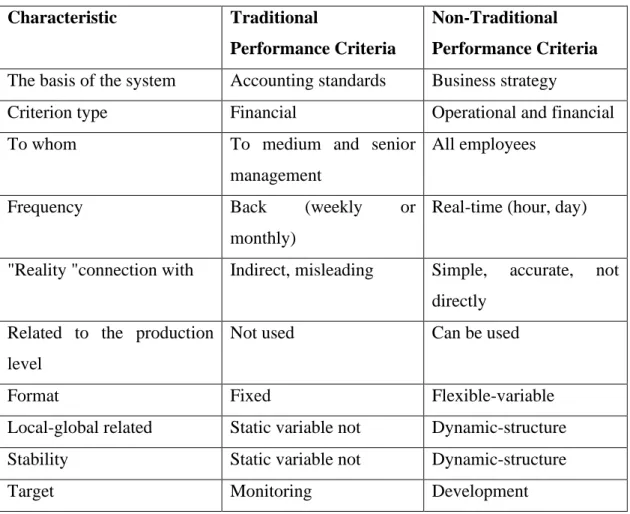
Traditional and among non-traditional modern methods differences in table 1.2. are also described in detail.
Table 1.2. Conventional and Non-Traditional Performance Measures
Characteristic Traditional
Performance Criteria
Non-Traditional Performance Criteria
The basis of the system Accounting standards Business strategy
Criterion type Financial Operational and financial To whom To medium and senior
management
All employees
Frequency Back (weekly or monthly)
Real-time (hour, day)
"Reality "connection with Indirect, misleading Simple, accurate, not directly
Related to the production level
Not used Can be used
Format Fixed Flexible-variable Local-global related Static variable not Dynamic-structure Stability Static variable not Dynamic-structure Target Monitoring Development
22
New approaches Difficult to adapt Applicable Continuous improvement
effect
Blocker Supporting
Source: Eymür E. (2009), A Field Study on Organizational Commitment to Examine Employee Performance, Master Thesis, Istanbul Commerce University, Institute of Social Sciences s Istanbul.
When performance evaluation methods are compared, traditional performance criteria make a static evaluation based on financial system. However, in non-traditional terms, modern methods, dynamic, real-time, not only the performance of the past, but also the performance that is happening in the future and even in the future is evaluating potential. In this context, the long-term potential performance of non-traditional methods will undoubtedly bring significant benefits to the efficiency of organizations.
1.5 Failures in Performance Evaluation
As a result of the inappropriateness or inadequacy of the method used in performance evaluation, there are also errors arising from the evaluator. According to Turnalı, the problems experienced in performance evaluation are mostly caused by individuals who make an assessment (Turnalı 2013, 40). Therefore, it is extremely important that the evaluator has the necessary competencies, with the appropriate method being used. Errors in performance evaluation in various sources are described in detail below.
1.5.1 Errors Caused by Performance Criteria
When performing performance evaluation, employees should be evaluated according to all criteria in the job description (Dişkaya 2006, 108). In the assessment, the assessment based on only one criterion will make a fair assessment impossible. Therefore, the evaluation of all criteria in the job definition from different angles according to these criteria will help to obtain a more objective result.
23
1.5.2 Technical Defects
The failure to complete the time required for the preparation of the evaluation form is the deficiency of the form or the failure of the assessor to have sufficient information about the form evaluation or the failure to understand the form data by the evaluator (Çotul 2014, 41).
1.5.3 Contrast Errors
Performance evaluators appear to be one of the most common problems encountered in a short period of time when people need to evaluate too many people. For example, after a successful employee, a less successful candidate may be considered unsuccessful by an evaluator, or a worker with a high performance is considered successful after an unsuccessful employee is evaluated (Çotul 2014, 42). In this case, the employees should not be compared with each other, without a successful and unsuccessful separation, the assessment must be made for each person separately for each person according to the predefined formal job descriptions. In this way, a more optimal selection will be possible.
1.5.4 Near Time Effect Error
The evaluator begins to collect data when the performance appraisal time is near. With the time approaching, employees also have more regular, work-related behavior. Therefore, when the evaluator is based on the data in the last valuation period, the effect of the latter occurs (Turnalı 2013, 42). In order to prevent the error due to the recent effect, the evaluation should be carried out at frequent intervals, or to cover the entire period, not just the period close to the time of evaluation.
1.5.5 Central Tendency (Standard Measurement) Errors
In the evaluation of performance, the evaluation of all employees using the 5-point scale (1 excellent, 5 very bad) is evaluated as 3 in the middle point (Şeker 2011,
24
39). Performance evaluation made in this way will prevent taking the necessary actions to increase the low performance while at the same time it will prevent the employees who have high performance to take full advantage of their career plans.
1.5.6 No Objectivity and Prejudices
The Assessor cannot assess the performance of the performer by taking into account certain characteristics such as age, gender and external appearance (Dişkaya 2011, 39). In this way, an objective assessment cannot be made. For this reason, it is very important for the evaluation of the human resources experts or managers who conduct the evaluation to be free of impartial prejudices.
1.5.7 Halo Influence
Evaluating the evaluator as successful in all areas, taking into account only the success of the employee in a certain area, creates the halo effect, while the unsuccessful assessment of all areas by the employee taking into account the area where the employee fails, creates the reverse halo effect (Kösedağı 2014, 44). It is usually caused by the lack of sufficient knowledge of the evaluator. As with other evaluation errors, the halo effect error also adversely affects the organization.
1.6 Factors Affecting Employee Performance
Although the organization's growth and survival are dependent on many factors, the most important factor is undoubtedly the success of employees. For this reason, the performance of employees is extremely important in today's globalizing and increasing competition. Several studies conducted by the researchers have shown that some factors affect employee performance.
The factors affecting the employee performance in the studies conducted on this subject are explained in detail below;
25
➢ Personal Factors: Employee's knowledge, skills, talent level and employee's personal characteristics (Yildirim 2011, 7). Personal factors are important factors affecting employee performance.
➢ Organizational Factors: Organizational characteristics such as structural characteristics specific to the organization, business design, hierarchical structure, subordinate relations, working conditions. In various studies, it is stated that organizational characteristics are the most important factor affecting employee performance. For example, providing employees with an opportunity to increase within the scope of career planning has a significant impact on performance development (Aydın 2010, 37).
➢ Environmental Factors: Cultural, social and political elements of the external environment and organizational culture are the environmental factors that affect the employee on the vision and mission of the organization (Yıldırım 2011, 20).
26
CHAPTER TWO: MOTIVATION
2.1. The Nature of Motivation
In this section, the importance of motivation and its importance are emphasized. Then, after emphasizing the relation of motivation with requirements, types of motivation are examined. The department, taking the motivation dynamics, The relationship between motivation and similar concepts.
2.2. Definition and Importance of Motivation
It is necessary to know the needs of people to understand and influence their behavior. Needs form the key to human behavior. Regarding human behavior theories are being put forward, their focus is on human needs. creates review. To understand the behavior of individuals, know the needs of behaviors. Individuals in specific situations the agent that directs certain behaviors is called "behavioral motivation" (Yalçın 1991, 203). Generally, in the sense of motivation, people continue to mobilize and initiate movements a driving force that allows it to be driven. Another motivation in the words of people, their desire to realize a specific purpose and requests can be defined as behaviors (Koçel 2001, 382). From an organizational point of view motivation, members of the organization, to start work and tasks it means all of the powers that bring them. Motivation in French and English is derived from the word Motive. In addition, Latin for "to the Mover" comes from the word. The Turkish counterpart is Motivation; it means power that drives man for various purposes. This recognition motivated by; activator, mobility, movement, positive it is a power that has three basic features as a router.” Motive “basic motivation (motivation) is one or more people made to continuously activate in one direction (aim and purpose) the sum of efforts (Eren 2001, 354)
27 Various definitions of motivation are as follows:
It is the event of activating the individual to do his job with desire and desire. Any the driving force behind the movement is a drive to satisfy some needs It consists. A business environment that will result in satisfying the needs of the enterprise and individuals influencing and motivating the individual to act the process (Can 1994, 164). Motivation leads to man's behavior in one direction, it can be defined as the mental state that makes it a behavior that is willing to do a job (Başaran 1989, 66). When there is a deficiency in the individual, a chain of events will begin. A behavior It will be. However, this behavior is not any behavior. A needy the organism will behave in a purposeful manner. Succeed will eliminate the need. Thus, the motivation mechanism will be completed (Dereli 1985, 121). (See Figure 2.1).
Figure 2.1. Motivation mechanism
To understand the behaviors of people tits necessary to understand their needs. Requirements constitute the key to human behavior. To be able to understand the behavior of individuals what we call behavior motivation (motivation) should be investigated (Yalçın 1991, 203).
Motivation in an organization gives movement to the organization, provides vitality. In businesses, all behavior of people is based on a reason. Satisfaction of people, needs and desires that they do a job to deliver. They can meet their needs they try to find the appropriate job. Reasons why people act in certain directions, in the face of the manager's abandonment of his office as soon as his official job expires. one another to work more than a few hours after everyone leaves the workplace the reasons such as the reason for preference are known.
One person likes to work for hours alone among documents and figures in case the other is unable to continue working at the desk and the reason why he wants to spend some
28
time in contact with others is that although they approve every word of their superiors; there are questions such as the reason they do not hesitate to criticize. In response to all of these, each individual has a unique personality although these differences can be said to be needs, satisfaction and motivation show a different degree (Dereli 1985, 187). Individuals should be encouraged and encouraged to work together. Attitudes and behaviors depend on a reason.
Here, motivation is the factor that creates the necessary reason for this attitude to start. Motivation of the manager, the intended purpose of encouraging the right elements they are used to awakening their desire and desire for work. is a tool. No matter how many machines, tools, devices and equipment Unless you are motivated people to use, it is impossible to ensure efficiency.
It aims to reach certain targets by means of physical and human resources in the company. It is all. For this purpose; work to be done, organized and goals the principles of reaching the roads are determined. Those who work within the enterprise
they are expected to work. These planned and organized efforts the details of the objectives, the operating policy, business execution processes, job descriptions, recruitment and training principles should also be determined.
Personality of working in an organization and is not limited to the way you make them. Staff cultural and social they are directed to the behavior of their structures. Employees specific within the enterprise social and cultural needs, as well as their responsibilities they want to be saturated. Consider employees as people who follow specific instructions it becomes a missing opinion. Knowing the various needs of employees, balanced relations between business objectives and individual needs at specific points
You may be able to set up. It will enable people working in a business to reach the target cooperation and cooperation between all employees. Coordination plays an important role. Such a working environment is on the other hand while trying to achieve its own planned goals the human needs of the employees to be taken into consideration can be provided with.
29
After this definitive explanation, this concept is tried to be found can be handled in terms of manager and staff. People have been brought to the business to achieve a purpose. This goal is production or service. Some things in return for them services (wages, promoted) and thus encouraged in a specific direction happen. Encouraging people to work is a concept with very complex qualities. The main reason for this is the infinite nature and complexity of human needs. Human needs are similar to each other. Besides, there are many different aspects. That is why people You need to understand his needs and know his needs to influence. Human their thoughts, their hopes, his beliefs are simply desire, need and fear. So, human activity (behavior), it is managed according to the desires, beliefs, needs and even fears of individuals. "This is the strength of the forces and forces we count it organizes to reach, gives continuity and dynamism (Eren 2001, 253).
What motivates, motivates, desires and needs human beings. Desires and a variety of needs the factors are shaped by the effect. These factors include the individual's cultural background. elements, biological characteristics, experiences can be shown. Individuals biological, personality features reflecting the influence of the social environment and culture they carry. For example; living in the village with a child living in the city center. There are cultural differences between children. Their personalities and lifestyle, it will affect the characteristics of the society in which it is located. A child may have normal education the other will want to study at a private school. These features It affects the needs and the level of satisfaction of the individual. Through individual learning and through a number of experiences, it can be shaped. Man's unsatisfied desires and needs over time they cause mental tension. These stresses are not easily visible from the outside but behaviors related to different stimulation tools and surrounding conditions by observing their assets and qualities. For example; a people will talk about a constant meal and pass by the restaurant. In this behavior the power of the need of hunger we can see. Balance will be achieved when the hunger feeling is removed. So, your purpose realization of tension or imbalance within the individual will be eliminated. Contact the person the intensity of the force pushing the direction decreases. A person will satisfy his purpose will feel physical and spiritual comfort.
30
Many negative attitudes and behaviors and even riots in social enterprises it arises from unsatisfactory desire and needs. A job done people who have meaning to have an incredible energy, dislike that those who find their jobs meaningless act lazily we can say.
When the individual enjoys the work that he or she is working for, the success at work may increase. Physician at the hospital looking at his patient, the accountant employed in the office while holding his notebook records If he is happy with work, he does not like a heavy burden, but rather a play with pleasure. Freelancers and the freedom to decide on their own the danger of workers who do not exist at all, naturally, slipping into laziness and stubbornness has. Considering that this situation will lead to a failed operation It should be taken.
For this reason, motivating employees should be identified and fulfilled requests should be attempted. Otherwise unhappy or unhappy a staff member will not be able to fulfill his duties in full. Motivation is a complex problem in business. Because of the working individuals their needs, desires and desires are different. People biological and psychological they are different from each other in terms of structure. Psycho- physiologist motivation homeostatic impulses in time (hunger, thirst, sleep, etc.) and sometimes examined non- homeostatic impulses (emotional stimuli) and they tried to explain.
2.3. Motivation Types
Motivation arising from the needs of the individual severity can be subjected to various classifications based on criteria such as. Motivation is important as much as it affects individual behaviors. These behaviors are conscious or may be unconscious. For example, the intellectual motivation based on the intellectual motivational motivation, and non-intellectual motivation. Beyond the dual evaluation, the motivation types are divided into three sections below. It is examined.
31
2.3.1. Physiological motivation
Physiological motivation is essential for human survival These are motivations directed towards obtaining primary needs. These motivations are semi-conscious and half unconscious. Among these motivations; nutrition, dressing, warming, housing etc. counted. These are primitive societies are the needs of individuals. Although this motivation exists in all people severity varies from person to person.
Physiological motivations are partially independent of each other and all other requirements superior and dominant. These motivations are firstly met for the continuation of life. The continuity and functioning of the human body as a biological organism requirement to be satisfied. Motivated as satisfied will disappear. For example; After a thirsty man drinking a glass of water,
The need is reduced. After that, every glass of drinking water needs to be destroyed. As a result, there is no desire to drink water. But the time has passed since this time the need arises again. In the end, the need will need to be remedied again. Physiological needs never disappear. Occur at regular intervals and must be satisfied. Individual, physiological requirements of basic nature unaffected and not motivated. Because the wishes and desires that come from within the individual (Sabuncuoğlu 1996, 90).
2.3.2. Social motivation
They are motivations that enable people to live in society. Human In this group he hears a certain level and strives to reach this level spend. Reaching such a place is the most important event in the world. Belonging, acceptance, love and love are included in this group of requirements (Hick &Gullet 1981, 216)
32
Rules that ensure the continuity and order of social life provides behavioral habits in human life. Behaviors of the community play a motivating role on an individual's behavior. This motivation is social It is content. The rules that provide social order, the formation of physiological motivations they make them look different. The individual society is a it is part of it, it cannot be isolated and isolated from society.
Different types of society It is natural that the individuals in the sections have different social motivations. Social motivations may vary according to the characteristics of the society. Each the society has its own traditional rules and pressures. Behavior of the individual Social-Psychological combined with the common motivations of the society motivation. An individual is a member of a group, spent with other people
The effects of their experiences and relationships reveal all the activities of that individual. Psychology dominating the society influences the individual and directs it to behavior. Keep in mind it is necessary that the socio- political motivation can be effective is bound (Blau&Meyer 1971,47).
2.3.3. Psychological motivation
This motivation is based on desire, desire, fear, longing, intellectual and spiritual needs caused. This motivation varies from person to person. For example; joy, sadness varies from individual to individual. Some individuals feel joy, some are happy about big events. This motivation is compassion, hearing, duty responsibility, if not motivation is learned over time. This motivation forms the individual's personality and behavior. Psychological motivation, sometimes desire to show itself, sometimes being independent the request. But the bond that unites them is the desire for power (Munn 1981, 45). Individuals success they want to win and ascend and They input. Analysis of psychological motivation, physiological and social it is more complex and difficult than the analysis of motivation. Psychological motivation in general evaluating the molds and
33
their effects and reactions and it is difficult to examine their causes. Sometimes not between individuals, even in the individual's own behavior may change over time. Interesting and difficult the direction of the behavior of others, as well as the individual's own behavior and the reasons for differentiation are not even fully known. Because this behavior is soy heritability through childhood many events occurring during the time until the subconscious caused. This fact is directly related to the personality of the individual (Sabuncuoğlu 1996, 92).
Personality is the name given to the sum of behaviors that distinguish individuals from each other. In a sense personality is the foundation of life in the universe. Attitudes, skills, and dislikes and how the individual sees himself / herself throughout an individual life repetition of the roots of a single person (Eren 2001, 215). Great influence on the family of children has. Personality; develops during the school period matures over time extending to working life. Passing through various stages personality affects the way in which psychological motivation occurs and determines its direction.
2.4. Motivation Theory
Motivation theories examine the causes of behavior and the processes that cause this behavior. The theories of content (content) that stand on what motivates the individual; the theories which stand on how the individual is motivated are called process theories (Bölükbaşı Yıldırtan, 2009, 349). Motivation theories will be examined in this context.
2.4.1. Scope Theories
The scope theories cover how people behave and what makes them behave like this (Şimşek et al., 2003, 137). These theories tend to understand the factors within the person that lead him to behavior. According to Koçel; examines the theories that cover the factors that direct the individual and his / her individual behavior to certain behaviors (Koçel, 2001, 39). Scope theories focus on the needs of employees and what motivates them. How can I better manage their employees using these factors that
34
work, investigates how it motivates? The scope theories we will examine in this section; Maslow's Hierarchy of Needs Approach, Herzberg's Double-Factor Theory, ERG Theory of Alderfer, McClelland's Theory of the Need for Success (Koparan, 1997: 304; Aşan, 2001: 226).
2.4.1.1. Maslow Hierarchy of Needs
The first scientist to examine human needs in a scientific way is American Abraham H. Maslow (Eren, 2007: 30). He argues that the basic of motivation is the necessity of human needs and that the individual takes action to meet these needs and that the most important factor that determines the behavior is the needs. (Vural, Coskun, 2007: 120). Maslow has explored how people can obey others, how they can accept to work according to someone's orders, and that they have needs and that they agree to work to meet these needs (Bölükbaşı, Yıldırtan, 2009: 350). Maslow puts human needs in a hierarchical order. These; physiological needs, need for security, social needs, need for value and self-realization are dealt with in five basic categories. (Maslow, 1970: 27) Physiological needs and need for safety are considered as primary requirements, others as secondary requirements. (Eroglu, 2007: 48). In order to meet the needs of the individual needs to satisfy these needs respectively (Basaran, 2000: 84). The basic needs must be met before the needs of the hierarchy are met. Maslow's Needs Hierarchy Approach is based on three basic assumptions. According to the first hypothesis: Man is a social being therefore constantly want, but what they want depends on what you have at that moment. Needs are unlimited, when someone is met, someone else takes his place immediately. According to the second hypothesis: The need is not directed to the individual. The man acts until he meets his needs. For example; hungry man searches for food until he meets his need. However, he does not continue with the same behavior. That is, a need for satisfaction is not a motivating factor and it is replaced by another need. The third is: Human needs are sorted according to a certain hierarchy. In the hierarchy of needs, the needs at the upper tier do not direct the person to any behavior, without lowering the needs at the lower tier. (Kocel, 2010: 648). A satisfactory need loses the distinction of being a driving force and the higher needs begin to affect
35
behavior (Şimşek et al., 2003a : 137 ). It is possible to explain the hierarchical needs as follows (Koparan, 1997: 304)
Physiological needs: All the needs of the individual in order to survive. (eat and drink,
etc.). In order to meet these needs, the individual must have a job. The basis of job search is to meet these needs. When the individual is hungry or dehydrated, these are the first ones that need to be removed. They do not want to do anything other than these and behave in this direction. After these needs are met, it is directed to the needs of an upper level. For the organization, the basic thing is the price. People spend a large part of their daily lives at workplaces to meet these needs.
Safety / Security needs: It needs to protect itself, to feel safe, to be in a stable position,
to avoid anxiety from the chaos. They do not direct the individual to any behavior in their assets. However, they cause individuals to exhibit behaviors to protect themselves in their absence by using the entire capacity. When we think about the organization, the need for self-protection; they occur when they are unemployed, insurers are not paid, there is no job security and the working conditions are not safe. The individual works insured to protect himself from this situation, becomes a member of the union and tries to accumulate.
Social needs: Human is a social being. Therefore, it is in constant interaction with those
around it. They have social needs such as love, affection, belonging, adoption. First, they want to be loved, loved by their own family, then in social environments where they participate. He also wants to know that other people need him. (Sabuncuoglu, 2001: 139). However, in order to be able to feel this need, he must have met his needs in the first two steps. A hungry person needs to feed his stomach rather than someone who will love him.
36
The need for respectability: The individual wants to be a respected personality within
the community after he has met his needs in the lower level in the need’s hierarchy. Achievement, appreciation, reputation, status, self-confidence, and the appreciation of others can be evaluated among these needs. (Sabuncuoglu, 2001: 139). Every individual needs to be useful and necessary for the society, but everyone's satisfaction threshold is different.
Self-Realization: Even if all the needs of the individual are met, the person will be
unhappy as long as he / she doesn't do something suitable for his / her knowledge, skills and abilities. One must do what he wants and remain true to his own nature. Anyone who likes to sing should sing, love to paint. The individual will realize himself only when he does what he wants. When we evaluate for the organization, situations such as doing jobs that require creativity and rising can be called self-realization. When we consider organizationally, each individual needs and level of satisfaction are different. According to Maslow, an average person can satisfy 10% of his / her needs for self-realization, 40% of the need for respect, 50% of social needs, 70% of security needs and 85% of physiological needs (Koçel, 2010: 625).
What motivates the individual within the organization is the ability of the manager to understand what step his / her employee is at and determine the motivating elements accordingly. Because the need for satisfaction will no longer motivate the person (Baykal, 1982: 106). As a result, the degree of satisfaction of each need and the need for each person vary from person to person. It is important to know which steps are needed to motivate employees. Work satisfaction has not been directly addressed in Maslow's hierarchy of needs. However, starting from what's up here, we can say that job satisfaction of individual needs is met by the organization level will rise.
2.4.1.2. Herzberg Double-Agent Theory
After Maslov, the most well-known motivation theory. It is a very interested theory. Herzberg with the causes and consequences of employee behavior the factors that push the interested individual to the positive behaviors and the factors that push the
37
negative behavior examined. In the simplest form, job satisfaction and dissatisfaction arose from different factors, feelings of job satisfaction and job dissatisfaction are independent of each other hypothesis has revealed (Kurt, 2005: 298). Examines the needs of the individual in two groups.
1. Motivating Factors: Work itself, employee success, sense of responsibility,
promotion is the factors related to the content of work, such as recognition. While it increases the job satisfaction by motivating the employee with its existence, it consists of factors that do not motivate the employees and have no effect on job satisfaction. Herzberg, He called these factors a satisfaction or” motivators (Çetinkanat, 2000: 18).
2. Hygiene (Health) Factors: Business policy, wage, salary, working
conditions, work safety, such as auditing. The existence of these factors provides the minimum conditions for the motivation of the person, while the employee will not be motivated. So, motivate the person of hygiene factors they are not real motivators.
Hygiene factors are acceptable under the lower limit of the employees feeling of dissatisfaction occurs in falls, the employees' work is as dangerous as businesses that could lead to hate and to cool the supervisor (Eren, 2007: 491)
2.4.1.3. Equality Theory
The theory developed by Stacey Adams; contribution of people to work and get is to compare their earnings with the contributions of those who do similar work, to try to understand to what extent they are equal. (Asan, 2001: 234)
38
Basic; employees' desire to be treated equally in the work environment. Person at work the level of success and satisfaction depends on the equality or inequality that it perceives in the work environment. (Akdemir, 2001: 86). If the employee perceives inequality, his / her motivation is reduced (Eren, 2007: 543).
When he / she feels inequality, he / she turns to various behaviors. First of all, he decreases his effort, he wants to increase his wages, and tries to change the contribution of the workload, develops defense mechanisms and tries to move away from inequality. That he tries to convince himself that he is temporary. In the case of helplessness, inequality continues. If he does, he either starts absentee or quits (Aşan, 2001: 235). To avoid this situation, managers should reward equal effort with equal reward (Koparan , 1997: 314).
2.4.1.4. Mc Chelland The Need to Achieve
David Mc Clelland grouped human needs into three groups. These; their needs for success, commitment and strength. These needs are socio-psychological as well as social importance is emphasized. According to Mc Clelland, the need for success under the passion and emotions of being the best in their profession and searching for perfection is reserved (Eren, 2007: 522). Unlike other theories, refers subsequently be gained by learning (Çetinkanat, 2000: 22).
According to Mc Clelland, if a person spends his time thinking about his family and friends, then he spends his devotion drive speculating about the identity of his manager.
Although he spends his motivation thinking about how to do better, he has the motive for success
39
The Need for Success: Most people have a potential to succeed, but they cannot always
be revealed. To the perfection of the individual's own interests. The feeling of access can be defined as 2003 the need for success (Şimşek et al., 2003a: 142). Individual he wants to be successful in his activities, but he is greatly afraid of failing and this fear can keep him from activities that lead to success. Successful common characteristics of individuals ; they are looking for success personal satisfaction, personal trust and responsibility, problem solving, difficult but impossible to set goals, never leave their jobs, problems they solve by analyzing , they are realistic when taking risks, they measure their success with the feedback they get from the environment. (Eren, 2007: 522). Individuals in the organization to make it successful, eliminate the factors leading to failures, put realistic targets, make good feedback.
The Need for Commitment: Persons cannot survive on their own, necessarily within a
society they need to relate to certain groups (Şimşek et al., 2003a: 143). Therefore, the need to establish a relationship with others, the group refers to the development and social relations are expressed. Individuals in need of a relationship love, love and they want to belong to the group; they spend a lot of effort, are very sincere, warm and sincere (Asan, 2001: 230).
The Need for Gaining Power: It is the result of human desire to dominate the
environment. In fact, this need arises as a result of the motives of being superior to others, keeping their business and activities under control. This need top found at the level; individuals are happy to do leadership, influence people with status, are people. (Özkalp, Kırel 1999: 288). The general characteristics of the people who need to gain power are as follows (Asan, 2001: 231): They want to control other people, the leader they look for positions, they like to compete with others, they are good speakers and arguments, they think logically, they are invincible to their feelings, they like to be instructive and to appeal to the community.
40
2.4.1.5. Alderfer's Erg Theory
This theory developed by Clayton P. Alderfer; Maslow's needs hierarchy is a theory developed to complete the theory. While Maslow's theory has not been developed for working life, Alderfer's theory is directed at the human needs of organizations. According to Alderfer, there are three types:
The need to exist: The human being is to stay safe and stay safe from all kinds of danger
in order to survive and survive (Eren, 2007: 506). It meets the physiological and security needs of Maslow in the hierarchy of needs.
The Need for Belonging: Establishing good relationships in social life and at work and
continuing them Avoid the need. It is the same as Maslow's social needs.
Need for Development: It is the need to reveal the potential within the person and
develop it. It is similar to Maslow's need for self-realization.
In the ERG theory, there is a hierarchy of needs. Without subclass requirements being satisfied, the upper group cannot be met, i.e. the direction of needs does not always move upwards, there is the principle of frustration and withdrawal. The unhappiness and disappointment experienced by the individual because of the success in the satisfaction of the upper level return him to the satisfaction of a lower level and the person becomes motivated in this way (Eren, 2007: 507). Alderfer and Maslow first agree that the low-level needs should be satisfied. However, according to Alderfer, a satisfied need does not lose the motivation effect and any or all of the needs affect individual behaviors (Akdemir, 2001: 83).