Journal of Agricultural Science and Technology A 4 (2014) 197-202
Earlier title: Journal of Agricultural Science and Technology, ISSN 1939-1250
Essential Oil Composition of Four Endemic Tanacetum
L. (Asteraceae) Taxa from Turkey and a
Chemotaxonomic Approach
Ömer KiliçTechnical Science Vocational College, Bingol University, Bingol 12000, Turkey
Received: February 17, 2014 / Published: March 20, 2014.
Abstract: In this study the essential oil components aerial parts of Tanacetum heterotomum (Bornm.) Grierson, T. zahlbruckneri
(Nab.) Griersson, T. densum (Lab.) Schultz Bip. subsp. amani Heywood and T. cadmeum (Boiss.) Heywood subsp. orientale were examined by HS-SPME/GC-MS technique. Thirty six, thirty nine, forty and forty five constituents were determined representing 88.9%, 90.1%, 90.8% and 91.5% of the oil, respectively. The main compounds of studied Tanacetum L. taxa; borneol, α-pinene, 1,8-cineole, -pinene, camphor, germacrene D, spathulenol are determined. Studied Tanacetum taxa showed congruency with the discription in Flora of Turkey as morphological properties; on the contrary essential oil composition were detected very quiet diverse infrageneric level. Chemotypes of Tanacetum L. taxa were reported as borneol, germacrene D, spathulenol,α-pinene, 1,8-cineole, -pinene and camphor. The results obtained from this study were discussed in terms of chemotaxonomy and natural products.
Key words: Tanacetum L., essential oil, chemotaxonomy, natural products.
1. Introduction
The genus Tanacetum L. which is an important member of the Asteraceae or Compositae family, is spreaded in Europe and West Asia throughout the northern temperate areas [1]. Tanacetum contains several annual and perennial taxa and represented in Turkey by 45 species, 18 of them are endemic and endemism rate 40% [2, 3].
Tanacetum have not seperated any sections but
have placed three groups (A, B and C) based largely on capitula and flower characters, in Flora of Turkey.
T. heterotomum and T. zahlbruckneri are belong to
group A; T. densum subsp. amani and T. cadmeum subsp. orientale are belong to group B. T.
heterotomum, T. zahlbruckneri, T. cadmeum subsp. orientale and T. densum subsp. amani are endemic
Correspounding author: Ömer Kiliç, assistant professor,
research fields: botanic, biochemical systematic, plant systematic, plant essential oil, ethnobotany, plant morphology and anatomy. E-mail: [email protected].
taxa in Flora of Turkey [2].
Tanacetum taxa are known in Turkey as “pireotu”
and their essential oils are used as repellent against insects [4]. Tanacetum spp. are rich in essential oils, sesquiterpene lactones and bitter substances and they have antiinflammatory, antibacterial and antihistaminic activities; in moderate doses, tansy essential oils are stomachic, cordial effect and used as a food additive [5]. Various extracts of plants materials and essential oil of plants have agitated interest as sources of natural products. The essential oils and seconder metabolites of plant samples have been investigated for their potential uses as alternative remedies for the treatment of many diseases. Especially antioxidant, antimicrobial and antibacterial activities of plants essential oils and various extracts of plant samples have formed the basis of many applications, including pharmaceuticals, alternative medicine, natural and aroma therapies [6].
D
Some earlier works have been reported on the essential oils of various Asteraceae taxa [7-10]. Some
Tanacetum taxa have been cultured in gardens [11]
and used in salads, omelets, cakes, dyes, medicines, cosmetics and preservatives as herbal cure [12]. Some members of Tanacetum have also been used as anti-helmintic for migraine, neuralgia, rheumatism, loss of appetite [13], antiinflammatory [14], antibacterial and antifungal [15] activities.
The objectives of this research were: (1) to reach chemotaxonomic results from obtained data; (2) to obtain the chemical constituents isolated from the east part of Anatolian region taxa of the Tanacetum genus; (3) to discuss the phytochemical relations and usefulness of the studied taxa. For purposes of this, the essential oil composition of four endemic
Tanacetum taxa (T. heterotomum, T. zahlbruckneri, T. densum subsp. amani, T. cadmeum subsp. orientale)
from eastern part of Turkey is reported.
2. Materials and Methods
2.1 Plant Materials
T. heterotomum was collected from north of Dikme
village (Bingol), stony slopes, 1,550-1,600 m, 20.VI.2013, Kiliç 4690. T. zahlbruckneri was collected from North of Dikme upland from vicinity of Yelesen village (Bingol), slopes, 1,450-1,500 m., 20.VI.2013, Kiliç 4801. T. densum subsp. amani was collected from West of Mandıra district (Elazığ), slopes, 1,200-1,300 m, 20.VI.2012, Kiliç 4564. T.
cadmeum subsp. orientale was collected from vicinity
of Aslankaşı village (Elaziğ), steppe, 960-1,000 m, 20.VI.2012, Kiliç 4563. The voucher specimens have been deposited at the Herbarium of Biology Department, Bingol University (BIN).
2.2 HS-SPME Procedure
The dried aerial part of 5 g plant samples were powdered with a liquidizer and was filled a 40 mL vial. The vials were equipped with a “mininert” valve and were carried out by a HS-SPME (headspace solid
phase microextraction) method using a DVB/CAR/PDMS fiber, with 50/30 lm film thickness; before the analysis the fiber was preconditioned in the injection port of the GC as indicated by the manufacturer. The vials was kept at 35 °C with continuous internal stirring and the sample was left to equilibrate for 30 min; then, the SPME fiber was exposed for 40 min to the headspace while maintaining the sample at 35 °C. After sampling the SPME fiber was introduced into the GC injector, and was left for 3 min to allow the analytes thermal desorption. In order to improve the technique, sample volume, sample headspace volume, sample heating temperature and extraction time, were studied on the extraction efficiency as previously reported by Verzera et al. [16].
2.3 GC-MS Analysis
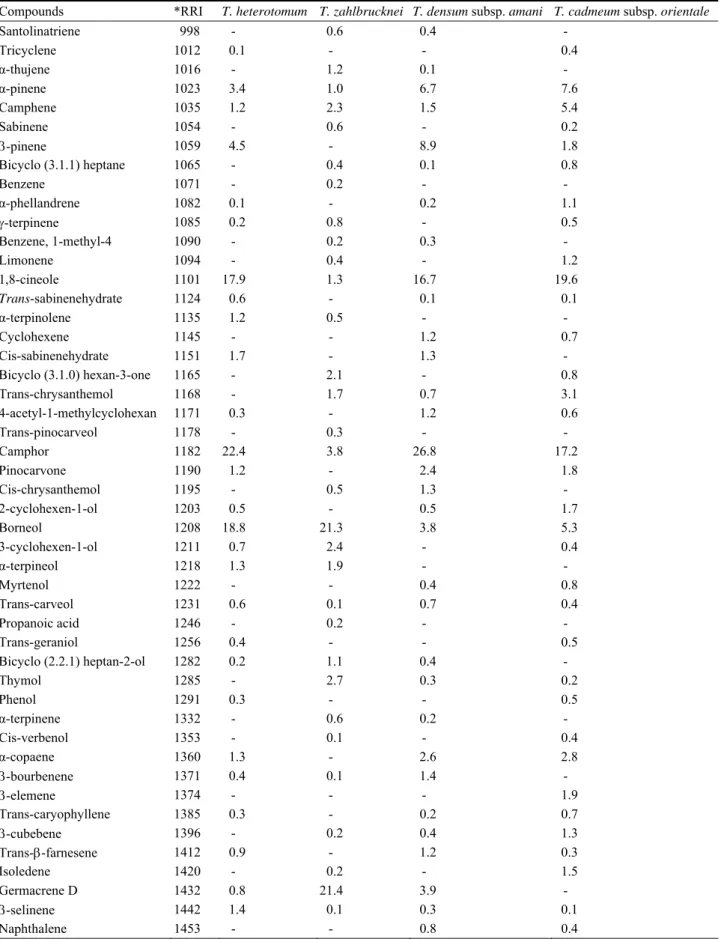
A Varian 3800 gas chromatograph interfaced with a Varian 2000 ion trap mass spectrometer (Varian Spa, Milan, Italy) was used. Injector temperature, 260 °C; injection mode, splitless; column, 60 m, CP-Wax 52 CB 0.25 mm i.d., 0.25 lm film thickness (Chrompack Italy s.r.l., Milan, Italy). The oven temperature was programmed 45 °C held for 5 min, then increased to 80 °C at a rate of 10 °C/min, and to 240 °C at 2 °C/min. Helium used as carrier gas was at a constant pressure of 10 psi; the transfer line temperature 250 °C; the ionisation mode, electron impact (EI); acquisition range, 40-200 m/z; scan rate, 1 us-1. The compounds were identified using the NIST (National Institute of Standards and Technology) library, mass spectral library and verified by the retention indices, which were calculated as described by Van den Dool and Kratz [17]. The relative retention indexes were calculated on the basis of peak-area ratios. The essential oil compositions of studied samples were showed in Table 1.
3. Results and Discussion
In this study the essential oil composition aerial parts of T. heterotomum, T. zahlbruckneri, T. densum
Table 1 Essential oil composition of studied Tanacetum taxa.
Compounds *RRI T. heterotomum T. zahlbrucknei T. densum subsp. amani T. cadmeum subsp. orientale
Santolinatriene 998 - 0.6 0.4 - Tricyclene 1012 0.1 - - 0.4 α-thujene 1016 - 1.2 0.1 - α-pinene 1023 3.4 1.0 6.7 7.6 Camphene 1035 1.2 2.3 1.5 5.4 Sabinene 1054 - 0.6 - 0.2 -pinene 1059 4.5 - 8.9 1.8 Bicyclo (3.1.1) heptane 1065 - 0.4 0.1 0.8 Benzene 1071 - 0.2 - - α-phellandrene 1082 0.1 - 0.2 1.1 -terpinene 1085 0.2 0.8 - 0.5 Benzene, 1-methyl-4 1090 - 0.2 0.3 - Limonene 1094 - 0.4 - 1.2 1,8-cineole 1101 17.9 1.3 16.7 19.6 Trans-sabinenehydrate 1124 0.6 - 0.1 0.1 α-terpinolene 1135 1.2 0.5 - - Cyclohexene 1145 - - 1.2 0.7 Cis-sabinenehydrate 1151 1.7 - 1.3 - Bicyclo (3.1.0) hexan-3-one 1165 - 2.1 - 0.8 Trans-chrysanthemol 1168 - 1.7 0.7 3.1 4-acetyl-1-methylcyclohexan 1171 0.3 - 1.2 0.6 Trans-pinocarveol 1178 - 0.3 - - Camphor 1182 22.4 3.8 26.8 17.2 Pinocarvone 1190 1.2 - 2.4 1.8 Cis-chrysanthemol 1195 - 0.5 1.3 - 2-cyclohexen-1-ol 1203 0.5 - 0.5 1.7 Borneol 1208 18.8 21.3 3.8 5.3 3-cyclohexen-1-ol 1211 0.7 2.4 - 0.4 α-terpineol 1218 1.3 1.9 - - Myrtenol 1222 - - 0.4 0.8 Trans-carveol 1231 0.6 0.1 0.7 0.4 Propanoic acid 1246 - 0.2 - - Trans-geraniol 1256 0.4 - - 0.5 Bicyclo (2.2.1) heptan-2-ol 1282 0.2 1.1 0.4 - Thymol 1285 - 2.7 0.3 0.2 Phenol 1291 0.3 - - 0.5 α-terpinene 1332 - 0.6 0.2 - Cis-verbenol 1353 - 0.1 - 0.4 α-copaene 1360 1.3 - 2.6 2.8 -bourbenene 1371 0.4 0.1 1.4 - -elemene 1374 - - - 1.9 Trans-caryophyllene 1385 0.3 - 0.2 0.7 -cubebene 1396 - 0.2 0.4 1.3 Trans--farnesene 1412 0.9 - 1.2 0.3 Isoledene 1420 - 0.2 - 1.5 Germacrene D 1432 0.8 21.4 3.9 - -selinene 1442 1.4 0.1 0.3 0.1 Naphthalene 1453 - - 0.8 0.4
(Table 1 continue)
Compounds *RRI T. heterotomum T. zahlbrucknei T. densum subsp. amani T. cadmeum subsp. orientale
-cadinene 1460 0.4 - - 0.3 Spathulenol 1495 0.6 16.2 1.4 - Caryophylleneoxide 1500 1.1 0.2 - 0.2 Muurolene 1518 - - 0.2 1.6 Epi-bicyclosesquiphellandrene 1532 0.8 - - 1.7 Copaene 1539 - 0.4 0.3 - α-cadinol 1541 0.4 0.1 - 1.3 -bisabolene 1551 - - 1.1 0.8 Aromadendrene 1558 0.3 1.2 - 1.3 2-pentadecanone 1625 - 0.4 0.2 - Hexadecanoic acid 1685 1.6 - 0.3 0.7 Carene 1741 0.3 0.2 - 0.4 Octadecanal 1862 - - 0.1 0.5 Tricosane 1902 0.7 0.5 - - Eicosane 1935 - 0.6 0.2 0.6 Total 88.9 90.1 90.8 91.5
*RRI: relative retention index.
subsp. amani and T. cadmeum subsp. orientale were investigated by HS-SPME/GC-MStechnique. Germacrene D (22.4%), borneol (18.8%) and spathulenol (17.9%) were detected the main constituents of T. heterotomum. Germacrene D (21.4%), borneol (21.3%) and spathulenol (16.2%) were determined the main components of T.
zahlbruckneri. Camphor (26.8%), 1,8-cineole
(16.7%), -pinene (18.8%) and α-pinene (6.7%) were found to be the main constituents of T. densum subsp.
amani. 1,8-cineole (19.6%), camphor (17.2%) and
α-pinene (18.8%) were reported the major constituents of T. cadmeum subsp. Orientale (Table 1).
1,8-cineole was found to be the main compounds of
T. densum subsp. amani (16.7%) and T. cadmeum
subsp. orientale (19.6%); whereas this compound was reported low amounts in the esential oil of T.
heterotomum (0.8%) and T. zahlbruckneri (1.3%)
(Table 1). Like our study 1,8-cineole was characterized the leaf (31%) and herb (11%) oils of T.
armenum [4]. Camphor was detected the main
compounds of T. densum subsp. amani (26.8%) and T.
cadmeum subsp. orientale (17.2%); whereas this
compound was detected low amounts in the esential oil of T. heterotomum (0.8%) and T. zahlbruckneri
(3.8%) (Table 1). Camhor also has been detected the main compounds of T. chiliophyllum var.
chiliophyllum (17%) and T. haradjani (16%) [4]; T. parthenium (56.9%) [18] and T. chiliophyllum var. chiliophyllum (28.5%) [19]. The essential oils of
Turkish T. aucheranum and T. chiliophyllum var.
chiliophyllum were analyzed by GC-MS and the major
components of T. aucheranum oil were 1,8-cineole (23.8%), camphor (11.6%), terpinen-4-ol (7.2%) and α-terpineol (6.5%); on the other hand camphor (17.9%), 1,8-cineole (16.6%) and borneol (15.4%) were detected the main constituents in the oil of T.
chiliophyllum [20]. Borneol was obtained high
amounts in T. heterotomum (18.8%), T. cadmeum subsp. orientale (5.3%); and T. zahlbruckneri (21.3%) oils; whereas borneol was detected only low amount in the esential oil of T. densum subsp. amani (3.8%) (Table 1).
α-thujone was found to be the major constituent of T.
argyrophyllum var. argyrophyllum leaf (52%) and
flower (63%) oils; this compound also has been reported in the T. argenteum subsp. canum var. canum (12%) and T. praeteritum subsp. massicyticum (51%) essential oils [21] whereas in our study α-thujene was found to be very low amount in the essential oils of T.
densum subsp. amani (0.1%) and T. zahlbruckneri
(1.2%) (Table 1). In another study, the main compounds of T. nitens were 1,8-cineole (27.57%), α-pinene (4.62%) and spathulenol (4.14%), whereas α-pinene (27.86%), santolinatriene (8.82%) and 1,8-cineole (6.82%), were detected the major constituents of T. argenteum subsp. Argenteum [22] similarly α-pinenecontained high concentrations of T.
densum subsp. amani (6.7%) and T. cadmeum subsp. orientale (7.6%) (Table 1). Germacrene D and
spathulenol was determined the major components of
T. heterotomum (22.4%, 17.9%) and T. zahlbruckneri
(21.4%, 16.2%) respectively; it is noteworthy that Germacrene D and spathulenol detected only low amount in the esential oil of T. densum subsp. amani (3.9%, 1.4%) respectively and no percentages in the essential oil of T. cadmeum subsp. orientale (Table 1).
4. Conclusions
It is possible to conclude from the results of this study that germacrene D/borneol/spathulenol are the most probable chemotypes of the essential oil in T.
heterotomum and T. zahlbruckneri which were in the
same group (A group) in Flora of Turkey. In additioncamphor/1,8-cineole/-pinene and 1,8-cineole /camphor/α-pinene are the most probable chemotypes of the essential oil in T. densum subsp. amani and T.
cadmeum subsp. orientale, respectively, which were
in the same group (B group) in Flora of Turkey. So chemical findings of studied Tanacetum taxa are overlapping with morphological results from Flora of Turkey. The results showed that the genus Tanacetum had a considerable changing in essential oil composition and our study shows the occurrence of germacrene D/borneol chemotypes of T. heterotomum and T. zahlbruckneri; camphor/1,8-cineole
chemotypes of T. densum subsp. amani and T.
zahlbruckneri in Eastern Anatolian region of Turkey.
Besides, the results of essential oil compositions of four endemic Tanacetum taxa have demostrated that studied taxa can be used for medicinal, agricultural
and pharmaceutical purposes.
Acknowledgments
The authors thank the financial support from the Bingol University Scientific Research Project Unit, Bingol/Turkey, Project No. BAP-203-129-2013.
References
[1] K. Bremer, Molecular phylogenetic dating of asteroid flowering plants shows early cretaceous diversification, Timb. Port 10 (2004) 295.
[2] P.H. Davis, Flora of Turkey and the East Aegean Islands, University Press, Edinburgh, 1982, pp. 64-268.
[3] S. Erik, B. Tarikahya, Türkiye florası üzerine, Hacettepe Ün. Yayınları, Ankara, Kebikeç. 17 (2004) 139-162. [4] K.H.C. Baser, B. Demirci, N. Tabanca, T. Ozek, N.
Goren, Composition of the essential oils of Tanacetum
armenum (DC.) Schultz Bip., T. balsamita L., T. chiliophyllum (Fisch. & Mey.) Schultz Bip. var. chiliophyllum and T. haradjani (Rech. fil.) Grierson and
the enantiomeric distribution of camphor and carvone, Flavour Fragr. J. 16 (2001) 195-200.
[5] D. Bown, Encyclopedia of Herbs and Their Uses, Dorling Kindersley, London, 1995, pp. 208-209.
[6] M. Lis-Balchin, S.G. Deans, Bioactivity of selected plant essential oils against Listeria monocytogenes, J. of Appl. Bac. 82 (1997) 759-762.
[7] O. Kilic, A. Kocak, E. Bagci. Composition of the volatile oils of two Anthemis L. taxa from Turkey, ZnC. 66 (2011) 535-540.
[8] E. Bagci, O. Kilic, Chemical Composition of essential oil of Senecio vernalis Waldst. Et Kit. (Asteraceae) from Turkey, Jeobp. 15 (2012) 399-404.
[9] O. Kilic, E. Bagci, Chemical composition of essential oil of Tripleurospermum parviflorum (Willd.) Pobed (Asteraceae) from Turkey, Asian J. of Chem. 24 (2012) 1319-1321.
[10] O. Kilic, E. Bagci, Chemical composition of endemic
Inula macrocephala Boiss. and Kotschy ex Boiss. from
Turkey, Asian J. of Chem. 25 (2013) 7952-7954.
[11] L.W. Mitich, Intriguing world of weeds—Tansy, Weed Technol. 6 (1992) 242-244.
[12] M. Grieve, Tansy, in: C.F. Leyel (Ed.), A Modern Herbal, Penguin Books Ltd., Middlesex, Great Britain, 1984, pp. 789-790.
[13] M. Blumenthal, The complete german commission e monographs: Therapeutic guide to herbal medicines, Tansy Flower and Herb, Unapproved Herbs, American Botanical Council/Integrative Medicine Communications, Austin, TX/Boston, MA, 1998, pp. 379-380.
[14] A.M.G. Brown, C.M. Edwards, M.R. Davey, J.B. Power, K.C. Lowe, Effects of extracts of Tanacetum species on human polymorphonuclear leucocyte activity in vitro, Phytother. Res. 11 (1997) 479-484.
[15] A. Neszmelyi, G.W.A. Milne, E. Hethelyi, Composition of the essential oil of clone 409 of Tanacetum vulgare and 2D NMR investigation of trans-chrysanthenyl acetate, J. Essent. Oil Res. 4 (1992) 243-250.
[16] A. Verzera, M. Zino, C. Condurso, V. Romeo, M. Zappala, Solid-phase microextraction and gas chromatography/mass spectrometry for the rapid characterisation of semi-hard cheeses, Anal. Bioanal. Chem. 380 (2004) 930-936.
[17] H. Van Den Dool, P.D. Kratz, A generalization of the retention index system including linear temperature programmed gas-liquid partition chromatography, J. of Chromatography 11 (1963) 463-471.
[18] H.A. Akpulat, B. Tepea, A. Sokmen, D. Daferera, M. Polissiou, Composition of the essential oils of Tanacetum
argyrophyllum (C. Koch) Tvzel. var. argyrophyllum and
Tanacetum parthenium (L.) Schultz Bip. (Asteraceae)
from Turkey, Biochem. Syst. Ecol. 33 (2005) 511-516. [19] E. Bagci, M. Kursat, A. Kocak,S. Gur, Composition and
antimicrobial activity of the essential oils of Tanacetum
balsamita L. subsp. balsamita and T. chiliophyllum (Fisch.
et Mey.) Schultz Bip. var. chiliophyllum (Asteraceae) from Turkey, JEOBP 11 (2008) 476-484.
[20] E. Salamci, S. Kordali, R. Kotan, A. Cakir, Y. Kaya, Chemical compositions, antimicrobial and herbicidal effects of essential oils isolated from Turkish Tanacetum
aucheranum and Tanacetum chiliophyllum var. chiliophyllum, Biochem. Syst. Ecol. 35 (2007) 569-581.
[21] N. Gören, B. Demirci, K.H.C. Başer,Composition of the essential oils of Tanacetum spp. from Turkey, Flav. Frag. J. 16 (2001) 191-194.
[22] E. Bagci, A. Kocak, Essential oil composition of two endemic Tanacetum (T. nitens (Boiss. & Noe) Grierson and T. argenteum (Lam.) Willd. subsp. argenteum) (Asteraceae) taxa, growing wild in Turkey, Indust. Crops Prod. 31 (2010) 542-545.