M L i m e
£·.Μ « P » S İŞ
-іГ^.-Лі~^-ілі Х щ ^ if ¿ I w 'Ü !U: l l i ^ t~«l*uif ,.* iil» rw ' < í ^ A.*W *<wfc· 4CÜÍ >**» •'¿«i* » 1« ’HUi*! ·» Л М 'Й
S%;?kl?PT Τ|ρώ·?5 .ji.ll Ύ ί Ι ^ Μ ^ ν
”¿i4fs m i^T S T .'îjîT «4# w U U NaS" 'чЛІ'* ♦». tUt v ^ <t^A‘ чйм*^ <k* S r “/^%5A|Mlâf^Çi .&%?0 SO ·'ϊ'Λ*. Л*>' чЫ / αί'Λ,· Wítf --«Ѵ»» *r >"'».· íJ<i. 'í*v· * v jf '
0 . 3 Ϊ | f ■>; M T ? ^ Ш IV S ? s s I T ■■*/ •%4 ГЯ δ % f í*.» , Ä iw^ v ¿ ^ í {J¿^ ,·«■, jMie ¿ T , .í*45 .JTS, ДІ. Γ/«**' „;, ,.ι« .;;»и. ,V.r r ¿ J/; \ .} ла^ ■!', \tj*-'4if-y». Хл* ** 4 « ^ *»■ Ч*
Ä THSSfS
шшшгггт
т о
t h s о^
р д и т м е ш тO f ШТІІІГЙАТІОЙАІ п в іл г т ш ѣ Ш РД Н ТШ . т ш
і ш
т г
і .;.-.··^ ί.-.■■ ϋ& δ.^ .ί'ίί,-.- ϊ а і о и < í j í ' á i ϋ..ί<^···^Λ·.·<3;2: п д « Ц . Ь і £ : ; Н 0 - ™ ! h! ТВ H Ä Т І О T .OL T M L ß S n C M S Ί і] έ г*' ■'■"*!! ÍÍN S Й í¿ ? . f ^ . .4*. .. ïï? *А ц .fc 4 ^ · ^ *! ·'*«. »i U* ч* ... л'** 4 Μ « ·-■.-»; · «< IK· Λ *· :.'■ ·ί ^'i>-’¡;: î^··^.>♦♦* ^•■’■. ·..■>■ «.· ·· ■» . *4 ілт д W г; ·>;·-■ >лч; J» ^ у ^и(И' 4¿··AN EVER ENLARGING EUROPE:
ENLARGEMENT OF THE EU, 1990S AND TURKEY
THE INSTITUTE OF ECONOMICS AND SOCIAI. SCIENCES OF BILKENT UNIVERSITY
BY
EGE ERKOCAK
A THESIS SUBMITTED TO THE DEPARTMENT
OF INTERNATIONAL RELATIONS IN PARTIAL FULFILLMENT OF THE REQUIREMENTS FOR THE DEGREE OF MASTER OF
INTERNATIONAL RELATIONS
BILKENT UNIVERSITY ANKARA
M C
2 Λ { ( . Ζ
I certify that I have read this thesis and have found that it is fully adequate, in scope and in quality, as a thesis for the degree of Master of International Relations.
Asst. Prof Gulgiin Tuna
I certify that I have read this thesis and have found that it is fully adequate, in scope and in quality, as a thesis for the degree of Master of International Relations.
Asst. Prof Ömer Faruk Erdem
I certify that I have read this thesis and have found that it is fully adequate, in scope and in quality, as a thesis for the degree of Master o f International Relations.
ABSTRACT
EVER ENLARGING EUROPE; ENLARGEMENT OF THE EU, 1990S AND TURKEY
Ege Erko^ak
M.A., Department of International Relations Supervisor; Asst. Prof. Dr. A. GiilgunTuna
September 2000
In this thesis, in the light of the integration theories, the enlargement of the European Union is described with a historical perspective comprising the enlargement process in the 1990s. A special focus is given to EU - Turkey relations continuing over four decades through the perspective of the EU enlargement. The EU has been inclined to enlarge ever since it was founded. Actually, enlargement has been both a cause and an effect of the many different policies of the Union. Although enlargement became an agreed fact of the Union by more than doubling its size through four different enlargements, it has always initiated some debates within the Union whenever it has become palpable. With the changing international as well as continental conditions of the 1990s, Europe has witnessed the EU’s growing role as the core organisation for conducting the Central and East European Countries’ ‘return’ to Europe. These circumstances have forced the EU to change its ‘classical’ method of enlargement to a more ‘adaptive’ method by challenging the structures of the EU, and forcing the Union to adapt its system accordingly. These conditions also encouraged Turkey in its quest for membership to the EU. Although the integration theories prove insufficient to explain the complete dynamics of the enlargement process, enlargement is an agreed and continuous policy which will prevail the agenda of the Union in the near future. It is concluded that the EU is predicted to start its fifth enlargement by the year 2003.
Ö Z E T
SÜREKLİ GENİŞLEYEN AVRUPA: AVRUPA BİRLİĞİNİN GENİŞLEME SÜRECİ, 1990LI YILLAR VE TÜRKİYE
Ege Erkoçak
Yüksek Lisans, Uluslararası İlişkiler Bölümü Tez Yöneticisi: Gülgün Tuna
Eylül 2000
Bu tezde, Avrupa Birliğinin genişlemesi, bütünleşme teorilerinin de yardımıyla tarihsel bir bakış açısından 1990’lı yıllardaki genişleme sürecini de kapsayacak şekilde İncelenmektedir. Kırk yılı aşan tarihiyle AB- Türkiye ilişkileri genişleme süreci çerçevesine oturtularak özellikle incelenmiştir. AB kuruluşundan bu yana genişlemeye eğilimli bir kuruluş olmuştur. Hatta, genel olarak genişlemenin AB’nin bir çok politikasımn gelişiminde sebep-sonuç ilişkileri çerçevesinde etkili olduğunu söyleyebiliriz. AB’nde genişlemenin etkisi, dört farklı genişlemeyle topluluğun üye sayısının kuruluşundan bu yana iki katından fazla artması da göz önünde bulundurulursa topluluğun gelişiminde çok önemli bir yere sahiptir. Buna rağmen genişleme olasılığı her gündeme geldiğinde AB içerisinde tartışmalı bir ortama neden olmuştur. 1990Tı yıllarda değişen uluslararası koşullar sonrasında Avrupa kıtası, Orta ve Doğu Avrupa ülkelerinin Avrupa’ya “geri dönüşlerini” yöneten AB’nin kıtanın en önemli kuruluşu olarak öne çıkmasına tanık oldu. Bu koşullar AB’ni, yeni üyelerin AB’ne uyum sağlamasım öngören ‘klasik’ genişleme metodunu, AB’nin bu koşullara kendisininde uyum sağlamasına yardımcı olan ‘adaptif- değişken’ bir metoda dönüştürmesi doğrultusunda zorladı. Bu ortam, Türkiye’ye de tam üyelik çalışmalanmn hızlandıniması için cesaret verdi. Genişleme Sürecinin tüm dinamikleri, bütünleşme teorileri tarafından tam olarak açıklanamasa bile, AB genişlemesi, üzerinde uzlaşılmış ve aralıksız devam eden bir süreç olarak yakın bir gelecekte de AB’nin gündemini belirlemeyi sürdürecektir. Topluluğun bu süreç içerisindeki ilk üye kabulünü 2003 yılı itibanyia yapması beklenmektedir. Anahtar Sözcükler: Bütünleşme (entegrasyon) teorileri, genişleme, AB-Türkiye
ACKNOWLEDGEMENTS
I would like to express my gratitude to all those people who have supported me throughout this thesis in one way or another.
I would like to gratefully acknowledge Asst. Prof Giilgun Tuna, who has patiently guided me throughout this study with her invaluable support and encouragement.
Finally, I wish to thank to my parents Emin Ugur Erko(?ak and Deniz Erko9ak, and also my grandmother Nejla Sahire Maytere for their continuous support and motivation without which this study would not have been possible.
TABLE OF CONTENTS
Abstract ... i Özet ... “ Acknowledgments... Table of Contents... ... List of T ables... INTRODUCTION ...1CHAPTER 1: EUROPEAN INTEGRATION IN THE LIGHT OF THE INTEGRATION THEORIES ... 6
1. L A BRIEF HISTORY OF THE DEVELOPMENT OF THE EU ... 8
1.2. DEVELOPMENT OF THEORIES... 12 1.2.1. Supranational Paradigm ... 13 1.2.1.1. Federalism ...13 1.2.1.2. Functionalism ...17 1.2.1.3. Neofunctionalism ... 21 1.2.2. State-centric Paradigm... 25 1.2.3. Syncretic Paradigm... 27 1.3. OVERALL EVALUATION OF INTEGRATION THEORIES WITH
REFERENCE TO THE ENLARGEMENT PROCESS... 30
CHAPTER 2: HISTORY OF ENLARGEMENT 35 2.1. ENLARGEMENT AND THE E U ... 35
2.2. THE CLASSICAL METHOD... 39
2.3. THE FIRST ENLARGEMENT... 49
2.3.1. The United Kingdom ... 49
2.3.1.1. The First British Application...53
2.3.1.2. The Second British Application ... 56
2.3.1.3. Accession Negotiations ...58
2.3.1.4. Renegotiation ... 60
2.3.2. Ireland, Denmark, and N orw ay...61
2.3.2.1. Ireland... 61
2.3.2.2. Denm ark... 63
2.3.2.3. Norw ay... 65
2.4. THE SECOND ENLARGEMENT...66
2.5. THE THIRD ENI.ARGEMENT... 74
2.5.1. S pain...77
2.5.2. Portugal...78
2.5.3. From the Application to the Membership... 80
2.6. THE FOURTH ENLARGEMENT...84 2.6.1. EFTA - EC Relations and the EEA Negotiations... .. 2.6.2. Membership Applications and the Accession Negotiations... gg
CHAPTER 3; PROSPECTIVE ENLARGEMENTS WITHIN THE CONTEXT
OF THE CHANGING FACET OF THE EU IN THE 1990S...93
3.1. GERMAN REUNIFICATION... 93
3.2. THE CENTRAL AND EAST EUROPEAN COUNTRIES... 95
3.2.1. Development of strategies of pre-accession...100
3.2.1.1. PHARE Programme ... 103
3.2.1.2. The Europe Agreements...105
3.2.1.3. The Single Market White P aper...107
3.2.1.4. The Structured Dialogue...109
3.2.2. Moving towards an Enlargement Strategy ... 110
3.2.2.1. Rising to the Top of the Agenda... 112
3.2.2.2. Agenda 2000 ... H 4 3.2.3. Approaching the Accession... 120
3.3. THE MEDITERRANEAN DIMENSION...126
3.3.1. Malta ...129
3.3.2. Cyprus ...132
CHAPTER 4: TURKEY - EU RELATIONS ...128
4.1. HISTORY OF THE TURKEY - EU RELATIONS... 139
4.1.1. Turkish Application to the EEC for Association...143
4. 1.2. The Association Agreement... 145
4.1.2.1. The Additional Protocol... 148
4.1.3. Turkey’s Application for Full Membership... 153
4.1.4. The Customs U nion...158
4.2. TURKEY AND THE ENLARGEMENT PROCESS OF THE EUROPEAN UNION IN THE I990S ... 163
4.2.1. The Luxembourg European Council ... 167
4.2.2. The Helsinki European C ouncil... 173
4.3. POST-HELSINKI DEVELOPMENTS... 176
4.3.1. The Association Committee... 177
4.3.2. National Programme... 178
4.3.3. Financial Cooperation... 178
4.3.4. Prospects for the Future o f European Union Enlargement Incorporating Turkey...180
4.3.5. Developments within the EU ... 181
CONCLUSION ...184
APPENDICES ...190
Appendix A HELSINKI EUROPEAN COUNCIL PRESIDENCY CONCLUSIONS 10 AND 11 DECEMBER 1999 190 Appendix В LUXEMBOURG EUROPEAN COUNCIL PRESIDENCY CONCLUSIONS 12 AND 13 DECEMBER 1997 195 Appendix C 1999 REGULAR REPORT ON TURKEY’S PROGRESS TOWARDS ACCESSION ... 206
LIST OF TABLES
Table 2.1 Enlargement Calendar...36
Table 2.2 Periods of Different Stages of Enlargement... 46
Table 2.3 EC Shares of Greek, Portuguese and Spanish Foreign T rade... 83
Table 3.1 The Associated Countries and the European U nion... 112
Table 3.2 External Trade of the Candidate CEECs, 1998 ... 125
Table 3.3 External Trade of Cyprus and Malta, 1998 ... 128
INTRODUCTION
This study will analyse and discuss the enlargement process of the European Union in a historical perspective with specific focus on the 1990s and Turkey’s position in this process. The European Community has been the centre of attraction for non-member states since its origins and, as a result, the enlargement of this organisation has occupied a significant place within its evolution.
The political structure of Europe has dramatically changed after 1989. The Communist rule has collapsed freeing the Central and Eastern European Countries (CEECs) from Soviet influence. Once the popular revolutions have been concluded, these countries expressed their determination to ‘return to Europe’ by which they meant full integration into the economic, political, and security structures of the West. The ‘return to Europe’ policy, of course, included European Union membership. This brought the 1991 and 1992 association agreements based on article 238 of the I'reaty of Rome with the main objective of trade liberalisation and free movement of people, services and capital. These agreements are now referred to as Europe agreements.
These recent developments starting in the early 1990s have continued throughout the decade ending up with membership applications of the CEECs. The EU has now taken the lead-role to integrate the CEECs into the New World Order after the collapse of the bi-polar system.
Of course all these rather unprecedented events have changed the course of the enlargement talks creating an opportunity to re-evaluate Turkey’s membership application. Turkey’s will for being a member of the EU is an ongoing quest for almost 40 years. In fact Turkey’s Europeanisation efforts can be traced back to the Ottoman period of the first half of the lO“** century. Turkey’s efforts in the long path to become a member of the EU and its prospective chances to achieve this objective within the perspective of the enlargement policy of the European Union will be the focus of this study. Turkey has a long-standing relationship with the EU starting with the 1963 Ankara Association agreement. This agreement foresaw a step-by-step approach drafting a three-phased transitional period that ended up with negotiations for full membership after a 22-year period after the signing of the 1973 Additional Protocol, at most ending in 1995. Yet this incremental approach lagged behind schedule and Turkey’s membership could not be realised by 1995. Accordingly, Turkey applied in 1987 for full membership. Yet, even its recognition as a candidate country was on December 11‘^of 1999 in the Helsinki European Council. Indeed, this recognition is a result of the recent developments in Europe in the previous decade, rather than the long-standing 1963 Ankara Association agreement that led to the establishment o f the Customs Union between Turkey and EU that has gone into effect on January 1996.
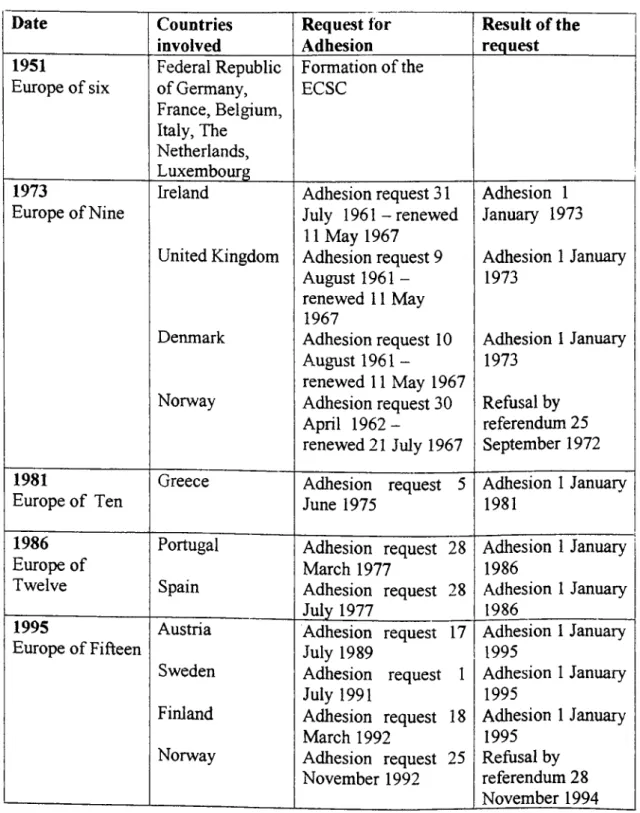
From the perspective of the European Union, enlargement has always been a factual policy of the Union since its foundation in 1957 by Rome Treaties. The Union kept enlarging throughout its development. The first enlargement was in 1973 including the United Kingdom, Denmark and Ireland; the second enlargement was in 1981 with only Greece entering; the third enlargement was in 1986 with Portugal and Spain; and the last and fourth enlargement was in 1995 introducing Austria, Sweden
and Finland as new members. Norway has rejected membership twice by referendum after successful negotiations in 1973 and 1995.
According to article 237 of the Treaty of Rome and Article O of the Maastricht Treaty: ‘any European state may apply to become a member’. Although the term European is rather vague, a combination of historical, geographical and cultural elements may contribute to the explanation of this term. The ‘Europe and the Challenge of Enlargement’ report from the Commission of the European Communities to the European Council in June 1992 outlines the EU strategy towards applicants and future applicants. This report referred to Article F of the Maastricht Treaty’ and concluded that a successful candidate for Union membership must satisfy the criteria of democratic status and respect for human rights as well as a functioning and competitive market economy and an adequate legal framework. Also the commission report implies the acceptance of the rights and obligations, actual and potential, o f the Community system and its institutional framework, the Community’s acquis, as it is known. Therefore the widening of the EU is a fact accepted and supported by the EU itself
The 1990’s saw an increase in the number of applicants, therefore the enlargement issue has always been considered at the top of the Union agenda. The inclusion of the CEECs became a major goal for Europe with the decisions taken at the
‘ Article F o f the Maastricht Treaty: 1. The Union shall respect the national identities o f its Member States, whose systems o f government are founded on the principles o f democracy, 2. The Union shall respect fundamental rights as guaranteed by the European Convention for the Protection o f Human Rights and Fundamental Freedoms signed in Rome on November 1950 and as they result from the constitutional traditions common to the Member States, as general principles o f Community law, 3.The Union shall provide with the means necessary to attain its objectives and carry through its policies.
Copenhagen European Council in June 1993 where the Council agreed on a multilateral framework known as the structured dialogue between the EU and the partner countries. This framework was endorsed at the Essen European Council in December 1994. The Copenhagen Criteria agreed in June 1993, became the major criteria to evaluate the development of the applicant countries in the route to membership. Therefore the prospective members have an illuminating list of guidelines in their quest for membership.
This new environment created better chances for Turkey in this enlargement wave. Although the decade has been a period of ups and downs for Turkey-EU relations, the end of the decade marked with the Helsinki European Council (10-11 December 1999) was a new start in the route towards Turkey’s membership. According to the Presidency Conclusions of the Helsinki Summit paragraph 12: ‘Turkey is a candidate state destined to join the Union on the basis of same criteria as applied to other candidate states’.
While analysing all these developments concerning EU’s enlargement and Turkey’s place in this process in the 1990s, the theories of regional integration will be utilised. The integration theories have grown hand-in hand with the European integration process. Although the latest developments cannot find an explanation in the traditional spillover mechanism from economic integration to political integration, other theories concerning supranational institutionalism or institutionalised intergovemmentalism also remain far from explaining the whole process. All these theories may be utilised together in order to draw a clear perspective for understanding European Union enlargement. It is a fact that most theories have developed as a
response to the developments on regional integration and do not offer presumptions for integration to occur and enlarge. In the 1990s Europe has witnessed unforeseen developments of political nature, therefore a need for revising the old theories and formulating new ones exists in order to explain the recent and future developments.
The study will start with an analysis and a review of the regional integration theories. Rather than picking up a single theory, a combination of theories vsdll be referred to understand and explain the process of integration in this first chapter. A critique of these theories will also be included. Chapter 2 will be exploring the history of the enlargement comprising all previous enlargements of the EU since its inception. This will help depict the process of enlargement. Chapter 3 will discuss the Enlargement process of the 1990s, and the changing conditions that affected the enlargement policy of the EU. From the 1993 Copenhagen Criteria to the 1999 Helsinki European Council Presidency conclusions, the pattern of change will be analysed. The fourth chapter will focus on Turkey. It will analyse the Turkish-EU relations with a historical view bringing it up to the 1990s. It will also include a review of the different approaches for and against Turkey’s membership in the EU and how these views affect Turkey in the enlargement process. Turkey’s will and ability to cope with the EU’s acquis communautaire shall be elaborated upon. The study also includes a conclusion that comprises future prospects of candidate countries within the enlargement process.
CHAPTER 1
EUROPEAN
INTEGRATION
IN
THE
LIGHT
OF
THE
INTEGRATION THEORIES
Over the past fifty years, the pace of European integration has often accelerated, retarded or reversed itself in response to external and domestic political and economic factors, endorsing or refuting the validity of various theoretical hypotheses and predictions. It is important, therefore, not to look at this phenomenon in isolation, but within the realm of international relations and to consider the European Union as part of a wider system, "a segment of international society".’ Conceptualising European integration cannot be seen exclusively as the application of detached and abstruse notions relevant only to Western Europe, but in a much broader sense, as an important component of the literature on world politics with its roots entrenched deep in the history of political thought.^
Studying through all of International Relations and European integration theories can be a lengthy and tough challenge. The following chapter intends to outline briefly the major theoretical assumptions relevant to European integration. In order to further highlight their relevance to this thesis, an attempt is also made to identify their positions and presumptions over the issue of enlargement. Finally these theories’ failure
‘ Paul Taylor, The European Union in the 1990s. Oxford: Oxford University Press, 1996, p.90.
^ Robert O. Keohane, Stanley Hoffmann, “Conclusion: Structure, Strategy, and Institutional Roles”, in After the Cold War: International Institutions and State Strategies in Europe. Cambridge: Harvard University Press, 1993, pp.381-404.
or success over explaining the enlargement process will be taken as criteria in evaluating and criticising them.
Defining the European Political Integration Studies is rather a vain effort since the area is shaped by the broad range of approaches shifting between the empirical and normative interpretations and between the scientific and ideological approaches. As it was the case prior to the formation o f the Community after the second World War normative discourse reappeared from time to time whenever the enlargement issue became a fashionable subject; suggestions appeared on the new institutional structure on a future enlarged Europe, especially after the end o f Cold War period. The revival of formal integration in Western Europe and the collapse of communism raise substantial theoretical challenges for the analysis of integration.
Yet, there are various theories on European political integration as well as regional political integration, since scientific explanations and new academic formulations were deemed necessary in order to explain this prevailing phenomenon of the second half of the twentieth century. The issue of regional integration moved towards the centre of the political debate from its more peripheral and isolated stands in the study of the World Politics. Opinion in Europe after 1945 was open to some degree of closer regional integration. Yet, there was not a consensus over the structure, timing and scope o f such developments. There has been an on-going debate over these issues both in political and academic realms as the European integration process has been launched. It has also followed the conventional pattern o f academic discourse, by giving rise to distinctive schools o f political thought or ‘paradigms . There are two main
paradigms. Supranational and State-centric in this area and another one that formulates these two main ones that can be called as the syncretic paradigm/ There has been a constant shift of paradigms through the years related to the dynamic course of European integration. A short review may explain this changing nature of the integration process.
1.1 A Brief history of the development of the EU
After the Second World War, Europe has altered strikingly and an economic regeneration was accompanied by a great scale of economic integration among West European countries. Meanwhile, new political structures have been constructed to conduct European security, regulate economic development, advance democratic values, and reinforce social cohesion throughout the Continent.^ The European Community, as one of the important pillars of this restructuring efforts, was established vrith the general objective “ to establish the foundations of an ever closer union among the European peoples.” ^
There had been a fast and an effective economic recovery after the end of the Second World War and the 1950s had witnessed the origins of a long and controlled increase in investment and consumption. In this period, production was globalised and needed international circulation of capital and labour. The urge for foreign market access of the national economies also pointed out the need for transnational schemes in
'' Syncretist is a term used to cover a wide variety o f contributions to the debate by Micheál O ’N eill Ibid p.82.
For a detailed account o f the European History after 1945 see: Derek W. Urwin, The C om m unity
Europe: A History o f European Integration Since 1945. Essex: Longman, 1993.
“Preamble to the Treaties o f Rome” in Brent F. Nelsen, Alexander C.G. Stubb, The European U nion
production and sales. Therefore, the rise of a new European framework offered one response to the needs of private capital in Europe. In addition, the economic weakness of individual European states on the world stage necessitated the co-operation in Europe later leading to interdependence.^
Despite that the Treaty of Rome signed on 25 March 1957 is a lengthy and a diverse document with far-reaching ambitions, its immediate objectives were formation of a customs union, a common external tariff and a common market tor capital and labour. Furthermore, the creation of common policies for industry, agriculture and transport within the Community were other significant objectives of the Treaty. Although started with great ambitions, the earlier acquisitions were achieved with a slower rate of development. For example, the successful achievements on the customs union were delayed till the late 1960s. In the beginning of the post-war period, the global conjuncture of the political and economic relations was advantageous for the EC to benefit from the developments of the economic integration. New approaches and arrangements on trade interactions among countries and the enhancement of the market opportunities in international arena proved to be beneficial for the EC which tried to attain economic integration. Also, other trade interactions, especially between the European Community and the United States made a positive effect as compared to other countries in the similar situation of reconstruction of their economies.
The EC became wealthier during the 1950s and 1960s and the original post-war trade deficit with the United States had deviated into a European surplus by the late 1950s. This fact assisted the EC to turn the 1960s a decade into an era of convincing
^ For an account o f co-operation in Europe see Brigid Laffan, Integration and Co-operation in F.nrr>p<> New York; Routledge, 1992, and, Martin Holland, European Community Integration , N ew York; St.’
accomplishments. The Customs Union was completed in 1968 and the frameworks of major policies such as Common Agricultural Policy and the Social Fund were established having account of the successful economic integration. At the 1969 The Hague Summit*, the member countries agreed on the necessity of greater economic and monetary integration as well as political unification by the end of the decade marking the preliminary step for moving towards an economic, monetary and political union. However, the 1974 and 1979 oil crises affected the global economic policies, which caused a general recession in the world during the early 1980s. Also, the successful economic development of the EC gave way to decline of the American hegemony in time leading a shift to flexible exchange rates in 1973.^ In this unsettled economic situation, the Community lost much of its confident dynamism and started to experience hesitation and political insufficiency to formulate internal policies within the Community. The Cold War and the political partition of the continent were other obstacles to economic development in the Europe of the 1970s. In the 1980s, therefore, the European Community was challenged by two main crises; first, the loss of global economic competitiveness and second, the stagnation of political and economic integration. The EC reached the peak of its crisis by the mid-19 8 0 s w h e n the community faced institutional weaknesses because of unstable political and economic conditions.
After this era of pessimism, a progressive phase replaced the stagnation period as a result of the implementation of the studies of the Commission, the White Paper that was drawn up by the European Commission in 1985, chaired by Jacques Delors.
Martin’s Press, 1993, pp. 22-59.
^ This can be considered as the relaunch o f the Community. Martin Holland, op.cit. pp.38-39. For the details o f the Global Political Economy o f these periods see: Robert Gilpin, The Political Economy o f International Relations Princeton: Princeton University Press, 1987.
Accordingly the Community set itself the task of creating a single market by January 1993. The Single European Act", signed in February 1986 and came into force on 1 July 1987, confirmed this goal and presented new procedures for adopting associated legislation. The collapse of the Berlin Wall, followed by German Unification on October 3 1990, reconstructed the political structure of Europe.
The Member States were strongly determined to strengthen their ties and negotiated a new treaty, the main features of which were agreed at the Maastricht European Council on 9 and 10 December 1991." The new political structure of the 1990s has significant impact as well as the economic issues on the formation of the new Treaty. As the EC transforming itself into the European Union, political matters gained much more importance in the agenda of the Union. The European Political Cooperation (EPC) became Common Foreign and Security Policy (CFSP) as one of the main pillars of the Union and Western European Union was revitalised as a prospective defence initiative of the Union. These developments, hence, aftectcd the nature of the enlargements, raising the importance of political issues and political integration to the same extent with economic integration. Also the threat of instability leading to war as it did in Yugoslavia and the attempts of the CEECs to cope with the free market economy increased the magnetism of the EU towards the non-EU countries. The EU’s will to reincorporate CEECs into Europe increased the debates over enlargement in the 1990’s.
10
It is called the period o f ‘Eurosclerosis’ by many authors.
The SEA differs significantly from its predecessors as it is seen in its preamble. Gone is the vision o f a united Europe important primarily as an alternative to war. In its place is a vision o f an evolving
‘European Union’ ready to act in the world as a single entity to protect the common interests o f its members, promote democracy and human rights, contribute to the ‘preservation o f international peace’and ‘improve the economic and social situation in Europe’ Nelsen and Stubb, op. cit. p.43.
1.2 Development of theories
This dynamic process of integration in Europe led to the development of many theories within each paradigm and led to many paradigm shifts over the course of events. Also, the development of these theories continued hand-in-hand with the development of European integration. Therefore many theories may well be suitable for explaining a certain component of the integration process but they fail to explain the process as a whole.
Another problem of the theories was that they fail to incorporate the first theories of integration. Such as, Wallace refers to the absence of agreed concepts or frames of reference.'^ Keohane and Hoffman suggest that many accounts of integration have discarded older theories without putting anything theoretical in their place. This led to an inflation of theories that more or less say the same things with different wordings. There is a growing recognition that new approaches to the study of integration are required and there is general agreement that an adequate understanding of the driving forces of integration must evolve from an application of the insights offered by various disciplines.'^
The Supranational paradigm covers the federalist, functionalist and neo functionalist approaches while the state-centric paradigm comprises intergovernmental ist such as confederalism. The third paradigm tries to cover both
Pascal Fontaine, Europe in Ten Points. Luxembourg ; Office for Official Publications o f the European Communities, 1995.
William Wallace, The Dynamics o f European Integration. London; Pinter, 1990, p. 3.
Robert O. Keohane, Stanley Hoffman, The N ew European Community. Boulder: W estview, 1991, p. 9. William Wallace, Theory and Practice in European Inteuation; Economic and Political Integration in Europe . Oxford: Blackwell, 1994, pp. 272-278.
approaches since the course of integration cannot be explained by either one o f the paradigms as the face of the old continent changed dramatically during the 1990s.
1.2.1 Supranational Paradigm
The Supranational paradigm encompasses those theories that take the foundation of institutions ruling above the nation-state level as the core and the fundamental goal of the integration process. These theories differ about the limits and structures of such institutions, yet they all formulate the integration beyond nation-state whether they assume this from a security perspective, an economic perspective or a utopian perspective.
1.2.1.1 Federalism
Innumerable interpretations encompass the concept of federalism, as reflected in its various theoretical explanations as well as in the political branches of federalist thinking. The moderate and more pragmatic branch falls perfectly within the rationalist school of thought in International Relations Theory for the emphasis on international and institutionalised association. The radical and idealistic branch points out the characteristics of the revolutionist/universalist heritage of Althusius'^ and Rousseau'^
For a good interpretation o f Johannes Althusius and his Política Metódica Digesta and its applicability for the European Federalism in the context o f European Union See: Daniel J. Elazaar, “Federal-Type Solutions and European Integration”, in Federal-tvpe solutions and European Integration r Lloyd Brown-John, (ed.). Maryland: University Press o f America, 1995, pp. 439-59.
For more detailed information see: Stanley Hoffman and David Fidler, Rousseau on Intematinnai Relations, Oxford University Press: Oxford, 1991. Also see, Kenneth Waltz, “Explaining War”. N ew
with its intention of surpassing the conventional nation-state and its ambition of altering international structures by going well beyond the formation of a society of states. In this utopian branch of federalism, the main premise is the encouragement of an original formation of the collective political culture may ultimately lead to the creation of a world society and goveniment.^^ Integration is seen as a dramatic, revolutionary process as 'the time becomes ripe for change’. T h i s assumption is further restated with strength by Denis de Rougemont who asserts that to form this model of federation is
'the primary, long overdue and decisive task, the real leap, the revolutionary and ? 21 creative action without which we shall not leave the present plane of impossibilities’.
However, federalism agrees with the realist premise of the birth of Leviathan of the Hobbesian notion, a supreme ruler entrusted with the authority to maintain order and peace by the people in order to escape from the dangers of the anarchic ‘state of nature’.·^ Some authors, such as Murray Forsyth, focus on federalism as a type of government founded upon a foedus or treaty between states. It is regarded as a course in which a number of individual states agree to raise themselves by contract to the threshold of being one state.^^ Therefore, the nation state is seen as a basic political unit that needs to be accommodated rather than abolished. By contrast, for others such as Heraud the nation state is nothing but a ‘historic accident’ which will eventually disappear as the federal forms of government start to prevail. He foresees a Europe des
York: Columbia University Press, 1959, reprinted in P. R. Viotti, M. V. Kauppi, International Relation?; Theory; Realism. Pluralism. Globalism. N ew York: Macmillan, 1993 pp. 123-42.
Although Rousseau can be regarded as the father o f Nationalism and nation-state, his wntings on International Relations prescribe a federal formula in order to demolish war.
Reginald J. Harrison, Europe in Question: Theories o f Regional Integration. N ew York: N ew York University Press, 1974, p. 45.
Paul Taylor, “The Politics o f the European Communities: The Confederal Phase”, in World Politics^ Vol. 27 (3), 1975, p. 12.
Denis de Rougemont, The Idea o f Europe. N ew York: MacMillan, 1967, p. 348.
C. Pentland, International Theory and European Integration. London: Faber & Faber, 1973, p. 147.
eihnies made up of collectivities naturally united by language and other cultural
traditions and much more equal and controllable elements than the nation states which can act irrational at any given situation.^^ This view is based on the Kantian tradition of International Relations^^ which stresses moral imperatives guiding not merely cooperation among states but rather the deposition of the system based on the states as main elements, and replacing this system by a cosmopolitan society where the European federation is a level as well as a required catalyst?^ Federal Europe can be created on the widespread destruction and disillusionment brought about by the war by providing an attractive alternative to the rebuilding of the nation-state system v^th its inherent rivalries’/^ And yet, while representing the first and most well known approach of European integration, federalism has been often denied recognition as a real theory in the traditional sense, for its explicit normative content and for privileging the description of the final goal over the scientific analysis of method and procedure. The final condition of integration presents an alternative to 'national atavism and insularity’ by proposing the creation of a federal union among previously sovereign powers.^29
While confirming the goal of European integration as their chief principle, federalists disagreed on the ways to be followed to attain a fully-fledged federation. ITie maximalists, among whom was Altiero Spinelli,^^ author of the 1941 federalist
M. Forsyth, The Theory and Practice o f Confederation. Leicester: Leicester University Press, 1981, p.
2.
Harrison, op. cit. p.45.
For a good explanation o f this tradition, see: Viotti, Kauppi, op.cit. pp. 273-78, pp. 533-534.
Hedley Bull, The Anarchical Society. N ew York: Macmillan, Columbia University Press, 1977, 1995, p. 25.
^ Denis de Rougemont, 1965, cited in Hodges, M. “Integration Theory”, in T. Taylor, (ed.), Approache.s and Theory in International Relations. London: Longman, 1978. p . 241.
David Mutimer, 1994, p. 8, cited in, Donatella M. Viola. “International Relations and the European Integration Theory”, in Jean Monnet Working Papers, University o f Catania, No. 26.00, 2000.
M. O ’Neill, op. cit. p. 23.
For more information on Altiero Spinelii see: Micheál Burgess. “Altiero Spinelli, Federalism and the EUT”, in Juliet Lodge, (ed.). European Union: The European Community in Search o f a Future I r^nHnrv Macmillan, 1986.
Ventotene M anifesto an d fo u n d e r o f th e M ouvem ent l'é d é ra liste E u ropéen (M F E ),
believed that European integration was a process to be achieved through political means?' More specifically, maximalists planned to raise an international campaign aimed at persuading public opinion and mobilising all of the major political forces which would be idealised by the setting up of a Constituent Assembly, elected by universal suffrage. This assembly would sketch a federal constitution authorising powers to the central government concerning budgetary matters, foreign policy and defence, including provisions for safeguarding fundamental and minority rights. This text would be finally submitted either to national parliaments for ratification or directly to European citizens by means of popular referenda. Minimalists gathered under the
Action Européen Fédéraliste (AUF), to which eventually Spinelli converted, adopted a
more pragmatic theory that the federal goal was to be achieved by gradual steps through the founding of organisations such as the ECSC, EURATOM and EEC.^^ 'fhis dichotomy inherent to federalism makes it rather difficult to place this approach within the mainstream of IR theory.
The principal value of federalism is its ability to attune the integration process with the essentiality of protecting diversity, an element which represents a precondition of any kind of integration in Europe and of the duties of the any Pan- European institution established to govern the integration process. By dividing political power between central and local powers, the federal model represents a very attractive strategy for uniting groups of states possessing diverse interests and satisfies the often mutually exclusive criteria of efficiency and democracy. Within a federal union, not only national, but also regional and local interests are duly represented. This emphasis on
31
Harrison, op. cit. p. 49. Ibid. p.50
model privileges decentralisation and, therefore, conforms to the logic of subsidiarity, a principle which Britain has promoted and which is now enshrined in the Treaty on European Union.^'’ The essence of federalism lies in the decentralisation of power and not, as is usually misinterpreted as a form of government in which central government continuously takes the power of national governments away, shaping them as subordinate entities to the central power. According to Juliet Lodge, the hostility of certain politicians to the idea of a federal evolution of the European Union may often
35 arise from ignorance and misunderstanding of its main principles.
Although it is a very idealistic approach, a federal Europe is what was envisaged while creating the European Communities during the 1950s. The changing conditions that led to the widening of the EU have at the same time pushed for deepening of the integration as the new century begins. If the EU enlarges with a renewed and stronger structural and institutional formation, the federalism may once again prevail among the integration theories.
1.2.1.2 Functionalism
Functionalism is one of the traditional and principal approaches of international integration which is generally associated with the rational school of thought for its attribute of surrendering ideology to ‘enlightened self-interest’ under the influential pressures of economic growth, for its reasonable and pragmatic character of adapting to
M. Hodges, op. cit. p.241. D. Mutimer, op. cit. p. 18.
Juliet Lodge, “Integration Theory, Decision-Making and Institutions”, in Juliet Lodge (ed.) The European Community: Bibliographical Excursions. London: Pinter, 1983, p. 9.
changes, for its problem-solving approach and for presuming the primacy of economics in international relations as an antidote to the application of traditional power politics based on security co-operation/^ Yet, it can also be considered revolutionary for its universalist pursuit envisaging the creation of a world society as the ultimate phase, for its aspiration of bypassing the national governments and incremental eradication of the nation states and for invigorating the idea of ‘historical determinism’ as theorised in the works of Comte and Marx. Yet, as Charles Pentland states, not all functionalists agree with this determinist view and, in particular with Lemaignen's belief that European integration represents a subsequent phase of the ‘irreversible’ phenomenon of nation absorbing province absorbing tribe.^^
A functionalist reading of integration is neither based on traditional national units nor aimed at the rise of a wider and influential regional state, as it would not soothe the present displeasure by many sceptics of integration, but only preserve and amplify critical political cleavages at a higher level.^* The telos is, rather, that of establishing technical and depoliticized units specializing in specific functions, which might lead to the creation of a world federation.^^ This necessitates the gradual decease and consequently substitution of the state-system by an executive integrated system that satisfies the needs of the arising global community. Functionalists, in the long term, are engaged in elimination of the state-system, and in the process of building a welfare- oriented global society driven by economic needs whilst confirming that along with
See, Wallace and Smith, 1995, 140, Paul Taylor, “Regionalism and Functionalism Reconsidered”, in, AJ.R. Groom, and P. Taylor, (eds.), Frameworks for International Co-operation. London: Pinter, 1990,
234-54. Also see, Harrison, op. cit. pp. 28-29, p. 66. R. Lemaignen, L'Europe au Berceau. Paris, 1964, pp. C. Pentland, op.cit. pp. 75-76, p. 149.
D. Mutimer, op. cit. p. 29.
international organisations, nation states remain basic units in the international society although their powers will be diminished.
Utilising Charles Pentland's metaphor, the functionalist reasoning views the state in the context of international cooperation as ‘the insect in a carnivorous plant’ which while ‘attracted ever inward by the benefits, it finds that behind it the avenues of retreat are progressively blocked’ Modem society produces a number of technical problems that can only be resolved by experts as opposed to politicians. As Mitrany points out:
“The number of problems which take on a world character is growing apace, partly because we have a better understanding of them...but also because of their technical peculiarities....These new contacts which crowd upon us from all directions can be as much a source of conflict or cooperation....”^'
A successful cooperation in one particular technical domain or functional area would lead to cooperation in other related fields by means of the spillover mechanism. Governments acknowledge the common benefits to be gained by such cooperative endeavours and allow for their further expansion.“'^ This can also allow for cooperative distribution mechanisms to balance out some of the disparities within society, whilst recognising, however, the impossibility of realising a ‘perfect world’.
Functionalists do not disregard the ‘high’ and ‘low’ politics dichotomy, which is also reflected in the distinction between Community and CFSP pillars.^^ They also * **
C. Pentland, op. cit. p. 82.
42 Mitrany, A Working Peace System Chicago: Quadrangle Books, 1966, pp. 92-93.
Viotti, Kauppi, op. cit. p. 241.
P. Taylor, “Consociationalism and Federalism as Approaches to International Integration”, in A.J.R. Groom. And P. Taylor, (eds.). Frameworks for International Co-operation. London: Pinter, 1990 nn 172-
84. See, p. 179. ’
express their preference for concentrating on non-political aspects within the realm of
multilateral cooperation arenas ‘where the nations shed their conflicts at the door and
busy themselves only with the cooperative use of the tools of mutual interests’.“*^ Yet this approach may be easily hindered as many issues are increasingly becomes the subject matter of global politics. According to David Mitrany, ‘sovereignty is not effectively transferred by diplomatic formula, but via a function’. The gathering of limited transfers of tasks from one section to another leads inevitably to ‘a translation of the true seat o f authority’ and to the accomplishment of a world society.“*^
Mitrany’s approach to international organisation and regional integration have led several contemporary theorists to formulate effective and useful insights to the study of integration. Functionalism may be useful in explaining the progress made during the pre-accession phase of enlargement process; yet, it still falls short of explaining the motives behind the attracted surrounding states around the Eli. It is a useful approach when dealing with the internal dynamics of integration within the EU. The economic motives may well be understood by utilisation of functionalism, but it is hard to assert that the candidate states pursue a form of regional or global society in which their sovereignty is very limited. Even the main pillars of the post-Maastricht Union such as the formulation of a Common Foreign and Security Policy (CFSP) and adapting common mechanisms to regulate Justice and Home Affairs (JHA) may create major impediments for these states, especially considering that most of them have gained their independence very recently. Only if the EU draws the limits of integration or reiterates that a single regional entity overriding the nation-state system is its ultimate goal, then
45
Claude, Inis. Swords into Plowshores: The Problems and Progress o f International Organiyationc „„ 350-353 cited in O ’Neill, op. cit. p.31.
David Mitrany. A Working Peace System. Chicago: Quadrangle Books, 1966, reprinted in, Brent F Nelsen & Alexander C-G. Stubb, op. cit. pp. 94-97.
the candidate states may thoroughly re-evaluate the course of integration and their motives accordingly. Yet, at the moment, this seems impossible since such deliberation is deemed to be eccentric, on the premise that all countries are preoccupied with economic integration and the spillover mechanism is at work diffusing integration into political areas without really being an issue of debate in most of the countries. Yet, the consequences o f this may result in impeding the further deepening of integration within the EU.
1.2.1.3 Neofunctionalism
Placed between the rationalist and revolutionist traditions of international relations, neofunctionalism, sometimes referred as ‘federal functionalism’, incorporates components from both functional and federal theories. Integration is formulated as a process for the creation of a ‘political community’ which resembles the ‘supranational state’ proposed by federalists.“*^ Along with federalists, neofunctionalists disregard the Tonnian“** model of society, the Gemeinschaft,^'^ which embodies a community whose aim is the attainment of the general welfare and whose roots are based on common loyalties and feeling of duty. They replace it with the Gesellschaft^ model, a pluralist type of society where conflicting interests coexist and where cooperation and integration can be reached through a convergence of interests.^* In the eyes of many neofimctionalists, the objective of integration is still unclear but may lead to the
C. Pentland, op. cit. pp. 100- 101.
Ferdinand Tönnies, known as the founder o f German Sociology. His most famous work is titled the Gemeinschaft und Gesellschaft. For a recent study on Tönnies, see; Ferdinand Tönnies. 1988.
Community and Society; Gemeinschaft und Ge.sellschaft. With a new introduction bv John SamplAo N ew Jersey; Transaction Inc.
49 _
establishment of a federation where national sub-systems give away, function by function, their authority to a central federal body.^'
The first prominent articulation of neo-functionalism is the study of Ernst Haas,
The Uniting o f Europe, which dwelled upon the political dynamics of the European
Coal and Steel Community. In this study, Haas defines integration as:
“ ...the process whereby political actors in several distinct national settings are persuaded to shift their loyalties, expectations and political activities towards a new centre, whose institutions possess or demand jurisdiction over the pre-existing national states. The end result of a process of political integration is a new political community, superimposed over the pre-existing ones.”^^
Although visualising a supranational state as the outcome of integration, neofunctionalists do not eliminate non-federal models of political system and direct their focus towards the methodology and process rather than the object. As this process advances, the nation state is no longer the basic unit of analysis and transnational interactions beyond the management and control of national governments become increasingly more frequent.^'^ Unlike the functionalist universal doctrine, neofunctionalism focuses on the establishment of a regional integration.^^ However, both theories place great emphasis on the concept of spillover, George introduces a distinction between ‘functional’ and ‘political spillover’,^^ while Tranholm-Mikkelsen
Society.
Paul Taylor, The Limits o f European Integration. London: Groom Helm, 1983, pp. 3-5.
D. R. Cameron, “The 1992 Initiative; Causes and Consequences”, in A. M. Sbragia (ed.), Euro-PolitioR· Institutions and Policymaking in the ‘N ew European Community. Washington, DC: Brookings
Institution. 1992, p. 28.
E. B. Haas, The Uniting o f Europe. Stanford; Stanford University Press, 1958, p. 16.
Robert O. Keohane, “Sovereignty, Interdependence and International Institutions”, in Linda B. Miller, Micheál Joseph Smith, (eds.). Ideas and Ideals: Essays on Politics in Honour o f Stanley Hoffmann Boulder; Westview, 1993, p. 386.
D. Mutimer, op. cit. p. 27.
S. George, Comparative European Politics. Oxford: Oxford University Press, 1991, pp. 21-24.
identifies three kinds of spillover: ‘functional’, ‘political’ and ‘cultivated’^^. Leon Lindberg describes ‘spillover’ as a situation in which a given action, related to a specific goal, creates a situation in which the original goal can be assured only by taking further actions, which in turn create a further condition and a need for more action, and so forth. Neofunctionalists have emphasised incremental political development in the system through spillover or forward linkage. In general, most theorists of this school agreed that ‘spillover will most likely occur in an international system with a strong system-wide political and bureaucratic elite, with complex interdependent socio economic structures, with a stable ideological and cultural consensus, and with some commitment on the part of its members to common long-term goals
The original goal of economic integration may be achieved by furthering the transfer of competence in other policy areas from member states to European Community level. Ernst Haas applied the concept of spillover to the ECSC which, by creating a common market in the sector of coal and steel production, raised the necessity for integrating the entire energy resources of the Community, such as nuclear energy covered by the Euratom Treaty in 1957, and gas and oil covered by the EC Treaty, and eventually led to the establishment of a common market for all goods and services. By the late 1960s, earlier predictions of progress in the field of political integration failed to occur, obscuring the general validity of this theory. Haas himself had to admit that a spillover from economic to political sectors and a shift of authority and legitimacy from national to supranational level were no longer automatic, but only
57
J. Tranholm-Mikkelsen. “Neofunctionalism : Obstinate or Obsolete? A Reappraisal in the Light o f the New Dynamism o f the EC”, in Millenium 1991. pp. 4-6.
Leon N. Lindberg, The Political Dynamics o f European Integration. Stanford: Stanford University Press, 1963, p. 9.
probable.^ Despite its flaws, particular scholars, such as Andrew Moravcsik and Jeppe Tranholm-Mikkelsen, consider that ‘neofunctionalism' is by no means obsolete’,^' in fact it ‘remains the sole attempt to fashion a coherent and comprehensive theory of European integration’.^"
It is observed that neofunctionalism rests on proposing the spillover rationale for the integration to occur. The revitalising of the integration efforts with the SEA during the late 1980s also enlivened this approach as it better explains the transmissive nature of the regional integration with less stress on Universalist ambitions. The neofunctionalist approach is often adopted when analysing the development of co operation within the framework of the EU.^^ Neofunctionalism is functional, as its name implies, in explaining the recent process directed towards further deepening of the intra community integration and maybe the most relevant theoiy in accomplishing this task, yet, it lacks the explanation of external effects o f this process. As the enlargement process is not considered as a major component of the course of integration, it is not dwelled upon by neofunctionalism, and the analysis of the Community is made upon the actual facts without emphasis on future widening.
60E. B. Haas. “International Integration: The European and the Universal Process , in International
Political Communities: An Anthology. N ew York: Doubleday, 1966. Cited in Sandholtz and Sweet, op. cit. 1998, p. 340.
Tranhobn-Mikkelsen, op.cit. p. 19.
Andrew Moravscik, “Negotiating the Single European Act: National Interests and Conventional Statecraft in the European Community”, in International Organization, Vol. 45, 1991, pp. 19-56.
1.2.2 State-centric Paradigm
The above approaches to integration is placed within the Supranational paradigm, whereas there are state-centric approaches in theorising integration which took the nation state as the focus and identified the crude realities of nationhood as the driving force behind the European integration process. Those theories that take nation state as the focus of conceptualising the EU can be grouped in the State-centric paradigm. These approaches can be defined as intergovemmentalism in general. The first three above-mentioned approaches though different in the process of reaching the end, seem to idealise a United States o f Europe. Such s political entity, however, is not on the agenda of many theorists as well as politicians. The issues of national sovereignty and the role of national governments in the process of integration have been the main focus of disagreement between neo-functionalists and intergovemmentalists.
Endless nuance and distinction exist within each approach, but in the end most theorising on integration endorses either the following statement or its opposite: the distribution of preferences and the conduct of bargaining among the governments o f the member-states broadly explain the nature, pace, scope of integration, and neither supranational organisation nor transnational actors generate political processes or outcomes of seminal importance.®'^ Intergovemmentalists consider the making of the European Union as a subset of international relations as a means to achieve interstate cooperation through an international regime with the support of the complimentary
63
Carsten Stroby Jensen. “Neofunctionalist theories and the development o f European Social and Labour Market”, in Journal o f Common Market Studies Vol: 38 (1), 2000, pp. 71-92.
Wayne Sandholtz, Alec Stone Sweet. European Integration and Supranational Gnyernancp Oxford- Oxford University Press, 1998, p. 3.
interdependence theory, which stressed the need for cooperation and collaboration between states.
The main intergovernmental theorists included Hofiman^^, whose model stressed the important role of the nation state and the power of national leaders and stressed the importance of links between the national and the Community policy making process; and Moravcsik whose theory o f intergovernmental institutionalism recognises the importance of supranational institutions, but also affirms that the primary source of integration lies in the interests of the states themselves and the relative power each brings to B ru ssels.M o rav scik developed his theory further as ‘liberal intergovemmentalism’ and he explains the European integration as ‘a series of celebrated intergovernmental bargains, each of which set the agenda for an intervening period o f co n so lid atio n .F ro m this intergovernmentalist perspective the EC is essentially a forum for interstate bargaining. Member-state governments remain the only important actors at the European level. Societal actors exert influence only through the domestic political structures o f member-states.^^ State-centrists may argue that state executives prefer to delegate these powers to achieve state-oriented collective goods, such as control over potential distortion of competition or a stronger bargaining position * ***
“International Regimes are intermediate factors between the power structure o f an international system and the political and economic bargaining that takes place within it.” Robert O. Keohane, Joseph S. N ye, Power and Interdependence: World Politics in Transition. Boston: Little, Brown, 1977. p. 21.
^ See Stanley Hoffman, “Reflections on the Nation-State in Western Europe Today , in Journal o f Common Market Studies. Vol.21 (1), 1982, cited in O ’Neill, op. cit. p. 64.
See A. Moravscik, op. cit. 1991, p. 56.
*** Andrew Moravscik, “Preferences and Power in the European Community: A Liberal Intergovernmental Approach”, in Journal o f Common Market Studies. Vol. 33 (3), 1993, p.473.
in international trade^°, but, one result of integration is that state executives have lost control in a range of policy areas.71
The intergovemmentalist approach seem to underestimate the general and institutional effects of the spillover mechanism to issues of ‘high politics’, concentrating on interstate bargaining. It is true that the EU structures and their operating methods depend on interstate bargaining and an on-going process of endless negotiations in which the Governments seem to be the main actors as they represent the other societal levels. But as the integration deepens at the institutional levels of the EU, the impact of governments on policy-making in the Union decreases. If enlargement process had exclusively been a matter of intracommunity bargaining, then intergovernmental approach would provide explanations for this process. But as the question of enlargement brings together many different dimensions such as motives of the candidates, responses of the Union at the political, cultural, social and economic levels to these candidate countries requires a more detailed analysis other than intergovemmentalism that does not have concrete explanations on how integration of the Community affects and attracts the peripheral states.
1.2.3 Syncretic Paradigm
The periodic shift in theorising integration has continued in order to bring about a new paradigm which Michael O’Neill considers as the syncretic paradigm. Instead of the certainties of both process and outcome that tend to characterise the classical
™ Gary Marks, Liesbet Hooghe and Kermit Blank, “European Integration from the 1980s: State-Centric v. Multi-Level Governance”, in Journal o f Com m on Market Studies. Vol. 34 (3), 1996, pp. 341-378.
’ ’ For example they no longer control competition within their border; they cannot aid national firms as they deem fit; they cannot autonomously conduct trade negotiations.
72
paradigms, it prefers the language of ambiguity and replaces certitude with paradox European integration is seen as hybrid of international and domestic factors, blended with several motives within different directions and speeds. It should come as no surprise here that the fluid metaphors of variable geometry or multi-speed change have been employed to challenge the old certitudes of the established paradigms.
This new paradigm offers a less prescriptive and predictive account of the regional process. The syncretism^'^ is the process by which elements of one belief are assimilated into another resulting in a change in the fundamental tenets or nature of those belief systems. It is the union of two or more confronting beliefs, so that the synthesised form is a new thing. It is not always a total fusion, but may be a combination of separate segments that remain identifiable compartments. Therefore this new paradigm incorporates assumptions about the nature of the European project from both sides of the classic debate.^^
As an example to this new breed of syncretic theory making, consociationalism can be mentioned. The term consociation refers to processes of co-operative joint decision-making at the Union level.^® While explaining this rather new trend o f consociationalism, Dimitris Chryssochoou implies:
“Almost half a century since its original inception, the integrative project represents neither a ‘complete’ Gemeinschaft based on a unity constituted
M. O’Neill, op. cit. p.81 B. LafFan, op. cit. pp. 13-15
74
The term is generally used in the studies o f religion. Originally a political term, "syncretism" was used to describe the joining together o f rival Greek forces on the Isle o f Crete in opposition to a common enemy. Compiled from http://mb-soft.com/believe/txc/syncreti.htm
’ ’ M. O ’Neill, op.cit. p.82.
Paul Taylor, 1990, op. cit. pp. 172-184. “Consociationalism and Federalism as Approaches to International Integration”. In A.J.R. Groom. And P. Taylor, (eds.), Frameworks for International Tq-