Received 09/05/2020 Review began 09/07/2020 Review ended 09/28/2020 Published 10/05/2020 © Copyright 2020
Ataç et al. This is an open access article distributed under the terms of the Creative Commons Attribution License CC-BY 4.0., which permits unrestricted use, distribution, and reproduction in any medium, provided the original author and source are credited.
Youtube as an Information Source During the
Coronavirus Disease (COVID-19) Pandemic:
Evaluation of the Turkish and English Content
Ömer Ataç , Yunus Can Özalp , Rifat Kurnaz , Osman Murat Güler , Melikşah İnamlık , Osman Hayran
1. Public Health, School of Medicine, Istanbul Medipol University, Istanbul, TUR Corresponding author: Ömer Ataç, [email protected]
Abstract
Introduction: YouTube is an important online source of information and has two billion users globally. Its viewing numbers tend to increase exponentially in extraordinary global situations. Our aim in this study was to review and evaluate the contents of the most frequently viewed YouTube videos during the Coronavirus disease 2019 (COVID-19) pandemic.
Methods: In this qualitative study, contents of the most frequently viewed Turkish and English YouTube videos regarding the COVID-19 pandemic were examined and scored with modified DISCERN, medical information and content index (MICI), and video power index (VPI) during April 2020.
Results: The mean DISCERN score of Turkish videos was similar to that of English videos (2.55±1.40 and 2.43±1.25, respectively). The total MICI score tended to be higher in Turkish videos. News channels released 86.9% of all 168 videos and 65.2% of all 23 misleading videos. When the descriptive characteristics of videos were compared in terms of their content category, average view counts, view ratios, and VPIs of misleading videos were higher than those of the useful videos. Only, the likes ratio of useful videos was higher than that of the misleading videos.
Conclusions: Since there is no peer-review system on YouTube, people can almost release every type of video. It is very important for the content of videos that are released through news channels to be accurate because the important messages can be spread among people in society through them. In our study, especially some Turkish videos included many different rumors and faulty statements. During the extraordinary situations such as the pandemic, the videos of official health authorities and international institutions should be more visible on YouTube.
Categories: Public Health, Epidemiology/Public Health Keywords: covid-19, discern, mici, video power index, youtube
Introduction
Coronavirus disease 2019 (COVID-19) was primarily announced to the world with cases of unknown etiology pneumonia from the city of Wuhan located in the state of Hubei, China [1]. The situation report of the World Health Organization (WHO), which was published on January 30, 2020, described the interim name of the disease "2019-nCoV acute respiratory disease" and "2019-nCoV" as an interim name of the virus [2]. On February 5, 2020, the name of the virus was announced as Severe acute respiratory syndrome coronavirus 2 (SARS-CoV-2) by The International Committee on Taxonomy of Viruses (ICTV), and the disease that the virus leads to was called COVID-19 in a press conference of the WHO Director-General [3-5]. While the outbreak of the disease was initially identified as Public Health Emergency of International Concern on January 30, it was later announced as a pandemic on March 11 [6,7]. By the first week of April, the confirmed
1 1 1 1 1
1
Open Access Original
of false or misleading information.
YouTube is an important online source of information with its two billion users globally. Its viewing numbers tend to increase exponentially in extraordinary global situations [14]. Not only ordinary people or patients but healthcare institutions and professionals also use and share information via YouTube [15]. Because of the open access and lack of peer review, there are some concerns with regard to reliability, confidentiality, and privacy of contents [16,17]. It is prone to misinformation, disinformation, and anecdotes which are not based on any evidence [13,18]. In the literature regarding past pandemics, it was demonstrated that the percentage of videos that contain false information is between 8.0% and 23.8% on YouTube [19-21].
The content analysis regarding social media and online platforms has been a significant research issue in recent years. The spreading of health information through the internet is crucial, especially during extraordinary times such as disease pandemics [20,22,23]. Our aim in this study was to review and evaluate the contents of the most frequently viewed YouTube videos during the COVID-19 pandemic.
Materials And Methods
This study was conducted as a qualitative study. Contents of the most frequently viewed Turkish and English YouTube videos regarding the COVID-19 pandemic were examined throughout April 2020.
Selection of the study material
On April 9, 2020, the search process was conducted on YouTube by using both Turkish and English keywords such as ‘’Corona virüsü’’, ‘’Koronavirüs’’, and ‘’Koronavirüs Hastalığı’’; and ‘’COVID-19’’ and ‘’Corona virus’’. In order to prevent the influence of cache, cookies, and watch history on the search process, a new YouTube account was created for this study. In all searches, the relevancy level in filter was selected as default on YouTube. The first 50 results were recorded in a separate list based on each keyword. The reason why the first 50 results were selected is that some studies show that YouTube users do not tend to watch videos after a couple of pages [24]. These videos are reviewed and examined in accordance with the stages in Figure 1. Since the literature demonstrates that the optimal length for a YouTube video is between 10 and 16 minutes, those that exceeded the 15-minute threshold were eliminated during the study [25]. Ultimately, 101 Turkish and 67 English videos, which met these criteria, were included in the study. Since this study was conducted through open data that are accessible to all people, any ethics committee approval was not taken.
FIGURE 1: Flow diagram for the selection process
Evaluation of the contents
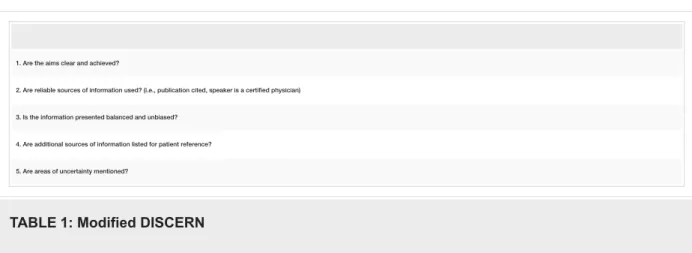
The descriptive characteristics, such as the name of videos, their upload dates, view counts, likes, sources, and content, were recorded on April 10, 2020. Every video was evaluated through the principles of DISCERN and medical information and content index (MICI). Moreover, a video power index (VPI) was calculated for each video, and the evaluations of modified DISCERN and MICI were conducted by researchers [20,22,26,27]. Modified DISCERN is a five-question scale that was adapted by Singh et al. from a 16-question DISCERN tool, which was developed by Charnock et al. [27,28]. Each criterion is ranked as 1-0 (yes/no) and scored between zero and five (Table 1).
1. Are the aims clear and achieved?
2. Are reliable sources of information used? (i.e., publication cited, speaker is a certified physician)
3. Is the information presented balanced and unbiased?
4. Are additional sources of information listed for patient reference?
5. Are areas of uncertainty mentioned?
TABLE 1: Modified DISCERN
MICI was developed by Nagpal et al. during the period of the Ebola epidemic in order to evaluate the content quality of videos that contain medical information and has been used by studies about the COVID-19
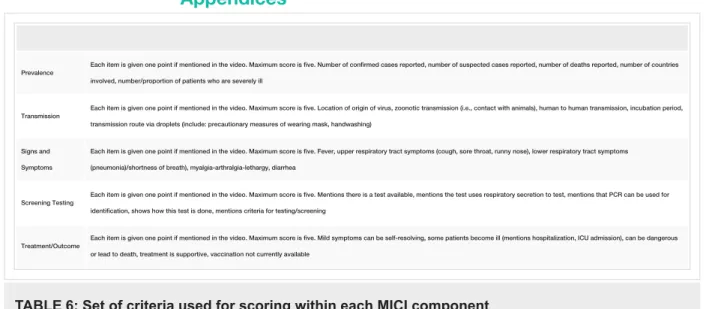
[20,22]. It examines every video under these main categories: prevalence, transmission, signs and symptoms, screening/testing, and treatment/outcome. Each main category includes five different criteria, which means that there are 25 different criteria in MICI. Every criterion is ranked as 1-0 and scored between zero and 25 (see Appendices).
VPI ([(view ratio x like ratio/100]), where view ratio=views/day and like ratio=[(likes x 100)/ (likes + dislikes)] was developed as an index by Erdem and Karaca in order to measure the power of social media based on the descriptive features of videos and has been used by different studies [12,26].
While two researchers (Mİ and YCÖ) evaluated the Turkish videos, two other researchers (RK and OMG) examined the English videos separately for eligibility. A third researcher (ÖA) was consulted during the evaluation process when there was a conflicting issue to finalize the decision. The level of agreement between researchers was significantly high for both languages (Cohen’s kappa: 0.81 for Turkish, and 0.85 for English).
The content evaluation was conducted under three categories: useful, misleading, and news update
[20,21,29]. Those videos which contain scientific and reliable information were coded as useful. In contrast, the ones which include false information, conspiracy theory, or manipulation were coded as misleading.
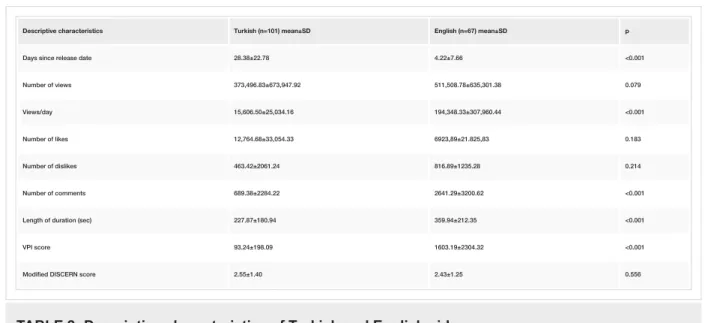
Descriptive characteristics Turkish (n=101) mean±SD English (n=67) mean±SD p
Days since release date 28.38±22.78 4.22±7.66 <0.001
Number of views 373,496.83±673,947.92 511,508.78±635,301.38 0.079
Views/day 15,606.50±25,034.16 194,348.33±307,960.44 <0.001
Number of likes 12,764.68±33,054.33 6923,89±21.825,83 0.183
Number of dislikes 463.42±2061.24 816.89±1235.28 0.214
Number of comments 689.38±2284.22 2641.29±3200.62 <0.001
Length of duration (sec) 227.87±180.94 359.94±212.35 <0.001
VPI score 93.24±198.09 1603.19±2304.32 <0.001
Modified DISCERN score 2.55±1.40 2.43±1.25 0.556
TABLE 2: Descriptive characteristics of Turkish and English videos
The views/day ratio of English videos was significantly higher than that of Turkish ones (p< 0.001). The number of comments, length of duration, and VPI scores of the English videos were significantly higher than those of the Turkish videos, whereas the mean DISCERN score of Turkish videos was similar to that of the English videos (2.55±1.40 and 2.43±1.25 respectively). Mean MICI scores for Turkish and English videos are presented in Table 3.
Turkish mean±SD English mean±SD p
Prevalence 0.66±1.44 1.07±1.31 0.062
Transmission 1.03±1.40 0.61±1.18 0.046
Signs-Symptoms 1.11±1.64 0.24±0.78 <0.001
Screening/Testing 0.11± 0.31 0.16±0.73 0.501
Treatment/Outcome 0.42±0.87 0.67±1.11 0.114
Total MICI Score 3.33±3.09 2.76±2.49 0.212
TABLE 3: MICI scores of the videos by language
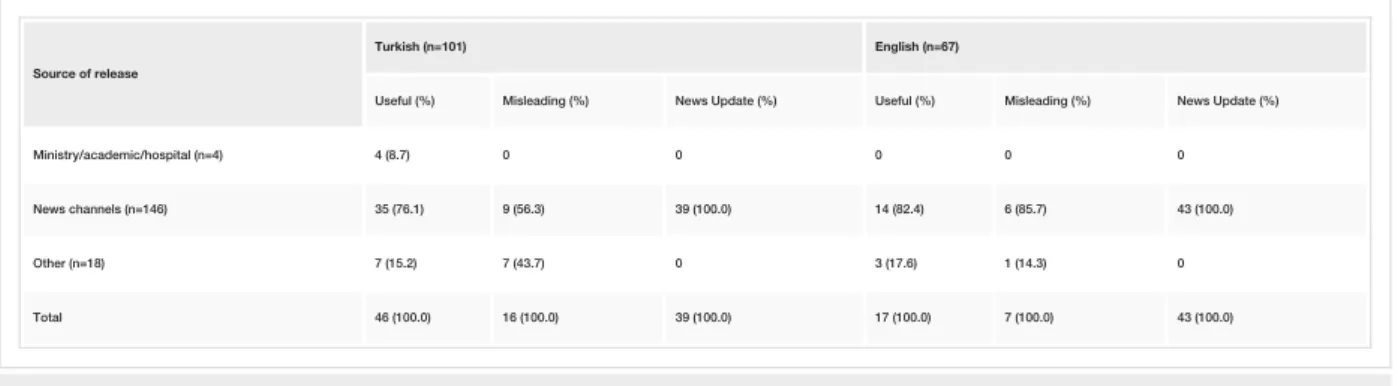
Total MICI scores tended to be higher in Turkish videos; however, there was no significant difference between the two languages (p=0.212). Mean scores for transmission and signs-symptoms of Turkish videos were significantly higher than those of the English videos (p=0.046 and p< 0.001, respectively). Of all 168 videos, 86.9% were released in news channels (Table 4).
Source of release
Turkish (n=101) English (n=67)
Useful (%) Misleading (%) News Update (%) Useful (%) Misleading (%) News Update (%)
Ministry/academic/hospital (n=4) 4 (8.7) 0 0 0 0 0
News channels (n=146) 35 (76.1) 9 (56.3) 39 (100.0) 14 (82.4) 6 (85.7) 43 (100.0)
Other (n=18) 7 (15.2) 7 (43.7) 0 3 (17.6) 1 (14.3) 0
Total 46 (100.0) 16 (100.0) 39 (100.0) 17 (100.0) 7 (100.0) 43 (100.0)
TABLE 4: Distribution of videos by language, source of release, and content
About 33.6% of news channels videos were categorized as useful. Around 15.8% of Turkish videos and 10.4% of English videos had misleading content, respectively. Of all 23 misleading videos, 65.2% were released by news channels. When the descriptive characteristics of videos were compared in terms of their content category, it was found out that the average view counts, view ratios, and VPIs of misleading videos were higher than those of the useful videos, but the difference between these groups was not statistically significant (Table 5). Only the likes ratio of useful videos was higher than that of the misleading videos.
Descriptive characteristics
Video categories
Useful (n=63) Misleading (n=23) p
Mean number of views 404,043.71±726,972.38 642,000.57±943,693.07 0.219
Mean length of duration (sec) 287.83±223.09 344.70±229.96 0.302
Likes ratio 89.10±15.69 80.22±27.35 0.204
View/day 40,694.24±80,177.21 99,054.95±189,597.07 0.165
VPI 356.88±685.93 859.30±1731.62 0.188
TABLE 5: Content evaluation of videos by descriptive characteristics
Discussion
Our study findings indicated that only 37.5% of the reviewed videos have useful content. A recent study that examined videos in English and Chinese regarding the COVID-19 pandemic found the proportion of useful content as 58.8% [20]. In another study about H1N1 influenza, the proportion of useful video content was 61.3% [21]. Both studies have indicated higher proportions of useful content compared to our study. The reason for the low proportion of useful content could be the high proportion of misleading content in Turkish videos than in English videos (15.8% and 10.4%, respectively) in our study group. On the other hand, 65.2% of misleading videos were released by news channels.
information quality of content, in which the maximum score is 25. Furthermore, four of those videos were released through news channels, and none of them was produced by an academic institution or the Ministry of Health. During the COVID-19 period, one research studied the most popular 100 videos in English to examine the information quality of preventive behaviors and indicated that only one-third of those videos included one of the seven different preventive behaviors. Moreover, it ascertained that 79.0% of all videos had content that could trigger fear and anxiety in society [23].
In our study, especially some Turkish videos included many different rumors and faulty statements such as; "the virus is developed in a laboratory environment, its treatment is certain, but they're waiting for the right time to announce it". We noticed that even some medical doctors expressed misleading or faulty comments such as "number of cases will not increase", "it was a virus that should not be feared", "saltwater gargle, vinegar water, or kelle paca soup (a traditional dish consists of a sheep's head and trotters) prevents this disease", or even "the virus did not exist at all". In Turkey, the YouTube videos regarding the COVID-19 are provided through COVID-19 health portals, and these portals are linked to the information address of the Ministry of Health [10].
Limitations
There are some limitations in our study. This study was conducted in a specific time period; it can lead to different results if it is conducted in different periods because the content and definitive features of YouTube are subject to change constantly. However, as this study was conducted for more than three months after the announcement of the first confirmed case, the videos which were analyzed might relatively have a standard ranking. Although the kappa coefficient was used for the measurement of DISCERN and MICI scores, there might be some issues regarding both intra- and inter-observer bias in our study. Lastly, it might also be a limitation that we only included videos in two different languages with five different keywords, which led us to evaluate 50 videos for each keyword.
Conclusions
YouTube is one of the most common news and information source in today’s world because of its simple access and provision of various contents. However, YouTube does not provide a peer-review agent, except for copyright and common complaint issues, people can almost release any types of videos. Consequently, it also becomes a suitable platform for the spread of misinformation and disinformation. News channels are the most-viewed sources of videos for users. It is very important for the content of videos that are released through these news channels to be accurate so that the important messages can be spread among people in society through them. However, the fact that the videos created by international institutions, academic and ministry accounts tend to be watched less than news channels shows that these institutions are not successful in using such platforms. Different solutions should be developed in order to increase the view counts of these institutions. During the extraordinary situations such as pandemics, the videos of official health authorities and international institutions should be more visible on YouTube.
Appendices
Prevalence Each item is given one point if mentioned in the video. Maximum score is five. Number of confirmed cases reported, number of suspected cases reported, number of deaths reported, number of countries involved, number/proportion of patients who are severely ill
Transmission Each item is given one point if mentioned in the video. Maximum score is five. Location of origin of virus, zoonotic transmission (i.e., contact with animals), human to human transmission, incubation period, transmission route via droplets (include: precautionary measures of wearing mask, handwashing)
Signs and Symptoms
Each item is given one point if mentioned in the video. Maximum score is five. Fever, upper respiratory tract symptoms (cough, sore throat, runny nose), lower respiratory tract symptoms (pneumonia)/shortness of breath), myalgia-arthralgia-lethargy, diarrhea
Screening Testing Each item is given one point if mentioned in the video. Maximum score is five. Mentions there is a test available, mentions the test uses respiratory secretion to test, mentions that PCR can be used for identification, shows how this test is done, mentions criteria for testing/screening
Treatment/Outcome Each item is given one point if mentioned in the video. Maximum score is five. Mild symptoms can be self-resolving, some patients become ill (mentions hospitalization, ICU admission), can be dangerous or lead to death, treatment is supportive, vaccination not currently available
TABLE 6: Set of criteria used for scoring within each MICI component
Additional Information
Disclosures
Animal subjects: All authors have confirmed that this study did not involve animal subjects or tissue. Conflicts of interest: In compliance with the ICMJE uniform disclosure form, all authors declare the
following: Payment/services info: All authors have declared that no financial support was received from any organization for the submitted work. Financial relationships: All authors have declared that they have no financial relationships at present or within the previous three years with any organizations that might have an interest in the submitted work. Other relationships: All authors have declared that there are no other relationships or activities that could appear to have influenced the submitted work.
Acknowledgements
Ömer Ataç: Conceptualization, Methodology, and Writing-Original Draft; Yunus Can Özalp: Investigation; Rifat Kurnaz: Investigation; Osman Murat Güler: Investigation; Melikşah İnamlık: Investigation; Osman Hayran: Supervision, Writing-Review & Editing.
References
1. World Health Organization, Pneumonia of unknown cause - China . (2020). Accessed: April 19, 2020: https://www.who.int/csr/don/05-january-2020-pneumonia-of-unkown-cause-china/en/ .
2. World Health Organization, Novel coronavirus (2019-nCoV) situation report-10. (2020). Accessed: April 19, 2020: https://www.who.int/docs/default-source/coronaviruse/situation-reports/20200130-sitrep-10-ncov.pdf.
3. World Health Organization, WHO director-general’s remarks at the media briefing on 2019-nCoV on 11 February. (2020). Accessed: April 25, 2020: https://www.who.int/dg/speeches/detail/who-director-general-s-remarks-at-the-media-briefing-on-2019-ncov-on-11-februa....
4. The International Committee on Taxonomy of Viruses, Naming the 2019 coronavirus . (2020). Accessed: April 19, 2020: https://talk.ictvonline.org/information/w/news/1300/page.
5. Gorbalenya AE, Baker SC, Baric RS, et al.: The species severe acute respiratory syndrome-related coronavirus: classifying 2019-nCoV and naming it SARS-CoV-2. Nat Microbiol. 2020, 5:536-544.
10.1038/s41564-020-0695-z
6. World Health Organization, WHO DirectorGeneral’s opening remarks at the media briefing on COVID19 -11 March. (2020). Accessed: April 30, 2020: https://www.who.int/dg/speeches/detail/who-director-general-s-opening-remarks-at-the-media-briefing-on-covid-19---11-....
7. World Health Organization, Statement on the second meeting of the International Health Regulations (2005) Emergency Committee regarding the outbreak of novel coronavirus (2019-nCoV). (2020). Accessed: April 17, 2020: https://www.who.int/news-room/detail/30-01-2020-statement-on-the-second-meeting-of-the-international-health-regulatio....
8. World Health Organization, Coronavirus disease 2019 (COVID-19) situation report - 75 . (2020). Accessed: April 30, 2020: https://www.who.int/docs/default-source/coronaviruse/situation-reports/20200404-sitrep-75-covid-19.pdf.
9. World Health Organization, Coronavirus disease 2019 (COVID-19) situation report - 89 . (2020). Accessed: April 25, 2020: https://www.who.int/docs/default-source/coronaviruse/situation-reports/20200418-sitrep-89-covid-19.pdf.
10. Ministry of Health, Current situation in Turkey . (2020). Accessed: April 25, 2020: https://covid19.saglik.gov.tr.
11. World Health Organization, Q&A on coronaviruses (COVID-19) . (2020). Accessed: April 20, 2020: https://www.who.int/news-room/q-a-detail/q-a-coronaviruses.
12. Radonjic A, Hing NNF, Harlock J, Naji F: YouTube as a source of patient information for abdominal aortic aneurysms. J Vasc Surg. 2020, 71:637-644. 10.1016/j.jvs.2019.08.230
13. Madathil KC, Rivera-Rodriguez AJ, Greenstein JS, Gramopadhye AK: Healthcare information on YouTube: a systematic review. Health Informatics J. 2015, 21:173-194. 10.1177/1460458213512220
14. Top sites in Turkey. (2020). Accessed: April 22, 2020: https://www.alexa.com/topsites/countries/TR. 15. Basnet B, Bhattarai S, Khanal A, Upadhyay M, Baruwal A: Quality of YouTube patient information on
prostate cancer screening. Baylor Univ Med Cent Proc. 2019, 32:361-363. 10.1080/08998280.2019.1594493
16. Aydin MA, Akyol H: Quality of information website on YouTube videos pertaining to thyroid cancer . J Cancer Educ. 2020, 35:599-605. 10.1007/s13187-019-01502-9
YouTube to mitigate transmission of COVID- 19: cross-sectional study. JMIR Public Heal Surveil. 2020, 6:18807. 10.2196/18807
24. Pew Research Center’s Internet & American Life Project, Health online 2013 . (2013). Accessed: May 02, 2020: https://www.pewinternet.org/wp-content/uploads/sites/9/media/Files/Reports/PIP_HealthOnline.pdf. 25. Twinword.com, 6 common features of top 250 YouTube channels . (2020). Accessed: April 19, 2020:
https://www.twinword.com/blog/features-of-top-250-youtube-channels/.
26. Erdem MN, Karaca S: Evaluating the accuracy and quality of the information in kyphosis videos shared on Youtube. Spine (Phila Pa 1976). 2018, 43:1334-1339. 10.1097/BRS.0000000000002691
27. Charnock D, Shepperd S, Needham G, et al.: DISCERN: an instrument for judging the quality of written consumer health information on treatment choices. J Epidemiol Community Health. 1999, 53:105-111.
10.1136/jech.53.2.105
28. Singh AG, Singh S, Singh PP: YouTube for information on rheumatoid arthritis - a wakeup call? . J Rheumatol. 2015, 39:899-903. 10.3899/jrheum.111114
29. Pathak R, Poudel DR, Karmacharya P, Pathak A, Aryal MR, Mahmood M, Donato AA: YouTube as a source of information on ebola virus disease. N Am J Med Sci. 2015, 7:306-309. 10.4103/1947-2714.161244