EXPLAINING SERVICE EMPLOYEES’ VOICE BEHAVIOR: A MULTILEVEL, SYSTEMS THEORY APPROACH
SÜHEYL ÜNVER 112811003
İSTANBUL BİLGİ UNIVERSITY INSTITUTE OF SOCIAL SCIENCES
PHD IN ORGANIZATION STUDIES / MARKETING
THESIS SUPERVISOR: PROF. DR. BÜLENT MENGÜÇ MAY 2016
II ACKNOWLEDGEMENTS
First and foremost, I would like to send my special thanks and deepest gratitude to Professor Bülent Mengüç who was my supervisor for this PhD thesis. Starting from the time when I met him, Professor Mengüç always provided me great help and mentorship. He was the main instigator of this thesis, and he shared his immense experience on conducting and writing high quality research with me, which I think of as a colossal opportunity for me. This thesis could not have been possible, and completed without Professor Mengüç’s constant guidance. I am very honoured to work under the supervision of such a world-class scholar, and very happy to know such a mentor. In this spirit, I hope to collaborate with Professor Mengüç in his future studies, and I will always consider myself as one of his disciples.
Second, I would like to thank Professor Selime Sezgin. Professor Sezgin was my first marketing teacher, and made me fall in love with this field. Furthermore, she had a huge and lifelong effect on my decision to become a marketing scholar.
Starting from the time when I was an undergraduate student in business school, she introduced me to the market research sector, and welcomed me with open arms when I finally decided to return to academia, and start a PhD. She was responsible for introducing me to Professor Bülent Mengüç, and I was very lucky to have her as one of my committee members for this thesis. I owe a significant part of my career to Professor Selime Sezgin, and I am deeply grateful for her belief in me, and what she did for me throughout the years.
I also would like to thank Professor Nimet Uray, Professor Aypar Uslu, and Professor Gonca Günay for their valuable feedback and support throughout the preparation process of this PhD thesis. They each had significant effect on me during my time as a doctoral student, and having them in my PhD committee was a big opportunity for me. Furthermore, I send my thanks to Assistant Professor Volkan Yeniaras, a lifelong friend, and now a colleague, whom I learned much from. During the preparation of this thesis, he amazed and influenced me both with his creativity as a researcher, and his masterful use of scientific language. I also thank Assistant Professor Ayşe Evren Hoşgör for her constant help and answers to me as the director of PhD programs in İstanbul Bilgi University.
III Finally, I owe my warmest thanks to my entire family. My wife Mrs.
Sinemyis Ünver always stood up with me during my time as a PhD student and throughout the preparation process of this thesis study. She showed big support, love, and always made my life easier even at times when I could not spend my time with her due to the immense workload of being a PhD student. I am grateful of having such a life companion. In addition, I send my thanks to my mother Mrs. Dürdane Ünver, my sister Selmin Eser, my mother and father-in-law Mrs. Nilsen Selek and Mr. Namık Selek, and brothers-in-law Gökhan Eser and Giray Selek for their constant belief in my journey as an academic.
This thesis is dedicated to the memory of Aydın Ünver, my late and dear father.
IV TABLE OF CONTENTS Page ACKNOWLEDGEMENTS ... II TABLE OF CONTENTS ... IV LIST OF FIGURES ... VI LIST OF TABLES ... VII ABSTRACT ... VIII ÖZET ... IX
1. INTRODUCTION ... 1
1.1. Limitations of previous research and the research problem ... 2
1.2. Purpose and motivations of the study ... 9
1.3. Significance of the study ... 11
1.4. Organization of the study ... 13
2. THE DOMAIN AND DEFINITION OF EMPLOYEE VOICE ... 14
2.1. The domain of employee voice behavior ... 14
2.1.1. Employee voice as an extra-role behavior ... 14
2.1.2. Employee voice as a proactive behavior ... 16
2.2. Definition of employee voice ... 17
2.3. Target for employee voice ... 19
3. THEORETICAL FRAMEWORK ... 20
3.1. Systems theory ... 21
3.2. Previous applications of systems theory ... 22
4. CONCEPTUAL FRAMEWORK ... 25
4.1. Employee-level factors... 25
4.1.1. Participative leadership ... 25
4.1.2. Service orientation ... 27
4.1.3. Perceived impact ... 28
4.1.4. Customer-focused employee voice ... 29
4.2. Unit-level factors ... 30
4.2.1. Customer complexity ... 30
4.2.2. Participative leadership and feedback-seeking climate strength ... 31
5. HYPOTHESIS DEVELOPMENT ... 35
5.1. Main effects ... 35
5.1.1. Participative leadership and service orientation ... 35
5.1.2. Participative leadership and perceived impact ... 36
5.1.3. Service orientation and customer-focused employee voice ... 38
5.1.4. Perceived impact and customer-focused employee voice ... 39
5.2. Interaction effects ... 40
5.2.1. Moderating effect of customer complexity on participative leadership– service orientation relationship ... 40
5.2.2. Moderating effect of customer complexity on participative leadership– perceived impact relationship ... 42
5.2.3. Moderating effect of participative leadership climate strength on participative leadership-service orientation relationship ... 44
5.2.4. Moderating effect of participative leadership climate strength on participative leadership–perceived impact relationship ... 47
V 5.2.5. Moderating effect of customer complexity on service
orientation-customer-focused employee voice relationship ... 49
5.2.6. Moderating effect of feedback-seeking climate strength on service orientation-customer-focused employee voice relationship... 51
5.2.7. Moderating effect of customer complexity on perceived impact-customer-focused employee voice relationship ... 53
5.2.8. Moderating effect of feedback-seeking climate strength on perceived impact- customer-focused employee voice relationship ... 55
6. RESEARCH METHODOLOGY ... 57 6.1. Research context ... 57 6.2. Study design ... 58 6.3. Sample ... 59 6.4. Measures ... 63 6.4.1. Employee-level variables ... 63 6.4.1.1. Participative leadership ... 63 6.4.1.2. Service orientation ... 64 6.4.1.3. Perceived impact ... 64
6.4.1.4. Customer-focused employee voice ... 64
6.4.2. Hospital-level variables ... 65
6.4.2.1. Customer complexity ... 65
6.4.2.2. Feedback-seeking climate strength ... 65
6.4.2.3. Participative leadership climate strength ... 66
6.4.3. Control variables ... 66
6.4.3.1. Employee-level control variables ... 66
6.4.3.2. Hospital-level control variables ... 67
7. STUDY RESULTS ... 68
7.1. Measurement model ... 68
7.1.1. Model fit ... 68
7.1.2. Reliability and validity tests ... 70
7.2. Controlling for common method bias ... 72
7.3. Normality tests ... 78
7.4. Results of the hypothesis tests ... 80
7.4.1. Method of analysis ... 80
7.4.2. Hypothesis tests ... 82
7.4.2.1. Main effects ... 82
7.4.2.2. Interaction effects ... 82
7.5. Post hoc tests ... 88
8. DISCUSSIONS AND IMPLICATIONS ... 92
8.1. Theoretical implications and contributions to literature ... 94
8.2. Managerial implications ... 100
8.3. Limitations and directions for future research ... 102
8.4. Conclusion ... 104
REFERENCES ... 106
APPENDICES ... 123
APPENDIX A – SUMMARY OF SCALES USED IN THE STUDY ... 123
APPENDIX B - MEASURES ... 124
VI LIST OF FIGURES
Figure 3.1 - The relationships proposed in systems theory ... 24 Figure 4.1 - Conceptualized model ... 34 Figure 7.1 - The interaction effects ... 87
VII LIST OF TABLES
Table 1.1 - Review of factors affecting employee voice ... 5
Table 2.1 - The domains of various extra-role behaviors ... 15
Table 2.2 - Different definitions of employee voice ... 18
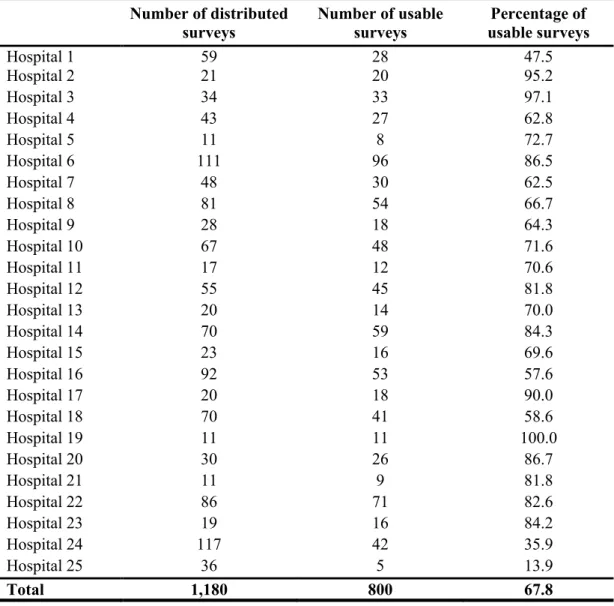
Table 6.1 - Number of distributed and usable surveys for each hospital ... 60
Table 6.2 - Sample information and distribution of participants' demographic characteristics to hospitals ... 62
Table 7.1 - Descriptive statistics and intercorrelations ... 77
Table 7.2 - Results of the normality tests ... 79
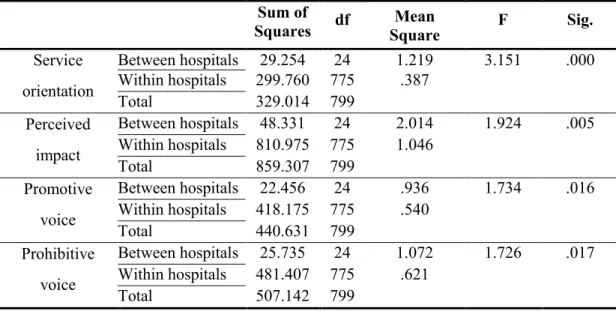
Table 7.3 - Mean score differences for criterion variables among hospitals in the study ... 80
Table 7.4 - Results of the multilevel path analysis ... 81
VIII ABSTRACT
Firms’ ability to seek and use information prior to their customers’ needs and wants is vital for organizational success in today’s highly competitive markets where customers are more selective than ever in their purchase decisions. Although
organizations can access customer information via alternative sources such as market research activities, employees’ proximity to customers further makes them
significant hubs of information for firms that particularly operate in service settings. In this spirit, the following thesis aims to explore the antecedents of service
employees’ customer-focused voice behavior, which is employees’ behavior of communicating customer-relevant issues to their organization. Using a multilevel conceptual model, our study mainly proposes that a type of leadership, namely participative leadership will be effective on different types of customer-focused employee voice (i.e., promotive and prohibitive), through fostering employees’ motivational states (i.e., service orientation and perceived impact). Furthermore, the study suggests that these relationships can be moderated by unit-level factors such as participative leadership climate strength, feedback-seeking climate strength and customer complexity. Our study follows a quantitative approach with surveys collected from employees working in the medical admission units of a Turkish hospital chain. The results of the study show that participative leadership acts as a factor that affects promotive and prohibitive customer-focused employee voice behavior through fostering service orientation and perceived impact at the employee-level. Nevertheless, the study has found that unit-level participative leadership climate strength and customer complexity negatively affect the relationship between participative leadership and service orientation at the employee-level. Customer complexity further affects the relationships between participative leadership and perceived impact and perceived impact and prohibitive customer-focused voice in negative terms. Finally, unit-level feedback-seeking climate strength has been found to diminish the effect of service orientation on promotive and prohibitive customer-focused employee voice, and to strengthen the relationship between perceived impact and prohibitive customer-focused voice behavior at the employee-level. Based on the results, our thesis further provides theoretical and managerial implications.
IX ÖZET
Firmaların tüketici ihtiyaç ve istekleriyle ilgili bilgi arama ve kullanması, günümüzde tüketicilerin satın alım kararlarında her zamandan daha fazla seçici olduğu yüksek orandaki rekabetçi pazarlarda kurumsal başarıya erişmek için hayati bir önem taşımaktadır. Kurumlar, tüketiciler hakkında bilgilere pazar araştırma çalışmaları gibi alternatif araçlar ile ulaşabiliyor olsa bile; firma çalışanlarının tüketicilere olan yakınlığı, onları da özellikle hizmet sektörlerinde faaliyet gösteren firmalar için önemli bilgi kaynakları haline getirmektedir. Bu doğrultuda işbu tez çalışmasının amacı, hizmet sektöründeki çalışanların tüketici odaklı sesliliğini, yani onların tüketicilerle ilintili konuları kurumlarına iletme davranışlarını etkileyen faktörleri incelemektir. Çok düzeyli bir kavramsal model eşliğinde çalışmamız, özellikle katılımcı liderlik adı verilen bir liderlik türünün, çalışanların motivasyonel durumlarını (hizmet odaklılığı ve etki algısı) güçlendirerek, farklı tipteki tüketici odaklı çalışan sesliliğinde (destekleyici ve önleyici seslilik) etkin olacağını önermektedir. Çalışma, ayrıca bu ilişkilerin katılımcı liderlik ikliminin gücü, geribildirim arama ikliminin gücü ve tüketici karmaşıklığı gibi ünite seviyesindeki faktörler tarafından etkilenebileceğini de öne sürmektedir. Çalışmamız bir Türk hastane zincirinin hasta kabul ünitelerinde görevli çalışanlardan toplanan anketler nezdinde kantitatif bir araştırma yöntemi kullanmaktadır. Çalışmanın sonuçlarına göre, katılımcı liderliğin, çalışan düzeyinde hizmet odaklılığı ve etki algısını güçlendirerek, çalışanların destekleyici ve önleyici sesliliğinde etkin bir rol aldığı görülmektedir. Öte yandan, ünite düzeyinde katılımcı liderlik ikliminin gücü ve tüketici karmaşıklığının, çalışan düzeyinde katılımcı liderlik ve hizmet odaklılığı arasındaki ilişkiyi negatif olarak etkilediği bulunmuştur. Tüketici karmaşıklığı ayrıca katılımcı liderlik ve etki algısı ile etki algısı ve önleyici tüketici odaklı seslilik arasındaki ilişkileri de negatif bir yönde etkilemektedir. Son olarak, ünite düzeyinde geribildirim arama iklimi gücünün çalışan düzeyinde hizmet odaklılığı ile
destekleyici ve önleyici tüketici odaklı seslilik arasındaki ilişkileri zayıflattığı ve etki algısı ile önleyici seslilik arasındaki ilişkiyi güçlendirdiği bulunmuştur. Sonuçlar nezdinde, tezimiz teorik ve pratik çıkarım ve önermeler de sunmaktadır.
1 1. INTRODUCTION
“I only wish I could find an institute that teaches people how to listen. Business people need to listen at least as much as they need to talk. Too many people fail to realize that real communication goes in both directions.”
- Lee Iacocca, former chief executive officer (CEO) of Chrysler Corporation
Customers are described as being intangible assets for organizations (Gupta & Lehmann, 2003). In a sense, customers contribute to firms’ successes and failures. They cherish brands like Amazon.com, which rather than selling what they actually have in their stocks, use customer trends to decide on their upcoming offerings (“Talk Desk”, 2015). Conversely, the negative events that Coca-Cola experienced following the launch of their new Coke during the 1980s, still constitute a pinnacle among examples that show how customers have the ability to doom their favorite brands into big failures when they feel their preferences are not taken into account. With today’s customers becoming even more selective in their purchase decisions with the memories of 2008’s crisis being intact in their minds (Sorenson & Adkins, 2014), the viewpoint held by marketers who adopt marketing concept is just like a testimony: That organizations reach and maintain success only by satisfying their customers’ needs (Deshpande, Farley, & Webster, 1993; Brown, Mowen, Donavan, & Licata, 2002).
Considering market orientation’s positive role on a firm’s performance (Day, 1994), businesses should note that a determinant for market orientation is the firms’ ability to seek and use information about customers’ needs and wants (Kohli & Jaworski, 1990). Besides different tools that organizations might use to obtain
2 information prior to customers’ needs and wants (i.e., formal market research activities), there are other ways for managers to obtain information concerning customers’ needs and wants (Maltz & Kohli, 1996). For instance, a particular source of customer-relevant information for businesses is their own employees, especially those who take up duties on the frontlines and have direct contact with customers (Ryan & Oestreich, 1998). Their proximity to customers makes frontline employees as corporate messengers who carry future customer opportunities or problems inside their firms (Edmondson, 1996; Tangirala & Ramanujam, 2012).
Against the above backdrop, our study concentrates on the use of frontline employees as agents who communicate customer-relevant information inside their organizations. More particularly, we delve into the concept of customer-focused employee voice, which refers to an employee’s behavior of communicating customer-related issues, areas of improvement or problems and concerns to the management with the intention of improving the overall customer experience provided by the organization (Lam & Mayer, 2013). We mainly focus on the circumstances under which customer-focused employee voice, or employees’ behavior to communicate customer-relevant issues to their organization can be formed. With these premises, we move on to a brief analysis of prior literature on our point of interest and the description of our own research problem.
1.1. Limitations of previous research and the research problem
The voice literature is rife with studies that attempt to explain the antecedents of employee voice behavior in organizations. In line with these studies, employee voice
3 behavior has been attributed to factors like employee characteristics, leader
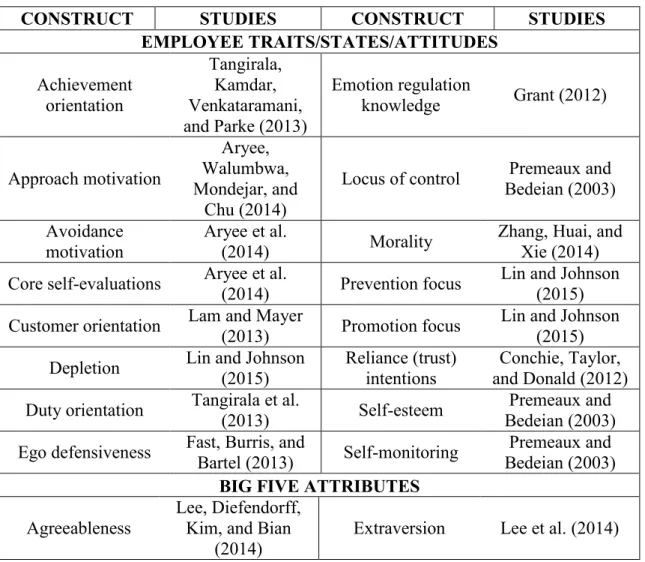
characteristics and environmental characteristics (i.e., organizational factors). Table 1.1 summarizes those factors that have been found by past studies to affect employees’ voice behaviors in organizations. Yet the majority of these studies focus on explaining the factors that account for employee voice, or employees’ behavior of communicating ideas, opinions, and concerns prior to organizational issues in general, but not only customer-relevant issues. That is, employee voice literature remains scant in terms of studies examining the factors affecting employees’ customer-focused voice behaviors. Therefore, our research problem in this study is about the factors that affect employees’ customer-focused voice behaviors.
To our knowledge, the only study that focuses on the antecedents of customer-focused employee voice belongs to Lam and Mayer (2013). Their study posits that customer-focused voice is influenced by a combination of employee (i.e., employee customer orientation and employees’ autonomy at work) and organizational
characteristics (i.e., unit service climate) (Lam & Mayer, 2013). Nevertheless, this study has its drawbacks that need to be addressed by further studies. First, the authors, “were not able to directly examine the psychological mechanisms by which” employee-level antecedents affect customer-focused voice (Lam & Mayer, 2013, p. 22). Second, although they explained customer-focused voice with employee and organizational characteristics, the study lacks in terms of whether other antecedents such as leadership characteristics can affect customer-focused voice. Finally, the organizational
4 service climate) need to be enriched with alternative environmental/organizational characteristics.
Although Lam and Mayer (2013) have examined customer-focused employee voice as a unique, single construct; the employee voice literature has also seen past studies (Liang, Farh, & Farh, 2012; Lin & Johnson, 2015; Wei, Zhang, & Chen, 2015), which examined voice behavior in two distinct constructs: (a) Promotive and (b) prohibitive employee voice. On one hand, promotive employee voice refers to “employees’ expression of new ideas or suggestions for improving the overall
functioning of their work unit or organization” (Liang et al., 2012, p. 74). On the other hand, prohibitive employee voice refers to “employees’ expressions of concern about work practices, incidents, or employee behavior that are harmful to their organization” (Liang et al., 2012, p. 75). Considering the differing nature of these types of voice (i.e., Promotive being more towards providing recommendations while prohibitive being towards communicating concerns), customer-focused voice literature remains scant with respect to studies focusing on this distinction.
In line with these limitations, we formulate our research question as “Does participative leadership affect employees’ promotive and prohibitive customer-focused voice behaviors in service context?” Our study particularly focuses on the service settings due to extensive presence of customer-employee interactions in services (Teng & Barrows, 2009). Addressing to the aforementioned gaps, we suggest that a type of leadership, namely participative leadership will affect employees’ customer-focused voice behaviors through certain psychological mechanisms (i.e. motivational states that
5 we conceptualized as service orientation and perceived impact). We further introduce three organizational factors, (i.e. unit-level participative leadership climate strength, feedback-seeking climate strength and customer complexity), as moderating variables, which condition the relationships between participative leadership and customer-focused voice. We draw the mediating role of motivational states and the moderating effect of organizational factors from systems theory (Chen & Kanfer, 2006). Finally, we address customer-focused voice with two constructs, promotive and prohibitive voice.
Table 1.1 - Review of factors affecting employee voice
CONSTRUCT STUDIES CONSTRUCT STUDIES
EMPLOYEE TRAITS/STATES/ATTITUDES Achievement orientation Tangirala, Kamdar, Venkataramani, and Parke (2013) Emotion regulation knowledge Grant (2012) Approach motivation Aryee, Walumbwa, Mondejar, and Chu (2014)
Locus of control Bedeian (2003) Premeaux and Avoidance
motivation
Aryee et al.
(2014) Morality
Zhang, Huai, and Xie (2014) Core self-evaluations Aryee et al. (2014) Prevention focus Lin and Johnson (2015) Customer orientation Lam and Mayer
(2013) Promotion focus
Lin and Johnson (2015) Depletion Lin and Johnson
(2015)
Reliance (trust) intentions
Conchie, Taylor, and Donald (2012) Duty orientation Tangirala et al.
(2013) Self-esteem
Premeaux and Bedeian (2003) Ego defensiveness Fast, Burris, and
Bartel (2013) Self-monitoring
Premeaux and Bedeian (2003) BIG FIVE ATTRIBUTES
Agreeableness Lee, Diefendorff, Kim, and Bian (2014)
6 EMPLOYEE JOB STATUS
Actor’s lower status vis-à-vis the
target
Liu, Tangirala and
Ramanujam (2013) Perceived risk Wei et al. (2015) Employee embeddedness Ng and Feldman (2013) Personal control Tangirala and Ramanujam (2008) Personal influence Tangirala and
Ramanujam (2012) Aryee et al. (2014)
Venkataramani and
Tangirala (2010) Self-perceived status Janssen and Gao (2013) Flexible work role
orientation
Ng and Feldman
(2012b) Status judgment Zhang et al. (2014) Job autonomy Lam and Mayer
(2013) Work-flow centrality Venkataramani and Tangirala (2010) Perceived self-efficacy for voice
Wei et al. (2015) Tangirala and Ramanujam (2012)
Janssen and Gao (2013) Tangirala et al.
(2013)
EMPLOYEE JOB ATTITUDES Actor’s relationship
quality with target Liu et al. (2013) Organizational trust
Ng and Feldman (2013) Affective
commitment
Tröster and van Knippenberg
(2012)
Procedural justice
perceptions Aryee et al. (2014) Disclosure (trust)
intentions
Conchie et al. (2012)
Organization-based
self-esteem Liang et al. (2012) Employee’s overall job satisfaction Tangirala and Ramanujam (2012) Subordinate psychological attachment to the organization
Burris, Detert, and Chiaburu (2008) Favorability of the
work group voice climate
Morrison, Wheeler-Smith, and Kamdar
(2011)
Trust in upper-level leader
Premeaux and Bedeian (2003) Felt obligation for
constructive change Liang et al. (2012)
Conchie et al. (2012) Group perceptions
of supervisor undermining
Frazier and Bowler (2012)
Gao, Janssen, and Shi (2011)
7 Individual
identification with the work group
Morrison et al.
(2011) Value congruence Wang, Hsieh, Tsai, and Cheng (2012) Individual
satisfaction with the work group
Morrison et al. (2011) Voice role conceptualization Tangirala et al. (2013) Organizational identification Tangirala and Ramanujam (2008) Work-group identification Venkataramani and Tangirala (2010) EMPLOYEE JOB BEHAVIORS
Deep/surface acting Grant (2012) Task performance Venkataramani and Tangirala (2010) Social networking
behavior Ng and Feldman (2012b) Subordinates’ level of performance Detert and Burris (2007) MANAGER TRAITS/ATTITUDES/BEHAVIORS
Authoritarianism Zhang et al. (2014)
Manager’s consultation
behavior
Tangirala and Ramanujam (2012) Benevolence Zhang et al. (2014) Perceived abusive
supervision Burris et al. (2008) Coaching Gao et al. (2011)
Perceived supervisor embeddedness
Ng and Feldman (2013) Ego threat Fast et al. (2013) transformational Safety-specific
leadership
Conchie et al. (2012) Informing Gao et al. (2011) Supervisory delegation Wei et al. (2015) Managerial
self-efficacy Fast et al. (2013)
Supervisory responsiveness
Janssen and Gao (2013) Managerial voice
aversion Fast et al. (2013)
Target’s positive mood
Liu, Tangirala, Lam, Chen, Jia, and Huang (2015) LEADERSHIP CHARACTERISTICS Ethical leadership Walumbwa, Morrison, and Christensen (2012) Leader openness
Tröster and van Knippenberg (2012) Walumbwa and Schaubroeck (2009) Leaders’ perceived display of openness
Detert and Burris (2007) Group-focused
transformational leadership
Wang et al. (2012) Leaders’ perceived transformational behaviors
Detert and Burris (2007)
8 Leader agreeableness Walumbwa and Schaubroeck (2009) Leader conscientiousness Walumbwa and Schaubroeck (2009) MANAGERIAL STATUS Exchange between
direct leader and skip-level leader Liu et al. (2013) Leader-member exchange Burris et al. (2008) Exchange between employee and
direct leader Liu et al. (2013) Zhang et al. (2014) Exchange between
employee and
skip-level leader Liu et al. (2013)
Leader-member similarity in
nationality
Tröster and van Knippenberg (2012) Manager’s status within the organization Tangirala and Ramanujam (2012) WORKGROUP CHARACTERISTICS Coworker support Loi, Ao, and Xu (2013) Scale referent
Podsakoff, Maynes, Whiting, and Podsakoff (2015) Group-level participative climate Lee, Diefendorff, Kim, and Bian
(2014)
Service climate Lam and Mayer (2013) Idiosynratic deals Ng and Feldman (2012b) Social stressors and strains Ng and Feldman (2012a)
Job stressors and
strains Ng and Feldman (2012a) Superficial harmony Wei et al. (2015) Member-team
dissimilarity in nationality
Tröster and van Knippenberg
(2012)
The frequency of group members
engaging in voice Podsakoff et al. (2015) Organizational
stressors and strains
Ng and Feldman (2012a)
The proportion of group members
engaging in voice Podsakoff et al. (2015) Participative
decision making Gao et al. (2011) Top-management openness Bedeian (2003) Premeaux and Perceived
organizational
support Loi et al. (2013) Voice climate Frazier and Bowler (2012) Power distance Wei et al. (2015) Wei et al. (2015)
9 Psychological
safety Liang et al. (2012)
Work group’s voice climate Morrison et al. (2011) Liu et al. (2013); Liu et al. (2015) Detert and Burris
(2007) Tröster and van Knippenberg (2012)
Walumbwa and Schaubroeck (2009)
Tangirala et al. (2013)
1.2. Purpose and motivations of the study
This study first aims to enrich the understanding on factors affecting the customer-focused employee voice behavior. Our initial motivation for studying the factors affecting customer-focused employee voice comes from a variety of reasons. First, considering that employee voice has an enhancing effect on the organizational performance (Morrison, 2014), we also believe that customer-focused employee voice is likely to benefit organizations, particularly in these times where it is becoming harder for organizations to attract and maintain the customers. Second, customer-focused employee voice still remains an under-examined concept in the voice literature.
Considering the role of customer-focused employee voice on meeting the ever-evolving customer needs (Lam & Mayer, 2013), we conclude that studying the factors that account for customer-focused employee voice might produce valuable contributions both for the marketing theory and practice.
10 When examining the factors that give birth to customer-focused employee voice behavior, our study particularly aims to understand the role of a specific leadership style, namely participative leadership on customer-focused voice at the employee-level. That is, we examine whether participative leadership relationships between supervisors and employees affect employees’ customer-focused voice behaviors. Noting leaders’ effect in certain employee behaviors including voice (Zhang et al., 2014), the voice literature came up with studies observing the role of various leadership styles (e.g., ethical leadership, transformational leadership) on employee voice (Detert & Burris, 2007; Walumbwa & Schaubroeck, 2009). Notwithstanding, participative leadership has never been associated with employee voice or customer-focused employee voice by any of the past studies in voice literature, which motivates us to examine the association between these constructs.
More particularly, our study suggests that the effect of participative leadership on customer-focused voice at the employee-level will be through employee motivational states, which we define as service orientation and perceived impact. The introduction of these motivational states that account for the potential effect of participative leadership on customer-focused voice will help us to understand participative leadership-voice relationship in depth, which can be translated in other forms employee voice or even extra-role behavior context by future studies. Furthermore, beyond their isolated effects, employee behavior is a product of the interaction between employee and environmental-level (i.e., organizational) factors (Chen & Kanfer, 2006). Against this backdrop, our study aims to investigate whether the employee-level relationships between participative
11 leadership-motivational states-customer-focused employee voice are contingent on different factors at the organizational level (i.e., unit-level participative leadership, feedback-seeking climate strength and customer complexity).
As mentioned previously, promotive and prohibitive voice represent different employee behaviors (i.e., promotive voice incorporates employees’ communication of their recommendations and ideas to the upper management while prohibitive voice is relevant to employees’ communication of concerns prior to organizational practices, incidents and behaviors). Therefore, a study is needed in terms of whether it takes different settings for each of these voice types to occur in organizations. Considering that the literature has overlooked this distinction, and mostly focused on voice as an activity similar to what we refer in promotive voice (Liang et al., 2012), past studies do not have an answer for such question, and thus, skips an information that can provide valuable theoretical and practical contribution. Therefore, our study aims to examine customer-focused employee voice behavior in two distinct constructs, with the motivation to address this gap and enrich the body of knowledge on these distinctive types of voice in the context of customer-focused employee voice.
1.3. Significance of the study
Our study is significant in terms of a variety of reasons. First, to the best of our knowledge, the study is the second attempt that concentrates on customer-focused employee voice, a type of employee voice, that has been neglected by the literature except the study by Lam and Mayer (2013). Second, our study stands out from Lam and Mayer (2013) by conceptualizing customer-focused employee voice in two unique
12 dimensions, namely promotive and prohibitive customer-focused employee voice.
Although previous researchers (Liang et al., 2012; Lin & Johnson, 2015; Wei et al., 2015) studied employee voice in these two distinctive forms, no attempts have been made to examine customer-focused voice in these two distinctive constructs. Third, our study is the first attempt that introduces a leadership style as the antecedent of customer-focused employee voice. The opportunity to confirm such a relationship would be likely to produce valuable theoretical and practical implications.
Fourth, our study observes the role of participative leadership on promotive and prohibitive customer-focused voice via the mediating effects of employee motivational states. That is, we examine whether motivational states, which we identify as service orientation and perceived impact can act as the underlying mechanisms that explain participative leadership-customer-focused voice relationship. The inclusion of
motivational states in our model particularly addresses the gap that has been mentioned by Lam and Mayer (2013) towards the lack of an underlying mechanism between various antecedents and customer-focused voice. Fifth, our study introduces a variety of organizational-level characteristics as factors affecting relationships between
participative leadership-motivational states-customer-focused employee voice behaviors at the employee-level. Thus, we emphasize that customer-focused voice is the product of a regular interaction among employee and organizational-level factors. To test these cross-level influences, our study draws from systems theory, which has not been used in voice literature (Chen & Kanfer, 2006).
13 1.4. Organization of the study
In the sections to follow, we first explain the concept of employee voice in general. This will help us to understand our subject of interest in detail. Noting the existence of different voice types in the literature (Maynes & Podsakoff, 2013), this part will further help us to draw the boundaries in terms of which type of voice we refer to in this study. We, then, provide an explanation for our theoretical framework, namely systems theory (Chen & Kanfer, 2006). This will be followed by the introduction of the constructs in our conceptual model and by the explanation of our research hypotheses. After providing information about the methodology that we use in our study, we detail the findings of our research, and discuss the implications that we deduct from our results.
14 2. THE DOMAIN AND DEFINITION OF EMPLOYEE VOICE
In this chapter, we introduce the concept of employee voice in order to establish a base for our later discussions. We first start by exploring the domain of employee voice as an employee behavior in organizations by referring to the past literature, which associated employee voice with employee extra-role behaviors and proactive behaviors. Such an attempt to position the employee voice behavior within the other employee behaviors will help us to rationalize our conceptual model and hypothesized
relationships, which we will explain later in this study. Our chapter will also provide a definition for employee voice based on past studies as well as information prior to the target of employee voice, which we further adopt in this study. Thus, this chapter will help us to draw the boundary lines for the concept of employee voice, which we observe a sub-dimension of (i.e., customer-focused employee voice).
2.1. The domain of employee voice behavior 2.1.1. Employee voice as an extra-role behavior
Employee voice can be observed under the broad umbrella of extra-role behaviors, which are “(1) not specified in advance by role prescriptions, (2) not recognized by formal reward systems, (3) not a source of punitive consequences when not performed by job incumbents” (Van Dyne & LePine, 1998, p. 108). Such behaviors are “class of pro-organizational behaviors that can neither be enforced on the basis of formal role obligations nor elicited by contractual guarantees of recompense”
(MacKenzie, Podsakoff, & Podsakoff, 2011, p. 562). Extra-role behaviors can be classified with a typology, which is based on the twin dichotomies of promotive vs.
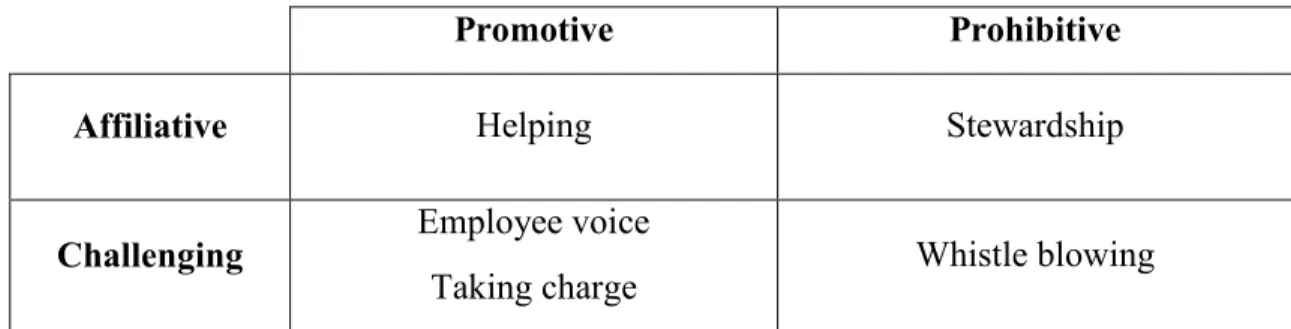
15 prohibitive and affiliative vs. challenging extra-role behaviors. Promotive extra-role behaviors are those that “promote, encourage or cause things to happen”, and prohibitive extra-role behaviors are those that are “protective and preventative” (Van Dyne & LePine, 1998, p. 108). Affiliative extra-role behaviors can be defined as cooperative and noncontroversial, and challenging extra-role behaviors are those behaviors that are change-oriented and challenge the status quo (Van Dyne & LePine, 1998). Table 2.1 displays the dimensions that different extra-role behaviors fall within.
Table 2.1 - The domains of various extra-role behaviors
Promotive Prohibitive
Affiliative Helping Stewardship
Challenging Employee voice
Taking charge Whistle blowing Source: Van Dyne and LePine (1998), Morrison and Phelps (1999), MacKenzie et al. (2011)
According to this typology, although helping and employee voice are common in terms of being defined as promotive behaviors, the latter, which is a challenging extra-role behavior, differs from the former (i.e., affiliative extra-extra-role behavior) (Van Dyne & LePine, 1998). Employee voice also departs from stewardship, which is more protecting and affiliative, and performed at times where organizational standards are violated. In a similar case, whistle blowing that incorporates the communication of illegal and
unethical practices inside the organization, differs from employee voice due to its goal of protecting the organization. Thus, employee voice is an extra-role behavior that differs from other extra-role behaviors due to its emphasis on challenging the status quo
16 inside the organization in a constructive tone (Van Dyne & LePine, 1998). Rather than a mere critic of organizational practices, employee voice involves the suggestion of innovative ideas and communication of problematic issues even to the dismay of others. Therefore, employee voice is a challenging and promotive extra-role behavior.
Like employee voice, taking charge is also considered a challenging and promotive extra-role behavior on the typology presented in Table 2.1 (Morrison & Phelps, 1999). However, employee voice varies from taking charge in three ways: First, it is a broader and multifaceted behavior than taking charge with its mediums and tools ranging from grievance filing to complaining to supervisors (Farrell, 1983). Second, it takes less effort to exert employee voice compared to behaviors associated with taking charge behaviors (Morrison & Phelps, 1999). Third, employee voice behaviors differ from taking charge by focusing on the behavior of communication between employees and upper-level managers (Ng & Feldman, 2012a). Constructs like issue selling or upward communication are also defined as being similar to employee voice but while the former differs from employee voice having the sole intention to bring attention to the recent developments, or key trends; the latter is defined as being much broader in
content compared to employee voice (Morrison, 2011). 2.1.2. Employee voice as a proactive behavior
The literature defines proactive behaviors as actions that aim to improve the existing conditions (Crant, 2000; Grant & Ashford, 2008; Morrison, 2011). Proactive behaviors are “anticipatory” (Grant & Ashford, 2008, p. 4), “self-initiated” and “future-oriented” (Morrison, 2011, p. 375) behaviors. When employees involve in proactive
17 behaviors, they aim to challenge the status quo rather than showing adaptation to the existing conditions in their organization (Crant 2000). Against this backdrop and in line with various past studies (Morrison, 2011; Frazier & Bowler, 2012; Detert et al., 2013), we consider employee voice to be a proactive behavior. This is because, employee voice aims to challenge the status quo and promote the functioning in organizations similar to proactive behaviors (Van Dyne & LePine, 1998; Parker & Collins, 2010). Nevertheless, despite being considered a proactive behavior, this link of employee voice with
proactive behaviors has received scant attention in voice literature (Morrison, 2011). A confusion in the literature stems from whether proactive behaviors and extra-role behaviors are the same (Parker, Williams, & Turner, 2006). Nevertheless, studies put that employees can act proactively both within their in-role and extra-role behaviors (Parker et al., 2006; Grant & Ashford, 2008). Therefore, we consider employee voice as a combination of extra-role and proactive employee behaviors at the same time. That is, employee voice is a proactive, extra-role employee behavior.
2.2. Definition of employee voice
The literature has come up with different definitions of employee voice. Some examples to these definitions are provided in Table 2.2:
18 Table 2.2 - Different definitions of employee voice
Article Definition
Van Dyne and LePine (1998, p. 109)
Promotive behavior that emphasizes expression of constructive challenge intended to improve rather than merely criticize
Premeaux and Bedeian (2003, p. 1538)
Openly stating one’s views or opinions about the workplace matters, including the actions or ideas of others, suggested or needed changes, and alternative approaches or different lines of reasoning for addressing job-related issues
Detert and Burris (2007, p. 869)
Discretionary provision of information intended to improve organizational functioning to someone inside an organization with the perceived authority to act, even though such
information may challenge and upset the status quo and its power holders.
Venkataramani and Tangirala (2010, p. 582)
The expression of challenging but constructive opinions, concerns, or ideas on work related issues
Drawing from these definitions, we define employee voice as a change-oriented and challenging communication of ideas, opinions, and concerns about organizational issues that aims to improve the organizational functioning. Since it is an extra-role behavior,
19 employee voice can neither be expected from the employees as a formal, standard job behavior, nor is rewarded. In these terms, our definition of employee voice is closer to that of Detert and Burris (2007) and of Venkataramani and Tangirala (2010). In our study, we focus on prosocial employee voice rather than acquiescent or defensive voice due to this voice type’s association with employees’ behavior of speaking up with the aim of improving and being beneficial to the organization (Lee et al., 2014). We further adopt constructive employee voice rather than supportive, defensive, or destructive voice types due to the former’s emphasis on “voluntary expression of ideas, information, or opinions” aiming organizational change (Maynes & Podsakoff, 2013, p. 5).
2.3. Target for employee voice
A particular issue that deserves attention is the target for the employee voice since employee voice is a behavior of communicating ideas, opinions, and concerns to a third party within the organization, namely a target. Voice target can be defined as the “potential recipient of the voice message” (Morrison, 2014, p. 174), and can differ from a supervisor to a colleague working at the same unit with the employee. Our study focuses on the upward employee voice where the target is defined as a person who works at the same organization with the employee, and who has a superior rank than the employee. We consider that the dominant content for upward communication in the form of employee voice is more constructive rather than mere complaint (Liu et al., 2013). We now move on to our third chapter in which we introduce the theoretical framework of our study.
20 3. THEORETICAL FRAMEWORK
This study aims to explain the antecedents of customer-focused employee voice behaviors. More particularly, we examine whether participative leadership, or a
supervisor’s one-to-one participative leadership behavior with an employee is a factor affecting promotive and prohibitive customer-focused employee voice at the employee-level through underlying motivational states of an employee (i.e., service orientation and perceived impact). Moreover, our study suggests that customer-focused voice behaviors are not only the product of these antecedents at the employee-level (i.e., participative leadership, service orientation, and perceived impact) but their combination with organizational-level (i.e., unit) characteristics, namely participative leadership climate strength, feedback-seeking climate strength and customer complexity.
In the light of our suggestions, we use systems theory (Chen & Kanfer, 2006) as a backbone to our conceptual model. The main reason for us to use systems theory is based on the theory’s ability to delineate individual-level motivation processes to explain the relationships between different input factors and employee behaviors.
Furthermore, systems theory differs from other motivation theories mainly because of its ability to combine individual and unit-level factors to explain employee behaviors in teams, thus serving to our study’s objectives. (Chen & Kanfer, 2006). Under this information, this chapter first presents systems theory in detail. We, then, provide information prior to some past studies that used systems theory framework in order to explain employee behaviors in group settings.
21 3.1. Systems theory
Our study builds upon systems theory (Chen & Kanfer, 2006), which posits that employee behavior is influenced by a combination of individual and group-level factors. The individual-level factors are called discretionary inputs, and refer to factors specific to some employees rather than all employees in the team. Discretionary inputs may include employees’ motivational traits, work experience or their exchange relationships with their leaders. The group-level characteristics, also called as ambient inputs,
represent the values and factors that relate to the overall team in general. Factors such as leadership climate, work design or group norms can be mentioned under ambient inputs.
Figure 3.1 displays that the individual factors affect employee motivational states (i.e., employees’ beliefs towards their capabilities for performing specific actions). These motivational states help employees generate (goal generation) and execute goals (goal striving) prior to performance. This process is exactly the same for workgroups where group-level input factors affect motivational states, which in turn affect performance via goal generation, and striving processes. The combination of
motivational states, goal generation, and goal striving is called motivational processes at the individual and workgroup levels (Chen & Kanfer, 2006).
Contrary to other motivational theories, systems theory assumes that employee motivation is not only affected by employee-level factors in isolation. Instead, group-level factors and motivational processes together take part in influencing employee motivation to perform specific behaviors. Systems theory refers this effect of group-level factors and motivational processes on employee motivation and performance as
22 top-down effects, and the effect of individual-level motivational processes on group motivation as bottom-up effects. Systems theory also posits that the group-level motivational processes have a direct effect on individual performance alongside the employee motivational processes. The individual performance, in turn, will contribute to the group-level performance.
3.2. Previous applications of systems theory
Studies thus far have directly or indirectly used systems theory to explain employees’ proactive behavior (Parker, Bindl, & Strauss, 2010) and their innovative behavior in workgroups (Chen, Farh, Campbell-Bush, Wu, & Wu, 2013). The former presented a model that combines together different employee and unit-level factors to predict employees’ proactive motivational states, which in turn relate to their goal generation and goal striving behaviors that eventually explain their proactive behaviors (Parker et al., 2010). The latter articulated employee and unit-level factors to explain innovative performance behavior in workgroups via employee and workgroup-level motivational states (Chen et al., 2013). The study has found that employee and unit-level input factors affect their respective motivational states, which in turn influence the employee and workgroup innovative performance. Moreover, workgroup motivational states have a top-down effect on employee-level motivational states and on employee innovative performance, which in turn affects the overall workgroup performance.
To the best of our knowledge, systems theory framework has never been applied to the context of employee voice. The only study that comes close to what we want to achieve is the model of proactive motivation (Parker et al., 2010). After all, employee
23 voice is a proactive employee behavior (Morrison, 2011). With this in mind, our study thus imports the foundations of systems theory into the context of customer-focused employee voice, as a form of proactive behavior. In the following chapters, we will explain the components of our model and articulate these components to customer-focused employee voice drawing from systems theory.
24 Figure 3.1 - The relationships proposed in systems theory
25 4. CONCEPTUAL FRAMEWORK
In essence, systems theory posits that an employee’s behavior such as voice is influenced by employee-level and unit-level factors, and by the interplay between the two (Chen & Kanfer, 2006). Drawing from systems theory, we propose that an employee-level input factor, namely participative leadership affects an employee’s service orientation and perceived impact (i.e., employee motivational states), which in turn influence his/her promotive and prohibitive customer-focused employee voice. At the unit-level, our model posits that external stimuli (i.e., customer complexity), unit-level input factor (i.e., participative leadership climate strength), and a unit-level motivational state (i.e., feedback-seeking climate strength) condition the relationships at the employee-level. We now move on to explain each of these constructs that we include in our conceptual model in detail.
4.1. Employee-level factors 4.1.1. Participative leadership
Organizations have started to rely on their employees to take on the duties, which are normally expected by managers in traditional, hierarchical corporate structures; when global competition, changing customer demands and the shift from a manufacturing to a service focus took on the businesses (Arnold, Arad, Rhoades, & Drasgow, 2000). This journey of the organizational staff to move from being mere employees to managerial collaborates is a factor that greatly relied on leaders’ empowering behaviors who delegated authority to their subordinates (Ahearne, Mathieu, & Rapp, 2005). Participative decision-making or participative leadership, which takes part under leaders’ empowering behaviors (Arnold et al., 2000), can be
26 defined as a joint decision-making process that exists between a supervisor and his/her subordinates (Koopman & Wierdsma, 1998). In a workgroup environment where participative leadership takes place, supervisors provide their subordinates the opportunity to express their opinions, consult them when making decisions, and often make decisions in collaboration with their subordinates (Rapp, Ahearne, Mathieu, & Schillewaert, 2006).
Participative leadership brings a variety of benefits for employees. In an environment where supervisors and subordinates involve in a collaborative, joint decision-making regarding the work-relevant matters, employees are mentioned to feel higher self-efficacy with a reduced sense of powerlessness (Huang, Iun, Liu, & Gong, 2010). Previous studies have also reported that participative leadership fosters employees’ commitment (Sashkin, 1976), satisfaction (Yammarino & Naughton, 1992), engagement (Tuckey, Bakker, & Dollard, 2012), and performance at work (Vecchio, Justin, & Pearce, 2010). Besides its benefits for employees, a participative leadership environment also improves organizations’ decision-making quality (Scully, Kirkpatrick, & Locke, 1995). As a sub-dimension of leaders’ empowering behaviors (Arnold et al., 2000; Rapp et al., 2006), participative leadership has been associated with employees’ involvement in affiliative and challenging extra-role behaviors (Raub & Robert, 2010), and in service-oriented extra-role behaviors (Auh, Menguc, & Jung, 2014). In line with these findings, our research model associates participative leadership with employee service orientation and perceived impact, which in turn affect employees’ promotive and prohibitive customer-focused voice behaviors.
27 4.1.2. Service orientation
The term service orientation has been conceptualized in two different levels in the literature. The first conceptualization identifies service orientation as an organizational-level characteristic, which has been defined as an “organization-wide embracement of a basic set of relatively enduring organizational policies, practices, and procedures intended to support and reward service-giving behaviors that create and deliver service excellence” (Lytle & Timmerman, 2006, p. 136). Service orientation at the organizational level has been defined as more of a climate or culture in the organizations (Bowen, Siehl, & Schneider, 1989), and relates to service leadership, service encounters with customers or service systems, which enable the organizations to provide reliable service (Lytle, Hom, & Mokwa, 1998).
The second conceptualization of service orientation is at the employee-level. As such, service orientation is defined as an “inclination to provide service, to be courteous and helpful in dealing with customers” (Cran, 1994, p. 36). Employees who are highly service oriented demonstrate an enjoyment to help the customers, fulfill and are proud of themselves by serving the customers in an excellent way (Bettencourt, Gwinner, & Meuter, 2001). Various individual traits (i.e.,
agreeableness) (Hurley, 1998; Brown et al., 2002) and contextual characteristics (e.g., leadership support) (Susskind, Kacmar, & Borchgrevink, 2007) are mentioned to increase an employee’s service orientation. Employee service orientation fosters employee performance at work (Kim, Leong, & Lee, 2005), and motivates
employees to involve in extra-role behaviors (Teng & Barrows, 2009). Our research model adopts this second conceptualization of service orientation, and proposes that
28 participative leadership can affect employees’ level of service orientation, which in turn would affect their involvement in customer-focused employee voice.
4.1.3. Perceived impact
The literature attributes perceived impact to the concept of empowerment (Spreitzer, 1995). Empowerment represents two alternative conceptions in the literature (Ahearne et al., 2005). The first conception is defined as an organizational-level practice, which delegates decision-making and execution behaviors from managers to the employees (Leach, Wall, & Jackson, 2003). The second conception is embedded in the concept of empowerment, which is a type of psychological state that consists of four dimensions: meaning, competence, self-determination and impact (Spreitzer, 1995). Meaning can be defined as a relative value of a work’s goal or purpose with employees’ own beliefs and values (Thomas & Velthouse, 1990). Competence refers as the extent of one’s self-efficacy is defined to his/her belief in his/her ability to perform a task (Gist, 1987). Self-determination is defined as an employee’s choice to initiate and regulate his/her actions (Deci, Connell, & Ryan, 1989).
Perceived impact refers to an employee’s perception that (s)he has influence over various functions of his/her workplace (Ashforth, 1989). Employees who perceive themselves to have high impact at work feel that they have a great deal of control and influence over the functioning of their unit (Spreitzer, 1995). The literature posits that contextual factors such as leadership behaviors can foster employees’ sense of perceived impact at work, which in turn motivate employees to involve in proactive behaviors like employee voice (Tangirala & Ramanujam, 2012; Wang, Gan, Wu, & Wang, 2015). In line with these studies, we suggest that
29 perceived impact is influenced by participative leadership, and in turn affects
customer-focused employee voice.
4.1.4. Customer-focused employee voice
Our study observes customer-focused voice in two distinct and unique concepts: (a) Promotive focused voice, and (b) prohibitive customer-focused voice. Promotive voice is defined as “employees’ expression of new ideas or suggestions for improving the overall functioning of their work unit or organization” (Liang et al., 2012, p. 74). Employees, who exert promotive voice, develop and make recommendations concerning issues relevant to the service functions even to the existence of dissenting opinions in the workgroup, and encourage other employees to get involved in such matters (Van Dyne & LePine, 1998). Promotive voice is aimed to change the status quo within the organization and improve the situation to a better, ideal state (Lin & Johnson, 2015). The literature has previously linked employee-level factors like sense of obligation for change, and promotion focus, to this type of voice (Liang et al., 2012; Lin & Johnson, 2015). Furthermore, power distance inside the organizations has been mentioned to associate negatively with promotive voice (Wei et al., 2015).
Prohibitive voice is defined as “employees’ expressions of concern about work practices, incidents, or employee behavior that are harmful to their
organization” (Liang et al., 2012, p. 75). Differently from promotive voice, employees who involve in prohibitive voice communicate their concerns and
potential/existent problems prior to organizational functions to their supervisors and managers (Van Dyne & LePine, 1998). Unlike promotive voice though, the literature
30 is limited in terms of studies focusing on prohibitive voice. The existing studies state that prohibitive voice can be affected by factors like employees’ perceptions of psychological safety inside the organization, or their sense of prevention focus (Liang et al., 2002; Lin & Johnson, 2015). The perception of harmony inside the organizations/workgroups is mentioned to affect employees’ decision to involve in prohibitive voice in negative terms (Wei et al., 2015).
4.2. Unit-level factors 4.2.1. Customer complexity
The term customer complexity has its roots in terms like task and job complexity (Campbell, 1988; Schaubroeck, Gangster, & Kemmerer, 1994; Schmitz & Ganesan, 2014). These studies associate complexity with the presence of a
multitude of diverse tasks, which, thus, place higher cognitive demands from the task doers (Campbell, 1988). With this information, customer complexity can be defined as the extent of the employees’ task to respond to a variety of customer needs and procedures relevant to their buying process (Schmitz & Ganesan, 2014). Customer complexity is nourished from factors like consumers becoming more dominant in buyer-seller relationship, increased competition between different service providers, a multitude of influences on consumer purchase decisions, globalization, and
increased customer diversity (Ingram, 2004).
In customer-complex environments, customers require more customized than standardized services for their unique and individual requests, leading the workgroup members to try to better understand these needs, and often collaborate with other units inside the organization, which increases employees’ workload and decreases
31 their reliance on standardized procedures and regulations (Schmitz & Ganesan, 2014). High customer complexity is further mentioned to create a sense of role conflict and ambiguity in employees (Singh, Marinova, & Brown, 2012; Schmitz & Ganesan, 2014). Our model proposes that customer complexity can condition the relationships between participative leadership and perceived impact, participative leadership and service orientation, service orientation and customer-focused employee voice, and between perceived impact and customer-focused employee voice.
4.2.2. Participative leadership and feedback-seeking climate strength The culture strength literature posits that culture is a set of shared values among its followers (Schneider, Salvaggio, & Subirats, 2002). A strong culture, thus, means that there exists a high number of people who uniformly adopt the same values with each other (Schneider et al., 2002). Moreover, situational strength literature posits that when people perceive particular conditions in the same way in a strong situation, they will have uniform expectations prior to appropriate behaviors in such situations, and consistently involve in these behaviors (Mischel, 1976). Conversely, in weak situations, employees do not perceive the conditions in the same way, which push them to have inconsistent expectations prior to appropriate
behaviors, which will push them to behave inconsistently/differently.
Similar to a given culture, an organizational climate represents employees’ shared values prior to an organizational environment (Menguc, Auh, & Kim, 2011). When the concepts of culture and situational strength are imported into the context of organizational climate, it is possible to deduct that in a strong organizational climate,
32 there will be a high number of employees who adopt the same values to each other (Schneider et al., 2002). That is, a strong (versus weak) organizational climate would represent a high (versus low) consensus among employees, which show that they interpret the climate in the same (versus different) way (Menguc et al., 2011). Furthermore, strong (versus) weak climates push employees to have uniform (versus inconsistent) beliefs about the appropriate behaviors within these climates, and to consistently (versus inconsistently) involve in these behaviors (Schneider et al., 2002).
Against the aforementioned backdrop, participative leadership climate strength can be defined as the extent of employees having uniform beliefs with respect to participative leadership climate in their unit (Schneider et al., 2002). In a strong participative leadership climate, employees are all in agreement that their supervisor provides many opportunities for them to express their opinions, consults on them on strategic decisions, and makes decisions together with them (Rapp et al., 2006). Drawing from the systems theory (Chen & Kanfer, 2006), we propose that as a unit-level factor, the stronger the participative leadership climate becomes, the more it will weaken the relationships between participative leadership and service orientation, and participative leadership and perceived impact at the employee-level.
In line with the above information, feedback-seeking climate strength is the extent of employees having uniform beliefs with respect to feedback-seeking climate in their workgroup (Schneider et al., 2002). In a strong feedback-seeking climate, employees all agree that their unit or organization requires them to seek feedback from customers, has norms and policies supporting feedback-seeking activities from
33 customers, and rewards them for their feedback-seeking activities. The voice
literature has particularly mentioned that a reason for employee silence is the lack of feedback channels in organizations (Morrison & Milliken, 2000). Morrison (2011) states that when supervisors fear of hearing negative feedback, they mainly avoid employees’ voice activities. Regarding the role of feedback-seeking on voice, our model proposes feedback-seeking climate strength as a unit-level factor moderating the effect of service orientation and perceived impact on customer-focused voice.
34 Figure 4.1 - Conceptualized model
Unit-level Employee-level Proactive Behavior Promotive Voice Prohibitive Voice External Stimuli Customer Complexity Input Factor Motivational States Service Orientation Participative Leadership (PL) Perceived Impact Employee-level Covariates Tenure Job Satisfaction Unit-level Covariates PL Climate Feedback-Seeking Climate Input Factor Motivational State PL Climate Strength
35 5. HYPOTHESIS DEVELOPMENT
In this chapter, we present our hypotheses, which will enable us to test the relationships in our conceptual model. In the first part (Main effects), we first provide detailed explanation for our hypotheses at the employee-level. Thus, we provide an explanation for the relationships between participative leadership and service orientation, participative leadership and perceived impact, service orientation and promotive/prohibitive customer-focused employee voice, and perceived impact and promotive/prohibitive customer-focused employee voice. In the second part (Interaction effects), we present hypotheses about the unit-level factors, which employee-level relationships are contingent on. That is, we provide the moderating effects of participative leadership climate strength, feedback-seeking climate strength and customer complexity, on the aforementioned relationships at the employee-level.
5.1. Main effects
5.1.1. Participative leadership and service orientation
Supervisors’ empowering behaviors consist of acts like motivating employees to contribute to decision-making processes and fostering employees’ sense of
autonomy (Ahearne et al., 2005). Empowering behaviors held by supervisors are instrumental in evoking positive affect in employees towards their jobs and their performance at work, particularly in the context of frontline service employees who are in need of prosocial, social exchange-based relationships with their supervisors (Blau, 1964; Bettencourt & Brown, 1997; Auh et al., 2014). The literature states that within the rules of reciprocity, employees who experience the above positive affect as an extension of empowering leadership behaviors would, in return, involve in acts
36 and values that would benefit their supervisors (Bagozzi, 1995; De Wulf,
Odekerken-Schroder, & Iacobucci, 2001). Such acts incorporate citizenship behaviors (Podsakoff, MacKenzie, Paine, & Bachrach, 2000) or providing better service to customers in service contexts (Auh et al., 2014).
Service orientation is a value that is concerned with being helpful and providing excellent service to the customers (Bettencourt et al., 2001). Against this backdrop, we posit that supervisors’ participative leadership behaviors will positively influence employees’ service orientation in service contexts. This is because, in line with the norms of reciprocity (Bagozzi 1995; De Wulf et al., 2001), participative leadership behaviors, which take part in supervisors’ empowering behaviors, will urge service employees to return a favor to their supervisor who values and welcomes their opinion, and build a social exchange bond between them. Considering service orientation’s beneficial outcome on performance in service context (Cran 1994), those employees whose contribution to decision-making processes is welcomed by supervisors will have a higher inclination to be helpful for customers and serve them in the best way possible. Therefore, we hypothesize, H1: Participative leadership has a direct and positive effect on service orientation. 5.1.2. Participative leadership and perceived impact
The literature states that a supervisor’s participative leadership behaviors foster the sense of impact experienced by the employee over the work environment (Spreitzer, 1996; Tangirala & Ramanujam, 2012). Employees perceive of having higher influence at work when they feel more important at work and sense that their personal contribution at work matters (Tangirala & Ramanujam, 2012). Conversely,
37 a low sense of influence originates from employees’ feelings of being unrecognized by those who own power at work (Ashforth, 1989; Spreitzer, 1995). When an
employee involves in a direct exchange relationship with his/her supervisor, this will evoke a feeling that a person with a relatively higher hierarchical status at work values his/her knowledge and opinions (Vroom & Jago, 1988; Edmondson, 2003). Such a sense will further foster employees’ belief that they can influence the key decision-makers on their decisions, and eventually what is happening at work in general (Shapiro & Brett, 2005; Tangirala & Ramanujam, 2012).
Mirroring the aforementioned findings of the literature, we posit that supervisors’ participative leadership behaviors will enhance service employees’ sense of perceived impact at work. Considering that frontline service employees do not have much control even in their own roles at work (Auh et al., 2014), we expect that they would normally have a feeling that their opinions do not matter at work, and that they have little impact over work conditions. Nevertheless, following past studies (Vroom & Jargo, 1988; Edmondson, 2003), we predict that when these employees share their opinions and views with their unit supervisor as an extension of participative leadership behaviors, we expect them to feel that their opinions count in the unit. Furthermore, as mentioned by prior studies (Shapiro & Brett, 2005; Tangirala & Ramanujam, 2012), service employees who are exposed to participative leadership behaviors will sense that they can influence their supervisor’s decisions and what is going on in their work unit. We accordingly hypothesize,