CULTURAL MANAGEMENT OF LIVING TREES: AN
INTERNATIONAL PERSPECTIVE
Nancy J. Turner, Yilmaz Ari, Fikret Berkes, Iain Davidson-Hunt, Z. Fusun Ertug and Andrew Miller
Culturally modified trees, or CMTs, are a phenomenon of forest-dwelling peoples worldwide, from North America to Scandinavia, to Turkey, to Australia. Living trees from which materials are harvested (edible inner bark, pitch and resin, bark, branches), or which are modified through coppicing and pollarding to produce wood of a certain size and quality, or which are marked in some way for purposes of art, ceremony, or to indicate boundary lines or trails, all represent the potential of sustainable use and management of trees and forested regions. Often their use is associated with particular belief systems or approaches to other life forms that result in conservation of standing trees and forests, and preserving or enhancing their habitat value and productivity, even while they serve as resources for people. Various types of culturally modified trees have religious or spiritual significance, tying people to their ancestors who used the trees before them, and signifying traditional use and occupancy of a given region. Although some CMTs are legally protected to some extent in some jurisdictions, many are at risk from industrial forestry, urban expansion and clearing land for agriculture, and immense numbers of CMTs from past centuries and decades have already been destroyed. The diverse types, and the patterns of CMT creation and use, need further study; these trees, collectively, are an important part of our human heritage.
Key words: culturally modified trees, CMTs, traditional management systems, archaeobota-ny, local and indigenous peoples.
Los a´rboles culturalmente modificados, o CMTs (por su sigla en ingles), son un feno´meno asociado a grupos humanos que habitan los bosques alrededor del mundo, desde Norte Ame´rica hasta Escandinavia, hasta Turquı´a, hasta Australia. A´rboles vivientes de los cuales materiales son recolectados (como corteza interna comestible, brea y resina, corteza, ramas), o que son modificados a trave´s de produccio´n de va´stagos y poda basal para producir madera de determinado taman˜o y calidad, o para indicar linderos y caminos, representan el potencial para el uso y manejo sostenible de a´rboles y regiones forestales. A menudo el uso de estos a´rboles esta asociado con sistemas de creencias o acercamientos a otras formas de vida que dan como resultado la conservacio´n de a´rboles en pie y bosques, preservando o mejorando el valor y la productividad de estos ha´bitats sin importar que ellos sirven como recursos para comunidades humanas. Diferentes tipos de a´rboles modificados tiene importancia religiosa o espiritual, enlazando a las comunidades contempora´neas con sus ancestros que usaron los a´rboles antes que ellos, y da´ndole significado de uso tradicional y ocupacio´n a una regio´n. Aunque algunos CMTs esta´n de alguna manera legalmente protegidos en algunas jurisdicciones, muchos esta´n en riesgo debido a pra´cticas forestales industriales, expansio´n urbana
Nancy J. Turner, School of Environmental Studies, University of Victoria, Victoria, BC, V8W 2Y2 CANADA
Yilmaz Ari, Department of Geography, Balikesir University, Cagis Kampus, 10145, Balikesir, TURKEY Fikret Berkes, Natural Resources Institute, University of Manitoba, Winnipeg, Manitoba, R3T 2N2
CANADA
Iain Davidson-Hunt, Natural Resources Institute, University of Manitoba, Winnipeg, Manitoba, R3T 2N2 CANADA
Z. Fusun Ertug, Ridvan Pasa sokak 13/14, 34730 Goztepe- Istanbul, TURKEY
Andrew Miller, Natural Resources Institute, University of Manitoba, Winnipeg, Manitoba, R3T 2N2 CANADA
y adecuacio´n de tierras para la agricultura. Un inmenso numero de CMTs de siglos y de´cadas pasadas han sido destruidos. Los diversos tipos y patrones para la creacio´n y uso de CMTs necesita mayor estudio. Estos a´rboles, colectivamente, son un importante legado de herencia humana.
Introduction
Our forests and mountainsides tell us the histories of our ancestors. If you destroy these modified trees, these histories will be destroyed. It’s as if we went into a library and ripped up the one and only existing copy of a history book (Sam 1997:92).
For millennia humans have taken advantage of the regenerative capacity of various tree species to enable the use of their wood, branches, bark, resin, roots and leaves without destroying the trees themselves. As a result, throughout the world there are examples of living trees that still bear evidence of these past uses. Such modified trees have global ethnoecological importance because they provide tangible records of past human use of trees and forests (British Columbia, Archaeology Branch 2001; Ericsson et al. 2003), as well as offering contemporary users of living trees models for sustainable resource use.
Researchers broadly refer to these altered trees as CMTs (Culturally Modified Trees), and more specifically as scarred trees, marked trees, and carved trees (Andersson 2005; Deur 2007; Etheridge 1918; Kaelin 2003; Long 2005). Although in its broadest sense, CMT refers to any tree, stump or log that shows physical evidence of human harvesting, modification or other activity (Andersson 2005; British Columbia, Archaeology Branch 2001; O¨ stlund et al. 2002; Stryd 1997), in this study we restrict our treatment to trees that have remained living following harvesting or modification. We explore here the commonalities and differences in the practices of living tree modification, the reasons behind them, and the implications for future management and protection of CMTs and forests.
The study of CMTs can provide information both on traditional management practices and associated worldviews that extend back in time for hundreds or even thousands of years. For many peoples, the harvest of living trees is often embedded within beliefs about preservation and conservation. For some, trees are regarded as living beings equivalent in status to humans and are not to be destroyed needlessly (Berkes 2008; Boas 1930; Davidson-Hunt 2003; Turner 2005). Others recognize the practical advantages to harvesting and using only parts of trees while keeping them alive, both in terms of the facility of harvesting and of resource sustainability and regeneration potential of materials for future use (Gottesfeld 1992; O¨ stlund et al. 2002). Furthermore, CMTs individually and collectively–in groves or suites of modified species–contribute to the formation of cultural landscapes. That is, they are lasting physical manifestations of long-term use, management, and land occupancy (Davidson-Hunt 2003). For the communities who produced them, they can provide daily reminders of the connections to the land, and for modern researchers, they present the possibility of understanding such cultural connections to landscapes.
As well as revealing the biological effects of exploitation and regenerative responses, CMTs reflect various aspects of intentional management. As such,
they embody many cultural, historical, and economic manifestations of human-environment interactions. They also constitute significant and sometimes legally recognized evidence of the occupancy and use of trees and forest ecosystems by indigenous and, by some definitions, other local peoples. Spatial and paleoecological studies of CMTs can extend our understanding of ethnoecolo-gical relationships between humans and trees, and of the complex dynamics among traditional ecological knowledge systems, historical landscapes, and resource stewardship, particularly in forested ecosystems.
Growing recognition of the importance of CMTs has lead to a proliferation of focused studies of their occurrence and cultural and ecological significance around the world (e.g., Altman 1994; Andersson 2005; Andersson et al. 2005, 2008; Arcas Consulting Associates 1986; Blackstock 2001; British Columbia, Archaeology Branch 2001; Deur 2007; Ertug 2006; Mack 1996; Mobley and Eldridge 1992; Ontario Ministry of Natural Resources 2007; O¨ stlund et al. 2002, 2003; Satıl et al. 2006; Speer and Hansen-Speer 2007; Stafford and Maxwell 2006; Stryd and Feddema 1998; Wessen 1995). This paper presents a review of some of the important and emerging understandings of CMTs and reasons behind their creation, a comparison of some of the similarities and differences of CMTs as they occur in different parts of the world and under the influence of different cultural management regimes, and a discussion of the relationships of CMTs to land tenure, ecosystem management, and environmental stewardship.
To narrow the potentially vast discussion of cultural modifications of trees worldwide, we only discuss CMTs created by indigenous and local peoples. Furthermore, we focus on modifications that have left the tree alive but changed or altered in form in major, obvious, and/or persistent ways. We do not include modifications resulting from industrial-scale, corporate production of products like turpentine, rubber or syrup. We acknowledge that this restriction leaves several intriguing uses for trees beyond our scope, including unharvested, but decorated trees featured in rituals and ceremonies. Our review, however, complements the relatively large literature about ‘‘sacred trees’’ and sacred groves, including intact trees that are spared from cutting for practical and/or religious or ceremonial purposes (cf., Dafni 2002; Manandhar 2002; O¨ stlund et al. 2002; Simoons 1998).
Below, we discuss some of the major types of CMTs within these categories in greater detail, followed by a consideration of the CMTs as a reflection of resource management and traditional ecological knowledge. Each of us as co-authors has contributed details drawn from our knowledge and experience of CMTs within our own regions or areas where we have undertaken research (particularly Canada, Europe, Mexico, and Turkey). Other areas of the world, notably Australia (e.g., Carver 2001; Rhoads 1992) and New Zealand, but also Southeast and South Asia and many parts of Africa, also have a rich legacy of culturally modified trees and forested areas, but for practical reasons we focus on the regions with which we are most familiar. With our examples we have attempted to reflect the extent of practices that create CMTs and highlight some of the underlying rationales for maintaining living trees while using their products.
Culturally Modified Trees: Diversity and Classification
Globally, there is a plethora of living tree uses and modifications (Table 1). We group these into three major classes of modification. The first includes alterations occurring as an incidental result of harvest activities, such as with the collection of inner bark tissues for food, pitch for medicine, bark for weaving, or planks for construction from standing, living trees. The other two categories include intentional modifications to trees. The second covers pruning, coppicing, pollarding (to encourage re-growth) or training tree limbs to intensify or enhance growth or production of more desirable products, and the third pertains to marking and distinguishing a tree in some way for cultural purposes. This last category includes tree art, boundary or trail marker trees, and witness trees used to express ownership, or to record historic or mythic events. These categories are not mutually exclusive, since modifying trees by cutting (e.g., pollarding) may create a desired product that is ideal for specific purposes, such as basket-making. Below, we discuss in greater detail some of the major types of CMTs within these three categories.
CMTs Created by Harvesting Inner Bark and Cambium as Food and Medicine People worldwide have eaten fresh or dried/processed inner bark tissues (phloem, cambium and perhaps some current years of xylem cells) of many tree species, from Pinus to Populus (Table 1). Among different cultures, edible inner bark has been a famine or emergency food, a staple food, a medicinal or health food, and a rare delicacy. The inner bark of many species, at the right stage and weather conditions, is sweet and good-tasting. It contains relatively high concentrations of sugars and vitamin C (O¨ stlund et al. 2009; Swetnam 1984). Harvesters usually test the trees for the quality of the inner bark before they undertake any large-scale harvesting. Inner bark harvesting implements usually include a strong, sharp tool for cutting and prying off the bark, and a flatter, sharp-edged implement for scraping off the edible tissue from the wood or inside of the bark (White 1954; Figure 1a, b, c). Bone and wooden tools from Paleolithic archaeological sites in Germany and the Czech Republic are identical to those used for accessing cambium by more recent societies in the region, suggesting that Neanderthals may have harvested and consumed inner bark (Sandgathe and Hayden 2003).
Sam Mitchell, a Stla’tl’imx (Lillooet) elder of southern Interior British Columbia, demonstrated inner bark harvesting on a montane lodgepole pine (Pinus contorta) approximately 80–100 years old and about 30 cm in diameter at about shoulder height (1–1.5 m; Turner, unpublished field notes, 1974). The bark usually was cut in a rectangular shape, then pried from the tree; finally the inner bark was scraped systematically, in lateral strips, from the exposed wood or from the inside of the removed bark sheet. Another Stl’atl’imx elder, Edith O’Donaghey described in 1985 how her family enjoyed lodgepole pine inner bark:
That’s the kind my dad used to [get]. In the springtime he’d take the peeling [bark] off and he’d scrape the white part off and… bring it home in buckets. It’s good… You come home with large buckets of it… It
comes off in white strips… The white stuff is around the wood. That’s really good… You have to eat it fresh. Even if it was in the middle of the night [when my father brought it home], everyone would get up and eat it.
Eating inner bark is also common in Mediterranean zone forests. Yas¸ar Kemal, a leading Turkish author, conducted extensive interviews in the 1950s among the villagers of Bes¸konak-Manavgat (Antalya) in the Taurus Mountains of Turkey and observed heavy modifications of many pine trees from inner bark (yalabuk) harvesting. He remembered the taste of yalabuk of Cedrus from his childhood:
Twenty years ago I tasted some yalabuk in a kamalak forest. Whenever it comes to mind, I feel that forest even more vibrantly, inside my very flesh; the breeze, the smell, the mint, the dog rose, the felty germander, the heather, the penny royal, the orchid… the thyme. …I would not exchange the yalabuk of kamalak trees for anything. …Our villagers love this yalabuk more than anything else I know. Give a villager a piece of yalabuk and they will risk their lives for you. …I have explored every large forest from I˙c¸el to Bandırma and hardly found a pine without its bark stripped (Kemal 2003:113; transl.).
In addition to its good taste, people attested to the healing power of yalabuk, particularly for tuberculosis. Yas¸ar Kemal (2003:113; transl.) recalled the harvesting:
Between the main outer park and the wood there is a fine, milk-white membrane…. You take out your penknife and carefully separate the membrane from the bark. Then you cut it in pieces and eat it. It is scented. As you chew it seems as if within it were a vast forest… with all its flavour, scent and wind… more delicious than any sugar.
Yas¸ar Kemal observed many groups of nomads in the 1950s, Yo¨ru¨ks and Turcomans with their animals; men, women, and children, each carrying a juniper-wood harvesting tool. In the forest law of 1956, however, any kind of modification to living trees, including sustainable use, was banned, and over time, fewer and fewer people harvested yalabuk, both because of the bans and a dramatic decline in rural populations.
The consumption of the inner bark of pines is also known from other forested areas of Anatolia and occurs especially during the spring and summer. In Erzurum, located in northeast Turkey, the inner bark of sarıc¸am (Pinus sylvestris) is eaten as a delicacy; it is also believed to be good for treating rheumatism and stomach troubles, and to improve the health of the sick (Altan et al. 1999). CMTs and Collection of Sap, Resin, Gum and Pitch
People in many parts of the world have harvested the exudates from living trees as food and medicine, among other purposes. Sap is a nutrient-rich fluid that circulates through the tree’s xylem and phloem tissues, transporting minerals, sugars from photosynthesis and storage and other necessary products
TABLE 1. Examples of Cultural Modifications. Type and purpose of modification Examples: Regions, tree species References I. As Outcome of Harvesting Food : Removal of inner bark (phloem) and cambium tissues to eat fresh or preserved in various ways Western N America : Abies amabilis Douglas ex J.Forbes; Alnus rubra Bong.; Tsuga heterophylla (Raf.) Sarg.; Picea sitchensis (Bong.) Carr.; Pinus contorta Dougl. ex Loud; P. ponderosa Douglas ex C. Lawson; Populus balsamifera ssp. trichocarpa (Torr. & A. Gray ex Hook.) Brayshaw; Central Sub-Arctic N America : Pinus banksiana Lamb.; Populus tremuloides Michx.; Scandinavia : Pinus sylvestris L.; Turkey : Pinus brutia Ten.; Pinus nigra ssp. pallasiana (Lamb.) Holmboe; Cedrus libani A. Rich.; Abies nordmanniana (Steven) Spach Altan et al.1999; Bergman et al. 2004; Davidson-Hunt et al. 2005; Deur 2007; Eidlitz 1969; Eldridge 1982; Garrick 1998; Gottesfeld 1992; Kemal 2003; Lepofsky and Peacock 2004; Magne 2007; Marshall 2002; O¨ stlund et al. 2002, 2003, 2009; Stryd and Eldridge 1993; Swetnam 1984; Turner 1995, 1997, 2004, 2005; Turner and Thompson 2006; White 1954; Zackrisson et al. 2000 Food : edible sap tapped for small-scale sugar or syrup production Northwestern N. America : Larix occidentalis Nutt.; Northeastern N. America : Acer saccharum Marshall, and other Acer spp.; Central Sub-arctic N America : Acer negundo L.; Betula papyrifera Marsh.; Italy, Sicily and other Mediterranean countries : Fraxinus oxycarpa Bieb. ex Willd. and F. ornus L.; Styrax officinalis ; Indonesia : Styrax paralleloneurum Perkins Davidson-Hunt et al. 2005; Holman and Egan 1985; Munson 1989 Food : pitch and gum for chewing Northwestern N. America : Picea sitchensis ; Central Sub-arctic N. America : Abies balsamea (L.) Mill.; Turkey and Greece (Chios island) : Pistacia lentiscus L. and P. lentiscus var. chia L.; Pinus brutia ; Pinus nigra ssp. pallasiana ; Pinus sylvestris ; Italy : Fraxinus oxycarpa and F. ornus Davidson-Hunt et al. 2005; Fu ¨sun Ertug, pers. obs., 2004; Madonie Manna Presidium 2002; Satıl et al. 2006; Turner et al. 1983, pers. obs. Technology : wooden planks, staves or limbs removed from standing trees Northwestern N. America : Thuja plicata Donn ex D.Don; Taxus brevifolia Nutt.; Southwestern N. America : Juniperus occidentalis Hook. ; Circis orbiculata Greene; Salix spp.; Eastern North America : Tilia americana L.; Great Britain : Quercus robur L.; Fagus sylvatica L.; Castanea sativa Mill..; Ulmus minor Mill. and other spp.; Populus nigra L.; Tilia cordata Mill.; Pinus sylvestris ; Salix spp.; Turkey : Pistacia lentiscus Anderson 2005; Blackburn and Anderson 1993; Ertug 2004; Gottesfeld 1992; Mabey 1996; Turner 1998, 2004
TABLE 1. Continued. Type and purpose of modification Examples: Regions, tree species References Technology : removal of bark sheets or slabs for roofing, shelters, canoes, baskets, etc. Northwestern N. America : Pseudotsuga menziesii (Mirb.) Franco; Thuja plicata ; Cupressus nootkatensis D. Don; Betula papyrifera ; Pinus monticola Douglas ex D. Don; Populus balsamifera ssp. trichocarpa ; Rubus spectabilis Pursh Eastern N. America : Betula papyrifera ; Thuja occidentalis L.; Central Sub-arctic N. America : Betula papyrifera ; Fraxinus nigra ; Turkey : Pinus brutia ; P. sylvestris ; Corylus avellana L., C. colurna L., C. maxima Mill.; Castanea sativa ; Fagus orientalis Lipsky; Myrtus communis L.; Olea europaea L.; Populus nigra ; Salix spp.; Asia : Prunus arborea (Bl) Kalkman; Australia : Eucalyptus spp. Carver 2001; Davidson-Hunt et al. 2005; Fu ¨sun Ertug, pers. obs. and Ertug 2006; Gottesfeld 1992; Mathews and Dady 2008; Stewart 1984; Stryd and Eldridge 1993; Turner 1998, 2004 Technology : removal of bark strips for weaving, cordage, etc. Northwestern N. America : Cupressus nootkatensis ; Thuja plicata ; Prunus emarginata (Dougl. ex Hook.) Eaton; Central Sub-arctic N. America : Thuja occidentalis ; Africa (Ivory Coast) : Adansonia digitata L. Davidson-Hunt et al. 2005; Fu ¨sun Ertug, pers. obs. and Ertug 2006; Gottesfeld 1992; Mathews and Dady 2008; Stewart 1984; Turner 1998, 2004 Technology : removal of bark, wood, pitch, resin as fuel or tinder Northwestern N. America : Pseudotsuga menziesii ; Pinus contorta ; Thuja plicata ; Betula papyrifera ; Northwestern Mexico, C America : Quercus spp.; Pinus oocarpa Schied.; Turkey, Anatola : Pinus brutia ; Pinus nigra ssp. pallasiana (Lamb.) Holmboe; Pinus sylvestris Johnson 1997; Fu ¨sun Ertug, Yilmaz Ari, pers. obs.; Mathews and Dady 2008; Turner 1998 Technology : removal of bark for paper, cloth, writing materials, etc. Eastern N. America : Betula papyrifera ; Polynesia, China, Japan, SE Asia : Broussonetia papyrifera (Bl) Kalkman; Artocarpus elasticus J.R.Forster & G.Forster, A. altilis (S. Parkinson ex Z) Fosb. Aubertin 2004; Balick and Cox 1996 Technology : removal of bark as dye or tanning agent Northwestern N. America : Alnus rubra and other Alnus spp.; Tsuga heterophylla ; Central Sub-arctic N. America : Quercus macrocarpa Michx.; Alnus spp.; Europe : Quercus spp. ; Turkey : Castanea sativa ; Cercis siliquastrum L.; Cydonia oblonga Mill.; Juglans orientis Dode; Malus domestica Borkh. ; Punica granatum ; Quercus spp.; Vitex agnus-castus L. ; Australia, S Asia, Philippines : Morinda citrifolia L. Aubertin 2004; Balick and Cox 1996; Bo ¨hmer 2002
TABLE 1. Continued. Type and purpose of modification Examples: Regions, tree species References Technology : removal of bark for cork Spain, Portugal and Morocco : Quercus suber L. Aubertin 2004; Balick and Cox 1996; Prescott-Allen and Prescott-Allen 1986 Medicine : removal of bark pieces or strips for medicinal use (Note: this category also includes many shrub species not listed in this table) Northwestern N. America : Abies spp.; Alnus rubra ; Frangula purshiana ; Malus fusca (Raf.) C.K.Schneid.; Pinus contorta ; Taxus brevifolia ; Tsuga heterophylla ; Central Sub-Arctic N. America : Corylus cornuta Marshall; Crataegus coccinea L.; Prunus nigra Aiton; Prunus pensylvanica L.; Prunus virginiana var. virginiana L.; Sorbus decora C.K.Schneid.; Salix spp.; S. America : Cinchona spp.; Turkey : Abies nordmanniana (Steven) Spach; Cedrus spp. (cedars); Fagus orientali s; Pinus spp.; Pistacia lentiscus ; Platanus orientalis L.; SE Asia : Cinnamonum zeylanicum Blume and other spp. Balick and Cox 1996; Baytop 1999; Christensen 2002; Davidson-Hunt et al. 2005; Fu ¨sun Ertug, pers. obs. and Ertug 2004; Turner 1998, 2004; Turner and Hebda 1990 Medicine : removal of pitch, including creation of pitch wounds for medicinal use Northwestern N. America : Abies spp.; Picea sitchensis ; Tsuga heterophylla ; Central Sub-arctic N. America : Abies balsamea (L.) Mill.; Picea mariana ; Pinus strobus ; Turkey, Mediterranean, Middle East : Abies nordmanniana (Stev.) Spach; Acacia senegal Willd. ; Cedrus libani ; Juniperus drupacea Labill.; Pinus brutia ; Pinus nigra ssp. pallasiana ; Pistacia lentiscus ; Liquidambar orientalis Mill.; Styrax officinalis L.; Sumatra, Indonesia : Styrax paralleloneurum Perkins Yilmaz Arı, pers. obs.; Baytop 1999; Davidson-Hunt et al. 2005; Ertug 2004; Ertug et al. 2004; Frazao-Moreira 2006; Garcı ´a Ferna ´ndez 2004; Satıl et al., 2005; Turner and Hebda 1990; Turner and Thompson 2006 II. Modification of Tree Growth or Shape, Intentional Modification : pruning, coppicing, pollarding to provide special products such as withes for weaving, or stems for charcoal production Northwestern N. America : Amelanchier alnifolia (Nutt.) Nutt.; Cornus sericea L.; Corylus cornuta ; Southwestern N America : Cercis occidentalis ; Salix spp.; Europe : Corylus spp.; Castanea sativa ; Quercus spp.; Fraxinus excelsior L. and other spp.; Cornus spp.; Olea europea ; Pinus spp.; Populus alba L.; Quercus spp.; Ulmus spp.; Punica granatum L. ; Vitex agnus-castus ; Myrtus communis ; Salix spp.; Turkey : Pistacia lentiscus ; St. Lucia, West Indies : Laguncularia racemosa (L.) C.F. Gaertn.; Asia, India : Cedrus deodarus (D. Don) G. Don Anderson 1990, 1996, 2005; Bichard 2006; Davidson-Hunt et al. 2005; Ertug 2004, 2006; Mabey 1996; Novellino 2006; Rackham 1976; Smith and Berkes 1993; Turner 1998
TABLE 1. Continued. Type and purpose of modification Examples: Regions, tree species References Modification : training branches Coastal and Central California (to facilitate fruit collection): Quercus spp. Aesculus californica Nutt.; Arbutus menziesii Pursh; Cupressus macrocarpa Harwt; Lithocarpus densiflorus (Hook. & Arn.) Rehd.; Umbellularia californica (H. & A.) Nutt.; Turkey : Tamarix aphylla L. Anderson 1990, 1996, 2005; Bichard 2006; Davidson-Hunt et al. 2005; Ertug 2006; Mabey 1996; Novellino 2006; Smith and Berkes 1993 Miscellaneous Modifications Northwestern N. America : Pseudotsuga menziesii ; Thuja plicata ; SE N. America (from Quebec to Mississippi Valley) : Quercus alba L.; Fagus grandifolia Ehrh.; Ulmus Americana L.; Acer spp.; Australia : Eucalyptus spp. Blackstock 2001; Marianne and Ron Ignace, pers. comm.; Janssen 1941; Long 2005 O¨ stlund et al. 2002; N. Turner, pers. obs.; Wade 1969 III. Intentional Drawing, Etching, Carving or Writing on Trees Marking : arboglyphs or carvings for ceremonial or religious purposes Western N. America : Tsuga heterophylla ; Eastern N. America: Pinus contorta , Betula papyrifera ; Populus balsamifera ssp. trichocarpa ; Scandinavia : Pinus sylvestris ; New South Wales, Australia : Eucalyptus spp.; Polynesia and New Zealand : Corynocarpus laevigatus Blackstock 2001; Etheridge 1918; Mallea-Olaetxe 2000; O¨ stlund et al. 2002; O¨ stlund et al. 2003; Teit 1906; Teit and Boas 1930 Marking : for historic, ownership, or boundary, or giving social messages Northwestern N. America : Picea sitchensis ; Tsuga heterophylla ; Western N. America : Populus tremuloides ; Sweden : Pinus sylvestris ; Turkey : Platanus orientalis ; Olea europaea ; Populus alba Andersson et al. 2005, 2008; Yilmaz Arı, pers. obs.; Blackstock 2001; NT pers. obs., K’yel 2008; Mallea-Olaetxe 2000; Teit 1906; Teit and Boas 1930
to nurture the tree’s tissues. People have learned that tapping into a tree can result in a leakage of sap, which can then be collected over time in a vessel, and used as a beverage or concentrated into a sweet syrup.
Resins are sticky, translucent materials secreted by special tissues of trees and other plants as a response to external wounding. They are not soluble in water, and tend to harden on exposure to air. Many resins are aromatic due to the traces of essential oils they contain. People use resins in various ways including as waterproofing, caulking and glue, as well as in some medicinal preparations. Gums are water-soluble polysaccharides that also harden with exposure to air. Tree pitch, sometimes referred to as oleoresin, is a complex mixture of resins, gums, and essential oils, which is sticky and aromatic and often has antibiotic FIGURE 1. Archie Dundas of Hartley Bay, British Columbia (Gitga’at Nation, Coast Tsimshian) starts to harvest bark from Abies amabilis for its edible inner bark or ksiiw. His sister, Elizabeth Dundas scrapes the ksiiw from the inner side of the bark, using a special scraping knife. Photograph by N. Turner.
properties. The biological function of resins, gums, and pitch is to seal wounds on a tree, and protect it from disease or insect attacks. Harvesting these exudates from living trees usually leaves distinctive scars in the bark–punctures, or cuts of varying depth depending on the substance being harvested, often coated with pitch–many of which are re-opened year after year.
In North America, for thousands of years people have been capturing the sweet liquid sap of trees like maple (Acer spp.), birch (Betula spp.), and larch (Larix spp.). Indigenous peoples learned how to harvest maple sap by tapping into the trunk in the springtime to gather the sap, and then concentrating it into a syrup (Munson 1989), long before large-scale production of maple syrup was undertaken (Prescott-Allen and Prescott-Allen 1986). The long-term importance of maple sap as one of the few sweeteners in the circumpolar region can be seen in its nomenclature and evolving use by the Iskatewizaagegan Anishinaabe of Shoal Lake, northwestern Ontario (Davidson-Hunt et al. 2005) The Anishinaabe name of Manitoba maple or box elder (Acer negundo) is siizibaakwetaatig; the root of this word was later applied to cane sugar, introduced during the colonial period, leading to the English translation of this tree as ‘‘sugar stick’’ or ‘‘sugar tree.’’ During the fur trade in the 1800s, maple sugar was mixed with buffalo meat and berries as a sweetener in pemmican, the fur traders’ staple (Davidson-Hunt and Berkes 2003). This, in turn, led Iskatewizaagegan Anishinaabe to create a large stand of Manitoba maple on an island in Shoal Lake that came to be known as Siizibaakwetaatig Minis (‘‘Sugar Tree Island’’).
Another very ancient sweet-tasting tree product of the Mediterranean and the Near East is manna. It was originally described in the Book of Exodus of the Bible (16:15) as well as in the Qur’an, as a mysterious food miraculously appearing in the desert to feed the starving Israelites on their way to Canaan (Ponzio 2002). Today, the Bedouins eat a food called Sinai manna, which is probably a lichen carried on the wind, or possibly resinous sections of vegetables after insect attacks and this may be the manna referred to in the Bible (see Baytop 1999; Madonie Manna Presidium 2002; Ponzio 2002 for discussions of manna and its identities). The Italians also use the term manna to refer to a sweet resin from ash trees (Fraxinus oxycarpa and F. ornus). It was harvested as early as the 16th
century in Calabria, Italy, then later, in Sicily, as a sweetener and natural laxative. Today, its production survives in only two small villages in Sicily near Palermo. It is harvested from incisions made in bark in July and August; the resin then thickens with exposure to air. Ash gum is also still valued in the Mediterranean region as a pharmaceutical and for cosmetics (Baytop 1999; Madonie Manna Presidium 2002).
Storax is one of many examples of tree exudates used as medicines (Table 1; Figure 2). The resin from sıg˘la, or gu¨nlu¨k, known as oriental sweetgum (Liquidambar orientalis) in English, which grows within a limited area of southwestern Anatolia and Rhodes, is most commonly thought of as storax. Kislev et al. (2005), however, suggest that the storax tree (Styrax officinalis) of the Eastern Mediterranean is also a source of this resin. In Turkey and other areas of Asia Minor, people obtain storax by cutting the bark in April, then scraping the exuded resin with special knives in July after it has hardened (Baytop 1999). These scraped flakes are then soaked in hot water for 10 to 30 minutes to separate
the resin from the bark tissues. The processed bark chips are burned as incense by both Christians and Muslims, while the resin balm is an effective antiseptic, wound healer (particularly good for stomach ulcers), and expectorant (Baytop 1999; Ertug 2004; Kızmaz 2001).
Tree pitch, especially from coniferous trees, is used in multiple ways, including as chewing gum and for medicine (Ertug 2004; Kuhnlein and Turner 1991). Indigenous peoples of western North America chew spruce (Picea spp.), hemlock (Tsuga heterophylla), and other types of hardened pitch, and many consider tree pitch to be one of the best all-round medicines for treating a host of ailments from wounds and skin infections, to tuberculosis and cancer. People collect it from the bark of trees that have been burned or injured. They often cut into the bark and wood to induce and increase pitch production, allowing the pitch to accumulate at the site of the wound over a period of a few days to a few weeks. True firs (Abies spp.) produce a liquid pitch in bark blisters of young trees, which along with the bark itself is highly valued as medicine (Turner 1988; Turner and Hebda 1990; Turner et al. 1980, 1990). Pitch from various types of trees is also used for waterproofing baskets, caulking, adhesives, pottery glazing and other purposes.
Some pitch trees are kept for continued use over many generations. For example, a large Sitka spruce (Picea sitchensis) in Gitga’at territory on the north FIGURE 2. Resin (rec¸ine) production from Pinus brutia at the Bornova Forestry Department, Aegean District, Turkey. Gum resin is harvested by injuring the bark of a tree and then inserting a metal plate below the injury that directs the resin into pots. Photograph by F. Ertug.
coast of British Columbia has been used for decades as a source of medicinal pitch; people cut it periodically, burn it to make the sap run, then collect the sap and mix it with animal fat to make a salve for cuts and infections.
Resin-rich bark of pines and other species are often trimmed off for use as fire starters. Removal of the bark leaves a characteristic scar on one side of the tree. In Anatolia, people use small pieces of Pinus brutia and P. nigra bark for this purpose, and sell small bunches of the bark in local markets (Fusun Ertug, pers. obs.). Similarly, in Mexico and the southwestern United States, resin-rich tinder used to be harvested from what are commonly known as ocote, fat or rich pines (Pinus oocarpa and other species). Formerly a localized practice, ocote has now become a commercial product and sold through many large hardware store chains. In northwestern British Columbia, the Gitxsan cut pine trunks (Pinus contorta) to initiate a run of pitch, which was then harvested as a fire starter during wet weather. Trees that were harvested for edible cambium collection also served later as a source of this pitch (Johnson 1997). On Vancouver Island, there are numerous large Douglas-fir (Pseudotsuga menziesii) CMTs showing evidence of bark removal by past generations of Coast Salish people; the bark of this species, considered the best quality fuel (Turner 1998), was split off standing living trees with wedges and mauls, and was also used for shelters (Mathews and Dady 2008).
In Turkey, pitch or tar (katran in Turkish) produced by slowly burning branches or resinous chips with bark harvested from various living conifers (e.g., Cedrus libani, Juniperus drupacea, Pinus nigra) is widely valued as a medicine for treating broken bones, protecting against various parasites and insects, and for treating stomach problems. It can be mixed with barley or chickpea flour to make a pill, or drunk in solution to treat tuberculosis, rheumatism and cirrhosis (Baytop 1999). Johansen (1998) documented pine tar production at the Saimbeyli-Go¨ksun area of the Taurus Mountains in 1957. Only one third of the circumference of the tree was removed, to keep the tree alive. However, both Johansen (1998) and Yas¸ar Kemal (2003) observed dying trees in the region, scarred from harvesting tar, tinder or cambium. Thus, such modifications can be destructive if they are too intensive, if the protocols for the amount of bark removed are not observed, or if harvesting occurs too frequently.
CMTs and Use of Tree Bark as Spice and Medicine
Tree bark has also been sustainably harvested as a spice. For example cinnamon (Cinnamonum zeylanicum and other species), whose bark is harvested in sheets or quills from the trunks and branches is an ancient flavoring, mentioned several times in the Old Testament of the Bible, and is still highly valued in many cuisines worldwide. Furthermore, bark of several species of Cinnamonum is harvested as medicine by the peoples of Iban and Kelabit in Borneo, to cure stomach problems, as stimulants, to give strength, and to cure diarrhea (Christensen 2002).
Hundreds of medicines are derived from the barks of living tree and shrub stems and trunks around the world (e.g., Turner 2004; Turner and Hebda 1990). These barks are usually carefully removed from a portion of the trunk or from branches, then prepared as infusions or decoctions in water, to be drunk as
medicinal teas, or used to prepare washing solutions and salves. Perhaps the most famous is the anti-malarial medicine quinine, which was once obtained only from the bark of Cinchona trees (Balick and Cox 1996). In western North America and elsewhere, there are strict protocols for harvesting such medicine, usually involving the removal of a small length of bark from a tree trunk, on the sunrise side or river-facing side of a tree, with the belief, as explained by Saanich elder Elsie Claxton in 1990 that the tree will heal faster on this side, and the patient treated with the bark medicine will also heal faster.
CMTs Created by Harvesting Bark, Planks and Other Materials
On the Pacific Coast of North America, harvesting the fibrous inner barks of western red cedar (Thuja plicata) and yellow cypress (Cupressus nootkatensis) results in one of the best, most widely cited examples of CMT creation (e.g., Arcas Consulting Associates 1986; Stafford and Maxwell 2006; Stewart 1984; Stryd and Feddema 1998; Wessen 1995). Indigenous basketmakers and weavers pull off the bark of these species in late spring and early summer, in long, tapering strips. There are strict sanctions against peeling off too much from a tree, since people recognize that this would kill the tree. Franz Boas (1921: 616–617) explained, for the Kwakwaka’wakw:
Even when the young cedar-tree is quite smooth, they do not take all of the cedar-bark, for the people of the olden times said that if they should peel off all the cedar-bark… the young cedar would die, and then another cedar-tree near by would curse the bark-peeler so that he would also die. Therefore, the bark-peelers never take all of the bark off a young tree.
Much has been written about cedar trees, and the practices associated with their use (e.g., Sewid-Smith et al. 1998; Stryd and Eldridge 1993). Western red cedar is often called ‘‘the cornerstone of Northwest Coast Indigenous culture’’ (Stewart 1984) because of its multitude of uses, and a number of these uses result in the production of CMTs. In addition to the continued use of inner bark strips of western red cedar and yellow cypress in weaving baskets, hats, capes, aprons, blankets, and mats, as well as for cordage and tinder, whole sheets of the outer bark of these trees were formerly cut from large, standing trees, to be used as roofing and siding of houses and temporary shelters (Stryd and Eldridge 1993; Figures 3, 4). The Haida, for example, used to cut large, rectangular cedar bark slabs from special western red cedar stands of tall, straight trees with clear, unbranched lower trunks. They flattened the bark sheets out with skewers of salmonberry (Rubus spectabilis) thrust through the layers of bark tissue. In addition to using these bark sheets themselves, the Haida traded the bark to the neighboring Nisga’a and other peoples (Turner 1998, 2004).
Long, straight planks of western red cedar were also split off from standing trees, using mauls and a series of graduated wedges of hard wood, usually of western yew (Taxus brevifolia), to be used as roofing and siding on winter houses, as well as for crafting boxes and other purposes (Stewart 1984; Turner 1998, 2004). Cedar boughs and cedar roots, for use in basketry and cordage, were also harvested from living trees (Turner 1998). Notably, western red cedar bark and
wood are known to be resistant to decay (Scheffer 1957), and hence were not only harvestable from living trees, but were also durable and protective in their use as roofing and siding, and for storage boxes and baskets.
In other parts of the world, bark of many tree species is removed in pieces from living trees and used for making items ranging from bark canoes to large vessels for cooking and storage (Table 1). For example, in Africa, the Senufo of the Ivory Coast used twined baobab (Adansonia digitata) bark in the construction of hats, baskets and domestic utensils (Sidibe and Williams 2002). In Borneo, the bark of pygeum (Prunus arborea) is used to make storage containers (Puri 2001). In Polynesia, the fibrous bark of the paper mulberry tree (Broussonetia papyrifera) is harvested and pounded into tapa cloth (Koojiman 1972). Breadfruit (Artocarpus altilis), also in the mulberry family (Moraceae), as well as producing a well-known starchy fruit, yields a high quality bark fiber for producing cloth, blankets, fish traps and back straps (Christensen 2002). In Australia, local groups use sheets of bark from Eucalyptus species for roofing material, containers and canoes (Carver 2001).
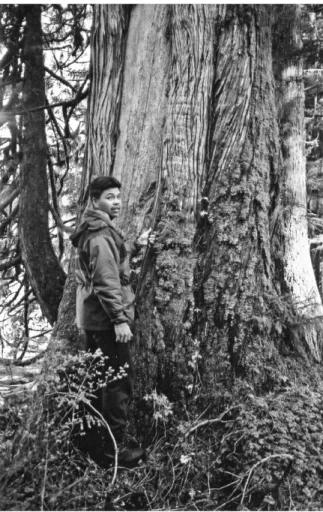
FIGURE 3. Haida cultural expert Captain Gold of Haida Gwaii, British Columbia, shows a ‘‘new’’ and ‘‘old’’ CMT of Thuja plicata, harvested for its fibrous bark, showing the characteristic triangular scar. Photograph by N. Turner.
Birch (Betula papyrifera and other species) is highly valued throughout its range for its tough, layered bark, which can be harvested sustainably from living trees. In North America the best known use of birch bark is for canoes (Figure 5), formerly constructed and used throughout the boreal forest region from the east coast to the Rocky Mountains and interior British Columbia. In areas that had large birch trees, a canoe could be made from a single sheet of birch bark. However, more frequently, as at Shoal Lake, smaller sheets of bark would be harvested and sewn together with split spruce roots. Once the canoe was built, the joins were sealed with pitch collected from balsam fir (Abies balsamea). While the birch canoe is quintessentially North American, various types and styles of birch-bark baskets, trays, baby cradles, and other types of containers were, and still are, made by peoples all around the circumpolar region, from Siberia and Kamchatka to Canada. These are generally sewn with tree roots or other fibers and sealed with pitch (Sentence 2001; Turner 1998, 2004).
FIGURE 4. Marven Robinson (Gitga’at, Hartley Bay) shows a Thuja plicata CMT, where a sheet of bark was extracted probably 60–80 years ago. Photograph by N. Turner.
Another widespread use of birch bark was as a writing medium. The oldest archaeological records of birch bark writing come from Kashmir in northwestern India, from the 10th century A.D. (Suryawanshi 2000; see also Rybina, 2001
regarding Viking Age birch bark letters). In North America birch bark scrolls were also used as writing sheets. The best known of these are the scrolls on which the Anishinaabe wrote down their teachings. These scrolls have been found in both archaeological and ethnographic contexts (Densmore 1974; Dewdney 1975; Kidd 1965).
Harvesting birch bark differs from that of most other tree barks because its anatomy allows the outer bark to be harvested around the circumference of the tree, leaving the inner bark and cambium intact and keeping the tree alive. The harvester must know when (during the spring) and how to remove the bark to avoid harming the tree. In Shoal Lake, for example, the Elders will only harvest birch bark when the raspberries (Rubus idaeus L. var. strigosus (Michx.) Focke) are ripe; this is when the outer bark can be harvested without damaging the inner bark and cambium (Davidson-Hunt et al. 2005).
Birch bark has a low cellulose and moisture content; its waxes and oils make it water resistant. It is also resistant to decay and insect attack due to the presence of suberine and betuline. Mechanically, the bark is flexible and can be readily bent, although not folded (Suryawanshi 2004). This has led to its use as sheeting, FIGURE 5. Chief Powassin Mending Canoe, c1912. Note burning stick being used to apply balsam fir pitch to seal seams where birch bark sheets stitched together. Result is illustrated in canoe not being worked on where the black bands created by application of pitch are visible. Photograph by Carl Gustav Linde. From the collection of the Lake of the Woods Museum (used by permission).
to cover structures of many sorts, and has allowed it to be stored and used for many years. These mechanical and chemical properties of birch bark have also made it a popular material for baskets and containers of many shapes and sizes, used to transport and store food and water, and to heat water for cooking using hot rocks (Densmore 1974).
Coppicing, Pruning and Pollarding
Coppicing is an ancient practice by which the stems or poles of trees and shrubs are cut at or below ground level to produce straight shoots (Rackham 1976). Both coppicing and pruning of willows (Salix spp.) or other shrubs and trees are used to produce flexible shoots for basketry (Anderson 1999, 2005). In North America, the rims of birch bark baskets are reinforced with willow, red-osier dogwood (Cornus sericea), or saskatoon (Amelanchier alnifolia) obtained from the first year of growth (Davidson-Hunt 2003; Turner 1998). Periodic cutting back of the shoots produces long withes which are flexible, free of nodes and less likely to break when bent. Similarly, in Europe, one-year-old willow withes have been used for basket making since ancient times (Bichard 2006). The stems were originally from wild willows, but over time selected clones were cultivated for weaving (Mabey 1996).
Ash (Fraxinus excelsior) also lends itself to coppicing and is the most common tree in coppiced woodlands across much of lowland Britain (Mabey 1996). Young ash poles, cut on a 10-year rotation, are described as the most versatile raw material in the British countryside, being used for everything from firewood to fork handles. The ‘‘stools’’ from which the poles are cut are said to produce straight, stout poles indefinitely. Ash poles are used to make walking sticks with handles, which are famous in parts of England. Ash trees are sometimes specially grown to have curved handles by planting seedlings at an angle in the ground with their end buds cut off, thus initiating the growth of a side bud. The stick is cut off when the growth is two or three years old, and the original stem, at right angles to the stick, forms the handle of the walking stick. Coppiced ash stems are also split and molded and used for ‘‘trug’’ and other garden baskets and for lobster and crab pots, called ‘‘creeves’’ (Mabey 1996).
The practice of coppicing living trees for fuel, tinder, construction and animal fodder is also widespread. Coppiced poles are often used as supports for growing hops and pole beans, and smaller, flexible coppiced branches of various species are used for wattle fences and walls, wickerwork, thatching, insulation materials, as well as fuel. Major species include hazel (Corylus spp.), sweet chestnut (Castanea sativa), oak (Quercus spp.), and ash (Fraxinus spp.) (Table 1; Figure 6; Bichard 2006: 659; Ertug 2006; Mabey 1996; Novellino 2006).
Since trees that have been coppiced have distinct shapes, these distinct forms can be used to detect ancient tree management. For example, Klinger (2006) reports unusual morphology in over 300-year-old trees of several species of California oaks (Quercus) and other ‘‘crop trees’’ (California buckeye, Aesculus californica; Pacific madrone, Arbutus menziesii; Monterey cypress, Cupressus macrocarpa; tan oak, Lithocarpus densiflorus; and bay laurel, Umbellularia californica) from sites in the Sierra Nevada foothills and coastal California. He found that trees with multiple large boles and long low bent limbs were entirely absent from younger cohorts and suggests that trees with these shapes had been coppiced,
pruned and trained to make their fruits more easily gathered by indigenous peoples. Furthermore, marine shells around the tree bases and lime from burnt shells on the trunks–both of which contribute nutrients and retard growth of moss and lichens–also support his conclusion that these trees were managed (see also Anderson 2005 for descriptions of ‘‘pruning’’ oak trees and coppicing).
When the trunk of a tree is cut at a point well above ground level, the practice is known as pollarding, and the thick trunk left behind is called the bolling (Rackham 1976). In the case of oaks, willows and many other species, coppicing and pollarding stimulate secondary buds found under the outer layer of bark, resulting in a new set of vertically growing branches, or poles. Pollarding, like coppicing retains the root structures yet enables trees to be used over and over again for producing new wood. Pollarding can actually prolong the life of a tree by reducing its top-heaviness and making it more wind-resistant. Pollarded trees can grow to a great age, and in Britain many have become landmark trees, exceptionally gnarled and full of character. They are symbolic of landscape continuity over many human generations. British woods are full of named, historic, pollarded trees: chestnuts, oaks, sycamores, limes, poplars and yews (Mabey 1996). A potential ecological disadvantage of pollarding might be the reduction of canopy cover, which would increase soil erosion and impact from rainfall if the trees are on sloped ground. However, keeping the roots of the trees intact to hold the soil in place offsets this risk.
FIGURE 6. Basket of strips of Castanea, coppiced from living trees in Turkey. Photograph by F. Ertug.
In the Sierra Tarahumara of Mexico, the Rara´muri people regularly pollard oaks (Quercus spp.) to produce firewood (Davidson-Hunt 2003). Around villages or towns, old oaks can be seen with thick trunks with many thin poles sprouting from the top. As these sprouts mature, they are harvested for fuel, a process repeated many times for the same tree. Trees lopped at ground level, in addition to producing fuel wood or basket materials, are grazed by goats, sheep and/or cattle, whereas the re-growth of pollarded trees cannot be eaten or trampled.
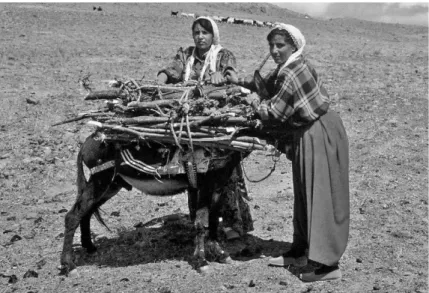
Coppicing and pollarding of oaks and other species to produce branches as fuel or charcoal, and/or for animal fodder is common in Anatolia (Figure 7), the United Kingdom, Nepal, India and many other parts of the world (Mabey 1996; Manandhar 2002; Rackham 1976). In parks, pasturelands and along hedgerows, trees in Britain are traditionally pollarded around 2 to 5 meters above the ground. Pollarding produces less reliably straight poles than coppicing, but, as in Mexico, the pollarded trees can coexist with cattle or deer, since the new shoots appear above the browse level (Mabey 1996). Pollards created for firewood can be harvested every 5 to 10 years and the stems can easily be cut in sections for fuel without requiring splitting.
A practice related to pollarding is shredding, or cutting off the crown of a tree, which results in a secondary branch taking over the function of the leader. Shredding is often undertaken on Himalayan cedar (Cedrus deodarus) and pines (Pinus spp.) in India and many species in England (Berkes et al. 1998; Rackham 1976). For example, in Northwest India, people cut the branches from the lower trunks of cedar and pine trees, leaving tufts of branches at the crown to grow. This allows continued nutrient production in the crown and retains the potential of the trunk for timber, while providing leafy material for animal bedding and feed, and branches for firewood. The residual branch stubs allow the harvester to climb the tree to obtain branches higher up (Berkes et al. 1998).
FIGURE 7. Villagers of Central Anatolia, bringing branches of oaks, which they have collected from Go¨llu¨ Dag-Nigde for feed-fuel, piled over donkey. Photograph by F. Ertug.
Bark, resin and other materials harvested from living trees are used for many other purposes–dyes, crafts, tannins, and perfumes (see Table 1 for examples). Some of these products have been commercialized. For example, the bark of the cork oak (Quercus suber), harvested from the outer layer of bark or ‘‘cork’’ and used since antiquity for fishing floats and stoppers for amphora, has been adapted to commercial use in the wine industry, and is also used as insulation. Produced year after year, it can be harvested multiple times from the same individual tree, so that even commercial production of cork has been sustainable (Prescott-Allen and Prescott-Allen 1986).
CMTs Created as Tree Art, Witness Trees or Marker Trees
Arborglyphs, taphoglyphs (grave marker trees), trail trees and message trees have been documented from around the world. Whether created as artistic expressions, message posts, during ritual events, or to mark graves, trails or territories, carved trees contributed to the creation of meaningful landscapes by facilitating the use and occupancy of forested environments (Andersson 2005; Davidson-Hunt 2003; Eldridge 1997; Etheridge 1918; Mallea-Olaetxe 2000; O¨ stlund et al. 2002; Ritzenhaler 1965). Blackstock (2001) cites carvings of faces and figures on trees from Cree, Gitxsan, Nisga’a, Tlingit, Carrier, and Dene areas in North America, which serve to create lasting markers for boundaries, ceremonial sites, to record stories and other culturally specific functions. In the western United States, shepherds from the Basque region of northern Spain, Peru and Mexico carved their names, dates, regional affiliations and depictions of their daily lives and dreams onto the bark of poplar trees (Mallea-Olaetxe 2000). Although the grazing patterns that prompted their creation are relatively recent, the carvings reflect patterns of resource use, which are traceable to different ethnic groups. Near Flagstaff, Arizona the dates and names of shepherds occur on historic shepherd trails and camps. The carved dates on trees indicate patterns of seasonal migration to higher elevations as new spring growth and warmer temperatures gradually reached higher elevations (P. Pilles, US Forest Service Peaks District Archaeologist, personal communication).
People around the world have carved their names or initials on trees located on a well-known route, or on trees located at an important destination to indicate that they have traveled on that route before. In addition, people sometimes carve their names on trees they planted. In Turkey, Yilmaz Ari observed and photographed a number of examples of writing on trees. In Australia, carved or scarred trees, especially Eucalyptus, were produced by Australian Indigenous peoples and European settlers in a wide variety of contexts, including as funerary markers and to mark ceremonially important sites (Etheridge 1918; Long 2005). In Sweden, writings on pine trees (Pinus sylvestris) by men and women herding dairy cows, dating from the late 18th century, mark boundaries used by different groups,
describe important events, and offer personal musings (Andersson et al. 2005, 2008). Wade (1969:i) describes the marking of trees by the Cherokee in northern Georgia before their removal to Oklahoma in the early 19thcentury:
Before the Cherokees’ removal on the infamous, ‘‘Trail of Tears’’ in 1838, they closed up their mines, buried their treasure and carved their
treasure signs on rocks and trees so skillfully that most of them can only be seen and deciphered by a member of the tribe or someone highly trained in this art. …They created sign trails by carving their symbols on trees that were normally long-lived…
In central British Columbia carved figures on trees in Lillooet (St’at’imc) territory were created by adolescent boys and girls as a ‘‘record of their observances’’ (Teit 1906: 282). In his 1927–28 Salish ethnography, Teit reproduces several tree art images, as well as similar rock art images (Teit and Boas 1930). In the Stein Valley of British Columbia, a place famous for its rock paintings, is an exceptional arboroglyph tree with a shallow cut design probably around 100 years old, three charcoal images and a recent pencil drawing, indicating a repeated use of the tree, possibly spanning a century (D. Lepofsky, personal communication 2008)
People around the world also marked trees by bending them to create distinctive growth patterns. Wade (1969) describes how the Cherokees in western Georgia bent sapling hardwoods by tying down the upper stem to the trunk. This led to a distinctive growth pattern as the tree aged and formerly dominant tops of the trees senesced leaving a ‘‘snout’’ while branches on the newly made ‘‘hip’’ become dominant (Janssen 1941). These distinctly bent trees have long been noted in the southeastern and midwestern United States, but the practice may be far more widespread (Mountain Stewards 2007). Southern Ute elders in the southern Rocky Mountains describe the process of bending ponderosa pine (P. ponderosa), which they refer to as ‘‘prayer trees’’ (Kaelin 2003). Other bent trees have been documented as trail markers, near campsites, historic meeting places, springs and portages, or as property boundary markers (Mountain Stewards 2007). Tree species selected for this treatment vary by region. In the American Southeast and Midwest white oak (Quercus alba), beech (Fagus grandifolia), elm (Ulmus americana), and maple (Acer spp.) are selected (Janssen 1941; Mountain Stewards 2007).
Although similar in appearance to trees with natural deformities (e.g., caused by being weighed down by snow, fallen trees, disease, or injury), culturally bent trail trees have some unique characteristics. Trees that have been bent naturally by a larger tree falling across it tend to bend at or near the base. In contrast, intentionally bent trees occur several feet above the ground as a person bends the tree around the height of their chest as they walk along the trail. In the Appalachian Mountains of Georgia ‘‘horse and rider trees,’’ bent at the height of a person on horseback as they ride down a trail have been documented (D. Wells, Director of Mountain Stewards, personal communication). In both cases the trunk is straight, and bends from obtuse to acute angles occur higher up the trunk than in naturally bent ones. Trail trees also tend to occur along natural travel corridors, such as along ridgelines and waterways (Mountain Stewards 2007). They are also likely to occur in groups, sometimes with one bent tree visible from the next. Bending trees may also take place in combination with the creation of appurtenances or knobs, which have been suggested to contain more complex messages such directions to a spring or other important sites that may not be obvious from the trail.
Culturally Modified Trees as Resource Management: Knowledge and Practice CMTs provide evidence of human adaptations to the environment and a legacy of traditional knowledge and management systems. People shape their home places through their selection and manipulation of species and through variously modifying habitats and ecosystems, producing cultural landscapes that, in turn, influence land use and people’s perceptions of the land. CMTs are part of these cultural landscapes–a result of human activity and a cultural product that, then, shapes that human activity, thought, beliefs, and actions. These modified trees become incorporated into the culture and identity of the people who produced them. As such, CMTs are one kind of tangible manifestation of peoples’ physical, emotional, and spiritual relationship with the world around them. By studying them we can get insights into these complex webs of human-environment interactions.
Kwakwaka’wakw historian and cultural specialist Dr. Daisy Sewid-Smith (Mayanilth) explained her peoples’ perspective on harvesting western red cedar bark and boards, a view that is widely shared by other First Nations on the Northwest Coast of North America (Turner 2005).
Yes, …if you remove too much of the bark you will kill that tree. And that was something that they were really careful of, that you do not remove too much to harm that plant. And even when they used to cut boards from the trees, they were very careful not to cut more than that tree could bear. It might be one or two boards from a tree, and then leave that tree standing to continue growing (Sewid-Smith et al. 1998).
Human use of tree parts while ‘‘keeping it living’’ (Deur and Turner 2005) is an achievement that requires knowledge based on detailed biological and ecological understanding. One can postulate that there is stepwise, cumulative learning and elaboration of environmental knowledge. Incremental learning pathways include retaining lessons from the past and perpetuating knowledge and experience encoded in language and in metaphorical sayings and narratives. Indigenous people often talk about learning from other places and from animals (Turner 2005; Turner and Berkes 2006). Developing an environmental knowledge system starts with observation; it requires monitoring or reading environmental signals, and trial and error experimentation to elaborate and build sophistication. Traditional cultures create ways of encoding, communicating and transmit-ting their environmental knowledge, for example through stories and narratives. There is a concomitant development of belief systems so that knowledge is reinforced by values. As well, societies develop institutions (rules-in-use) of knowledge and practice, and these institutions ensure continuity (Turner and Berkes 2006). In time, practitioners of these traditional systems learn about larger ecosystem processes (such as fire cycles in the boreal forest), and develop the capability of not only dealing with single species but also with suites of species (Berkes 2008). This is shown in the example of the Shoal Lake Anishinaabe use of birch and related species (Davidson-Hunt and Berkes 2003). Traditional cultures also learn to manage entire populations of trees, not just individuals, as reflected in the example of sap collecting practices for stands of Manitoba maples
(Davidson-Hunt and Berkes 2003) and of the groves of coppiced and trained oak trees from California (Klinger 2006). Some stands of CMTs, for example red cedar and yellow cypress on the Northwest Coast of North America, may represent not only a knowledge and ethic of conservation, but also the management of those stands by certain families (Lepofsky and Pegg 1996).
In many cases, the main reason people harvest parts of living trees has to do with resource use–obtaining food, medicines, and other livelihood needs. In many other cases, however, functional and spiritual aspects of CMT use are intertwined. For example, in India several rare species of Dipterocarps persist in a sacred grove of the Goddess Karikannama; the sacred grove also serves as the local community’s medicine chest (Gadgil 1987).
CMTs also frequently relate to questions of land tenure, cultural symbols and teachings, and spiritual connections (Andersson 2005; Blackstock 2001). They are, by definition, human-created artifacts, providing physical evidence of traditional land use and occupancy of an area (Arcas Consulting Associates 1986; Mack 1996; Stryd and Eldridge 1993; Stryd and Feddema 1998; Wessen 1995). Like place names (toponyms) in many cultures, and songs and stories that go with the land in the Australian aboriginal and other indigenous peoples’ traditions, CMTs provide proof of land tenure, proprietorship, and ownership. In Canada and elsewhere, CMTs can serve as concrete evidence of an Aboriginal Right, as enshrined in the Canadian Constitution. As symbols of rights and ownership, values of CMTs are often controversial.
In British Columbia, Canada as well as in Scandinavia and elsewhere, archaeologists have been at the leading edge of recognizing and describing CMTs (British Columbia, Archaeology Branch 2001; Eldridge 1997; Lepofsky and Pegg 1996; O¨ stlund et al. 2002, 2003; Stryd and Eldridge 1993; Stryd and Feddema 1998). Of course, the indigenous peoples who created the CMTs, and the descendants of these people today, have been well aware of their value and have long argued for their protection. Guujaaw, long-standing Chair of the Council of the Haida Nation, described CMTs as sacred memorials to ‘‘…our ancestors who worked in the forests and created the canoes and totem poles for which the Haidas are known worldwide’’ (1990, cited by Stryd and Feddema 1998:14; Turner and Wilson 2008).
The very activities that create CMTs, however–especially bark stripping for materials and food production–have been actively discouraged by foresters and others for decades. This opposition is ongoing, even in British Columbia where CMTs themselves have some degree of legal protection. In this region, stands of CMTs, termed ‘‘forest utilizations sites,’’ are protected by the Heritage Conservation Act of the province of British Columbia (1996), if it either can be demonstrated or shown to be likely that one or more in the group was modified prior to 1846 (Arcas Consulting Associates 1986; British Columbia, Government of 1996, 2001; Eldridge 1997; Stryd and Feddema 1998).
Under the provisions of the Act it is illegal to damage, move, or even take a core for dating purposes from a recognized CMT without an appropriate permit. This situation leads to confusion and conflict, however, since without coring or cutting down the tree, it is impossible to determine its age, or the date of the cultural modification. Frequently, it is only after a tree is cut down, with or
without a permit, that its antiquity as a CMT is proven, and of course, by then it is too late. Such a situation occurred recently on Haida Gwaii (Queen Charlotte Islands), at Naden Harbour, where several ancient and known western red cedar CMTs, including one dating back to 1550 AD, were cut by a timber company in the summer of 2007 (Turner and Wilson 2008). Another quandary for documentation of CMTs is that many of the oldest culturally modified trees will have entirely healed over, leaving no visible trace until the tree is cored or cut down (Dana Lepofsky, personal communication 2008).
CMTs are important because they are cultural symbols and related to indigenous teachings, and signify spiritual connections to the land. Many indigenous people consider the places where culturally modified trees occur as spiritual or sacred sites because they represent peoples’ direct connections to their ancestors and to their ancestral lands (Clayoquot Scientific Panel 1995). Many of the African, Indian, and Southeast Asian sacred groves are about spiritual connection to ancestors (cf., Ramakrishnan et al. 1998). Numerous indigenous groups value sacred sites and CMTs for their teaching and learning opportunities, and the continuity they represent with past practices (Guujaaw 1990, cited in Stryd and Feddema 1998).
Sacred areas, often containing CMTs, are found throughout the world, and many of them are incorporated into UNESCO’s World Heritage Sites network (Schaaf and Lee 2006). Many national parks and other protected areas also contain sacred sites. These areas are often selected for protection precisely because local communities have set them aside and maintained their high natural biodiversity as an indirect outcome of cultural conservation. Hence culturally protected sites, including those encompassing CMTs, have a role to play in contemporary protected area systems for biodiversity conservation (Berkes 2008). Equally important, sacred areas and CMTs have a role to play in teaching modern society about nature stewardship. Trees are revered in many ancient cultures. Many of the world’s religions, from the Amazon to pre-Islamic Central Asia, to the Vikings of Scandinavia, make reference to the Tree of Life. Turkish descendents of ancient Central Asian peoples still weave the design of the Tree of Life into Anatolian carpets. Various species of trees are worshipped in different cultures. In the Indian subcontinent, large Ficus trees may be modified but are nearly always protected. Signifying pre-Islamic practice in present-day north-western Turkey, a Pinus nigra growing at the top of Mount Ida (Figure 8) is associated with the tomb of a holy person and carries prayer flags similar to those that one might see in Buddhist Tibet and Central Asia. The oak tree was worshipped by Romans, Druids, and Celts as the home of deities. In ancient Europe, fairies were said to make their homes in old oak trees, departing through holes where branches had fallen (Laird 1999).
Conclusion
The numerous and diverse examples of tree modification presented here demonstrate the widespread human use of trees’ versatility and capacity for regeneration from their meristematic tissues. Living trees showing evidence of past harvesting, shaping, or cultural marking are parts of complex systems of
local and indigenous knowledge, developed through centuries or millennia of experience and observation, and passed down from generation to generation through teaching and participatory learning. Stories, ceremonies, and belief systems are intertwined with these practices, and together they help to perpetuate and sustain peoples’ use of trees. From reliance on cambium and inner bark tissues as a food, especially in times of scarcity, and the use of bark for weaving and basketry, to the coppicing and splitting off wood from trunks, the lopping or pollarding branches for fuel, poles, thatch or weaving, and the harvesting of resin and bark for medicinal purposes, fire starters, spices, dyes or other materials, trees–living trees–have provided us with a whole array of sustaining resources.
Unfortunately, as can often happen, when production of a resource escalates from local consumption only to a marketed commodity, sustainability generally suffers. In British Columbia, for example, multinational forestry companies, seeking timber and pulp for a world market, cannot earn enough capital from harvesting only parts of trees. Instead, an entire industry has developed over the past century and a half of ‘‘clearcutting’’ forests, felling the giant trees of the coastal temperate rainforest at a rate so rapid that even when the trees are ‘‘replaced’’ by planted seedlings, the forests themselves are cut down again when FIGURE 8. Pinus nigra, a sacred tree, at the top of Mount Ida in northwestern Turkey. Photograph by Yilmaz Ari.
the second growth has reached only a fraction of its potential age and size. In this scenario, trees are not seen as living beings, or relatives, but as a ‘‘standing crop of fiber’’ to be cut, milled, and sold. This situation is occurring in forests all over the world–tropical, subtropical, temperate, and boreal. The CMTs themselves– evidence of past human use and management of trees–are being destroyed along with trees and forests in general, despite protective legislation for some types of CMTs in some places (Ericsson et al. 2003; Ramakrishnan et al. 1998). Furthermore, in part due to official bans against damaging trees in areas as distant from each other as western Canada, Australia, and Turkey, the creation of CMTs for food collection or basketry materials, for example, has decreased markedly over the 20th century. Ironically, government sanctioned damage to
trees and entire forests has been far more destructive than local people’s harvesting from living trees (Andersson 2005).
We may never fully understand the extent and overall patterns of tree peeling and other types of CMT creation at different scales of time and space because our sampling is now biased towards unlogged areas. Large protected areas that have never been commercially logged may indeed provide the best opportunities for sampling and understanding the patterns of CMT distributions. However, a range of other disturbances–urban development, flooding, sea level change, and global climate change–have also been at play, affecting the existence of CMTs and the knowledge they embody (Fedje and Josenhans 2000).
CMTs represent our collective human heritage. What need to be conserved are not just the trees themselves but the knowledge, practices, and institutions that tell us which trees can be harvested and kept living, and how to harvest the resources we use and still keep the trees alive and healthy. CMTs uniquely provide us with information on exact locations and exact points of time–even to season–of particular human activities relating to the harvesting of edible plants and particular materials (cf., Prince 2001). They can help connect archaeological materials with specific settlement and resource use in the past. We also need to understand the context of their creation–the constellations of activities and practices accompanying tree use. For example, some archaeologists have noted that prime berry patches are often found in the vicinity of CMTs, indicating resource nodes (J. Stafford, personal communication). Perhaps, most importantly, we need to acquire and retain the perspective and worldview reflected in many CMTs: the culture of care, respect, reverence and attention to trees as generous living beings, essential to the world’s ecosystems, and whose lives should not be forfeited unnecessarily.
Acknowledgements
Many people have contributed to this paper. We particularly acknowledge Elsie Claxton, Archie Dundas, Elizabeth Dundas, Morley Eldridge, Captain Gold, Dr. Marianne Ignace and Dr. Ron Ignace; Dr. Kepa Morgan, Lars O¨ stlund, Yas¸ar Kemal and Mary Is¸ın (for her translation of the quotation from Yas¸ar Kemal); Edith O’Donaghey, Peter Pilles, Ranjay Singh, Marven Robinson, Tina Robinson, Dr. Daisy Sewid-Smith, James Stafford and Don Wells, of Mountain Stewards. We also thank our two helpful and conscientious peer reviewers, whose suggestions we greatly appreciate. We are deeply grateful to Dr. Dana Lepofsky for editing this issue, for her help and encouragement, and especially for