1 Computational investigation of intramolecular reorganization energy in
1
diketopyrrolopyrrole (DPP) derivatives 2
Şule ATAHAN EVRENK 3
Faculty of Medicine, TOBB University of Economy and Technology, Ankara, Turkey 4
5
2 Computational investigation of intramolecular reorganization energy in
6
diketopyrrolopyrrole (DPP) derivatives 7
Şule ATAHAN EVRENK 8
Faculty of Medicine, TOBB University of Economy and Technology, Ankara, Turkey 9
Correspondence: [email protected] 10
Abstract: Intramolecular reorganization energy (RE) of molecules derived from the 11
diketopyrrolopyrrole (DPP) unit has been studied using the B3LYP/6-31G(d,p) theory. It 12
was found that the replacement of the oxygen atoms with sulfur in the DPP unit led to a 13
smaller RE for both the hole and electron transfer processes. One disadvantage of the sulfur 14
replacement is the twist of the conjugated backbone which might impair the π–π 15
interactions in the solid state. The RE calculated from the adiabatic potential energy 16
surfaces and that derived from the normal mode analysis agreed well for both the systems. 17
Electronic structure data showed that the replacement of oxygen atoms with sulfur in the 18
DPP unit might lead to the development of ambipolar compounds with low RE. 19
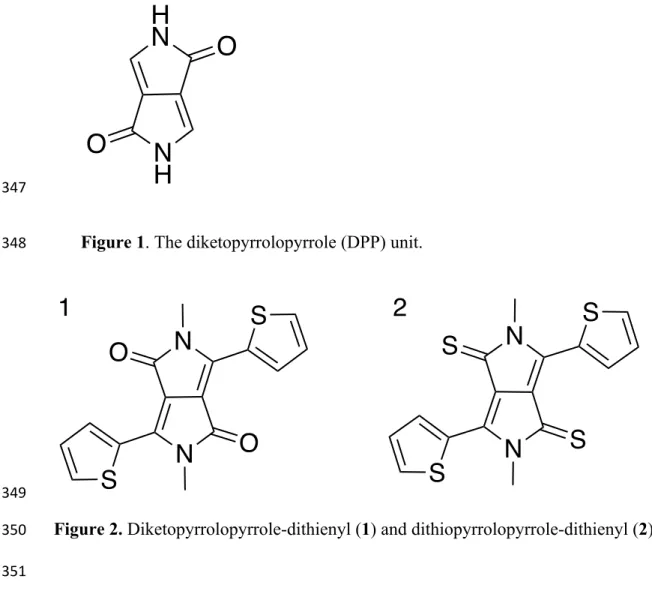
Key words: Diketopyrrolopyrrole, dithiopyrrolopyrrole, reorganization energy, charge 20 transfer 21 1. Introduction 22 -- Figure 1 -- 23
The electron-deficient diketopyrrolopyrrole (DPP) unit (Figure 1) has been extensively 24
used to build organic semiconductors (OSCs) for transistors, 1–3 organic photovoltaics 25
(OPVs), 2,4–6 and light emitting diodes. It has also been utilized for building compounds for 26
imaging purposes. 7 Both the highest occupied molecular orbital (HOMO) and the lowest 27
3 unoccupied molecular orbital (LUMO) of DPP are low-lying. Moreover, strong π–π
28
interactions among the DPP units in the polymers facilitate aggregation and improve the 29
device performance. Therefore, the DPP unit has emerged as a versatile building block for 30
small band gap OPV compounds as well as organic field-effect transistors (OFETs) with 31
ambipolarity. 8 32
Charge mobility plays a crucial role in the device performance, which is important for all 33
electronics applications. Reorganization energy (RE) is one of the most important charge 34
transport parameters that strongly influences charge mobility. It refers to the relaxation 35
energy for the nuclei to adapt to the charge transfer process. The smaller the RE, the higher 36
is the charge transfer rate. For example, in the non-adiabatic Marcus charge transfer theory, 37
the rate of charge transfer decreases exponentially with the increasing RE. 9 38
In molecular van der Waals solids, an approximate RE value can be calculated based on the 39
assumption that the intramolecular electron-vibronic coupling is the largest contributor to 40
the RE. 10 The external contribution to the RE was found to be much smaller than the 41
intramolecular contribution. 11 Moreover, the intramolecular RE has been successfully used 42
for the theoretical characterization of OSCs and screening of molecules to identify the 43
potential for high performance. 10,12,13 Thus, in this study, we have focused on the 44
intramolecular RE, and henceforth, RE refers in particular to the intramolecular RE. 45
Understanding the structural factors that affect the magnitude of the RE is helpful for 46
improving OSC designs. Consequently, a lot of effort has been dedicated to the 47
investigation of the relationship between the molecular structure and RE. The effect of a 48
4 particular conjugated backbone structure 14,15 and the substitutions, 16 in addition to
49
geometrical parameters such as the size, length, and linearity of the conjugated backbone 50
have been previously investigated. 17 In OSCs, the substitutions were usually employed to 51
engineer the carrier type and crystal morphologies, and also to control the solution 52
processability. Most substitutions such as fluorination, chlorination, and alkoxy 53
substitutions, however, increase the RE. 18 Therefore, it is of interest to find design 54
strategies that reduce the RE in OSCs. 55
-- Figure 2 -- 56
Among the studies of the RE with the molecular structure, the ones which present a detailed 57
study of the electron-vibration coupling in terms of the individual contributions from the 58
particular couplings of vibrational modes to the electronic motion is of great value. They 59
provide a quantitative basis for the identification of the structure-property relationships. 60
16,19,20 In this work, first we present such an analysis of the RE for the molecular structures
61
shown in Figure 2. In the first molecule (1), the two sides of the DPP unit are flanked with 62
two thiophene rings. Molecule 2 is the sulfur analogue of molecule 1, where the oxygen 63
atoms are replaced with sulfur atoms. We studied molecule 2 to test the hypothesis that 64
hindering the short axis stretching motion might reduce the strong coupling seen in the case 65
of molecule 1 and consequently reduce the magnitude of the RE. Therefore, we performed 66
a detailed analysis of the couplings of the electronic motion with the particular vibrational 67
modes in molecules 1 and 2 for both the hole- and electron-transfer processes. To test the 68
hypothesis in a larger library, we extend the molecular library to six molecules obtained by 69
5 flanking one of the ends of molecule 1 and 2 with either one of the heterocycles: thiophene, 70
furan or selenophene. 71
Previous research on the dithiopyrrolopyrrole (DTPP) unit has been rather limited. To the 72
best of our knowledge, there are only two previous reports. 21,22 One study investigates the 73
structural isomers of the dithiopyrrolopyrrole unit 19 and the other demonstrates that the 74
unit can be used as an acceptor in low band gap donor-acceptor polymers produced for 75
OPV and near-IR photo detector applications. 20 At present, there are no studies analyzing 76
the RE for molecule 2. The RE for the derivatives of molecule 1, obtained by the addition 77
of various thiophene groups to 1, has been reported. 23 Makarova et al studied another 78
oligomer derived from molecule 1 by flanking the both ends with thiophene rings. 24 None 79
of these works however include a detailed analysis of the RE to examine the couplings 80
from particular vibrational modes to the charge transfer process. 81
In the following, we summarized the computational methodology and focused on the 82
detailed comparison of the RE for molecules 1 and 2. The RE values calculated for the 83
extended set show that the substitution lowers the RE in molecules derived from 1 and 2 as 84
well. This work presents a structural variation that can lower the RE, and thus aims to 85
contribute to the improvement of the computational strategies in the design of OSC 86
materials. It is worth noting that several factors affect the charge mobility as well, and it is 87
not reasonable to conclude that the molecular variation discussed here is going to lead to a 88
certain expected experimental device performance. It is our objective to simply determine 89
whether further experimental study can be potentially beneficial. 90
6 2. Computational methods
92
-- Figure 3-- 93
There are various approaches to calculating the RE that have been reported in literature. 94
Assuming a gas-phase self-exchange type of a charge transfer reaction such as 𝑴𝟏+ 95
𝑴𝟐!/! → 𝑴
𝟏!/!+ 𝑴𝟐, the RE can be calculated according to a four-point scheme from 96
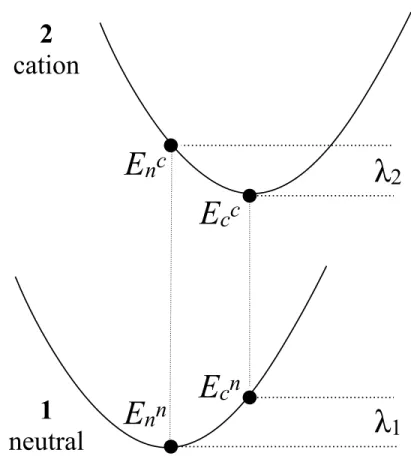
the adiabatic potential energy surfaces of the neutral and ionic states of the molecule. 19,25 97
Figure 3 illustrates this scheme for the hole transfer process. This adiabatic scheme captures 98
the relaxation energies during the charge transfer from a neutral molecule to a neighboring 99
ion of the same molecule. The computation involves two geometry optimizations and four 100
single-point calculations and the RE is derived from the total energy differences. 101
This total energy difference approach does not provide information about the RE 102
contributions from the coupling of specific vibrational modes to the electronic motion. 103
The contribution from a particular vibration-electronic coupling to the RE can be 104
determined by using a decomposition method previously outlined by Reimers. 26 In this
105
method, first the dimensionless projection of the coordinate displacements onto the normal 106
modes of the neutral or ionic state are calculated. This is done according to the following 107 equation: 108 𝜹𝟏= 𝐈𝟏!𝟏𝑪 𝟏 𝑻𝒎𝟏𝟐 𝐱 𝟐 𝐨− 𝐱 𝟏 𝐨
Here 𝐈! refers to the zero-point lengths of the normal modes and is defined as 𝐼!!! = 109
ℏ !!!!!
!/!
for the neutral ground state, where 𝜈!! is the ith vibrational frequency. 𝑪𝟏 is a 110
3𝑛 × 𝑛! matrix including the normal mode coordinates (n atoms have 𝑛! = 3𝑛 − 6 normal 111
7 coordinates); 𝒎 is a 3𝑛 × 3𝑛 diagonal matrix which has the corresponding atomic masses 112
for the Cartesian coordinates; and 𝐱𝟏𝐨 and 𝐱 𝟐
𝐨 are the Cartesian coordinates for the optimized 113
neutral and ion geometries, respectively. Note that the normal modes are the eigenvectors 114
of the mass-weighted Hessian matrix. If the normal modes were not mass-weighted, such as 115
in the case of the output from the Q-Chem frequency calculation, the normal vectors are 116
multiplied with a correction factor such as 𝐶!! × 𝑚!/ 𝜇!!, where 𝜇! is the reduced mass 117
for the particular normal mode i, and 𝑚! is the mass of the jth atom. 118
Thus, 𝛿!! is a unitless projection of the change in the Cartesian coordinates onto the normal 119
coordinates of the molecule in the neutral state. The same relationship can then be used to 120
obtain 𝛿!!, which is the projection of the same vector onto the normal coordinates of the 121
molecule in the ionic state. The relationship of 𝛿 with the well-known Huang-Rhys factor is 122
𝑆 = !!! . 9
123
The dimensionless projection 𝛿!!, is then used to calculate the contribution of each normal 124
mode of the neutral geometry to the RE as 𝜆!! =!!𝜈!!𝛿!!!. The total RE for the neutral mode 125
projection is obtained as 𝜆! = !!!!𝜆!!. The same sequence can be repeated for the ionic 126
state and the contributions to total RE are calculated by the projection of the Cartesian 127
displacements onto the normal modes of the ionic state as 𝜆! = ! 𝜆!!
!!! , where 𝜆!! = 128
! !𝜈!!𝛿!!
!. Finally, the total RE is obtained by a simple sum of the neutral and ionic 129
contributions as 𝜆 = 𝜆!+ 𝜆!. 130
8 The initial geometries were obtained with the ChemAxon geometry plugin. 27 The
131
geometries were optimized with the B3LYP/6-31G(d,p) density functional theory, 28–32 132
except for the anion geometries, where the basis set (6-31G+(d,p)) with diffuse functions 133
was used. The tight convergence thresholds were held throughout. The true minima were 134
confirmed by the absence of the negative vibrational frequencies. It was observed that the 135
spin contamination was always less than 4% for the ionic states. All electronic structure 136
calculations were performed using Q-Chem 4.2. 33 The normal mode analysis of the RE 137
was performed by using an in-house Python code. 138
3. Results and discussion 139
3.1. Geometry 140
- Figure 4-- 141
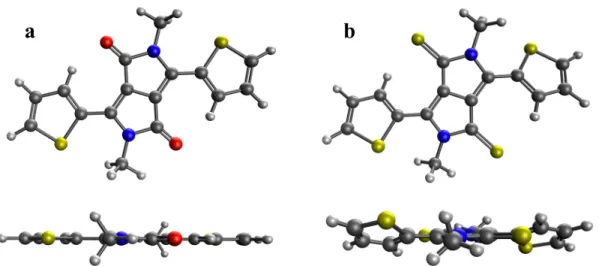
The optimized geometries for the lowest energy conformers of the molecules are shown in 142
Figure 4. A flat backbone for molecule 1 can be observed regardless of whether symmetry 143
has been imposed or not. This is also true for both the cation and anion states. In contrast, 144
the large sulfur atoms in 2 cause the backbone to twist, resulting in dihedral angles along 145
the N–C–C–S atoms as 27.5°, 25.8°, and 27.6° for the neutral, cation, and anion 146
geometries, respectively. Therefore, the presence of sulfur atoms instead of oxygen in the 147
DPP unit might adversely influence the π–π interactions in the solid state. 148
-- Figure 5-- 149
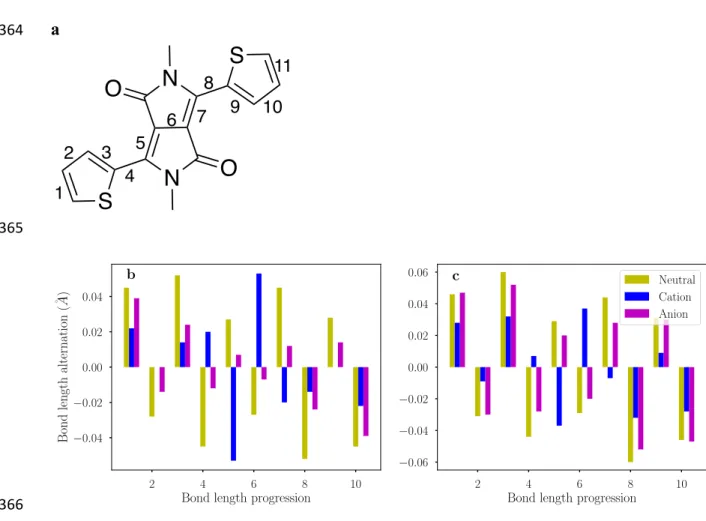
Bond length alternation, calculated as 𝑩𝑳𝑨 = 𝑹𝟐− 𝑹𝟏, where 𝑹𝟏 and 𝑹𝟐 refer to bond 150
lengths of two consecutive bonds along the conjugation length, provides an insight into the 151
relaxation process. Figure 5 illustrates how BLA varies along the conjugation length of the 152
9 molecules for the neutral, anion, and cation states. The BLA for all of the species are
153
symmetric and the neutral and anion alternations show a trend similar to the conjugation 154
structure shown in Figure 5a. This is also true for molecule 2. In contrast, the cation BLA 155
distributions have a reverse BLA pattern for the DPP unit, which indicates the switch of the 156
double bond to a position in between the shared carbon atoms of the pyrrole cycles (bond 6 157
in Figure 5a). The same is true for the cationic state of molecule 2 as well. For both 158
molecules, smaller geometric distortions are generally observed upon electron transfer. 159
Therefore, a smaller RE value for electron transfer is expected in comparison to hole 160
transfer from the analysis of the BLA patterns. 161
-- Table 1 -- 162
Table 1 presents the electronic structure data and the RE values obtained from the potential 163
energy surfaces and the normal mode analysis for molecules 1 and 2. The introduction of 164
the sulfur atoms into the DPP unit reduces the frontier orbital energies, and increases the 165
adiabatic ionization potential and electron affinity. The carrier type of an OSC can be 166
correlated with the frontier orbital energy levels. 34,35 The polymers derived from molecule 167
1 shown ambipolar conductance in the OFETs. Based on the lower HOMO and LUMO 168
values for molecule 2, a potential for ambipolar mobility of the polymers derived from this 169
unit is expected. 170
In addition to the frontier molecular orbital energy levels of the neutral molecule, we also 171
report the HOMO values for the optimized cation geometry 𝜖!!"!! . A previous study 17
172
showed that the HOMO energy difference 𝜖!!"!! − 𝜖
!!"! is a good predictor of the RE 17 173
for the hole transfer in polyaromatic hydrocarbons. Although this observation is strictly true 174
10 for an exact exchange-correlation functional, for the hybrid functional employed here the 175
energy difference is also a good descriptor of the reorganization energy. The difference is 176
327 and 218 meV for molecules 1 and 2, respectively, which closely resembles the 𝜆! 177
values of 331 and 217 meV obtained from the potential energy surfaces. 178
The RE for the hole transfer is above average compared to other high-performance OSCs. 179
For example, the RE of hole transfer in pentacene is 98 meV. 36 On the other hand, it was
180
found that the RE for the electron transfer, 𝜆!, was almost half of that of the hole transfer 181
process. This explains the high electron mobility measurements in these materials 1. 182
The substitution with sulfur atoms in the DPP unit leads to a 35% decrease in the RE for 183
hole transfer. Albeit more moderate, there is also a decrease (~18%) in the RE for the 184
electron transfer process. Therefore, an improvement in the both the charge transfer rates is 185
expected based on the assumption that the substitution does not change the intermolecular 186
electronic coupling. In the next section, we present the details of the coupling and the 187
reasons for the decrease in the RE upon sulfur substitution. 188
3.2. Vibronic coupling and molecular orbital shapes 189
-- Figure 6-- 190
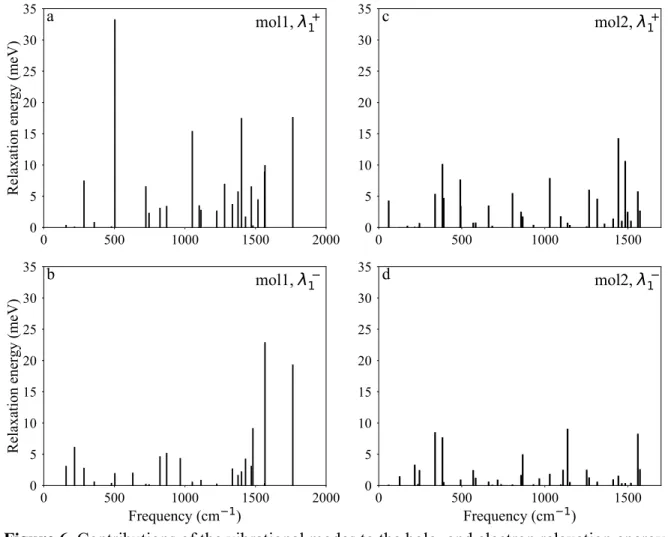
Figure 6 shows the distribution of the relaxation energy over the vibrational frequencies of 191
molecules 1 and 2. For brevity, only the projections to the normal modes of the neutral 192
ground state, 𝝀𝟏, have been included. This is because the contributions 𝝀𝟏 and 𝝀𝟐 are 193
almost equal and show similar distributions. For example, the hole transfer RE components 194
𝝀𝟏 and 𝝀𝟐 for molecule 1 are both 166.6 meV, while they are 115 and 105 meV, 195
respectively, for molecule 2. 196
11 --Figure 7--
197
-- Figure 8-- 198
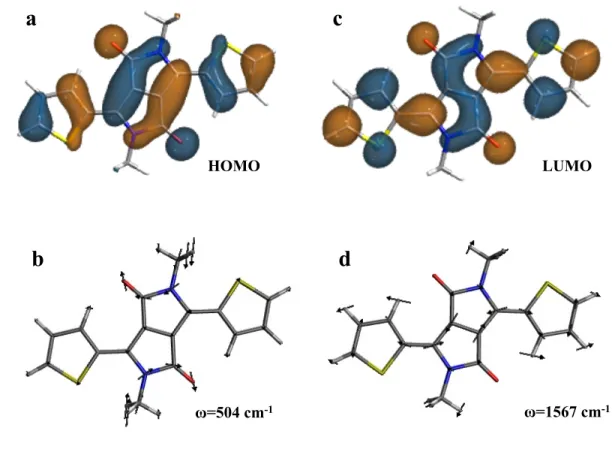
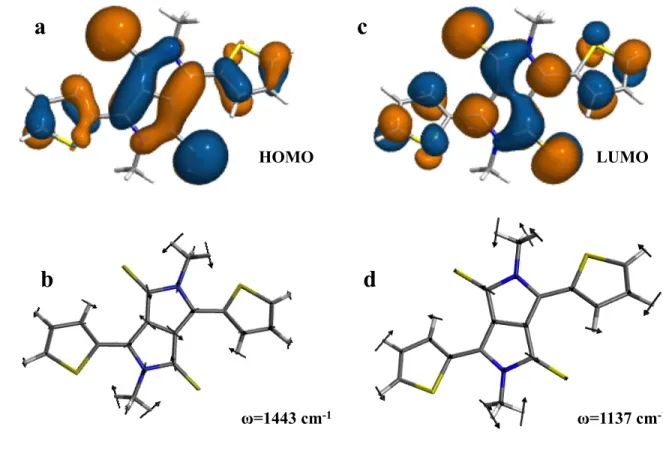
The shape of the frontier orbitals and the vibrational normal modes with the highest 199
contributions to the RE are shown in Figure 7 and 8 for molecule 1 and 2, respectively. The 200
exact numbers of all of the electron-vibration couplings are listed in the Tables 2 and 3. 201
Only those frequencies for which a significant electron-vibration coupling observed, such 202
that any one of the Huang-Rhys parameters 𝑺𝟏! or 𝑺 𝟏
! is greater than 0.001, have been 203
reported. 204
The analysis of the frontier molecular orbitals together with the Huang-Rhys factors 205
provides a fingerprint for the analysis of structure-relaxation relationships. 20,37,38 The 206
coupling is usually strong for those frequencies for which the normal displacements match 207
the pattern of the particular molecular orbital involved in the charge transfer process. This 208
would be the HOMO for the hole transfer and the LUMO for the electron transfer. 37 In our 209
analysis, the first notable difference observed on comparing the relaxation energies was that 210
molecule 1 had the strongest contribution from the vibrational mode of 504 cm–1 for the 211
hole transfer, although this coupling was very small for the electron transfer process (Figure 212
6a and 6b). The normal coordinates for this mode are shown in Figure 7a. This normal 213
coordinate involves a vertical stretch of the DPP unit in the molecule. As seen in Figure 7a 214
and 7b, the normal coordinates strongly match the HOMO pattern over the DPP unit. The 215
same stretching mode does not show any significant coupling in the case of the electron 216
transfer. This could be rationalized by evaluating the LUMO in Figure 7c. On the other 217
hand, the stronger coupling for the electron transfer process corresponds to the vibrational 218
12 mode with the frequency of 1567 cm–1 (Figure 7d). This mode involves the stretching 219
vibration along the long-axis of the molecule 1. 220
The replacement of the oxygen atom with the heavier sulfur atom dampens the stretching 221
mode over the DPP unit. In turn, this reduces the coupling of the vibrational mode at 491 222
cm–1 and results in a significant reduction in the RE (as seen in Figure 6a and 6c). 223
The largest contribution to the hole transfer RE in the case of molecule 2 arises from the 224
coupling of the vibrational mode at 1443 cm–1. The normal mode vectors for the vibration 225
at 1443 cm–1are shown in Figure 8d. For electron transfer, the largest contribution is from 226
the mode at 1137 cm–1. 227
-- Figure 9 -- 228
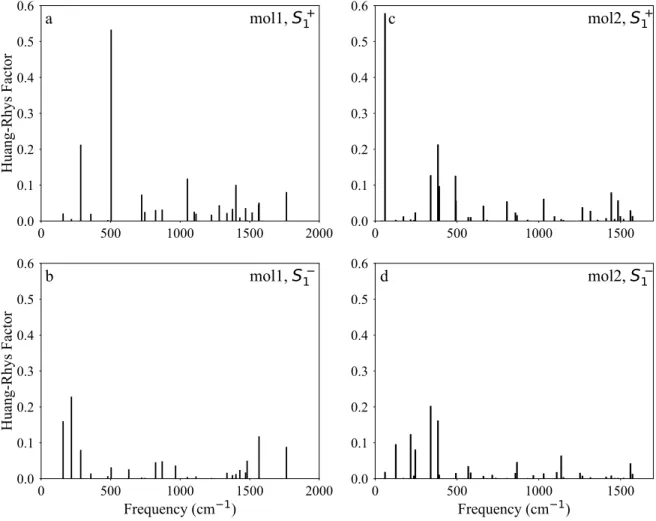
The Huang-Rhys factors for the two molecules are shown in Figure 9. Since these factors 229
are dimensionless, a stronger Huang-Rhys value in the lower frequency region indicates a 230
small contribution to the RE. Comparing the Huang-Rhys distributions for molecules 1 and 231
2 for hole transfer (Figure 9a and 9c), it is evident that the strongest coupling in molecule 2 232
is for the vibrational frequency of 60 cm–1. Moreover, the Huang-Rhys factors for the high 233
frequency vibrations are very small. For electron transfer, the Huang-Rhys values are 234
smaller in magnitude and the stronger couplings correspond to the low frequency modes in 235
both molecules. In general, this lowers the total RE for the electron transfer as compared to 236
the hole transfer process. 237
3.3. The extended oligomers 238
-- Figure 10 -- 239
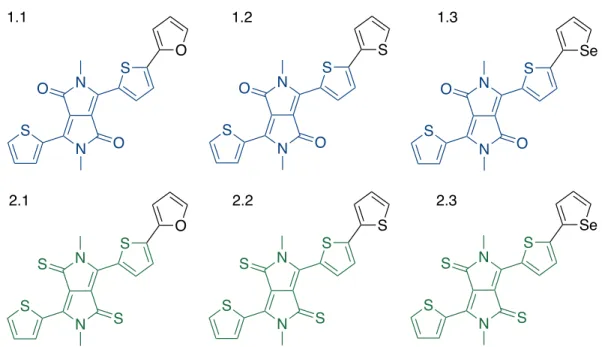
13 We further illustrate the reduction of the RE with the sulfur substitution in DPP unit by 240
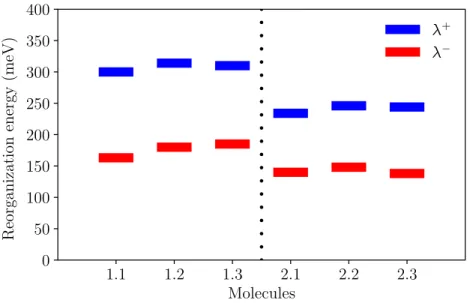
calculating the RE for a series of compounds derived from molecule 1 and 2. Figure 10 241
shows the thiophene, furan and selenophene end-capped molecules, labeled to represent the 242
original molecule from which they are derived. The electronic data for the molecules were 243
summarized in Table 4. Figure 11 clearly shows that the compounds derived from molecule 244
2 have lower RE compared to the molecule 1 derived analogues. The change in the RE 245
with the replacement of the end heterocycle as we go down the periodic table from oxygen 246
to selenium is smaller than the effect of the sulfur substitution in the DPP unit. Moreover, 247
both the HOMO and LUMO energies decreased after substitutions and this shift is much 248
larger than the effect of the addition of the end heterocyles. 249
4. Conclusion 250
In this article, we presented a detailed theoretical analysis for the RE of two derivatives of 251
the DPP unit. We demonstrated that the substitution of the oxygen atoms of the DPP unit 252
with sulfur results in a smaller coupling of the vibrational and electronic motions during 253
charge transfer. In all the molecules we studied, we observed a smaller RE for the electron 254
transfer processes as compared to the hole transfer. The molecular orbital levels and the RE 255
values indicated that molecule 2 could be a viable option as an ambipolar material, with the 256
only caveat being its twisted backbone, which might reduce the π–π interactions in the solid 257
state. 258
Acknowledgements 259
This research was financially supported by the TÜBİTAK (The Scientific and Technological 260
Research Council of Turkey) BİDEB 2232 Program (Grant No: 114C153) and software support 261
from ChemAxon Ltd. 262
14 References
263
(1) Nielsen, C. B.; Turbiez, M.; McCulloch, I. Adv. Mater. 2013, 25, 1859–1880. 264
(2) Li, Y.; Sonar, P.; Murphy, L.; Hong, W. Energy Environ. Sci. 2013, 6, 1684–1710. 265
(3) Sonar, P.; Singh, S. P.; Li, Y.; Soh, M. S.; Dodabalapur, A. Adv. Mater. 2010, 22, 266
5409–5413. 267
(4) Ripaud, E.; Demeter, D.; Rousseau, T.; Boucard-Cétol, E.; Allain, M.; Po, R.; 268
Leriche, P.; Roncali, J. Dye. Pigment. 2012, 95, 126–133. 269
(5) Qu, S.; Tian, H. Chem. Commun. 2012, 48, 3039–3051. 270
(6) Sonar, P.; Ng, G.-M.; Lin, T. T.; Dodabalapur, A.; Chen, Z.-K. J. Mater. Chem. 271
2010, 20, 3626–3636. 272
(7) Grzybowski, M.; Gryko, D. T. Adv. Opt. Mater. 2015, 3, 280–320. 273
(8) Tieke, B.; Rabindranath, A. R.; Zhang, K.; Zhu, Y. Beilstein J. Org. Chem. 2010, 6, 274
830–845. 275
(9) Barbara, P. F.; Meyer, T. J.; Ratner, M. A. J. Phys. Chem. 1996, 100, 13148–13168. 276
(10) Coropceanu, V.; Cornil, J.; da Silva Filho, D. A.; Olivier, Y.; Silbey, R.; Bredas, J.-277
L. Chem. Rev 2007, 107, 926–952. 278
(11) McMahon, D. P.; Troisi, A. J. Phys. Chem. Lett. 2010, 1, 941–946. 279
(12) Sokolov, A. N.; Atahan-Evrenk, S.; Mondal, R.; Akkerman, H. B.; Sánchez-Carrera, 280
R. S.; Granados-Focil, S.; Schrier, J.; Mannsfeld, S. C. B.; Zoombelt, A. P.; Bao, Z.; 281
Aspuru-Guzik, A. Nat. Commun. 2011, 2, 437. 282
(13) Schober, C.; Reuter, K.; Oberhofer, H. J. Phys. Chem. Lett. 2016, 7, 3973–3977. 283
(14) Chang, Y. C.; Chao, I. J. Phys. Chem. Lett. 2010, 1, 116–121. 284
15 (15) Chen, H. Y.; Chao, I. ChemPhysChem 2006, 7, 2003–2007.
285
(16) Geng, H.; Niu, Y.; Peng, Q.; Shuai, Z.; Coropceanu, V.; Bredas, J. L. J. Chem. Phys. 286
2011, 135, 104703. 287
(17) Misra, M.; Andrienko, D.; Faulon, J.; Lilienfeld, O. A. Von. J. Chem. Theory 288
Comput. 2011, 7, 2549–2555. 289
(18) Chen, H. Y.; Chao, I. Chem. Phys. Lett. 2005, 401, 539–545. 290
(19) Coropceanu, V.; Cornil, J.; da Silva Filho, D. A.; Olivier, Y.; Silbey, R.; Bredas, J.-291
L. Chem. Rev. 2007, 107, 926–952. 292
(20) Coropceanu, V.; Kwon, O.; Wex, B.; Kaafarani, B. R.; Gruhn, N. E.; Durivage, J. C.; 293
Neckers, D. C.; Brédas, J.-L. Chem. Eur. J. 2006, 12, 2073–2080. 294
(21) Nourmohammadian, F.; Yavari, I.; Mirhabibi, A. R.; Moradi, S. Dye. Pigment. 2005, 295
67, 15–20. 296
(22) Qian, G.; Qi, J.; Wang, Z. Y. J. Mater. Chem. 2012, 22, 12867–12873. 297
(23) Gunther, F.; Gemming, S.; Seifert, G. J. Phys. Chem. C 2016, 120, 9581–9587. 298
(24) Makarova, M. V.; Semenov, S. G.; Guskova, O. A. Int. J. Quantum Chem. 2016, 299
116, 1459–1466. 300
(25) Nelsen, S. F.; Blackstock, S. C.; Kim, Y. J. Am. Chem. Soc. 1987, 109, 677–682. 301
(26) Reimers, J. R. J. Chem. Phys. 2001, 115, 9103–9109. 302
(27) ChemAxon. Calculator Plugins, Marvin 15.1.5 (http://www.chemaxon.com). 2015. 303
(28) Becke, A. D. J. Chem. Phys. 1993, 98, 5648–5652. 304
(29) Lee, C.; Yang, W.; Parr, R. G. Phys. Rev. B 1988, 37, 785–789. 305
(30) Hariharan, P. C.; Pople, J. A. Theor. Chim. Acta 1973, 28, 213–222. 306
16 (31) Francl, M. M.; Pietro, W. J.; Hehre, W. J.; Binkley, J. S.; Gordon, M. S.; Defrees, D. 307
J.; Pople, J. A. J. Chem. Phys. 1982, 77, 3654–3665. 308
(32) Hehre, W. J.; Ditchfield, R.; Pople, J. A. J. Chem. Phys. 1972, 56, 2257–2261. 309
(33) Shao, Y.; Gan, Z.; Epifanovsky, E.; Gilbert, A. T. B.; Wormit, M.; Kussmann, J.; 310
Lange, A. W.; Behn, A.; Deng, J.; Feng, X.; Ghosh, D.; Goldey, M.; Horn, P. R.; 311
Jacobson, L. D.; Kaliman, I.; Khaliullin, R. Z.; Kuś, T.; Landau, A.; Liu, J.; Proynov, 312
E. I.; Rhee, Y. M.; Richard, R. M.; Rohrdanz, M. A.; Steele, R. P.; Sundstrom, E. J.; 313
III, H. L. W.; Zimmerman, P. M.; Zuev, D.; Albrecht, B.; Alguire, E.; Austin, B.; 314
Beran, G. J. O.; Bernard, Y. A.; Berquist, E.; Brandhorst, K.; Bravaya, K. B.; Brown, 315
S. T.; Casanova, D.; Chang, C.-M.; Chen, Y.; Chien, S. H.; Closser, K. D.; 316
Crittenden, D. L.; Diedenhofen, M.; Jr., R. A. D.; Do, H.; Dutoi, A. D.; Edgar, R. G.; 317
Fatehi, S.; Fusti-Molnar, L.; Ghysels, A.; Golubeva-Zadorozhnaya, A.; Gomes, J.; 318
Hanson-Heine, M. W. D.; Harbach, P. H. P.; Hauser, A. W.; Hohenstein, E. G.; 319
Holden, Z. C.; Jagau, T.-C.; Ji, H.; Kaduk, B.; Khistyaev, K.; Kim, J.; Kim, J.; King, 320
R. A.; Klunzinger, P.; Kosenkov, D.; Kowalczyk, T.; Krauter, C. M.; Lao, K. U.; 321
Laurent, A. D.; Lawler, K. V; Levchenko, S. V; Lin, C. Y.; Liu, F.; Livshits, E.; 322
Lochan, R. C.; Luenser, A.; Manohar, P.; Manzer, S. F.; Mao, S.-P.; Mardirossian, 323
N.; Marenich, A. V; Maurer, S. A.; Mayhall, N. J.; Neuscamman, E.; Oana, C. M.; 324
Olivares-Amaya, R.; O’Neill, D. P.; Parkhill, J. A.; Perrine, T. M.; Peverati, R.; 325
Prociuk, A.; Rehn, D. R.; Rosta, E.; Russ, N. J.; Sharada, S. M.; Sharma, S.; Small, 326
D. W.; Sodt, A.; Stein, T.; Stück, D.; Su, Y.-C.; Thom, A. J. W.; Tsuchimochi, T.; 327
Vanovschi, V.; Vogt, L.; Vydrov, O.; Wang, T.; Watson, M. A.; Wenzel, J.; White, 328
17 A.; Williams, C. F.; Yang, J.; Yeganeh, S.; Yost, S. R.; You, Z.-Q.; Zhang, I. Y.; 329
Zhang, X.; Zhao, Y.; Brooks, B. R.; Chan, G. K. L.; Chipman, D. M.; Cramer, C. J.; 330
III, W. A. G.; Gordon, M. S.; Hehre, W. J.; Klamt, A.; III, H. F. S.; Schmidt, M. W.; 331
Sherrill, C. D.; Truhlar, D. G.; Warshel, A.; Xu, X.; Aspuru-Guzik, A.; Baer, R.; 332
Bell, A. T.; Besley, N. A.; Chai, J.-D.; Dreuw, A.; Dunietz, B. D.; Furlani, T. R.; 333
Gwaltney, S. R.; Hsu, C.-P.; Jung, Y.; Kong, J.; Lambrecht, D. S.; Liang, W.; 334
Ochsenfeld, C.; Rassolov, V. A.; Slipchenko, L. V; Subotnik, J. E.; Voorhis, T. Van; 335
Herbert, J. M.; Krylov, A. I.; Gill, P. M. W.; Head-Gordon, M. Mol. Phys. 2015, 336
113, 184–215. 337
(34) Tang, M. L.; Reichardt, A. D.; Wei, P.; Bao, Z. J. Am. Chem. Soc. 2009, 131, 5264– 338
5273. 339
(35) Subhas, A. V; Whealdon, J.; Schrier, J. Comput. Theor. Chem. 2011, 966, 70–74. 340
(36) Gruhn, N. E.; Filho, D. A. da S.; Bill, T. G.; Malagoli, M.; Veaceslav Coropceanu; 341
Antoine Kahn; Brédas, J.-L. J. Am. Chem. Soc. 2002, 124, 7918–7919. 342
(37) Kato, T.; Yamabe, T. J. Chem. Phys. 2001, 115, 8592–8602. 343
(38) Salman, S.; Delgado, M. C. R.; Coropceanu, V.; Brédas, J.-L. Chem. Mater. 2009, 344
21, 3593–3601. 345
18 347
Figure 1. The diketopyrrolopyrrole (DPP) unit. 348
349
Figure 2. Diketopyrrolopyrrole-dithienyl (1) and dithiopyrrolopyrrole-dithienyl (2). 350 351 352
O
N
H
O
H
N
N
O
N
O
N
S
N
S
S
S
S
S
1
2
19 353
Figure 3. The calculation of the RE from the adiabatic potential energy surfaces of the 354
cation and neutral states as 𝜆! = 𝜆!!+ 𝜆 ! ! = 𝐸
!! − 𝐸!!+ 𝐸!!− 𝐸!!. The subscript refers to 355
the optimized geometry and the superscript refers to the charge state, i.e. 𝐸!! is the total 356
electronic energy of the neutral molecule at the optimized cation geometry. The total RE 357
for the hole transfer is calculated as 𝜆! = 𝜆!! + 𝜆 !
!. In the rest of this article, we refer to 358
the RE as 𝜆! and 𝜆! for the hole- and electron transfer processes, respectively. 359 360
λ
2
λ
1
2
cation
1
neutral
E
nc
E
cc
E
nn
E
cn
20 361
Figure 4. The top and side view of the optimized geometries for molecules 1 (a) and 2 (b). 362
363
21 a
364
365
366
Figure 5. Bond length alternation of molecules 1 (b) and 2 (c) for the conjugation pathway 367
as labeled in (a). 368
369
2 4 6 8 10
Bond length progression
0.04 0.02 0.00 0.02 0.04 Bond length alternation (˚A ) b 2 4 6 8 10
Bond length progression
0.06 0.04 0.02 0.00 0.02 0.04 0.06 c Neutral Cation Anion
N
O
N
O
S
S
1 2 3 4 5 6 7 8 9 10 1122 370
Figure 6. Contributions of the vibrational modes to the hole- and electron relaxation energy 371
in molecule 1 and 2 372
23 374
Figure 7. The HOMO (a) and LUMO (c) wavefunctions and the normal modes with strong 375
hole (b) and electron (d) vibronic coupling in molecule 1. 376 377 ω=1567 cm-1 ω=504 cm-1 LUMO HOMO
a
b
c
d
24 378
Figure 8. The HOMO (a) and LUMO (c) wavefunctions and the normal modes with strong 379
hole (b) and electron (d) vibronic coupling in molecule 2. 380 381 382 ω=1443 cm-1 LUMO HOMO
a
b
c
d
ω=1137 cm-125 383
Figure 9 Huang-Rhys factors for the vibrational modes in the hole- and electron relaxation 384
in molecule 1 and 2 385
26
386
Figure 10 The oligomers derived from molecule 1 and 2. 387 388 N S N S S S Se N S N S S S S N S N S S S O N O N O S S Se N O N O S S S N O N O S S O 1.1 1.2 1.3 2.1 2.2 2.3
27
389
Figure 11 The reorganization energy values for the oligomers shown in Figure 10. The 390
dotted line separates molecule 1 and 2 derived units. 391 392 393 1.1 1.2 1.3 2.1 2.2 2.3 Molecules 0 50 100 150 200 250 300 350 400 Reorganization energy (meV) λ+ λ−
28 Table 1. Frontier orbital energy level values, electron affinity (EA), ionization potentials 394
(IP) and the total reorganization energies from the adiabatic surfaces (λ) and normal mode 395
analysis (λnm) for the hole and electron transfer for molecule 1 and 2. 396
Mol 𝝐𝒉𝒐𝒎𝒐 𝝐𝒍𝒖𝒎𝒐 𝝐𝒉𝒐𝒎𝒐𝒄 IP
adia EAadia λ+ λ- λ+nm λ-nm
1 -4.980 -2.530 -4.653 6.239 2.413 331 196 333 196 2 -5.142 -3.020 -4.925 6.396 2.658 217 141 220 142 All values are in eV, except λ which are in meV.
397 398
29 Table 2. Huang-Rhys factors (unitless) and the decomposition of the RE over the
399
vibrational frequencies of molecule 1. 400 401 No 𝝎 (cm-1) S 1+ S1- 𝝀𝟏!(meV) 𝝀𝟏!(meV) V) 7 158 0.021 0.160 0.415 3.138 10 218 0.006 0.229 0.156 6.178 16 285 0.213 0.080 7.514 2.833 18 358 0.020 0.015 0.889 0.647 23 479 0.003 0.007 0.181 0.425 25 504 0.533 0.032 33.304 1.985 29 631 0.000 0.026 0.035 2.058 35 723 0.074 0.003 6.596 0.277 37 746 0.025 0.002 2.356 0.214 41 823 0.031 0.046 3.151 4.675 43 871 0.032 0.048 3.455 5.22 49 967 0.000 0.037 0.000 4.396 51 1052 0.118 0.005 15.44 0.620 53 1101 0.026 0.000 3.539 0.021 55 1114 0.020 0.007 2.829 0.900 59 1225 0.018 0.002 2.700 0.309 61 1281 0.044 0.000 7.000 0.006 64 1337 0.023 0.016 3.754 2.724 66 1376 0.034 0.010 5.784 1.703 67 1401 0.101 0.013 17.506 2.268 69 1429 0.110 0.024 1.754 4.313 70 1470 0.036 0.017 6.588 3.163 72 1482 0.002 0.050 0.326 9.190 76 1518 0.024 0.000 4.520 0.021 78 1564 0.046 0.002 8.982 0.406 80 1567 0.051 0.118 9.978 22.933 83 1764 0.081 0.089 17.677 19.362 402 403
30 Table 3. Huang-Rhys factors (unitless) and the decomposition of the RE over the
404
vibrational frequencies of molecule 2. 405 No 𝝎 (cm-1) S 1+ S1- 𝝀𝟏!(meV) 𝝀𝟏!(meV) (meV) (meV) 2 41 0.001 0.000 0.007 0.00 3 60 0.579 0.019 4.316 0.141 7 126 0.003 0.096 0.053 1.502 8 173 0.013 0.002 0.277 0.044 12 217 0.005 0.124 0.124 3.336 14 236 0.002 0.009 0.071 0.25 15 245 0.024 0.082 0.737 2.479 19 339 0.128 0.203 5.378 8.534 21 384 0.214 0.162 10.16 7.713 22 391 0.098 0.011 4.732 0.545 24 491 0.126 0.001 7.687 0.071 25 493 0.057 0.016 3.461 0.963 27 569 0.011 0.035 0.767 2.465 28 584 0.011 0.017 0.794 1.245 32 662 0.043 0.008 3.519 0.634 33 684 0.003 0.002 0.282 0.135 35 716 0.000 0.011 0.014 0.947 37 737 0.000 0.002 0.027 0.219 42 805 0.055 0.002 5.510 0.179 44 857 0.024 0.016 2.522 1.686 46 867 0.016 0.046 1.762 4.995 48 932 0.004 0.002 0.420 0.204 49 967 0.000 0.010 0.004 1.152 51 1030 0.062 0.015 7.920 1.878 53 1096 0.013 0.001 1.802 0.188 55 1110 0.000 0.018 0.025 2.523 57 1137 0.005 0.064 0.768 9.092 59 1151 0.003 0.004 0.395 0.577 61 1252 0.001 0.016 0.193 2.534 63 1267 0.038 0.008 6.043 1.305 65 1316 0.028 0.004 4.615 0.617 67 1360 0.004 0.000 0.626 0.000 69 1412 0.008 0.006 1.434 0.987 71 1443 0.080 0.009 14.284 1.569 73 1464 0.006 0.002 1.069 0.365 75 1484 0.058 0.002 10.64 0.387
31 77 1499 0.014 0.000 2.509 0.032 78 1519 0.006 0.002 1.081 0.441 80 1560 0.030 0.043 5.786 8.289 82 1573 0.014 0.013 2.701 2.614 406 407
32 Table 4. Frontier orbital energy level values, electron affinity (EA), ionization potentials 408
(IP) and the total reorganization energies from the adiabatic surfaces (λ) for the hole (+) and 409
electron (-) transfer for the molecules in Figure 10. 410
Molecule 𝝐𝒉𝒐𝒎𝒐 𝝐𝒍𝒖𝒎𝒐 IPadia EAadia λ+ λ
-1.1 -4.834 -2.565 5.957 1.406 300 163 1.2 -4.873 -2.606 5.978 1.480 314 180 1.3 -4.875 -2.625 5.975 1.512 310 185 2.1 -5.020 -2.995 6.136 1.855 234 140 2.2 -5.047 -3.027 6.150 1.663 246 148 2.3 -5.054 -3.057 6.120 1.497 244 138 All values are in eV, except λ, which are in meV.