2017 4th International Conference on Electrical and Electronics Engineering
Classification of Explosives Materials Detected by Magnetic Anomaly Method
Serkan Giirkan, Mustafa KarapinarNational Defense University, NCO Academy Department of Electrical and Electronics
Bahkesir
e-mail: [email protected]. [email protected]
Abstract-In this study, it is aimed to classify buried explosives detected by magnetic anomaly method by means of nearest neighborhood classification algorithm. In this context, buried object data acquisition system using passive measurement technique has been used to scan 10 explosive samples having ferromagnetic properties and 10 misleading materials having almost similar geometry with explosives. Scanning procedures for all samples have been made at 5 cm, 10 cm, and 15 cm distances from the top of the scanned object. As a result, a total of 60 data matrices of 32x25 dimensions have been obtained. The classification has been carried out using the nearest neighborhood algorithm just after attribute extractions were performed for the data matrices. The classification results for samples were compared using the obtained attributes and neighborhood values. In the classification, 91.66%success has been achieved by using the standard deviation values, Kurtosis Coefficient values arithmetic mean attributes and by taking into account k=3 nearest neighborhood.
Keywords-magnetic anomaly detection; classification; nearest neighborhood algorithm
I. INTRODUCTION
The most important thing for buried explosive detection technologies is to detect and identify the explosives quickly at low false alarm, at high detection rate and almost the same geometry. Many different algorithms can be used for this purpose. Design strategies of almost all algorithms can be divided into four subcategories such as pre-processing, feature extraction, trust assigmnent and giving a decision. It
can be required from all algorithms to have computational efficiency and to have small classifier memory requirements [1 ].
In order to be reliable and fast systems used in buried explosive detection researches should not only focus on determining mines having magnetic properties as in conventional mine detectors [2]. Collecting of some additional data, evaluation of them and signal processing techniques giving ability to the operator to make quick decisions will increase the reliability and the speed.
Explosives buried by terrorist groups show different characteristic behaviors from the others. In order to block, slow down or damage to the mobility of security forces, it is well known that some explosives buried by these groups have switching mechanisms which are sensitive to broadcast frequency of detectors. It is known that buried explosives are blowed up by these switching mechanisms stimulated by the detection frequency of the used detector. In order to
978-1-5090-6789-3/ 17/$31 .00 ©20 17 IEEE 347
Seydi Dogan
Bahkesir University, Faculty of Engineering Department of Electrical and Electronics Engineering Bahkesir
e-mail: [email protected]
passivate such explosives, the used detection method should be inactive one which is not broadcasting any signal.
Buried explosive detection by the magnetic anomaly detection (MAD) method [3]-[10] can be performed in two different ways:
i) The buried object is excited by an externally applied magnetic field. Then, anomalies may be obtained by analyzing data acquired from a sensor or a sensor network. Finally, the character of the anomaly can be examined and information about the buried object can be obtained. However, in this technique there are broadcasting signals to buried objects and an active measurement is carried out.
ii) It is well known that the earth has a natural magnetic field. There is no broadcasting signal to the buried object, but magnetic field of the Earth is used. When an object having different magnetic permeability with its enviromnent is buried just under at any point of the Earth's surface, the magnetic permeability of the object will cause an increase or decrease on the magnetic field lines and create an anomaly at the point where it is buried. With the help of these anomalies, it is possible to detect buried explosives and buried obiects having ferromagnetic contents
rI
1H13l
Thus, passive detection will be carried outsince there is not any signal broadcasting around. In this technique; magnetically inductive (MI), magneto-electric (ME), Hall, SQUIDs, magneto-resistive (MR) and tluxgate sensors may be preferred for magnetic anomaly determinations.
Classification of buried obiects or explosives is also important as well as the detection of their existences The researches carried out in recent years show that successful results have been obtained in classifying buried objects.
Nazhbilek et al (2011) reported that MI5 anti-tank (AT) and MI6 anti-personnel (AP) mines have been identified by a classification method named "Back-Most (BM) object recognition and classification algorithm" [11]. This research group has used the magnetic anomaly method in their researches, and measured the anomalies resulted from an object stimulated with Helmotz coil by means of a sensor network in which 42 sensors were used. With the help of standard deviation values calculated from collected data, It
has been reported that they distinguished one MI5 AT mine and one MI6 AP mine from among the 33 foreign objects and one iron core, one MI5 AT mine and one MI6 AP mine by using Back-Most (BM) object recognition technique. It
has not given any explanation about the percent success rate of the classification.
Nazhbilek et al (2012) have also reported that they were able to distinguish M2 AP and MI6 AP mines among 23 different samples using the "Neural Network" [14].
Sezgin et al (2007) have focused on how electromagnetic induction (EMI) can be used to identify buried metallic objects [15]. Artificial neural network based classification has been carried out by extracting out the distinguishing attributes in the data. In the study, the number of neurons per hidden layer and the learning rates has been chosen to be 40 and 0.0125, respectively. 92.6% success has been achieved in a classification carried out for 162 data.
To the best of our knowledge, there is no study using the nearest neighborhood algorithm in order to classify buried objects detected by magnetic anomaly method.
In this study, the TE100 fluxgate sensor has been chosen for the reasons such as low power consumption, small size, low cost, being very light, having a range of 25 to 65 micro Tesla (f.tT) which is compatible with the magnetic field of the Earth. All buried test samples having explosive properties from 20 buried objects were successfully classified with 91.66% success and 0.83 reliability coefficient.
11. DATA ACQUISITION
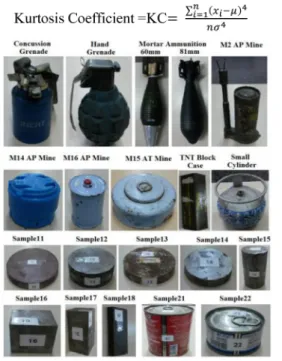
In this study, 20 different test samples have been selected in order to detect and classify the buried objects. 10 of these test samples are explosive materials which are used to prepare in hand made explosives (HMEs), and the others are misleading materials having explosive geometry.
Data acquisition system has the ability of cartesian motion. It has a sensor network including 32 fluxgate magnetic field sensors and uses a passive measurement technique to detect magnetic anomalies. The image of the data acquisition system is shown in Figure 1.
Figure I. Data acquisition system
At the data acquisition system, the measurement area was filled with moist sand and the distance between the top of the sand and the top part of the buried test samples was 3 cm. The sensor network located at 5 cm, 10 cm and 15 cm high from the top of the sample has been moved 25 steps along the y-axis and magnetic field values have beencollectedby32 fluxgate sensors. A total of 60 different data matrices of
348
32x25 sizes were obtained as a result of the scans carried out at 3 different distances for each test sample.
Ill. A TTRffiUTE EXTRACTION
In classification, instead of using a signal or a set of data directly, it is more preferable to use a method that best describes them. If the number of data to be processed is not suitable for processing all components, a preprocessing will be essential to facilitate the task of classifier. Thus, attributes that have no effect on classification can be eliminated. Since it will take a while to get the attributes for each data processed in real time in the classifier, the number of attributes used in real-time applications has to be limited as well. For systems that have real time and speed problems, it is necessary to determine the attribute elements that require as less mathematical calculation as possible and describe the best data that it will be processed by system. In this study, maximum (max) value, minimum (min) value, standard deviation (a), Kurtosis coefficient (KC) and arithmetic mean (AM) attributes have been used to characterize magnetic field data.
Maximum value attribute refers to the element having the highest numerical value in the data set.
Minimum value attribute refers to the element having the lowest numeric value in the data set.
Standard deviation attribute is a term used to summarize the distribution of data values and can be given as following.
. . Ln_ (Xi-Il)2
Standard deVIatIOn = a = '-1 (1)
n
where Xi is the " i"th element of the data set, f.t is the mean
value and n is the number of data.
The Kurtosis coefficient attribute is used to give the steepness or flatness of the magnetic field signal, and its value, also known as fourth moment, is basically a magnitude applied to the distribution functions.
K urtOSIS oe IClent = . C ffi · KC
= -
Lf-1 (Xi-Il)44
no- (2)
Mortar A mmu.D ilioD ~12 A.P M.int
The arithmetic mean attribute is obtained by dividing the numerical summation of the elements in the data set by the number of elements.
IV. CLASSIFICATION
In this study, the nearest neighborhood (kNN) algorithm has been used to classify the data for which the attribute extraction is performed. The kNN algorithm is preferred because it is easy to implement, and its performance rate in real-time applications is almost the same compared to very complex classification algorithms.
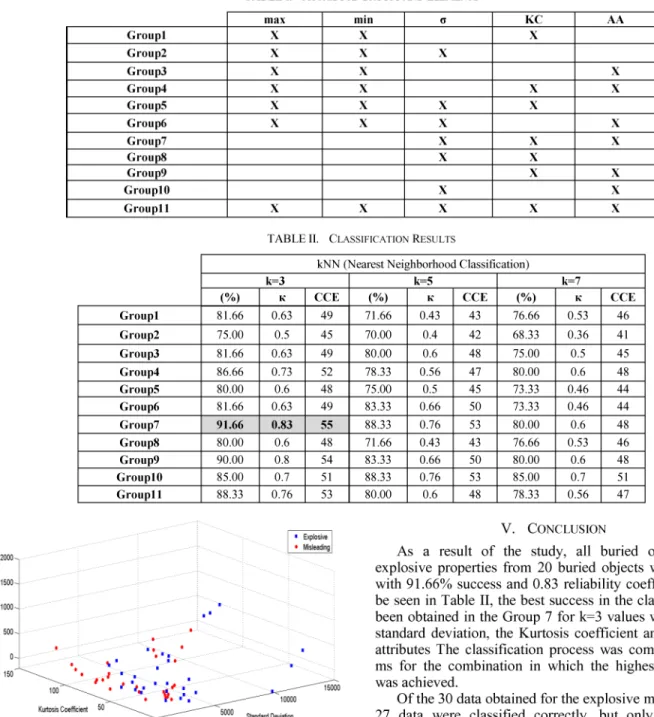
In the classification study; of the 60 data matrices of 32x25 dimensions, 30 data matrices have been categorized as explosive and the other 30 data matrices have been categorized as misleading material. Then , each combination of attributes given in Table I as a classification input of kNN has been subjected to classification for k = 3, k = 5 and k = 7. As a result of the classification, percent success rate (%), reliability coefficient (K) and Correctly Classified Element (CCE) has been obtained and given in Table 11. Standard deviation-Kurtosis coefficient and arithmetic mean values for Group 7attributeshave been given all together in Figure 3.
TABLE I. ATTRIBUTE GROUPS AN D ELEMENTS
max min (f KC AA Groupl X X X Group2 X X X Group3 X X X Group4 X X X X Group5 X X X X Group6 X X X X Group7 X X X GroupS X X Group9 X X GrouplO X X Groupll X X X X X
TABLE 11. C LASSIFICATION RESULTS
kNN (Nearest Neighborhood Classification) k=3 (%) K CCE Groupl 81.66 0.63 49 Group2 75.00 0.5 45 Group3 81.66 0.63 49 Group4 86.66 0.73 52 Group5 80.00 0.6 48 Group6 81.66 0.63 49 Group7 91.66 0.S3 55 GroupS 80.00 0.6 48 Group9 90.00 0.8 54 GrouplO 85.00 0.7 51 Groupll 88.33 0.76 53 2000 1500 1000 " 500
..
, \ '. .
:.
-,~- " 150 ' . , . ' • I • I ' ••. ' .. ' tA' :.
r. I. 10000 100 15000 Kurtosis Coefficient 50 SlandardDeviation o 0Figure 3. Standard deviation-Kurtosis coefficient and arithmetic mean values for group 7 attributes
k=5 k=7 (%) K CCE (%) K CCE 71.66 0.43 43 76.66 0.53 46 70.00 0.4 42 68.33 0.36 41 80.00 0.6 48 75.00 0.5 45 78.33 0.56 47 80.00 0.6 48 75.00 0.5 45 73.33 0.46 44 83.33 0.66 50 73.33 0.46 44 88.33 0.76 53 80.00 0.6 48 71.66 0.43 43 76.66 0.53 46 83.33 0.66 50 80.00 0.6 48 88.33 0.76 53 85.00 0.7 51 80.00 0.6 48 78.33 0.56 47 V. CONCLUSION
As a result of the study, all buried objects having explosive properties from 20 buried objects were classified with 91.66% success and 0.83 reliability coefficient. As can be seen in Table 11, the best success in the classification has been obtained in the Group 7 for k=3 values with the use of standard deviation, the Kurtosis coefficient and the average attributes The classification process was completed in 24.5 ms for the combination in which the highest performance was achieved.
349
Of the 30 data obtained for the explosive material groups, 27 data were classified correctly, but only 3 data were classified as incorrect. Of the 30 data obtained for the
misleading material groups, 28 data were classified correctly, but only 2 data were classified as incorrect.
The results show that the classification system used in this study reduces significantly the false alarm ratio unlike conventional buried object detection systems.
REFERENCES
[1] Y. Ege, A. Kakilli and O. KIIH(, "Performance Analysis of Techniques Used for Determining Land Mines", International Journal of Geosciences, vol. 5, no. 10, p. 1163-1189,2014.
[2] E.M.A. Hussein, E.J. Wailer, "Landmine Detection: the Problem and the Challenge", Applied Radiation and Isotopes, vol. 53, no. 4-5, p. 557-563,2000.
[3] Y. Ege, O. Kalender, and S. Nazhbilek, "Direction finding of moving ferromagnetic objects inside water by magnetic anomaly", Sensors and Actuators A, vol. 147, p. 52-59,2008.
[4] S. Nazhbilek, O. Kalender, and Y. Ege," A multi-sensor network for direction fmding of moving felTomagnetic objects inside water by magnetic anomaly", Measurement, vol. 42, p. 1402-1416, 2009. [5] T.R. Clem, "Sensor Technologies for Hunting Buried Sea Mines",
Oceans 02 MTS/IEEE Conference, I, p. 452-460, 2002.
[6] A. Sheinker, N. Salomonski, B. Ginzburg, L. Frumkis, and B.Z. Kaplan, "Aeromagnetic Search Using Genetic Algorithm", Progress In Electromagnetics Research Symposium'05, p. 492-495, 2005. [7] T. El Tobelyl and A. Salem, "Position Detection of Unexploded
Ordnance From Airborne Magnetic Anomaly Data Using 3-D Self Organized Feature Map", 5th IEEE International Symposium on Signal Processing and InfOlmation Technology, 1-2, p. 322-327, 2005.
350
[8] S. Soyler, E. Kurt and O. Dag, "Optimization of the Magnetic Anomaly Signals fi'om a New Land Mine Detection Device", Recent Researches in Applications of Electrical and Computer Engineering, p. 178-183,2012.
[9] J. Vyhnanek, M. Janosek, and P. Ripka, "AMR Gradiometer For Mine Detection", Sensors and Actuators A: Physical, 2012.
[10] 1. Vyhnanek, M. Janosek, P. Ripka, "AMR Gradiometer For Mine Detection And Sensing", Procedia Engineering, vol 25, p. 362-366, 2011.
[11] S. Nazhbilek, O. Kalender and Y. Ege, "Mine Identification and Classification by Mobile Sensor Network Using Magnetic Anomaly", IEEE Transactions on Instrumentation and Measurement, vol. 60, no. 3, p. 1028-1036,2011.
[12] M.G. ~ensoy, "Identification and determination of magnetic materials in magnetic field with magnetic characteristic by sensing magnetic anomaly", M.Sc. Thesis, Bahkesir University, Institute of Science, Department of Physics, Bahkesir, 2010.
[13] H. <;:Itak, " Detennination Of Upper Surface Magnetic Flux Profiles Of Buried Magnetic Materials Which Have Got Unknown Physical Features With The Help Of Magnetic Sensor Network And Its Efficiency In Defining Material", Ph.D. Thesis, University, Institute of Science, Department as Electrical Education, istanbul, 2014. [14] S. Nazhbilek, Y. Ege, O. Kalender and M.G. ~ensoy, "Identification
of materials with magnetic characteristics by neural Networks" , Measurement, vol. 45, no. 4, p. 734-744, 2012.
[15] M. Sezgin, G. Kaplan, M. Birimand and Y. Bahadlrlar, "Neural Network Based Identification of Buried Metallic Objects", Proceedings of the IEEE 12th Signal Processing and Communications Applications Conference, SIU '07, 07, p. 1-4, 2007.