MONUMENT LIGHTING
A THESIS
SUBMITTED TO THE DEPARTMENT OF
INTERIOR ARCHITECTURE AND ENVIRONMENTAL DESIGN
AND THE INSTITUTE OF FINE ARTS
OF BİLKENT UNIVERSITY
IN PARTIAL FULFILLMENT OF THE REQUIREMENTS
FOR THE DEGREE OF
MASTER OF FINE ARTS
By
Mehmedalp Tural
September, 2001
I certify that I have read this thesis and that in my opinion it is fully adequate, in scope and in quality, as a thesis for the degree of Master of Fine Arts.
Assoc. Prof. Dr. Cengiz Yener (Principal Advisor)
I certify that I have read this thesis and that in my opinion it is fully adequate, in scope and in quality, as a thesis for the degree of Master of Fine Arts.
Prof. Dr. Mustafa Pultar
I certify that I have read this thesis and that in my opinion it is fully adequate, in scope and in quality, as a thesis for the degree of Master of Fine Arts.
Dr. Sibel Ertez Ural
Approved by the Institute of Fine Arts
ABSTRACT
MONUMENT LIGHTING
Mehmedalp Tural
M.F.A. in Interior Architecture and Environmental Design Supervisor: Assoc. Prof. Dr. Cengiz Yener
September, 2001
This thesis is related with the concept of monument lighting. It focuses on the interaction between two elements of art; light and the monument, and also the interaction between human and monument regarding the psychological, physical, and sociological factors. The study concentrates on the approach to the problem and discusses the facts that lighting designers and sculptors have to be concerned about in bridging the gap between public and monuments. Rather than expressing general lighting criteria, discussions are carried upon the examples to suggest a better understanding to the topic. The recommendations involve the case studies of two monuments and the evaluation of observer responses among different lighting schemes.
ÖZET
ANIT AYDINLATMASI
Mehmedalp Tural
İç Mimarlık ve Çevre Tasarımı Bölümü Yüksek Lisans
Tez Yöneticisi: Doç. Dr. Cengiz Yener Eylül, 2001
Bu tez anıt aydınlatması üzerinedir. Tez dahilinde iki ayrı sanat unsuru olan aydınlatma ve anıt kavramlarının ilişkisinin incelenmesinin yanısıra, insan ve anıtlar arasındaki etkileşim psikolojik, fiziksel ve sosyolojik faktörler ele alınarak ortaya konulmaya çalışılmıştır. Çalışmada anıt aydınlatması problemine akılcı bir yaklaşım getirilmesi amaçlanırken, yapılan tartışmalarda aydınlatma tasarımcıları ve heykeltraşların, anıtlar ile halk arasında oluşan boşluk ve yabancılaşmayı ortadan kaldırmaya yönelik göz önünde bulundurmaları gereken şartlar ele alınmıştır. Bu noktadan hareketle, tartışmalar genel aydınlatma kriterlerinin sıralanması yerine, konuya dair doğru bakış açısının yakalanması yönünde şekillenmiştir. İki anıt üzerinde yoğunlaşarak yapılan çalışmalar, gözlemcilerin farklı aydınlatma uygulamalarına verdikleri tepkilerin değerlendirilmesi ile desteklenmiştir.
ACKNOWLEDGEMENTS
Foremost, I would like to thank my supervisor Assoc. Prof. Dr. Cengiz Yener for his guidance, support and patience. His breadth of interest, encouragement and forbearance are some of the reasons that this thesis got started and why it got done.
I could not have begun this project without the support and guidance of Prof. Dr. Hüseyin Gezer.
I am grateful to my parents for their support, trust and continuous patience. I would like to thank to the sophomore students in IAED Department of Bilkent University and all students of INAR Department of Çankaya University for participating in the interviews.
I would also like to thank Prof. Dr. Faruk Yalçın Uğurlu, for his invaluable help and support.
Special thanks should go to Barış for his continuous support, friendship and for the many hours he spent in preparing and photographing the settings with me.
Last, but not least, I would like to thank Aslı, Çağrı, Hakan and my master’s degree classmates for their invaluable help.
I dedicate this thesis to my fiancée, Tûba who gave me invaluable help, great support and showed immense patience during preparation process this thesis.
TABLE OF CONTENTS
1. INTRODUCTION 1
2. HISTORICAL BACKGROUND OF MONUMENTS 8
2.1 Development of Monuments in Turkey ……… 10
2.2 Atatürk Monuments ……….………. 13
2.3 Technological Improvements and The Reveal of Lighting Concept on Monuments ………. 15
3. THE NEED FOR MONUMENT LIGHTING 19
3.1 Functional Needs ……… 22
3.2 Psychological Needs ...……….. 24
3.3 Aesthetic Needs ....………. 26
4. CONCEPTUAL FRAMEWORK 31
4.1 Artists’ Aim in the Creation of Artifact Conceptual Formation and the End Product ……….. 31
4.2 Light and Meaning ………... 34
5. LIGHTING CRITERIA 37
5.1 Daylight and Artificial Lighting ……… 41
5.2 Dynamic Perception versus Static Perception ………. 43
6. LUMINARIES 51
6.1 Light Distribution ………... 52
6.2 Quality and Quantity of Lighting ……… 55
6.2.1 Light and the Material of Monument ……….. 58
6.2.2 Influence of Color Properties of Light on Perception of Monument ………. 61
6.3 Efficacy and Energy Consumption Criteria ………. 64
6.4 Light Pollution and Trespass ..………. 65
7. CASE STUDIES 68
7.1 Bilkent University Atatürk Monument ………. 69
7.2 Hacettepe University Bayraklaşan Atatürk ……… 71
7.3 Survey ………. 72
7.3.1 Experimental Setup ……….. 77
7.3.2 Method ………..… 79
7.3.3 Results and Discussion ……… 80
8. CONCLUSION 109
REFERENCES 114
APPENDIX A QUESTIONNAIRE 118
APPENDIX B FIGURES 122
LIST OF TABLES
Table 1 Illumination Design Guide for Monuments ………. 38
Table 2 Illuminance Categories ……… 39
Table 3 Typical Material Reflectance Characteristics ……….. 58
Table 4 Recommended Surface Illuminance Values ……….. 60
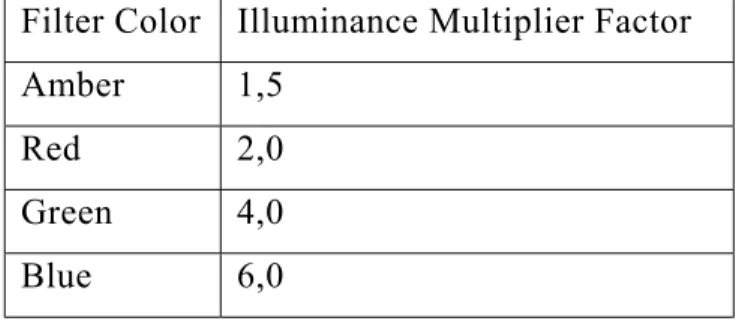
Table 5 Illuminance Multiplication Factors for Color Filters ……… 63
LIST OF FIGURES
Figure 1.1 The Batıkent Atatürk Monument ..……….. 123
Figure 1.2 The Ulus Atlı Atatürk Monument ……… 123
Figure 1.3 The Zafer Monument ……….……….. 124
Figure 1.4 Atatürk Monument – Bakanlıklar ………. 124
Figure 2.1 Abdülaziz Monument ……… 125
Figure 2.2 The Sarayburnu Atatürk Monument ………. 125
Figure 2.3 Laocoön’s expressions under changing illumination ……… 126
Figure 2.4 The Lincoln Memorial ………. 126
Figure 3.1 The Samsun Atlı Atatürk Monument ……… 127
Figure 3.2 The Ministry of Education Atatürk Monument ……… 127
Figure 4.1 The Bilkent Atatürk Monument - Front view ……….. 128
Figure 4.2 The Bilkent Atatürk Monument – View from roundabout ….….. 128
Figure 4.3 Prof. Dr. Hüseyin Gezer’s workshop lighting conditions ….…… 129
Figure 5.1 The Ministry of Finance Atatürk Monument ……… 129
Figure 5.2 The Dikmen 27 Aralık Monument – Setting ……… 130
Figure 5.3 The Dikmen 27 Aralık Monument - Front view ………….…….. 130
Figure 5.4 Michelangelo’s David ……….. 131
Figure 5.5a Gypsum model of Atatürk with negative molding pattern ……... 131
Figure 5.5b Gypsum model - changing expressions from different viewpoints132 Figure 5.6 Movement of the sun with respect to the Bilkent Monument ….. 132
Figure 5.7 The Air Force Headquarters Atatürk Monument – view a …….. 133
Figure 5.9 The Air Force Headquarters Atatürk Monument – view c ……... 134
Figure 6.1 Binocular visual field ……….. 134
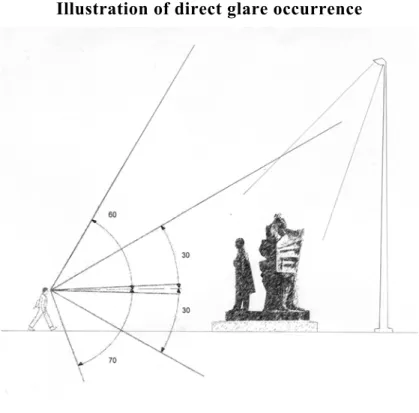
Figure 6.2 Illustration of direct glare occurrence ……….. 135
Figure 6.3 The Tarımcı Atatürk Monument ………. 135
Figure 6.4 The Atatürk Monument – Mithatpaşa Boulevard ……… 136
Figure 6.5 Modeling techniques in revealing human form (Adapted from Millerson) ……… 136
Figure 6.6 Effects of key, fill and back light (Adapted from IESNA, Photographer: Daniel B. Howell) ………. 137
Figure 6.7 Recommended incident angles ………. 137
Figure 6.8 The Gazi University Atatürk Monument – view a ……….. 138
Figure 6.9 The Gazi University Atatürk Monument – view b ……….. 138
Figure 6.10 Effects of brightness difference ……….. 139
Figure 6.11 Kruithof Curve ………. 139
Figure 6.12 Color appearance in combination ……… 140
Figure 6.13 General characteristics of commonly used light sources ………. 141
Figure 7.1 The Bilkent Atatürk Monument – Backside V-shaped view ….. 142
Figure 7.2 Prof. Dr. Hüseyin Gezer’s lighting proposal sketch ……… 142
Figure 7.3 The Hacettepe Bayraklaşan Atatürk Monument – environmental setting ………. 143
Figure 7.4 Lighting proposal for Bilkent Atatürk Monument and site plan .. 143
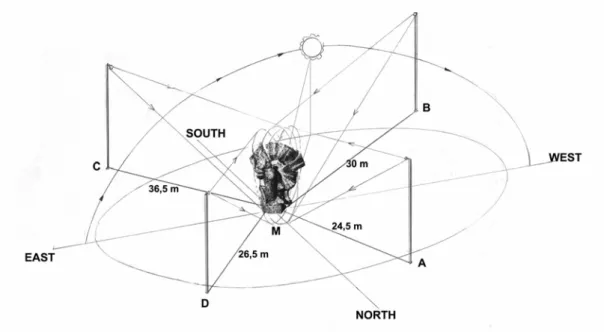
Figure 7.5 Illustration of proposed pole locations with respect to monument 144 Figure 7.6 Sun path diagram for 40° northern latitude (Robbins, 330) ……. 144
Figure 7.7 Altitude and bearing angles for 30°- 46° northern latitude (Egan, 172) ……… 145
Figure 7.8 Sundial ……… 145
Figure 7.9 Movement of the sun with respect to the Hacettepe Monument .. 145
Figure 7.10 Question 1 – Front views ……….. 146
Figure 7.11 Question 1 – Backside views ……… 146
Figure 7.12 Question 1 – Distribution of preferences among front views ….. 82
Figure 7.13 Question 1 – Distribution of preferences among front and
backside views ……… 84
Figure 7.14 The Bilkent Monument – environmental setting ………. 147
Figure 7.15 Three representations of 21st March 10.00 am (daylight, sundial,
artificial lighting) ………. 147
Figure 7.16 Question 2 – Distribution of preferences among front views …… 86
Figure 7.17 Question 3 – Front views ………. 148
Figure 7.18 Question 3 – Backside views ……… 148
Figure 7.19 Question 3 – Distribution of preferences among front views ….... 90
Figure 7.20 Question 3 – Distribution of preferences among backside views .. 90
Figure 7.21 Question 4 – Front views ………. 149
Figure 7.22 Question 4 – Backside views ……….….. 149
Figure 7.23 Question 4 – Distribution of preferences among front views …… 92
Figure 7.24 Question 4 – Distribution of preferences among backside views .. 93
Figure 7.25 Question 5 – Daylight imitation comparison
(45° - 60° front views) ………. 150
Figure 7.26 Question 5 – Daylight imitation comparison
(45° - 60° backside views) ……….. 150
Figure 7.27 Question 5 – Comparison between contrary schemes (60° - 45° front
Figure 7.28 Question 5 – Comparison between contrary schemes (45° - 60°
backside views) ……… 151
Figure 7.29 Question 5 – Distribution of preferences among daylight imitation (45° - 60° front views) ……….. 94
Figure 7.30 Question 5 – Distribution of preferences among daylight imitation (45° - 60° backside views) ……… 95
Figure 7.31 Question 5 – Distribution of preferences among contrary schemes (60° - 45° front views) ……… 95
Figure 7.32 Question 5 – Distribution of preferences among contrary schemes (45° - 60° backside views) ………. 96
Figure 7.33 Roundabout view ………. 152
Figure 7.34 Reflector proposal - Philips SVF 607 ………. 152
Figure 7.35 Louvers ………. 152
Figure 7.36 Question 6 – 21st March sundial photos (front views) ………….. 153
Figure 7.37 Question 6 – 21st March sundial photos (backside views) ……… 153
Figure 7.38 Question 6 – 21st June sundial photos (front views) ………. 154
Figure 7.39 Question 6 – 21st June sundial photos (backside views) ……….. 154
Figure 7.40 Question 6 – 21st December sundial photos (front views) ……... 155
Figure 7.41 Question 6 – 21st December sundial photos (backside views) …. 155 Figure 7.42 Question 6 – Distribution of preferences among 21st March (front and backside views) ………. 100
Figure 7.43 Question 6 – Distribution of preferences among 21st June (front and backside views) ………. 100
Figure 7.44 Question 6 – Distribution of preferences among 21st December (front and backside views) ……….. 101
Figure 7.45 Question 6 – Distribution of preferences among front views ….. 101
Figure 7.46 Question 6 – Distribution of preferences among backside views 102 Figure 7.47 Question 7 – Lighting from upwards and downwards (front views) ……… 156
Figure 7.48 Question 7 – Lighting from upwards and downwards (backside views) ………... 156
Figure 7.49 Question 7 - Distribution of front view preferences ……… 103
Figure 7.50 Question 7 - Distribution of backside view preferences ……….. 103
Figure 7.51 The Atatürk Monument – Çankaya ……….. 157
Figure 7.52 The Yenimahalle Municipality Atatürk Monument ……… 157
Figure 7.53 Question 8 ……… 158
Figure 7.54 Question 8 – Distribution of preferences ……… 104
Figure 7.55 Question 9 – Hacettepe Monument 21st March front views ……. 158
Figure 7.56 Question 9 – Hacettepe Monument 21st March backside views .. 159
Figure 7.57 Question 9 – Hacettepe Monument 21st June front views …….. 159
Figure 7.58 Question 9 – Hacettepe Monument 21st June backside views …. 160 Figure 7.59 Question 9 – Hacettepe Monument 21st December front views .. 160
Figure 7.60 Question 9 – Hacettepe Monument 21st December backside views ………. 161
Figure 7.61 Question 9 – Distribution of front view preferences ……… 106
Figure 7.62 Question 9 – Distribution of backside view preferences ………. 107
1. INTRODUCTION
Over the past twenty years there has been a movement in lighting practice from illuminating engineering to lighting design, a movement from calculations of illuminance to judgments of aesthetics, a movement from quantity to quality. (IESNA Lighting Handbook, ix) The movement has been assisted by the progression in lighting technology, which allows designers to propose new solutions on existing situations and work on new and innovative fields with an extending variety of lamp and luminaire types.
In time, we have seen an increase in the usage of the nighttime, as there was a sense of spectacle commonly enjoyed by all people. Outdoors, the untouched dark canvases of night turns out to be more significant for lighting designers. Also, the increase in the efficiency of artificial light sources has resulted in a growing interest in the use of outdoor lighting to help improve the attractiveness of the environment. Outdoor lighting has become a focal point for city beautification programs around the world, and aesthetics, ambience, identity and image are become the hallmarks for modern nighttime lighting (Camminada, 28). Outdoor lighting practice, comprising a range of fields extending from roadway lighting to landscape lighting, from pure functional to more aesthetical, allows us to better read the city and the environment.
Entering a nicely lit square or looking at a floodlighted building or landmark, examining a light washed sculpture or monument, spectators are
lighting to reveal character, form and atmosphere. Such lighting encourages the visitors to come and walk in the area in the evening, which is something that they would probably not consider doing with purely functional street lighting.
Lighting up the monuments, statues and sculptures that have always been seen as true symbols of history and art, is a crucial factor that outdoor lighting discipline should employ and be concerned with. The monuments or sculptures in a city define its history or an event or just an emotion through the perspective of their artist or creator. Sometimes they are the witnesses of an historical event or represent a well-known idea or concept. Looking at a monument of Atatürk, we literally remember his principles and philosophy. It can be recognized that their scenery defines a concrete ideology, but sometimes they are the solely abstract artifacts hiding their meaning behind.
Forms are rendered differently under different lighting conditions. At night, the brush strokes of daylight change to artificial lighting. The perception of the total environment changes rapidly. In monuments, we now perceive different facets, cutouts and transitions. What can be the role of outdoor lighting in this relation between man and the artifact? What can be the requirements of the viewer with the general environment, including the backgrounds against which the exhibits are viewed? It is more than discussing the lumens and lighting levels but rather focusing on the divine and metaphorical sacredness that reveals itself by the creative usage of lighting.
A variety of monuments surround our periphery. Turkey’s capital city, Ankara, is encircled with more than 50 monuments of Atatürk. At night most of them are left in darkness waiting for a glimpse of light (Fig 1.1). The rest are lit inaccurately that it is not possible to perceive their implications as well as their formal appearances.
The Ulus Atlı Atatürk Monument in Fig. 1.2 is seen under nighttime lighting condition. The luminaries, being located at the corners of the base, are far from illuminating the main figure, Atatürk. Rather, they reveal the base and the horse. The flawed positioning of luminaries brings about unexpected distribution patterns on the surfaces, excessive brightness on the figures around the base, and creates light trespass. A similar example for the base lighting can be seen in Fig. 1.3, which shows the Zafer Monument with its glittering base. Both examples reflect the misconception of lighting design on two olden monuments. Fig. 1.4 is an evidence for a recent disturbing lighting application on the Atatürk Monument, that is located at the Atatürk Square. It is difficult to perceive the details of the figures around the base. The background façade was not taken into account while positioning the luminaires and the light source characteristics does not match with the material of the monument.
The observable facts above have formed the basis of the reason for choosing the topic of this thesis. Furthermore, it creates a chance to glance towards the field of outdoor lighting, which needs as much attention as interior lighting does.
The aim in the present study is to put an emphasis on the interaction between two elements of art; light and the monument; and the interaction between the human and the monument regarding the psychological, physical, and sociological factors, furthermore to expose light’s increasing prevalence and importance at the outdoors. The problem is broken down into three related questions: how can artificial lighting express ideas; how can it be used to influence behavior and manipulate form; and how settings are affected. The study concentrates on the means of approaching the problem and discusses facts that lighting designers and sculptors have to be concerned about in bridging the gap between the public and monuments. Reasons for lighting the monuments are clarified to set forth arguments on the subject. Rather than expressing general lighting criteria, discussions, from both the artists’ and lighting designers’ standpoints, are carried through examples to suggest a better understanding the topic. The recommendations are the result of the evaluation of observer responses on the different lighting schemes applied on two monuments.
Following this introductory chapter, the second chapter includes information on the concept of monuments. The development of monuments in Turkey is examined and definitions of sculpture and monument are investigated to put forward the differences in between. The concept of plastic arts and the development of monuments in Turkish culture are discussed, from the Islamic to the Republican periods, to question the reasons for the reaction against sculpture and to understand the struggle for the formation of plastic arts. Additionally the preliminary stages of electric lighting are investigated to
find its place in art and the relation between technological improvements of electric lighting and reveal of lighting concept on monuments are questioned.
In the third chapter, the need for monument lighting is discussed in order to expose general design aspects. Monument lighting is thought to incorporate three components and discussed under as functional, psychological and aesthetical factors.
Light acquires meaning in arts relationally, that is, as part of a sequence of luminous relationships. Light is approached in an integrated way, both conceptually and practically in the fourth chapter. Through a conceptual framework, the philosophy of the artist is analyzed, in order to grasp his aim, and to associate it with the subject of lighting.
In chapter five, the relations between daylight and artificial light are examined to further discuss the use of artificial light for daylight imitation. The dynamic quality of daylight is stressed to point out the dynamic formation of shades and shadows on three-dimensional objects. The interaction of the dynamic quality of perception with the dynamic quality of daylight is explained and artificial lighting is discussed from the point of its static property. In accordance with the light source characteristics, the ideas of imitating daylight or creating an alternative setting are considered to figure out the appropriate luminaire location. Additionally, the importance of the orientation of monument with respect to sun’s movement is pointed out with
some examples posing debatable orientation schemes that diminish the quality of daylight modeling.
Chapter six deals with the criteria in selecting the appropriate luminaires and deals with the goals of illumination standards, by transforming the light into illumination. The indication of the importance of luminaire distribution characteristics is followed by the discussions of quantity and quality; comprising color properties of light and material characteristics of the artifact. The energy consumption criteria in exterior lighting applications with an emphasis on spill light are also discussed to draw one’s attention on the significance of luminaire design.
In chapter seven, a survey study involving the Bilkent University Atatürk Monument and the Hacettepe University Bayraklaşan Atatürk Monument is introduced. The participants in the survey were shown a variety of photos, demonstrating the monuments under different lighting schemes. The aim was to examine their perceptional preferences among daylight and artificial lighting schemes to discuss the possibilities of day and nighttime lighting interaction on a proposed lighting plan of Bilkent University Atatürk Monument. The effects of different directions, incidents and intensities of artificial lighting on the monument were analyzed. Additionally, both of the monuments were photographed, under different months of the year, utilizing a sundial to depict the distinctions of daylight conditions in different seasons and to point out the importance of orientation. Similar to the artificial lighting schemes, sets of seasonal photographs were shown to participants to find out
the most recognizable and perceivable scheme. The results of the survey are discussed in detail.
2. HISTORICAL BACKGROUND OF MONUMENTS
“Sculpture is a form of aesthetic expression in which hard or plastic materials are worked, as by carving, molding or welding, into three-dimensional art objects” (“Sculpture”). Simply it is the three-three-dimensional art concerned with the organization of solids and voids. “Sculpture is not a fixed term that applies to a permanently circumscribed category of objects or sets of activities. It is rather the name of an art that grows and changes and is continually extending the range of its activities and evolving new kinds of object” (Yılmaz, 12). Yılmaz defines sculpture as the art of creation of projections and recessions in space (13). As an area in fine arts, the art of sculpting is the shaping of the material that would reflect the feelings and ideologies of the artist.
A monument is an artifact conveying a profound historical event, reflecting or symbolizing a special ideology, or representing a hero or a heroic action to the following generations. In a general sense, it covers artifacts in the fields of art and architecture; but from the artistic point of view it is a sculpture that entered the public domain for commemorative purposes.
The tradition of setting up monuments and sculptures in public spaces and squares started with the ancient civilizations. By the classical period of Hittite, Egypt, Indian, Chinese and Greek civilization, religious, political or sociological functions were undertaken. Through the Roman period, monuments were built up to emphasize the magnificence of the emperor and to
stress his political identity. A similar understanding emerged with the Renaissance in Europe. Donatello’s Gattamelata is regarded as the first public sculpture of the period (Osma, 18).
Looking at the urban design context in 20th century, a physically oriented urban planning system is observed, with sets of environmental objectives, such as the orderly arrangement of parts of the city, the provision of recreation and other community services of adequate size, location, and quality, an efficient system of circulation within the city and to the outside world.
From the late 60s, monuments and sculptures in the city districts, nodes and squares are laid on with more urban provisions, in addition to their sociological and artistic functions. As images of spaces, they become the tangible elements of city beautification programs and city master plans (Kaya, v). Creating enlivening spaces of interaction, attracting visitors and enhancing the value of urban pattern that they belong, monuments have various levels of influences on the city. These, what we may call elusive contributions, are interpreted by the public through perceptual processes and cognitive acts.
2.1 DEVELOPMENT OF MONUMENTS IN TURKEY
To understand and examine the development of monuments in Turkey, the concept of plastic arts in Turkish culture needs to be analyzed.
During the emergence of Islam, the idols of gods and thereby sculptures were accursed. They were taken to be the main characters in an era of darkness and had to be prohibited to set up the new ideology-ideology of one-god. In the beginning nearly all sculptures received the same evaluation without any distinction. Although Islamic ideology has an open-minded structure in its formation, it was impossible to observe an improvement in the plastic arts till the foundation of the art school “Mekteb-î Nefise-î Şahane” in 1882. (Berk and Gezer, 3) The use of human figure in the art of miniature seems to pose a conflict in this manner, however, Gezer states that the reason for the reaction against sculpture rather than the art of painting and miniature is that having the three dimensional form, sculpture possesses the shadows imitating the idols. As a result, sculpturing had the field of application with its strong connection to architecture and its meaning was charged on structures such as mosques, tombs and madrasas. The stone works and tombstones with relief and carvings produced during the Seljuk period are accepted as the abstract formation for the plastic arts. (Cumhuriyet Dönemi Türk Heykeli, 12) The need for the plastic arts found its reflection through the works of calligraphy and handwritings in the later periods. During the reign of Sultan Abdülaziz, there exits a struggle to abolish the prohibition of depiction with the building of the Abdülaziz monument by Füller. (“Türk Heykel Sanatı”, 20) (Fig. 2.1) So 1871
can be regarded as the turning point of Turkish plastic arts. (Giray, 31) In that century, with the influence of western culture, the use of small figurative sculptures of animals in yards, gardens and houses were also observed (Osma, 24) With the proclaimlion of the new Republic, the attempt for the progression followed the constitution of new acts in the field of art, science, and technology.
Özsezgin discusses the history of sculpture in two different ways: The traditional or classical understanding of sculpture, and the free-explanatory understanding. The classical understanding has its roots connected within the formal or governmental ideology and this is the reason for the vicious circle of art and function. The free-explanatory understanding, on the other hand, stands as an action of alteration, breaking its ties with the classical formation (27). However, Turkish plastic arts and sculpture did not find its way through the interaction of these approaches but rather they were induced by governmental orientation and support. The reason can mainly be found in the late interference of plastic arts with Turkish culture, which was already mentioned above.
While the new Turkish Republic was facing issues of plastic arts there was a similar struggle, in other countries such as America. There, traditional memorial sculpture took a figurative form and was built with the assumption that the community that commissioned it existed as a historical continuity and the values it expressed were shared, whether it was funerary in nature or dedicated to ideas, events or individuals. (Senie, 15) However in the 20th century history is no longer seen as a continuous, rationally explicable
progression and other needs of public realm have begun to be considered, and addressed by the artists. (Senie, 16)
Regarding the world wars, sufferings, and the victories that it comprises, the period from 1900 to the 1950s was a convenient medium for monuments in Turkey. As Nilgün discusses, most of the sculptors were dreaming of constituting a monument (235). However, the fast spread of monuments through the country came along with problems of diminished quality as an outcome of inexperienced sculptors, and a conflict between artistic and political approaches. The scarcity in the number of good examples made by the foreigners like Krippel and Bellini is pointed out as another reason for this problematic development (Gezer, “Atatürk, Heykel ve Anıtları” 70).
2.2 ATATÜRK MONUMENTS
From the first years of the Republic, groups of students were sent to Europe for training in art, music and literature. The main aim was to provide an efficient information transfer to the society with these apprentices. Throughout the period of their education, foreign instructors and tutors were utilized in the field of plastic arts (Gezer, Cumhuriyet Dönemi Türk Heykeli, 12). With the return of first artist groups to the country and by the help of the foreigners there was a sparkle of advancement in painting, sculpting, music and in other fields of art. As Günyaz states, this rapid influence in art was stacked in the exhibition spaces and art galleries and could not be carried to the public (29). According to Gezer, this problematic issue was the main factor influencing the born of Atatürk monuments and sculptures. The city squares, hills were hosting the new monuments that were built especially for emphasizing the new social, cultural system and development in the new republic. (Cumhuriyet Dönemi Türk Heykeli, 14) Foreign sculptures played an important role in the primary phase of this movement. Monuments became a part of city development and beautification plans. The public, unaware of the subject of art till that time, was now faced with artifacts affecting their sense of aesthetics, and psychology.
The artifacts were reminding them the hard times of their near past and make them be proud of the victory that was hardly achieved. As Berk and Gezer point out they were not dealing with the convenience of the forms with the real ones, but rather were focusing on the figure, that is reminding them the
savior of the country, the one who gave them their freedom (14) So, the concept of sculpture was attached to the Atatürk Monuments in the minds of public. According to Gezer, this attachment is strengthened with the busts of Atatürk that are spread upon the entire country. The reason for the prolification of monuments was supported by two distinct ideologies. One is the spatial need for ceremonial activities, so busts and monuments were utilized in this functional manner (Gezer, Cumhuriyet Dönemi Türk Heykeli, 15). The other is, as Özsezgin explains, the formation of a barrier against the reactionary ideology (28).
Discussing the state of art, the financial position of the country was a barrier for the evolution. Similarly, art was closely associated with luxury in other cultures. According to Senie, during the time of American revolution funds for monument projects never existed and moreover it was seen as antithetical to the philosophy of the new republic (5). On the other hand Atatürk, being a foresighted leader, gave great importance to the artistic development of the country and began the movement of this new development by commissioning the first monument for the republic in Dumlupınar to a Turkish sculptor, Arif Hikmet Koyunoğlu in 1924. The first Atatürk Monument in Turkish history is commonly accepted to be the Sarayburnu Atatürk monument, which was built in 1926 by Krippel (Fig. 2.2).
2.3 TECHNOLOGICAL IMPROVEMENTS AND THE REVEAL OF LIGHTING CONCEPT ON MONUMENTS
The public has always understood lighting as a powerful symbolic medium, and yet the history of lighting usually has been presented as the triumph of science in providing the useful. Before gas and electric streetlights, people had to find their way with lanterns, and the city at night seemed fraught with danger. Public lighting made the city safer, more recognizable, easier to negotiate, but such a functional approach cannot begin to explain why electric lighting had its origins in the theater or why spectacular lighting emerged as a central cultural practice. Light used as a form of symbolic expression in world’s fairs, theaters, and public events. (Nye, 29)
The making and manipulation of light entered into art and changed how artists see the world. Paleolithic artists could not have painted their caves without illumination from small oil lamps. In the sixteenth century Caravaggio was said to have painted under artificial light to produce his dramatic effects (Perkowitz, 13).
In the late 18th century what resulted from the trade fairs was, understanding the importance of the classification of electric lighting as a viable physical, aesthetic and commercial entity, subject for improvement and modification of the environment (Rossell, 59). Electricity, it was argued, should no longer be seen as a purely scientific enterprise nor should there be limited control over it.
The illustrations and numerous drawings prepared by 1880s point out the transfer of preliminary electric light bulb to the profession of illuminating engineering. Figure 2.3 shows that the head of Laocoön, part of the famous Hellenistic sculpture of that name, ranged considerably in appearance as light served in accentuating or marring the effect of pain, sadness, humor, or other emotions intended by the sculptor (Rossell, 80). Rossell mentions that illuminating engineers were employed to restore Abraham Lincoln’s appearance as the figure looked craggy and stern with the natural light coming through the doors of Washington’s Lincoln Memorial (81). (Fig. 2.4) The examples indicate analyses on the imagery that is associated with the transition from the carefully engineered light bulb to the engineered image. The bulb appeared as a static, idealized form expressed with an engineer’s interest in exactness and detail. It asserted a sense of practicality. By contrast it was understood that light, projected from different directions could help us to understand the forces and ideals shaping meaning and changing form.
The use of artificial lighting for the arts can also be observed in opera houses and theaters with the design of spotlights, rainbows, and luminous fountains in the late 1870s. (Nye, 30) With the spread of the Edison electricity system, national landmarks and monuments also began to be permanently illuminated. As Nye points out one of the most effective display was the lighting of the Statue of Liberty in 1886, that made the statue stand out against the darkness of the New York harbor. In addition to the great emphasis on its torch, lamps of eight thousand candle power were placed around the base for
the further dramatization of the statue. (Nye, 32) Spectacular lighting was dramatic, non-utilitarian, abstract and universalizing. It provided a brilliant canopy, connecting many elements, statues, monuments, fountains, and memorials. In the 1930s artificial lighting became more than the theme of displaying a building, but it provided the steps of progress for the civilizations and its arts. (Nye, 35)
Light was further defined in the late nineteenth and early twentieth century by its increasing use in a large-scale, unified manner, and by the continued emergence and influence of independent electric consultants.
In the first years of the twentieth century the basic vocabulary of lighting, or light’s sake on the one hand, and evocative associationalism on the other hand, was replaced by a sharpened discourse of illumination, or the act of putting a particular amount of light on a specific object. Illuminating engineering served as a practical and metaphorical tool defining environments and relationships in a time of rapid change. Electric light, in the guise of illumination, ultimately reoriented people’s relationship with space and design by providing not just visibility, but normative layers of meaning giving shape to new era. Electricity opened a new world of clear, efficient, and convenient light. Light wrapped whatever it touched in a compelling vision of new meanings and new applications. (Rossell, xvii)
From appending a sign to integrating a sign with a building façade to designing the building as a sign to projecting signs on monuments or other structures, the use of electric light extended traditional advertisements at the same time that it undermined architectural form and muddied the proprieties of public and private space.
As electric lighting installations became more prevalent, notions of illuminating efficiency and cost determined which sources of light to use, and it was understood that a system of illumination should appeal to the senses of beauty, harmony and art in addition to the production of sufficient intensity (Rossell, 32).
Electric lighting underlines significant landmarks, highlight important locations, emphasize statues and allowed the spectator to grasp the environment in a simplified pattern. It became an essential part of experiencing both natural and national symbols. (Nye, 61)
3. THE NEED FOR MONUMENT LIGHTING
Finn discusses the relationship between light and the artifact as follows:
Essential to the appreciation of sculpture is light. Whether the light is coming from the left or right, the top or the bottom, makes a crucial difference in the appearance of the forms. Soft light helps you appreciate subtle undulations, strong, direct light accentuates dramatic details. Or a strong light may be necessary to reveal the bulges of a figure that represent muscle and bone and give strength to work, or a texture of tool marks that show the artist’s personal touch. Light from above may throw deep shadows that obscure the forms below or create misleading or disturbing shapes, but it may be the only way to bring out the dramatic forms of the work that enable it to speak forcefully to you, as is often the case with Oceanic or African works which the artists carved in equatorial climate with the sun shining directly overhead. Light creeping around an edge of a sculpture can produce breathtaking outlines; light shining on a surface can reveal exquisite colors of patination. As the light changes on outdoor sculpture, the work itself is transformed (Finn 13). Fig. 2.4
For most people lighting is simply a matter of “Turn the lights on, you see,” and “Turn them off, you don’t”. Today we see that it actually comprises various dynamics that influence the way we live. As Perkowitz states, light extends from a large scale of the universe into the ordinary human world and no other single phenomenon crosses so many human and physical categories. (2) It defines the boundaries of our life, the space in light years.
Directing the beams to the urban context, as Philips indicates, outdoor lighting shapes our overall feeling about the city at night, creating an almost infinitely variable range of effects and emotions that are effective image-builders for any city (Outdoor Lighting Catalogue, 117).
A city is made up of many elements or components: streets, squares, parks, buildings, monuments, activities and so on. The essence of a city is not understood by simply summing up all these elements, it comes from the relationships between them. However, it is not the intent to discuss the essence of the relationships but rather focus on one constituent, monuments as profound image conveyers to urban and social structure.
Societies constitute their common identities and social structures through their collective memories. The social structure is positively influenced and developed by means of historical components, knowledge acquisition and works of art. As mentioned in Chapter 2 monuments are structured to execute the functions of commemoration and remembrance. The term monument, with a wider sense, is generally attributed to the fields of art and architecture. Rather like the architectural products, the term monument is referred and constricted to figurative sculptures in plastic arts in Turkish culture, specifically on Atatürk monuments. Lighting up the monuments, statues and sculptures that have always been seen as true symbols of history and art, is a crucial factor that outdoor lighting discipline should employ and be concerned with.
We may state the objective of lighting these monuments as: Conveying the monuments’ social and psychological meanings to the public and revealing their form with the aesthetic assets it involves; by studying each in terms of its function, historical meaning, symbolic quality, shape, dimensions, color and so forth in order to develop lighting solutions that will form a harmonious composition within the city’s or the corresponding district’s lighting plan.
Lam introduces human biological needs as the dominating requirement in lighting practice (12). These include psychological responses, as cognitive, aesthetic and emotional ones.
Essentially, each monument needs an artificial light render to be identified, to have legibility in meaning and to have a common aesthetic appeal. Therefore, monument lighting is thought to incorporate three components and discussed as the encounter of functional, psychological and aesthetical factors.
3.1 FUNCTIONAL NEEDS
All events take place between people in an environment or between people and their environment. Light is the catalyst that unites the two (Erhardt, 39).
The primary need for the monument lighting can be discussed in relation to humans’ primary need for light, namely vision. “Visibility is the selectively emphasized composite of everything that contributes to awareness, to perception, to recognition, to orientation, and to comprehension; all of the elements of cognition” (Erhardt, 6) Thus visibility for the purpose of understanding is a much broader concept than that suggested by the engineer’s definition, being perceived by the eye, or the simplest awareness.
According to the Illuminating Engineering Society (IES) visibility is the state of being perceivable by the eye (IES Education Commitee, 2-2) or as International Commission on Illumination (CIE) identifies its threshold, barely visible at a specified informational requirement such as detection of presence, recognition of spatial detail, or recognition of meaning. Visibility includes all of the factors of recognition and cognition, and forces us to set forth our own list of exclusions but it does not contain any elements of aesthetics, of emotion, or of comfort (Erhardt, 12).
As touching artifacts is often prohibited, the most and even the only sense, that is used in observing and experiencing the sculptures is the sense of
seeing. A sense of physical contact is established with our eyes with the three-dimensional creation standing. “It is not the touch of the material that provides the critical impression, it is as if your eyes have fingers that are able to explore the work from all sides” (Finn, 22).
All living substance is sensitive to light, seeks it, avoids it, or absorbs its energy. The eye has developed a high degree the photosensitivity present as a rudimentary activity throughout organized substance, and can thus be regarded as a specialization to gain additional information from the light stimulus (Wyburn, et al. 67).
Light and vision provide the strongest link between man and his environment. Most of what we know has been acquired through sight and vision. Vision is the sensation of seeing, and sensation is the mind’s link with the physical world (Erhardt, 7). In other words, as Jones points out, lighting design covers the notions of the luminous environment and the eye and mind of the human observer (3). In this sense the basic need for monument lighting can be defined as the functional need, the appropriate level of light allowing us to see, perceive, identify and distinguish the monument.
Sometimes spectators are not even aware of the work of art in the public space until it is taken away. Then, they recognize that they are missing something, as Senie mentions something intangible as it addresses the spirit or the soul (4). “Unless the mind is directed, visual scenes pass before the eyes without conveying any impressions to the brain and so the visual experience is not registered, but goes unseen” (Erhardt, 6).
Mostly the unawareness comes from the problem of explosion in public sculpture and monuments, and from the fact that we are not really taught to look. The same problem is going to be discussed as a matter of aesthetic needs, a matter of art education but as a functional necessity, lighting can be used to establish a kind of identity and promotion that would take public attention and increase the level of recognition.
Hence the lighting design should provide a functional establishment to convey to the minds of the spectator the significant meanings of the monument quickly and easily by emphasis and organization, combined with the more elusive factors, which bring an overall pleasant sense.
3.2 PSYCHOLOGICAL NEEDS
“Sculpture is something that has been created by the artist to take you through the space in which you live” (Finn, 12).
Facing the challenge of lighting three-dimensional objects, the lighting designer must try to answer two general questions: what does the observer need to see, and how does the object needs to be seen? The first question is about the content of the object, and the second about its context (Turner, Designing with Light, 93). Context wise, each production in art expresses an ideological approach to the observer, namely, as Lam points out, its
Traditionally, expression in figural sculpture is derived from the sculptor’s illustrations of the subject’s thoughts and feelings by means of facial and gestural articulation. The identity of the figure comes not only from its title but also often from the use of objects that are attributes or symbols. Since antiquity, sculpture has been a form of immortality for its subject, by presenting in the figure to the society, physical, intellectual and spiritual culture.
For each monument, a different contextual approach is proposed as a subject of discussion. Regarding Atatürk monuments, each reminds us of his ideology and his heroic character. Sometimes the heroic character is more emphasized with a dynamic form like in Atlı Atatürk monument (Fig. 3.1) in Samsun, imposing the heroic ideology of Turkish War of Independence; but sometimes it is rather a static form accenting a didactic meaning like worth of peace, importance of education, value of becoming contemporaneous. The Monument at the entrance of Ministry of Education symbolizes Atatürk’s efforts in educational reforms. (Fig. 3.2)
This figure dominated process of perception includes various dynamics as Itelson notes. Cognitive, affective, interpretive and evaluative components, all operating at the same time (cited in Bell, 64). The mental representation or cognition occurs as a next phase. The concepts or ideas acquired from the image, the monument, are constructed as a meaning or analogy based knowledge through the mind.
The role of lighting in emphasizing the symbolic and ideological meanings hidden behind the monuments, and bringing out their psychological concerns is a factor to be considered in monument lighting. Lighting can be utilized to give emphasis to the dynamic form, stress the state of static monumentality, and create an indication of battle by color changes.
Hence the design of monument lighting needs a careful analysis of the ideological impact, psychological accentuation, and meaning prominence.
3.3 AESTHETIC NEEDS
From the ancient Greek word aisthanesthai, the word aesthetics literally refers to perception. This general sense is maintained in the definition of aesthetics as “knowledge derived from the senses”. In general parlance, however, the word has become more specific during the last two hundred years or so, referring to the appreciation of beauty in certain objects, in particular art and architecture. Thus the “aesthete” is generally thought of as some kind of expert, skilled and/or talented in the appraisal and evaluation of beautiful things (Ungar).
The art of making sculpture is a sensual form of creativity. “It grows primarily out of the emotional relationship we have to the human figure our
own begin with, and more importantly those of others who arouse in us the passions associated with physical love” (Finn, 15).
According to the Parsons’s framework, discussing the aesthetical needs in art, we have to focus on the subject (37). The ideas of art and beauty are complexly linked, but the concept of beauty can be discussed upon the beauty of the subject, the beauty of expression, strength of the feeling or generosity of spirit as he states, and the beauty of the medium -shape, form, color- and the sense of beauty regarding judgment. The obviousness of beauty and ugliness comes from the sense of their shared character, since it is shared, it can simply be seen, it need not be discussed (Parsons, 43).
In modern aesthetics, the theories of beauty find their way through the study of perception and the science of sensory cognition (Porteous,19). Studies of aesthetic quality judgments in the field of art using composite visual, auditory and other scales have demonstrated that composite perceptions are heavily weighted towards the visual (Porteous, 32).
Gezer states that in order to have an aesthetical judgment about a product in plastic arts, one has to observe as many artifacts as possible. However, he points out that one’s aesthetic notion could only be formed and enriched by observing the contentfull and successful products (Personal Interview). Regarding the grammar of sculpture and plastic arts, Sharma relates the state of success to the creatively definition of the attached meaning and to attain of the state of equilibrium of solids, voids, weights, twists, lines and bends (57). The achievement of public’s aesthetic awareness is dependent
upon the qualified artifacts around them (Gezer, Personal Interview). In the same way, art and artistic activity and products in the environment enriches and reinforces the man’s cognitive abilities and aesthetic assets (Sharma, 176).
In Turkey, as mentioned before, the rapid spread of monuments throughout the country has diminished the quality of the products. Atatürk busts were almost mass-produced, and monuments were built by callow artists for meeting political and municipal demands. Also, Finn connotes the difficulty to have a discussion on the greatness and quality in relation to any work of art (29). In addition, Doğan emphasizes the impossibility of putting forward a commonly accepted aesthetics definition (10).
There is often a split between the artists’ intentions and the public perception of his/her work. According to Senie this is largely the result of the absence of art education and the nurturing of visual thinking throughout the public school systems. (4) Regarding the education system, we might have an alteration or an improvement to solve similar problems in Turkey. Thus the difference and also the relation between looking, seeing and perceiving should be stressed in education.
The state of aesthetic evaluation of human is, then, directly related with the artifacts surrounding him and the stages of aesthetic development are levels of increasing ability to interpret the expressiveness of works in this way.
Lighting, as a reinforcer of spatial perceptions, enhancer of environmental atmosphere, definer of moods and behaviors, should not be
bounded within the field of illuminating engineering. “Lighting is an Art as well as a Science” (Erhardt, 14). Lighting is both a psychological and physiological inducer.
Leslie draws an analogy between music and light in defining its artistic peculiarity (8). Like the musical chord, which is a particular combination of tone, duration, intensity and expression, a light chord provides an analogous series of color, intensity, duration, view, direction, contrast etc. to the perceiver. “Only by accepting light as artistically autonomous, as a world of art itself, as plastic stuff to be molded, shaped, and formed as freely as the clay in which sculptors model, could artist hope to find the looked for correspondence between their new scale of experience and their artistic expression of it…” (Leslie, 12).
From the artistic point of view, light can affect one’s moods, reactions and perceptions. It is an element in art that embodies components of use as well as fantasy, and can radically transfer our experience of any space defining our sense of scale and mood. Light can be utilized to alter our perception of the spaces and surfaces around us. (Senie,190)
Lighting design is the process of integrating, in a unique way, the art and science of human perception with the art and science of human technology. The result is a very complex system that varies in time in a way that can be extremely exciting (Jones, 43). It is more than the calculation of illumination levels but rather an enhancer of aesthetic impression. The least important
element of lighting design is illuminance, but unfortunately it happens to be the easiest lighting metric to calculate and measure (Steffy, 1).
The form, unity, solid and void relationship, proportion, scale, volumetric harmonies and contrasts are some characteristics constituting the plastic composition. Lighting has the function of revealing this composite. The encounter of two artistic approach results in the concept of monument lighting. They should have a convenient superimposition in order to achieve a kind of aesthetical understanding regarding the observer.
Art is not just a series of pretty objects; it is rather a way we have of articulating our interior life. We have a continuing and complex inner response to the exterior world, composed of various needs, emotions, thoughts, both fleeting and long-term. This inner life is not transparent to us, not self-interpreting; if we are to understand it, we must give it some more perceptible shapes, and then examine the shapes. Art is one way of doing this (Parsons, 12).
4. CONCEPTUAL FRAMEWORK
4.1 ARTISTS’ AIM IN THE CREATION OF ARTIFACT CONCEPTUAL FORMATION AND THE END PRODUCT
In the previous chapters, an approach was put forward for understanding the concept of monument as an artifact and its relation to the subject of lighting. Yet, the artistic point of view needs a different discussion. The emphasis on conceptual formation that the artist constructs through the process of molding the artifact was discussed. However there is the debate on artists’ idealogy of lighting through production.
Until this point, the problem was examined from the lighting designers’ point of view. On the other hand, in each field of art, it is difficult to make a judgment of the work, and to understand the creators’ intentions. In literature, as an example, one has to analyze the period, authors’ life and idea to understand what lies behind his/her lines of the poetry.
As a general fact it has been observed that lighting projects are mostly proposed after the monument’s or the artifact’s installation. However, the lighting criteria, as Erhardt points out, should include a limited care to luminance or illuminance factors but rather needs a great attention to the problem of creating the appropriate scenery and atmosphere with respect to the monuments or the artists’ concept and aim (35). Consequently to understand the conceptual formation accurately, in order to propose the general lighting
plan, the artist should be consulted beforehand or the artists themselves should propose the lighting plan.
According to Gezer, the conceptual formation and production procedure of the sculptor does not involve the idea of artificial lighting, as the daylight is paramount for the sculptors. He adds that, for night scenery the most practical solutions usually are applied to the project, although the intended scenery, with the appropriate shadow distribution, is not effectively achieved (Personal Interview).
Another argument can be carried upon the relation, in between the conceptual subject and the end product. To achieve the appropriate proportion that would support the monumentality of the artifact, sculptors work on different scales with different layers of detailing. Gezer states that the site and the environment in which the monument is going to be installed should be investigated beforehand (Personal Interview). In spite of this, the end product sometimes does not reflect the ultimate goal of the artist. The change in the scale, and the great discrimination between the working model and the end product diminish the impression of concept. While molding or carving the model, the artist should consider the resultant viewpoint. In the Bilkent Atatürk Monument, examined in this thesis, a similar discussion can be carried out regarding the conceptual formation. It is difficult to distinguish the radial movement above Atatürk’s head (which represent the artist’s intention, namely, the beams of light representing Atatürk’s reforms and his foresightness) when viewing the monument from its immediate environment.
(Fig. 4.1) Located at the entrance roundabout, the monument is generally perceived by the drivers and the vehicle passengers (Fig. 4.2) Therefore an instant and selective perception occurs, as the monument is perceived as a landmark element, a point of reference that is easily distinguishable visually. Unless one is looking for something specific, the first thing to attract the undirected visual attention would be an unusual quality, contrasting with its visual context, or with the environment (Lam, 36). Through the complex structure and procedure of perception, brain dictates the scanning pattern of the eye and interrupts the normal sequence of consciously directed eye movements at a point of distraction (Lam, 37). Lighting, especially at nighttime, appears as the primary cause for taking ones attention. Structuring a hierarchy of the way human vision generally responds to focal accents, Michel also states that brightness, high contrast and vivid color, which stand as the attributes of luminance, are important accents to be considered (62). Thus, light may be utilized to direct the visual attention by revealing the symbolic light beams on the monument.
Furthermore, the lighting system under which the artist works directly influences the work of art. The shades and shadows dramatically change when the object is located at the outdoors. The material characteristics around the monument, the base, environmental conditions rapidly change its facets. Different brushstrokes of light render it in different intervals of time. Gezer works under diffuse light conditions, however his monuments are always standing under direct sunlight, except in cloudy sky conditions. (Fig. 4.3) A semi-open space allowing an appropriate level of sunlight penetration or
provision of direct light to simulate sun, would allow the artist to observe the model under a variety of shadow patterns.
4.2 LIGHT AND MEANING
“It is through symbols that man finds his way out of his particular situation and open himself to the general and the universal. Symbols awaken individual experience and transmute it into a spiritual act, into metaphysical comprehension of the world” (Millet, 135) Light acquires meaning in arts relationally, that is, as part of a sequence of luminous relationships. These relationships in turn set up a series of associations in the inhabitants that transfer meaning from the intentional realm of the artist into the personal realm of the inhabitant. Light is approached in an integrated way, both conceptually and practically. Included are the poetic and the practical, daylight and electric light, intention and realization (Millet, 3).
Through the environment of childhood, the human observes what forms mean, from small toys to large forms like buildings. This process includes the experience of light, the kinds of visual information that it conveys. In relation to this, the patterns of light, which attract human’s attention, possess meanings. According to Millet some of these meanings are universal, archetypal images that humanity shares, some cultural, absorbed through rituals and reflecting an attitude of life and some are personal associated with particular events (5).
Light, in revealing plastic arts, simultaneously reveals the meaning of the artifact, sublimate it or diminish its character. The experience of darkness, with the shades and shadows it involves, implicates associations and carries a potential in expressing meanings also.
The appreciation of darkness can lead the product to contemplative light. On the other hand festive light can add a celebrative character to the setting by offering pinpoints of light that disclose the shape of the monument and theatrical light adds drama to the artifact by creating illusions as in theaters. Millet discusses the use of light in metaphorical manner, suggesting scenery of other than physical reality, like expressing an idea or concept that cannot readily be perceived (144). Whereas through the use of symbolic light, the product represents something more immaterial than itself and the light gains meaning through association with that which is symbolized (Millet, 136).
In other words, lighting can be defined as a denotative signifier that conveys the intentional meaning of a form. Weber indicates that in order to craft a convincing theory of the structure of meaning as embodied in an object, one has to move beyond the simple distinction between form and content (88). He defines the key features of meaning properties of an object as follows:
1. Meaning - The abstraction of the object as a meaningful entity of operational knowledge independent of any specific referent. (The status of the object within classes of known objects, its function and, accordingly, its value -practical, ideological, symbolic-, including any
messages to be communicated and/or any utilitarian, ideological, moral or symbolic purposes to be represented)
2. Presentational and Conventional Arrangement (Meaningful Form) - The realization of meaning through signifiers and individual and cultural conventions of arrangement.
3. Form - The totality of the physical and perceptible constituents and their organization. (Physical constituents, factors of complexity and orderliness)
However, the above model must be further qualified to reflect the variances of individuals’ meaning aspects. Therefore, the meaning that is given to the light is directly bounded with the observers’ or spectators’ degree of knowledge acquisition. This value or meaning can have the property related to the concepts of psychology, politics and ideology, or it just bears the aesthetical property. As mentioned before, in the monuments, like artifacts, it is difficult to distinguish this value of aesthetical understanding from the influences of ideological and political property. Moreover, what art enables us to understand is not necessarily what the artist sought consciously to communicate. “Art is capable of layers of interpretation and may reveal aspects of its creators, which they themselves were unaware” (Parsons, 13).
5. LIGHTING CRITERIA
The clarity of characteristics of an object - form, surface texture, color, inherent contrast, etc. - has a great influence on how well we can see at various levels of illumination (Lam, 58).
Artificial lighting outdoors, regarding the reveal of monuments, has several potentials:
- It can reveal form, texture and detail to emphasize features and make them discernible.
- It can conceal certain features restricting the vision using careful arrangement of shadows. Sometimes it can be used to suppress all surface contour and detail, and reveal only the artifact’s outline as a silhouette.
- Shadows and light patterns can also be utilized to imply unreal features, by differing our sense and impressions of size and distance. Light gradations can suggest distortions in surface perception (Fig. 5.1, 5.5b). (Shading can make a flat surface appear curved or sloping) - It can influence the way the observers react to the monument by
suggesting symbols and images like mystifying the setting or evoking the sense of excitement. More complex associations can be established by compositional relationships of light in the environment. - By careful adjustment of color filters it can alter the color values
(Use of high color temperature may suggest a cool environment and imply weather)
- Can build up several different ambiances by developing variety of atmospheres and mood. It can isolate the monument with a single spotlight, or may create visual continuity by unifying a series of separate elements. (Fig. 5.2)
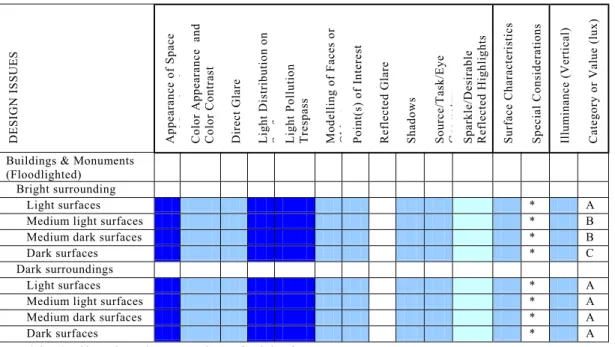
Illuminating Engineering Society of North America, IESNA, proposes the following design guide for floodlighted monuments (IESNA, 10 Outdoor-1):
Table 1 Illumination Design Guide for Monuments
Very Important Important
Somewhat Important Not Important
* Lighting must not interfere with visibility for pedestrians, motorists or boaters
DESIGN ISSUES Appearance of
Space
dL
i
i
Color Appearance and Co
lo
r Co
nt
rast
Direct Glare Light Distr
ibution on
Sf Light Pollution Trespass Modelling of
Faces or
Obj
t
Point(s) of Interest Ref
lected Glare Shadows Sour ce/T ask/E ye Geom etry Sparkle/Desirable Ref lected Highlights Surf ace Characteristics
Special Considerations Illum
inance (Vertical)
Categor
y or
Value (
lux)
Buildings & Monuments (Floodlighted)
Bright surrounding
Light surfaces * A
Medium light surfaces * B
Medium dark surfaces * B
Dark surfaces * C
Dark surroundings
Light surfaces * A
Medium light surfaces * A
Medium dark surfaces * A
Table 2 Illuminance Categories
A B C 20-50 lux 50-100 lux 100-200 lux
In the third chapter, the objective of lighting monuments is stated as: Conveying the monuments’ social and psychological meanings to the public and revealing their form with the aesthetic assets it involves.
Therefore, rather than proposing a general lighting criteria, it can be stated that utilizing the design guides mentioned above, one should study the monument in terms of its function, historical meaning, symbolic quality, shape, dimensions, color and so forth in order to develop lighting solutions that will form a harmonious composition within the city’s or the corresponding district’s lighting plan. In line with the techniques to be employed, monument lighting should be consistent with the city’s lighting theme and character, and also with the future development strategies within the city. .
As Lynch underlines, each setting in a city is perceived within the environment that it has been set, with the conditions and chains of reasons that leads to its existence (161). Therefore, the lighting plan should encompass a study of monument in relation with its immediate and distant surroundings. Is the monument located within a historic center or a central business area or within public park? In what ways are the different areas linked or connected?