EUROPEAN ORGANIZATION FOR NUCLEAR RESEARCH (CERN)
CERN-EP-2020-101 2020/11/26
CMS-HIN-19-001
Evidence for top quark production in nucleus-nucleus
collisions
The CMS Collaboration
*Abstract
Ultrarelativistic heavy ion collisions recreate in the laboratory the thermodynamical conditions prevailing in the early universe up to 10−6seconds, thereby allowing the study of the quark-gluon plasma (QGP), a state of quantum chromodynamics (QCD) matter with deconfined partons. The top quark, the heaviest elementary particle known, is accessible in nucleus-nucleus collisions at the CERN LHC, and constitutes a novel probe of the QGP. Here, we report the first evidence for the production of top quarks in nucleus-nucleus collisions, using lead-lead collision data at a nucleon-nucleon center-of-mass energy of 5.02 TeV recorded by the CMS experiment. Two methods are used to measure the cross section for top quark pair production (σtt) via the selection of charged leptons (electrons or muons) and bottom quarks. One method relies on the leptonic information alone, and the second one exploits, in addi-tion, the presence of bottom quarks. The measured cross sections, σtt =2.54+−0.840.74and 2.03+−0.710.64µb, respectively, are compatible with expectations from scaled proton-proton data and QCD predictions.
”Published in Physical Review Letters as doi:10.1103/PhysRevLett.125.222001.”
© 2020 CERN for the benefit of the CMS Collaboration. CC-BY-4.0 license
*See Appendix B for the list of collaboration members
1
Since the top quark discovery at the Fermilab Tevatron more than twenty years ago [1, 2], top quarks have been measured at the LHC in proton (pp) [3–7] as well as proton-nucleus [8] collisions, but so far have not been observed in proton-nucleus-proton-nucleus collisions because of insufficient nucleon-nucleon (NN) center-of-mass energies (√s
NN) or integrated
luminosi-ties. The multi- TeV energies available at the CERN LHC have opened up the possibility to measure, for the first time, the top quark in lead-lead (PbPb) collisions [9]. More specifically, the top quark constitutes a novel and theoretically precise probe of the nuclear parton distri-bution functions (nuclear PDFs, or nPDFs), in the poorly explored region where partons have a large fraction of the nucleon momentum, as well as of the properties of the produced quark-gluon plasma (QGP) [9, 10]. First, precise knowledge of nPDFs is a key prerequisite to extract detailed information on the QGP properties from the experimental data. Second, top quarks, on average, decay on a timescale similar to the formation of the QGP, hence offering a unique opportunity to study its time evolution [10]. The study presented here shows evidence for the production of the top quark in PbPb collisions at√s
NN =5.02 TeV with an integrated
luminos-ity of (1.7±0.1) nb−1[11] as recorded by the CMS detector [12].
The top quark—the heaviest elementary particle known—is produced at hadron colliders pre-dominantly in pairs (tt) through quantum chromodynamics (QCD) processes, mostly gluon-gluon fusion at the LHC, and is thereby a sensitive probe of the gluon-gluon PDF of the incoming nucleons [13]. Once produced, it decays with almost 100% probability into a W boson and a bottom (b) quark. Top quark pair production is thereby characterized by final states compris-ing the decay products of the two W bosons, and two b jets, resultcompris-ing from the hadronization products of b quarks. The dilepton final states, in which both W bosons decay into electrons (e) or muons (µ) and the corresponding neutrinos (ν), are the cleanest final states for the tt signal measurement, despite their relatively small branching fractionB(tt → `+`−
ν`ν`bb) = 5.25% [14], with`±=e±, µ±. See Appendix A for a candidate tt event.
In this letter, the measurement of the tt cross section (σtt) in three dilepton final states, i.e., e+e−, µ+µ−, and e±µ∓, is performed by (i) making use of the final-state dilepton kinematic properties alone, and (ii) imposing extra requirements on the number of jets “tagged” as origi-nating from b quarks (referred to as “b-tagged jets”). The first method is motivated by the fact that leptons propagate unscathed through the QGP, thereby providing favorable conditions for the detection of tt production. The second method, which enhances the signal over background in standard pp analyses, is applied with realistic estimates of the impact of b quark energy loss, also known as “jet quenching”, in the QGP [15].
The main feature of the CMS detector is a superconducting solenoid, providing a magnetic field of 3.8 T. Within the solenoid volume is a silicon pixel and strip tracker, which is used to detect charged particles, a lead tungstate crystal electromagnetic calorimeter, and a brass and scintillator hadron calorimeter. Hadron forward calorimeters extend the pseudorapidity coverage up to |η| = 5.2. Muons are detected in gas-ionization chambers embedded in the steel flux-return yoke outside the solenoid. A more detailed description of the CMS detector, together with a definition of the coordinate system, the relevant kinematic variables (e.g., the transverse momentum pT), and the physics-object reconstruction, can be found in Ref. [12]. The data sample is collected with a two-level trigger system [16]: at level-1 events are selected by custom hardware processors while the high-level trigger uses fast versions of the offline software. All particle candidates are reconstructed with the particle-flow algorithm [17] using an optimized combination of information from the various elements of the CMS detector. The data sample is filtered to favor events with two opposite-sign (OS) high-pT leptons, with pT > 25 (20) GeV and|η| < 2.1 (2.4) for the electron [18] (muon [19]) candidates, that do not
belong to jets reconstructed using a distance parameter of 0.4 [20, 21] and are thus isolated from nearby hadronic activity. The correction for the underlying event (UE) formed from soft processes is done on a particle-by-particle basis using an estimation of the median of the en-ergy density ρ [20–22] in the event for the lepton isolation, and the “constituent subtraction” method [23, 24] for the jet constituents. The characteristic additional presence of two b-tagged jets in the tt decay chain is then used, in our second method only, to enhance the sensitiv-ity to the top quark signal. Jets must have pT > 30 GeV and |η| < 2.0, and are considered as b tagged if an optimized “combined secondary vertex” (CSV) discriminator [25] produces a value above a certain threshold for the probability of the jet to stem from the hadroniza-tion of the b quark. The b tagging efficiency depends on the geometric overlap of the two colliding nuclei as given by the centrality percentile [26]. This percentile is defined from per-centages corresponding to fractions of the total inelastic hadronic cross section, e.g., with 0% denoting the full overlap of the two colliding nuclei. After the selection criteria, the b tagging efficiency in a NN → tt Monte Carlo (MC) simulation sample, generated at next-to-leading order (NLO) in QCD using the MADGRAPH5 aMC@NLO(v2.4.2) [27] program and interfaced to the “tuned” [28]PYTHIA8 (v2.3.0) [29] MC event generator, is approximately 60 (70)%, with a misidentification rate of 5 (2)%, in the 0–30 (30–100)% centrality interval. The two jets with the highest CSV discriminator values are used to count the b-tagged jet multiplicity, Nb-tag, and classify the selected events into the “0b” (Nb-tag = 0), “1b” (Nb-tag = 1), and “2b” (Nb-tag = 2) jet categories.
The main background is Drell–Yan quark-antiquark annihilation into lepton-antilepton pairs through Z bosons or virtual photons (a process referred to as “Z/γ∗”). It contaminates all final states with either offshell (in e+e−and µ+µ−) or Z/γ∗→τ+τ− →e±µ∓+X (in e±µ∓) decays, where “X” represents other particles. The Z/γ∗ process is modeled at NLO using the MAD -GRAPH5 aMC@NLOsimulation with corrections obtained from data, as detailed below. In the e±µ∓ final state, in particular, there are additional contaminations from W boson production in association with jets (“W+jets”), Z/γ∗ with one unreconstructed lepton, and QCD multijet events. In these cases, the produced jets are mainly from heavy quarks eventually decaying into high-pT leptons that are erroneously identified as being isolated. These latter processes, referred to in what follows as “nonprompt” background, are directly derived from control re-gions in the data, as explained next. Smaller background contributions from single top quark and W boson (“tW”), and WW, WZ, and ZZ (collectively referred to as “VV”) production, are directly estimated from MC simulation with POWHEG [30, 31]. In all simulated samples, the EPPS16 NLO nPDF [32], with CT14 NLO free-nucleon PDF [33], the strong coupling constant at the Z boson mass αS(mZ) =0.118±0.001 [14], and the top quark mass mt =172.5 GeV [34] are used as input. At the step of detector digitization, each hard scattering event is placed at the same primary-vertex [35] location as a heavy ion background event generated withHYD
-JET (v1.9) [36], to mimic the effects of the UE without any QGP-induced modifications of the final-state particles from the top quark decay. Finally, all simulated samples include an emula-tion of the full CMS detector response, based on GEANT4 [37], and a realistic description of the luminous region produced by the collisions.
The Z/γ∗simulation provides a good modeling of the dilepton kinematic properties, except for the low-pTregion where multiple soft-gluon emission dominates and the agreement is slightly worse. We thus apply correction (“scale”) factors to the MC simulation using events in data enriched with Z/γ∗ → `+`−candidates. The scale factors are measured as a function of cen-trality, but no particular centrality dependence is seen. The difference between the corrected and uncorrected MC distributions is considered as the Z/γ∗ pT modeling uncertainty. Events in the e+e− and µ+µ− final states with dilepton invariant mass m(`+`−)in the proximity of
3
the Z boson mass mZ [14] (76< m(`+`−) <106 GeV) are rejected, and their number is used to control the normalization of the corrected MC distributions outside the mZ region. The over-all normalization of the nonprompt background is estimated by forming a “same-sign” (SS) control region, i.e., applying the same criteria as to the signal selection, but requiring SS lepton pairs. The SS dilepton events predominantly contain at least one misidentified lepton. The scal-ing from the SS control to the signal regions is performed assumscal-ing the ratio of the number of OS to SS events containing misidentified leptons to be unity. To estimate the distribution of the nonprompt background, an event mixing technique is developed. The mixing is performed for each lepton in a pool of 100 different events sharing the same features (i.e., lepton charge and flavor, and whether originating from onshell or offshell Z bosons). Each lepton is randomly substituted, and the kinematic variables are recomputed with this new dilepton hypothesis. A multidimensional distance is calculated with respect to the original event using a nearest-neighbor algorithm [38]. The variables entering the algorithm are the centrality, ρ, lepton pT and isolation, and the magnitude of the pTof the dilepton system (“dilepton pT”). The highest ranked mixed events, corresponding to the smallest multidimensional distance, are chosen as the nominal distribution. Differences with respect to the distributions obtained using events further apart in this multidimensional distance, i.e., lower ranked hypotheses, are considered as a source of systematic uncertainty.
For both the dilepton-only and dilepton plus b-tagged jets methods, a boosted decision tree (BDT [39]) classifier is trained on the simulated tt signal versus the overall Z/γ∗ →e+e−,µ+
µ− background. This classifier is based exclusively on leptonic quantities to minimize effects from the imprecise knowledge of the jet properties in the heavy ion environment. The BDT exploits the properties of the leading- and subleading-pT leptons, denoted by “`1” and “`2”, respec-tively, and their correlations. As input to the BDT classifier, the following variables are used in descending order of importance: (i) the pT of the leading lepton, pT(`1), (ii) the normalized momentum imbalance between`1and`2, ApT = (pT(`1) −pT(`2))/(pT(`1) +pT(`2)), (iii) the dilepton pT, (iv) the absolute pseudorapidity of the dilepton system, (v) the absolute azimuthal separation between`1and`2, and (vi) the sum of the absolute η of`1and`2.
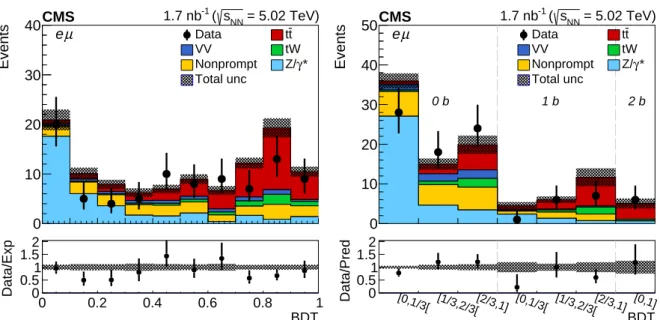
Figure 1 (left) shows the observed BDT discriminator distribution for the dilepton-only method in the higher sensitivity e±µ∓final state (see Appendix A for the e+e−and µ+µ−final states). The tt signal and various sources of background are also shown, indicated as “prefit expected” as they are not adjusted according to any statistical treatment (“fit”). The Z/γ∗background is normalized to the next-to-next-to-leading order (NNLO) cross section from theFEWZ(v3.1.rc)
program [40], and the VV and tW contributions are normalized to the NLO and the approx-imate NNLO cross sections calculated with MCFM(v8.0) [41] and from Ref. [42], respectively.
The classifier separates well the tt signal from the Z/γ∗ background in all final states. The tt signal (red histogram) populates the high-BDT discriminator values. The uncertainties in the data are statistical only, while the uncertainties in the backgrounds include a prefit expectation of the systematic uncertainty.
Profile likelihood fits [43, 44] to binned BDT discriminator distributions are performed sep-arately for the dilepton-only and dilepton plus b-tagged jets methods. The best fit values of “signal strength” (µ), their uncertainty∆µ (corresponding to a 68% confidence level), and the significance (in units of standard deviations) of the tt process against the background-only hypothesis, are obtained following the procedure described in Section 3.2 of Ref. [45] and the frequentist paradigm using the profile likelihood ratio as a test statistic [46], accord-ingly. The value of µ is defined as the ratio of the observed σtt to the expectation from the-ory, i.e., µ = σtt/σttth. The theoretical cross section σttth = σPbPbNNLO→+ttNNLL+X = 3.22+−0.380.35(nPDF⊕
PDF)+−0.090.10(scale) µb, calculated with the TOP++ (v2.0) program [47, 48] at NNLO in QCD, in-cluding soft-gluon resummation at next-to-next-to-leading logarithmic (NNLL) accuracy, with the nuclear EPPS16 [32] and free-nucleon CT14 [33] PDFs. The same calculation but with the free-nucleon CT14 and NNPDF30 [49] NNLO PDFs (scaled by the square of the number of nucleons in the Pb nucleus, A2 = 2082) yields σPbPbNNLO→+ttNNLL+X = 3.04+−0.180.14(PDF)+−0.080.10(scale) and 2.98±0.14(PDF⊕αS(mZ))+−0.080.10(scale) µb, respectively. The small difference between the cross sections obtained with nuclear and free-nucleon PDFs arises from the nPDF “antishadowing” effect, which is only mildly dependent on√sNN[9].
In the dilepton-only method, the extracted values of µ = 0.79+−0.260.23 (where contributions to∆µ are statistical and systematic in nature) and significance of 3.8 standard deviations constitute the first evidence of tt production in nucleus-nucleus collisions. As can be seen in the prefit distribution of Fig. 1 (left), the data are somewhat below the expectation at the high-BDT dis-criminator values. This is also reflected in differences in µ and significance, where the expected values are µ=1.00+−0.250.23and 4.8 standard deviations, respectively.
Events in which Nb-tag ≥1 are expected to be very pure in the tt signal process. Since b quarks are affected by final-state energy loss in the QGP, we take into account the centrality-dependent impact from jet quenching on Nb-tag. We make use of a jet quenching model [50, 51] that is consistent with the CMS b jet data [15], estimating the expected migration of tt signal events among the 0b-, 1b-, or 2b-tagged jet categories. A combined profile likelihood fit, introducing a parameter εb that correlates the number of tt signal events in the three b-tagged jet cate-gories based on multinomial probabilities [5], is thus expected to control better the background contamination. We include in the likelihood the effects on εb from jet quenching (comparing the maximum with no b quark energy loss scenarios), and the intrinsic uncertainties in the b tagging efficiency and misidentification rate. The values of the observed (expected) signal strength and significance are µ= 0.63+−0.220.20(1.00+−0.230.21) and 4.0 (5.8) standard deviations, respec-tively. Figure 1 (right) compares the data to the tt signal and various sources of background adjusted according to the fit procedure (“postfit predicted”) for the dilepton plus b-tagged jets method in the e±µ∓final state (see Appendix A for the e+e−and µ+µ−final states). The BDT distribution for the Z/γ∗ background is taken from the MC simulation, after scaling the event yield in each Nb-tagbin to the corresponding Nb-tagdistribution observed in data within the mZ region.
Sources of experimental uncertainties, incorporated into the likelihoods via “nuisance param-eters”, include the lepton selection efficiency found using a “tag-and-probe” method [52] (6%), integrated luminosity [11] (5%), and the normalization of the background based on control samples in data (12%). The statistical uncertainties in the tt signal and background distribu-tions (7%) are estimated separately. The dilepton plus b-tagged jets method is, in addition, affected by the uncertainty in εb (6%), and the jet energy scale and resolution (2%) estimated following the methodology of Ref. [53]. Sources of theoretical uncertainty included in the likeli-hoods are the nPDF parametrization (derived from the 54+40 eigenvalues of the EPPS16+CT14 sets), the choice of renormalization and factorization scales (within a factor of two from their default values of µR = µF = mt), and αS(mZ)are included (<1%). We also take into account the uncertainties in the pTmodeling of the tt signal and Z/γ∗ background distributions (5%) as well as in the top quark mass (<1%). The precision of the two methods is dominated by the statistical uncertainty (≈28%).
The inclusive tt production cross sections (for the dilepton-only and dilepton plus b-tagged jets methods) are finally obtained in the combined e+e−, µ+µ−, and e±µ∓final states multiplying the best fit µ values of 0.79+−0.260.23and 0.63+−0.220.20by the theoretical expectation. We measure σtt =
5 0 10 20 30 40 Events Data tt VV tW Nonprompt Z/γ* Total unc CMS 1.7 nb-1 ( sNN = 5.02 TeV) µ e 0 0.2 0.4 0.6 0.8 1 BDT 0 0.51 1.52 Data/Exp 0 10 20 30 40 50 Events Data tt VV tW Nonprompt Z/γ* Total unc CMS 1.7 nb-1 ( sNN = 5.02 TeV) µ e 0 b 1 b 2 b [0,1/3[ [1/3,2/3[[2/3,1] [0,1/3[ [1/3,2/3[[2/3,1] [0,1] BDT 0 0.51 1.52 Data/Pred
Figure 1: Observed and prefit expected (left) or postfit predicted (right) BDT discriminator distributions in the e±µ∓final state either inclusively (left) or separately in the 0b-, 1b-, and 2b-tagged jet multiplicity categories (right). The data are shown with markers, and the signal and background processes with filled histograms. The vertical bars on the markers represent the statistical uncertainties in data. The hatched regions show the uncertainties in the sum of tt signal and backgrounds. The lower panels display the ratio of the data to predictions, including the tt signal, with bands representing the uncertainties in the predictions.
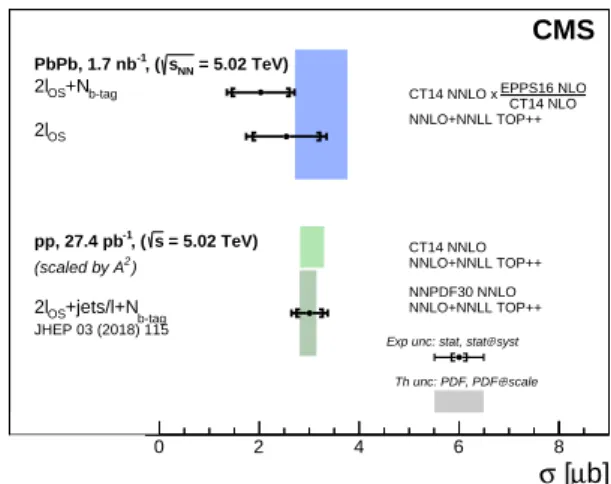
2.54+−0.840.74and 2.03+−0.710.64µb for the two methods, i.e., smaller than, but still consistent with, the theoretical predictions at NNLO+NNLL accuracy in QCD. Despite the expected antishadowing effect, the data appear below the theoretical expectations with or without nPDF effects. Figure 2 presents a summary of the extracted cross sections, including the measurement in pp collisions at√s =5.02 TeV [6] scaled by A2, compared with the corresponding theoretical predictions. In summary, evidence for top quark pair (tt) production is presented for the first time in nucleus-nucleus collisions, irrespective of any possible final-state interactions of the studied top quark decay products (charged leptons and bottom quarks) with the quark-gluon plasma (QGP). Using lead-lead collisions with a total integrated luminosity of (1.7±0.1) nb−1 at a nucleon-nucleon center-of-mass energy of 5.02 TeV, we measure the inclusive tt cross section (σtt) utilizing the leptons only, and in a second method, in addition, the bottom quarks. The extracted σtt =2.54+−0.840.74and 2.03+−0.710.64µb in the two methods, respectively, are compatible with, though somewhat lower than, the expectations from scaled proton-proton data and perturba-tive quantum chromodynamics calculations. This measurement is just the first step in using the top quark as a novel and powerful probe of the QGP.
Acknowledgments
We congratulate our colleagues in the CERN accelerator departments for the excellent perfor-mance of the LHC and thank the technical and administrative staffs at CERN and at other CMS institutes for their contributions to the success of the CMS effort. In addition, we gratefully acknowledge the computing centers and personnel of the Worldwide LHC Computing Grid for delivering so effectively the computing infrastructure essential to our analyses. Finally, we acknowledge the enduring support for the construction and operation of the LHC and the
2 − 0 2 4 6 8 b] µ [ σ CMS NNLO+NNLL TOP++ NNPDF30 NNLO NNLO+NNLL TOP++ CT14 NNLO = 5.02 TeV) s , ( -1 pp, 27.4 pb ) 2 (scaled by A b-tag +jets/l+N OS 2l JHEP 03 (2018) 115 NNLO+NNLL TOP++ CT14 NLO EPPS16 NLO CT14 NNLO x = 5.02 TeV) NN s , ( -1 PbPb, 1.7 nb OS 2l b-tag +N OS 2l syst ⊕ Exp unc: stat, stat
scale ⊕ Th unc: PDF, PDF
Figure 2: Inclusive tt cross sections measured with two methods in the combined e+e−, µ+µ−, and e±µ∓final states in PbPb collisions at
√
sNN = 5.02 TeV, and pp results at√s = 5.02 TeV (scaled by A2) from Ref. [6]. The measurements are compared with theoretical predictions at NNLO+NNLL accuracy in QCD [47, 48]. The inner (outer) experimental uncertainty bars include statistical (statistical and systematic, added in quadrature) uncertainties. The inner (outer) theoretical uncertainty bands correspond to nuclear [32, 54] or free-nucleon [33, 49] PDF (PDF and scale, added in quadrature) uncertainties.
CMS detector provided by the following funding agencies: BMBWF and FWF (Austria); FNRS and FWO (Belgium); CNPq, CAPES, FAPERJ, FAPERGS, and FAPESP (Brazil); MES (Bulgaria); CERN; CAS, MoST, and NSFC (China); COLCIENCIAS (Colombia); MSES and CSF (Croatia); RIF (Cyprus); SENESCYT (Ecuador); MoER, ERC IUT, PUT and ERDF (Estonia); Academy of Finland, MEC, and HIP (Finland); CEA and CNRS/IN2P3 (France); BMBF, DFG, and HGF (Germany); GSRT (Greece); NKFIA (Hungary); DAE and DST (India); IPM (Iran); SFI (Ireland); INFN (Italy); MSIP and NRF (Republic of Korea); MES (Latvia); LAS (Lithuania); MOE and UM (Malaysia); BUAP, CINVESTAV, CONACYT, LNS, SEP, and UASLP-FAI (Mexico); MOS (Mon-tenegro); MBIE (New Zealand); PAEC (Pakistan); MSHE and NSC (Poland); FCT (Portugal); JINR (Dubna); MON, RosAtom, RAS, RFBR, and NRC KI (Russia); MESTD (Serbia); SEIDI, CPAN, PCTI, and FEDER (Spain); MOSTR (Sri Lanka); Swiss Funding Agencies (Switzerland); MST (Taipei); ThEPCenter, IPST, STAR, and NSTDA (Thailand); TUBITAK and TAEK (Turkey); NASU (Ukraine); STFC (United Kingdom); DOE and NSF (USA).
References
[1] CDF Collaboration, “Observation of top quark production in pp collisions”, Phys. Rev. Lett. 74 (1995) 2626, doi:10.1103/PhysRevLett.74.2626,
arXiv:hep-ex/9503002.
[2] D0 Collaboration, “Observation of the top quark”, Phys. Rev. Lett. 74 (1995) 2632, doi:10.1103/PhysRevLett.74.2632, arXiv:hep-ex/9503003.
[3] ATLAS Collaboration, “Measurement of the tt production cross section and lepton differential distributions in e µ dilepton events from pp collisions at√s =13 TeV with the ATLAS detector”, Eur. Phys. J. C 80 (2020) 528,
References 7
[4] LHCb Collaboration, “Measurement of forward top pair production in the dilepton channel in pp collisions at√s = 13 TeV”, JHEP 08 (2018) 174,
doi:10.1007/JHEP08(2018)174, arXiv:1803.05188.
[5] CMS Collaboration, “Measurement of the tt production cross section, the top quark mass, and the strong coupling constant using dilepton events in pp collisions at√s =13 TeV”, Eur. Phys. J. C 79 (2019) 368, doi:10.1140/epjc/s10052-019-6863-8, arXiv:1812.10505.
[6] CMS Collaboration, “Measurement of the inclusive tt cross section in pp collisions at√ s =5.02 TeV using final states with at least one charged lepton”, JHEP 03 (2018) 115, doi:10.1007/JHEP03(2018)115, arXiv:1711.03143.
[7] CMS Collaboration, “Measurement of the tt production cross section in the all-jets final state in pp collisions at√s =8 TeV”, Eur. Phys. J. C 76 (2016) 128,
doi:10.1140/epjc/s10052-016-3956-5, arXiv:1509.06076.
[8] CMS Collaboration, “Observation of top quark production in proton-nucleus collisions”, Phys. Rev. Lett. 119 (2017) 242001, doi:10.1103/PhysRevLett.119.242001,
arXiv:1709.07411.
[9] D. d’Enterria, K. Krajcz´ar, and H. Paukkunen, “Top quark production in proton-nucleus and nucleus-nucleus collisions at LHC energies and beyond”, Phys. Lett. B 746 (2015) 64, doi:10.1016/j.physletb.2015.04.044, arXiv:1501.05879.
[10] L. Apolin´ario, J. G. Milhano, G. P. Salam, and C. A. Salgado, “Probing the time structure of the quark-gluon plasma with top quarks”, Phys. Rev. Lett. 120 (2018) 232301,
doi:10.1103/PhysRevLett.120.232301, arXiv:1711.03105.
[11] CMS Collaboration, “CMS luminosity measurement using 2016 proton-nucleus collisions at nucleon-nucleon center-of-mass energy of 8.16 TeV”, CMS Physics Analysis Summary CMS-PAS-LUM-17-002, 2018.
[12] CMS Collaboration, “The CMS experiment at the CERN LHC”, JINST 3 (2008) S08004, doi:10.1088/1748-0221/3/08/S08004.
[13] M. Czakon, M. L. Mangano, A. Mitov, and J. Rojo, “Constraints on the gluon PDF from top quark pair production at hadron colliders”, JHEP 07 (2013) 167,
doi:10.1007/JHEP07(2013)167, arXiv:1303.7215.
[14] Particle Data Group, M. Tanabashi et al., “Review of particle physics”, Phys. Rev. D 98 (2018) 030001, doi:10.1103/PhysRevD.98.030001.
[15] CMS Collaboration, “Evidence of b jet quenching in PbPb collisions at√sNN =2.76 TeV”, Phys. Rev. Lett. 113 (2014) 132301, doi:10.1103/PhysRevLett.113.132301,
arXiv:1312.4198. [Erratum: doi:10.1103/PhysRevLett.115.029903]. [16] CMS Collaboration, “The CMS trigger system”, JINST 12 (2017) P01020,
doi:10.1088/1748-0221/12/01/P01020, arXiv:1609.02366.
[17] CMS Collaboration, “Particle-flow reconstruction and global-event description with the CMS detector”, JINST 12 (2017) P10003, doi:10.1088/1748-0221/12/10/P10003, arXiv:1706.04965.
[18] CMS Collaboration, “Performance of electron reconstruction and selection with the CMS detector in proton-proton collisions at√s=8 TeV”, JINST 10 (2015) P06005,
doi:10.1088/1748-0221/10/06/P06005, arXiv:1502.02701.
[19] CMS Collaboration, “Performance of the CMS muon detector and muon reconstruction with proton-proton collisions at√s=13 TeV”, JINST 13 (2018) P06015,
doi:10.1088/1748-0221/13/06/P06015, arXiv:1804.04528.
[20] M. Cacciari, G. P. Salam, and G. Soyez, “FastJet user manual”, Eur. Phys. J. C 72 (2012) 1896, doi:10.1140/epjc/s10052-012-1896-2, arXiv:1111.6097.
[21] M. Cacciari, G. P. Salam, and G. Soyez, “The anti-kTjet clustering algorithm”, JHEP 04 (2008) 063, doi:10.1088/1126-6708/2008/04/063, arXiv:0802.1189.
[22] M. Cacciari and G. P. Salam, “Pileup subtraction using jet areas”, Phys. Lett. B 659 (2008) 119, doi:10.1016/j.physletb.2007.09.077, arXiv:0707.1378.
[23] P. Berta, M. Spousta, D. W. Miller, and R. Leitner, “Particle-level pileup subtraction for jets and jet shapes”, JHEP 06 (2014) 092, doi:10.1007/JHEP06(2014)092,
arXiv:1403.3108.
[24] CMS Collaboration, “Measurement of the splitting function in pp and PbPb collisions at√ sNN =5.02 TeV”, Phys. Rev. Lett. 120 (2018) 142302,
doi:10.1103/PhysRevLett.120.142302, arXiv:1708.09429.
[25] CMS Collaboration, “Identification of heavy-flavor jets with the CMS detector in pp collisions at 13 TeV”, JINST 13 (2018) P05011,
doi:10.1088/1748-0221/13/05/P05011, arXiv:1712.07158.
[26] CMS Collaboration, “Jet momentum dependence of jet quenching in PbPb collisions at√ s
NN =2.76 TeV”, Phys. Lett. B 712 (2012) 176,
doi:10.1016/j.physletb.2012.04.058, arXiv:1202.5022.
[27] J. Alwall et al., “The automated computation of tree-level and next-to-leading order differential cross sections, and their matching to parton shower simulations”, JHEP 07 (2014) 079, doi:10.1007/JHEP07(2014)079, arXiv:1405.0301.
[28] CMS Collaboration, “Extraction and validation of a new set of CMSPYTHIA8 tunes from
underlying-event measurements”, Eur. Phys. J. C 80 (2020) 4,
doi:10.1140/epjc/s10052-019-7499-4, arXiv:1903.12179.
[29] T. Sj ¨ostrand et al., “An introduction toPYTHIA8.2”, Comput. Phys. Commun. 191 (2015)
159, doi:10.1016/j.cpc.2015.01.024, arXiv:1410.3012.
[30] E. Re, “Single-top Wt-channel production matched with parton showers using the
POWHEGmethod”, Eur. Phys. J. C 71 (2011) 1547,
doi:10.1140/epjc/s10052-011-1547-z, arXiv:1009.2450.
[31] P. Nason and G. Zanderighi, “W+W−, WZ, and ZZ production in thePOWHEG-BOX-v2”, Eur. Phys. J. C 74 (2014) 2702, doi:10.1140/epjc/s10052-013-2702-5,
arXiv:1311.1365.
[32] K. J. Eskola, P. Paakkinen, H. Paukkunen, and C. A. Salgado, “EPPS16: Nuclear parton distributions with LHC data”, Eur. Phys. J. C 77 (2017) 163,
References 9
[33] S. Dulat et al., “New parton distribution functions from a global analysis of quantum chromodynamics”, Phys. Rev. D 93 (2016) 033006,
doi:10.1103/PhysRevD.93.033006, arXiv:1506.07443.
[34] CMS Collaboration, “Measurement of the top quark mass in the all-jets final state at√ s =13 TeV and combination with the lepton+jets channel”, Eur. Phys. J. C 79 (2019) 313, doi:10.1140/epjc/s10052-019-6788-2, arXiv:1812.10534.
[35] CMS Collaboration, “Technical proposal for the Phase-II upgrade of the Compact Muon Solenoid”, CMS Technical proposal CERN-LHCC-2015-010, CMS-TDR-15-02, 2015. [36] I. P. Lokhtin and A. M. Snigirev, “A model of jet quenching in ultrarelativistic heavy ion
collisions and high-pThadron spectra at RHIC”, Eur. Phys. J. C 45 (2006) 211, doi:10.1140/epjc/s2005-02426-3, arXiv:hep-ph/0506189.
[37] GEANT4 Collaboration, “GEANT4—a simulation toolkit”, Nucl. Instrum. Meth. A 506 (2003) 250, doi:10.1016/S0168-9002(03)01368-8.
[38] F. Pedregosa et al., “Scikit-learn: machine learning in Python”, J. Mach. Learn. Res 12 (2011) 2825, doi:10.5555/1953048.2078195, arXiv:1201.0490.
[39] H. Voss, A. H ¨ocker, J. Stelzer, and F. Tegenfeldt, “TMVA, the toolkit for multivariate data analysis with ROOT”, in XIth International Workshop on Advanced Computing and Analysis Techniques in Physics Research (ACAT), p. 40. 2007. arXiv:physics/0703039.
[PoS(ACAT)040]. doi:10.22323/1.050.0040.
[40] Y. Li and F. Petriello, “Combining QCD and electroweak corrections to dilepton production inFEWZ”, Phys. Rev. D 86 (2012) 094034,
doi:10.1103/PhysRevD.86.094034, arXiv:1208.5967.
[41] J. M. Campbell, R. K. Ellis, and C. Williams, “Vector boson pair production at the LHC”, JHEP 07 (2011) 018, doi:10.1007/JHEP07(2011)018, arXiv:1105.0020.
[42] N. Kidonakis, “Top quark production”, in Proceedings, Helmholtz International Summer School on Physics of Heavy Quarks and Hadrons (HQ 2013), p. 139. Verlag Deutsches Elektronen-Synchrotron, Hamburg, 2014. arXiv:1311.0283.
doi:10.3204/DESY-PROC-2013-03/Kidonakis.
[43] W. Verkerke and D. P. Kirkby, “The RooFit toolkit for data modelling”, in Statistical Problems in Particle Physics, Astrophysics and Cosmology (PHYSTAT 05), A. H. Jaffe, ed. World Scientific Publishing, Oxford University, UK, 2006.
doi:10.1142/9781860948985_0052.
[44] L. Moneta et al., “The RooStats project”, in 13th International Workshop on Advanced Computing and Analysis Techniques in Physics Research (ACAT2010), p. 057. Jaipur, India, 2010. arXiv:1009.1003. [PoS(ACAT2010)057]. doi:10.22323/1.093.0057. [45] CMS Collaboration, “Precise determination of the mass of the Higgs boson and tests of
compatibility of its couplings with the standard model predictions using proton collisions at 7 and 8 TeV”, Eur. Phys. J. C 75 (2015) 212,
[46] G. Cowan, K. Cranmer, E. Gross, and O. Vitells, “Asymptotic formulae for likelihood-based tests of new physics”, Eur. Phys. J. C 71 (2011) 1554,
doi:10.1140/epjc/s10052-011-1554-0, arXiv:1007.1727. [Erratum: doi:10.1140/epjc/s10052-013-2501-z].
[47] M. Czakon and A. Mitov, “TOP++: a program for the calculation of the top pair cross section at hadron colliders”, Comput. Phys. Commun. 185 (2014) 2930,
doi:10.1016/j.cpc.2014.06.021, arXiv:1112.5675.
[48] M. Czakon, P. Fiedler, and A. Mitov, “Total top quark pair production cross section at hadron colliders throughO(α4S)”, Phys. Rev. Lett. 110 (2013) 252004,
doi:10.1103/PhysRevLett.110.252004, arXiv:1303.6254.
[49] NNPDF Collaboration, “Parton distributions for the LHC Run II”, JHEP 04 (2015) 040, doi:10.1007/JHEP04(2015)040, arXiv:1410.8849.
[50] F. Arleo, “Tomography of cold and hot QCD matter: tools and diagnosis”, JHEP 11 (2002) 044, doi:10.1088/1126-6708/2002/11/044, arXiv:hep-ph/0210104. [51] F. Arleo, “Quenching of hadron spectra in heavy ion collisions at the LHC”, Phys. Rev.
Lett. 119 (2017) 062302, doi:10.1103/PhysRevLett.119.062302, arXiv:1703.10852.
[52] CMS Collaboration, “Measurement of Higgs boson production and properties in the WW decay channel with leptonic final states”, JHEP 01 (2014) 096,
doi:10.1007/JHEP01(2014)096, arXiv:1312.1129.
[53] CMS Collaboration, “Jet energy scale and resolution in the CMS experiment in pp collisions at 8 TeV”, JINST 12 (2017) P02014,
doi:10.1088/1748-0221/12/02/P02014, arXiv:1607.03663.
[54] A. Kusina et al., “Vector boson production in pPb and PbPb collisions at the LHC and its impact on nCTEQ15 PDFs”, Eur. Phys. J. C 77 (2017) 488,
11
A
tt event display and BDT distributions in the e
+e
−and µ
+µ
−final states
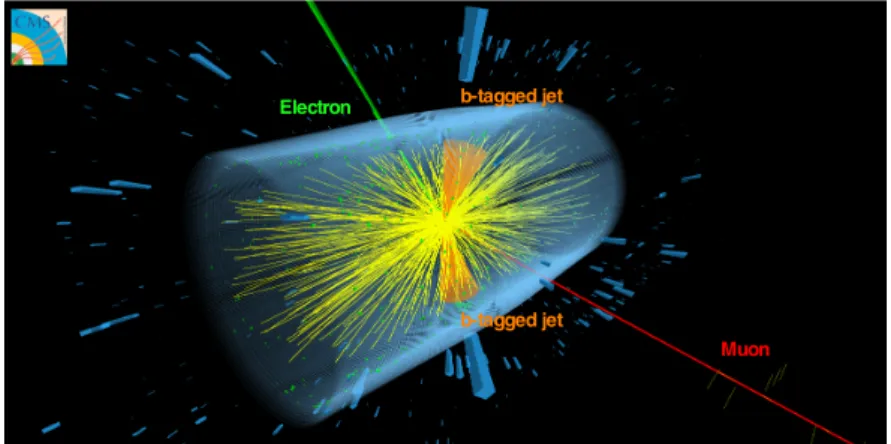
Dedicated algorithms deployed in real time allow the CMS detector to collect events with high-pT leptons, hence making the measurement of tt production in PbPb collisions possible in the e+e−, µ+µ−, and e±µ∓final states. Figure A.1 displays a candidate tt event in the e±µ∓final state in the PbPb data sample.
Electron
Muon
b-tagged jet
b-tagged jet
Figure A.1: Event display of a candidate tt event measured in PbPb collisions where each top quark decays into a bottom quark and a W boson. The b quarks and W bosons, in turn, produce jets and leptons, respectively. The event is interpreted as originating from the dilepton decay chain tt → (bW+)(bW−) → (b e+
νe)(b µ−νµ).
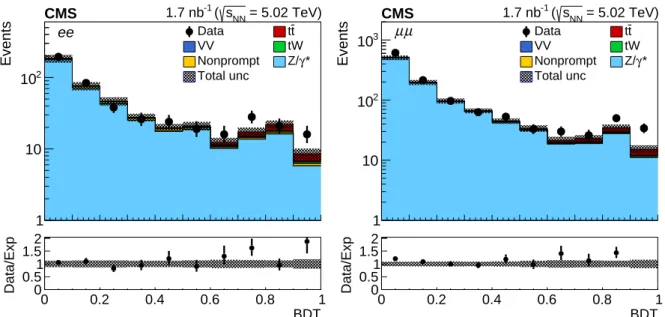
The selected configuration for the multivariate analysis is a BDT with gradient boosting. The classification probabilities for individual events are derived using a transformation of the back-ground and signal distributions, in which backback-ground events are uniformly distributed be-tween 0 and 1, whereas signal events cluster towards 1. The expected BDT performance is evaluated by computing the area under the “receiver operating characteristics” curve, yielding a value of 0.9 (an algorithm with ideal discrimination would yield 1.0, whereas with no discrim-ination would yield 0.5). Cross validation with differently tuned parameters was performed, but no significant gain was observed. Figures A.2 and A.3 show the observed BDT discrimina-tor distributions for the dilepton-only (as prefit expected) and dilepton plus b-tagged jets (as postfit predicted) methods, respectively, in the e+e−(left) and µ+µ−(right) final states.
1 10 2 10 Events Data tt VV tW Nonprompt Z/γ* Total unc CMS 1.7 nb-1 ( sNN = 5.02 TeV) ee 0 0.2 0.4 0.6 0.8 1 BDT 0 0.51 1.52 Data/Exp 1 10 2 10 3 10 Events Data tt VV tW Nonprompt Z/γ* Total unc CMS 1.7 nb-1 ( sNN = 5.02 TeV) µ µ 0 0.2 0.4 0.6 0.8 1 BDT 0 0.51 1.52 Data/Exp
Figure A.2: Observed (markers) and prefit expected (filled histograms) BDT discriminator dis-tributions in the e+e− (left) and µ+µ− (right) final states. The data are shown with markers, and the signal and background processes with filled histograms. The vertical bars on the mark-ers represent the statistical uncertainties in data. The hatched regions show the prefit uncer-tainties in the sum of tt signal and backgrounds. The lower panels display the ratio of the data to expectations, including the tt signal, with bands representing the prefit uncertainties in the expectations. 1 10 2 10 3 10 Events Data tt VV tW Nonprompt Z/γ* Total unc CMS 1.7 nb-1 ( sNN = 5.02 TeV) ee 0 b 1 b 2 b [0,1/3[ [1/3,2/3[[2/3,1] [0,1/3[ [1/3,2/3[[2/3,1] [0,1] BDT 0 0.51 1.52 Data/Pred 1 10 2 10 3 10 4 10 Events Data tt VV tW Nonprompt Z/γ* Total unc CMS 1.7 nb-1 ( sNN = 5.02 TeV) µ µ 0 b 1 b 2 b [0,1/3[ [1/3,2/3[[2/3,1] [0,1/3[ [1/3,2/3[[2/3,1] [0,1] BDT 0 0.51 1.52 Data/Pred
Figure A.3: Observed (markers) and postfit predicted (filled histograms) BDT discriminator distributions in the e+e− (left) and µ+
µ− (right) final states separately for the 0b-, 1b-, and 2b-tagged jet multiplicity categories. The data are shown with markers, and the signal and background processes with filled histograms. The vertical bars on the markers represent the statistical uncertainties in data. The hatched regions show the postfit uncertainties in the sum of tt signal and backgrounds. The lower panels display the ratio of the data to predictions, including the tt signal, with bands representing the postfit uncertainties in the predictions.
13
B
The CMS Collaboration
Yerevan Physics Institute, Yerevan, Armenia A.M. Sirunyan†, A. Tumasyan
Institut f ¨ur Hochenergiephysik, Wien, Austria
W. Adam, F. Ambrogi, T. Bergauer, M. Dragicevic, J. Er ¨o, A. Escalante Del Valle, R. Fr ¨uhwirth1, M. Jeitler1, N. Krammer, L. Lechner, D. Liko, T. Madlener, I. Mikulec, N. Rad, J. Schieck1, R. Sch ¨ofbeck, M. Spanring, S. Templ, W. Waltenberger, C.-E. Wulz1, M. Zarucki
Institute for Nuclear Problems, Minsk, Belarus
V. Chekhovsky, A. Litomin, V. Makarenko, J. Suarez Gonzalez Universiteit Antwerpen, Antwerpen, Belgium
M.R. Darwish2, E.A. De Wolf, D. Di Croce, X. Janssen, T. Kello3, A. Lelek, M. Pieters, H. Rejeb Sfar, H. Van Haevermaet, P. Van Mechelen, S. Van Putte, N. Van Remortel
Vrije Universiteit Brussel, Brussel, Belgium
F. Blekman, E.S. Bols, S.S. Chhibra, J. D’Hondt, J. De Clercq, D. Lontkovskyi, S. Lowette, I. Marchesini, S. Moortgat, Q. Python, S. Tavernier, W. Van Doninck, P. Van Mulders
Universit´e Libre de Bruxelles, Bruxelles, Belgium
D. Beghin, B. Bilin, B. Clerbaux, G. De Lentdecker, H. Delannoy, B. Dorney, L. Favart, A. Grebenyuk, A.K. Kalsi, I. Makarenko, L. Moureaux, L. P´etr´e, A. Popov, N. Postiau, E. Starling, L. Thomas, C. Vander Velde, P. Vanlaer, D. Vannerom, L. Wezenbeek
Ghent University, Ghent, Belgium
T. Cornelis, D. Dobur, I. Khvastunov4, M. Niedziela, C. Roskas, K. Skovpen, M. Tytgat, W. Verbeke, B. Vermassen, M. Vit
Universit´e Catholique de Louvain, Louvain-la-Neuve, Belgium
G. Bruno, F. Bury, C. Caputo, P. David, C. Delaere, M. Delcourt, I.S. Donertas, A. Giammanco, V. Lemaitre, J. Prisciandaro, A. Saggio, A. Taliercio, M. Teklishyn, P. Vischia, S. Wuyckens, J. Zobec
Centro Brasileiro de Pesquisas Fisicas, Rio de Janeiro, Brazil G.A. Alves, G. Correia Silva, C. Hensel, A. Moraes
Universidade do Estado do Rio de Janeiro, Rio de Janeiro, Brazil
W.L. Ald´a J ´unior, E. Belchior Batista Das Chagas, W. Carvalho, J. Chinellato5, E. Coelho, E.M. Da Costa, G.G. Da Silveira6, D. De Jesus Damiao, S. Fonseca De Souza, H. Malbouisson, J. Martins7, D. Matos Figueiredo, M. Medina Jaime8, M. Melo De Almeida, C. Mora Herrera, L. Mundim, H. Nogima, P. Rebello Teles, L.J. Sanchez Rosas, A. Santoro, S.M. Silva Do Amaral, A. Sznajder, M. Thiel, E.J. Tonelli Manganote5, F. Torres Da Silva De Araujo, A. Vilela Pereira
Universidade Estadual Paulistaa, Universidade Federal do ABCb, S˜ao Paulo, Brazil
C.A. Bernardesa, L. Calligarisa, T.R. Fernandez Perez Tomeia, E.M. Gregoresb, D.S. Lemosa, P.G. Mercadanteb, S.F. Novaesa, Sandra S. Padulaa
Institute for Nuclear Research and Nuclear Energy, Bulgarian Academy of Sciences, Sofia, Bulgaria
A. Aleksandrov, G. Antchev, I. Atanasov, R. Hadjiiska, P. Iaydjiev, M. Misheva, M. Rodozov, M. Shopova, G. Sultanov
University of Sofia, Sofia, Bulgaria
Beihang University, Beijing, China W. Fang3, Q. Guo, H. Wang, L. Yuan
Department of Physics, Tsinghua University, Beijing, China M. Ahmad, Z. Hu, Y. Wang
Institute of High Energy Physics, Beijing, China
E. Chapon, G.M. Chen9, H.S. Chen9, M. Chen, C.H. Jiang, D. Leggat, H. Liao, Z. Liu, R. Sharma, A. Spiezia, J. Tao, J. Wang, H. Zhang, S. Zhang9, J. Zhao
State Key Laboratory of Nuclear Physics and Technology, Peking University, Beijing, China A. Agapitos, Y. Ban, C. Chen, G. Chen, A. Levin, J. Li, L. Li, Q. Li, X. Lyu, Y. Mao, S.J. Qian, D. Wang, Q. Wang, J. Xiao
Sun Yat-Sen University, Guangzhou, China Z. You
Institute of Modern Physics and Key Laboratory of Nuclear Physics and Ion-beam Application (MOE) - Fudan University, Shanghai, China
X. Gao3
Zhejiang University, Hangzhou, China M. Xiao
Universidad de Los Andes, Bogota, Colombia
C. Avila, A. Cabrera, C. Florez, J. Fraga, A. Sarkar, M.A. Segura Delgado Universidad de Antioquia, Medellin, Colombia
J. Mejia Guisao, F. Ramirez, J.D. Ruiz Alvarez, C.A. Salazar Gonz´alez, N. Vanegas Arbelaez University of Split, Faculty of Electrical Engineering, Mechanical Engineering and Naval Architecture, Split, Croatia
D. Giljanovic, N. Godinovic, D. Lelas, I. Puljak, T. Sculac University of Split, Faculty of Science, Split, Croatia Z. Antunovic, M. Kovac
Institute Rudjer Boskovic, Zagreb, Croatia
V. Brigljevic, D. Ferencek, D. Majumder, B. Mesic, M. Roguljic, A. Starodumov10, T. Susa University of Cyprus, Nicosia, Cyprus
M.W. Ather, A. Attikis, E. Erodotou, A. Ioannou, G. Kole, M. Kolosova, S. Konstantinou, G. Mavromanolakis, J. Mousa, C. Nicolaou, F. Ptochos, P.A. Razis, H. Rykaczewski, H. Saka, D. Tsiakkouri
Charles University, Prague, Czech Republic M. Finger11, M. Finger Jr.11, A. Kveton, J. Tomsa Escuela Politecnica Nacional, Quito, Ecuador E. Ayala
Universidad San Francisco de Quito, Quito, Ecuador E. Carrera Jarrin
Academy of Scientific Research and Technology of the Arab Republic of Egypt, Egyptian Network of High Energy Physics, Cairo, Egypt
15
Center for High Energy Physics (CHEP-FU), Fayoum University, El-Fayoum, Egypt A. Lotfy14, M.A. Mahmoud
National Institute of Chemical Physics and Biophysics, Tallinn, Estonia
S. Bhowmik, A. Carvalho Antunes De Oliveira, R.K. Dewanjee, K. Ehataht, M. Kadastik, M. Raidal, C. Veelken
Department of Physics, University of Helsinki, Helsinki, Finland P. Eerola, L. Forthomme, H. Kirschenmann, K. Osterberg, M. Voutilainen Helsinki Institute of Physics, Helsinki, Finland
E. Br ¨ucken, F. Garcia, J. Havukainen, V. Karim¨aki, M.S. Kim, R. Kinnunen, T. Lamp´en, K. Lassila-Perini, S. Laurila, S. Lehti, T. Lind´en, H. Siikonen, E. Tuominen, J. Tuominiemi Lappeenranta University of Technology, Lappeenranta, Finland
P. Luukka, T. Tuuva
IRFU, CEA, Universit´e Paris-Saclay, Gif-sur-Yvette, France
M. Besancon, F. Couderc, M. Dejardin, D. Denegri, J.L. Faure, F. Ferri, S. Ganjour, A. Givernaud, P. Gras, G. Hamel de Monchenault, P. Jarry, C. Leloup, B. Lenzi, E. Locci, J. Malcles, J. Rander, A. Rosowsky, M. ¨O. Sahin, A. Savoy-Navarro15, M. Titov, G.B. Yu
Laboratoire Leprince-Ringuet, CNRS/IN2P3, Ecole Polytechnique, Institut Polytechnique de Paris, Paris, France
S. Ahuja, C. Amendola, F. Beaudette, M. Bonanomi, P. Busson, C. Charlot, O. Davignon, B. Diab, G. Falmagne, R. Granier de Cassagnac, I. Kucher, A. Lobanov, C. Martin Perez, M. Nguyen, C. Ochando, P. Paganini, J. Rembser, R. Salerno, J.B. Sauvan, Y. Sirois, A. Zabi, A. Zghiche Universit´e de Strasbourg, CNRS, IPHC UMR 7178, Strasbourg, France
J.-L. Agram16, J. Andrea, D. Bloch, G. Bourgatte, M. Brom, E.C. Chabert, C. Collard, J.-C. Fontaine16, D. Gel´e, U. Goerlach, C. Grimault, A.-C. Le Bihan, P. Van Hove
Universit´e de Lyon, Universit´e Claude Bernard Lyon 1, CNRS-IN2P3, Institut de Physique Nucl´eaire de Lyon, Villeurbanne, France
E. Asilar, S. Beauceron, C. Bernet, G. Boudoul, C. Camen, A. Carle, N. Chanon, R. Chierici, D. Contardo, P. Depasse, H. El Mamouni, J. Fay, S. Gascon, M. Gouzevitch, B. Ille, Sa. Jain, I.B. Laktineh, H. Lattaud, A. Lesauvage, M. Lethuillier, L. Mirabito, L. Torterotot, G. Touquet, M. Vander Donckt, S. Viret
Georgian Technical University, Tbilisi, Georgia A. Khvedelidze11
Tbilisi State University, Tbilisi, Georgia Z. Tsamalaidze11
RWTH Aachen University, I. Physikalisches Institut, Aachen, Germany
L. Feld, K. Klein, M. Lipinski, D. Meuser, A. Pauls, M. Preuten, M.P. Rauch, J. Schulz, M. Teroerde
RWTH Aachen University, III. Physikalisches Institut A, Aachen, Germany
D. Eliseev, M. Erdmann, P. Fackeldey, B. Fischer, S. Ghosh, T. Hebbeker, K. Hoepfner, H. Keller, L. Mastrolorenzo, M. Merschmeyer, A. Meyer, P. Millet, G. Mocellin, S. Mondal, S. Mukherjee, D. Noll, A. Novak, T. Pook, A. Pozdnyakov, T. Quast, M. Radziej, Y. Rath, H. Reithler, J. Roemer, A. Schmidt, S.C. Schuler, A. Sharma, S. Wiedenbeck, S. Zaleski
RWTH Aachen University, III. Physikalisches Institut B, Aachen, Germany
C. Dziwok, G. Fl ¨ugge, W. Haj Ahmad17, O. Hlushchenko, T. Kress, A. Nowack, C. Pistone, O. Pooth, D. Roy, H. Sert, A. Stahl18, T. Ziemons
Deutsches Elektronen-Synchrotron, Hamburg, Germany
H. Aarup Petersen, M. Aldaya Martin, P. Asmuss, I. Babounikau, S. Baxter, O. Behnke, A. Berm ´udez Mart´ınez, A.A. Bin Anuar, K. Borras19, V. Botta, D. Brunner, A. Campbell, A. Cardini, P. Connor, S. Consuegra Rodr´ıguez, V. Danilov, A. De Wit, M.M. Defranchis, L. Didukh, D. Dom´ınguez Damiani, G. Eckerlin, D. Eckstein, T. Eichhorn, A. Elwood, L.I. Estevez Banos, E. Gallo20, A. Geiser, A. Giraldi, A. Grohsjean, M. Guthoff, M. Haranko, A. Harb, A. Jafari21, N.Z. Jomhari, H. Jung, A. Kasem19, M. Kasemann, H. Kaveh, J. Keaveney, C. Kleinwort, J. Knolle, D. Kr ¨ucker, W. Lange, T. Lenz, J. Lidrych, K. Lipka, W. Lohmann22, R. Mankel, I.-A. Melzer-Pellmann, J. Metwally, A.B. Meyer, M. Meyer, M. Missiroli, J. Mnich, A. Mussgiller, V. Myronenko, Y. Otarid, D. P´erez Ad´an, S.K. Pflitsch, D. Pitzl, A. Raspereza, A. Saibel, M. Savitskyi, V. Scheurer, P. Sch ¨utze, C. Schwanenberger, R. Shevchenko, A. Singh, R.E. Sosa Ricardo, H. Tholen, N. Tonon, O. Turkot, A. Vagnerini, M. Van De Klundert, R. Walsh, D. Walter, Y. Wen, K. Wichmann, C. Wissing, S. Wuchterl, O. Zenaiev, R. Zlebcik
University of Hamburg, Hamburg, Germany
R. Aggleton, S. Bein, L. Benato, A. Benecke, K. De Leo, T. Dreyer, A. Ebrahimi, F. Feindt, A. Fr ¨ohlich, C. Garbers, E. Garutti, D. Gonzalez, P. Gunnellini, J. Haller, A. Hinzmann, A. Karavdina, G. Kasieczka, R. Klanner, R. Kogler, S. Kurz, V. Kutzner, J. Lange, T. Lange, A. Malara, J. Multhaup, C.E.N. Niemeyer, A. Nigamova, K.J. Pena Rodriguez, A. Reimers, O. Rieger, P. Schleper, S. Schumann, J. Schwandt, D. Schwarz, J. Sonneveld, H. Stadie, G. Steinbr ¨uck, B. Vormwald, I. Zoi
Karlsruher Institut fuer Technologie, Karlsruhe, Germany
M. Akbiyik, M. Baselga, S. Baur, J. Bechtel, T. Berger, E. Butz, R. Caspart, T. Chwalek, W. De Boer, A. Dierlamm, K. El Morabit, N. Faltermann, K. Fl ¨oh, M. Giffels, A. Gottmann, F. Hartmann18, C. Heidecker, U. Husemann, M.A. Iqbal, I. Katkov23, S. Kudella, S. Maier, M. Metzler, S. Mitra, M.U. Mozer, D. M ¨uller, Th. M ¨uller, M. Musich, G. Quast, K. Rabbertz, J. Rauser, D. Savoiu, D. Sch¨afer, M. Schnepf, M. Schr ¨oder, D. Seith, I. Shvetsov, H.J. Simonis, R. Ulrich, M. Wassmer, M. Weber, C. W ¨ohrmann, R. Wolf, S. Wozniewski
Institute of Nuclear and Particle Physics (INPP), NCSR Demokritos, Aghia Paraskevi, Greece
G. Anagnostou, P. Asenov, G. Daskalakis, T. Geralis, A. Kyriakis, D. Loukas, G. Paspalaki, A. Stakia
National and Kapodistrian University of Athens, Athens, Greece
M. Diamantopoulou, D. Karasavvas, G. Karathanasis, P. Kontaxakis, C.K. Koraka, A. Manousakis-katsikakis, A. Panagiotou, I. Papavergou, N. Saoulidou, K. Theofilatos, K. Vellidis, E. Vourliotis
National Technical University of Athens, Athens, Greece
G. Bakas, K. Kousouris, I. Papakrivopoulos, G. Tsipolitis, A. Zacharopoulou University of Io´annina, Io´annina, Greece
I. Evangelou, C. Foudas, P. Gianneios, P. Katsoulis, P. Kokkas, S. Mallios, K. Manitara, N. Manthos, I. Papadopoulos, J. Strologas, D. Tsitsonis
17
Budapest, Hungary
M. Bart ´ok24, R. Chudasama, M. Csanad, M.M.A. Gadallah25, P. Major, K. Mandal, A. Mehta, G. Pasztor, O. Sur´anyi, G.I. Veres
Wigner Research Centre for Physics, Budapest, Hungary
G. Bencze, C. Hajdu, D. Horvath26, F. Sikler, V. Veszpremi, G. Vesztergombi† Institute of Nuclear Research ATOMKI, Debrecen, Hungary
N. Beni, S. Czellar, J. Karancsi24, J. Molnar, Z. Szillasi, D. Teyssier Institute of Physics, University of Debrecen, Debrecen, Hungary P. Raics, Z.L. Trocsanyi, B. Ujvari
Eszterhazy Karoly University, Karoly Robert Campus, Gyongyos, Hungary T. Csorgo, S. L ¨ok ¨os27, F. Nemes, T. Novak
Indian Institute of Science (IISc), Bangalore, India
S. Choudhury, J.R. Komaragiri, D. Kumar, L. Panwar, P.C. Tiwari
National Institute of Science Education and Research, HBNI, Bhubaneswar, India
S. Bahinipati28, D. Dash, C. Kar, P. Mal, T. Mishra, V.K. Muraleedharan Nair Bindhu, A. Nayak29, D.K. Sahoo28, N. Sur, S.K. Swain
Panjab University, Chandigarh, India
S. Bansal, S.B. Beri, V. Bhatnagar, S. Chauhan, N. Dhingra30, R. Gupta, A. Kaur, A. Kaur, S. Kaur, P. Kumari, M. Lohan, M. Meena, K. Sandeep, S. Sharma, J.B. Singh, A.K. Virdi
University of Delhi, Delhi, India
A. Ahmed, A. Bhardwaj, B.C. Choudhary, R.B. Garg, M. Gola, S. Keshri, A. Kumar, M. Naimuddin, P. Priyanka, K. Ranjan, A. Shah
Saha Institute of Nuclear Physics, HBNI, Kolkata, India
M. Bharti31, R. Bhattacharya, S. Bhattacharya, D. Bhowmik, S. Dutta, S. Ghosh, B. Gomber32, M. Maity33, K. Mondal, S. Nandan, P. Palit, A. Purohit, P.K. Rout, G. Saha, S. Sarkar, M. Sharan, B. Singh31, S. Thakur31
Indian Institute of Technology Madras, Madras, India
P.K. Behera, S.C. Behera, P. Kalbhor, A. Muhammad, R. Pradhan, P.R. Pujahari, A. Sharma, A.K. Sikdar
Bhabha Atomic Research Centre, Mumbai, India
D. Dutta, V. Jha, V. Kumar, D.K. Mishra, K. Naskar34, P.K. Netrakanti, L.M. Pant, P. Shukla Tata Institute of Fundamental Research-A, Mumbai, India
T. Aziz, M.A. Bhat, S. Dugad, R. Kumar Verma, U. Sarkar Tata Institute of Fundamental Research-B, Mumbai, India
S. Banerjee, S. Bhattacharya, S. Chatterjee, P. Das, M. Guchait, S. Karmakar, S. Kumar, G. Majumder, K. Mazumdar, S. Mukherjee, D. Roy, N. Sahoo
Indian Institute of Science Education and Research (IISER), Pune, India
S. Dube, B. Kansal, A. Kapoor, K. Kothekar, S. Pandey, A. Rane, A. Rastogi, S. Sharma Department of Physics, Isfahan University of Technology, Isfahan, Iran
Institute for Research in Fundamental Sciences (IPM), Tehran, Iran
S. Chenarani36, S.M. Etesami, M. Khakzad, M. Mohammadi Najafabadi, M. Naseri University College Dublin, Dublin, Ireland
M. Felcini, M. Grunewald
INFN Sezione di Baria, Universit`a di Barib, Politecnico di Baric, Bari, Italy
M. Abbresciaa,b, R. Alya,b,37, C. Arutaa,b, C. Calabriaa,b, A. Colaleoa, D. Creanzaa,c, N. De Filippisa,c, M. De Palmaa,b, A. Di Florioa,b, A. Di Pilatoa,b, W. Elmetenaweea,b, L. Fiorea, A. Gelmia,b, G. Iasellia,c, M. Incea,b, S. Lezkia,b, G. Maggia,c, M. Maggia, I. Margjekaa,b, J.A. Merlina, S. Mya,b, S. Nuzzoa,b, A. Pompilia,b, G. Pugliesea,c, A. Ranieria, G. Selvaggia,b, L. Silvestrisa, F.M. Simonea,b, R. Vendittia, P. Verwilligena
INFN Sezione di Bolognaa, Universit`a di Bolognab, Bologna, Italy
G. Abbiendia, C. Battilanaa,b, D. Bonacorsia,b, L. Borgonovia,b, S. Braibant-Giacomellia,b, R. Campaninia,b, P. Capiluppia,b, A. Castroa,b, F.R. Cavalloa, C. Cioccaa, M. Cuffiania,b, G.M. Dallavallea, T. Diotalevia,b, F. Fabbria, A. Fanfania,b, E. Fontanesia,b, P. Giacomellia, C. Grandia, L. Guiduccia,b, F. Iemmia,b, S. Lo Meoa,38, S. Marcellinia, G. Masettia, F.L. Navarriaa,b, A. Perrottaa, F. Primaveraa,b, A.M. Rossia,b, T. Rovellia,b, G.P. Sirolia,b, N. Tosia INFN Sezione di Cataniaa, Universit`a di Cataniab, Catania, Italy
S. Albergoa,b,39, S. Costaa,b, A. Di Mattiaa, R. Potenzaa,b, A. Tricomia,b,39, C. Tuvea,b INFN Sezione di Firenzea, Universit`a di Firenzeb, Firenze, Italy
G. Barbaglia, A. Cassesea, R. Ceccarellia,b, V. Ciullia,b, C. Civininia, R. D’Alessandroa,b, F. Fioria, E. Focardia,b, G. Latinoa,b, P. Lenzia,b, M. Lizzoa,b, M. Meschinia, S. Paolettia, R. Seiditaa,b, G. Sguazzonia, L. Viliania
INFN Laboratori Nazionali di Frascati, Frascati, Italy L. Benussi, S. Bianco, D. Piccolo
INFN Sezione di Genovaa, Universit`a di Genovab, Genova, Italy
M. Bozzoa,b, F. Ferroa, R. Mulargiaa,b, E. Robuttia, S. Tosia,b
INFN Sezione di Milano-Bicoccaa, Universit`a di Milano-Bicoccab, Milano, Italy
A. Benagliaa, A. Beschia,b, F. Brivioa,b, F. Cetorellia,b, V. Cirioloa,b,18, F. De Guioa,b, M.E. Dinardoa,b, P. Dinia, S. Gennaia, A. Ghezzia,b, P. Govonia,b, L. Guzzia,b, M. Malbertia, S. Malvezzia, D. Menascea, F. Montia,b, L. Moronia, M. Paganonia,b, D. Pedrinia, S. Ragazzia,b, T. Tabarelli de Fatisa,b, D. Valsecchia,b,18, D. Zuoloa,b
INFN Sezione di Napolia, Universit`a di Napoli ’Federico II’b, Napoli, Italy, Universit`a della Basilicatac, Potenza, Italy, Universit`a G. Marconid, Roma, Italy
S. Buontempoa, N. Cavalloa,c, A. De Iorioa,b, F. Fabozzia,c, F. Fiengaa, A.O.M. Iorioa,b, L. Layera,b, L. Listaa,b, S. Meolaa,d,18, P. Paoluccia,18, B. Rossia, C. Sciaccaa,b, E. Voevodinaa,b
INFN Sezione di Padova a, Universit`a di Padova b, Padova, Italy, Universit`a di Trento c,
Trento, Italy
P. Azzia, N. Bacchettaa, D. Biselloa,b, A. Bolettia,b, A. Bragagnoloa,b, R. Carlina,b, P. Checchiaa, P. De Castro Manzanoa, T. Dorigoa, U. Dossellia, F. Gasparinia,b, U. Gasparinia,b, S.Y. Hoha,b, M. Margonia,b, A.T. Meneguzzoa,b, M. Presillab, P. Ronchesea,b, R. Rossina,b, F. Simonettoa,b, G. Strong, A. Tikoa, M. Tosia,b, M. Zanettia,b, P. Zottoa,b, A. Zucchettaa,b, G. Zumerlea,b
INFN Sezione di Paviaa, Universit`a di Paviab, Pavia, Italy
A. Braghieria, S. Calzaferria,b, D. Fiorinaa,b, P. Montagnaa,b, S.P. Rattia,b, V. Rea, M. Ressegottia,b, C. Riccardia,b, P. Salvinia, I. Vaia, P. Vituloa,b
19
INFN Sezione di Perugiaa, Universit`a di Perugiab, Perugia, Italy
M. Biasinia,b, G.M. Bileia, D. Ciangottinia,b, L. Fan `oa,b, P. Laricciaa,b, G. Mantovania,b, V. Mariania,b, M. Menichellia, F. Moscatellia, A. Rossia,b, A. Santocchiaa,b, D. Spigaa, T. Tedeschia,b
INFN Sezione di Pisaa, Universit`a di Pisab, Scuola Normale Superiore di Pisac, Pisa, Italy K. Androsova, P. Azzurria, G. Bagliesia, V. Bertacchia,c, L. Bianchinia, T. Boccalia, R. Castaldia, M.A. Cioccia,b, R. Dell’Orsoa, M.R. Di Domenicoa,b, S. Donatoa, L. Gianninia,c, A. Giassia, M.T. Grippoa, F. Ligabuea,c, E. Mancaa,c, G. Mandorlia,c, A. Messineoa,b, F. Pallaa, A. Rizzia,b, G. Rolandia,c, S. Roy Chowdhurya,c, A. Scribanoa, N. Shafieia,b, P. Spagnoloa, R. Tenchinia, G. Tonellia,b, N. Turinia, A. Venturia, P.G. Verdinia
INFN Sezione di Romaa, Sapienza Universit`a di Romab, Rome, Italy
F. Cavallaria, M. Cipriania,b, D. Del Rea,b, E. Di Marcoa, M. Diemoza, E. Longoa,b, P. Meridiania, G. Organtinia,b, F. Pandolfia, R. Paramattia,b, C. Quarantaa,b, S. Rahatloua,b, C. Rovellia, F. Santanastasioa,b, L. Soffia,b, R. Tramontanoa,b
INFN Sezione di Torino a, Universit`a di Torino b, Torino, Italy, Universit`a del Piemonte
Orientalec, Novara, Italy
N. Amapanea,b, R. Arcidiaconoa,c, S. Argiroa,b, M. Arneodoa,c, N. Bartosika, R. Bellana,b, A. Belloraa,b, C. Biinoa, A. Cappatia,b, N. Cartigliaa, S. Comettia, M. Costaa,b, R. Covarellia,b, N. Demariaa, B. Kiania,b, F. Leggera, C. Mariottia, S. Masellia, E. Migliorea,b, V. Monacoa,b, E. Monteila,b, M. Montenoa, M.M. Obertinoa,b, G. Ortonaa, L. Pachera,b, N. Pastronea, M. Pelliccionia, G.L. Pinna Angionia,b, M. Ruspaa,c, R. Salvaticoa,b, F. Sivieroa,b, V. Solaa, A. Solanoa,b, D. Soldia,b, A. Staianoa, D. Trocinoa,b
INFN Sezione di Triestea, Universit`a di Triesteb, Trieste, Italy
S. Belfortea, V. Candelisea,b, M. Casarsaa, F. Cossuttia, A. Da Rolda,b, G. Della Riccaa,b, F. Vazzolera,b
Kyungpook National University, Daegu, Korea
S. Dogra, C. Huh, B. Kim, D.H. Kim, G.N. Kim, J. Lee, S.W. Lee, C.S. Moon, Y.D. Oh, S.I. Pak, S. Sekmen, Y.C. Yang
Chonnam National University, Institute for Universe and Elementary Particles, Kwangju, Korea
H. Kim, D.H. Moon
Hanyang University, Seoul, Korea B. Francois, T.J. Kim, J. Park
Korea University, Seoul, Korea
S. Cho, S. Choi, Y. Go, S. Ha, B. Hong, K. Lee, K.S. Lee, J. Lim, J. Park, S.K. Park, Y. Roh, J. Yoo Kyung Hee University, Department of Physics, Seoul, Republic of Korea
J. Goh, A. Gurtu
Sejong University, Seoul, Korea H.S. Kim, Y. Kim
Seoul National University, Seoul, Korea
J. Almond, J.H. Bhyun, J. Choi, S. Jeon, J. Kim, J.S. Kim, S. Ko, H. Kwon, H. Lee, K. Lee, S. Lee, K. Nam, B.H. Oh, M. Oh, S.B. Oh, B.C. Radburn-Smith, H. Seo, U.K. Yang, I. Yoon
University of Seoul, Seoul, Korea
D. Jeon, J.H. Kim, B. Ko, J.S.H. Lee, I.C. Park, I.J. Watson Yonsei University, Department of Physics, Seoul, Korea H.D. Yoo
Sungkyunkwan University, Suwon, Korea
Y. Choi, C. Hwang, Y. Jeong, H. Lee, J. Lee, Y. Lee, I. Yu Riga Technical University, Riga, Latvia
V. Veckalns40
Vilnius University, Vilnius, Lithuania A. Juodagalvis, A. Rinkevicius, G. Tamulaitis
National Centre for Particle Physics, Universiti Malaya, Kuala Lumpur, Malaysia W.A.T. Wan Abdullah, M.N. Yusli, Z. Zolkapli
Universidad de Sonora (UNISON), Hermosillo, Mexico
J.F. Benitez, A. Castaneda Hernandez, J.A. Murillo Quijada, L. Valencia Palomo Centro de Investigacion y de Estudios Avanzados del IPN, Mexico City, Mexico
H. Castilla-Valdez, E. De La Cruz-Burelo, I. Heredia-De La Cruz41, R. Lopez-Fernandez, A. Sanchez-Hernandez
Universidad Iberoamericana, Mexico City, Mexico
S. Carrillo Moreno, C. Oropeza Barrera, M. Ramirez-Garcia, F. Vazquez Valencia Benemerita Universidad Autonoma de Puebla, Puebla, Mexico
J. Eysermans, I. Pedraza, H.A. Salazar Ibarguen, C. Uribe Estrada Universidad Aut ´onoma de San Luis Potos´ı, San Luis Potos´ı, Mexico A. Morelos Pineda
University of Montenegro, Podgorica, Montenegro J. Mijuskovic4, N. Raicevic
University of Auckland, Auckland, New Zealand D. Krofcheck
University of Canterbury, Christchurch, New Zealand S. Bheesette, P.H. Butler
National Centre for Physics, Quaid-I-Azam University, Islamabad, Pakistan
A. Ahmad, M.I. Asghar, M.I.M. Awan, Q. Hassan, H.R. Hoorani, W.A. Khan, M.A. Shah, M. Shoaib, M. Waqas
AGH University of Science and Technology Faculty of Computer Science, Electronics and Telecommunications, Krakow, Poland
V. Avati, L. Grzanka, M. Malawski
National Centre for Nuclear Research, Swierk, Poland
H. Bialkowska, M. Bluj, B. Boimska, T. Frueboes, M. G ´orski, M. Kazana, M. Szleper, P. Traczyk, P. Zalewski
Institute of Experimental Physics, Faculty of Physics, University of Warsaw, Warsaw, Poland K. Bunkowski, A. Byszuk42, K. Doroba, A. Kalinowski, M. Konecki, J. Krolikowski, M. Olszewski, M. Walczak
21
Laborat ´orio de Instrumenta¸c˜ao e F´ısica Experimental de Part´ıculas, Lisboa, Portugal
M. Araujo, P. Bargassa, D. Bastos, A. Di Francesco, P. Faccioli, B. Galinhas, M. Gallinaro, J. Hollar, N. Leonardo, T. Niknejad, J. Seixas, K. Shchelina, O. Toldaiev, J. Varela
Joint Institute for Nuclear Research, Dubna, Russia
S. Afanasiev, M. Gavrilenko, A. Golunov, I. Golutvin, N. Gorbounov, I. Gorbunov, A. Kamenev, V. Karjavine, V. Korenkov, A. Lanev, A. Malakhov, V. Matveev43,44, P. Moisenz, V. Palichik, V. Perelygin, D. Seitova, S. Shmatov, V. Smirnov, O. Teryaev, N. Voytishin, A. Zarubin
Petersburg Nuclear Physics Institute, Gatchina (St. Petersburg), Russia
G. Gavrilov, V. Golovtcov, Y. Ivanov, V. Kim45, E. Kuznetsova46, V. Murzin, V. Oreshkin, I. Smirnov, D. Sosnov, V. Sulimov, L. Uvarov, S. Volkov, A. Vorobyev
Institute for Nuclear Research, Moscow, Russia
Yu. Andreev, A. Dermenev, S. Gninenko, N. Golubev, A. Karneyeu, M. Kirsanov, N. Krasnikov, A. Pashenkov, G. Pivovarov, D. Tlisov, A. Toropin
Institute for Theoretical and Experimental Physics named by A.I. Alikhanov of NRC ‘Kurchatov Institute’, Moscow, Russia
V. Epshteyn, V. Gavrilov, N. Lychkovskaya, A. Nikitenko47, V. Popov, I. Pozdnyakov, G. Safronov, A. Spiridonov, A. Stepennov, M. Toms, E. Vlasov, A. Zhokin
Moscow Institute of Physics and Technology, Moscow, Russia T. Aushev
National Research Nuclear University ’Moscow Engineering Physics Institute’ (MEPhI), Moscow, Russia
R. Chistov48, M. Danilov48, P. Parygin, D. Philippov, S. Polikarpov48 P.N. Lebedev Physical Institute, Moscow, Russia
V. Andreev, M. Azarkin, I. Dremin, M. Kirakosyan, A. Terkulov
Skobeltsyn Institute of Nuclear Physics, Lomonosov Moscow State University, Moscow, Russia
A. Baskakov, A. Belyaev, E. Boos, L. Dudko, A. Ershov, A. Gribushin, O. Kodolova, V. Korotkikh, I. Lokhtin, S. Obraztsov, S. Petrushanko, V. Savrin, A. Snigirev
Novosibirsk State University (NSU), Novosibirsk, Russia
V. Blinov49, T. Dimova49, L. Kardapoltsev49, I. Ovtin49, Y. Skovpen49
Institute for High Energy Physics of National Research Centre ‘Kurchatov Institute’, Protvino, Russia
I. Azhgirey, I. Bayshev, V. Kachanov, A. Kalinin, D. Konstantinov, V. Petrov, R. Ryutin, A. Sobol, S. Troshin, N. Tyurin, A. Uzunian, A. Volkov
National Research Tomsk Polytechnic University, Tomsk, Russia A. Babaev, A. Iuzhakov, V. Okhotnikov
Tomsk State University, Tomsk, Russia V. Borchsh, V. Ivanchenko, E. Tcherniaev
University of Belgrade: Faculty of Physics and VINCA Institute of Nuclear Sciences, Belgrade, Serbia
Centro de Investigaciones Energ´eticas Medioambientales y Tecnol ´ogicas (CIEMAT), Madrid, Spain
M. Aguilar-Benitez, J. Alcaraz Maestre, A. ´Alvarez Fern´andez, I. Bachiller, M. Barrio Luna, Cristina F. Bedoya, J.A. Brochero Cifuentes, C.A. Carrillo Montoya, M. Cepeda, M. Cerrada, N. Colino, B. De La Cruz, A. Delgado Peris, J.P. Fern´andez Ramos, J. Flix, M.C. Fouz, O. Gonzalez Lopez, S. Goy Lopez, J.M. Hernandez, M.I. Josa, D. Moran, ´A. Navarro Tobar, A. P´erez-Calero Yzquierdo, J. Puerta Pelayo, I. Redondo, L. Romero, S. S´anchez Navas, M.S. Soares, A. Triossi, C. Willmott
Universidad Aut ´onoma de Madrid, Madrid, Spain C. Albajar, J.F. de Troc ´oniz, R. Reyes-Almanza
Universidad de Oviedo, Instituto Universitario de Ciencias y Tecnolog´ıas Espaciales de Asturias (ICTEA), Oviedo, Spain
B. Alvarez Gonzalez, J. Cuevas, C. Erice, J. Fernandez Menendez, S. Folgueras, I. Gonzalez Ca-ballero, E. Palencia Cortezon, C. Ram ´on ´Alvarez, V. Rodr´ıguez Bouza, S. Sanchez Cruz
Instituto de F´ısica de Cantabria (IFCA), CSIC-Universidad de Cantabria, Santander, Spain I.J. Cabrillo, A. Calderon, B. Chazin Quero, J. Duarte Campderros, M. Fernandez, P.J. Fern´andez Manteca, A. Garc´ıa Alonso, G. Gomez, C. Martinez Rivero, P. Mar-tinez Ruiz del Arbol, F. Matorras, J. Piedra Gomez, C. Prieels, F. Ricci-Tam, T. Rodrigo, A. Ruiz-Jimeno, L. Russo51, L. Scodellaro, I. Vila, J.M. Vizan Garcia
University of Colombo, Colombo, Sri Lanka
MK Jayananda, B. Kailasapathy52, D.U.J. Sonnadara, DDC Wickramarathna University of Ruhuna, Department of Physics, Matara, Sri Lanka
W.G.D. Dharmaratna, K. Liyanage, N. Perera, N. Wickramage
CERN, European Organization for Nuclear Research, Geneva, Switzerland
T.K. Aarrestad, D. Abbaneo, B. Akgun, E. Auffray, G. Auzinger, J. Baechler, P. Baillon, A.H. Ball, D. Barney, J. Bendavid, M. Bianco, A. Bocci, P. Bortignon, E. Bossini, E. Brondolin, T. Camporesi, G. Cerminara, L. Cristella, D. d’Enterria, A. Dabrowski, N. Daci, V. Daponte, A. David, A. De Roeck, M. Deile, R. Di Maria, M. Dobson, M. D ¨unser, N. Dupont, A. Elliott-Peisert, N. Emriskova, F. Fallavollita53, D. Fasanella, S. Fiorendi, G. Franzoni, J. Fulcher, W. Funk, S. Giani, D. Gigi, K. Gill, F. Glege, L. Gouskos, M. Gruchala, M. Guilbaud, D. Gulhan, J. Hegeman, Y. Iiyama, V. Innocente, T. James, P. Janot, J. Kaspar, J. Kieseler, M. Komm, N. Kratochwil, C. Lange, P. Lecoq, K. Long, C. Lourenc¸o, L. Malgeri, M. Mannelli, A. Massironi, F. Meijers, S. Mersi, E. Meschi, F. Moortgat, M. Mulders, J. Ngadiuba, J. Niedziela, S. Orfanelli, L. Orsini, F. Pantaleo18, L. Pape, E. Perez, M. Peruzzi, A. Petrilli, G. Petrucciani, A. Pfeiffer, M. Pierini, F.M. Pitters, D. Rabady, A. Racz, M. Rieger, M. Rovere, H. Sakulin, J. Salfeld-Nebgen, S. Scarfi, C. Sch¨afer, C. Schwick, M. Selvaggi, A. Sharma, P. Silva, W. Snoeys, P. Sphicas54, J. Steggemann, S. Summers, V.R. Tavolaro, D. Treille, A. Tsirou, G.P. Van Onsem, A. Vartak, M. Verzetti, K.A. Wozniak, W.D. Zeuner
Paul Scherrer Institut, Villigen, Switzerland
L. Caminada55, W. Erdmann, R. Horisberger, Q. Ingram, H.C. Kaestli, D. Kotlinski, U. Langenegger, T. Rohe
ETH Zurich - Institute for Particle Physics and Astrophysics (IPA), Zurich, Switzerland M. Backhaus, P. Berger, A. Calandri, N. Chernyavskaya, G. Dissertori, M. Dittmar, M. Doneg`a, C. Dorfer, T. Gadek, T.A. G ´omez Espinosa, C. Grab, D. Hits, W. Lustermann, A.-M. Lyon, R.A. Manzoni, M.T. Meinhard, F. Micheli, P. Musella, F. Nessi-Tedaldi, F. Pauss, V. Perovic,
23
G. Perrin, L. Perrozzi, S. Pigazzini, M.G. Ratti, M. Reichmann, C. Reissel, T. Reitenspiess, B. Ristic, D. Ruini, D.A. Sanz Becerra, M. Sch ¨onenberger, L. Shchutska, V. Stampf, M.L. Vesterbacka Olsson, R. Wallny, D.H. Zhu
Universit¨at Z ¨urich, Zurich, Switzerland
C. Amsler56, C. Botta, D. Brzhechko, M.F. Canelli, A. De Cosa, R. Del Burgo, J.K. Heikkil¨a, M. Huwiler, A. Jofrehei, B. Kilminster, S. Leontsinis, A. Macchiolo, V.M. Mikuni, U. Molinatti, I. Neutelings, G. Rauco, P. Robmann, K. Schweiger, Y. Takahashi, S. Wertz
National Central University, Chung-Li, Taiwan
C. Adloff57, C.M. Kuo, W. Lin, A. Roy, T. Sarkar33, S.S. Yu National Taiwan University (NTU), Taipei, Taiwan
L. Ceard, P. Chang, Y. Chao, K.F. Chen, P.H. Chen, W.-S. Hou, Y.y. Li, R.-S. Lu, E. Paganis, A. Psallidas, A. Steen, E. Yazgan
Chulalongkorn University, Faculty of Science, Department of Physics, Bangkok, Thailand B. Asavapibhop, C. Asawatangtrakuldee, N. Srimanobhas
C¸ ukurova University, Physics Department, Science and Art Faculty, Adana, Turkey
F. Boran, S. Damarseckin58, Z.S. Demiroglu, F. Dolek, C. Dozen59, I. Dumanoglu60, E. Eskut, G. Gokbulut, Y. Guler, E. Gurpinar Guler61, I. Hos62, C. Isik, E.E. Kangal63, O. Kara, A. Kayis Topaksu, U. Kiminsu, G. Onengut, K. Ozdemir64, A. Polatoz, A.E. Simsek, B. Tali65, U.G. Tok, S. Turkcapar, I.S. Zorbakir, C. Zorbilmez
Middle East Technical University, Physics Department, Ankara, Turkey B. Isildak66, G. Karapinar67, K. Ocalan68, M. Yalvac69
Bogazici University, Istanbul, Turkey
I.O. Atakisi, E. G ¨ulmez, M. Kaya70, O. Kaya71, ¨O. ¨Ozc¸elik, S. Tekten72, E.A. Yetkin73 Istanbul Technical University, Istanbul, Turkey
A. Cakir, K. Cankocak60, Y. Komurcu, S. Sen74 Istanbul University, Istanbul, Turkey
F. Aydogmus Sen, S. Cerci65, B. Kaynak, S. Ozkorucuklu, D. Sunar Cerci65
Institute for Scintillation Materials of National Academy of Science of Ukraine, Kharkov, Ukraine
B. Grynyov
National Scientific Center, Kharkov Institute of Physics and Technology, Kharkov, Ukraine L. Levchuk
University of Bristol, Bristol, United Kingdom
E. Bhal, S. Bologna, J.J. Brooke, D. Burns75, E. Clement, D. Cussans, H. Flacher, J. Goldstein, G.P. Heath, H.F. Heath, L. Kreczko, B. Krikler, S. Paramesvaran, T. Sakuma, S. Seif El Nasr-Storey, V.J. Smith, J. Taylor, A. Titterton
Rutherford Appleton Laboratory, Didcot, United Kingdom
K.W. Bell, A. Belyaev76, C. Brew, R.M. Brown, D.J.A. Cockerill, K.V. Ellis, K. Harder, S. Harper, J. Linacre, K. Manolopoulos, D.M. Newbold, E. Olaiya, D. Petyt, T. Reis, T. Schuh, C.H. Shepherd-Themistocleous, A. Thea, I.R. Tomalin, T. Williams
Imperial College, London, United Kingdom