Dergi web sayfası: www.agri.ankara.edu.tr/dergi
Journal homepage: www.agri.ankara.edu.tr/journal
Growth Characteristics of Indigenous Norduz
Female and Male Lambs
Irfan DASKIRANa, Seyrani KONCAGULb,Mehmet BINGOLc a UN,FAO- Orta Asya Alt Bolge Ofisi, Ankara, TURKEY
b University of Harran, Faculty of Agriculture, Department of Animal Science, Şanlıurfa, TURKEY c University of Yuzuncu Yil, Department of Animal Science, Van, TURKEY
ARTICLE INFO
Research Article Animal Production
Corresponding author: Seyrani Koncagul, e-mail: [email protected], Tel: +90 (414) 247 0384/2291 Received: 28 April 2009, Received in revised form: 27 February 2010, Accepted: 01 March 2010
ABSTRACT
The objectives of the present study were to compare the growth curve models for their ability to describe the growth of Turkish Norduz sheep, and to estimate the growth curve parameters by the selected growth model. The data were collected from 93 male lambs and 86 female lambs from birth to 198 day of age. Five different nonlinear models, Brody, Gompertz, Logistic, Bertalanffy and Negative exponential, were compared using coefficient of determination (R2), asymptotic mature weight (BW
A), residual standard deviation (RSD) and coefficient of correlation (r) between
the observed and estimated growth curves. The Logistic growth model was observed to be appropriate for explaining the growth of Norduz female and male lambs. Male lambs grew faster and attained larger mature weight than female lambs showing that sex is the main factor affecting the growth of Norduz lambs. Type of birth had no effect on the growth of the lambs.
Keywords: Norduz sheep; Growth parameters; Lamb growth
Norduz Dişi ve Erkek Kuzuların Büyüme Özellikleri
ESER BĐLGĐSĐ
Araştırma Makalesi Hayvansal Üretim
Sorumlu Yazar: Seyrani Koncagul, e-posta: [email protected], Tel: +90 (414) 247 0384/2291 Geliş tarihi: 28 Nisan 2009, Düzeltmelerin gelişi: 27 Şubat 2010, Kabul: 01 Mart 2010
ÖZET
Bu çalışmanın amacı, Norduz koyunlarının büyümesini tanımlama bakımından büyüme modellerinin karşılaştırılması ve belirlemede kullanılan büyüme modeline göre büyüme eğrisi parametrelerinin tahmin edilmesidir. Veri seti, 93 baş erkek ve 86 baş dişi kuzuya ait doğumdan 198 günlük yaş’a kadar canlı ağırlıkları kapsamıştır. Beş farklı doğrusal olmayan model (Brody, Gompertz, Logistic, Bertalanffy and Negative exponential model) belirleme katsayısı (R2),
ergin canlı ağırlık (BWA), hata standart sapması (RSD) ve gözlenen ile tahmin edilen büyüme eğrisi arasındaki
korelasyon katsayısı (r) kullanılarak karşılaştırılmıştır. Norduz erkek ve dişi kuzuların büyümelerini en iyi tanımlayan modelin Logistic büyüme modeli olduğu gözlenmiştir. Erkek kuzuların dişi kuzulara göre daha hızlı geliştikleri ve ergin canlı ağırlığa daha erken yaşta ulaştıkları gözlenmiştir. Cinsiyet, Norduz kuzuların büyümelerini etkileyen en önemli faktör olarak gözlenirken, doğum tipinin kuzuların büyümesi üzerine önemli bir etki yapmadığı gözlenmiştir. Anahtar sözcükler: Norduz koyunu; Büyüme parametreleri; Kuzu gelişimi
© Ankara Üniversitesi Ziraat Fakültesi
1. Introduction
One of the most important traits is the growth in farm animals, like sheep. It can be describes as the increasing body cell numbers, or weight gain in a
certain time period in lifespan of sheep. Nonlinear models provide the basis for an objective method of estimating characteristics of growth trajectory. Understanding the biological meaning of the model
T
A
R
IM
B
İL
İM
LE
R
İ
D
E
R
G
İS
İ
J
O
U
R
N
A
L
O
F
A
G
R
IC
U
LT
U
R
A
L
S
C
IE
N
C
E
S
16 ( 20 10 ) 6 2-6 9
T a r ı m B i l i m l e r i D e r g i s i – J o u r n a l o f A g r i c u l t u r a l S c i e n c e s 16 (2010) 62-69
63
parameters and their relationships with othereconomically important production traits provide a sound basis for developing a breeding plan to modify or change the trajectory of growth (Brown et al 1976; Efe 1990; Torre et al 1992; Kocabas et al 1997; Akbas et al 1999; Esenbuga et al 2000; Bilgin et al 2004a). Estimate of parameters can be obtained by iteration even though nonlinear models are more difficult to fit than linear models (Ratkowsky 1990) because the difficulty of fitting nonlinear functions has been overcome by the developed computer technology.
Fitting growth curves to growth functions is an interesting tool for assessing different management factors or for breeding purposes. Growth curve models provide a set of parameters that describes growth pattern over time, and that estimates the expected weight of animals at a certain age (Tzeng & Becker 1981; Yakupoglu & Atil 2001; Dogan 2003; Colak et al 2006; Koncagul & Cadirci 2009; Koncagul & Cadirci 2010). In addition, the parameters obtained from growth functions are highly heritable and have been used in selection studies (Merrit 1974; Mignon-Grasteau et al 2000). Growth characteristics of sheep have been described by nonlinear mathematical functions; such as, Brody, Gompertz, Logistic, Negative exponential and Bertalanffy growth functions in Turkish Kivircik and Daglic male lambs (Akbas et al 1999), in Awassi lambs (Tekel et al 2005), and in Karacabey Merino x Kivircik lambs (Yildiz et al 2009). Akbas et al (1999) concluded that the all four functions described the growth of male lambs quite similarly. On the other hand, Tekel et al (2005) reported that Logistic, Gompertz and Bertalanffy models described the growth of Awassi lambs better than Brody and Negative exponential models. Bilgin et al (2004b) compared Brody, Logistic, Gompertz, Bertalanffy and Richards functions to describe growth of Awassi and Morkaraman sheep. They reported that the Brody and Richards functions best described the growth of both breeds with the same accuracy. Growth trajectories of the other Turkish sheep and goat breeds have also been studied by other researchers (Keskin & Dag 2006; Topal et al 2004; Thieme et al 1999). However, the research on the growth of Norduz sheep is limited.
Therefore, this study has two folds; the first aim was to compare various nonlinear growth functions in terms of their ability for describing growth
trajectory of Norduz female and male lambs from birth to 198 days of age, the second aim was to investigate and examine the growth of Norduz female and male lambs by selected nonlinear growth function.
2. Materials and Methods
Total of 179 heads Norduz lambs of 93 male lambs and 86 female lambs were used as animal material. The lambs were raised in farmer condition in Norduz Plateau of Gürpınar County in Van-Turkey. Norduz sheep is a native sheep of Eastern Anatolia. This sheep is actually distrubuted 23 villages of an area, called Norduz plateau in Van, Turkey. This research was carried out in Geçerli village in Gürpınar county, Van, Turkey. The lambs were freely nursed by their mothers and were grazed until 3-month-old age. In addition, two times in a day, alfa-alfa hay was given to the lambs after 2– week-old age. Body weight (BW) were measured in two week periods from birth to 198-d of age.
Brody, Gompertz, Logistic, Negative exponential and Bertalanffy growth curve models were fitted to the data, previously described by Hald (1952), Fitzhugh (1976), Brown et al (1976); Neter et al (1989) and Bathaei & Leroy (1996), respectively, as follows:
Brody : BWt = BWA [1 − B exp(−kt)],
Gompertz : BWt = BWA exp[(−B exp(−kt)],
Logistic : BWt = BWA/[(1 + B exp(−kt)],
Bertalanffy : BWt = BWA [1 − B exp(−kt)3],
Negative Exponential: BWt = BWA − [BWA exp(-kt)]
Where, BWt is the body weight at age t; BWA is
the asymptotic or mature weight; B is the initial weight; k is the growth rate; t is the age in days. Since repeated measurements are generally autocorrelated, the growth models were fitted to individual lamb to remove any possible bias in the statistical inference on the growth parameters. When the analyses were completed, the model parameters were used to predict the growth data from day 1 to day 198 and correlation between the observed and the predicted growth curves were calculated. The models were compared based on the asymptotic body weight (BWA), coefficient of
determination (R2) which shows how well a model fits the data, residual standard deviation (RSD) which measures the error in absolute terms, and correlation between the observed and the predicted body weights (r) which quantifies the degree of
64
T a r ı m B i l i m l e r i D e r g i s i – J o u r n a l o f A g r i c u l t u r a l S c i e n c e s 16 (2010) 62-69 association between real and estimated growthcurves. Calculations were carried out with non-linear regression option in the SPSS (version 5.0.1) statistical software package program with Levenberg-Marquart estimation method. Convergence criterion was the relative reduction between successive residual sums of squares, and was set to 1.0E–08. Means of individuals subjected to different environments were compared by t-test (Duzgunes et al 1987).
3. Results and Discussion
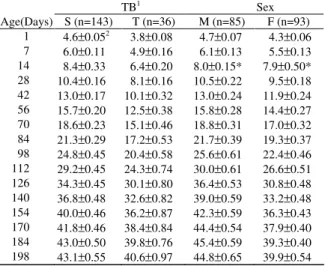
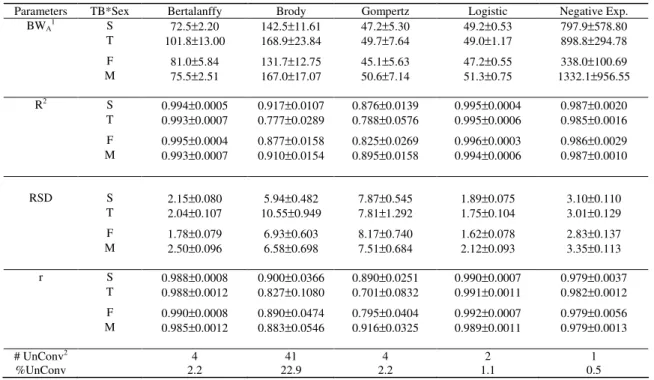
Overall means and standard errors for body weight (BW) for both sexes and type of birth by age are represented in Table 1. For both sexes and type of birth, standard error increased with age. Differences between sexes first appeared at 1wk of age and sustained thereafter (P<0.01) except in 2 wk of age where the difference between the mean BWs of male and female lambs was insignificant. Over the growth period of lambs, males were heavier than females. Differences between type of birth first appeared at birth and sustained thereafter (P<0.01). Over the growth period of lambs, single born lambs were heavier than twin born lambs. The goodness of fit parameters obtained from the Bertalanffy, Gompertz, Brody, Negative exponential and Logistic growth curves fitted separately to individual data are presented in Table 2.
3.1. Model comparison
The R2 values were highest for Logistic growth models indicating a significant relationship between age and weight in both sexes and types of birth, followed by Bertalanffy and Negative exponential functions. The R2 values obtained from fitting the Gompertz and Brody growth curves were the smallest among the five functions fitted in this study. The results in this study are in conflict with the study conducted on Norduz female kids by Keskin & Daskiran (2007). They concluded that the Gompertz model was the most apropriate for describing growth trejectory of Norduz female kids. In a study of growth in broilers, Yakupoglu & Atil (2001) reported high coefficient of determination for Gompertz and Bertalanffy growth models. Topal et al (2004) stated that the Gompertz function was the best fitted for the Morkaraman breed, while the Bertalanffy function was the best for describing the growth of Awassi breed. On the other hand, Bilgin & Esenbuga (2003) compared exponential,
Brody, Gompertz, Logistic, Bertalanffy and Richard models in order to describe the growth of Morkaraman sheep and concluded that the Brody model has best decribed the growth of Morkaraman sheep.
Table 1-Means (±±±±SEM) of body weight by age and type of birth and sex in Norduz female and male lambs
Çizelge 1-Norduz erkek ve dişi kuzuların cinsiyet ve doğum tipine göre değişik yaşlardaki canlı
ağırlıklarının ortalaması (±SH) TB1 Sex Age(Days) S (n=143) T (n=36) M (n=85) F (n=93) 1 4.6±0.052 3.8±0.08 4.7±0.07 4.3±0.06 7 6.0±0.11 4.9±0.16 6.1±0.13 5.5±0.13 14 8.4±0.33 6.4±0.20 8.0±0.15* 7.9±0.50* 28 10.4±0.16 8.1±0.16 10.5±0.22 9.5±0.18 42 13.0±0.17 10.1±0.32 13.0±0.24 11.9±0.24 56 15.7±0.20 12.5±0.38 15.8±0.28 14.4±0.27 70 18.6±0.23 15.1±0.46 18.8±0.31 17.0±0.32 84 21.3±0.29 17.2±0.53 21.7±0.39 19.3±0.37 98 24.8±0.45 20.4±0.58 25.6±0.61 22.4±0.46 112 29.2±0.45 24.3±0.74 30.0±0.61 26.6±0.51 126 34.3±0.45 30.1±0.80 36.4±0.53 30.8±0.48 140 36.8±0.48 32.6±0.82 39.0±0.59 33.2±0.48 154 40.0±0.46 36.2±0.87 42.3±0.59 36.3±0.43 170 41.8±0.46 38.4±0.84 44.4±0.54 37.9±0.40 184 43.0±0.50 39.8±0.76 45.4±0.59 39.3±0.40 198 43.1±0.55 40.6±0.97 44.8±0.65 39.9±0.54
1TB: Type of birth (S:single, T:twin); M:male, F:female
2All means in each row within TB and within Sex are significantly
different (P<0.01) *Nonsignificant
Sengul & Kiraz (2005) reported high R2 values for Gompertz-Laird and Logistic models in a study of growth curves of turkeys. Norris et al (2007) compared Gompertz-Laird and Logistic growth models in a study of growth in Venda and Naked Neck chickens, and found high R2 values for the two growth models. Aggrey (2002) compared the Gompertz-Laird and Logistic growth models in a study of growth in chickens, and reported high R2 values for the two growth models. Tekel et al (2005) concluded that Logistic, Gompertz and Bertalanffy models described growth of Awassi lambs better than Brody and Negative exponential models. Koncagul & Cadirci (2009) reported high R2 values for Gompertz and Logistic growth functions in a study of growth curve of Japanese quails. On the basis of coefficient of determination in the present study to describe relationship between body weight and age, the Logistic, Bertalanffy and Negative exponential functions seemed to be appropriate.
T a r ı m B i l i m l e r i D e r g i s i – J o u r n a l o f A g r i c u l t u r a l S c i e n c e s 16 (2010) 62-69
65
Table 2-Comparison criteria (Mean±±±±SE) for model selection
Çizelge 2-Model seçimi için karşılaştırma kıstasları (Ort±SH)
Parameters TB*Sex Bertalanffy Brody Gompertz Logistic Negative Exp. BWA1 S 72.5±2.20 142.5±11.61 47.2±5.30 49.2±0.53 797.9±578.80 T 101.8±13.00 168.9±23.84 49.7±7.64 49.0±1.17 898.8±294.78 F 81.0±5.84 131.7±12.75 45.1±5.63 47.2±0.55 338.0±100.69 M 75.5±2.51 167.0±17.07 50.6±7.14 51.3±0.75 1332.1±956.55 R2 S 0.994±0.0005 0.917±0.0107 0.876±0.0139 0.995±0.0004 0.987±0.0020 T 0.993±0.0007 0.777±0.0289 0.788±0.0576 0.995±0.0006 0.985±0.0016 F 0.995±0.0004 0.877±0.0158 0.825±0.0269 0.996±0.0003 0.986±0.0029 M 0.993±0.0007 0.910±0.0154 0.895±0.0158 0.994±0.0006 0.987±0.0010 RSD S 2.15±0.080 5.94±0.482 7.87±0.545 1.89±0.075 3.10±0.110 T 2.04±0.107 10.55±0.949 7.81±1.292 1.75±0.104 3.01±0.129 F 1.78±0.079 6.93±0.603 8.17±0.740 1.62±0.078 2.83±0.137 M 2.50±0.096 6.58±0.698 7.51±0.684 2.12±0.093 3.35±0.113 r S 0.988±0.0008 0.900±0.0366 0.890±0.0251 0.990±0.0007 0.979±0.0037 T 0.988±0.0012 0.827±0.1080 0.701±0.0832 0.991±0.0011 0.982±0.0012 F 0.990±0.0008 0.890±0.0474 0.795±0.0404 0.992±0.0007 0.979±0.0056 M 0.985±0.0012 0.883±0.0546 0.916±0.0325 0.989±0.0011 0.979±0.0013 # UnConv2 4 41 4 2 1 %UnConv 2.2 22.9 2.2 1.1 0.5
*TB: Type of birth (S:single, T:twin); Sex (M:male, F:female)
1BW
A:asymtotic weight; R2:multiple correlation coefficient; RSD:residual standard deviation; r: correlation
between the observed and the predicted growth curves
2#UnConv: number of unconverged growth curves
%UnConv: percentage of unconverged growth curves
Residual standard deviations (RSD) were smallest for Logistic growth curve (Table 2). RSD was slightly larger for Bertalanffy growth model. The other models produced larger RSD for both sexes and types of birth. RSDs were very similar within the types of birth but larger for male lambs than female lambs. Yakupoglu & Atil (2001) reported smaller RSD for Gompertz model than Bertalanffy. Sengul & Kiraz (2005) found smaller RSD for MMF (Morgan-Mercer-Flodin) function compared to Richards, Gompertz, and Logistic models. Additionally, Norris et al (2007) found that the Richards model had the smaller RSD than Gompertz and Logistic models. Keskin & Daskiran (2007) reported similar estimates of RSD for the Logistic and Gompertz growth models in a study of growth of Norduz female kids. Koncagul & Cadirci (2009) reported that the Richards, Logistic and Gompertz models produced similar estimates of RSD. Yildiz et al (2009) found that the Gompertz model described the growth of crassbred lambs (Karacabey Merino x Kivircik) the best comparing to Logistic ve linear model. In the
present study, the smallest RSD were obtained from the Bertalanffy and Logistic functions. Based on the RSD in this study, the Bertalanffy and Logistic models seemed to be appropriate for describing the growth of Norduz lambs.
The appropriateness of the models for describing the growth of animals has been decided by arguing on the asymptotic body weights (BWA) predicted by the
models fitted (Lopez de Torre et al 1992; Yakupoglu & Atil 2001; Norris et al 2007; Koncagul & Cadirci 2009). Lopez & Torre et al (1992) assessed the best fitting growth models by comparing the observed 60 to 90 months average weight and the BWA predicted
by the models. Yakupoglu & Atil (2001) recommended that small estimate of BWA should be
desirable for deciding on the best fit model. In the present study, based upon the decision of the choice of the most appropriate model, differences between the observed BWA (average of 184th and 198th day in
Table 1) and the predicted BWA (Table 2) were tested
using t-test procedure. Largest values of the BWA
parameter were observed under the Negative exponential model (P<0.05), followed by Brody and Bertalanffy growth models. The Gompertz and
66
T a r ı m B i l i m l e r i D e r g i s i – J o u r n a l o f A g r i c u l t u r a l S c i e n c e s 16 (2010) 62-69 Logistic models produced meaningful and closerestimates to observed mature body weight of Norduz lambs (Table 2). Based on the t-test results, the Bertalanffy, Brody and Negative exponential models severly overestimated the BWA. Although no significant differences were
observed between the observed and the predicted asymptotic BW by the Logistic and Gompertz model, the standard errors of the estimates of BWA by Gompertz model were quite higher than
those obtained by Logistic growth model. Based on the BWA in this study, the Logistic models
seemed to be appropriate for describing the growth of Norduz lambs.
In the present study, decision on appropriateness and the ability of the models for describing the growth trejectory of Norduz lambs has been made by examining the correlations (r) between the observed and the predicted growth curves (Table 2). After obtaining the parameters from each model, daily (from day 1 to day 198 in two weeks interval) body weights were predicted using the parameters produced by the models. Then, correlations between the observed and the predicted BWs were calculated for sexes and types of birth for each model. Regarding Table 2, it is clear that Logistic growth model produced the highest r values, followed by Bertalanffy and Negative exponential models. The smallest estimates of r were obtained fitting of Gompertz and Brody models.
The overall assessment of the growth models on the basis of the comparison criteria of R2, RSD, r, and BWA, used in the present study, the
Logistic growth model seemed to be the most appropriate model to describe the association between age and live weight, and to explain the growth trajectory of Norduz female and male lambs. Based on the above assessments, the Logistic growth model was further used to assess the parameters of the growth curves of Norduz female and male lambs.
3.2. Growth of Norduz lambs
Since consecutive or repeated measurements are usually autocorrelated, the growth models were fitted to individual lambs to remove possible bias in the statistical inference on the growth parameters. Then, the estimated parameters were averaged over each main effect of the sex and types of birth. Comparisons were made within the sex and types of birth using
t-test procedure. The levels of interaction of environmental conditions are not reported here because the all interaction effects were insignificant. The Logistic growth curves are shown in Figure 1a for type of birth and in Figure 1b for sexes. As seen in curves, fitted lines are close to the observed values. The values estimated by Logistic model for the parameters BWA, r, RSD, and R2 are given in Table 2
(the sixth column). The other model parameter estimates are shown in Table 3.
Table 3-Means (±±±±SE) of growth curve parameters of Logistic function by type of birth and
sex in Norduz lambs
Çizelge 3-Norduz kuzularında, Lojistik fonksiyonun büyüme eğrisi parametrelerinin ortalamaları (±SH)
Factors TB* BWA K ti BWA --- -0.4108 0.6344 K -0.6443 --- -0.8273 ti 0.7084 -0.8572 --- Sex BWA --- -0.5690 0.7091 K -0.6167 --- -0.7732 ti 0.6857 -0.8743 ---
*TB: Type of birth (S:single, T:twin); Sex (M:male, F:female) aDifferent subscripts indicated significant difference (P<0.001) within
row within TB and within Sex
There was no differences between growth parameters for type of birth, except for the age at maximum growth (ti). Although single and twin born lambs had similar growth rate (K) and similar asymptotic body weight (BWA), single born lambs
reached age at maximum growth about 17 days earlier than twin born lambs. It can be expected that individual with lower K would reach ti later than individual with higher K.
In the present study, Norduz female lambs reached ti later, but they were able to have same BWA
probably due to the environment provided to them. There was significant (P<0.001) differences between growth parameters for sex, except for the age at maximum growth (ti). Male lambs had higher K and BWA than female lambs although female lambs and
male lambs had similar (ti).
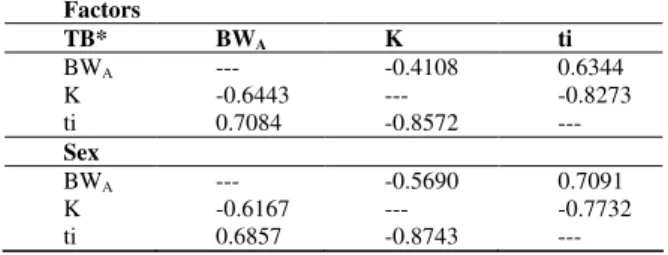
Correlations among growth curve parameters for sex and type of birth are given in Table 4. The relationship between BWA and K has biologically
important meanings (Lopez de Torre et al 1992). Moderate negative correlations for both single born lambs and twin born lambs observed between BWA
and K indicate that type of birth is not a factor affecting the K and BWA in Norduz sheep.
T a r ı m B i l i m l e r i D e r g i s i – J o u r n a l o f A g r i c u l t u r a l S c i e n c e s 16 (2010) 62-69
67
0 5 10 15 20 25 30 35 40 45 50 0 14 42 70 98 126 154 184 Age (days) W ei gh t ( kg ) Singe_observed Single_predicted Twin_observed Twin_predictedFigure 1a-Measured and estimated growth curves of single and twin born lambs by Logistic model
Şekil 1a-Đkiz ve tekiz doğan kuzuların gözlemlenen ve Lojistik model tarafından tahmin edilen büyüme eğrileri
0 5 10 15 20 25 30 35 40 45 50 0 14 42 70 98 126 154 184 Age (days) W ei gh t ( kg ) Female_observed Female_predicted Male_observed Male_predicted
Figure 1b-Measured and estimated growth curves of male and female lambs by Logistic model
Şekil 1b-Erkek ve dişi doğan kuzuların gözlemlenen ve Lojistik model tarafından tahmin edilen büyüme eğrileri That is to say, faster growing lambs do not attain a
larger mature weight compared to those slower growing lambs.
In regard to sex factor, this statement is not hold because male lambs grew faster and attained larger mature weight than female lambs showing that sex is the main factor affecting the growth of Norduz lambs. In the present study, interaction between sex and type of birth was examined, and preliminary analysis showed that the interaction was insignificant. Thus, all the comparisons were made within the main factors. If the objective in a
Table 4-Correlation among the model parameters of Logistic function by type of birth and sex in Norduz lambs
Çizelge 4-Norduz kuzularında, Lojistik fonksiyonun büyüme eğrisi parametreleri arasındaki korelasyonlar
TB Sex
S T F M
BWA 49.2±0.53 49.0±1.17 47.2±0.55a 51.3±0.75b
K 0.023±0.00030.022±0.00050.022±0.0003a 0.024±0.0004b
ti 92.6±1.48a 109.2±3.36b 98.3±2.08 93.5±1.98
*TB: Type of birth (S:single, T:twin); Sex (M:male, F:female)
#Upper triangle within TB is for Single birth, and lower triangler is for Twin birth
#Upper triangle within Sex is for female lambs, and lower triangler is for male lambs
68
T a r ı m B i l i m l e r i D e r g i s i – J o u r n a l o f A g r i c u l t u r a l S c i e n c e s 16 (2010) 62-69 breeding program is to increase the mature bodyweight, evaluation should be made within sex without considering type of birth in Norduz sheep.
4. Conclusion
Logistic growth curve is appropriate for describing the age-body weight relationship in the Norduz sheep. The results showed evidence that there are differences in the growth of female and male lambs whereas type of birth is not resulted in any differences. The development of growth curves for this indigenous sheep provides information about mature weights and growth rates of this sheep. Further studies are required to estimate genetic parameters of the growth curves, so that, in development of a breeding program growth curve parameters could be used in selection decision for genetic improvement.
References
Aggrey S E (2002). Comparison of three nonlinear and spline regression models for describing chicken growth curves. Poultry Science 81: 1782–1788 Akbas Y, Taskin T & Demiroren E (1999). Farkli
modellerin Kivircik ve Daglic erkek kuzularinin buyume egrilerine uyumunun karsilastirilmasi. Turkish Journal of Veterinary and Animal Science
23(3): 537–544
Bathaei S S & Leroy P L (1996). Growth and mature weight of Mehraban Iranian fat-tailed sheep. Small
Ruminant Research 22: 155–162
Bilgin C O & Esenbuğa N (2003). Dogrusal olmayan buyume modellerinde parametre tahmini. Hayvansal
Uretim 44(2): 81–90
Bilgin O C, Emsen E & Davis M E (2004a). Comparison of nonlinear models for describing growth of scrotal circumference in Awassi male lambs. Small
Ruminant Research 52(1-2): 155-160
Bilgin O C, Esenbuga N, Macit M & Karaoglu M (2004b). Growth curve characteristics in Awassi and Morkaraman Sheep, Part I: Comparison of nonlinear functions. Wool Technology and Sheep Breeding
52(1): 1-7
Brown J E, Fitzhugh Jr H A & Cartwright T C (1976). A comparison of nonlinear models for describing weight-age relationships in cattle. Journal of Animal
Science 42: 810-818
Colak C, Orman M N & Ertugrul O (2006). Simental x Guney Anadolu Kirmizisi sigirlarina ait canli agirlik olcumlerine dayanan dogrusal ve dogrusal olmayan buyume egrileri. Lalahan Hayvansal Arastirma
Enstitusu Dergisi 46(1): 1–5
Doğan I (2003). Kuzularda buyumenin cok boyutlu olcekleme yontemi ile degerlendirilmesi. Uludag University Journal of the Faculty of Veterinary
Medicine 22(1–3): 33–37
Duzgunes O, Kesici T, Kavuncu O & Gurbuz F (1987). Arastirma ve Deneme Metotlari. Istatistik Metotlari
II. Ankara Universitesi Ziraat Fakultesi
Yayinlari:1021. Ders Kitabi: 295. Ankara
Efe E (1990). Buyume Egrileri (Growth Curves). Doktora Tezi, Cukurova Universitesi Fen Bilimleri Enstitüsü, Adana
Esenbuga N, Bilgin O C, Macit M & Karaoglu M (2000). Ivesi, Morkaraman ve Tuj kuzularinda buyume egrileri. Ataturk Universitesi Ziraat Fakultesi Dergisi
31: 37-41
Fitzhugh Jr H A (1976). Analysis of growth curves and strategies for altering their shape. Journal of Animal
Science 42: 1036–1050
Hald A (1952). Statistical Theory with Engineering Applications. Wiley, New York
Keskin S & Daskiran I (2007). Comparison of growth models in Norduz Female Kids. Indian Veterinary
Journal 84: 1066-1068
Keskin I & Dag B (2006). Comparison of the Linear and Quadratic Models for describing the growth of live weight and Body measurements in Anatolian Merino male lambs in fattening period. Journal of Animal
and Veterinary Advances 5(1): 81-84
Kocabas Z, Kesici T & Elicin A (1997). Akkaraman, Ivesi x Akkaraman ve Malya x Akkaraman kuzularında buyume egrisi. (Growth curve of Akkaraman, Ivesi x Akkaraman ve Malya x Akkaraman lambs). Turkish Journal of Veterinary
and Animal Science 21(3): 267-275
Koncagul S & Cadirci S (2009). Comparison of three non-linear models when data truncated at different lengths of growth period in Japanese quails.
European Poultry Science 73(1): 7–12
Koncagul S & Cadirci S (2010). Analysis of Growth Curve of Broiler with Restricting and Unrestricting Initial Body Weight in Gompertz-Laird Model in Different Environments. Italian Journal of Animal
Science 9(1): 20–25
Lopez de Torre G, Candotti J J, Reverter A, Bellido M M, Vasco P, Garcia, L J & Brinks J S (1992). Effects of growth curve parameters on cow efficiency.
Journal of Animal Science 70: 2668–2672
Merrit E S (1974). Selection for growth rate of broilers
with a minimum increase in adult size. In Proc. 1st
World Congress of Genetics Applied to Livestock.
Madrid, Spain. Pp. 951–958
Mignon-Grasteau S, Piles M, Varona L, de Rochambeau H, Poivey J P, Blasco A & Beaumont C (2000). Genetic analysis of growth curve parameters for male
T a r ı m B i l i m l e r i D e r g i s i – J o u r n a l o f A g r i c u l t u r a l S c i e n c e s 16 (2010) 62-69
69
and female chickens resulting from selection onshape of growth curve. Journal of Animal Science 78: 2515–2524
Neter J, Wasserman W & Kutner M H (1989). Applied Linear Regression Models. Irwin, Boston
Norris D, Ngambi J W, Benyi K, Makgahlela M L, Shimelis H A & Nesamvuni E A (2007). Analysis of growth curves of indigenous male Venda and Naked Neck chickens. South African Journal of Animal
Science 37: 21–26
Ratkowsky D A (1990). Handbook of nonlinear regression modeling. (Marcel Dekker, New York) Sengul T & Kiraz S (2005). Non-linear models of growth
curves in large white turkeys. Turkish Journal of
Veterinary and Animal Science 29: 331–337
Tekel N, Sireli H D, Elicin M & Elicin A (2005). Comparison of growth curve models on Awassi lambs. Indian Veterinary Journal 82: 179–182 Thieme O, Karazeybek M, Azman M A & Ugurlu A
(1999). Performance of village sheep flocks in Central Anatolia. I. Growth of Lambs. Turkish
Journal of Veterinary and Animal Science 23: 467–
474
Topal M, Ozdemir M, Aksakal V, Yildiz N & Dogru U (2004). Determination of the best nonlinear function in order to estimate growth in Morkaraman and Awassi Lambs. Small Ruminant Research 55: 229– 232
Torre G L, Candotti J J, Reverter A, Bellido M M, Vasco P, Garcia L J & Brinks J S (1992). Effects of growth parameters on cow efficiency. Journal of Animal
Science 70: 2668-2672
Tzeng R Y & Becker W A (1981). Growth pattern of body and abdominal fat weight in male broiler chickens. Poultry Science 60: 1101–1106
Yakupoglu C & Atil H (2001). Comparison of growth curve models on broilers II: Comparison of models.
Online Journal of Biological Science 1(7): 682–684
Yildiz G, Soysal M I & Gurcan E K (2009). Tekirdag ilinde yetistirilen Karacabey Merinosu x Kivircik melezi kuzularda buyume egrisinin farkli modellerle belirlenmesi. Tekirdag Ziraat Fakultesi Dergisi 6(1): 11-19