Some egg quality traits of two laying hybrids kept in different cage
systems
*Esin Ebru ONBAŞILAR
1, Necmettin ÜNAL
1, Evren ERDEM
21Ankara University, Faculty of Veterinary Medicine, Department of Animal Husbandry, Ankara; 2Kırıkkale University, Faculty of
Veterinary Medicine, Department of Animal Husbandry, Kırıkkale, Turkey.
Summary: Interest has been increasing about enriched cages affecting the laying hens and the producers. Egg quality traits are important for economic impact. Whence, the purpose of this study was to determine the differences in egg quality traits of two laying hybrids reared in conventional and enriched cages at different ages. 532 Lohmann Brown Classic (LB) and 532 Lohmann LSL Classic (LW) hens were kept from 16 to 73 weeks in either conventional cages or enriched cages. Twenty eight eggs were selected randomly from each hybrid and cage group at 20, 30, 40, 50, 60 and 70 wk of ages at from 08.00 to 10.00 o’clock to evaluate egg quality traits. For this aim, a total of 672 eggs were used. Egg weight, shape index, breaking strength, shell thickness, albumen index, yolk index and Haugh Unit were determined. Yolk index, albumen index and Haugh Unit in eggs of hens were reared in conventional cages were lower than those of in enriched cages. Egg weight, shape index and shell thickness were higher in eggs laid by LB hens. Layer age was affected all examined egg quality parameters. Consequently, albumen index, yolk index and Haugh Unit were enhanced by the enrichment of the cages and interactions among cage type, hybrid and layer age should be taken for the egg quality traits.
Keywords: Age, cage type, egg quality, hybrid.
Farklı kafes sistemlerinde barındırılan iki yumurtacı hibritte bazı yumurta kalite özellikleri
Özet: Yumurtacı tavukları ve üreticileri etkileyen zenginleştirilmiş kafeslere olan ilgi artmaktadır. Yumurta kalite özellikleri ekonomik öneme sahiptir. Bu nedenle bu araştırmanın amacı geleneksel ve zenginleştirilmiş kafeslerde barındırılan iki yumurtacı hibritte farklı yaşlarda yumurta kalite özelliklerini araştırmaktır. Toplam 532 Lohmann Kahverengi (LB) ve 532 Lohmann Beyaz (LW) yumurtacı tavuk 16 haftalık yaştan 73 haftalık yaşa kadar geleneksel ve zenginleştirilmiş kafeslerde barındırıldı. Yumurta kalite özelliklerinin incelenmesi için 20, 30, 40, 50, 60 ve 70 haftalık yaşlarda saat 8.00-10.00 arasında her bir genotip ve kafes grubundan 28 yumurta rastgele seçildi. Bu amaçla toplam 672 yumurta kullanıldı. Yumurta ağırlığı, şekil indeksi, kırılma mukavemeti, kabuk kalınlığı, ak indeksi, sarı indeksi ve Haugh birimi belirlendi. Geleneksel kafeste yetiştirilen tavukların yumurtasında sarı indeksi, ak indeksi ve Haugh birimi zenginleştirilmiş kafeste yetiştirilenlerinkine göre daha düşük bulundu. Yumurta ağırlığı, şekil indeksi ve kabuk kalınlığının kahverengi yumurtacılardan elde edilen yumurtalarda daha yüksek olduğu görüldü. Yumurtacı tavukların yaşı, incelenen tüm yumurta kalite özelliklerini etkiledi. Sonuç olarak, zenginleştirilmiş kafesler ak indeksi, sarı indeksi ve Haugh birimini arttırmıştır ve kafes tipi, hibrit ve yaş arasındaki interaksiyonlar yumurta kalitesi bakımından dikkate alınmalıdır.
Anahtar sözcükler: Hibrit, kafes tipi, yaş, yumurta kalitesi.
Introduction
Cage systems of laying hens have been changed from conventional to enriched cages due to the welfare of hens’ and consumers’ demands. Enriched cages have more space per hen and supply the hen’s behavioural needs such as nest, perch, scratch-pad and nail shortener. In commercial egg production, different hybrids are used according to the culture. However, production parameters vary according to the hybrids (12). Egg production, feed conversion, external appearances, bone and liver health and also some blood parameters of hens kept in different cage systems were examined (4, 12, 22, 23, 27). Besides
* This research was supported by Ankara University BAP-10A3338005.
these parameters, egg quality traits are also important for consumers and producers. Egg quality is influenced by genotype, age, rearing system, diet and environmental factors (8, 10, 19, 25). Also interactions of genotype, cage system and age probably play an important role in egg quality determination. However, there are limited studies including these interactions. Therefore, this study was to determine the effect of cage type on the egg quality obtained from brown and white layers and interaction of cage type (conventional and enriched), genotype (Lohmann Brown Classic and Lohmann LSL Classic) and layer age on some egg quality traits.
Materials and Methods
Animal care protocols and experimental procedures were certified by Ankara University Animal Experiments Ethics Committee (Number: 201057/285). A total of 532 brown (Lohmann Brown Classic; LB) and 532 white (Lohmann LSL Classic; LW) laying hybrids aged from 16 to 73 wk of age were used in the study. These hybrids were kept in two caging systems (conventional and enriched) in the same poultry house. Each system had 3 rows. Conventional cages were 192 cm width, 62.5 cm depth and 57 cm height and 20 hens were kept in this cage type. Enriched cages were 240 cm width, 62.5 cm depth and 57 cm height and 18 hens were kept in this cage type. Enriched cages also included the nest (48 cm width x 62.5 cm depth), scratch-pad (35 cm width x 35 cm length), perch and claw shortener (12 cm width x 3 cm length). The nesting area was separated from the other areas with blue plastic strips. Two plastic perches were used with 190 and 137 cm in length. Each cage had 8 nipple type drinkers. Each hybrid and cage system groups consisted of 14 cages. The ingredients and the nutrient compositions of the diets by period were reported in Table 1. The lighting program was 16 L:8 D during the laying period.
28 eggs (2 eggs of each cage) were selected from each hybrid and cage group at 20, 30, 40, 50, 60 and 70 week of ages at from 08.00 to 10.00 o’clock to evaluate egg quality traits. A total of 672 eggs were used. They
were weighed and their shape indexes were determined as (egg width (cm)/egg length (cm)) × 100. A quasi-static compression device was used to determine the eggshell breaking strength. A tripod micrometer was used to determine the albumen and yolk heights. Digital caliper was used to specify the length and width of the albumen and diameter of the yolk. Indexes of albumen and yolk were calculated as: Albumen index (%): [(albumen height (mm)/average of albumen length (mm) and albumen width (mm)] × 100 and Yolk index (%): [(yolk height (mm)/yolk diameter (mm)] × 100. Haugh unit (%) was reckoned as 100 × log (albumen height + 7.57 − 1.7 egg weight0.37). Eggshell thickness was measured with using a
micrometer in 3 different parts of the shell (28).
Statistical analysis: A minimum sample size of 26
eggs achieves 80% power to detect an effect size of 0.8 with a significance level (alpha) of 0.05. However, 28 eggs were examined in the study depending on the number of cages. Sample size estimation was carried out using the PASS 11. Distribution the homogeneity of variance of the data was analysed. Differences among cage type, hybrid and layer age groups as well as their interactions with respect to the egg quality traits were determined with three-way ANOVA with SPSS for Windows (SPSS Inc., Chicago, IL). P < 0.05 was taken into the account statistically significant (3).
Table 1. Ingredients and chemical composition of the experimental diets. Tablo 1. Deneme rasyonlarının içeriği ve kimyasal bileşimi.
Ingredient, %
Laying periods (weeks of age)
16-17 18-31 32-45 46-59 60-73
Maize 51.6 52.0 53.4 54.0 54.8
Wheat 7.6 7.80 6.80 6.90 6.90
Soybean meal, 47% 17.4 17.3 17.3 17.1 16.2
Full-fat soy 8.00 6.52 6.09 4.34 4.10
Sunflower seed meal 5.50 5.70 5.10 6.20 6.40
Limestone 8.00 8.50 9.10 9.40 9.60
Dicalcium phosphate 1.20 1.50 1.50 1.40 1.30
Sodium chloride 0.21 0.21 0.21 0.21 0.21
DL-Methionine 0.17 0.15 0.15 0.15 0.14
Vitamin mineral premixes 0.25 0.25 0.25 0.25 0.25
Sodium bicarbonate 0.10 0.10 0.10 0.10 0.10 Analysed value ME, MJ/kg 11.6 11.4 11.4 11.3 11.3 CP, % 17.8 17.3 17.0 16.6 16.2 Ca, % 3.40 3.70 3.95 4.05 4.12 Total P, % 0.58 0.61 0.60 0.58 0.55 Methionine, % 0.44 0.41 0.41 0.41 0.39 Lysine, % 0.87 0.84 0.83 0.80 0.77
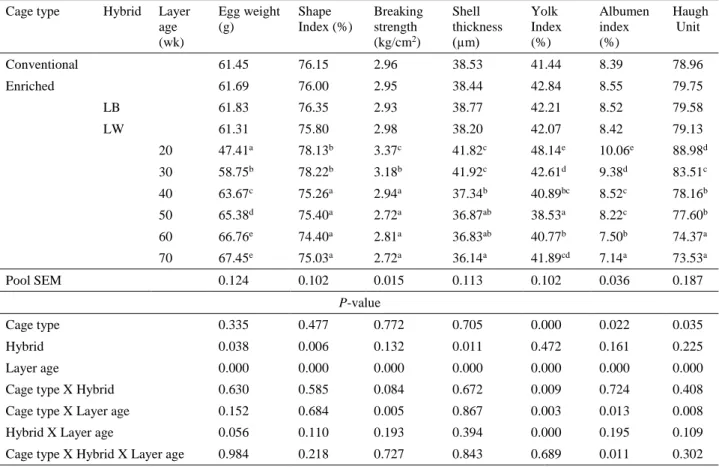
Table 2. Egg quality traits of two different laying hybrids kept in conventional and enriched cages.
Tablo 2. Geleneksel ve zenginleştirilmiş kafeslerde barındırılan iki farklı yumurtacı hibritin yumurta kalite özellikleri. Cage type Hybrid Layer
age (wk) Egg weight (g) Shape Index (%) Breaking strength (kg/cm2) Shell thickness (µm) Yolk Index (%) Albumen index (%) Haugh Unit Conventional 61.45 76.15 2.96 38.53 41.44 8.39 78.96 Enriched 61.69 76.00 2.95 38.44 42.84 8.55 79.75 LB 61.83 76.35 2.93 38.77 42.21 8.52 79.58 LW 61.31 75.80 2.98 38.20 42.07 8.42 79.13 20 47.41a 78.13b 3.37c 41.82c 48.14e 10.06e 88.98d 30 58.75b 78.22b 3.18b 41.92c 42.61d 9.38d 83.51c 40 63.67c 75.26a 2.94a 37.34b 40.89bc 8.52c 78.16b 50 65.38d 75.40a 2.72a 36.87ab 38.53a 8.22c 77.60b 60 66.76e 74.40a 2.81a 36.83ab 40.77b 7.50b 74.37a 70 67.45e 75.03a 2.72a 36.14a 41.89cd 7.14a 73.53a Pool SEM 0.124 0.102 0.015 0.113 0.102 0.036 0.187 P-value Cage type 0.335 0.477 0.772 0.705 0.000 0.022 0.035 Hybrid 0.038 0.006 0.132 0.011 0.472 0.161 0.225 Layer age 0.000 0.000 0.000 0.000 0.000 0.000 0.000
Cage type X Hybrid 0.630 0.585 0.084 0.672 0.009 0.724 0.408
Cage type X Layer age 0.152 0.684 0.005 0.867 0.003 0.013 0.008
Hybrid X Layer age 0.056 0.110 0.193 0.394 0.000 0.195 0.109
Cage type X Hybrid X Layer age 0.984 0.218 0.727 0.843 0.689 0.011 0.302
a–eValues within the same column with no common superscripts are significantly different, P < 0.05. a–e Aynı sütunda farklı harfleri taşıyan değerler istatistiksel olarak farklıdır, P < 0.05.
Results
Effects of cage type, hybrid and age on egg quality traits were given in Table 2. In conventional cages, egg weight, shape index, breaking strength and shell thickness were 61.45 g, 76.15 %, 2.96 kg/cm2 and 38.53 µm, while
in enriched cages 61.69 g, 76.00 %, 2.95 kg/cm2 and 38.44
µm, respectively. Cage type didn’t influence these parameters (P>0.05). In LB hens, egg weight, shape index, breaking strength and shell thickness were 61.83 g, 76.35 %, 2.93 kg/cm2 and 38.77 µm, while in LW hens, 61.31 g,
75.80 %, 2.98 kg/cm2 and 38.20 µm, respectively. Egg
weight (P<0.05) and shape index (P<0.01) and shell thickness (P<0.05) were affected by hybrid groups. Egg weight increased, while shape index, breaking strength and shell thickness decreased with layer age. Cage type and layer age affected the yolk index, albumen index and Haugh unit. Interactions were important for breaking strength, yolk index, albumen index and Haugh unit.
Discussion and Conclusion
Results of this study didn’t reveal differences in egg weight according to the cage type. Egg weights of hens reared both conventional and enriched cages were similar. Also, Tactacan et al. (22) showed that no differences were found in the egg weight of reared in conventional and
enriched cages. However, Jones et al. (6) found that eggs from furnished cages were significantly heavier than those produced in conventional cages. Egg weight was affected by hybrid and layer age. The egg weight of LB hens was heavier (P<0.05) than that of LW hens throughout the laying period. LB laying hens were heavier and this trait correlated with egg weight (21). Similarly, Ledvinka et al. (10) reported that egg weight increased with advancing hen age in different 3 genotypes. Egg weight increased with the layer age (P<0.001) from 47.41 to 67.45 g. Silversides and Scott (20), Johnston and Gous (5), Peebles et al. (15) and Dikmen et al. (4) found similar results. Interaction is important to understand impact of the cage type, hybrid and layer age together in more details. However, there were no significant interactions among examined parameters for egg weight.
No significant differences on egg shape index of hens reared in different cage type were detected. Similarly some researchers (1, 11) reported that egg shape index was not affected by rearing systems. The result of the present study indicated that shape index was significantly (P<0.01) affected by the hybrid, because shape index depends on the anatomical structure of the hen. Width was longer and length was shorter in brown eggs than those in white eggs. Therefore shape index was higher of brown
eggs than that of white eggs. Similarly, Küçükyılmaz et al. (8) showed that shape index for eggs from brown layers was higher than that for eggs from white layers. Egg shape index decreased (P<0.001) and longer eggs being produced from older hens. Because anatomical structure particularly of the shape of the pelvic bone changes with layer age and egg shape might be affected by this situation. However, no significant interaction among cage type, hybrid and layer age was found.
Shell breaking strength is important for producers. However enrichment didn’t affect the breaking strength. Similarly Valkonen et al. (26) and Kalmendal et al. (7) reported that modifying some details of cage design didn’t have an effect on shell strength parameters. Brown eggs have thicker egg shells as compared to white eggs. The results of our experiment were in accordance with the findings of Ledvinka et al. (9) and Zita et al. (29) who found a thicker eggshell in brown eggs. Poggenpoel et al. (16) indicated that genetic selection programs can affect the eggshell quality. Genotypes of layers influenced egg shell traits more than the cage type.
Layer age had an important role (P<0.001) on breaking strength and shell thickness. Significant interaction of cage type and layer age (P<0.01) was found. Breaking strength and shell thickness decreased with layer age. This result might correspond with results of Rodriguez-Novorro et al. (18) who described the effect of age on shell microstructure like crystal size. Egg shells composed of larger crystals obtained from older hens than those from young hens. Ahmed et al. (2) stated that small crystal size was more solid and this was stronger shells. However, Ledvinka et al. (10) indicated that there was no significant effect of age on shell strength. This difference from our study might be a result of examined period. Cage type and layer age interaction was important (P<0.01) for breaking strength.
Cage type and layer age were significant (P<0.001) factors, clearly affecting the yolk index. Yolk index of eggs laid in enriched cages was higher than that in conventional cages. Different results were obtained from previous studies. Ahammed and Ohh (1) and Pavlouski et al. (14) informed that housing system did not affect any significant difference on yolk index. This might be related to the different housing system. The yolk index was high value in the 20th wk of the layer age, and then this index
started to decrease to 50th wk of layer age. Similar results
with Zita et al. (30) who reported the decreasing yolk index with increasing age. Hybrid didn’t affect the yolk index. Cage type and hybrid interaction was important (P<0.01) for yolk index due to the differences in hybrid reared in enriched cages. Brown layers reared in the enriched cages had eggs with higher yolk index. Significant interactions were also seen cage type and layer age and also hybrid and layer age (P<0.001). Yolk index
of eggs laid in enriched cages in all examined period was higher than that in conventional cages. And also, yolk index of egg laid of brown hybrids was lower than that of white hybrids in 70th wk of age.
Albumen index and Haugh unit in eggs of hens reared in enriched cages were higher than that in conventional cages (P<0.05). Similarly Ahammed and Ohh (1) reported that Haugh Units of eggs laid in barn and cage were significantly different. However Küçükyılmaz et al. (8) showed that hens reared in organic and conventional cages didn’t affect the Haugh Unit. It is known that albumen index and Haugh Unit values directly depend on the albumen height. And also these traits differ significantly (P<0.001) between different layer age of measurement and the highest albumen index and Haugh Unit were observed at 20th weeks of layer age. The internal
quality of eggs is measured by means of the Haugh Unit that associated the height of with the functionality of albumen (25). 90% of the inner thick albumen is composed of ovomucin and is the most important component in determining the height of the inner thick albumen (24, 25). Decrease in albumen height as the age advances also reported some researchers (10, 13, 17, 24, 29). Significant interaction between cage type and layer age in albumen index and Haugh Unit. And also interaction among cage type, hybrid and layer age was significant for albumen index.
As a conclusion enrichment of the cages was enhanced to the yolk index, albumen index and Haugh Unit. Also enrichment was interacting with hybrid and layer age separately or together some egg quality traits. Hybrid, only affected the egg weight, shape index and shell thickness. All examined egg quality traits were influenced by layer age. Cage type, hybrid and layer age interactions should be taken into account when considering the egg quality.
References
1. Ahammed M, Ohh SJ (2013): Effect of housing
systems-barn vs cage on the first phase egg production and egg quality traits of laying pullet. Korean J Poult Sci, 40, 67-73.
2. Ahmed, AMH, Rodriguez-Navarro AB, Vidal ML, et al. (2005): Changes in eggshell mechanical properties,
crystallographic texture and in matrix proteins induced by moult in hens. Br Poult Sci, 46, 268-279.
3. Dawson B, Trapp RG (2001): Basic and clinical
biostatistics, 3rd ed. Lange medical books. McGraw-Hill
Medical Publishing Division, New York.
4. Dikmen BY, İpek A, Şahan Ü, et al. (2016): The egg
production and welfare of laying hens kept in different housing systems (conventional, enriched cage, and free range). Poult Sci, pew082.
5. Johnston SA, Gous RM (2007): Modelling the changes in
the proportions of the egg components during a laying cycle. Br Poult Sci, 48, 347-353.
6. Jones DR, Karcher DM, Abdo Z (2014): Effect of
commercial housing system on egg quality during extended storage. Poult Sci, 93, 1282-1288.
7. Kalmendal R, Johansson F, Wall H (2013): Effects of
fiber supply in furnished cages on performance, egg quality, and feather cover in 2 egg-laying hybrids. J Appl Poult Res,
22, 109-117.
8. Küçükyılmaz K, Bozkurt M, Herken EN, et al. (2012):
Effects of rearing systems on performance, egg characteristics and immune response in two layer hen genotype. Asian Australas J Anim Sci, 25, 559-568.
doi:10.5713/ajas.2011.11382.
9. Ledvinka Z, Tůmová E, Arent E, et al. (2000): Egg shell
quality in some white-egg and brown egg cross combinations of dominant hens. Czech J Anim Sci, 45,
285-288.
10. Ledvinka Z, Tůmová E, Englmaierová M, et al. (2012):
Egg quality of three laying hen genotypes kept in conventional cages and on litter. Arch Geflűgelkunde, 76,
38-46.
11. Lewko L, Gornowicz E (2011): Effect of housing system
on egg quality in laying hens. Ann Anim Sci, 11, 607-616.
12. Onbaşılar EE, Ünal N, Erdem E, et al. (2015): Production
performance, use of nest box, and external appearance of two strains of laying hens kept in conventional and enriched cages. Poult Sci, 94, 559-564.
13. Padhi MK, Chatterjee RN, Haunshi S, et al. (2013):
Effect of age on egg quality in chicken. India Int J Poult Sci,
48, 122-125.
14. Pavlovski Z, Masic B, Josipovic S, et al. (1992): The effect
of system of housing on the laying performance of hens in small flocks. Biotech U Stocarstvu, 8, 57-63.
15. Peebles ED, Zumwalt CD, Doyle SM, et al. (2000): Effects
of breeder age and dietary fat source and level on broiler hatching egg characteristics. Poult Sci, 79, 698-704.
16. Poggenpoel DG, Ferreira GF, Hayes JP, et al. (1996):
Response to long‐term selection for egg production in laying hens. Br Poult Sci, 37,743-756.
17. Rajkumar U, Sharma RP, Rajaravindra KS, et al. (2009): Effect of genotype and age on egg quality traits in
naked neck chicken under tropical climate from India. Int J
Poult Sci, 8, 1151-1155.
18. Rodriguez-Navarro A, Kalin O, Nys Y, et al. (2002):
Influence of the microstructure on the shell strength of eggs laid by hens of different ages. Br Poult Sci, 43, 395-403.
19. Svobodova J, Tůmová E, Englmaierová M (2014): The
effect of housing system on egg quality of Lohmann white and Czech hen. Acta Fytotechn Zootechn, 17, 44-46.
20. Silversides FG, Scott TA (2001): Effect of storage and
layer age on quality of eggs from two lines of hens. Poult
Sci, 80, 1240-1245.
21. Siegel PB (1962): Selection for body weight at eight weeks
of age 1. Short term response and heritabilities. Poult Sci,
41, 954-962.
22. Tactacan GB, Guenter W, Lewis NJ, et al. (2009):
Performance and welfare of laying hens in conventional and enriched cages. Poult Sci, 88, 698707.
23. Tauson R (2005): Management and housing systems for
layers – effects on welfare and production. World's Poult
Sci J, 61, 479-492.
24. Toussant MJ, Latshaw JD (1999): Ovomucin content and
composition in chicken eggs with different interior quality.
J Food Sci, 79, 1666-1670.
25. Tůmová E, Gous RM (2012): Interaction of hen
production type, age, and temperature on laying pattern and egg quality. Poult Sci, 91, 1269-1275.
26. Valkonen E, Venäläinen E, Rossow L, et al. (2010):
Effects of calcium diet supplements on egg strength in conventional and furnished cages, and effects of 2 different nest floor materials. Poult Sci, 89, 2307-2316.
27. Wall H, Tauson R, Elwinger K (2002): Effect of nest
design, passages and hybrid on use of nest and production performance of layers in furnished cages. Poult Sci, 81,
333-339.
28. Yalçın S, Özsoy B, Erol H, et al. (2008): Yeast culture
supplementation to laying hen diets containing soybean meal or sunflower seed meal and its effect on performance, egg quality traits, and blood chemistry. J Appl Poult Res,
17, 229-236.
29. Zita L, Tůmová E, Štolc L (2009): Effects of genotype, age
and their interaction on egg quality in brown-egg laying hens. Acta Veterinaria Brno, 8, 85-91.
30. Zita L, Ledvinka Z, Klesalová L (2013): The effect of the
age of Japanese quails on certain egg quality traits and their relationships. Veterinarski Arhiv, 83, 223-232. Geliş tarihi: 15.07.2016 / Kabul tarihi: 26.01.2017
Address for correspondence:
Prof. Dr. E. Ebru ONBAŞILAR Ankara University,
Faculty of Veterinary Medicine, Department of Animal Husbandry, 06110, Ankara, Turkey.