‘Autonomy:
The Basque Autonomous Community in Spain and the Kurdish Question in Turkey’
Joint Master’s Programme European Studies Master Thesis
Antalya / Hamburg, 2013 Nurullah Cihan AĞBAY
Nurullah Cihan AĞBAY
‘Autonomy:
The Basque Autonomous Community in Spain and the Kurdish Question in Turkey’
Supervisors:
Prof. Dr. Wolfgang VOEGELI Assoc. Prof. Ramazan İZOL
Joint Master’s Programme European Studies Master Thesis
Nurullatr Cihan AGRAY'rn bu gahgmasr jtirimiz tarafindan Uluslararasr iliqkiler Ana Bilim Da1
Avnrpa Qahqmalarr Ortak Yiiksek Lisans Programr tezi olarak kabul edilmiqtir.
/.r'-1
Bagkan
: Dog. Dr. M. CihanCAMCI
V
4fI
I
Uye @anrqmaru) : Prof. Dr. Wolfgang VOEGEL
r
U(y-
I "!
ra.
Uy"
: yrd. Dog. Dr. RamazaniZOf
Tez BaEh$r: Autonomy: The Basque Autonomous community in spain and the Kurdish Question in Turkey
Onay : Yukandaki imzalann, adr gegen d[retim iiyelerine ait oldulunu onaylanm.
Tez Savunma
Tarihi
t!8.t.q!,lzotz MezuniyetTarihi
*l.t.A.L|ZO|ZDog. Dr. Zekeiy a KARADAVUT
TABLE OF CONTENTS
LIST OF TABLES ... iii
LIST OF MAPS ... iv LIST OF FIGURES ... v LIST OF ABBREVIATIONS ... vi ÖZET ... vii ABSTRACT ... viii INTRODUCTION ... 1 CHAPTER I 1.THE THEORY OF AUTONOMY ... 3
1.1.The Definition of Autonomy ... 4
1.2.Forms of Autonomy ... 6 1.2.1.Territorial Autonomy ... 6 1.2.2.Non-Territorial Autonomy ... 8 1.2.2.1.Cultural Autonomy ... 8 1.2.2.2.Personal Autonomy ... 10 1.2.2.3.Functional Autonomy ... 11
1.3.Autonomy and the Ethnic Conflicts ... 12
1.3.1.Autonomy and States ... 12
1.3.2.Autonomy and Groups ... 14
1.4.The Right to Self-Determination and Autonomy ... 15
1.4.1.What is the Right to Self-Determination? ... 16
1.4.1.1.External Self-Determination ... 19
1.4.1.2.Internal Self-Determination ... 21
CHAPTER 2 2.THE BASQUE AUTONOMOUS COMMUNITY ... 24
2.1.The Spanish Constitution of 1978 ... 25
2.1.1.Autonomy in the Spanish Constitution of 1978 ... 28
2.1.2.The Statute of Autonomy of the Basque Country ... 33
2.2.The Basque Autonomous Community and the Right to Self-Determination ... 36
CHAPTER 3
3.THE KURDISH QUESTION IN TURKEY... 42
3.1.The Kurdish Question as a Separatist Movement ... 42
3.2.The Kurdish Question as Socio-economic Problem ... 43
3.3.Turkish Nationalism and the Kurdish Question ... 45
3.4.The Kurds and the Right to Self-Determination ... 51
3.5.Pros and Cons ... 52
CONCLUSION ... 55
BIBLIOGRAPHY ... 57
CURRICULUM VITAE ... 65
LIST OF TABLES
Table 1.1. Indication of the possible relationship between international law and constitutional
law ... 23
LIST OF MAPS
LIST OF FIGURES
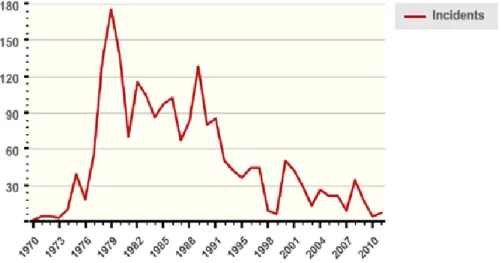
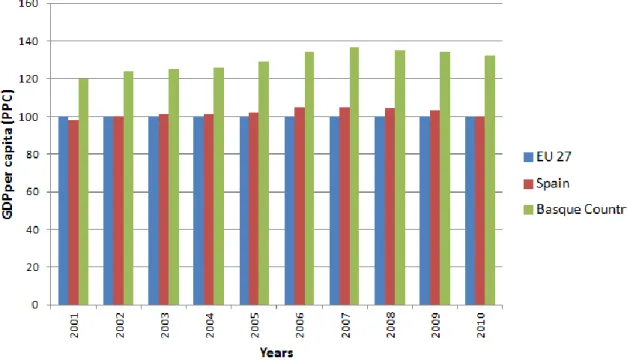
Figure 2.1. Incidents of ETA between 1970-2011. ... 39 Figure 2.2. Popular Support for ETA in the Basque Country ... 39 Figure 3.1. The evolution of GDP of the Basque Country (EU 27= 100) ... 45
LIST OF ABBREVIATIONS
BAC Basque Autonomous Community
BDP Barış ve Demokrasi Partisi (Peace and Democracy Party) CERD Committee on the Elimination of Racial Discrimination CE Constitución Española (Constitution of Spain)
EEC European Economic Community
ETA Euskadi ta Askatasuna (the Basque Country and Freedom) HADEP Halkın Demokrasi Partisi (People’s Democracy Party) PKK Partiya Karkeren Kurdistan (Kurdistan Workers Party) PNV Parti de Nacionalista Vasco (Basque Nationalist Party)
ÖZET
Otonomi: İspanya’da Bask Otonomisi ve Türkiye’de Kürt Sorunu
Kürt sorunu günümüz Türkiye’sinin halen en temel problemlerinden biridir. Bu problemin çözümünü bulmaya yönelik farklı yaklaşımlar geliştirildi. Otonomi modeli de bunların içinde tartışılan örneklerden bir tanesidir. Özellikle de İspanya’daki Bask otonom bölgesi, Türkiye’de de benzer bir uygulama yapmak için örnek olarak gösterilmektedir. Ancak Bask otonomi modelinin önerilmesine rağmen Kürt sorunu ve Bask örneği karsılaştırmasını otonomi teorisi altında yapan bilimsel çalışma bulmak oldukça zor. Dolayısıyla, bu çalışma Bask ve Kürt otonomisi tartışmalarına katkıda bulunacaktır.
Bu yüksek lisans tezinin çerçevesi İspanya’daki Bask otonom bölgesi ve Türkiye’deki Kürt sorunun otonomi teorisi adi altında karsılaştırmasını yapmaktır. Bu çerçevede çalışmanın amacı “Bask Otonomisi Kürt sorununun çözümü için bir model olabilir mi” sorusuna cevap vermektir.
Anahtar Kelimeler: Otonomi, Kendi Kaderini Tayin Hakkı, Bask Otonom Topluluğu, Bask
ABSTRACT
The Kurdish question is still one of the most fundamental problems in today’s Turkey. Different approaches have been developed in order to find a solution to this problem. Autonomy is one of the popular examples of them in question. In particular, the Basque Autonomy in Spain is shown as an example to implement such a model in Turkey. Despite the proposed Basque model, it is quite difficult to find relevant scientific studies that compare the Kurdish question with Basque cases under the theory of autonomy. Therefore, this study will contribute to the Basque and the Kurdish autonomy debates.
The scope of this master thesis is to compare the Basque Autonomous Region in Spain with the Kurdish case in Turkey within the theory of autonomy. In this perspective, it is aimed to answer the question that “Can the Basque Autonomy be a model for the solution of the
Kurdish question in Turkey?”
Key Words: Autonomy, The Right to Self-Determination, The Basque Autonomous
Community, The Statute of Autonomy of the Basque Country, The Spanish Constitution of 1978, ETA, PKK, The Kurdish question in Turkey.
INTRODUCTION
Tansu Ciller, one of the former Prime Ministers of Turkey, made a statement regarding the autonomy for the solution of the Kurdish question by the Basque Autonomy Model, after a meeting with her Spanish counterpart.1 It was in 1993 when she explained her idea. However, today, even two decades after her speech, the Kurdish question still continues as one of the major issues in Turkey. The history of the Kurdish question in Turkey or possible solutions have hitherto been discussed by the scholars, politicians and non-governmental organizations. Therefore, there is an excessive amount of related literature. However, this study differs from others in that it not only examines the theory of autonomy and the experience of autonomy in the Basque territory but also proposes this model to the Kurdish question. This master thesis consists of three chapters for a clearer analysis.
In the first chapter of the study, the theory of autonomy will be tested. Unless content of autonomy is internalized, proposing sample of it for any ethnic conflicts will not be grounded. While explaining the autonomy as well as its forms, the right to self-determination, one of the most controversial subjects that affects ethnic groups’ future, will be discussed in order to come to conclusion whether autonomy can be an answer to the right to self-determination claim or not.
The second chapter consists of three parts: Firstly, under the main title of The Spanish Constitution of 1978, the situation of autonomy in the Spanish Constitution of 1978 and the Statute of Basque Autonomous Community will be discussed. They hold great significance in order to understand what the Basques Autonomy Model is. Secondly, the right to self determination of the Basques will be addressed to see whether being autonomous region has fulfilled said right for the Basques or not. Thirdly, effects of autonomy on the secessionist movement, ETA, will be summarized.
In the last chapter of the study, the current Kurdish Question in Turkey will be the main subject. In order to define the problem, three main subjects will be examined. Firstly, the Kurdish question and PKK; secondly, the Kurdish question as a socio-economic backwardness of the Kurds and the South-eastern Turkey; thirdly, Turkish nationalism policies and the Kurdish Question will be argued. In the final part of the chapter, possibility of the Basque model for the Kurds will be discussed in terms of pros and cons.
1
Tozun Bahcheli and Sid Noel, ‘The Justice and Development Party and the Kurdish Question’ in Nationalisms and Politics in Turkey: Political Islam, Kemalism and the Kurdish Issue, ed. by Marlies Casier and Joost Jongerden (New York: Routledge, 2011), pp. 101-120, at p. 102.
However, it should be noted that, by and large, this study does not aim to deal with the history of the Kurds, their situation in the Middle East or their rebellions in Ottoman Empire or Turkish Republic in details. Doubtlessly, it includes some statements about the background of the Kurdish question and PKK but it neither examines the history of PKK and its existence nor proposes alternative models to end the conflict or negotiation strategies between the State and the PKK. Similarly, purpose of the study is not to argue the history of the Basques or not to deal with the aims of ETA, its background and struggle against Spain.
CHAPTER I
“Autonomy is not a panacea, but only a tool or a framework that can constitute an adequate compromise if the parties are looking for one.”
Ruth Lapidoth
1. THE THEORY OF AUTONOMY
It might be considered that autonomy can be easily defined since there are so many autonomy models in different parts of the world. However, autonomy does not have the same functioning system in all these parts. Some of them show the same characteristics whereas the others have differences. For instance, autonomy can be for both religious-ethnic groups and indigenous people in different geographical areas. In such group-based autonomies, group members have the right to rule certain matters, e.g. cultural or family issues, whereas autonomy for indigenous people possesses local administrative authorities, locally elected legislative assembly and local independent courts.2
Therefore, Potier claims that ‘international lawyers have failed to come to an agreement on a stable workable definition for autonomy’. According to his assumption, it is impossible to define autonomy accurately since ‘it is a loose and disparate concept which contains many threads, but no single strand’.3 However, although he points at the difficulty of the theory of autonomy, there have been many scholars to explain it from different perspectives. We owe great thanks to forefather scientists in particular Ruth Lapidoth, Hurst Hannum, Markku Suksi, Yash Ghai and Yoram Dinstein, who dedicated so many researches to autonomy. In the following parts, the definition and forms of autonomy will be explored.
2 Hurst Hannum, ‘Autonomy, Sovereignty and Self-Determination: The Accommodation of Conflicting Rights’,
(Philadelphia: University of Pennsylvania Press, 1990), p. 467-8, quoted in: Alexandra Xanthaki, Indigenous Rights and United Nations Standards: Self-Determination, Culture and Land, (New York: Cambridge University Press, 2007), p. 165.
3 Tim Potier, Conflict in Nagorno-Karabakh, Abkhazia and South Ossetia: A legal Appraisal, (The Hague:
1.1. The Definition of Autonomy
The word autonomy is the combination of the Greek words auto and nomos. According to Pitkin, the meaning of auto is “self or own” and nomos is “law, rule, binding custom, and
way of life”.4
Dinstein argues that autonomy will be seen as self-rule or self-government when looked up at legal-political vocabulary. He narrows the definition of autonomy to a system of self-government – within the borders of a sovereign country – set up in a specified region (or several regions).5 Heintze states that in principle, autonomy might be considered “as the granting of internal self-government to a region or group of persons, thus recognizing a partial independence from the influence of the central government”.6 Thereby, he observes that granting of certain rights to a specific part of national minority is an essential element of autonomy.7
According to Lapidoth’s idea, the original meaning of autonomy in Greek words used to be taken as the right to make one’s own laws.8 However, she claims that today the concept of autonomy is used in three different areas of science.9 Firstly, it exists in philosophy and its derivatives as the power of a person, which helps determine oneself through rational will. Secondly, in the natural sciences, the concept of autonomy is organic independence. Thirdly, autonomy exists in jurisprudence and political science in which there are different approaches to autonomy. Lapidoth classifies those approaches in politics under four main headings10:
a) Firstly, autonomy is compared to a right to act one’s own discretion in certain matters,
b) Secondly, autonomy is a synonym of independence,
c) In the third notion, autonomy is a synonym of decentralization,
4 Hanna F. Pitkin, Fortune is a Woman: Gender and politics in the Thought of Niccolo Machiavelli (Chicago:
The University of Chicago Press, 1999), p. 7.
5 Yoram Dinstein, ‘Autonomy Regimes and International Law’, Villanova Law Review, 56 (2011), 437-454 (p.
437)
6 Hans J. Heintze, ‘On the Legal Understanding of Autonomy’ in Autonomy: Applications and Implications, ed.
by Markku Suksi (The Hague: Kluwer Law International, 1998), pp.7-32, at p. 7.
7
Hans J. Heintze, ‘Territorial autonomy: A possible solution of Self-determination conflicts?’, Conference: Autonomy for Papua-Opportunity or Illusion?, Berlin: 4-5 June 2003, http://home.snafu.de/watchin/A fP2003heintze.htm accessed on 05.10.2012.
8 Ruth Lapidoth, Autonomy: Flexible Solutions to Ethnic Conflicts (Washington: United States Institute of Peace
Press, 1997), p. 29.
9
Ibid.
10 Ruth Lapidoth, ‘Autonomy: Potential and Limitations’, International Journal on Minority and Group Rights,
d) According to the fourth notion, autonomy is an entity that has exclusive powers of legislation, administration and adjudication in specific areas.
Hannum and Lillich state that autonomy is an independence of action on the internal or domestic level that does not work for the foreign affairs and defence as they are managed by central government. However, it may rarely work as a power to conclude international agreements related to cultural or economic matters since those issues also may reside with the autonomous entity.11 For instance, despite the membership of Denmark in European Union, Greenland – autonomy within the Kingdom of Denmark – left the European Community by a referendum on February 1 in 1985, and still is not a member of the EU. The reasons for Greenland were regulations governing commercial fishing and an EEC (European Economic Community) ban on the importation of sealskin products.12 Åland Islands might be shown as another example since it is today represented in Nordic Council by two delegates.13 It is also permitted to conclude agreements with the Nordic Countries with the approval of the President of Finland.14
In Yash Ghai’s words, autonomy is “a device which allows ethnic groups claiming a distinct identity to exercise direct control over affairs of their special concern” but at the same time, it allows the larger entity those powers which cover common interests.15 Gurr briefly defines the autonomy as a regime in which minority has a collective power base, usually a regional one, in a plural society.16
Bernhardt explains the autonomy in a broader sense as “the autonomous self-determination of an individual or an entity, the competence or power to handle one’s own affairs without outside interference”17. He shows the autonomy of universities, of cities, of churches as examples of the ‘limits of State interference’. In a narrower sense, the meaning of autonomy for Bernhardt is the protection and the self-determination of minorities, such as
11 Hurst Hannum and Richard B. Lillich, ‘The Concept of Autonomy in International Law’, American Journal of
International Law, 74.4 (Oct., 1980), 858-889 (p. 860).
12 Pamela R. Stern, Historical Dictionary of the Inuit (USA: Scarecrow Press, 2004), pp. 55-6.
13 See: http://www.norden.org/en/nordic-council/members-of-the-nordic-council accessed on 02.10.2012. 14
Lapidoth Autonomy: Flexible Solutions to Ethnic Conflicts, p. 27.
15
Yash Ghai, ‘Ethnicity and Autonomy: A Framework Analyses’, in Autonomy and Ethnicity: Negotiating Competing Claims in Multi Ethnic States, ed. by Yash Ghai (Cambridge: Cambridge University Press, 2000), pp. 1-24, at p. 8.
16 Ted R. Gurr, Minorities at risk: A global View of Ethnopolitical Conflicts (Washington, DC: United States
Institute of Peace Press, 1993), p. 292.
17 Rudolf Bernhardt, ‘Federalism and Autonomy’, in Models of Autonomy, ed. by Yoram Dinstein (London: Tel
linguistic, cultural or ethnic minorities. Autonomy provides this protection by granting certain rights to a specific part of the State population, in view of its characteristics which differ from the majority of the population. The importance of autonomy is that since minorities are different from the majority population, they can exclude “State and majority interference as far as their specific background, tradition and way of life concerned”.18
To sum up, considering the definitions of autonomy stated above, two important features can be seen as the bases for autonomy: firstly, autonomy is based on rule or self-government; secondly, autonomy serves to govern the groups’ interests/concerns.
1.2. Forms of Autonomy 1.2.1. Territorial Autonomy
Territory is one of the key elements of the theory of autonomy. It is extremely important since it has an active role to demand autonomy. For example, in some cases it may become the primary criterion because it grants rights to individuals who belong or wish to belong to the relevant group living in the territory.19 However, at the same time, should be mentioned that the importance of territory in desiring autonomy can emerge because of different reasons. For instance, the distance of the region to centre, historical and cultural development of the region, the existence of indigenous peoples who survived colonisation, also the importance of the land, and use of natural resources foster to establish a territorial autonomy.20
Rotchild and Hartzell define the territorial autonomy as an “institutional arrangement that delimits a regionally-based, self-administering entity or entities within a state as having explicit policy-making responsibilities in one or more political, economic or cultural sphere”.21
From Heintze’s view, territorial autonomy that works as a form of group protection can be implemented if the group in question lives in a defined area, which is geographically well defined territory, and constitutes the majority there. If a region becomes autonomous, not only the members of the majority or a certain group but also all inhabitants in that area enjoy this status. The important point here is that minority living outside this autonomy will not be able
18
Ibid.
19 Markku Suksi, ‘Concluding Remarks’ in Autonomy: Applications and Implications, ed. by Markku Suksi (The
Hague: Kluwer Law International, 1998), p. 359.
20 Potier, Conflict in Nagorno-Karabakh…, p. 55. 21
Donald Rothchild and Caroline A. Hartzell, ‘Security in Deeply Divided Societies: The Role of Territorial Autonomy’, in Identity and Territorial Autonomy in Plural Societies, ed. by William Safran and Ramon Maiz (Portland: Frank Cass Publishers, 2000), p. 259.
to benefit this autonomy status. In his opinion, this kind of autonomy is called “fake” national autonomy.22
Weller and Wolff highlight that the basic idea of territorial autonomy is an autonomous entity that is defined in territorial terms. Therefore, a population living in a certain territory is granted an autonomous status irrespective of whether the individuals living on this territory belong to one or another ethnic group.23 The significant point of territorial autonomy is that no matter what the degree of autonomy given to this specific area is, the constitution of the country will be preserved. Thus, the autonomous territory will be an integral part of that country. However, it will not be enough to provide the integration through only legislative measures. According to Weller and Wolff, this can be achieved in three different ways: Firstly, there should be an adequate representation of the autonomous entity at the central level; secondly, constitutionally guaranteed procedures can be provided for the resolution of disputes between central government and autonomous entity; thirdly, it is a necessity to function a mechanism that will “ensure the protection of human rights of all residents in the autonomous territory, regardless of their ethnic identity, including a right to appeal to judicial institutions at the central level”.24
In the contents of territorial autonomy, major issues are the division of powers –matters of culture, economics and social affairs– between the autonomous entity and central government.25 Lapidoth states that the extent of those powers, which are transferred to autonomous authorities, varies accordingly, “ranging from very limited to larger and up to a high concentration of major powers in the above spheres”.26 The question here we need to ask is how the territorial autonomy system will be achieved? At his point, it will be helpful to refer to Hannum and Lillich’s suggestions.27 Firstly, there should be a locally elected body with some independent legislative power. This body will be responsible for the local matters, such as health, education, internal trade and commerce, local taxation, local government
22
Hans J. Heintze, ‘On the Legal Understanding of Autonomy’ in Autonomy: Applications and Implications, ed. by Markku Suksi (The Hague: Kluwer Law International, 1998), pp.7-32, at p. 18.
23 Marc Weller and Stefan Wolff, ‘Self-Determination and Autonomy: A Conceptual Introduction’, in Autonomy,
Self-Governance and Conflict Resolution: Innovative Approaches to Institutional Design in Divided Societies, ed. by Marc Weller and Stefan Wolff (London: Routledge, 2005), pp. 1-22, at p. 12.
24 Ibid.
25 Ruth Lapidoth, ‘Elements of Stable Regional Autonomy Arrangements’, Centrum für Angewandte
Politikforschung (C.A.P.) Working Paper (August 2001), p. 7.
26
Lapidoth, ‘Autonomy: Potential and Limitations’, p. 277.
27 Hurst Hannum and Richard B. Lillich, ‘The Concept of Autonomy in International Law’, American Journal of
structure and government. The decisions made by it should not be subject to veto of sovereign government unless those decisions exceed its competence. Secondly, there should be a locally-chosen chief executive. S/he will probably be subject to prove or confirmation of the principal government, “who has general responsibility for the administration and execution of local laws or decrees”. Thirdly, the authors offer an independent local judiciary. Some members of this may be subject to approval by the principal government, too. If there are questions related to the scope of local power, they may be considered primarily by either local and national courts, then by a non-local court or a joint commission for final resolution. Lastly, full autonomy will be compatible with the power sharing arrangements between autonomous regions and central governments, e.g. police powers, ports and other aspects of transportation, and implementation of national/central regulations and legislations.
To draw a conclusion about the territorial autonomy in general, the following three important factors should be stressed: Firstly, to able to talk about such autonomy ‘a specific area-region’ should be determined where the autonomous entity will govern. Secondly, this area will be responsible for the certain affairs and for regulating its own legislation and government/administration. Thirdly, the autonomous entity will be in cooperation with the central government by providing representation of autonomous region in centre in order to be integral part of the state.
1.2.2. Non-Territorial Autonomy
The difference between non-territorial autonomy and territorial autonomy is not only the regional claims but also the rights of ethnic, religious minorities or other groups within the state where those groups live. Since it may be appropriate for all kind of groups, it exists in different models. In the following, different models of non-territorial autonomy will be explained:
1.2.2.1. Cultural Autonomy
Heintze states that main purpose of the cultural autonomy is the “free cultural development of the group”.28 Therefore, he defines cultural autonomy as an autonomous self-government of cultural affairs by the group or minorities who have possibility to decide freely on the identity issues such as language and education. In other words, cultural autonomy is “the right to self-rule, by a culturally defined group, in regard to matters which affect the
maintenance and reproduction of its culture”.29
The critical point here is that majority’s or State’s decision making tools are not able to rule the minority.30 In other words, in cultural autonomy, ‘even if the citizens inhabit a territory where the majority belongs to a different national group’, members of different ethnic groups are not subject to the cultural practices of majority especially on matters of national and ethnic interest.31
Eide highlights the point that territorial autonomy sets borders on the ground whereas the cultural one is essentially set in the minds of peoples. From this point of view, there are three reasons of difference between cultural autonomy and territorial autonomy.32 Firstly; in cultural autonomy, culturally defined groups have possibility to manage themselves rather than a territorially defined group. Secondly, the scope of self-management is limited to cultural aspects. Thirdly, cultural authority will be applied only over those individuals who belong to cultural group. In addition, it should be mentioned that the scope of self-management in such a cultural autonomous system does include the following: the state will not be able to overrule or invalidate the decisions of the cultural groups’ institutions unless they violate the national law.33
We can give some examples for cultural autonomy. For example, in 1925, parliament of Estonia passed an act about the Cultural Autonomy for Ethnic Groups. It entitled ethnic groups of more than 3,000 members in order to enable them to organize themselves into corporate bodies and run their own educational and cultural affairs.34 Although the Estonian government had the right to control the affairs of cultural self-government, the decisions or regulations of cultural autonomy bodies were not confirmed by the State.35
29 Asbjorn Eide, ‘Cultural Autonomy: Concept, Content, History and Role in the World Order’ in Autonomy:
Applications and Implications, ed. by Markku Suksi (The Hague: Kluwer Law International, 1998), pp. 251-276, at p. 252.
30 Heintze, ‘On the Legal Understanding of Autonomy’, p. 21.
31 Robert A. Kann, Multinational Empire: Nationalism and National Reform in the Habsburg Monarchy, 1848
-1918, (New York: Octagon Press, 1970), p. 244, quoted in Ephraim Nimni, ‘National-Cultural Autonomy as an Alternative to Minority Territorial Nationalism’, Ethnopolitics: Formerly Global Review of Ethnopolitics, 6.3 (2007), 345-364 (p. 348)
32 Eide, ‘Cultural Autonomy: Concept…’, p. 252. 33 Ibid.
34
See: http://ec.europa.eu/languages/documents/et_en.pdf accessed on 01.10.2012.
35http://www.estonica.org/en/Cultural_autonomy_of_national_minorities_and_cultural_self-government_in_the_
Non-Muslim communities in the Ottoman Empire, called as millet system, the Belgian linguistic communities, Eritrea, and Greenland are shown as examples of cultural autonomy systems.36
1.2.2.2. Personal Autonomy
In Lapidoth’s words, there is no difference between the terms cultural and personal
autonomy. Just like the definitions of cultural autonomy, she defines the personal autonomy
as an application “to all the members of a certain group within the state, regardless of the place of their residence”.37 She states that in personal autonomy, minorities have the rights to take the necessary steps so as to protect and implement their rights. Despite the discretion of those minorities, they will have to protect or implement those rights within the limits of the laws of the state.38 In addition, Lapidoth mentions the importance of personal autonomy by stating its great advantage over territorial autonomy by comparison:
“In principle personal autonomy should apply only to people opt to be members of the group for the benefit it is established, whereas territorial autonomy applies to all the inhabitants of a certain region, thus including also those who are not members of the group for whose benefit the regime is established”.39
On another side, Heintze makes distinction between the cultural and personal autonomy. He states that cultural affairs are the major subjects of cultural autonomy, whereas those of the personal autonomy are the members of ethnic groups. He sees this difference as an exception to the rule of State competence because in such autonomy collective rights of a people or a minority are transferred to individual.40
According to Hannum’s definition, ‘personal and political autonomy is in some real sense the right to be different and to be left alone: to preserve, protect and promote values which are beyond legitimate reach of the rest of society’41. However, Suksi criticizes Hannum’s definition because of its reference to personal and political autonomy together. He stresses that these types of autonomy should be defined separately because personal autonomy is “a description of especially private law forms of organization that lead to institutional
36
Hannum and Lillich, ‘The Concept of Autonomy in International Law’, p. 860.
37 Lapidoth, Autonomy: Flexible Solutions to Ethnic Conflicts, p. 37. 38 Ibid., p. 38.
39 Lapidoth, ‘Autonomy: Potential and Limitations’, p. 282. 40
Heintze, ‘On the Legal Understanding of Autonomy’, p. 21-2.
41 Hurst Hannum, Autonomy, Sovereignty and Self-Determination: The Accommodation of Conflicting Rights,
consequences when persons belonging to minorities create activities in community with the other members of their group”; therefore, the aim of personal autonomy here might be enjoying their own culture, professing and practicing religion or using their own language.42
1.2.2.3. Functional Autonomy
“Die Übertragung bestimmter staatlicher Funktionen und Rechte an privatrechtliche Minderheitenvereinigungen kann als funktionelle Autonomie’ bezeichnet werden”.43 [Functional autonomy can be referred as the transfer of certain state functions and rights to private minority associations]. In order to be able to transfer the particular functions to these private corporations, minorities should be organized in a private form, in other words organization must be collectively and without the State’s influence.44 Thus, the basis of functional autonomy becomes competence, initiative and interest of the associations.45 However, the significant point here is that despite the transfer of the functions, functional autonomy “does not provide the jurisdictional boundaries that often serve to maintain the particular identity of ethnic communities”.46
Functional autonomy, for example, aims to provide ‘adequate linguistic services to minority population in respect of a certain public function (such as education)’.47 And it achieves this by creating special linguistically identified units. Those units are at the different administrative levels, that is, ‘national or local administration of the public function’.48
Functional autonomy is rarely implemented but before the Church and States were separated, there were different regimes in Europe, which are related to certain subject matter
42 Markku Suksi, ‘Personal Autonomy as Institutional Form – Focus on Europe Against the Background of
Article 27 of the ICCPR’, International Journal on Minority and Group Rights, 15.2-3 (2008), 157-178 (p. 177).
43 See Dieter Blumenwitz, Volksgruppen und Minderheiten: Politische Vertretung und Kulturautonomie, (Berlin:
Gebr Mann, 1995), p. 97.
44
Heintze, ‘On the Legal Understanding of Autonomy’, p. 24.
45
Ibid.
46 William Safran, ‘Spatial and Functional Dimensions of Autonomy: Cross-National and Theoretical
Perspectives’, Nationalism and Ethnic Politics, 5.3-4 (1999), 11-34 (p. 12).
47 Markku Suksi, ‘Functional Autonomy: The Case of Finland with Some Notes on the Basis of International
Human Rights Law and Comparisons with Other Cases’, International Journal on Minority and Group Rights, 15.2-3 (2008), 195-225 (p. 199).
applicable differentially for Catholics, Protestants and Jews.49 Today, Danish minority in Germany is often cited as functional autonomy.50
1.3. Autonomy and the Ethnic Conflicts
Autonomy is used as a tool to prevent the ethnic conflicts or to fulfil the demands of minorities or groups. There are many examples of the ethnic conflicts that states and minorities tried to end by autonomy agreements. Some of them were shaped as territorial autonomy, whereas the others as cultural or the other types of autonomy. Although those autonomous entities or regimes were established to solve ethnic problems, some of them still deal with the problems. To illustrate, today in some of the autonomous regimes, there are claims based on the independency of autonomous region, e.g. Basque autonomous region or Catalonia in Spain. So is it possible to conclude that autonomy did not end the problems because of independency claims? In order to answer this question it is crucial to underscore the role of autonomy on solving the ethnic conflicts.
Doubtlessly, as far as the theory and implementations of autonomy are considered, it can be said that autonomy might be one of the best solutions to solve the ethnic problems. This is the pragmatic side of autonomy as we are able to test whether autonomy reaches its goal or not, namely the end of conflict. Both the States and ethnic groups are the contents that shape the autonomy. Therefore, to study the effects of autonomy on the ethnic conflicts, we should discuss the autonomy from State and minorities’ or groups’ perspective.
1.3.1. Autonomy and States
When the States’ side is considered, the most important feature is the fact that the States are unwilling to solve ethnic conflicts by autonomy. Cornell draws three reasons why the States are almost universally reluctant to accept autonomy systems.51 Firstly, they hesitate to grant autonomy since it may lead to eventual secession of the autonomous region. As ‘existing autonomous territories are – as a rule – interested in becoming independent’52
, it is difficult to claim that autonomous entities will not demand independency in the future.
49 John Packer, ‘Autonomy and the Effective Participation of Minorities in Public Life: Developments in the
OSCE’, in Beyond a One-Dimensional State: An Emerging Right to Autonomy, ed. by Zelim A. Skurbaty (Leiden: Koninklijke Brill NV, 2005), pp. 321-336, at p. 322.
50
Heintze, ‘On the Legal Understanding of Autonomy’, p. 23.
51 Swante E. Cornell, ‘Autonomy as a Source of Conflict: Caucasian Conflicts in Theoritical Perspective’, World
Politics, 54.2 (Jan. 2002), 245-276 (p. 246).
52 Bengt Broms, ‘Autonmous Territories’ in Rudolf Bernhardt, “Encyclopedia of Public International Law 1,
1992, Amsterdam, p. 311, quoted in: Hans J. Heintze, Territorial autonomy: A possible solution of Self-determination conflicts?, Conference: Autonomy for Papua-Opportunity or Illusion?, Berlin: 4-5 June 2003,
Secondly, giving autonomy to one ethnic group or region might be considered as discrimination by the other groups. Cornell’s example is the claim by Turkish Republic that the Kurds will perceive the given autonomy as second-class status if granted. Instead, I intend to suggest that Turkey can implement the autonomy not only for the Kurds but also for the other ethnic minorities as well in order to avoid such perceptions. At this point, it’s quite important to state the idea of Yash Ghai. He mentions that autonomy will work better if there are several ethnic groups rather than two.53 For example, the autonomy in Spain is entitled not only to the Basques but also to the Catalans and the other regions as well. Similarly, all minorities may have equal rights in Turkey, too. The third reason for the States’ hesitation to grant autonomy is the risk of the intervention of foreign state/s when autonomous entity has affiliation with this foreign state/s.
What is seen from the State’s perspective, in general, is that they concentrate on the future of the autonomy rather than solving ethnic conflicts or fulfilling the demands of minorities or ethnic groups by the help of autonomy. Therefore, unwillingness of the State may be valid in that since autonomy may lead to secession or discrimination in the future, it will not solve the ethnic problems. However, despite the fact that secession is well beyond the scope of this study54, I want to remark here that the reservation of the states about the secession should not be a reason not to support the autonomy. They should firstly question themselves about the reasons for secession demands. Why do the ethnic groups demand the secession despite the autonomy? Is it because of the lack of democracy or because of the regional economic disparities? Doesn’t it fulfil the rights of minorities? The democracy level of the state, partly the rights of minorities, is the major determinant of the future success. As Lenin stated that:
“The closer a democratic state system is to complete freedom to secede the less frequent and less ardent will the desire for separation be in practice, because big states afford indisputable advantages, both from the standpoint of economic progress and from that of the interests of the masses…”55
53
Yash Ghai, ‘Ethnicity and Autonomy: A Framework Analyses’, p. 17.
54 For more about secession see: Secession and Self-Determination, ed. by Stephan Macedo and Allen Buchanan,
(New York: New York University Press, 2003), and Allen Buchanan, Justice, Legitimacy and Self-Determination, (New York: Oxford University Press, 2004), pp. 331- 424.
55
V. I. Lenin, ‘The Socialist Revolution and the Right of Nations to Self-Determination, Theses’, Collected Work, 22 (December 1915-July 1916), (Moscow: Progress Publisher, Digital Reprints-2011), pp. 143-156, at p. 146.
According to Nordquist, there is a strong relation between the democratic structure of the State and success of autonomy as a conflict solving mechanism. For instance, if an institution is based on certain democratic ideas, it may co-function well with a democratic central government than a non-democratic one. Therefore, democracy level between the central government and the autonomy affects the durability of autonomy.56 In addition, democracy level of a State is significant during the preparation of autonomy arrangements. The more they are negotiated in a democratic environment and participatory way the more successful they will be.57 By this way, it may reply positively to the demands of minorities or autonomous units such as new institutional changes in future. For example, the reason why autonomy failed in Yugoslavia is shown as the lack of democracy.58 Therefore, such democratic arrangements accelerate the chance to guarantee a judicial process that can be accessed for resolving disputes.59 Briefly, the success of autonomy arrangements on ethnic conflicts depends on the democracy level of the States in order to protect stability in the future.
1.3.2. Autonomy and Groups
One of the most important features of autonomy is, as mentioned in the previous parts, is the division or transfer of the powers from centre to autonomous units. Autonomous regions/groups can benefit this characteristic of autonomy more than States. To illustrate, by the diffusion of the powers, territorial autonomy can reassure minority groups about their ability to control social, cultural, and economic matters that are important to the maintenance of communal identities and interests.60 Therefore, Hannum sees autonomy as an advantage to solve ethnic conflicts because of responding successfully to concerns about minority rights.61 Doubtlessly, hopes of these minority groups to obtain such competences show the importance of autonomy in peacemaking process for the minorities’ demands. Likewise, States may also
56 Kjell Ake Nordquist, ‘Autonomy as a Conflict-Solving Mechanism- an Overview’, in Autonomy: Applications
and Implications, ed. by Markku Suksi (The Hague: Kluwer Law International, 1998), pp. 59-77, at p. 70.
57 Yash Ghai, ‘Ethnicity and Autonomy: A Framework Analyses’, in Autonomy and Ethnicity: Negotiating
Competing Claims in Multi Ethnic States, ed. by Yash Ghai (Cambridge: Cambridge University Press, 2000), pp. 1-24, at p. 18.
58 Sinisa Malesevic, ‘Ethnicity and Federalism in Communist Yugoslavia and Its Successor States’, in Autonomy
and Ethnicity: Negotiating Competing Claims in Multi Ethnic States, ed. by Yash Ghai (Cambridge: Cambridge University Press, 2000), pp. 147-168 at p. 167-8.
59 Jacques Bertrand, Nationalism and Ethnic Conflict in Indonesia, (New York: Cambridge University Press), p.
187.
60 Donald Rothchild and Caroline A. Hartzell, ‘Security in Deeply Divided Societies’, p. 259. 61
Hurst Hannum, ‘Territorial Autonomy: Permanent Solution or Step toward Secession’ in Facing Ethnic Conflicts: toward a New Realism, ed. by Andreas Wimmer and others (USA: Rowman&Littlefield Publishers, Inc, 2004), pp. 274-282, at p. 275.
use this advantage as a way to dispose of its obligations – financial and other – towards the group.62
On another side, although autonomous entities have the right to control their affairs, autonomy may also “isolate the minority and prevent its members from political or economic participation in the larger sphere of the state”.63 Similarly, ‘it may aggravate the dialogue between groups and alienate the component groups from one another, and thus may lead to segregation’.64
To sum up, it can be easily said that autonomy has positives effects on the ethnic conflicts as well as it disadvantages. We should firstly note that the prevailing atmosphere of conciliation and goodwill of the parts play important roles during the agreement process.65 Secondly, autonomy is not able to resolve the ethnic conflicts entirely. However, in order to overcome the challenges, e.g. secession, discrimination or future constitutional alterations, autonomy should be designed and “maintained with necessary safeguards providing mechanisms to ensure the regulation of possible future conflicts, and for eventual alterations of the autonomy’s status”.66
1.4. The Right to Self-Determination and Autonomy
First of all, let us show the reason why there is a need to explain the term ‘self-determination’ in this study. As known, Spain is governed under the autonomous system and the Basques are entitled to one of the autonomous regions in Spain. Today, however, there are some Basques such as Basque nationalists still demanding their independency just like it was the past (See title 2.2. of this study). The ground for their claim is that the Basques have the right to self-determination. So, does it mean that self-determination is equal to independency?
Similarly, discussions about the same topic exist in Turkey as well. The Kurdish question could not be ended, no matter whatever solution has been proposed. There are some who claim that the Kurds have the right to self-determination. Therefore, the following two points are explored in the study: it is a necessity to explain the term “self-determination” in order to understand whether autonomy can provide the right to self-determination. However,
62
Alexandra Xanthaki, Indigenous Rights and United Nations Standards…, p. 166.
63 Cornell, ‘Autonomy as a Source of Conflict…’, p. 251.
64 Ibid., see also: Hans Joachim Heintze, ‘Implementation of Minority Rights through the Devolution of
Powers-The Concept of Autonomy Reconsidered’, International Journal on Minority and Group Rights, 9 (2002), 323-343 (p. 328).
65 Lapidoth, ‘Autonomy: Potential and Limitations’, p. 288. 66 Cornell, ‘Autonomy as a Source of Conflict…’, p. 251.
primarily we need to clarify the meaning of self-determination to see whether it equals to independency or not.
1.4.1. What is the Right to Self-Determination?
The right to self-determination should be explained in a detailed study as there are so many discussions and views about this right. However, it will be useful to point the ideas of two important characters of the last century, Lenin and US President Woodrow Wilson, about this right.
Lenin explains the right of nations to self-determination as ‘a political separation of these nations from alien national bodies, and the formation of an independent national state’.67 In other words, it is a right to independence in the political sense or the right to free political secession from the oppressor nation; therefore, Lenin sees this demand as a political ‘democracy will’ which is only a consistent expression of struggle against any kind of national oppression.68 Democracy will hold importance for him in that it is a tool used to ‘overthrow the bourgeois governments and for the achievement of socialism’.69
We can make Lenin’s thesis concrete by considering his statement about the oppressed nations mostly living on the border region of Russia and whose numbers is not less than 57 per cent of the population of Russia. He claims that some of those nations are more highly cultured than the Great Russians. However, they suffer from barbarous and medieval politics of Russian Tsarism. Therefore, Lenin states that it is an obligation for the social democrats to recognize their right to secede from Russia.70
Lenin supports the right to self-determination for the achievement of socialism; whereas Wilson asserts it for ‘government’ which means the right of people to choose their government freely. In other words, ‘peoples of each State be granted the right freely to select State authorities and political leaders’.71 In addition to this internal aspect of Wilson’s views, Potier summarizes the external dimension of Wilson’s self-determination, mentioned by
67 V. I. Lenin, Collected Works, vol. 20, (December 1913-August 1914), (Moscow: Progress Publisher, Digital
Reprints-2011), p. 397.
68
V. I. Lenin, ‘The Socialist Revolution and the Right of Nations to Self-Determination, Theses’, in Collected Works”, vol. 22 (December 1915-July 1916), (Moscow: Progress Publisher, Digital Reprints-2011), pp. 143-156 at p. 146.
69 Ibid., p. 156. 70
Ibid., p. 154.
71 Antonio Cassese, Self-Determination of Peoples: A legal Appraisal, (Cambridge: Cambridge University Press,
Wilson in the Fourteen Points.72 Firstly, self-determination could be used in order to restructure the States of Central Europe. Secondly, it could be utilised as a tool to govern territorial changes after the end of World War. Thirdly, it might be applied to solve competing colonial claims.73 After the Fourteen Points, Wilson had another speech on 11th February 1918. In this speech, by using the term ‘self-determination’ for the first time, he pointed that all national aspirations must be respected since peoples may be governed by their own consent. Therefore, ‘self-determination is not a mere phrase; it is an imperative principle of actions which statesmen will henceforth ignore at their peril’.74
Both Lenin and Wilson used the term self-determination in line with their political views: Socialism and Liberalism. Doubtlessly, they had a positive contribution to such a discussion. However, although this term is discussed in the 19th and early 20th centuries, it was not incorporated into any treaty until the UN Charter, which is the first authoritative document that upholds the term.75 In Article 1 (2) of the UN Charter, self-determination was directly stated as one of the purposes of the UN that is;
“…to develop friendly relations among nations based on respect for the principle of equal rights and self-determination of peoples, and to take other appropriate measures to strengthen universal peace...”76
Similarly, Article 55 of the UN Charter states the importance of the term by saying ‘...peaceful and friendly relations among nations based on respect for the principle of equal rights and self-determination of peoples...’77
The self-determination was accepted as a principle in the UN Charter whereas it was incorporated as a right into the Declaration on the Granting of Independence to Colonial Peoples and the Countries.78 It stated that ‘all peoples have the right to self-determination; by
72 Potier, Conflict in Nagorno-Karabakh…, p. 23.
73 See Woodrow Wilson’s “Fourteen Points Speech” available at:
http://www.woodrowwilson.org/library-a-archives/wilson-elibrary accessed on 07.10.2012.
74 See Woodrow Wilson’s Speech on 11 February 1918, available at:
http://wwi.lib.byu.edu/index.php/President_Wilson's_Address_to_Congress,_Analyzing_German_and_Austrian _Peace_Utterances accessed on 07.10.2012.
75
Antonio Cassese, ‘Political Self-Determination- Old Concepts and New Developments’, in UN Law/Fundamental Rights: Two Topics in International Law, ed. by Antonio Cassese (Netherlands: Sijthoff&Noordhoff International Publishers B. V., 1979), pp. 137-166, at p. 138.
76 See the UN Charter, available at: http://treaties.un.org/doc/Publication/CTC/uncharter.pdf accessed on
09.10.2012.
77
Ibid.
78 See the UN General Assembly Resolution 1514 (XV), 14 Dec. 1960 Resolution Available at:
virtue of that right they freely their political status and freely pursue their economic, social and cultural development’.79
Similarly, International Covenant on Civil and Political Rights in 16 December 1966 placed the same article.80
Some scholars think that the vague point of these statements was the lack of the definition or description of the ‘peoples’ since it does not show who the “peoples” are. For Potier, for example, any ethnic group can be peoples.81 According to Gunter, it means that people living in an existing colony or trust territory taken as a whole were eligible for self-determination.82 On the contrary, Crawford states that one cannot interpret “all peoples” as limited to the colonial case since it does not say that some peoples have the right of self-determination.83 UNESCO contributes to the ‘peoples’ debates for the right to self-determination and clarifies the ‘peoples’ as a group of individual human beings who enjoy some or all of the following common points84:
a. a common historical tradition, b. racial or ethnic identity, c. cultural homogeneity, d. linguistic unity,
e. religious or ideological affinity, f. territorial connection and
g. common economic life.
Despite the debates about the ‘peoples’ in the past, the existence of the self-determination as a principle is important than its description. At this point, I agree with the Falk’s reasonable comment ‘...such a principle exists and is actualized, it implies the existence
79
Ibid., para. 2.
80 See http://www2.ohchr.org/english/law/ccpr.htm accessed on 09.10.2012. 81 Potier, Conflict in Nagorno-Karabakh…, p. 33.
82
Michael Gunter, ‘Kurdish Question in International Law’, in The Kurdish Conflict in Turkey: Obstacles and Chances for Peace and Democracy, ed. by Ferhad Ibrahim and Gülistan Gürbey (Münster: LIT VERLAG, 2000), pp. 31-5, at p. 34.
83 James Crawford, ‘Right of Self-Determination in International Law’, in Peoples’ Rights, ed. by Philip Alston
(New York: Oxford University Press, 2001), pp. 7-67, at p.27.
84
International Meeting of Experts on Further Study of the Concept of the Rights of the Peoples, UNESCO, Paris, 27-30 November 1989, UNESCO SHS-89/CONF. 602/7, para. 23. Paris, 22 February 1990. Available at:
of rights and duties to ensure its application, or at least encompasses the prospect that such rights will be specified and realized’.85
In the following, to be able to understand the relation between self-determination and autonomy, we will try to answer three questions: which types of self-determination are implemented, who are they implemented for, and which conditions are prerequisite for its implementation?
1.4.1.1. External Self-Determination
Although the right to self-determination have long been discussed, there is still not an exact definition of these terms: ‘external and internal self-determination’. It is because of the existence of different views of the right to self-determination in general. As Xanthaki points out that the importance of self-determination is well-accepted and recorded but its precise meaning has not yet been agreed.86 However, despite the lack of the exact definition of the term, there are some explanations of external and internal self-determination. For example, Senese defines the ‘external self-determination’ as “the recognition that each people has the right to constitute itself a nation-state or to integrate into, or federate with, an existing state”.87 For Cassese, it refers to the ability of a people or a minority to choose freely in the field of international relations, opting for independence or union with other States.88 In Pomerance’s words the external self-determination is “the act by which a people determines its future international status and liberates itself from alien rule”.89
In addition to the definition of external self-determination, another point that should be clarified is the ‘people’, who will benefit from this right.
When the Declaration of Principles of International Law is analysed, one can see the statement that if there is a subjection of peoples to alien subjugation, domination and exploitation, it means it “constitutes a violation of the principle as well as a denial of
85
Richard Falk, ‘Self-Determination Under International Law’, in the Self-Determination of Peoples: Community, Nation and State in an Independent World, ed. by Wolfgang Danspeckgruber (Colorado: Lynne Rienner Publishers, 2002), pp. 31-66, at p. 41.
86
Alexandra Xanthaki, ‘the Right to Determination: Meaning and Scope’, in Minorities, Peoples and Self-Determination, ed. by Nazila Ghanea and Alexandra Xanthaki (Leiden: Martinus Nijhoff Publishers, 2005), pp. 15-33, at p. 15.
87 Salvatore Senese, ‘External and Internal Self-Determination’, Social Justice, 16.1 (35), (Spring 1989), 19-25
(p. 19).
88
Antonio Cassese, ‘Political Self-Determination- Old Concepts and New Developments’, p. 137.
89 Michla Pomerance, Self-Determination in Law and Practice: The New Doctrine in the United Nations, (The
fundamental human rights and is contrary to Charter”.90 Similarly, Committee on the Elimination of Racial Discrimination (CERD) emphasizes this violation as a ground to use external self-determination that;
“The external aspect of self-determination implies that all peoples have the right to determine freely their political status and their place in the international community based upon the principle of equal rights and exemplified by the liberation of peoples from colonialism and by the prohibition to subject peoples to alien subjugation, domination and exploitation”.91
Thus, it can be interpreted that if there is a colonial situation or generally alien exploitation on people, the subject of external self-determination will be the issue. It is necessary here to ask the question ‘how will this external self-determination be achieved?’ The answer can be found in the statement of Declaration of Principles of International Law, which generalizes the implication of external self-determination and shows the way as:
“The establishment of a sovereign and independent State, the free association or integration
with an independent State or the emergence into any other political status freely determined by a people constitute modes of implementing the right of self-determination by that people”.92
Moreover, although it mentions that “...a people constitute modes...”, the Charter specifies those people by stating ‘...separate and distinct status under the Charter shall exist until the
people of the colony or Non-Self-Governing Territory have exercised their right of
self-determination...”93
Consequently, international law explains the external self-determination, in particular for people living ‘under colonial or other comparable alien domination’,94 as a secession from a State namely to establish a new independent state, or to integrate-associate with an independent State.
90
UN General Assembly, Declaration of Principles of International Law Concerning Friendly Relations and Co-operation Among States in Accordance with the Charter of the United Nations, 24 October 1970, available at: http://www.unhcr.org/refworld/docid/3dda1f104.html accessed on 08.11.2012.
91
The Committee on the Elimination of Racial Discrimination General Recommendation No. 21: “Right to
self-determination”, 08/23/1996, available at:
http://www.unhchr.ch/tbs/doc.nsf/(Symbol)/dc598941c9e68a1a8025651e004d31d0?Opendocument accessed on 08.11.2012.
92 UN General Assembly, Declaration of Principles of International Law… 93
Ibid.
94 Lauri Hannikainen, ‘Self-Determination and Autonomy in International Law’, in Autonomy: Applications and
1.4.1.2. Internal Self-Determination
The CERD adopted General Recommendation 21 in 1996 that explains the internal aspect of self-determination as ‘the rights of all peoples to pursue freely their economic, social and cultural development without outside interference’.95 In a narrow sense, internal self-determination is right of people to choose their own political, economic, and social system.96 In Cassese’s words, it means ‘people in a sovereign State can elect and keep the government of its choice or an ethnic, racial, religious or other minority within a sovereign State has the right not to be oppressed by central government’.97
He mentions that it is realized when the State has a government representing those people to the territory without distinction as to race, creed or colour.98
Briefly, it is possible to say that the existence of internal self-determination depends on the democracy level of a State. Thus, we will be able to see whether ethnic, religious or linguistic minorities will enjoy their own culture, practise own religion or use their languages. So far the right to self-determination and its types have been summarized. Now, the necessity is to state the role of autonomy in such determination types. From internal self-determination perspective, autonomy might be a preferable model. No matter what kind of autonomy is implemented, it might increase the democracy level of a State. Thus, people demanding internal self-determination can benefit from this right. For instance, in territorial autonomy, local actors will have competences to take decisions themselves.99
Additionally, the Status of autonomy, using the native language as the official language in the autonomous region, possibility of joining the decision-making process at a national level are determinants of internal self-determination100 that can be rendered possible by territorial autonomy. Internal self-determination may appear either in cultural autonomy or personal one as well. For example, minorities will be able to enjoy their rights. However, we need to mention that the dimension of those rights and the level of freedoms are of great significance for its success. If autonomy does not provide the internal self-determination by
95 The Committee on the Elimination of Racial Discrimination General Recommendation No. 21: “Right to
self-determination”, 08/23/1996, available at:
http://www.unhchr.ch/tbs/doc.nsf/(Symbol)/dc598941c9e68a1a8025651e004d31d0?Opendocument
96 Senesa, ‘External and Internal Self-Determination’, p. 19.
97 Cassese, ‘Political Self-Determination- Old Concepts and New Developments’, p. 137. 98 Ibid., p. 144.
99
Marc Weller, ‘Settling Self-Determination Conflicts: Recent Developments’, the European Journal of International Law, 20.21 (2009), 111-165, (p. 115).
those rights, ethnic groups or minorities may resort to forms of external self-determination. In other words, if it is apparent that all attempts to achieve internal self determination have failed, a racial or religious group may attempt to secede, which is the most radical form of external self-determination.101
It is clear that according to international law, autonomy can be an alternative model for the external self determination. As it can be seen from the statement that “…the free
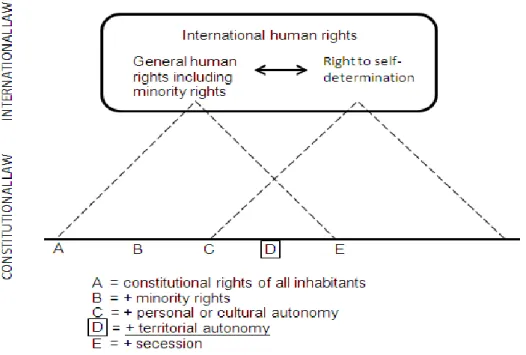
association or integration with an independent State or the emergence into any other political status freely determined by a people”102 means autonomous status is one of the choices to implement external self-determination because autonomy may emerge as an integration or can be freely determined by a people. However, it should be stressed that although international law does not grant the right to autonomy103, we can say that it accepts the autonomy to implement external self-determination because it is the will of a ‘peoples’. The situation of the Kurds and the Basques will be explained in related chapters. However, before concluding the right to self-determination topic, it is helpful to state Suksi’s table in the following.
101 Cassese, Self-Determination of Peoples: A legal Appraisal, p. 120.
102 UN General Assembly, Declaration of Principles of International Law Concerning Friendly Relations and
Co-operation Among States in Accordance with the Charter of the United Nations, 24 October 1970, available at: http://www.unhcr.org/refworld/docid/3dda1f104.html accessed on 08.11.2012.
103 See Hans-Joachim Heintze, ‘The Protection of Indigenous Peoples under the ILO Convention 169’, in:
Amazonia and Siberia, ed. by M. Bothe and others (London: Graham&Trotman/Martinus Nijhoff, 1993), p. 323, see also: Yoram Dinstein, ‘Autonomy Regimes and International Law’, Villanova Law Review, 56 (2011), pp. 437-454, and Markku Suksi, ‘The Constitutional Setting of the Aland Islands Compared’ in: Autonomy and Demilitarisation in International Law: The Aland Islands in a Changing Europe, ed. by Lauri Hannikainen and Frank Horn (The Hague/London/Boston: Kluwer International Law, 1997), pp. 99-126, at p. 101.
Table 1.1. Indication of the possible relationship between international law and constitutional
law104
He summarizes the relation among the international law, the right to self-determination and autonomy briefly.105 He states that international law has regulations for A, B, and E because it aims to create a certain minority protection (A and B) at the international level, especially in situations of blatant oppression of minorities and a right to self-determination leading secession (E).
In this Chapter of the study, it has been aimed to explain the term autonomy, its forms and its importance for the right to self-determination. In the following Chapter, one of the implications of autonomy, Basque Autonomous Community (BAC), will be analyzed in order to understand the Basque Autonomy model and to able to answer whether autonomy became successful or not.
104 Suksi, ‘The Constitutional Setting of the Aland Islands Compared’, p. 101. 105 Ibid.
CHAPTER 2 2. THE BASQUE AUTONOMOUS COMMUNITY
Map 2.1. The Basque Country106
The Basque Autonomous Community (BAC, Euskadi) is one of the three parts of the Basque Country with Navarre (Autonomous Region in Spain) and Iparraldea (includes three districts of France). There is a need to clarify that the Basques, call the sum of these three regions as the Basque Country. In other words, they believe that the great Basque Country, as seen from the map above, consists of the BAC – Navarra (South Basque Country) and Iparraldea (North Basque Country- in the borders of France). Today, however, ‘the Basque Country’ means ‘the Basque Autonomous Community’ in Spain in the official terminology.
106 The original map is cited from: Paddy Woodworth, the Basque Country: A cultural History, (New York: