Original article /
Araştırma
Methylphenidate treatment outcomes and gender differences in
attentional deficit and hyperactivity disorder with epilepsy:
a follow-up study*
Perihan ÇAM RAY,
1Gonca GÜL
ÇELİK,
1Ayşegül YOLGA TAHİROĞLU,
1İpek SÜZER GAMLI,
2Özlem
MİHRİBAN HERGÜNER
3_____________________________________________________________________________________________________
ABSTRACT
Objective: The aim of this study is to investigate the methylphenidate (MPH) treatment response in children and
adolescents with Attention Deficit Hyperactivity Disorder (ADHD) with and without epilepsy. Methods: Ninety-four children and adolescents with ADHD consisting of 47 with and 47 without epilepsy were enrolled into the study. The patients were evaluated by DSM-IV-TR, the Stroop test, the Conners' Parent and Teacher Rating Scales. The groups were matched with regard to age, gender, ADHD subtype and comorbidity. The Stroop test was performed three times: during baseline (S-1); at the third month of the MPH treatment (S-2); after drug holiday of the treatment with MPH which lasted for six months (S-3). Stroop total time (ST) and Stroop total error+correction (SEC) scores were analyzed. Results: The mean ST-3 and SEC-3 scores were significantly higher in cases with ADHD-attention deficit (ADHD-AD) subtype with the epilepsy group compared to ADHD-combined type (ADHD-CT) in the epilepsy group, whereas there was no significant difference detected in the non-epilepsy groups. While in the boys with/ without epilepsy and the girls without epilepsy and were demonstrated significant reductions in all recorded ST and SEC scores during/after treatment in comparison with the initial scores, a similar relationship could not be shown for the girls with epilepsy. Conclusion: It is noted that gender and the ADHD subtypes may affect drug choice in patient with ADHD cases comorbid with epilepsy. One of the noticeable results of our study is was that the Stroop scores is no significant change with methylphenidate treatment in especially in girls with ADHD and epilepsy.
(Anatolian Journal of Psychiatry 2019; 20(6):642-650)
Keywords: epilepsy, attention deficit and hyperactivity disorder, gender, methylphenidate
Epilepsinin
eşlik ettiği dikkat eksikliği hiperaktivite bozukluğunda
metilfenidat tedavi
yanıtı ve cinsiyet farklılıkları: İzleme çalışması
ÖZ
Amaç: Bu çalışmanın amacı, epilepsisi olan ve olmayan dikkat eksikliği hiperaktivite bozukluğu (DEHB) çocuk ve
ergenlerde metilfenidat (MPH) tedavi yanıtının araştırmaktır. Yöntem: Çalışmaya, 47 epilepsili ve 47 epilepsisi olmayan DEHB’li 94 çocuk ve ergen alındı. Hastalar, DSM-IV-TR, Stroop testi, Conners Ebeveyn ve Öğretmen Değerlendirme Ölçeği ile değerlendirildi. Gruplar yaş, cinsiyet, DEHB alt tipi ve eş tanılar bakımından eşlendi. Stroop testi üç kez uygulandı: Başlangıçta (S-1), MPH tedavisinin üçüncü ayında (S-2), altı ay süren MPH ile tedavi- nin ilaç tatilinden sonra (S-3). Stroop toplam süre (SS) ve stroop toplam hata+düzeltme (SHD) puanları analiz edildi. _____________________________________________________________________________________________________ * This study was presented as poster at the 22th National Child and Adolescent Psychiatry Meeting, April 2012, Abant, Turkey 1 Department of Child and Adolescent Psychiatry, Faculty of Medicine Çukurova University, Adana, Turkey
2 Gaziosmanpaşa Taksim Training And Research Hospital, Department of Child and Adolescent Psyhiatry, İstanbul, Turkey 3 Department of Pediatric Neurology, Faculty of Medicine Çukurova University, Adana, Turkey
Correspondence address / Yazışma adresi:
Perihan ÇAM RAY, Department of Child and Adolescent Psychiatry, Faculty of Medicine, Cukurova University, 01330 Adana, Turkey
E-mail: [email protected]
Received: February, 11th 2019, Accepted: May, 17th 2019, doi: 10.5455/apd.28181
Bulgular: Ortalama SS-3 ve SHD-3 puanları, epilepsisi olan DEHB-dikkat eksikliği (DEHB-DE) alt tipinde epilepsisi
olan DEHB-birleşik tipine (DEHB-BT) göre anlamlı derecede daha yüksekti, fakat epilepsisi olmayanlarda DEHB alt tipleri arasında anlamlı farklılık gözlenmedi. Epilepsisi olan/olmayan erkeklerin ve epilepsisi olmayan kızlarda, başlangıç puanlarına göre tedavi sırasında/sonrasında kaydedilen tüm SS ve SHD puanlarında anlamlı düzeyde azalma gözlenirken, epilepsili kızlar için benzer bir ilişki gösterilememiştir. Sonuç: Cinsiyet ve DEHB alt tiplerinin, epilepsi ile birlikte olan DEHB olan hastalarda ilaç seçimini etkileyebileceği belirtilmektedir. Çalışmamızın dikkat çeken sonuçlarından biri, Stroop puanlarının, özellikle DEHB ve epilepsi olan kızlarda MPH tedavisi ile anlamlı bir değişiklik olmamasıdır. (Anadolu Psikiyatri Derg 2019; 20(6):642-650)
Anahtar sözcükler: Epilepsi, dikkat eksikliği hiperaktivite bozukluğu, cinsiyet, metilfenidat
_____________________________________________________________________________________________________ INTRODUCTION
Attention deficit and hyperactivity disorder (ADHD) affects approximately 5-7% of children worldwide.1 The most common type is ADHD
combined type (ADHD-CT) which is followed by ADHD attentional deficit predominant type (ADHD-AD) and ADHD hyperactive-impulsive type (ADHD-HI).2,3
Epilepsy and ADHD are common diseases dur-ing childhood and adolescence, and they have significant effects on the social, academic, and emotional development of the individual. Accom-panying neuropsychiatric disorders are demon-strated in 40-70% of epileptic individuals.4 The
most common of those neuropsychiatric disor-ders are ADHD, autism, depression, and anxiety disorders.5,6 ADHD is estimated to be present in
13-40% of epileptic children.7-11 Among children
with a history of recent onset seizures and epi-lepsy diagnosis, ADHD frequency is reported to be 2.5 times more than the expected frequency in the general population; the association is especially valid for ADHD-AD subtype which has a 3.7 times increased risk.12 Similarly, epilepsy
risk in cases with ADHD is 2.7 times higher than the general population and seizure frequency tends to increase in epileptic ADHD cases com-pared to non-ADHD epileptics.13 Among many
hypotheses proposed to explain the association between ADHD and epilepsy, the leading ones are similar genetic vulnerabilities, similar patho-physiology as in frontal lobe epilepsy, subclinical epileptiform discharges and noradrenergic epi-leptiform discharges that play a role in the patho-logy of both disorder.14 Also, recurrent seizures
and cognitive side effects of antiepileptic drugs may also cause or increase the severity of ADHD.7
Although long-term methylphenidate (MPH) ad-ministration has been believed to reduce seizure threshold in epileptic individuals for a long time and may trigger seizures, there are few short- and long-term studies on the effects of MPH treatment in patients with concurrent epilepsy
and ADHD diagnosis. Present studies report that MPH treatment of patients with ADHD and epi-lepsy is shown to positively affect the quality of life scores and to be safe and effective.9,15-19 and
provides a significant improvement in ADHD symptoms.7,15-18,20-24 On the other hand, it is
reported thatMPH treatment may be related to aggravation of seizure frequency in subjects with ADHD and epilepsy.24
In summary, not enough studies are available regarding the effects of ADHD and epilepsy comorbidity on clinical and attentional findings and variables that determine these effects. This study aimed to compare differences between ADHD children and adolescents with or without epilepsy according to the initial levels of inat-tention measured with the Stroop test and the levels of their MPH response with gender varia-bility.
METHODS
Sample
This study included 94 children and adolescents with ADHD between 8-14 years range (mean age; 10.8±1.7). Forty-seven of them had epilep-sy, and 47 did not. Diagnoses of psychiatric disorders were made after a clinical interview and evaluation by a child and adolescent psychi-atrist in accordance with DSM-IV-TR criteria.25
The two groups were matched one-by-one ac-cording to age, sex, education level, ADHD sub-type, and comorbidities. Pervasive develop-mental disorder or develop-mental retardation were exclusion criteria for both groups. In addition to minimizing the possibility of an active epileptic discharge affecting the attention measurement inclusion criteria also included not having a seizure for the last six months and using anti-epileptics at least for the last three months for the epilepsy group.
Psychometric measurements
Stroop TBAG Form: This test was used to
determine attention deficit and to screen its Anatolian Journal of Psychiatry 2019; 20(6):642-650
severity. It was developed by Stroop, and Turk-ish adaptation and standardization study was performed.26-28 In this study, initial attention
func-tions and effects of MPH treatment on attention were evaluated with Stroop test TBAG form. In statistical analyses, Stroop total time (ST) and Stroop total error and correction (SEC) scores were used. Stroop form was applied three times recurrently for each case: at initial presentation (S-1); during the evaluation at the third month of MPH treatment 1-2 hours after MPH use (S-2); and after three days of drug holiday in cases who received MPH treatment for six months (S-3).
Conners Teacher Rating Scale (CTRS) and Conners Parent Rating Scale (CPRS): CTRS
was developed by Conners,29 and validity and
reliability study for the Turkish version was per-formed by Sener et al.30 CPRS was developed
by Conners,29 and validity and reliability study for
the Turkish version was performed by Dereboy et al.31
Starting methylphenidate treatment and follow up
Before starting MPH to the patients, as a routine procedure of our clinic, electrocardiogram, hemogram, and routine biochemical evaluations were performed, and presence of an organic disorder that may be of concern for drug use was investigated. These measurements were re-peated during follow up visits at three-month intervals after titration of the drug to the ap-propriate dose. The data of this study were ob-tained a chart review of the patients and ap-proval was obtained from the ethics committee of Çukurova University Medical School. The cases and their families were informed about MPH use at the beginning of treatment. Ex-pected benefits, possible side effects of, and reasons for the proposed treatment were ex-plained. MPH-OROS treatments were planned (dose range: 18-72 mg/day, once a day, after breakfast).
Statistical analyses
The data were analyzed with SPSS 16.0 pack-age program. Cross-tables and chi-square test were used for the analysis of categorical varia-bles. Normal distribution of continuous variables was assessed with Shapiro-Wilk test. Analyses were made for comparisons of both mean Stroop scores of the two diagnostic groups between each other (between groups/independent varia-bles) and between repeated measures of each group (intragroup/dependent variable) and the
non-parametric Mann-Whitney U test was used. Statistical evaluations of continuous variables in dependent groups were performed by the non-parametric Wilcoxon Signed Rank Test. Statis-tical significance was accepted as p<0.05. Sample size was calculated with an expected parameter estimate based on the study of Ayaz et al.32 Assuming 1 sided test a mean of 125.72
SRKT in group EG and a mean of 109.19 in Group NEG with a 31.7 standard deviation at baseline, the minimum sample size thus required to be approximately 47 in each study groups within a 95% confidence and 80% power. RESULTS
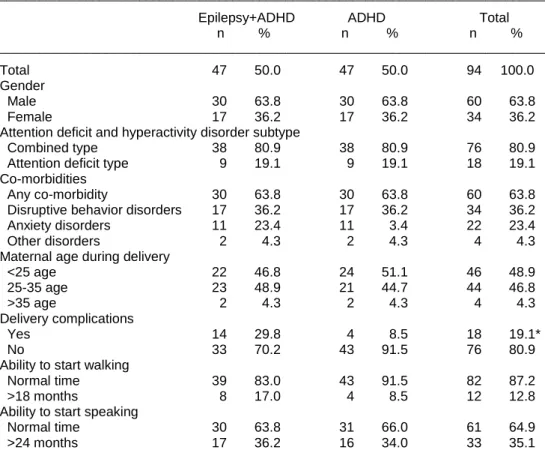
Comparison of sociodemographic data Each group included 30 (63.8%) males and 17 (36.2%) females. Each group included 38 (80.9%) cases with ADHD-CT and 9 (19.1%) cases with ADHD-AD. Evaluation of the distribu-tion of the epileptic cases according to seizure type revealed that 10 (21.3%) cases had partial seizures; 22 (46.8%) cases had generalized seizures and 15 (31.9%) cases had paroxysmal activity disorder. Evaluation of the frequency of antiepileptic drugs revealed that 25 (80.9%) cases used valproate; six (12.8%) cases used carbamazepine, and 5 (6.3%) cases used other antiepileptics. None of the epilepsy cases re-ceiving MPH-OROS treatment had a seizure during the six-month follow up period. Demog-raphic data, developmental features, DEHB sub-types and comorbidities of the groups are given in Table 1.
The mean CTRS scores of both the epileptic and the non-epileptic males were significantly higher than those of females, but no difference was found between CPRS scores in terms of gender. Among epileptic cases, the mean CTRS and CPRS scores of ADHD-CT cases were higher than those of ADHD-AD cases. In the non-epi-leptic group, no difference was found in similar statistical analyses (Table 2).
Comparison of the groups with and without epilepsy
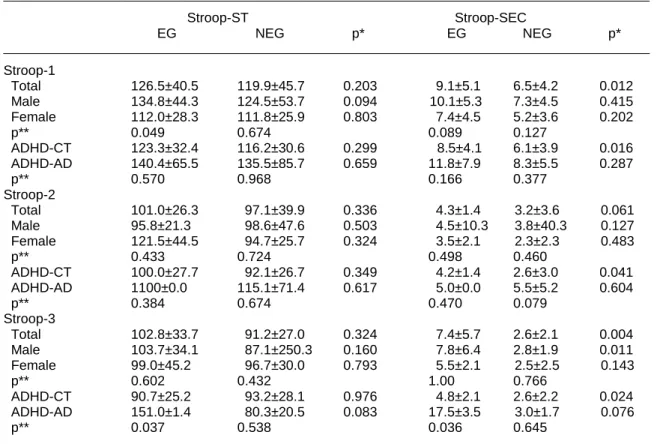
In a comparison of the Stroop scores of the two groups, the mean SEC-1 and SEC-3 scores of the ADHD cases with epilepsy were higher than those of the ADHD cases with epilepsy. No significant difference could be found between the mean ST-1, ST-2, ST-3, and SEC-2 scores of the epileptic and the non-epileptic groups.
Table 1. Clinical, demographic and developmental features according to the groups
__________________________________________________________________________________
Epilepsy+ADHD ADHD Total n % n % n % __________________________________________________________________________________ Total 47 50.0 47 50.0 94 100.0 Gender Male 30 63.8 30 63.8 60 63.8 Female 17 36.2 17 36.2 34 36.2 Attention deficit and hyperactivity disorder subtype
Combined type 38 80.9 38 80.9 76 80.9 Attention deficit type 9 19.1 9 19.1 18 19.1 Co-morbidities
Any co-morbidity 30 63.8 30 63.8 60 63.8 Disruptive behavior disorders 17 36.2 17 36.2 34 36.2 Anxiety disorders 11 23.4 11 3.4 22 23.4 Other disorders 2 4.3 2 4.3 4 4.3 Maternal age during delivery
<25 age 22 46.8 24 51.1 46 48.9 25-35 age 23 48.9 21 44.7 44 46.8 >35 age 2 4.3 2 4.3 4 4.3 Delivery complications Yes 14 29.8 4 8.5 18 19.1* No 33 70.2 43 91.5 76 80.9 Ability to start walking
Normal time 39 83.0 43 91.5 82 87.2 >18 months 8 17.0 4 8.5 12 12.8 Ability to start speaking
Normal time 30 63.8 31 66.0 61 64.9
>24 months 17 36.2 16 34.0 33 35.1
__________________________________________________________________________________
*: 0.009; Chi-square test, cross tabs analysis
Table 2. The mean CTRS and CPRS scores of the cases according to the diagnostic groups
___________________________________________________________________________________
Epilepsy+ADHD (n=47) ADHD(n=47) Total (n=94) Mean±SD Mean±SD Mean±SD
___________________________________________________________________________________
Conners Teacher Rating Scale
Total 30.9±14.1 30.0±11.7 30.5±12.9 Male 34.3±13.6 32.6±12.8 33.4±13.1 Female 25.0±13.4 25.4±8.0 25.2±10.9 p* 0.027 0.043 0.003 ADHD-CT 33.6±13.8 31.5±11.7 32.5±12.7 ADHD-AD 19.7±9.4 23.8±10.6 21.8±9.9 p* 0.007 0.110 0.002 Conners Parent Rating Scale
Total 40.4±195 37.2±15.5 38.8±17.6 Male 43.1±17.6 37.8±14.5 40.4±16.2 Female 35.7±22.2 36.2±17.6 36.0±19.7 p* 0.191 0.756 0.242 ADHD-CT 43.7±18.9 39.4±15.4 41.5±17.3 ADHD-AD 26.6±16.2 28.0±13.1 27.3±14.3 p* 0.014 0.060 0.002 ___________________________________________________________________________________
*: Mann Whitney U test; ADHD: Attention Deficit and Hyperactivity Disorder, -CT: Combined Type , -AD: Attention Deficit Type
Evaluation of the epileptic subgroups ac-cording to the mean Stroop scores
The mean Stroop scores, (ST-1, ST-2, ST-3, SEC-1, SEC-2, SEC-3) didn’t change significant-ly according to the epilepsy subgroups. When the cases were grouped according to the anti-epileptic drug they use, an adequate number for statistical analysis couldn't be reached in any of the groups. Therefore, no comparison could be made according to the medications used. Comparison of the groups according to the ADHD subtypes
No significant difference could be found between epileptic and non-epileptic ADHD subgroups ac-cording to ST-1 and SEC-1. Although all of the mean SEC-1, SEC-2 and SEC-3 scores were higher in the epileptic + ADHD-CT group com-pared with the non-epileptic + ADHD-CT group, statistical significance couldn't be found in any of the similar statistical analyses for the ADHD-AD
cases. Within-group comparisons of the epileptic cases according to ADHD subtypes revealed that the mean ST-3 and SEC-3 scores for ADHD-AD subtype were significantly higher than the ADHD-CT subtype, but no significant differ-ence was found in similar analyses between the ADHD subtypes in non-epileptic cases (Table 3). Comparison of the Stroop scores of the groups according to gender
Compared to the non-epileptic ones, SEC-3 scores of the epileptic males were higher, although no significant difference could be found in any of the comparisons between the Stroop scores of epileptic and non-epileptic females. The mean ST-1 score of the epileptic males was significantly higher than that of epileptic girls, no significant difference could be found between the mean Stroop scores of non-epileptic males and females (Table 3).
Table 3. Comparison of the Stroop scores recorded between, during and after treatment between the groups
_________________________________________________________________________________________________ Stroop-ST Stroop-SEC EG NEG p* EG NEG p* _________________________________________________________________________________________________ Stroop-1 Total 126.5±40.5 119.9±45.7 0.203 9.1±5.1 6.5±4.2 0.012 Male 134.8±44.3 124.5±53.7 0.094 10.1±5.3 7.3±4.5 0.415 Female 112.0±28.3 111.8±25.9 0.803 7.4±4.5 5.2±3.6 0.202 p** 0.049 0.674 0.089 0.127 ADHD-CT 123.3±32.4 116.2±30.6 0.299 8.5±4.1 6.1±3.9 0.016 ADHD-AD 140.4±65.5 135.5±85.7 0.659 11.8±7.9 8.3±5.5 0.287 p** 0.570 0.968 0.166 0.377 Stroop-2 Total 101.0±26.3 97.1±39.9 0.336 4.3±1.4 3.2±3.6 0.061 Male 95.8±21.3 98.6±47.6 0.503 4.5±10.3 3.8±40.3 0.127 Female 121.5±44.5 94.7±25.7 0.324 3.5±2.1 2.3±2.3 0.483 p** 0.433 0.724 0.498 0.460 ADHD-CT 100.0±27.7 92.1±26.7 0.349 4.2±1.4 2.6±3.0 0.041 ADHD-AD 1100±0.0 115.1±71.4 0.617 5.0±0.0 5.5±5.2 0.604 p** 0.384 0.674 0.470 0.079 Stroop-3 Total 102.8±33.7 91.2±27.0 0.324 7.4±5.7 2.6±2.1 0.004 Male 103.7±34.1 87.1±250.3 0.160 7.8±6.4 2.8±1.9 0.011 Female 99.0±45.2 96.7±30.0 0.793 5.5±2.1 2.5±2.5 0.143 p** 0.602 0.432 1.00 0.766 ADHD-CT 90.7±25.2 93.2±28.1 0.976 4.8±2.1 2.6±2.2 0.024 ADHD-AD 151.0±1.4 80.3±20.5 0.083 17.5±3.5 3.0±1.7 0.076 p** 0.037 0.538 0.036 0.645 __________________________________________________________________________________________________
p*: Mann-Whitney U test; Epileptic and Non-Epileptic intergroup comparison; p**: Mann-Whitney U test; analysis made separately for EG and NEG based on gender and ADHD subtypes (Intergroup comparison of independent variables) EG: Epileptic Group; NEG: Non-Epileptic Group; ST: Stroop total time; SEC: Stroop Total Error+Correction Scores; Stroop-1: Stroop scores recorded before the treatment; Stroop-2: The mean Stroop scores recorded during methylphenidate-OROS treatment; Stroop-3: The mean Stroop scores recorded after discontinuation of the treatment with methylphenidate- OROS which lasted for six months;
ADHD: Attention Deficit and Hyperactivity Disorder, -CT: Combined Type, -AD: Attention Deficit Type
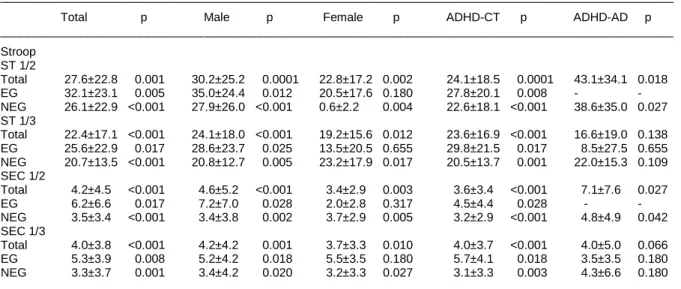
In order to evaluate whether a change occurred among three Stroop measurements, compari-sons were made between the two groups and within each group. To assess whether improve-ment happened in attention functions, the differ-ences among the pretreatment (S-1), during treatment (S-2) and posttreatment mean Stroop
scores were evaluated. Accordingly, in the gen-eral group, all the differences between epileptic and non-epileptic males and ST-1/2, ST-1/3, SEC-1/2 and SEC-1/3 measurements in nonepi-leptic females were statistically significant. In epileptic girls none of such analyses was signifi-cant (Table 4).
Table 4. Change in the mean Stroop score during and after the treatment
_____________________________________________________________________________________________________
Total p Male p Female p ADHD-CT p ADHD-AD p _____________________________________________________________________________________________________ Stroop ST 1/2 Total 27.6±22.8 0.001 30.2±25.2 0.0001 22.8±17.2 0.002 24.1±18.5 0.0001 43.1±34.1 0.018 EG 32.1±23.1 0.005 35.0±24.4 0.012 20.5±17.6 0.180 27.8±20.1 0.008 - - NEG 26.1±22.9 <0.001 27.9±26.0 <0.001 0.6±2.2 0.004 22.6±18.1 <0.001 38.6±35.0 0.027 ST 1/3 Total 22.4±17.1 <0.001 24.1±18.0 <0.001 19.2±15.6 0.012 23.6±16.9 <0.001 16.6±19.0 0.138 EG 25.6±22.9 0.017 28.6±23.7 0.025 13.5±20.5 0.655 29.8±21.5 0.017 8.5±27.5 0.655 NEG 20.7±13.5 <0.001 20.8±12.7 0.005 23.2±17.9 0.017 20.5±13.7 0.001 22.0±15.3 0.109 SEC 1/2 Total 4.2±4.5 <0.001 4.6±5.2 <0.001 3.4±2.9 0.003 3.6±3.4 <0.001 7.1±7.6 0.027 EG 6.2±6.6 0.017 7.2±7.0 0.028 2.0±2.8 0.317 4.5±4.4 0.028 - - NEG 3.5±3.4 <0.001 3.4±3.8 0.002 3.7±2.9 0.005 3.2±2.9 <0.001 4.8±4.9 0.042 SEC 1/3 Total 4.0±3.8 <0.001 4.2±4.2 0.001 3.7±3.3 0.010 4.0±3.7 <0.001 4.0±5.0 0.066 EG 5.3±3.9 0.008 5.2±4.2 0.018 5.5±3.5 0.180 5.7±4.1 0.018 3.5±3.5 0.180 NEG 3.3±3.7 0.001 3.4±4.2 0.020 3.2±3.3 0.027 3.1±3.3 0.003 4.3±6.6 0.180 _____________________________________________________________________________________________________
p*: Wilcoxon Signed Rank Test; Comparison of measurements in EG+ADHD and NEG+ADHD groups at initial, during and post-treatment (Intergroup comparison of dependent variables)
EG: Epileptic Group, NEG: Non-Epileptic Group, ST: Stroop total time, SEC: Stroop Total Error+Correction
S-1/2: Comparison of mean stroop scores recorded at the baseline and during the treatment (as per time, error, correction) S-1/3: Comparison of mean stroop scores recorded at the baseline and after the treatment (as per time, error, correction) ADHD: Attention Deficit and Hyperactivity Disorder, -CT: Combined Type, -AD: Attention Deficit Type
DISCUSSION
This study showed that the effect of MPH treat-ment on Stroop scores change according to ADHD subgroups, gender, and presence of epilepsy. Accordingly, it can be concluded that ADHD-AD cases with epilepsy are significantly different than ADHD-CT cases with epilepsy regarding mean Stroop scores. Some authors believe that executive functions in ADHD cases without epilepsy are affected more in attention deficit subtype than the combined type and these cases consist a subgroup with a different clinical appearance.33,34
It was reported that the most common subtype was ADHD-CT subtype with a rate of 43.7%, and this was followed by ADHD-HI (37.5%) and ADHD-AD (18.7%) subtypes in epileptic ADHD children.35 Similarly, ADHD-CT was the most
common type in our study, and it was at a higher rate (80.9%) than current studies.24,35 In addition,
there are also studies that reported ADHD-AD
subtype was more common in cases with epilep-sy.36,37 The difference between this study and
the previous ones regarding subtype rates may be related to many factors such as differences in sample and research methods.
Psychiatric comorbidities are common (37-77%) in epileptic children and adolescents.38 Similarly,
in our study, rate of psychiatric diagnosis accom-panying epilepsy+ADHD cases is 63.8%. Be-sides ADHD, the most common diagnosis was disruptive behavioral disorder (36.2%), followed by anxiety disorders (23.4%) and other disorders (4.3%). Our findings are consistent with previous studies which demonstrated that the frequency of other psychiatric comorbidities in epileptic chil-dren with ADHD was similar with nonepileptic ADHD children.39
MPH use and seizure risk
Methylphenidate is effective in most of the chil-dren and adolescents with ADHD symptoms and comorbid epilepsy without increasing seizure Anatolian Journal of Psychiatry 2019; 20(6):642-650
risk significantly,7,15,17,19,23,40 but the number of
controlled studies are limited.19,40 Current
stu-dies state that stimulants seem safe for ADHD treatment in children with epilepsy needs sup-port from large population-based studies.23,41 In
a prospective observational study, the seizure recurrence rate was not significantly different between patients who were treated with MPH or those who did not get any specific pharmacolo-gical intervention for ADHD.18 The absence of
seizures in any of the epileptic cases in our study also supports these findings.
Differences between genders
It is very interesting that in this study no differ-ence was observed in epileptic females in ST or SEC scores at the beginning, during and after cessation of MPH treatment. Similarly, no signifi-cant difference was observed in the epilepsy + ADHD-AD group in ST1/2, ST 1/3, SEC- 1/2 and SEC 1/3 scores during MPH treatment and after cessation. On the other hand, in all of the mea-surements in the epilepsy + ADHD-CT group, there were significant decreases, which means a positive response to medication. The more common occurrence of ADHD-AD subtype in females may have affected the results of these two analyses. Although ADHD-CT subtype was the predominant type in non-epileptic cases, ADHD-AD subtype was two times more common in females than in males.2 Selective attention
was more commonly affected in girls with ADHD and boys gave more impulsive responses in continuous attention tasks.
Most of the information on the differences in MPH treatment response between genders is based on animal studies and usually appears to focus on neurotransmitter effects. It was pro-posed that in addition to effects of sex hormones
on MPH pharmacokinetics, estrogen might mediate some effects of psychostimulants by affecting mRNA expression in dopamine and serotonin receptors in the brain.42 GABAergic
system related behavioral activation due to the repeated psychostimulant application is more prominent in females and mediated by reproduc-tive hormones.43 Behavioral activation due to
MPH application may decrease the curative effect of MPH in girls, and smaller doses may improve attention functions more effectively without inducing disruptive effects.44
Brown et al. found that MPH treatment response in gender-specific differences may be related to striatal Brain-Derived Neurotrophic Factor (BDNF).45 The effect of gender in ADHD is
probably on clinical appearance and other co-morbid psychiatric disorders.2 It is not yet clear
whether attention deficit in cases with epilepsy is due to disease subtype or gender in cases comorbid with epilepsy.
CONCLUSION
The strengths of our study are a one-to-one match for subtypes of the epileptic and non-epileptic ADHD, gender, and psychiatric comor-bidities, adequate patient number, and the absence of any seizures during the MPH use period. It is noted that the co-occurrence of ADHD and epilepsy may affect the treatment choices and the clinical courses of both dis-eases. Therefore, It is recommended that regu-lar follow-up is necessary for drug interactions, clinical observation and rating scales, the pre-sence/absence of seizures and their frequency, and the clinical severity of ADHD in patients ADHD.
Authors’ contributions: P.Ç.R.: data collection, literature, writing manuscript; G.G.Ç.: finding topic, literature, data
collection, writing manuscript; A.Y.T.: planning, data collection, statistics, writing manuscript; İ.S.G.: literature, writing manuscript; Ö.M.H.: examination sample.
REFERENCES
1. Polanczyk G, De Lima MS, Horta BL, Biederman J, Rohde LA. The worldwide prevalence of ADHD: A systematic review and metaregression analysis. Am J Psychiatry 2007; 64:942-948.
2. Biederman J, Faraone SV. The Massachusetts General Hospital studies of gender influences on attention-deficit/hyperactivity disorder in youth and relatives. Psychiatr Clin North Am 2004; 27:225-232.
3. Skounti M, Philalithis A, Galanakis E, Variations in prevalence of attention deficit hyperactivity disor-der worldwide. Eur J Pediatr 2007; 166:117-123. 4. Turky A, Beavis JM, Thapar AK, Kerr MP. Psycho-pathology in children and adolescents with epi-lepsy: an investigation of predictive variables. Epilepsy Behav 2008; 12:136-144.
5. Pellock JM. Understanding co-morbidities af-fecting children with epilepsy. Neurology 2004; 62:17-23.
6. Dunn DW. Should pediatric neurologists play a role in the management of the most common psychiatric comorbidities in children with epilep-sy? Practical considerations. Epilepsy Behav 2018; doi: 10.1016/j.yebeh.2018.11.013.
7. Kaufmann R, Goldberg-Stern H, Shuper A. Atten-tion-deficit disorders and epilepsy in childhood: incidence, causative relations and treatment possibilities. J Child Neurol 2009; 24:727-733. 8. Russ SA, Larson K, Halfton N. A national profile of
childhood epilepsy and seizure disorder. Pediatrics 2012; 129:256-264.
9. Cohen R, Senecky Y, Shuper A, Inbar D, Chodick G, Shalev V, et al. Prevalence of epilepsy and attention- deficit hyperactivity (ADHD) disorder: A population-based study. J Child Neurol 2013; 28(1):120-123.
10. Reilly CJ, Atkinson P, Das KB, Chin RF, Aylett SE, Burch V, et al. Neurobehavioral comorbidities in children with active epilepsy: A population- based study. Pediatrics 2014; 133:1586-1593.
11. Liu X, Carney PR, Bussing R, Segal R, Cottler LB, Winterstein AG. Stimulants do not increase the risk of seizure-related hospitalizations in children with epilepsy. J Child Adolesc Psychopharmacol 2018; 28(2):111-116.
12. Hesdorffer DC, Ludvigsson P, Olafsson E, Gud-mundsson G, Kjartansson O, Hauser WA. ADHD as a risk factor for incident unprovoked seizures and epilepsy in children. Arch Gen Psychiatry 2004; 61:731-736.
13. Davis SM, Katusic SK, Barbaresi WJ, Killian J, Weaver AL, Ottman R, et al. Epilepsy in children with attention-deficit/hyperactivity disorder. Pedi-atr Neurol 2010; 42:325-330.
14. Weinshenker D, Szot P. The role of catechola-mines in seizure susceptibility. New results using genetically engineered mice. Pharmacol Ther 2002; 94:213-233.
15. Gücüyener K, Erdemoğlu AK, Şenol S, Serda-roglu A, Soysal S, Kockar AI. Use of methylpheni-date for attention-deficit hyperactivity disorder in patients with epilepsy or electroencephalographic abnormalities. J Child Neurol 2003; 18:109-112. 16. Radziuk AL, Kieling RR, Santos K, Rotert R,
Bastos F, Palmini AL. Methylphenidate improves the quality of life of children and adolescents with ADHD and difficult-to-treat epilepsies. Epilepsy Behav 2015; 46:215-220.
17. Socanski D, Aurlien D, Herigstad A, Thomsen PH, Larsen TK. Attention deficit/hyperactivity disorder and interictal epileptiform discharges: it is safe to use methylphenidate? Seizure 2015; 25:80-83.
18. Rheims S, Herbillon V, Villeneuve N, Auvin S, Napuri S, Cances C, et al. Investigators of the Paediatric Epilepsy REsearch NeEwork (PERENE). ADHD in childhood epilepsy: Clinical determinants of severity and of the response to methylphenidate. Epilepsia 2016; 57(7):1069-1077.
19. Kral MC, Lally MD, Boan AD. Effectiveness and side effect profile of stimulant medication for the treatment of attention-deficit/hyperactivity disor-der in youth with epilepsy. J Child Adolesc Psychopharmacol 2017; 27(8):735-740.
20. Gonzalez-Heydrich J, Whitney J, Waber D, Forbes P, Hsin O, Faraone SV, et al. Adaptive phase I study of OROS methylphenidate treat-ment of attention deficit hyperactivity disorder with epilepsy. Epilepsy Behav 2010; 18: 229-237. 21. Fosi T, Lax-Pericall MT, Scott RC, Neville BGR,
Aylett SE. Methylphenidate treatment of attention deficit hyperactivity disorder in young people with learning disability and difficult-to-treat epilepsy: Evidence of clinical benefit. Epilepsia 2013; 54:2071-2081.
22. Santos K, Palmini A, Radziuk AL, Rotert R, Bastos F, Booij L, et al. The impact of methylphenidate on seizure frequency and severity in children with attention-deficit-hyperactivity disorder and diffi-cult-to-treat epilepsies. Dev Med Child Neurol 2013; 55(7):654-660.
23. Ravi M, Ickowicz A. Epilepsy, attention-deficit/ hyperactivity disorder and methylphenidate: criti-cal examination of guiding evidence. J Can Acad Child Adolesc Psychiatry. 2016; 25(1):50-58. 24. Park J, Choi HW, Yum MS, Ko TS, Shon SH, Kim
HW. Relationship between aggravation of sei-zures and methylphenidate treatment in subjects with attention-deficit/hyperactivity disorder and epilepsy. J Child Adolesc Psychopharmacol 2018; 28(8):537-546.
25. American Psychiatric Association. Diagnostic and Statistical Manual for Mental Disorders (DSM-IV), Fourth ed. Washington, DC: American Psychiatric Association, 1994.
26. Stroop JR. Studies of interference in serial verbal reactions. J Experimental Psychol 1935; 18:643-662.
27. Karakaş S, Erdogan E, Sak L, Soysal AŞ, Ulusoy T, Ulusoy İY, ve ark. Stroop testi TBAG formu: Türk kültürüne standardizasyon çalışması, güve-nirlik ve geçerlilik. Klinik Psikiyatri 1999; 2:75-88. 28. Kılıç BG, Koçkar AI, Irak M, Şener Ş, Karakaş S.
Stroop testi TBAG formunun 6-11 yaş grubu çocuklarda standardizasyon çalışması. Çocuk ve Gençlik Ruh Sağlığı Dergisi 2002; 9:86-99. 29. Conners CK. Rating scales for use in drug studies
with children. Psychopharm Bull (Special Issue-pharmacotherapy with children) 1973; 24-84.
30. Sener S, Dereboy Ç, Dereboy IF. Conners öğret-men derecelendirme ölçeği Türkçe uyarlaması-I. Çocuk ve Gençlik Ruh Sağlığı Dergisi 1995; 2:131-141.
31. Dereboy Ç, Şenol S, Şener Ş. Conners anababa derecelendirme ölçeği uyarlama çalışması. X. Ulusal Psikoloji Kongresi, Ankara, 1998, s.42. 32. Ayaz M, Karakaya I, Ayaz AB, Kara B, Kutlu M.
Psychiatric and neurocognitive evaluation fo-cused on frontal lobe functions in rolandic epi-lepsy. NöroPsikiyatri Arşivi 2013; 50:209-215. 33. Barkley RA. The inattentive type of ADHD as a
distinct disorder: What remains to be done. Clin Psychol-Sci PR 2001; 8:489-493.
34. Roessner V, Sagvolden T, Dasbanerjee T, Mid-dleton FA, Faraone SV, Walaas SI, et al. Methyl-phenidate normalizes elevated dopamine trans-porter densities in an animal model of the atten-tion-deficit/hyperactivity disorder combined type, but not to the same extent in one of the attention-deficit/hyperactivity disorder inattentive type. Neuroscience 2010; 167:1183-1191.
35. Loutfi KS, Carvalho AM, Lamounier JA, Nasci-mento Jde A. ADHD and epilepsy: contributions from the use of behavioral rating scales to inves-tigate psychiatric comorbidities. Epilepsy Behav 2011; 20:484-489.
36. Dunn DW, Austin JK, Harezlak J, Ambrosius WT. ADHD and epilepsy in childhood. Dev Med Child Neurol 2003; 45(1):50-54.
37. Socanski D, Aurlien D, Herigstad A, Thomsen PH, Larsen TK. Epilepsy in a large cohort of children diagnosed with attention deficit/hyperactivity disorders (ADHD). Seizure 2013; 22(8):651-655. 38. Plioplys S, Dunn DW, Caplan R. 10-year research
update review: psychiatric problems in children with epilepsy. J Am Acad Child Adolesc
Psychi-atry 2007; 46:1389-1402.
39. Gonzalez-Heydrich J, Dodds A, Whitney J, Mac-Millan C, Waber D, Faraone SV, et al. Psychiatric disorders and behavioral characteristics of pediat-ric patients with both epilepsy and attention-deficit hyperactivity disorder. Epilepsy Behav 2007; 10:384-388.
40. Verrotti A, Moavero R, Panzarino G, Di Paolan-tonio C, Rizzo R, Curatolo P. The challenge of pharmacotherapy in children and adolescents with epilepsy-ADHD comorbidity. Clin Drug Investig 2018; 38(1):1-8.
41. Williams AE, Giust JM, Kronenberger WG, Dunn DW. Epilepsy and attention-deficit hyperactivity disorder: Links, risks, and challenges. Neuro-psychiatr Dis Treat 2016; 12:287-296.
42. Zhou W, Cunningham KA, Thomas ML. Estrogen regulation of gene expression in the brain: a possible mechanism altering the response to psychostimulants in female rats. Brain Res Mol Brain 2002; 100:75-83.
43. Freese L, Muller EJ, Souza MF, Couto-Pereira NS, Tosca CF, Ferigolo M, Barros HM, et al. GABA system changes in methylphenidate sen-sitized female rats. Behav Brain Res 2012; 231:181-186.
44. Wagner AK, Kline AE, Ren D, Willard LA, Wenger MK, Zafonte RD. Gender associations with chron-ic methylphenidate treatment and behavioral performance following experimental traumatic brain injury. Behav Brain Res 2007; 181:200-209. 45. Brown RW, Hughes BA, Hughes AB, Sheppard
AB, Perna MK, Ragsdale WL, et al. Sex and dose-related differences in methylphenidate adolescent locomotor sensitization and effects on brain-derived neurotrophic factor. J Psychopharmacol 2012; 26:1480-1488.