PHYSICAL REVIEW
8
VOLUME 40, NUMBER 12Rapid Communications
15OCTOBER 1989-II
The Rapid Communications section is intended for the accelerated publication
of
important new results. Since manuscripts submitted to this section are given priority treatment both in the editorial once and in production, authors should explain in their submittal letter why the workjustifies this special handling. A Rapid Communication should be no longer than 3'i~ printed pages and must be accompanied by an abstract P.age proofs are sent to authors, but, becauseof
the accelerated schedule, publication is not delayed for receiptof
corrections unless requested by the author or noted by the editorEffects
of
the constriction
geometry
on quasi-one-disssensional
transport:
Adiabatic
evolution
and
resonant tss»cling
E.
Tekman andS.
CiraciDepartment
of
Physics, Bilkent University, Bilkent 06533,Ankara, Turkey (Received 27 June 1989)The geometry of a constriction, which plays acrucial role in quasi-one-dimensional (quasi-1D) ballistic transport, is investigated by performing calculations ofthe conductance.
If
theconstric-tion becomes smoothly narrower inside, the current-carrying states evolve adiabatically leading to quantized conductance without a resonance structure. In contrast, quasi-OD (confined) states can form in a local widening inside the constriction and give rise to resonant tunneling. The effects of an obstacle at the entrance and the roughening along the constriction are also studied.
The effects
of
the quantizationof
the transverse mo-mentum in infinite one-dimensional(1D)
electron wave-guides were investigated theoretically, ' and the conduc-tanceof
this constrictionG,
was predicted to be quantized as the multiplesof
2e /h. Recently, van Wees et al. and Wharam et a/. measured the conductance through a con-striction between two 2D electron-gas(EG)
reservoirs. They found that in compliance with the earlier theory, ' the conductance increases with the gate voltage Vs (or equivalently with the width wofthe constriction) approxi-mately in stepsof
2e /h. This experimental observationof
the step structure in the conductance has attracted alot
of
interest. Several theories have been developed with the assumption that the transport is ballistic, as pointed out by the experimentalists, ' and the emphasis has been placed on the critical effect
of
the boundaries between the 2DEG
and the constriction. In fact, reQectionsof
the electron waves from the boundaries were shown to result in the resonance structure on the plateaus. While the lackof
the resonance structure in the experiments was at-tributed to the 6nite-temperature effects ' or to scatter-ing from the nonuniform constriction potential, 9Garcia objected to the ballisticityof
the transport. ' In the meantime, the measurements on two consecutive constric-tions separated by an electron gas yielding only G corre-spondingto
the narrowerone"
have been taken as evi-dence forthe ballisticityof
the transport.Earlier, we presented a re6ned formalism '
of
thequantum conductance through aconstriction and provided the exact calculation
of
G. In the formalism the current-carrying states are obtained by the boundary matchingof
the plane-wave states inthe 2D
EG
tothe states which are quantized in the constriction. The spatial formof
the po-tential, V(y,z),
of
the constriction depends on the gate voltage, as such that it is parabolic for small w (large—
Vs), but becomes square-well-like at large w (small—
Vs).' We considered an infinite well potential, since in the energy range relevantto
the experiments it yields eigenstates similar to thatof
the square well, but provides a substantial convenience in computations. Nevertheless, the formof
the potential in6uences the spacingsof
the steps intheG(w)
curve, but the underlying physics essen-tially remains unaltered.The expression we obtained forthe conductance isgiven in matrix form: '
2
G
-
'
'
'
]
[e'(k)r,
e(k)
—
k'(k)rRk(k)]
trh 4 kr
k,
(tr)+
21m[e'(k)rth(k)]]
.
e(k)
[f
—
(ie'
)
]
'tq andg(k)
eirereirue(k)
are expressed in termsof
the reflection matrixi
and the transmission vector tg which are analogous to the reflection and transmission coefficients for a 1D step po-tential. The diagonal matrixf
has elements(I;J)
(E
—
e„)/Qz for energyE,
with the effective mass m and constriction eigenenergye„,
and isexpressed asI
I
R+iI
q. In the expressionof
conductance, thein-terference effects
of
the re6ected waves are built in by the separationof
the right-going (first term) and left-going(second term) states. The evanescent states in the third term contribute as tunneling, and smooths out the sharp rises in G corresponding
to
the openingof
anew channel. This effect becomes signi6cant atsmall constriction length d. As pointed out earlier, for the simplest system that is auniform quasi-ID constriction between two 2DEG,
the quantizationof
6
starts atd
=A.F and steps occur exactlyat
the integer multiplesof
2e /h only ford)
5%,t;. Thecase
of
d0
corresponds to Sharvin conductance, ' G, (2e /h)2w/A, F,but the whole curve is displaced and8560
E.
TEKMAN ANDS.
CIRACI weak oscillations are superimposed owing to the quantuminterference effects. However, the larger
d
is, the sharper the quantum jumps are, and the Batter the plateaus are. In addition, the resonance structure, which originates from the interferenceof
multiple re6ected waves, super-imposed on the flat plateaus, becomes more pronounced at large d.The resonance structure is the crucial aspect
of
the ballistic transport through a quasi-1D constriction.It
has to appear only when the phase coherence is maintained during the transport, but can be destroyed due to the elas-tic scattering and Fermi-level smearing at finite tempera-ture, ordue tothe inelastic scattering. Nonuniform con-strictions, tapering, surface roughness, and the impurities in the constriction may lead to elastic scattering, in which the resonance structure may get weaker due to the mixed phasesof
the wave functions.If
the transport is really ballistic asispresumed, the phase incoherence due to elas-tic scattering or finite temperature may explain why the observed G(V~) curves are lacking the resonance struc-ture. Clearly, the geometryof
the constriction has impor-tant implications, and is essential fora
thorough under-standingof
the 1D transport. The effectof
the self-consistent potential—
which happens to deviate from the square-well or parabolic potential used in the calcula-tions—
can also be deduced to some extent from the studyof
the constriction geometry.In this paper, we investigate the effects
of
the constric-tion geometry on the conductance. The major advantageof
the formalisms outlined above lies in its extension to various geometries. In this case the constriction is de-scribed by closely spaced uniform constrictions with different widths, and a transfer-matrix method is used formultiple boundary matching. Wefound that foratapered constriction
of
uniform lengthdo-i,
p the plateaus do not reach to the quantized valuesif
the tapering anglea
& 75.
In contrast, for the large tapering anglea
& 85(i.
e.
, small deviation from the uniformity) the wave func-tion can evolve adiabatically with depressed scattering. As a result, steps become sharp and the plateaus are flat, but the resonance structure is destroyed to alarge extent. In the rough constriction, the heightsof
the steps deviate from the ideal valueof
2e /h and the resonance structure is distorted and becomes either weaker or stronger.For
the 6rst time, we show that a local widening
of
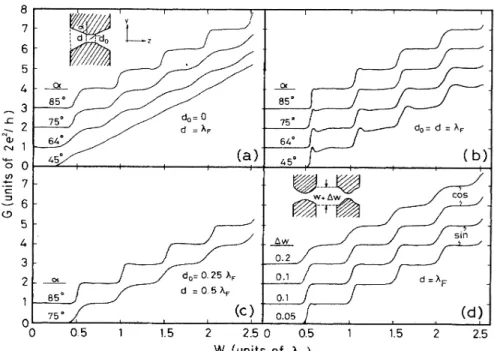
the con-striction may lead to quasi-OD states, which in turn gives rise to resonant tunneling.In Fig. 1, we present the
G(w)
curves calculated for various tapered constrictions. As described in the inset, the lengthof
the uniform part is do, and the tapering is characterized byd
anda.
Forthe caseof
do0,
G exhib-its a behavior reminiscentof
the Sharvin conductance even fora
—
45.
Asa
increases the oscillations develop and change into the step structure. Bythe inclusionof
a uniform constrictionof
do A,F between two taperings theconductance changes. The steplike structure appears even for
a
45.
Although the plateaus cannot be Qattened, and thus cannot reach the quantized values, a resonance structure which is seen in the abrupt and uniform con-strictionof
do XF(i.e.
,d0)
ismaintained fora~85
.
However, as in the previous cases for
a~85'
the reso-nance structure disappears to yield a well-defined step structure. Contrary to this situation, one would expect pronounced and sharper resonance structure since the tapering changes into the uniform constriction asa
90,
and thus its length increases from dotodo+2d.
3
=2
1 4 88 J 8J
(b)
6-
5-Qw 0.2 COS o./
o.f
CX 8SJ
5/
005
oosj
(cI)
2.5 I 1.5 1 1.5 1 2 2.50 0.5 1 2 W (units of AF)FIG.
l.
Calculated G(w) curves showing the adiabatic evolution ofthe constriction states forcertain geometries.(a)-(c)
corre-spond to tapering with diR'erent parameters described by the inset in
(a).
In (d) the constriction is modulated by sine- aud cosine-pro61es.EFFECTS OF THE CONSTRICTION GEOMETRY ON QUASI-.
.
.
8561 This behaviorof
G is relatedto
the adiabatic evolutionof
the current-carrying wave. Since ttlw/8z t is small for
large
a, a
state entering the tapering evolves without changing the quantum number n associated with the y momentum, while the energya„(z)
and the momentum k»increase. The conditions, in which the adiabatic evolution
of
the states takes place, depend on the geometryof
the constriction.It
appears that a tapering witha=85
satisfies this condition. Becauseof
the adiabatic evolu-tion, the quantizationof
conductance is not affected in any essential manner, ''
but owing to the insufBcient phase coherence the resonance structure disappeared. A similar behavior was shown to exist for a constriction be-tween two large circles.' The constriction described in Fig.1(d)
mimics that geometry, where the widths w aregiven by
w(z)
w+bw(I
—
sin(xz/XF)) andw(z)
w+
2 hw(1—
cos(2'/X,
F))
for amplitude hw rangingfrom
0.
05 to0.
2 A.F. While adiabatic evolution iscom-plete for small hw and yields sharp steps and almost fiat plateaus, the steps are not as sharp for large hw.
Contrary to the above geometry,
a
finite constriction which is relatively narrower at both ends gives rise to the spatially varying subband energies,8„(z),
which are lowered near the centerof
the constriction. As schemati-cally described in Fig.2(a)
these subbands can be viewed as the potential wells, ' in which quasi OD (or confined) states are formed. A similar confinement can occur evenif
the widening isabrupt inside the constriction. This situ-ation is reminiscentof
adouble-barrier resonant tunneling(DBRT)
structure, and hence may lead to the resonant tunneling. Before the nth channel (n~
1)
is opened, theresonance may occur on the (n
—
1)th
plateau whenever a confined state in the wellof
z„(z)
matchesto
the statesof
the 2D
EG.
As a result, resonance peaks illustrated in Fig.2(b)
appear near the edgesof
the quantum stepsof
G(w).
We used sine and cosine modulation along the constric-tion with the amplitude hw. We found that the sine modulation yields relatively smaller widths
w„(at
which resonant tunneling occurs), and broader peaks as com-pared to thoseof
the cosine modulation. This can be ex-plained by using theDBRT
analogy. Since the sine modulation is represented by aDBRT
structure with a relatively wider well, but narrower barriers as compared to thoseof
the cosine modulation, the resonance energies are relatively farther from the topof
the barrier (or equivalently from the quantized steps inG)
and resonance peaks are relatively broader forthe sine modulation. That theDBRT
analogy is valid and thus the peaks near the steps are related to the resonant tunneling are shown by calculating the quasi-OD states for an infinite constriction with awideningof
the same form asthe finite constriction above and by comparing the positionsof
these with the resonance positions~,.
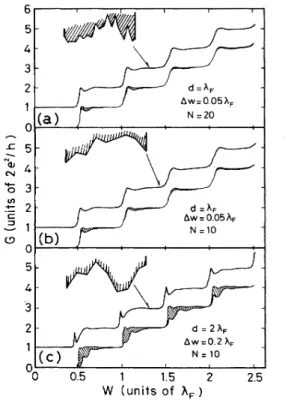
Next we investigate the effect
of
the roughness along the constriction, which is closely related to the qualityof
the split gate. As shown in the inset
of
Fig.3,
the rough-ness is simulated by a random modulationof
the width. At each step,M
d/N along the constriction w is varied by xhtv, where the valueof
x(0
~
x
~
1)
israndom. This 3-b w=0.05A N=20(a)
5-0
3(b)
b,w=0.05AF N=10 Vbv8 CV CV ~V/ O Q) 3 Oe2 J 01 c90.
1 0.05 I I I 0.5 1 1.5 W (units of &F)FIG.2. (a)A schematic description for the formation ofthe
quasi OD states (sb) in aconstriction. (b)G(w) calculated for constrictions modulated bysine- and cosine-profiles.
J
,(c)
0 0.5 1 1.5 d=2PF bed=0.2XF N=10 2.5 W (units of P~)FIG. 3. In each panel a single G(w) curve calculated for a specific profile w+bw(z) (shaded line in upper left-hand side) reproducing arough constriction. Shaded plot isgenerated from 25
G(w„)
curves calculated for different, randomly selected8562
E.
TEKMAN ANDS.
CIRACI5—
dO;AW 4 0.&10.2g 0.&,0.05 0.05;0.2 0.05; 0.05 O ~««~llllllhl 0.1;0.2 0.&.
.0.05 0.05;0.2 0.05; 0.05'0
05
I i 15 W (units ot)F)
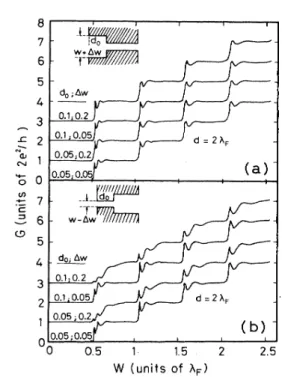
I 2.5FIG. 4. G(w) curves calculated for an obstacle at the en-trance of auniform constriction.
The conductance
G(w,
„)
fora given setof (d,
d,w) varies inthe shaded region asafunctionof
the profile. The width way a histogram profile bw(z) is superimposed over the uniform width w. The G(w) is then calculated for 25 different bw(z) prollles, and is traced on the same plot with respect tothe average widthpd
w,
„w+
d
' bw(z)dz.
of
the shaded region increases with increasing d,~.
In each panel in Fig. 3G(w) isalso presented corresponding to a speci6cpronle. Since hw issmall, the positionsof
the resonance peaks are maintained. Nevertheless, the con-ductance values at the resonances and antiresonances are affected becauseof
the scattering from the roughness.Finally, we discuss two forms
of
the constriction de-scribed in Fig.4.
These are obtained by implementing an obstacleof
length do at the entranceof
a uniform con-strictionof
length d. The widthof
the obstacle is relative-ly larger or smaller(~hw).
In the arst one, since the states in the obstacle region can match the 2DEG
states to thoseof
the uniform constriction, the conductance is not affected. In contrast, the narrower obstacle lacks ap-propriate states, which match the uniform constriction to the 2DEG.
Since the openingsof
the channels are shifted to nA,F/2+hw,
the sharp step structure is disturbed and the flat plateaus disappear with increasing h,m. We notice that even fordo~0.
05K,~ a small reductionof
wat the en-trance gives rise to drastic deviations from the idealG(w)
curve
of
the uniform constriction.If
such an obstacle is put in the constriction near the center, its effect is not as drastic as the previous one.In conclusion, we showed that the form
of
the constric-tion plays an essential role in the measured conductanceG(w)
for the 1D ballistic transport between two 2DEG
reservoirs.
If
the variationof w(z)
is very small and smooth, permitting adiabatic evolutionof
the wave func-tion, the quantized conductance with step structure is maintained, but the resonance structure disappears. We predict that the resonant tunneling may occur in a con-striction which becomes relatively wider atthecenter.%'eacknowledge valuable discussions with Professor N. Garcia and A. Yacobi. This work is partially supported by the Joint Project Agreement between Bilkent Universi-ty and
IBM
Zurich Research Laboratory.'R.
Landauer, IBMJ.
Res. Dev. 1, 233 (1957); Y. Imry, inDirections in Condensed Matter Physics, edited by G.
Grin-stein aud G.Mazenko (World Scientific, Singapore, 1986), Vol. 1, p. 102.
B.
J.
van Wees, H.van Houten, C.W.J.
Beenakker,J.
G.Wil-liamson, L. P. Kouwenhoven, D. van der Marel, and C. T. Foxon, Phys. Rev.Lett. 60,848
(1988).
D. A. Wharam,
T.
J.
Thornton, R. Newbury, M. Pepper, H. Rithcie, and G. A.C.Jones,J.
Phys. C21,L209(1988).
4G. Kirczenow, Solid State Commun. 6$, 715
(1988).
5A.D.Stone and A.Szafer, Phys. Rev. Lett. 62, 300
(1989).
sN. Garcia and L.Escapa, AppL Phys. Lett. (tobe published); L.Escapa and N. Garcia,
J.
Phys. Condens. Matter 1, 2125(1989).
7E.G.Haanapel and D.van der Marel, Phys. Rev.
8
39,5484 (1989);D.van der Marel andE.
G.Haanapel, ibid. 39,7811(1989).
sE.Tekman and
S.
Ciracl, Phys. Rev. B39,8772(1989).
E.Tekmau and
S.
Ciraci, in Science and Engineering of'IDand ODSemiconductors, edited by
S.
P.Beaumont and C.M. Sotomayor-Torres (Plenum, New York, in press).'oN. Garcia (private communication).
"D.
A. Wharam, M. Pepper, H. Ahmed,J.
E.F.
Frost, D. G. Hasko, D.C.Peacock, D. A.Ritchie, and G. A.C.Jones,J.
Phys. C 21, L887(1988).
'
S.
E.Laux, D.J.
Frank, andF.
Stern, Surf. Sci. 196, 101(1988).
'3Yu. V. Sharvin, Zh. Eksp. Teor Fiz. 48, 984
.
(1965) [Sov. Phys. JETP21, 655(1965)1."L.
I.
Glazman, G.B.
Lesorik, D. E.Khmelnitskii, and R.I.
Shekhter, Pis'ma Zh. Eksp. Teor. Fiz. 4$, 218 (1988)[JETP Lett. 48,238 (1988)l.iSA. Yacobiand Y.Imry (unpublished).
C. G.Smith, M. Pepper, H. Ahmed,
J.
E. F.Frost, D. G. Hasko, D.C.Peacock, D. A. Ritchie, and G. A.C.Jones,J.
Phys. C 21,L893 (1988). These authors proposed that ODstates can also occur between two potential barriers created