O R I G I N A L A RT I C L E
Internet Addiction, Fatigue, and Sleep Problems
Among Adolescent Students: a Large-Scale Study
Abdulbari Bener
1,2,3 &Erol Yildirim
4&Perihan Torun
5&Funda Çatan
1,6&Erkut Bolat
1&Sümmani Al
ıç
1&Salih Akyel
1&Mark D. Griffiths
7Published online: 14 May 2018
# Springer Science+Business Media, LLC, part of Springer Nature 2018
Abstract The aim of the present study was to examine the association between Internet
addiction (IA), fatigue, and sleep problems among university students. A total of 3000 Turkish
students aged 18 to 25 years were approached and 2350 students (78.3%) participated in this
cross-sectional study from April 2017 to September 2017 in public and private universities in
Istanbul. Data were collected via a structured questionnaire including socio-demographic
details, lifestyle and dietary habits, Internet Addiction Test (IAT), Fatigue Scale, and Epworth
Sleepiness Scale (ESS). Descriptive statistics, multivariate, and factorial analyses were
per-formed. The overall prevalence of IA among the studied population was 17.7%. There were
significant differences between gender, family income, father’s occupation, school
perfor-mance, frequency and duration of watching television, physical activity, Internet use duration,
and sleep duration (all p < 0.001). Significant differences were also found between participants
with IA and those without IA in having headaches, blurred vision, double vision, hurting eyes,
hearing problems, and eating fast food frequently (all p < 0.001). Using multivariate regression
* Abdulbari Bener
[email protected]; [email protected]
1
Department of Biostatistics & Medical Informatics, Cerrahpaşa Faculty of Medicine, Istanbul University, Cerrahpasa, 34098 Istanbul, Turkey
2
Department of Evidence for Population Health Unit, School Of Epidemiology and Health Sciences, University of Manchester, Manchester, UK
3
International School of Medicine, Istanbul Medipol University, Kavacik,İstanbul, Turkey
4
Department of Psychology,İstanbul Medipol University, Kavacık, 34810 İstanbul, Turkey
5 Faculty of Medicine, Department of Public Health, Bezmiâlem Foundation University,İstanbul,
Turkey
6
Department of Computer Education and Instructional Technologies, Faculty of Education, University of Kastamonu, Kastamonu, Turkey
7
analysis, the duration of Internet use, physical and mental symptoms, headache, hurting eyes,
tired eyes, hearing problems, and ESS scores were significantly associated with (and primary
predictors of) IA. The present study demonstrated that IA was associated with poor dietary
habits, sleep problems, and fatigue symptoms.
Keywords Excessive Internet use . Sleep disorders . Fatigue . Internet addiction
Access to the Internet via smartphones, tablets, and laptop computers have made it possible for
anyone to enjoy many work and leisure activities regardless of time and physical location.
Internet misuse among children and adolescents has become a widespread major public health
concern worldwide (Kuss et al.
2014
; Bener and Bhugra
2013
). The phenomenon of Internet
addiction was first described in a number of papers in the mid- to late-1990s by Griffiths and
Young (Griffiths
1996
,
1998
; Young
1996
). The topic immediately gained more attention and
has become a highly researched area. Specific types of Internet use, such as online socializing,
gaming, gambling, and sex, can lead to pathological behavior (Griffiths
1998
; Young and
Rogers
1998
; Müller et al.
2015
; Kim et al.
2016
). One type of problematic Internet use is
Internet gaming disorder (IGD) and has been included in the fifth edition of the Diagnostic and
Statistical Manual of Mental Disorders (DSM-5) as an emerging area that requires further
evidence before being included in the main text (American Psychiatric Association
2013
).
Several studies have established that in particular children and adolescents have problems
and/or are becoming addicted to playing online games, in much the same way as adults
become addicted to alcohol or drug or gambling (Griffiths
1998
; Young
1996
; Ko et al.
2008
).
Several studies have demonstrated that individuals can become addicted to online activities,
particularly those that have psychological and emotional problems such as depression, anxiety,
loneliness, distraction, and lack of sleep (Griffiths
1998
; Bener and Bhugra
2013
; Demirci
et al.
2015
; Rehbein et al.
2015
; Lam
2014
). Moreover, excessive and/or problematic Internet
use can lead to physical health issues such as dry eyes; carpal tunnel syndrome; repetitive
motion injuries; wrist, neck, back, and shoulder pain; migraine headaches; and numbness and
pain in the thumb, index, and middle fingers (Park et al.
2013
).
Several studies have documented adverse effects of IA among adolescents such as irregular
dietary habits (Bener et al.
2010
,
2011
), physical inactivity, lack of adequate sleep (Choi et al.
2009
; Canan et al.
2013
; Ekinci et al.
2014
), increased depression, loneliness, and social
anxiety (Caplan
2007
; Celik et al.
2014
). These detrimental social and health effects are still
being debated within the psychological, psychiatric, and medical communities. The primary
aim of the present study was to examine the association between IA, fatigue, and sleep
problems among university students.
Methods
Participants and Procedure The present cross-sectional study comprised students aged
18 to 25 years, studying in five Istanbul Government and Trust universities (Turkey).
Ethical clearance for the study was given by the Istanbul Medipol University,
Interna-tional School of Medicine. A multi-stage stratified random sampling technique was used
and university students were selected randomly. Urban and semi-urban areas were
proportionally represented by stratification. Data were collected during the period April
2017 to September 2017. The questionnaires were handed out to the students at five
different universities. Although 3000 students were approached, 2350 students
partici-pated in the study (response rate of 78.3%). Istanbul is a cosmopolitan city, so the sample
represents all parts of Turkey. Furthermore, the value of Kaiser-Meyer-Olkin measure of
sampling adequacy was found 0.91 > 0.6, so the sample size was deemed good enough
for all the statistical tests carried out. Content validity, face validity, and reliability of the
questionnaire were tested among 148 participants. A high level of validity and high
degree of repeatability was found (kappa = 0.85 > 0.8).
Measures The questionnaire comprised five sections. The first section included
socio-demographic details of the students; the second section concerned lifestyle habits, extra
physical activities, and several disorders; the third section comprised the Fatigue Scale; the
fourth section comprised the Epworth Sleep Scale; the final section concerned Internet use and
included Young’s Internet Addiction Test (Young
2004
).
We used the Turkish translation of Young’s Internet Addiction Test (IAT) developed by
Cakır Balta and Horzum (
2008
). IAT comprises 20 questions to determine the level of
addiction as mildly, moderately, or severely. It is evaluated on a scale up to 100: up to 49 is
categorized as normal, 50–79 is categorized as problematic, and 80–100 is categorized as
significantly problematic. Items were rated on a 6-point scale where 0 = does not apply, 1 =
rarely, and 5 = always. The internal consistency (Cronbach’s alpha) for the 20 items using the
responses of all participants was 0.89. On the other hand, people were considered as Internet
addicted if they use the Internet more than 35 h/week in Aslan
’s study (Aslan and Yazici
2016
). For the purposes of this study, students were regarded as having Internet addiction if
they fulfilled all of the following two inclusion criteria: an IAT score > 65 and Internet viewing
of
≥5 h/day.
The Fatigue Scale comprises 14 items that determine widely seen physical and mental
fatigue symptoms (Chalder et al.
1993
). The 4-point Likert scale was applied where 1 = better
than usual, 2 = no more than usual, 3 = worse than usual, and 4 = much worse than usual.
Cronbach’s alpha for physical fatigue items (1–8) was 0.85; and for mental fatigue items (9–
14) was 0.82. The Epworth Sleepiness Scale (ESS) is used to assess average daytime
sleepiness (Johns
2000
). The validated ESS comprises 8 items scored on a 24-point scale.
Scores ranging from between 1 and 10 are normal and scores between 11 and 24 are
considered to be abnormal. Epworth score varies in the range of 0–24: < 10 denotes normal;
10–15 moderate impairment, and 16–24 severe impairment (Johns
2000
). Cronbach’s alpha
for the ESS was 0.88 in the present study.
Data Analysis Factor analysis was used for data reduction purposes. It is a statistical
method to reduce numerous variables into lower numbers of factors, which are more
understandable (Thompson
2004
). Confirmatory factor analysis was used to determine
the factor structure of the IAT. Student
’s t tests were performed to test the significance
of differences between mean values of two continuous variables while the
Mann-Whitney test was used for non-parametric data. Chi-square and Fisher
’s exact tests
(two-tailed) were used to establish for differences in proportions of categorical
variables between two or more groups. Multiple regression analysis was performed
with stepwise selection, because of having detailed steps, to estimate IA score on
several predictor variables in the dataset. Statistical significance was accepted at the
p < 0.05 level.
Results
Factor analysis was applied on participants’ responses in order to determine the psychometric
features of the Internet Addiction Test (IAT). Confirmatory factor analysis (CFA) was
per-formed on the dataset (N = 2350). Table
1
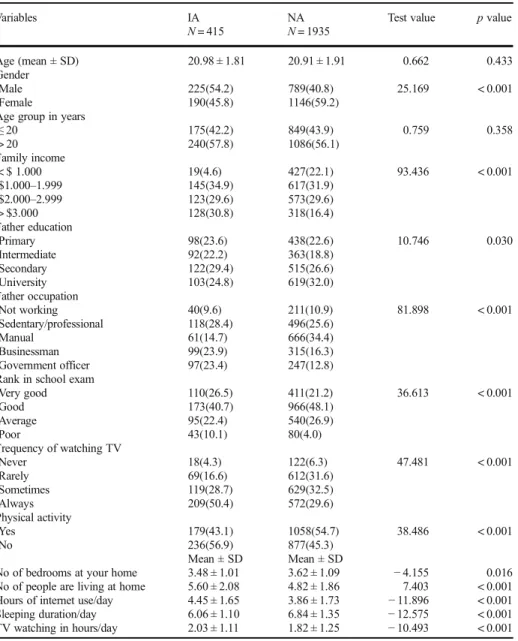
indicates the socio-demographic characteristics of
the sample participants. Of these, 43.1% were males and 56.9% were females. The overall
prevalence of IA among participants was 17.7%. The proportion of IA was significantly higher
among males (54.2%) compared to females (45.8%; p < 0.001). There were significant
differences between gender, family income, father occupation, school performance, frequency
Table 1 Socio-demographics characteristics of the studied students (N = 2350)Variables IA
N = 415
NA N = 1935
Test value p value
Age (mean ± SD) 20.98 ± 1.81 20.91 ± 1.91 0.662 0.433
Gender
Male 225(54.2) 789(40.8) 25.169 < 0.001
Female 190(45.8) 1146(59.2)
Age group in years
≤ 20 175(42.2) 849(43.9) 0.759 0.358 > 20 240(57.8) 1086(56.1) Family income < $ 1.000 19(4.6) 427(22.1) 93.436 < 0.001 $1.000–1.999 145(34.9) 617(31.9) $2.000–2.999 123(29.6) 573(29.6) > $3.000 128(30.8) 318(16.4) Father education Primary 98(23.6) 438(22.6) 10.746 0.030 Intermediate 92(22.2) 363(18.8) Secondary 122(29.4) 515(26.6) University 103(24.8) 619(32.0) Father occupation Not working 40(9.6) 211(10.9) 81.898 < 0.001 Sedentary/professional 118(28.4) 496(25.6) Manual 61(14.7) 666(34.4) Businessman 99(23.9) 315(16.3) Government officer 97(23.4) 247(12.8)
Rank in school exam
Very good 110(26.5) 411(21.2) 36.613 < 0.001 Good 173(40.7) 966(48.1) Average 95(22.4) 540(26.9) Poor 43(10.1) 80(4.0) Frequency of watching TV Never 18(4.3) 122(6.3) 47.481 < 0.001 Rarely 69(16.6) 612(31.6) Sometimes 119(28.7) 629(32.5) Always 209(50.4) 572(29.6) Physical activity Yes 179(43.1) 1058(54.7) 38.486 < 0.001 No 236(56.9) 877(45.3) Mean ± SD Mean ± SD
No of bedrooms at your home 3.48 ± 1.01 3.62 ± 1.09 − 4.155 0.016
No of people are living at home 5.60 ± 2.08 4.82 ± 1.86 7.403 < 0.001
Hours of internet use/day 4.45 ± 1.65 3.86 ± 1.73 − 11.896 < 0.001
Sleeping duration/day 6.06 ± 1.10 6.84 ± 1.35 − 12.575 < 0.001
and duration of watching television, and physical activity (p < 0.001). Those with IA had
significantly less hours of sleep (6.06 ± 1.10 vs. 6.84 ± 1.35; p < 0.001) compared to those
without IA. Those with IA had significantly high number of hours’ Internet use (4.45 ± 1.65
vs. 3.86 ± 1.73; p < 0.001) as compared to those without IA.
Table
2
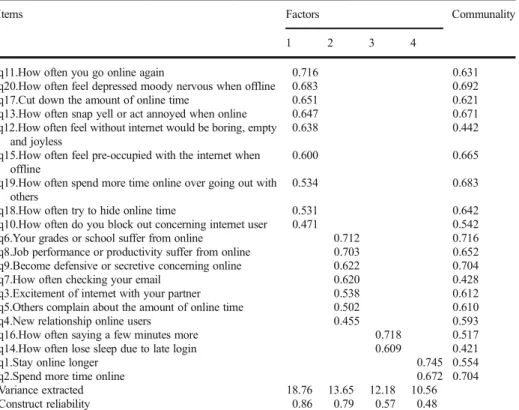
denotes confirmatory factor analysis of IAT. The variables comprised four factors
that had an eigenvalue greater than 1. Factor 1 related to nine variables (Q10, Q11, Q12, Q13,
Q15, Q17, Q18, Q19, Q20) and concern behavioral attitudes with and without Internet. The
variance for factor 1 was 19.52. Factor 2 comprised seven variables (Q3, Q4, Q5, Q6, Q7, Q8,
Q9). These concern the effects of being online. The variance for factor 2 was 16.49. Factor 3
comprised two variables (Q14, Q16) and concern controlling time when online. Factor 4
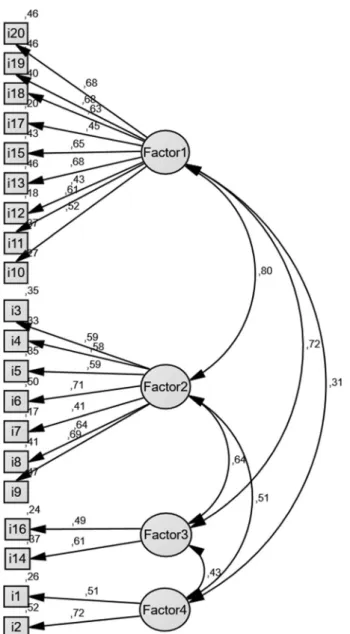
comprised two variables (Q1, Q2) and concerned the spending of more time online. In Fig.
1
,
as a result of reliability analysis, Cronbach’s alpha of the scale was satisfactory (factor 1 =
18.76, factor 2 = 13.65, factor 3 = 12.18, factor 4 = 10.56). Figure was drawn by using AMOS,
and all standardized values have to be smaller than 1. The CFA provided the following results:
X
2= 11.53 (p < 0.001), root mean square error of approximation (RMSEA) = 0.06 with the
criteria of < 0.08 (Stevens
2001
), goodness of fit index (GFI) = 0.92 (≥ 0.9) (Hair et al.
2010
),
comparative fit index (CFI) = 0.88 (≥ 0.9) (Hair et al.
2010
), adjusted goodness of fit index
(AGFI) = 0.91 (≥ 0.9), standardized root mean square residual (SRMR) = 0.07 (≤ 0.05)
(Schermelleh-Engel and Moosbrugger
2003
), normed fit index (NFI) = 0.88 (≥ 0.9), and
non-normed fit index (NNFI) = 0.87 (≥ 0.9) (Schermelleh-Engel and Moosbrugger
2003
).
Table 2 Confirmatory factor analysis of Internet Addiction Test (IAT) (N = 2350)
Items Factors Communality
1 2 3 4
q11.How often you go online again 0.716 0.631
q20.How often feel depressed moody nervous when offline 0.683 0.692
q17.Cut down the amount of online time 0.651 0.621
q13.How often snap yell or act annoyed when online 0.647 0.671
q12.How often feel without internet would be boring, empty and joyless
0.638 0.442
q15.How often feel pre-occupied with the internet when offline
0.600 0.665
q19.How often spend more time online over going out with others
0.534 0.683
q18.How often try to hide online time 0.531 0.642
q10.How often do you block out concerning internet user 0.471 0.542
q6.Your grades or school suffer from online 0.712 0.716
q8.Job performance or productivity suffer from online 0.703 0.652
q9.Become defensive or secretive concerning online 0.622 0.704
q7.How often checking your email 0.620 0.428
q3.Excitement of internet with your partner 0.538 0.612
q5.Others complain about the amount of online time 0.502 0.610
q4.New relationship online users 0.455 0.593
q16.How often saying a few minutes more 0.718 0.517
q14.How often lose sleep due to late login 0.609 0.421
q1.Stay online longer 0.745 0.554
q2.Spend more time online 0.672 0.704
Variance extracted 18.76 13.65 12.18 10.56
Table
3
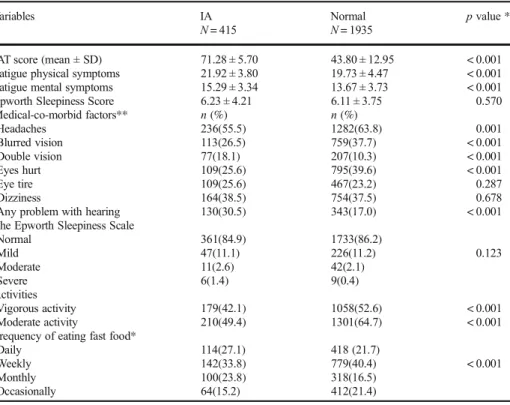
shows the lifestyle habits, diet, and co-morbid factors comparing Internet-addicted
participants with those not addicted. Significant differences were found between IA and
non-IA participants in having headaches, blurred vision, double vision, hurting eyes, hearing
problems, and eating fast food frequently (all p < 0.001). Significantly fewer participants with
IA reported having vigorous and moderate activities compared to non-IA participants
(p < 0.01). Table
4
compares fatigue disorders of those with IA to non-IA participants. Those
with IA had significantly higher fatigue disorder scores, especially physical fatigue, due to the
significantly high number of hours’ Internet use (p < 0.001) as compared to non-IA
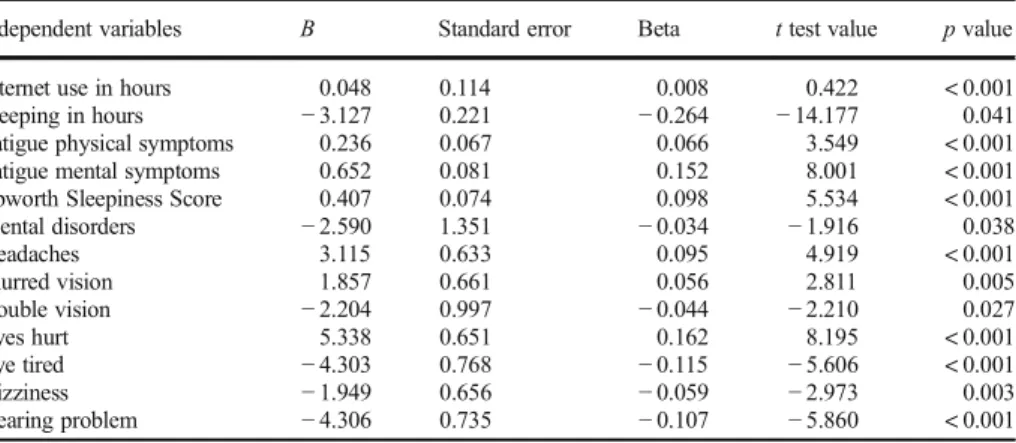
partici-pants. Table
5
shows the multiple linear regression analysis to determine the potential
Fig. 1 Standardized scores of four-factor structure of Internet Addiction ScaleTable 3 The characteristics of lifestyle, dietary, and co-morbid factors between Internet addicts and normal students (N = 2350) Variables IA N = 415 Normal N = 1935 p value *
IAT score (mean ± SD) 71.28 ± 5.70 43.80 ± 12.95 < 0.001
Fatigue physical symptoms 21.92 ± 3.80 19.73 ± 4.47 < 0.001
Fatigue mental symptoms 15.29 ± 3.34 13.67 ± 3.73 < 0.001
Epworth Sleepiness Score 6.23 ± 4.21 6.11 ± 3.75 0.570
Medical-co-morbid factors** n (%) n (%) Headaches 236(55.5) 1282(63.8) 0.001 Blurred vision 113(26.5) 759(37.7) < 0.001 Double vision 77(18.1) 207(10.3) < 0.001 Eyes hurt 109(25.6) 795(39.6) < 0.001 Eye tire 109(25.6) 467(23.2) 0.287 Dizziness 164(38.5) 754(37.5) 0.678
Any problem with hearing 130(30.5) 343(17.0) < 0.001
The Epworth Sleepiness Scale
Normal 361(84.9) 1733(86.2) Mild 47(11.1) 226(11.2) 0.123 Moderate 11(2.6) 42(2.1) Severe 6(1.4) 9(0.4) Activities Vigorous activity 179(42.1) 1058(52.6) < 0.001 Moderate activity 210(49.4) 1301(64.7) < 0.001
Frequency of eating fast food*
Daily 114(27.1) 418 (21.7)
Weekly 142(33.8) 779(40.4) < 0.001
Monthly 100(23.8) 318(16.5)
Occasionally 64(15.2) 412(21.4)
*Two-sided p values based on Student’s t test **Not adding to 100%
Table 4 The comparison of fatigue physical and mental symptoms according Internet addiction and normal subjects (N = 2350)
14-item Fatigue Scale IA
N = 415
Normal students N = 1935
p value
Physical symptoms
1. Do you have problem with tiredness? 2.80 ± 1.20 2.41 ± 1.03 < 0.001
2. Do you need to rest more? 2.73 ± 1.24 2.50 ± 1.01 < 0.001
3. Do you feel sleepy or drowsy? 2.71 ± 2.08 2.43 ± 1.06 < 0.001
4 Do you have problems starting things? 2.67 ± 1.10 2.50 ± 1.12 0.031
5. Do you start things without difficulty but get weak as you go on? 2.61 ± 1.10 2.49 ± 1.06 < 0.001
6. Are you lacking in energy? 2.93 ± 1.11 2.51 ± 1.07 < 0.001
7. Do you have less strength in your muscle? 2.67 ± 1.09 2.36 ± 1.10 < 0.001
8. Do you feel weak? 2.81 ± 1.16 2.52 ± 1.12 < 0.001
Mental symptoms
9. Do you have difficulty concentrating? 2.53 ± 1.13 2.41 ± 0.99 0.023 10. Do you have problems thinking clearly 2.74 ± 1.08 2.42 ± 1.12 < 0.001 11. Do you make lips of the tongue when speaking? 2.66 ± 1.16 2.39 ± 1.10 < 0.001 12. Do you find it more difficult to find the correct word? 2.55 ± 1.27 2.51 ± 1.13 0.558
13. How is your memory? 2.44 ± 1.13 2.53 ± 1.00 0.112
predictors as risk factors for Internet addiction. This analysis demonstrated that the duration of
Internet use, physical fatigue, mental symptoms, sleepiness (as assessed using the EES),
headaches, hurting eyes, tired eyes, and hearing problems were significantly associated with
(and key predictors of) Internet addiction.
Discussion
The present study clearly demonstrated that IA was related to a wide range of co-morbid
factors and poor lifestyle habits. The prevalence of IA in the present Turkish sample (17.7%) is
higher than that of China (11%) (Lam et al.
2009
), Australia (10.8%) (Choi et al.
2009
), Greece
(8%) (Siomos et al.
2008
), Taiwan (17.1%) (Liu et al.
2017
), and the USA (9%) (Caplan
2007
). Moreover, IA affects approximately 1.2 to 26.3% of US university students (Li et al.
2015
). Although it is difficult to compare the exact prevalence of IA due to the lack of a shared
criteria and assessment instrument used, the present study highlights the importance of using a
robust psychometrically validated scale. The present study examined the psychometric features
of the IA test using factorial analysis.
Researchers have used different terms to describe adverse impacts of excessive Internet use
on individuals, including (but not limited to) Internet addiction, Internet addiction disorder,
Internet use disorder, Internet dependence, problematic Internet use, and pathological Internet
use (Kuss et al.
2014
; Griffiths
1998
; Choi et al.
2009
). A recent cross-sectional study of 1156
students in the Mersin Province of Turkey reported that 175 students (15.1%) were considered
as Internet addicts (
Şaşmaz et al.
2014
). The prevalence rate of Internet addiction was 9.3% in
girls and 20.4% in boys (p < 0.001), and is therefore in line with findings from the present
study. Several studies in Turkey examined the relationship between Internet addiction and
depression (Gunay et al.
2018
) and anxiety (Seyrek et al.
2017
), Internet and sleep problems
(Canan et al.
2013
; Ekinci et al.
2014
; Bhandari et al.
2017
), and Internet and loneliness (Celik
et al.
2014
). Yilmazsoy and Kahraman (
2017
) found that the level of Internet addiction is
related to the duration of Internet usage and the increased duration of Internet usage leads to
increase in the level of Internet addiction. This is confirmatory with the present research.
Moreover, this is the first study to investigate the relationship between Internet addiction,
fatigue, and sleeping problems among young Turkish population.
Table 5 Multiple stepwise regression analysis predictors for determinants of Internet addiction affect (N = 2350)
Independent variables B Standard error Beta t test value p value
Internet use in hours 0.048 0.114 0.008 0.422 < 0.001
Sleeping in hours − 3.127 0.221 − 0.264 − 14.177 0.041
Fatigue physical symptoms 0.236 0.067 0.066 3.549 < 0.001
Fatigue mental symptoms 0.652 0.081 0.152 8.001 < 0.001
Epworth Sleepiness Score 0.407 0.074 0.098 5.534 < 0.001
Mental disorders − 2.590 1.351 − 0.034 − 1.916 0.038 Headaches 3.115 0.633 0.095 4.919 < 0.001 Blurred vision 1.857 0.661 0.056 2.811 0.005 Double vision − 2.204 0.997 − 0.044 − 2.210 0.027 Eyes hurt 5.338 0.651 0.162 8.195 < 0.001 Eye tired − 4.303 0.768 − 0.115 − 5.606 < 0.001 Dizziness − 1.949 0.656 − 0.059 − 2.973 0.003 Hearing problem − 4.306 0.735 − 0.107 − 5.860 < 0.001
Nevertheless, a large body of literature suggests that Internet addiction has negative effects
on individuals’ abilities (Kuss et al.
2014
; Griffiths
1996
,
1998
; Choi et al.
2009
; Bener and
Bhugra
2013
; Niemz et al.
2005
), irregular dietary habits (Bener et al.
2010
,
2011
; Park et al.
2013
), physical inactivity (Bener et al.
2010
,
2011
; Kuss et al.
2014
; Griffiths
1996
,
1998
), and
adequate sleep (Canan et al.
2013
; Ekinci et al.
2014
; Bhandari et al.
2017
). Furthermore, a
Korean study reported a significant association between IA, sleep disturbances, fatigue
symptoms, and fast food consumption (Kim et al.
2010
). The results of the present study
concur with these findings. Previous research has also established that computer screen lights
can have negative effect on the circadian rhythm and lead to sleep phase delay (Petit et al.
2016
). Similarly, IA plays an important role in daytime sleepiness and sleeping disorders
(Ferreira et al.
2017
) and fatigue (Lin et al.
2013
). Another study has also reported that IA has
negative impacts on sleep including sleep deprivation and fatigue (Bener et al.
2016
).
The present study is not without its limitations. Firstly, common diagnostic criteria for IA
differ across studies and the present study used the most widely used measure but arguably the
most out-of-date. Secondly, there may be reporting bias by students such as hiding the duration
of Internet use due to the self-reported scale (along with other well-known biases common to
all self-report methods such as memory recall). Finally, family factors related to IA were not
evaluated as potential variables in the present study. Despite these limitations, the present study
demonstrated that IA was associated with poor dietary habits, sleep problems, and fatigue
symptoms using a relatively large-scale sample. Using confirmatory factor analysis, the study
investigated the latent structure of the IAT scale and results support its reliability and validity.
Acknowledgments This work was supported by the Istanbul Medipol University, International School of Medicine. The authors would like to thank the Istanbul Medipol University for their support and ethical approval (Research Protocol and IRB# 10840098-604.01.01-E.9713).Authors’ Contributions AB and EY organized the study, collected data, performed statistical analysis, and wrote the first draft of the article, and contributed to the interpretation of the data and writing the final draft of manuscript. PT, FÇ, EB, and SA collected data, performed statistical analysis, and wrote the first draft of the article. MDG contributed to the interpretation of the data and writing the manuscript.
Compliance with Ethical Standards
Informed Consent Verbal informed consent was obtained for this study due to its nature.
Conflict of Interest The authors declare that they have no conflict of interest.
References
American Psychiatric Association. (2013). Diagnostic and statistical manual of mental disorders (5th ed.). Arlington: American Psychiatric Association.
Aslan, A., & Yazici, A. (2016). Internet addiction among university students and related sociodemographic factors. Turkish Journal of Clinical Psychiatry, 19(3), 109–117.
Bener, A., & Bhugra, D. (2013). Lifestyle and depressive risk factors associated with problematic internet use in adolescents in an Arabian Gulf culture. Journal of Addiction Medicine, 7, 236–242.
Bener, A., Al-Mahdi, H. S., Vachhani, P. J., Al-Nufal, M., & Ali, A. I. (2010). Do excessive internet use, television viewing and poor life-style habits affect low vision in school children? Journal Child Health Care, 14, 375–385.
Bener, A., Al-Mahdi, H. S., Ali, A. I., Al-Nufal, M., Vachhani, P. J., & Tewfik, I. (2011). Obesity and low vision as a result of excessive internet use and television viewing. International Journal of Food Science and Nutrition, 62(1), 60–62.
Bener, A., Al-Mahdi, H. S., & Bhugra, D. (2016). Lifestyle factors and internet addiction among school children. International Journal of Community Family Medicine., 1, 118.
Bhandari, P. M., Neupane, D., Rijal, S., Thapa, K., Mishra, S. R., & Poudyal, A. M. (2017). Sleep quality, internet addiction and depressive symptoms among undergraduate students in Nepal. BMC Psychiatry, 17, 106. Cakır Balta, O., & Horzum, M. B. (2008). Internet addiction test. Journal of Educational Sciences & Practice.,
7(13), 99–121.
Canan, F., Yildirim, O., Sinani, G., Ozturk, O., Ustunel, T. Y., & Ataoglu, A. (2013). Internet addiction and sleep disturbance symptoms among Turkish high school students. Sleep and Biological Rhythms, 11(3), 210–213. Caplan, S. E. (2007). Relations among loneliness, social anxiety, and problematic internet use. Cyberpsycho
Behavİor, 10(2), 234–242.
Celik, V., Yesilyurt, E., Korkmaz, O., & Usta, E. (2014). From the perspective of loneliness and cognitive absorption internet addiction as predictor and predicted. Eurasia Journal of Mathematics, Science & Technology Education, 10(6), 581–594.
Chalder, T., Berelowitz, G., Pawlikowska, T., Watts, L., Wessely, S., Wright, D., & Wallace, E. P. (1993). Development of a fatigue scale. Journal of Psychosomatic Research, 37(2), 147–153.
Choi, K., Son, H., Park, M., Han, J., Kim, K., Lee, B., & Gwak, H. (2009). Internet overuse and excessive daytime sleepiness in adolescents. Psychiatry and Clinical Neurosciences, 63, 455–462.
Demirci, K., Akgönül, M., & Akpinar, A. (2015). Relationship of smartphone use severity with sleep quality, depression, and anxiety in university students. Journal of Behavioral Addictions., 4(2), 85–92.
Ekinci, Ö., Celik, T., SAVAŞ, N., & Toros, F. (2014). Association between internet use and sleep problems in adolescents. Nöro Psikiyatri Arşivi, 51(2), 122–128.
Ferreira, C., Ferreira, H., Vieira, M. J., Costeira, M., Branco, L., Dias, A., & Macedo, L. (2017). Epidemiology of internet use by an adolescent population and its relation with sleep habits. Acta Medica Portuguesa Journal, 30(7–8), 524–533.
Griffiths, M. D. (1996). Internet addiction: an issue for clinical psychology? Clinical Psychology Forum, 97, 32–36. Griffiths, M. D. (1998). Internet addiction: does it really exist? In J. Gackenbach (Ed.), Psychology and the internet: intrapersonal, interpersonal, and transpersonal implications (pp. 61–75). San Diego: Academic. GÜnay, O., Özturk, A., Arslantas, E. E., & Sevinc, N. (2018). Internet addiction and depression levels in Erciyes
University students. Dusunen Adam The Journal of Psychiatry and Neurological Sciences 31, 79–88. Hair, J. F., Black, W. C., Babin, B. J., & Anderson, R. E. (2010). Multivariate data analysis (7th ed.). Upper
Saddle River: Prentice Hall.
Johns, M. W. (2000). Sensitivity and specificity of the multiple sleep latency test (MSLT), the maintenance of the wakefulness test and the Epworth Sleepiness Scale: failure of the MSLT as a gold standard. Journal Sleep Research, 9, 5–11.
Kim, Y., Park, J. Y., Kim, S. B., Jung, I. K., Lim, Y. S., & Kim, J. H. (2010). The effects of Internet addiction on the lifestyle and dietary behavior of Korean adolescents. Nutrition Research Practice, 4(1), 51–57. Kim, N. R., Hwang, S. S.-H., Choi, J.-S., Kim, D.-J., Demetrovics, Z., Király, O., Nagygyörgy, K., Griffiths, M.
D., Hyun, S. Y., Youn, H. C., & Youn, H. C. (2016). Characteristics and psychiatric symptoms of Internet gaming disorder among adults using self-reported DSM-5 criteria. Psychiatry Investigation, 13(1), 58–66. Ko, C. H., Yen, J. Y., Yen, C. F., Chen, C. S., Weng, C. C., & Chen, C. C. (2008). The association between
Internet addiction and problematic alcohol use in adolescents: the problem behavior model. CyberPsychology & Behavior., 11(5), 571–576.
Kuss, D. J., Griffiths, M. D., Karila, L., & Billieux, J. (2014). Internet addiction: a systematic review of epidemiological research for the last decade. Current Pharmaceutical Design, 20, 4026–4052.
Lam, L. T. (2014). Internet gaming addiction, problematic use of the Internet, and sleep problems: a systematic review. Current Psychiatry Reports., 16(4), 444.
Lam, L. T., Peng, Z. W., Mai, J. C., & Jing, J. (2009). Factors associated with Internet addiction among adolescents. Cyberpsychol Behavior, 12, 1–5.
Li, W., O'Brien, J. E., Snyder, S. M., & Howard, M. O. (2015). Characteristics of internet addiction/pathological internet use in U.S. university students: a qualitative-method investigation. PLoS One, 10(2), e0117372. Lin, S. C., Tsai, K. W., Chen, M. W., & Koo, M. (2013). Association between fatigue and Internet addiction in
female hospital nurses. Journal Advanced Nursing, 69(2), 374–383.
Liu, H. C., Liu, S. I., Tjung, J. J., Sun, F. J., Huang, H. C., & Fang, C. K. (2017). Self-harm and its association with internet addiction and internet exposure to suicidal thought in adolescents. Journal of the Formosan Medical Association., 116(3), 153–160.
Müller, K., Janikian, M., Dreier, M., Wölfling, K., Beutel, M., Tzavara, C., Richardson, C., & Tsitsika, A. (2015). Regular gaming behavior and Internet gaming disorder in European adolescents: results from a
cross-national representative survey of prevalence, predictors, and psychopathological correlates. European Child & Adolescent Psychiatry., 24(5), 565–574.
Niemz, K., Griffiths, M. D., & Banyard, P. (2005). Prevalence of pathological Internet use among university students and correlations with self-esteem, the general health questionnaire (GHQ), and disinhibition. CyberPsychology Behavior, 8, 562–570.
Park, S., Hong, K. E., Park, E. J., Ha, K. S., & Yoo, H. J. (2013). The association between problematic internet use and depression, suicidal ideation and bipolar disorder symptoms in Korean adolescents. Australian & New Zealand Journal of Psychiatry, 47(12 Pt 1), 153–159.
Petit, A., Karila, L., Estellat, C., Moisan, D., Reynaud, M., D'Ortho, M. P., Lejoyeux, M., & Levy, F. (2016). Sleep disorders in Internet addiction. Presse Medicale journal, 45, 1170–1177.
Pituchi, K. A., Stevens, J. P. (2016). Applied Multivariate Statistics for the Social Sciences. 6th Edition, Routledge, Taylor & Francis Group, pp 1–814.
Rehbein, F., Kliem, S., Baier, D., Mößle, T., & Petry, N. M. (2015). Prevalence of Internet gaming disorder in German adolescents: diagnostic contribution of the nine DSM-5 criteria in a state-wide representative sample. Addiction, 110(5), 842–851.
Şaşmaz, T., Öner, S., Kurt, A. Ö., Yapıcı, G., Buğdaycı, R., & Şiş, M. (2014). Prevalence and risk factors of Internet addiction in high school students. European Journal of Public Health, 24, 15–20.
Schermelleh-Engel, K., & Moosbrugger, H. (2003). Evaluating the fit of structural equation models: tests of significance and descriptive goodness-of-fit measures. Methods of Psychological Research Online., 8(2), 23–74.
Seyrek, S., Cop, E., Sinir, H., Ugurlu, M., &Şenel, S. (2017). Factors associated with Internet addiction: cross-sectional study of Turkish adolescents. Pediatrics International, 59(2), 218–222.
Siomos, K. E., Dafouli, E. D., Braimiotis, D. A., Mouzas, O. D., & Angelopoulos, N. V. (2008). Internet addiction among Greek adolescent students. Cyberpsychol Behavior, 11, 653–657.
Thompson B. (2004). Exploratory and Confirmatory Factor Analysis:Understanding Concepts and Applications, Third Edition (pp. 195). Washington, DC: American Psychological Association.
Yilmazsoy, B., & Kahraman, M. (2017). Determining of the level of internet addiction of distance learning students. Journal of Open Education Practices and Research., 3(4), 9–29.
Young, K. (1996). Psychology of computer use: XL. Addictive use of the internet: a case that breaks the stereotype. Psychological Reports, 79, 899–902.
Young, K. S. (2004). Internet addiction—a new clinical phenomenon and its consequences. American Behavioral Scientist, 48(4), 402–415.
Young, K. S., & Rogers, R. C. (1998). The relationship between depression and Internet addiction. CyberPsychology and Behavior, 1(1), 25–28.