Prey of some Robber Flies (Diptera: Asilidae) in Fars Province, Iran
Article in Journal of the Entomological Research Society · January 2010
CITATIONS
6
READS
332 4 authors:
Some of the authors of this publication are also working on these related projects:
Scarab beetles ...View project
Study on Rice Cultivars resistance to Chilo suppressalis ...View project Nazila Saghaei
Islamic Azad University Marvdasht Branch
26PUBLICATIONS 199CITATIONS SEE PROFILE Rustem Hayat Ataturk University 54PUBLICATIONS 462CITATIONS SEE PROFILE Hadi Ostovan
College of Agricultural Sciences, Shiraz Branch, Islamic Azad University ُ, Shiraz, IR…
467PUBLICATIONS 1,814CITATIONS SEE PROFILE
Majid Fallahzadeh
Islamic Azad University, Jahrom Branch, Jahrom, Iran
117PUBLICATIONS 673CITATIONS SEE PROFILE
All content following this page was uploaded by Hadi Ostovan on 13 October 2014.
Prey of some Robber Flies (Diptera: Asilidae) in
Fars Province, Iran
Nazila SAGHAEI1 Rüstem HAYAT2 Hadi OSTOVAN 3 Majid FALLAHZADEH4
1Department of Plant Protection, Islamic Azad University, Marvdasht Branch, IRAN,
E-mail: [email protected] 2Vice Rector of Ardahan University, 75100 Ardahan, TURKEY
3Department of Entomology, Islamic Azad University,
Fars Science and Research Branch, IRAN
4Department of Entomology, Islamic Azad University, Jahrom Branch, IRAN
ABSTRACT
In the present research, the prey of asilid species (Diptera, Asilidae) from Fars province, Iran was identified during the years 2006–2008. The prey consisted mainly of Hymenoptera (Sphecidae, Vespidae, Apidae, Chrysididae, Megachilidae and Scoliidae), followed by Diptera (Tabanidae, Syrphidae, Therevidae, Tachinidae and Dolichopodidae), Orthoptera (Acrididae and Gryllidae), Coleoptera (Buprestidae, Alleculidae and Cerambycidae), Hemiptera (Cicadellidae and Coreidae), Neuroptera (Myrmeleontidae) and Odonata (Aeshnidae).
Key words: Asilidae, Diptera, Fars Province, Iran, Predator, Prey
INTRODUCTION
Robber flies (Diptera: Asilidae) are small to very large flies (3-80 mm) (Lehr,
1988), long and slender to short, robust, and bee-like
(Wood, 1981). They are spread
throughout the world with the exception of polar areas (Bosák & Barták, 2000). Some
genera have a nearly world-wide distribution, but most genera are restricted to a
zoogeographical region or to parts of it (Theodor, 1980). They are particularly abundant
in the warm temperate and tropical areas of the world (Wood, 1981).
Robber flies have
been reported as preying on multiple orders of insects and some spiders (Londt, 1994;
Dennis & Lavigne, 2007). They usually attack other flying insects, capturing them with
their strong legs and piercing them with their well-developed proboscis (Londt, 1995).
The prey is often larger than the asilid. When an asilid is caught with its prey the latter
is invariably paralyzed (Theodor, 1980). Larvae of many genera live in soil while those
of the Laphriinae and Laphystiinae usually occur in decaying logs and stumps, where
they are predators of the larvae and pupae of other insects (Geller-Grimm, 2002).
Lehr (1969), Lavigne & Dennis (1985), Londt (1993, 1994, 1995) and Hayat (1997)
have commented on robber flies foraging in different zones within a habitat. Lavigne
(2005) produced an Asilidae Predator-Prey Database, which currently contains over
58 thousand prey records. This database includes Londt’s (2006) list of 2000 prey
of Afrotropical Asilidae. Dennis and Lavigne (2007) recently analyzed hymenopteran
prey in the database and added many new records .
Most studies of Iranian Asilidae are very restricted and have been conducted
primarily by foreign researchers (Hayat et al., 2008). In recent years additional
collecting and reporting of the occurrence of Iranian Asilidae has been carried out and
currently the number of species of this family recorded in Iran stands at 233 species
(Lehr et al., 2007; Ghahari et al., 2007a, b; Hayat et al., 2008; Saghaei et al., 2008 and
Saghaei et al., 2009). However, biological information concerning Iranian species is
scant and consists largely of habitat or prey records, ea. studies of Abbassian-Lintzen
(1964a). Recently, Lehr et al. (2007) and Ghahari et al. (2007b) provided lists of Iranian
species that had taken prey.
Fars province is located in the south of Iran. It is bordered by the provinces Yazd
and Isfahan to the North, Kerman to the East, Bushehr to the West, Kohgiluyeh /
Boyer-Ahmed to the Northwest and Hormozgan to the southeast. The location of
Fars province is interesting from a biogeographic point of view. The Fars Nature
Reserve (GPS coordinates 27°2’-31°4’N, 50°42’-55°36’E) occupies a surface of about
1,333,000 km
2, 12 percent of which is primarily forest with oak and pistachio species
predominating; however, no asilids have as yet been collected within the confines of
the Reserve. There are three distinct climatic regions in the Fars province. First, the
mountainous area of the north and northwest has moderate cold winters and mild
summers. Secondly, the central regions, has relatively rainy mild winters, and hot dry
summers. The third region located in the south and southeast, has moderate winters
and very hot summers. The average temperature of center region of Shiraz is 16.8 °C,
ranging between 4.7° and 29.2°C. The geographical and climatic variation of within
the province determines plant variation. The objectives of this study were to provide
detailed information on the distribution of this family in Fars province, and to make
an additional contribution to the knowledge of the Iranian asilid fauna.
MATERIALS AND METHODS
This study is a result of several collection trips to the different locations in Fars
province during the years 2006-2008. A white sweep net with a handle about 150
cm long and with a rim about 50 cm in diameter made of fairly heavy wire was used
for collecting asilids and their prey. Specimens were captured in flight or when they
were landing on the ground.
Asilid identifications were made using published keys of Engel (1930), Oldroyd
(1958), Abbasian-Lintzen (1964a, b), Tsacas (1968), Theodor (1980) and Lehr
(1964-1996). In this paper we have retained the 11 subfamily classification of
Geller-Grimm (2003). All prey items were identified at least to order and family level,
and to generic and species level, where possible. Prey specimens were identified
by different taxonomic specialists as follows: Dr. Martin Hauser, U.S.A (Therevidae);
Dr. Hans-Peter Tschorsnig, Germany (Tachinidae); Dr. Andrej Gorochov, Russia
(Gryllidae); Dr. Marc Pollet, Belgium (Dolichopodidae); Dr. André Prost, France
(Myrmeleontidae); Dr. Axel Hochkirch, Germany (Acrididae); Dr. Maurizio Gigli,
Italy (Buprestidae); Mohammad Taghizadeh, Iran (Cicadellidae); Dr. Ali Salur,
Turkey (Aeshnidae); Dr. Till Osten, Germany (Scoliidae); Dr. Abou Fazel Dousti,
Iran (Syrphidae); Dr. A. Yavuz Kilic, Turkey (Tabanidae); Dr. Erol Yildirim, Turkey
(Vespidae); Dr. Sébastien Patiny, Belgium (Apidae); Dr. Toshko Ljubomirov, Bulgaria
and Dr. Wojciech J. Pulawski, U.S.A (Sphecidae); Dr. Rauno E. Linnavuori, Finland
(Coreidae) and Dr. Yasemin Güler, Turkey (Megachilidae).
The asilid species and their prey collected have been deposited in the Insect
Collection of the Department of Plant Protection, Marvdasht Islamic Azad University,
Iran.
RESULTS
The asilid species and their prey collected and identified during this study are
listed as follows:
Subfamily Apocleinae Papavero, 1973
Apoclea femoralis (Wiedemann, 1828)
Material Examined: Fars province, Shiraz: Hosein Abad, 18 May 2008, 1 ♂; predator of Polistes sp. (Hymenoptera, Vespidae).
Philodicus ponticus (Bigot, 1880)
Material Examined: Fars province, Shiraz: Akbar Abad, 16 July 2007, 1 ♂; predator of Tabanus leleani Austen 1920 (Diptera: Tabanidae).
Hayat et al. (2008) previously recorded Vespula germanica (Fabricius) and Vespa
orientalis Linnaeus (Hymenoptera: Vespidae) as prey.
Philodicus spectabilis Loew, 1871
Material Examined: Fars province, Jahrom: Hakan, 12 May 2006, 1 ♀; predator of Goniocercus
walkeri (McLachlan, 1894) (Neuroptera, Myrmeleontidae).
Promachus canus (Wiedemann, 1818)
Material Examined: Fars province, Shiraz: Palayeshgah (Pinus forest), 13 May 2007, 1 ♀; predator of
Trachypteris picta (Fabricius, 1787) (Coleoptera, Buprestidae).
Hayat et al. (2008) had previously collected Podalonia hirsuta hirsuta (Scopoli,
1763) (Hymenoptera: Sphecidae) as prey in Iran. Hayat & Alaoglu (1996a) and
Hayat (1997) recorded Ontophagus sp. (Coleoptera: Scarabaeoidea), Andrena sp.
(Hymenoptera: Andrenidae), and Apis mellifera Linnaeus (Hymenoptera: Apidae)
as prey in Turkey. Ozbek & Hayat (1999) recorded this species as an Apis mellifera
Linnaeus hunter in Turkey.
Subfamily Asilinae Latreille, 1802
Aneomochtherus macropygus (Tsacas, 1968)
Material Examined: Fars province, Estahban (Ficus carica forest), 14 May 2008, 1 ♀; predator of
Aneomochtherus mundus (Loew, 1849)
Material Examined: Fars province, Shiraz: Kaftarak, 5 November 2007, 1 ♀; predator of Salentia sp. (Diptera, Therevidae).
Hayat et al. (2008) previously recorded grasshoppers, especially Acridella robusta
Uvarov (Orthoptera: Acrididae) as prey
.
Aneomochtherus ochriventris caucasicus (Tsacas, 1968)
Material Examined: Fars province, Fasa: Main-Jangle (Amygdalus scoparia forest), 12 August 2006, 1 ♂; predator of Phyllomorpha sp. (Hemiptera, Coreidae).
Antiphrisson adpressus (Loew, 1849)
Material Examined: Fars province, Shiraz: Ab Barik (mountain belt), 21 August 2006, 1 ♂; predator of
Bembecinus tridens Fabricius, 1781 (Hymenoptera; Sphecidae); Fars province, Shiraz: Hosein Abad, 18
May 2008, 1 ♂; predator of Eristalis tenax (Linnaeus 1758) (Diptera, Syrphidae).
Antiphrisson trifarius (Loew, 1849)
Material Examined: Fars province, Kazeron, 2 July 2006, 1 ♀; predator of Delta unguiculatum (Villers, 1789) (Hymenoptera, Vespidae).
Dysmachus
sp.
Material Examined: Fars province, Kavar (alfalfa), 28 September 2007, 1 ♀; predator of Sphaerophoria
scripta (Linnaeus, 1758) (Diptera, Syrphidae).
Machimus annulipes (Brullé, 1832)
Material Examined: Fars province, Marvdasht (wheat field), 15 May 2008, 1 ♂; predator of
Psammotettix sp. (Hemiptera, Cicadellidae).
Hayat et al. (2008) previously recorded Sarcophaga (Liopygia) argyrostoma
Robineau-Desvoidy and Sarcophaga (Sarcophaga) lehmanni Mueller (Diptera:
Sarcophagidae) as prey.
Machimus aradensis Theodor, 1980
Material Examined: Fars province, Jahrom, 19 April, 2008, 1 ♂; predator of Ammophila sabulosa (Linnaeus, 1758) (Hymenoptera, Sphecidae).
Machimus idiorrhytmicus Janssens, 1960
Material Examined: Fars province, Fasa: Mian-Jangle (Amygdalus scoparia forest), 1 August 2007, 1 ♀; predator of Phycus sp. (Diptera, Therevidae).
Machimus nahalalensis Theodor, 1980
Material Examined: Fars province, Marvdasht: Olia (bank of stream), 2 June 2006, 1 ♀; predator of
Syntormon sp. (Diptera, Dolichopodidae).
Machimus rusticus (Meigen, 1820)
Material Examined: Fars province, Firoz Abad (rock surface), 8 May, 2008, 1 ♂; predator of Delta
unguiculatum (Villers, 1789) (Hymenoptera, Vespidae).
Papilio demoleus demoleus L. (Lepidoptera: Papilionidae); Amphicoma sp.
(Coleoptera: Scarabaeoidea); Sphaerophoria scripta (Linnaeus) (Diptera: Syrphidae),
and Thymelicus sylvestris Poda (Lepidoptera: Hesperiidae) were determined as prey
in Turkey (Hayat & Alaoglu, 1996b and Hayat, 1997).
Philonicus albiceps (Meigen, 1820)
Material Examined: Fars province, Kavar (alfalfa), 28 September 2007, 1 ♀; predator of Anthidium
Ricardo (1920) observed that this asilid hunts house flies (Musca domestica
Linnaeus), entering houses for this purpose at Enzeli in the early summer, and flying
near windows; however, it was not abundant enough to be an effective control agent.
Satanas gigas (Eversmann, 1855)
Material Examined: Fars province, Kazeron: Nodan (Quercus forest), 15 June 2006, 1 ♀; predator of
Bryodema sp. (Orthoptera, Acrididae); Fars province, Shiraz: Kaftarak (in low grass), 24 April 2008, 1 ♂;
predator Truxalis sp. (Orthoptera, Acrididae).
Hayat et al. (2008) had previously recorded Podalonia hirsuta hirsuta (Scopoli)
(Hymenoptera: Sphecidae) as prey.
Subfamily Dasypogoninae Macquart, 1838
Dasypogon irinelae Weinberg, 1986
Material Examined: Fars province, Shiraz: Kaftarak, 5 November 2007, 1 ♀; predator of Delta
dimidiatipenne (Saussure, 1852) (Hymenoptera, Vespidae).
Hayat et al. (2008) has previously collected this species with Chalybion (Chalybion)
flebile (Lepeletier de Saint-Fargeu, 1845) (Hymenoptera: Sphecidae) as prey. Other
prey of this species, Camptopus lateralis (Germar) (Hemiptera: Alydidae), Eristalis
tenax (Linnaeus) (Diptera: Syrphidae), Systropha culvicornis (Scopoli) (Hymenoptera:
Halictidae), Megabombus (Thoracobombus) sylvarum daghestanicus (Radoszkowski),
Pyrobombus soroeensis (Fabricius), and Apis mellifera Linnaeus (Hymenoptera:
Apidae) have been noted (Hayat & Alaoglu, 1996a; Hayat, 1997; Ozbek & Hayat, 1999).
Additionally, the ethology of this species has been studied by Hayat & Caliskan (2003).
Dasypogon magisi Tomasovic, 1999
Material Examined: Fars province, Zarghan (on sandy soil), 29 May 2007, 1 ♀; predator of Gryllus
bimaculatus De Geer (Orthoptera, Gryllidae); Fars province, Fasa: Mian-Jangle (Amygdalus scoparia
forest), 1 August 2007, 1 ♀; predator of Xylocopa pubescens Spinola, 1838 (Hymenoptera, Apidae); Fars province, Jahrom, 29 April 2008, 1 ♀; Megascolia maculata maculata (Drury, 1773) (Hymenoptera, Scoliidae).
Saropogon distinctus Becker, 1906
Material Examined: Fars province, Shiraz: Khanezenian, 8 June 2006, 1 ♂; predator of Tabanus
eggeri Schiner 1868 (Diptera: Tabanidae).
Subfamily Laphriinae Macquart, 1838
Laphria dizonias
Loew, 1847
Material Examined: Fars province, Shiraz: Dokohak (clay and rocky region), 17 June 2007, 1 ♂; predator of Bembix oculata Panzer, 1801 (Hymenoptera, Sphecidae).
Stiphrolamyra rubicunda Oldroyd, 1947
Material Examined: Fars province, Kazeron 14 June 2006, 1 ♂; predator of Cylindromyia brassicaria (Fabricius, 1775) (Diptera, Tachinidae).
Subfamily Laphystiinae Hendel, 1936
Laphystia erberi (Schiner, 1865)
Material Examined: Fars province, Jahrom: Hakan (clay and rocky region), 13 May 2006, 1 ♂; predator of unidentified species of Chrysididae (Hymenoptera).
Subfamily Leptogastrinae Schiner, 1862
Leptogaster cylindrica (De Geer, 1776)
Material Examined: Fars province, Marvdasht: Emad Abad (harvested wheat field), 15 June 2007, 1 ♀; predator of Zyginidia sohrab Zachvatkin, 1947 (Hemiptera, Cicadellidae).
Subfamily Stenopogoninae Hull, 1962
Crobilocerus spinosus persianus Geller- Grimm & Hradsky, 1999
Material Examined: Fars province, Shiraz: Akbar Abad (mountain belt), 2 May, 2006, 1 ♂; predator of
Tabanus atropathenicus Olsufjev, 1937 (Diptera: Tabanidae).
Galactopogon hispidus Engel, 1929
Material Examined: Fars province, Shiraz: Kavar, 17 July 2007, 1 ♀; predator of Scaeva pyrastri (Linnaeus, 1758) (Diptera, Syrphidae); Fars province, Shiraz: Kaftarak, 29 April 2008, 1 ♀; predator of
Hemianax ephippiger (Burmeister, 1839) (Odonata, Aeshnidae).
Pycnopogon mixtus (Loew, 1847)
Material Examined: Fars province, Shiraz: Kaftarak (on sandy loam), 14 May 2006, 1 ♀; predator of
Episyrphus balteatus (De Geer, 1776) (Diptera, Syrphidae).
Lehr et al (2007) previously recorded Malachius (Malachius) labiatus Brullé, 1832
(Coleoptera: Malachiidae) and Melanotmethis fuscipennis (Redtenbacher, 1889)
(Orthoptera: Pamphagidae) as prey.
Stenopogon elongatus (Meigen, 1804)
Material Examined: Fars province, Jahrom (in a palm tree), 14 May 2006, 1 ♀; predator of Jebusaea
hammerschmidti Reiche, 1877 (Coleoptera, Cerambycidae); Fars province, Kazeron, 29 April 2007, 1 ♂;
predator of Omophlus sp. (Coleoptera, Alleculidae); Fars province, Kavar (alfalfa field), 28 September 2007, 1 ♀; predator of Apis mellifera Linnaeus (Hymenoptera, Apidae).
According to Khajehzadeh (2004) this species is an important predator of the
grasshoppers, Locusta migratoria L., and Dociostaurus maroccanus (Thunberg)
(Orthoptera: Acrididae) in Khuzestan province.
Stenopogon junceus (Wiedemann in Meigen, 1820)
Material Examined: Fars province, Kohmareh (Quercus forest), 5 June 2006, 1 ♀; predator of
Chalcophorella bagdadensis Laporte & Gory, 1837 (Coleoptera, Buprestidae).
Abbassian-Lintzen (1964a) observed S. junceus preying on the Migratory Locusts,
Schistocerca gregaria (Forskal) several times .
Stenopogon heteroneurus (Macquart, 1838)
Material Examined: Fars province, Fasa: Mian-Jangle (Amygdalus scoparia forest), 1 August 2007, 1 ♀; predator of Apis mellifera L. (Hymenoptera, Apidae).
Stenopogon sciron (Loew, 1873)
Material Examined: Fars province, Shiraz: Kaftarak (surface of bare ground), 2 June 2006, 1 ♀; predator of Oedaleus sp. (Orthoptera, Acrididae).
Stenopogon sp.
Material Examined: Fars province, Shiraz: Kaftarak (on grass), 3 July 2007, 1 ♂; predator of
DISCUSSION
In this study the prey of 32 robber fly species was determined. The following
division of total prey can be made: Hymenoptera 35.90% (Vespidae-4, Shecidae-4,
Chrysidae-1, Megachilidae-1, Apidae-2, Scoliidae-1), Diptera 28.20% (Syrphidae-4,
Tabanidae-3, Therevidae-2, Tachinidae-1, Dolichopodidae-1), Orthoptera 12.82%
(Acrididae-4, Gryllidae-1), Coleoptera 10.26% (Buprestidae-2, Alleculidae-1,
Cermbycidae-1), Hemiptera 7.70% (Cicadellidae-2, Coreidae-1), Neuroptera 2.56%
(Myrmeleontidae-1) and Odonata 2.56% (Aeshnidae-1). Comparisons using current
data, resolved at the robber fly subfamily level, are presented in Table 1. The presence
of large numbers of Hymenoptera as prey of robber flies is probably due to their
abundance and the fact that they occur in many of the same habitats as the predators
(Dennis & Lavigne, 2007). O’Neill & Seibert (1996) observed that robber flies tend
to congregate in the vicinity of flowering plants which are attractive to Hymenoptera.
In data presented by Londt (1993) of 1068 prey of African robber flies, 51% were
from the orders Hymenoptera (17.8%), Diptera (17%) and Orthoptera (16.2%). In the
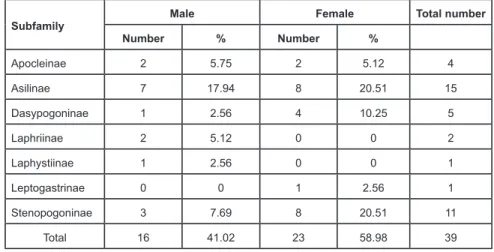
present study, a Comparison of the total number of prey taken by individual male and
female Asilidae showed that female asilids are more often found with prey than males
(Table 2). The results of this study indicate that for every male with prey there are
1.43 females. Most published studies confirm that female asilids are more commonly
encountered feeding than males (Londt 1990, 1991, 1995, 1999, 2006). Since it is
apparent that asilid species in Iran are important predators of other insects (Lehr et
al., 2007 and Hayat et al., 2008), further study of their occurrence, biology, ethology,
and especially prey specificity, should be encouraged.
Table 1. The arthropod prey of the Iranian subfamilies of Asilidae. Abbreviations: Apo = Apocleinae, Asi = Asilinae, Das = Dasypogoninae, Lar = Laphriinae, Lay = Laphystiinae, Lep = Leptogastrinae, Ste = Stenopogoninae. Dominant data are presented in bold face.
Prey order Total no. % Asilidae subfamily
Apo Asi Das Lar Lay Lep Ste
Coleoptera 10.26 1 0 0 0 0 0 3 Diptera 28.2 1 5 1 1 0 0 3 Hemiptera 7.70 0 2 0 0 0 1 0 Hymenoptera 35.9 1 6 3 1 1 0 2 Neuroptera 2.56 1 0 0 0 0 0 0 Odonata 2.56 0 0 0 0 0 0 1 Orthoptera 12.82 0 2 1 0 0 0 2 Total 100 4 15 5 2 1 1 11
Table 2. A comparison of the prey of male and female by Asilidae subfamily.
Subfamily Male Female Total number
Number % Number % Apocleinae 2 5.75 2 5.12 4 Asilinae 7 17.94 8 20.51 15 Dasypogoninae 1 2.56 4 10.25 5 Laphriinae 2 5.12 0 0 2 Laphystiinae 1 2.56 0 0 1 Leptogastrinae 0 0 1 2.56 1 Stenopogoninae 3 7.69 8 20.51 11 Total 16 41.02 23 58.98 39
REFERENCES
Abbassian-Lintzen, R., 1964a, Asilidae (Diptera) of Iran. I. Robber flies belonging to the subfamilies Laphriinae and Dasypogoninae (with description of new species). Annals and Magazine of Natural
History, London, 13: 417-435.
Abbassian-Lintzen, R., 1964b, Asilidae (Diptera) of Iran. II. Notes on the genus Eremisca Zin. and description of E. schahgudiani n. sp. Annals and Magazine of Natural History, London, 13: 547-552. Bosák, J., Barták, M., 2000, Asilidae. In: Barták, M., Vanhara, J. (Eds.). Diptera in an industrially affected
region (North-Western Bohemia, Bílina and Duchcov Environs) I. - Folia Facultatis Scientiarum Naturalium Universitatis Masarykianae Brunensis, Biologia, Brno. 104: 167-173 (240 pp.).
Dennis, D. S., Lavigne, R. J., 2007, Hymenoptera as prey of robber flies (Diptera: Asilidae) with new prey records. Journal of the Entomological Research Society, 9, 23–42.
Engel, E. O., 1930, 24. Asilidae. In: Lindner, E. (Ed.). Die Fliegen der Palaarktischen Region Band IV(2). Stuttgart, 1-491.
Ghahari, H., Hayat, R., Ostovan, H., Lavigne R., 2007a, Robber flies (Diptera: Asilidae) of Iranian rice fields and surrounding grasslands. Linzer Biologische Beitraege, 39:2: 919-928.
Ghahari, H., Lehr, P. A., Lavigne, R. J., Hayat, R., Ostovan, H., 2007b, New records of robber flies (Diptera, Asilidae) for the Iranian fauna with their prey records. Far Eastern Entomologist, 179: 1-9. Geller-Grimm, F., 2002, Robber flies (Diptera: Asilidae) of the Socotra Archipelago, Yemen. Fauna of
Arabia, 19: 467-489.
Geller-Grimm, F., 2003, A world catalogue of the genera of the family Asilidae (Diptera). Studia
dipterologica, 10(2): 473-526.
Hayat, R., 1997, Prey of some robber flies (Diptera: Asilidae) in Turkey. Zoology in the Middle East, 15: 87-94.
Hayat, R., Alaoglu, O., 1996a, Faunistic and systematic studies on the Asilidae (Diptera) species in Erzurum and neighboring provinces II. Laphystinae, Stichopogoninae, Dasypogoninae, Leptogastrinae and Apocleinae. Journal of Agricultural College, Ataturk University, 27: 111-120.
Hayat, R., Alaoglu, O., 1996b, Faunistic and systematic studies on the Asilidae (Diptera) species in Erzurum and neighboring provinces III. Asilinae. Journal of Agricultural College, Ataturk University, 27: 121-138.
Hayat, R., Çalışkan, H., 2003, Ethology of the robber fly Dasypogon irinelae Weinberg, 1986 (Diptera, Asilidae). Zoology in the Middle East, 30: 91-94.
Hayat, R., Ghahari, H., Lavigne, R., Ostovan, H., 2008, Iranian Asilidae (Insecta: Diptera). Turkish Journal
of Zoology, 32:175-195.
Khajehzadeh, Y., 2004, Investigation on the grasshoppers and their natural enemies in Khuzestan province. Proceeding of 16th Iranian Plant Protection Congress, p. 93.
Lavigne, R. J., 2005, Predator-prey database for the family Asilidae (Hexapoda: Diptera). http://www. geller-grimm.de/catalog.lavigne.htm. 12.10.2008.
Lavigne, R. J., Dennis, S., 1985, Ethology of three coexisting species of Efferia (Diptera: Asilidae) in Mexico. Proceedings of the Entomological Society of Washington, 87: 146-160.
Lehr, P.A., 1964, [New genera and new species of robber flies (Diptera, Asilidae) in the fauna of the USSR]. Entomologiceskoe Obozreniye, 43(4): 914-934. (In Russian)
Lehr, P.A., 1967, An ecological and morphological analysis of robber flies of the tribe Asilini (Diptera: Asilidae) with descriptions of new genera and species from Kazakhstan and Soviet Central Asia
Entomological Review, 46(2): 391-408.
Lehr, P.A., 1969, An ecological and morphological analysis of the robber flies (Diptera, Asilidae). Communication II. Entomological Review, 48(3): 341-357.
Lehr, P. A., 1972, [Leptogastrinae and Asilinae (Diptera, Asilidae) of the Mongolian People’s Republic].
Insects of Mongolia Nauka, Leningrad, 1: 791-844. (In Russian)
Lehr, P. A., 1977, Robber flies of the subfamilies Atomosinae and Laphriinae (Diptera, Asilidae) from Central Asia and Kazakhstan. Entomological Review, 56(4): 123-131.
Lehr, P. A., 1979, [Palearctic robber flies of the genus Asilus L. and a new genus Reminasus Lehr (Diptera, Asilidae)]. Entomologiceskoe Obozreniye, 58(3): 639-645. (In Russian)
Lehr, P. A., 1988, Asilidae. In: Catalogue of Palearctic Diptera (eds. A. Soos, L. Papp). Elsevier Science Publishing Co. Inc. Amsterdam, pp. 197-326.
Lehr, P. A., 1992a, [Small ‘genera of robber flies of the subfamily Asilinae (Diptera, Asilidae). 1.Taxonomy and Ecology]. Zoologichesky Zhurnal, 71(5): 91-105. (In Russian)
Lehr, P. A., 1992b, [Small ‘genera of robber flies of the subfamily Asilinae (Diptera, Asilidae). 2. Phylogeny].
Zoologichesky Zhurnal, 71(9): 49-59. (In Russian)
Lehr P. A., 1996, [The robber flies of subfamily Asilinae (Diptera, Asilidae) of Palaearctic. Ecological and
morphological analysis, taxonomy and evolution.] Vladivostok: Dalnauka. 184 pp. (In Russian)
Lehr P. A., Ghahari, H., Ostovan, H., 2007, A contribution to the robber flies of subfamilies Stenopogoninae and Asilidae (Diptera: Asilidae) from Iran. Far Eastern Entomologist, 173: 1-14.
Londt, J. G. H., 1990, Afrotropical Asilidae: prey survey of adult flies. Abstract. 2nd International Congress
of Dipterology, Bratislava, p. 134.
Londt, J. G. H., 1991, Afrotropical Asilidae (Diptera) 21. Observations on the biology and immature stages of Damalis femoralis Ricardo, 1925 (Trigonomiminae). Annals of the Natal Museum, 32: 149–162. Londt, J. G. H., 1993, Afrotropical robber fly (Diptera: Asilidae) predation of honey bees, Apis mellifera
Linnaeus (Hymenoptera: Apidae). African Entomology, Pretoria, 1(2): 167-173.
Londt, J. G. H., 1994, Afrotropical Asilidae (Diptera) 26. Ethological observations, and a possible ecological classification based on habitats. Annals of the Natal Museum, 35: 97-122.
Londt, J. G. H., 1995, Afrotropical Asilidae (Diptera) 27. Predation of Asilidae by Asilidae. Annals of the
Natal Museum, 36: 161-167.
Londt, J. G. H., 1999, Butterfly predation by robber flies (Diptera: Asilidae). Metamorphosis, 10(1): 24-30. Londt, J. G. H., 2006, Predation by Afrotropical Asilidae (Diptera): an analysis of 2000 prey records.
African Entomology, 14(2): 317-328.
O`Neill, K. M., Seibert, C.,1996, Foraging behavior of the robber fly, Megaphorus willistoni (Cole) (Diptera: Asilidae). Journal of the Kansas Entomological Society, 69: 317-325.
Oldroyd, H., 1958, Some Asilidae from Iran. Stuttgarter Beitrage zur Naturkunde. Staatliches Museum fur
Naturkunde, 9: 1-10.
Ozbek, H., Hayat, R., 1999, Ülkemizde balarısı (Apis mellifera L.)’nın doğal düşmanı olarak saptanan bazı Hymenoptera ve Diptera türleri. Turkiye’de Arıcılık Sorunları ve I. Ulusal Arıcılık Sempozyumu,
Kemaliye, Erzincan, pp. 53-63.
Ricardo, G., 1920, A Persian asilid attacking house-flies. The Entomologist’s Monthly Magazine, 56: 278-280.
Saghaei, N., Ostovan, H., Shojai, M., 2008, A faunistic study of robber flies (Asilidae) in Fars province.
Proceedings of 18th Iranian Plant Protection Congress, 1: Pests, p. 88.
Saghaei, N., Ostovan, H., Shojai, M., Hayat, R., 2009, Introduction to the Asilidae Fauna (Insecta: Diptera) of Fars Province, Iran. Turkish Journal of Zoology, 33: 187-200.
Theodor, O., 1980, Diptera: Asilidae. Fauna Palaestina, Insecta II. Israel Academy of Sciences & Humanities, Jerusalem, 448.
Tsacas, L., 1968, Revision des especes du genere Neomochtherus Osten- Sacken (Dipteres: Asilidae). I. Region palearctique. Mémoires du Muséum National d’histoire Naturelle (N.S.), Ser. A, Zool. 47: 129-328.
Wood, G. C., 1981, Asilidae. In: McAlpine, J. P., Peterson, B. V., Shewel, G. E., Teskey, H. J., Vockeroth, J. R., Wood, D. M. (Eds.). Manuel of Nearctic Diptera, Vol. 1; Ottawa: Research Branch, Agriculture Canada, Monograph, 27: 549-573.
of the Entomological Research Society and its content may not be copied or emailed
to multiple sites or posted to a listserv without the copyright holder’s express written
permission. However, users may print, download, or email articles for individual use.
View publication stats View publication stats