RESEARCH ARTICLE / ARAŞTIRMA
Address for Correspondence/Yazışma Adresi: Ayşe Uyan MD,
Ege University Faculty of Medicine, Department of Infectious Diseases and Clinical Microbiology, İzmir, Turkey
Phone: +90 232 390 33 09 E-mail: [email protected] ORCID ID: orcid.org/0000-0001-6615-2662 Received/Geliş Tarihi: 03.07.2017 Accepted/Kabul Tarihi: 31.12.2017
©Copyright 2017 by the Infectious Diseases and Clinical Microbiology Specialty Society of Turkey Mediterranean Journal of Infection, Microbes and Antimicrobials published by Galenos Yayınevi.
Ayşe UYAN1, Gül DURMUŞ2, Nurbanu SEZAK3, Fatmanur PEPE4, Türkkan KAYGUSUZ5, Nefise ÖZTOPRAK6, Kevser ÖZDEMİR7, Firdevs AKSOY8, Serpil EROL9, Meliha Meriç KOÇ10, Ahsen ÖNCÜL11, Sabahat ÇAĞAN AKTAŞ12, Hülya ÇAŞKURLU13, Güven ÇELEBİ14, Özlem KANDEMİR15, Selçuk ÖZGER16, Rezan HARMAN17, Kübra DEMİRAY18, Alpay ARI19, Sevil ALKAN ÇEVİKER20, İlknur ESEN YILDIZ21, Şirin MENEKŞE22, Güneş ŞENOL23, Sema SARI24, Mustafa DOĞAN25, Kenan UĞURLU26, Mustafa ARSLAN27, İrem AKDEMİR28, Pınar FIRAT29, Yeşim KÜREKÇİ30, Derya ÇAĞLAYAN31, Mehmet UÇAR32, Ramazan GÖZÜKÜÇÜK33, Habibe Tülin ELMASLAR MERT34, Handan ALAY35, Haluk ERDOĞAN36, Aslıhan DEMİREL37, Nilgün DOĞAN38, Funda KOÇAK39, Emre GÜVEN40, Güleser ÜNSAL41, Hilal SİPAHİ42, Meltem IŞIKGÖZ TAŞBAKAN1, Bilgin ARDA1, Sercan ULUSOY1, Oğuz Reşat SİPAHİ1
1Ege University Faculty of Medicine, Department of Infectious Diseases and Clinical Microbiology, İzmir, Turkey
2Bursa Yüksek İhtisas Training and Research Hospital, Clinic of Infectious Diseases and Clinical Microbiology, Bursa, Turkey
3İzmir Katip Çelebi University, Atatürk Training and Research Hospital, Department of Infectious Diseases and Clinical Microbiology, İzmir, Turkey 4Ankara Numune Hospital, Clinic of Infectious Diseases and Clinical Microbiology, Ankara, Turkey
5Elazığ Training and Research Hospital, Clinic of Infectious Diseases and Clinical Microbiology, Elazığ, Turkey 6Antalya Training and Research Hospital, Clinic of Infectious Diseases and Clinical Microbiology, Antalya, Turkey 7Pamukkale University Faculty of Medicine, Department of Infectious Diseases and Clinical Microbiology, Denizli, Turkey
8Karadeniz Technical University Faculty of Medicine, Department of Infectious Diseases and Clinical Microbiology, Trabzon, Turkey 9Haydarpaşa Numune Training and Research Hospital, Clinic of Infectious Diseases and Clinical Microbiology, İstanbul, Turkey 10Kocaeli University Faculty of Medicine, Department of Infectious Diseases and Clinical Microbiology, Kocaeli, Turkey 11Şişli Etfal Training and Research Hospital, Clinic of Infectious Diseases and Clinical Microbiology, İstanbul, Turkey
12Dr. Lütfi Kırdar Kartal Training and Research Hospital, Clinic of Infectious Diseases and Clinical Microbiology, İstanbul, Turkey
13İstanbul Medeniyet University, Göztepe Training and Research Hospital, Department of Infectious Diseases and Clinical Microbiology, İstanbul, Turkey 14Bülent Ecevit University Faculty of Medicine, Department of Infectious Diseases and Clinical Microbiology, Zonguldak, Turkey
15Mersin University Faculty of Medicine, Department of Infectious Diseases and Clinical Microbiology, Mersin, Turkey 16Dr. Ersin Arslan Training and Research Hospital, Clinic of Infectious Diseases and Clinical Microbiology, Gaziantep, Turkey 17Private Sani Konukoğlu Hospital, Clinic of Infectious Diseases and Clinical Microbiology, Gaziantep, Turkey
18Celal Bayar University Faculty of Medicine, Department of Infectious Diseases and Clinical Microbiology, Manisa, Turkey 19İzmir Bozyaka Training and Research Hospital, Clinic of Infectious Diseases and Clinical Microbiology, İzmir, Turkey 20Balıkesir State Hospital, Clinic of Infectious Diseases and Clinical Microbiology, Balıkesir, Turkey
21Recep Tayyip Erdoğan University Faculty of Medicine, Department of Infectious Diseases and Clinical Microbiology, Rize, Turkey 22Kartal Koşuyolu Training and Research Hospital, Clinic of Infectious Diseases and Clinical Microbiology, İstanbul, Turkey
23Dr. Suat Seren Chest Diseases and Chest Surgery Training Hospital, Clinic of Infectious Diseases and Clinical Microbiology, İzmir, Turkey 24Türkiye Yüksek İhtisas Hospital, Clinic of Intensive Care, Ankara, Turkey
Türkiye’deki Yoğun Bakım Ünitelerinde Hemşire İşgücü Yeterli mi? Çok Merkezli Karia
Çalışmasının Sonuçları
Is Nurse Workforce Sufficient in Intensive Care Units in Turkey?
Results of the Multicenter Karia Study
DOI: 10.4274/mjima.2017.20
Mediterr J Infect Microb Antimicrob 2017;6:20 Erişim: http://dx.doi.org/10.4274/mjima.2017.20
Published: 31 December 2017
Cite this article as: Uyan A, Durmuş G, Sezak N, Pepe F, Kaygusuz T, Öztoprak N, Özdemir K, Aksoy F, Erol S, Koç MM, Öncül A, Çağan Aktaş S, Çaşkurlu H, Çelebi G, Kandemir Ö, Özger S,
Harman R, Demiray K, Arı A, Çeviker SA, Esen Yıldız İ, Menekşe Ş, Şenol G, Sarı S, Doğan M, Uğurlu K, Arslan M, Akdemir İ, Fırat P, Kürekçi Y, Çağlayan D, Uçar M, Gözüküçük R, Elmaslar Mert HT, Alay H, Erdoğan H, Demirel A, Doğan N, Koçak F, Güven E, Ünsal G, Sipahi H, Işıkgöz Taşbakan M, Arda B, Ulusoy S, Sipahi OR. Is Nurse Workforce Sufficient in Intensive Care Units in Turkey? Results of the Multicenter Karia Study. Mediterr J Infect Microb Antimicrob. 2017;6:20.
Presented in: This study has been presented as a poster
presentation in “European Congress of Clinical Microbiology and Infectious Diseases” 2017 in Vienna, Austria.
Introduction: In this multicenter study, we analysed the magnitude of healthcare worker (HCW) [infection control practitioner (ICP), nurses and others]
workforce in hospitals participated in the study.
Materials and Methods: This study was performed in 41 hospitals (with intensive care units-ICU) located in 22 cities from seven regions of Turkey.
We analysed the ICP workforce, nursing and auxiliary HCW (AHCW) workforce in ICUs, number of ICU beds and occupied beds in four different days [two of which were in summer during the vacation time (August 27 and 31, 2016) and two others in autumn (October 12 and 15, 2016)]. The Turkish Ministry of Health (TMOH) requires two patients per nurse in level 3 ICUs, three patients per nurse in level 2 ICUs and five patients per nurse in level 1 ICUs. There is no standardization for the number of AHCW in ICUs. Finally, one ICP per 150 hospital beds is required by TMOH.
Results: The total number of ICUs, ICU beds and ICPs were 214, 2377 and 111, respectively in he 41 participated centers. The number ICPs was adequate
only in 12 hospitals. The percentage of nurses whose working experience was <1 year, was; 19% in level 1 ICUs, 25% in level 2 ICUs and 24% in level 3 ICUs. The number of patients per nurse was mostly <5 in level 1 ICUs whereas the number of patients per nurse in level 3 ICUs was generally >2. The number of patients per other HCW was minimum 3.75 and maximum 4.89 on weekdays and on day shift while it was minimum 5.02 and maximum 7.7 on weekends or on night shift. When we compared the number of level 1, 2 and 3 ICUs with adequate nursing workforce vs inadequate nursing workforce, the p value was <0.0001 at all time points except summer weekend night shift (p=0.002).
Conclusion: Our data suggest that ICP workforce is inadequate in Turkey. Besides, HCW workforce is inadequate and almost ¼ of nurses are relatively
inexperienced especially in level 3 ICUs. Turkish healthcare system should promptly make necessary arrangements for adequate HCW staffing.
Keywords: Infection control, infection, healthcare-associated infections, intensive care infections, infection control practitioner
Giriş: Bu çok merkezli çalışmada, katılan hastanelerdeki sağlık personeli [enfeksiyon kontrol hemşiresi (EKH), hemşire ve personel] yeterliliğinin analiz
edilmesi amaçlanmıştır.
Gereç ve Yöntemler: Çalışmaya toplam yedi bölge, 22 şehirden yoğun bakım ünitesi (YBÜ) bulunan 41 merkez katıldı. Enfeksiyon kontrol hemşiresi
sayısı, YBÜ’lerdeki hemşire ve yardımcı sağlık personeli işgücü, toplam yoğun bakım yatak sayısı ve dolu yoğun bakım yatak sayısı dört farklı günde [ikisi yaz mevsimi izin döneminde (27 ve 31 Ağustos 2016), ikisi sonbaharda (12 ve 15 Ekim 2016)] değerlendirildi. Türkiye Cumhuriyeti Sağlık Bakanlığı (TCSB) standartlarına göre hemşire başına düşen maksimum hasta sayısının birinci basamak YBÜ’lerde beş, ikinci basamak YBÜ’lerde üç ve üçüncü basamak YBÜ’lerde iki olması gerekmektedir. Yardımcı sağlık personeli için belirlenmiş bir standart yoktur. Buna karşı TCSB standartlarına göre 150 yatağa bir EKH’nin mevcut olması gerekmektedir.
Bulgular: Toplam YBÜ sayısı, yoğun bakım yatak sayısı ve EKH sayısı sırasıyla 214, 2377 ve 111 olarak saptandı. Enfeksiyon kontrol hemşiresi sayısı 41
merkezden sadece 12’sinde yeterliydi. Yoğun bakım deneyimi bir yıldan az olan hemşire oranı; birinci basamak YBÜ’lerde %19, ikinci basamak YBÜ’lerde %25, üçüncü basamak YBÜ’lerde %24 idi. Hemşire başına düşen hasta sayısı; birinci basamak YBÜ’lerde genellikle beş ve altındaydı, ancak üçüncü basamak YBÜ’lerde genellikle ikinin üstünde olduğu saptandı. Diğer sağlık personelleri başına düşen hasta sayısı mesai içi minimum 3,8 ve maksimum 4,9; mesai dışı ise minimum 5,0 maksimum 7,7 idi. Üçüncü, ikinci ve birinci basamak YBÜ’lerde hemşire sayısı yeterli ve yetersiz üniteler çok gözlü ki-kare testi ile karşılaştırıldığında yaz hafta sonu/gece dışında hepsinde p<0,0001 idi, yaz dönemi hafta sonu/gece ölçümünde ise p=0,002 idi.
Sonuç: Verilerimiz ülkemizdeki EKH sayısının oldukça yetersiz olduğunu, buna paralel olarak özellikle üçüncü basamak YBÜ’lerde sağlık personeli
sayısının yetersiz ve yaklaşık ¼’inin nispeten deneyimsiz olduğunu ortaya koymaktadır. Türk sağlık sisteminin yeterli hemşire istihdamı için gerekli düzenlemeleri acil bir şekilde işleme koyması önerilir.
Anahtar Kelimeler: Enfeksiyon kontrolü, enfeksiyon, sağlık bakımı ilişkili enfeksiyonlar, yoğun bakım enfeksiyonları, enfeksiyon kontrol hemşiresi
Abstract
Öz
25Çorlu State Hospital, Clinic of Infectious Diseases and Clinical Microbiology, Tekirdağ, Turkey 2625 Aralık State Hospital, Clinic of Infectious Diseases and Clinical Microbiology, Gaziantep, Turkey
27Amasya Sabuncuoğlu Şerefeddin Training and Research Hospital, Clinic of Infectious Diseases and Clinical Microbiology, Amasya, Turkey 28Batman State Hospital, Clinic of Infectious Diseases and Clinical Microbiology, Batman, Turkey
29Keçiören Training and Research Hospital, Clinic of Infectious Diseases and Clinical Microbiology, Ankara, Turkey 30Arnavutköy State Hospital, Clinic of Infectious Diseases and Clinical Microbiology, İstanbul, Turkey
31Torbalı State Hospital, Clinic of Infectious Diseases and Clinical Microbiology, İzmir, Turkey 32Uşak Medical Park Hospital, Clinic of Infectious Diseases and Clinical Microbiology, Uşak, Turkey
33Private Hisar Intercontinental Hospital, Clinic of Infectious Diseases and Clinical Microbiology, İstanbul, Turkey 34Ardahan State Hospital, Clinic of Infectious Diseases and Clinical Microbiology, Ardahan, Turkey
35Nenehatun Obstetrics and Gynecology Hospital, Clinic of Infectious Diseases and Clinical Microbiology, Erzurum, Turkey
36Başkent University Alanya Medical and Research Center, Department of Infectious Diseases and Clinical Microbiology, Antalya, Turkey 37İstanbul Bilim University Faculty of Medicine, Department of Infectious Diseases and Clinical Microbiology, İstanbul, Turkey
38TOBB University of Economics and Technology Hospital, Hospital Infection Control Committee, Ankara, Turkey 39Başakşehir State Hospital, Clinic of Infectious Diseases and Clinical Microbiology, İstanbul, Turkey
40Beytepe Murat Erdi Eker State Hospital, Clinic of Infectious Diseases and Clinical Microbiology, Ankara, Turkey 41Bozok University Faculty of Medicine, Hospital Infection Control Committee, Yozgat, Turkey
Uyan et al.
Is Nurse Workpower Enough in Intensive Care Units of Turkey? Mediterr J Infect Microb Antimicrob2017;6:20
Introduction
In spite of developments in antimicrobial agents, medicine, infection control practices and intensive care unit (ICU) care, nosocomial and/or healthcare-associated infections (HCAI) are still associated with significant mortality and morbidity in many countries including Turkey[1-3]. Multidrug-resistant (MDR) infections are also common in almost any kind of HCAI in Turkey and in many developing countries[1,2,4]. Infection control committees (composed of infectious diseases and clinical microbiology specialists as well as other doctors and infection control nurses/practitioners) comprise an important workforce in the management and prevention of HCAI in all over the world and Turkey[1,5]. However, since it is not possible to maintain all healthcare work with infection control team, infection control committees or infection control nurses alone are not enough to control HCAI in a hospital. Hence, adequate healthcare workforce is of critical importance for quality of healthcare. Ventilator-associated pneumonia (VAP), catheter-related blood stream infection (CRBSI) and catheter-catheter-related urinary tract infection (CRUTI) rates in Turkey differ widely, with rates being quite higher than those in the United States[1]. Hand hygiene and other infection control measures, infrastructure of the hospital and ICU as well as adequate healthcare workforce [doctors, nurses and other healthcare workers (HCW)] are important parameters in the prevention of HCAI[1,2,5-7].
Adequate nurse workforce allows nurses to spend more time with patients as well as a favorable practice environment which affects the timeliness of interventions when a patient problem
has been identified[8]. With the increased need for intensive care
beds, inadequate number of nurses and staff can negatively affect the health and safety of the patient. Inadequate nurse staffing may be associated with poor patient survival,
development of decubitus ulcer and infections[9].
In previous small-scale studies, the number of patients per
nurse was reported to be low in several Turkish ICUs[6,7]. In this
multicenter study, we analyzed the magnitude of HCW (nurses and others) workforce in ICUs as well as infection control practitioner (ICP) workforce in hospitals.
Materials and Methods
This study was performed in all ICUs in 41 hospitals (27 tertiary-care training and research hospitals, 10 state hospitals and 4 private hospitals) from 22 cities in seven regions of Turkey. The planned study was announced via Infectious Diseases and Clinical Microbiology Specialty Society of Turkey (Türkiye Enfeksiyon Hastalıkları ve Klinik Mikrobiyoloji Uzmanlık Derneği) mail communication group and all sites who accepted
the invitation were included in the study. Study contributors from each site collected the data in a standard form through visits to ICUs in their center on the days of the study. Via these forms, we analyzed nursing workforce, ICP workforce, auxiliary HCW (AHCW) workforce, number of ICU beds and occupied beds on four different days [two of which were in summer during the vacation time (August 27 and 31, 2016) and two others in autumn (October 12 and 15, 2016)]. All participants sent their data in an Microsoft Excel and Word format attached to an email.
The Turkish Ministry of Health (TMOH) requires two patients per nurse in level 3 ICUs, three patients per nurse in level 2 ICUs and five patients per nurse in level 1 ICUs. However, there is no
standardization of the number of AHCWs in ICUs[10]. The TMOH
requires one ICP per 150 hospital beds[5]. For this reason number
of ICP was considered to be inadequate if the number of hospital beds/number of ICP was >150. Nursing workforce was considered to be inadequate if patient/nurse was >2 in level 3 ICUs, >3 in level 2 ICUs and >5 in level 1 ICUs.
Statistical Analysis
Statistical analysis was performed by SPSS 16.0. Chi-square test was used for comparison of adequately staffed level 1-2-3 ICUs.
A p value of less than 0.05 was considered statistically significant.
Results
The total number of ICUs and intensive care beds were 214 and 2377, respectively. The majority of the ICUs in the centers participating in the study were medical ICU (number of medical ICUs: 142, number of surgical ICUs: 49, 23 ICUs were not specified (medical + surgical). The number of nurses whose working experience was <1 year was; 62 in level 1 ICUs (total 322, 19%), 172 in level 2 ICUs (total 684, 25%), and 587 in level 3 ICUs (total 2418, 24%).
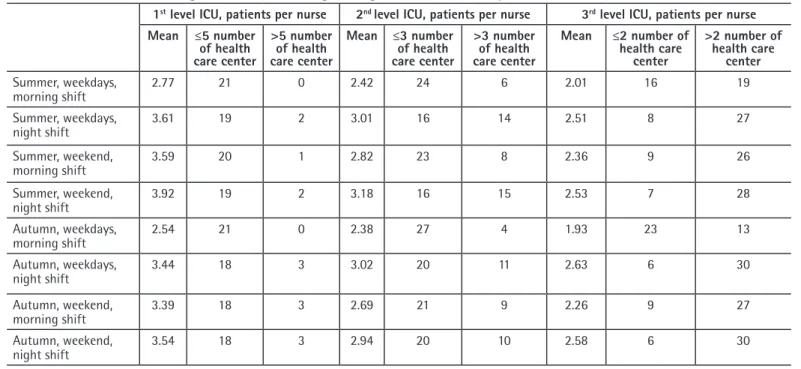
The number of patients per nurse was mostly ≤5 in level 1 ICUs (18 to 21 of 21 ICUs) whereas the number of patients per nurse in level 3 ICUs was generally >2 (13-30 of 35-36 ICUs). The mean number of patient per nurse was ≤5 in all eight time points (four day shifts and four night shifts) in level 1 ICUs. However, it was ≤2 in only one of eight time points in level 3 ICUs (Table 1). When we compared the number of level 1, 2 and 3 ICUs with adequate nursing workforce vs inadequate nursing force, the p value was <0.0001 at all time points except summer weekend night shift (p=0.002). Table 2 shows the percentile data of the nursing workforce in the study dates (data of all hospitals). The mean number of patients per AHCW was minimum 3.75 and maximum 4.89 on weekdays and on day shift while minimum 5.02 and maximum 8.09 at the weekend or on night shift (Table
3). There was no AHCW in 0-3 of the study ICUs in the related study time points.
There were a total of 111 ICPs working in the 41 centers. Only 12 of these 41 participating centers had adequate ICP workforce. Furthermore, most of the centers with adequate number of ICPs were the centers with ≤150 beds (9 of 12).
Discussion
Adequate number of experienced ICU nurses is of quite importance in proper healthcare[11,12]. Inadequate nurse staffing and ICU nurses who do not have specialized knowledge and skills are associated with increased mortality[11]. In a recent study involving 1416 nursing staff members in ICUs in 144 Turkish hospitals, 48.6% had not received any critical care-related training and 30.2% had worked in the ICU for 1 year or less[12]. Similarly, our study shows that almost ¼ of nurses working in level 3 ICUs had <1 year of experience. Turkish healthcare system should find ways for ICU nursing workforce sustainability such as extra motivations e.g. salary higher than average salary for nurses or additional vacation days.
The Turkish Ministry of Health recommends two patients per nurse in level 3 ICUs, three patients per nurse in level 2 ICUs and five patients per nurse in level 1 ICUs[10]. In a previous study held in pediatric ICUs, the number of nurses per patient was reported to be <2 in shifts. However, the number of pediatric ICU beds per nurse during shifts was 1.99–3.5 and 1.96–3.9 in TMOH-affiliated hospitals and university-affiliated hospitals, respectively[7]. In another recent study, Dikiş et al.[6] analysed the nurse and AHCW numbers in Ege University Hospital ICUs. They reported that the number of nurses per patient was ≤2 in only one ICU among 5 level 3 ICUs in day or night shifts. In our study, lack of adequate nurse staffing was most prominent in level 3 ICUs.
The relationship between adequate number of nurse and auxiliary staff and increased risk of mortality and morbidity in ICUs has been shown in many studies[9,13-16]. Hugonnet et al.[14] showed that inadequate/lower nurse staffing level increased the risk for late-onset VAP, independent of confounding factors. Cho et al.[15] found that every additional patient per registered nurse showed a 9% increase in mortality risk in ICUs. Stone et al.[9] found the level of nurse staffing per patient to be significantly associated with CRBSI, VAP, 30-day mortality, and decubiti. In a large study of patients undergoing surgery in 300 hospitals in nine countries in Europe; it has been shown that one patient increase in nurse workload increased mortality by 7% while every 10% increase in bachelor’s degree nurses reduced mortality by 7%[16]. In our study, the effects of the nurse staffing adequacy on patient outcomes were not investigated, but when the studies in the literature are taken into consideration, it is
possible that the inadequate number of nurses might probably be affecting patient outcomes in our sample, too.
According to the Organisation for Economic Co-operation and Development (OECD) data (2014) the number of nurses per 1000 inhabitants was 1.9 in Turkey which is the lowest among 36 OECD countries[17]. Similarly, Turkey had the lowest budget for healthcare spending (997$ per capita annually) in 2015 among
OECD countries[18]. According to the Turkish Health and Social
Service Union (Türk Sağlık Sendikası), there is a need for 400.000 nurses countrywide, whereas the total workforce consists of
only 150.000[19]. In addition, working conditions of the nurses
(especially ICU nurses) are quite hard and overwhelming[7,12,20].
Tekindal et al.[21] analyzed burnout levels in nurses working in
internal, surgical and ICUs of a university hospital. They reported that burnout levels of the nurses were high. Younger age, scarcity of experience in the profession, lower levels of education, having chosen the profession and the unit they work in not willingly and working in environments like ICUs increased the probability of burnout.
Duty of AHCW changes among hospitals or ICUs. In some settings their duty is confined to carriage of patients to other departments or radiology department outside ICU. In some ICUs their duties also consist of hygiene of patients as well as minor interventions. Auxiliary HCW number differed in a wide range. In some settings, there were no AHCW at night or day shifts. However, since there is no standardization, it is not easy to evaluate the situation in an accurate way.
Ventilator-associated pneumonia, CRBSI and CRUTI rates are notified to the TMOH regularly. According to annual summary of Turkish nosocomial infection surveillance data, fifty percentile rates of VAP, CRBSI and CRUTI incidence ranges between 0.0-9.8, 0.0-3.2 and 0.0-2.6 in 2015[22].The rates are somewhat higher than the American surveillance data and International
Nosocomial Infection Control Consortium data[1]. Bundles for the
prevention of device-associated infections such as CRUTI, CRBSI and VAP are commonly practiced in the contemporary ICP. These bundles include a couple of evidence-based recommendations practiced simultaneously. Adequate workforce is considered to be a fixed component of several bundle studies, indicating its importance for high-quality patient care and less mortality[1]. Problems in infection control are not rare. In Turkey, >95% of the population’s health care services is reimbursed by the Turkish Republic Social Security Institution, which is funded by the
government[3]. There have been improvements in the Turkish health
system in the last decade[23]. However, the Turkish government
has not made any increase in the payment for healthcare services to the hospitals for the last nine years. Although some of the infection control measures such as hand hygiene or elevation of the head of the bed to 30-45 degrees, daily ‘sedation vacation’
Uyan et al.
Is Nurse Workpower Enough in Intensive Care Units of Turkey? Mediterr J Infect Microb Antimicrob2017;6:20
are relatively low cost, some interventions such as PCR screening of MDR bacteria screening or continuous subglottic aspiration are
quite expensive[1]. In addition, an important portion of the nurses’
salaries is paid through hospital budgets but not governmental or national central budget. Thus, hospitals are quite tensed to keep the budget balance that infection control measures cannot be funded adequately and adequate nurses cannot be added to workforce.
Our study has several limitations. Although this study included data from 41 centers from all seven regions of the country, it
does not represent the whole Turkey. The presented study did not analyze the severity of the cases hospitalized in the ICUs. Cases that do not fulfill the criteria to be hospitalized in ICU might have been hospitalized in the ICUs (due to lack of adequate beds in clinics). We could not analyse the association of the inadequate nurse/ICP labor or nurse experience with patient outcomes (HCAI or mortality rates). Finally, we did not question the roles of AHCWs in the ICUs. The roles of AHCWs are not standard in many centers. In some ICUs they do not deal with routine patient care, whereas in some others they tend to work as aiders to nurses.
Table 2. Percentile table of the nursing workforce on the study dates (all hospitals)
1st level ICU, patients per nurse 2st level ICU, patients per nurse 3st level ICU, patients per nurse
10p 25p 50p 75p 90p 10p 25p 50p 75p 90p 10p 25p 50p 75p 90p Summer, weekdays, morning shift, 1.5 2 2.5 3.18 3.75 1 1.71 2.22 3 3.5 1.25 1.6 2.02 2.3 2.75 Summer, weekdays, night shift 2 2.5 3.4 4 5 2 2.25 3 3.5 4.75 1.5 2 2.4 2.8 3.3 Summer, weekend, morning shift 2 2.5 3 4 5 1.75 2 2.66 3 4 1.5 2 2.4 2.8 3.3 Summer, weekend, night shift 2 2.42 3.5 4.66 5 2 2.25 2.8 3.8 5 1.5 2.12 2.48 2.9 3.3 Autumn, weekdays, morning shift 1.5 1.63 2.1 2.8 4 1 1.6 2.33 3 3.3 1.24 1.53 1.81 2.08 2.42 Autumn, weekdays, night shift 2 2 3 4.25 5.3 1.4 2.25 3 3.5 4.25 1.72 2.16 2.55 2.91 3.52 Autumn, weekend, morning shift 2 2.4 3 4 6 1.25 2.08 2.5 3.42 4.5 1.4 2 2.45 2.73 3.25 Autumn, weekend, night shift 2 2.4 3 4 6 1.75 2.33 2.76 3.6 4.8 1.73 2.33 2.54 3 3.55
ICU: Intensive care unit
Table 1. Distribution of nursing workforce at morning and night shifts on the study dates
1st level ICU, patients per nurse 2nd level ICU, patients per nurse 3rd level ICU, patients per nurse
Mean ≤5 number of health care center >5 number of health care center Mean ≤3 number of health care center >3 number of health care center Mean ≤2 number of health care center >2 number of health care center Summer, weekdays, morning shift 2.77 21 0 2.42 24 6 2.01 16 19 Summer, weekdays, night shift 3.61 19 2 3.01 16 14 2.51 8 27 Summer, weekend, morning shift 3.59 20 1 2.82 23 8 2.36 9 26 Summer, weekend, night shift 3.92 19 2 3.18 16 15 2.53 7 28 Autumn, weekdays, morning shift 2.54 21 0 2.38 27 4 1.93 23 13 Autumn, weekdays, night shift 3.44 18 3 3.02 20 11 2.63 6 30 Autumn, weekend, morning shift 3.39 18 3 2.69 21 9 2.26 9 27 Autumn, weekend, night shift 3.54 18 3 2.94 20 10 2.58 6 30
Despite these disadvantages, to our knowledge, this is the largest detailed dataset related to the problem.
Conclusion
The presented study shows that HCW workforce is inadequate in especially level 3 ICUs in Turkey. Level 3 ICUs reside the most critical patients. Lack of adequate healthcare may result in secondary HCAI or other complications, which may also cause significant morbidity and mortality[1,2,4,9,11,13-16]. Besides, almost ¼ of nurses are inexperienced. The TMOH, healthcare stakeholders, including reimbursement systems, university, state hospital and private hospital administrators, should seek ways to improve the problem as soon as possible. The TMOH should clearly describe the standards for AHCW working in the ICUs. Since at least some portion of the nursing workforce is financed only by the hospital budget (which is mostly maintained by the Social Security Institute which did not increase the payment per healthcare service for the last 9 years), payments for the healthcare system should be increased in accordance with inflation rates, besides subsidizing hospitals for increasing nursing workforce. Another solution may be to increase the number of nurses who are paid through central governmental budget by the TMOH. It is not rational to expect different results while doing the same things. Hence, if these interventions are not performed, it is quite possible that some possible morbidity or morbidity will continue to develop.
Ethics
Ethics Committee Approval: Retrospective study. Informed Consent: Retrospective study.
Peer-review: Externally and internally peer-reviewed. Authorship Contributions
Concept: O.R.S., A.U., Design: O.R.S., A.U., Data Collection: A.U., G.D., N.S., F.P., T.K., N.Ö., K.Ö., F.A., S.E., M.M.K., A.Ö., S.Ç.A., H.Ç., G.Ç., Ö.K., S.Ö., R.H., K.D., A.A., S.A.Ç., İ.E.Y., Ş.M., G.Ş., S.S., M.D., K.U., M.A., İ.A., P.F., Y.K., D.Ç., M.U., R.G., H.T.E.M., H.A., H.E., A.D., N.D., F.K., E.G., G.Ü., H.S., M.I.T., B.A., S.U., O.R.S., Analysis or Interpretation: H.S., Literature Search: O.R.S., A.U., Writing: A.U., G.D., N.S., F.P., T.K., N.Ö., K.Ö., F.A., S.E., M.M.K., A.Ö., S.Ç.A., H.Ç., G.Ç., Ö.K., S.Ö., R.H., K.D., A.A., S.A.Ç., İ.E.Y., Ş.M., G.Ş., S.S., M.D., K.U., M.A., İ.A., P.F., Y.K., D.Ç., M.U., R.G., H.T.E.M., H.A., H.E., A.D., N.D., F.K., E.G., G.Ü., H.S., M.I.T., B.A., S.U., O.R.S.
Conflict of Interest: No conflict of interest was declared by the
authors.
Financial Disclosure: The authors declared that this study
received no financial support.
References
1. Türe Z, Alp E. Infection control bundles for the prevention of hospital infections. Mediterr J Infect Microb Antimicrob. 2016;5:8.
Table 3. Distribution of auxiliary healthcare workers at morning and night shifts on the study dates
1st level ICU,
patients per healtcare worker
1st level ICU, number
of ICU without staff/ total number of ICU
2nd level ICU, patients per healtcare worker 2nd level ICU, number of ICU without staff/total number of ICU 3rd level ICU, patients per healtcare worker
3rd level ICU, number
of ICU without staff/ total number of ICU
Summer, weekdays, morning shift 4.32 0/21 3.93 0/30 3.75 0/35 Summer, weekdays, night shift 7.13 3/21 7.16 3/30 7.13 1/35 Summer, weekend, morning shift 6.02 0/21 5.02 1/30 5.03 0/35 Summer, weekend, night shift 8.09 3/21 7.10 3/30 7.24 1/35 Autumn, weekdays, morning shift 4.89 1/21 3.90 0/31 3.82 0/36 Autumn, weekdays, night shift 7.70 3/21 6.88 3/31 7.36 2/36 Autumn, weekend, morning shift 5.35 1/21 5.15 1/30 5.65 1/36 Autumn, weekend, night shift 7.17 3/21 6.75 2/30 7.82 2/36
Uyan et al.
Is Nurse Workpower Enough in Intensive Care Units of Turkey? Mediterr J Infect Microb Antimicrob2017;6:20
2. Sipahi OR. Economics of antibiotic resistance. Expert Rev Anti Infect Ther. 2008;6:523-39.
3. T.C. Sağlık Bakanlığı. Erişim adresi: http://hizmetstandartlari.saglik.gov.tr/ dosya/1-97086/h/2014-ulusal-ozet-rapor-1.pdf
4. Hazırolan G, Kanyılmaz D, Mumcuoğlu İ, Bodur H, Yetkin MA, Aksu N. Antimicrobial Susceptibility Pattern of Nosocomial Gram Negative Pathogens: Surveillance Data of Ankara Numune Education And Research Hospital (2011-2015). ANKEM Derg. 2016;30:24-30.
5. Yataklı tedavi kurumları enfeksiyon kontrol yönetmeliğinde değişiklik yapılmasına dair yönetmelik. Resmi Gazete, 25 Haziran 2011.
6. Dikiş D, Kepeli N, Küçükler ND, Ulusoy B, Korkmaz N, Akşit Barık Ş, Sipahi OR. Ege Üniversitesi Tıp Fakültesi Hastanesi Yoğun Bakım Ünitelerinde Hemşire Ve Personel Başına Düşen Hasta Sayısının Değerlendirilmesi. Uluslararası Hemşirelikte Yönetim Kongresi; 2014.
7. Bayrakci B, Kesici S, Kendirli T, Kalkan G, Sari A, Tokmak N, Yilmaz G, Baloğlu O, Şencan İ. Evaluation report of pediatric intensive care units in Turkey. Turk J Med Sci. 2014;44:1073-86.
8. Cho E, Sloane DM, Kim EY, Kim S, Choi M, Yoo IY, Lee HS, Aiken LH. Effects of nurse staffing, work environments, and education on patient mortality: an observational study. Int J Nurs Stud. 2015;52:535-42.
9. Stone PW, Mooney-Kane C, Larson EL, Horan T, Glance LG, Zwanziger J, Dick AW. Nurse working conditions and patient safety outcomes. Med Care. 2007;45:571-8.
10. Yataklı sağlık tesislerinde yoğun bakım hizmetlerinin uygulama usul ve esasları hakkında tebliğde değişiklik yapilmasina dair tebliğ, Ek-1 (Erişkin Yoğun Bakım Servislerinin Asgari Donanım, Personel ve Hizmet Standartları. Resmi Gazete, 16 Ağustos 2015.
11. Needleman J, Buerhaus P, Pankratz VS, Leibson CL, Stevens SR, Harris M. Nurse staffing and inpatient hospital mortality. N Engl J Med. 2011;364:1037-45. 12. Sevinç S, Türkmen E, İlhan M. The Nursing Workforce in Critical Care Units in
University and Private Hospitals in Turkey. Yoğun Bakım Derg. 2014;5:5-10. 13. McGahan M, Kucharski G, Coyer F; Winner ACCCN Best Nursing Review
Paper 2011 sponsored by Elsevier. Nurse staffing levels and the incidence of
mortality and morbidity in the adult intensive care unit: a literature review. Aust Crit Care. 2012;25:64-77.
14. Hugonnet S, Uçkay I, Pittet D. Staffing level: a determinant of late-onset ventilator-associated pneumonia. Crit Care. 2007;11:R80.
15. Cho SH, Hwang JH, Kim J. Nurse staffing and patient mortality in intensive care units. Nurs Res. 2008;57:322-30.
16. Aiken LH, Sloane DM, Bruyneel L, Van den Heede K, Griffiths P, Busse R, Diomidous M, Kinnunen J, Kózka M, Lesaffre E, McHugh MD, Moreno-Casbas MT, Rafferty AM, Schwendimann R, Scott PA, Tishelman C, van Achterberg T, Sermeus W; RN4CAST consortium. Nurse Staffing and Education with Hospital Mortality in nine European Countries: a retrospective observational study. Lancet. 2014;383:1824-30.
17. The Organisation for Economic Co-operation and Development (OECD). Son erişim tarihi: 22.06.2017. Erişim adresi: https://data.oecd.org/healthres/ nurses.htm#indicator-chart
18. The Organisation for Economic Co-operation and Development (OECD). Erişim adresi: https://data.oecd.org/healthres/health-spending.htm#indicator-chart Son erişim tarihi: 22.06.2017
19. Sağlık ve Sosyal Hizmet Çalışanları Sendikası (SAĞLIK-SEN). Erişim adresi: http://www.sagliksen.org.tr/haber/1684/12-mayis-hemsireler-gunu Son erişim tarihi: 22.06.2017
20. Sözcü Gazetesi. Erişim adresi: http://www.sozcu.com.tr/2016/gundem/ hemsirelerden-agir-calisma-sartlarina-tepki-1193358/ Son erişim tarihi: 22.06.2017
21. Tekindal B, Tekindal MA, Pinar G, Ozturk F, Alan S. Nurses’ burnout and unmet nursing care needs of patients’ relatives in a Turkish State Hospital. Int J Nurs Pract. 2012;18:68-76.
22. T.C Sağlık Bakanlığı Türkiye Halk Sağlığı Kurumu Mikrobiyoloji Referans Laboratuvarı Daire Başkanlığı, Ulusal Hastane Enfeksiyonları Surveyans Ağı Özet Raporu; 2015. Erişim adresi: http://www.saglikaktuel.com/d/file/ulusal_ ozet_raporu_22_07_2016.pdf
23. Atun R. Transforming Turkey’s Health System--Lessons for Universal Coverage. N Engl J Med. 2015;373:1285-9.