New Records For Turkish Mycoflora From Alanya (Antalya) District
Hasan Hüseyin DOĞAN1, Celâleddin ÖZTÜRK1, Gıyasettin KAŞIK1, Sinan AKTAŞ1Abstract: Some macrofungi specimens were collected from Alanya district in 1999-2001. As a result of field and laboratory studies 14 species belonging to 9 families were identified as new records for Turkish mycoflora. These species are Exidia recisa (Ditmar: S.F.Gray) Fr., Ramaria flaccida (Fr.) Ricken, Ramaria gracilis (Pers.:Fr.) Quél., Athelia neuhoffii (Bres.) Donk, Phanerochaete calotricha (Karst.) Erikss, Asterostroma ochroleucum Bres, Ischnoderma benzoinum (Wahl.: Fr.) Karst., Hygrocybe flavescens (Kauff.) Sm. & Hes., Hygrophorus dichrous Kühn. & Romagn, Hygrophorus discoxanthus (Fr.) Rea, Entoloma sericeonitidum (Orton) Noordeloos, Panaeolus guttulatus Bres., Pholiotina arrhenii (Fr.) Kits van Wav. and Tubaria confragosa (Fr.) Harmaja.
Key Words: Macrofungi, new records, Alanya (Antalya), Turkey.
Türkiye Mikoflorası İçin Alanya (Antalya) Yöresinden Yeni Kayıtlar
Özet: Alanya yöresinden 1999-2001 yıllarında bazı makrofungus örnekleri toplanmıştır. Arazi ve laboratuvar çalışmaları sonucu 9 familyaya ait 14 tür Türkiye mikoflorası için yeni kayıt olarak belirlenmiştir. Bu türler şunlardır; Exidia recisa (Ditmar: S.F.Gray) Fr., Ramaria flaccida (Fr.) Ricken, Ramaria gracilis (Pers.:Fr.) Quél., Athelia neuhoffii (Bres.) Donk, Phanerochaete calotricha (Karst.) Erikss, Asterostroma ochroleucum Bres, Ischnoderma benzoinum (Wahl.: Fr.) Karst., Hygrocybe flavescens (Kauff.) Sm. & Hes., Hygrophorus dichrous Kühn. & Romagn, Hygrophorus discoxanthus (Fr.) Rea, Entoloma sericeonitidum (Orton) Noordeloos, Panaeolus guttulatus Bres., Pholiotina arrhenii (Fr.) Kits van Wav. ve Tubaria confragosa (Fr.) Harmaja.Anahtar kelimeler: Makrofunguslar, yeni kayıtlar, Alanya (Antalya), Türkiye.
Introduction
Many studies on the macrofungi of Turkey have been carried out and are still being continued. However, there are a number of provinces here the fungi flora has not been studied yet. Macrofungi in Turkey especially grow abundantly in Mediterranean region, Aegean region, Marmara and Black Sea region. Climatic feature and habitat of these regions are very suitable for the growth of macrofungi. Alanya district is very suitable place for macrofungi studies in Mediterranean region. In this study, the
previous studies carried out in the research area have revised [1-4] and some new species have been recorded for Turkish mycoflora. In this way, the newly recorded species have been added to the macrofungi flora of Turkey.
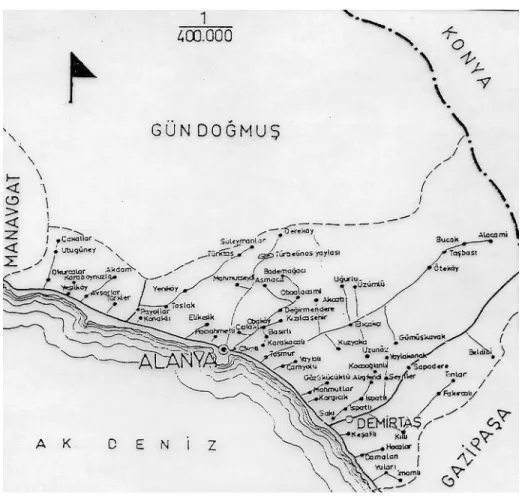
The Alanya region covers 1545 km² (Figure 1). The city is surrounded by Mediterranean sea in the south, Antalya in the west, Mersin in the east and Konya in the north. The climate of Alanya is of a humid and semi-humid Mediterranean type. The annual rainfall is 1084.4 mm/m2 and the annual
average temperature is 18.8 ºC in the region.
In the study area, the leathery leafed 2-3 m high, tall dense scrub of evergreen shrubs present the true macchie and it is most wide spread. It extends from the coast up to an altitude of 750 m. The coniferous forests are represented mainly by two species which are Pinus brutia Ten 0-900 m and
Pinus nigra J.F. Arn. subsp. nigra var. caramanica (J.F. Loudon) Rehder 900-1600 m in the research
area. The vegetation of these localities is predominantly mixed woodland with conifers, Pinus brutia Ten, Querqus petraea (Mattuschka) Liebl., Q. pubescens Willd., Q. cerris L. Abies cilicica (Ant. & Kotschy.) Carr. subsp. isaurica Coode & Cullen, Cedrus libani A. Rich. extend an altitude of 1200-1700 m while Salix alba L. and Populus L. spp. constitute the main hosts for parasitic macrofungi near the stream. Other dominant plants are Cupressus sempervirens L., Laurus nobilis L., Crateagus monogyna Jacq., Myrtus communis L., Pistacia terebinthus L, P. lentiscus L. and Nerium oleander L.
Materials and Methods
The macrofungi specimens were collected during field trips between 1999 and 2001 years. The morphological and ecological characteristics of the these specimens were noted in the field and taken on the colour photograph. Then microscopic characteristics of these specimens were determined in the laboratory. The specimens were identified according to the following literature [5-22].
The species are kept in Selçuk University Mushroom Application and Research Centre Fungarium, Konya.
Results
Basidiomycetes Tremellaceae
1. Exidia recisa (Ditmar :S.F.Gray) Fr.
Macroscopic features
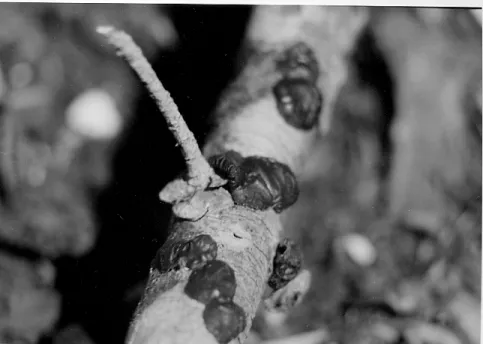
Fruiting body 0.5-3 cm across, 0.5-1.5 cm tall, irregularly conical to plate shaped or smooth and lobed (Figure 2), upper surface with the hymenium almost smooth or undulating to honeycombed-wrinkled, slightly shiny, without small warts, sterile underside slightly rough and dull, whole fruiting body amber coloured to dark red brown, attached to the substrate by a short, indistinct stalk. Flesh gelatinous and tough, imply elastic, dry. Usually growing gregariously. When dry the fruiting body forms only an inconspious brownish crust on the substrate.
Microscopic features
Spores 14-15 x 3-3.5 µ, cylindrical, allantoid (Figure 3), smooth, hyaline. Conidia 5-6 x 1.5-2 µ. Hypobasidia subglobose to pyriforme, 8-15 x 6-10 µ, longitudinally septate, usually with 4 fingerlike epibasidia.
Distribution
Avsallar, İncekum district, 04.03.2000, Doğan, Öztürk, Kaşık, Aktaş 421.
Ramariaceae
2. Ramaria flaccida (Fr.) Ricken
Macroscopic features
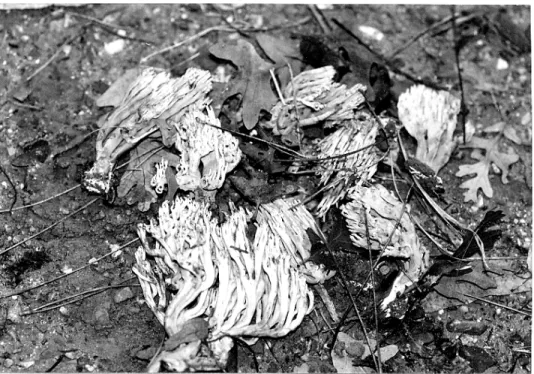
thick, with whitish base and ochre-yellowish above the base, branches arising from the base 1-3 mm thick and light ochre when young, then brown-yellow and of branches with 2 or several points or denticles, lighter or concolorous with the branches, never discolouring when bruised or rubbed. Flesh whitish, fibrous, tough, flaccid, without KOH reaction, odour weakly fruity or uncharacteristic, taste mild to somewhat bitter.
Microscopic features
Spores 7-8 x 3-4 µ, elliptical, verrucose-spinose (Figure 5), hyaline.
Distribution
Merap district, 20.01.2000, Doğan, Öztürk, Kaşık 1160, 1174. 3. Ramaria gracilis (Pers. :Fr.) Quél.
Macroscopic features
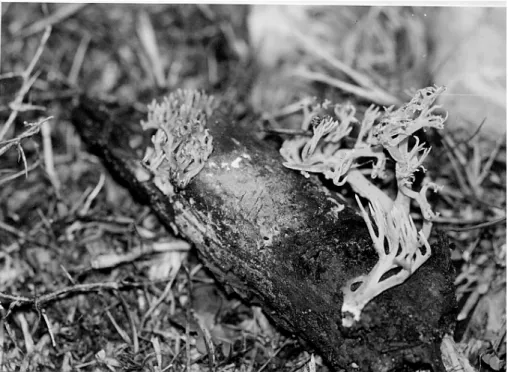
Fruiting body arising from a common, root like base, branched like a coral (Figure 6), basal trunk 1-1.5 x 0.3-0.5 cm, with white rhizomorphs, dichotomously branched many times toward the top beginning immediately above the trunk, branches ending in multiply branched, thorn like tips, branches 1-3 mm thick, light ochre-yellowish with flesh colour tint, whitish toward the tips, not discolouring when bruished, entire fruiting body 3-6 x 2-5 cm. flesh elastic, succulent, tough, odour faintly like anise, taste somewhat bitter. Solitary to gregarious.
Microscopic features
Spores 5-7 x 3-4 µ, elliptical, finely verrucose (Figure 7), hyaline.
Distribution
Çukur plateau, 10.12.2000, Doğan, Öztürk, Kaşık, Aktaş 1047.
Corticiaceae
4. Athelia neuhoffii (Bres.) Donk Macroscopic features
Fruiting body fully resupinate, appressed to the substrate (Figure 8), thin forming, membranous
patches and several cm in extent, surface smooth to slightly undulating, somewhat fissured when dry, white to cream-white, margin distinctly bounded to fringed.
Microscopic features
Spores 6-7.5 x 5-5.5 µ, subglobose to broadly elliptic (Figure 9), smooth, hyaline.
Distribution
Çayarası district, 05.05.2001, Doğan, Öztürk, Kaşık, Aktaş 1164.
5. Phanerochaete calotricha (Karst.) Erikss Macroscopic features
Fruiting body fully resupinate (Figure 10), attached loosely to the substrate, forming thin,
membranous patches up to 0.3 mm thick and several cm in extent, surface white when young, smooth, then cream-ochre to ocherish or yellowish, somewhat fissured when dry.
Microscopic features
Spores 4-5.5 x 2-2.5 µ, elliptical (Figure 11), smooth, hyaline.
Distribution
Çakallar, Süzek district, 03.12.1999, Doğan, Öztürk, Kaşık 353.
Hymenochaetaceae
6. Asterostroma ochroleucum Bres.
Macroscopic features
Fruiting body fully resupinate, attached loosely to the substrate, forming membranous patches
several cm in extent (Figure 12), surface smooth to slightly tuberculate, whitish to ocherish. Microscopic features
Distribution
Avsallar, İncekum district, 04.03.2000, Doğan, Öztürk, Kaşık, Aktaş 427.
Polyporaceae
7. Ischnoderma benzoinum (Wahl.:Fr.) Karst. Macroscopic features
Fruiting body bracket, flabellate to almost hood shaped (Figure 14), 4-20 cm across, projecting
3-15 cm from the substrate, narrowly to broadly attached, surface concentrically undulating, radially furrowed, tomentose, dark red-brown to almost black. Underside finely porose, white to ocherish, pores rounded, 4-6 per mm, tube lenght 5-8 mm, trama light ocherish, 1-2 cm thick.
Microscopic features
Spores 5.5-6 x 2-2.5 µ, cylindric, rather allantoid (Figure 15), smooth, hyaline.
Distribution
Çukur plateau, 10.12.2000, Doğan, Öztürk, Kaşık, Aktaş 1054.
Hygrophoraceae
8. Hygrocybe flavescens (Kauff.) Sm. & Hes. Syn : Hygrocybe obrussea (Fr.) Fr.
Macroscopic features
Pileus 3-6 cm across, convex when young, later plane and eventually with an uplifted margin (Figure 16), surface smooth, lubricous-slimy, light lemon yellow to orange yellow, translucent striate, margin even, acute. Flesh yellow to orange yellow, thin, odour unpleasant, taste mild. Lamellae light lemon yellow to pale orange yellow with paler to whitish edges. Stipe 5-7 x 0.5-1 cm, cylindrical, often compressed and grooved-furrowed, surface smooth, dull, dry, yellow to orange yellow, apex at times somewhat lighter, flesh orange yellow rigid, fragile.
Microscopic features
Spores 6.5-8 x 5-7 µ, broadly elliptic (Figure 17), smooth, hyaline, with drops.
Distribution
Sarıağalar, 20.01.2000, Doğan, Öztürk, Kaşık 1100. 9. Hygrophorus dichrous Kühn. & Romagn.
Macroscopic features
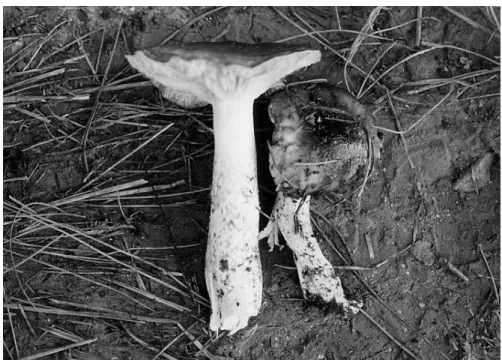
Pileus 4-8 cm across, hemispheric when young, later convex to plane and often a small umbo, also with a depressed centre when old (Figure 18). Surface slightly viscid, dirty brown-grey to dark brown with olivaceous tone. Flesh white, sometimes with greenish or bluish tone, subdecurrent, edges smooth to somewhat undulating. Stipe 10-15 x 1-1.5 cm, cylindrical, the whole length brownish, spotted on a whitish background even when young.
Microscopic features
Spores 9-13 x 5-7.5 µ, elliptic, smooth (Figure 19), hyaline, with drops. Distribution
Çukur plateau, 10.12.2000, Doğan Öztürk, Kaşık, Aktaş 1048, Alarahan, 20.01.2000, Doğan, Öztürk, Kaşık 1135, Merap district, Doğan, Öztürk, Kaşık 1158, Sarıağalar Doğan, Öztürk, Kaşık 1098, Akçatı Village, 06.02.2000, Doğan, Aktaş 395.
10. Hygrophorus discoxanthus (Fr.) Rea Syn: Hygrophorus chrysaspis Métr
Hygrophorus cossus (Sow.)Fr. Hygrophorus melizeus (Fr. :Fr.) Fr.
Macroscopic features
Pileus 2-6 cm across, hemispheric or conical when young, later convex and plane, sometimes with an indented centre, surface smooth (Figure 20), lubricous-viscid when moist, finely tomentose and
dull when dry, white to cream white when young, becoming increasingly yellow and rust-brownish from the margin inward with age, dark brown when dry. Flesh whitish, thick in the centre, odour somewhat resinous, taste mild, not distinctive. Lamellae cream-whitish, later yellow brownish, dark brown in dried specimens, broadly adnate to subdecurrent. Stipe 3-8 x 0.5-1 cm, cylindrical, tapering toward the base, surface lubricous when young, apex floccose or with small guttation droplets, white to cream coloured and gradually yellowing with age.
Microscopic features
Spores 7-10 x 4.5-6 µ, elliptic (Figure 21), smooth, hyaline, with drops.
Distribution
Sabırlar district, 05.02.2000, Doğan, Öztürk, Kaşık 896.
Entolomataceae
11. Entoloma sericeonitidum (Orton) Noordeloos Syn: Entoloma undatum (Fr.) Mos.
Macroscopic features
Pileus 1-3 cm across, concave when young, soon depressed with an umbilicate centre and
omphaloid (Figure 22), surface grey to grey brown, radially appressed fibrillose with shiny grey silvery fibrils, somewhat paler toward the margin, sometimes with one to several darker concentric zones, margin incurved when young, later smooth, acute barely striate. Flesh grey white to grey brown, thin, odour faintly spicy to faintly farinaceous, taste mild farinaceous. Lamellae light grey beige when young, later grey pink to pink, decurrent. Stipe 2-3 x 0.2-0.5 cm, cylindrical to compressed, somewhat enlarged at the base, central to eccentric, solid, somewhat fragile, surface grey whitish to grey brown, with inconspicuous white silvery longitudinally fibrils especially toward the apex.
Microscopic features
Spores 8-10.5 x 6-7 µ, 6-8 angled with rounded angles (Figure 23). Distribution
Çukur plateau, 20.05.2001, Doğan, Öztürk, Kaşık 1334,
Coprinaceae
12. Panaeolus guttulatus Bres.
Macroscopic features
Pileus 1.5-3.5 cm across, convex when young, later plane, with a slightly umbonate or slightly indented centre (Figure 24), surface dull, uneven, slightly tuberculate to hammered, dark olive brown to black, finely pruinose, slightly hygrophanous, margin paler to whitish. Flesh dark brown to blackish, thin, odour rather unpleasant. Lamellae greyish when young, soon black, narrowly adnate, edges yellowish white, finely floccose. Stipe 2-5 x 0.2-0.5 cm, cylindrical, base sometimes with a small bulb, stiff, hollow, surface smooth, dull, dark brown and longitudinally whitish-fibrillose.
Microscopic features
Spores 7-9.5 x 4-5.5 µ, narrowly elliptical (Figure 25), light brown, thick walled, with a distinct
germ pore.
Distribution
Merap district, 20.01.2000, Doğan, Öztürk, Kaşık 1147.
Bolbitiaceae
13. Pholiotina arrhenii (Fr.) Kits van Wav. Syn : Pholiotina blattaria (Fr.) Fay.
Macroscopic features
Pileus 1-3 cm across, hemispherical when young, then campanulate to plane, with an obtuse umbo (Figure 26), surface smooth to somewhat radially wrinkled, red to ochre brown when moist, ochre yellow with a darker to red brown centre when dry, with whitish veil remnants hanging when young. Flesh cream to dark brown, thick in the centre, thin toward the margin, odour polyporoid.
Lamellae pale cinnamon when young, later ochre brown, broadly adnate, edges white dentate. Stipe 3.5-5 x 0.1-0.3 cm, cylindrical, base slightly bulbous, solid elastic, stiff, surface above the annulus white-floccose on an light brown background, surface below white floccose to fibrillose on a grey brown background, annulus membranous, whitish.
Microscopic features
Spores 7-8.5 x 4-4.5 µ, elliptical (Figure 27), smooth, yellowish brown, slightly thick walled,
without or with a hint of a germ pore.
Distribution
Yeşilköy, 03.12.1999, Doğan, Öztürk, Kaşık 323.
Strophariaceae
14. Tubaria confragosa (Fr.) Harmaja
Macroscopic features
Pileus 2-4 cm across, convex when young, soon plane (Figure 28), completely covered with white veil remnants (greyish-silky to scaly floccose) when young, underneath dark chocolate to cinnamon brown. Edges white-floccose. Flesh whitish, ochre brown, odour weak, not distinctive. Lamellae orange brown, edges white floccose, more weakly decurrent. Stipe 4-6 x 0.3-0.5 cm, cylindrical, pink brown to dark brown base white, with annulus.
Microscopic features
Spores 7-10 x 4-6 µ, elliptical (Figure 29), smooth, light grey-yellow. Distribution
Şifalısu district, 05.05.2001, Doğan, Öztürk, Kaşık, Aktaş 1169.
This investigation was supported by Selcuk University Research Council (FEF: 99/045).
References
1. Işıloğlu M., Watling R., Macromycetes of Mediterranean Turkey, Edinburg Journal of Botany, 49(1):99-121 (1992).
2. Işıloğlu M., Öder N., Contributions to The Macrofungi of Mediterranean Turkey, Tr. J. of Botany, 19:603-609 (1995).
3. Gezer T., Gökler İ., Işıloğlu M., Türkiye Mikoflorası İçin Antalya Yöresinden Yeni Kayıtlar, Çev Kor, Cilt:10, Sayı 3, 17-19 (2000).
4. Gezer K., Contributions to The Macrofungi Flora of Antalya Province, Tr. J. of Botany, 24:293-296 (2000).
5. Breitenbach J., Kränzlin F., Fungi of Switzerland, Volume (2-4), Verlag Mykologia Ch-6000 Luzern 9, Switzerland (1986-1995).
6. Dähncke R.M., Grundschule für Pilzsammler, At Verlag Aarau, Stuttgart (1988). 7. Dähncke R.M., 1200 Pilze, At Verlag Aarau, Stuttgart (1993).
8. Gerhardt E., Der Große Blv Pilzführer für Unterwegs, Blv, München (1997). 9. Grünert H., Grünert R., Pilze, Mosaik Verlag, Gmbh, München (1984).
10. Grünert H., Grünert R., Field Guide to Mushrooms of Britain and Europe, The Crowood Press Ltd. (1991). 11. Hennig B., Kreisel H., Taschenbuch für Pilzfreunde, Gustav Fischer Verlag Jena, München (1987).
12. Jordan K., The New Guide to Mushrooms, Anness Publishing Ltd., Singapore (1996). 13. Krieger L.C., The Mushroom Handbook, Wolf Publishing, New York (1967).
14. Michael E., Hennig B., Kreisel H., Handbuch für Pilzfreunde, Gustav Fisher Verlag, Band (1-5), Stuttgart (1983-1987).
15. Moser M., Keys to Agarics and Boleti, Gustav Fischer Verlag, Stuttgart (1983). 16. Pace G., Mushrooms of The World, Firefly Books Ltd., Ontorio, Canada (1998).
17. Pacioni G., Mushrooms and Toadstools, Mac Donald and Ltd., London (1983). 18. Pegler D.N., Mushrooms and Toadstools, Mac Donald and Co. Ltd., London (1987).
19. Phillips R., Mushrooms and other Fungi of Great Britain and Europe, Pan Books Ltd., London (1981). 20. Smith A., Smith W. N., The Mushroom Hunter’s Field Guide, Thunder Bay Press, University of Michigan,
Michigan (1996).
21. Watling R., Identification of The Larger Fungi, Hulton Educational Publications Ltd, Amersham (1973). 22. Watling R., Britisch Fungus Flora, Bolbitiaceae 3: Agrocybe, Bolbitius, Conocybe, HMSO, Edinburgh
(1982).
Figure 2. Basidiocarps of Exidia recisa
Figure 4. Basidiocarps of Ramaria flaccida
Figure 6. Basidiocarps of Ramaria gracilis
Figure 8. Basidiocarps of Athelia neuhoffii
Figure 10. Basidiocarps of Phanerochaete calotricha
Figure 12. Basidiocarps of Asterostroma ochroleucum
Figure 14. Basidiocarps of Ischnoderma benzoinum.
Figure 16. Basidiocarps of Hygrocybe flavescens.
Figure 18. Basidiocarps of Hygrophorus dichrous.
Figure 20. Basidiocarps of Hygrocybe discoxanthus.
Figure 22. Basidiocarps of Entoloma sericeonitidum.
Figure 24. Basidiocarps of Panaeolus guttulatus.
Figure 26. Basidiocarps of Pholiotina arrhenii.
Figure 28. Basidiocarps of Tubaria confragosa.