Selcuk Journal of Agriculture and Food Sciences
http://sjafs.selcuk.edu.tr/sjafs/index ….Research Article…. SJAFS (2019) 33 (2), 67-73 e-ISSN: 2458-8377 DOI:10.15316/SJAFS.2019.158The Determination of Population Development and Infestation Rate of
Mediterranean Fruit Fly (Ceratitis capitata (Wied)) in Peach Orchards in
Meram (Konya) Province
Şerife Nur ÜÇPINAR1
, Levent ÜNLÜ1, *
1Selçuk University, Faculty of Agriculture, Department of Plant Protection, Konya, Turkey
1. Intrоduсtiоn
Mediterranean fruit fly (MFF) (Ceratitis capitata (Wied)) (Dip.: Tephritidae) is an external quarantine pest and has a zero tolerance in export. It causes eco-nomic losses in our country. The presence of a single infested fruit with this pest in export leads to the return of the whole product (Başpınar et al. 2009). C. capitata is a member of the Tephritidae family, order Diptera, which has more than 4500 species in the world (Liqui-do et al., 1990, Bayrak and Hayat, 2012). MFF is one of 118 species of fruit fly pests recorded in Turkey (Kütük et al., 2013). The most important hosts identi-fied in our country are mainly citrus fruits, peaches, figs, persimmon and pomegranates, but it also causes damage in apricot, apple, pear, quince, plum and avo-cado (Alkan, 1953; Demirdere, 1961; İleri, 1961; Giray, 1966; Elekçioğlu, 2009; 2013). However, there is no serious damage to lemons (Kaygısız and Aybak, 2005).
*Corresponding author email: [email protected]
One of the most suitable hosts of the MFF is peach fruits among many kind of fruits such as pepper, lo-quat, guava, orange, mandarin and feijoa (Medeiros et al., 2007). Estimated world production of peach and nectarines are 24.665.205 tons with 152.803-hectare total cultivated area. In Turkey, there are 771.459 tons’ production from 46.299 ha cultivated area. Konya province is one of the leading provinces of peach and nectarines production. Meram district shares 25.7% of total production in Konya province (Anonymous, 2018).
Females of MFF lay eggs to the mature fruits at the time of maturity, where they leave brownish spots. The main damage caused by larval stage of the pest by feeding in the fleshy part of the fruit. This leads to the softening and rotting of fruits by the time. Infested fruits usually ripen ahead of time and poured to the ground. Infested fruits rot as a result of the develop-ment of microorganisms such as fungus and bacterial species (Anonymous, 2008; Elekçioğlu, 2009).
The presence of MFF in the Central Anatolia region of Turkey has been detected in Ankara and Kırşehir
ARTICLE INFO ABSTRACT
Article history:
Received date: 18.03.2019 Accepted date: 17.05.2019
This study was carried out in 2017 and 2018 in Meram district (Konya) in order to determine the population development and infestation rate of the Mediterranean fruit fly (MFF) (Ceratitis capitata (Wied)) (Dip.: Tephritidae) in the peach orchards. In the study, traps called Decis Trap were used to catch the adults of the MFF. As a result of the study, adult population development determined different in two years, two population peaks occurred in 2017 and four times in 2018. The pest may give two to four generation in Meram district according to climatic conditions and years. The first adults of the MFF ap-peared in 2017 in the third week of August and were active for four months, and appeared in 2018 in the third week of July and were determined to be active in the nature for about five months. In addition to the results of the study conducted in the years 2017-2018, the infestation rates were 5% and 2% in Ekmekkoçu, 3% and 2% in Hasanköy, 96% and 96% in Hatıp, 94% and 100% in Karahüyük, 0% and 2% in Yenibahçe location, respectively. Farmers are advised to use Decis Trap at the beginning of July and to carry out other maintenance work in orchards, especially the destruction of the fruit falling on the ground.
Edited by:
Murat KARACA; Selçuk University, Turkey
Reviewed by:
Levent Efil; Çanakkale Onsekiz Mart University, Turkey
İslam SARUHAN; Ondokuz Mayıs University,Turkey
Fedai ERLER, Akdeniz University, Tur-key
Keywords:
Mediterranean Fruit Fly Trap
Population Infestation rate Peach
(Kansu, 1988; Kaya and İpekdal, 2018). Previous stud-ies conducted by different researchers were related to population development and infestation rates of the pest, including, in pomegranate orchards (Yıldırım and Başpınar, 2011; Çardak and Demirel, 2014), in manda-rin orchards; satsuma variety (Akyol, 2014), in per-simmon fruit orchards (Kılıç, 2015), in pomegranate and persimmon fruit orchards, in fig, peach and avoca-do orchards (Tiring and Satar, 2017), in orange or-chards (Çatak, 2017), in citrus oror-chards (Gürbüz, 2018). However, there is no study on the current status of the pest in Konya province.
In this study, it was aimed to determine the popula-tion development, infestapopula-tion rates and some biological characteristics of MFF in peach orchards in Konya province.
2. Materials and Methods 2.1. Materials
The basic materials of this research were peach or-chards located in Meram district of Konya province and MFF population in these orchards. Decis trap (Bayer CropScience) containing 0,015g Deltamethrin + 7.8g Ammonium acetate + 0.5g Chloro hydra tetrime-thyl amine + 0.03g + 1.5g Diamineopentane was used for mass trapping of the pest.
2.2. Methods
2.2.1. Selecting Trial Orchards
Five peach orchards with late-pruning varieties se-lected for determining population development of the pest. Details of the orchards are given in Table 1. Table 1
General properties of the trial orchards
Location Orchard age (Year) Variety Orchard size (ha) Coordinates
Ekmekkoçu 15 Monroe 0.2 37˚82934000 32˚49852200
Hasanköy 12 Monroe 0.6 37˚81058500 32˚47958700
Hatıp 9 Monroe 1.2 37˚76671000 32˚11560000
Karahüyük 14 Monroe 0.5 37˚77437910 32˚44906390
Yenibahçe 9 Monroe 1.2 37˚75861900 32˚47456200
2.2.2. Population Development of Mediterranean fruit fly
Five Decis type traps for per 0.1 hectar were hung on August 6th in 2017 and July 13th in 2018 in each orchard. The traps were hung 1.5-2 m high from the ground in the south-east direction of the trees. Trap controls were performed twice a week until the first adult was captured, and once a week after the first adult was captured, the number of captured adults was rec-orded. The same traps used till harvesting.
2.2.3. Infestation Rates of Mediterranean fruit fly
Infestation rates of MFF in peach orchards deter-mined by sampling infested fruits at harvesting time. Twenty-five peach trees selected in each orchard and
four fruits collected from those trees. Collected fruits number was 100 fruit from each orchard. Abbott for-mula was used to determine infestation rates for each orchard (Abbott, 1925).
3. Results
3.1. Population Development of Mediterranean fruit fly
Population development of the pest has been de-termined in five locations in Meram district, Konya. Population development of C. capitata in 2017 and 2018 in Ekmekkoçu location is given in Figure 1.
Figure 1
Two years’ population development of Ceratitis capitata in peach orchard in Ekmekkoçu location.
In Ekmekkoçu location, in 2017, the adults of the pest were first captured on 20 August. The pest has
been determined to be active from the end of August until the middle of November (Figure 1). When the
0 200 400 600 800 1000 19… 26… 2 A ug 9 A ug 16… 23… 30… 6 S e p 13 S e p 20 S ep 27 S e p 4 O c t 11 O c t 18 O c t 25 O c t 1 N ov 8 N ov 15… 22… 30… C ap tı re d A du lt N um be r (P ie c e )
Ekmekkoçu
2017 2018data is examined, it is seen that there are two peaks of population. The first peak reached 47 adults per week on October 8, and the second peak on October 22 with 66 adults per week. During the entire flight period, an average of 261 adult MFF were caught in the traps.
However, population was more intense in 2018; the first adult in the traps was caught on July 19th. Pest was determined as active from mid-July to the last week of November. Population peak was also three time in season (Figure 1). The first peak was 130 adults / week on the 6th of September, the second peak on the 27th of September with 168 adults / week, and the third peak
on October 18 with 60 adults / week. During the entire flight period, an average of 912 adult individuals was caught in traps.
In 2018, the number of adults caught in traps incre-ased three-fold compared to 2017. When the popula-tion curves are examined, the date of emergence, the active period and the different peaks they create may be considered as a result of climate change as well as many ecological factors.
Population development of C. capitata in 2017 and 2018 in Hasanköy location is given in Figure 2.
Figure 2
Two years’ population development of Ceratitis capitata in peach orchard in Hasanköy location.
In Hasanköy location, in 2017, the adults of the pest was first caught in traps on 23 August. Pest activity was determined from the last week of August to 15 November (Figure 2). When the number of captured adults is examined, it is seen that there are two peaks. The first peak point was 29 adults / week on 8 October and the second peak on October 22nd, 41 adults / week. During the entire flight period, 169 median MFF were caught in the traps.
The adults of the pest were first caught on July 19th in 2018. Pest activity was from mid-July to the last week of November and it was three peaks of popula-tion. The first peak was 101 adults / week on the 6th of September, the second peak on September 27th, 130
adults / week, the third peak on October 18, 47 adults / week. An average of 696 adults was caught in the traps during the entire flight period (Figure 2).
It was detected that, emergence and population den-sity are different in 2017 and 2018 years and this may be considered as the winter months was more temper-ate in 2018 comparing to 2017. It is believed that the farmer used intensive insecticide to avoid any risk during the season and to collect the harvest residues in the garden at the end of season may affect pest popula-tion development.
Figure 3 shows population development of C. capi-tata in 2017 and 2018 in Hatıp location. 0 200 400 600 800 1000 19 Jul y 26 Jul y 2 A ug 9 A ug 16 A ug 23 A ug 30 A ug 6 S e p 13 S e p 20 S e p 27 S e p 4 O c t 11 O c t 18 O c t 25 O c t 1 N ov 8 N ov 15 N ov 22 N ov 30 N ov C ap tı re d A du lt N um be r (P ie ce )
Hasanköy
2017 2018Figure 3
Two years’ population development of Ceratitis capitata in peach orchard in Hatıp location.
In Hatıp location, in 2017, the adults of the pest were first captured on 23 August. Pest active period was determined from the last week of August until 8 November. When the number of adults is examined, it is seen that there are two peaks. The first peak occurred on October 8th, 55 adults / week, the second peak on October 22nd, 83 adults / week. During the entire flight period, an average of 307 adult MFF was caught in the traps (Figure 3).
But, in 2018, the pests were first caught in the traps on 26 July. Pest activity was from mid-July to the last week of November. When the data is examined, it is seen that there are four peaks in 2018. The first peak point was 436 adults / week on September 6th, the sec-ond peak was 878 adults / week on September 20th, the third peak on October 18th, 133 adults / week and
final-ly on November 1st, 43 adults / week. During the entire flight period, 3169 adult individuals were caught in the traps (Figure 3).
In Hatıp location, the total number of adults in 2018 is 10 times higher than the total number of adults in 2017. The owner of the garden has applied tillage, pruning and bordeaux mixture in the garden in 2017, but, did not applied any chemicals during season against pests. In the 2018 season, he did not apply any procedures to the garden. Therefore, it is thought that C. capitata population is higher than other gardens. In addition, many harmful pests also were seen in these infested fruits.
Figure 4 shows population development of C. capi-tata in 2017 and 2018 in Karahüyük location.
Figure 4
Two years’ population development of Ceratitis capitata in peach orchard in Karahüyük location.
In Karahüyük location, in 2017, the adults of the pest were first captured on 23 August. Pest active peri-od was from the last week of August until November 8th. When the number of adults is examined, it is seen that there are two peaks. The first peak was 52 adults/ week on October 8th, and the second peak on October 18th with 76 adults / week. During the whole flight
period, 307 adult MFF were caught in the traps (Figure 4).
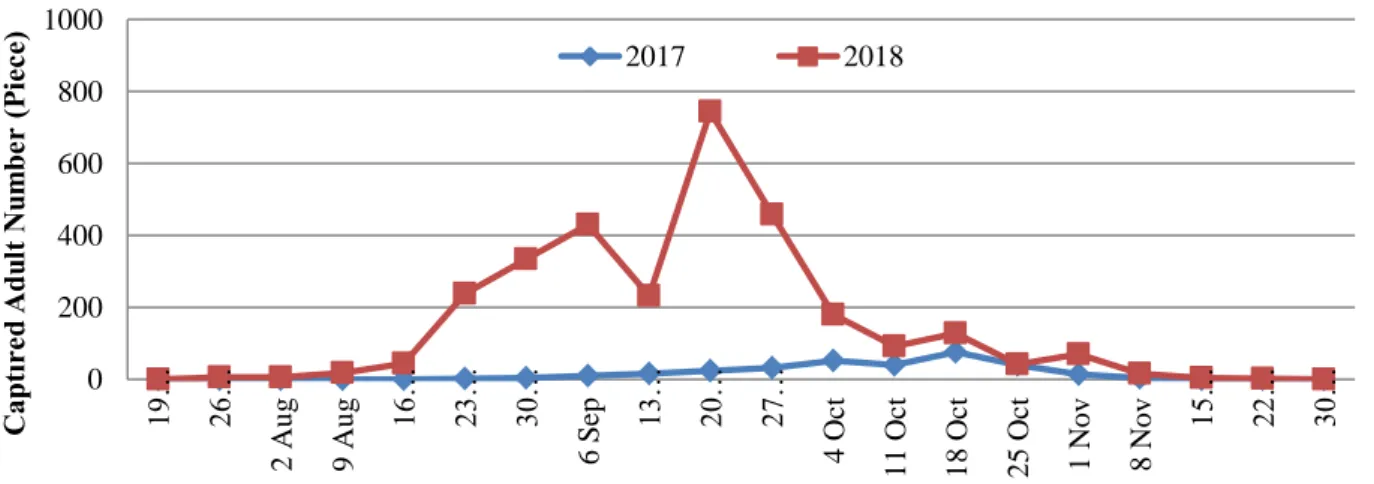
In 2018, the pests were first caught in the traps on 26 July. Pest was determined as active from mid-July to 22 November. Population peaks were four peaks in 2018 season. The first peak was 430 adults / week on the 6th of September, 743 adults / week on the second
0 200 400 600 800 1000 19 J ul y 26 J ul y 2 A ug 9 A ug 16 A ug 23 A ug 30 A ug 6 S e p 13 S e p 20 S e p 27 S e p 4 O c t 11 O ct 18 O c t 25 O c t 1 N ov 8 N ov 15 N ov 22 N ov 30 N ov C ap tı re d A du lt N um be r (P ie ce )
Hatıp
2017 2018 0 200 400 600 800 1000 19… 26… 2 A ug 9 A ug 16… 23… 30… 6 S e p 13… 20… 27… 4 O c t 11 O c t 18 O c t 25 O c t 1 N ov 8 N ov 15… 22… 30… C ap tı re d A du lt N um be r (P ie ce )Karahüyük
2017 2018peak on September 20th, 128 adults / week on the third peak on October 18th and last peak on the 1st of No-vember, 70 adults/week. An average of 3034 adult individuals was caught in traps during the entire flight period (Figure 4).
In this location, the total number of adults in 2017 is less than the number of 2018. Application
proce-dures were in Karahüyük location the same with Hatıp location, the owner of the garden did not apply even its primary preventive controls in both years. In 2018 season, the garden was left without harvesting.
Population development of C. capitata in 2017 and 2018 in Yenibahçe location is given in Figure 5.
Figure 5
Two years’ population development of Ceratitis capitata in peach orchard in Yenibahçe location.
In Yenibahçe location, the adults of the pest were first caught on August 30 in 2017. It was determined that pest was active from the last week of August until November 22nd. When the number of adults is exam-ined, it is seen that there are two peaks. The first peak was 9 adults / week on October 8th, and the second peak on October 22nd, 14 adults / week. During the entire flight period, an average of 56 adult MFF was caught in the traps (Figure 5).
In 2018, the pests were first caught in the traps on 26 July. Pest activity prolonged from mid-July to 22 November. When the number of adults is examined, it is seen that there are four peaks. The first peak point was 261 adults / week on 6 September, the second peak on 386adults / week on September 20, the third peak on
October 18, 161 adults / week, and finally on Novem-ber 1, 99 adults / week. During the entire flight period, an average of 1807 adult individuals was captured in the traps (Figure 5).
Numerous ecological factors are thought to be ef-fective for population curve of the pest. Furthermore, the low population in 2017 can be attributed to the fact that in 2016, the farmer made maintenance work regu-larly and especially the destruction of fruit residues at the end of harvest.
Infestation Rates of Mediterranean fruit fly
The rate of infestation of fruits by MFF in Meram district is given in Table 2.
Table 2
Ceratitis capitata infestation rate in Meram in 2017-2018.
Location Infestation Rate (%)
2017 2018 Ekmekkoçu 5 2 Hasanköy 3 2 Hatıp 96 100 Karahüyük 64 100 Yenibahçe 0 2
Harvest was performed in the first week of Septem-ber in Hasanköy, Ekmekkoçu and Yenibahçe location in 2017. Owners of the gardens, in order not to take the risk, they applied chemicals to their gardens in addition to the warnings of the technical staff of Meram District Directorate of Agriculture. Although unnecessary ap-plications were made, the chance of success against the pest has increased when the pesticides are applied on
time. In these locations, the rate of infestation in 2017 was determined as 0-5%. The owner of the garden in the Hasanköy location in 2016 and in 2017 destroyed fruit debris in the garden after harvesting, and the own-er of the garden in the Yenibahçe location destroyed it only in 2016. For this reason, infestation rates in these orchards were observed as highly lower than others. Infestation in Hatıp location was 96% and 94% in
0 200 400 600 800 1000 19… 26… 2 A ug 9 A ug 16… 23… 30… 6 S e p 13 S e p 20 S e p 27 S e p 4 O ct 11 O c t 18 O c t 25 O c t 1 N ov 8 N ov 15… 22… 30… C ap tı re d A du lt N um be r (P ie ce )
Yenibahçe
2017 2018Karahüyük location in 2017. Both gardens have been maintained in 2017 early spring, but not applied any control against disease and pests in the production season.
Harvesting was done in Hasanköy, Ekmekkoçu and Yenibahçe location in 2018, 5-10 days early compared to 2017, and the rate of infestation was determined in 2% of all three gardens. Harvest dates are thought to be 5-10 days early in 2018 with the increase in tempera-ture compared to 2017 and the shift of phenological periods to early. In Hatıp and Karahüyük locations, the infestation rate in 2018 was 100% in both gardens. Due to the proximity of the gardens in Hatıp and Karahüyük locations, the infestation rate and population changes were similar. Both gardens were left without harvesting in 2018.
4. Discussion
The MFF, which is the main detrimental factor in the loss of citrus fruits, has begun to cause significant and economic damage in different hosts in recent years. One of these hosts is peach.
In this study, the population development and infes-tation rates of MFF in the peach orchards in the district of Meram (Konya) in the locations of Ekmekkoçu, Hasanköy, Hatıp, Karahüyük, Yenibahçe, were deter-mined to be active in the peach areas from mid-July to the end of November for about five months.
It was determined that the pest does not cause harm in the early peach varieties. Tiring and Satar (2017) found that early peaches in Balcalı (Adana) did not cause any damage due to harvesting in the first week of May.
As a result of the study conducted in Konya, de-pending to the climatic conditions in the peach or-chards, the pest formed 2 to 4 peak in the season. Tir-ing and Satar (2017) reported that this pest has 7-8 generations in avocado, fig and peach orchards in Bal-calı (Adana), Başpınar et al. (2009) detected 4-5 gener-ations in the province of Aydin in citrus orchards, Kızılyamaç (2016) determined 3-7 generations at dif-ferent elevations; Kasap and Aslan (2016) reported, 5-6 generations in the persimmon and 6-7 generations in the pomegranate orchards in Adana province. As a result of all these studies, it was stated that the pest has a large number of generation in different hosts.
The highest point of the population with the in-crease of temperatures reached in September-October. The highest number of adults in 2017 and 2018 was in Hatıp location, number of captured adults was 106 adults / week on October 22, and 878 adults / week on September 20, respectively. Akyol and Demirel (2014) reported that captures of the adults in traps in the satsuma mandarin orchards in Hatay were maximum number in September. The reason for the high popula-tion density in Hatıp locapopula-tion is that the orchards are located close to each other which may be host of the
pest, and that the garden is neglected and not sprayed in the season.
In general, it was determined that the pest increased in 2018 compared to the previous year. This is due to the fact that the climate conditions are a little more moderate, the farmers do not spray against increasing pest populations and the number of host increases.
As a result of the study, the highest infestation rates were determined as 96 to 100% in Hatıp location, and 94 to 100 in Karahüyük location, in 2017-2018, respec-tively. Yıldırım and Başpınar (2011) found that the infestation rate of pomegranate orchards during harvest time was 2.20%. Although Demirel (2014) reported that the infestation rates in pomegranate orchards was between 3-43.5% according to varieties of pomegran-ate. Kasap and Aslan (2016) indicated that the infesta-tion rates in pomegranate was 1.35% in date was 5.2% in Adana province.
The importance of the chemical application for the MFF is understood from the loss in the gardens that are left without harvesting. In peach gardens, the damage rate of the pest may reach up 100% if the control tac-tics not applied. It is recommended that our farmers need to use Decis traps widely, and if they do not use it, they should fight with chemical at least twice on the dates proposed by the technical staff.
5. Acknowledgements
This study is summarized from Şerife Nur ÜÇPI-NAR’s Master's thesis. Authors are grateful to Tair Esenali UULU (PhD student, Department of Plant Protection, Faculty of Agriculture, Selcuk University) for translation help of manuscript.
6. References
Abbott WS (1925). A method of computing the effecti-veness of an insecticide. Journal of Economic En-tomology, 18, 265-267.
Akyol E (2014). Hatay ili mandalina bahçesinde kitle-sel tuzaklamayöntemi ile Akdeniz meyve sineği, Ceratitis capitata (Wiedemann) (Dipte-ra:Tephritidae)'nin kontrolü ve zarar oranının belir-lenmesi. Mustafa Kemal Üniversitesi, Fen Bilimleri Enstitüsü. Yüksek Lisans Tezi. 51 s.
Alkan B (1953). Türkiye'de narenciye (turunçgil) has-talık ve zararlıları. Ankara Üniv. Ziraat Fak. Yar-dımcı ders kitabı, sayı: 21, Ankara, 98 s.
Anonim (2008). Tarımsal Araştırmalar ve Politikalar Genel Müdürlüğü, Zirai Mücadele Teknik Talimat-ları Kitabı, Cilt 5, Ankara, 57-60 s.
Anonymous (2018).
http://www.fao.org/faostat/en/#data/QC erişim tari-hi 15.12.2018
Başpınar H, Çakmak İ, Koçlu T, Başpınar N (2009). Aydın İli Meyve Bahçelerinde Akdeniz Meyve Si-neği Ceratitis capitata (Wiedemann) (Diptera:
Tephritidae)’nin Biyo-Ekolojisi, Zararı, Yayılışı ve Turunçgil Bahçeleri Üzerindeki Çalışmaları. TO-VAG 105O17, 56 s., Isparta.
Bayrak N, Hayat R (2012). Türkiye’nin Tephritidae (Diptera) türleri. Türk Bilimsel Derlemeler Dergisi, 5(2): 49-55.
Çardak M, Demirel N (2014). Osmaniye İli nar Bahçe-lerinde Akdeniz Meyve sineği, Ceratitits capitata (Wiedemann) (Diptera: Tepritidae)’nin Yayılışı, Popülasyon Yoğunluğu ve Zarar Oranının Belir-lenmesi. Türkiye V. Bitki Koruma Kongresi, An-talya, 3-5 Şubat 2014.
Çatak A (2017). Muğla ili Köyceğiz ilçesi portakal bahçelerinde Akdeniz meyve sineği [Ceratitis capi-tata wied. (Diptera: Tephritidae)]'nin popülasyon yoğunluğu ve zarar oranının belirlenmesi Muğla Sıtkı Koçman Üniversitesi, Fen Bilimleri Enstitüsü. Yüksek Lisans Tezi. 82 s.
Demirdere A (1961). Çukurova Bölgesinde Akdeniz meyve sineği (Ceratitis capitata Wied.)’nin biyoloji ve mücadelesi üzerinde araştırmalar. Tarım Bakan-lığı, Zirai Mücadele ve Zirai Karantina Umum Mü-dürlüğü, Ankara, 118 s.
Demirel N (2014). Akdeniz Meyve Sineği, Ceratitis capitata (Wiedemann) Diptera: Tephritidae)’nin Populasyon Yoğunluğu ve Zarar Oranının Farklı Çeşitteki Nar Bahçelerinde Belirlenmesi. Türkiye V. Bitki Koruma Kong., 3-5 Şubat 2014, Antalya. Elekçioğlu NZ (2009). Akdeniz meyve sineği. Biyoloji
Bilimleri Araştırma Dergisi 2(1): 61-65.
Elekçioğlu NZ (2013). Fruit flies of economic impor-tance in Turkey, with special reference to Mediter-ranean fruit fly, Ceratitis capitata (Wied.). Türk Bi-limsel Derlemeler Dergisi 6(2): 33-37.
Giray H (1966). Ege Bölgesi’nde kültür bitkilerine arız olan Trypetidae familyası türleri ve konukçuları üzerinde araştırmalar. Ege Üniversitesi, Ziraat Fa-kültesi Yayın No: 26, İzmir, 61s.
Gürbüz T (2018). Antalya ili turunçgil bahçelerinde Akdeniz meyve sineği, Ceratitis capitata (Wiede-mann) (Diptera: Tephritidae)'nin kitlesel tuzaklama ile kontrolü ve zarar oranının belirlenmesi. Mustafa Kemal Üniversitesi, Yüksek Lisans Tezi, Hatay, 89s.
İleri M (1961). Türkiye’de Akdeniz meyve sineği du-rumu ve mücadelesi. Tarım Bakanlığı, Ankara Zirai Mücadele Enstitüsü Md. Yayını, Ankara, 38 s.
Kansu A (1988). Böcek Ekolojisi. Ankara Üniversitesi Ziraat Fakültesi Yayınları, Ankara.
Kasap A, Aslan M (2016). Akdeniz meyve sineğinin feromon tuzaklarla (Ceratitis capitata Wied.) (Dip-tera: Tephritidae)’nin nar ve hurmadaki popülasyon takibi ve zarar oranının tespiti. KSÜ Doğa Bilimleri Dergisi, 19(1): 43-50.
Kaya T, İpekdal K (2018). Akdeniz meyve sineği Ceratitis capitata (Diptera: Tephritidae)’nın Kırşe-hir’deki ilk kaydı ve barkodlaması. Mediterranean Agricultural Sciences (2018) 31(2): 101-105 Kaygısız H, Aybak HÇ (2005). Narenciye
Yetiştirici-liği. Hasad Yayıncılık, İstanbul, 224s.
Kılıç G (2015). Hatay İli Trabzon Hurması Bahçelerin-de AkBahçelerin-deniz Meyve Sineği, Ceratitis capitata (Wie-demann) (Diptera: Tephritidae)’nin Popülasyon Yoğunluğu Ve Zarar Oranının Belirlenmesi. MKÜ Fen Bilimleri Enst. Yüksek Lisans Tezi, Hatay, 142s.
Kızılyamaç S (2016). Farklı Yükseltilerdeki Akdeniz Meyve Sineği, Ceratitis capitata Wıedemann (Dip-tera: Tephritidae) Popülasyonlarının Biyo-Ekolojisi Üzerine Araştırmalar. Çukurova Üniversitesi Fen Bilimleri Enstitüsü, Yüksek Lisans Tezi 63 s. Kütük M, Yaran M, Hayat R, Koyuncu MÖ, Görmez
V, Aytekin HU (2013). The determination of fruit fly (Diptera: Tephritidae) fauna in Adıyaman, Kilis, and Şanlıurfa provinces with a new record for Tur-kish fauna. TurTur-kish Journal of Zoology, 37: 38-49. Liquido NJ, Cunningham RT, Nakagawa S (1990).
Host plants of Mediterranean fruit fly (Diptera: Tephritidae) on the Island of Hawaii (1949-1985 survey). Journal of Economic Entomology, 83: 1863-1878.
Medeiros A, Oliveria L, Garcia P (2007). Suitability as Medfly Ceratitis capitata (Diptera, Tephritidae) hosts, of seven fruit species growing on the island of São Miguel. Azores Life and Marine Sciences, 24: 33-40. Azores.
Tiring G, Satar S (2017). Ceratitis capitata (Wiede-mann) (Diptera: Tephritidae)’nın bazı meyve bah-çelerinde popülasyon dalgalanması. Türk. entomol. bült, 7(3): 239-247
Yıldırım EM, Başpınar H (2011). Aydın ili nar bahçe-lerinde saptanan zararlı ve predatör türler, yayılışı, zararlı türlerden önemlilerinin popülasyon değişimi ve zararı. Türk. entomol. bült., 2011, 1 (3): 169-179