KADİR HAS UNIVERSITY
GRADUATE SCHOOL OF SCIENCE AND ENGINEERING PROGRAM OF MSC IN ELECTRONICS ENGINEERING
POWER CONTROL AND MULTIHOP
COMMUNICATION APPROACHES FOR THE
COEXISTENCE OF IEEE 802.11af AND IEEE 802.22
NETWORKS IN TV WHITE SPACE
OĞUZ ÜLGEN
MASTER’S THESIS
Oğuz Ülgen M.Sc. Thesis 20 18
POWER CONTROL AND MULTIHOP
COMMUNICATION APPROACHES FOR THE
COEXISTENCE OF IEEE 802.11af AND IEEE 802.22
NETWORKS IN TV WHITE SPACE
OĞUZ ÜLGEN
MASTER’S THESIS
Submitted to the Graduate School of Science and Engineering of Kadir Has University in partial fulfillment of the requirements for the degree of Master’s in the Program of
Electronics Engineering
DECLARATION OF RESEARCH ETHICS / METHODS OF DISSEMINATION
I, OĞUZ ÜLGEN, hereby declare that;
this Master’s Thesis is my own original work and that due references have been appropriately provided on all supporting literature and resources;
this Master’s Thesis contains no material that has been submitted or accepted for a degree or diploma in any other educational institution;
I have followed “Kadir Has University Academic Ethics Principles” prepared in accordance with the “The Council of Higher Education’s Ethical Conduct Principles”
In addition, I understand that any false claim in respect of this work will result in disciplinary action in accordance with University regulations.
Furthermore, both printed and electronic copies of my work will be kept in Kadir Has Information Center under the following condition as indicated below :
The full content of my thesis/project will be accessible from everywhere by all means.
KADIR HAS UNIVERSITY
GRADUATE SCHOOL OF SCIENCE AND ENGINEERING
ACCEPTANCE AND APPROVAL
This work entitled POWER CONTROL AND MULTIHOP COMMUNICATION APPROACHES FOR THE COEXISTENCE OF IEEE 802.llaf AND IEEE 802.22 NETWORKS iN TV WHITE SPACE prepared by OGUZ ÜLGEN has been judged to be
successful at the defense exam held on 06/06/2018 and accepted by our jury as MASTER'S
THESIS.
APPROVED BY:
Assoc. Prof. Dr. Serhat Erküçük (Advisor) (Kadir Has University) Prof. Dr. Hakan Ali Çırpan (Tstanbul Technical University) Asst. Prof. Dr. Yalçın Şadi (Kadir Has University)
I ceıtify that the above signatures belong to the faculty members named above.
Assoc. Prof. r. Demet Akten Akdoğan Dean of Graduate School of Science and Engineering DATE OF APPROVAL:
'
.
of;
.
2.D/8
TABLE OF CONTENTS
ABSTRACT ... i
ÖZET ... iii
ACKNOWLEDGEMENTS ... v
LIST OF TABLES ... vii
LIST OF FIGURES ... viii
LIST OF SYMBOLS / ABBREVIATIONS ... 1
1. INTRODUCTION ... 2
1.1. Motivation for TV White Space ... 3
1.2. Contribution ... 4
1.3. Dissertation Organization ... 5
2. WIRELESS COMMUNICATION NETWORKS IN TVWS ... 6
2.1. History of Wireless Communication Networks ... 6
2.2. IEEE 802.22 Wireless Regional Area Network ... 8
2.3. IEEE 802.11af Wireless Local Area Network ... 9
2.4. Protection of Primary Users ... 10
2.5. Coexistence in TV White Space ... 10
3. BT BASED COEXISTENCE WITH POWER CONTROL ... 11
3.1. Previous BT Based Approaches ... 11
3.2. System Model ... 13
3.3. BT Based Power Control Algorithm ... 16
3.4. Simulation Results ... 19
3.5. IPR and PTR Results Under Realistic Conditions ... 26
4. BT BASED COEXISTENCE WITH MULTIHOP COMMUNICATION ... 30
4.1. BT Based Multihop Algorithm ... 30
4.2. System Performance and Results ... 33
5. CONCLUSION ... 36
5.1. Summary of Thesis ... 36
5.2. Future Work ... 37
REFERENCES ... 38
ii
APPENDIX A ... 44 A.1 Calculated New Powers of IEEE 802.11af clients ... 44
i
POWER CONTROL AND MULTIHOP COMMUNICATION APPROACHES FOR THE COEXISTENCE OF IEEE 802.11af AND IEEE 802.22 NETWORKS IN TV
WHITE SPACE
ABSTRACT
Communication networks have been among the most important research fields of scientists in the recent years. Researches have been conducted in various different topics and contents as technology has evolved. As some new technologies become available, some technologies become out of date. One of the outdated technologies in recent years is the analog TV broadcasting. With the shift from analog TV broadcasting to digital TV broadcasting, the frequency bands of old analog TV broadcasting has become available for the implementation of new technologies. This spectrum is called TV White Space (TVWS). Due to wide coverage and good signal transmission properties in TVWS, researchers and engineers have focused on developing standards for this valuable spectrum. Within the same period of time, another new technology based on cognitive radios has been investigated and implemented. Among the standards and technologies developed for TV White Space, one focus area has been to allow the access of unlicensed (secondary) users to the spectrum. Even though solutions for protecting the licensed (primary) users has been successful, researches for protecting the secondary users in coexistence have not given conclusive results. Several of these researches are on the coexistence of IEEE 802.22 wireless regional area network and IEEE 802.11af wireless local area network. However, due to the nature of two heterogeneous networks not communicating with each other, there is a need for further coexistence mechanisms.
In this thesis, different from the earlier works, busy tone based power control and multihop communication algorithms are implemented for different coexistence scenarios of IEEE 802.22 and IEEE 802.11af. Interfering packet rate results and successful packet transmission rate results obtained via computer simulations and improved results are presented. In addition, interfering packet rate results and successful packet transmission rate results are presented under realistic channel models
ii
and log-normal shadowing. The presented results are important to improve the results of existing busy tone based approaches.
Keywords: Cognitive radio, TV white space, IEEE 802.11af, IEEE 802.22, Power control, Multi hop communication, Coexistence
iii
IEEE 802.11af VE IEEE 802.22 AĞLARININ BİRLİKTE VAROLABİLMELERİ İÇİN GÜÇ KONTROLÜ VE ÇOK SEKMELİ HABERLEŞME YAKLAŞIMLARI
ÖZET
Haberleşme ağları, son yıllarda bilim insanlarının en önemli çalışma alanları arasında yer almaktadır. Teknoloji geliştikçe birçok farklı konuda ve içerikte çalışmalar yürütülmüştür. Bazı yeni teknolojiler ortaya çıkarken, bazı teknolojilerin de süreleri dolmuştur. Son yıllarda süresi dolan teknolojilerden bir tanesi analog TV yayınıdır. Analog TV yayınından dijital TV yayınına geçişle birlikte, eski analog TV frekans bantları yeni teknolojilerin uygulanabilmesi için uygun hale gelmiştir. Bu tayf TV Beyaz Boşluğu (TVBB) olarak adlandırılmaktadır. TVBB'nin geniş kapsama alanı ve iyi sinyal iletim özellikleri sayesinde araştırmacılar ve mühendisler bu değerli tayf için standartlar geliştirmeye odaklanmıştır. Aynı zaman sürecinde, bilişsel radyolar tabanlı bir başka yeni teknoloji araştırılmış ve uygulanmıştır. TVBB standartları ve araştırmaları arasında bir odak alanı lisanssız (ikincil) kullanıcıların tayfa erişiminin izni olmuştur. Her ne kadar lisanslı (birincil) kullanıcılar için bulunan çözümler başarılı olsa da, ikincil kullanıcıların birlikte varolabilmeleri için yapılan çalışmalar kesin sonuçlar verememiştir. Bu araştırmaların bir kısmı IEEE 802.22 kablosuz bölgesel alan ağı ve IEEE 802.11af kablosuz yerel alan ağı üzerinedir. Bununla birlikte, iki heterojen ağın doğaları gereği birbiriyle haberleşememesi sonucu, ileri bir birlikte varolabilme yöntemine ihtiyaç duyulmaktadır.
Bu tezde, önceki çalışmalardan farklı olarak, IEEE 802.22 ve IEEE 802.11af'nin farklı birlikte varolabilme senaryoları için meşgul tonu tabanlı güç kontrolü ve çok sekmeli haberleşme algoritmaları uygulanmıştır. Bilgisayar benzetimleri aracılığıyla paket girişim oranı sonuçları ve başarılı paket oranı sonuçları elde edilmiş ve geliştirilmiş sonuçlar sunulmuştur. Ek olarak, gerçekçi kanal modelleri ve log-normal gölgeleme altında paket girişim oranı ve başarılı paket oranı sonuçları sunulmuştur. Sunulan sonuçlar varolan meşgul tonu tabanlı yaklaşımların sonuçlarını geliştirmek adına önemlidir.
iv
Anahtar Sözcükler: Bilişsel radyo, TV beyaz boşluğu, IEEE 802.11af, IEEE 802.22, Güç kontrolü, Çok sekmeli haberleşme, Birlikte varolabilme
v
ACKNOWLEDGEMENTS
I would like to express my appreciation to my thesis supervisor Associate Professor Serhat Erküçük. Without his guidance and knowledge I would not be able to complete my master’s study.
I would also like to thank to Assistant Professor Tunçer Baykaş for his feedback on my research work. His vision motivated me a lot through my research.
I would like to thank the other researchers in my faculty. It has been a pleasure to work in a group of intelligent fellows.
I would like to thank to my friends for their understanding.
Last but not the least; I would like to express my thankfulness to my family. The unconditional support of them gave me the strength to carry out my thesis and to finish it.
vi
vii
LIST OF TABLES
Table 3-1: IEEE 802.11af system parameters ... 21 Table 3-2 : IEEE 802.22 system parameters ... 21 Table A-1 : Power control results. ... 44
viii
LIST OF FIGURES
Figure 3.1 : Hidden Terminal Problem ... 13
Figure 3.2: Safe to talk distances between IEEE 802.11af AP and IEEE 802.22 CPE with respect to distances between IEEE 802.22 BS and IEEE 802.22 CPE ... 15
Figure 3.3: Coexistence of IEEE 802.11af and IEEE 802.22 networks ... 16
Figure 3.4: Two scenarios with different SIR ranges ... 20
Figure 3.5: Comparison of IPR results in scenario 1 ... 23
Figure 3.6: Comparison of PTR results in scenario 1 ... 23
Figure 3.7: Comparison of IPR results in scenario 1 ... 25
Figure 3.8: Comparison of PTR results in scenario 2 ... 25
Figure 3.9 : Probabilistic client distribution under 10 dB log-normal shadowing ... 26
Figure 3.10 : IPR results for scenario 1 under 10 dB log-normal shadowing ... 28
Figure 3.11 : PTR results for scenario 1 under 10 dB log-normal shadowing... 28
Figure 3.12: IPR results for scenario 2 under 10 dB log-normal shadowing ... 29
Figure 3.13 : PTR results for scenario 2 under 10 dB log-normal shadowing... 29
Figure 4.1: IEEE 802.11af AP and clients ... 31
Figure 4.2: IEEE 802.11af Neighbors ... 32
Figure 4.3: Successful multihop communication ... 33
Figure 4.4: IPR results for multihop communication in scenario 1 ... 34
Figure 4.5: PTR results for multihop communication in scenario 1 ... 34
Figure 4.6: IPR results for multihop communication in scenario 2 ... 35
1
LIST OF SYMBOLS / ABBREVIATIONS
PU : Primary User
SU : Secondary User
FCC : Federal Communications Commission
TVWS : Television White Space
CR : Cognitive Radio
WRAN : Wireless Regional Area Network
WLAN : Wireless Local Area Network
WPAN : Wireless Personal Area Network
BT : Busy Tone
TVBD : TV Band Device
IPR : Interfering Packet Rate
PTR : Packet Transmission Rate
WCN : Wireless Communications Network
CPM : Channel Power Management
DSE : Dynamic Station Enablement
GLDB : Geo-Location Database
BS : Base Station
CPE : Customer Premises Equipment
TPC : Transmit Power Control
T
11af: IEEE 802.11af Transmit Power level
T
22 : IEEE 802.22 Transmit Power levelL
: Path Loss between Stationsλ
int : Interference Threshold in dBmλ
wlan : Tolerable SIR Level in IEEE 802.11af Network in dB2
1.
INTRODUCTION
From smoke and mirrors to cutting-edge technology of digital communication, wireless communication has always been a part of humankind's life. Especially in the 20th and 21st centuries lots of researches conducted on wireless communication networks, and consequently technology has evolved rapidly. By 2017, number of subscribers who use wireless communication technologies (i.e. mobile telecommunication, internet etc.) has surpassed 5 billion (GSMA, 2017). This demand caused tremendous traffic growth and higher data rates. Many problems have been developed out of this hypertrophy. One of the problems with high demand in radio channels is scarcity in the spectrum. This encouraged scientists and engineers to find new ways of reusing the occupied frequencies. Modulations, optimizations and standardizations were investigated and offered by many researchers (The Institute of Electrical and Electronics Engineers, 1990), (LeFloch et al., 1995). However, the speed of technology is faster than the standardization processes and it is impossible to authorize all equipment to use an individual frequency. Therefore some authorized or licensed equipment -which are called primary users (PUs)- are able to communicate interference freely in an individual channel, while some other unauthorized or unlicensed equipment -which are called secondary users (SUs)- are allowed to access channels opportunistically (Kang et al., 2009).
Recently, a lot of new technologies are emerging. While new technologies are coming out, some of the older technologies become out of date. The frequencies of the outdated technologies are either underused or not used efficiently. For the usage of these frequencies efficiently many researches are conducted. One of the developments in wireless communication was digitization of TV broadcasting (Hart, 2004). This caused Federal Communications Commission (FCC) to regulate the frequencies used by Analog TV broadcasts. This frequency spectrum is called as TV White Space (TVWS) (Federal Communications Commission, 2010).
3
The following sections will give an overview for TVWS and motivation for TV White Space of this thesis. Later, contribution of thesis will be given and finally organization of this dissertation concluded.
1.1. Motivation for TV White Space
The unused channels between active UHF and VHF bands are called as “TV White Space”. These channels were used as buffer channels to protect interference between TV broadcasts. Due to the shift from analog TV to digital TV broadcasting, these under-used channels become available for cognitive radio (CR) access by FCC regulation in 2010 (Federal Communications Commission, 2010).
While Wi-Fi offers coverage of 100 meters under perfect conditions, TVWS offers coverage with 10 kilometers in diameter. Also as utilizing the low frequency UHF bands, TVWS offers ability to penetrate obstacles and cover uneven grounds without infrastructural additions. With these advantages TVWS offers a whole new experience of digital communication. Also known as “Super Wi-Fi”, TVWS has attracted many researchers and some standards have been developed. For wide area coverage, IEEE 802.22 wireless regional area network (WRAN) standard has been developed in 2011 (The Institute of Electrical and Electronics Engineers, 2011). In 2013, extension of Wi-Fi has been offered and IEEE 802.11af wireless local area network (WLAN) has been developed (The Institute of Electrical and Electronics Engineers, 2013). Lastly, for Bluetooth, IEEE 802.15.4m wireless personal area networks (WPAN) standard has been developed in 2014 (The Institute of Electrical and Electronics Engineers, 2014a). These networks may cause interference to each other and PUs when deployed together (Sum et al., 2014). Therefore to protect PUs and SUs in TVWS from interference of secondary users, in 2014, 802.19.1 standard has been developed (The Institute of Electrical and Electronics Engineers, 2014b). However, coexistence of these networks comes with many problems. Therefore, finding peaceful coexistence mechanisms are a must for this valuable spectrum.
4
In this dissertation, various methods are used to verify the coexistence of IEEE 802.11af and IEEE 802.22 networks. Busy Tone (BT) based power control and multihop communication with power control algorithms are given. The detailed algorithms and simulations are shown in the following chapters using graphical representations.
1.2. Contribution
While interference of SUs to PUs is prevented with standards in TVWS, interference between unlicensed devices stays as a research problem. Various algorithms and analysis towards this problem are proposed in the past. Although there are some researches offer successful interference preventing mechanisms to protect PUs, damages in SU networks still remain.
In this thesis IEEE 802.22 WRAN is aimed to be protected from the harmful interference of IEEE 802.11af WLAN signals while IEEE 802.11af WLAN does not stop communicating. This thesis offers a unique way for the aim by providing:
1. The power control algorithm to decrease interfering packet rate (IPR) and hold the packet transmission rate (PTR) of IEEE 802.11af in an acceptable level at the same time.
2. Multihop communication with power control algorithm to decrease IPR of the system with respect to power control algorithm proposed and also to increase PTR of IEEE 802.11af.
3. Simulations of the proposed algorithms under specified conditions.
5 1.3. Dissertation Organization
This dissertation consists of 5 chapters. The literature review for cognitive radio and TV white space is presented and the motivation of the thesis is given in Chapter 1. In Chapter 2, wireless communication networks in TVWS is presented. In Chapter 3, a BT based power control coexistence algorithm is proposed and simulations of this algorithm for the specified cases are given. Also in chapter 3, considering realistic channel models and client distributions, simulations of power control are given and compared with only-BT and non-BT algorithms in the literature. In Chapter 4, multihop communication approach is given and compared to the other algorithms and discussed. Finally, Chapter 5 concludes the thesis and gives directions for future research.
6
2. WIRELESS COMMUNICATION NETWORKS IN TVWS
Wireless networking is a method that avoids the cost of wire installation for telecommunication. WCNs are generally implemented and administrated by using radio communication. WCNs ranges from cellphones communication networks to sensor networks, satellite networks etc. The common usage of WCNs started to expand after second half of the 20th century. Many technologies coming out recently and TVWS is one of them.In this section a brief history of wireless communication networks is given. Then, two important networks in TVWS are introduced: IEEE 802.22 WRAN and IEEE 802.11af WLAN. Later, protection of primary users in TVWS is presented. Lastly, coexistence of these two networks in TVWS is presented.
2.1. History of Wireless Communication Networks
The first successful implementation of WCN was ALOHAnet in 1969 at the University of Hawaii and became operational in June 1971 (Abramson, 1970). The development of the network started at 1968 at the University of Hawaii under the leadership of Norman Abramson. The goal was to have a low-cost communication network in Oahu that would connect the computers in the whole Island to each other and finally to the main computer at the main campus.
Later, three companies NCR, AT&T and Lucent introduced the first commercial use of WCNs: WaveLAN in 1988 (NCR Corporation, 1991). WaveLAN was operating in the 900 MHz or 2.4 GHz ISM bands. The operations for WaveLAN led to another massive development which is called IEEE 802.11 WLAN standard, also known as "Wi-Fi (Wireless Fidelity)".
7
In 1991, 2G cell phone networks are introduced by Radiolinja in Finland (Narang and Kasera, 2006). 2G networks were more beneficial over older technologies with three features:
1. Digitally encrypted phone conversations,
2. Greater wireless penetration levels,
3. Data services for mobile communication (SMS text messages, picture messages, MMS).
Especially with data services such as multimedia messages, 2G introduced users to a new kind of communication.
1997 was a breakthrough for WCNs. IEEE 802.11 standard introduced by IEEE. The IEEE 802.11 standard is a set of media access control (MAC) and physical layer (PHY) specifications for implementing wireless local area network (WLAN) computer communication in the 2.4, 3.6, 5, and 60 GHz frequency bands (Banerji and Chowdhury, 2013). IEEE LAN/MAN Standards Committee (IEEE 802) creates and maintains these specifications. The base version of the standard was released in 1997, and later has had many modifications. The standard and modifications provide the basis for wireless network products using the Wi-Fi brand. Each modification has become a new standard with a new name such as IEEE 802.11a or IEEE 802.11b, etc. (Li, 2008).
Later on the newer technologies introduced such as VoIP, 3G, 4G, Li-Fi (Kim, 2015) etc. Wireless communication networks improve and new technologies emerge each and every day.
TVWS is one of the recent technologies. As mentioned before, in this thesis, two of the standards of TVWS are considered mainly. Following section offers an insightful overview for IEEE 802.22 WRAN.
8
2.2. IEEE 802.22 Wireless Regional Area Network
IEEE 802.22 is a standard for wireless regional area network (WRAN) using white spaces in the TV frequency spectrum (The Institute of Electrical and Electronics Engineers, 2011). The development of the IEEE 802.22 WRAN standard is aimed at using cognitive radio (CR) techniques to allow sharing of geographically unused spectrum allocated to the television broadcast service, on a non-interfering basis, to bring broadband access to hard-to-reach, low population density areas, typical of rural environments, and is therefore timely and has the potential for a wide applicability worldwide. This standard is the first attempt by using CR techniques for the opportunistic use of TV bands interference freely.
IEEE 802.22 WRANs are aimed to be operating without causing harmful interference to the primary users in TVWS such as digital TV, analog TV or wireless microphones (Oh et al., 2016). The standard was expected to be finalized in Q1 2010, but was finally published in July 2011.
IEEE 802.22 is a TVWS standard developed for rural area using. Since itt is a wireless regional area network standard; the communication ranges are much wider than WLAN. The system used in this work contains two equipment. The first one is base station (BS) and the second one is customer premises equipment (CPE).
IEEE 802.22 WRAN network topology is point-to-multipoint (PMP) since it has a fixed BS and fixed subscribers. Communication radius ranges from 1 km to 100 km. BS uses sectorized or omni-directional antenna while the subscribers antennas is directional with 14 dB of front-to-back lobe suppression. It uses sensing antennas to sense primary users which are TV and microphone signals. The system also uses GPS based geo-location and terrestrial geo-location for services (Mody, 2015).
One of the most important features of IEEE 802.22 is busy tone. One of the antennas of customer premises equipment can broadcast busy tone signal to the medium so that the other equipment in the medium can sense that the IEEE 802.22 network is exist in
9
nearby. This has a lot of usages in literature and also helps the idea in this thesis (Li et al., 2007), (Wang et al., 2006), (Xu and Lei, 2016).
2.3. IEEE 802.11af Wireless Local Area Network
A wireless local area network (WLAN) links multiple devices over a short distance using a wireless distribution method, usually providing a connection through an access point for internet access. The use of spread-spectrum or OFDM technologies may allow users to move around within a local coverage area, and still remain connected to the network.
Products using the IEEE 802.11 WLAN standards are marketed under the Wi-Fi brand name. Fixed wireless technology implements point-to-point connects between PCs or systems at two far off areas, frequently utilizing committed microwave or adjusted laser light pillars over line of sight paths. It is regularly utilized as a part of urban communities to interface arranges in at least two structures without introducing a wired connection. IEEE 802.11 WLAN is branded as “Wi-Fi” and many sub standards have been developed. One of the sub standards is IEEE 802.11af.
Also known as “Super Wi-Fi” or “White-Fi”, IEEE 802.11af system is using principles of cognitive radio and operating in TV White Space. IEEE 802.11af is released in 2014 to use. The cognitive functions are supported with two mechanisms which are Channel Power Management (CPM) and Dynamic Station Enablement (DSE). The access points and the stations are using Geo-Location Database (GLDB) to determine the frequencies unused so that spectrum sharing is dynamic and interference-free. Depending on conditions two different scenarios of coverage possible; indoor (<100 m) and outdoor (<5 km) (Lekomtcev and Maršálek, 2012).
The IEEE 802.11af network in this thesis consists of two different equipment. One is access point and the other one is client. Access point and clients connect each other and communication stream from AP to client is called as downlink while the stream from
10
client to AP called as uplink. Communication packets in IEEE 802.11af network are assumed as homogenous. It means that the traffic in downlink equals to traffic in uplink.
2.4. Protection of Primary Users
For protection of the PUs and prevent possible interference, three different approaches offered by the FCC as geo-location database (GLDB), transmit power control (TPC) and spectrum sensing mechanisms (Baykas et al., 2012). In GLDB method, All SUs are expected to be connected to the database and have the knowledge of the idle bands (i.e., PU-free channels) before they start to communicate each other (Sun et al., 2012), (Oh et al., 2013). This database stores operating frequencies and schedules the location information of licensed users. On the other hand, SUs that cannot access the database must use spectrum sensing and power control mechanisms. However, due to high transmit power level (i.e., higher than 1W) for fixed devices and strict requirements for spectrum sensing (i.e., any SU must detect the presence of PU with threshold of -107 dBm under 2 seconds and not exceed the 50mW transmit power level) regulated by standards (Baykas et al., 2012), fixed devices cannot operate in the mentioned modes. So, GLDB mechanism can provide efficient PU protection during SU operation in TVWS.
2.5. Coexistence in TV White Space
IEEE 802.11af and IEEE 802.22 are heterogeneous in terms of Physical (PHY) and Medium Access (MAC) Layers which causes these two systems to interfere each other (The Institute of Electrical and Electronics Engineers, 2013), (The Institute of Electrical and Electronics Engineers, 2011). In the literature, there are approaches have been studied in detail including adaptive transmit power control (Mizutani and Harada, 2014), power and range prediction (Villardi et al., 2012a), dynamic frequency selection (Villardi et al., 2012b) and interfering neighbor discovery (Wang et al., 2012a) algorithms proposed for TVWS. However, according to (The Institute of Electrical and Electronics Engineers, 2014), all SUs are required to be connected to a coexistence server which results in additional costs to networks and under-utilization of CR devices.
11
3. BT BASED COEXISTENCE WITH POWER CONTROL
Busy Tone is a signal used for to indicate that a device or a frequency is busy in that particular moment. It is used in telecommunication technologies in many different cases. One of the usages of busy tone is coexistence situations of two heterogeneous networks. When a device broadcast busy tone signal to the medium in a frequency, it is sensed by other devices which helps to decrease number of packet collisions by using different algorithms.In the following sections, previous BT based approaches are considered and discussed. Later, system model of this thesis is presented where IEEE 802.11af and IEEE 802.22 systems coexist. BT based power control algorithm will be introduced and simulation results will be presented in 3.3 and 3.4 respectively. Then, BT based power control algorithm will be discussed under more realistic conditions.
3.1. Previous BT Based Approaches
Busy tone has been considered in many works before. Not only for TVWS but lots of researchers used BT in many different ways in wireless communication networks. Busy tone is used for ad hoc networks (Huang et al., 2002) as well as for improving throughput of WLAN (Zhu and Sydor, 2010) and also for RFID systems (Wang et al., 2012b).
As an alternative to these techniques, a method with busy tone (BT) is suggested as a simple but effective way for coexistence of IEEE 802.22 and IEEE 802.11af networks (Feng et al., 2013a). The main idea behind BT method is that when an IEEE 802.22 network is communicating, network nodes can broadcast BT signal to the medium to indicate that the selected frequency is in use.
It is assumed that IEEE 802.22 network devices have simultaneous transmit and receive capability (STAR) (Kolodziej and Perry, 2016), which can provide a high level of
12
transmit signal suppression (i.e., self BT interference cancellation). BT approach is simulated in another work, where only IEEE 802.11af Access Point (AP) can detect BT signal (Feng et al., 2013b). The proposed approach has limitations in two ways. Firstly, as the clients of IEEE 802.11af network could also interfere with IEEE 802.22 network, clients also affect the coexistence performance. Secondly, an indoor pathloss model is used which is unrealistic for IEEE 802.22 and IEEE 802.11af networks in real life applications. Although various BT based algorithms (e.g., interference aware BT, dual-tone narrow-band BT, etc.) were suggested in the MAC layer of IEEE 802.11 systems to prevent hidden and exposed terminal problems (Li et al., 2007), (Haas et al. 2012), (Wang et al., 2006), there are fewer studies in the literature considering the coexistence of heterogeneous networks using the BT based algorithms. In (Zhang et al., 2013) and (Ock et al., 2014), BT based algorithms are considered for IEEE 802.11 and 802.15.4 networks in the ISM band for peaceful coexistence among heterogeneous networks. However, these studies did not consider the effect of shadowing and realistic client distributions.
The recent researches considered a BT approach that offers silencing IEEE 802.11af network when any of the devices in IEEE 802.11af network hears BT (Karatalay et al., 2015). Although, it offers an effective solution for protection of IEEE 802.22 WRAN, stopping whole communication in IEEE 802.11af network is not feasible. Another work offers power control approach (Ülgen et al., 2017), but in this approach even though IEEE 802.11af devices continue to communicate, interfering packet rate results are almost the same with no algorithm applied situation.
After considering the missing or lacking sides of the proposed approaches, in this thesis a BT based power control algorithm is offered that holds IEEE 802.22 packet interference low, while providing IEEE 802.11af communication continuity.
13 3.2. System Model
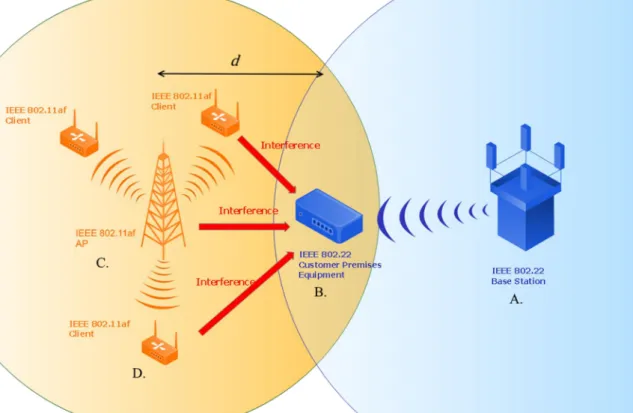
In this thesis, it is assumed that two networks, IEEE 802.11af and IEEE 802.22, are operating in the same frequency and PUs are protected from interference with GLDB. In the model, IEEE 802.11af WLAN consists of access point (AP) and clients (Cs), while IEEE 802.22 WRAN consists of base station (BS) and customer premises equipment (CPE). Since these two networks are heterogeneous, IEEE 802.11af signals cannot be resolved by IEEE 802.22 devices which results in packets loss in both networks. This problem is also known as “hidden terminal problem” and depicted in Figure 3.1.
IEEE 802.22 BS located at point A is communicating with IEEE 802.22 CPE is located at point B, while IEEE 802.11af AP located at point C is communicating with IEEE 802.11af client located at point D. The uplink operation of CPE will not be interfered due to the distance of BS to AP, but the downlink operation is likely to be interfered. If the signal coming from point A to point B becomes weaker than signals from point C or point D, then communication of IEEE 802.22 will stop working properly. When deplo-
14
ying these two networks together it is important to consider a safe distance between IEEE 802.22 CPE and IEEE 802.11af AP.
It is assumed that IEEE 802.11af and IEEE 802.22 are both operating at maximum transmit power levels, and , respectively (Federal Communications Commission, 2010), the received signal power under ideal conditions (i.e., no shadowing effect) at point B transmitted by a device at point A can be calculated as
=
+
(3.1)where represents the path loss between point A and B according to HATA path loss model. HATA path loss model is used to determine path loss between devices as
=
− 4.78(log ( )) + 18.33 log ( ) −
(3.2)= 69.55 + 26.16 log ( ) − 13.82 log (ℎ ) − (ℎ )
+(44.9 − 6.55 log (ℎ )) log ( )
(3.3)(ℎ ) = 3.2(log (11.75ℎ )) − 4.97
(3.4)where is the distance between devices in km, is the operating frequency, ℎ and ℎ are the transmitter and receiver antenna heights in meters respectively. is defined as 35.94 for rural environments (Goldsmith, 2005).
Furthermore, the signal-to-interference-ratio (SIR) at point B due to interference level from WLAN devices in Fig. 3.1 (AP or Clients) can be calculated as
15
Where
∈ {
,
}
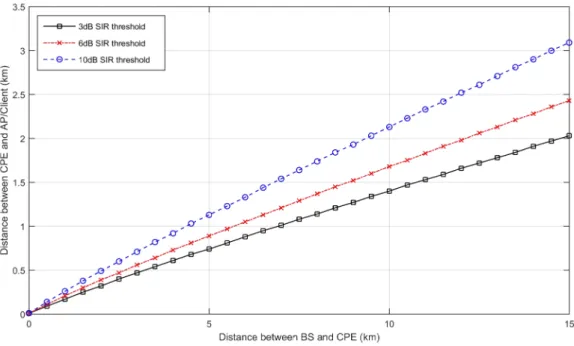
can be similarly calculated as in (3.1) for the AP and Clients.When no distortion (i.e. shadowing is neglected) is considered, the safe to talk distance between IEEE 802.11af AP and IEEE 802.22 CPE can be calculated by formulas 3.1 to 3.5 with respect to distance between IEEE 802.22 BS and IEEE 802.22 CPE. The calculated safe distances for different SIR thresholds are given in the Figure 3.2. The threshold is determining the certain SIR value calculated as 3.5 where below values cannot be accepted for safe communication.
Figure 3.2: Safe to talk distances between IEEE 802.11af AP and IEEE 802.22 CPE with respect to distances between IEEE 802.22 BS and IEEE 802.22 CPE
For example, when SIR threshold is assumed as 6 dB, when the distance between IEEE 802.22 BS and IEEE 802.22 CPE is 5.71 km, safe to talk distance between IEEE 802.22 CPE and IEEE 802.11af AP calculated as 1 km. So, when AP is at any distance less than 1 km to CPE could cause a possible interference. Thus, these ranges should be strictly obeyed for professional deployments, which is unlikely for the purpose of WLAN systems and wide coverage in TVWS. Otherwise, there must be an algorithm to prevent SU interference.
16 3.3. BT Based Power Control Algorithm
In this thesis, BT based power control coexistence algorithm aims to decrease interference to IEEE 802.22 WRAN to a reasonable level and maintain IEEE 802.11af WLAN communication. To achieve this aim, power adjustment algorithm has to ensure two things:
1) Minimize the power of IEEE 802.11af equipment
2) Maintain the power of IEEE 802.11af equipment at a level that IEEE 802.11af network communication will still be able to continue
To ensure these two things, IEEE 802.22 CPE is assumed to be constantly broadcasting BT signal to the medium so that when IEEE 802.11af equipment hear the BT, they could sense that there is an IEEE 802.22 network exist.
17
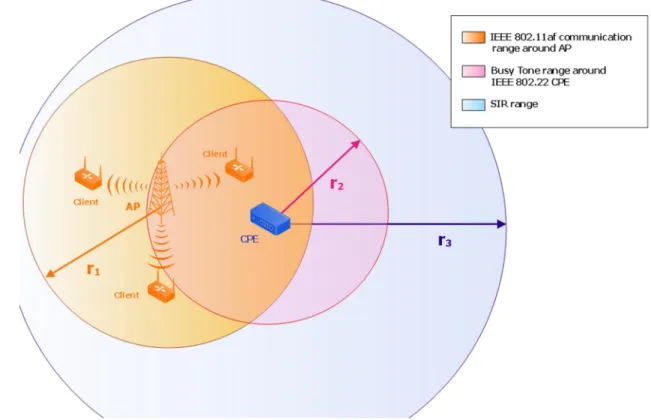
It is assumed that IEEE 802.11af clients are uniformly distributed around IEEE 802.11af AP when no shadowing effect is considered. In Figure 3.3 it is depicted that AP and clients could be at a maximum range where this range is named as communication range around IEEE 802.11af AP. IEEE 802.22 is constantly sending BT signal with a range of and if any of IEEE 802.11af equipment in that range can detect BT signal. Finally, is the SIR distance around IEEE 802.22 CPE.
When any of the equipment of IEEE 802.11af network is in a range out of SIR range, there is no possible interference occurs at IEEE 802.22 systems. However, when any IEEE 802.11af equipment gets closer to the IEEE 802.22 CPE, possibility of interference increases. If an IEEE 802.11af gets in range of SIR but senses the BT sent by IEEE 802.22 CPE can react in a way to decrease interference possibility. In thesis, different from earlier works, it is offered that after BT sensed by IEEE 802.11af devices, these devices do not stop communication but adjust their transmit power at a level that protects both IEEE 802.22 systems and IEEE 802.11af systems can communicate.
In the previous section, received signal power and SIR calculations are given with the formulas (3.1) and (3.5) respectively. It is assumed that or is known by AP or client. Also, pathloss between AP and a certain client is known since the received power is known. In this thesis it is offered that the new transmit power of the IEEE 802.11af AP is calculated as:
=
+ λ
+
(3.6)where λ is the communication threshold for IEEE 802.11af systems. This means that any signal received under this level of power cannot be successfully maintain communication. This is a heuristic approach since is not known by the AP, however, in any case the transmit power of AP and/or clients will be 20 dBm or less when transmitting. If the new calculated transmit power is above 20 dBm, 802.11af AP
18
or clients will be silent. Improved results will be presented in the following sections. The algorithm of the power adjustment algorithm is shown in Algorithm 1.
Since power adjustment is determined by Algorithm 1, behavior of networks must be considered in coexistence situations. It is difficult to achieve collision-free communication only by fixed professional deployment since the Clients may be mobile and the AP may not know the presence of the CPE.
When any of IEEE 802.11af equipment senses the busy tone, not only the one which hears the BT but all of the IEEE 802.11af equipment adjust their power according to Algorithm 1. It is assumed that if AP hears the BT it informs all clients to adjust their power, or if any of the clients hear BT, firstly it informs AP and then AP informs all of the clients to adjust their power. When powers are adjusted, it is still be possible that IEEE 802.11af network cause interference to IEEE 802.22. If SIR between AP/or clients and CPE is less than a certain threshold λ it is assumed that there is a possible interference occurs. Offered algorithm is shown in Algorithm 2.
Since the aim is to balance the protection of IEEE 802.22 and still make IEEE 802.11af network to operate it is accepted as a trade-off. Since the new calculated power cannot be more than 20 dBm, most of the time the new calculated power would cause less interference than no algorithm is used.
Algorithm 1 : Power Adjustment Algorithm
1: while PC = true do2: if equipment = AP then
3:
←
+ λ
+
4: else
5: if equipment = Client then
6:
←
+ λ
+
7: if > 20 then
19 3.4. Simulation Results
To evaluate the performance of the system, two main performance metrics considered; interfering packet rate (IPR) and packet transmission rate (PTR). IPR is the ratio of packet interferences that caused by IEEE 802.11af AP and clients packets to IEEE 802.22 CPE packets. In the MAC layer of IEEE 802.11af, Carrier Sense Multiple Access with Collision Avoidance (CSMA/CA) protocol is used to prevent packet interference within the network by sending request-to-send (RTS), clear-to-send (CTS) and acknowledgment (ACK) protocol messages (The Institute of Electrical and Electronics Engineers, 2013). This way, data packets of both in the uplink and downlink signals are protected and reliable communication can be sustained. However, these protocol messages may often collide with another protocol message in the same network, or they may interfere with the IEEE 802.22 CPE packets. In this thesis, only the uplink signal of CPE is considered as interference to data packets and ACK
Algorithm 2 : Power Adjustment Algorithm
1: while PC = true do2: if AP hears BT then
3: AP adjust the power according to Power Adjustment Algorithm
4: SIR calculated between AP and CPE 5: SIR calculated between clients and CPE
6: if −
<
then7: 1 possible packet loss
8: if −
<
then9: 1 more possible packet loss
10: if C hears BT then
11: Client informs AP about existing BT signal 12: Clients and AP adjust their powers
13: SIR calculated between AP and CPE 14: SIR calculated between clients and CPE
15: if −
<
then16: 1 possible packet loss
17: if −
<
then20
messages in IEEE 802.11af network and collisions with RTS and CTS protocol messages are neglected. In order to calculate successful packet transmission in both networks, tolerable SIR threshold within the IEEE 802.11af network is assumed as 3dB, where both data and ACK signal powers must be above the threshold at the same time at the receiver side. Upon successful execution of the algorithm, if the IEEE 802.11af network is able to move to an available frequency band, the packet transmission will not be interfered by the IEEE 802.22 network.
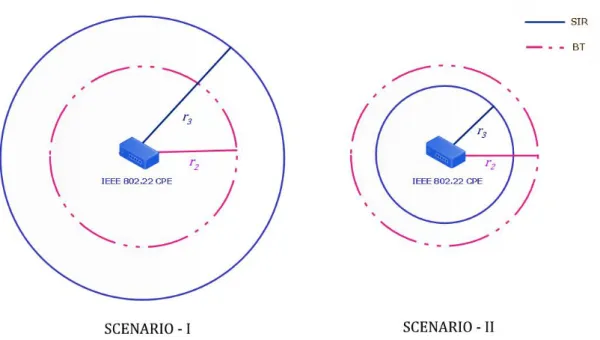
Since IPR depends on different combinations of , and shown in Figure 3.3, two different scenarios are considered. Since the communication range of IEEE 802.11af AP and the busy tone signal coverage of IEEE 802.22 CPE do not change, SIR range is the identifier for these scenarios. In the first scenario, it is assumed that > > due to the distance between IEEE 802.22 BS and IEEE 802.22 CPE. In the second scenario, distance between BS and CPE is decreased and > > is considered. Both scenarios are shown in Figure 3.4.
Figure 3.4: Two scenarios with different SIR ranges
Two cases offer two different points of view. In the first scenario, IEEE 802.11af devices might be in SIR range while there is a high possibility not to hear BT signal.
21
Therefore, there is a high possibility of interference to IEEE 802.22 CPE. In the second scenario, IEEE 802.11af devices sense the BT signal if any of the devices in SIR range. Thus, power control algorithm would operate and decrease possible interference probability.
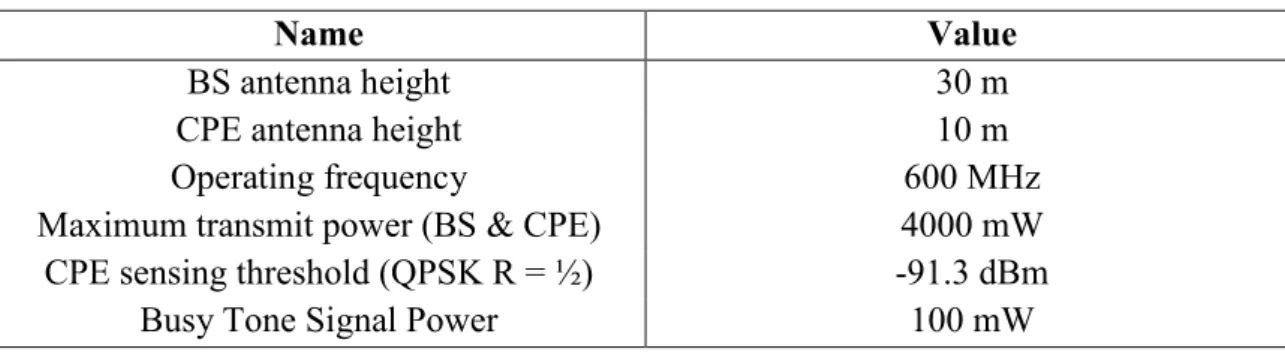
The system values used in simulations are given in the Table 3-1 for IEEE 802.11af and in the Table 3-2 for IEEE 802.22. These values are chosen according to standards (The Institute of Electrical and Electronics Engineers, IEEE Std 802.11af, IEEE Standard for information technology, 2013), (The Institute of Electrical and Electronics Engineers, IEEE Std 802.22, IEEE Standard for local and metropolitan area networks, 2011).
Table 3-1: IEEE 802.11af system parameters
Name Value
AP antenna height 1 m
Client(s) antenna height(s) 1 m
Operating frequency 600 MHz
Maximum transmit power (AP & Clients) 100 mW Sensing Threshold (AP & Clients) (QPSK R = ½) -85 dBm
Table 3-2 : IEEE 802.22 system parameters
Name Value
BS antenna height 30 m
CPE antenna height 10 m
Operating frequency 600 MHz
Maximum transmit power (BS & CPE) 4000 mW
CPE sensing threshold (QPSK R = ½) -91.3 dBm
Busy Tone Signal Power 100 mW
It is assumed that clients of IEEE 802.11af are uniformly distributed and the clients are randomly chosen for the simulations. According to system parameters given in Table 3-1 and Table 3-2, IEEE 802.3-13-1af AP coverage area is a circle with radius of 425 meters. Operating frequencies are both 600 MHz and IEEE 802.11af systems and IEEE 802.22 systems are co-channel coexist. It means that they are both at the same channel and it is
22
assumed that there is no available other channels exist so that any of IEEE 802.11af device can adjust its channel by using CR feature. Given busy tone signal power creates 300 meters range around IEEE 802.22 CPE. Therefore, for both scenarios mentioned in Figure 3.4 is 300 meters. SIR threshold is chosen as 6 dBm. For scenario 1, IEEE 802.22 BS is assumed to be 5.71 km away from IEEE 802.22 CPE so that SIR range for scenario 1 is 1km. For scenario 2, IEEE 802.22 BS is assumed to be 1.24 km away from IEEE 802.22 CPE which creates 250 meters of SIR range. For both scenarios and these system parameters, calculated new powers of IEEE 802.11af AP and clients are given in Appendix A (see Table A-1).
It is assumed that downlink packet numbers and uplink packet numbers are equal and total packets of 1000 is transmitted at IEEE 802.22 system.
In the first scenario, four different regions exist.
1. Where Distance between IEEE 802.11af AP and 802.22 CPE ( - ) is less than
300 meters (where BT is heard definitely).
2. Where 300 m ≤ - ≤ 725 m (because of the client distribution around AP, so
that BT might be heard by any IEEE 802.11af devices)
3. Where 725 ≤ - ≤1425 m (where BT is not be heard by any IEEE 802.11af
devices but possible interferences happen due to SIR range)
4. Where - ≥ 1425 m (No possible interference will happen)
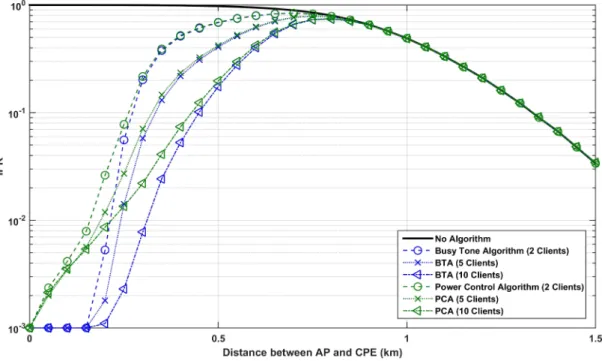
Figure 3.5 shows the IPR results for IEEE 802.11af. In Figure 3.5, power control algorithm is compared with two different cases. The first case is when no algorithm applied and the second case is the busy tone algorithm (BTA) from (Karatalay et al, 2015).
23
Figure 3.5: Comparison of IPR results in scenario 1
In the first region (≤ 300 m), since BT is heard by AP power control algorithm operates. It is observed that IPR decreased around 100 to 1000 times when compared to no algorithm case. In the second region (≥ 300 m, ≤ 725 m), clients hear BT and informs AP about existing BT and power control algorithm operates. It is shown that, power control algorithm and BTA results are close in the second and third region but when the number of clients increase, the difference between PCA and BTA also increases.
24
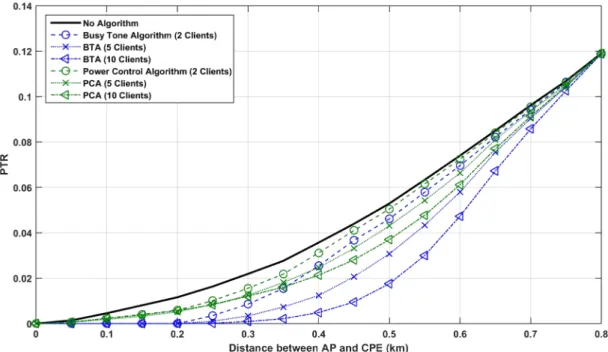
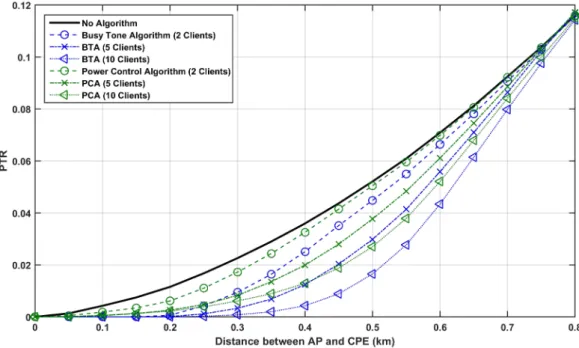
As a trade-off, PTR results show that IEEE 802.11af devices continue to communicate with PC algorithm unlike BT algorithm. In Figure 3.6, it is shown that packet transmission continues even when IEEE 802.22 CPE and IEEE 802.11af AP is very close. For example, when CPE and AP 100 meters away from each other and number of clients is 5, in BTA there is no communication occurs in IEEE 802.11af system, but in PCA, the results show that IEEE 802.11af devices’ packet transmission rate is more than 50% of the results when no algorithm is used. Figure 3.6 also shows that the more clients exist the more efficient the algorithm gets compared to BTA. For instance, at 400 meters, when 2 clients considered PCA offers 20% better results while when 10 clients considered algorithm offers almost 10 times better results than BTA.
On the other hand for the second scenario, three different regions exist.
1. Where - ≤ 300 m (where BT is heard definitely)
2. Where 300 m ≤ - ≤ 725 m (because of the client distribution around AP, so
that BT might be heard by any IEEE 802.11af devices)
3. Where - ≥ 725 m (No possible interference will happen)
In Figure 3.7, for second scenario, power control algorithm IPR results also compared with BT algorithm in “Karatalay, Erküçük, & Baykaş, Analysis of extended busy tone performance for coexistence between WRAN and WLAN TVWS networks, 2015” and no algorithm applied.
Since SIR range is less than BT range, every device in SIR range hears BT. This improves IPR results when compared to scenario 1. Figure 7 shows that IPR results never exceed 10-2 for power control algorithm while if no algorithm is applied results do not reach 10-2 even at 600 meters distance between AP and CPE. In this scenario no algorithm used case is outperformed by power control algorithm in every region for IPR.
25
Figure 3.7: Comparison of IPR results in scenario 1
Figure 3.8 shows PTR results for scenario 2. Results show that PCA offers continuity of communication for IEEE 802.11af in scenario 2 in just the same way as scenario 1. After 400 meters, 2 clients’ results show that PCA algorithm results almost same with no algorithm used. Also increasing number of clients increases the efficiency of algorithm when compared to BTA.
26
However, since the shadowing effect and probabilistic client distributions are not considered, these results are difficult to apply in real life. Therefore, in the next subsection by considering more realistic conditions, IPR and PTR results are given for power control algorithm and compared to older works.
3.5. IPR and PTR Results Under Realistic Conditions
In this chapter, realistic channel models with probabilistic client distributions including shadowing effect are considered and improved simulations results for IPR and PTR are provided. Including the effect of shadowing on the channel, the received signal power at point B transmitted by a device at point A in Figure 3.1 can be calculated as
=
+
+
(3.7)where
η
is log-normal shadowing(0,
)
and represents the pathloss between any given points A and B. Also, SIR value between two stations can be found similarly as in (3.5).27
The system values are the same with the previous section (see tables 3-2 and 3-3) but due to log-normal shadowing and probabilistic client distribution, BT and SIR ranges change. One case is investigated for two scenarios: 10 dB log normal shadowing for scenario 1 and scenario 2.
For probabilistic client distribution, model in (Karatalay, Erkucuk, & Baykas, Busy Tone Based Coexistence Algorithm for WRAN and WLAN Systems in TV White Space, 2018) is used,
( ) =
( ( ))
∫ ( ) (3.8)
where ( ) is the probability of a client be at a distance r from AP. ( ) is the communication threshold of IEEE 802.11af. is the maximum transmit power of IEEE 802.11af, ( ) is the pathloss between IEEE 802.11af AP and the client, and finally successful connection probability between AP and client ( ) which is calculated as
( ) =
( ( )) (3.9)Where
is the standard deviation of shadowing effect.
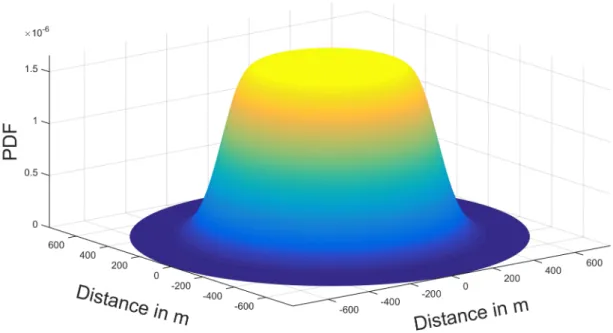
By using (3.8) and (3.9), the obtained probabilistic client distribution of IEEE 802.11af network around AP under 10 dB log-normal shadowing is given in Figure 3.9. It is shown that, the probability of a client to be successfully connected AP is higher when the distance between client and AP decreases.
28
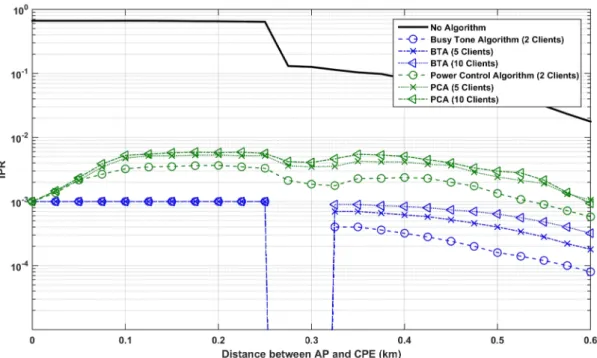
Figure 3.10 : IPR results for scenario 1 under 10 dB log-normal shadowing
In Figure 3.10, IPR results for scenario 1 under 10 dB log-normal shadowing are given. When compared to no shadowing results, smoother results are obtained. It is seen that BT is heard by AP in region less than 300 meters due to the effect of shadowing. Also in Figure 3.11, PTR results are given for scenario 1 under 10 dB log-normal shadowing. In every case, PCA results outperform BTA results in PTR.
29
Figure 3.12: IPR results for scenario 2 under 10 dB log-normal shadowing
In Figure 3.12, IPR results for scenario 2 under 10 dB log-normal shadowing are given. Under shadowing effect, IPR of PCA increases until AP leaves SIR range, and then IPR is constantly decreasing for all number of clients. In Figure 3.13, PTR is shown for scenario 2 under 10 dB log-normal shadowing. In every number of clients, PCA results are better than BTA results for PTR.
30
4. BT BASED COEXISTENCE WITH MULTIHOP
COMMUNICATION
In this chapter a new approach is proposed to decrease IPR and increase PTR by using multihop communication with power control. This algorithm is built on the power control algorithm but using more than one hop to decrease IPR while increasing PTR.
4.1. BT Based Multihop Algorithm with Power Control
While power control algorithm offers some improvement, because of the physical constraints the improvement is limited. Power adjustment solution is not the only way to solve the problem, therefore another solution is proposed. With a network based approach it is possible to improve both IPR and PTR results.
The main idea behind BT based multihop algorithm with power control is to decrease the distance between AP and client so that the pathlosses would decrease and the power control formula (3.6) gives a smaller signal power for signal transmission. This way the interference caused by IEEE 802.11af AP and clients to 802.22 CPE will decrease while the communication is not affected and even improved.
To summarize the algorithm, three figures are given. In Figure 4.1, there are two types of nodes which are clients and AP. Four IEEE 802.11af clients ( , , , ) and one IEEE 802.11af AP exist. The blue dashed-line circle represents the communication range of AP, while red dashed-line circle represents the communication range of client . The red and green circles around client nodes show if the corresponding node is able to communicate with AP without interfering to IEEE 802.22 CPE. When tries to communicate with AP, but even by using power control algorithm, it is not possible.
With Algorithm 3, monitors and saves the neighborhood clients and sorts the clients according to distance by using GLDB feature.
31
Figure 4.1: IEEE 802.11af AP and clients
As shown in Figure 4.2, there are two possible neighbors of exist in the communication range of which are called and . This time, choose the best possible neighbor. Since the closest neighbors of is stored, aim is to search neighbors and eventually have a node with both close and not interfering to IEEE 802.22 CPE, so that the minimum power is used to communicate with AP.
Algorithm 4 shows how to find the best possible neighbor that will act as relay and multihop communication occurs with controlled powers.
Algorithm 3 : The Closest Neighbor Algorithm
1: for clients do2: Location information of clients acquired 3: for client locations do
4: Neighbor clients listed and stored as sorted by distance
32
Figure 4.2: IEEE 802.11af Neighbors
In Figure 5.3 representation of a client's relay acting given. acts as relay so communicates AP without creating interference to IEEE 802.22 CPE.
Algorithm 4 : Multihop Communication Algorithm
1: for clients do2: Closest Neighbor Algorithm operates
3: The closest neighbors stored and listed 4: for neighbors do
5: the communication with AP is checked 6: if Communication = true then
7: The closest neighbor acts as a relay 8: Power Control algorithm operates
33
Figure 4.3: Successful multihop communication
4.2. Simulation Results
For the simulation and channel models, same parameters with power control algorithm are used (see chapter 3). HATA pathloss model is used to calculate the pathlosses between devices. It is assumed that two hop is considered as multihop, and more than two hops are not considered.
For the given system variables, two different scenarios in Figure 3.4 are considered. After the simulation results are obtained, these results are also compared with BT based power control algorithm offered in chapter 3 and also with no algorithm used situation.
In Figure 4.4, IPR results for 2, 5, 10 and 20 clients are given for both PCA and multihop algorithm with power control (MHA). IPR offers slightly better results, since the relay client will decrease the distance between AP and the desired client. Although, the less the number of clients, the better IPR results get for scenario 1.
34
Figure 4.4: IPR results for multihop communication in scenario 1
PTR results for scenario 1 are given in Figure 4.5. It is observed that the number of clients’ increase affects MHA positively. For example, at 500 meters distance between AP and CPE, it is observed that 2 clients’ results does not have much difference, while for 20 clients, MHA offers better results up to 20%.
35
Figure 4.6: IPR results for multihop communication in scenario 2
IPR and PTR results for scenario 2 are given in Figure 4.6 and Figure 4.7 respectively. It is observed that, MHA results even better in scenario 2 in PTR. For instance, at 500 meters, for 20 clients, MHA almost performs 70% better than PCA.
36
5. CONCLUSION
5.1. Summary of ThesisIn this thesis, BT based power control algortihm and multihop algorithm with power control are proposed to limit the interference in the coexistence between cognitive based IEEE 802.11af and IEEE 802.22 networks operating in TVWS. The proposed algorithms are verified by simulations for two different scenarios.
i) when BT range is smaller than SIR range under no shadowing and uniform client distribution
ii) when BT range is greater than SIR range under no shadowing and uniform client distribution
Also proposed BT based power control algorithm is verified by simulations under log-normal shadowing and realistic client distribution for two different scenarios.
The proposed algorithms compared with an older work propose BT based blind silence algorithm. Results show that with the proposed algorithms in this thesis, both networks continue to communicate while interfering packet rates improved when compared to no algorithm used.
The deployment of the proposed algorithm is important or TVWS coexistence considerations and it can be extended to coexistence of other cognitive radio based networks.
37 5.2. Future Work
This thesis focused on power control and multihop communication based solutions. Since multihop communication considered is just with two hops in this thesis, in the future works more hops would be considered to decrease IPR while increasing packet transmission. Also time-scheduling among two networks is another solution for coexistence of both networks. Another approach might be to use a different MAC protocol implementation for IEEE 802.11af to decrease interference to IEEE 802.22 network.
38
REFERENCES
Abramson, N. (1970). THE ALOHA SYSTEM—Another alternative for computer communications. Fall Joint Computer Conference, (s. 281-285). Houston, TX. Alam, M. M., Bhattarai, S., Hong, L., & Shetty, S. (2016). Robust cooperative
beamforming against steering vector uncertainty in cognitive radio networks.
IEEE Consumer Communications & Networking Conference (s. 656-661). Las
Vegas, USA: IEEE.
Banerji, S., & Chowdhury, R. S. (2013). On IEEE 802.11: Wireless LAN Technology.
International Journal of Mobile Network Communications & Telematics (IJMNCT) .
Baykas, T., Kasslin, M., Cummings, M., Kang, H., Kwak, J., Paine, R., et al. (2012). Developing a standard for TV white space coexistence: technical challenges and solution approaches. IEEE Wireless Communications.
Dong, J., & Smith, D. (2014). Joint relay selection and transmit power control for wireless body area networks coexistence. Communications (ICC), IEEE
International Conference on. Sydney, NSW, Australia: IEEE.
Federal Communications Commission. (2010). Second Memorandum Opinion and
Order. Washington, D.C.
Feng, X., Zhang, Q., & Li, B. (2013). Enabling co-channel coexistence of 802.22 and 802.11af systems in TV White Spaces. Communications (ICC), IEEE
International Conference on (s. 6040-6044). Budapest, Hungary: IEEE.
Goldsmith, A. (2005). Wireless Communications. Cambridge University Press. GSMA. (2017). The Mobile Economy. London: GSM Association.
Haas, Z., & Deng, J. (June 2012). Dual busy tone multiple access (DBTMA)-a multiple access control scheme for ad hoc networks. IEEE Transactions on
Communications ( Volume: 50, Issue: 6), 975-985.
Hart, J. A. (2004). Technology, Television, and Competition: The Politics of Digital TV. New York: Cambridge University Press.
Huang, Z., Shen, C.-C., Srisathapornphat, C., & Jaikaeo, C. (2002). A busy-tone based directional MAC protocol for ad hoc networks. MILCOM Proceedings.
39
Jeong, K., Lim, H., & Kang, H. (2015). Power control for cognitive users in coexistence with CSMA-based primary networks. Information Networking (ICOIN),
International Conference on. Cambodia, Cambodia: IEEE.
Julio, E. P., & Albuquerque, C. (2015). Power control and channel allocation
mechanism for coexistence between secondary cognitive networks. Computers
and Communication (ISCC), IEEE Symposium on. Larnaca, Cyprus: IEEE.
Kang, H., Lee, D., Jeong, B.-J., & Kim, A. C. (2011). Coexistence between 802.22 and 802.11af over TV white space. ICT Convergence (ICTC), International
Conference on. Seoul, South Korea: IEEE.
Kang, X., Liang, Y.-C., Nallanathan, A., Garg, H. K., & Zhang, R. (2009). Optimal power allocation for fading channels in cognitive radio networks: Ergodic capacity and outage capacity. IEEE Transactions on Wireless Communications, 940 - 950.
Karatalay, O., Erkucuk, S., & Baykas, T. (2018). Busy Tone Based Coexistence Algorithm for WRAN and WLAN Systems in TV White Space. IET
Communications. doi:10.1049/iet-com.2017.0740
Karatalay, O., Erküçük, S., & Baykaş, T. (2015). Analysis of extended busy tone performance for coexistence between WRAN and WLAN TVWS networks.
Personal, Indoor, and Mobile Radio Communications (PIMRC), IEEE 26th Annual International Symposium on (s. 1957-1962). Hong Kong, China: IEEE.
Karatalay, O., Erküçük, S., & Baykaş, T. (2015). Busy tone implementation for coexistence of IEEE 802.22 and 802.11af systems. Signal Processing and
Communications Applications Conference (SIU), 23th. Malatya, Turkey: IEEE.
Kim, H. (2015). Wireless Communications Systems Design. John Wiley & Sons, Ltd. Kolodziej, K. E., & Perry, B. T. (2016). Simultaneous transmit and receive (STAR)
mobile testbed. Radio and Wireless Symposium (RWS) (s. 66-69). Austin, TX, USA: IEEE.
LeFloch, B., Alard, M., & Berrou, C. (1995). Coded orthogonal frequency division multiplex [TV broadcasting]. Proceedings of the IEEE, 982 - 996.
Lekomtcev, D., & Maršálek, R. (2012). Comparison of 802.11af and 802.22 standards – physical layer and cognitive functionality. Elektrorevue, 12-18.
Li, X.-Y. (2008). Wireless Ad Hoc and Sensor Networks: Theory and Applications. Cambridge University Press.
Li, Y., Li, M., & Wu, M.-Y. (2007). An Interference-Aware Busy Tone Based MAC Protocol. Vehicular Technology Conference, 2007. VTC2007-Spring. IEEE 65th. Dublin, Ireland: IEEE.
40
MacKenzie, A. B., Reed, J. H., Athanas, P., Bostian, C. W., Buehrer, R. M., DaSilva, L. A., et al. (2009). Cognitive Radio and Networking Research at Virginia Tech.
Proceedings of the IEEE, 660 - 688.
Mizutani, K., & Harada, H. (2014). Adaptive time-domain windowing based transmit power control for TVWS-WLAN systems. Wireless Communications and
Networking Conference (WCNC) (s. 259-263). Istanbul, Turkey: IEEE.
Mody, A. N. (2015). IEEE 802.22 Wireless Regional Area Networks. IEEE.
Narang, N., & Kasera, S. (2006). 2G Mobile Networks: GSM and HSCSD. McGraw Hill Education.
NCR Corporation. (1990,1991). WaveLAN PC-AT Installation and Operations manual,
part number ST-2119-09, revision number 008-0127167. NCR.
Nekovee, M. (2012). Autonomous spectrum sharing in heterogeneous White Space networks. Network Infrastructure and Digital Content (IC-NIDC), 3rd IEEE
International Conference on. Beijing, China: IEEE.
Ock, J., Choi, Y.-J., & Bahk, S. (2014). Performance Analysis of Periodic Busy Tones Protecting a ZigBee Network from Wi-Fi Interruption. Vehicular Technology
Conference (VTC Spring) (s. 1-5). Seoul, South Korea: IEEE.
Oh, S. W., & Chai, C. C. (2013). Geo-location database with support of quality of service for TV White Space. Personal Indoor and Mobile Radio
Communications (PIMRC), 2013 IEEE 24th International Symposium on.
London, UK: IEEE.
Oh, S. W., Ma, Y., Tao, M.-H., & Peh, E. (2016). TV White Space: The First Step
Towards Better Utilization of Frequency Spectrum. Wiley-IEEE Press.
Sum, C.-S., Zhou, M.-T., Lu, L., Kojima, F., & Harada, H. (2014). Performance and coexistence analysis of multiple IEEE 802 WPAN/WLAN/WRAN systems operating in TV White Space. Dynamic Spectrum Access Networks (DYSPAN),
2014 IEEE International Symposium on. McLean, VA, USA: IEEE.
Sun, C., Villardi, G. P., Lan, Z., Alemseged, Y. D., Tran, H. N., & Harada, H. (2012). Coexistence of secondary user networks under primary user constraints in TV white space. Wireless Communications and Networking Conference (WCNC),
2012 IEEE. Shanghai, China: IEEE.
Tawk, Y. A., Constantine, J., & Christodoulou, C. G. (2014). Cognitive-radio and antenna functionalities: A tutorial [Wireless Corner]. IEEE Antennas and