DE HISTORIA
UROLOGIAE EUROP
AEAE 25
Historia Urologiae Europaeae series is addressed to all European urologists. Its aim is to make known the ideas and the work of our predecessors, and to help us understand the cur-rent trends in the development of our speciality. Unfortunately, the treatises written in Sanskrit, ancient Chinese, Greek and Latin are both dif-ficult to find and difdif-ficult to understand, and should, therefore, be translated into English. The same applies to more recent books published in various languages.
Most of the treatises produced before
the 17th century, even the legendary ones, have
gaps, mistakes and inconsistencies. Modern scientific research allows us to re-evaluate this ancient knowledge and examine it from new perspectives. The History Office of the EAU in collaboration with internationally based urolo-gists, historians, philologists and other experts, conducts research, accumulates and shares this fascinating information in their annual publica-tion, Historia Urologiae Europaeae.
“Remember the days of old, consider the years of many generations, ask thy father, and he will shew thee; thy elders, and they will tell thee.” (Deuteronomy 32:7)
DE HISTORIA
UROLOGIAE EUROPAEAE
De Historia
Urologiae Europaeae
Volume 25Edited by:
Philip Van Kerrebroeck
25th Anniversary Co-Editors:
Johan Mattelaer and Dirk Schultheiss
The History Office of the EAU
P.E.V. Van Kerrebroeck (Chairman) Maastricht (NL)
C. Alamanis Athens (GR)
L.A. Fariña-Pérez Vigo (ES)
J.F. Felderhof The Hague (NL)
J.C. Goddard Leicester (GB)
R. Jungano Naples (IT)
F.H. Moll Cologne (DE)
I. Romics Budapest (HU)
D. Schultheiss Giessen (DE)
R. Sosnowski Warsaw (PL)
P. Thompson London (GB)
A. Verit Istanbul (TR)
N.M. Fredotovich (CAU representative) Buenos Aires (AR) M.E. Moran (AUA representative) Linthicum, MD (USA)
Contents of Volume 25 de Historia Urologiae Europaeae
(2018)
Foreword 7
Chris Chapple
Introduction 9
Philip Van Kerrebroeck
In Memoriam: Rainer Engel (1933-2018) 14
Johan Mattelaer and Dirk Schultheiss
Comment to Prof. Chaussy’s article on
ESWL in De Historia Vol. 24 16
The Ernest Desnos Prize
Ernest Desnos (1852-1925): Pioneering Urologist 19
and the First Urological Historian
Philip Van Kerrebroeck
Sergio Musitelli: Inaugural Winner of the EAU 27
Ernest Desnos Prize for Contributions to the History of Urology
Philip Van Kerrebroeck
A Historical Survey of Human Generation 31
The 25th Anniversary
Witches and Sex, Cats and Stolen Phalluses in 81
Medieval and Renaissance Europe
Johan J. Mattelaer
The Portrait of Dr. Hans Haustein 99
Dirk Schultheiss
The Bollock Dagger: The Ultimate Urological Weapon? 107
Philip Van Kerrebroeck
The History of Urology
The Phallic Depictions of Newly-Discovered 117
Prehistoric Cave Art in Asia Minor
Ayhan Verit, Murat Durukan, Serdar Girginer
The Douglas Brothers and Bladder Stone Surgery in 125
Enlightenment England
Jonathan C. Goddard
Obstructive Pyohydronephrosis and Life-Saving 141
Intervention of the Greatest Theatre Star of All Time- Sarah Bernhardt
Michael E. Moran
Antoni Jurasz - Forced Cosmopolite. How the 169
political turbulences dramatically influenced and ruined the career of a surgeon
The Persecution of Basque Republican Urologists 195
by the Franco Regime for their Involvement in the Founding of the Basque Country University
Javier C. Angulo
Urology Behind the Iron Curtain from 1945-1990: 211
A Personal Perspective
Foreword
Welcome to 25th Anniversary Edition of de Historia Urologiae Europaeae! To celebrate this remarkable milestone, all three editors of the past 25 years were involved in the production of this volume, also contributing an article each. Furthermore, this year sees the first time that the EAU Ernest Desnos Prize is awarded for services to the field of the history of urology. The EAU is proud to support the exploration and documentation of our field’s long and distinguished past. Read all about Ernest Desnos and this year’s win-ner in the coming pages.
In addition, this volume contains a wonderful variety of other topics. Ayhan Verit takes us to Asia Minor to discover human depictions with phallus, as they are found in prehistoric caves in that part of the world. Jonathan Goddard presents a chapter on the Douglas brothers. We all know these brothers because of their eponym (the pouch of Douglas), but Jonathan clearly indicates that their value goes beyond the small pelvis!
It is a unique opportunity that we can publish the article on Sarah Bernardt by Mike Moran, historian of the History Office of the American Urological Association (AUA). This article not only illustrates how the history of Urology is not limited by continental borders, but is also an example of the excellent cooperation between the EAU History office and its American counterpart.
As World War II had a tremendous impact on urological colleagues in the whole of Europe, it remains important to remem-ber these terrible times and the consequences that are still felt today. Therefore I am pleased that two articles were included that touch on these events that in turn impacted on many urologists and in fact on urology itself. We close this volume with a highly personal account of European urology at the time of the iron curtain by veteran urologist Imre Romics.
My congratulations to the EAU History Office for this achievement. On to the next 25 years!
The Phallic Depictions of Newly-Discovered Prehistoric Cave Art in Asia Minor*
Ayhan Verit1, Murat Durukan2, Serdar Girginer3
1University of Health Sciences, Medical Faculty, Fatih Sultan Mehmet Hospital,
Dept. of Urology, Istanbul, Turkey,
2Mersin University, Faculty of Science and Literature, Dept. of Archeology, Mersin, Turkey 3Çukurova University, Faculty of Science and Literature, Dept. of Archeology, Adana, Turkey
In Turkey, even a routine dig during construction work can be interrupted with the finding of historical artefacts from Asia Minor’s past. News about the discovery of fantastic archeological findings is not so surprising for local citizens because they were regarded as ordinary events.
It was recently announced by an archeological society that cave art depicting human beings dated back to nearly 8,000 years ago had been discovered at the southern-most point of Anatolia. This was in the city of Mersin located in the Cilicia region of the East Mediterranean coast, more or less in the center of the old world. (Fig. 1)1,2 This cave, named Akyapı (Ala kapı), is located
at 750 meters above sea level, on the Mediterranean side of the Taurus mountain range.3 (Figs. 2A&B)
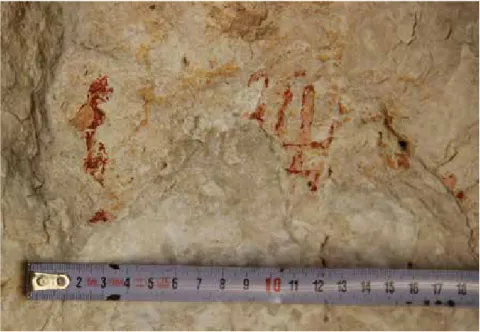
The archeologists of the survey area, Profs. Murat Durukan and Serdar Girginer, reported that these simple cave paintings had been drawn with red ocher composed of iron oxide and iron bind-ing liquid that was applied to rock via bare fbind-ingers or with simple tools.3,4 (Fig. 3) The cave harboring the rock art was supposed to
* This manuscript was presented at the 32nd Annual EAU Congress in London, March 24-28, 2017 and an earlier version was published in the Turkish Journal of Urology, 2017;43:553-555
1. “8,000-year-old cave paintings found in southern Turkey date back to the prehistoric era”. The Daily Sabah,
23 September, 2016. Online. https://www.dailysabah.com/history/2016/09/24/8000-year-old-cave-paintings-found-in-southern-turkey-date-back-to-the-prehistoric-era (Accessed 29 January, 2018)
2. “8,000 year old cave paintings found in southern Turkey”, Archeology News Network, 9 September, 2016.
Online. https://archaeologynewsnetwork.blogspot.com/2016/09/8000-year-old-cave-paintings-found-in. html#O6828ZYxdHfmrwzX.99 (Accessed 29 January, 2018)
3. Girginer S., Durukan M. Prehistoric Paintings in the Akyapı Cave in Mersin / Gülnar. OLBA (The Journal of
Figure 3: The paintings were drawn with red ocher, applied to the rock with bare fingers.
Figure 4: Cave art involving a simple drawing of a human being. Notice the phallus and its equivalence in lenght to the
Figure 5: Another example of the newly-discov-ered cave art: simple and symmetric with its
belong to the period of 6,000-5,000 BC in the timeline.2,3 However,
the authors of the archeological area were pointing to the difficulty of dating of drawings due to the presence of any known definitely dated evidence around these recent findings yet. Nevertheless, it was well known that the similar examples of Anatolia had been related with the Neolithic or Chalcolithic ages.3
The most basic property of the Neolithic age is food pro-duction. Archeologists think that this Neolithic, or Agricultural Revolution began in upper Mesopotamia. This region is known as the Fertile Cresent (Fig. 1) and includes the location of the cave in question. The start of this process is thought to have occurred during the period of 10,000-9,000 BC and spread to other parts of the world from there. The Neolithic period is regarded as big revolution of human social life and art, also marking the beginning of the settlement period of mankind.5 Although the exact timing
of this development can differ from region to region, even within a small area, the early Anatolian Neolithic age is thought to begin at 11,000 BC and matured at about 6,000 BC.6 Moreover, during
the early Neolithic age of Anatolia, the hill sides of the South East
Taurus Mountains, including the location of these caves, is thought
to have hosted a crowded human population of the time.7
The drawings
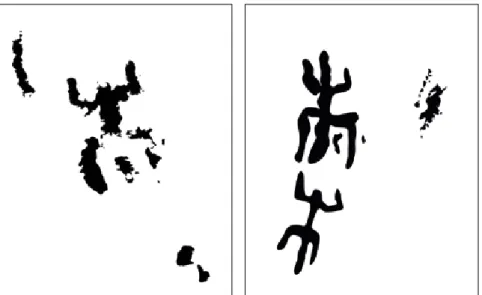
The figures drawn on the cave walls were mostly worn down by the passing of time. The cave features nearly 10 human figures, totally or partially preserved with a size of 10-30cm.3 The primitive
human figures are composed of head, torso, limbs and the phallus, which is pointing to the ground and almost the same size as the legs. (Figs. 4&5) The cave artists depicted their masterpiece without
4. “Mersin’deki Maōarada 8 Bin Yıllık Kaya Resimleri Bulundu”. Arkeolojihaber.net, 23 September 2016. Online:
http://arkeolojihaber.net/2016/09/23/mersindeki-magarada-8-bin-yillik-kaya-resimleri-bulundu (Accessed 29 January, 2018)
5. Schmidt K (Invited author). Preface. In. Göbeklitepe (Jager-Tempel am Bauchberg Göbekli Tepe). (ed.) Luckert KW. (In Turkish. Translator ed; Leyla Tonguç Basmacı) 2nd ed. ALFA Basımevi (ALFA Press), Istanbul, 2016;pp 7-11.
6. Mutluay N. Introduction. In: Anadolu neolitik çağ uygarlığı (Neolithic civilizations in Anatolia) (in Turkish).
Ankara-Turkey, Alter yayıncılık (Alter Press), Ankara, 2010;pp 7-21.
7. Sevin V. Neolitik çağ: Köyler ve köylüler (Neolithic age; Villages and villagers). In: Anadolu arkeolojisi
any exaggeration, that is to say that the proportions of the body are almost natural with the exception of the extraordinary phallus.
In regard to the link of Andrological science with Archeology, it should be emphasized that the phallus is a frequently appearing figure in ancient art. Thus, archeologists specially name objects with erect penis as “ithyphallic” figures. Ithyphallic figures are
common images of caves all over the world such as Lascaux cave
in the Dordogne (France), Zimbabwe and the Kakadu- (Northern
Australia), everywhere that prehistoric humans were settled.8
J.J. Mattelaer, after reviewing of related publications, con-cluded that prehistoric phallic presentations are thought to link strongly to concepts like ‘strength’ and ‘power’ and addition to ‘virility’ and ‘fertility’ and reported that the earliest known exam-ples of phallic images can be dated back to about 30,000 years ago.8
The earliest known “Cult center”, or place of worship is
Göbeklitepe-Sanliurfa (10,000 – 9,000 BC). It features sexual themes
dated back to the initial part of this period and is just 300km fur-ther East from the newly-discovered cave.9,10 Anatolian cave artists
did not hesitate to draw even (pregnant) women with phalluses
(Bafa –Latmos, 6,000 BC almost the same time, about 400 km
fur-ther West).11
While Latmos cave art represents both schematic and
natu-ralistic nature, (Fig. 6) the art in Akyapi cave is only schematic. According to scholars of this particular historic era, the subject matter of the art was indicating a specific human-like divine crea-tor due to the image impression that all figures were individual and had similar anatomic properties. (Figs.7A&B)3 Moreover, the
inter-8. Mattelaer JJ. The Phallus in Art. & Culture. 1st ed., Historical Committee European Association of Urology (EAU) Press, Arnhem-Netherlands, 2000;pp 12-15.
9. Verit A, Kurkcuoglu C, Verit FF, Kafalı H, Yeni E. Paleoandrologic genital and reproductive depictions in
earliest religious architecture: ninth to tenth millennium BC. Urology. 2005;65:208-10.
10. Hauptmann H. The Urfa region. In: Neolithic in Turkey/The cradle of Civilizations, New Discoveries.
M. Özdogan, and N. Basgelen (eds.) Arkeoloji ve Sanat Yayınları (Archeology and Art Press), Istanbul, 1999;pp 65-86.
11. Acar O. Anatolia, the motherland of the father god and mother goddess. In. The history of male-female
sexuality and fertility in Turkey. (eds.) Kendirci M, Kadıoglu A, Serefoglu EC, Cayan S, Turkish Society of Andrology Press, Istanbul, 2014;pp 45-85.
esting point was that the present prehistoric artists did not try to define any definitive event such as hunting, social relations etc. just the same human-like figures in a certain position with extraordinary phallus that might indicate belief in a prehistoric sacred creator. This point of view, also consolidate the argument that Akyapı cave
was a cult center.3
There are some indications that the figures are depictions of supernatural beings or creators. Despite of their simplicity, present cave paintings had the detail of phallus and even in a big size if it compared with other parts of the body and it was pointing to the ground. Until the Neolithic age, it was animals that were depicted as supernatural objects, and then, during the settlement period animals were replaced with (fertile) soil as a symbol of abundance.12
According to Mattelaer JJ., erected penis was regarded as the sym-bol of giver of life and linked with the creator of the Universe in the initial period of art.8
Thus we think that, present cave artists reflected their points of view that the erected penis via ejaculation vitalizes the soil as in the form of agricultural products. The lower limbs and the penis were at the same ground level so that there was a close relation between the ground and the tip of penis. The creative contact between them seems to be inevitable. In addition, the hands up to the sky and the phallus downward to the ground depiction might be significant as well: it represents man as the conduit between the creatorsin the sky (clouds, rain) and the fields below that supply goods such as agricultural products and hunting animals for men. The symmetry of upper and lower parts of the body as more likely a mirror image seemed to be reflecting the same respect for both sides of the world and may represent human body as the adaptor tool to transmit the energy in either direction. However, in spite of the tiny role of man in this creation process, the phallus seemed to be the relatively main actor for all this life drama.
In this chapter, we attempted to speculate on the recent archeological discovery in Anatolia through an eye glass of Andrology. While the caves provided shelter for the prehistoric Neolithic communities for the long dark nights, they also supplied a canvas for the early artists to express themselves. With their masterpieces in their natural shelters, primitive humans tried to understand and make sense of what was happening around this bizarre huge wonderful world and the role of his weak and small but interesting and incredible body. All in all, despite many unan-swered questions and speculations about these excavation sites the key role of phallus is undisputed. In our opinion, a multidisciplinary approach is appropriate for almost all scientific studies, even in archeology and the involvement of Andrology.
Correspondence to: Dr. Ayhan Verit
Fatih Sultan Mehmet Hospital, Dept. of Urology Içerenköy / Ataşehir Tr- 34752
Istanbul, Turkey [email protected]