Impact on genitourinary function and quality of life following focal
irreversible electroporation of different prostate segments
Matthijs J. Scheltema
John I. Chang
Willemien van den Bos
Ilan Gielchinsky
Tuan V. Nguyen
Theo M. de Reijke
Amila R. Siriwardana
Maret Böhm
Jean J. de la Rosette
Phillip D. Stricker
F
ocal therapy has been introduced as an alternative treatment option for patients with unifocal, organ-confined prostate cancer (PCa) (1). The nature of this therapy is selective and lesion-based to preserve genitourinary function. Important structures that are spared include the neurovascular bundles, urethra, rectal wall, urethral sphincter, and bladder neck.The initial experience with focal therapy was derived from whole-gland cryotherapy and high-intensity focused ultrasound (HIFU) (2, 3). Over time, treatments became more le-sion-based due to the increasing experience and improvements in multiparametric magnetic resonance imaging (mpMRI) (4). The feasibility of other ablative modalities were considered (e.g., radiofrequency ablation, focal brachytherapy) in light of new technologies such as pho-todynamic therapy, laser interstitial thermotherapy, transurethral HIFU (TULSA) and irrevers-ible electroporation (IRE) (5). Recently, Valerio et al. (5) reported the outcomes of 73 phase 1-2 clinical trials on focal therapy. Their report established the feasibility and safety of focal therapy, demonstrating a low impact on genitourinary function and quality of life (QoL).
However, there is a lack of evidence in evaluating focal therapy against PCa treatments that are currently in the guidelines. Similarly, there is a lack of consensus and data to deter-mine which focal therapy modality is superior. Sivaraman and Barret (6) recently proposed From Garvan Institute of Medical Research & The
Kinghorn Cancer Centre (M.J.S. m.scheltema@ garvan.org.au) J.I.C., W.B., I.G., T.V.N., A.R.S., M.B.) Darlinghurst, NSW, Australia; St Vincent’s Prostate Cancer Centre (M.J.S., J.I.C., W.B., I.G., A.R.S., P.D.S.) Darlinghurst, NSW, Australia; Amsterdam UMC (M.J.S., T.M.R., J.J.R.), University of Amsterdam, the Netherlands; University of New South Wales (T.V.N., A.R.S.), Sydney, NSW, Australia; University of Technology (T.V.N.), Sydney, Australia; Department of Urology (J.J.R), İstanbul Medipol University, İstanbul, Turkey.
This work was presented at the annual meeting of the western section of the AUA 2017.
Received 18 September 2017; revision requested 12 November 2017; last revision received 19 March 2018; accepted 4 April 2018.
Published online 13 August 2018. DOI 10.5152/dir.2018.17374
Diagn Interv Radiol 2018; 24:268-275
© Turkish Society of Radiology 2018
INTER VENTIONAL R ADIOLOGY
ORIGINAL AR TICLE
You may cite this article as: Scheltema MJ, Chang JI, van den Bos W, et al. Impact on genitourinary function and quality of life following focal irreversible electroporation of different prostate segments. Diagn Interv Radiol 2018; 24:268-275.
PURPOSE
We aimed to evaluate the genitourinary function and quality of life (QoL) following the ablation of different prostate segments with irreversible electroporation (IRE) for localized prostate can-cer (PCa).
METHODS
Sixty patients who received primary focal IRE for organ-confined PCa were recruited for this study. Patients were evaluated for genitourinary function and QoL per prostate segment treated (anterior vs. posterior, apex vs. base vs. apex-to-base, unilateral vs. bilateral). IRE system settings and patient characteristics were compared between patients with preserved vs. those with im-paired erectile function and urinary continence. Data were prospectively collected at baseline, 3, 6, and 12 months using the expanded prostate cancer index composite, American Urological Association symptom score, SF-12 physical and mental component summary surveys. Difference over time within segments per questionnaire was evaluated using the Wilcoxon’s signed rank test. Outcome differences between segments were assessed using covariance models. Baseline measurements included questionnaire scores, age, and prostate volume.
RESULTS
There were no statistically significant changes over time for overall urinary (P = 0.07–0.89), bowel (P = 0.06–0.79), physical (P = 0.18–0.71) and mental (P = 0.45–0.94) QoL scores within each seg-ment. Deterioration of sexual function scores was observed at 6 months within each segment (P = 0.001–0.16). There were no statistically significant differences in QoL scores between pros-tate segments (P = 0.08–0.97). Older patients or those with poor baseline sexual function at time of treatment were associated with a greater risk of developing erectile dysfunction.
CONCLUSION
IRE is a feasible modality for all prostate segments without any significantly different effect on the QoL outcomes. Older patients and those with poor sexual function need to be counseled regarding the risk of erectile dysfunction.
an alternative approach utilizing multiple ablative technologies: the “à la carte” ap-proach. The authors advocated that rather than looking for a one-size-fits-all modality, a tailored solution to each individual pa-tient depending on the PCa lesion localiza-tion should be used. They argue that certain ablative modalities are better suited for le-sions in certain prostate segments. In their experience; to preserve genitourinary func-tion, posterior lesions are best treated with HIFU, anterior lesions with cryotherapy, and apical lesions with focal brachytherapy. At this point, their theoretical concept has not been validated in a clinical trial. More so, there are no studies on the performance of each of the available ablative systems on the different prostate segments in terms of oncologic control, genitourinary function or QoL. Studies on the system settings used during focal therapy and the dosimetry are also lacking.
The initial feasibility trials with IRE demon-strated the safety and feasibility of this new technique with low patient morbidity and good short-term oncologic control (7–12). IRE ablates tumor tissue by delivering a direct high-voltage current between a pair of needle electrodes (13). By targeting cells with multiple consecutive electrical pulses, the cell membrane becomes irre-versibly permeable, resulting in cell death (13). However, there are no studies on the performance of IRE in the different prostate segments, in terms of oncologic control, genitourinary function and QoL. An IRE ab-lation and resection study by Van den Bos et al. (14) showed that all the tissue within the needle configuration is ablated. Since all the prostate segments can be encom-passed within the needle configurations of IRE, oncologic control should not theoreti-cally differ between the prostate segments. Failures after IRE were recently proven to be significantly dependent on the applied
safety margin and/or system errors that oc-curred during the treatment (12).
In this study, we evaluated the impact on the genitourinary function and QoL fol-lowing the ablation of different prostate segments with IRE. In case of genitourinary functional failure, i.e., urinary incontinence requiring pads and/or erection insufficient for intercourse, patient characteristics and system settings were analyzed to assess po-tential risk factors.
Methods
Study design and patients
Patients treated between February 2013 and August 2016 with primary IRE for local-ized PCa were invited to have their genito-urinary function and QoL evaluated. Pre-treatment template mapping biopsies and mpMRI were used to diagnose PCa lesions and to identify prostate segments requiring treatment, in accordance with the selection guidelines (15). A total of 72 patients con-sented for prospective evaluation, of which 60 had at least 6 months of follow-up and were included for final retrospective anal-ysis of prospectively acquired data (Table 1). Data was collected at baseline, 3, 6, and 12 months. As outlined above, this analysis focused on the genitourinary function and QoL only but not on oncologic outcomes. Ethical approval
The institutional review board of the Human Research Ethics Committee of the St. Vincent’s Hospital (Sydney, Australia) approved prospective collection of gen-itourinary function and QoL data (HREC approval SVH 13/018). The data collection was executed in adherence to the declara-tion of Helsinki (Fortealeza, Brazil, October 2013) and written informed consent was obtained from all patients.
IRE procedure
Single-surgeon IRE was performed un-der general anesthesia, antibiotic pro-phylaxis, and deep-muscle relaxation. An indwelling catheter was placed prior to the procedure. Using the Nanoknife® system (AngioDynamics), four to six nee-dle electrodes were placed with a trans-perineal approach, encircling the tumor lesion. Needle placement was guided by biplanar transrectal ultrasound (BK med-ical) and a floor mounted transperineal template grid. The needle locations and configuration geometry was recorded in
the Nanoknife® system and operation re-port. The inter-electrode distance ranged from 6 to 22 mm and the active tip length from 15 to 20 mm. Ten test pulses were delivered to evaluate the obtained di-rect current with the standard applied voltages (~1500 V/cm). The remaining 80 treatment pulses were delivered if an adequate current was achieved (20–40 A); otherwise the applied voltage was altered until an adequate current was reached. The median minimum and maximum applied voltages were 1600 V (interquartile range [IQR], 1400–1760 V) and 2550 V (IQR, 2400–2850 V). The me-dian minimum and maximum direct cur-rents were 25 A (IQR, 20–28 A) and 43 A (IQR, 38–49 A). The pulse length was ini-tially set at 70 μs (17 cases in total), but in-creased to 90 μs to adhere to the interna-tional treatment protocol proposed by the Clinical Research Office of the Endouro-logical Society (CROES). The catheter was removed within 2–5 days depending on preexisting lower urinary tract symptoms. Follow-up of genitourinary function and QoL
Genitourinary function and QoL data were prospectively evaluated using ques-tionnaires at baseline, 3, 6, and 12 months. The expanded prostate cancer index com-posite (EPIC) (16), American Urological As-sociation (AUA) symptom score (17), short form of health survey (SF-12) physical and mental component summary surveys (18) were used for genitourinary and QoL eval-uation.
Segmental definitions and risk factor analysis
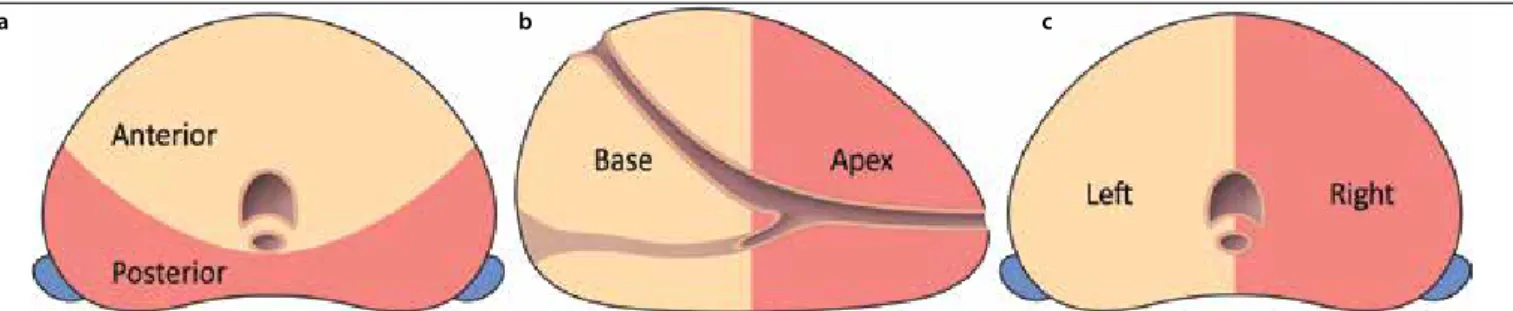
The prostate was segmentally divided into: 1) anterior (i.e., transition zone and fibromuscular stroma) vs. posterior (i.e., peripheral zone including anterior horn), 2) apex (i.e., apex or apex to mid-apex) vs. base (i.e., base or base to mid-base) vs. apex-to-base (i.e., ablation from apex to base), and 3) unilateral vs. bilateral (i.e., unifocal ablation crossing the midline or multifocal bilateral ablation). The division into the different prostate segments is illus-trated in the Figure. An ablation covering at least 80% of its total ablation zone volume in one segment was deemed a segmental ablation. The ablation zone volume was determined by perioperative needle con-figuration and consisted of the area within the active needle configuration. For
bilater-Main points
•
Focal irreversible electroporation forlocalized prostate cancer can be performed in all prostate segments without jeopardizing different quality of life outcomes.
•
Older patients and those with poor baseline sexual function need to be counseled regarding the risk for erectile dysfunction.•
All men that were pad-free continent atbaseline remained pad-free continent at their latest quality of life evaluation.
al and apex-to-base ablations, 80% of the ablation zone volume covered both seg-ments. Patients that had ablations covering multiple segments outside the specified segments were excluded from segmental analysis since potential interference was possible.
For each individual segment, the 6-month questionnaire was used to assess changes on genitourinary function and QoL over time compared to baseline. Summary score differences from baseline and 6 months were used to assess the performance of IRE per prostate segment, correcting for base-line age and prostate volume. In patients with genitourinary functional failure follow-ing IRE treatment (i.e., urinary incontinence requiring pads and/or erections insuffi-cient for intercourse), the standard system settings (interelectrode distance, voltage, amperage, pulse length) and patient char-acteristics (age, prostate volume, baseline urinary/sexual function) were compared with patients without genitourinary func-tional failure. As 6 patients did not answer the question (Q32) regarding erections suf-ficient for intercourse in the 6-month ques-tionnaire, despite completing the question-naire, their answer to that question in their latest questionnaire (3 or 12 months) was used as a substitute.
Statistical analysis
The operational hypothesis of differ-ences in genitourinary function and QoL between segments was tested by the anal-ysis of covariance (ANCOVA) model. In this model, the dependent variable was the measured value at month 6, the indepen-dent variable was the treatment group, and the covariate was the measured baseline value. All data were log-transformed prior to the analysis. This ANCOVA model was preferred to simpler methods such as the paired t-test, because by including baseline values in the modeling, it removes the po-tential “regression toward the mean” effect. Post-hoc comparison between groups was conducted with the Tukey’s honest signifi-cant difference test within the R statistical environment (R Development Core Team,
2011) (19). The level of significance was set at P < 0.05.
Results
The study included 60 patients (median age, 67 years; IQR, 62–73 years) who under-went IRE treatment. The median prostate specific antigen level was 5.9 μg/L (IQR, 3.6–7.6 μg/L). In three patients, the ablation covered both the anterior and posterior segment and these patients were excluded for anterior vs. posterior segmental analy-sis. Likewise, two patients received multi-ple ablations interfering with apex vs. base vs. apex-to-base segmental analysis. Table 1 summarizes the patient characteristics, including the number of patients per seg-mental ablation. None of the patients start-ed androgen deprivation therapy in the course of follow-up.
By the 6th month, no statistically signif-icant deteriorations on the AUA symptom score (P = 0.17–0.89), EPIC urinary (P = 0.07– 0.88), EPIC bowel (P = 0.06–0.79) and both SF-12 physical (P = 0.18–0.71) and mental (P = 0.45–0.94) scores were observed from baseline for each individually treated seg-ment. For each segment, a significant de-cline in the EPIC summary sexual score was found (P = 0.001–0.046), except for the bi-lateral segment (P = 0.16) despite a decline within that segment (median decline from 83 to 63). This decline on the EPIC sexual score would have been significant at 12 months (P = 0.28) compared with baseline. None of the segments were significantly associated with better-preserved or deteri-orated genitourinary function or QoL when the outcomes were compared with the op-posite group (P = 0.08–0.97). In Tables 2–4 the median summary scores per segment treated over time are presented.
Figure. Schematic overview of the different prostate segments. (a) The anterior segment (beige) consists of the fibromuscular stroma with the transition
zone. The posterior segment (red) consists of the peripheral zone, including the anterior horn of the transition zone. (b) The apical segment (red) includes any ablation performed within the mid to upper apex. The base segment (beige) is considered as any ablation in the area from the mid to the distal base. The apex-to-base segment included both the apex and base for more than 80% of the ablation zone volume. (c) A bilateral ablation was divided as an ablation that had more than 80% of the ablation zone volume in both the left and right hemi-prostate. Unilateral ablation was performed when more than 80% of the ablation occurred in either the left (beige) or right (red) hemi-prostate.
a b c
Table 1. Patient characteristics (n=60)
Variable Value
Age (years), mean±SD 68±7.0
PSA (μg/L), mean±SD 6.0±3.3
Prostate volume (cc), mean±SD 44±21
Clinical stage, n (%) T1c 3 (5) T2a 40 (67) T2b 7 (12) T2c 10 (17) Gleason score, n (%) 6 8 (13) 3+4 40 (67) 4+3 10 (17) 4+4 or higher 2 (3) Ablated segments, n (%) Anterior 18 (30) Posterior 39 (65) Apex 18 (30) Base 14 (23) Apex-to-base 26 (43) Unilateral 50 (83) Bilateral 10 (17)
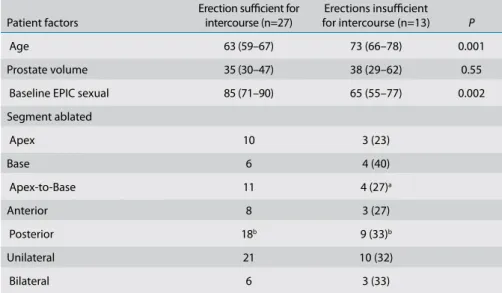
At baseline, 40 men (66%) had erections sufficient for intercourse, of whom 27 men (68%) maintained their erectile ability to have intercourse during the course of this study. Of these 27 men, the use of medicinal aids increased from 7.4% (2/27) at baseline to 18.5% (5/27) during the course of this study. Thirteen patients experienced an erectile function insufficient for intercourse following IRE. This was significantly associ-ated with an older age at time of treatment (P = 0.001) and a lower baseline sexual summary score on the EPIC questionnaire (P = 0.002). None of the system settings were significantly associated with an in-creased risk for genitourinary functional failure. Table 5 displays the patient charac-teristics, ablated segments and system set-tings for patients with and without erectile dysfunction following IRE.
Of the 58 men that were pad-free con-tinent at baseline (97%, 58/60), only one patient needed one pad per day for urinary
leakage at 6 months. The patient charac-teristics or system parameters could not be statistically assessed due to the limited events of urinary incontinence. This patient was treated with a unilateral anterior abla-tion, including the basal quadrant and did not differ from pad-free continent patients in terms of baseline age, prostate volume and EPIC urinary summary score. The uri-nary continence of this patient improved at 12 months. Therefore pad-free continence was preserved in all men at their latest QoL evaluation.
Discussion
This study showed that primary focal IRE could be safely performed on all prostate segments. There were no statistically sig-nificant differences between prostate seg-ments in terms of genitourinary function and QoL, indicating that this ablative mo-dality is a feasible momo-dality for any prostate segment. Apex-targeted IRE
demonstrat-ed improvdemonstrat-ed bowel function on the EPIC questionnaire at 6 months compared with a decline in bowel function for base-target-ed IRE. The clinical significance is negligi-ble since both apex and base directed IRE treatments have remarkably high summa-ry bowel scores at 6 months, and no clini-cal symptoms were described (e.g., rectal pain, bleeding or fistula). There were no statistically significant QoL deteriorations at 6 months within the individual segments treated. However, sexual function was im-paired for all segments at 6 months. This deterioration was not statistically signifi-cant with bilateral IRE, which is most likely due to the limited number of patients in that group. A decline was observed on the EPIC sexual summary score over time that would have been significantly decreased at 12 months compared with baseline. More-over, there was some heterogeneity within the bilateral group that may have affected the outcomes. Most bilateral cases were
sin-Table 2. Anterior vs. posterior genitourinary function and quality of life
Anterior Posterior Baseline (n=18) (n=39) 3 months (n=17) (n=39) 6 months (n=17) (n=35) 12 months (n=4)
(n=20) Segment difference Baseline/6 months Different treatment impact Anterior vs. Posterior AUA Anterior 6 (3–14) 6 (3–11) 4 (3–10) 4 (2–5) No (P = 0.55) No (P = 0.97, Posterior 6 (3–12) 7 (3–10) 5 (2–11) 4 (2–11) No (P = 0.19) E= -0.05, CI ±2.5) EPIC urinary Anterior 93 (72–98) 89 (69–96) 94 (79–98) 92 (82–97) No (P = 0.68) No (P = 0.83, Posterior 89 (81–98) 92 (81–98) 92 (83–98) 94 (85–98) No (P = 0.24) E= -0.71, CI ±6.6) EPIC sexual Anterior 60 (25–82) 52 (29–71) 46 (14–79) 27 (2–79) Yes (P = 0.03) No (P = 0.41, Posterior 67 (48–81) 47 (31–74) 49 (29–69) 42 (19–76) Yes (P = 0.008) E= -4.1, CI ±9.6) EPIC bowel Anterior 96 (92–100) 96 (93–98) 96 (91–99) 93 (87–99) No (P = 0.79) No (P = 0.80, Posterior 96 (93–98) 96 (89–100) 96 (89–100) 97 (92–100) No (P = 0.70) E= 0.51, CI ±3.9) SF-12 physical Anterior 55 (44–56) 55 (48–56) 55 (40–57) 57 (43–58) No (P = 0.64) No (P = 0.74, Posterior 56 (52–56) 55 (52–57) 55 (52–57) 55 (52–57) No (P = 0.35) E= -0.71, CI ±4.1) SF-12 mental Anterior 56 (39–58) 56 (50–58) 56 (40–60) 53 (48–60) No (P = 0.80) No (P = 0.64, Posterior 56 (50–58) 57 (53–59) 56 (48–58) 57 (56–59) No (P = 0.45) E= 1.1, CI ±4.4)
Data are presented as median (interquartile range).
AUA, American Urological Association; E, the effect size of anterior vs. posterior; CI, confidence interval (represents 47.5% deviation from the mean); EPIC, expanded prostate cancer index composite; SF-12, short form of health survey.
gle-ablative IRE, targeting anterior midline lesions. However, multi-ablative bilateral ablations performed in three patients re-sulted in two having erectile dysfunction. The more extensive ablative procedures in most bilateral cases may have led to the im-proved urinary function scores at 6 months in this group due to post-treatment pros-tate volume reduction (20).
Promising rates of preserved pad-free uri-nary continence were found. It was demon-strated that older patients at time of
treat-ment and those with poor baseline sexual function were significantly at risk of devel-oping erections insufficient for intercourse. This may be unexpected since animal stud-ies suggested that in pigs the endoneural architecture was preserved following IRE and showed signs of regeneration (21). In a preclinical study, it was also shown in rat sciatic nerves that the number of my-elinated axons and the thickness of myelin sheath were preserved at 10 weeks follow-ing IRE exposure (22). None of the system
settings used could be identified to be a sig-nificant risk factor for erectile dysfunction. A prolonged pulse length showed a trend of significance, which could be explained by increased Joule-heating. It was shown in a polyacrylamide gel that applying longer pulses is associated with more Joule-heat-ing and potentially more thermal damage due to higher energy delivery (23). Surpris-ingly, erectile dysfunction also occurred in ablations that were far away from the neurovascular bundle, suggesting another
Table 3. Apex vs. Base vs. Apex-to-Base genitourinary function and quality of life
Different treatment impact Apex Base Apex-to-Base Baseline (n=18) (n=14) (n=26) 3 months (n=17) (n=14) (n=26) 6 months (n=17) (n=13) (n=24) 12 months (n=10) (n=4) (n=11) Segment difference Baseline/6 months Apex vs. Base Apex vs. Apex-to-Base Base vs. Apex-to-Base AUA Apex 3 (2–16) 7 (3–10) 4 (2–12) 4 (2–8) No (P = 0.86) No (P = 0.79, No (P = 0.28, No (P = 0.41, Base 10 (4–12) 10 (4–13) 7 (4–14) 8 (2–23) No (P = 0.89) E= 0.43, E= -1.5, E= 1.9, Apex-to-Base 6 (4–14) 6 (3–11) 5 (3–10) 4 (3–5) No (P = 0.19) CI ±3.1) CI ±2.7) CI ±3.0) EPIC urinary Apex 96 (81–98) 94 (78–99) 96 (77–98) 94 (90–96) No (P = 0.88) No (P = 0.64, No (P = 0.34, No (P = 0.93, Base 87 (78–94) 89 (74–96) 90 (84–97) 85 (70–98) No (P = 0.33) E= 2.0, (E= 3.4, E= -1.5, Apex-to-Base 92 (77–98) 89 (72–98) 93 (84–98) 95 (89–98) No (P = 0.23) CI ±8.2) CI ±7.0) CI ±7.8) EPIC sexual Apex 67 (55–90) 54 (39–75) 53 (41–76) 48 (26–87) Yes (P = 0.008) No (P = 0.53, No (P = 0.91, No (P = 0.72, Base 62 (49–76) 51 (36–74) 54 (23–73) 50 (8–72) Yes (P = 0.046) E= -3.7, E= 0.60, E= -4.3, Apex-to-Base 60 (27–85) 42 (18–73) 41 (21–69) 35 (6–77) Yes (P = 0.001) CI ±11.6) CI ±10.1) CI ±11.0) EPIC bowel Apex 96 (91–98) 96 (94–100) 98 (96–100) 97 (94–100) No (P = 0.055) No (P = 0.08, No (P = 0.11, No (P = 0.93, Base 97 (91–100) 93 (84–100) 93 (85–100) 86 (71–100) No (P = 0.44) E= -4.3, E= -3.5, E= -0.87, Apex-to-Base 96 (91–100) 96 (91–99) 96 (89–98) 96 (91–100) No (P = 0.44) CI ±4.7) CI ±4.1) CI ±4.6) SF-12 physical Apex 56 (53–56) 55 (53–56) 56 (53–57) 55 (54–57) No (P = 0.53) No (P = 0.26, No (P = 0.63, No (P = 0.73, Base 56 (52–58) 56 (47–57) 52 (40–57) 47 (44–56) No (P = 0.18) E= -2.9, E= -1.1, E= -1.9, Apex-to-Base 54 (45–57) 55 (46–57) 56 (42–58) 56 (53–58) No (P = 0.71) CI ±5.0) CI ±4.3) CI ±4.8) SF-12 mental Apex 56 (52–58) 7 (54–58) 57 (54–58) 58 (57–59) No (P = 0.94) No (P = 0.94, No (P = 0.77, No (P = 0.94, Base 57 (48–58) 56 (44–58) 56 (41–57) 48 (42–55) No (P = 0.66) E= -0.23, E= 0.73, E= -0.96, Apex-to-Base 57 (44–59) 556 (50–59) 54 (45–59) 56 (49–60) No (P = 0.62) CI ±5.6) CI ±4.9) CI ±5.4)
Data are presented as median (interquartile range).
mechanism behind the observed decrease in sexual function that may be elucidated in larger datasets. Future in vivo studies must provide the ideal system settings to suc-cessfully ablate prostate tissue while mini-mizing Joule-heating.
Our study is limited we did not include any data on oncologic performance. We choose to exclude the oncologic control per prostate segment based on previous results from an ablation and resection study (14). Moreover, infield oncologic failures follow-ing IRE were proven to be significantly de-pendent on the applied safety margin and/ or system errors occurring during IRE (12). In this cohort, 7 patients had infield residual disease, including all different prostate seg-ments (anterior, posterior, apex, mid, base), justifying our exclusion of oncologic anal-ysis. Other limitations are the small cohort size and the short follow-up time. Murray et al. (8) showed that (marginal) improvement
of erectile function was seen between 6–12 months, which may be applicable to our results. Furthermore, division of ablations into true segmental ablations can be arbi-trary. An ablation was deemed segmental if an estimated 80% of its ablation volume (volume between electrodes) occurred in one segment. It has been shown that the histopathologic ablation zone extends the needle configuration by 2.5–2.9 times (two-dimensionally) (24). Moreover, in our institution, a T2-weighted MRI was per-formed 1 week after IRE to confirm if the predefined treatment region was covered by IRE. The coverage often extended the needle configuration, potentially invading other segments. The ablation zone volume on T2-weighted MRI has been shown to closely correlate with the volume on his-topathology (25). However, this correlation was performed at 4 weeks after IRE, and the swelling and edema seen on T2-weighted
MRI at 1 week can easily obscure the his-topathologic effect. We aimed to reduce the extended ablation effect by using the exact needle locations/geometry regis-tered in the Nanoknife® system and surgical report. Although the ablation zone dimen-sions may invade into other segments, we showed that wherever the electrodes were placed, good genitourinary function and QoL could be obtained. Interestingly, some ablations included the urethra or extended the capsule, without causing significant side effects seen with other ablative modal-ities (e.g., urethral sloughing with cryother-apy) (26).
In conclusion, IRE can be safely performed in each prostate segment without significant-ly different effects on genitourinary function and QoL outcomes, establishing this tech-nique as a feasible focal ablative modality with good functional outcomes for all pros-tate segments treated. Patients who were
Table 4. Bilateral vs. unilateral genitourinary function and quality of life
Unilateral Bilateral Baseline (n=50) (n=10) 3 months (n=49) (n=10) 6 months (n=47) (n=8) 12 months (n=21) (n=6) Segment difference baseline/6 months Different treatment impact Bilateral vs. Unilateral AUA Unilateral 6 (3–13) 7 (3–11) 6 (2–11) 4 (2–9) No (P = 0.17) No (P = 0.75, Bilateral 11 (4–13) 5 (2–12) 4 (3–14) 5 (4–13) No (P = 0.25) E= -0.71, CI ±6.6) EPIC urinary Unilateral 92 (80–98) 91 (77–98) 93 (81–98) 94 (92–98) No (P = 0.46) No (P = 0.084, Bilateral 84 (76–95) 88 (70–94) 95 (90–99) 88 (79–94) No (P = 0.068) E= 7.4, CI ±8.3) EPIC sexual Unilateral 62 (45–79) 47 (31–72) 43 (26–69) 38 (15–77) Yes (P < 0.001) No (P = 0.54, Bilateral 83 (63–90) 41 (21–76) 63 (37–84) 59 (28–77) No (P = 0.16) E= 3.8, CI ±12.0) EPIC bowel Unilateral 96 (93–98) 96 (91–100) 96 (91–100) 98 (93–100) No (P = 0.67) No (P = 0.62, Bilateral 95 (89–96) 96 (90–98) 93 (86–96) 93 (82–97) No (P = 0.31) E= -1.3, CI ±5.1) SF-12 physical Unilateral 56 (45–57) 55 (50–57) 56 (51–57) 56 (53–57) No (P = 0.63) No (P = 0.31, Bilateral 55 (48–56) 55 (49–57) 54 (49–57) 51 (44–56) No (P = 0.40) E= 2.6, CI ±4.9) SF-12 mental Unilateral 57 (49–58) 57 (51–58) 56 (48–58) 57 (55–59) No (P = 0.46) No (P = 0.94, Bilateral 58 (43–60) 56 (46–59) 56 (49–60) 58 (49–61) No (P = 0.61) E= 0.21, CI ±5.5)
Data are presented as median (interquartile range).
AUA, American Urological Association; E, the effect size of bilateral vs. unilateral; CI, confidence interval (47.5% deviation from the mean); EPIC, expanded prostate cancer index composite; SF-12, short form of health survey.
older at time of treatment, or those with a poor baseline sexual function, had higher risk to develop erectile dysfunction. Future com-parative trials need to elucidate whether the trifecta outcomes of focal therapy supersedes those of current radical treatments.
Acknowledgements
We thank Quoc Nguyen and Anne-Maree Haynes from the Australian Prostate Cancer Research Cen-tre-NSW (APCRC-NSW), IT Applications Group and CANSTO Database at Garvan Institute. We thank Jayne Matthews for clinical support.
Financial disclosure
The Australian Prostate Cancer Research Cen-tre-NSW and the St. Vincent’s Prostate Cancer Centre funded this research project.
Conflict of interest disclosure
Scheltema received a PhD grant from the Cure for Cancer Foundation. Scheltema, Chang and Gielchin-sky received a fellowship grant from the St Vincent’s Prostate Cancer Centre and the Australian Prostate Cancer Research Centre-NSW (APCRC-NSW). De la Rosette is paid consultant to AngioDynamics. An-gioDynamics had no role throughout the study. All other authors have nothing to disclose.
Refecences
1. Donaldson I, Alonzi R, Barratt D, et al. Focal therapy: patients, interventions, and out-comes-a report from a consensus meeting. Eur Urol 2015; 67:771–777. [CrossRef]
2. Ahmed HU, Zacharakis E, Dudderidge T, et al. High-intensity-focused ultrasound in the treat-ment of primary prostate cancer: the first UK series. Br J Cancer 2009; 101:19–26. [CrossRef]
3. Jones JS, Rewcastle JC, Donnelly BJ, Lugnani FM, Pisters LL, Katz AE. Whole gland primary prostate cryoablation: initial results from the cryo on-line data registry. J Urol 2008; 180:554– 558. [CrossRef]
4. Matsuoka Y, Numao N, Saito K, et al. Can-didate selection for quadrant-based focal ablation through a combination of diffu-sion-weighted magnetic resonance imaging and prostate biopsy. BJU Int 2016; 117:94– 101. [CrossRef ]
5. Valerio M, Cerantola Y, Eggener SE, et al. New and established technology in focal ablation of the prostate: a systematic review. Eur Urol 2017; 44:17–34. [CrossRef]
6. Sivaraman A, Barret E. Focal therapy for pros-tate cancer: an “À la Carte” approach. Eur Urol 2016; 69:2015–2017. [CrossRef]
7. Ting F, Tran M, Böhm M, et al. Focal irreversible electroporation for prostate cancer: functional outcomes and short-term oncological control. Prostate Cancer Prostatic Dis 2016; 1:46–52.
[CrossRef]
8. Murray KS, Ehdaie B, Musser J, et al. Pilot study to assess safety and clinical outcomes of irre-versible electroporation for partial gland abla-tion in men with prostate cancer. J Urol 2016; 196:883–890. [CrossRef]
9. Valerio M, Stricker PD, Ahmed HU, et al. Initial assessment of safety and clinical feasibility of irreversible electroporation in the focal treat-ment of prostate cancer. Prostate Cancer Pros-tatic Dis 2014; 17:343–347. [CrossRef]
10. Valerio M, Dickinson L, Ali A, et al. Nanoknife electroporation ablation trial (NEAT): a pro-spective development study investigating fo-cal irreversible electroporation in men with lo-calised prostate cancer. J Urol 2017; 3:647–654.
[CrossRef]
11. van den Bos W, De Bruin D, Veelo D, et al. Qual-ity of life and safety outcomes following irre-versible electroporation treatment for prostate cancer: results from a phase I-Ii study. J Cancer Sci Ther 2015; 7:312–321.
12. van den Bos W, Scheltema MJ, Siriwardana AR, et al. Focal irreversible electroporation as pri-mary treatment for localized prostate cancer. BJU Int 2018; 121:716–724. [CrossRef]
13. Davalos RV, Mir LM, Rubinsky B. Tissue ablation with irreversible electroporation. Ann Biomed Eng 2005; 33:223–231. [CrossRef]
14. van den Bos W, Jurhill RR, de Bruin DM, et al. Histopathological outcomes after irreversible electroporation for prostate cancer: results of an ablate and resect study. J Urol 2016; 196:552–559. [CrossRef]
15. Scheltema MJ, Tay KJ, Postema AW, et al. Utili-zation of multiparametric prostate magnetic resonance imaging in clinical practice and focal therapy: report from a Delphi consen-sus project. World J Urol 2017; 35:695–701.
[CrossRef]
16. Wei JT, Dunn RL, Litwin MS, Sandler HM, Sanda MG. Prostate cancer index composite (EPIC) for comprehensive assessment of health-related quality of life in men with prostate cancer. Urol-ogy 2000; 56:899–905. [CrossRef]
Table 5. Patient characteristics and system parameters of patients with and without erections
sufficient for intercourse after IRE Patient factors
Erection sufficient for intercourse (n=27)
Erections insufficient
for intercourse (n=13) P
Age 63 (59–67) 73 (66–78) 0.001
Prostate volume 35 (30–47) 38 (29–62) 0.55
Baseline EPIC sexual 85 (71–90) 65 (55–77) 0.002
Segment ablated Apex 10 3 (23) Base 6 4 (40) Apex-to-Base 11 4 (27)a Anterior 8 3 (27) Posterior 18b 9 (33)b Unilateral 21 10 (32) Bilateral 6 3 (33)
aTwo patients received multiple ablations; bOne patient was treated in both anterior and posterior segments.
System settings
Minimum interelectrode distance
(mm) 9 (8–10) 9 (8–10) 0.63
Maximum interelectrode distance
(mm) 18 (17–21) 18 (16–20) 0.23
Minimum voltage (V) 1620 (1200–1760) 1600 (1440–1710) 0.13
Maximum voltage (V) 2550 (2400–2850) 2550 (2400–2775) 0.53
Minimum amperage (A) 25 (20–28) 26 (21–31) 0.44
Maximum amperage (A) 41 (37–45) 44 (38–50) 0.16
Pulse length (μs) 90 (70–90) 90 (70–90) 0.09
Average length (μs) 79.6 85.4
Data are presented as median (interquartile range) or n (%). EPIC, expanded prostate cancer index composite.
17. Barry MJ, Fowler FJ, O’Leary MP, et al. The Amer-ican Urological Association symptom index for benign prostatic hyperplasia. J Urol 1992; 148:1549–1557. [CrossRef]
18. Gandek B, Ware JE, Aaronson NK, et al. Cross-validation of item selection and scoring for the SF-12 health survey in nine countries: Results from the IQOLA project. J Clin Epidemi-ol 1998; 51:1171–1178. [CrossRef]
19. R Core Team. R: a language and environment for statistical computing. R Foundation for Sta-tistical Computing, Vienna, Austria. 2016. 20. Scheltema MJ, Postema AW, de Bruin DM, et al.
Irreversible electroporation for the treatment of localized prostate cancer: a summary of imag-ing findimag-ings and treatment feedback. Diagnos-tic Interv Radiol 2017; 23:365–370. [CrossRef]
21. Schoellnast H, Monette S, Ezell PC, et al. The de-layed effects of irreversible electroporation ab-lation on nerves. Eur Radiol 2013; 23:375–380.
[CrossRef]
22. Li W, Fan Q, Ji Z, Qiu X, Li Z. The effects of irre-versible electroporation (IRE) on nerves. PLoS One 2011; 6:e18831. [CrossRef]
23. Van Den Bos W, Scheffer HJ, Vogel JA, et al. Thermal energy during irreversible electropo-ration and the influence of different ablation parameters. J Vasc Interv Radiol 2016; 27:433– 443. [CrossRef]
24. van den Bos W, de Bruin DM, Jurhill RR, et al. The correlation between the electrode configura-tion and histopathology of irreversible electro-poration ablations in prostate cancer patients. World J Urol 2016; 34:657–664. [CrossRef]
25. van den Bos W, de Bruin DM, van Randen A, et al. MRI and contrast-enhanced ultrasound im-aging for evaluation of focal irreversible elec-troporation treatment: results from a phase I-II study in patients undergoing IRE followed by radical prostatectomy. Eur Radiol 2016; 26:2252–2260. [CrossRef]
26. Rodríguez SA, Arias Fúnez F, Bueno Bravo C, et al. Cryotherapy for primary treatment of prostate cancer: intermediate term results of a prospective study from a single institution. Prostate Cancer 2014; 2014:571576. [CrossRef]