Acta Pharm. Sci. Vol 57 No: 2. 2019 DOI: 10.23893/1307-2080.APS.05712
In vitro Antimicrobial and Antioxidant Activity
Evaluation of
Melampyrum arvense L. var.
elatius Boiss. and Sedum spurium
M. Bieb. Extracts
Ayşe Esra Karadağ1*, Fatma Tosun1
1 Istanbul Medipol University, School of Pharmacy, Department of Pharmacognosy, İstanbul, Turkey
INTRODUCTION
Melampyrum L. genus is an annual and semi-parasitic plant group. It is represented by two species, M. arvense and M. pratense in the Flora of Turkey1. Iridoid glycosides were the major bioactive secondary metabolites of
ABSTRACT
Sedum spurium M. Bieb. (Crassulaceae) is a common ornamental plant, whereas, Melampyrum arvense L. var. elatius Boiss. (Orobanchaceae) is a semi-parasitic plant and grows naturally in the fields. In this study, the dichloromethane and ethyl acetate extracts of M. arvense and S. spurium were evaluated for their in vitro antioxidant and antimicrobial activities. The antioxidant activity was evaluated by DPPH•-ABTS• methods. The antimicrobial activity of S. spurium and
M. arvense extracts was determined using the in vitro broth microdilution assay against following human pathogenic strains; Staphylococcus aureus ATCC 6538, Enterococcus faecalis ATCC 29212, Escherichia coli NRLL B-3008, Helicobacter pylori ATCC 43504, Mycobacterium smegmatis ATCC 25291, Mycobacterium avium ssp. avium and Pseudomonas aeruginosa ATCC 10145.
The extracts showed weak antimicrobial activity against Gram-negative/positive bacteria, having the MIC values of 500-1000 μg/mL. Antibacterial activity was not observed against Mycobacteria at 2000 µg/mL. In addition, antioxidant activity of M. arvense ethyl acetate extract was higher than those of the other extracts. Keywords: Melampyrum arvense, Sedum spurium, Antibacterial, Antioxidant, Mycobacteria
*Corresponding Author: Ayşe Esra Karadağ, e-mail: [email protected] Ayşe Esra Karadağ ORCID Number: 0000-0002-3412-0807
Fatma Tosun ORCID Number: 0000-0003-2533-5141 (Received 28 January 2019, accepted 26 February 2019)
Melampyrum species2. The previous in vitro studies showed that Melampyrum extracts have antioxidant, protein kinase C inhibitory, antimalarial, cytotoxic and antiprotozoal activities3-5 and it is used as animal fodder traditionally6. Sedum L. is represented by 43 species in Turkey7-8. It is reported that several Sedum species have wound healing properties and were used as diuretic and laxative and as well as for the treatment of various diseases such as hemorrhoids in folk medicine 9-11. The major components of Sedum species have been described as alkaloids and flavonoids in previous studies 12-16. The aim of the present study was evaluation of the antimicrobial and antioxidant activities of M. arvense and S. spurium extracts. The phenolic compound composition of the extracts was analyzed by High Performance-Liquid Chromatography (HPLC).
METHODOLOGY
Plant Material and Extraction
M. arvense and S. spurium were collected in the vicinity of Trabzon-Tonya and Trabzon-Hamsiköy, respectively. Plants were identified by Prof. M. Vural and voucher specimens have been deposited at Herbarium of the Depertment of Pharmacognosy, School of Pharmacy, Istanbul Medipol University, Istanbul, Turkey. (Voucher specimens no. IMEF: 1055 and IMEF: 1142 resp.) The air-dried and coarsely ground aerial parts of plant material were macerated with 70% ethanol. The extract was filtered and evaporated to dryness in vacuo (Heidolph, Germany), and then dissolved in a water-ethanol (90:10) mixture and extracted with dichloromethane and ethyl acetate, respectively.
Antioxidant Activity
DPPH• and ABTS• Scavenging Assay
The antioxidant capacity was determined in terms of hydrogen donating or radical scavenging ability using DPPH• by its capability to bleach the stable radical17. The reaction mix contained 100 μM DPPH• in methanol and dichloromethane or ethyl acetate extracts. After 30 min, absorbance was read at 517 nm by using a UV–Vis spectrophotometer (UV-1800, Shimadzu, Japan) at 25 ± 2°C and the radical scavenging activity (RSA) was determined as the percentage of radical reduction as follows:
DPPH• RSA % = [(Absorbance
control – Absorbance test sample) / Absorbance control)] x 100
The total antioxidant activity of the samples was measured using the ABTS radical cation decolorization assay18. ABTS• was produced by reacting 7 mM
aqueous ABTS• with 2.45 mM potassium persulfate. The reaction mixture was left at room temperature overnight (12−16 h) in the dark. The resulting intensely colored ABTS radical cation was diluted with ethanol. Absorbance was measured at 734 nm at room temperature. The assay was performed in triplicate. Negative controls in which 990 μL ethanol was substituted for ABTS• were used. The assay was carried out on Trolox as a positive control19. The results were expressed as IC50 as follows:
ABTS• RSA % = [(Absorbance
control – Absorbance test sample)/Absorbance control)] x 100
Each experiment was performed in triplicate. The IC50 value of the extracts was calculated from a calibration graph. Test results are presented as mean ± standard deviation (SD). Statistical analysis of antioxidant test results was completed using one-way ANOVA with the SPSS 23.0 software. A difference in the mean values of P<0.05 was considered to be statistically significant. Antimicrobial Activity
The antimicrobial activity of the extracts was determined using the broth microdilution assay20 to determine the minimum inhibitory concentrations (MIC). Staphylococcus aureus ATCC 6538, Enterococcus faecalis ATCC 29212, Escherichia coli NRLL B-3008, and Pseudomonas aeruginosa ATCC 10145 strains were grown in Mueller Hinton Broth (MHB) at 37°C in aerobic conditions for 24 h. All microorganisms were standardized to McFarland No: 0.5.
Helicobacter pylori ATCC 43504 strain was grown for 24 hours in Brucella broth containing 5% (v/v) horse blood and 10% (h/h) fetal bovine serum at 37°C in an anaerobic incubator (5% CO2). After incubation at 37°C, 100 μL H. pylori (2x10⁷ CFU/mL) strain was transferred to the microplate evaluation21, 22. Diluted bacterial suspensions were added to each well and then allowed to incubate at 37 °C for further 24 h.
Mycobacteria strains were inoculated in Middlebrook 7H11 agar and incubated in aerobic conditions at 37 °C for 4-5 days. The microorganism was transferred to media and incubated for a further five days. Diluted bacterial suspensions (106 CFU/mL) were added to each well and then allowed to incubate at 37 °C for 5 days 23-25.
Test samples stock solution was prepared in dimethyl sulfoxide and serial dilutions were prepared for each sample. The minimum non-reproductive concentration was reported as minimum inhibitory concentration (MIC). The MIC was calculated as the mean of three repetitions.
HPLC Analysis
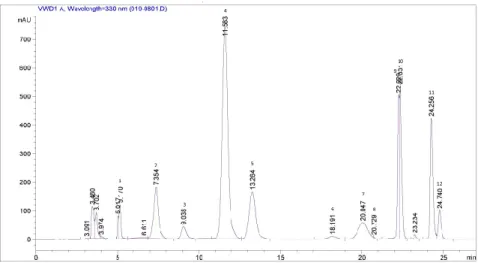
The HPLC analyses studied on an Agilent (1200 LC) and UV-Vis detector (G1314A). HPLC was run on an Agilent C18 column (4.6 x 250 mm x 5 μm) and its temperature was maintained at 40°C. The mobile phases were Solvent A: Acetonitrile: Water (10:90, v/v) and Solvent B: Acetonitrile: Water (90:10, v/v). The composition of solvent B was increased from 15% to 100% in 35 min, and at a flow rate of 0.6 mL/min. The injection volume is 10 μL26. Phenolic compounds were identified by matching their retention times against those of the standards analyzed under the same conditions (Figure 1).
Test samples stock solution was prepared in dimethyl sulfoxide and serial dilutions were prepared for each sample. The minimum non-reproductive concentration was reported as minimum inhibitory concentration (MIC). The MIC was calculated as the mean of three repetitions.
HPLC Analysis
The HPLC analyses studied on an Agilent (1200 LC) and UV-Vis detector (G1314A). HPLC was run on an Agilent C18 column (4.6 x 250 mm x 5 µm) and its temperature was maintained at 40°C. The mobile phases were Solvent A: Acetonitrile: Water (10:90, v/v) and Solvent B: Acetonitrile: Water (90:10, v/v). The composition of solvent B was increased from 15% to 100% in 35 min, and at a flow rate of 0.6 mL/min. The injection volume is 10 μL26. Phenolic compounds were identified by matching
their retention times against those of the standards analyzed under the same conditions (Figure 1).
Figure 1. HPLC Chromatogram of References
1, Chlorogenic acid (RT: 5.1); 2, Caffeic acid (RT: 7.3); 3, Luteolin-O-Glycoside (RT: 9.03); 4, Coumaric acid (RT: 11.5); 5, Ferulic acid (RT: 13.2); 6, Rosmarinic acid (RT: 18.1); 7, Myrcetin (RT: 20.04); 8, Eriodictyol (RT: 20.7); 9, Luteolin (RT: 22.2); 10, Quercetin (RT: 22.3); 11, Apigenin (RT: 24.2); 12, Gallic acid (RT: 24.7)
Figure 1. HPLC Chromatogram of References
1, Chlorogenic acid (RT: 5.1); 2, Caffeic acid (RT: 7.3); 3, Luteolin-O-Glycoside (RT: 9.03); 4, Coumaric acid (RT: 11.5); 5, Ferulic acid (RT: 13.2); 6, Rosmarinic acid (RT: 18.1); 7, Myrcetin (RT: 20.04); 8, Eriodictyol (RT: 20.7); 9, Luteolin (RT: 22.2); 10, Quercetin (RT: 22.3); 11, Apigenin (RT: 24.2); 12, Gallic acid (RT: 24.7)
RESULTS AND DISCUSSION Antioxidant Activity
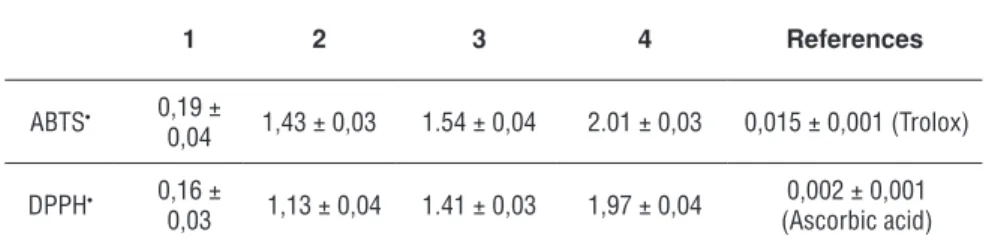
Antioxidant activities of the ethyl acetate and dichloromethane extracts of M. arvense and S. spurium were measured by the ability to scavenge DPPH free radicals and ABTS radical scavenging method, by comparing with Ascorbic acid and Trolox, respectively. Antioxidant capacities were expressed by IC50 values, indicating the extracts concentrations scavenge 50% of ABTS radical. It was observed that ethyl acetate extract of M. arvense has higher antioxidant capacity than those of the other extracts. The results were shown in Table
1. Although there is no detailed study of antioxidant activity on M. arvense, the results of previous studies on antioxidant activities other Melampyrum species were similar to those of the current study results3, 27. As shown in a previous study28, phenolic compounds found in the M. barbatum extract may be responsible for the antioxidant activity. To the best of our knowledge, this is the first report on the antioxidant capacity of M. arvense extract.
Table 1. ABTS and DPPH radical scavenging activities of extracts
ABTS and DPPH radical scavenging activities + [IC50 ± SD (mg/mL)]
1 2 3 4 References
ABTS• 0,19 ±
0,04 1,43 ± 0,03 1.54 ± 0,04 2.01 ± 0,03 0,015 ± 0,001 (Trolox) DPPH• 0,16 ±
0,03 1,13 ± 0,04 1.41 ± 0,03 1,97 ± 0,04 (Ascorbic acid)0,002 ± 0,001 1: M. arvense ethyl acetate extract; 2: M. arvense dichloromethane extract; 3: S. spurium ethyl acetate extract; 4: S. spurium dichloromethane extract
Antimicrobial Activity
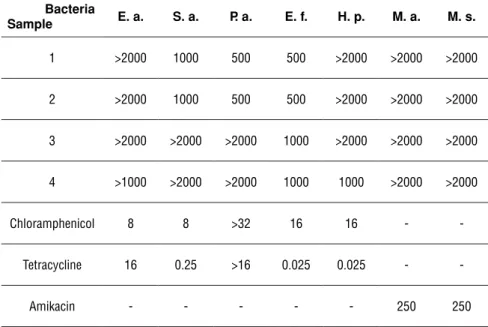
Antimicrobial activities of M. arvense and S. spurium extract were evaluated according to their MIC values against various strains. Table 2 shows antimicrobial activities of M. arvense and S. spurium extracts against bacterial strains. The results revealed that the extracts have weak antimicrobial activity against Gram-negative/positive bacteria with the MIC values in the range to 500-1000 μg/mL. Antibacterial activity was not observed against Mycobacterias at 2000 µg/mL. In a previous study, antimicrobial activity of S. spurium essential oil was evaluated29 but this is the first report on antimicrobial activity evaluation of S. spurium extracts. Also, the results obtained by Tosun and co-workers in a previous study of different Mycobacteria strains on the S. spurium extract were similar to the results of the current study30.
Table 2. Antimicrobial activity of extracts (MICs in µg/mL). Bacteria Sample E. a. S. a. P. a. E. f. H. p. M. a. M. s. 1 >2000 1000 500 500 >2000 >2000 >2000 2 >2000 1000 500 500 >2000 >2000 >2000 3 >2000 >2000 >2000 1000 >2000 >2000 >2000 4 >1000 >2000 >2000 1000 1000 >2000 >2000 Chloramphenicol 8 8 >32 16 16 - -Tetracycline 16 0.25 >16 0.025 0.025 - -Amikacin - - - 250 250
1: M. arvense ethyl acetate extract; 2: M. arvense dichloromethane extract; 3: S. spurium ethyl acetate extract; 4: S. spurium dichloromethane extract
E.a.: Escherichia coli; S.a.: Staphylococcus aureus; P.a.: Pseudomonas aeruginosa; E.f.: Enterococcus faecalis; H.p.: Helicobacter pylori; M.a.: Mycobacterium avium; M.s.: Mycobacterium smegmatis
HPLC Analysis
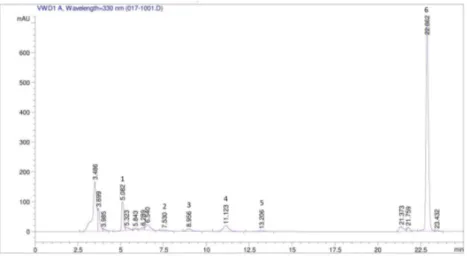
The phytochemical constituents of the extracts were analyzed using HPLC technique. The phenolic compounds of M. arvense ethyl acetate extract was characterized as chlorogenic acid, caffeic acid, luteolin-7-O-glycoside, coumaric acid, ferulic acid, and quercetin (Figure 2). The high antioxidant capacity of M. arvense ethyl acetate extract may be due to the aforementioned phenolic compounds. It was reported that the phenolic compounds were responsible for the antioxidant activity in the previous studies on Melampyrum species3.In addition, eriodictyol, luteolin and quercetin were detected in S. spurium ethyl acetate extract by HPLC (Figure 3).
Figure 2. HPLC Chromatogram of M. arvense methanol extract
1, Chlorogenic acid (RT: 5.082); 2, Caffeic acid (RT: 7.5); 3, Luteolin-O-Glycoside (RT: 9.03); 4, Coumaric acid (RT: 11.5); 5, Ferulic acid (RT: 13.206); 6, Quercetin (RT: 22.3)
Figure 3: HPLC Chromatogram of S. spurium metanol extract
1, Eriodictyol (RT: 20.7); 2, Luteolin (RT: 22.2); 3, Quercetin (RT: 22.3)
Figure 2. HPLC Chromatogram of M. arvense methanol extract
1, Chlorogenic acid (RT: 5.082); 2, Caffeic acid (RT: 7.5); 3, Luteolin-O-Glycoside (RT: 9.03); 4, Coumaric acid (RT: 11.5); 5, Ferulic acid (RT: 13.206); 6, Quercetin (RT: 22.3)
Figure 2. HPLC Chromatogram of M. arvense methanol extract
1, Chlorogenic acid (RT: 5.082); 2, Caffeic acid (RT: 7.5); 3, Luteolin-O-Glycoside (RT: 9.03); 4, Coumaric acid (RT: 11.5); 5, Ferulic acid (RT: 13.206); 6, Quercetin (RT: 22.3)
Figure 3: HPLC Chromatogram of S. spurium metanol extract
1, Eriodictyol (RT: 20.7); 2, Luteolin (RT: 22.2); 3, Quercetin (RT: 22.3)
Figure 3: HPLC Chromatogram of S. spurium metanol extract 1, Eriodictyol (RT: 20.7); 2, Luteolin (RT: 22.2); 3, Quercetin (RT: 22.3)
REFERENCES
1. Davis, P.H. In Flora of Turkey and the East Aegean Islands, Vol 6, Edinburgh University Press, Edinburgh, 1978.
2. Damtoft, S.; Hansen, S. B.; Jacobsen, B.; Jensen, S. R.; Nielsen, B. J. Iridoid glucosides from Melampyrum. Phytochemistry. 1984, 23, 2387-2389.
3. Štajner, D.; Popović, B. M.; Boža, P.; Kapor, A. Antioxidant capacity of Melampyrum barbatum–Weed and medicinal plant. Phytother. Res. 2009, 23, 1006-1010.
4. Kirmizibekmez, H.; Atay, I.; Kaiser, M.; Brun, R.; Cartagena, M. M.; Carballeira, N. M.; Yeşilada E.; Tasdemir, D. Antiprotozoal activity of Melampyrum arvense and its metabolites. Phytother. Res. 2011, 25, 142-146.
5. Galkin, A.; Jokela, J.; Wahlsten, M.; Tammela, P.; Sivonen, K.; Vuorela, P. Discovering protein kinase C active plants growing in Finland utilizing automated bioassay combined to LC/ MS. Nat. Prod. Commun. 2009, 4, 139–142.
6. Korkmaz, M.; Karakuş, S.; Selvi, S.; Çakılcıoğlu, U. Traditional knowledge on wild plants in Üzümlü (Erzincan-Turkey). Indian J. Trad. Know. 2016, 15, 538-545.
7. Hart, H.; Alpınar, K. Sedum L. In: Güner, A.; Özhatay, N.; Ekim, T.; Başer, K. H. C., Flora of Turkey and the East Aegean Islands, Vol. 11. Edinburgh, Edinburgh University Press, 2000, pp 127.
8. Chamberlain, D. F. Sedum L. (Crassulaceae). In: Davis PH, ed., Flora of Turkey and the East Aegean Islands, Vol. 4, Edinburgh, Edinburgh University Press, 1972, pp 224.
9. Baytop, T. In Therapy with Medicinal Plants in Turkey-Past and Present, 2nd ed.; Nobel Publishers: Istanbul, 1999, pp 480.
10. Zeybek, N.; Zeybek, U. In Farmasotik Botanik, Ege University Press, Izmir, 1994, pp 390. 11. Karahan, F.; Oz, I.; Demircan, N.; Stephenson, R. Succulent plant diversity in Turkey: Stonecrops (Crassulaceae). Haseltonia, 2006, 12, 41–54.
12. Bandyukova, V. A.; Shinkarenko, A. L. Paper-chromatographic determination of flavonoids in high-altitude plants of the Teberda reservation. Farm Zh, 1965, 26, 37–41.
13. Franck, B. Sedum alkaloids. II. Alkaloids in Sedum acre and related species. Ber. 1958, 91, 2803–2818.
14. Stevens, J. F.; Hart, H. T.; Elema, E. T. Flavonoid variation in Eurasian Sedum and Sempervivum. Phytochemistry, 1996, 41, 503–512.
15. Gill, S.; Raszeja, W.; Szynkiewicz, G. Occurrence of nicotine in some species of the genus Sedum. Farmacja Polska, 1979, 35, 151–153.
16. Franck, B.; Hartmann, W. The Sedum alkaloids. Abhandl Deut Akad Wiss Berlin KI. Chem. Geol. Biol. 1963, 4, 111–119.
17. Blois, M. S. Antioxidant determinations by the use of a stable free radical. Nature. 1958, 181, 1199.
18. Re, R.; Pellegrini, N.; Proteggente, A.; Pannala, A.; Yang, M.; Rice-Evans, C. Antioxidant activity applying an improved ABTS radical cation decolorization assay. Free Rad. Biol. Med. 1999, 26, 1231-1237.
19. Okur, M. E.; Ayla, Ş.; Çiçek Polat, D.; Günal, M. Y.; Yoltaş, A.; Biçeroğlu, Ö. Novel insight into wound healing properties of methanol extract of Capparis ovata Desf. var. palaestina Zohary fruits. J. Pharm. Pharmacol. 2018, 70, 1401-1413.
20. Clinical and Laboratory Standards Institute M7-A7. In Methods for Dilution Antimicrobial Susceptibility Tests for Bacteria That Grow Aerobically, Approved Standard-Seventh Edition; CLSI document A. Wayne, Pa. USA. 2006, 26.
21. EUCAST clinical breakpoints for Helicobacter pylori. European Committee on Antimicrobial Susceptibility Testing, 2011.
22. Whitmire, J. M.; Merrell, D. S. Successful culture techniques for Helicobacter species: general culture techniques for Helicobacter pylori. Methods Mol. Biol. 2012, 921, 17-27. 23. Clinical and Laboratory Standards Institute, In Susceptibility testing of Mycobacteria, Norcardiae, and Other Aerobic Actinomycetes, Approved Standard; CLSI document M24-A. Wayne, Pa., 2003, USA.
24. Lee, S. M.; Kim, J.; Jeong, J.; Park, Y. K.; Bai, G.; Lee, E. Y.; Lee, M. K.; Chang, C. L. Evaluation of the Broth Microdilution Method Using 2,3-Diphenyl-5- thienyl-(2)-tetrazolium Chloride for Rapidly Growing Mycobacteria Susceptibility Testing, J. Korean Med. Sci. 2007, 22, 784-90.
25. Chung, G. A.; Aktar, Z.; Jackson, S.; Duncan, K. High-Throughput Screen for Detecting Antimycobacterial Agents. Antimicrob. Agents Chemother. 1995, 39, 2235–2238.
26. Toplan, G. G.; Kurkcuoglu, M.; Goger, F.; İşcan, G.; Ağalar, H. G.; Mat, A.; Baser, K. H. C.; Koyuncu, M.; Sarıyar, G. Composition and biological activities of Salvia veneris Hedge growing in Cyprus. Ind. Crop. Prod. 2017, 97, 41-48.
27. Háznagy-Radnai, E.; Wéber, E.; Czigle, S.; Berkecz, R.; Csedő, K.; Hohmann, J. Identification of iridoids, flavonoids and triterpenes from the methanolic extract of Melampyrum bihariense A. Kern. and the antioxidant activity of the extract. Chromatographia, 2014, 77, 1153-1159. 28. Galishevskaya, E. E.; Petrichenko, V. M. Phenolic compounds from two Melampyrum species. Pharm. Chem. J. 2010, 44, 497-500.
29. Yaylı, N.; Yaşar, A.; Yılmaz İskender, N.; Yaylı, N.; Cansu, T. B.; Coşkunçelebi, K.; Karaoğlu, Ş. Chemical constituents and antimicrobial activities of the essential oils from Sedum pallidum var. bithynicum and S. spurium grown in Turkey. Pharm. Biol. 2010, 48, 191-194.
30. Tosun, F.; Akyüz Kızılay, Ç.; Şener, B.; Vural, M. The evaluation of plants from Turkey for in vitro antimycobacterial activity. Pharm. Biol. 2005, 43, 58-63.