Impulse purchases of new products: an empirical analysis
Nukhet Harmancioglu, R. Zachary Finney, Mathew Joseph,
Article information:
To cite this document:
Nukhet Harmancioglu, R. Zachary Finney, Mathew Joseph, (2009) "Impulse purchases of new products: an empirical analysis",
Journal of Product & Brand Management, Vol. 18 Issue: 1, pp.27-37,
https://doi.org/10.1108/10610420910933344
Permanent link to this document:
https://doi.org/10.1108/10610420910933344
Downloaded on: 22 December 2018, At: 10:59 (PT)
References: this document contains references to 52 other documents.
To copy this document: [email protected]
The fulltext of this document has been downloaded 6981 times since 2009*
Users who downloaded this article also downloaded:
(2008),"Impulse buying: the role of affect, social influence, and subjective wellbeing", Journal of Consumer Marketing, Vol. 25
Iss 1 pp. 23-33 <a href="https://doi.org/10.1108/07363760810845381">https://doi.org/10.1108/07363760810845381</a>
(2006),"A structural model of fashion-oriented impulse buying behavior", Journal of Fashion Marketing and Management:
An International Journal, Vol. 10 Iss 4 pp. 433-446 <a href="https://doi.org/10.1108/13612020610701965">https://
doi.org/10.1108/13612020610701965</a>
Access to this document was granted through an Emerald subscription provided by emerald-srm:145363 []
For Authors
If you would like to write for this, or any other Emerald publication, then please use our Emerald for Authors service
information about how to choose which publication to write for and submission guidelines are available for all. Please visit
www.emeraldinsight.com/authors for more information.
About Emerald www.emeraldinsight.com
Emerald is a global publisher linking research and practice to the benefit of society. The company manages a portfolio of
more than 290 journals and over 2,350 books and book series volumes, as well as providing an extensive range of online
products and additional customer resources and services.
Emerald is both COUNTER 4 and TRANSFER compliant. The organization is a partner of the Committee on Publication Ethics
(COPE) and also works with Portico and the LOCKSS initiative for digital archive preservation.
*Related content and download information correct at time of download.
empirical analysis
Nukhet Harmancioglu
Faculty of Business Administration, Bilkent University, Bilkent, Ankara, Turkey
R. Zachary Finney
Mitchell College of Business, University of South Alabama, Mobile, Alabama, USA, and
Mathew Joseph
Bill Greehey School of Business, St Mary’s University, San Antonio, Texas, USA
Abstract
Purpose – This paper aims to examine consumers’ cognitive processes and motivations for making impulse purchases of new products.
Design/methodology/approach – A total of 157 consumer surveys were collected and these were analyzed using structural equations modeling. Findings – There are two major findings: new product knowledge and consumer desire for excitement and esteem promote impulse buying intention and behavior.
Originality/value – The paper is among the first to determine how impulse purchases of new products differ from impulse purchases of other types of products. In doing so, the paper builds on the substantial body of work surrounding impulse purchases.
Keywords Buying behaviour, New products, Consumer psychology, Self esteem Paper type Research paper
An executive summary for managers and executive readers can be found at the end of this article.
Scholars have taken an interest in impulse purchasing for over 50 years (Clover, 1950; Stern, 1962; Rook, 1987; Gardner and Rook, 1988; Peck and Childers, 2006). Not surprisingly, many crucial insights emerge from these studies. For instance, Rook and Fisher (1995, p. 305) proposed that consumers attempt to control their innate impulsive tendencies because they perceive impulse buying as normatively wrong and do not want to be perceived as immature or lacking behavioral control. Despite the risks and the negative normative associations with such behavior, Bellenger et al. (1978) found that impulse buying is present in most product classes. Their study also reveals that between 27 and 62 percent of department store merchandise is bought on impulse.
Another research area that has received significant attention is product innovations. Substantial research on innovations has appeared in the consumer behavior, marketing and management literatures over the last 30 years (Rogers, 1976; Olshavsky and Spreng, 1996; Moreau et al., 2001; Mukherjee and Hoyer, 2001; Steenkamp and Gielens, 2003). The effects of product innovation on a firm’s performance can be massive and long lasting, thus innovative products are viewed as the source of competitive advantage to the innovator (Chandy and Tellis, 1998). However, new product development (NPD) is inherently a high risk and difficult venture
because there is a high degree of uncertainty concerning customers’ needs (Raju, 1979; Wind and Mahajan, 1997). Only a small portion of the new product ideas chosen for market development meet consumers’ expectations and become commercially successful. Hence, it is imperative to understand how consumers react to new products and what drives their purchases.
Surprisingly very little research has focused on consumers’ cognitive processes or impulse buying motivations for new products (Bagozzi, 1999). Moreover, although some research now exists, Rook (1987, p. 191) states that scholars need a theoretical framework to guide empirical research on impulse buying; he calls for work on the effects of personality traits and the social environment on impulse purchasing. To answer his call, we draw on the literature and refer to:
. the theory of reasoned action; . impulse buying;
. consumer decision-making; and
. new products (Ajzen and Fishbein, 1980).
We use this literature to model and test the determinants of consumers’ impulse buying behavior for new products.
We propose that in the context of impulse purchases, intentions do not play a significant role in predicting purchase behavior. Instead, we predict that consumer excitement, esteem, and new product knowledge directly influence impulse buying. Further, for new products, consumers’ desire for excitement and esteem and their prior product knowledge influence their impulse buying behavior. We also examine how the influence of opinion-leaders and compliance to social norms are positively related to new product knowledge.
The paper is divided into three parts. Part one provides a review of the impulse buying and product innovation literature followed by an overview of the proposed model. Part two discusses the development and testing of the hypotheses (for direct versus indirect paths). The final section
The current issue and full text archive of this journal is available at www.emeraldinsight.com/1061-0421.htm
Journal of Product & Brand Management 18/1 (2009) 27 – 37
q Emerald Group Publishing Limited [ISSN 1061-0421]
[DOI 10.1108/10610420910933344]
discusses the results and provides some managerial and theoretical implications.
Impulse buying behavior
What exactly is an impulse purchase? Stern (1962, p. 59) posited that planned buying behavior involved a time-consuming information search followed by rational decision making. Unplanned buying, on the other hand, entailed all purchases made without such advance planning and includes impulse buying. Hence, scholars propose that the most important distinguishing factor between planned and impulse purchases is the relative speed with which buying decisions are made. In an attempt to eliminate the problems caused by the imprecise conceptualization of impulse buying and eliminate the inconsistencies in the literature, Piron (1991) proposed a definition of an impulse purchase that includes four criteria. Impulse purchases (Hodge, 2004, p. 11) are unplanned, decided “on the spot”, stem from reaction to a stimulus and involve a cognitive reaction, an emotional reaction, or both.
Further, even though previous research viewed impulse buying as “a response to inexpensive product offerings” (Hausman, 2000, p. 404), the extant literature treats the phenomenon as an individual trait. According to Rook (1987, p. 196), impulsiveness is a “lifestyle trait” of some consumers. Research also reveals that consumers experience stronger feelings regarding impulse purchases than about planned purchases (Gardner and Rook, 1988). Perhaps more interestingly, different consumers experience impulse purchases in different ways; specifically, the intensity of feeling associated with impulse buying varies and the ability to control impulse buying urges also varies across individuals (Rook, 1987).
Not surprisingly, consumers also experience negative consequences as a result of impulse buying. In one study, 80 percent of respondents indicated that there had been some negative consequences from their impulse purchases (Rook, 1987). More alarmingly, of those who had experienced problems as a result of impulse purchasing, none had sought counseling to deal with the problem.
Hausman (2000, p. 405) argues that Rook’s (1987) results might have been an anomaly since he studied individual consumers’ motivation for a particular impulse purchase, rather than their attitudes toward impulse buying in general. She further posits that consumers shop (not only buy) to satisfy their needs and may purchase products that they see during their shopping and consider as suitable for a particular need. If the purchase was unanticipated and unplanned, it “falls into the realm of impulse buying behavior”. Overall, these assertions corroborate the notion that consumers’ inherent traits as well as the opinions of others influence impulse buying behavior.
As Hausman (2000, p. 404) points out, earlier literature on impulse buying behavior focused on bringing about a definition of the phenomenon, as opposed to scrutinizing the underlying reasons for consumers’ buying impulses. Beatty and Ferrell’s (1998) study, in which they provides a comprehensive overview of the impulse buying process, is an exception in the extant literature. Accordingly, we study individual consumer characteristics (i.e. excitement and esteem) as well as opinions of others (i.e. word-of-mouth and compliance to social norms) as antecedents of impulse buying behavior. Our research is the first to analyze
empirically consumers’ impulse buying tendencies and behavior for new products.
Innovation and consumer behavior
In defining innovation, previous research on adoption and diffusion of innovations highlighted the role of the individual’s perceptions. The idea of relying on consumer perception for defining an innovation has its roots in the sociology literature (Lowrey, 1991). Rogers (1976), one of leading scholars of the field, has defined innovation as “an idea perceived as new by the individual”. In the same vein, Rogers and Shoemaker (1971) emphasized the subjective and the perceived “newness” of an idea. They indicated that “the idea becomes an innovation when it is perceived as new”. Thus, researchers should rely on consumer perception and accept majority consumer opinion of what is and what is not an innovation (Robertson, 1967).
Gatignon and Robertson (1989) developed a rigorous conceptual framework for classifying different product innovations based on differences in consumer information processing for products that differ in their degree of newness. All of these classifications hold that “the more complex the product, the more distinctive its newness, the more the cost and the greater the shift required in the usual way of doing things” (Lancaster and White, 1976). Accordingly, we define innovative products as new offerings perceived by consumers as totally different and requiring major changes both in thinking and in behavior.
In the information processing and innovation research, scholars have generally accepted that consumers face special challenges as they attempt to understand novel innovations. The information processing literature acknowledges that consumers’ prior knowledge and experience affect consumers’ memories; knowledge and experience affect both what information is stored and how information is organized, in addition to the type of information processing undertaken (Bettman and Sujan, 1987). The consumer decision-making research reveals that consumers tend to simplify the cognitive requirements of their decision process due to their limited capacity (Abelson and Levi, 1985; Bettman et al., 1998). Consequently, consumers rely on prior knowledge when constructing their comprehension and judgments of new products.
For highly innovative products, however, individuals generally lack existing knowledge, and thus confront difficulties in attempting to simplify their cognitive processes (Ziamou and Gregan-Paxton, 1999). Hence, we predict that some consumers purchase new products on impulse, which may be influenced by individual characteristics and their prior knowledge. Customers lack information stored in their memories. This is particularly true for highly innovative products. Therefore, word-of-mouth and opinions of others should play a significant role in structuring their knowledge regarding new products.
Theoretical background and overview of the
model
Among the most prevalent frameworks employed in the innovation adoption literature to study individual adoption and usage behavior is the theory of reasoned action (Ajzen and Fishbein, 1980), a theory borrowed from other fields. Fishbein and Ajzen’s (1975) Theory of Reasoned Action explains the underlying psychological process by which attitudes might
serve as causes of behavior. The basic proposition underlying this theory is that in order to predict a specific behavior (e.g. the purchase of a particular product) one must measure the person’s intentions to perform that behavior. The theory suggests that the proximal cause of the behavior is one’s intention to engage in behavior, which is determined by attitude towards the behavior (attitudinal belief structure) and the subjective norm (normative belief structure). Therefore, attitudes and social norms influence behavior through intentions, which are decisions to act in a particular way. In other words, intentions mediate the relationship between the particular behavior and its antecedents.
However, we propose that in the context of impulse purchases, this mediation effect of behavioral intention is not significant. That is, some impulse consumers bypass purchase intentions. Meanwhile, in the adoption/diffusion literature, the likelihood of adoption and the rate of diffusion of innovations have been related to:
. the specific nature of the innovation; . the characteristics of the adopters; and
. sociocultural values and beliefs (Olshavsky and Spreng, 1996; Bagozzi, 1999).
Hence, antecedents – product knowledge, consumer characteristics and compliance to social norms – influence impulse buying behavior directly, rather than indirectly through intentions. Overall, potential impulse buyers fall into two categories: those who bypass purchase intentions and those who form intentions.
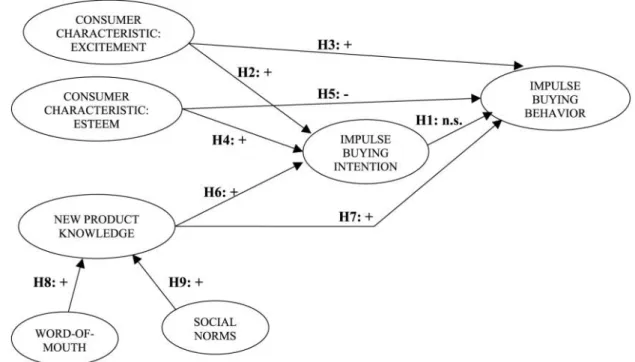
We depict the model in Figure 1. We propose that the impact of impulse buying intentions on impulse buying behavior is non-significant (H1). Consumer excitement (H2, H3), consumer esteem (H4, H5), and new product knowledge (H6, H7) influence impulse buying intentions and behavior, respectively. Finally, new product knowledge is influenced by word-of-mouth (H8) and compliance to social norms (H9). The next section develops the model and hypotheses (Figure 1).
Impulse buying intention
The inclusion of the construct of intention in Ajzen and Fishbein’s (1980) model suggests that behavior is under control of intention (Eagly and Chaiken, 1993). The model only predicts the class of behavior that can be termed volitional, i.e. behaviors that people perform because they decide to perform them under their own will (Sheppard et al., 1988). Impulse buying behavior is voluntary, however, it is also spontaneous, unanticipated and unplanned (Hodge, 2004). Rook (1987, p. 191) states: “Buying impulses are often forceful and urgent; contemplative purchasing is less so”. Hence, one would expect that the factors that play a role in the context of impulse buying to lead directly to impulse purchasing behavior. Therefore, we propose that the mediating effect of intentions to be non-significant (i.e. impulse buying intention-behavior is not significant). H1. Impulse buying intention does not significantly
mediate the relationship between impulse buying behavior and its antecedents.
Consumer characteristics: excitement
Among the consumer characteristics examined in studies of consumers’ evaluations of new products are novelty, variety, and surprise (Hirschman, 1980; Holbrook and Hirschman, 1982). Similarly, impulse buying may satisfy hedonic desires and create the desire for fun and excitement (Piron, 1991; Hausman, 2000). In addition, such needs may also be nurtured by the social interaction inherent in the shopping experience (Cobb and Hoyer, 1986; Rook, 1987). For instance, Hausman’s (2000) findings indicate that a shopping experience may encourage emotions such as feeling uplifted or energized. These notions support a link between excitement and impulse buying motives and behavior. Therefore:
Figure 1 The theoretical model
H2. Consumers’ excitement is positively related to impulse buying intention.
H3. Consumers’ excitement is positively related to impulse buying behavior.
Consumer characteristics: esteem Rook (1987, p. 191) posits:
Impulse buying occurs when a consumer experiences a sudden, often powerful and persistent urge to buy something immediately. The impulse to buy is hedonically complex and may stimulate emotional conflict. Also, impulse buying is prone to occur with diminished regard for its consequences.
Rook and Fisher (1995) found that consumers attempted to suppress their innate impulsive tendencies because they desire others’ respect and do not want to be perceived as immature or irrational. Spontaneous and uncontrolled spending on unplanned purchases is likely to receive negative normative evaluations. Hence, due to the unplanned and uncontrolled nature of impulse purchases, consumers with high need and desire for esteem may try to control or avoid such behavior. On the other hand, Hausman (2000) found that the efforts to satisfy esteem and self-actualization needs drive consumers to make impulse purchases that provided satisfaction for such needs. We argue that the inconsistent views in the literature may be explained by the distinction between impulse intentions and purchase behavior: one’s esteem may foster impulse intentions, but hinder impulse purchase behavior. Accordingly, we propose that consumers need to satisfy their self-esteem and desire to gain others’ respect will have a positive impact on their impulse buying intentions, but an adverse effect on their impulse buying. The underlying reason is that the desire to satisfy self-esteem may bring about the purchase intention, but one’s self-esteem would preclude that individual from making a speedy purchase. Thus:
H4. Consumers’ esteem is positively related to impulse buying intention.
H5. Consumers’ esteem is negatively related to impulse buying behavior.
New product knowledge
Flynn and Goldsmith (1999) hold that there are three basic types of consumer knowledge:
1 subjective; 2 objective; and 3 experience.
Subjective knowledge is the information that a consumer believes he/she possesses about a firm or its products. Objective knowledge is the information that a consumer actually possesses about a firm or its products. Experience consists of knowledge that the consumer has gained through actual interactions with a firm or its products. According to these authors, too many previous studies focus only on objective knowledge, while ignoring subjective knowledge and experience. Too many past studies, in Flynn and Goldsmith’s (1999, p. 57) opinion, have measured subjective knowledge only in an ad hoc manner. Accordingly, subjective knowledge is the focus of Flynn and Goldsmith’s study. They specifically suggest that future studies examine how knowledge (particularly) subjective knowledge relates to other consumption-related variables; for instance, the authors
suggest that managers could assess how subjective knowledge influences consumer perceptions of new products. Two important factors have been identified in the literature that determined the type of cognitive processes consumers engaged in: prior knowledge and involvement (Hirschman, 1980; Wilton and Pessemier, 1981; Moreau et al., 2001; Pham and Muthukrishnan, 2002). Stored schemas have their most significant impact on the evaluation or inference stage of social information processing. Studies find that if the new product is similar to existing products, matching the expectations of consumers, the product will be successfully categorized as a member of an existing category in the prior objective knowledge (Olshavsky and Spreng, 1996). This is because the consumer will recall an existing schema that the new information can fit in easily. So the consumer places the new product as part of that schema. This allows more information to be chunked and processed per unit of time (Bettman and Sujan, 1987). On the contrary, for highly innovative products for which they lack objective schemas in their memories, consumers’ subjective knowledge may be influential in their evaluation processes.
Past research suggests that the addition of novel attributes is likely to improve product evaluation and sales, since consumers interpret these attributes as additional benefits provided by the manufacturer (Mukherjee and Hoyer, 2001). Thus, consumers believe that innovative features add value to products. Hirschman (1980) contended that consumers’ prior positive experience with an existing product may “blind” them to the functional superiority of novel alternatives; and thus, lead to an impulse purchase. Regardless of how innovative the product is, consumers’ subjective product knowledge or experience with a similar product encourages an impulse purchase intention and behavior. Formally stated: H6. New product knowledge is positively related to impulse
buying intention.
H7. New product knowledge is positively related to impulse buying behavior.
Opinion leadership and social norms
Scholars have analyzed the adoption and the diffusion of innovation according to Rogers’ (1976) scheme, which defines diffusion as the process by which members of a social system communicate about innovation over time. Accordingly, the social system (i.e. consumers’ relevant others) plays a significant role in their reactions to and purchase behavior of new products. Scholars have devoted considerable effort to understanding how consumers influence – and are influenced – by others. Opinion leaders are people who try to influence other consumers’ purchasing. Opinion seekers pursue information about products or companies from others (Flynn et al., 1996).
Research reveals much about the dynamics of word-of-mouth and opinion leadership. Opinion leadership does not tend to be a trait that generalizes across many situations; opinion leaders tend to have influence only in specific domains (Goldsmith et al., 1996). Opinion leadership also carries tremendous managerial significance; scholars find that word-of-mouth and opinion leaders exert considerable influence over consumers’ decision making to purchase (or not purchase) new products (Flynn et al., 1996). Thus: H8. Word-of-mouth is positively related to new product
knowledge.
Ajzen and Fishbein (1980) define consumers’ normative beliefs as their perceptions of significant others’ preferences about whether one should engage in a behavior. They model these beliefs as a function of the subjective likelihood that a particular significant other thinks the person should perform the behavior and the person’s motivation to comply with the referent’s expectation. Accordingly, we propose that, aside from what opinion leaders think about the new product, a consumer’s new product knowledge is influenced by the degree to which they are willing to comply with what others think (i.e. social norms). Therefore:
H9. Compliance with social norms is positively related to new product knowledge.
Method
Sampling frame
The questionnaire was a modified version of the instrument used by Flynn et al. (1994). The data were collected by distributing 250 surveys to a convenience sample of customers in the southern part of the USA. In order to qualify, respondents had to have bought a new product at least once during the past six months. A mall intercept method was used to distribute the surveys. In total, 157 completed surveys were analyzed for this study (see Table I for the demographics of our sample). To test for response bias, we conducted one-way ANOVA to test whether there were any significant differences in our variables based on the respondents’ gender, age, education and annual income. Non-significant results indicated no evidence for response bias.
Analysis
We examined the proposed model using partial least squares analysis (PLS). We selected PLS to test the hypotheses since it is intended for causal-predictive analysis in explaining complex relationships (i.e. high number of indicators) with collinear factors (Fornell and Bookstein, 1982; Hulland, 1999). The objective of PLS, first proposed by Wold (1985), is the maximization of the explained variance for the indicators and latent variables by ordinary least squares (OLS). Following a series of OLS analyses, PLS optimally weights the indicators so that the researcher can obtain a latent variable estimate. Accordingly, PLS avoids the indeterminacy problem and provides an exact definition of component scores. Scholars hold that PLS is superior to other techniques (such as factor analysis and multiple regression) because it tests the measurement model within the context of a structural path model (Fornell and Larcker, 1981). Compared to other path-analytic techniques, PLS requires minimal demands on measurement scales, sample size, and residual distributions (Barclay, 1991).
Result: measurement validation
The PLS model was analyzed in two stages: the assessment of the unidimensionality, reliabilities and validity of the measurement model, followed by the evaluation of the structural path model. Using Hulland’s (1999) guidelines, we tested the adequacy of the measurement model by examining: . unidimensionality of the constructs;
. scale reliabilities; and . construct validity.
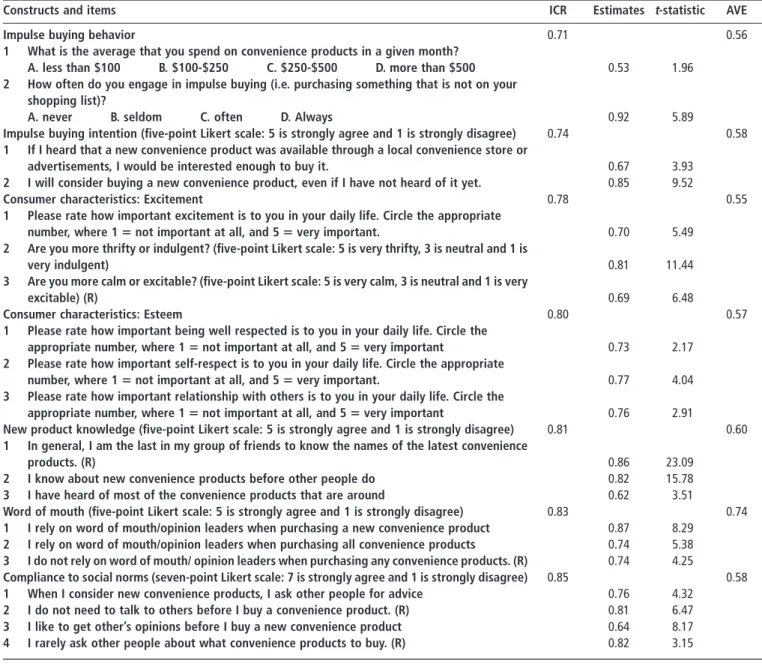
We performed principal component analysis with varimax rotation to assess the unidimensionality of each construct. Only the first eigenvalue was greater than one; this supported the constructs’ unidimensionality (Gerbing and Anderson, 1988). We evaluated the scale reliability of the measures by examining the loadings of the items on their corresponding factors (Hulland, 1999). PLS revealed high loadings (. 0.53) for all scales in the measurement model providing support for their reliability (see Table II; Churchill, 1979; Fornell and Bookstein, 1982). We then assessed convergent validities by calculating their internal composite reliabilities (ICR) and average variance extracted (AVE; see Tables II and III). These reliability coefficients ranged from 0.71 to 0.85, providing strong support for each latent variable (Nunnally, 1978; Fornell and Larcker, 1981; Bagozzi and Yi, 1988). The reported AVE’s in PLS were acceptable (i.e. at least AVE ¼ 0.55, square root AVE ¼ 0.74), showing strong support for substantial explained variance in each dependent variable. Finally, we evaluated discriminant validity by testing whether the AVE of each construct (the average variance shared between a construct and its measures) was greater than the shared variance between the construct and other constructs in the model (square of correlation between the two constructs). The AVE’s of the constructs were all higher than their shared variances; and thus, all constructs in the model exhibited discriminant validity.
All scale items are shown in Table II. All items were specified as multiple reflective indicators comprising five-point and seven-five-point modified Likert scales loading on their respective constructs (except for impulse buying behavior, which was measured using ordinal scale items with four categories). The two items for impulse buying behavior assessed how often consumers engaged in impulse behavior and how much they spent on new convenience products in a given month (ICR ¼ 0.71).
We gauged impulse buying intention using two five-point scales probing the degree of the consumers’ interest in buying the new product when they were informed it was available and even if they haven’t heard of it (ICR ¼ 0.74). New product knowledge incorporates three items signifying the extent of consumers’ knowledge about most new products and the degree to which they hear about new products compared to Table I Sample demographics
Age % Gender % Income % Education %
Under 18 3.8 Male 42.9 Less than $25,000 61 High School/GED 43 19-25 60.5 Female 51.1 $25,000-$45,000 23.4 College 44
26-35 12.7 $45,000-$65,000 4.5 Graduate 8.3
36-44 8.9 More than $65,000 11 Further Education 5.1 Above 45 14
others (ICR ¼ 0.81). We measured word-of-mouth using three items that assess the degree to which consumers rely on word-of-mouth and opinion leaders (ICR ¼ 0.83). The four items for compliance to social norms assessed the degree to which the consumers ask others for advice when buying new convenience products (ICR ¼ .85). Two constructs measured consumer characteristics:
1 excitement, consisting of excitement in the consumers’ life, consumers’ degree of indulgence and calmness (reversed; ICR ¼ 0.78); and
2 esteem, encompassing the degree to which self-respect, respect from and relationship with others are important for the consumer (ICR ¼ 0.80).
Results: structural model
The PLS construct level statistics (AVE and ICR, previously explained) indicate a fit for the manifest variables to the latent
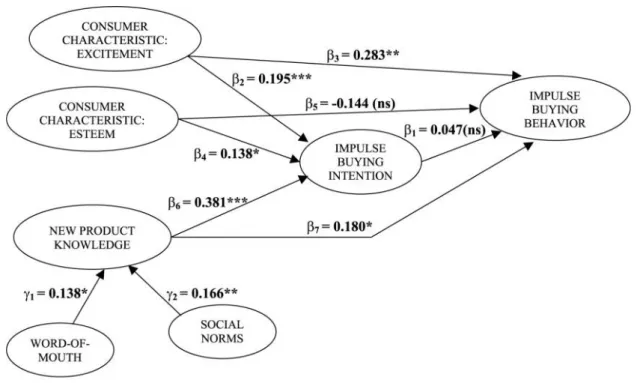
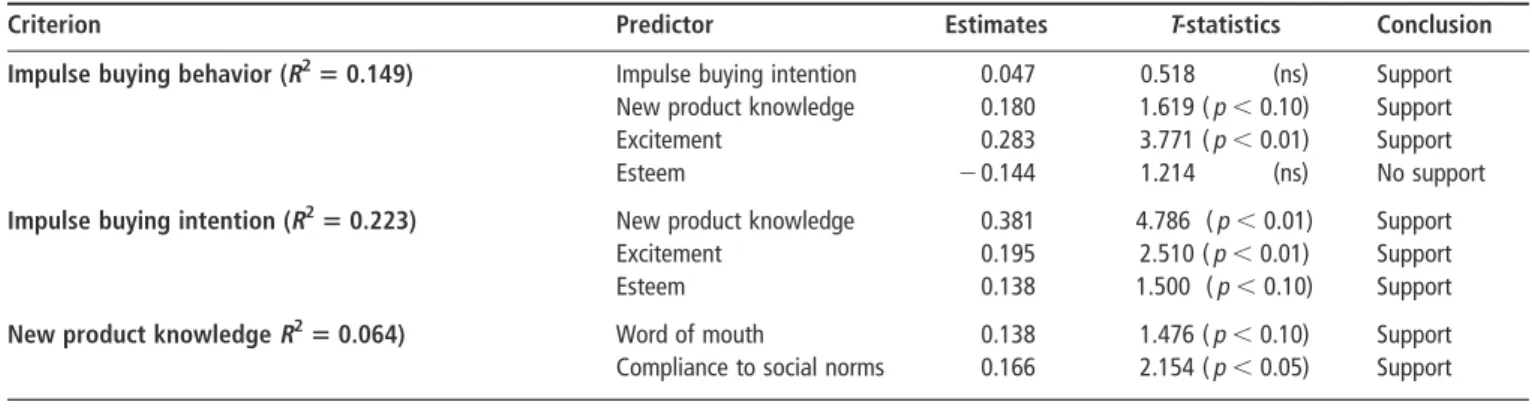
variables; however, they do not give an indication of overall model fit or how the latent variables co-vary with one another. Since PLS is designed to maximize prediction, the emphasis is put on explanatory power to maximize variance in the dependent variables based on the independent variables in the model. Consequently, the degree to which PLS models accomplish this objective is evaluated based on prediction oriented measures (R2; instead of covariance fit as is attempted in SEM) (Fornell and Bookstein, 1982; Barclay, 1991). Figure 2 depicts the structural path coefficients. Table IV shows the results for the hypothesized model: variance explained for each dependent construct is shown, along with an indication of the significance of the hypotheses.
Consistent with H1, impulse buying intention was not significantly related to impulse buying behavior (b1 ¼ 0.047, p. 0.10). Both of the consumer characteristics, i.e. excitement and esteem, significantly increased impulse buying intention (b2 ¼ 0.195, p , 0.01; b4 ¼ 0.138, p , 0.10; respectively), Table II Measures, reliabilities and factor loadings
Constructs and items ICR Estimates t-statistic AVE
Impulse buying behavior 0.71 0.56
1 What is the average that you spend on convenience products in a given month?
A. less than $100 B. $100-$250 C. $250-$500 D. more than $500 0.53 1.96 2 How often do you engage in impulse buying (i.e. purchasing something that is not on your
shopping list)?
A. never B. seldom C. often D. Always 0.92 5.89
Impulse buying intention (five-point Likert scale: 5 is strongly agree and 1 is strongly disagree) 0.74 0.58 1 If I heard that a new convenience product was available through a local convenience store or
advertisements, I would be interested enough to buy it. 0.67 3.93 2 I will consider buying a new convenience product, even if I have not heard of it yet. 0.85 9.52
Consumer characteristics: Excitement 0.78 0.55
1 Please rate how important excitement is to you in your daily life. Circle the appropriate
number, where 1 5 not important at all, and 5 5 very important. 0.70 5.49 2 Are you more thrifty or indulgent? (five-point Likert scale: 5 is very thrifty, 3 is neutral and 1 is
very indulgent) 0.81 11.44
3 Are you more calm or excitable? (five-point Likert scale: 5 is very calm, 3 is neutral and 1 is very
excitable) (R) 0.69 6.48
Consumer characteristics: Esteem 0.80 0.57
1 Please rate how important being well respected is to you in your daily life. Circle the
appropriate number, where 1 5 not important at all, and 5 5 very important 0.73 2.17 2 Please rate how important self-respect is to you in your daily life. Circle the appropriate
number, where 1 5 not important at all, and 5 5 very important. 0.77 4.04 3 Please rate how important relationship with others is to you in your daily life. Circle the
appropriate number, where 1 5 not important at all, and 5 5 very important 0.76 2.91
New product knowledge (five-point Likert scale: 5 is strongly agree and 1 is strongly disagree) 0.81 0.60 1 In general, I am the last in my group of friends to know the names of the latest convenience
products. (R) 0.86 23.09
2 I know about new convenience products before other people do 0.82 15.78 3 I have heard of most of the convenience products that are around 0.62 3.51
Word of mouth (five-point Likert scale: 5 is strongly agree and 1 is strongly disagree) 0.83 0.74 1 I rely on word of mouth/opinion leaders when purchasing a new convenience product 0.87 8.29
2 I rely on word of mouth/opinion leaders when purchasing all convenience products 0.74 5.38 3 I do not rely on word of mouth/ opinion leaders when purchasing any convenience products. (R) 0.74 4.25
Compliance to social norms (seven-point Likert scale: 7 is strongly agree and 1 is strongly disagree) 0.85 0.58 1 When I consider new convenience products, I ask other people for advice 0.76 4.32
2 I do not need to talk to others before I buy a convenience product. (R) 0.81 6.47 3 I like to get other’s opinions before I buy a new convenience product 0.64 8.17 4 I rarely ask other people about what convenience products to buy. (R) 0.82 3.15
supporting H2 and H4. Consumer excitement positively impacted impulse buying behavior (b3 ¼ 0.283, p , 0.05), while esteem was not significantly related (b5 ¼ 20.144, p. 0.10), confirming H3, but not H5. As expected in H6 and H7, new product knowledge increased impulse buying intention (b6 ¼ 0.381, p , 0.01) as well as impulse buying (b7 ¼ 0.180, p , 0.10). Finally, word-of-mouth positively influenced new product knowledge (g1 ¼ 0.138, p , 0.10) and compliance to social norms (g2 ¼ 0.166, p , 0.05); this result supports H8 and H9. Overall, our results reveal that
consumer knowledge and consumer characteristics directly impact impulse buying behavior excitement – not indirectly through impulse buying intention.
Discussion and managerial implications
Rook (1987), in his seminal article, emphasizes the need for a theoretical framework to guide empirical research on impulse buying (Rook, 1987, p. 191). He also calls for work on the effects of personality traits and the social environment on impulse purchasing (Rook, 1987, p. 196). Furthermore, another under-researched area that remains is consumers’ cognitive processes or impulse buying motivations for new products (Bagozzi, 1999; Waarts et al., 2002). Accordingly, our research contributes to the literatures on impulse buying and product innovation in three ways.
1 Our research is the first to analyze consumers’ impulse buying tendencies and behavior for new products. 2 We draw on the theory of reasoned action as a theoretical
foundation in building our model of impulse buying of product innovations. We adopt Fishbein and Ajzen’s (1975) framework by arguing that, in the context of impulse purchases, purchase intention is not a significant mediator. In other words, impulse purchases are unplanned, unexpected, and spontaneous; hence, the determinants of behavior influence impulse buying directly rather than indirectly through intentions. 3 Third, we empirically analyze our model of impulse
purchases of innovative products. The determinants of impulse purchases include consumers’ characteristics (i.e. excitement and esteem) and prior product knowledge (as influenced by opinion-leaders and compliance to social norms).
Figure 2 Results of model testing
Table III Reliabilities and correlations among constructs
ICR 1 2 3 4 5 7 8 1 Impulse buying behavior 0.71 0.75
2 Impulse buying intention 0.73 0.17 0.76 3 Word-of-mouth 0.83 0.07 0.14 0.79 4 Compliance to social norms 0.84 0.15 0.37 0.230.76 5 New product knowledge 0.81 0.22 0.20 -0.22 0.400.77 7 Excitement 0.78 0.30 -0.02 -0.17 0.24 0.090.74 8 Esteem 0.80 -0.11 0.02 -0.20 0.16 0.01 1.000.75 Notes: Internal composite reliability (ICR) statistic represents a ratio of the squared total of the variance explained for each manifest variable divided by the sum of the squared total of the variance explained plus the total of the unexplained variance. An ICR greater than 0.7 is considered adequate to achieve sufficient reliability; Diagonal is the square root of the Average Variance Extracted (AVE). Average Variance Extracted (AVE) represents a ratio of the total of variance explained divided by the sum of variance explained and variance unexplained. A square root AVE greater than 0.7 is considered adequate in the sense the manifest variables measure what is intended. Off diagonal entries are correlations among constructs
Overall, we argue that the impact of impulse buying intentions on impulse buying behavior is non-significant. New product knowledge, and two consumer characteristics – consumer excitement and consumer esteem – drive impulse buying intentions and behavior. Finally, word-of-mouth influences new product knowledge and compliance to social norms. Parallel to the extant impulse buying literature, we argue that impulse buying is an inherent consumer trait, rather than a response to particular products. Accordingly, we provide an understanding of what drives the tendency to purchase new products on impulse.
One may describe the overall picture that emerges as follows. First, impulse buying intention does not exert a significant impact on impulse buying behavior. This result shows that the drivers of impulse buying directly influence such behavior; behavioral intention is not a significant mediator. Impulse buying intention does not play a significant role in the conduct of impulse buying behavior. More specifically, our findings show that some impulse consumers bypass purchase intentions. Overall, potential impulse buyers fall into two categories:
1 those who bypass purchase intentions; and 2 those who form intentions.
Second, consumers’ desire and need for excitement encourages both impulse buying intention and impulsive purchase of innovative products. Clearly, consumers’ innate desires and need for excitement, fun, and variety promotes their intentions as well as impulse purchases of new products. Third, contrary to our prediction, consumers’ desire for esteem does not significantly influence impulse buying behavior; more specifically, the importance a consumer places on: relationships with others; receiving respect from others; and self-respect did not significantly influence impulse buying. Consumers may believe that buying the latest innovations will get them more respect from others and increase their self-respect by making them feel more contemporary. However, impulse purchases of new products entail spontaneous and uncontrolled spending. Perhaps this dilemma explains the non-significant result. On the other hand, our results also indicate that consumers’ esteem has a significant positive impact on intention. Hence, one’s esteem creates the motivation to satisfy a need and encourages impulse buying intention; however, impulse buying intention does not predict impulse buying behavior.
Fourth, consumers’ level of knowledge of new products has a positive influence on their impulse buying intentions and purchases. Hence, the retrieved schemas that are stored in
consumers’ memories – either subjective or objective – promote the sudden urge as well as the unplanned act to purchase innovations. Finally, as proposed in the theory of reasoned action and adoption theory of innovations, new product knowledge is influenced by what others think (word-of-mouth) and consumers’ willingness to comply with others. Overall, our results indicate that although similar factors encourage consumers to form purchase intentions and to make impulse purchases, those consumers who form impulse purchase intentions do not proceed to make an impulse buy. Hence, this suggests that the effort and time taken to form an intention, characterizes the cautious shopper rather than the impulse buyer. Impulse buyers make purchase at the spur of the moment and do not spend time to form intentions. Putting it differently, after an individual has taken the time to form purchase intentions, she/he might still buy. However, this purchase will not constitute an impulse buy.
Our research provides a number of suggestions for managers. To promote the impulse buying urge and behavior of new products, marketing managers may emphasize excitement, fun and variety in their promotional activities. As an illustration, they may depict individuals who enjoy fun and excitement, and who, at the same time, cannot resist buying new products when they see them. Furthermore, to eliminate the negative evaluations and transform the impulse buying intention into behavior, managers might show that impulse purchases promote customer self esteem, and that others perceive impulse purchasers as contemporary and innovative. Finally, knowledge about product innovations fosters consumers’ impulse buying motives and behavior; the beliefs of opinion leaders and the degree to which consumers are willing to comply combine, in turn, to influence knowledge. This finding clearly points to the importance of informing potential customers about the benefits and unique attributes of product innovations; the results also indicate that firms should identify lead users in order to reach a large number of consumers. Future research may complement the present study through other methods, such as experiments. Furthermore, scholars may wish to investigate the non-significant relationship between impulse buying intentions and behavior and to test whether these findings hold in other contexts. Other situational factors, consumer characteristics or degree of product newness may play a moderating role. Table IV Variance explained (R2) and estimated path coefficients
Criterion Predictor Estimates T-statistics Conclusion Impulse buying behavior (R2
50.149) Impulse buying intention 0.047 0.518 (ns) Support New product knowledge 0.180 1.619 (p , 0.10) Support Excitement 0.283 3.771 (p , 0.01) Support Esteem 20.144 1.214 (ns) No support Impulse buying intention (R250.223) New product knowledge 0.381 4.786 (p , 0.01) Support
Excitement 0.195 2.510 (p , 0.01) Support Esteem 0.138 1.500 (p , 0.10) Support New product knowledgeR2
50.064) Word of mouth 0.138 1.476 (p , 0.10) Support Compliance to social norms 0.166 2.154 (p , 0.05) Support
References
Abelson, R.P. and Levi, A. (1985), “Decision making and decision theory”, in Lindzey, G. and Aronson, E. (Eds), The Handbook of Social Psychology, 3rd ed., Vol. 1, Random House, New York, NY, pp. 259-69.
Ajzen, I. and Fishbein, M. (1980), Understanding Attitudes and Predicting Social Behavior, Prentice-Hall, Englewood Cliffs, NJ.
Bagozzi, R.P. (1999), “Consumer resistance to, and acceptance of, innovations”, Advances in Consumer Research, Vol. 26, pp. 218-25.
Bagozzi, R.P. and Yi, Y. (1988), “On the evaluation of structural equation models”, Academy of Marketing Science Journal, Vol. 16 No. 1, pp. 74-94.
Barclay, D.W. (1991), “Interdepartmental conflict in organizational buying: the impact of the organizational context”, Journal of Marketing Research, Vol. 28 No. 2, pp. 145-59.
Beatty, S.E. and Ferrell, M.E. (1998), “Impulse buying: modeling its precursors”, Journal of Retailing, Vol. 74 No. 2, pp. 169-91.
Bellenger, D.N., Robertson, D.H. and Hirschman, E.C. (1978), “Impulse buying varies by product”, Journal of Advertising Research, Vol. 18 No. 6, pp. 15-18.
Bettman, J.R. and Sujan, M. (1987), “Effects of framing on evaluation of comparable and non-comparable alternatives by expert and novice consumers”, Journal of Consumer Research, Vol. 14 No. 2, pp. 141-54.
Bettman, J.R., Luce, M.F. and Payne, J.W. (1998), “Constructive consumer choice processes”, Journal of Consumer Research, Vol. 25 No. 3, pp. 187-217.
Chandy, R.K. and Tellis, G.J. (1998), “Organizing for radical product innovation: the overlooked role of willingness to cannibalize”, Journal of Marketing Research, Vol. 35 No. 4, pp. 474-87.
Churchill, G.A. Jr (1979), “A paradigm for developing better measures of marketing constructs”, Journal of Marketing Research, Vol. 16 No. 1, pp. 64-73.
Clover, V.T. (1950), “Relative importance of impulse-buying in retail stores”, Journal of Marketing, Vol. 15 No. 1, pp. 66-70.
Cobb, C.J. and Hoyer, W.D. (1986), “Planned versus impulse purchase behavior”, Journal of Retailing, Vol. 62 No. 4, pp. 384-409.
Eagly, A.H. and Chaiken, S. (1993), “The structure of attitudes and beliefs”, The Psychology of Attitudes, Harcourt Brace, NewYork, NY.
Fishbein, M. and Ajzen, I. (1975), Belief, Attitude, Intention and Behavior: An Introduction to Theory and Research, Addison-Wesley, Reading, MA.
Flynn, L.R. and Goldsmith, R.E. (1999), “A short, reliable measure of subjective knowledge”, Journal of Business Research, Vol. 46 No. 1, pp. 57-66.
Flynn, L.R., Goldsmith, R.E. and Eastman, J.K. (1994), “The King and Summers opinion leadership scale: revision and refinement”, Journal of Business Research, Vol. 41 No. 1, pp. 55-64.
Flynn, L.R., Goldsmith, R.E. and Eastman, J.K. (1996), “Opinion leaders and opinion seekers: two new measurement scales”, Journal of the Academy of Marketing Science, Vol. 24 No. 2, pp. 137-47.
Fornell, C. and Bookstein, F.L. (1982), “Two structural equation models: LISREL and PLS applied to consumer exit-voice theory”, Journal of Marketing Research, Vol. 19 No. 4, pp. 440-52.
Fornell, C. and Larcker, D.F. (1981), “Evaluating structural equation models with unobservable variables and measurement error”, Journal of Marketing Research, Vol. 18 No. 1, pp. 39-50.
Gardner, M.P. and Rook, D.W. (1988), “Effects of impulse purchases on consumers’ affective states”, Advances in Consumer Research, Vol. 15, pp. 127-30.
Gatignon, H. and Robertson, T.S. (1989), “Technology diffusion: an empirical test of competitive effects”, Journal of Marketing, Vol. 53 No. 1, pp. 35-49.
Gerbing, D.W. and Anderson, J.C. (1988), “An updated paradigm for scale development incorporating unidimensionality and its assessment”, Journal of Marketing Research, Vol. 25 No. 2, pp. 186-92.
Goldsmith, R.E., Freiden, J.B. and Eastman, J.K. (1996), “The generality/specificity issue in consumer innovativeness research”, Technovation, Vol. 15 No. 10, pp. 601-12. Hausman, A. (2000), “A multi-method investigation of
consumer motivations in impulse buying behavior”, Journal of Consumer Marketing, Vol. 17 No. 5, pp. 403-19. Hirschman, E.C. (1980), “Innovativeness, novelty seeking, and consumer creativity”, Journal of Consumer Research, Vol. 7 No. 3, pp. 283-95.
Hodge, R. (2004), “Factors influencing impulse buying during an online purchase transaction”, unpublished master’s thesis, University of Waterloo, available at: http:// etd.uwaterloo.ca (accessed November 2006).
Holbrook, M.B. and Hirschman, E.C. (1982), “The experiential aspects of consumption: consumer fantasies, feelings, and fun”, Journal of Consumer Research, Vol. 9 No. 2, pp. 132-40.
Hulland, J.S. (1999), “Use of partial least squares in strategic management research: a review of four recent studies”, Strategic Management Journal, Vol. 20 No. 2, pp. 195-204. Lancaster, G.A. and White, M. (1976), “Industrial diffusion, adoption and communication”, European Journal of Marketing, Vol. 10 No. 5, pp. 280-98.
Lowrey, T.M. (1991), “The use of diffusion theory in marketing: a qualitative approach to innovative consumer behavior”, Advances in Consumer Research, Vol. 18, pp. 644-50.
Moreau, C.P., Markman, A. and Lehmann, D.R. (2001), “What is it? Categorization flexibility and consumers’ responses to really new products”, Journal of Consumer Research, Vol. 27 No. 4, pp. 489-98.
Mukherjee, A. and Hoyer, W.D. (2001), “The effect of novel attributes on product evaluation”, Journal of Consumer Research, Vol. 28 No. 3, pp. 461-72.
Nunnally, J.C. (1978), Psychometric Theory, McGraw-Hill, New York, NY.
Olshavsky, R.W. and Spreng, R.A. (1996), “An exploratory study of the innovation evaluation process”, Journal of Product Innovation Management, Vol. 13 No. 6, pp. 512-29. Peck, J. and Childers, T.L. (2006), “If I touch it I have to have it: individual and environmental influences on impulse purchasing”, Journal of Business Research, Vol. 59 No. 6, pp. 765-9.
Pham, M.T. and Muthukrishnan, A.V. (2002), “Search and alignment in judgment revision: implications for brand
positioning”, Journal of Marketing Research, Vol. 39 No. 1, pp. 18-30.
Piron, F. (1991), “Defining impulse purchasing”, Advances in Consumer Research, Vol. 18, pp. 509-14.
Raju, P.S. (1979), “Stimulus-response variables in new product research”, Advances in Consumer Research, Vol. 6, pp. 200-5.
Robertson, T.S. (1967), “The process of innovation and the diffusion of innovation”, Journal of Marketing, Vol. 31 No. 1, pp. 14-19.
Rogers, E.M. (1976), “New product adoption and diffusion”, Journal of Consumer Research, Vol. 2, pp. 290-301.
Rogers, E.M. and Shoemaker, F.F. (1971), Communication of Innovations: A Cross-cultural Approach, Free Press, New York, NY.
Rook, D.W. (1987), “The buying impulse”, Journal of Consumer Research, Vol. 14 No. 2, pp. 189-99.
Rook, D.W. and Fisher, R.J. (1995), “Normative influences on impulsive buying behavior”, Journal of Consumer Research, Vol. 22 No. 3, pp. 305-13.
Sheppard, B.H., Hartwick, J. and Warshaw, P.R. (1988), “The theory of reasoned action: a meta-analysis of past research with recommendations for modifications and future research”, Journal of Consumer Research, Vol. 15 No. 3, pp. 325-43.
Steenkamp, J.E.M. and Gielens, K. (2003), “Consumer and market drivers of the trial probability of new consumer packaged goods”, Journal of Consumer Research, Vol. 30 No. 3, pp. 368-84.
Stern, H. (1962), “The significance of impulse buying today”, Journal of Marketing, Vol. 26 No. 2, pp. 59-62.
Waarts, E., Van Everdingen, Y.M. and Van Hillegersberg, J. (2002), “The dynamics of factors affecting the adoption of innovations”, Journal of Product Innovation Management, Vol. 19 No. 6, pp. 412-23.
Wilton, P.C. and Pessemier, E.A. (1981), “Forecasting the ultimate acceptance of an innovation: the effects of information”, Journal of Consumer Research, Vol. 8, pp. 162-71.
Wind, J. and Mahajan, V. (1997), “Issues and opportunities in new product development: an introduction to the special issue”, Journal of Marketing Research, Vol. 34 No. 1, pp. 1-12. Wold, H. (1985), “Partial least squares”, in Kotz, S. and Johnson, N.L. (Eds), Encyclopedia of Statistical Sciences, Vol. 6, Wiley, New York, NY, pp. 581-91.
Ziamou, P. and Gregan-Paxton, J. (1999), “Learning of new products: moving ahead by holding back”, Advances in Consumer Research, Vol. 26, pp. 365-7.
About the authors
Nukhet Harmancioglu is Assistant Professor of Marketing on the Faculty of Business at Bilkent University in Ankara, Turkey. Nukhet completed her doctoral work in marketing and international business at Michigan State University’s Eli Broad College of Business. Nukhet earned her MBA with honors from the Bosphorus University, Turkey and has also earned degrees from the Middle East Technical University and the Izmir American Collegiate Institute in Turkey. She is the 2005 winner of the Product Development and Management Association Dissertation Proposal Competition. Her research has been published in the Journal of Product Innovation Management and R&D Management.
R. Zachary Finney is Assistant Professor of Marketing at the Mitchell College of Business at the University of South Alabama. He earned his PhD in marketing from the University of Alabama in 2001. Dr Finney’s research has been accepted for publication in numerous journals including the Journal of Business Research, the Journal of Advertising Research, the Journal of Marketing Theory and Practice, and Marketing Management Journal. In 2003, Dr Finney and two colleagues won the Steven J. Shaw Award for the Outstanding Conference Paper at the Society for Marketing Advances Annual Conference in New Orleans. Dr Finney’s primary area of scholarly research is marketing strategy. Dr Finney is the corresponding author and can be contacted at: [email protected]
Mathew Joseph is the Emil C.E. Jurica Professor of Marketing at St. Mary’s University, San Antonio, Texas, USA. He holds an MBA from the University of Waikato in New Zealand. He is the author of a number of articles in the areas of cross-cultural marketing, service quality, marketing strategy, health-care marketing, electronic marketing, service technology, international advertising and promotion, marketing to Asia and Latin America, and marketing education.
Executive summary and implications for
managers and executives
This summary has been provided to allow managers and executives a rapid appreciation of the content of this article. Those with a particular interest in the topic covered may then read the article in toto to take advantage of the more comprehensive description of the research undertaken and its results to get the full benefits of the material present.
Planned purchases have been described as being typically the product of extensive information search and rational decision making. On the contrary, any detailed planning is absent when impulse buying occurs. The relative swiftness in which planned and impulse purchases are carried out is therefore often cited as the most significant difference between the two behaviors.
Some analysts consider that personality traits influence impulse buying and believe that different individuals experience different levels of intensity and control relating to the behavior. It is also accepted that consumers may perceive impulse buying as evidence of character weakness and some have reported negative consequences of their actions.
Innovation has likewise been the focus of much study and it has been argued that ideas only become innovative when consumers perceive them as new. Harmancioglu et al. add that a necessary transformation in both thought and behavior further defines these “new offerings”. It is also acknowledged that consumers try to understand and evaluate new products through use of their prior knowledge and experience.
According to the authors, this knowledge and experience becomes inadequate where highly innovative products are concerned. They believe that this complicates cognitive processing and prompts some consumers to buy these new products on impulse. In the present study, the aim is to investigate what motivates impulse buying of innovative products. Scant research has been undertaken to in this particular area to date.
The theory of reasoned action is commonly utilized to study adoption and usage of innovations. A basic premise of this approach is that behavior can be predicted through measuring
a person’s intentions to perform the behavior in question. In relation to impulse buying, however, Harmancioglu et al. propose that intention does not drastically mediate subsequent behavior. Any influence of intention is deemed immaterial, largely on the basis that impulse buying is characterized by its spontaneity and unplanned nature. They instead subscribe to the belief that impulse buying behavior in many individuals is directly influenced by antecedents that include product knowledge, consumer characteristics and compliance to social norms.
Issues to consider
Previous studies have identified novelty, value and surprise as significant factors in consumer assessment of and desire for new products. Links between impulse buying and fun and excitement have also been identified. The social interaction within the shopping experience itself can nurture such desires among consumers who may feel invigorated or fortified or as a result.
Another potential influence on impulse buying behavior is consumer esteem. The premise here is that consumers who desire respect from others will attempt to limit or avoid such behavior for the fear of being labeled irrational or aberrant. Some consumers may, however, perceive that making impulsive purchases actually helps to fulfill their esteem-related needs. This apparent inconsistency could indicate that esteem might promote impulse intentions but suppress impulse buying behavior.
The authors also believe that objective and subjective knowledge impacts on how consumers perceive new products. Studies have shown that consumers use prior knowledge and involvement to aid their cognitive processing for new product evaluation. Use of existing schemas allows new products to be measured against familiar ones. When similarity is perceived, the new offering is placed in the same category that is part of the consumer’s objective knowledge. When the product is highly innovative, such objective knowledge is likely to be absent so a consumer’s evaluation depends on his or her subjective knowledge. However, relevant study into the influence of subjective knowledge is limited. It is believed though that consumers regard the product as more beneficial when manufacturers include innovative features. Such attributes therefore add value for the consumer and increase sales.
It has long been established that consumer behavior is heavily influenced by the influence of relevant others in their social system. Research has specifically identified word-of-mouth (WOM) and opinion leadership as especially influential on consumer decision-making where purchase behavior is concerned. Social norms are similarly important in that consumer behavior is to some extent shaped by whether and how much they are prepared to comply with what others think and expect.
Study and results
Harmancioglu et al. formed hypotheses based around these issues and conducted a survey in southern USA. The 157 participants qualified through buying at least one new product during the preceding six months.
Study findings indicated that:
. impulse buying behavior was not especially influenced by impulse buying intention;
. both excitement and esteem significantly increased impulse buying intention;
. excitement had a positive impact on impulse buying behavior;
. the link between esteem and impulse buying behavior was not significant;
. new product knowledge increased impulse buying intention; and
. WOM positively influenced new product knowledge and compliance to social norms.
The results substantiate author expectations with regard to intention and the different antecedents. One notable exception here is esteem, where the non-significant result mirrors the conflicting evidence in the extant literature. Harmancioglu et al. surmise that this provides an indication of the dilemma impulse buyers face. Such consumers value personal relationships and believe that buying the newest innovations will help increase both their self-esteem and the respect from others. However, a fear of being perceived as spontaneous or irrational is likewise a key issue that serves to temper any propensity for engaging in impulse buying behavior.
It is apparent that different factors positively influence intention without necessarily also influencing actual buying behavior. The authors argue that the shopper who forms an intention to buy is actually demonstrating caution rather than impulsiveness. Developing any intention demands time and effort, while impulse buying occurs instantaneously. They concede that intention may still lead to purchase but point out that, by definition, this cannot be construed as an impulse buy. Recommendations and future research
Marketers aiming to stimulate impulse buying desire and behavior among consumers should create promotional activities with a focus on fun, excitement and variety. One suggestion is to portray fun-loving individuals whose desires are fulfilled through the purchase of new products. Harmancioglu et al. further propose that managers should emphasize that consumers who impulse buy improve their self-esteem and are regarded as “contemporary and innovative” by others. This can help transform intent into action while also suppressing negative perceptions of impulse buying behavior. The authors also believe that marketers will be able to reach a greater consumer population by targeting “key users” of the product. Informing potential consumers of the benefits and exclusivity of the latest innovations is likewise important.
Future research could further explore the relationship between intention and behavior to ascertain whether or not the findings are applicable to other settings. Using alternative study methods and considering different contextual factors, consumer characteristics or degrees of product newness may also be informative.
(A pre´cis of the article “Impulse purchases of new products: an empirical analysis”. Supplied by Marketing Consultants for Emerald.)
To purchase reprints of this article please e-mail: [email protected] Or visit our web site for further details: www.emeraldinsight.com/reprints