a thesis
submitted to the department of computer engineering
and the institute of engineering and science
of bilkent university
in partial fulfillment of the requirements
for the degree of
master of science
By
Hilal Zitouni
Y. Do¸c. Dr. Pınar Duygulu S¸ahin(Advisor)
I certify that I have read this thesis and that in my opinion it is fully adequate, in scope and in quality, as a thesis for the degree of Master of Science.
Prof. Dr. Fazlı Can
I certify that I have read this thesis and that in my opinion it is fully adequate, in scope and in quality, as a thesis for the degree of Master of Science.
Assoc. Prof. Dr. Aydın Alatan
Approved for the Institute of Engineering and Science:
Prof. Dr. Levent Onural Director of the Institute
Hilal Zitouni
M.S. in Computer Engineering
Supervisor: Asst. Prof. Dr. Pınar Duygulu S¸ahin July, 2010
In this study, we introduce a method to name less-frequently appearing people on the web via naming frequently appearing ones first. Current image search engines are widely used for querying a person, however; retrievals are based on textual content; therefore, the results are not satisfactory. On the other hand, although; face recognition is a long standing problem; it is tested for limited sizes and successful results are acquired just for face images captured under controlled environments. Faces on the web, contrarily are huge in amount and vary in pose, illumination, occlusion and facial attributes. Recent researches on the area, suggest not to use simply the visual or textual content alone, but to combine them both. With this approach, face recognition problem is simplified to a face-name association problem.
Following these approaches, in our method textual and visual information is combined to name faces. We divide the problem into two sub problems, first the more frequently appearing faces, then the less-frequently appearing faces on the web images are named. A supervised algorithm is used for naming a specified number of categories belonging to more frequently appearing faces. The faces that are not matched with any category are then considered to be the less-frequently appearing faces and labeled using the textual content. We extracted all the names from textual contents, and then eliminate the ones used to label frequently-appearing faces before. The remaining names are the candidate categories for less-frequently appearing faces. Each detected less-less-frequently appearing face finally matched to the names extracted from their corresponding textual content. In order to prune the irrelevant face images, finally, the most similar faces among this collection are found to be matched with their corresponding category.
In our experiments, the method is applied on two different datasets. Both iii
datasets are constructed from the images captured in realistic environments, vary-ing in pose, illumination, facial expressions, occlusions and etc. The results of the experiments proved that the combination of textual and visual contents on realistic face images outperforms the methods that use either one of them. Be-sides, handling the face recognition problem as a face-name association, improves the results for the face images collected from uncontrolled environments.
Keywords: face recognition, face detection, face retrieval, face naming, naming faces, SVM, SIFT.
˙IS˙IMLEND˙IR˙ILMES˙I
Hilal Zitouni
Bilgisayar M¨uhendisli˘gi, Y¨uksek Lisans Tez Y¨oneticisi: Y. Do¸c. Dr. Pınar Duygulu S¸ahin
Temmuz, 2010
Bu ¸calı¸smada, web ¨uzerinde sık g¨or¨ulen y¨uzlerin isimlendirilmesinden faydala-narak, nadir g¨or¨ulen y¨uzlerin isimlendirilmesini saˇglayan bir y¨ontem sunulmu¸stur. Mevcut g¨or¨unt¨u arama motorları, g¨un¨um¨uzde yaygın olarak bir ki¸sinin sorgulan-ması i¸cin kullanılmaktadır; ancak sonu¸clar, g¨or¨unt¨ulere ait metinler kullanılarak getirilmektedir, dolayısıyla y¨uksek ba¸sarı elde etmek i¸cin bu y¨ontem yetersiz kalmaktadır. Y¨uz tanıma sistemleri ise, ¨uzerinde uzun zamandır ¸calı¸sılan bir konu olmasına raˇgmen, ba¸sarılı sonu¸clar sadece kontroll¨u ortamlarda ¸cekilen fotoˇgraflar ¨uzerinde, limitli bir veri k¨umesi i¸cin elde edilmi¸stir. Web ¨uzerinde bu-lunan y¨uz resimleri ise, bunun aksine, ger¸cek ortamlarda ¸cekilmi¸s olup, pozisyon, ı¸sıklandırma, y¨uz ifadeleri vb. farklılıklar g¨ostermektedir. Bu alanda yapılan son ¸calı¸smalar ise, sadece metin ya da sadece g¨orsel i¸ceriˇgi kullanmaktansa, ik-isini birle¸stirerek daha ba¸sarılı sonu¸clar elde etmeyi ¨onermektedir. Bu yakla¸sım kullanılarak, y¨uz tanıma problemi, isim-y¨uz e¸sle¸stirmesi olarak basitle¸stirilmi¸stir. Yukarıda bahsetmi¸s olduˇgumuz bilgiler doˇgrultusunda, y¨uzleri isimlendirmek i¸cin geli¸stirmi¸s olduˇgumuz metot, metinsel ve g¨orsel i¸ceriˇgi birlikte kullanmı¸stır. Problem, iki alt probleme b¨ol¨unm¨u¸s olup, ilk basamakta sık g¨or¨ulen y¨uzler isim-lendirilmi¸s, ikinci basamakta ise nadir g¨or¨ulen y¨uzler isimlendirilmi¸stir. Sık g¨or¨ulen y¨uzlerin isimlendirilmesinde, belirli bir kategori sayısı i¸cin g¨ud¨uml¨u al-goritma tekniˇgi kullanılmı¸stır. Bu a¸samada isimlendirilemeyen y¨uzler, nadir g¨or¨ulen y¨uz olarak nitelendirilmi¸s ve bu y¨uzlerin isimlendirilmesinde ise resme ait metinlerden faydalanılmı¸stır. Metinsel i¸ceriklerdeki t¨um isimler ¸cıkarılmı¸s, bunların arasından ilk a¸samada sık g¨or¨ulen bir y¨uz ile e¸sle¸stirilmi¸s olan isimler elenmi¸stir. Geriye kalan isimler, resimlerdeki nadir g¨or¨ulen y¨uzler i¸cin aday isim
kategorilerini olu¸sturacaktır. Her nadir g¨or¨ulen y¨uz, ilgili metinden ¸cıkarılan isim-lerle e¸sle¸stirilmi¸stir. Son olarak, bir isim i¸cin toplanmı¸s y¨uzler arasındaki alakasız resimlerin elenmesi adına birbirine en ¸cok benzeyen resim topluluˇgu bulunarak, bu topluluktaki y¨uz resimleri, altında toplanmı¸s oldukları isim ile e¸sle¸stirilir.
Deneylerimiz boyunca, ¨onerilen metot iki ayrı veri k¨umesi ¨uzerinde uygu-lanmı¸stır. ˙Iki veri k¨umesi de, kontrols¨uz, ger¸cek ortamlarda ¸cekilmi¸s olan fotoˇgraflardan olu¸sup, pozisyon, ı¸sıklandırma, y¨uz mimikleri a¸cısından farklılıklar g¨ostermektedir. Deneylerimizin sonu¸cları kanıtlamı¸stır ki, metin ve g¨orsel i¸ceriˇgin birarada kullanılması, ikisinden sadece birinin kullanıldıˇgı metotlarlardan daha ba¸sarılı sonu¸clar elde edilmesini saˇglamı¸stır. Bunun yanı sıra, y¨uz tanıma prob-lemini, isim-y¨uz e¸sle¸stirme problemi olarak basitle¸stirmek, kontrols¨uz ortamlarda ¸cekilmi¸s olan fotoˇgraflar ¨uzerinde de ba¸sarı elde edilmesine yol a¸cmı¸stır.
Anahtar s¨ozc¨ukler : y¨uz tanıma, y¨uz bulma, y¨uz sorgulama, y¨uz isimlendirme, SVM, SIFT.
I would like to thank my supervisor Prof. Dr. Pınar Duygulu for her support, guidance and encouragement. It was an honour to work with her.
This research is partially supported by T ¨UB˙ITAK Career Project, grant num-ber 104E065.
I want to express my thanks to my family, especially to my mother, for their endless love and support during this period.
I would like to thank my boss Nil¨ufer ˙Ince, for her valuable support, help and understanding especially during the last period of my master’s thesis.
I would like to thank all my friends for being supportive and helpful during my thesis study. I would like to thank my colleague Seza Soylu¸ci¸cek for her graphical contribution on the design of my diagrams and figures.
I would like to express special thanks to my friend Melih ¨Ozbekoˇglu, who have been very supportive and helpful, technically and psychologically during the entire period of my thesis study. And, I want to express how greateful I am to have a friend like him, it would be harder to get through this period without his support.
Last but not least, I would like to express my deepest appreciation and thanks to my present and future life partner Barı¸s, for being so nice, understanding and supportive during my entire master’s thesis. Without his support and under-standing it would be really hard to finish this thesis.
1 Introduction 1
2 Related Work 6
3 Naming Multi-Face Images 16
3.1 Naming more frequently appearing people on the web . . . 17
3.1.1 Labeling faces with supervised classification . . . 17
3.1.2 Finding the outliers . . . 18
3.2 Naming infrequently appearing people on the web . . . 19
3.2.1 Assigning names to outliers using textual content . . . 20
3.2.2 Pruning the categories generated for outliers . . . 21
3.2.3 Dissimilarity graph construction for outliers . . . 22
3.3 A use case scenario . . . 25
3.3.1 Name more frequently appearing people on the web . . . . 25
3.3.2 Name less frequently appearing people on images . . . 27
4 Dataset and Facial Features 31
4.1 Dataset . . . 31
4.2 Facial Features . . . 33
4.2.1 PubFig Facial Features . . . 33
4.2.2 SIFT Descriptors . . . 36
5 Experiments 37 5.1 Construction of the dataset . . . 37
5.1.1 Multi-face image generation . . . 38
5.1.2 Random generation of textual content . . . 38
5.2 Evaluation criteria . . . 41
5.3 Support vector machines . . . 43
5.4 Experimental results on PubFig dataset . . . 45
5.4.1 Experimental results for different values of n, TS and prob-ability of correct text generation . . . 47
5.5 Using FW dataset . . . 62
5.5.1 Naming more frequently appearing people . . . 64
5.5.2 Naming less-frequently appearing people . . . 70
5.6 Comparison of the results from different facial features . . . 70
6 Discussion 73 6.1 Different values of training size (TS) . . . 73
6.2 Different values of name set size (n) . . . 75 6.3 Different values of probability value for correct name generation
(Prob Corr) . . . 75 6.4 Feature selection for face representation . . . 76
7 Conclusion and Future Work 79 7.1 Conclusion . . . 79 7.2 Future work . . . 80
Bibliography 82
Appendix 85
A PubFig Dataset 85
A.1 Evaluation Name Categories . . . 85 A.2 PubFig Attribute Classifiers . . . 85
1.1 Sample images collected from the first pages of Google image search results for the text based query on George Bush. . . 2 1.2 Faces collected under uncontrolled environment for Donald
Rums-feld. Images are from Faces in the Wild Dataset [3]. Each row corresponds to a different person. Note the large variety in pose, illumination, expression and make-up. . . 4 1.3 The outlier faces (images with label -1 ) detected while naming
faces, will be matched with the names extracted from the textual content. Each name extracted from the textual contents will then be matched with less-known (less frequently appearing) faces, and as a result, for an extracted name bunch of face images will be obtained. . . 5
2.1 Three steps of the Face Recognition Problem (taken from [28]). . 7
3.1 (a) Classification without any outlier detection. (b) Labeling with-out any with-outlier detection. (c) Labeled faces with with-outlier detection. “-1” means the face image is an outlier. . . 19 3.2 Sample news images and their textual contents provided by FW
Dataset. . . 20
3.3 Input image of Colin Powell and a less known person (Ana Palacio). Colin Powell is correctly labeled; and Ana Palacio is labeled as outlier. The names are extracted from the textual content. . . 21 3.4 Less frequent face image collection for extracted name Ana Palacio. 22 3.5 Constructed graph of the images collected for extracted name Ana
Palacio. . . 23 3.6 Ranking algorithm for images collected for a less-frequently
ap-pearing face. The images with higher ranks will be the outliers in the collection. . . 25 3.7 Labeled faces without any outlier detection. . . 26 3.8 Labeled faces with outlier detection. . . 27 3.9 An input image of Dave Chappelle(as celebrity) and Gillian
An-derson(less frequently appearing face) is labeled correctly for Dave Chappelle, and the image of Gillian Anderson is correctly detected as outlier. Then the names are extracted from its textual content. 28 3.10 Name matching for Gillian Anderson among the names extracted
from the textual content of the input image of Dave Chappelle(as celebrity) and Gillian Anderson(less frequently appearing face). . 29 3.11 Face images collected for the extracted name “Gillian Anderson”. 30
4.1 Random name generation for textual content of an image. . . 33 4.2 Attribute Classifiers agreement despite the differences in pose,
il-lumination, etc. (this image is taken from [15]). . . 35 4.3 Specific 9 Facial Points. . . 36
5.1 Sample generated two-face images. Faces on the left belong to popular people, faces on the right belong to less-known people. . . 39 5.2 Random name generation for textual content of an image with two
face. . . 39 5.3 Correct Text Generation Including a Location Name. . . 40 5.4 Random famous and less-known face combination for two-face
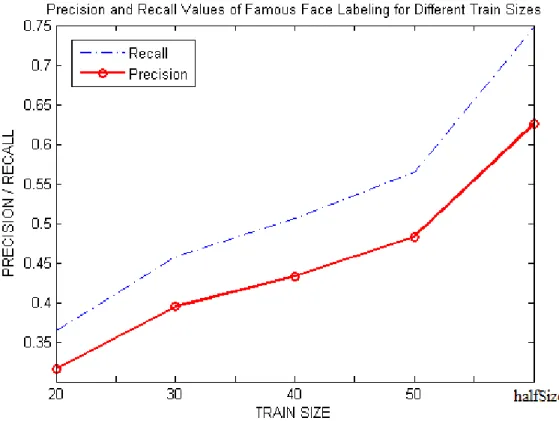
im-age generation. . . 47 5.5 Precision and Recall Values for Popular Face Labeling vs TS. . . . 49 5.6 False Positive Rates of different TS values for Outlier Detection
and Popular Face Labeling. . . 50 5.7 Precision and Recall Values for Outlier Detection. . . 51 5.8 Precision and Recall Values for Outlier Detection and Labeling of
the Less Frequently Appearing People vs TS. . . 52 5.9 Number of Face Images Collected for a Less-Known Name vs.
Training Size. . . 53 5.10 Precision Values for Outlier Detection and Less-Known Face
La-beling. . . 54 5.11 Recall Values for Outlier Detection and Less-Known Face Labeling. 55 5.12 Average Precision For Outlier Detection and Less-Known Face
La-beling vs. n. . . 56 5.13 Average Recall For Outlier and Less-Known Faces vs. n. . . 57 5.14 Number of Images Per Query for Different Values of n. . . 58 5.15 Rate of Correct Face Images Collected for a Less-Known Name vs.
5.16 Recall Values for Outlier detection and Less-Known Name
Label-ing vs. Prob Corr. . . 60
5.17 Images where Alec Baldwin is a less-frequently appearing people. 61 5.18 Generated names for corresponding images. . . 61
5.19 Images matched for the name “Alec Baldwin”. . . 62
5.20 Labeled faces and detected outliers. . . 65
5.21 Accuracy Rate of Labeling for Attribute Classifiers and SIFT Fa-cial Features. . . 71
6.1 Accuracy rates for Pubfig and Sift face features vs. TS. . . 74
6.2 Precision and recall values for outlier detection. . . 76
6.3 Number of images per query for different values of n. . . 77
6.4 Accuracy rate for less-known face labeling and outlier detection vs. Prob Corr. . . 78
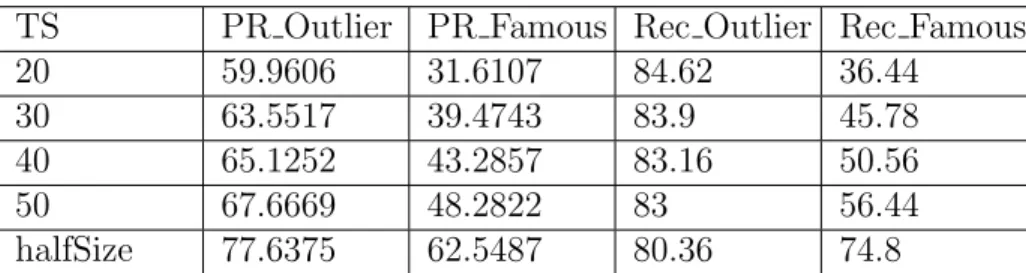
5.1 Average Evaluation Results For Different TS Values . . . 48
5.2 Average Evaluation Results For Different n Values . . . 53
5.3 Average evaluation results for face labeling if all the faces are con-sidered to be less-known faces. . . 59
5.4 Number Of Images Per Query . . . 63
5.5 Query Names . . . 63
5.6 Precision and Recall Values of FW . . . 67
5.7 Precision and Recall Values of FW . . . 68
5.8 Precision and Recall Values of FW . . . 69
A.1 PubFig Name Categories and Number of Images Per Category . . 86
A.2 PubFig Name Categories and Number of Images Per Category . . 87
A.3 65 Attribute Classifiers . . . 88
A.4 65 Attribute Classifiers . . . 88
Introduction
The amount of data on the web has been increasing tremendously, resulting in a demand for efficient and effective retrieval systems.
Searching for people is a desired and common task especially for news related pages. The usual approach is to query for the name of a person in the surround-ing textual content e.g in the captions of news photographs. However; such an approach is likely to return irrelevant results (see Figure 1.1). Since there may be several people or no people at all in the image associated with the textual content including the name.
In order to get the most desired results, the visual information should also be taken into account. Although face recognition seems like a solution to the problem, it is not easy to detect and recognize faces on photographs which are taken in natural environments.
The traditional face recognition systems are successful only when faces are frontal and captured in controlled environments. However, faces on the web differ in illumination, pose, size, and there are several other factors making it difficult to recognize people even by humans, such as occlusion, aging, clothing and make-up (see Figure 1.2). Therefore, most of the current face recognition systems are barely successful for faces captured in realistic environments.
Figure 1.1: Sample images collected from the first pages of Google image search results for the text based query on George Bush.
Recently, rather than using purely text based, or purely visual based methods, textual and visual information are integrated [20], [23], [21]. Having the visual information and the possible names appearing around the corresponding image, the problem of face recognition is simplified to finding face-name associations.
Inspired by those studies, in this study, we propose a method for naming faces in the news photos appearing on the web, as in Yahoo News, etc. With the light of the information that some people mentioned in the news photos appear more frequently than the others, naming frequently appearing faces will be a relatively easier task, compared to naming less frequently appearing faces on the photos.
In this study, we aim to address this challenge, and consider also naming people appearing less frequently, who appear on the web next to people appearing more frequently. The steps of our algorithm will be as follows:
• Name more frequently appearing people on the Web
– Label the faces with the name list of more-frequently appearing people via a supervised classification
– Find the outliers (in other words the faces that are not in the list of more frequently appearing people)
• Name less frequently appearing people on the web
– Assign names to outliers detected in the previous step using textual content
– Prune the irrelevant face images from the images matched with the name categories generated for the outliers.
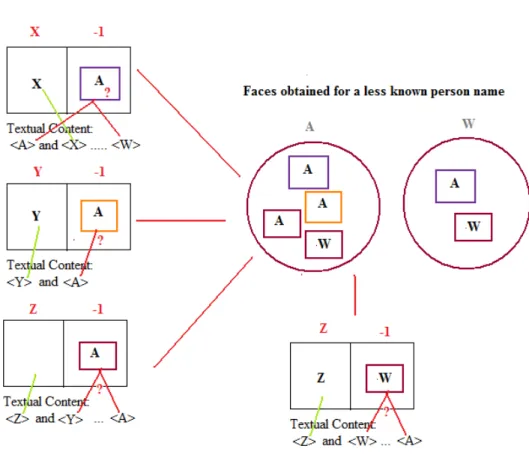
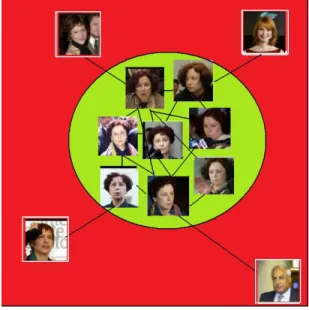
The second step of our methodology, naming less frequently appearing people is illustrated in Figure 1.3.
The thesis will be organized as follows; first the related work on the relevant subjects will be discussed in Chapter 2. The details of the steps of this algorithm will be explained in Chapter 3. Chapter 4 will give brief information on the datasets used, and the corresponding experimental results will be presented in Chapter 5. The evaluations of the results will be discussed in Chapter 6. Finally, the conclusion and future work will take place in Chapter 7.
Figure 1.2: Faces collected under uncontrolled environment for Donald Rumsfeld. Images are from Faces in the Wild Dataset [3]. Each row corresponds to a different person. Note the large variety in pose, illumination, expression and make-up.
Figure 1.3: The outlier faces (images with label -1 ) detected while naming faces, will be matched with the names extracted from the textual content. Each name extracted from the textual contents will then be matched with less-known (less frequently appearing) faces, and as a result, for an extracted name bunch of face images will be obtained.
Related Work
Face Recognition is a well-studied and challenging problem that receives sig-nificant attention for the scientists on the area of image processing, computer vision, pattern recognition, machine learning, neural networks and etc. So far, it begins to be a considerable need for technological achievements especially in commercial and law enforcement applications. People tend to improve methods for applications that need security and privacy rather than using passwords or pins. Although different types of personal biometric identification exists, such as retinal scan or fingerprints, as stated in the study of Zhao et al. [28] , those methods rely on the participation of the subject of person. Therefore, with the expanding demand on technological improvement, face recognition is about to become an integral part of our lives.
Although it is a long-studied problem, the solution to the problem is not yet achieved adequate results. Recognizing a detected face on an image is difficult due to the variations in positions, illumination, orientations, occlusions, facial ex-pressions and etc. Therefore, existing face-recognition systems use faces captured in controlled environments.
Zhao et al. [28] in their survey of face recognition, divide the problem into three steps as illustrated in Figure 2.1. Given an input image or video scene, the faces are detected as a first step, then the features on the detected regions
are extracted, finally the face is recognized using the extracted facial features. In this survey, in order to emphasize the importance of the face recognition problem, and for an entire comprehension, the studies over 30 years have been examined throughout the aspects of psychophysicists and neuroscientists. Some of the issues considered relevant to the face recognition problem concerned by psychophysicists and neuroscientists are as follows:
• Is face recognition a dedicated process? • Is it a holistic or feature analysis?
• Which facial features are more significant in recognition?
• How significant are the caricaturist and distinctive facial features in recog-nizing faces?
Figure 2.1: Three steps of the Face Recognition Problem (taken from [28]). Examining through the face recognition problems, the solutions proposed re-quire a dataset of images captured under controlled environments. Meanwhile, as the need for the face recognition grows, existing face recognition systems are
no more adequate. There are a huge amount of face images on the web, and rele-vant retrieval of a specific face image search among this huge pool is significantly demanded. However, the face images on the web are not appropriate to be the inputs for a face recognition system, since they are captured in a realistic envi-ronment, which may result in variations in pose, illumination, occlusion and etc. In order to recognize faces from such images, a different perspective is proposed by the researchers. Rather handling the problem as a face recognition problem, they come up with the idea of name-face association using the textual contents of the face-images. Regarding this approach, name-face association is first studied by Satoh et al. in 1997 [23]. Textual and visual information from videos are collected in order to extract a face-name association. The association is matched by extracting the names from scripts and faces from frames that appear at the overlapping time periods. Following this extraction the co-occurrence factor C (N, F) is calculated by finding the occurrence rate of a face F around a name in videos, in order to determine the best N associated faces for a name. The most similar face in the association set with the dataset of that name is decided as the associated resulting face for that name.
Although naming faces is not considered as a face recognition problem in gen-eral, Liu et al. in their study [18] claims that both of them are the same problem. First, the face data is collected from web search engines, and the correct images among those images are considered to be the recognition dataset. After forming the dataset, the naming faces problem is a face recognition problem, hence the faces are detected on images, and the representation for the detected faces Gabor feature approach [25] is adopted, finally with a threshold value approach the face matching procedure is completed.
Recent researches show that combining both textual and visual information increases the accuracy of face-name association [27], [13]. Based on this assump-tion, Berg et al., propose a method for naming faces in their large dataset of images that are taken in uncontrolled environments. Using simple natural lan-guage and clustering techniques on the images from news with their associated captions, the faces are named [13]. The entire dataset of face images are put into a pool to be clustered according to their names. However, in case of a small
variation in environment conditions, this approach may produce poor results. Ozkan et al. in [21] apply a graph-based method for naming faces. To con-struct their similarity graph they combine both textual and visual information, as well. In their graph, the nodes represent the images and the edges represent the weight of similarity between the nodes. The similarity is calculated by comparing the interest points between two faces. Unlike existing face representations with interest points, not only particular points on the face are used, but also other detected interest points are taken into account. On the other hand, the use of all detected interest points on a face, rather then particular interest points, do not always give the best result. Finally, using their similarity graph, the most similar images are found via producing the densest subset on that graph, which leads the irrelevant images to be eliminated.
Guillaumin et al. in their study [10] propose a method similar to [6]. They name faces in their database that consists of news photos with captions by con-sidering two scenarios, one is to find faces for a single query, and the other is to name all the faces in their database. In order to achieve the first scenario, they apply the method explored in Ozkan. et al. [21] and find the densest set for a single query. For the second scenario, which is to name all the faces in their database, two approaches are used on a graph based method. They too, construct a similarity graph where the nodes represent the images and the edges represent the similarity weight, however, their similarity weights were different from Ozkan et al. They preferred to select 9 facial features rather than using all the extracted interest points. The first approach is a kNN method with a threshold and the second approach is to differentiate between the neighbors. With the use of 9 particular facial features, they overcome the matching interest points problem encountered in [6].
Satoh et al in [16] introduce an unsupervised method for annotations of faces on the web. Their method consists of two steps, where the first step is to mine the data from the web and find the densest set via ranking the distribution of visual similarities and the second step is the classification of the output query where binary labeling of faces as desired person or non-desired person is determined.
The ranking list of the faces is estimated by their Rank-By-Local-Density-Score method, which is calculated with LDS (p, k); the average distance of a point p to its k-nearest neighbors. The labeling process in the second step is strengthened via Ranking by Bagging of SVM Classifiers method. This method is improved using SVM with probabilistic output, so-called LibSVM [5]. Using a density based estimation, they find their density set, and unlike Ozkan et al. this method does not require a threshold value.
Berg et al, in their study Names an Faces [3], propose a method for association of names to faces using a more realistic dataset which is different from existing face recognition dataset in the sense of faces being captured “in the wild”. Dataset for general face recognition should be captured in a controlled environment, for the recognition to be accurate. However, Berg et al, automatically constructed their face data set from uncontrolled environments which have a wide range of positions, illuminations and poses. Their dataset consists of 30.281 face images which are detected from half a million captioned new images.
One recent study on name-face association is proposed by Phi The Pham et al. In their study [22] also focused on name-face association; however rather than the general approach of assigning names to the faces on the images, they propose a method which aims to achieve a one-to-one assignment for names and faces. In order to do so, they proposed three significant models, one is to assume the names in the texts generate the images, the second one is to assume the faces on the images generate the names, and the last one computes the alignment of names and faces with a joint probability calculations of names and faces, P(f,n). For each image-text pair si, with Fi faces and Ni names, there are several alignment
schemes aj. In order to achieve a successful one-to-one alignment they used a standard Expectation Maximization algorithm, where their expectation step is to estimate the likelihood of eacg alignment aj, for si; and the Maximization Step updates the probability distributions using the alignment estimations. IN order to strengthen their strategy to find alignments, they use two additional scores, picturedness and namedness, to be used in P(f—n) and P(n—f) calculations. They come up with this idea based on the case that not all the names extracted from texts, or not all the faces extracted from images, have the same possibility for
being significant in terms of having a corresponding face-image just because the name is mentioned, picturedness, or having a corresponding name just because the image contains the face, namedness. The picturedness and namedness scores are then used for the evidence of name-face co-occurance. Finally, for each story si, the alignment aj with the highest corresponding aigma ij obtained from the E-step of EM algorithm is selected.
Another significant part of face naming is to determine the face representations in terms of facial features. One of the most common methods used to represent faces recently is based on the SIFT algorithm. Recent researches on image detec-tion techniques have shown that local image features provide a better descripdetec-tion on the detection of images, especially faces. One of the algorithms to extract descriptors of local features was published by David Lowe in 1999, SIFT (Scale Invariant Feature Transform) [19]. A significant reason for this method to be preferred on face detection is that it is a scale invariant algorithm, as it indicates with its name. The feature vectors extracted by the algorithm are robust to trans-lation, rotation, scaling and illumination. Handling the face recognition problem as a face naming problem arises from the need to recognize faces on photos that are captured in uncontrolled environments. While holistic based approaches gives better results on controlled environments, feature-based approaches works bet-ter on uncontrolled environments, since they are robust to variations on images caused by environments. Hence, recent researches on image detection techniques have shown that local image features provide a better description on the detection of images, especially faces. One of the algorithms to extract descriptors of local features was published by David Lowe in 1999, SIFT (Scale Invariant Feature Transform). A significant reason for this method to be preferred on face detec-tion is that it is a scale invariant algorithm, as it indicates with its name. The feature vectors extracted by the algorithm are robust to translation, rotation, scaling and illumination.
Although SIFT algorithm was widely applicable for 2D classifications, Bicego et al.s work [4] was one of the first attempts to apply SIFT on face classification. They use SIFT on faces using three different matching approach. The first and the simplest one is the matching pair distance, which is to compute the minimum pair
distance, DMPD, via getting the Euclidean Distance between all pairs of keypoint descriptors. The second methodology, Matching Eyes and Mouth, depends on the claim that the most significant face features are located around eyes and mouth, therefore using only those descriptors, a pair-wise matching is performed. The last methodology, Matching on a Regular Grid, improves the first two methodology, by examining their problems which are not taken into consideration, such as matching of descriptors in different locations. In the first methodology, each descriptor is matched with others, and although in the second matching criteria, eyes are matched with eyes, and mouth with mouth, still, the descriptors on the left eye are being matched with the ones on the right. Realizing that matching different descriptor locations with each other is unrealistic, in the third matching method a location dependent matching approach is applied.
Later studies on facial feature extraction with SIFT, improve the decision on locations of the SIFT descriptors to be selected from points that will be more significant on recognition. Nine keypoint descriptors, two on each corner of both eyes, two on each corner of mouth, two on the nostrils and one on the tip of the nose are selected to be the facial features. In [7], four more significant points are added, two being at the center of each eyes, one being between each eyes and one being at the center of mouth.
Another recent study on face-name association using the combination of tex-tual and visual content is investigated by Everingham et al. [8]. This study is an expansion to [7]. Their method is divided into two sub problems, first by the alignment of subtitles and transcripts, they automatically generate time stamped character annotation, and secondly they strengthen this information by identify-ing if a character speaks. Finally, in order to prune the errors resulted from weak textual annotation; they include cues for face and cloth matching. The automatic alignment of subtitles and scripts, it is possible to find what is said by whom and when. This information is then combined with the visual speaker detector in order to detect the character of the speaker. They used 9 facial features of SIFT descriptors also proposed in [7]. Their face detector detects frontals, however frontal face detectors, although more reliable, will not be adequate for videos. Therefore, for the cases where a detection of face is hard, a cloth representation
is taken into account. The clothes are matched with the faces, and represented using color alone. For classification two different methods are used, one is nearest neighbor classification and the other is the SVM classification. Depending on the poses of a face the classifiers gives different results.
Another expansion to the study [7] is proposed by Sivic et al. [24]. They propose a method to label faces automatically on TV or movie materials using a weak supervision technique combined with the textual content of subtitles and script texts. Their previous work [7] on the subject suggested a method where samples faces restricted to be frontal and nearest neighbor classification was used. In this study they expanded their work to be able to detect profile faces as well, and their facial features are able to distinguish between characters. They proposed two different methods for face detection; one is for full frontal faces and the other is 3/4 view to full left profile, and the right profiles are detected using a mirrored input image. HOG feature extraction is used along with a linear SVM classifier. Their facial features are based on 13 points on the face regarding points around mouth, nose and eyes. The results are than combined with the speaker detection they propose. Their speaker detector extracts the textual content from scripts and subtitles, if at that period of time there is a face on the screen. Their method outperforms the results where only frontal face images are of concern. As a result of this study, more faces are detected to be named.
Another face-name association study on the news videos are introduced by Le et al. [17]. They proposed a method to find important people repeatedly appearing during a certain time period in large news video databases. They di-vide the problem into two sub problems, one is to group similar faces in order to find dominant groups, and the other one is to label these groups. However, the problem of face-name association still preserves the same troubles, since the face images from videos, will vary in illumination, pose, hair-style, etc. Also the problem of name-face pairs not being together causes error-prone labeling. To handle these problems, for finding dominant groups, they used a relevant set cor-relation based clustering model which can efficiently find similar dominant groups among noisy and large groups of data. For labeling procedure, name extraction from the transcripts are performed, and the filtered extracted names matched
with their best correspondences. The results from the clustering algorithm are observed to give a ranking score in terms of being important. They decide on this rank via examining the appearance degree of the subject person that the group of images belongs to. The faces are detected using the method using Ling-Pipe described in [2], where the names are extracted, and sorted according to their frequencies. Frequency based elimination is performed in order to remove the unimportant names. A generalized nearest-neighbor clustering method RSC (relevant-set correlation) proposed by Houle [11] is applied to find the dominant groups. The group with the higher frequency is selected as the anchor face clus-ters. All the anchor-faces are found and then faces belong to these clusters are removed in order to find the anchor face images not found at the first step. Using the assumption that the anchor faces appear at the similar studio settings, for the remaining set, a new clustering, based on color histograms of the already extracted faces are performed. Finally the name face association is completed using the methodology proposed by Duygulu et al. in their study [6].
Pham et al. in their study [22], also focused on name-face association; however rather than the general approach of assigning names to the faces on the images, they propose a method which aims to achieve a one-to-one assignment for names and faces. In order to do so, they proposed three significant models, one is to assume the names in the texts generate the images, the second one is to assume the faces on the images generate the names, and the last one computes the align-ment of names and faces with a joint probability calculations of names and faces, P(f,n). For each image-text pair si, with Fi faces and Ni names, there are several alignment schemes aj. In order to achieve a successful one-to-one alignment they
used a standard Expectation Maximization algorithm, where their expectation step is to estimate the likelihood of each alignment aj, for si; and the
Maximiza-tion Step updates the probability distribuMaximiza-tions using the alignment estimaMaximiza-tions. In order to strengthen their strategy to find alignments, they use two additional scores, picturedness and namedness, to be used in P(f—n) and P(n—f) calcula-tions. They come up with this idea based on the case that not all the names extracted from texts, or not all the faces extracted from images, have the same possibility for being significant in terms of having a corresponding face-image
just because the name is mentioned, in their own words the picturedness, or hav-ing a correspondhav-ing name just because the image contains the face, namedness. The picturedness and namedness scores are then used for the evidence of name-face co-occurance. Finally, for each story si, the alignment aj with the highest
corresponding δij obtained from the E-step of EM algorithm is selected.
Kumar et al., in [15] proposed a novel method for face representation. During their studies on face recognition, they realized the confusions may as well appear between, male and female, Asian and Caucasian, young and old. They proposed a method for reducing the confusions in labeling by generating a feature vector that aims to represent faces using the distinguishable facial aspects of people. They have found 65 different attributes, such as age, sex, gender, etc. for repre-senting a face. They extract their facial features based on two methods, attribute and simile classifiers. The first method attribute classifiers, is the step where a binary classification whether those attributes exist or not is performed. The simile classifiers on the other hand, examine the resemblance of those attributes for a face to a group of reference face.
Although recent studies on the area, propose effective solutions to the prob-lem of name-face association, the suggested algorithms works successfully for the cases where image samples are usually large in size. The popular people such as celebreties or politicians appear more-frequently on the web, therefore; collecting image samples for them is a relatively easier task compared to the task of collect-ing image samples for people appear less-freqeuntly on the web. Regardcollect-ing these facts, in this study we focus on naming less frequently appearing people who are seen next to more-frequently appearing people on the web. The methodology will be simply to name the more frequently appearing people first, then name the less-frequently appearing ones next to them, using the textual content.
Naming Multi-Face Images
With the observation that, some people, such as politicians or celebrities ap-pear on the news related web pages more frequently, naming faces for them is a relatively easier task compared to the task of naming less frequently appearing people. In this study, using both textual and visual content, we will make use of the more frequently appearing faces on the web, to name the less frequently appearing ones. The algorithm is divided into two major steps. The first step is to name the more frequently appearing faces on the web using supervised clas-sification algorithms. In the second step, textual content will be used for faces that are not assigned to any more-frequently appearing faces at the first step.
The overall algorithm consists of the following steps:
• Name more frequently appearing people on the Web – Label faces with supervised classification
– Find the outliers (in other words the faces that are not in the list of more frequently appearing people)
• Name infrequently appearing people on the web – Assign names to outliers using textual content – Pruning the categories generated for outliers.
In the following two subsections, first the methodology used to name the more frequently appearing people and next the methodology of naming the infrequently appearing people will be described. Then a use case scenarip will be presented for a better understanding.
3.1
Naming more frequently appearing people
on the web
In this section, the methods used for labeling popular faces, detecting outliers, and finally assigning names to those outliers will be explained.
3.1.1
Labeling faces with supervised classification
In this study, we label the people appearing frequently on the web by using a supervised classification setting. Although other methods proposed in the liter-ature could also be used, this decision is made in order to get a high accuracy. We use Support Vector Machines (SVM) to train the classifiers for a number of people appearing most likely. The details will be explained in Chapter 5 briefly.
To sum up; we assign an input to the label of the closest sample in its training set. Therefore, given an image with multiple faces on it, the supervised classifi-cation method SVM matches the faces on that image with the closest category from our dataset of more frequently known people.
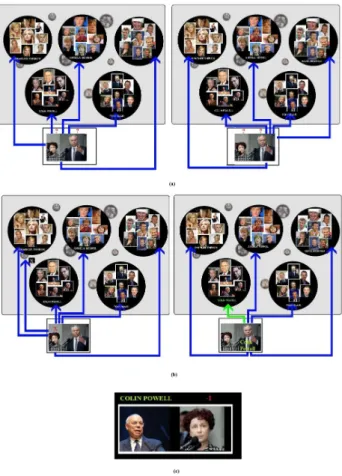
For example, Figure 3.1 illustrates the classification for an input image with two faces. Each face on the image is compared to the face categories in the dataset. In this step of the algorithm, each face image will be assigned to the name of its closest category found by the classification algorithm. To go further; we need to distinguish the faces that do not belong to any category. The next section will introduce the outlier detection, in other words, the detection of the less-known faces on the images. In the rest of the thesis, we will refer to the
images with multiple faces on it, as multi-face images.
3.1.2
Finding the outliers
In the previous step, each face is labeled with the category having highest con-fidence value. After finding out the highest concon-fidence values for each face, a threshold value is calculated in order to decide whether the face should really be assigned to a category or should be labeled as an outlier. This means that the faces left as outlier in this step do not belong to any category in the list of more frequently appearing people, but likely to be one of the less frequently appearing people. (see Figure 3.1(c)).
Figure 3.1: (a) Classification without any outlier detection. (b) Labeling without any outlier detection. (c) Labeled faces with outlier detection. “-1” means the face image is an outlier.
3.2
Naming infrequently appearing people on
the web
In this section, the methods to name less frequently appearing people will be described.
3.2.1
Assigning names to outliers using textual content
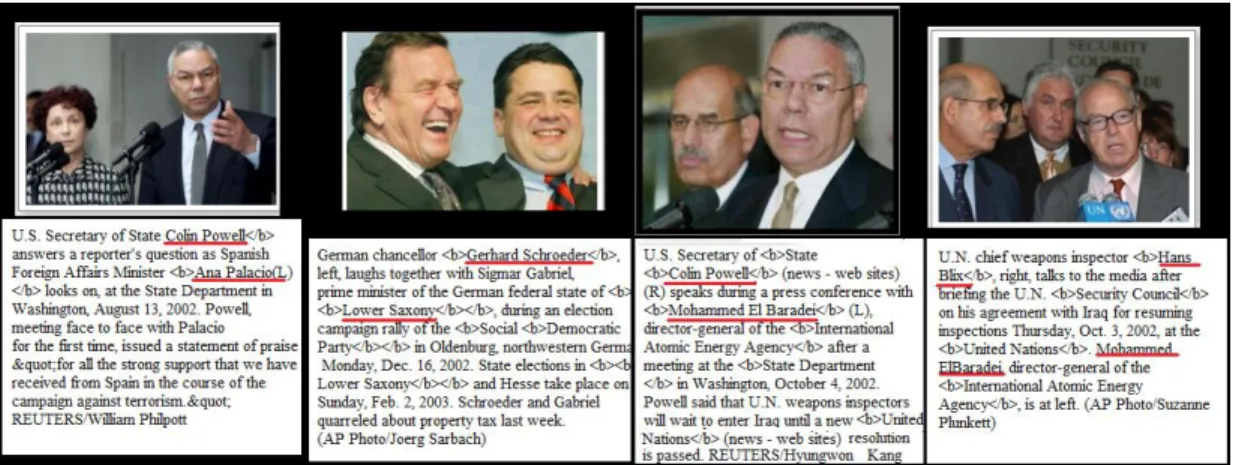
The textual content associated with the images including the face of a person is likely to include the name of that person. However; there may be several names in the text, several faces on the images, and with any of the correspondances also missing (see Figure 3.2). With the supervised classification method described in the previous section, the name-face association for frequently appearing people becomes more reliable. The outliers detected in the previous step are now labeled using the textual content with the names of frequently appearing people are excluded.
Figure 3.2: Sample news images and their textual contents provided by FW Dataset.
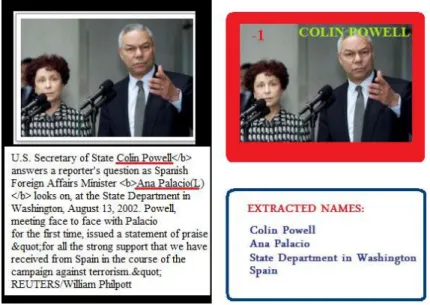
To understand how labeling works, let’s consider the example in Figure 3.3 where Colin Powell and Ana Palacio appear together. Besides the names of the two people in the list of more-frequently appearing people. With the steps explained in the previous sections, Colin Powell is correctly labeled however, since the person next to him is not a member of the most frequently appearing people list, she will not be recognized by the system. Therefore, she will be labeled as an outlier. In this step, the less frequently appearing people will be named with the extracted names, which are not yet assigned to a face. For this sample, the extracted names will be Colin Powell, Ana Palacio, State Department in Washington and Spain. Although the last two proper names, does not belong to
people, they will also be extracted by the system.
Figure 3.3: Input image of Colin Powell and a less known person (Ana Palacio). Colin Powell is correctly labeled; and Ana Palacio is labeled as outlier. The names are extracted from the textual content.
Examining the faces labeled on an image, the names that are already matched with a face will be eliminated from the list of names extracted for the image. In this case, Colin Powell is already labeled by the classification system; therefore, the less known person on this image will be assigned with three of the names ex-tracted from the text; Ana Palacio, State Department in Washington and Spain. For each extracted name, bunch of face images will be collected from other image-text pairs. Correct face-name association by eliminating the irrelevant faces from this collection will be explained in the next section.
3.2.2
Pruning the categories generated for outliers
As explained in the previous section, the names extracted from the textual content are assigned to the outlier faces on the corresponding images.
This step results in collections where names are associated with a set of faces; however, there are faces belonging to the name just as there are faces that are
Figure 3.4: Less frequent face image collection for extracted name Ana Palacio. irrelevant (see Figure 3.4). As expected with the intuition of the general situation that a face of a person appears on the web around his/her name, the number of relevant images in the collection is more than the number of irrelevant images. With this assumption, it becomes possible to prune the irrelevant images from the images belonging to the name.
The irrelevant images are pruned by the following two steps:
• Generate a dissimilarity graph for the images collected for an outlier name • Find the most similar images in the collection in this graph
3.2.3
Dissimilarity graph construction for outliers
In this step, a dissimilarity graph, where the nodes represent images, and the edges represent dissimilarity weights between the nodes, will be constructed for face images assigned to an outlier name. Let there are n numbers of face images matched with the name N. The graph G(V,E), where V is the set of face images, and E is the set of edges between them, will be an nxn matrix. Eij, the edge
between the ithnode and the jthnode, is the dissimilarity weight between the face
D, between face image i, Ii; and face image j, Ij is the Euclidean distance between
the feature vectors of these faces;
D(Ii, Ij) = Euclidean(F v(Ii), F v(Ij)) (3.1)
D(Ii, Ij) =q(F v(I
i)2 - Fv(Ij)2) (3.2)
Having constructed the dissimilarity graph for an outlier name, the most similar faces in the graph will be found in order to eliminate the faces that do not belong to the specified name (see Figure 3.5).
Figure 3.5: Constructed graph of the images collected for extracted name Ana Palacio.
Although there are different graph based methods on finding the densest sub-set in a graph, those algorithms give successful results for larger sample image sizes [21], [10]. However, in our case, the sample face images collected for less-frequently appearing names are limited, therefore we have proposed a different
algorithm. In order to find the most similar face images, we apply an algorithm inspired by Borda Rank Algorithm [1] on our dissimilarity graph. (see Algorithm 1)
Algorithm 1 Ranking of images : Finding the most similar face in a collection of face image
1: n : no Of Images collected for a name
2: sortedD = sort the dissimilarity matrix D(Ii,Ij) (an nxn matrix)
3: sortedDInd = the indices of the sorted matrix D (an nxn matrix)
4: for each image i do
5: for each value j of the row D do
6: rankOf Imgi = find the rank of the image i at the jth row of sortedDInd
7: rankD(1, i) = rankD(1, i) + rankOf Imgi
8: end for
9: end for
10: rankD = rankD / n
11: {rankD is a 1xn row vector where rankD(1,i) is the total dissimilarity rank
of image i for among all n images.}
For an outlier name, a 1xn row vector (rankD in Algorithm 1), is constructed to represent the outlier face. At each index of this row vector, a value for the corresponding face image is hold. This value is the total rank of the image in terms of dissimilarity among the other images. Since D is a dissimilarity matrix, when it is sorted in ascending order, the first indices of the ith row will carry the
most similar images to itself. As we go to the last indices, the less similar faces to face image i will be found. Therefore, an ithrow of sortedDInd will carry the most similar faces to face image i in ascending order. With the help of sortedDInd, one can find the rank of all images, in other words, which images are mostly seen at the first indices. So the ith index of rankD holds the total rank count of ithimage
among other images. The lower this value means the image is strongly similar to the majority of the image collection. As a result of this algorithm, among the collected less-known face images for an extracted name, the most similar images, in other words, the relevant images among this collection will be found. (see Figure 3.6)
Figure 3.6: Ranking algorithm for images collected for a less-frequently appearing face. The images with higher ranks will be the outliers in the collection.
3.3
A use case scenario
For a better understanding of our methodology, this section will present a use case scenario for explaining each step of our approach given in the previous sections.
3.3.1
Name more frequently appearing people on the web
3.3.1.1 Labeling faces with supervised classification
We construct a dataset with a set of names to be the popular (more-frequently appearing) faces, and another set of names is selected to be the names of less-known (less frequently appearing) faces. With the intention of simulating a multi-face web image, one multi-face from each set is taken. Additionally, knowing that a face image is encountered when its name is mentioned in its textual content, we randomly generate a corresponding textual content which may or may not contain the names of the faces on that image.
First each face on an image is labeled with one of the categories in our list of frequently appearing people. Figure 3.7 illustrates a set of images generated
to be a two-face image where the person on the left is popular, and the person on the right is a less-known person. Therefore, in this figure while Dave Chap-pelle,Donald Trump, David Beckham and Adam Sandler are selected to be the popular faces on the web, the faces on the right side of the images are selected from the names that are chosen to be the less-known faces. As it is mentioned be-fore, in this very first step, each face on the image will be labeled by the classifier, with a name from the categories of popular names in our dataset.
Figure 3.7: Labeled faces without any outlier detection.
3.3.1.2 Find The outliers
The labels assigned to each face are actually the names of the faces which are found to be the best match for an input face image. In other words, although the faces on the right are labeled with a name, actually they are only labeled with the name of the face that the algorithm finds as a best match. However, examining through the confidence values of a face being in its matching category,
we find out that the probabilistic results for less-known faces are lower, compared to the faces labeled correctly with the categories of popular ones. Therefore, as it will be explained in Chapter 5, a threshold value is calculated for detecting the less-known face images. Figure 3.8 illustrates the labeling results for the images given in Figure 3.7 after using a threshold value for labeling process which results in labeling less frequently people as outliers (shown -1)
Figure 3.8: Labeled faces with outlier detection.
3.3.2
Name less frequently appearing people on images
3.3.2.1 Assign names to outliers using textual content
In Figure 3.7, the first image contains the faces of Dave Chappelle and Gillian Anderson. The random selection of popular and less-known name category sets in that case resulted as David Chappelle being the popular person on that image, and Gillian Anderson being the less-known person. Hence, the face of Gillian Anderson, who is labeled as an outlier in the previous section, will be labeled in this step, with a name from the textual content.
with a higher probability for containing correct names in the text. But there is also a low probability of having an irrelevant name, and not even having any correct name in the entire text. At this step, name generation and extraction for images are simulated. Below, in Figure 3.9, results for the randomly generated image of Dave Chappelle and Gillian Anderson, and its corresponding textual content is explored. The extracted names are found as Dave Chappelle, Gillian Anderson and Gael Garcia Bernal.
Figure 3.9: An input image of Dave Chappelle(as celebrity) and Gillian Ander-son(less frequently appearing face) is labeled correctly for Dave Chappelle, and the image of Gillian Anderson is correctly detected as outlier. Then the names are extracted from its textual content.
Although, both the names Dave Chappelle and Gillian Anderson are related to the image, Gael Garcia Bernal is mentioned without the appearance of his face. With the detection of the outlier face and the extraction of the names from text, the outlier face will be matched with the names extracted. In order to limit the extracted names for the assignment of less known faces, any names that are already assigned to a face on the same image are eliminated (Figure 3.10).
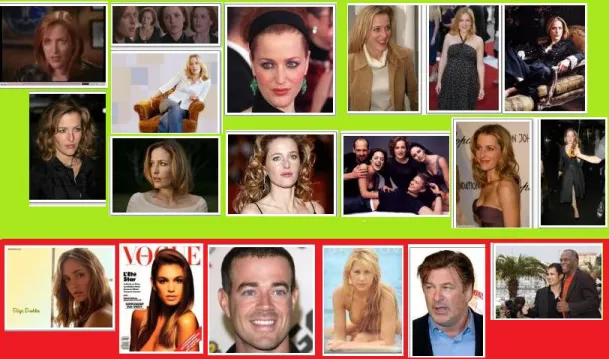
The remaining names on the text will be candidate names for the less fre-quently known person. Examining through the names extracted for this image, Dave Chappelle is eliminated from the list, since it is already used to label the face on the left. Therefore; the outlier face on the right is matched with two names; Gillian Anderson and Gael Garcia Bernal. As the operation proceeds, more and more faces that are labeled as outliers at the first step will match with the extracted names (see Figure 3.11).
Figure 3.10: Name matching for Gillian Anderson among the names extracted from the textual content of the input image of Dave Chappelle(as celebrity) and Gillian Anderson(less frequently appearing face).
To sum up; any face image belonging to “Gillian Anderson” and detected as outlier, will be matched with the name “Gillian Anderson” if the textual content contains her name. As a result, there will be a bunch of face images collected for “Gillian Anderson”. However, there will be irrelevant images as well, since the matching procedure only depends on the textual contents, which might not contain the correct names. In other words; although Gael Garcia Bernal himself does not exist in the image, his name is mentioned in this simulation. As a result of this, the face of Gillian Anderson is also matched with the name Gael Garcia Bernal. However, irrelevant images collected for a name will be less than the relevant ones. Therefore, searching for the most similar images in a set of face images will lead us to find the correct face for the extracted name.
Dataset and Facial Features
4.1
Dataset
The algorithm has been applied on two different dataset. The first dataset is a subset of the dataset Labeled Faces in the Wild, collected by Berg et al.[3]. The entire dataset consists of 31.280 images from 1.249 categories of people. The images are collected from Yahoo! News over a two years period by Berg et al. The dataset contains the original news images, their captions and the cut-out face images for each face detected on these news photos.
The second dataset is a subset of PubFig dataset, which is collected from the web by Kumar et al. Their evaluation dataset consists of 42,879 images for 140 categories of names. For each face, they specify 65 different features some of which are the attributes of being male, Asian, white, black, baby, child, youth, etc. 65 facial features are given in A.2.
Faces on both datasets are considered to be more realistic compared to the existing face recognition dataset images.
The collected images are captured in the wild rather than controlled envi-ronments, therefore, the faces in these photos vary in pose, illumination and
expressions; even they are exposed to occlusions.
Faces in the Wild dataset already consists of multi-face images and their corresponding textual contents. However, in the PubFig dataset, we only have images of single faces. In order to apply our algorithm on this dataset, images with multiple faces, and their textual contents are required. Therefore, we have used this dataset to form a simulation of web photos collection. Examining the Berg’s dataset, we find out that the content belongs to an image may or may not contain the correct names of the faces on that image. However, having the correct name in the text is more likely than not having it. On the other hand, the name extractors not only detect the names of the people but also the location names and proper names are detected. Hence, in order to simulate a realistic content for an image, we generate names in following ways. If we want an image to contain n faces, we generate (n+1) different name slots, the first n slots belonging to the n faces respectively, and the last slot belonging to any location or proper name. However, for the simulation to be realistic, an error rate of having an irrelevant name in the text should be taken into account. In the light of the information that textual contents have a tendency to contain accurate names more frequently, after a series of empirical experiments, we decided to give 80% probability of having an accurate name, where 20% of the time the name will be any other name than the ones that belong to the faces in that image. Meanwhile, the contents may not always contain a location or proper name which could be detected as a person name; therefore there is a 50% probability of that last slot to exist. If it exists, a random name from the combination of all the category names except the ones in that image, and the formerly constructed bunch of location names will be selected for that slot. To clarify our method, let there are n faces on an image, belonging person A, B, ... ,and X. The textual content belonging to this image will generate names as illustrated in Figure 4.1.
In our study, we have used subsets of the two dataset Faces in the Wild, which will be referred to as FW, and Public Figures Face Database, which will be referred to as PubFig in the remaining of the thesis. The following section will give brief information on the facial features extracted from detected faces.
Figure 4.1: Random name generation for textual content of an image.
4.2
Facial Features
Recent studies on face recognition applied on the LFW [12] dataset support that, it is difficult to achieve a high accuracy rate of labeling faces for images that are captured under uncontrolled environment. Not only illumination, pose, focus resolution of images cause bad labeling in face recognition systems, but also make-up, hairstyle, eye-classes, facial hairs (beard, mustache) and several other person and environment related changes on the face, make recognition difficult for researchers of the area. In order to reduce the effects of such problems, feature vector selections on face representations are important. Two different methods for face representations are applied for our study. One of them is PubFig Representation which is a novel approach introduced by Kumar et al. [15], and the other one is the SIFT [19] descriptors extracted for 9 specific facial points, as its name indicates a scale-invariant method robust to pose, illumination, scale and etc.
4.2.1
PubFig Facial Features
When the incorrectly labeled data is examined by Kumar et al,[15], it is realized that the confusion in labeling may as well appear between man-woman, young-old, Asian-Caucasian to a great extend. They claim to reduce this confusion
by suggesting a novel method for face verification of images captured under un-controlled environment. Using the common idea of extraction and comparison of high-level visual features they explore their contribution under two methods, attribute and simile classifiers. They mention that it is easier to collect data for their face recognition system, since their visual features are robust to pose, illu-mination, expressions etc. Contrary to existing methods in face recognition [26], their method does not require a pre-alignment of image pairs and through this contribution they get rid of a computationally expensive work. Although they use visual features common to existing methods, their features are different in terms of representation of faces. In their own words, their visual features “provide information about the identity of an individual ”. They suggest two methods for their novel visual features; one is the attribute classifiers; which is to recognize the describable attributes; and the other is the simile classifiers for recognizing the similarity of those attributes to a set of reference people. In our study, we have used their attribute clasifiers, the details of their attribute classifiers are explained below.
4.2.1.1 Attribute Classifiers
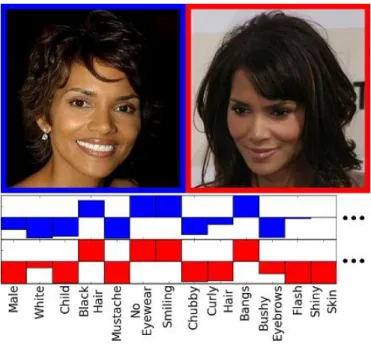
Inspired from the name of the method described in [15] this method is called attribute classifiers based on the idea of extracting the facial attributes of indi-viduals. In this step a binary classifier is trained for recognizing whether those describable aspects of visual appearance (such as age, hair color, race, sex etc.) exist or do not exist. Up to now they have built 65 attribute classifiers, explored in A.2, and via these attributes they can recognize faces despite the illumination, pose or expressions. As it is clarified in figure 4.2 most of the attribute classifiers belong to the two face image of Hale Berry is strongly close to each other, despite the differences in pose or illumination.
In order to construct their attribute classifiers, first the low level features are extracted, then the visual traits are computed.
Figure 4.2: Attribute Classifiers agreement despite the differences in pose, illu-mination, etc. (this image is taken from [15]).
For every face image I, a feature vector F(I) is constructed. F(I) is simply constructed by the concatenation of k low level feature vectors fi = 1, ..., k.
The low level features are constructed via extracting the image intensities in RGB, HSV color spaces, edge magnitudes and gradient directions of fiducial point locations on the regions manually selected from the rectified image of the detected face region outputs of commercial face detectors.
2- Compute Visual Traits
In this step the attribute classifiers in other words the trait vector C(I), n trait classifiers C1...Cn, is computed using the extracted feature vectors. C(I) =
< C1F(I), ..., CnF(I) >
Based on their assumptions, face verification systems may as well confuse people of different sex, gender, age and etc. Kumar et al.[15] comes with a novel solution to the confusion problem. They propose a method where the facial features are extracted based on people’s different attributes that can distinguish
them from other people, and evaluate those attributes via comparing them with a set of reference people. Their experiments proved that, this first and novel method applied on face verification, results in a lower error rate in confusion compared to LFW [12] . (31.68% to 23.92%)
4.2.2
SIFT Descriptors
As a second approach for feature vector selection, SIFT features are extracted for 9 facial features mentioned in Everingham et al. [7]. The selected 9 facial features are chosen to be robust to translation, illumination, pose, etc. Therefore; having a face image collection captured under uncontrolled environment as our dataset, extracted SIFT descriptors will be a strong way for representation of faces. Those specific 9 facial points explored in Figure [4.3], are the left and right corners of each eye, the two nostrils and the tip of the nose, and the left and right corners of the mouth.
Figure 4.3: Specific 9 Facial Points.
For each 9 point, a 128x1 column vector of SIFT descriptors are extracted. As a result, a face image is represented with a 128x9 matrix.
Experiments
In this chapter, we will evaluate the results of our algorithm and explore the accuracy rates of each step.
5.1
Construction of the dataset
As introduced in section 4.1, two different sets of data, Faces in the Wild, and Public Face Figures Dataset, are used in order to form our dataset. For the rest of this study we will refer to Faces in the Wild Dataset as FW, and Public Face Figures Dataset as PubFig. The FW dataset already consists of multi-face images (images with multiple faces on it) and their corresponding contents. However, in the PubFig dataset, we only have images of single faces. Therefore, in order to apply our method, while FW Dataset does not require any additional work; slight changes and additions are necessary for PubFig. Let us first give a brief information on the additional work applied on PubFig Dataset.
In the following two sections; using PubFig Dataset, first, the simulation im-plemented for multi-face image generation and then random generation of textual contents belonging to corresponding multi-face images will be explained.
5.1.1
Multi-face image generation
There are approximately around 300 face images for each 140 categories of names in Public Figures Face Database (PubFig). Among all these 140 categories, the category with the maximum number of image collection contains 1536 images, while the one with the minimum number contains only 63 images.
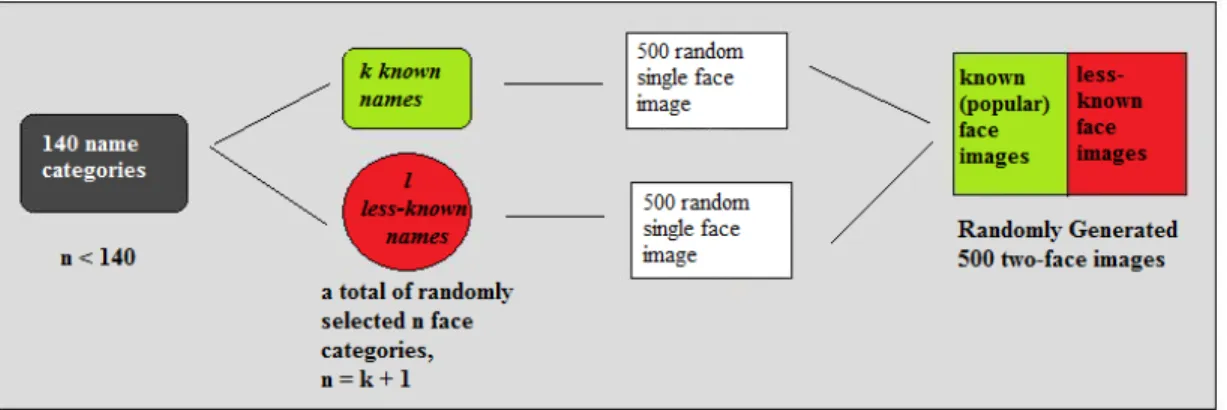
A total of 42.879 images for 140 people are collected for PubFig Dataset gen-eration by Kumar et al. Since the subject of this study is to name less frequently appearing faces using frequently appearing ones; we needed to construct two sets of names among those 140 categories, for both most frequently and less frequently appearing people on the web. Therefore, we randomly select some of the names to be the faces of most frequently appearing people, and some of them to be the less frequently appearing ones.
We choose to have n categories of names, where k of them belong to popular faces and l of them belong to less frequently appearing faces. Using 10-fold cross validation, at each step k random names for popular faces are selected among 140 names, and for less frequently appearing faces, l random names are selected from the remaining 140-k names. After determining the names for less-frequently and most-frequently appearing people, w random face images for both name sets (a total of 2*w face images) are selected from the category sets of images belonging to these randomly generated names. In order to generate an image with two faces, one from each w random face images are put together. To make the evaluation easier, while the faces placed on the left sides of the image are selected from the categories of popular names, the faces placed on the right sides are selected from the categories of less-known people names (Figure[5.1]). n have been empirically changed during our experimental work.
5.1.2
Random generation of textual content
Considering the fact that, for a query name, image search engine results are pretty satisfactory, we can arrive at the conclusion that generally textual contents around
Figure 5.1: Sample generated two-face images. Faces on the left belong to popular people, faces on the right belong to less-known people.
face images contain the names of the corresponding faces. However; it is possible to retrieve images with irrelevant names in its textual content. For a query name “George W. Bush”, images of “Saddam Hussein” may appear in the result set. Therefore; in our experiments, in order to simulate a realistic textual content generation we include some error rate in having correct names for face images.
Figure 5.2: Random name generation for textual content of an image with two face.
For images with two faces, textual contents are generated as illustrated in Figure 5.2. For an image withtwo faces on, we allocated three slots for name generation. The first slot belongs to person A, the second slot belongs to person B, and the last slot is a random name. However, as explained before, we will