INVESTIGATING THE EFFECTS OF DEMOGRAPHIC VARIABLES ON
THE ROLE OF MEDIA EDUCATIONS OF IRAN HELAL INSTITUTE IN
INCREASING PUBLIC AWARENESS FOR REHABILITATION AFTER
EARTHQUAKE IN THE POSSIBLE EARTHQUAKE IN TEHRAN
Zahra FilomDepartment of Social Communication Sciences, Islamic Azad University, Iran [email protected]
ABSTRACT
The aim of this study was to investigating the effects of demographic variables on the role of media educations of Iran Helal institute in increasing public awareness for rehabilitation after earthquake in the possible earthquake in Tehran. In the quantitative research, using survey method and questionnaire tool, investigating the role of educational media of Helal institute on public awareness for rehabilitation after earthquake. The study population included all persons 15-65 years at the time of implementation of project were living in 5 regions in North, South, East, West and center of Tehran. Sample size n=380 in each region is calculated based on Cochran formula. Overall, this study shows that media educations of Helal institute on people's awareness about prevention and preparing and informing the public about the rehabilitation after the earthquake is effective.
Keywords: media educations, Iran Helal Institute, public awareness, possible earthquake in Tehran
TAHRAN'DA OLASI DEPREM SONRASI REHABİLİTASYON TOPLUM
BİLİNCİNİN ARTIRILMASI İRAN HELAL ENSTİTÜSÜ MEDYA
EĞİTİMİN ROLÜ KONULU DEMOGRAFİK DEĞİŞKENLER
ETKİLERİNİN ARAŞTIRILMASI
ÖZ
Bu çalışmanın amacı, Tahran'da olası bir depremde depremden sonra rehabilitasyon için kamu bilincinin artırılması İran Helal enstitüsü medya eğitimleri rolüne ilişkin demografik değişkenlerin etkilerini araştıran oldu. Nicel araştırmada, depremden sonra rehabilitasyon için halkın bilinçlendirilmesi üzerinde Helal enstitüsü eğitim medyanın rolünü araştıran, anket yöntemi ve anket aracını kullanarak. Araştırmanın evrenini, projenin uygulanması sırasında 15-65 yıl Kuzey, Güney, Doğu, Batı ve Tahran merkezinde 5 bölgede yaşayan tüm kişileri dahil. Her bölgedeki Örnek büyüklüğü n = 380 Cochran formülü esas alınarak hesaplanır. Genel olarak, bu çalışma önlenmesi ve hazırlanması ve deprem sonrası rehabilitasyonu hakkında kamuoyunu bilgilendirme konusunda insanların farkındalık Helal enstitüsü medya eğitimler etkili olduğunu göstermektedir.
Anahtar Kelimeler: Medya eğitimler, İran Helal Enstitüsü, halkın bilinçlendirilmesi, Tahran'da olası
deprem
INTRODUCTION
Natural and non-natural disasters and accidents are threatening human life and yet one of the pillars of human evolution and every year taken thousands of victims around the world and will cause large financial damages. In fact, human losses and natural disasters and accidents in the world, a figure more
than ten thousand a month is estimated and our country due to its geographical location, has repeatedly faced with the occurrence of disasters and accidents and according to evidence and statistics, Iran is among the top ten disaster-prone countries in the world. Despite considerable progress there is not enough growth in technologies post-traumatic response in the prevention and preparedness and failed to prevent or reduce the risks of it seriously. (1) Based on studies in Tehran, faults, including fault in northern and southern areas of Tehran such as Darabad, Niavaran, Narmak, Tajrish, Ghasr Firoozeh in active condition and if the fault resistance ceases occurred in the event of earthquake in Tehran more than 5 million people will lose their lives.
According to study of JICA Japan's International Cooperation Department (JICA) the possibility of activating these three fault, south Ray and north Tehran was diagnosed that activate any damage and various intensity in each region of Tehran.
In Tehran historical records, large earthquakes such as earthquake 7.1 magnitude Damavand in 1830, earthquake 7.2 magnitude in 1117 AD in Karaj, 7.7magnitude Taleghan in 958 AD, earthquake 7.1 magnitude in 855 AD in Ray and many more earthquakes above 7 was registered in Tehran. Tehran earthquake return period about 150 to 200 years, since the last strong earthquake over the past 170 years is a very high risk of earthquake in Tehran. The present study aims to investigate the effects of demographic variables on the role of educational media of Iran Helal Institute in increasing public awareness for rehabilitation after possible earthquake in Tehran is measured. (2)
THEORETICAL FOUNDATIONS AND RESEARCH LITERATURE THEORIES OF SOCIAL COMMUNICATION
In the field of "social communication", several theories have been proposed, there are some of which in other fields of “Human Science” as "sociology” and "behavioral science" as well. Theories such as “Hypodermic Theory”, strength theory, the theory of “Usage and Satisfaction”, the theory of “Agenda-Setting”, the theory of " audience dependency " and “Public Relation Expert”, aware of these theories and know their application in public relations. (3)
DIFFUSION THEORY
"Diffusion theory", is another theory for analyzing the people, how to accept or reject information. According to this theory, the "Diffusion”, a process through which the "Innovation" of specified channels during the given period, among members of a social system is published. (4) The most complete theory of diffusion, "Everet Rogers", an American professor of communications science, in the book "diffusion of innovation" is raised. Rogers, believes that people, information resulted of innovations adopt through the five stages that each of these steps has their specific features. The steps are as follows: awareness, motivation and persuasion, decision and evaluation, implementation and acceptance and consolidation phase. (5)
RESEARCH LITERATURE
A research by Malek Mohammadi, Mohammad (2006) entitled "public education, self-aid education, the role of mass media, training courses and exercises in Shahr Kord city Red Crescent" as quasi-experimental research carried. And the results suggest the need to go through training courses, educational books, radio and television, watch instructional videos, holding maneuvers to train how to deal flood, fire, etc., as well as teaching aid and first aid as a preventive measure in the face of natural disasters. (6)
A study by Mehdi Pour, Abtin (2003) entitled "Strategies for the development of self-aid in the country with public education and public participation 'has been done to investigate the role of public participation in disaster. Research findings show education through TV and media are the best practices on ways to improve the efficiency index in human societies and for a comprehensive and grassroots participation in disaster for all age and social groups training should be provided. (7)
Research by Ghanjal, Ali (2003) examines "the role of self-aid in unexpected events” is done. These results confirmed the importance of proper training of population to initial relief to quickly and accurately that this will cause significant that the lives saved from death and that the damage can be prevented
Research by Lorna (2003) did tick prevention education. The results emphasize the impact of education through the use of audio, visual and formed workgroups and evaluation methods. (9)
RESEARCH HYPOTHESIS
3.1 There is significant relationship between age and the effectiveness of media educations of Iran Helal institute in increasing public awareness for rehabilitation after possible earthquake in Tehran
3.2 There is significant relationship between gender and the effectiveness of media educations of Iran Helal institute in increasing public awareness for rehabilitation after possible earthquake in Tehran 3.3 There is significant relationship between the location and the effectiveness of media educations of Iran Helal institute in increasing public awareness for rehabilitation after possible earthquake in Tehran 3.4 There is significant relationship between education and the effectiveness of media educations of Iran Helal institute in increasing public awareness for rehabilitation after possible earthquake in Tehran
3.5 There is significant relationship between employment status and the effectiveness of media educations of Iran Helal institute in increasing public awareness for rehabilitation after possible earthquake in Tehran
RESEARCH METHODOLOGY
The study is quantitative research; using survey method and questionnaire tool, the role of media educations of Helal institute in increasing public awareness were discussed. The study population included all persons 15-65 years in Tehran and sample size n =380 in each region are calculated based on Cochran formula.
RESULTS
THE FIRST HYPOTHESIS ANALYSIS
H0: There is not significant relationship between age and the effectiveness of media educations of Iran Helal institute in increasing public awareness for rehabilitation after possible earthquake in Tehran H1: There is significant relationship between age and the effectiveness of media educations of Iran Helal institute in increasing public awareness for rehabilitation after possible earthquake in Tehran
Table 1 Investigating relationship between age and the effects of media education Iran Helal Institute at
increasing public awareness about possible earthquake rehabilitation after the earthquake in Tehran Age Awareness 15 to 25 years 26 to 35 years 36 to 45 years 46 to 55 56 and above Total Previous score Lower than average Number Percent 492 62.27 272 68 232 66.28 153 76.5 88 55 1237 65.11 Above average Number Percent 298 37.73 128 32 118 33.71 47 23.5 72 45 663 34.89 Next Score Lower than
average Number Percent 420 53.16 198 49.5 189 54 163 81.5 89 55.63 1059 55.73 Above
average Number Percent 370 46.84 202 50.5 161 46 37 18.5 71 44.37 841 44.27
Total 790 400 350 200 160 1900
Test Value Degrees of freedom Significance level Cramer coefficient
Chi square 9.54 4 0.123 0.112
The results indicate that there is not significant relationship between age and the effectiveness of media educations of Iran Helal institute in increasing public awareness for rehabilitation after possible earthquake in Tehran. Therefore, H0 is accepted and H1 is rejected.
THE SECOND HYPOTHESIS ANALYSIS
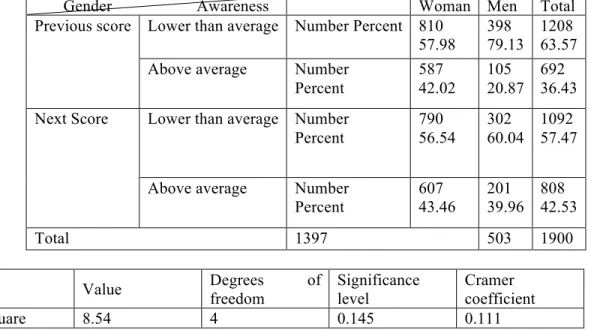
H0: There is not significant relationship between gender and the effectiveness of media educations of Iran Helal institute in increasing public awareness for rehabilitation after possible earthquake in Tehran H1: There is significant relationship between gender and the effectiveness of media educations of Iran Helal institute in increasing public awareness for rehabilitation after possible earthquake in Tehran
Table 2 Investigating relationship between gender and the effectiveness of media educations of Iran Helal
institute in increasing public awareness for rehabilitation after possible earthquake in Tehran
Gender Awareness Woman Men Total
Previous score Lower than average Number Percent 810 57.98
398 79.13
1208 63.57 Above average Number
Percent 587 42.02 105 20.87 692 36.43 Next Score Lower than average Number
Percent 790 56.54 302 60.04 1092 57.47 Above average Number
Percent 607 43.46 201 39.96 808 42.53
Total 1397 503 1900
Test Value Degrees freedom of Significance level Cramer coefficient
Chi square 8.54 4 0.145 0.111
The results indicate that there is not significant relationship between gender and the effectiveness of media educations of Iran Helal institute in increasing public awareness for rehabilitation after possible earthquake in Tehran
Therefore, H0 is accepted and H1 is rejected.
THE THIRD HYPOTHESIS ANALYSIS
H0: There is not significant relationship between the location and the effectiveness of media educations of Iran Helal institute in increasing public awareness for rehabilitation after possible earthquake in Tehran H1: There is significant relationship between the location and the effectiveness of media educations of Iran Helal institute in increasing public awareness for rehabilitation after possible earthquake in Tehran
Table 3 Investigating relationship between the location and the effectiveness of media educations of Iran
Helal institute in increasing public awareness for rehabilitation after possible earthquake in Tehran
Location North East Center South West Total
Previous score Lower than average Number Percent 222 58.4 219 57.63 216 56.84 220 57.89 225 59.21 1102 58 Above average Number Percent 158 41.57 161 42.36 164 43.15 160 42.10 155 40.78 798 42
Next Score Lower than average Number Percent 189 49.73 186 48.94 183 48.15 181 47.63 179 47.10 918 48.31 Above average Number Percent 191 50.26 194 51.05 197 51.84 199 52.36 201 52.89 982 51.68 Total 380 380 380 380 380 1900
Test Value Degrees of
freedom Significance level Cramer coefficient Chi square 10.16 4 0.136 0.135
The results indicate that there is not significant relationship between the location and the effectiveness of media educations of Iran Helal institute in increasing public awareness for rehabilitation after possible earthquake in Tehran. Therefore, H0 is accepted and H1 is rejected.
THE FOURTH HYPOTHESIS ANALYSIS
H0: There is not significant relationship between education and the effectiveness of media educations of Iran Helal institute in increasing public awareness for rehabilitation after possible earthquake in Tehran H1: There is significant relationship between education and the effectiveness of media educations of Iran Helal institute in increasing public awareness for rehabilitation after possible earthquake in Tehran
Table 4 Investigating relationship between education and the effectiveness of media educations of Iran
Helal institute in increasing public awareness for rehabilitation after possible earthquake in Tehran Education
Awareness
High school Diploma Associate Degree
Bachelor's
Degree or
higher
Total Previous score Lower than
average Number Percent 532 87.21 485 93.26 123 58.58 368 65.71 1508 79.36 Above average Number Percent 78 12.78 35 6.74 87 41.42 192 34.28 392 20.64 Next Score Lower than
average Number Percent 456 74.75 412 79.24 98 46.66 312 55.72 1278 67.26 Above average Number Percent 154 25.24 108 20.76 112 53.34 248 44.28 622 3274 Total 610 520 210 560 1900
Test Value Degrees of freedom Significance
level
Cramer coefficient
Chi square 8.14 4 0.136 0.121
The results indicate that there is not significant relationship between education and the effectiveness of media educations of Iran Helal institute in increasing public awareness for rehabilitation after possible earthquake in Tehran. Therefore, H0 is accepted and H1 is rejected.
H0: There is not significant relationship between employment status and the effectiveness of media educations of Iran Helal institute in increasing public awareness for rehabilitation after possible earthquake in Tehran
H1: There is significant relationship between employment status and the effectiveness of media educations of Iran Helal institute in increasing public awareness for rehabilitation after possible earthquake in Tehran
Table 5 Investigating relationship between employment status and the effectiveness of media educations
of Iran Helal institute in increasing public awareness for rehabilitation after possible earthquake in Tehran Employment
Awareness
Jobless Housewife Employee Self-employed Student Total Previous score Lower than average Number Percent 223 79.64 413 79.42 259 80.68 413 82.76 212 75.71 1520 80 Above average Number Percent 57 20.35 107 20.57 62 19.31 86 17.23 68 24.28 380 20 Next Score Lower
than average Number Percent 185 66.07 365 70.19 213 66.35 325 65.13 159 56.78 1247 65.63 Above average Number Percent 95 33.92 155 29.80 108 33.64 174 34.86 121 43.21 653 34.36 Total 280 520 321 499 280 1900
Test Value Degrees of freedom Significance level Cramer coefficient
Chi square 9.18 4 0.165 0.113
The results indicate that there is not significant relationship between employment status and the effectiveness of media educations of Iran Helal institute in increasing public awareness for rehabilitation after possible earthquake in Tehran. Therefore, H0 is accepted and H1 is rejected.
CONCLUSION
Overall, this study shows that media educations of Helal institute on people's awareness about prevention and preparing and informing the public about the rehabilitation after the earthquake is effective. However, in some age and education groups as well as rehabilitation training needs serious revision. Certainly, there is still the subject of much study to accept the fact that public education in developed countries and in developing countries is necessary. Since the government alone can carry out the necessary measures to confront and deal with the harmful consequences of natural disasters like earthquakes, public education is as one of the most crucial components of the preparation. (10)
Overall results showed that:
1: There is not significant relationship between age and the effectiveness of media educations of Iran Helal institute in increasing public awareness for rehabilitation after possible earthquake in Tehran 2: There is not significant relationship between gender and the effectiveness of media educations of Iran Helal institute in increasing public awareness for rehabilitation after possible earthquake in Tehran 3: There is not significant relationship between the location and the effectiveness of media educations of Iran Helal institute in increasing public awareness for rehabilitation after possible earthquake in Tehran 4: There is not significant relationship between education and the effectiveness of media educations of Iran Helal institute in increasing public awareness for rehabilitation after possible earthquake in Tehran
5: There is not significant relationship between employment status and the effectiveness of media educations of Iran Helal institute in increasing public awareness for rehabilitation after possible earthquake in Tehran
REFERENCES
1. Rafipour, F. (1999). Mass media and changing social values. Tehran. Learn book publishing.
2. Kianmehr, N. (2003). Prepare families to deal with unexpected events. Proceedings of the First International Congress on Health and crisis management in disasters Page 360
3.Community Based Disaster Risk Management (2007) Organized byAsian Disaster Preparedness Center, Bangkok, Thailand. A Literature review and reappraisal
4. Vindal, Sun et al. (1997). The application of communication theories. (Translated by Alireza Dehghan). Tehran . Center for Media Studies & Research
5.Everet Rogers (2003).Information Needs Analysis .What we want to find out and what the literature tells us?2nd ed. RA399A1L54
6. Malek Mohammadi, M. (2006). Public education, self-aid training, the role of mass media, training courses maneuver and Red Crescent in this city. Proceedings of the Third International Congress on Health and crisis management in disasters, Page 57
7. Mehdi Pour, A (2003). Pyramid of self-aid measures in the country with public education and public participation. Proceedings of the First International Congress on Health and crisis management in disasters, Page 43
8. Ghanjal, A. (2003). Its role and self-aid in disasters. Proceedings of the First International Congress on Health and crisis management in disasters, Page 176
9.Lorna, Victoria (2003), COMMUNITY BASED DISASTER MANAGEMENT IN THE PHILIPPINES: MAKING A DIFERENCE IN PEOPLE’S LIVES. 9 p
10. Lak, M. (2004). Workshop on Health in infectious disease control in disasters. Proceedings of the Second International Congress of Health and crisis management in disasters, Page 73