1877–0428 © 2011 Published by Elsevier Ltd. doi:10.1016/j.sbspro.2011.04.127
Procedia Social and Behavioral Sciences 15 (2011) 2454–2458
WCES-2011
The development of an Astronomy Concept Inventory (ACI)
Sedef Canbazoglu Bilici
a, Fulya Oner Armagan
b, Nevin Kozcu Cakir
b, Nejla Yuruk
b*Aksaray University, Faculty of Education, Department of Science Education, 68100, Aksaray, Turkey **Gazi University, Gazi Faculty of Education, Department of Science Education, 06500, Ankara, Turkey
Abstract
The aim of this study is to develop an Astronomy Concept Inventory (ACI) to assess undergraduate students’ conceptual
understanding of moon phases, moon and earth motion. ACI consists of 25 multiple choice questions with four distracters. The
inventory was administered to 262 undergraduate students who took introduction to astronomy course. The data were analyzed
by ITEMAN software program. The difficulty indices ranged from .45 to .92, and discrimination indices ranged from .21 to .59.
The mean P value as difficulty index was found to be .66 for the test while alpha value for whole test was found as .80.
© 2011 Published by Elsevier Ltd.
Keywords: Astronomy concept inventory, moon phases; moon and earth motion; conceptual understanding;
1. Introduction
Astronomy is one of the oldest sciences related with stars, halley, satellites, space and solar system (Pena &
Quilez, 2001; Osborne, 1991).In recent years the number of studies regarding students’ conceptual understanding of
astronomy has been increasingly accelerated. Since astronomy includes concepts that are directly related with
different disciplines, it has a significant place in curriculum contexts. Countries, United States of America,
Australia, Canada, Israel, Italy and United Kingdom, which paid special attention to astronomy, reconstructed their
curriculum from primary school to university (Kalkan & Kiroglu, 2007). Students’ conceptual understanding of the
causes of moon phases was identified as a part of scientific literacy and emphasized as a targeted concept in
National Science Education Standards (National Research Council [NRC], 1996).
As developments in science education throughout the world have been continuing, an important step has just
been taken in Turkey. Turkish primary science and technology program was renewed in 2005 and the content of
astronomy subjects was reconstructed in this new science and technology curriculum. Topics in the new curriculum
are: shape and structure of earth (fourth grade), size and shape of sun, earth and moon – moon and earth motion –
day and night cycle (fifth grade), orbs, solar system and space probes (seventh grade), and the formation of the
universe and the earth (eighth grade) (Turkish Ministry of National Education [TMNE], 2005). Since the content
regarding astronomy concepts covered in the high school curriculum was limited “Astronomy and Space Sciences
Course” and its content was modified and the new course is being implemented starting from 2010 (TMNE, 2010).
* Sedef Canbazoglu Bilici. Tel.:+90-312-202-8108; fax:+90-312-222-8483.
E-mail address: [email protected]
Open access underCC BY-NC-ND license.
Studies conducted about students’ conceptions in astronomy showed that many misconceptions about astronomy
concepts experienced by students in their daily lives are often observed in their from childhood (Vosniadou, 1991;
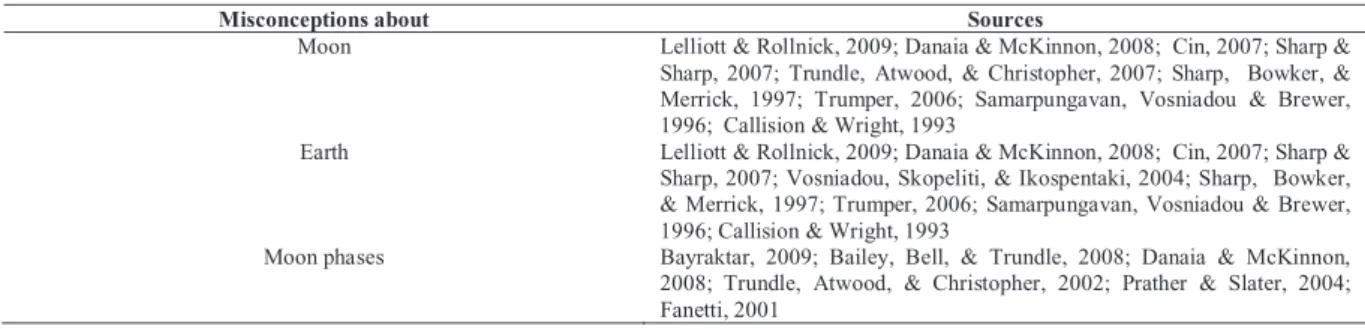
Vosniadou & Brewer, 1990). The topics in which misconceptions were most commonly observed and the studies
that identified those misconceptions are summarized in Table 1.
Table 1. The topics regarding the targeted misconceptions and the relevant studies
Misconceptions about Sources
Moon Lelliott & Rollnick, 2009; Danaia & McKinnon, 2008; Cin, 2007; Sharp & Sharp, 2007; Trundle, Atwood, & Christopher, 2007; Sharp, Bowker, & Merrick, 1997; Trumper, 2006; Samarpungavan, Vosniadou & Brewer, 1996; Callision & Wright, 1993
Earth Lelliott & Rollnick, 2009; Danaia & McKinnon, 2008; Cin, 2007; Sharp & Sharp, 2007; Vosniadou, Skopeliti, & Ikospentaki, 2004; Sharp, Bowker, & Merrick, 1997; Trumper, 2006; Samarpungavan, Vosniadou & Brewer, 1996; Callision & Wright, 1993
Moon phases Bayraktar, 2009; Bailey, Bell, & Trundle, 2008; Danaia & McKinnon, 2008; Trundle, Atwood, & Christopher, 2002; Prather & Slater, 2004; Fanetti, 2001
In previous studies open-ended questions, interview and observation forms were used for assessing students’
understanding of astronomy concepts (Bayraktar, 2009; Bell & Trundle, 2007; Blown & Bryce, 2006). Several
multiple choice tests (see Table 2) related to astronomy concepts were also developed by researchers in different
countries for different contents. However, these kinds of assessment tools are rarely found in Turkey. Because
multiple choice tests are useful assessment tools that are easy to construct, edit, and score for teachers and as shown
in Table 1 moon phases, moon and earth motion are difficult topics for students to understand, the aim of this study
is to develop an Astronomy Concept Inventory (ACI) to assess undergraduate students’ conceptual understanding of
moon phases, moon and earth motion.
2. Methods
2.1. Participants
The inventory was administered to 262 undergraduate students from four different universities (Ankara
University, Gazi University, Amasya University, Kocaeli University) who have taken introduction to astronomy
course during the spring semester of 2009-2010 academic year. 173 of participants were enrolled in Department of
Primary Education. Apart from these, 89 participants were enrolled in Department of Astronomy and Space
Sciences.
2.2.Instrument
In this study, the instrument was developed based on the theory of traditional test construction (Crocker &
Algina, 1986). Prior to the beginning of this study, purpose of the inventory was identified and the concept domain
was defined by the researchers. For the purpose of content validity, a table of specifications was prepared to ensure
that all of the objectives in the curriculum are represented by all test items. 12 questions were taken from eight
different sources (see Table 2): Frede (2008), Kalkan and Kiroglu (2007), Gray, (2006), Trumper (2006), Sarranize
(2005), Lindell (2001), Trumper (2000), Finegold and Pundak (1991) and 18 questions were developed by the
researchers by considering instructional objectives. 12 questions were translated by three researchers, and a fourth
researcher checked the linguistic equivalence of the questions. Prior to the field-testing, two experts of astronomy
education examined the structure and content of the all questions in the inventory.
Table 2. Distribution of ACI items according to sources
Item Sources
1,2,3 (Frede, 2008)
5,7, (Finegold & Pundak, 1991)
6 (Trumper, 2006),
15,16 (Lindell, 2001)
20 (Gray, 2006)
21,23 (Sarranize, 2005)
Table 3 shows the distribution of ACI items according to the topics covered in the test.
Table 3. Distribution of ACI items according to subject matterContent Item
Moon Phases 1, 3, 4, 6,10,11, 12, 13, 21, 22, 25, 26, 28, 29, 30
Moon Motion 2, 8, 15, 16, 17, 18, 23
Earth Motion 5, 7, 9,14,19, 20, 24, 27
*Bold questions were eliminated after item analysis
2.3.Data Analysis
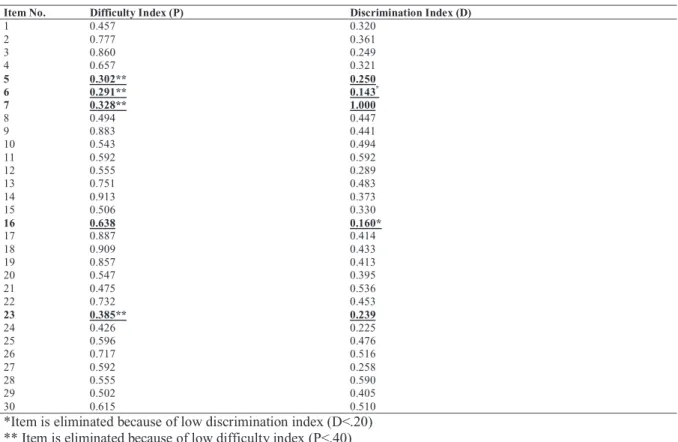
The data were analyzed by ITEMAN (Item and Test Analysis program) software program. The results of item
analysis are tabulated in Table 4.
Table 4: The results of ITEMAN
Item No. Difficulty Index (P) Discrimination Index (D)
1 0.457 0.320 2 0.777 0.361 3 0.860 0.249 4 0.657 0.321 5 0.302** 0.250 6 0.291** 0.143* 7 0.328** 1.000 8 0.494 0.447 9 0.883 0.441 10 0.543 0.494 11 0.592 0.592 12 0.555 0.289 13 0.751 0.483 14 0.913 0.373 15 0.506 0.330 16 0.638 0.160* 17 0.887 0.414 18 0.909 0.433 19 0.857 0.413 20 0.547 0.395 21 0.475 0.536 22 0.732 0.453 23 0.385** 0.239 24 0.426 0.225 25 0.596 0.476 26 0.717 0.516 27 0.592 0.258 28 0.555 0.590 29 0.502 0.405 30 0.615 0.510
*Item is eliminated because of low discrimination index (D<.20)
** Item is eliminated because of low difficulty index (P<.40)
Item discrimination index of .40 or higher indicates that it is an exceptionally good item in terms of its ability to
discriminate between high achievers and poor achievers (Van Blerkom, 2009). Ebel and Frisbe (1991) classified
items with discrimination index from .30 to .39 is reasonably good but possibly subject to improve, 0.20 to 0.29 is
marginal items usually subjected to improvement and below 0.19 is poor items that are to be rejected or further
improved by revision. Thus, two items (6, 16) were eliminated due to poor discrimination index (D<.20). Three
items with difficulty index (5, 7, 23) .40 and below were eliminated. After the elimination of the items, item analysis
was repeated and the final version of inventory consisted of 25 items. The difficulty indices ranged from .45 to .92,
and discrimination indices ranged from .21 to .59. The mean P value as difficulty index was found to be .66 for the
test while alpha value for whole test was found as .80.
3. Conclusion
The findings presented in this study show that final version of the ACI consists of 25 multiple choice questions
which of 7 was taken from six different sources: Frede (2008), Kalkan and Kiroglu (2007), Gray (2006), Sarranize
(2005), Lindell (2001), Trumper (2000), remaining 18 items were developed by the researchers. Fourteen questions
are related to moon phases, five to moon motion, and six to earth motion in test. All the findings obtained from the
item analysis, validity and reliability analyses of indicate that ACI is a valid and reliable tool to identify
undergraduate students’ understanding related to astronomy concepts.
References
Bailey, J.M., Prather, E.E., & Slater, T.F. (2004). Reflecting on the history of astronomy education research to plan for the future. Advances in
Space Research, 34, 2136–2144.
Bayraktar, ù. (2009). Preservice primary teachers’ ideas about lunar phases. Journal of Turkish Science Education, 6(2),12-23.
Bell, R. L., & Trundle, K.C. (2007).Using technology to promote conceptual change: phase 3 of the research. Retrieved October 23, 2009 from http://theaste.org/publications/proceedings/2007proceedings/2007proceedings/Bell_2.mht
Blown, E. J., & Bryce, T.G.K. (2006). Knowledge restructuring in the development of children’s cosmologies. International Journal of Science Education, 28(12), 1411-1462.
Callision, P. L., & Wright, E. L. (1993). The effect of teaching strategies using models on preservice elementary teachers’ conceptions about earth-sun-moon relationships. Paper presented at Annual Meeting of the National Association for Research in Science Teaching, Atlanta, April.
Cin, M. (2007). Alternative views of the solar system among Turkish students. Review of Education, 53, 39-53.
Crocker, L., & Algina, J. (1986). Introduction to classical and modern test theory. New York: Holt, Reinhart and Winston, Inc.
Danaia, L. & McKinnon, D. H. (2008). Common alternative astronomical conceptions encountered in junior secondary science classes: Why is this so? Astronomy Education Review, 2(6), 32-53.
Ebel, R.L., & Frisbie, D.A. (1991). Essentials of educational measurement (5th ed.). New Delhi: Prentice Hall of India Pvt. Ltd.
Fanetti, T. M. (2001). The relationships of scale concepts on college age students’ misconceptions about the cause of lunar phases. Unpublished master’s thesis, Iowa State University, Ames.
Finegold, M., & Pundak, D. (1991). A study of change in students’ conceptual frameworks in astronomy. Studies in Educational Evaluation, 17, 151-166.
Frede, V. (2008). Teaching astronomy for pre-service elementary teachers: A comparison of methods. Advances in Space Research, 42, 1819-1830.
Gray, P. A. (2006). Gender differences in science misconceptions in eighth grade astronomy. Unpublished doctoral dissertation, Widener University.
Kalkan, H., & Kiroglu, K. (2007). Science and non-science students’ ideas about basic astronomy concepts in preservice training for elementary school teachers. Astronomy Education Review, 6(1), 15-24.
Kehoe, J. (1995). Basic item analysis for multiple-choice tests. Practical Assessment, Research & Evaluation, 4(10). Available online: http://PAREonline.net/getvn.asp?v=4&n=10 .
Lelliott, A., & Rollnick, M. (2009). Big Ideas: A review of astronomy education research 1974-2008. International Journal of Science Education, 32(13), 1771–1799.
Lindell, R. (2001). Enhancing college students’ understanding of lunar phases. Unpublished doctoral dissertation, University of Nebraska-Lincoln.
National Research Council. (1996). National science education standards. Washington, DC: National Academy Press.
Osborne, J. (1991). Approaches to the teaching of AT16- the Earth in space: Issues problems and resources. School Science, 72(260), 7-15. Pena, B. M., & Quilez, M. J. (2001). The importance of images in astronomy education. International Journal of Science Education, 23(11),
1125-1135.
Samarpungavan, A., Vosniadou, S., & Brewer, W. F. (1996). Mental models of the earth, sun, and moon: indian children’s cosmologies. Cognitive Development, 11, 491.
Sarrazine, A. R. (2005). Addressing astronomy misconceptions and achieving national science standards utilizing aspects of multiple intelligences theory in the classroom and the planetarium. Unpublished doctoral dissertation, Indiana University.
Sharp, J. G., Bowker, R., & Merrick, J. (1997). Primary astronomy: conceptual change and learning in three 10–11 year olds. Research in Education, 57, 67–83.
Sharp, J.G. & Sharp, J. C. (2007). Beyond shape and gravity: children’s ideas about the Earth in space reconsidered. Research Papers in Education, 22(3), 363-401.
Trumper, R. (2000). University students’ conceptions of basic astronomy concepts, Physics Education, 35, 9-15.
Trumper, R. (2006). Teaching future teachers basic astronomy concepts – seasonal changes – at a time of reform in science education. Journal of Research in Science Teaching, 43(9), 879-906.
Trundle, K.C., Atwood, R.K., & Christopher, J.E. (2002). Preservice elementary teachers’ conceptions of moon phases before and after instruction. Journal of Research in Science Teaching, 39(7), 633–658.
Trundle, K.C., Atwood, R.K. & Christopher, J.E. (2007). Fourth-grade elementary students’ conceptions of standards-based lunar concepts. International Journal of Science Education, 29(5), 595-616.
Turkish Ministry of National Education (2005). Fen ve teknoloji ö÷retim programÕ [New curriculum of science and technology education]. Retrieved December 24, 2005, from http://ttkb.meb.gov.tr/ogretmen/.
Turkish Ministry of National Education (2010). Ortaö÷retim astronomi ve uzay bilimleri dersi ö÷retim programÕ [Astronomy and Space Sciences in Higher Education Curriculum]. Retrieved July 24, 2010, from http://ttkb.meb.gov.tr/ogretmen/modules.php?name=downloads&d_op=viewdownload&cid=75.
Van Blerkom, M. L. (2009). Measurement and statistics for teachers. New York, USA: Taylor and Francis.
Vosniadou, S., & Brewer, W. F. (1990). A cross-cultural investigation of children's conceptions about the earth, the sun, and the moon: Greek and American data. In H. Mandl, E. DeCorte, N. Bennett, & H. F. Friedrich (Eds.), Learning and instruction: European research in an international context (pp. 605-629). Oxford: Pergamon.
Vosniadou, S. (1991). Designing curricula for conceptual restructuring lessons from the study of knowledge acquisition in astronomy. Journal of Curriculum Studies, 23, 219-237.
Vosniadou, S., Skopeliti, I., & Ikospentaki, K. (2004). Modes of knowing and ways of reasoning in elementary astronomy. Cognitive Development, 19, 203-222.