Dergi web sayfası:
www.agri.ankara.edu.tr/dergi www.agri.ankara.edu.tr/journalJournal homepage:
TARIM BİLİMLERİ DERGİSİ
—
JOURNAL OF AGRICUL
TURAL SCIENCES
22 (2016) 528-538
The Effect of Saline and Non-Saline Soil Conditions on Yield and
Nutritional Characteristics of Some Perennial Legumes Forages
Süleyman TEMELa, Bilal KESKİNa, Uğur ŞİMŞEKb, İbrahim Hakkı YILMAZaaIğdır University, Faculty of Agriculture, Department of Field Crops, Iğdır, TURKEY
bIğdır University, Faculty of Agriculture, Department of Soil Science and Plant Nutrition, Iğdır, TURKEY ARTICLE INFO
Research Article
Corresponding Author: Süleyman TEMEL, E-mail: [email protected], Tel: +90 (533) 437 87 03 Received: 05 April 2015, Received in Revised Form: 04 August 2015, Accepted: 05 August 2015
ABSTRACT
Salinity is one of the important environmental stress factors restricting agricultural productivity and sustainability, particularly in arid and semi-arid regions. In the evaluation of saline soils, growing of salt tolerant or resistant plants is recently a widespread implementation. The aim of this study was to compare some yield and nutritional properties of alfalfa (Medicago sativa L.), sainfoin (Onobrychis sativa Lam.) and bird’s foot trefoil (Lotus corniculatus L.) species cultivated in extreme saline-soil (9.80 EC dS m-1) and non-saline soil (0.43 EC dS m-1) conditions. For this purpose, this research was conducted in randomized
blocks design with three replications on the Iğdır Plain, located in eastern Turkey, between the years of 2011-2013. Plants were sown under irrigable conditions in 2011, and data were obtained from the examined plants during three years including the year of sowing. In the study, leaf area index (LAI), crude protein (CP), fresh hay and hay yields differed significantly (P<0.01) in terms of species x soil type x year interaction. In respect to plant height, all the paired interactions, but only soil type x year interaction in terms of neutral detergent fiber (NDF) were found statistically significant. According to these results, maximum fresh hay yields and LAI were obtained from alfalfa grown on non-saline soils in the maintenance years (2012-2013), and maximum hay yields were determined again in alfalfa grown on non-saline soils for each of the three years and also on saline soil in 2012. However, minimum fresh hay and hay yields were measured under saline soil conditions in the establishing year for each of the three species. Maximum and minimum CP contents were found in alfalfa and sainfoin grown on saline soil conditions in the establishing year (2011), respectively. Along with changing as per species, plant heights increased in the years following the establishing year, but decreased on saline soil compared to non-saline soil. In respect of NDF content, the highest values were determined under non saline-soils in 2012, and the lowest ones were obtained from saline soil conditions in 2011 and 2013. As conclusion, it was determined that all species can easily grow without too much yield and quality loss in salt-affected areas and can provide enough forage production for livestock feding.
Keywords: Feed value; Forage yield; Halomorphic soils; Salinity; Leaf area index
Bazı Baklagil Yem Bitkisi Türlerinin Verim ve Besin Özellikleri Üzerine
Tuzlu ve Tuzsuz Toprak Koşullarının Etkisi
ESER BİLGİSİ
Araştırma Makalesi
Sorumlu Yazar: Süleyman TEMEL, E-posta: [email protected], Tel: +90 (533) 437 87 03 Geliş Tarihi: 05 Nisan 2015, Düzeltmelerin Gelişi: 04 Ağustos 2015, Kabul: 05 Ağustos 2015
1. Introduction
Soil salinity is one of the most serious abiotic factors restricting productivity of field, plant diversity and plant growth in arid and semi-arid regions, where soil salt content is high and precipitation is insufficient (Kazemi & Eskandari 2011). Salt affected area throughout the world is estimated at over 12.78 million hectares (FAO 2011). In Turkey, there is salinity problem in 1.5 million hectares of soils due to improper management of irrigation and inadequate drainage (Kendirli et al 2005). In Iğdır Plain (92,200 ha), which has a microclimate feature, more than 1/3 of the total cultivable lands have been affected by salinity. Consequently, soil salinity is particularly a great socioeconomic problem in Iğdır, resulting in the dislocation of populations and forcing farmers to subsistence level of living in the salt-affected areas (Temel & Şimşek 2011). In these areas, desired yields can not be obtained and also can not meet roughage needs. Therefore, the quantities of marginal areas within the suitable farmlands are gradually increasing. Bringing these areas back into
production and ameliorating salt-affected soils by leaching and drainage is difficult, very expensive and has a high cost of maintenance (Hanay et al 2004). Thus, the uses of salt tolerant plants present a useful approach in bringing these areas back into production (Qureshi & Barrett-Lennard 1998; Temel et al 2013). Salt tolerant plants also have the great potential to ameliorate the saline soils. Of course, yield and quality losses range depending on the type of crop and the severity of the salinity problem (Karakullukçu & Adak 2008; Özaslan Parlak & Parlak 2008). However, there are many forage species that grow under saline conditions, and lot of these have been opportunistically used as fodder for grazing livestock and sustaining livestock production (Grattan et al 2004).
Fodder crops not only bring the salt-affected areas into production, but also provide a good source of roughage for livestock feeding. For this reason, identification and selection of salt-tolerant forage crop varieties offers a useful approach for increasing yield and improving the salt-affected ÖZET
Tuzluluk özellikle kurak ve yarı kurak bölgelerde tarımsal verimlilik ve sürdürülebilirliği kısıtlayan önemli çevresel stres faktörlerinden birisidir. Tuzlu toprakların değerlendirilmesinde tuza toleranslı ya da tuza dayanıklı bitkilerin yetiştirilmesi son zamanlarda oldukça yaygın uygulamalardandır. Bu çalışmada amaç, çok (aşırı) tuzlu (9.80 EC dS m-1)
ve tuzsuz (0.43 EC dS m-1) toprak koşullarında yetiştirilen yonca (Medicago sativa L.), korunga (Onobrychis sativa
Lam.) ve sarıçiçekli gazalboynuzu (Lotus corniculatus L.) türlerinin bazı verim ve besin özelliklerini karşılaştırmaktır. Bu amaçla, 2011-2013 yılları arasında Türkiye’nin Doğusunda yer alan Iğdır Ovasında tesadüf blokları deneme desenine göre üç tekrarlamalı olarak bu araştırma yürütülmüştür. Bitkiler 2011 yılında sulu şartlarda ekilmiş ve ekim yılı da dahil 3 yıl boyunca veri alınmıştır. Araştırmada yaprak alan indeksi (YAI), ham protein (HP), yaş ot ve kuru ot verimleri, tür x toprak tipi x yıl interaksiyonu açısından önemli bir şekilde farklılık göstermiştir (P<0.01). Bitki boyu bakımından tüm ikilli interaksiyonlar, nötr çözücülerde çözünemeyen lif (NDF) açısından ise sadece toprak tipi x yıl interaksiyonu istatisitiksel olarak önemli bulunmuştur. Bu sonuçlara göre maksimum yaş ot verimleri ve YAI, bakım yıllarında (2012-2013) tuzsuz toprak koşullarında yetişen yonca bitkisinde, maksimum kuru ot verimleri ise her üç yılda da yine tuzsuz toprak koşullarında yetişen yonca bitkisinden elde edilmiştir. Oysa minimum yaş ot ve kuru ot verimleri her üç türde de tesis yılında tuzlu topraklarda ölçülmüştür. Maksimum ve minimum HP içerikleri ise sırasıyla 2011 yılında tuzlu toprak koşullarında yetişen yonca ve korunga bitkisinde bulunmuştur. Türlere göre değişmekle birlikte bitki boyları tesis yılını müteakiben artmış, oysa tuzsuz toprağa göre tuzlu toprakta azalmıştır. NDF içeriği bakımından en yüksek değerler 2012 yılında tuzsuz toprak koşullarında, en düşük değerler 2011 ve 2013 yılında tuzlu topraklarda elde edilmiştir. Sonuç olarak çalışmada, tüm türlerin tuzdan etkilenmiş alanlarda çok fazla verim ve kalite kaybı olmadan kolay bir şekilde yetiştirilip, hayvan beslenmesi için yeterli yem üretimi sağlayabildiği tespit edilmiştir.
Anahtar Kelimeler: Besin değeri; Yem verimi; Halomorfik topraklar; Tuzluluk; Yaprak alan indeksi
areas (Qureshi & Barrett-Lennard 1998; Hameed & Ashraf 2008). Therefore, studies for the identification of salt tolerant plants must be carried out in different ecolgies. For this purpose, a study was conducted to performance and to compare some yield and nutritional properties of some perennial legumes forage species grown at extreme saline soil
and non-saline soil in Iğdır conditions.
2. Material and Methods
2.1. Experimental siteThe research was conducted on irrigable lands of the Iğdır Plain, located in eastern Turkey where more than 1/3 of the total cultivable lands have been affected by salinity. Long term annual precipitation, relative humidity and temperature are 264.0 mm, 51.2% and 12.5 oC, respectively (MGM 2014). Throughout the research years of 2011, 2012 and 2013, total annual precipitation amounts were 340.0 mm, 237.2 mm and 226.9 mm, respectively. Lowest temperatures during winters of 2011, 2012 and 2013 were recorded as -9.0 oC, -2.9 oC and -4.0 oC, respectively. In establishment year, average annual total precipitation amount and relative humidity were found relatively higher than those in 2012 and 2013 while annual average temperature was lower in 2011 when compared to 2012 and 2013. Moreover, long-term average annual precipitation, average temperature and relative humidity are higher when compared to three-year average climate data of trial years (MGM 2014).
Initial chemical and physical characteristics of the soil (0-30 cm) belonging to the site were determined according to the fallowing methods, and
soil characteristics of trial areas were presented in Table 1. Soils were air dried and ground to pass a 2 mm sieve opening. Particle size distribution was determined by the Bouyoucos hydrometer method (Gee & Baunder 1986). The pH was measured in 1:2.5 (soil:water) extracts according to Rhoades (1996). The organic matter (OM) of the soil was performed by using the Smith-Weldon method (Kacar 1994). Available phosphorus (P) content was determined by sodium bicarbonate (NaHCO3) extraction and subsequent spectrophotometry (Olsen & Summers 1982). Exchangeable potassium (K), sodium (Na), calcium (Ca) and magnesium (Mg) were determined using an ammonium acetate extraction followed by the atomic absorption method (Rhoades 1982a). Boron (B) was determined as described by John et al (1975). Electrical conductivity (EC) was determined by a conductivity meter in saturation extract (Rhoades 1982b).
2.2. Experimental design
A randomized block experiment with three replicates was conducted between 2011-2013 years. Research was established at two locations with different soil properties, extreme saline soil (coordinates 39o55’31.47” N, 44o27’05.54’’ E, EC 9.80 dS m-1, ESP 11.9%) and non-saline soil (coordinates 39o54’57.36’’ N, 44o28’25.26’’ E, EC 0.43 dS m-1, ESP 8.9%), but the similar climate properties. As the test plants, three perennial legumes forage species with different degrees of salt tolerance were used in this study. Alfalfa (Medicago sativa L.) and bird’s foot trefoil (Lotus corniculatus L.) have moderate salinity tolerance. Sainfoin (Onobrychis
sativa Lam.) has low salinity tolerance. In the study, Table 1- Some physical and chemical soil characteristics of the experimental locations
Çizelge 1- Deneme alanı toprakların bazı fiziksel ve kimyasal özellikleri
Soil type Texture EC pH OM P Ca Mg Na K B ESP
dS m-1 % mg kg-1 %
Non saline Clay loam 0.43 8.2 4.4 27.9 3640 537 552 1251 4.3 8.9
Saline Loamy sand 9.80 8.5 2.1 33.8 3680 549 759 1329 12.4 11.9
30, 20 and 120 kg of seeds per hectare were used for alfalfa, bird’s foot trefoil and sainfoin species, respectively. The fodder crops were manually sown in 30 cm row spacing with a seeding depth of 2 cm. Sowings were done on trial plots prepared in 3 m x 4 m dimensions on 20th of April 2011. In each year, weeds were controlled with hand hoeing as needed.
For the fertilization, the amount of nutrient elements in soil were neglected. For the fertilization, 40 kg ha-1 N (ammonium sulphate) and 80 kg ha-1 P2O5 (triple superphosphate) were given to legume forages at sowing in the first year of the study. For the subsequent years, 150 kg ha-1 P
2O5 (triple superphosphate) for alfalfa and bird’s foot trefoil and 50 kg ha-1 P
2O5 (triple superphosphate) for sainfoin were applied between row after the last harvest in season of autumn for maintenance years, but N fertilizer was not applied. Irrigation periods of the plants were determined with “Soil Water Potential Measurement Device” (WaterScout SM 100 Sensor), taking soil texture classes into account. Irrigation was started when the available moisture level in soil dropped to 50%. Plants were irrigated five times within one year and in every irrigation period, about 75 mm of water was given by means of surface irrigation method which is widely and practically used in the region.
2.3. Data collection
Plants were harvested at the convenient growth stages. Alfalfa, bird’s foot trefoil and sainfoin were cut at early flowering, full flowering stages and between early flowering and 50% flowering stages, respectively according to the procedure described by Tan & Serin (2012). In both locations, alfalfa and bird’s foot trefoil were harvested three times in 2011, but four times in the maintenance years. On the other hand, sainfoin was cut three times in 2012, but twice in 2011 and 2013 years. All the characteristics investigated in the study were given as average of the cuttings. Before each harvest, plant height was determined by taking measurements on 10 stems selected randomly in each plot. For leaf area index (LAI), above-ground biomass of plants grown on a 30 cm x 30 cm area was cut out from ground level
at the convenient growth stages of every plant and immediately delivered to the laboratory. Leaf blades were separated from the point where the leaf sheaths combined and leaf areas were measured with a portable leaf area measurement device (CI-202 Portable Area Meter Model). Then, measured leaf areas were transformed to unit areas (Yunusa & Sedgley 1992). At each harvest, a square meter of area was cut from the middle of each trial plot when plants reached the planned harvest stage, and the fresh hay weight was immediately determined. Then, a representative sub-sample (0.5 kg) of the cut material at each cutting period was dried at 70 oC in an oven for 48 h and the hay yields were calculated in metric tons ha-1 by comparing dried hay with fresh hay yield. Later, dried samples ground in a Wiley mill to pass through a 1 mm screen prior to analyses (CP and NDF). All analyses were carried out on duplicate samples. The nitrogen content of the forage was measured by the Kjeldahl method and crude protein (CP) of plant samples were calculated by multiplying N with 6.25. Neutral detergent fibre (NDF) was measured using the procedure described by (Van Soest et al 1991).
2.4. Statistical analysis
The results were statistically evaluated by using JMP 5.1 software (JMP, A Business Unit of SAS, Cary, NC, 2003) and mean separations were made on the basis of Duncan’s Multiple Range tests.
3. Results and Discussion
The fresh hay and hay yields differed significantly (P<0.01) in terms of plant x soil type x year interaction (Table 2). According to these results, maximum fresh hay yields were measured in the maintenace years (2012 and 2013) from alfalfa grown under the non-saline soil conditions, and this followed the establishing year (2011) of alfalfa plant (55.97 t ha-1) grown on non saline-soils. Maximum hay yields were determined in alfalfa plant grown on the non-saline soil conditions for each of the three years. This can be explained with its genetic characteristics depending on the properties for each species which are able to get and store the nutritional
elements from the soil. In addition, the differences between species have been attributed to their cutting numbers within the year of the plants and the hay amount attained per cutting. Regarding this issue, Avcıoğlu et al (2009) stated that the yields in alfalfa changed depending on the varieties, climate, cultural procedures and the number of cuttings made during a season. In the studies conducted previously related to the salinity, it was also reported that the yield parameters varied among the forage species and its cultivars (Mlay et al 2006; Tavirimirwa et al 2012; Mohajer et al 2013).
As shown in Table 2, minimum fresh hay yields were determined in sainfoin (9.26 t ha-1) followed by bird’s foot trefoil (15.25 t ha-1) and alfalfa (21.25 t ha-1) grown under saline soils in the year of 2011, and the yield values of both species (bird’s foot trefoil and sainfoin) were under the same statistical group (Table 2). This can be attributed to the difference of the plants in their tolerance to salinity depending on the genetic characteristics of the species and the increase in the amount of the salt ions in the soil. In addition, this may be caused by the fact that the examined forage species have a weak seedling development in the first year and their tolerances to salinity are low in the seedling stage (Torabi et al 2011; Yarnia et al 2011). Because, while the plants with less resistance against salinity reflects
significant yield decreases even under low salinity, the plants with high resistance against salinity may not reflect significant yield decreases even under high salinity (Yurtseven et al 1996). Hence, in many researches performed, it has been reported that low yield in the plants is more along with increasing salinity (Li et al 2010; Kandil et al 2012).
The results showed that minimum fresh hay and hay yields were obtained from saline soil conditions in the establishing year (2011) for each of the three species. The reason of low yields in the establishing year compared to the following years may arise from the condition that the chemical and physical properties of soils is worse in the first years compared to the following years. Because, at the saline soil conditions chosen as trial area in our present study, no crop production had been conducted for a long time. Therefore, this may be caused by the fact that the soluble salts are excessively available especially at saline soils in the establishing year. As it is known, depending on the soil salinity, increases in the amount of cations such as magnesium, potassium, sodium, and in the amount of anions such as chlorine, sulphate, carbonate and bicarbonate are being observed. Soluble salts which are excessively available in saline soils can be taken easily by the plants. The salt compounds being taken by the plant might cause toxic effect
Table 2- The fresh hay and hay yields (t ha-1) of forage legume species grown on saline and non-saline soil conditions during the three years
Çizelge 2- Üç yıl boyunca tuzlu ve tuzsuz toprak koşulunda yetiştirilen baklagil yem bitkisi türlerinin yaş ot ve
kuru ot verimleri (t ha-1)
Soil
types Fresh hay yield (t ha
-1) Hay yield (t ha-1)
Years M.s L.c O.s M.s L.c O.s
NSS 2011 55.97 b 34.54 fg 26.16 h 14.34 a 8.76 de 8.18 ef ** 2012 61.26 a 51.42 cd 49.74 d 15.03 a 10.60 c 9.55 cde 2013 63.16 a 45.08 e 33.55 g 14.89 a 10.09 cd 8.64 ef SS 20112012 21.25 ı54.44 bc 15.25 j37.15 fg 9.26 k24.94 hı 6.11 g14.44 a 3.53 h9.39 cde 3.10 h7.37 fg 2013 53.31 bcd 38.12 f 37.75 fg 12.75 b 8.83 de 9.06 de Interaction LSD P x S: 2.62P x Y: ns, P x S x Y: 4.54*, Y x S: 2.62**** P x S: 0.80 *, Y x S: 0.80** P x Y: ns, P x S x Y: 1.39**
**, difference between same letters is not significant; NSS, non-saline soil; SS, saline soil; M.s, Medicago sativa; L.c, Lotus corniculatus
in plant through nutrition and deterioration of metabolism depending on the type and amount of salt. Moreover, excessive salt at saline soils hampers the plant to take water from the soil, and slows down the growth of plant by deteriorating the structure of soil and stops it in the following stages (Güngör & Erözel 1994). Despite having sufficient water in soil under saline conditions, the plants are unable to take the water due to high osmotic pressure. This condition is being called physiological drought, and it negatively affects the growth of plant (Ayyıldız 1990). Hence, in many researches performed, it has been reported that serious decreases are experiences in the fresh hay and hay yields of the forage species being cultivated on the saline soils (Hussain et al 2009; Kandil et al 2012).
In the study, plant x soil type interaction was found significant (P<0.01) in terms of plant height (Figure 1). In this context, which M. sativa grown under the non-saline soil had the highest plant height (78.6 cm), the lowest plant height (33.0 cm) was measured in L. corniculatus cultivated in the
extreme saline soil conditions. This difference arises from the condition that plant species react different against soil salinity (Pessarakli et al 1991). Generally, the saline soils have a higher concentration of salt when compared to the normal agriculture soils. Consequently, along with increasing salinity, the physical and chemical structure of soil is negatively affected, and the growth and elongation of plant slow down or even remains (Kanber et al 1992; Güngör & Erözel 1994; Sima et al 2013).
The plant heights were found significant (P<0.01) in terms of plant x year interaction and the lowest plant height was determined in
L. corniculatus (33.66 cm) in 2011 while the highest
plant height was obtained from M. sativa (77.64 cm) in 2013 (Figure 2). This may have resulted from the difference of species-variety depending on the genetic characteristics of the plants. In the studies performed regarding the subject, it was revealed that the plant heights were different among forage species and even among varieties of the same species (Mlay et al 2006; Tavirimirwa et al 2012).
Plan
t heigh
t (cm)
Figure 1- The effects of species x soil type interaction on the plant height (cm). Plots followed by the same letter are not significantly different. NSS, non-saline soil; SS, saline soil; M.s, Medicago sativa; L.c, Lotus
corniculatus and O.s, Onobrychis sativa
Şekil 1- Bitki boyu üzerine tür x toprak tipi interaksiyonunun etkileri. Aynı harfleri takip eden çizimler arasındaki fark önemli değildir. NSS, tuzsuz toprak; SS, tuzlu toprak; M.s, Medicago sativa; L.c, Lotus corniculatus and O.s, Onobrychis sativa
Plan
t heigh
t (cm)
Figure 2- The effects of species x year interaction on the plant height (cm). Plots followed by the same letter are not significantly different. M.s, Medicago
sativa; L.c, Lotus corniculatus and O.s, Onobrychis
sativa
Şekil 2- Bitki boyu üzerine tür x yıl interaksiyonunun etkileri. Aynı harfleri takip eden çizimler arasındaki fark önemli değildir. M.s, Medicago sativa; L.c, Lotus corniculatus and O.s, Onobrychis sativa
In addition, this may be caused by the fact that the examined forage species have a weak seedling development in the first year. Generally, because seedlings of the forage crops develop weakly in the first year, their gradations are low (Tan & Serin 2012). However, thanks to the strong root systems that the forage crops develop in the years following the establishing year, they can establish a better height increase (Torabi et al 2011; Yarnia et al 2011).
In addition, the plant height differed significantly (P<0.01) with respect to year x soil type interaction (Figure 3). According to these results, while the highest plant height was measured in the non-saline soils in 2013, the lowest plant height was determined in the saline soil conditions in 2011. And these results obtained are in agreement with reports of Özaslan Parlak & Parlak (2008). After all, as non-saline soils are more suitable for growth of plants, the plants are able to be a stronger growth and are able to show a better elongation (Li et al 2010). In addition, it has been reported by different researchers that many plant species are more sensitive to salinity in the establishing year according to the next years and the negative impact of the salinity is seen especially
in the germination and seedling period (Torabi et al 2011; Yarnia 2011; Temel et al 2015). Due to these reasons, it may be differed the plant heights of soil types according to years.
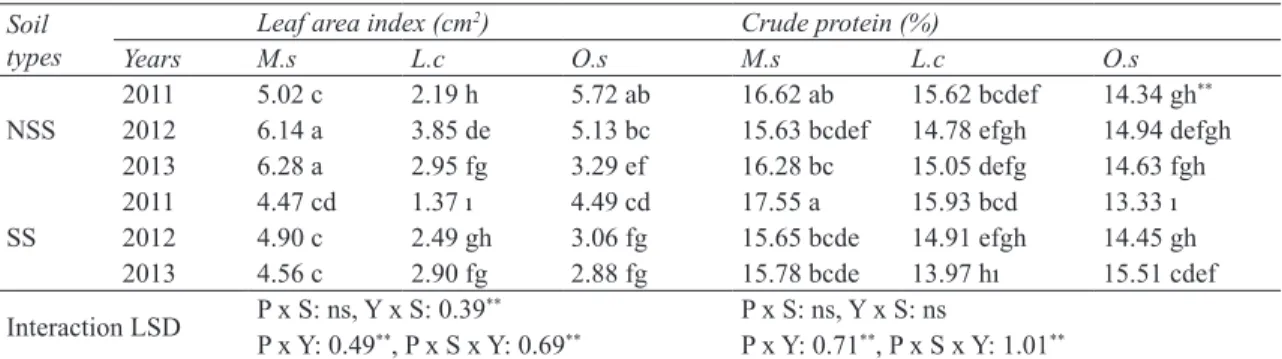
In the study, the leaf are index (LAI) was found significiant (P<0.01) in terms of species x soil type x year interaction (Table 3). According to these results, the highest LAI was obtained from M. sativa plant grown under non saline-soil conditions in the years of 2013 and 2012 that followed by O. sativa growing on non saline-soil conditions in 2011. This may have resulted from the difference of species-variety depending on the genetic characteristics of the plants, or the difference of tolerance degrees of plants against saline stress. When Table 3 is examined, it has also been seen that LAI values of alfalfa grown on non saline soils were at the same statistical group in the years of 2013 and 2012. On the other hand, the lowest LAI values were determined in L. corniculatus (1.37 cm2) cultivated under saline soil conditions in 2011. It can be said that this differences stem from the increase in the amount of the salt ions causing to the salinity of the soils (Table 1). In addition, this can be due to the weak growth of forage species in the first year and their strong growth depending on in the following years. Generally, the saline soils have higher ion concentration compared to normal soil. Therefore, along with the increase of salt concentrations in the soil, it becomes hard for the plants to get water from the soil and the enlargement of cell and development of shoots slow down. As a consequence, the plants produce both less amounts of organic matter and decrease their leaf sizes so as to decrease the loss of water with transpiration (Tuteja 2007).
It has also been reported in the previous studies that LAI differed among forage species and varieties according to locations and years (Açıkgöz 1991). For example, it has been stated that LAI is required to be 3-5 cm2 in flat leaf plants and 5-6 cm2 in alfalfa (Nelson 1995). In fact, high LAI of sainfoin plant grown on non saline-soils in establishing year could be due to its large seeds compared to other species and thus due to a better seedling growth in the first year. As it is known, the forage crops show a weak development in the first year, but a much better development in the
Plan
t heigh
t (cm)
Figure 3- The effects of soil type x year interaction on the plant height (cm). Plots followed by the same letter are not significantly different. NSS, non-saline soil; SS, saline soil
Şekil 3- Bitki boyu üzerine toprak tipi x yıl interaksiyonunun etkileri. Aynı harfleri takip eden çizimler arasındaki fark önemli değildir. NSS, tuzsuz toprak; SS, tuzlu toprak
years following the establishing year (Tan & Serin 2012). This arises from the condition of small seed of forage species and of their low degree of competition against weeds in the first year. On the other hand, it has been seen that LAI in sainfoin decreased in years following the establishing year in both soil types (Table 3). This may have resulted from its lowering of plant frequency due to the root rots and decrease of area covered on soil surface at unit area.
As shown in Table 3, the crude protein (CP) contents of the fodders obtained significantly (P<0.01) changed in terms of species x soil type x year interaction. While maximum CP content (17.55%) was obtained from M. sativa grown under saline soil conditions in 2011, this followed again M. sativa (16.62%) grown on non saline-soils in the year of 2011 (Table 3). This may cause that forage species examined have higher leaf-to-stem ratio and weaker seedling growth in the establishing year when compared with the maintenance years. Moreover, this may be caused by the fact that the forage species are in tendency to show a worse growth and a lower height increase in the soils in which the stress factors take place. Thus, these results obtained are in agreement with reports of Zandi Esfahan et al (2010), Panahi et al (2012) and Sayar et al (2014), who stated that the forage quality of species changed depending on the
characteristics of the soil and years. For instance, Canpolat & Karaman (2009) in their study intended to determine the feed value of some legume fodders determined that alfalfa had the highest CP rate (17.84%). Minimum CP values were determined in
O. sativa (13.33%) grown on saline soils in 2011
(Table 3). As it is known, sainfoin is a perennial species that has an economic life of 3-4 years and show a better seedling development and height increase in the first year when compared to alfalfa (Tan & Serin 2012). Thus, the sainfoin plant may have had lower CP content due to having higher stem-to-leaf ratio in the year of establishment. In addition, this can be explained by the genetic properties depending on the ability of each species to take the nutritional element from soil and their ability to store. Because in coarse fodder there are many factors affecting the feeding value. These are plant characteristics, environmental factors and cultural practices. And among plant factors, species and variety have a significant position (Schut et al 2010; Panahi et al 2012). In the studies performed regarding the subject, it has been revealed that CP contents were different among forage species and even among varieties of the same species (Mlay et al 2006; Tavirimirwa et al 2012).
NDF content of the fodders has been found to be significant (P<0.01) in respect of year x soil
Table 3- Leaf area index (cm2) and the crude protein contents (%) of forage legume species grown on saline and non-saline soil conditions during the three years
Çizelge 3- Üç yıl boyunca tuzlu ve tuzsuz toprak koşulunda yetiştirilen baklagil yem bitkisi türlerinin yaprak alan
indeksi (cm2) ve ham protein içerikleri (%)
Soil
types Leaf area index (cm
2) Crude protein (%)
Years M.s L.c O.s M.s L.c O.s
NSS 2011 5.02 c 2.19 h 5.72 ab 16.62 ab 15.62 bcdef 14.34 gh
**
2012 6.14 a 3.85 de 5.13 bc 15.63 bcdef 14.78 efgh 14.94 defgh
2013 6.28 a 2.95 fg 3.29 ef 16.28 bc 15.05 defg 14.63 fgh
SS 20112012 4.47 cd4.90 c 1.37 ı2.49 gh 4.49 cd3.06 fg 17.55 a15.65 bcde 15.93 bcd14.91 efgh 13.33 ı14.45 gh
2013 4.56 c 2.90 fg 2.88 fg 15.78 bcde 13.97 hı 15.51 cdef
Interaction LSD P x S: ns, Y x S: 0.39P x Y: 0.49**, P x S x Y: 0.69** ** P x S: ns, Y x S: nsP x Y: 0.71**, P x S x Y: 1.01**
**, difference between same letters is not significant; NSS, non-saline soil; SS, saline soil; M.s, Medicago sativa; L.c, Lotus corniculatus
type interaction. According to this, while maximum NDF percentage was found under non-saline soil conditions in 2012 followed by 2011, minimum values were determined under saline soil conditions in 2011 followed by 2013 (Figure 4). Similar results have been revealed by different researchers, and they stated that the NDF ratio in fodders decreased along with the increase of salinity in soil (Valipoor Dastenai et al 2012) and also changed depending on the years (Zandi Esfahan et al 2010; Panahi et al 2012). Generally, the plants are in tendency to show a much better growth and height increase in the year following the establishing year and in the soils in which the stress factors do not take place. However, decreases occur in the leaf/stem ratio with height increase. Therefore, the decrease of NDF content can be attributed to the decrease in the quality of the stem elements and the decrease in the leaf/stem ratio. Because physiologically, the leaves of the plants are the organs of the plants that produce the most organic matter and have the least structural composites due to the density of the ratio of the chlorophyll. However, the ratio of fibers is more in the stems of the plants (Nelson & Moser 1994).
NDF (%)
Figure 4- The effects of soil type x year interaction on the NDF content (%) of the fodders. Plots followed by the same letter are not significantly different. NSS, non-saline soil; SS, saline soil Şekil 4- Yemlerin NDF içeriği (%) üzerine toprak tipi x yıl interaksiyonunun etkileri. Aynı harfleri takip eden çizimler arasındaki fark önemli değildir. NSS, tuzsuz toprak; SS, tuzlu toprak
4. Conclusions
As the conclusion of this 3 year study, the salinity of soil-along with changing as per species-caused decreases in the yield and yield parameters of plants and a partial increase in the quality components. Especially when alfalfa is compared with other species, it was the least affected species under saline soil conditions in respect of all the examined characteristics for each of the three years. Moreover, in years following the establishing year, significant increases were recorded in yield and yield components while decreases were found in the quality components of the fodders obtained along with changing as per species. Consequently, it can be said that the examined species at saline soils of Iğdır Plain-which has an arid climate and where many crop plants cannot be cultivated economically-can be easily cultivated without high yield and quality loss, and that it can be contributed to coarse fodder required by the animals.
Acknowledgements
This research was supported by the Scientific and Technological Research Council of Turkey with Project No. 110O259. The authors thank TUBITAK for its funding.
References
Açıkgöz E (1991). Yem Bitkileri. Uludağ Üniversitesi Yayınları: 633: 2, Bursa, pp. 456
Avcıoğlu R, Geren H, Tamkoç A & Karadağ Y (2009). Yonca (Medicago sativa L.). (Ed: Avcıoğlu R, Hatipoğlu R, Karadağ Y), Yem Bitkileri, Vol II. TUGEM, Emre Basımevi, İzmir. pp. 290-316
Ayyıldız M (1990). Sulama Suyu Kalitesi ve Tuzluluk Problemleri. Ankara Üniversitesi Ziraat Fakültesi Kültürteknik Bölümü, Ankara Üniversitesi Ziraat Fakültesi Yayınları: 1196, Ders Kitabı: 344, Ankara, pp. 282
Canpolat Ö & Karaman Ş (2009). Bazı baklagil kaba yemlerinin in vitro gaz üretimi, organik madde sindirimi, nispi yem değeri ve metabolik enerji içeriklerinin karşılaştırılması. Tarım Bilimleri
FAO (2011). Food and Agricultural Organization. Land
and plant nutrition management, Rome
Gee G W & Baunder J W (1986). Particle- Size Analysis. In: Methods of Soil Analysis. Part 1. Physical
and Minerological Methods, 2nd ed. (Ed. A Klute). American Society of Agronomy, Soil Science Society of America, Madison, Wisconsin pp. 383-441 Grattan S R, Grieve J A, Poss P H, Robinson D L & Benes
S E (2004). Evaluation of salt-tolerant forages for sequential water reuse systems. I. Biomass production.
Agricultural Water Management 70: 109-120
Güngör Y & Erözel Z (1994). Drenaj ve Arazi Islahı. Ankara Üniversitesi Ziraat Fakültesi Yayınları No: 1341, Ders Kitabı: 389, Ankara, pp. 232
Hameed M & Ashraf M (2008). Physiological and biochemical adaptations of Cynodon dactylon (L.) Pers. from the salt range (Pakistan) to salinity stress.
Flora 203: 683-694
Hanay A, Büyüksönmez F, Kızıloğlu F M & Canpolat M Y (2004). Reclamation of saline-sodic soils with Gypsum and MSW Compost. Compost Science and
Utilization 12: 175-179
Hussain K, Majeed A, Nawaz K, Bhatti K H & Nisar F K (2009). Effect of different levels of salinity on growth and ion contents of black seeds (Nigella sativa L.).
Current Research Journal of Biological Science 1:
135-138
John M K, Chuah H H & Neufeld J H (1975). Application of improved azomethine-H method to the determination of boron in soils and plants. Analytical
Letters 8: 559-568
Kacar B (1994). Bitki ve Toprağın Kimyasal Analizleri III. Ankara Üniversitesi Ziraat Fakültesi Eğitim Araştırmaları Vakfı Yayınları No: 3, Ankara
Kanber R, Kırda C & Tekinel O (1992). Sulama Suyu Niteliği ve Sulamada Tuzluluk Sorunları. Çukurova Üniversitesi Ziraat Fakültesi Genel Yayın No: 21, Ders Kitapları Yayın No: 6, Adana
Kandil A A, Sharief A E, Abido W A E & Ibrahim M M (2012). Effect of salinity on seed germination and seedling characters of some forage sorghum cultivars.
International Journal of Agricultural Sciences 4:
306-311
Karakullukçu E & Adak M S (2008). Determination of salinity tolerance of some chickpea (Cicer arietinum L.) varieties. Tarım Bilimleri Dergisi-Journal of
Agricultural Science 14: 313-319
Kazemi K & Eskandari H (2011). Effects of salt stress on germination and early seedling growth of rice (Oryza sativa) cultivars in Iran. African Journal of
Biotechnology 10: 17789-17792
Kendirli B, Çakmak B & Ucar Y (2005). Salinity in the Southeastern Anatolia Project (GAP), Turkey: Issues and Options. Irrigation and Drainage 54: 115-122
Li R, Shi F, Fukuda K & Yang Y (2010). Effects of salt and alkali stresses on germination, growth, photosynthesis and ion accumulation in alfalfa (Medicago sativa L.).
Soil Science and Plant Nutrition 56: 725-733
MGM (2014). Başbakanlık DMİ Genel Müdürlüğü Meteoroloji Bültenleri, Ankara
Mlay P S, Pereka A, Phiri E C, Balthazary S, Igusti J & Hvelplund T (2006). Feed value of selected tropical grasses, legumes and concentrates. Veterinarski Arhiv
76: 53-63
Mohajer S, Taha R M, Khorasani A & Mubarak E E (2013). Comparative studies of forage yield and quality traits among proso millet, foxtail millet and sainfoin varieties. International Journal of Environment
Science and Development 4: 465-469
Nelson C J (1995). Photosynthesis and Carbon Metabolism In Foreges. (Ed: Barnes R F, Miller D A, Nelson C J),
An Introduction to Grassland Agriculture, Vol I. lowa
State University Press, Ames, Iowa, USA, pp. 31-44 Nelson C J & Moser L E (1994). Plant Factors Affecting
Forage Quality. (Ed: Fahey G C, Collins M, Mertens D R, Moser L E), Forage Quality, Evaluation and
Utilization, ASA, CSSA, SSSA, Madison, Wisconsin,
USA, pp. 998
Olsen S R & Summers L E (1982). Phosphorus. In: Methods of Soil Analysis. Part 2. Chemical and
Microbiological Properties. 2nd ed. American Society of Agronomy, Soil Science Society of America, Madison, Wisconsin pp. 403-427
Özaslan Parlak A & Parlak M (2008). Effect of salinity in irrigation water on some plant development parameters of sainfoin (Onobrychis viciifolia Scop.) and soil salinity. Tarım Bilimleri Dergisi-Journal of
Agricultural Science 14: 320-325
Panahi F, Assareh M H, Jafari M, Jafari A, Arzani H, Tavili A & Zandi Esfahan E (2012). Phenological effects on forage quality of Salsola arbuscula, Salsola
orientalis and Salsola tomentosa in three habitats
in the central part of Iran. Middle East Journal of
Pessarakli M, Tucker T C & Nakabayashi K (1991). Growth response of barley and wheat to salt stress.
Journal of Plant Nutrition 14: 331-340
Qureshi R H & Barrett-Lennard E G (1998). Saline Agriculture for Irrigated Land in Pakistan. A
handbook, ACIAR Monograph No. 50 Canberra,
Australian
Rhoades J D (1982a). Exchangeable cations. In: Methods of Soil Analysis. Part 2. Chemical and Microbiological
Properties. 2nd ed. American Society of Agronomy, Soil Science Society of America, Madison, Wisconsin pp. 159-164
Rhoades J D (1982b). Soluble salts. In: Methods of Soil Analysis. Part 2. Chemical and Microbiological
Properties. 2nd ed. American Society of Agronomy, Soil Science Society of America, Madison pp. 167-179. Rhoades J D (1996). Salinity: Electrical conductivity and
total dissolved solids. In: Methods of Soil Analysis. Part 3. Chemical Methods. Sparks D.L. (Ed.), American Society of Agronomy, Soil Science Society of America, Madison pp. 417-436
Sayar M H, Han Y, Yolcu H & Yücel H (2014). Yield and quality traits of some perennial forages as both sole crops and intercropping mixtures under irrigated conditions. Turkish Journal of Field Crops 19: 59-65
Schut A, Gherardi S & Wood D (2010). Empirical models to quantify the nutritive characteristics of annual pastures in south-west Western Australia. Crop and
Pasture Science 61: 32-43
Sima N A K K, Ahmad S T & Pessarakli M (2013). Comparative study of different salts (sodium chloride, sodium sulfate, potassium chloride and potassium sulfate) on growth of forage species. Journal of Plant
Nutrition 36: 214-230
Tan M & Serin Y (2012). Baklagil Yem Bitkileri. Atatürk Üniversitesi Ziraat Fakültesi Ders Yayınları No: 190, Eruzurm.
Tavirimirwa B, Manzungu E & Ncube S (2012). The evaluation of dry season nutritive value of dominant and improved grasses in fallows in Chivi District, Zimbabwe. Online Journal of Animal and Feed
Research 2: 470-474
Temel S & Şimşek U (2011). Desertification process of Iğdır Plain soils and solution suggestions. Alınteri
Journal of Agricultural Science 21: 53-59
Temel S, Şimşek U, Keskin B & Yılmaz İ H (2013). Effectiveness of forage grasses which have different degrees of salt tolerance as phytoremediation for reclamation of saline soils. 10th Field Crops Congress, 10-13 September 2013 Konya, Vol 3, pp. 242-250 Temel S, Keskin B, Şimşek U & Yılmaz İ H (2015). Bazı
çok yıllık yem bitkisi türlerinin m2’deki bitki çıkışına halomorfik toprak koşullarının etkisi. Tekirdağ Ziraat
Fakültesi Dergisi 12: 46-54
Torabi M, Halim R A, Sinniah U R & Choukan R (2011). Influence of salinity on the germination of Iranian alfalfa ecotypes. African Journal of Agricultural
Research 6: 4624-4630
Tuteja N (2007). Mechanisms of high salinity tolerance in plants. Methods in Enzymology 428: 419-438
Valipoor Dastenai M, Mirhadi M J & Mehrani A (2012). The study and comparison of 3 foxtail millet (Setaria
italica L.) cultivars in different phenological stages in
Karaj Region. Technical Journal of Engineering and
Applied Science 2: 62-68
Van Soest P J, Robertson J D & Lewis B A (1991). Methods for diatery fibre, neutral detergent fibre and non-starch polysaccharides in relation to animal’s nutrition. Journal of Dairy Science 74: 3583-3597
Yarnia M, Heidari Sharif Abad H, Hashemi Dezfuli S A, Rahimzade Khoei F & Ghalavand A (2011). Evaluation of alfalfa (Medicago sativa L.) lines to salinity tolerance. Iranian Journal of Crop Science 3:
12-26.
Yunusa I A M & Sedgley R H (1992). Reduced tillering spring wheats for heavy textured soils in a semiarid Mediterranean environment. Journal of Agronomy
and Crop Science 168: 159-168
Yurtseven E, Öztürk A, Kadayıfçı A & Ayan B (1996). Sulama suyu tuzluluğunun biberde (Capsium
annuum) farklı gelişme dönemlerinde bazı verim
parametrelerine etkisi. Tarım Bilimleri
Dergisi-Journal of Agricultural Science 2: 5-9
Zandi Esfahan E, Assareh M H, Jafari M, Jafari A A, Javadi S A & Karimi G (2010). Phenological effects on forage quality of two halophytes species Atriplex
leucoclada and Suaeda vermiculata in four saline
rangelands of Iran. Journal of Food Agriculture and