T. R.
SELCUK UNIVERSITY INSTITUTE OF SOCIAL SCIENCES
MASTER OF ARTS PROGRAMME
DEPARTMENT OF ENGLISH LANGUAGE TEACHING
THE USE OF ACTION RESEARCH AS A MODEL IN THE
PROFESSIONAL DEVELOPMENT OF AN ENGLISH TEACHER: A CASE STUDY
Saadet KORUCU Master of Arts Thesis
Supervisor
Assist. Prof. Dr. Abdülhamit ÇAKIR
Saadet The Use of Action Research As a Model
KORUCU In the Professional Development of Master of Arts 2011 an English Teacher: A Case Study Thesis
T.C.
SELÇUK ÜNĐVERSĐTESĐ SOSYAL BĐLĐMLER ENSTĐTÜSÜ
YABANCI DĐLLER EĞĐTĐMĐ ANA BĐLĐM DALI ĐNGĐLĐZCE ÖĞRETMENLĐĞĐ BĐLĐM DALI
THE USE OF ACTION RESEARCH AS A MODEL IN THE
PROFESSIONAL DEVELOPMENT OF AN ENGLISH TEACHER: A CASE STUDY
Saadet KORUCU Yüksek Lisans Tezi
Danışman
Assist. Prof. Dr. Abdülhamit ÇAKIR
Saadet The Use of Action Research As a Model
KORUCU In the Professional Development of Yüksek Lisans 2011 an English Teacher: A Case Study Tezi
TABLE OF CONTENTS
TABLE OF CONTENTS ... Đ BĐLĐMSEL ETĐK SAYFASI ... ĐĐĐ YÜKSEK LĐSANS TEZĐ KABUL FORMU ... ĐV ACKNOWLEDGEMENTS ... V ABSTRACT ... VĐĐ LIST OF FIGURES ... ĐX
INTRODUCTION ... 1
1.1. Background of the Study ... 5
1.2. STATEMENT OF THE PROBLEM ... 6
1.3. PURPOSE OF THE STUDY ... 7
1.4. RESEARCH QUESTIONS ... 7
1.5. SIGNIFICANCE OF THE STUDY ... 8
1.6. LIMITATIONS ... 8
REVIEW OF LITERATURE ... 9
2.1.Teacher Professional Development ... 9
2.2.The Interplay Between Teacher’s Content Knowledge, Beliefs and Attitudes and Teaching Practices... 16
2.3.Action Research ... 23
2.3.1. A Brief History of Action Research ... 23
2.3.2. What is action research ... 24
2.3.3 Steps in Action Research ... 31
2.3.4. Limitations of Action Research ... 33
2.4. The Relationship between Professional Development and Action Research .. 33
2.5. Teaching Vocabulary to Young Learners (The Action Research Process) ... 40
2.5.1. General Characteristics of Young Learners ... 41
2.5.2. Teaching Vocabulary to Young Learners ... 43
2.5.3. Vocabulary Teaching Techniques For Young Learners ... 45
2.5.5.Conclusion ... 51
METHODOLOGY ... 52
3.1.CONTEXTOFTHESTUDY ... 53
3.2. The problem statement ... 54
3.3. Data collection ... 54
3.3.2. Procedures ... 55
3.3.2.1. Interviews ... 56
3.3.2.2. Audio Recording ... 57
3.3.2.3. Students’ Quiz and Examination Results ... 57
3.3.3. The Research Process ... 57
3.3.1. Pre-Action Research Process ... 59
3.3.3.2. While-Action Research Process ... 59
3.4. Data Analysis ... 66
3.4.1. Qualitative Data Analysis ... 68
3.4.1.1. Journal and Interview Analysis ... 68
3.4.2. Quantitative Data Analysis ... 79
3.5.Trustworthiness of the Findings ... 82
3.6.Conclusion ... 83
CONCLUSION ... 85
4.1.Results and Implications ... 85
4.2.Summary of the General Results ... 85
4.3. Implications For Further Research ... 89
REFERENCES ... 90
APPENDIX ... 104
Interview Questions ... 104
Pre-Action Research Interview Questions ... 104
While-action research Interview Questions ... 105
Post-Action Research Interview Questions ... 106
T. C.
SELÇUK ÜNĐVERSĐTESĐ Eğitim Bilimleri Enstitüsü Müdürlüğü
BĐLĐMSEL ETĐK SAYFASI
Ö ğ re n ci n in Adı Soyadı Numarası
Ana Bilim / Bilim Dalı
Programı Tezli Yüksek Lisans Doktora
Tezin Adı
Bu tezin proje safhasından sonuçlanmasına kadarki bütün süreçlerde bilimsel etiğe ve akademik kurallara özenle riayet edildiğini, tez içindeki bütün bilgilerin etik davranış ve akademik kurallar çerçevesinde elde edilerek sunulduğunu, ayrıca tez yazım kurallarına uygun olarak hazırlanan bu çalışmada başkalarının eserlerinden yararlanılması durumunda bilimsel kurallara uygun olarak atıf yapıldığını bildiririm.
Öğrencinin imzası (Đmza)
T. C.
SELÇUK ÜNĐVERSĐTESĐ Eğitim Bilimleri Enstitüsü Müdürlüğü
YÜKSEK LĐSANS TEZĐ KABUL FORMU
Yukarıda adı geçen öğrenci tarafından hazırlanan ……… başlıklı bu çalışma ……../……../…….. tarihinde yapılan savunma sınavı sonucunda oybirliği/oyçokluğu ile başarılı bulunarak, jürimiz tarafından yüksek lisans tezi olarak kabul edilmiştir.
Ünvanı, Adı Soyadı Danışman ve Üyeler Đmza
Ö ğ re n ci ni n Adı Soyadı Numarası
Ana Bilim / Bilim Dalı
Programı Tezli Yüksek Lisans Tez Danışmanı
ACKNOWLEDGEMENTS
First of all, I would like to thank my thesis supervisor, Assist. Prof. Dr. Abdülhamit ÇAKIR for his invaluable guidance and support. I am particularly indebted to Assist. Prof. Dr. Harun ŞĐMŞEK for his enlightening suggestions and feedback.
My deepest gratitude and special thanks go to my colleague, the subject of this study, who helped me carry out my research opening the doors of her teaching life.
Last but not least, I am sincerely thankful to my beloved parents, Huriye and Ömer KORUCU and my sister Sebahat KORUCU and my brother Murat KORUCU for their wholehearted support, endless patience and genuine belief in me.
ÖZET
Bu çalışma, model olarak eylem araştırmasının kullanımının bir Đngilizce öğretmeninin mesleki gelişimine katkıda bulunup bulunmadığını araştırmaktadır. Öğretmenin mesleki gelişimini oluşturan; alan bilgisi, inanç ve tutumlar ve öğretme uygulamaları çalışmanın ana yapılarını oluşturmaktadır.
Çalışmada hem nitel hem de nicel veri analiz teknikleri kullanılmıştır. Nitel veriler eylem araştırmasını uygulayan Đngilizce öğretmenin süreç boyunca tuttuğu günlük girdilerinden ve araştırmacı ile yapılan röportajlardan elde edilmiş olup kodlama tekniğiyle analiz edilmiştir. Öğrencilerin uygulama öncesinde ve sonrasında yapılan sınavlardan aldıkları sonuçlar nicel verileri oluşturmuş ve T-test tekniğiyle analiz edilmiştir.
Çalışmanın sonuçları; eylem araştımasının, mesleki gelişimin ögeleri olan alan bilgisi, inanç ve tutumlar ve öğretme uygulamaları üzerinde değişiklikler ve gelişmeler sağlayarak bir Đngilizce öğretmeninin mesleki gelişimine katkıda bulunabileceğini göstermiştir.
Anahtar Kelimeler: Öğretmenin Mesleki Gelişimi, Eylem Araştırması
Ö ğ re n ci n in
Adı Soyadı Saadet KORUCU Numarası 085218021010 Ana Bilim / Bilim
Dalı
Yabancı Diller Eğitimi Ana Bilim Dalı Đngilizce Öğretmenliği Bilim Dalı
Programı Tezli Yüksek Lisans Doktora Tez Danışmanı Yrd. Doç. Dr. Abdülhamit ÇAKIR
Tezin Adı
Model Olarak Eylem Araştırmasının Bir Đngilizce
Öğretmeninin Mesleki Gelişiminde Kullanılması: Örnek Olay Çalışması
ABSTRACT
This study investigates whether action research as a model can contribute to the professional development of an English teacher. The three specific areas of investigation are content knowledge, beliefs and attitudes and teaching practices of teachers that consist of professional development.
Both qualitative and quantitative data analysis techniques were employed in the study. Qualitative data analyzed by coding system were collected from the reflection journal of the subject and the interviews conducted by the researcher with the subject. Quantitative data were collected from the quiz and exam results of the students and analyzed by T-test technique.
The results of the study show that action research can contribute the professional development of an English teacher with respect to increasing content knowledge, bringing about changes in beliefs and attitudes and leading to improvements in teaching practices.
Key Words: Teacher Professional Development, Action Research
Ö ğ re nc in in
Adı Soyadı Saadet KORUCU Numarası 085218021010 Ana Bilim / Bilim
Dalı
Yabancı Diller Eğitimi Ana Bilim Dalı Đngilizce Öğretmenliği Bilim Dalı
Programı Tezli Yüksek Lisans Doktora Tez Danışmanı Yrd. Doç. Dr. Abdülhamit ÇAKIR
Tezin Đngilizce Adı
The Use of Action Research As a Model In the Professional Development of an English Teacher :A Case Study
List of Tables
Table 1. Target Words to Be Learnt by the Students……….58
Table 2. Code Category 1 (Teacher’s Content Knowledge)………...68
Table 3. Code Category 2 (Teacher’s Teaching Practices)……….70
Table 4. Code Category 3 (Teacher’s Beliefs and Attitudes)……….71
Table 5. Code Category 4 (Reflectivitiy)….………...74
Table 6. Code Category 5 (Structured Approach)………..76
Table 7. Code Category 6 (Time-Restraint)……….………..78
Table 8. Code Category 7 (Future Conduction of Action Research)………..79
Table 9. Results of the First Quizzes Before and After the Action Research Project Conduction ……….80
Table 10. Results of the Second Quizzes Before and After the Action Research Project Conduction………..80
Table 11. Results of the Third Quizzes Before and After the Action Research Project Conduction……..……….…………..80
Table 12. Results of the Exams Before and After the Action Research Project Conduction…………..……….……..81
List of Figures
CHAPTER I
INTRODUCTION
Teaching process has a very complicated nature and it is affected by numerous factors. Teachers are expected to meet the needs of a substantial number of students with varied cognitive and behavioral properties, with diverse learning styles, different cultural and personal backgrounds simultaneously. Moreover, teachers are also expected to adapt the latest developments in pedagogical and subject matter knowledge which is constantly growing. Political, economic and technological changes of the contemporary world place their effects on education, which cannot be ignored by teachers, according to Ur (1996), particularly language teachers as investigating the EFL teachers professional development adds a particular angle to the general issue of teacher professional development, because language teaching encompasses specific aspects different from teaching other subjects (in Atikler, 1997)
Second and foreign language teaching provides a career for hundreds of thousands of teachers worldwide, and the vast educational enterprise of English language teaching could not operate effectively without the dedication and effort of such teachers day by day and year by year throughout their careers. Maintaining the interest, creativity, and enthusiasm of experienced language teachers in their profession is of great concern. Teachers need to expand their roles and responsibilities over time if they are to continue to find language teaching rewarding and to develop longer-term career goals and opportunities over time. (Richards and Farrell, 2005: vii)
The field of language teaching is subject to rapid changes, both as the profession responds to new educational paradigms and trends and as institutions face new challenges as a result of changes in curriculum, national tests, and student needs. As a result, teachers need regular opportunities to update their professional
knowledge and skills, that is, their opportunities for professional development. Teachers need to be able to take part in activities such as:
• engaging in self-reflection and evaluation
• developing specialized knowledge and skills about many aspects of teaching • expanding their knowledge base about research, theory, and issues in
teaching
• taking on new roles and responsibilities, such as supervisor or mentor teacher, teacher-researcher, or materials writer
developing collaborative relationships with other teachers (Richards and Farrell, 2005: vii)
There are three main stages in language teachers’ preparation history : teacher training, teacher education and teacher professional development. In a teacher-training program, teachers are taken as the media for realizing education aims and goals, and teacher preparation is to familiarize student teachers with teaching techniques and skills to be applied in classroom. While in a teacher-education program, the student teachers are not only taught the specific teaching techniques and skills, they also take such courses as general linguistics, applied linguistics, language examination and evaluation, and research methods. To sum up, the former aims at teachers teaching crafts training, while the latter strengthening teachers comprehensive professional qualifications. Based on teachers’ teaching qualification education, the teacher-professional development encourages the teachers to reflect on their own teaching practice, observe their own class activities and evaluate their own teaching effects and advocates active action research to form their own teaching belief. (Quan, 2006: 4)
Action research is a term used to describe the process of identifying a question or problem in the classroom, collecting data, and interpreting that data. This process is beneficial to teachers and students, since it is concerned with improving the immediate learning environment. action research is thus a practical tool which every EFL practitioner can use as a means of improving the teaching/learning environment, since it involves qualitative and subjective reflection on the learning process as perceived by the main participants – teachers and students. (Finch, 2005)
As Burns points out (2000) action research “…. emerges from concrete problems, issues, puzzles or questions that are of importance and concern to people involved…” (p.3) . It is also a way for teachers to develop professionally and investigate their classroom practice. She goes further to suggest that “… the research should provide a sense of personal meaning and development for those involved” She also adds that it enables teachers who act as researchers to develop personal goals, values and beliefs about practice.
Although it may seem difficult to bring about change to values, beliefs and attitudes of teachers as some teachers may not be open to changes, Somekh (1993) mentions, action research is a powerful tool to bring about change and development since it investigates and makes an impact upon our perceptions, beliefs and values about our own teaching. She also states that we do this through collecting evidence in our classrooms, “… because we are investigating solutions which we have the best possible opportunity of gaining access to beliefs and values which underpin what we do and say.” (p.36)
Action research is also effective in bringing about theory and practice into the classroom environment. Many language teachers may complain about not being able to transfer their knowledge in the field into their teaching. Many research studies in the field of education may also be insufficient in enabling teachers to bring theory into practice since they can not apply directly the findings in their classes. At this stage, language teachers may try carrying out action research since it bridges the gap between theory and practice. It is the teacher who tries to solve current problems in his/her classroom by implementing certain strategies that she/he has read in related literature. According to Hollingsworth and Sockett (1994) teacher research is not a passing trend but instrumental in creating the groundwork and vision needed to further "professionalize teaching and rethink… schools" (p. 17). Lawrence Stenhouse once said, "It is teachers who, in the end, will change the world of the school by understanding it" (in Beverley, 1993). As teachers engage in action research they are increasing their understanding of the schooling process. What they are learning will have great impact on what happens in classrooms, schools, and districts in the future. The future directions of staff development programs, teacher preparation curricula, as well as school improvement initiatives, will be impacted by the things teachers
learn through the critical inquiry and rigorous examination of their own practice and their school programs that action research requires (Beverley, 1993). Teachers engaging in action research have a more critical and reflective eye for their own teaching practices.
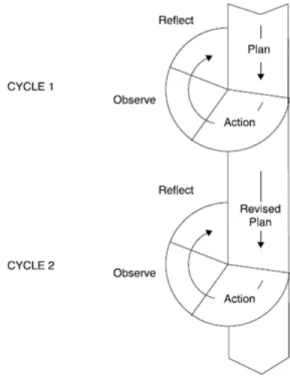
Action Research consists of a spiral of cycles of (a) planning, (b) acting, (c) observing, (d) reflecting (Kemmis & McTaggart, 1988). Teachers can use action research and reflection to reshape their knowledge, examine their attitudes, beliefs, assumptions, and improve their teaching practices. Danielson and McGreal (2000) stated, “Few activities are more powerful for professional learning than reflection on practice” (p.24). The use of reflective practice in teacher professional development is based on the belief that teachers can improve their own teaching by consciously and systematically reflecting on their teaching experiences (Farrell, 2004). Richards and Lockhart (1994) say that teachers should “collect data about their teaching, examine their attitudes, beliefs, assumptions, and teaching practices, and use the information obtained as a basis for critical reflection about teaching” (p.1). Reflective practices are such entwined with action research that McNiff (1997) says “It is a form of self-reflective inquiry that is now being used in school-based curriculum development, professional development, school improvement schemes, and so on, and, as such, it actively involves teachers as participants in their own educational process” (p. 1). Teachers as researchers critically assess their actions in order to bring changes and improvements to their instructional practices.
The element of change is a key feature with regard to the purpose of professional development. Learning something new is believed to take place only if it is implemented and used in practice. In other words, development is supposed to bring about change in practice. Receiving positive results from changed practice patterns affects teachers' knowledge; only when teachers see improvement in their classes as a result of changed practice, they get a reason to change previously held knowledge and beliefs (Goodson 1. 1992). The relationship between teacher beliefs,attitudes, knowledge and instructional practices is not straight; on the contrary, it is dialectic. Change in one of them influences the others thus leads teachers to professional development. Turnbull and Pinder’s (2003) statement “…… professional development brings about change in teachers' beliefs and attitudes,
content knowledge, and instructional practices, leading to improved student learning” reinforces what has been said so far. As regards, this study investigates whether action research as a professional development model can be effective on them.
Change in content knowledge of a teacher can help the teacher to develop a background of important and relevant theoretical concepts and become conversant with new methods and techniques in ELT (Finocchiaro, 1988). Change in instructional practices encompass many aspects of teaching, including the roles of teacher and student for the day, instructional materials that will be utilized, the tasks to be completed, and the method of assessing student learning (in Cooper-Twamley U.S. Department of Education, 2009). The study of teachers’ beliefs and attitudes forms part of the process of understanding how teachers conceptualize their work and how they behave. Teacher beliefs influence the way they design and interact in their classes. Richards (1998) stated “A primary source of teachers’ classroom practices is belief systems—the information, attitudes, values, expectations, theories, and assumptions about teaching and learning that teachers build up over time and bring with them to the classroom” (p. 66)
1.1. Background of the Study
This study is a case study. Case studies involve a systematic inquiry into a specific phenomenon, e.g. individual, event, program, or process. Action research is also defined as a systematic inquiry that can be conducted by teachers with vested interest in the teaching and learning process to gather more information about how they teach and how their students learn. It is truly a systematic inquiry into one’s own teaching practice (Johnson, 2005). Action research allows teachers to study their own classrooms— for example their own instructional methods, their own students, their own assessments— in order to better understand them and be able to improve their quality or effectiveness. It focuses specifically on unique characteristics of the population with whom a practice is employed or with whom some action must be taken. This is ,in turn, results in increased utility and effectiveness for the practitioner (Parsons& Brown, 2002).
Both case-study research and action research are concerned with the researcher’s gaining an in-depth understanding of particular phenomena in real-world settings. The two types of research seem quite similar in their focus on the field or the world of action, while embracing considerable diversity in theory and practice. Several authors argue that action research should rely on the case-study method. Also, many action researchers adopt the specific guidelines for doing research which the proponents of case-study research offer. (Blichfeldt and Andersen, 2006)
In a similar vein, a single subject was worked with for this study. The researcher who acted as a guide and facilitator throughout the research process initiated the project with an English teacher (Action Research Practitioner: ARP) who teaches elementary levels. The ARP determined to carry out the action research study regarding the problem of students’ vocabulary learning. Although the students’ overall performance was very good, they weren’t able to retain vocabulary items for a long time. Therefore, the ARP carried out an action research study in which she changed her classroom management and teaching techniques during vocabulary activites in order to enhance students’ retention of vocabulary. The details of the action research project will be presented in chapter three.
1.2. STATEMENT OF THE PROBLEM
Professional development models such as workshops, conferences, and in-service meetings, are aimed at improving teachers and teaching. However, teachers are not always impacted by professional development activities (Yoon, Park, & Hong, 1999). Even some teacher development activities leave teachers feeling frustrated that their time has been wasted as they don’t meet teachers’ immediate needs in their own classrooms and can be irrelevant to their concerns. Considering the needs of teachers, one can argue that action research is an appropriate model of professional development to teachers since it is concerned with improving the immediate teaching/learning environment. Because of its practical and applicable nature, it enables teachers to delve into any skill or topic area that they may wish to work on and provide them with guidelines as to how to identify problems and seek solutions for them in their own classroom situations.
1.3.PURPOSE OF THE STUDY
Many conventional forms of professional development are seen as too top-down and too isolated from school and classroom realities to have much impact on practice. As a result, hoped-for improvements are seldom realized. That’s why teachers need more practical tools to meet their individual needs and action research can be an efficient tool in responding to teacher needs which paves the way for their professional development. As regards,
The purposes of this study are:
1)To discover whether action research as a model is effective on the professional development of an English teacher.
2) To investigate whether action research brings about changes in an English teacher’s beliefs, attitudes, knowledge and instructional practices.
1.4.RESEARCH QUESTIONS
Fullan and Miles (1992) state that what teachers hope to gain through professional development activities are specific, concrete and practical ideas that directly relate to the day-to-day operation of their classrooms to improve the teaching/learning environment in their classes. In this respect, this study investigates whether action research is a practical tool bringing about changes in the professional development of an English teacher. Pinder (2003) states that “…… professional development brings about change in teachers' beliefs and attitudes, content knowledge, and instructional practices, leading to improved student learning.” In other words, changes in teachers' beliefs and attitudes, content knowledge, and instructional practices lead a teacher develop professionally. Thus, the research questions of this study are as follows:
1.When teachers conduct action research :
a)What changes does it bring about in teacher attitudes and beliefs? b) What changes does it bring about in teachers’ content knowledge? c) What changes does it bring about in instructional practices?
1.5.SIGNIFICANCE OF THE STUDY
The findings of this study provide information on how action research may assist a language teacher to improve her own classroom teaching and learning practices. It contributes to our understanding of a teacher’s experiences as she progresses through the implementation cycle of action research in her classroom and the subsequent effects on her instructional practices and content knowledge focusing on inner changes in beliefs and attitudes. Johnson (1993) agrees that teachers should be researchers in their own classrooms and this study showed that research can be conducted by a teacher rather than an outside researcher. Therefore, this study can be a model for teachers who want to conduct action research and empower themselves professionally through it.
1.6.LIMITATIONS
This study is a case study. Case studies centre on individual units like an individual student, teacher or a particular event. Therefore the results can not be generalized to the others statistically. Similarly, action research is primarily an approach relating to individual or small group professional development. It is an "informal, qualitative, subjective, interpretive, reflective and experiential model of inquiry. The specific focus of case study hence becomes advantegous for action researchers. As regards, this study is restricted to an English teacher’s class at elementary level which means that the results cannot be generalisable to other classrooms or schools. The time framework of the research was another limitation of this study as having more time could have enabled more elaborated data. Teacher’s content knowledge, teacher’s beliefs and attitudes and teacher’s instructional practices are the main constructs determined for the research that professional development directly affects and is directly affected by changes in them.
Definitions of Terms:
Professional Development: A process of continual intellectual experiential, and attitudinal growth of teachers. (Bailey et al., 1998)
Action Research: An inquiry-based form of professional development, which requires an “identification of a problem; collection of data; analysis and
interpretation of data; implementation of changes based on the interpretations; and evaluation of the effects of the intervention” (Jones, Lubinski, Swafford, & Thornton, 1994, p. 29).
CHAPTER II
REVIEW OF LITERATURE
In this chapter, first teacher professional development will be presented. Next, the interplay between teacher professional development constituents will be explained. Then, action research will be discussed in detail. After that, the relationship between professional development and action research will be studied. Finally, the vocabulary teaching activities that enhance retention in young learners will be discussed, since the action research practitioner focused on it for the action research process.
2.1. Teacher Professional Development
These are changing times in education systems around the world. With the start of the new millennium, many societies are engaging in serious and promising educational reforms. One of the key elements in most of these reforms is the professional development of teachers; societies are finally acknowledging that teachers are not only one of the ‘variables’ that need to be changed in order to improve their education systems, but they are also the most significant change agents in these reforms. This double role of teachers in educational reforms being both subjects and objects of change – makes the field of teacher professional development a growing and challenging area, and one that has received major attention during the past few years (Villegas-Reimars, 2003: 7). More specifically, the theme professional development has been recurring in language teaching settings in recent years and it is of importance in these circles as a result of the emergence of initiatives that have been led by teachers and it is for these teachers that professional development opportunities are needed. Wallace (1991) explains us a good deal about the word “professional”. He states “People use the adjective ‘professional’ to describe
something that has been well done, whereas ‘an amateur job’ is something that has been badly done…Those engaged in a profession also ‘professed’to have a knowledge not available to the public at large, but a knowledge that could be of great public use… Thus in ‘profession’ we have a kind of occupation which can only be practiced after long and rigorous academic study, which should be well rewarded because of the difficulty in attaining it…, but which is not simply engaged in for profit, because it also carries a sense of public service and personal dedication.” (p. 5). He further states that any occupation aspiring to the title of ‘profession’ will claim at least some of these qualities: a basis of scientific knowledge; a period of rigorous study which is formally assessed; a sense of public service; high standards of professional conduct; and the ability to perform specified demanding and socially useful tasks in a demonstrably competent manner. As regards, teaching is definitely a profession. The term development is defined as “the growth or change of someone or something to become more advanced in many contemporary dictionaries. In the related literature, professional development of teachers is defined as changes of the behavior, knowledge, beliefs, or teaching practices. Teacher is one of the fundamentals in education and the key variable of the effective education program at all levels and environments (Miller & Miller, 2002).
According to Çeliköz (2000), the general characteristics of a teacher who is regarded as the key variable of education are as follows:
• taking into consideration of the individual differences
• supporting all students and groups in the classroom to participate in the activities,
• encouraging group work, • planning teaching strategies,
• using suitable and different methods and techniques, • evaluating the students with appropriate method and tools, • preparing teaching materials,
• using appropriate technologies,
• directing students to correct behavior, and
Teacher professional development can be seen both as an individual and collective process that contribute to the development of the teacher’s professional skills, by means of formal and informal experiences. As the importance of teaching to learn processes increased, the concept of professional development has had many changes and it is now regarded as a continuing-long term process covering different types of opportunities and initiatives that are systematically planned to stimulate the development and evolution of the teacher. It is a construction of the professional I, which is based on personal commitment, the availability to learn to teach, beliefs, values, knowledge on the subjects they teach and how they teach them, past experiences as well as professional vulnerability (Marcelo, 2005)
Rudduck defines professional development of the teacher as “the teacher’s ability to maintain the curiosity of the class; to identify significant interests in the teaching and learning processes; to value and seek dialogue with experienced colleagues as a source of support in the analysis of situations” (Rudduck, 1991: 129). Following are some of the definitions of the concept of teacher professional development :
“The professional development of teachers goes beyond a merely informative stage; it implies adaptation to change with a view to changing teaching and learning activities, altering teacher attitudes and improving the academic results of students. The professional development of teachers is concerned with individual, professional and organisational needs” (Heideman, 1990: 4);
“The professional development of teachers is a broad area which includes any activity or process intent on improving dexterity, attitudes, understanding or involvement in current or future roles” (Fullan, 1990 : 3);
“It is defined as the entire process that improves knowledge, dexterity or teacher attitudes” (Sparks & Loucks-Horsley, 1990 : 234-235);
“It is the process by which teachers, whether alone or accompanied, review, renew and further their commitment as agents of change, with moral teaching aims. Moreover, they acquire and develop knowledge, competencies and emotional intelligence that are essential to professional thinking, planning and practice with children, adolescents and colleagues throughout each stage of their teaching lives” (Day, 1999 : 4);
“Work opportunities that encourage creative and reflective skills in the teachers, thus, enabling them to improve their practices” (Bredeson, 2002 : 663);
“The professional development of teachers is the professional growth the teacher acquires as a result of his/her experience and systematic analysis of his/her own practice” (Villegas-Reimers, 2003: 19 ).
Lange ( 1990, in Bailey et al. 2001:4) defines teacher development as “a process of continual, experimental, and attitudinal growth of teachers.” To Head and Taylor (1997: 250) teacher development is associated with the process of becoming “the best teacher that I personally can be”. It is centred on personal awareness of the possibilities for change but it also builds on the past, since recognizing how past experiences have or have not been developmental helps identify opportunities for change in the present or future.
To the extent that teachers are regularly asking themselves ‘How can I become a better teacher?’ ‘How can I enjoy my teaching more? ‘How can I feel that I am helping learning?’ they are thinking about ways of developing. They are acknowledging that it is possible to change the way they teach and perhaps also the preconceptions that they have about teaching and learning. Professional development means becoming a student of learning, your own as well as that of others. It represents a widening of the focus of teaching to include not only the subject matter and the teaching methods, but also who are working with the subject and using the methods. It means taking a step back to see the larger picture of what goes on in learning, and how the relationship between students and teachers influences learning. It also means attending to small details which can in turn change the bigger picture. Teacher development, as we understand it, draws on the teacher’s own inner resource for change. It is centred on personal awareness of the possibilities for change, and of what influences the change process. It builds on the past, because recognizing how past experiences have or have not been developmental helps identify opportunities for change in the present and future. It also draws on the present, in encouraging a fuller awareness of the kind of teacher you are now and of other people’s responses to you. It is a self-reflective process because it is through questioning old habits that alternative ways of being and doing are able to emerge (Sabuncuoğlu, 2006).
Throughout their professional lives, teachers need changes and improvements as they don’t want to suffer from burnout, disillusionment or dissatisfaction with their professions. Teachers engage in professional development activities because professional development:
• focuses on teachers as central to student learning, yet includes all other members of the school community;
• focuses on individual, collegial and organizational improvement;
• respects and nurtures the intellectual and leadership capacity for teachers; •reflects best available research and practice in teaching, learning and leadership;
• enables teachers to develop further expertise in subject content, teaching strategies, uses of technologies and other essential elements in teaching to high standards;
• promotes continuous inquiry and improvement embedded in the daily life of schools;
• is planned collaboratively by those who will participate in and facilitate that development;
• requires substantial time and other resources; • is driven by a coherent long-term plan,
• is evaluated ultimately on the basis of its impact on teacher effectiveness and student learning; and this assessment guides subsequent professional development efforts (Underhill, 1995).
Professional development has a crucial role in revitalizing education and realize educational reforms. Professional development is essential because “Students learn only from teachers who are themselves in the process of learning” (McCall, 1997, p. 23, in Sally 2008). According to Abdal-Haqq (1996), effective professional development that ensures learning:
• is ongoing;
• includes training, practice and feedback; opportunities for individual reflection and group inquiry into practice; and coaching or other follow-up procedures;
• is collaborative, providing opportunities for teachers to interact with peers; • focuses on student learning, which should, in part, guide assessment of its effectiveness;
• encourages and supports school-based and teacher initiatives; • is rooted in the knowledge base for teaching;
• incorporation of available knowledge bases;
• time to work on staff development and assimilate new learning; • designs built on principles of adult learning and the change process; • appropriate incentives and rewards;
• integration of individual goals and district goals, • leadership and sustained administrative support; • experimentation and risk-taking;
• appropriate participant involvement in goal setting, implementation, evaluation and decision-making;
• formal placement of the program within the philosophy and organizational structure of the school and district;
• incorporates constructivist approaches to teaching and learning; • recognizes teachers as professionals and adult learners;
• provides adequate time and follow-up support; and • is accessible and inclusive.
Professional development need to be job-embedded, promote discussion and supported through peer coaching, study groups, action research and other forms of learning from the work of teaching (Sally,2008).
Although teachers of English participate in many teacher training courses for professional development all over the world, they are generally not able to benefit from them effectively. The reasons for failure are summarised by Turney (cited in Sabuncuoğlu, 2008, 1982) as follows:
• One-shot workshops are widespread but are ineffective.
• Topics are frequently selected by people other than those for whom the inservice is intended.
• Follow-up support for ideas and practices introduced in in-service programs occurs in only a very small minority of cases.
• Follow-up evaluation occurs infrequently.
• In-service programs rarely address the individual needs and concerns.
• The majority of programs involve teachers from many different schools, but there is no recognition of the differential impact of positive and negative factors within the systems to which they must return.
• An inadequate theory of implementation, resulting in too little time for teachers and school leaders to plan for and learn new skills and practices;
• Too many competing demands or overload;
• Failure to address the incompatibility between project requirements and existing organizational policies and structure;
• Lack of awareness of the limitations of teacher and school administrator knowledge about how to implement the project;
• The turnover of teachers in each school;
• Lack of technical assistance and other forms of intensive staff development; • Under-funding the project or trying to do too much with too little support. Nevertheless, the need for developing professionally has brought about the emergence of teacher-led initiatives such as action research and reflective teaching. According to Craft (2000, p.10) the opportunities for teacher development includes the following:
• action research
• self-directed study as well as teacher research linked to awards such as the Education Doctorate
• using distance-learning materials
• receiving and/or giving on-the-job coaching, mentoring or tutoring • school-based and off-site courses of various lengths
• job shadowing and rotation • peer networks
• membership of a working party or task group
• school cluster projects involving collaboration, development and sharing of experience/skills
• teacher placement including those in business but also those in other schools • personal reflection
• experiential 'assignments' • collaborative learning
• information technology-mediated learning (e.g. through e-mail discussion groups, or self-study using multi-media resources).
Teacher professional development serves a longer-term goal and seeks to facilitate growth of teachers’ understanding of their teaching as well as of themselves as teachers. It often involves examining different dimensions of a teacher’s practice as a basis for reflective review and can hence be seen as “bottom-up. Strategies for teacher development often involve documenting different kinds of teaching practices; reflective analysis of teaching practices, examining beliefs, values, and principles. Teachers are constantly exposed to a great variety of possibilities for professional development (Richards J. and Farrell T., 2005), some of which are obligatory and even imposed by authorities (Hargreaves A and Fullan M,1992), like certain in-service courses, workshops and lectures of different nature. Other PD possibilities are of a more personal character, undertaken by the teachers out of their own initiative. These could include reflection, peer teaching, collegial sharing, professional reading (Guskey T. and Huberman M., 1995) and action research. Some teacher development activities are directed at the whole school or district pedagogical staff dealing with matters of broader vision, while others are concerned with practical every-day classroom functioning of an individual teacher (Guskey T. and Huberman M., 1995) like action research.
2.2. The Interplay Between Teacher’s Content Knowledge, Beliefs and Attitudes and Teaching Practices
Studies conducted in educational fields show that two fundamental elements of schools systems are students and teachers. It is pointed out that there would be no education or schools without them. Likewise, the facilities, class, tools, and equipment, educational and industrial training programs designed to meet the basic needs of the students make up the programs' needs. However, an effective teacher is of major importance for a dynamic and successful training program. Teacher is the key variable of the effective education program at all levels and environments (Miller & Miller, 2002). As Prawat (1992) indicates, teachers are expected to play a crucial role in
changing schools and classrooms. Paradoxically, however, they are also viewed as major obstacles to change due to their traditional beliefs. According to Bandura (1986), an individual’s decisions throughout his/her life is strongly influenced by his/her beliefs. In their study, Bingimlas and Hanrahan discuss that there is a complex relationship between teachers’ knowledge, beliefs and classroom practices. Similarly, Pajares (1992) asserts that beliefs are best indicators of the decisions that individuals make throughout their lives and teachers’ beliefs influence and play a fundamental role in their knowledge acquisition and interpretation, task selection, and course content interpretation. Mansour (2008) suggested beliefs controlled the gaining of knowledge but that knowledge also influenced beliefs. Thompson (1992) argued that distinguishing between beliefs and knowledge was very difficult but that the distinction needed to be understood by educators and researchers since teachers may treat their beliefs as knowledge. Zembylas (2005) argued that teacher beliefs are important components of teacher knowledge and like teacher beliefs, teacher knowledge is needed in understanding teachers’ teaching. In coming to an understanding of teachers' practices, the significance of teachers’ knowledge and how it impacts on teachers‟ thinking should be considered (Standen, 2002). The notion of teaching as a thinking activity, which has been characterized as a common concern with the ways in which knowledge is actively acquired and used by teachers and the circumstances that affect its acquisition and employment is now making its way into SLTE. An examination of the goals of teacher education reveals a considerable deemphasis of skills and behaviors in favor of an emphasis on the formation or transformation of teacher thinking and reflective processes, dispositions, knowledge, and beliefs.
Knowledge is a widely discussed concept in the literature. The definition of knowledge as a term can be traced back to the time of Socrates. According to Calderhead (1996) “… knowledge refers to factual propositions and the understandings that inform skillful action” (p.175). An effective teacher should be aware of the importance of the knowledge of the subject area, other related disciplines and learner needs. Shulman (1987) mentioned that the knowledge base of teachers includes the content knowledge about the subject area of the teacher,
pedagogical knowledge, curriculum knowledge about his/her subject area and other subject areas, knowledge about learners and their characteristics, knowledge about school districts and school culture, and knowledge about educational values, purposes and philosophies determined by the government. As stated in Seviş’s study (1998) many researchers have emphasized on the importance of content knowledge in professional development of teachers (Ball, 1990a; Ball, 1990b; Ball, Thames, & Phelps, 2007; Borko, 2004; Chinnapan & Lawson, 2005; Even & Tirosh, 1995; Goulding & Suggate, 2001; Grossman, Wilson, & Shulman, 1989; Ma, 1999; McDiarmid, Ball & Anderson, 1989; Shulman, 1987; Wilson & Berne, 1999). The widely known approach to teacher knowledge is the content knowledge classification proposed by Shulman (1986). He divided content knowledge as subject matter knowledge, pedagogical content knowledge and curriculum knowledge. He regarded knowledge of subject matter or knowledge of content as a prerequisite for someone who will teach. He further states that teachers must have in depth understanding of subject matter, organization of the subject matter, the ways of identifying students’ past learning and deficiencies in their past learning, and the ways of facilitating new understanding by the help of teacher education program they followed. In general, this source of knowledge base of teachers is the content knowledge. Grossman (1990) also pointed out that the knowledge of subject matter and the knowledge of students are two basic knowledge components that make a person a teacher. Subject matter content knowledge refers not only to have the knowledge of facts, concepts or accepted truths but also to explain why these concepts are worth learning and to relate the concepts within and without discipline. Shulman’s pedagogical content knowledge generally reflects the subject matter knowledge for teaching, and bridges the content knowledge and the teaching as a practice. Pedagogical content knowledge includes the following characteristics: (1) the knowledge of the most useful examples, (2) the knowledge of alternative and various representations, (3) the knowledge about how the subject matter can be made comprehensible and meaningful to students, (4) the knowledge of the topics that students have difficulty to learn and how to make it easy for students, (5) the knowledge of preconceptions and misconceptions of students in different grade levels, and (6) the knowledge of the strategies for overcoming the misconceptions of students (Shulman, 1986). In this
respect, it can be said that, the characteristics of the pedagogical content knowledge deals with “how to teach the subject matter” question. The third category of the content knowledge is the curricular knowledge. The curricular knowledge also refers to the knowledge about the philosophy of the curriculum, organization of the topics in the curriculum, knowledge of variety of the instructional materials for different grade levels and knowledge of alternative programs, textbook and materials (Shulman, 1986). These types of knowledge consist of the main source of teachers’ teaching and they are supported by conceptions and beliefs of teachers. According to Pajares (1992), teachers’ beliefs influence and play a fundamental role in their knowledge acquisition and interpretation, task selection, and course content interpretation. In this respect, researchers’ key vision of the relationship between beliefs and knowledge was that “whether knowledge directs beliefs or beliefs leads to knowledge. For example, teachers may have inappropriate or untrue beliefs despite the years they have spent preparing for their profession and this supports the idea that knowledge is not always the source for beliefs. On the other hand, it is sometimes difficult to determine whether the interpretations of the events are based on what the teacher knows, what the teacher believes, or what the teacher believes he knows (Woods 1996:194). Mansour (2008) suggested beliefs controlled the gaining of knowledge but that knowledge also influenced beliefs and it can be concluded that these two concepts are so entwined that it is almost impossible to pinpoint where knowledge ends and belief begins (Pajares 1992). Abelson (1979) defined beliefs in terms of people manipulating knowledge for a particular purpose or under a necessary circumstance. According to Brown and Cooney (1982), beliefs are dispositions to action and major determinants of behavior. Rokeach (1972) defined beliefs as “any simple proposition, conscious or unconscious, inferred from what a person says or does, capable of being preceded by the phrase ‘I believe that’” (p. 113). Based upon a literature review of beliefs, Pajares (1992) defined belief as an “individual’s judgment of the truth or falsity of a proposition, a judgment that can only be inferred from a collective understanding of what human beings say, intend, and do” (p. 316). Anthropologists, social psychologists, and philosophers have agreed upon a commonly accepted definition of beliefs; “beliefs are thought of as psychologically held understandings, premises, or propositions about the world that
are felt to be true” (Richardson, 1996, p.103). In educational settings, Haney et al. (2003) defined beliefs as “one’s convictions, philosophy, tenets, or opinions about teaching and learning” (p. 367). Virginia Richardson (1994) considers beliefs to be a componet of teaching philosophy. She also defines the term “belief” as a proposition that is accepted as true by the individual holding the belief. According to her it is a psychological concept and differs from knowledge, which implies epistemic warrant.
Goodenough (1963), for example, described beliefs as propositions that are held to be true and are "accepted as guides for assessing the future, are cited in support of decisions, or are referred to in passing judgment on the behavior of others". Eisenhart, Shrum, Harding, and Cuthbert (1988), however, added an element of attitude to Goodenough's definition: "a belief is a way to describe a relationship between a task, an action, an event, or another person and an attitude of a person toward it" (p.12).Many studies have been carried to describe the attitudes teachers and learners hold towards educational issues and their impact on teaching and learning process (Krashen 1982 cited in Chastain 1988; Bai and Ertmer 2004; Karabenick and Noda 2004; Kirazlar 2007). Although it has been interchangeably used with beliefs, the distinction is obvious that attitude refers to a learned predisposition to respond in a consistently favourable or unfavourable manner with respect to a given object whereas beliefs represent the information he has about the object (Fishbein and Ajzen 1975).The information about a particular “object” forms the beliefs and the set of such beliefs indicates the attitude towards that object (Deryakulu 2004). As a result of observations and received information from outside sources or inference processes beliefs are formed about an object, people or an event. The totality of these beliefs determines individual’s attitudes, intentions and behaviours. (Fishbein and Ajzen 1975; Deryakulu 2004) Thus in order to measure attitudes researchers tend to assess beliefs (Fishbein and Ajzen 1975:131). As Rokeach’s definition summarises “an attitude is a relatively enduring organization of beliefs about an object or situation predisposing one to respond in some preferential manner” (Rokeach 1965:550). A wealth of research evidence has shown that teachers’ beliefs and attitudes about teaching and learning influence their teaching practices. As Pajares (1992) states “beliefs are the best indicators of the decisions individuals make throughout their lives” (p. 307). He further suggests that there is “a
strong relationship between teachers’ educational beliefs and their planning, instructional decisions, and classroom practices” (p. 326). Beliefs of teachers influence their perceptions and attitudes which, in turn, affect their behaviours in the classroom. It is clear that teacher is one of the fundamentals in education. Although the content of the courses are designed by the government or institutions, as practitioners, teachers decide how the learning will take place. In most cases beliefs influence teacher’s style, attitudes, decisions and practice both before and after the classroom. The teaching process involves teachers’ thought processes (Woods 1996) and teachers’ actions and their observable effects (Richardson 2002). Teachers’ thought processes include the educational decisions they make throughout their professional lives. First of all, teachers need to decide what to teach both during the course and in a particular class and then they need to organize the environment, the materials and activities in a way which they think proper for successful teaching (Erdem, 1999). In other words, without establishing new beliefs, it is impossible to implement any educational reforms (Tatto and Coupland, 2003). Moreover, teachers’ beliefs play an important part in teacher development as they influence the acceptance and uptake of new approaches, techniques and activities (Donaghue 2003). About daily routines, teachers are always under the influence of their beliefs; beliefs strongly affect the materials and activities they choose for the classroom (Richards, 1994). Teacher beliefs might be influential on their classroom practice, expectations for success, and even public policy (Snider and Roehl 2007:873). Classroom practice of a teacher could illustrate the beliefs underlying those decisions and actions. For that reason, researchers should look beyond the teachers’ behaviour, their classroom practice, to the beliefs hidden underneath their actions (Fukami 2005). Similarly, Şenel (2006) stated that beliefs are one of the factors that shape teaching as they determine the strongly believed behaviour and practice in classrooms. In her study she mentions, Tobin (1993) have found out that beliefs have a vital effect in teachers' behaviour, and that teeachers need to change their beliefs in order to change their behaviour. One of his studies indicate that beliefs can be changed when roles are reconceptualized. In this instance it was not a case of changing specific beliefs one by one, but of making sets of beliefs no longer applicable to a specific role and developing others that are consistent with a new
conceptualization of a role. The futility of attempting to change beliefs one at a time became clear as the potential of using metaphors about roles as a master switch emerged.
Prosser and Trigwell (1997) argue that the study of effective teaching in education has largely been in theoretical and practical manner, involving the teacher's perspective and beliefs rewarding the educational process because what teachers think affects what they do. It is frequently observed that teachers are not aware of the implicit beliefs that define their teaching orientations. Reflecting upon their own practice and approaches may make these beliefs explicit. As teaching is a complex process, one should think about it reflectively because reflection enables teachers to challenge their personal beliefs about teaching. This gives teachers the opportunity to examine their thoughts about learning, teaching and educational issues as well as their classroom practices. Hawky (1997) claim that if we are to understand and change teaching practices in adult and higher education, we must start by making clarifiying our intentions and conceptions of teaching and learning. Ideally, these conceptions can be made explicit through reflection and discussion within the teaching/learning process. This would help teachers to understand these conceptions, and therefore to approach their learning in an appropriate manner. Change in beliefs and practice is only possible when teachers are willing to criticise themselves and open to new ideas. Several studies have showed that teachers change their beliefs due to the effects of reflection which can be done by staff-development courses, student feedback, keeping journals, trial and error, collaboration with others, action research and so on.
The statement of Zembylas (2005) “Teacher beliefs are important components of teacher knowledge and like teacher beliefs, teacher knowledge is needed in understanding teachers’ teaching.” and Standen’s (2002) “In coming to an understanding of teachers' practices, the significance of teachers’ knowledge and how it impacts on teachers’ thinking should be considered” (in Bingimlas &Hanrahan, 2010) clearly sums up the interplay between content knowledge, beliefs and attitudes and teaching practices by showing that change in one of the components of professional development influence others as the relationship between them is dialectical rather than unilateral.
2.3. Action Research
Action research can be a powerful way for language teachers to investigate their own practice. It is usually undertaken with the idea of improving a teacher’s classroom practice. This type of research requires that the teacher investigate an issue that he or she has been puzzled by for a period of time by engaging in a process of planning, acting, observing, and reflecting. As a result of insight gained from undertaking an action research project, language teachers learn a lot about their own teaching practices. (Richards and Farrell, 2005)
2.3.1. A Brief History of Action Research
The idea of using research in a “natural” setting to change the way that the researcher interacts with that setting can be traced back to Kurt Lewin, a social psychologist an educator whose work on action research was developed throughout the 1940s in the United States. “Lewin is credited with coining the term ‘action research’ to describe work that did not separate the investigation from the action needed to solve the problem” (McFarland & Stansell, 1993, p. 14). Topics chosen for his study related directly to the context of the issue. His process was cyclical, involving a “non-linear pattern of planning, acting, observing, and reflecting on the changes in the social situations” (Noffke & Stevenson, 1995, p. 2). Stephen Corey at Teachers College at Columbia University was among the first to use action research in the field of education. He believed that the scientific method in education would bring about change because educators would be involved in both the research and the application of information. Corey summed up much of the thought behind this fledgling branch of inquiry. We are convinced that the disposition to study…the consequences of our own teaching is more likely to change and improve our practices than is reading about what someone else has discovered of his teaching. (Corey, 1953, p. 70) Corey believed that the value of action research is in the change that occurs in everyday practice rather than the generalization to a broader audience. He saw the need for teachers and researchers to work together. However, in the mid 1950s, action research was attacked as unscientific, little more than common sense, and the work of amateurs (McFarland & Stansell, 1993, p. 15). Interest in action
research waned over the next few years as experiments with research designs and quantitative data collection became the norm. By the 1970s we saw again the emergence of action research. Education practitioners questioned the applicability of scientific research designs and methodologies as a means to solve education issues. The results of many of these federally funded projects were seen as theoretical, not grounded in practice. The practice of action research is again visible and seen to hold great value. Over time, the definition has taken on many meanings. It is now often seen as a tool for professional development, bringing a greater focus on the teacher than before (Noffke & Stevenson, 1995). It is increasingly becoming a tool for school reform, as its very individual focus allows for a new engagement in educational change. According to Borg (1965: 313)Action research emphasizes the involvement of teachers in problems in their own classrooms and has as its primary goal the in-service training and development of the teacher rather than the acquisition of general knowledge in the field of education. (in Ferrance, 2000)
2.3.2. What is action research
Language teachers all around the world want to be effective teachers, develop themselves professionally and provide the best learning opportunities for their students. Action research can be a very valuable way for teachers to improve classroom practice, extend teaching skills and gain more understanding of themselves as teachers.
Action research refers to teacher-conducted classroom research that seeks to clarify and resolve practical teaching issues and problems. The term “action research” refers to two dimensions of this kind of activity: The word research in “action research” refers to a systematic approach to carrying out investigations and collecting information that is designed to illuminate an issue or problem and to improve classroom practice. The word action refers to taking practical action to resolve classroom problems. Action research takes place in the teacher’s own classroom.(Richards and Farrell, 2005). Mills (2003: 1) also points out that action research is any systematic inquiry conducted by teacher researchers to gather information about the ways that their particular school operates, how they teach, and how well their students learn. The information is gathered with the goals of gaining
insight, developing reflective practice, effecting positive changes in the school environment and on educational practices in general, and improving student outcomes. So, in action research, a teacher becomes an ‘investigator’ or ‘explorer’ of his or her personal teaching context, while at the same time being one of the participants in it (Burns, 2010, p.2).
Action research is a tool that is used to help teachers and other educators uncover strategies to improve teaching practices (Sagor, 2004); it is a viable and realistic endeavor for all educators. Action research requires teachers to design a study in an area of interest that they would like to carry out in their classrooms or schools. Many times, action research is considered a professional development opportunity because, frequently, teachers test a new instructional strategy, assess a new curriculum program, or evaluate an existing pedagogical method. In many research studies, participating in action research has been found to be the impetus for positive change exemplified by teacher improvement, self-reflection, and overall learning that enhances classroom practices (Ferrance, 2000; Johnson & Button, 2000; Ross, Rolheiser, & Hogoboam-Gray, 1999; Sax & Fisher, 2001). Goswami and Stillman (1987; preface) explains how research influences their roles when it becomes a part of teachers’ professional lives:
• Their teaching is transformed in important ways: they become theorists, articulating their intentions, testing their assumptions, and finding connections with practice.
• Their perceptions of themselves as writers and teachers are transformed. They step up their use of resources; they form networks; and they become more active professionally.
• They become rich resources who can provide the profession with information it simply doesn't have. They can observe closely, over long periods of time, with special insights and knowledge. Teachers know their classrooms and students in ways that outsiders can't.
• They become critical, responsive readers and users of current research, less apt to accept uncritically others' theories, less vulnerable to fads, and more authoritative in their assessment of curricula, methods and materials.