i RELATIVE EFFECTS OF PERCEIVED SOCIAL SUPPORT FROM FAMILY
AND PERCEIVED SOCIAL SUPPORT FROM FRIENDS ON ADOLESCENTS’ SELF ESTEEM
SERKAN KAHYAOĞLU 106627017
İSTANBUL BİLGİ ÜNİVERSİTESİ SOSYAL BİLİMLER ENSTİTÜSÜ PSİKOLOJİ YÜKSEK LİSANS PROGRAMI
Prof. Dr. DIANE SUNAR 2010
ii Relative Effects of Perceived Social Support from Family and Perceived Social Support from
Friends on Pre-Adolescents’ Self Esteem
Ön Ergenlerin Ailelerinden ve Arkadaşlarından Algıladıkları Sosyal Desteğin Özsaygılarına Göreceli Etkileri
Serkan Kahyaoğlu 106627017
Prof. Dr. Diane Sunar __________________________
Dr. Zeynep Çatay __________________________
Doç. Dr Fatoş Erkman __________________________
Tezin Onaylandığı Tarih: __________________________
Toplam Sayfa Sayısı:
Anahtar Kelimeler (Türkçe) 1) Özsaygı
2) Ön-ergenlik ve özsaygı 3) Sosyal destek
4) Aileden algılanan sosyal destek
5) Arkadaşlardan algılanan sosyal destek
Anahtar Kelimeler (Türkçe) 1) Self-esteem
2) Early adolescence and self-esteem 3) Social support
4) Perceived social support from family 5) Perceived social support from friends
iii Abstract
The concept of self esteem is frequently used in personality development and also psychological counseling and psychotherapy. In addition for early adolescents to have a good sense of self and self esteem and to establish confident relationships with both parents and peers is regarded as an important developmental task. Therefore, the main purpose of this study is to investigate the relative effects of social support from family and social peers on adolescents’ self-esteem. In addition, a secondary purpose of the study is to find out the variables which have specific effects on social support such as spending amount of time with peers and family, household conditions, gender and age differences. 192 participants who are 5th, 6th, 7th and 8th grade students of a private elementary school in Istanbul were included the study.
The results indicated that self esteem is influenced by both family and friend support. Another important point is family attitudes and adolescent-parent interaction influence the perceived social support and self esteem. Furthermore, perceptions of social support of boys and girls differ and girls emphasize social support both from family and from friends more than boys. Finally as predicted, there is relationship between age and social support with gradually increasing perception of support from friends with increasing age.
iv Özet
Özsaygı kavramı kişilik gelişiminde, psıkolojık danışamanlıkta ve psokoterapide sık kullanılan bir kavramdır. Ayrıca ön ergenler için iyi bir kendilik algısına, özsaygıya sahip olmak ve hem akranlarıyla hem de ebeveyleriyle güvenli ilişkiler kurmak bir gelişim görevidir. Bu nedenle, bu çalışmanın ana amacı ergenlerin ailelerinden ve arkadaşlarından aldıkları sosyal desteğin özsaygılarına etkilerini araştırmak olarak belirlenmiştir. Ek olarak, ikinci bir amaç ise sosyal desteği etkileyen aile ve akranlarla geçirilen zaman, ev ortamı, cinsiyet ve yaş değişkenlerinin etkisini araştırmaktır. İstanbul’daki bir özel okulun 5., 6., 7. ve 8. Sınıfında okuyan 192 öğrenci çalışmanın örneklemini oluşturmuştur.
Sonuçlar, algılanan özsaygının hem aile hem de arkadaş desteği tarafından etkilendiğini göstermektedir. Bir başka önemli nokta ise aile tutumlarının ve ergen-ebeveyn ilişkisinin algılanan sosyal desteği ve özsaygıyı etkilediğidir. Ayrıca erkek ve kız çocuklarının sosyal desteği farklı algıladıkları görülmektedir ve kız çocuklarının aileden ve arkadaşlardan sosyal desteği erkeklere oranla daha fazla önemsedikleri görülmüştür. Son olarak beklendiği gibi yaş ve sosyal destek arasında, yaşın büyümesiyle arkadaşlardan alınan sosyal desteğin arttığını gösteren bir ilişki bulunmuştur.
v Acknowledgements
First of all, I would like to thank Diane Sunar for all kindness and guidance from beginning to end of this study. She gave me many ideas and made valuable contributions. I would also like to thank Zeynep Çatay for her comments and helpful communication style which gave me energy and motivation. I also want to thank Fatoş Erkman for her contributions and valuable feedback.
I owe a special thanks to Mesrure Tekay and VKV Koc Schools Administration who gave me special support for master program. I also want to thank my colleagues in Koc School who gave me some original ideas to think about with regard to adolescents. Additionally, I would like to express my gratitude to teachers and students – especially my term friends- of Clinical Psychology Department of Bilgi University who enriched my professional view. Honestly, I feel very lucky to be a student of this department.
I would also like to give special thanks to my dear friend Ege Ortaçgil who always supported me by giving feedback, ideas and all the things that I could not remember now.
Finally, I would like to thank my dear, lovely wife Nilgkouin who always encouraged and supported me in this study and other parts of my life. After everything else, I would like thank my smart, cute, sweet daughter Asya who gives me big energy by only being.
vi Table of Contents Title Page i Approval ii Abstract iii Özet iv Acknowledgements v Table of Contents vi
List of Appendixes viii
List of Tables ix
1. Introduction 1
1.1. Self Esteem 2
1.2. Consequences of Self Esteem 6 1.3. Causes\Antecedents of Self Esteem 15 1.4. Self-Esteem and Social Interaction, Environmental Support 21 1.5. Social Support from Family 25
1.6. Social Support from Friends 31
1.7. Comparison of Social Support from Family and Friends 42 1.8. The Aim of the Present Study and Specific Hypotheses 43
2. Method 45
2.1. Participants 45
2.2. Instruments 45
2.3. Procedure and Data Analysis 47
3. Results 49
vii 5. Conclusion 62
Reference 63
viii Appendices
Appendix A
Personal Data Sheet 73
Appendix B
Coopersmith Self Esteem Inventory 74 Appendix C
Perceived Social Support from Friends Inventory 75 Appendix D
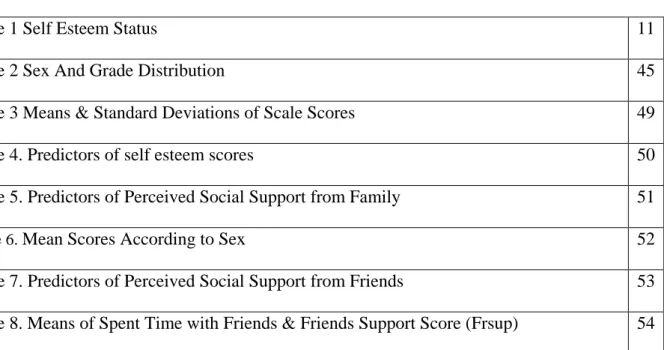
ix List of Tables
Table 1 Self Esteem Status 11
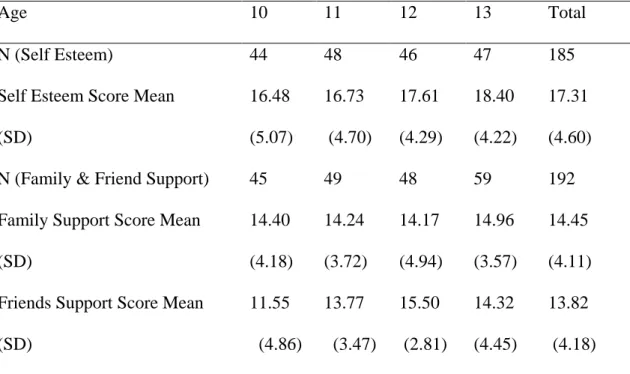
Table 2 Sex And Grade Distribution 45 Table 3 Means & Standard Deviations of Scale Scores 49
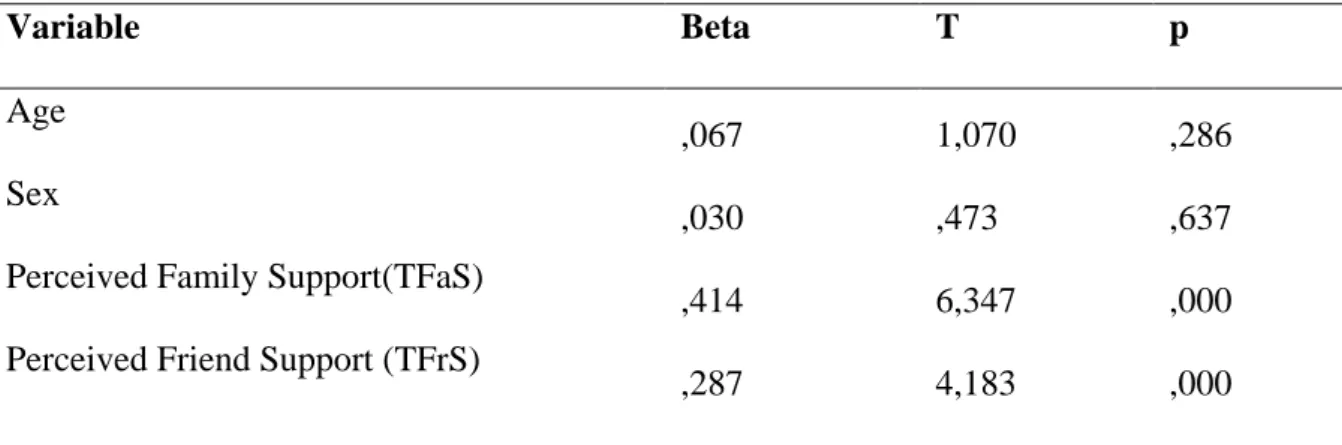
Table 4. Predictors of self esteem scores 50
Table 5. Predictors of Perceived Social Support from Family 51
Table 6. Mean Scores According to Sex 52
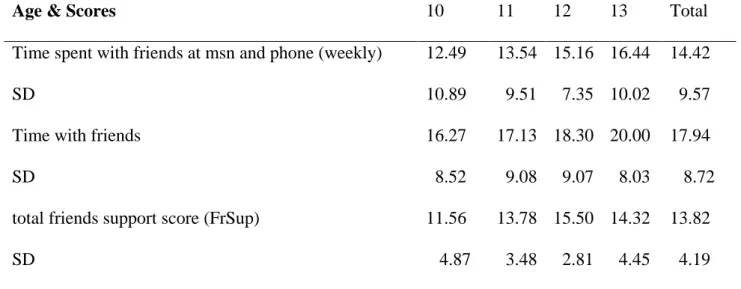
Table 7. Predictors of Perceived Social Support from Friends 53 Table 8. Means of Spent Time with Friends & Friends Support Score (Frsup) 54
Relative Effects of Perceived Social Support from Family and from Friends on Pre-Adolescents’ Self Esteem
1. Introduction
The concept of self esteem has a complex role in modern life and it is frequently used within four areas: the self-help industry, social science, therapy and education (Cigman, 2004). In literature the concept of self-esteem was mentioned around the late 1800’s and early 1900’s by James and Cooley with different formulations (Harter, 1993). According to Harter (1993), in 1892, James claimed that global self-esteem was evaluated or understood by the ratio of one’s successes to one’s pretensions. Moreover, it was claimed that if one perceives oneself as competent in domains where one wants to be successful one will have high self esteem. Conversely, if one perceives oneself as competent and wants to be successful but falls into an unsuccessful position, one will have low self esteem. In short, James’s formulation can be interpreted as saying that low or high self-esteem depends on the person’s own chosen domains and being successful or unsuccessful in those chosen domains. On the other hand, according to Cooley’s view, self esteem level depends on social interactions and significant other’s interpretations; thus, if one gets approval from significant others she/he has high self esteem and if one gets negative feedback from significant others, he/she has low self esteem (Cooley, 1902, as cited in Harter, 1993).
Significant others and aspirations to be competent in domains which are very
important for self esteem can depend on different variables in the adolescent stage of life and in our time (Harter, 1993; Hauser & Smith, 1993). Moreover for adolescents, with rapid change, significant others include both peers and parents. In addition, family support and peer support may have different effects on adolescents’ self esteem, which is the main question of this study. Adolescence is an important stage of life in terms of the relation between parents and peers. Specifically, for early adolescents, the importance of peers increases while at the
same time their need for psychosocial support from their family continues (Berk, 2000; Parman, 2000).
The main purpose of the present study is to investigate the relative effects of social support from family and social peers on adolescents’ self-esteem. In addition, a secondary purpose of the study is to find out the variables which have specific effects on perceived social support, such as amount of time spent with peers and family, household conditions, gender and age differences. Considering the facts, risks and opportunities of the contemporary world to understand and support adolescents in an appropriate way gains a special
importance. In this context, the possible relationship between social support and self esteem in adolescents’ life is explored. For this exploration the concepts of self esteem and perceived social support from family and peers are examined.
Initially, the concepts of self and self esteem are reviewed in order to draw a frame for examining adolescents’ self esteem and perception of social support.
1.1. Self-esteem
Self and self-esteem are among the most popular concepts studied in the field of psychology. There are several definitions of “self” that vary according to particular
approaches. Self and the concepts in relation with self such as esteem, confidence, integrity, awareness, acceptance, beliefs, evaluation, and knowledge have been reviewed in many studies. Still, it is possible to find a common point in the literature that self esteem is considered to affect psychological processes such as competition, conformity, attraction, causal attribution, and achievement, helping and coping with stressful events (Baumeister, 1993).
In a detailed review, Brown (1993) has pointed out some functions of the self concept. According to him, the self concept contains personality information; furnishes individuals with a basis for immediate action (Gergen, 1971, as cited in Brown, 1993), a goal for future
behavior, sense of existential security, and interpersonal functions (Brown, 1993). The self concept is an organized, integrated schema that contains memories and controls the
processing of relevant information. There is a theoretical distinction between self-knowledge and self evaluation. Self-knowledge is the answer to the question “who am I?” and is part of the schema which is called the self concept. In addition self evaluation is also part of the schema but it is conceptualized as self-esteem that contains self reflexive attitudes which evaluate the self as an object (Campbell & Lavalle, 1993).
Self esteem is defined as the individual’s personal judgment of his or her own worth and it is influenced by the feedback that people continuously get from the environment from the beginning of their life (Baumeister, 1993). In developing self esteem, individuals are guided by their memories and interpretations of earlier experiences, and by the framework of self-concepts, self standards and self perceptions (Mischel, Shoda, & Smith, 2003). Moreover, self esteem has a powerful impact on human cognition, motivation, emotion, and behavior (Campbell & Lavallee, 1993).
In the self esteem literature, it is possible to find two main assumptions. The
traditional assumption is that self esteem is related to the self concept; that is, having low or high self esteem depends on positivity level of self beliefs. The other assumption which has increasing evidence claims that self esteem can be associated with the structure of the self concept (Campbell & Lavalle, 1993). The second assumption emphasizes the number of the self beliefs and the contents of the self. In another theory, Greenberg and his colleagues assume that overall morality and adequacy is necessary to provide a self-integrity. In addition, this theory assumes that a threat to this image triggers the process of self affirmation
(Greenberg et al., 1990). Moreover, the goal of this system is to reach a global sense of self integrity but not refutation of each specific threat. In other words, according to this theory the aim of the self is to get integration rather than to cope with each single threat (Spencer,
Joseph, & Steele, 1993). Before 1960, it was considered that Low Self Esteem (LSE) and High Self Esteem (HSE) people have opposite view points and according to this view, LSE people want failure and social rejection, while HSE people want success and social
acceptance. In addition this theory has claimed that, LSE have nothing to lose, so they can behave risky and conversely HSE have much to lose and should be cautious (Tice, 1993). On the other hand, in terms of motivational side of self esteem about affective and cognitive reactions, LSE people are strongly oriented toward self-enhancement and HSE people are oriented toward protecting themselves (Shrauger, 1975). In the literature, concepts of protection and enhancement were commonly emphasized by researchers as indicators of self-esteem. Related with this, various researchers found that HSE people are more concerned with self-enhancement and LSE people are more concerned with self-protection (McFarlin & Blascovich, 1981; Baumeister, 1993). HSE and LSE people can have different reasons for the same behavior. For example, HSE people may be interested in defining and identifying their strengths and developing them to show them off, which is consistent with a self-enhancing orientation. Conversely, LSE people may focus on their weaknesses and their coping method for this is to protect the self against failure, rejection, humiliation, or anxiety. In addition, Arkin (1981) has argued that self-protection and self enhancement can be conceptually and empirically distinguishable which can be seen as an example of performing in public of LSE and HSE people. In his example, performing in public can be seen as risk by LSE people for their self esteem and can be seen as an opportunity by HSE people to enhance their self. Therefore, HSE people - in other words self-enhancing people- will seek out opportunities to perform in public and LSE people- –in other words self-protection oriented people- might avoid performing in public because of some risks such as failure and public embarrassment (Arkin, 1981). Tice (1993) mentioned that the concept of self-handicapping is related with both HSE and LSE people as self handicapping can be a strategy for both goals of
enhancement and protection. Self handicapping provides protective excuse for failure and enhances credit for success. In addition, it was reported that HSE participants
self-handicapped more frequently than LSE participants when the task was described as identifying the extreme upper range of nonverbal intelligence (Tice, 1993).
Some studies showed that situational factors lead to temporary changes in self-evaluation (Baumgardner, Kaufman, & Levy, 1989). Although self-esteem is a relatively enduring trait, some fluctuations can be measured (Heatherton & Polivy, 1991). The stability of self esteem has been conceptualized in terms of either long-term or short-term fluctuations. As long term fluctuations, the stability of self-esteem reflects change in an individual’s baseline level of self-esteem that occurs slowly and over an extended period of time (Kernis, 1993). For instance, gradual changes can be seen in academic or career life. As short term fluctuations, the stability of self-esteem reflects the magnitude of change in immediate, contextually based self-esteem. For short term fluctuations temporary increase or decreases resulting from experiencing specific events can be given as examples (Rosenberg, 1986, as cited in Kernis, 1993).
The positive and the negative self view, in other words high or low self esteem affects the accessibility and availability of people to each other in interpersonal relationships.
Furthermore, the heightened accessibility of a self-view should, in turn increase the likelihood that people will translate the self-view into behavior. Moreover, people verify their view of selves; for example, people with negative view are forced into crossfire where their self-verification strivings cause them to seek unfavorable feedback (De La Ronde & Swann, 1993). In other words, attributions or meanings that people give to “self esteem” define the functions and contents of the self esteem (Brockner, Wiesenfield, & Raskas, 1993).
As mentioned above, self and self esteem are usually considered as related concepts and examined together. Self is defined as an organized, integrated schema that contains
memories of a person and controls the processing of the relevant information. On the other hand, self esteem influences the psychological processes of individuals. Moreover, self esteem of an individual includes basis for immediate action, goal for future behavior, sense of existential security, and interpersonal functions. Self esteem is acknowledged as the
individual’s personal judgment of his or her own worth influencing cognition, motivation, emotion, and behavior of the individuals. Furthermore, the traditional assumption on self esteem underlines that having low or high self esteem depend on positivity level of self beliefs, on the other hand, the second assumption which is focused on the structure of the self concept emphasizes the number of the self beliefs and the contents of the self. According to this second assumption, the aim of the self is to get integration rather than to cope with each single threat. In literature, it is mentioned that HSE people tend to focus on enhancing their selves and they seek out opportunities to perform in public. On the other hand, LSE people focus on protecting their selves and it is assumed that this protection orientation might be for avoiding performance in public because of several risks such as failure and public
embarrassment.
In the next topic, consequences of self esteem are examined to understand how and why self esteem has an important role on personality development and interpersonal relationships.
1.2. Consequences of self esteem
In the literature, the origins, the causes and consequences of low and high self esteem have been examined by using different variables such as mood, tendency to depression, cognitive reaction, and coping methods. In terms of these variables comparison of high and low self esteem people are explored in detail below.
In a study, participants were asked the to describe their own attributes and then a comparison was made between high and low self esteem people but the results of the study
were not clear (Baumgardner, 1991). Campbell and Lavelle (1993) compared the self beliefs of low self esteem people and high self esteem people with their beliefs about their general behavior. The results of the study showed that people with low self esteem were less absolute than people with high self esteem. In addition, low self esteem people are more confused or ambivalent with respect to their standing along descriptive dimensions. Moreover, the results showed that low self esteem subjects’ mood was less pleasant than high self esteem people. Whereas high self esteem subjects cognitively accept the self relevant implications of their positive events and rejected the self relevant implications of their negative events, low self esteem subjects accept both types of events. Furthermore, low self esteem people are more conservative or cautious in their responses to the social environment. Finally, high self esteem subjects exhibited higher temporal stability than did low self esteem subjects (Campbell & Lavalle, 1993). Parallel with these results, Spencer, Joseph, and Steele (1993) reported that high self esteem people have more resources to affirm their overall sense of self integrity. Conversely, low self-esteem people have fewer resources for self integrity. People with low self esteem have more difficulty providing self integrity because they have fewer and less positive aspects of their self-image. Additionally, when low self esteem people are threatened, it can be more difficult for them to restore feelings of adequacy by recruiting valued self aspects (Spencer, Joseph, & Steele, 1993).
In a study it was found that there are differences between high and low self esteem people’s reactions in terms of focusing on affirmation resources following a self image threat, motivation to maintain an overall sense of self-integrity, and estimated self performance. Low self-esteem people showed marked rationalizing of their decisions, whereas high self esteem people showed none. Moreover, it has been found that both high and low self esteem people have motivation to maintain an overall sense of self-integrity. The only difference was high self esteem people had more positive aspects of their self image than low ones. It can be
claimed that after a bad or unwanted experience high self esteem people can turn to the positive self-affirmation resources whereas low self esteem people can’t do this easily and presumably judge themselves critically and have difficulty coping with the situation (Spencer, Joseph, & Steele, 1993). When the interaction and feedback are undertaken, in immediate feedback, both high and low self esteem people overestimated their performance because of the potential humiliation effect. But high and low self esteem people had different reactions. High self esteem people were relatively undaunted by this threat because they had many positive aspects of their self-image to fall back on. In contrast, low self esteem people were concerned with this threat, because they have fewer self evaluative resources. As a result, they lower their estimates to protect against the threat. In not receiving immediate feedback, either when the results were anonymous or delayed, LSE people did not lower their estimates, because there were no obvious threats. In sum both low and high self esteem people have motivation to maintain self-integrity, but the costs of pursuing a self-enhancing strategy are different for them: For high self esteem people it is easier to cope with self-image threats because they can affirm themselves, but for low self esteem people, it is more difficult because they can’t affirm themselves easily and restore self-integrity. (Spencer, Joseph, & Steele, 1993).
For a long time, LSE people were to assumed regard themselves as incompetent, unlovable, and generally worthless individuals with a strong dislike, even hatred of self (Tice, 1993). However, LSE people don’t define themselves worthless, incompetent losers. They are essentially neutral in their self descriptions, and do not attribute strongly negative or positive traits to themselves. LSE people present themselves in a neutral, noncommittal fashion and they also want to succeed, win love and admiration, to be rich, but such goals seem out of reach to them and are not part of their ongoing concerns. Instead, their first goal in most situations is to avoid failure, humiliation, rejection and other disasters. They have difficulty in
presenting themselves in a highly negative or positive fashion (Tice, 1993). On the other hand, McFarlin and Blascovich (1981) found that LSE people desire success but cognitively they continue to expect failure. In another study, similar results have been reported, which can be summarized as showing that cognitive consistency dynamics may influence expectations and willingness to believe feedback (Swann, Predmore, & Gaines 1987). Moreover, HSE people tend to continue working on the task when they had succeeded and avoid the task when they had failure, especially if the failure was humiliating. Conversely, LSE people tend to avoid the task if they had been told they had performed exceptionally well on it, but they tend to persist at the task after a humiliating failure. As a result HSE people focus on their successes and avoid failures, and LSE people focus on failures (Tice, 1993).
According to Bruce and Crocker (1993) after their success, high self esteem people assume that it depends on their abilities, and they feel that they control their outcomes. On the other hand, when they fail they are surprised because it is unexpected for them and
inconsistent with their self-concept. In addition, discrepancy between the feedback and their self-concept arouses negative affect, which motivates a search for explanations for the outcome that are consistent with their self-concept (Brown & Rogers, 1991, as cited in Bruce & Crocker, 1993). Moreover, high self esteem people attribute the negative outcome to external causes. They also create some cognitive strategies like devaluing the importance of the task, deciding the evaluator is not credible, or focusing on negative information about other people. Also, low self esteem people have some biases in evaluating events and their selves. Initially, they have doubt about their positive attributes and in addition they are not sure that they do not have negative attributes. Even so, they care that they have positive attributes. Secondly, they generally expect negative outcomes and are more likely to self handicap to provide excuse for failure. In addition, for LSE people success is not entirely consistent with their self concept. For them self concept is a mixture of positive and negative
attributes and they expect failure more than success. Low self esteem people believe that if they have positive attributes or they succeed something, this will produce expectations from them such as to appear same abilities, to be successful. As a result if they can’t show the expected abilities and success, they can live a greater disappointment. Thus for LSE people successful regulation of affect involves acknowledging future failures and even
disconfirmations and anxieties. This pattern can be described as self fulfilling prophecy. Low self esteem people live some motivation breakdowns because of causes such as constraining of the less positive “reality” of the self concept, anticipating possible for failure and creating or imagining excuses for failure. Although they desire to enhance their selves, this desire inhibited by the fear of not to achieving this enhancement in the future which can result in great disappointment. In addition, HSE people seek self-enhancement intra-psychically and LSE people seek self-enhancement interpersonally (Baumgardner, Kaufman, & Levy 1989). It is a reasonable assumption that favorable life events are more consistent with the self image of HSE than ones with LSE (Brown, 1993). In Brown and McGill’s first study female high school students completed Rosenberg’s Self-Esteem Scale and a standard life events inventory. The results of the first study indicated that the more positive life events LSE subjects reported experiencing, the more illness they reported during the course of
investigation. In opposition, for HSE subjects high levels of positive life events were associated with fewer health complaints. In the second study which recorded visits to a medical facility over a 6 month period, findings of first study were replicated and extended (Brown & Mcgill, 1965, as cited in Brown, 1993).
There are some reasons for less challenging goals of LSE people in comparison to HSE people. Initially, LSE people expect to perform worse than HSE people (Brockner, 1979). In addition, LSE people have some suspicions about their skills, therefore less confident that their efforts will lead to success while HSE people generally use a variety of
different methods to cope with failures such as making external attributions or increasing their ratings on self-dimensions that are unrelated to the failure (Baumeister, 1982, as cited in Heatherton & Ambady, 1993 ). Moreover, LSE people are concerned to protect themselves from the image damaging consequences of failure and less likely to fail and to suffer from embarrassment, humiliation, or other injuries to their self-images (Heatherton & Ambady, 1993). When HSE people were examined, it has been mentioned that HSE people tend to work harder after failure, they set ambitious and risky goal because of their overconfidence. Generally, their approach to the problems is, even if the problem is unsolvable, persisting to try to solve the problem, more than LSE people. But when they are informed that the problem is unsolvable they stop trying (Mcfarlin, Baumeister, & Blascovich, 1984). Baumeister, Heatherton, and Tice (1993) examined HSE and LSE people’s reactions in the face of an ego threat on a complex self-regulatory task. Subjects in these experiments choose performance contingencies for themselves on a video game from among several options, with larger monetary rewards linked to greater chances of failure. After their experiments they reached the results below: If there is no ego threat, HSE subjects showed a greater capacity for self-regulation than LSE by setting appropriate goals and meeting them. When there is ego threat, HSE people set inappropriate, risky goals and ended up with smaller monetary rewards than subjects with LSE.
In the literature the relation between depression and self esteem –specifically low self esteem- relation is studied with a special emphasis. Bemporad and Wilson (1978) claimed that depression includes ungratifying existence, sustained by certain pathological cognitive
constructs, which cannot be given up because of internal and external obstacles, and eventually depression leads to a sense of helplessness, hopelessness, and low self-regard. Depressed and LSE people typically suffer when they are rejected and they seem motivated to get others to like them. On one hand -like everyone- LSE people seek favorable reactions, but
on the other hand they ask for unfavorable reactions to prove their beliefs about their selves. There are some reasons about the satisfaction of LSE people from receiving negative
feedback. Initially, LSE people seek negative feedback and some people (friends) who will give them negative, to reduce uncertainty about them. By choosing someone who gives negative feedback as a friend, ultimately they try to convert a potential enemy into a friend so that could produce exceptionally strong feelings of positivity. In addition they interact with a similar one that makes them feel better (De La Ronde & Swann, 1993).
Kernis (1993) has reviewed the stability of self esteem and reported the different effects of different self-esteem status. He has divided four different statuses and described the psychological qualities and the manifestations of these statuses in table below:
Table 1
Self Esteem Status
Self-Esteem Status Psychological Qualities and Manifestations
Stable High PQ: Secure in positive feelings, not easily threatened
M: Not very reactive to specific instances of positive or negative evaluative events
Unstable High PQ: Fragile self-feelings, easily threatened
M: Strong adverse reactions to negative evaluative events, embellish favorable implications f positive evaluative events
Unstable Low PQ: More resilient than stable LSE, attempt to avoid continuous
negative self-feelings
M: less adverse reactions to negative evaluative events, increased use of strategies to counteract adverse impact of threatening events; do not react especially favorably to positive self-relevant events
Stable Low: PQ: Continous negative self-feelings
M: Little attempt to counteract adverse impact of negative self-relevant events or to assimilate positive self-relevant events
In sum, stable and unstable self-esteem statuses influence the emotions and reactions of individuals. When it is considered in terms of depression level and self esteem status, self-esteem level is a much stronger predictor of subsequent depression for stable than for unstable self-esteem individuals. On the other hand, among individuals with unstable self-esteem there is little relationship between level of self-esteem and depression (Kernis, 1993). Furthermore,
according to Pelham (1993) depressed persons make more internal, stable and global
attributions for their personal failures and misfortunes than non-depressed persons. Contrarily, the depressed person demeans and derogates other people on selected dimensions rather than exaggerating his/her own good qualities. For example rather than saying “I’m wonderful”, the depressed person says “I’m so so but you and he and she are terrible” (Baumeister, 1993, p: 292). Moreover, Kernis (1993) pointed out that both LSE and HSE people use excuse making mechanisms to protect and to enhance their selves. LSE people use excuse making to protect their selves after poor performance in order to reduce the negative diagnostic value of the outcome. In other words they create some excuses to reduce the effect of the negative feedback.
LSE people’s beliefs about themselves are generally negative and they have fewer reasons to regard themselves as superior beings with very little awareness about themselves. Moreover, confidence is an important asset and LSE people may suffer from lack of
confidence in approaching others or initiating social interactions (Baumeister, 1993). When a comparison is made between LSE and HSE people in these issues, four different trends have drawn attention. Especially in terms of perceptions of the expectancy-value discrepancy some differences have been seen between LSE and HSE people in assessments. Initially, while self-consistency and self-enhancement are working together for HSE persons for LSE persons these are not working together. In addition, self-enhancement effects are typically found on affective measures whereas self-consistency effects generally are observed on cognitive measures. One big difference is having knowledge about their selves; research indicates that HSE people have more knowledge about themselves more than LSE people. Finally, HSE people are more likely to practice self-enhancement and LSE people are more likely to practice self-protection (Brockner, Wiesenfield, & Raskas, 1993). The study of Campbell and Lavalle (1993) showed that subjects low in self esteem more affected by affective reactions.
In addition LSE people have more tendencies to be more threatened by negative feedback and more gratified by positive feedback. As a result of this, they are more reactive to their social environment and feedback from people (Campbell & Lavalle, 1993). In another study, participants were asked to recall their interactions with people in different issues such as receiving instruction, conversations, and feedback to process the interaction fully. Results of the study showed that HSE people also recalled more than the LSE people who had received the same instructions to be boastful. On the other hand, LSE was associated with a relatively impoverished knowledge structure about the self (Tice, 1993).
Some studies have shown that people recall positive and negative feedback more when it is consistent with one’s initial self-evaluations. In other words people with high self esteem overestimated their performance while people with low self esteem underestimated their performance regardless of how they had actually performed relative to another. Depressed college students accurately recalled the frequency of negative feedback on a laboratory task, whereas non-depressed ones underestimated the frequency of negative feedback (Nelson & Craighead, 1991, as cited in Bruce & Crocker, 1993). The cognitive reactions were judgments of the accuracy of the feedback, the validity of evaluation technique, and the competence of the evaluator. Moreover, liking for the evaluator and having a positive relation with and/or perception of the evaluator were evaluated as affective reactions. The researchers reached the conclusion that on all the cognitive measures, socially confident individuals responded more favorably to positive feedback and less favorably to negative feedback than did socially insecure ones. In another study it was found that both socially confident and socially non confident participants responded more favorably to positive feedback and less favorably to negative feedback (Swann, Griffin, Predmore, & Gaines, 1987). Even though unstable LSE viewed negative feedback as more accurate and valid than did stable LSE, they nevertheless were less likely to take it out on the evaluator.
As a summary, the consequences of low and high self esteem have been reviwed in relation with multiple variables such as mood, tendency to depression, behavior style, cognitive reactions to events, using resources, and coping methods. The differences between HSE and LSE people can be summarized as; (1) LSE people are less absolute and are more confused than HSE people, (2) LSE people are more conservative or cautious in their responses to the social environment, (3) HSE people have higher temporal stability than low self esteem subjects, (4) HSE people have more resources than LSE people to affirm their overall sense of self integrity, (5) HSE people take feedback relatively undaunted because they had many positive aspects of their self-image to fall back on, in contrast, LSE people usually perceive feedback as a threat and they are concerned with this threat, because they have fewer self evaluative resources, (6) For HSE people it is easier to integrate self on the other hand for LSE people it is more difficult to do this. Therefore, perceiving feedback as a threat or undaunted is related to be able to affirm and restore self-integrity. In regard of consequences of self esteem, another essential point is the relation of depression and low self esteem. In the literature it is pointed that depression leads to a sense of helplessness,
hopelessness, and low self-regard. Furthermore, stable and unstable self-esteem status influences the emotions and reactions of individuals. When it is considered in terms of depression level and self esteem status, self-esteem level is a much stronger predictor of subsequent depression for stable than for unstable self-esteem individuals.
As a result, having low or high and stable or unstable self esteem status has effect on personality. The causes of self esteem are reviewed in next topic, to make integration with the consequences of the self esteem.
1.3. Causes/ antecedents of self esteem
In this section, the origins of the self esteem are described in regard to the impact of the family, environment, peers, and other developmental characteristics.
Self esteem is considered to be a vital part of the personality. In the developmental and the psychoanalytic psychotherapy literature, generally it has been claimed that having high or low self esteem depends on the early childhood (0-6 ages) experiences of the individual. On the other hand, Judith Rich Harris (2007) disagreed with these ideas. In her recent book “No Two Alike”, she claims that the developmental and the psychoanalytic literature exaggerate the parental and within family environment influence on self esteem and personality. Additionally, although she agreed with the importance of parent-child interaction and the importance of the first six years she objected to the view that it is difficult to change the effects of the early childhood experiences in later life (Harris, 2007).
In her theory, Harris (2007) claimed that individuals are born into a social
environment and spend their whole lives in different social environments. According to her conceptualization, three systems and the interaction of these systems have crucial importance in personal development and self esteem. These systems are shortly defined below:
a. The Relationship System refers the different mental mechanisms designed to process and store information about people. According to Harris “managing relationships is Job 1 for a baby.” (Harris, 2007, p.182).
b. The Socialization System consists of acquiring the social behaviors, customs, language, accents, attitudes, and morals deemed appropriate in a particular society. Again according to Harris “The baby’s Job 2 is to learn how to behave in a way that is acceptable to the other members of his or her society” (Harris, 2007, p. 183).
c. The Status System refers to competition of people for a position in a particular group. Harris claimed that “The baby’s Job 3 is to compete successfully.” (Harris, 2007, p. 209).
Some studies show that self esteem of adolescents is influenced by maternal
gender specific was found (Ojanen & Perry, 2007). According to this study perceived maternal affection predicted gains in self-esteem for girls, whereas perceived
psychological control predicted reduced self-esteem for boys. In addition, a persistent association was found between unstable high self-esteem and self-reported violent offending. The results suggest that self-esteem level plays a limited role in the understanding of violent behavior (Boden, Fergusson, & Horwood, 2007).
Self esteem has multifaceted nature and there are at least three separate domains of self esteem: physical, academic and social. In addition these domains become more refined with age (Marsh, 1990). Accordingly self esteem takes on a hierarchical structure. Specifically under general self esteem, academic self esteem includes reading, math and other school subjects. Furthermore, social self esteem includes relationship with peers and parents. Finally physical self esteem includes physical appearance and physical ability (Berk, 2000). Especially in adolescence but generally at all ages, although individual differences exist, perceived physical appearance correlates more strongly with global self-worth than any other self esteem factor (Harter, Waters, & Whitesell, 1998). Moreover with the arrival of adolescence, several new dimensions of self esteem are added such as close friendship, romantic appeal and job competence (Berk, 2000). In addition adolescents become more discriminating in the people whom they look to for validation of their self esteem. Some of them rely on parents, others on teachers and still others on peers (Harter, Waters, & Whitesell, 1998). Separate factors of self esteem are influenced by social comparisons. In other words social comparison affects self esteem of individuals with the judgment of abilities, behavior, appearance, and other characteristics in relation to those of others (Stipek & Maclver, as cited in Berk, 2000).
Self esteem of adolescents is influenced by many factors. Cultural forces are important factors that influence self esteem of adolescents. Studies have indicated that early
maturing of girls and late maturing of boys, cultural standards of beauty, gender stereotyped expectations for physical attractiveness and achievement, have detrimental effects on self-esteem of adolescents (Berk, 2000). Moreover, the role of social
comparison in self esteem varies from culture to culture. For example in a study, Chinese and Japanese children score lower in self esteem than American children although their academic achievement is similar with American children (Chiu 1992,1993, as cited in Berk, 2000). Similarly Asian children less often use social comparison to bolster their own self esteem because their culture places a high value on modesty. As a result of this they tend to judge themselves but to be generous in their praise of others (Heine & Lehman, 1995).
Another important causal factor on self esteem is child rearing practices. Children and adolescents whose parents are warm, accepting and provide reasonable expectations for behavior feel especially good about themselves (Steinberg, Fletcher Darling, Mounts, & Dornbusch 1994). On the other hand adolescents who experience coercive parenting and whose parental support is conditional with high standards, suffer severe assaults to their self esteem. In addition adolescents’ self esteem is influenced by peer relationships (Berk, 2000).
According to Dweck, the hallmark of successful individuals which she called “mastery oriented qualities” is that they love learning, they seek challenges, they value effort, and they face of obstacles (Dweck, 1999). She added that there are several misbeliefs about confidence, success, ability and praise which are common in society. She listed these misbeliefs and truths as follows:
The first misbelief is that students with high ability are more likely to display mastery oriented qualities, but the truth is that many of these students are the most worried about failure (Legget, 1985; Licht & Dweck, 1984a, b; Licht & Shapiro, 1982, as cited in
Dweck, 1999). The second misbelief is that school success directly fosters
mastery-oriented qualities but the truth is that success has little positive effect on the ability to cope with setbacks (Mueller & Dweck, 1998, as cited in Dweck, 1998). The third misbelief is that praise, particularly praising intelligence encourages mastery-oriented qualities, but the truth is that praising intelligence can lead students to fear failure, avoid risks, doubt
themselves when they fail and cope poorly with setbacks (Mueller & Dweck, 1998, as cited in Dweck, 1999). Finally the fourth misbelief is that confidence in intelligence is the key to mastery-oriented qualities, but the studies show that many of the most confident individuals do not want to be tested for their intelligence and their high confidence is too quickly shaken when they are confronted with difficulty (Henderson & Dweck, 1990; Hong, Chiu, Dweck & Lin, 1998; Zhao, Dweck &Mueller, 1998, as cited in Dweck, 1999). Dweck has mentioned the entity theory which is that some people (parents) believe that people’s intelligence is a fixed trait and there is a certain amount of intelligence and that amount does not change. Thus, entity theory is a system that requires a diet of
successes and when parents believe that their children have a fixed amount of intelligence, every challenge can become a threat to self esteem. On the other hand some people
believe that intelligence is a trait that they simply possess, but can change through learning, which is called “incremental theory”. Dweck has pointed out that it is deterministic for self esteem of children whether the parents and adults around the
children believe incremental or entity theory (Dweck, 1999). In addition within the entity-theory framework peers are competitors for self esteem. Specifically, the students who believe in entity theory have been asked when they feel smart. Their answer was; when they did better than others they feel smart. On the other side, students who have
incremental view about intelligence derive their self esteem from their own striving, from the use of their efforts and abilities. Consistent with this, incremental theorists had said
that students who have incremental view feel smart not only when they are striving new tasks, but also when they put their knowledge to use in helping to their peers learn. As a result within incremental framework, peers can gain self esteem by cooperating rather than being rivals for self esteem (Dweck, 1999). In addition, the meaning of effort and parents’ perception, interpretation about effort are important for adolescents’ and children’s self esteem. When the meaning and importance of effort is discounted by praising quick, rapid successes and underestimating success with long performance, especially on important tasks, long-term goals may be sabotaged for the sake of short term judgments (Zuckerman, Kieffer, & Knee, 1998). It has become common practice to praise students for their performance on easy tasks to tell them they are smart when they do something quickly and perfectly (Meyer, 1982, as cited in Dweck, 1999).
Another important factor that influences self esteem of adolescents is group interaction and being a member of popular group. Even to be member of popular group is such an important thing that some adolescents prefer to be less valuable, bullied, insulted member of a popular group rather than being an equal member of a less popular group (Harris, 2007).
Self esteem of an individual is influenced by several factors such as socialization process, relationship style and competition to successfully to get a status especially among peers. In addition to parenting styles, significant parental figures have important
influences on self esteem of children and also adolescents. Children and adolescents, whose parents are warm, available and acceptable for children and provide reasonable expectations have positive impact on self esteem of children. Additionally, parents’ beliefs about their children’s intelligence which is defined as entity and incremental view have an important effect on children’s self esteem. On the other hand in early adolescence, peer relationships and being accepted or rejected by peers have an increasing effect on self
esteem. One more important causal effect on self esteem is cultural factors. For example as mentioned above, Chinese and Japan children criticize themselves and praise others but on the other hand American children don’t criticize themselves as much as Chinese and Japan children do.
In sum, it is suggested that social interaction and support essentially influence the development of self esteem in children. In relation with this, in the next topic the
interaction process and support with the adolescences’ developmental characteristics are reviewed.
1.4. Self-Esteem and Social Interaction, and Environmental Support
Socialization process and social environment teach children the appropriate attitudes, behaviors and values in a wide range of situations with regard to being boys or girls
(Maccoby, 2000). Each developmental stage requires some specific developmental tasks. The adolescence stage is generally described by metaphors such as bridge, transition, passing time, having or gaining skills, revolution, reorganization, and revising of personality (Berk, 2000). It is also referred to as a chaotic and sad stage because being an adolescent means leaving childhood’s relatively irresponsible world and passing into adult life (Parman, 2000).
Jacobson (1961) mentioned that adolescence includes a saddening farewell to childhood and a gradual, anxious-hopeful passing over many barriers to the gates which permit entrance to the unknown world of adulthood. On the other hand, adolescents have physical and mental power at that stage and they have motivation to be independent, to interact more with peers (Levin, 1988). Furthermore, on one side the adolescent wants to be independent, on the other side when he has a problem he wants and needs an available parent or parental figure (Berne, 1972). In the 1950s and early 1960s in psychoanalytic literature, adolescence stage was described with the ambivalences of extremely moody, depressed one day and excitedly high the next. In addition according to psychoanalytic theory, conflict with family, friends, and
authorities are expected at that stage (Hauser & Smith, 1991). Brandt claimed that “the adolescent achieves identity when he no longer says "I am like you" (or as in the case of the toddler "I am part of you"), but rather "I am different and therefore separate from you." (Brandt, 1977, p. 512). According to Anna Freud, adolescents withdraw their libido from their parents suddenly and altogether instead of gradual detachment and this leads them to form relationships outside the family (Freud, 1958).
Regarding Erikson’s psychosocial development theory, he mentioned eight stages of life and claimed that human beings pass these stages According to him, in every stage
individuals experience characteristic conflicts and cope or can’t cope with this crisis. In other words, in each stage there are syntonic versus dystonic characteristics in regard to
psychosocial development. Names of these eight stages and the more or less ages of these stages in human life are as follows: basic trust versus basic mistrust (0-1), autonomy versus shame, doubt (2-3), initiative versus guilt (3-5), industry versus inferiority (6-12), identity versus role confusion (13-18), intimacy versus isolation (19-26), generativity versus stagnation, (26-40), ego integrity versus despair (40+...) According to him every stage
contain some skills, developmental tasks and at the same time a preparation for the next stage. The stages most relevant to this thesis, pre-adolescence ages and adolescence, will be
reviewed briefly light of Erikson’s theory.
According to Erikson, the stage of industry and inferiority stage coincides with the primary school years. At this stage children learn to produce things that the culture they live in requires. Moreover, at that stage children are expected to apply some given, learned skills and tasks such as reading, writing, and a more sophisticated mode of social skills. In all cultures, these skills are given to children by systematic instructions. According to Erikson these instructions need not be at a school where a special learning and teaching environment is organized, but the social environment prepares them to learn. In addition, Erikson claimed
that perhaps the children learned the greatest amount from the older children. In this way children become ready to handle the materials and tools used by adults. One important thing is that literate people must make the child literate to be ready to more sophisticated skills. In almost all cultures literacy is the basic skill and becomes a ground for further skills which will be required at school and wider social environment. At that point parent must prepare their children for school and by giving feedback provide a supportive environment that leads to use the required or necessary skills for the cultures they live in. This is very important because at school and in society the danger for the child is having a sense of inadequacy and inferiority. The peers’ feedback gains a critical importance at that stage because children begin to spend their time with peers and older children more than with parents. In addition peer group relations and having a position in a group increases children’s self esteem at that stage. If the child despairs of using his tools and skills or experiences the risk of losing status in the social group, the child may lose the hope of work association and this can pull him back to the more isolated, less tool-conscious familial rivalry of the oedipal time (Erikson, 1951). As
mentioned above the wider society becomes significant for children to understand the meaningful roles of technology, social roles, values and skills (Harris, 2007; Berne, 1972). Erikson pointed out that many children’s development is disrupted when family life has failed to prepare them for school life. On the other hand this stage is socially most decisive stage because industry involves doing things beside and with others. In many cultures, a first sense of division of labor and differential opportunities that involves technological ethos and essence of a culture develops at that time. Generally, in literature, Erikson’s industry and inferiority stage contains learning and applying many skills and involves the ages of primary and beginning of middle school years. At that stage child can feel a sense of responsibility towards others, can comprehend and obey values and rules and has a sense of self which is
adequately separated from others. As a result of this, judgments of peers and society become important (Bemporad &Wilson, 1978).
After that stage adolescence years come and Erikson called these years “identity versus role confusion.” At that stage in many culture children had achieved the basic skills that they need to be in society such as literacy, fundamental social, and communication skills and a different mind, and body developmental process begin to occur. In another words youth begins but in puberty and adolescence earlier stages are both questioned and have sameness and continuity features. Developmental psychologists define and describe this stage with the words of transition, transformation and passage years from childhood to adulthood. Erikson claimed that the adolescent mind is essentially a mind of moratorium, a psychosocial stage between childhood and adulthood (Berk, 2000). Moreover, adolescents have to cope with their sexual, narcissistic needs, create resolutions for their conflicts, work with the vacillations of self-esteem and feelings of identity transiton, which will help them to reach new, and more object-directed aims and positions. When the adolescent has coped with his/her conflicts and meets the needs noted above toward the end of adolescence, it can be said that he has found himself (Jacobson, 1961).
As mentioned above, in different stages a supportive environment must include age specific characteristics. It must be taken into consideration that adolescence is a chaotic and sad stage, and it is critical to understand the importance of feedback, interaction, and
supportive environment. Therefore, parents need to prepare their children for school and wider community. Generally parents make this preparation by giving feedback and providing a supportive environment. In the next topic, the content and the process of adolescents’ receiving social support from family are reviewed.
1.5. Social Support From Family
Children usually give more importance and meanings to parent behaviors and these meanings influence their self evaluation. Furthermore, children’s own perceptions of parental behavior have more effect than parents’ actual behavior on children’s self esteem (Hauser, & Smith, 1991; Parker & Benson, 2004). Likewise, child and parents may have different perceptions about child-parent relationship and this can affect the child’s
adjustment and psychological determinants (Serot & Teevan, 1961). According to Freud detachment from parental authority is one of the most important but also painful psychic achievements of adolescents. He pointed out that this detachment has two functions: repudiation of incestuous fantasies; and permission of development of a new generation with new ideas, and with wider social community (Freud, 1905).
These two functions are described as transition from childhood dependency to adult identity and one of the “central conflicts in adolescence” by Brandt (Brandt, 1977).
Moreover, Schafer pointed out that while the detachment process the adolescent –usually has a number of fateful primitive psychological assumptions about the nature of feelings, self, identity, and his relations with other people. According to Schafer, these assumptions usually are unconscious and can be expressed in dreams, neurotic and psychotic symptoms, slips, and symptomatic acts (Schafer, 1973).
According to Parental Acceptance Rejection Theory (PART) every child needs acceptance from parents and open and close reciprocal relationship with his/her parents. If the children can’t satisfy these needs, they tend to be hostile and aggressive, dependent or defensively independent, impaired in self esteem and self-adequacy, emotionally
unresponsive and unstable or to have a negative world view. Moreover, adolescents and adults who perceived themselves as rejected have more behavior problems, depressed mood and substance abuse (Rohner & Khaleque, 2005). PART has two main dimensions
which are called parental acceptance and parental rejection. Parental acceptance refers to warmth, closeness, affection and love. On the other hand parental rejection refers to discounting or neglecting of these feelings. Specifically, parental rejection includes the unaffectionate, aggressive, neglecting, rejecting behaviors. Again according to theory child may experience these rejecting behaviors as cold, hostile, indifferent, undifferentiated and incomprehensible. Although PART has defined parental acceptance and rejection almost operationally, PART pointed out that sometimes child’s perception is more important or effective than actual behavior of parents. For example warmth can be perceived as a
rejection by the child. Similarly, parental rejection may not be perceived as rejection by the child. In sum PART focuses on interpretation and perception of caregiver’s behaviors (Rohner & Khaleque, 2005). In addition PART has three sub-theories: personality sub theory, coping sub theory, and socio-cultural systems sub theory. Personality Sub theory assumes that every human being has an emotional need for positive response and parents is the most probable source to ensure this emotional need. In other words like attachment theory according to PART parents are especially important due to the children’s sense of emotional security, state of well-being and forming personality. According to Personality Sub-Theory “parental rejection” causes some psychological problems such as; hostility, low self esteem, low self adequacy, and emotional instability. The second sub theory of PART, Coping Sub Theory deals with that how the rejected people overcome the
consequences of being rejected. In that point PART assumes some factors can be helpful to cope with the rejection for rejected people. The presence of an alternative warmth
attachment figure (siblings, friends), self determination which includes power to manage difficulties and depersonalizing capacity are helpful to deal with perceived rejection. According to PART there are two coping groups; affective and instrumental copers. Instrumental Copers are people who are successful in school and professional life but not
emotionally healthy. Conversely Affective Copers are people with more or less good mental health even though they had been rejected in their childhood. However it must not be forgotten that in terms of social and emotional problems in life, Affective Copers have greater risk than people who have experienced enough love and acceptance in childhood. The last sub theory of PART is Socio-Cultural Systems Model Sub Theory and it claims that acceptance/rejection is shaped by the maintenance systems of the society from family to economical-political organizations within the natural environment. In that theory although the power of parents’ acceptance/rejection has been mentioned the symbolic expressions such as religious, artistic, musical and folkloric traditions which are
conceptualized under the term “institutional expressive systems” and their interactions are emphasized more. In sum, all these factors interact with each other and Socio-Cultural Systems Sub Theory attempts to explain the world wide effects of parental acceptance-rejection (Rohner & Khaleque, 2005) .
On the other hand, according to attachment theory, an infant needs to be close to the care giver for his survival and when the caregiver is sensitive and responsive to the infant, infant feels secure and knows that the caregiver will be present when he/she needs. In addition the security level of the relationship between infant and caregiver influences the infant’s coping with stress. Thus the attachment figure plays a regulation role for the child’s affective and physiological reactions under stress (Bartholomew & Horowitz, 1991). According to attachment theory there are four types of attachment style and these attachment styles are formed in early childhood with the influence of caregiver-infant relationship quality. These attachment styles are listed as secure, ambivalent, avoidant and disorganized attachment. Children who are securely attached do not experience significant distress when separated from caregivers. On the other hand, when children are attached ambivalently they tend to be extremely suspicious of strangers. These children display
considerable distress when separated from a parent or caregiver, but do not seem reassured or comforted by the return of the parent. Third attachment style is avoidant attachment in which children tend to avoid parents and caregivers. This avoidance often becomes especially pronounced after a period of absence. These children might not reject attention from a parent, but neither do they seek out comfort or contact. Children with an avoidant attachment show no preference between a parent and a complete stranger. The last attachment style is disorganized attachment and children with a disorganized-insecure attachment style show a lack of clear attachment behavior. Their actions and responses to caregivers are often a mix of behaviors, including avoidance or resistance (Bowlby, 1969). As mentioned above three of the attachment styles are insecure and only one is secure and the infant internalizes the relational pattern with the attachment figure and that relationship becomes a prototype for later interactions. Bowlby called these internal representations “internal working models” which guide beliefs, feelings, behaviors, and information processing, including attention, perception, memory, and interpretation (Cassidy, Kirsh, Scolton, & Parke, 1996). In sum, the attachment style of the children influences the later relationships. For example in peer relations, securely attached children receive more positive behavior from unfamiliar peers than insecurely attached children (Cassidy et al., 1996). On the other hand insecure attached children show doubting self conscious and suspicious style in their relationship with peers (Maunder & Hunter, 2001). In sum
according the attachment theory, relationship and attachment style with primary caregivers influence the internal representations, and internal representations are used throughout the life span in other relationships, including the friends (Brody, 1998). In other words
attachment theory asserts that relationship with primary caretaker (generally mother) has a determinant effect on children’s life.
According to social cognitive learning theory children gradually copy and repeat their parents’ behavior. Bandura claimed that children have ability to listen, remember, and abstract general rules from complex sets of observed behaviors. In other words children learn by observing, listening and receiving feedback from their parents. Moreover, by observing others –especially parents- and by receiving feedback from parents, children develop some personal standards and some ideas about themselves such as self-praise, self-blame, sense of self efficacy that guide them in particular situations (Bandura, 1997, as cited in Berk, 2000).
In psychoanalytic theory, different approaches have emphasized the parent-child relationship and have claimed that early relationships with parents influence the future interactions. Especially object relations theorists underline the role of significant others in future interaction patterns (Freud, 1958; Winnicott, 1993; Kohut, 2004). According psychoanalytic developmental perspective, parents are usually significant others and first six years of life influence the future years of the life in terms of personality development and identity formation (Clarkson, 1992). According the Anna Freud, ego and super ego formation are influenced by early relationships with parents (Freud, 1958). On the other hand Kohut developed the self psychology and stated that parents influence children personality development in two dimensions which he called mirroring and idealizing. He added that to provide a healthy support for children, parents should fulfill both mirroring and idealization needs of the children. According to Kohut, mirroring refers to providing close relationships, giving suitable feedback and fulfills the needs of the children. In
idealization dimension children need to see role models and parental figures to be idealized (Erten, Mitrani, & Melis, 2004). As mentioned above different theories had pointed out that parents have great effect on children’s personality development. From another angle parental and child rearing styles influence the personality development. In literature, four
main child rearing styles have been pointed out. These are authoritative, permissive, authoritarian and uninvolved child rearing styles (Berk, 2000, p. 564). Authoritative style is the most adaptive approach and authoritative parents make reasonable demands for maturity and setting limits and insisting that the child obey. In that style, at the same time parents express warmth and affection, listen patiently and encourage all members of the family to participate in decision making. At older ages children who are reared by
authoritative style have high self esteem, social and moral maturity involvement in school learning, academic achievement in high school and educational attainment (Eccles et al., 1997; Herman et al., 1997; Luster & McAdoo, 1996; Steinberg, Darling, & Fletcher, 1995, as cited in Berk, 2000). On the other hand parents who use authoritarian parenting style use punishment and place a high value on conformity, and as a result they engage in very little positive and functional interaction with their children. Adolescents who are reared with this style are less well adjusted than those reared with an authoritative style (Steinberg, Fletcher & Darling, 1994). The permissive style includes nurturing and acceptance but it avoids imposing controls and putting limits. Permissive parents allow children whatever they want and whenever they want. As a result of this style in adolescence, children have poor self control, are less involved in school learning and use more drugs (Baumrind, 1991, as cited in Berk, 2000). The fourth main parenting style combines undemanding with indifferent rejecting behavior. As a result of this child rearing style, in adolescence, children have poor emotional self regulation and school performance, frequent drug use and delinquency (Berk, 2000). Berk has pointed out that in adolescence parents should foster the autonomy and not to forget that adolescents emotionally want to rely on more on themselves and less on parents for support and guidance. In addition at this stage children want to make decisions independently with little and careful guidance of parents.