ABSTRACT
EUROPEAN UNION ENVIRONMENTAL POLICY AND ENVIRONMENTAL NGOs LOBBYING
Kılıç, Zeynep
M.A. in European Union Relations Supervisor: Assistant Prof. Özgür Ünal
May, 2007, 106
Environment is a subject gaining bigger importance for the future of the World, while discussions about global warming and sustainable development are increasing. European Union is a leading actor in policy making about environmental matters with an increased awareness about the subject but also thanks to its Civil Society actively involved in this policy making process
While placing EU’s environmental policy in a global context, a very important matter; Turkey’s adhesion to EU seems to raise new questions about these policies and Turkey’s adaptation.
Within this framework, in the first part of the thesis the focus has been explaining European Union environmental policy by giving its history, decision-making under this policy title and the institutions related to this process.
Turkey’s adaptation to EU norms and global policies and actual situation has constituted the second party of the thesis.
Finally an extensive analysis of NGOs in environmental decision making has been done in a global scope and within the EU.
Keywords: European Environmental Policy, Global Warming, NGO lobbying, European decision making
ÖZET
EUROPEAN UNION ENVIRONMENTAL POLICY AND ENVIRONMENTAL NGOs LOBBYING
Kılıç, Zeynep
Avrupa Birliği İlişkileri Yüksek Lisans Programı Tez Danışmanı: Yard. Doç Dr. Özgür Ünal
Mayıs, 2007, 106
Küresel ısınma ve sürdürülebilir kalkınma ile ilgili tartışmalar giderek artarken, çevre konusu dünyanın geleceği için giderek önem kazana bir konu haline gelmekte. Avrupa Birliği ise çevre konusunda yüksek farkındalığı ama daha özelde bu politika alanında yoğun faaliyet gösteren Sivil Toplumu sayesinde bu konuda politika üretiminde başı çeken bir aktör haline gelmiş durumda.
Avrupa Birliği’nin çevre politikalarını küresel bir perspektife yerleştirirken, oldukça önemli bir konu olan Türkiye’nin üyeliği ve çevre konusunda Avrupa ve Dünya normlarına uygunluğu yeni sorular uyanmasına sebep oldu.
Bu çerçeve içinde, tezin ilk bölümünde odak noktası Avrupa Birliği çevre politikaları, tarihi, karar alma mekanizmaları ve bu başlık altında çalışan ilgili kurumlar incelendi.
Türkiye’nin Avrupa Birliği normlarına ve küresel politikalara adaptasyonu ise tezin ikinci önemli başlığını oluşturdu.
Son olarak küresel ölçekte ve Avrupa çapında Sivil Toplum Kuruluşlarının çevre politikalarında karar alma mekanizmalarındaki etkisi analiz edildi.
Anahtar Kelimeler: Avrupa Birliği Çevre Politikası, Küresel Isınma, STK lobiciliği, Avrupa Birliği Karar Alma Süreçleri
TABLE OF CONTENTS
LIST OF TABLES
...VI1. INTRODUCTION
...12. EU ENVIRONMENTAL POLICY
...32.1 HISTORY AND DEVELOPMENT OF THE ENVIRONMENTAL POLICY OF THE EUROPEAN UNION...3
2.2 EU ENVIRONMENTAL POLICY IN GLOBAL REGIMES...11
2.3 EU INSTITUTIONS IN GREEN ISSUES...17
2.3.1 EUROPEAN PARLIAMENT...17
2.3.1.1 Green MEPs...18
2.3.1.2
Auto-Emission Directive
...212.3.2 EUROPEAN COMMISSION...22
2.3.3 COUNCIL OF MINISTERS...24
2.3.4 EUROPEAN COURT OF JUSTICE...25
2.4 ENVIRONMENTAL DECISION-MAKING IN THE EUROPEAN UNION...26
2.5 EUROPEAN ENVIRONMENTAL POLICY IN DIRECTIVES...30
2.6
IMPLEMENTATION AND ENFORCEMENT...362.7 ASSESSING EU ENVIRONMENTAL POLICY...39
3. TURKEY FULFILLING ITS LIABILITIES ON THE EUROPEAN
LEVEL
...454. ENVIRONMENTAL NGOs LOBBYING IN EU
...564.1 ENVIRONMENTAL NGOs IN BRUSSELS...56
4.1.1 THE EUROPEAN ENVIRONMENTAL BUREAU...57
4.1.2 WORLD WIDE FUND FOR NATURE (WWF)...59
4.1.3
INTERNATIONAL UNION FOR THE CONSERVATION OF
NATURE (IUCN)...61
4.1.4 GREENPEACE...63
4.1.5 FRIENDS OF EARTH...65
4.1.6 CLIMATE ACTION NETWORK EUROPE...66
4.1.7BIRDLIFE INTERNATIONAL...67
4.1.8 FRIENDS OF NATURE INTERNATIONAL...68
4.2ENVIRONMENTAL NGOs IN THE INTERNATIONAL ARENA...69
4.3EU INSTITUTIONS AND LOBBYING...73
4.3.1EUROPEAN PARLIAMENT AND LOBBYING...73
4.3.2EUROPEAN COMMISSION AND LOBBYING...75
4.3.3COUNCIL AND LOBBYING...77
4.3.4EUROPEAN COURT OF JUSTICE AND LOBBYING...78
4.3.5THE EUROPEAN ENVIRONMENTAL AGENCY...79
4.4ENVIRONMENTAL NGO EFFECTED DIRECTIVES...81
4.5ENVIRONMENTAL NGO INFLUENCE IN THE EU...85
4.6
HOW TO INFLUENCE DECISION-MAKING PROCESS...89
5. CONCLUSION
...92LIST OF TABLES
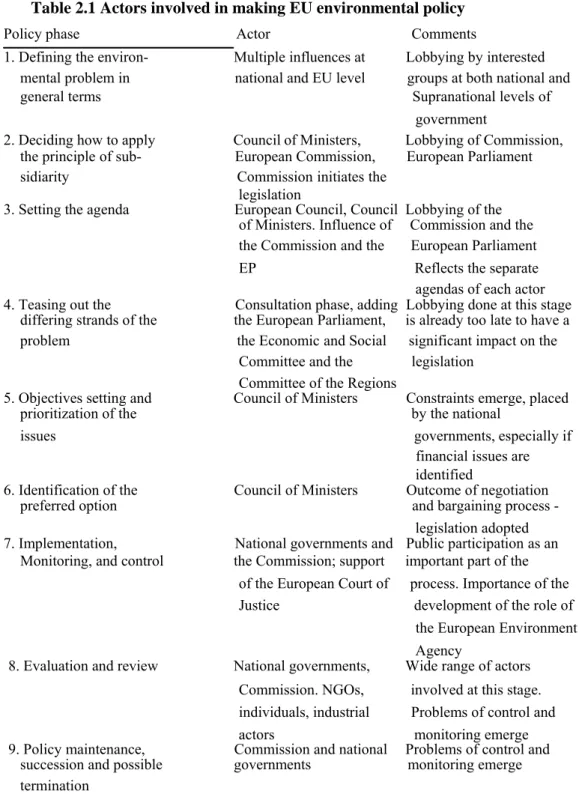
Table 2.1: Actors Involved in Making EU Environmental Policy……..………...…30
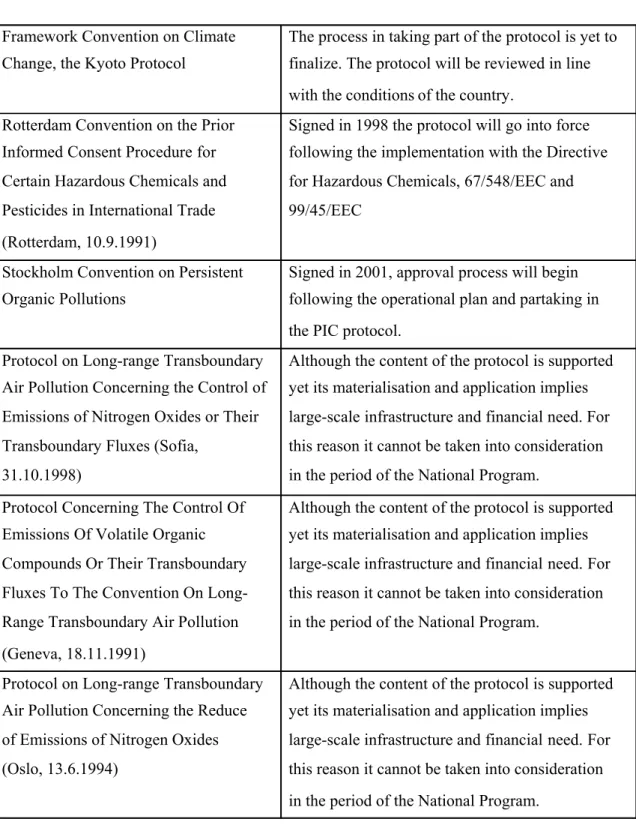
Table 3.1 Promises made by Turkey in the Domain of Environment …………. …..53
1. INTRODUCTION
Protecting the environment is essential for the quality of life of current and future generations. The challenge is to combine this with continuing economic growth in a way which is sustainable over the long term.
European citizens are increasingly aware of the importance of high environmental standards for their health,well-being and overall quality of life. They demand high standards, both in their own interest and the interest of future generations. The EU continues to develop its environmental policy. The adoption by the European Council of the EU’s first Sustainable Development Strategy in june 2001 was a direct response to that demand. It committed the Union to pursuing policies and actions that support economic growth and social development, without compromising the use and the enjoyment by future generations.
This paper is prepared in order to analyse the abilities and deficiencies of the EU in environmental isssues and whether the environmental NGOs in Brussels are effective in this process.
Most people agree that an element of international decision-making is needed to solve environmental problems. This is natural and has no borders. But how effective is the EU in solving threats to our environment? Are the EU’s environmental policies in conflict with EU policies in other areas such as trade and agriculture? Is the linkage between the EU and environmental NGOs in Brussels strong?
In the light of researches that I’ve made, after the necessity of giving a historical background of the history and the development of the European environmental policies according to Environmental Action Programmes and the establisment of the DG Environment, the status of EU in environmental decision-making process, the effects of its institutions, and examples of implementation become the matter.
In order to investigate pre-adhesion procedures, I selected Turkey case as one of the most important issues of EU’s agenda.This part includes Turkey’s environmental policy and
responsibilities in the accessing process and in what degree Turkey is successful to fulfill its obligations on both national and European level and deficiencies it faces.
Additionally, revealing from my individual curiosity, the effects of lobbying as a great political pressure, NGOs’ influence in environmental issues are problematic as well as lobbying and institutional structure which can be easily traced through the related EU directives, which is linked to the question of legality versus actuality. In order to give some explanations and some perspectives upon future scenarios and recommendations on those matters, G9 is taken as primary source with its interference in EU institutitons by drafting, experting and advising; aiming to have influence the decision-making process.
In this paper the analysis of the environmental interest groups’ capacity engaging policy making in the environmental field will be the major point and also their dedication to the cause and struggling with business associations will be closely examined.
2. EU ENVIRONMENTAL POLICY
2.1 HISTORY AND DEVELOPMENT OF THE ENVIRONMENTAL POLICY
OF THE EUROPEAN UNION
It is possible to identify three important break points in the development of the EU's environmental policy. The first was the introduction of the First EAP in 1972, which signaled the response of the national governments to growing global awareness of environmental degradation and a recognition that joint action would result in benefits for the creation of the market and protection of the environment. The second came in the adoption of the Single European Act in 1987 and was crucial to the development of the policy. The SEA gave a firm legal basis to supranational action. It put in place the foundations for the move away from a policy based on ad hocmeasures which attempted to address individual problems, and provided the basis for the introduction of an environmental policy founded on the principle of integration of environmental objectives into other areas of policy. The SEA also enabled the EU to play a more active role in global environmental agreements which were being negotiated. 1
A range of political and economic factors helped expand the EU's green remit.
Particular to the development of the EU's environmental policy was a heightened
awareness of the environmental consequences of unregulated economic growth.
Concern about the consequences of economic expansion was piqued by a series of
industrial and nuclear accidents, such as the Seveso accident in 1976, Chernobyl in
1986 and the Sandoz chemical spill into the Rhine in 1986. Increasing awareness
amongst the European public was reflected in growing demands for environ-
mentally sound consumer products and services and rising electoral support for
green parties on the local, national and European level. In the 1989 EP elections,
green parties doubled their EP contingent and increased their per cent of the
popular vote in every Member State.
2Previous to the Single European Act, Union’s environmental policy-making was
controlled by the bilateral relationship between the Council of Ministers and the
Commission.
The Single European Act (SEA) was a turning point in the development of the EU's environmental and related policies. In particular, the SEA added to the treaties a special title on the environment which gave legal force to certain principles already set out in earlier EAPs. The SEA gave environmental protection a legal basis in the treaties.The SEA and Treaty of EU (Maastricht Treaty) introduced institutional changes that
sought to increase the democratic legitimacy of the Union while speeding up the
decision-making process. Under the SEA, the Rome Treaty was amended so that
nearly all legislation related to the internal market would be authorised by qualified
majority. The SEA also sought to make the policymaking process more democratic
by increasing the powers of the directly elected EP. Non-corporate interests such as
consumer or environmental concerns tended to be better represented in the EP than in
other EU institutions.(Lobbying groups and Members of the European Parliament
(MEPs).
3The SEA increased the powers of the EP in Union policy-making by putting into
force the 'co-operation procedure'.
Environmental legislation linked to the single market mostly came under the provisions of QMV in the Council of Ministers and the procedure for cooperation in the EP in whichlegislation starts in the usual way with a Commission
proposal, a parliamentary Opinion and the Council of Ministers' decision. However
the Council's decision was not final. It adopted a 'common position' which was
returned to Parliament for a 'second reading'. First, it could approve it; second, it
could propose amendments by an absolute majority of its members. Third, the EP
could reject the Council's position. If the proposal was rejected, the Council could
carry it through only by a unanimous vote. The cooperation procedure gave the EP
greater influence in Council decisions. The Council still had the final say on policies,
but previously the Council's decision on amendments proposed by the Parliament
2Bomberg , Elizabeth, 1998, “Green Parties and the Politics in the European Union”, European Public PolicySeries, Routhledge, p.34
was final. The cooperation procedure gave the EP a second opportunity to put them
forward.
With SEA, the EU was mandated to harmonise product standards, including those
related to the environment. Completing the single market necessitated more European-
wide environmental measures if economic conditions were to be standardised
throughout the EU.
4Trade considerations were the primary factor shaping the SEA's
development. Greens and other critics raised concerns that the increased trade and
economic activity generated by internal market could have undesirable effects on the
environment and public health. Moreover, there was concern over who would benefit
most from the single market. The SEA addressed some of these concerns; the SEA's
Article 100a(4) gave Member States the right to apply more stringent national
regulations aimed at protecting the environment or worker health and safety, provided
they are 'not a means of arbitrary discrimination or a disguised restriction on trade
between Member States' .
5Following the adoption of the SEA, it finally was possible to speak of an EU environmental policy. The Union's environmental policy competence was secure and not restricted to measures related to trade.
Another factor contributing to the EU's increasing role was a growing recognition of
the
transnationalnature of environmental, degradation and environmental protection in
Europe. A transnational actor would be in a powerful position to respond to
environmental as well as economic global challenges, or to push others to do so. The
need for global negotiations to address global problems expanded the EU's
environmental role beyond EU borders. Related to the cross-national awareness was
the concern over
globalenvironmental problems such as climate change, deforestation
and depletion of the ozone layer. Member States had long realised that the EU could
provide them with a stronger position in negotiations on global issues.
4Bomberg, Elizabeth, 1998, “Green Parties and the Politics in the European Union”, European Public Policy
Series, Routhledge, p.36
In the 1990s with the shift of the pattern a tougher economic climate and recognition of the unanticipated costs of environmentalism have led to a more cautious approach.The EU's environmental remit was furthered by the Maastricht Treaty signed
in Maastricht in
February 1992
which expanded the legal remit of the EU in global environmental
issues. To the legal objectives of EU policy was added the aim of promoting
measures at the international level to deal with regional or world wide environmental
problems. Thus the EU's hand in international activities related to the environment
was strengthened by the force of law.
Both the SEA and the TEU explicitly recognized that the Union would have external relations in the field of environmental policy. Overtime the Union would begin to play a much more assertive role within the UN framework, culminating in its very visible role in the climate change negotiations which led to the Kyoto Protocol. The Treaty of Amsterdam brought more changes than many had expected to the environmental field.6A second way in which Maastricht widened the EU's environmental remit was by
adding to Article 130 a new 'precautionary principle' suggested the use of potentially
costly measures to prevent even the possibility of serious environmental degradation.
Yet the Maastricht Treaty failed to detail on how the principle would be
operationalised in an EU context. For example, no guidance was given to clarify at
what point the need to take precautionary measures takes precedence over the
scientific uncertainty surrounding a potential environmental threat.
The Maastricht Treaty also highlighted the principle of
subsidiarity.On one hand, it
provides a powerful justification for the EU to develop policies where it has never
done so before. Clearly, many objectives of environmental policy can be better
attained at the EU level than at the national level. On the other hand, however, the
principle places limits on EU action.The EU should be involved only in areas of
policy where it can provide some sort of advantage or 'added value' to existing
national policies. The Treaty leaves wide open the question of precisely where EU
6Wallace, Helen & Wallace, William, 2000, “Policy-making in the European Union”, Oxford University Press,
policies bring advantages over purely national ones.
7Treaty gave a legal base to the EU's use of the concept 'sustainability'. At the heart of
the concept of sustainable development is the idea that each generation should not
close off options for the next. Sustainable development is thus defined as
development that 'meets the needs of the present without compromising the ability of
future generations to meet their own needs'.
8The Treaty of Amsterdam simplifies decision-making in environmental policy enormously. Most environmental matters are now subject to QMV and the co-decision procedure. The EP will play a more significant role in the legislative process for most environmental issues than it did under the TEU.
The Treaty extended considerably the areas where qualified
majority voting applied.
'Co-decision' gave the EP a right to negotiate amendments directly with the Council
and to veto outright certain types of legislation, thus granting the EP equal standing
with the Ministers for the first time. Environmental strategy, consumer protection and
public health were among the areas covered by co-decision.However, in terms of the
EP's role in environmental policy, the results of Maastricht were mixed. The EP still
did not have the power to initiate legislation. Moreover, the text of Maastricht's
Article 130s was not clear as to when each of the decision-making procedures. As the
EP's own visibility and influence increased, conflict among the EU's institutions
became a much more common feature of EU politics. The increased structural and
political power of the EP forced both the Commission and Council to take EP view
more seriously and to engage in substantial inter-institutional bargaining.
9MEPs felt only limited powers had been delivered to the Parliament. Yet, overall,
treaty changes increased significantly the EP's institutional powers generally, and its
role in environmental policy-making particularly.By expanding the areas covered
7Peterson, John& Bomberg, Elizabeth, 1999 ”Decision-making in the European Union”, St.Martin’s Press,
New York, p.176
8Bomberg, Elizabeth, 1998, “Green Parties and the Politics in the European Union”, European Public Policy
Series, Routhledge, p.38-39
under co-decision, the Amsterdam Treaty, signed in 1997, promises to increase the
EP's role further. Because of its tendency to champion environmental causes, the EP's
enlarged role served both green issues and actors.
The treaty explicitly gives the Commission the right to reject measures even if they are not found to be a means of arbitrary discrimination or a disguised restriction on trade.The TEU repeated the importance of taking environmental policy into account when formulating and implementing other EU policies. In addition, the treaty assuaged the concerns of poorer member states by allowing temporary derogations and/or financial support from the Cohesion Fund to compensate them for environmental measures involving dispro- portionately high costs.10
By the time Maastricht Treaty was ratified in 1993, public interest in environmental issues had begun to wane. In a climate of severe European recession,environmental concerns appeared to become less salient as the state of the economy became the most pressing issue for many voters. Support for ambitious new environmental legislation diminished. This pattern of development suggests that, more than other sectors, EU environmental policy is susceptible to changes in the wider political and economic climate.The Amsterdam Treaty made this link stronger in its new Article 6, which insists that environmental protection requirements mustbe integrated into the definition and implementation of EU policies and activities. The massive budget reform package, Agenda 2000, makes 'a top priority' the linkage of the structural funds to environmental protection and the promotion of sustainable development. 11
The Union's rising concern with environmental issues can be traced through successive Environmental Action Programmes (EAPs). These multi-annual programmes set objectives, state key principles, select the priorities and describe measures to be taken in different policy sectors related to the environment.
These Action Programmes expressed an increasing
EU commitment to the issues of environmental protection.
10Dinan, Desmond, 1999, ”An introduction to European Integration” Palgrave, New York, p.409 11Ibid, p.176
As the environmental movement gathered momentum throughout Western Europe, national governments and the Commission developed a keen interest in environmental issues. Accordingly, at their summit in Paris in October 1972, the heads of state and government took the unprecedented step of calling for an EC environmental policy. Within a year the Commission proposed and the Council adopted the first Environmental Action Program (EAP). This and the second EAP (1977) listed various measures that were essentially corrective in nature. Subsequent EAPs (1982, 1987, and 1993) emphasized preventive mea- sures. Reflecting the economic malaise of the early 1980s, the third EAP specifically called for environmental action that would contribute to economic growth and job creation through the development of less-polluting industries. It also advocated a European-level environmental impact assessment procedure and, for the first time, offered some EC financing for environmental projects. 12
Reflecting the growing importance of environmental policy in the EC, in 1981 the Commission established a separate directorate-general -DG XI- to deal with environmental issues. Although smaller than other major DGs, DG XI quickly acquired a reputation for activism and as a main channel for environmental groups to pressure the Commission to pursue "greener" policies. This reputation often put DG XI at odds with its powerful counterparts engaged in economic and internal market activities.13
By the Fifth EAP,
published in 1992 and due to run until the year 2000,
the EU's comprehensive remit in environmental issues was apparent. Entitled Towards Sustainability, the 5th EAP brought the term 'sustainable development' into EU parlance which was definedin terms of strategies to secure “continued economic and social development without
detriment to the environment and the natural resources on the quality of which
continued human activity and further development depend”.
At the heart of the concept was the idea that each generation should not close off options for the next. The notion of sustainable development thus underlined the EU's commitment to incorporate environmental concerns into other EU activities.12Dinan, Desmond, 1999, “Beyond the Marketplace, An Introduction to European Integration”, Palgrave, New
York, p.408
The fifth EAP resulted in the creation of an Environmental Consultative Forum which advises the Commission on various environmental issues. In addition to that the European Partners for the Environment (EPE), a Commission-initiated structure under the Environmental Fifth Action Programme brought together some NGOs (such as WWF and the EEB) with business and trade unions and public authorities.
The sixth Environmental Action Programme adopted in 2002 is the EU’s ten years policy (2002-2012) policy programme for the environment. It identifies four key environmental priorities: climate change, nature and biodiversity, environment and health, and natural resources and waste. Above all it identifies the need for to decouple economic growth and environmental degradations as the fundamental priorities for the Union in the programme period.
2.2 EU ENVIRONMENTAL POLICY IN GLOBAL REGIMES
Almost from the beginning, EU environmental policy acquired an international dimension.
In
its early years, the EU was deemed competent to conclude an international convention
only when this was expressly provided for in Treaty.
Duringthe last twenty-five years, the EU has over time and with some difficulty evolved into an international actor in the environmental area. That difficulty has been caused primarily by (1) questions about whether the EU has competence to deal with specific issues under consideration, and (2) the fact that the European Commission, even when possessing legal competence, is dependent on the member stetes for representation in international negotiations because the EU is not a fullfledged member of such negotiations. In those cases where 'mixed competence' exists, ad hoc arrangements are typically characterized by the Presidency of the Council of Ministers (CoM) speaking for the agreed EU position when such exists.14The EU’s global role expanded considerably in 1971 when the ECJ ruled (ERTA ruling) that,where the EU had passed internal legislation in a particular area,it had the right to handle external affairs relating to that field. Still, ambiguity remained regarding the proper division of labour in negotiating international environmental agreements,and precise competencies and roles often were not decided until negotiations were under way.15 It did not specify which of
the institutions would have the authority to represent the EU whether the Commission or the Presidency of the CoM but it did set the stage for the EU's international activity.
Realizing that pollution had no bounds and that environmental degradation was a global problem, in 1970s member states undertook to coordinate their international positions. On that basis, the EU became increasingly involved in worldwide environmental affairs. After the 1972 Stockholm Conference, the member states began signing multilateral environmental agreements. The Commission, for its part, feared that such agreements would establish barriers to trade which would hinder the EU's attempts at economic
14Sbragia, A. M. & Damro C., 1999, “The Changing role of the European Union in International Environmental Politics: Institution Building and the Politics of Climate Change, Environment and Planning”, Government and Policy, vol.17, p.54
15Peterson, John & Bomberg, Elizabeth, 1999, “Decision-Making in the European Union; The European Union Series”, St.Martin’s Press New York, pp.186-187
integration. The Commission therefore quickly identified relations with third parties as a part of its environmental policy. The EU subsequently became part to numerous multilateral environmental agreements.
The EU's international status began to improve with the Vienna Convention on the Ozone Layer signed in 1985. The Council of Ministers had agreed as a prenegotiation position that the EU should become a contracting party without conditions being attached, and the Commission strenuously pursued that position in the actual international negotiations in the face of US and Soviet objections. Finally, a compromise was reached which included both the EU and the member states. A similar process occurred during the negotiations of the Montreal Protocol.16
The SEA authorized the EC to enter into international agreements on environmental issues "with third countries and with relevant international organizations," and the fourth EAP called on member states and the EC to participate actively on the international stage to protect the environment. When the base was provided in the Single European Act and reinforced in the Treaty of European Union (Maastricht), the Commission gained legal authority to represent the EU in external relations in the environmental arena and fresh impetus to act in other areas. Even when policy competency was provided, however, the international status of the EU outside of the General Agreement on Tariffs and Trade (GATT) was ambiguous and therefore often contested by the member states; furthermore, its presence as a negotiator was resisted by other international actors.17
The carbon/energy tax case illustrates clearly the EU’s intergovernmental backbone. By the mid 1990s, industry’s relatively relaxed approach had shifted to frenzied lobbying.Eventually, the industrial lobby successfully convinced EU decision makers to adopt the principle of “conditionality”: the implementation of the tax was made conditional on other western countries adopting similar taxes and measures. Strong intergovernmental constraints still exist which limit the range of measures that can be adopted,as well as the scope and character of
16Sbragia, A. M. & Damro C., 1999 , “The Changing role of the European Union in International
Environmental Politics: Institution Building and the Politics of Climate Change, Environment and Planning”, Government and Policy, vol.17, p.57
environmental policy.18
The need for global solutions to global problems expanded the EU's environmental policy beyond European borders.The EU and the member states participated in the Rio Conference in 1992 which underlined the EU's contribution to the causes and solutions of global environmental problems, adopted three basic texts: the Rio Declaration on the Environment and Development (general principles relating to the environmental implications of economic development), Agenda 21 (a comprehensive work program covering virtually every aspect of environment and development), and a nonbinding statement on forest principles.19
The 1992 United Nations Conference on the Environment and Development (or Rio summit) most Member States were too small individually to play a effective role in global negotiations, but the EU was a powerful transnational actor able to answer environmental as well as economic global challenges. The range of issues to be discussed by the conference was so broad that it was difficult to see any areas in which the EU had exclusive competence. However, the EU was much more visible as an international actor.
Although the EU signed multilateral agreements, its status as an international actor was always debatable. First, its exact policy competencies were never clear even after the Maastricht Treaty. Second, the Commission's role in negotiations was also unclear, and the dividing line between the EU's jurisdiction and that of the member states acting unilaterally was also ambiguous. The issues covered in international environmental negotiations are therefore typically viewed as involving 'mixed competence' and the resulting agreements are known as 'mixed agreements'. Under such a system, both the EU and the member states are parties to the agreement. Given the ambiguous nature of the EU's powers and international legal status, personalities can play a very important role in 'grey areas' in determining whether the commission or the member states play polar negotiating roles.
18Peterson, John & Bomberg, Elizabeth, 1999, “Decision-Making in the European Union, The European Union Series”, St.Martin’s Press New York, pp.182-183
19Dinan, Desmond, 1999, “Beyond the Marketplace; An Introduction to European Integration”, Palgrave, New
However, the European Union's position in the global environmental arena has changed dramatically since the mid-1980s. It is now an acknowledged actor on the global scene, and it is viewed as supporting the kinds of stringent standards traditionally associated with a 'leader' in global negotiations. Whereas it stymied progress during the negotiations over the Vienna Framework Convention on Ozone and did not play a leadership role during negotiations on the Montreal Protocol on substances that deplete the Ozone Layer, it gradually became more willing to set the agenda after the Protocol's London meeting. By the time of the Kyoto negotiations over climate change in December 1997, the EU had taken on a leadership role.20
i) KYOTO PROTOCOL
At the international level the EU is now widely recognized as a leader, especially in the crucial climate change negotiations. The EU is unique amongst international organizations in that it has a substantial environmental policy of its own, but also participates in a wide array of international agreements.It has been an important player in international negotiations to stop the increasing emissons of greenhouse gases,especially carbon dioxide,and negotiations to protect the ozone layer by reducing ozone-depleting substances.
Of all the issues discussed at Rio, climate change is likely to remain the biggest bone of international contention in the years ahead. Beginning with its 1990 commitment to stabilizing carbon dioxide emissions the Commission has attempted to stake out a position for the EU as a leader in reducing emissions of greenhouse gases and to exert moral pressure on others (mainly the United States) to follow the EU example.21
In the run-up to the
International Conference on global warming
which discussed the Kyoto Protocol (agreed eventually in December 1997) to bind states to implementing the UNFCCC, the EU Environment Council committed the EU to reducing by 15 per cent emissions of greenhouse gases by 2010. The Commission admitted that such targets would be “politically challenging ... as the only way to reduce CO2 emissions is through20Sbragia, A. M. & Damro C, 1999, “The Changing role of the European Union in International Environmental Politics: Institution Building and the Politics of Climate Change, Environment and Planning”, Government and Policy, vol.17, p.53
21Dinan, Desmond, 1999, “Beyond the Marketplace; An Introduction to European Integration”, Palgrave, New
modification of structures, processes, equipment and behaviour which directly or indirectly use fossil fuels”.22
The Kyoto negotiations were so difficult because reducing carbon dioxide emissions would not only affect trade but would also affect important sections of the domestic economy both in industrialized and in developing countries.
The EU's efforts to curb carbon dioxide emissions have been hindered so far by the
inability to agree an EU-wide CO
2tax. The case of the CO
2tax illustrates that the
Commission has moved on from reconciling needs of Member States to playing a role
at the global level, but that intense disagreements remain in determining when the EU
has negotiating rights in international environmental negotiations and when those
rights override national prerogatives.
23In june 1998,the burden sharing targets carefully constructed in 1997 disintegrated when over half the EU member states demanded and won further relaxation of their national targets to limit or reduce greenhouse emissions. In the end, the EU reduced its target to 8 percent reductions below 1990 levels in six greenhouse gases between 2008 and 2012, accompanied by commitments of 7 percent for the United States and 6 percent for Japan and Canada with provisions allowing for both EU bubble and joint implementation as well as for emissions trading and a "clean-development mechanism" to attract private-sector investment to developing countries in return for tradable emissions credits.24
EU policy-makers were pleased with the achievement of embedding legally binding targets into the Protocol which safeguarded EU competitiveness. Their agreed level was an overall per cent reduction of greenhouse gas emissions in the EU, compared to 1990 levels by the year 2012. The US government took much more persuading, even threatening to block the whole process, because of severe difficulties in gaining domestic consent for stringent targets.
22Wallace, Helen & Wallace, William, 2000, “Policy-making in the European Union”, Oxford University Press,
p.313
23Peterson, John & Bomberg, Elizabeth, 1999, “Decision-Making in the European Union”, The European
Union Series, St.Martin’s Press New York, p.183
24Dinan, Desmond, 1999 “Beyond the Marketplace; An Introduction to European Integration”, Palgrave, New
Eventually the Americans accepted a reduction of 7 per cent in its targets, but only because the Protocol induded the so-called 'flexible mechanisms'. 25
The flexible mechanisms that is, economic instruments-introduced under the Protocol allow for a system of trading in emissions and transfer of credits earned by those countries which have reduced emissions. In global negotiations,flexibility internally equals coherence externally. But clearly ,wide variaton in member states’ interests often weakens the EU position. The Kyoto negotiations and their aftermath illustrate the limits of EU global action on the environment, even when internal compromises can be reached.
The KyotoMechanisms are fundamentally different from the way the European Community and its Member States have organised their environmental policy over the last decades. Environment policy has been based on technical standards, regulatory emission limitations, and more recently on economic instruments such as taxes, charges, and environmental agreements.
The EU's regulatory framework in the field of environmental protection operated with a combination of two approaches, both the traditional 'command and control' approach, and the new market-information-based elements. The Kyoto Protocol adds new mechanisms to this mix, and will complicate still further the politics of EU environmental policy. The economic character of the Kyoto mechanisms will need to be reconciled with both the single market and competition policy. 26
The EU is now engaged in developing environmental policy at three main levels: global, EU, and national. A key question for the future is how that new global involvement will alter the dynamics of environmental policy-making within the EU.27
25Wallace, Helen & Wallace, William, 2000, “Policy-making in the European Union”, Oxford University Press,
p.313
26Dinan, Desmond, 1999, “Beyond the Marketplace; An Introduction to European Integration”, Palgrave, New
York, p.420
2.3 EU INSTITUTIONS IN GREEN ISSUES
2.3.1 EUROPEAN PARLIAMENT
The Parliament has often taken a “greener” line than either the Commission or the Council. It has forced the passage of tighter rules than desired by the Council in several important pieces of legislation. The EP's influence over policy-setting decisions increased with the enactment of the Maastricht Treaty which
has made the EP a more weighty institution in the EU's
policy process.
The new co-decision procedure gave the EP the right to veto legislation related to environmental strategy, consumer protection and public health. By extending co- decision to virtually all non-fiscal environmental measures, the Amsterdam Treaty further enhanced the Parliament's bargaining position. Both the cooperation and co-decision pro- cedures have been important institutional instruments in forcing the Commission and the Council to take account of the EP's interventions. HoweverTreaty revisions gradually
have increased the EP's powers and it now holds co-legislative status in certain areas,
compared to most national parliaments, the EP's power to legislate is weak.
As the EP’s own visibility and influence grew,conflict among the EU’s institutions became a much more common feature of EU politics. Generally the EP's influence clearly has contributed to increased stingency in EU rules on bathing water, urban waste water treatment and stationary air pollution.Its bargaining has led to important changes in environmental policy on the margins.The EP's influence in policy-making bases also on informal sources. The Parliament
obtains its authority directly from the people: the Council and Commission do not.
Through direct elections and through its associates with environmental groups, the
EP has translated public support for environmental protection into institutional
influence in the EU policy-making process.
A range of parliamentary devices exist to help the EP generally and the Greens
specifically to maximise their policy influence. One of the important device is the use
of
oral and written Questions.Green NGOs and MEPs view the questions process as a
way to promote agenda-setting from below. Working through MEPs, outside
organisations and grassroots movements have suggested motions or directed
questions to the Commission. Second, MEPs can table
urgency resolutions.These are
mostly on broad issues such as human rights or nuclear safety. Given their urgent
subject matter, the resolutions receive priority in plenary sessions of the EP. More
often than not, these are issues over which the EP has no direct influence. They are
quite effective because they require immediate attention from parliamentary
committees and are directed promptly to the Commission, Council, appropriate
Member State or international body. Another channel of expression is plenary speeches,
but they remain a fairly unimportant channel for the Greens. First, the amount of
speaking time in the EP's plenary is allotted to each political group based on its size.
28Perhaps the most important tools of agenda-setting in the
EPare wielded by standing
parliamentary committees. Working through these committees, MEPs may set the agendaby use of “own initiative reports”. These reports are designed to raise a new issue on
the policy agenda, or to give a view on a Commission Communication on which
Parliament had not been formally consulted.The Environment Committee is especially
active in producing these reports.
A final parliamentary tool for raising issue awareness is the establishment of special
committees of inquiry. At the request of a quarter of its current members, the EP may setup committees to investigate “incidents of mal-administration with respect to
Community responsibilities”.
292.3.1.1 Green MEPs
Green issues and actors have benefited from general moves by the Parliament to
strengthen its own positions within the EU's policy-making process. Both the GRAEL
and the GGEP groups sought to shape policy within the Parliament, but with different
means and to different degrees. The main difference between the two groups is seen
in their key parliamentary priorities, their level of cooperation with other groups, and
their approach to committee work.
3028Bomberg, Elizabeth, 1998, “Green Parties and Politics in the European Union”, European Public Policy
Series, Routledge, London/New York, p.138
29Ibid;p.140
30Bomberg, Elizabeth, 1998, “Green Parties and Politics in the European Union”, European Public Policy
As a group, Green MEPs generally have not managed to combine their efforts as effectively as green NGOs.
Generally, if the GRAEL had any influence within the
Commission, it was the result of isolated initiatives of individual MEPs. The majority
of GRAEL members avoided Commission officials.Similarly, most GGEP members
chose to work more closely with their fellow parliamentarians, as opposed to the
Commission. MEPs mainly influence DG XI only through the Environment
Committee of the EP. Green MEPs on the whole remain sceptical about this avenue of
agenda-setting. They believe the Commission favours legislation that, for example,
tends to benefit producers more than consumers and environmentalists. Although the
GGEP shares many of the EEB's aims, it usually chooses to stand apart from the
EEB's lobbying activities. In terms of agenda-setting impact, the Green MEPs’
reluctance to work more closely with NGOs and the Commission is a 'purist' strategy
that carries strategic costs. Obviously, larger, better-established interests enjoy closer
access to Commission officials. Yet smaller groups and environmental organisations
have made their presence heard within the Commission, especially within the corridors
of Directorate General XI. The Green MEPs' decision to keep an arm's length from
their NGO allies, and their dismissive attitudes towards the Commission, have
diminished their success in shaping EU policy agenda at a critical stage.
31For GRAEL members the more frequent contact was with movement leaders and
activities, and other organisations involved in the issue area concerned. This is
another way is which Greens hoped to encourage policy influence from the bottom
up. Many GRAEL parliamentary reports were filled by Green MEPs who later
withdrew their authorship on the grounds that their original report had been
completely altered by amendments in committee or in plenary sittings. Thus, despite
the active cooperation of a few individual GRAEL MEPs, the group as a whole was
viewed as a source of unreliable or inconsistent committee members.
3231Ibid, p.131
32Bomberg, Elizabeth, 1998, “Green Parties and Politics in the European Union”, European Public Policy
Unlike the GRAEL, the GGEP sought to formulate and follow a coherent set of
group priorities for each year. In 1992, the UN Conference on Environment and
Development (Rio Summit) provided a new theme for Green parliamentarians. The
Group produced its own 'Green Agenda' to take to the NGO meeting in Rio.
By the mid-1990s, the Group decided to forgo the practice of designating one Group
theme per year. Instead, the GGEP sought to attack a wide array of 'priority' issues
within the EP. These included:
•the demand for democratization of European institutions, pursuit of the goals
of eco-development and ecological conversion of industry, starting with
energy, armaments and transport industries, support for organic farming, the
critique of GATT, the combat against social exclusion on economic or
ideological grounds, protection of animal species and their habitat…
33Compared to the GRAEL, which used the EP almost exclusively as a tribune for
social movement protest the GGEP has become an adept user of a wide variety of
insitutional and informal policy-making channels and GGEP was willing to play a
more serious and constructive role in Parliament. It offers concrete proposals. It takes
a particular problem and decides which parliamentary tool to use.
Whilst the GGEP's priorities were more targeted than GRAEL, the GGEP has had
great difficulty in agreeing on one single dominant theme or set of priorities to guide
their activities within the EP.In short, despite a clear shift towards cooperative,
reformist strategies, the Greens are not willing to abandon totally their
unconventional principled stance within the EP.
3433Ibid, p.144
34Bomberg, Elizabeth,1998, “Green Parties and Politics in the European Union”, European Public Policy
2.3.1.2 Auto-Emission Directive
The 1989 directive on auto emissions standards for small cars is widely cited as an example of the EP’s growing influence in environmental policy.Although intended to promote environmental protection,the directive’s primary purpose was the removal of non-tariff barriers to trade in automobiles. In its first opinion EP proposed far stricter ceilings and advocated introduction but was ignored by the Council of Ministers and the Council adopted the weaker standards in its common position. But the EP was granted a second reading as well as the right to reject the common position by majority vote.Responding to green concerns the EP amended the common position,insisting the norms which were “at least as strict” as US standards be obligatory from 1993.The EP threatened that ,if its amendments were not accepted it would reject outright the norms proposed by the Commission and agreed by the Council. Had the Parliament done so,the Council of Ministers would have had to act by unanimity to overturn the position.The commissioner for the Environment convinced the Commission to recognise the EP’s preference for stricter standards and to accept them in its draft directive.In return the EP’s Environment Committee dropped two amendments unacceptable to the Commission. In june 1989, the Council adopted the stricter legislation by QMV. The EP’s muscle flexing had produced an EU policy which set a minimum level of environmental protection which has higher than could have been achieved at a domestic level in most EU members.The directive was a political triumph for the EP because it signalled its growing institutional power.35
35Peterson, John & Bomberg, Elizabeth, 1999, “Decision-Making in the European Union”, The European
2.3.2 EUROPEAN COMMISSION
The Commission is the main initiator of EU policy. Legally, it is the only body
with the authority to table legislative proposals. The Commission acts as 'Guardian
of the Treaties' and proposes to the Council measures for the development of EU
policies.
The Commission is thekey player at the stage of policy formulation, since the regulatory approach that it adopts can be very difficult to change completely. Although both Member States and the EP participate in setting the environmental agenda, the main initiator remains the Commission. The Council can instruct the Commission to prepare a text, but cannot command itscontents. Commission proposals tend to define the ground on which governments negotiate. For that reason, those member governments interested in extemalizing their own domestic regulation try to influence the Commission's initial proposal. The Commission decides what should constitute 'plausible policy responses' and places these on the EU's agenda.36 The Commission's power of initiative is critical because the content of early drafts is essential in shaping the final text.
The Commission is also, however, typically a segmented player. Its structure and culture mitigate against coordinated approaches even more than do most national policy systems. Fragmetation and rivalry within the Commission are more acute in the environmental field than in other sectors. Ambiguity concerning ownership of policy means that the content of environmental proposals often reflects turf battles and competing agendas.37 Thus, many 'environmental' problems need the cooperation of the DGs concerned with those sectors, which are generally much less sympathetic to environmental considerations than is DG XI. DG XI is at something of a disadvantage in that it is less powerful within the Commission than are DGs such as DG III (Industry), or DG VI (Agriculture). The effect of its stature is
36Wallace, Helen & Wallace, William, 2000, “Policy-making in the European Union”, Oxford University Press,
pp.298-299
37Peterson, John & Bomberg, Elizabeth, 1999, “Decision-Making in the European Union”, The European Union
most often reflected in the dilution of DG Xl's proposals even before bargaining with the Council begins. In Rio Summit the Commission could hardly act as an effective counter to a Council reluctant to agree to any but the most marginal of targets.38 In general, however, the integration of environmental considerations into other policy sectors has been a very slow process. It is complicated by the types of trade-off which must be made in order to keep European firms competitive in a global economy and the different priority given to environmental considerations in the various member states.
In sum, the Commission retains important powers to set environmental policy, but the influence of DG XI is highly circumscribed. Moreover, the Commission must share its power to set policy not only with the Council but, increasingly, with the EP, whose influence in environmental policy has expanded steadily.
38Wallace, Helen & Wallace, William, 2000, “Policy-making in the European Union”, Oxford University
2.3.3 COUNCIL OF MINISTERS
Environment ministers have undoubtedly been able to approve some legislation in Brussels for which they would have been unable to win support in their national cabinets. Most directives are written with quite long lead-times for implementation, and before expenditure has to be made to meet the new standards. As the Council developed its legislative activity vis-a-visthe environment, its members became more cautious, a factor which has begun to undermine the previous advantages of the Commission in pioneering policy. 39
At the systemic level, bargaining on the Council is marked by attempts to accommodate diverse environmental interests. QMV is the dominant form of voting on the Environment Council and this rule informs bargaining on most environmental matters by encouraging coalition building between leaders or laggard Member States. Focusing exclusively on bargaining amogst member states makes it easy to neglect the unintended or unexpected consequences of EU environmental decision making.40
39Ibid, p.300
40Peterson, John & Bomberg, Elizabeth, 1999, “Decision-Making in the European Union”, The European
2.3.4 EUROPEAN COURT OF JUSTICE
The ECJ historically has supported the intervention of the EU in the field of environmental protection even though it was acting without a treaty base. Since the SEA, its major impact has been to determine those instances in which the principles of the internal market can be constrained by environmental protection and in restricting the access of environmental groups to the ECJ. In the Danish Bottle case of 1988 the Court established that the objective of
environmental protection may override the principle of the free movement of goods. Secondly, the court is a key instrument for the enforcement of EU legislation in the member states. Many environmental cases brought by the Commission concern the failure of national governments to adopt legislation implementing directives approved in Brussels.41
The European Court of Justice is responsible for interpreting and enforcing
Community law which overrides national law. The Court consists of 15 judges and
nine advocates-generals appointed on the basis of consensus with agreement of the
Member States. Cases can be brought by the EU institutions against one another, by
the Commission against Member States and by Member States against the
Commission.
In the field of environmental policy compliance with legislation after its adoption is often a serious problem. However, the Commission does not usually bring cases concerned with post-legislative compliance to the ECJ. Environmental groups, by contrast, are typically concerned with monitoring post-legislative compliance. The judiciary provides a potentially very important access-point for such groups in their efforts to ensure that legislation is actually executed on the ground. In particular, they would like to use the ECJ to force the Commission to pay more attention to such execution.
41Wallace, Helen & Wallace, William, 2000, “Policy-making in the European Union”, Oxford University
2.4 ENVIRONMENTAL DECISION-MAKING IN THE EUROPEAN UNION
The environment marks an especially dynamic policy area in the EU. Unlike more entrenched policy areas such as agriculture, patterns of EU decision-making in the environmental arena are still relatively new and fluid. The open character of decision-making on environmental policy has several broad implications. It means that there is no single pattern to environmental decision-making which reflects the informal politics of bargaining and resource exchange across and within loose issue networks. The cross-sectoral character of environmental issues complicates decision-making. The overlap between the environment and other spheres such as the internal market, agriculture or cohesion policy is widely recognised.42The role of the smaller EU countries is often dominated in traditional integration theory. More than once in the hazardous waste and carbon tax cases, the Netherlands and Denmark stood out as important influences in the process. The small states can do this through indirect and direct means within the EU. For example, a fundamental aim of the EU system is to enhance its engine, the Single Market. This creates the conditions under which individual country initiatives can raise both policy problems and solutions on the EU agenda. Whatever the size of the country, the EU is compelled to respond.
This pathway is also available to larger countries, which individually may have a greater impact. Not every issue interests a member state equally; this allows smaller states leverage on issues of particular concern. Each government has a position in the Council to sway policy in a particular direction or to form a blocking coalition. 43
The EU system is difficult to describe in simple terms, not
least because
it
is an on-
going experiment in international
co-operation and regional government. Comprising essentially a complex mixture of interactions both between and among institutions at supra-national, national and even sub-national levels, there are several features of the42Peterson, John & Bomberg, Elizabeth, 1999, “Decision-Making in the European Union”, The European
Union Series, St.Martin’s Press New York, p.178
43Zito, Anthony R., 2000, ”Creating Environmental Policy in the European Union”, Palgrave, New York,
EU system that are generally recognised as important when looking at interest group activity in particular. Because power is dispersed among a large number of organisations and political actors both vertically and horizontally in a 'multi-national, neo-federal' fashion there at a large number of potential fora for the interaction of political
administration and organised interests.
44EU
policy-making is extraordinarily complex. First, it reflects the competing interests
expressed by civil servants and governmental officials from 25 Member States with
widely varying environmental priorities. Second, the EU's environmental policy-
making process includes non-state actors such as scientific experts, environmental
NGOs and business interest groups. Their participation stems from the dependence of
the Commission, who proposes legislation, on a wide variety of sources for
information.
But the highly technical nature of environmental policies accentuates the Com-
mission's need for outside experts. DG XI, must rely on a wide array of participants
from outside its department for technical and political advice.DG XI has been
generally considered to be more open to lobbyists than any other DG. In particular, it
is relatively open to a wide array of pressure gronps and environmental NGOs
anxious to exert influence.
45Scrutinizing the stages of the policy process in general terms leads to the conclusion that the large number of institutional access points to the EU system favors the position of entrepreneurs in bringing new ideas to the EU agenda. When organizations and individual officials in a coalition have prestige and political resources equal to or greater than that of the opposing interests, there is a better chance for successful entrepreneurship. EU environmental coalitions have struggled to move initiatives through the Commission and Council veto points because DG XI and its allies face more established sectoral organizations responsible for the Single Market and other
44Porter, Martin & Phillip, Alan Butt, 1993, “The Role of Interest Groups in EU Environmental Policy Formulation:A Case Study of the Draft Packaging Directive”, European Environment, vol.3, heft.6, p.16 45Bomberg, Elizabeth, 1998, “Green Parties and Politics in the European Union”, European Public Policy
policy sectors. Theoretically; the number of potential veto points need not matter to the entrepreneurial coalition.46
EU’s rule-making characterizes that the Commission has exclusive control of EU agenda-setting. Principal-agency theory expects that other actors can limit the Commission's freedom of action to propose new initiatives.
For instance, the member states, can limit the mandate of the Commission to issue proposals, using the subsidiarity principle. The countries can authorize the Commission to propose only general types of regulatory frameworks, leaving the concept to the member states.On the other hand
the EU's environmental policy is distinctively
influenced by the EP. The Commission welcomes the Parliament's view precisely
because the EP is democratically elected and thus can legitimate EU environmental
policy.
In short,environmental decision making is not simply a process which reflects dominant coalitions of member states pushing their own national style of regulation.National concerns are “displaced” onto a higher level,but in the process become mediated by institutional bargaining between the Council, Commission and, increasingly, the EP. In environmental policy the institutional balance of power is constantly shifting, and decisions rules are manipulated in the struggle. Three institutional factors are particularly important in determining how policies are set the increase in “vetoplayers”,the growth in the EPs power and commission’s enduring role as agenda setter.
46Zito, Anthony R., 2000, ”Creating Environmental Policy in the European Union”, Palgrave, New York,
Table 2.1 Actors involved in making EU environmental policy
Policy phase Actor Comments
1. Defining the environ- Multiple influences at Lobbying by interested mental problem in national and EU level groups at both national and
general terms Supranational levels of
government
2. Deciding how to apply Council of Ministers, Lobbying of Commission, the principle of sub- European Commission, European Parliament sidiarity Commission initiates the
legislation
3. Setting the agenda European Council, Council Lobbying of the of Ministers. Influence of Commission and the the Commission and the European Parliament
EP Reflects the separate
agendas of each actor 4. Teasing out the Consultation phase, adding Lobbying done at this stage
differing strands of the the European Parliament, is already too late to have a problem the Economic and Social significant impact on the
Committee and the legislation Committee of the Regions
5. Objectives setting and Council of Ministers Constraints emerge, placed
prioritization of the by the national
issues governments, especially if
financial issues are identified
6. Identification of the Council of Ministers Outcome of negotiation
preferred option and bargaining process -
legislation adopted 7. Implementation, National governments and Public participation as an
Monitoring, and control the Commission; support important part of the of the European Court of process. Importance of the Justice development of the role of
the European Environment Agency
8. Evaluation and review National governments, Wide range of actors Commission. NGOs, involved at this stage. individuals, industrial Problems of control and
actors monitoring emerge
9. Policy maintenance, Commission and national Problems of control and
succession and possible governments monitoring emerge
termination
Source: Barnes Pamela M. And Barnes Ian G., “Environmental Policy in the European Union”, Edward Elgar
2.5 EUROPEAN ENVIRONMENTAL POLICY IN DIRECTIVES
EU environmental legislation has developed unevenly, varying from measures on specific problems to directives on catchall issues. In the mid-1990s EU environmental legislation developed along two main lines: (1) the proposal of framework directives such as those on air quality and the ecological quality of-water and (2) the consolidation or revision of existing directives such as those on environmental impact assessments, the prevention of major accidents involving dangerous substances (the so-called Seveso directive), and the quality of bathing water.47
Most environmental policy relies on the use of directives.
• Seveso directive:After much debate following a major industrial disaster in Seveso, Italy, in 1977, the Council adopted a directive aiming to ensure that manufacturers using dangerous materials, as well as local authorities, have adequate contingency plans to limit the environmental impact of accidents. A revised and updated Seveso directive adopted in December 1996, kept the basic principles of the original directive but added new requirements and measures to achieve more consistent implementation.
• Environmental impact assessments:
In 1985 the Council adopted a directive compelling member states to demand “environmental impact assessments” before approving projects that by virtue of size, nature, or location are likely to have a significant impact on the environment. Assessments are mandatory for certain types of industrial and infrastructural projects. • European Environment Agency (EEA):
A 1990 regulation created the European Environment Agency to collect and circulate reliable data on the environment, thereby partially filling the information gap that had plagued EU efforts to formulate and enforce environmental policy. A dispute over the siting of European agencies, eventually resolved at the Brussels summit in October 1993, delayed formal establishment of the Environment Agency until October 1994, when it
47Dinan, Desmond, 1999, “Beyond the Marketplace; An Introduction to European Integration”, Palgrave, New
opened in Copenhagen.48 • Ecolabeling:
In 1992 the Council adopted a regulation laying out rules for a scheme to award "ecolabels" to environmentally friendly products, ranging from detergent to refrigerators. • Ecooauditing:
In March 1993 the Council adopted a regulation setting out the rules for the EU Eco- Management and Audit Scheme, which became fully operational in April 1995. Under the voluntary regulation, participating companies improve and periodically assess their environmental performance, provide adequate public information, and submit their systems and public statements to a review by a panel of independent experts. In return, companies are allowed to use a logo indicating their participation in the scheme.
• Integrated pollution prevention and control (IPPC):
In December 1996 the Council adopted a directive obliging member states to install regulatory systems that would issue a single permit to enterprises covering all types of emissions (air, water, and soil). This directive obliges regulatory authorities to evaluate the overall effect of a given operation on the environment not only by using criteria based on environmental quality standards but also by comparing emissions levels to those possible with the "best available technology." 49
• Convention on Trade in Endangered Species (CITES):
A 1982 directive instituted a system of licensing to implement the 1973 International Convention on Trade in Endangered Species. In response to the impending elimination of border controls, in 1992 the Commission proposed further measures to improve internal implementation of CITES rules, resulting in a Council regulation of December 1996.
48Dinan, Desmond, 1999, “Beyond the Marketplace; An Introduction to European Integration”, Palgrave, New
York, p.411